Learners for Tomorrow
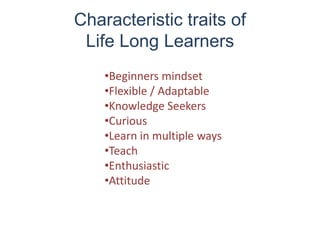
Characteristic traits of Life Long Learners Beginners mindset
Flexible / Adaptable
Knowledge Seekers
Curious
Learn in multiple ways
Teach
Enthusiastic
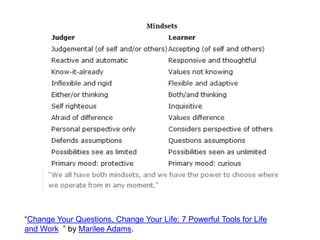
Attitude“Change Your Questions, Change Your Life: 7 Powerful Tools for Life and Work” by Marilee Adams.
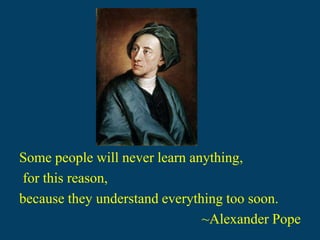
Some people will never learn anything,for this reason, because they understand everything too soon. ~Alexander Pope
Learners Make Connections Analyze Synthesize Apply – Use  & Practice
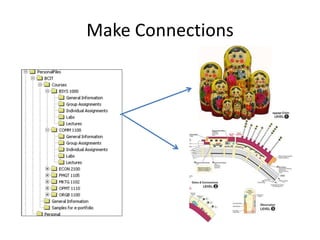
Make Connections
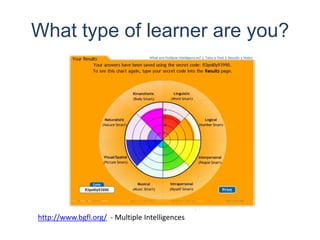
What type of learner are you?http://www.bgfl.org/  - Multiple Intelligences
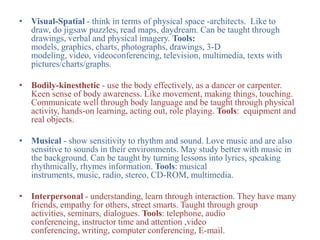
Visual-Spatial - think in terms of physical space -architects.  Like to draw, do jigsaw puzzles, read maps, daydream. Can be taught through drawings, verbal and physical imagery. Tools:  models, graphics, charts, photographs, drawings, 3-D modeling, video, videoconferencing, television, multimedia, texts with pictures/charts/graphs.Bodily-kinesthetic - use the body effectively, as a dancer or carpenter. Keen sense of body awareness. Like movement, making things, touching. Communicate well through body language and be taught through physical activity, hands-on learning, acting out, role playing. Tools:  equipment and real objects.Musical - show sensitivity to rhythm and sound. Love music and are also sensitive to sounds in their environments. May study better with music in the background. Can be taught by turning lessons into lyrics, speaking rhythmically, rhymes information. Tools: musical instruments, music, radio, stereo, CD-ROM, multimedia.Interpersonal - understanding, learn through interaction. They have many friends, empathy for others, street smarts. Taught through group activities, seminars, dialogues. Tools: telephone, audio conferencing, instructor time and attention ,video conferencing, writing, computer conferencing, E-mail.
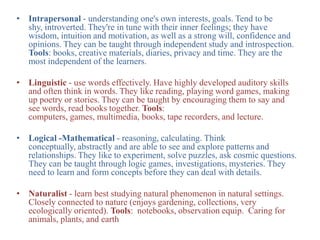
Intrapersonal - understanding one's own interests, goals. Tend to be shy, introverted. They're in tune with their inner feelings; they have wisdom, intuition and motivation, as well as a strong will, confidence and opinions. They can be taught through independent study and introspection. Tools: books, creative materials, diaries, privacy and time. They are the most independent of the learners.Linguistic - use words effectively. Have highly developed auditory skills and often think in words. They like reading, playing word games, making up poetry or stories. They can be taught by encouraging them to say and see words, read books together. Tools: computers, games, multimedia, books, tape recorders, and lecture.Logical -Mathematical - reasoning, calculating. Think conceptually, abstractly and are able to see and explore patterns and relationships. They like to experiment, solve puzzles, ask cosmic questions. They can be taught through logic games, investigations, mysteries. They need to learn and form concepts before they can deal with details.Naturalist - learn best studying natural phenomenon in natural settings. Closely connected to nature (enjoys gardening, collections, very ecologically oriented). Tools:  notebooks, observation equip.  Caring for animals, plants, and earth
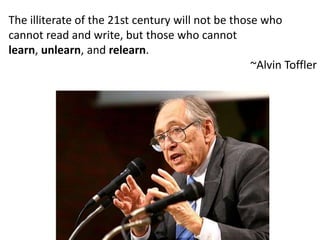
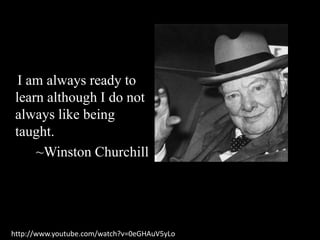
The illiterate of the 21st century will not be those who cannot read and write, but those who cannot learn, unlearn, and relearn. ~Alvin Toffler
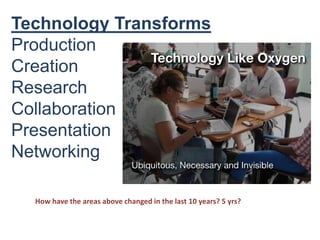
Technology TransformsProductionCreationResearchCollaborationPresentationNetworkingHow have the areas above changed in the last 10 years? 5 yrs?
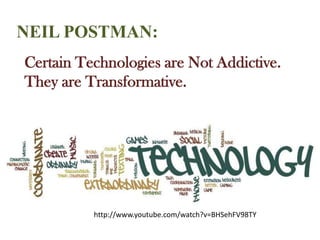
Neil Postman:Certain Technologies are Not Addictive.  They are Transformative.  http://www.youtube.com/watch?v=BHSehFV98TY
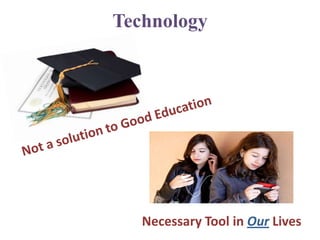
TechnologyNot a solution to Good EducationNecessary Tool in Our Lives
Technology
Where should we be?And how do we get there?
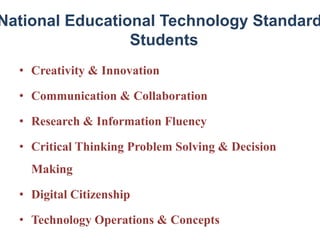
National Educational Technology Standards StudentsCreativity & InnovationCommunication & CollaborationResearch & Information FluencyCritical Thinking Problem Solving & Decision MakingDigital CitizenshipTechnology Operations & Concepts
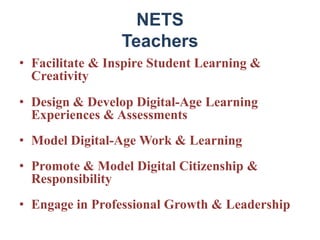
NETSTeachersFacilitate & Inspire Student Learning & CreativityDesign & Develop Digital-Age Learning Experiences & AssessmentsModel Digital-Age Work & LearningPromote & Model Digital Citizenship & ResponsibilityEngage in Professional Growth & Leadership
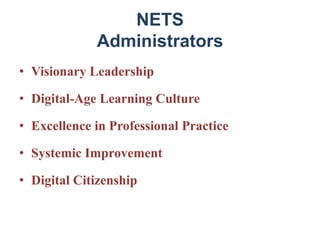
NETSAdministratorsVisionary LeadershipDigital-Age Learning CultureExcellence in Professional PracticeSystemic ImprovementDigital Citizenship
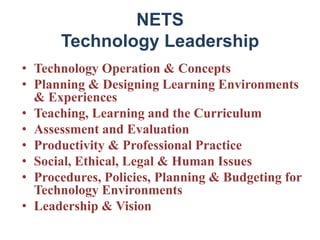
NETSTechnology LeadershipTechnology Operation & ConceptsPlanning & Designing Learning Environments & ExperiencesTeaching, Learning and the CurriculumAssessment and EvaluationProductivity & Professional PracticeSocial, Ethical, Legal & Human IssuesProcedures, Policies, Planning & Budgeting for Technology EnvironmentsLeadership & Vision
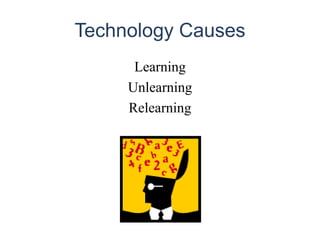
Technology CausesLearningUnlearningRelearning
Tools for   Learning                    Unlearning                    Relearning
Change/InnovationInnovation is a change in the thought                    process for doing something, or                useful application of new inventions              or discoveries.Must be substantially different and must increase value. Goal:  positive changeto make someone or something better.
Lifelong Learners & Learning ProfessionalsLearn for tomorrowPracticeShareQuestionTeach

Learner for tomorrow

  • 1.
  • 2.
    Characteristic traits ofLife Long Learners Beginners mindset
  • 3.
  • 4.
  • 5.
  • 6.
  • 7.
  • 8.
  • 9.
    Attitude“Change Your Questions,Change Your Life: 7 Powerful Tools for Life and Work” by Marilee Adams.
  • 10.
    Some people willnever learn anything,for this reason, because they understand everything too soon. ~Alexander Pope
  • 11.
    Learners Make ConnectionsAnalyze Synthesize Apply – Use & Practice
  • 12.
  • 13.
    What type oflearner are you?http://www.bgfl.org/ - Multiple Intelligences
  • 14.
    Visual-Spatial - thinkin terms of physical space -architects. Like to draw, do jigsaw puzzles, read maps, daydream. Can be taught through drawings, verbal and physical imagery. Tools: models, graphics, charts, photographs, drawings, 3-D modeling, video, videoconferencing, television, multimedia, texts with pictures/charts/graphs.Bodily-kinesthetic - use the body effectively, as a dancer or carpenter. Keen sense of body awareness. Like movement, making things, touching. Communicate well through body language and be taught through physical activity, hands-on learning, acting out, role playing. Tools: equipment and real objects.Musical - show sensitivity to rhythm and sound. Love music and are also sensitive to sounds in their environments. May study better with music in the background. Can be taught by turning lessons into lyrics, speaking rhythmically, rhymes information. Tools: musical instruments, music, radio, stereo, CD-ROM, multimedia.Interpersonal - understanding, learn through interaction. They have many friends, empathy for others, street smarts. Taught through group activities, seminars, dialogues. Tools: telephone, audio conferencing, instructor time and attention ,video conferencing, writing, computer conferencing, E-mail.
  • 15.
    Intrapersonal - understandingone's own interests, goals. Tend to be shy, introverted. They're in tune with their inner feelings; they have wisdom, intuition and motivation, as well as a strong will, confidence and opinions. They can be taught through independent study and introspection. Tools: books, creative materials, diaries, privacy and time. They are the most independent of the learners.Linguistic - use words effectively. Have highly developed auditory skills and often think in words. They like reading, playing word games, making up poetry or stories. They can be taught by encouraging them to say and see words, read books together. Tools: computers, games, multimedia, books, tape recorders, and lecture.Logical -Mathematical - reasoning, calculating. Think conceptually, abstractly and are able to see and explore patterns and relationships. They like to experiment, solve puzzles, ask cosmic questions. They can be taught through logic games, investigations, mysteries. They need to learn and form concepts before they can deal with details.Naturalist - learn best studying natural phenomenon in natural settings. Closely connected to nature (enjoys gardening, collections, very ecologically oriented). Tools: notebooks, observation equip. Caring for animals, plants, and earth
  • 16.
    The illiterate ofthe 21st century will not be those who cannot read and write, but those who cannot learn, unlearn, and relearn. ~Alvin Toffler
  • 17.
  • 18.
    Neil Postman:Certain Technologiesare Not Addictive. They are Transformative. http://www.youtube.com/watch?v=BHSehFV98TY
  • 19.
    TechnologyNot a solutionto Good EducationNecessary Tool in Our Lives
  • 20.
  • 21.
    Where should webe?And how do we get there?
  • 22.
    National Educational TechnologyStandards StudentsCreativity & InnovationCommunication & CollaborationResearch & Information FluencyCritical Thinking Problem Solving & Decision MakingDigital CitizenshipTechnology Operations & Concepts
  • 23.
    NETSTeachersFacilitate & InspireStudent Learning & CreativityDesign & Develop Digital-Age Learning Experiences & AssessmentsModel Digital-Age Work & LearningPromote & Model Digital Citizenship & ResponsibilityEngage in Professional Growth & Leadership
  • 24.
    NETSAdministratorsVisionary LeadershipDigital-Age LearningCultureExcellence in Professional PracticeSystemic ImprovementDigital Citizenship
  • 25.
    NETSTechnology LeadershipTechnology Operation& ConceptsPlanning & Designing Learning Environments & ExperiencesTeaching, Learning and the CurriculumAssessment and EvaluationProductivity & Professional PracticeSocial, Ethical, Legal & Human IssuesProcedures, Policies, Planning & Budgeting for Technology EnvironmentsLeadership & Vision
  • 26.
  • 27.
    Tools for Learning Unlearning Relearning
  • 28.
    Change/InnovationInnovation is achange in the thought process for doing something, or useful application of new inventions or discoveries.Must be substantially different and must increase value. Goal: positive changeto make someone or something better.
  • 29.
    Lifelong Learners &Learning ProfessionalsLearn for tomorrowPracticeShareQuestionTeach

Editor's Notes

  • #2 CoursesTrainingExperienceDegreeBooksPeople
  • #3 Beginners mindset – Flexible / Adaptable – Knowledge Seekers– Curious – Learn in multiple ways – Teach – Attitude
  • #4 Optimism – cognitive Most if not all of us carry both categories at least at timesWhere do you spend most of your thinking?Cognitive thinking of a learner may take practice so with your discussion this morning revolving around technology the learner side is where we need to be
  • #8 Break into their learning groupsDiscuss how their style fits them – give examples (me, words spelling)discuss next slideThen after discussion have them mix up to their tables.
  • #10 Get into your groups and discuss your learning style (about 5-6min)Nominate one member to summarize your learning style if group is over 10 then get into sub-groups
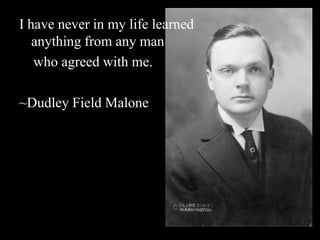
  • #11 82 yrs oldis an Americanwriter andfuturist, known for his works discussing the digital revolution, communication revolution, corporate revolution and technological singularity.Former editor of Fortune Then he moved to examining the reaction of and changes in society. His later focus has been on the increasing power of 21st century military hardware, weapons and technology proliferation, and capitalism.He is a principal of Toffler & Associates, a consulting company, and was a visiting scholar at the Russell Sage Foundation, visiting professor at Cornell University, faculty member of the New School for Social Research, a White House correspondent, an editor of Fortune magazine, and a business consultant.[3]
  • #12 Think of the industries that have been transformed by technology:History – industrial revolutionMedicalAdvertisingMusicSnail mailTV – competing with internetOf course Education – but how much? Have it kept pace with exponential increase in technology?
  • #13 Social NetworksFacebook, MySpace Delicious, Diigo Deviant ArtYouTubePodcastingBloggingWhat words did you hear these students use?Would you agree that Technology is embedded in their life?When they have a project something to create they will think differently than you. No posters with markers probably.
  • #14 Is Not an solution to good educationIt Is a necessary Tool in our student lives, workplace, in our culture today and tomorrowDo you think that if students use their tools that they are more comfortable using for learning that their motivation and engagement would increase? It is like a quill pen when you have a ink pen at home or in your pocket.4. Tapping into their world for creativity, collaborating skills, makes learning seem more significant.Technology is Exponentially growing and has since before the Apple II in 1977Apple 1977 WWW 1989 -91Better FasterEasierAffordableChanging
  • #15 Is Not an solution to good educationIt Is a necessary Tool in our student lives, workplace, in our culture today and tomorrowDo you think that if students use their tools that they are more comfortable using for learning that their motivation and engagement would increase? It is like a quill pen when you have a ink pen at home or in your pocket.4. Tapping into their world for creativity, collaborating skills, makes learning seem more significant.Technology is Exponentially growing and has since before the Apple II in 1977Apple 1977 WWW 1989 -91Better FasterEasierAffordableChanging
  • #17 ISTE: International Society for Technology in Education has National Education Technology Standards that educators from around the globe has agreed to for Students, Teachers, Administrators and Technology Leaders.We could spend a week looking at these and what they look like and how to begin or advance. But lets take a few minutes and briefly go over these. They are also on the server along with the By Grade profile. If you wondering where you should target for this is a good place.
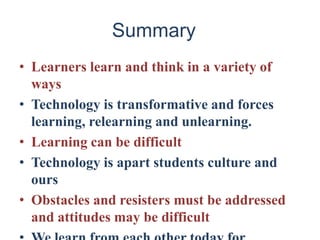
  • #21 Technology changes fastWhat you have learned changesSo you unlearnThen relearn the newHow is that bad?We could talk a week on this but lets end its challenging
  • #22 Professional Development?Training?School – degrees?BooksExperience / EmotionOthersHelpWhich ones would you place at the top?
  • #23 Innovation
  • #24 As professionals how do we support each other in our learning & teaching of each otherHow can you share what you are doing, what you are learning to be a better professional
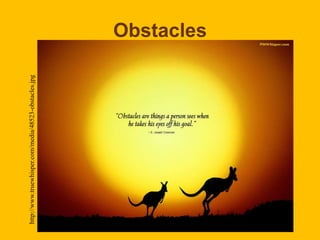
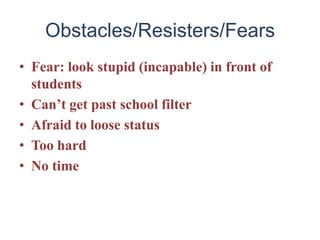
  • #27 Are these obstacles personalAre some personalAttitudesBurn outFearsLack of knowledgeObstacles – resistersA force that tends to oppose or delay motionI can ignore the change (who can say that)my needs are already met hereI have invested heavily hereI do not want to change because…the destination looks worse than where I am nowI am in the middle of something importantthere is nothing to attract me forwardsThe journey look painfulthe destination or journey is somehow bad or wrongI don’t trust those inchargeI am able to ignore the changeI can ignore the change (who can say that)
  • #28 Group back into a like intelligencesAre these obstacles personalAre some personalAttitudesBurn outObstacles – resistersA force that tends to oppose or delay motion