FUNDAMENTOS METODOLÓGICOS DO ENS. INGLÊS Webinar I  Group:  Carla  Gilberto Roberto
Presentation Study Methods Group Work Time Management
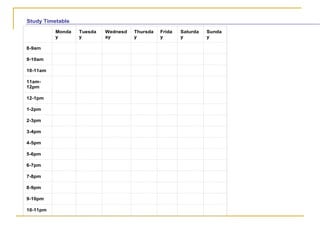
STUDY METHODS Set goals - what do I want to achieve?  Prioritise - what needs to be done first?  Set apart a place for study.  Set apart some time.  Make a weekly study plan.
 
STUDY METHODS Keep up to date with your studies.  Do tutorial exercises and work through examples.  Work through past exam papers as it gets closer to exam time.
GROUP WORK The aim of group work is to produce better. But how to achieve this? - Combining talents of group members, contributing knowledge and ideas.   Group work requires each member to focus on the process rather than just the product.
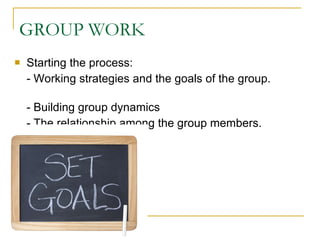
GROUP WORK Starting the process: - Working strategies and the goals of the group.   - Building group dynamics - The relationship among the group members.
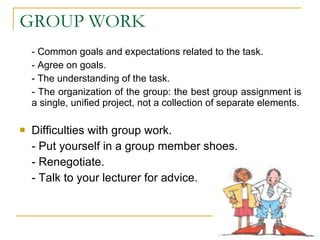
GROUP WORK - Common goals and expectations related to the task. - Agree on goals. - The understanding of the task. - The organization of the group: the best group assignment is a single, unified project, not a collection of separate elements. Difficulties with group work.   - Put yourself in a group member shoes.  - Renegotiate. - Talk to your lecturer for advice.
 
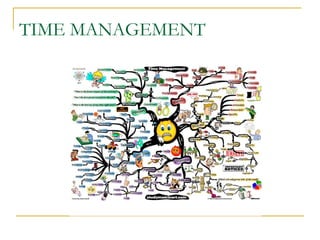
TIME MANAGEMENT
TIME MANAGEMENT Strategy 1. Blocks of study time and breaks 2. Dedicated study spaces 3. Weekly reviews 4. Prioritize your assignments 5. Achieve "stage one"--get something done
TIME MANAGEMENT 6. Postpone unnecessary activities until the work is done 7. Identify resources to help you 8. Use your free time wisely 9. Review notes and readings just before class 10. Review lecture notes just after class
TIME MANAGEMENT Effective help A simple “To do” list Daily/weekly planner Long term planner
REFERENCES http://www.monash.edu.au/lls/llonline/quickrefs/24-groupwork.xml   http://www.monash.edu.au/lls/llonline/quickrefs/02-study-methods.xml   http://www.studygs.net/timman.htm   Vídeo: Study Methods.wmv

Fundamentos metodologicos webinar i

  • 1.
    FUNDAMENTOS METODOLÓGICOS DOENS. INGLÊS Webinar I Group: Carla Gilberto Roberto
  • 2.
    Presentation Study MethodsGroup Work Time Management
  • 3.
    STUDY METHODS Setgoals - what do I want to achieve? Prioritise - what needs to be done first? Set apart a place for study. Set apart some time. Make a weekly study plan.
  • 4.
  • 5.
    STUDY METHODS Keepup to date with your studies. Do tutorial exercises and work through examples. Work through past exam papers as it gets closer to exam time.
  • 6.
    GROUP WORK Theaim of group work is to produce better. But how to achieve this? - Combining talents of group members, contributing knowledge and ideas. Group work requires each member to focus on the process rather than just the product.
  • 7.
    GROUP WORK Startingthe process: - Working strategies and the goals of the group. - Building group dynamics - The relationship among the group members.
  • 8.
    GROUP WORK -Common goals and expectations related to the task. - Agree on goals. - The understanding of the task. - The organization of the group: the best group assignment is a single, unified project, not a collection of separate elements. Difficulties with group work. - Put yourself in a group member shoes. - Renegotiate. - Talk to your lecturer for advice.
  • 9.
  • 10.
  • 11.
    TIME MANAGEMENT Strategy1. Blocks of study time and breaks 2. Dedicated study spaces 3. Weekly reviews 4. Prioritize your assignments 5. Achieve "stage one"--get something done
  • 12.
    TIME MANAGEMENT 6.Postpone unnecessary activities until the work is done 7. Identify resources to help you 8. Use your free time wisely 9. Review notes and readings just before class 10. Review lecture notes just after class
  • 13.
    TIME MANAGEMENT Effectivehelp A simple “To do” list Daily/weekly planner Long term planner
  • 14.
    REFERENCES http://www.monash.edu.au/lls/llonline/quickrefs/24-groupwork.xml http://www.monash.edu.au/lls/llonline/quickrefs/02-study-methods.xml http://www.studygs.net/timman.htm Vídeo: Study Methods.wmv