SPELLING
                                                   @
                                                  STM


                                                       Parent workshop
All images displayed in this presentation were obtained from creative commons sources siting permission to use and modify content provided
At STM our
teaching is
 guided by
 research.
What
 research
says about
spelling...
1) Focus needs to be on teaching
spelling strategies not lists of
words.


   “The emphasis of a spelling program should be on
developing independent spellers who have the necessary
 skills to use resources to locate the correct spelling of
            words they are not familiar with .”
         Shepherd, J. (1994). Spell it out: Success with spelling. Melbourne: Oxford University Press.
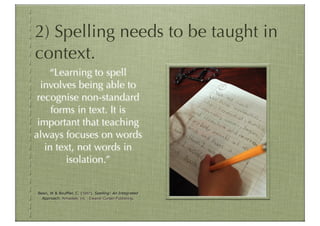
2) Spelling needs to be taught in
context.
    “Learning to spell
  involves being able to
 recognise non-standard
     forms in text. It is
 important that teaching
always focuses on words
   in text, not words in
        isolation.”


Bean, W & Bouffler, C. (1997). Spelling: An Integrated
  Approach. Armadale, Vic. : Eleanor Curtain Publishing.
3)There are problems with
conventional phonics
teaching.
  If we begin to teach children how to spell by starting
 with one sound per letter, we then have to reteach the
  exceptions to those rules e.g. for words such as rice,
 swan, happy etc. This can be very hard for children to
  grasp as patterns relating to letters and sounds seem
                    to always change.


 “The letter ‘a’ is given the sound [a], as in ant and so on. The problem is when we come to read a word like baby the
letter ‘a’ isn’t making [a] as in ant, but is representing the phoneme[A], heard in words such as tape, snail and tray.
Similarly with words such as what and was, the letter ‘a’ represents the phoneme [A], as heard in words such as frog and
swan.” This is both inconsistent and unsustainable.

                   http://www.thrass.com.au/infobrouch/Thrass%20InfomationBrochure%20.pdf
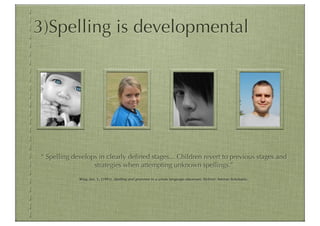
3)Spelling is developmental


“ Spelling develops in clearly defined stages... Children revert to previous stages and
                  strategies when attempting unknown spellings.”
             Wing Jan, L. (1991). Spelling and grammar in a whole language classroom. Sydney: Ashton Scholastic.
Spelling developmental stages
1) Precommunicative spelling:
- child uses symbols to represent writing

2) Semiphonetic spelling:
- child attempts to apply letter sound correspondence

3) Phonetic spelling
- child has a knowledge of sounds that allows writing to be understood but spelling conventions not applied

4) Transitional spelling:
- child uses other spelling strategies, displays correct letters but not always in correct order

5) Correct spelling                                      :

- child uses all strategies to spell words, can recognise incorrect spelling and uses generalisations to help with
new spelling problems

Gentry, B (1982, cited in Wing Jan, L. (1991). Spelling and grammar in a whole language classroom. Sydney: Ashton Scholastic.
How STM
  tackles
 spelling
1) Through teaching
        spelling strategies

    Sound                                                   Visual                                                            Meaning
  Strategies                                              Strategies                                                          Strategies
- Sounding out words                                         - visualising letter                                       - spelling choices based
- exploring the sounds                                      patterns e.g. blends,                                       on what the word
of different letter                                            letter clusters,                                         means ( eg. two/too/to
patterns                                                     compound words,                                            - prefixes/ suffixes
                                                                                                                        - word origin / original
                                                                                                                        meaning of word(or part
                                                                                                                        of word)


                     Fountas, Irene and Pinnell, G.S. Guiding readers and Wr.iters, Grades 3-6. Portsmouth, NH: Heinemann, 2001
Sounds
            Strategies
✤Some of the ways we address sound strategies include:
★Start from an oral language & sounds basis
★Utilising sounds charts
★Rhyme games/ activities/ nursery rhymes/ songs/ rhyming cloze/ rhyming tag/ rhyming
words that are spelt the same and not spelt the same

★Forming generalisations about sounds
★Focusing on sounds in shared reading/ writing/ Literacy activities & sessions
★Cued articulation
★Online sounds based games/ blending games
★alliteration games
★Puppetry
★Word wheels
★Alliteration and tongue twisters
★Beats / claps and syllables
★Word sorts according to sounds
★homophones
★silent letters
Visual
                    strategies
           ✤Some of the ways we address visual strategies include:
★Utilising sounds charts                      ★CH.I.M.P or Look Say Cover Write Check
★Magnetic letters                             ★Create the word shape on grid paper
★Forming generalisations about letter         ★Cloze exercises with patterns included e.g. - --
patterns                                      ough- he was ---ough for I though he was
                                              through /Cloze exercises using big books (masking
★Bingo games                                  letters)

★Onset and rime                               ★Crosswords
★Online visual/ letter pattern based games ★Word searches
★word walls/ generalisation walls             ★Write a sentence with vowels missing & fill in
                                              vowel
★Dictation develops visual memory in
context – seen dictation / unseen dictation   ★Hangman
★M100W words and related games                ★Wordlinks – find the hidden words –
                                              mnksladyjuskluneighbourmjuiopsd
★Flashcards
                                              ★Using cards with individual words – take one
★Compound word snap                           away – what is missing?

★Silent letters                               ★Speed copying
★Break word into syllables / highlight        ★Proofreading
difficult part (larger font, colour)
★ Illustrate particular words or word parts   ★mnemonics
that cause difficulty
Meaning Strategies
                          Etymological
                            Where the word comes from


      ✤Some of the ways we address etymological strategies include:
                                                        ★Word webs e.g. from the Greek
★Word meaning investigations                            “aer” meaning air

★Word origin investigations                             ★Word sorts according to etymology

★Word walls                                             ★topic words e.g. food words and
                                                        locate origin of words eg sushi
★ Forming generalisations about word meaning
                                                        ★Word derivation charts
★ Explicit identification of word meaning/ origin in
shared reading/ writing/ inquiry/ literacy tasks        ★Root words are written on cards and
                                                        task is to write as many words as
★Breaking words apart and looking at the meaning        possible that come from this root
of sections of the word
                                                        ★Create an animal using Greek or
★ Identifying word meaning when reading texts           Latin roots e.g. punctata
                                                        quadrocornisbiped (dotted four-horned
★Activities                                             two footed animal)

★Word origins – matching cards                          ★Cartoons for word origins (eg Word
                                                        for Word – Atchison)
★Acronym and abbreviation hunt
                                                        ★Explore different forms of etymology
★Words with “ch” from English (hard ch), Greek (k)      e.g.
and French (sh) origins – what pronunciation?
                                                        ★Words that sound like their meaning
Meaning Strategies
                    Morphemic
                     Parts of words that have meaning

✤Some of the ways we address Morphemic strategies include:
  affixes – prefixes and suffixes / affix snap

  base word families

  homophone concentration

  compound words / Compound word race (base word e.g.
water – form as many compound words as possible

  antonyms / synonyms

  contractions / abbreviations

  changing tense – “ed”, “ing” “s”/
  Headlight vs. head light / changing f to v and adding es

   plurals – adding “s” “es” / plurals – changing y to i and adding
es or ed

  nouns that change vowels eg foot to feet

  word webs

  word sorts according to common morpheme

  using letter tiles to make new words

  Palindromes
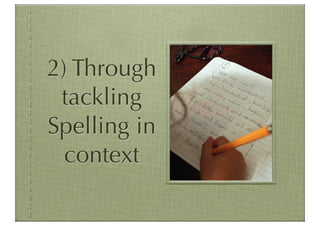
2) Through
 tackling
Spelling in
  context
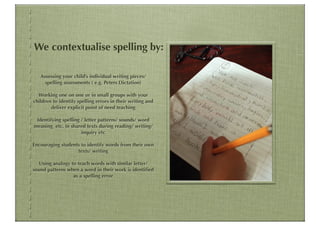
We contextualise spelling by:

   Assessing your child’s individual writing pieces/
     spelling assessments ( e.g. Peters Dictation)

  Working one on one or in small groups with your
children to identify spelling errors in their writing and
        deliver explicit point of need teaching

 Identifying spelling / letter patterns/ sounds/ word
meaning etc. in shared texts during reading/ writing/
                      inquiry etc

Encouraging students to identify words from their own
                   texts/ writing

  Using analogy to teach words with similar letter/
sound patterns when a word in their work is identified
                 as a spelling error
3) Through
integrating
spelling into other
curriculum areas
and providing
varied ways of
learning to spell
We integrate spelling into the
       curriculum by:
    Identifying spelling choices, sounds,
       terminology across all subjects

linking spelling and vocabulary to our Inquiry
                     units

       Maintaining word walls which:
     - house words in sound categories
      - support matching explanations
          - display word definitions
           - highlight letter patterns

  Provide a range of hands on, written and
          online spelling activities
So where do
lists come in?
•At STM, we don’t start our spelling teaching with lists
•Once a student’s writing piece or assessment has been
analysed, one or two words/ letter patterns will be identified

•Once a focus point has been identified then other words
containing that letter combination/ sound will be selected

•lists will not exceed 5 or so words
•children will engage in activities or tasks at school (and
possibly as part of their homework)which help them to make
connections with and memorise the spelling strategy/ letter
choice

•assessment of spelling will be done in a variety of ways
including analysis of children’s writing, small tests or through
teacher observation/ note taking when in one on one or
small group learning situations
Things you
 can do at
   home
Things you can do at home :
                    Play spelling games

         Play rhyming games/ sing rhyming songs


  Spell out words when asking your children to do things

Point out the spelling of different words when children ask
                       what they mean

Point out new or interesting words you see the media or on
       signs etc and break them up as you read them

encourage children to think of different words that mean the
same thing and prompt them to have a go at attempting the
                 spelling of those words

  Identify other words which have the same sound/ letter
                 pattern as words they use

            discuss the meaning of new words

Look up where words originated in the dictionary/ thesaurus

                         or online

                Play online spelling games

Play games like scrabble ( always with a dictionary handy)
Spelling
Websites:
Spelling Websites:
  http://docs.google.com/viewer?      http://www.spellingcity.com/
  url=http://www.decs.sa.gov.au/
          barossa/files/links/      http://www.superteacherideas.com/
thinkingspelling.pdf&chrome=true             spelling.html

http://www.primarygames.com/see-     http://www.bbc.co.uk/schools/
       n-spell/see-n-spell.htm         wordsandpictures/phonics/
                                               postcard/
     http://www.elgweb.net/
          spell_act.html               http://www.kidsspell.com/

  http://www.gamesgames.com/         http://www.kidspot.com.au/
   games/spelling/spelling.html     SpellingGames/wordscrambler-
                                           index-kidspot.asp
 http://www.theclassroomkit.com/
     word-families-games.html        http://www.bbc.co.uk/schools/
                                       wordsandpictures/phonics/
 http://www.gamequarium.com/                  sandcastle/
          spelling.html
                                        http://roythezebra.com/
  http://www.spinandspell.com/
                                     http://www.bbc.co.uk/schools/
                                                spellits/
Spelling Websites continued:
http://www.teachingideas.co.uk/english/contents08writingspelling.htm

http://www.bbc.co.uk/skillswise/words/spelling/

http://www.ezschool.com/EZSheets/index.html

http://www.tutpup.com/plays/new/2-word-game

http://www.primaryresources.co.uk/english/english.htm

http://www.toolsforeducators.com/

http://www.woodlands-junior.kent.sch.uk/interactive/literacy.html#7

http://www.bbc.co.uk/schools/spellits/index.shtml

http://www.worksheetworks.com/english/alphabetizing.html

http://www.edhelper.com/?gclid=CMaftZKFzZgCFQlrgwodsHnu1A

http://www.woodlands-junior.kent.sch.uk/interactive/literacy/index.htm

http://www.bbc.co.uk/hardspell/starspell_game.shtml

http://www.ezschool.com/Tutorials/index.html

http://www.ezschool.com/Spelling/index.html
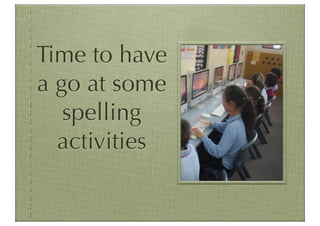
Time to have
a go at some
   spelling
  activities

Parent spelling workshop

  • 1.
    SPELLING @ STM Parent workshop All images displayed in this presentation were obtained from creative commons sources siting permission to use and modify content provided
  • 2.
    At STM our teachingis guided by research.
  • 3.
  • 4.
    1) Focus needsto be on teaching spelling strategies not lists of words. “The emphasis of a spelling program should be on developing independent spellers who have the necessary skills to use resources to locate the correct spelling of words they are not familiar with .” Shepherd, J. (1994). Spell it out: Success with spelling. Melbourne: Oxford University Press.
  • 5.
    2) Spelling needsto be taught in context. “Learning to spell involves being able to recognise non-standard forms in text. It is important that teaching always focuses on words in text, not words in isolation.” Bean, W & Bouffler, C. (1997). Spelling: An Integrated Approach. Armadale, Vic. : Eleanor Curtain Publishing.
  • 6.
    3)There are problemswith conventional phonics teaching. If we begin to teach children how to spell by starting with one sound per letter, we then have to reteach the exceptions to those rules e.g. for words such as rice, swan, happy etc. This can be very hard for children to grasp as patterns relating to letters and sounds seem to always change. “The letter ‘a’ is given the sound [a], as in ant and so on. The problem is when we come to read a word like baby the letter ‘a’ isn’t making [a] as in ant, but is representing the phoneme[A], heard in words such as tape, snail and tray. Similarly with words such as what and was, the letter ‘a’ represents the phoneme [A], as heard in words such as frog and swan.” This is both inconsistent and unsustainable. http://www.thrass.com.au/infobrouch/Thrass%20InfomationBrochure%20.pdf
  • 7.
    3)Spelling is developmental “Spelling develops in clearly defined stages... Children revert to previous stages and strategies when attempting unknown spellings.” Wing Jan, L. (1991). Spelling and grammar in a whole language classroom. Sydney: Ashton Scholastic.
  • 8.
    Spelling developmental stages 1)Precommunicative spelling: - child uses symbols to represent writing 2) Semiphonetic spelling: - child attempts to apply letter sound correspondence 3) Phonetic spelling - child has a knowledge of sounds that allows writing to be understood but spelling conventions not applied 4) Transitional spelling: - child uses other spelling strategies, displays correct letters but not always in correct order 5) Correct spelling : - child uses all strategies to spell words, can recognise incorrect spelling and uses generalisations to help with new spelling problems Gentry, B (1982, cited in Wing Jan, L. (1991). Spelling and grammar in a whole language classroom. Sydney: Ashton Scholastic.
  • 9.
    How STM tackles spelling
  • 10.
    1) Through teaching spelling strategies Sound Visual Meaning Strategies Strategies Strategies - Sounding out words - visualising letter - spelling choices based - exploring the sounds patterns e.g. blends, on what the word of different letter letter clusters, means ( eg. two/too/to patterns compound words, - prefixes/ suffixes - word origin / original meaning of word(or part of word) Fountas, Irene and Pinnell, G.S. Guiding readers and Wr.iters, Grades 3-6. Portsmouth, NH: Heinemann, 2001
  • 11.
    Sounds Strategies ✤Some of the ways we address sound strategies include: ★Start from an oral language & sounds basis ★Utilising sounds charts ★Rhyme games/ activities/ nursery rhymes/ songs/ rhyming cloze/ rhyming tag/ rhyming words that are spelt the same and not spelt the same ★Forming generalisations about sounds ★Focusing on sounds in shared reading/ writing/ Literacy activities & sessions ★Cued articulation ★Online sounds based games/ blending games ★alliteration games ★Puppetry ★Word wheels ★Alliteration and tongue twisters ★Beats / claps and syllables ★Word sorts according to sounds ★homophones ★silent letters
  • 12.
    Visual strategies ✤Some of the ways we address visual strategies include: ★Utilising sounds charts ★CH.I.M.P or Look Say Cover Write Check ★Magnetic letters ★Create the word shape on grid paper ★Forming generalisations about letter ★Cloze exercises with patterns included e.g. - -- patterns ough- he was ---ough for I though he was through /Cloze exercises using big books (masking ★Bingo games letters) ★Onset and rime ★Crosswords ★Online visual/ letter pattern based games ★Word searches ★word walls/ generalisation walls ★Write a sentence with vowels missing & fill in vowel ★Dictation develops visual memory in context – seen dictation / unseen dictation ★Hangman ★M100W words and related games ★Wordlinks – find the hidden words – mnksladyjuskluneighbourmjuiopsd ★Flashcards ★Using cards with individual words – take one ★Compound word snap away – what is missing? ★Silent letters ★Speed copying ★Break word into syllables / highlight ★Proofreading difficult part (larger font, colour) ★ Illustrate particular words or word parts ★mnemonics that cause difficulty
  • 13.
    Meaning Strategies Etymological Where the word comes from ✤Some of the ways we address etymological strategies include: ★Word webs e.g. from the Greek ★Word meaning investigations “aer” meaning air ★Word origin investigations ★Word sorts according to etymology ★Word walls ★topic words e.g. food words and locate origin of words eg sushi ★ Forming generalisations about word meaning ★Word derivation charts ★ Explicit identification of word meaning/ origin in shared reading/ writing/ inquiry/ literacy tasks ★Root words are written on cards and task is to write as many words as ★Breaking words apart and looking at the meaning possible that come from this root of sections of the word ★Create an animal using Greek or ★ Identifying word meaning when reading texts Latin roots e.g. punctata quadrocornisbiped (dotted four-horned ★Activities two footed animal) ★Word origins – matching cards ★Cartoons for word origins (eg Word for Word – Atchison) ★Acronym and abbreviation hunt ★Explore different forms of etymology ★Words with “ch” from English (hard ch), Greek (k) e.g. and French (sh) origins – what pronunciation? ★Words that sound like their meaning
  • 14.
    Meaning Strategies Morphemic Parts of words that have meaning ✤Some of the ways we address Morphemic strategies include: affixes – prefixes and suffixes / affix snap base word families homophone concentration compound words / Compound word race (base word e.g. water – form as many compound words as possible antonyms / synonyms contractions / abbreviations changing tense – “ed”, “ing” “s”/ Headlight vs. head light / changing f to v and adding es plurals – adding “s” “es” / plurals – changing y to i and adding es or ed nouns that change vowels eg foot to feet word webs word sorts according to common morpheme using letter tiles to make new words Palindromes
  • 15.
  • 16.
    We contextualise spellingby: Assessing your child’s individual writing pieces/ spelling assessments ( e.g. Peters Dictation) Working one on one or in small groups with your children to identify spelling errors in their writing and deliver explicit point of need teaching Identifying spelling / letter patterns/ sounds/ word meaning etc. in shared texts during reading/ writing/ inquiry etc Encouraging students to identify words from their own texts/ writing Using analogy to teach words with similar letter/ sound patterns when a word in their work is identified as a spelling error
  • 17.
    3) Through integrating spelling intoother curriculum areas and providing varied ways of learning to spell
  • 18.
    We integrate spellinginto the curriculum by: Identifying spelling choices, sounds, terminology across all subjects linking spelling and vocabulary to our Inquiry units Maintaining word walls which: - house words in sound categories - support matching explanations - display word definitions - highlight letter patterns Provide a range of hands on, written and online spelling activities
  • 19.
    So where do listscome in? •At STM, we don’t start our spelling teaching with lists •Once a student’s writing piece or assessment has been analysed, one or two words/ letter patterns will be identified •Once a focus point has been identified then other words containing that letter combination/ sound will be selected •lists will not exceed 5 or so words •children will engage in activities or tasks at school (and possibly as part of their homework)which help them to make connections with and memorise the spelling strategy/ letter choice •assessment of spelling will be done in a variety of ways including analysis of children’s writing, small tests or through teacher observation/ note taking when in one on one or small group learning situations
  • 20.
    Things you cando at home
  • 21.
    Things you cando at home : Play spelling games Play rhyming games/ sing rhyming songs Spell out words when asking your children to do things Point out the spelling of different words when children ask what they mean Point out new or interesting words you see the media or on signs etc and break them up as you read them encourage children to think of different words that mean the same thing and prompt them to have a go at attempting the spelling of those words Identify other words which have the same sound/ letter pattern as words they use discuss the meaning of new words Look up where words originated in the dictionary/ thesaurus or online Play online spelling games Play games like scrabble ( always with a dictionary handy)
  • 22.
  • 23.
    Spelling Websites: http://docs.google.com/viewer? http://www.spellingcity.com/ url=http://www.decs.sa.gov.au/ barossa/files/links/ http://www.superteacherideas.com/ thinkingspelling.pdf&chrome=true spelling.html http://www.primarygames.com/see- http://www.bbc.co.uk/schools/ n-spell/see-n-spell.htm wordsandpictures/phonics/ postcard/ http://www.elgweb.net/ spell_act.html http://www.kidsspell.com/ http://www.gamesgames.com/ http://www.kidspot.com.au/ games/spelling/spelling.html SpellingGames/wordscrambler- index-kidspot.asp http://www.theclassroomkit.com/ word-families-games.html http://www.bbc.co.uk/schools/ wordsandpictures/phonics/ http://www.gamequarium.com/ sandcastle/ spelling.html http://roythezebra.com/ http://www.spinandspell.com/ http://www.bbc.co.uk/schools/ spellits/
  • 24.
  • 25.
    Time to have ago at some spelling activities