Sacred Heart
 Spelling Workshop


Phonemic Awareness
     Program
    22nd March 2012
Why?
   NAPLAN results – Whole school
    approach needed

   Feedback and observations from
    Emma and Cassie – referrals

   Observations and concerns from upper
    primary teachers
Background information about
          spelling
   Importance of Oral Language
    development in pre school years
   “Reading and writing float on a sea of
    talk” James Britton
   Spelling is a strategy for writing
   When we spell we draw on our
    knowledge of phonics and phonemic
    awareness
Phonics:
   Refers to the relationships between letters
    and sounds, or between letter patterns and
    sound patterns (Emmitt & Hornsby, 1996).

Phonemic Awareness:
   Relates specifically to the working
    knowledge of the individual phonemes that
    form the words of Australian English.
   Incorporates the ability to segment words
    into their component sounds.
Strategies used to spell
   Sound out the phonemes
   Memorisation
   Looks right
   Sounds right – as it articulates
   Syllables
   Analogy
   Mnemonics
   Rule or pattern
   Context
   Etymology- origin of words
   Dictionary/ thesaurus/ resource /ask a friend
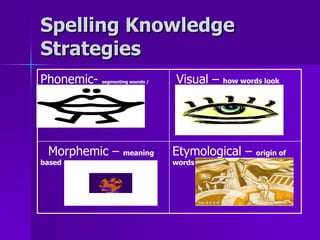
Spelling Knowledge
Strategies
Phonemic-      segmenting sounds /   Visual –   how words look
articulating


   Morphemic –         meaning       Etymological –     origin of
based                                words
Sound Waves

   Uses a sound to letter strategy –
    acknowledges sounds can be represented in
    different ways
    Example – f, ff, ph
   Firstly focus on the basic units of sound and
    then the letters that represent them
   Segmenting for writing – s/o/ck/s
   Blending for reading
Sound Waves

   The idea is that children will be better
    equipped to ‘have a go’ at spelling because
    they will be aware of the many different
    options for each sound as presented on the
    Sound Waves charts.

   Kindergarten - Jolly Phonics Program which
    teaches the most common sounds and options
    before beginning Sound Waves in Year 1
How we use Sound Waves

   Whole school scope and sequence –
    focus sound of the week

   Lessons over the week
    • Introduce sound and brainstorm
    • Singing/chant
    • Large posters with sounds and options – reading
      and writing
    • Segmenting list words – word strips
    Year 1 Blog - http://year1od.blogspot.com.au/
    Year 5 online - ....Yr 5Year 5Yr 5
      2012LiteracyLiteracySpellingUnit 8 'f ff ph'list words
      segmenting.pdf
How we use Sound Waves

    • Sound Waves Online
      http://tlc.fireflyeducation.com.au/program/soundwaves5/units
    • Flipchart activities
      ..Spelling Flipcharts 2012Year 1Spelling Unit 8 f ff.flipchart
      ..Spelling Flipcharts 2012Year 5Year 5 Unit 8 'f' fish.flp
    • Other spelling strategies and grammar activities
       • prefixes, suffixes, root words, word beginnings
         and endings, rhyme, word families, tense
    • Student workbook - homework
    • Extension words and challenge activities
    • Review and discuss
   Have a go at spelling your name!
Learning Support

   Children are supported in small groups with similar
    needs (6 max)
   Focus on the most commonly used sounds for
    longer to ensure these are secure
   Multi sensory activities
   Links with real reading and writing activities
   Good communication with home so skills can be
    practised
   Referral to specialist therapist if problems persist eg
    Speech Pathologist, Occupational Therapist

Spelling workshop powerpoint

  • 1.
    Sacred Heart SpellingWorkshop Phonemic Awareness Program 22nd March 2012
  • 2.
    Why?  NAPLAN results – Whole school approach needed  Feedback and observations from Emma and Cassie – referrals  Observations and concerns from upper primary teachers
  • 3.
    Background information about spelling  Importance of Oral Language development in pre school years  “Reading and writing float on a sea of talk” James Britton  Spelling is a strategy for writing  When we spell we draw on our knowledge of phonics and phonemic awareness
  • 4.
    Phonics:  Refers to the relationships between letters and sounds, or between letter patterns and sound patterns (Emmitt & Hornsby, 1996). Phonemic Awareness:  Relates specifically to the working knowledge of the individual phonemes that form the words of Australian English.  Incorporates the ability to segment words into their component sounds.
  • 5.
    Strategies used tospell  Sound out the phonemes  Memorisation  Looks right  Sounds right – as it articulates  Syllables  Analogy  Mnemonics  Rule or pattern  Context  Etymology- origin of words  Dictionary/ thesaurus/ resource /ask a friend
  • 6.
    Spelling Knowledge Strategies Phonemic- segmenting sounds / Visual – how words look articulating Morphemic – meaning Etymological – origin of based words
  • 7.
    Sound Waves  Uses a sound to letter strategy – acknowledges sounds can be represented in different ways Example – f, ff, ph  Firstly focus on the basic units of sound and then the letters that represent them  Segmenting for writing – s/o/ck/s  Blending for reading
  • 8.
    Sound Waves  The idea is that children will be better equipped to ‘have a go’ at spelling because they will be aware of the many different options for each sound as presented on the Sound Waves charts.  Kindergarten - Jolly Phonics Program which teaches the most common sounds and options before beginning Sound Waves in Year 1
  • 9.
    How we useSound Waves  Whole school scope and sequence – focus sound of the week  Lessons over the week • Introduce sound and brainstorm • Singing/chant • Large posters with sounds and options – reading and writing • Segmenting list words – word strips Year 1 Blog - http://year1od.blogspot.com.au/ Year 5 online - ....Yr 5Year 5Yr 5 2012LiteracyLiteracySpellingUnit 8 'f ff ph'list words segmenting.pdf
  • 10.
    How we useSound Waves • Sound Waves Online http://tlc.fireflyeducation.com.au/program/soundwaves5/units • Flipchart activities ..Spelling Flipcharts 2012Year 1Spelling Unit 8 f ff.flipchart ..Spelling Flipcharts 2012Year 5Year 5 Unit 8 'f' fish.flp • Other spelling strategies and grammar activities • prefixes, suffixes, root words, word beginnings and endings, rhyme, word families, tense • Student workbook - homework • Extension words and challenge activities • Review and discuss  Have a go at spelling your name!
  • 11.
    Learning Support  Children are supported in small groups with similar needs (6 max)  Focus on the most commonly used sounds for longer to ensure these are secure  Multi sensory activities  Links with real reading and writing activities  Good communication with home so skills can be practised  Referral to specialist therapist if problems persist eg Speech Pathologist, Occupational Therapist