The document discusses the definition of grammar, arguing both for and against its explicit teaching in language education. It compares deductive and inductive approaches to grammar instruction, highlighting their advantages and disadvantages. Various presentation and practice techniques for teaching grammar are also outlined.
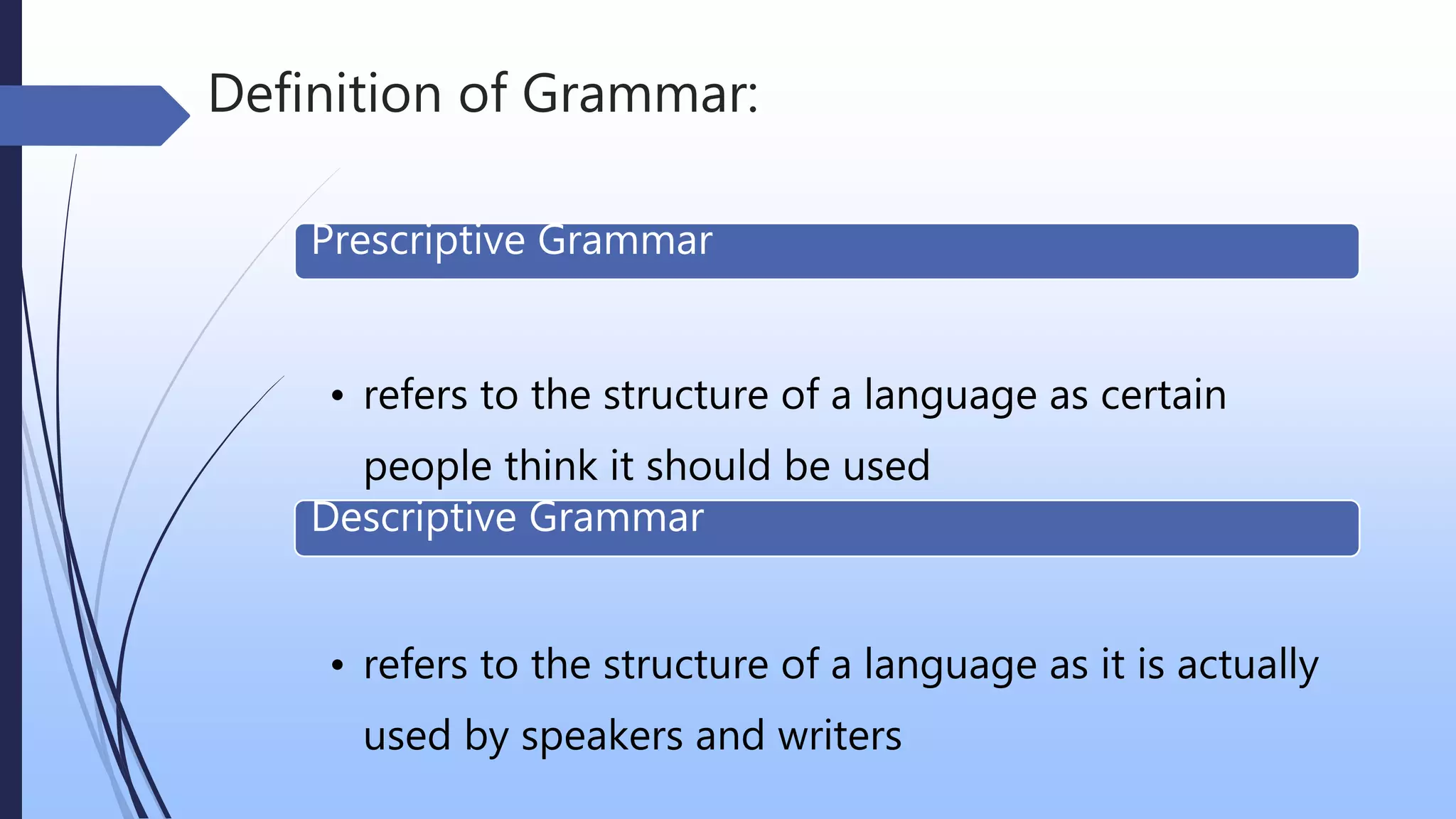
Definition of Grammar:
PrescriptiveGrammar
• refers to the structure of a language as certain
people think it should be used
Descriptive Grammar
• refers to the structure of a language as it is actually
used by speakers and writers
5.
Descriptive vs Prescriptive
Languageis prior to rules
Languages started by people making sounds which
evolved into words, phrases and sentences
What we call "grammar" is simply a reflection of a
language at a particular time
Not to teachGrammar:
Grammatical features are acquired unconsciously as
they contribute a little to SLA (Ellis,1997)
Grammatical competence is only acquired if learners
are exposed to comprehensible and meaningful
input.
8.
To teach Grammar:
Grammarfacilitates the acquisition process and it is
not acquired by exposing learners to a
comprehensible input (Celce- Murcia,1991).
Grammar is significant as it helps learners to
communicate accurately and meaningfully (Widodo,
2006)
The deductive approach– rule driven
learning:
Deductive approach is defined as a process that
proceeds from the presentation of a rule by a
teacher to the provision of examples in which
the rule is applied.
GENERAL RULE -> EXAMPLES -> PRACTICE
11.
Advantages of adeductive approach:
straight to the point
Time saving
Efficeint and clear
Rules can be quickly explained
little demaned on teachers planing
Ensures correct interpretation
Guarantee a Sense of safety
12.
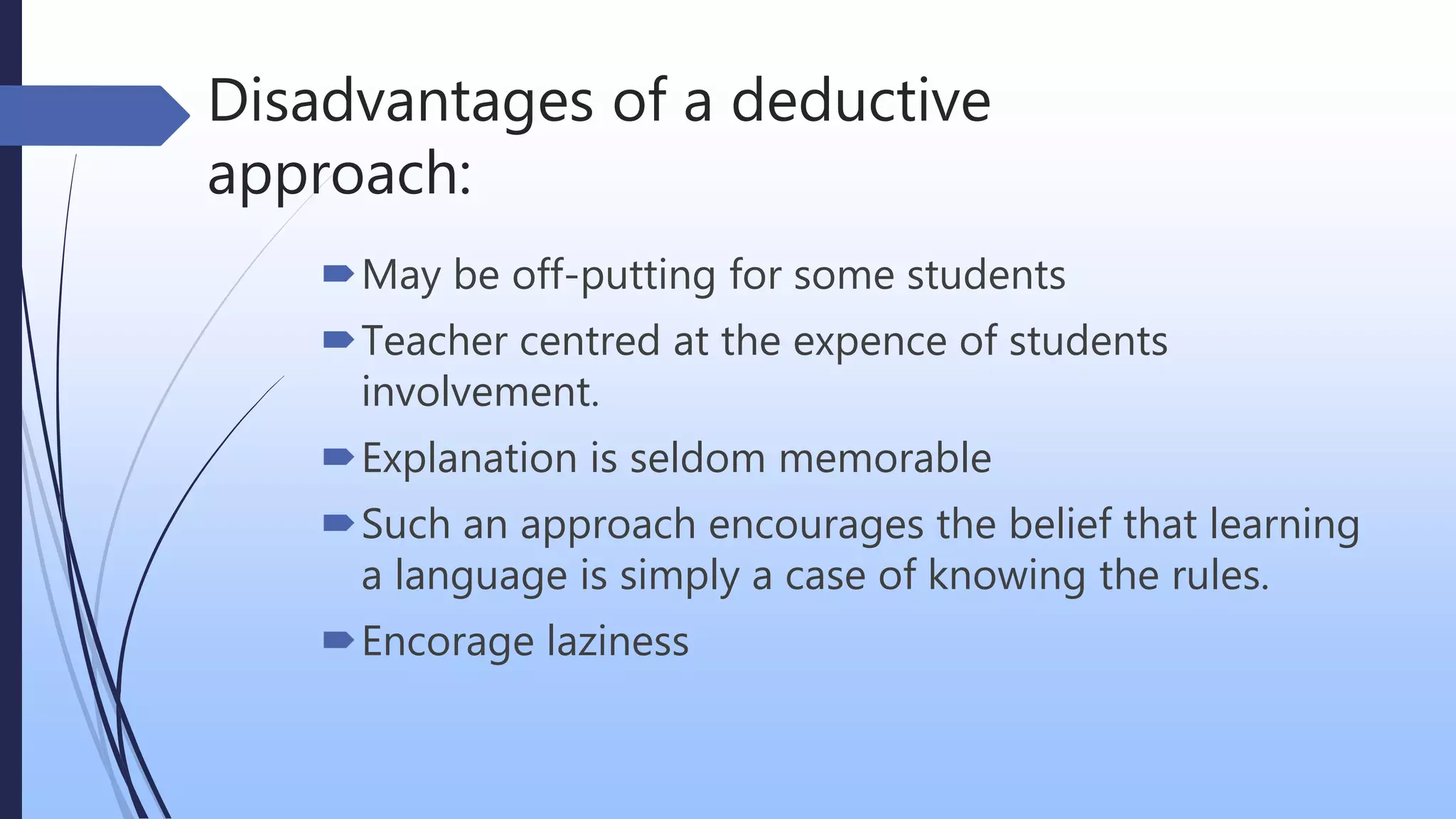
Disadvantages of adeductive
approach:
May be off-putting for some students
Teacher centred at the expence of students
involvement.
Explanation is seldom memorable
Such an approach encourages the belief that learning
a language is simply a case of knowing the rules.
Encorage laziness
13.
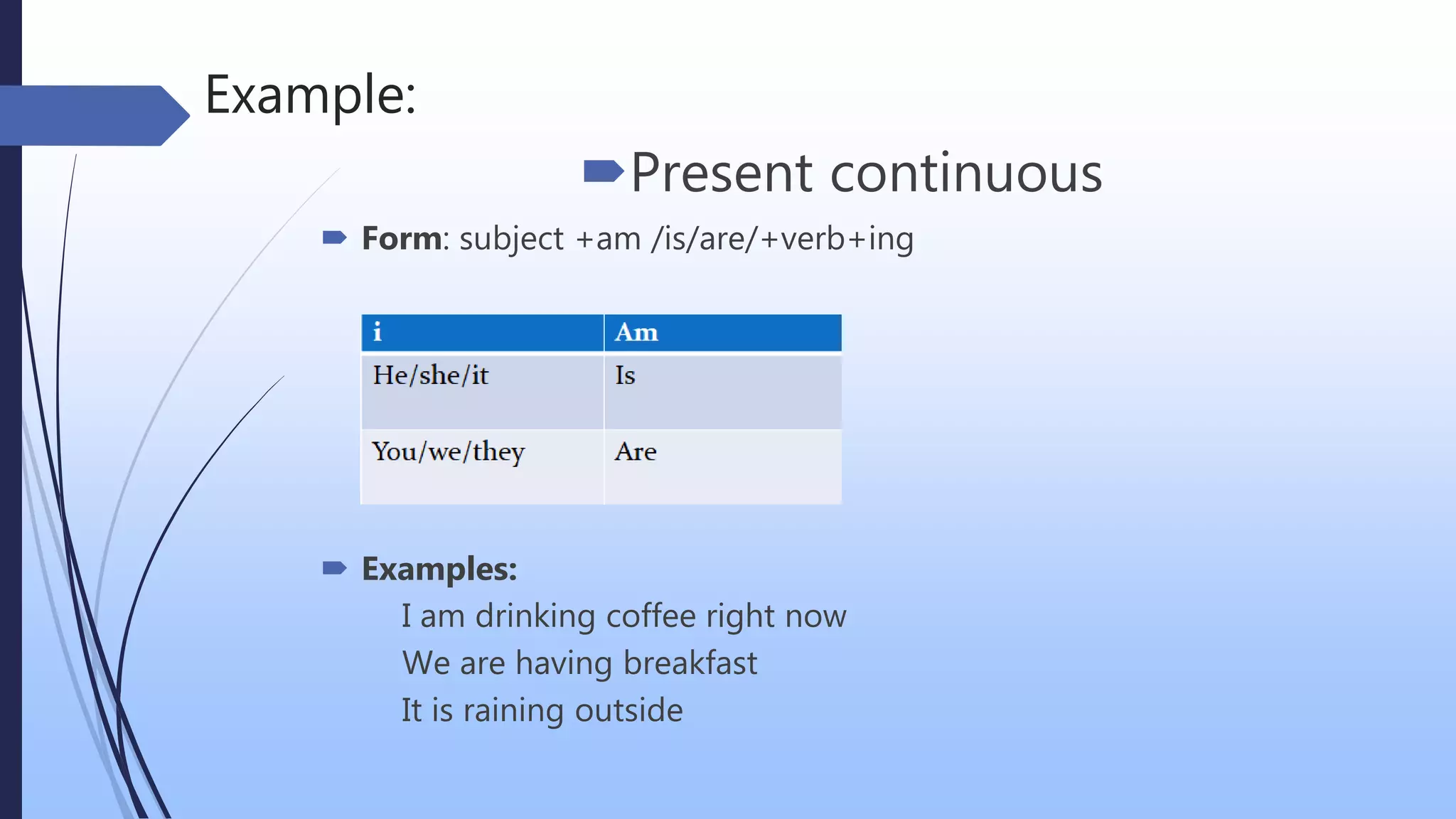
Example:
Present continuous
Form:subject +am /is/are/+verb+ing
Examples:
I am drinking coffee right now
We are having breakfast
It is raining outside
14.
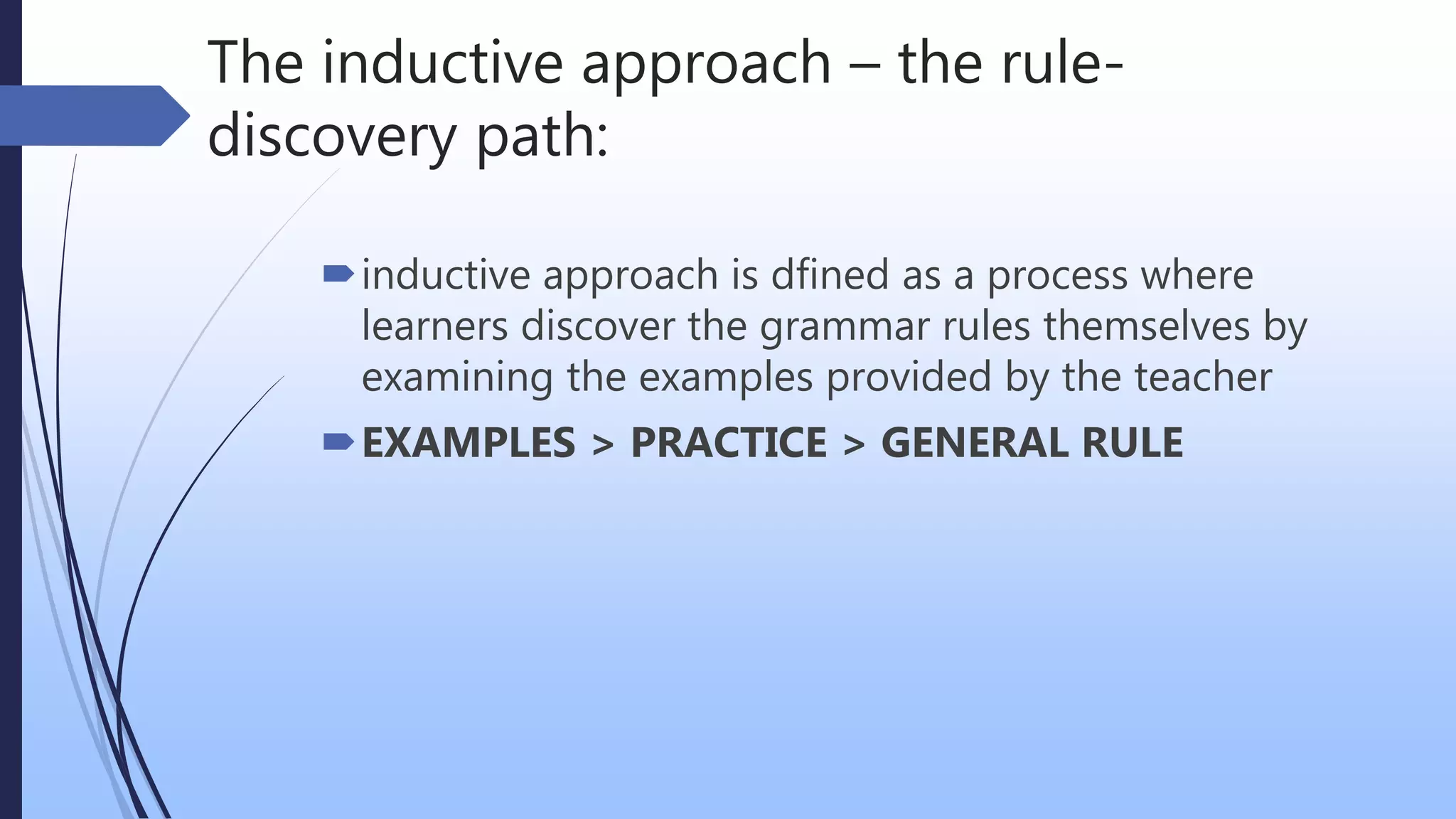
The inductive approach– the rule-
discovery path:
inductive approach is dfined as a process where
learners discover the grammar rules themselves by
examining the examples provided by the teacher
EXAMPLES > PRACTICE > GENERAL RULE
15.
The advantages ofinductive approach:
Trigers curiousity
Ensures a great degree of cognitive depth
Ensures longer memorability
Learners are actively involved, attentive and
motivated
Favors problem solving abilities
Conductive to learner autonomy
16.
Disadvantiges of inductiveapproach:
Time and energy consuming
Danger of hypothesing the wrong rule
Heavy demand on teachers planning
Often frustrating for learners
17.
Example:
Look at thefollowing sentences :
He talks to tourists
She writes letters
We always go to school
It is raining here
There is a final s on the verbs with certain subjects. what are they?
He/She/It = s
We/You/They = no s
Now apply the rule:
I see/sees ahmed everyday
He call/calls me on the phone
They come/comes to my house on weekand