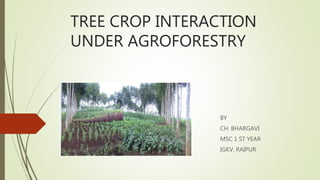
TREE CROP INTERACTION
UNDER AGROFORESTRY
BY
CH. BHARGAVI
MSC 1 ST YEAR
IGKV, RAIPUR
CONTENTS
 Abstract
 Introduction
 Possible interaction effects
 Why to study
 Interactions based on components
 Types of interactions
 How to quantify interactions
 Management
 Conclusion
 reference
ABSTRACT
 Agroforestry-the deliberate combination of woody perennials on the
same piece of land with agricultural crops and/or animals, where
they interact with each other in both positive and negative ways like
Micro-climate amelioration and maintenance or improvement in soil
productivity is the major positive interactions while competition for
light, water and nutrients, and allelopathy are the major negative
interactions in agroforestry systems. The balance between negative
and positive interactions determines the overall effect of interactions
in a given agroforestry system.
INTRODUCTION
 In agroforestry systems, trees are grown in close proximity to crops
and pastures.
 Various interactions take place between the tree and herbaceous
plants which are referred as tree/crop interface.
 These interactions take place through the media of soil and
microclimate and may exert favourable or adverse effects on crops.
 Interfaces occur both above and below ground including complex
set of interactions relating water balance, nutrients, radiation
exchange, shelter and microclimate modifications.
POSSIBLE INTERACTION EFFECTS
 Tree grows better, agricultural crops grows worse.
 Tree grow worse, agricultural crop relatively unaffected.
 Both tree and agricultural crop do better than expected.
 Both tree and crop adversely affected to some degree.
WHY TO STUDY?
Tree crop interface studies are of particular use in obtaining
preliminary information about the following:
 Choice of species
 Design of agroforestry systems
 Management of agroforestry system.
Interactions based on components:
 Tree – crop interface (TCI)
 Tree – animal interface (TAI)
TREE CROP INTERFACE:
Positive effects:
 Microclimate amelioration
 Weed suppression
 Soil and water conservation
 Biomass and shading
Negative effects:
 Competition for light
 Water
 Nutrients
 Allelopathy
TREE ANIMAL INTERFACE:
Positive effects:
 Shade for livestock
 Manure from livestock acts as fertilizer
 Fodder from trees can be used to feed livestock
Negative effects:
 Low quality of, or toxic components within, tree fodder can
adversely affect livestock production.
 Soil compaction through trampling.
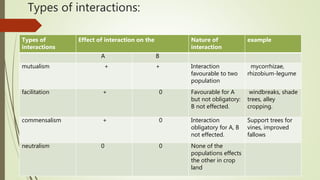
Types of interactions:
Types of
interactions
Effect of interaction on the Nature of
interaction
example
A B
mutualism + + Interaction
favourable to two
population
mycorrhizae,
rhizobium-legume
facilitation + 0 Favourable for A
but not obligatory:
B not effected.
windbreaks, shade
trees, alley
cropping.
commensalism + 0 Interaction
obligatory for A, B
not effected.
Support trees for
vines, improved
fallows
neutralism 0 0 None of the
populations effects
the other in crop
land
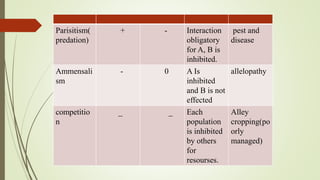
Parisitism(
predation)
+ - Interaction
obligatory
for A, B is
inhibited.
pest and
disease
Ammensali
sm
- 0 A Is
inhibited
and B is not
effected
allelopathy
competitio
n
_ _ Each
population
is inhibited
by others
for
resourses.
Alley
cropping(po
orly
managed)
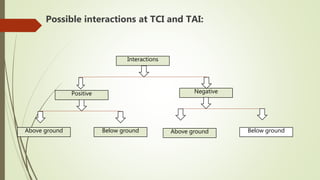
Possible interactions at TCI and TAI:
Interactions
Positive Negative
Above ground Below ground Above ground Below ground
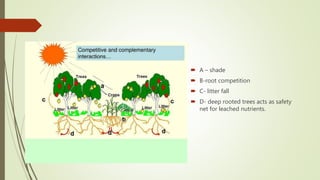
 A – shade
 B-root competition
 C- litter fall
 D- deep rooted trees acts as safety
net for leached nutrients.
Positive interactions:
1)Shading trees:
 Shading causes reduction in temperature which in turn reduces
transpiration rate reducing water stress for shaded crops especially
during short period of drought.
 Shade is always beneficial for livestock and some shade loving
crops like turmeric, zinger, coffee etc.
2)Biomass contribution:
Biomass can be added from pruning material which increases soil condition.
3)Microclimate amelioration:
 Increase in soil moisture
 Reducing soil temperature
 Recycling of nutrients.
4) Efficient utilization of aerial space:
Tree crop association ensures optimal utilization of aerial space both
horizontally and vertically.
5) Water conservation:
Reducing transpiration, pumping water from deep soil which makes the soil
surface moistened.
6) Weed suppression:
Effect of shade is more severe for light demanding weeds.
7) Soil conservation:
In agroforestry system appropriate tree crop association control soil erosion
efficiently.
Ex: alley cropping, windbreaks etc.
8) Efficiently use of light or reduce waste of light resource:
 Light interception by monoculture never be achieved 100% where
as in agroforestry system under storey crops can utilize these light,
that might be lost otherwise, even light can pass through the gaps of
fully developed canopy or it is minimised by shoot pruning.
 A multi-layered agroforestry system efficiently utilize light or
reduce waste of light by using light in different layers.
Negative interactions:
1) Light competition:
In agroforestry systems light availability is the most limiting factor for
the under storey annual crops when it is planted with densely planted
unpruned trees.
2) Nutrient competition:
In agroforestry systems both the components are taking nutrients from
limited nutrient pool in the soil, competition is likely to occur.
 since the crop is usually the smaller component (when compared
individually), its root system will usually be confined to soil
horizons that are also available to the roots of the trees; but the trees
can exploit soil volume beyond reach of the crop.
 Therefore, the effects of nutrient competition will probably be more
severe for the crop components.
3) Water competition:
Trees in agroforestry system tends to compete with crops for moisture
thereby depress crop reduction.
It is observed that crops that are present in a distance less than 10m from the
tree line are effected more(Malik and Sharma (1990).
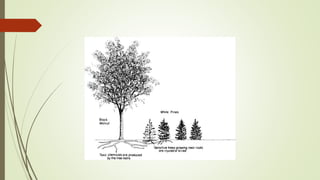
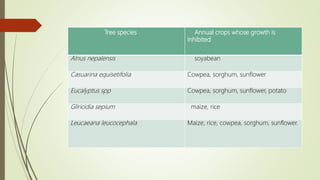
4) Allelopathy:
 The phenomena of one plant having detrimental effect on another plant
through the production of toxic compounds is called as allelopathy.
 Detected by Davis (1928) in black walnut tree whose leaves contain
juglone effected the germination and seedling growth of crops under trees.
 These allelochemicals interfere with metabolic pathways of plants
growing in the vicinity causing suppression of growth.
Tree species Annual crops whose growth is
inhibited
Alnus nepalensis soyabean
Casuarina equisetifolia Cowpea, sorghum, sunflower
Eucalyptus spp Cowpea, sorghum, sunflower, potato
Gliricidia sepium maize, rice
Leucaeana leucocephala Maize, rice, cowpea, sorghum, sunflower.
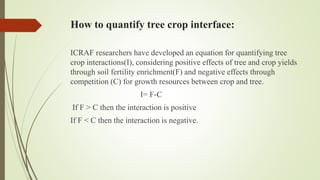
How to quantify tree crop interface:
ICRAF researchers have developed an equation for quantifying tree
crop interactions(I), considering positive effects of tree and crop yields
through soil fertility enrichment(F) and negative effects through
competition (C) for growth resources between crop and tree.
I= F-C
If F > C then the interaction is positive
If F < C then the interaction is negative.
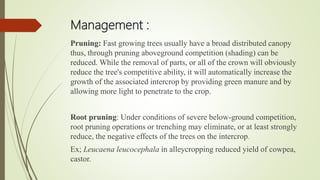
Management :
Pruning: Fast growing trees usually have a broad distributed canopy
thus, through pruning aboveground competition (shading) can be
reduced. While the removal of parts, or all of the crown will obviously
reduce the tree's competitive ability, it will automatically increase the
growth of the associated intercrop by providing green manure and by
allowing more light to penetrate to the crop.
Root pruning: Under conditions of severe below-ground competition,
root pruning operations or trenching may eliminate, or at least strongly
reduce, the negative effects of the trees on the intercrop.
Ex; Leucaena leucocephala in alleycropping reduced yield of cowpea,
castor.
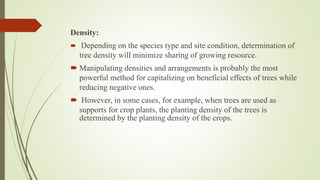
Density:
 Depending on the species type and site condition, determination of
tree density will minimize sharing of growing resource.
 Manipulating densities and arrangements is probably the most
powerful method for capitalizing on beneficial effects of trees while
reducing negative ones.
 However, in some cases, for example, when trees are used as
supports for crop plants, the planting density of the trees is
determined by the planting density of the crops.
Mulch:
Incorporating trees residue improves soil fertility. Decomposition of
organic residues has a direct effect on crop growth.
Using different species:
It is safe to say that a greater diversity of species is more favourable,
as it results in a more complete occupation of space above and below
the soil, and the variation in the characteristics of the species reduces
competition.
CONCLUSION:
 Studying tree crop interaction in agroforestry would help to devise
appropriate ways to increase overall productivity of land. Increased
productivity, improved soil fertility, nutrient cycling are the major
positive effects of interactions and competition is the main negative
effect of interaction, which substantially reduces the crop yield. It
may be for space, light, nutrients and moisture. Many studies are
indicating that higher yield of crops in different agroforestry
systems compared to sole crop yields.
REFERENCE
 An Introduction to Agroforestry P.K. Ramachandran Nair
Department of Forestry, University of Florida, Gainesville, Florida,
U.S.A.
 Muhammed T* Department of Forestry, Wollo University, Ethiopia
Tree-Crop Interaction Management in Agroforestry: A Review J
Ecol & Nat Resour Tree-Crop Interaction Management in
Agroforestry: A Review Journal of Ecology & Natural Resources
ISSN: 2578-4994.
 Textbook of agroforestry by B.S. Chundawat and S.K.
Gautam(1993), CBS publishers & distributors PVT LTD.
Tree crop interaction under agroforestry

Tree crop interaction under agroforestry

  • 1.
    TREE CROP INTERACTION UNDERAGROFORESTRY BY CH. BHARGAVI MSC 1 ST YEAR IGKV, RAIPUR
  • 2.
    CONTENTS  Abstract  Introduction Possible interaction effects  Why to study  Interactions based on components  Types of interactions  How to quantify interactions  Management  Conclusion  reference
  • 3.
    ABSTRACT  Agroforestry-the deliberatecombination of woody perennials on the same piece of land with agricultural crops and/or animals, where they interact with each other in both positive and negative ways like Micro-climate amelioration and maintenance or improvement in soil productivity is the major positive interactions while competition for light, water and nutrients, and allelopathy are the major negative interactions in agroforestry systems. The balance between negative and positive interactions determines the overall effect of interactions in a given agroforestry system.
  • 4.
    INTRODUCTION  In agroforestrysystems, trees are grown in close proximity to crops and pastures.  Various interactions take place between the tree and herbaceous plants which are referred as tree/crop interface.  These interactions take place through the media of soil and microclimate and may exert favourable or adverse effects on crops.  Interfaces occur both above and below ground including complex set of interactions relating water balance, nutrients, radiation exchange, shelter and microclimate modifications.
  • 5.
    POSSIBLE INTERACTION EFFECTS Tree grows better, agricultural crops grows worse.  Tree grow worse, agricultural crop relatively unaffected.  Both tree and agricultural crop do better than expected.  Both tree and crop adversely affected to some degree.
  • 6.
    WHY TO STUDY? Treecrop interface studies are of particular use in obtaining preliminary information about the following:  Choice of species  Design of agroforestry systems  Management of agroforestry system.
  • 7.
    Interactions based oncomponents:  Tree – crop interface (TCI)  Tree – animal interface (TAI)
  • 8.
    TREE CROP INTERFACE: Positiveeffects:  Microclimate amelioration  Weed suppression  Soil and water conservation  Biomass and shading Negative effects:  Competition for light  Water  Nutrients  Allelopathy
  • 9.
    TREE ANIMAL INTERFACE: Positiveeffects:  Shade for livestock  Manure from livestock acts as fertilizer  Fodder from trees can be used to feed livestock Negative effects:  Low quality of, or toxic components within, tree fodder can adversely affect livestock production.  Soil compaction through trampling.
  • 10.
    Types of interactions: Typesof interactions Effect of interaction on the Nature of interaction example A B mutualism + + Interaction favourable to two population mycorrhizae, rhizobium-legume facilitation + 0 Favourable for A but not obligatory: B not effected. windbreaks, shade trees, alley cropping. commensalism + 0 Interaction obligatory for A, B not effected. Support trees for vines, improved fallows neutralism 0 0 None of the populations effects the other in crop land
  • 11.
    Parisitism( predation) + - Interaction obligatory forA, B is inhibited. pest and disease Ammensali sm - 0 A Is inhibited and B is not effected allelopathy competitio n _ _ Each population is inhibited by others for resourses. Alley cropping(po orly managed)
  • 12.
    Possible interactions atTCI and TAI: Interactions Positive Negative Above ground Below ground Above ground Below ground
  • 13.
     A –shade  B-root competition  C- litter fall  D- deep rooted trees acts as safety net for leached nutrients.
  • 14.
    Positive interactions: 1)Shading trees: Shading causes reduction in temperature which in turn reduces transpiration rate reducing water stress for shaded crops especially during short period of drought.  Shade is always beneficial for livestock and some shade loving crops like turmeric, zinger, coffee etc.
  • 15.
    2)Biomass contribution: Biomass canbe added from pruning material which increases soil condition. 3)Microclimate amelioration:  Increase in soil moisture  Reducing soil temperature  Recycling of nutrients. 4) Efficient utilization of aerial space: Tree crop association ensures optimal utilization of aerial space both horizontally and vertically.
  • 16.
    5) Water conservation: Reducingtranspiration, pumping water from deep soil which makes the soil surface moistened. 6) Weed suppression: Effect of shade is more severe for light demanding weeds. 7) Soil conservation: In agroforestry system appropriate tree crop association control soil erosion efficiently. Ex: alley cropping, windbreaks etc.
  • 17.
    8) Efficiently useof light or reduce waste of light resource:  Light interception by monoculture never be achieved 100% where as in agroforestry system under storey crops can utilize these light, that might be lost otherwise, even light can pass through the gaps of fully developed canopy or it is minimised by shoot pruning.  A multi-layered agroforestry system efficiently utilize light or reduce waste of light by using light in different layers.
  • 18.
    Negative interactions: 1) Lightcompetition: In agroforestry systems light availability is the most limiting factor for the under storey annual crops when it is planted with densely planted unpruned trees. 2) Nutrient competition: In agroforestry systems both the components are taking nutrients from limited nutrient pool in the soil, competition is likely to occur.
  • 19.
     since thecrop is usually the smaller component (when compared individually), its root system will usually be confined to soil horizons that are also available to the roots of the trees; but the trees can exploit soil volume beyond reach of the crop.  Therefore, the effects of nutrient competition will probably be more severe for the crop components.
  • 20.
    3) Water competition: Treesin agroforestry system tends to compete with crops for moisture thereby depress crop reduction. It is observed that crops that are present in a distance less than 10m from the tree line are effected more(Malik and Sharma (1990). 4) Allelopathy:  The phenomena of one plant having detrimental effect on another plant through the production of toxic compounds is called as allelopathy.  Detected by Davis (1928) in black walnut tree whose leaves contain juglone effected the germination and seedling growth of crops under trees.  These allelochemicals interfere with metabolic pathways of plants growing in the vicinity causing suppression of growth.
  • 22.
    Tree species Annualcrops whose growth is inhibited Alnus nepalensis soyabean Casuarina equisetifolia Cowpea, sorghum, sunflower Eucalyptus spp Cowpea, sorghum, sunflower, potato Gliricidia sepium maize, rice Leucaeana leucocephala Maize, rice, cowpea, sorghum, sunflower.
  • 23.
    How to quantifytree crop interface: ICRAF researchers have developed an equation for quantifying tree crop interactions(I), considering positive effects of tree and crop yields through soil fertility enrichment(F) and negative effects through competition (C) for growth resources between crop and tree. I= F-C If F > C then the interaction is positive If F < C then the interaction is negative.
  • 24.
    Management : Pruning: Fastgrowing trees usually have a broad distributed canopy thus, through pruning aboveground competition (shading) can be reduced. While the removal of parts, or all of the crown will obviously reduce the tree's competitive ability, it will automatically increase the growth of the associated intercrop by providing green manure and by allowing more light to penetrate to the crop. Root pruning: Under conditions of severe below-ground competition, root pruning operations or trenching may eliminate, or at least strongly reduce, the negative effects of the trees on the intercrop. Ex; Leucaena leucocephala in alleycropping reduced yield of cowpea, castor.
  • 25.
    Density:  Depending onthe species type and site condition, determination of tree density will minimize sharing of growing resource.  Manipulating densities and arrangements is probably the most powerful method for capitalizing on beneficial effects of trees while reducing negative ones.  However, in some cases, for example, when trees are used as supports for crop plants, the planting density of the trees is determined by the planting density of the crops.
  • 26.
    Mulch: Incorporating trees residueimproves soil fertility. Decomposition of organic residues has a direct effect on crop growth. Using different species: It is safe to say that a greater diversity of species is more favourable, as it results in a more complete occupation of space above and below the soil, and the variation in the characteristics of the species reduces competition.
  • 27.
    CONCLUSION:  Studying treecrop interaction in agroforestry would help to devise appropriate ways to increase overall productivity of land. Increased productivity, improved soil fertility, nutrient cycling are the major positive effects of interactions and competition is the main negative effect of interaction, which substantially reduces the crop yield. It may be for space, light, nutrients and moisture. Many studies are indicating that higher yield of crops in different agroforestry systems compared to sole crop yields.
  • 28.
    REFERENCE  An Introductionto Agroforestry P.K. Ramachandran Nair Department of Forestry, University of Florida, Gainesville, Florida, U.S.A.  Muhammed T* Department of Forestry, Wollo University, Ethiopia Tree-Crop Interaction Management in Agroforestry: A Review J Ecol & Nat Resour Tree-Crop Interaction Management in Agroforestry: A Review Journal of Ecology & Natural Resources ISSN: 2578-4994.  Textbook of agroforestry by B.S. Chundawat and S.K. Gautam(1993), CBS publishers & distributors PVT LTD.