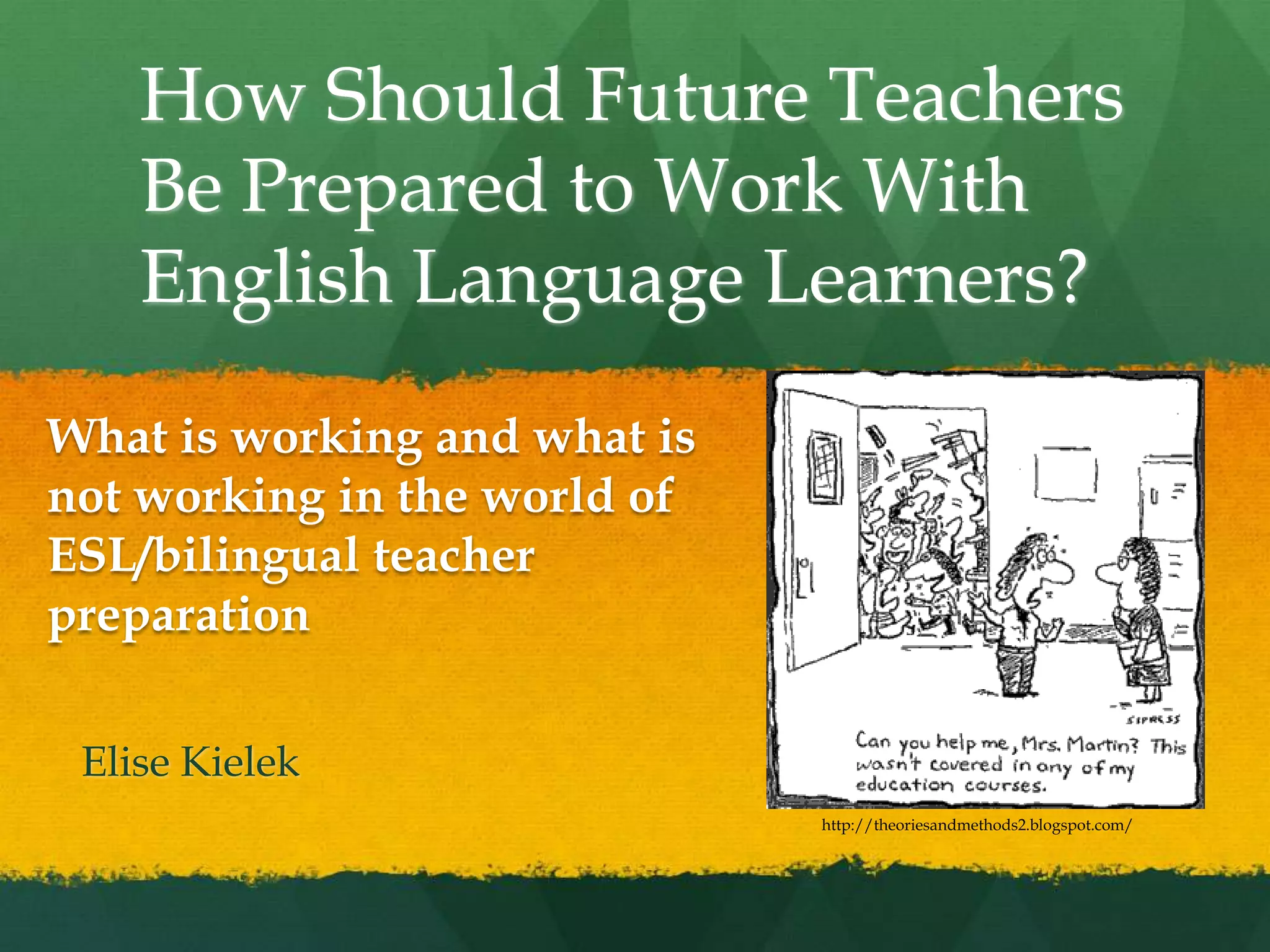
How Should Future Teachers Be Prepared to Work With English Language Learners?Elise KielekWhat is working and what is not working in the world of ESL/bilingual teacher preparationhttp://theoriesandmethods2.blogspot.com/
Understand some of the history and legislative issues altering the number of well prepared ESL/bilingual teachersConsider case studies that demonstrate examples of good teacher preparation programsSee what is working within the successful teacher education programs and understand how to incorporate these successful aspects into his or her own educational future with ELLsBy the end of this presentation, viewers should be able to:
ELLs in the School System Today“From 2003-2004, 5.5 million students in the American school system have Limited English Proficiency (LEP), and 80% of them speak Spanish as their first language.” (Batt, 2008)The number of ELLs is growing quickly, thus demanding well prepared, highly staffed future ESL and bilingual programs.So, are our teacher ed. programs up to par?
The History of Teacher PreparationIssues that necessitated legislative reform Shortage of teachers in the 80s led to the creation of programs that “short cut” teacher educationie. Alternative routes to certificationThese “short cuts” caused “fragmentation in licensure/curriculum, lack of coordination with classroom practice and public school norms, declining budget for teacher preparation, and limited capacity within state supported programs” (Hafner & Maxie, 2006)So how do we fix this?
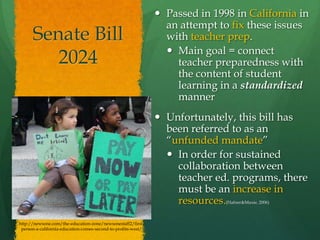
Senate Bill 2024Passed in 1998 in California in an attempt to fix these issues with teacher prep.Main goal = connect teacher preparedness with the content of student learning in a standardized mannerUnfortunately, this bill has been referred to as an “unfunded mandate”In order for sustained collaboration between teacher ed. programs, there must be an increase in resources.(Hafner & Maxie, 2006)http://newsone.com/the-education-zone/newsonestaff2/first-person-a-california-education-comes-second-to-profits-west/
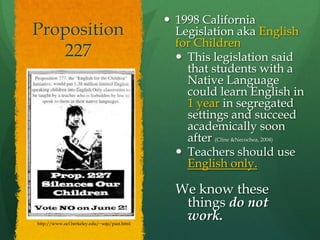
Proposition 2271998 California Legislation aka English for Children This legislation said that students with a Native Language could learn English in 1 year in segregated settings and succeed academically soon after (Cline & Necochea, 2004)Teachers should use English only.We know these things do not work.http://www.ocf.berkeley.edu/~soja/past.html
No Child Left BehindNCLB has cut funding to several bilingual education programs, moving the country toward “monolingualism”—English Only. (Katz, 2004)Meanwhile, we know that a child’s Native Language positively affects the development of their second language (English)This act has:Reduced the number of bilingual teacher positionsReduced federal funding to those programs that need it the mostLeft ELLsunprepared for their futures (Katz, 2004)
So, what teacher preparation programs are doing things right?In San Antonio, TX…(Milk, 1990)A teacher preparation program provides future ESL teachers with an immersion experience in Spanish, the bilingual students with a wider lexical range of Spanish in content areas, and simulated classroom experiences as instructional modelEncouraged confidence in use of Spanish in the classroomGreater understanding language barriers of ELLsEmpathywith students
In Long Island, NY…(Honigsfeld & Cohan, 2006)Intensive Teacher Institute: Teacher Preparation Program combined Japanese “Lesson Study” method with Sheltered Instruction Observation Protocol (SIOP)Lesson Study emphasized group of teachers investigating lesson plans in a collaborative effortSIOP emphasized adapting the mainstream curriculum to fit the ELLCombining these two stressed collaboration, preparation, background knowledge, comprehensible input, strategies, and interactionGives future teachers the experience of collaborating to discover what methods work best in the classroom
At Queens College in NY… (Dong, 2004)
Course entitled“Language, Literacy, and Culture in Education; teachers encouraged to empathize with ELLs and modify instruction to fit their needs
25 hours of field observation required in ESL/bilingual classrooms
Future teachers kept journalsthat demonstrated the growing empathy they felt with ELLs through communication break downs and identity issue
Learned about instructional modifications:
Language/content objectives
Anticipate ESL related difficulties

Teaching el ls

  • 1.
    How Should FutureTeachers Be Prepared to Work With English Language Learners?Elise KielekWhat is working and what is not working in the world of ESL/bilingual teacher preparationhttp://theoriesandmethods2.blogspot.com/
  • 2.
    Understand some ofthe history and legislative issues altering the number of well prepared ESL/bilingual teachersConsider case studies that demonstrate examples of good teacher preparation programsSee what is working within the successful teacher education programs and understand how to incorporate these successful aspects into his or her own educational future with ELLsBy the end of this presentation, viewers should be able to:
  • 3.
    ELLs in theSchool System Today“From 2003-2004, 5.5 million students in the American school system have Limited English Proficiency (LEP), and 80% of them speak Spanish as their first language.” (Batt, 2008)The number of ELLs is growing quickly, thus demanding well prepared, highly staffed future ESL and bilingual programs.So, are our teacher ed. programs up to par?
  • 4.
    The History ofTeacher PreparationIssues that necessitated legislative reform Shortage of teachers in the 80s led to the creation of programs that “short cut” teacher educationie. Alternative routes to certificationThese “short cuts” caused “fragmentation in licensure/curriculum, lack of coordination with classroom practice and public school norms, declining budget for teacher preparation, and limited capacity within state supported programs” (Hafner & Maxie, 2006)So how do we fix this?
  • 5.
    Senate Bill 2024Passedin 1998 in California in an attempt to fix these issues with teacher prep.Main goal = connect teacher preparedness with the content of student learning in a standardized mannerUnfortunately, this bill has been referred to as an “unfunded mandate”In order for sustained collaboration between teacher ed. programs, there must be an increase in resources.(Hafner & Maxie, 2006)http://newsone.com/the-education-zone/newsonestaff2/first-person-a-california-education-comes-second-to-profits-west/
  • 6.
    Proposition 2271998 CaliforniaLegislation aka English for Children This legislation said that students with a Native Language could learn English in 1 year in segregated settings and succeed academically soon after (Cline & Necochea, 2004)Teachers should use English only.We know these things do not work.http://www.ocf.berkeley.edu/~soja/past.html
  • 7.
    No Child LeftBehindNCLB has cut funding to several bilingual education programs, moving the country toward “monolingualism”—English Only. (Katz, 2004)Meanwhile, we know that a child’s Native Language positively affects the development of their second language (English)This act has:Reduced the number of bilingual teacher positionsReduced federal funding to those programs that need it the mostLeft ELLsunprepared for their futures (Katz, 2004)
  • 8.
    So, what teacherpreparation programs are doing things right?In San Antonio, TX…(Milk, 1990)A teacher preparation program provides future ESL teachers with an immersion experience in Spanish, the bilingual students with a wider lexical range of Spanish in content areas, and simulated classroom experiences as instructional modelEncouraged confidence in use of Spanish in the classroomGreater understanding language barriers of ELLsEmpathywith students
  • 9.
    In Long Island,NY…(Honigsfeld & Cohan, 2006)Intensive Teacher Institute: Teacher Preparation Program combined Japanese “Lesson Study” method with Sheltered Instruction Observation Protocol (SIOP)Lesson Study emphasized group of teachers investigating lesson plans in a collaborative effortSIOP emphasized adapting the mainstream curriculum to fit the ELLCombining these two stressed collaboration, preparation, background knowledge, comprehensible input, strategies, and interactionGives future teachers the experience of collaborating to discover what methods work best in the classroom
  • 10.
    At Queens Collegein NY… (Dong, 2004)
  • 11.
    Course entitled“Language, Literacy,and Culture in Education; teachers encouraged to empathize with ELLs and modify instruction to fit their needs
  • 12.
    25 hours offield observation required in ESL/bilingual classrooms
  • 13.
    Future teachers keptjournalsthat demonstrated the growing empathy they felt with ELLs through communication break downs and identity issue
  • 14.
  • 15.
  • 16.