Research-Based Informationto keep in mind while teaching English Language LearnersBibliography:American Educator, Summer 2008, Teaching English Language Learners.Susana Dutro/2008, A Focused Approach to Systematic ELD.
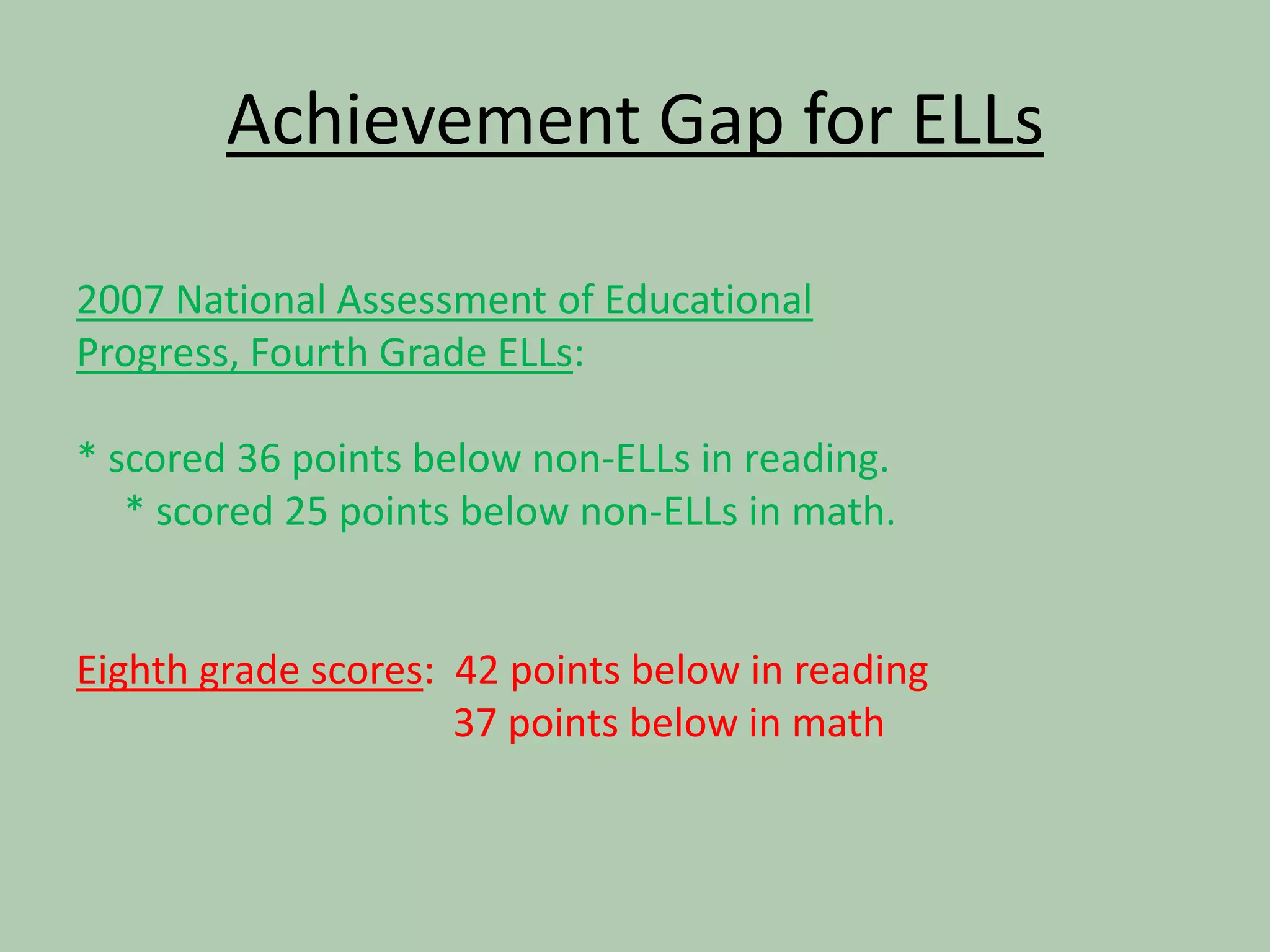
Achievement Gap for ELLs2007 National Assessment of EducationalProgress, Fourth Grade ELLs:* scored 36 points below non-ELLs in reading.	* scored 25 points below non-ELLs in math.Eighth grade scores:  42 points below in reading                                     37 points below in math
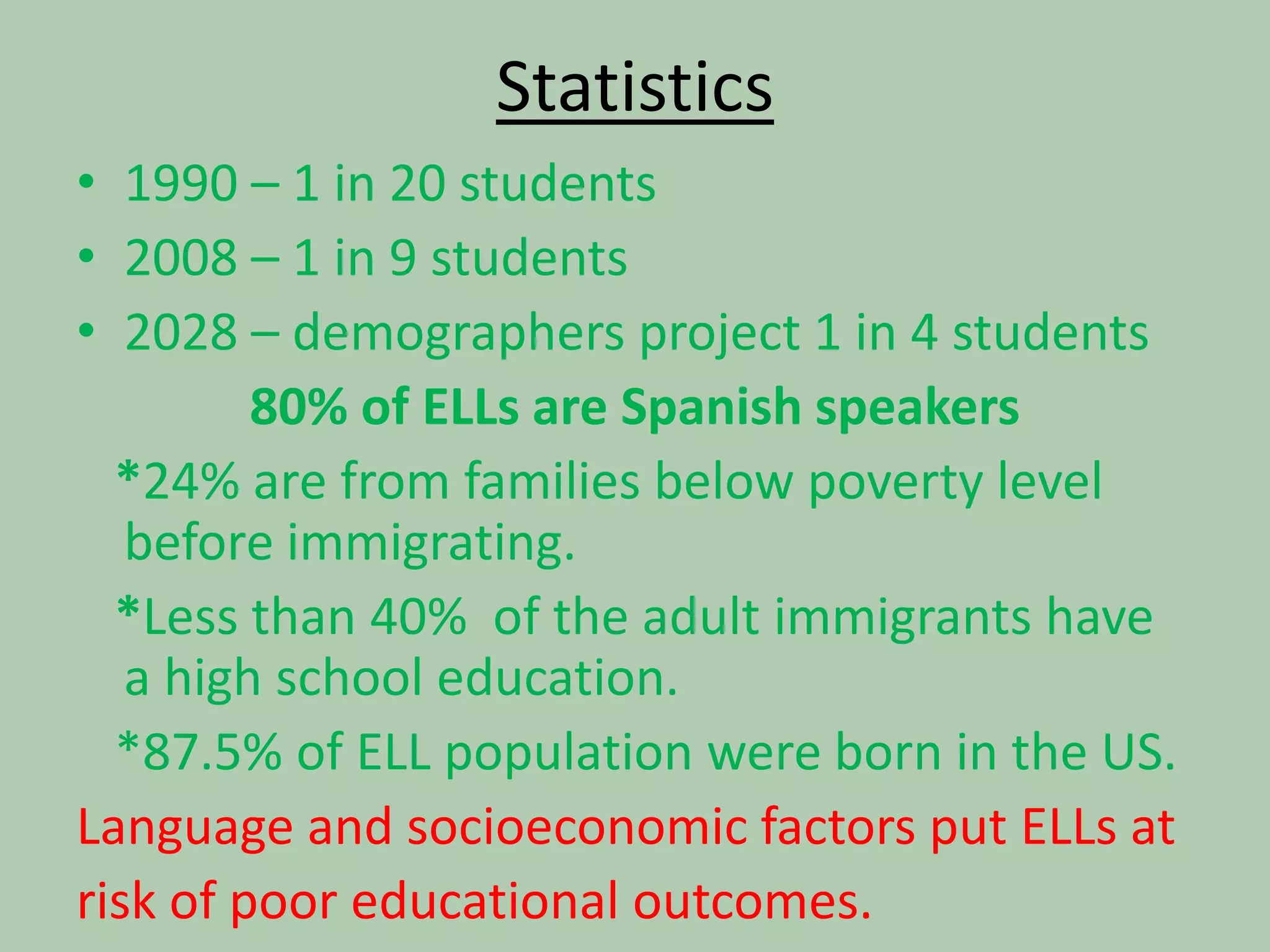
Statistics 1990 – 1 in 20 students 2008 – 1 in 9 students2028 – demographers project 1 in 4 students 80% of ELLs are Spanish speakers  *24% are from families below poverty level before immigrating. *Less than 40%  of the adult immigrants have a high school education.   *87.5% of ELL population were born in the US.Language and socioeconomic factors put ELLs atrisk of poor educational outcomes.
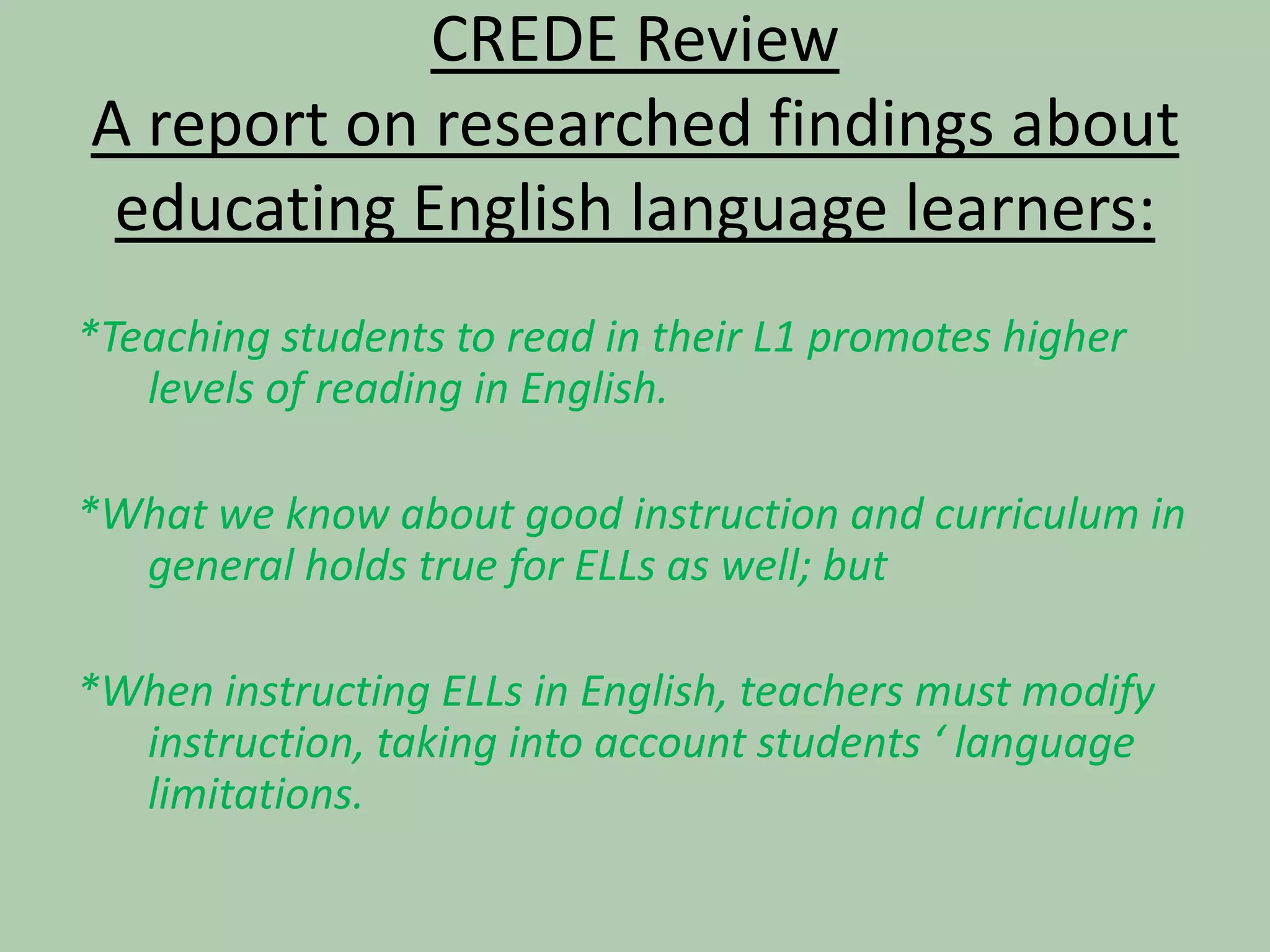
CREDE ReviewA report on researched findings about educating English language learners:*Teaching students to read in their L1 promotes higher levels of reading in English.*What we know about good instruction and curriculum in general holds true for ELLs as well; but*When instructing ELLs in English, teachers must modify instruction, taking into account students ‘ language limitations.
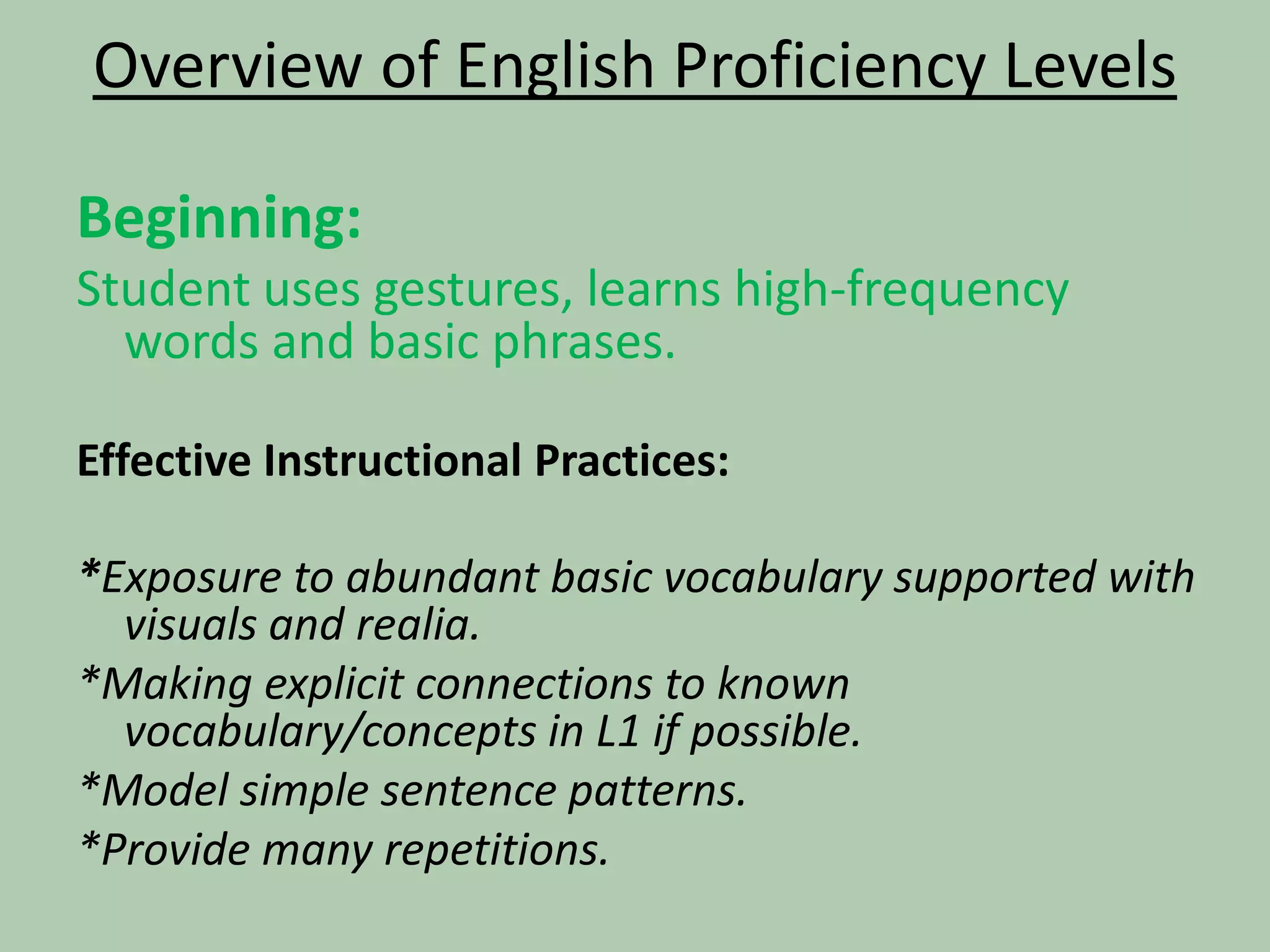
Overview of English Proficiency LevelsBeginning: Student uses gestures, learns high-frequency words and basic phrases.Effective Instructional Practices:*Exposure to abundant basic vocabulary supported with visuals and realia.*Making explicit connections to known vocabulary/concepts in L1 if possible.*Model simple sentence patterns.*Provide many repetitions.
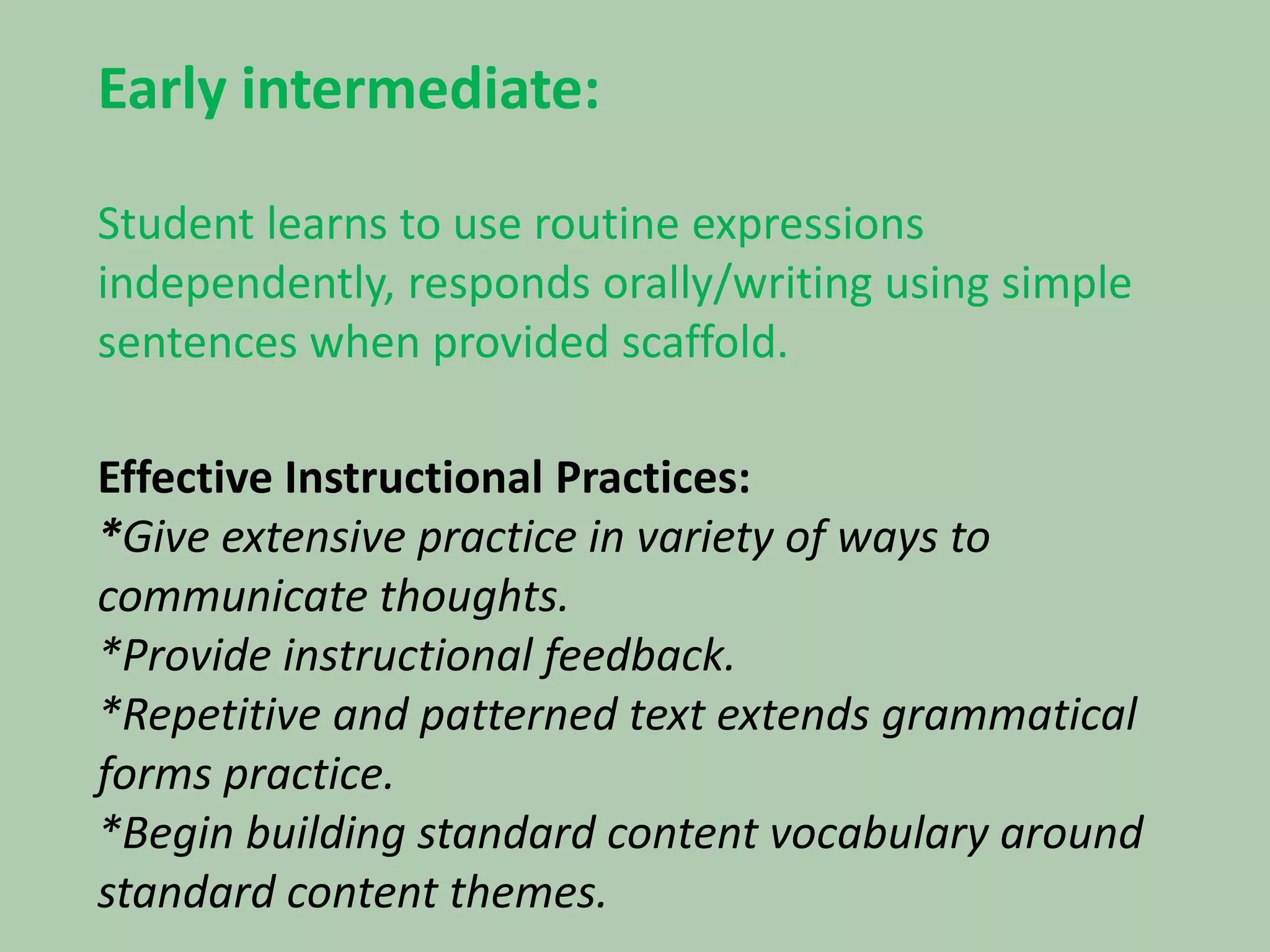
Early intermediate:Student learns to use routine expressions independently, responds orally/writing using simple sentences when provided scaffold.Effective Instructional Practices:*Give extensive practice in variety of ways to communicate thoughts.*Provide instructional feedback.*Repetitive and patterned text extends grammatical forms practice.*Begin building standard content vocabulary around standard content themes.
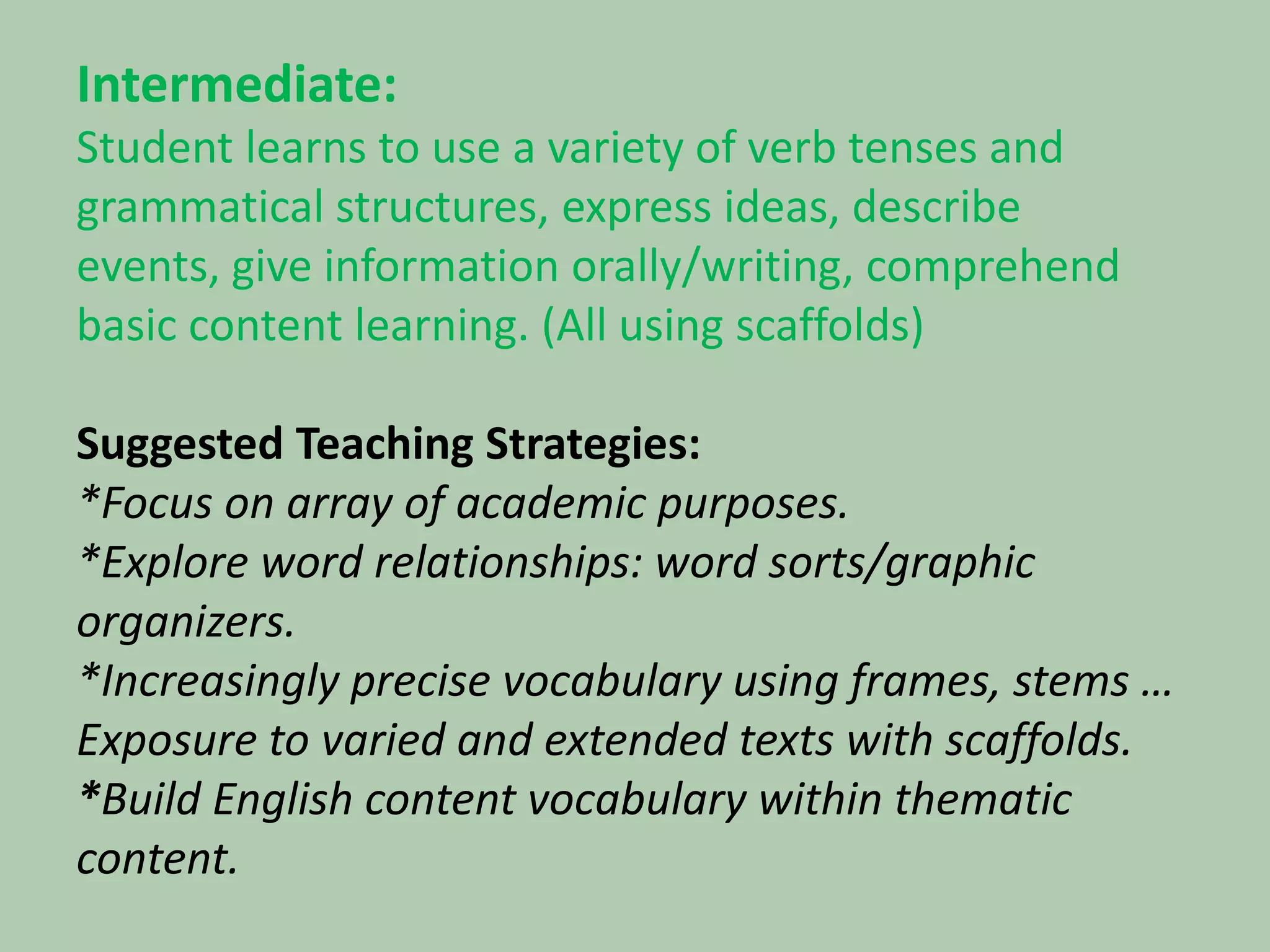
Intermediate:Student learns to use a variety of verb tenses and grammatical structures, express ideas, describe events, give information orally/writing, comprehend basic content learning. (All using scaffolds)Suggested Teaching Strategies:*Focus on array of academic purposes.*Explore word relationships: word sorts/graphic organizers.*Increasingly precise vocabulary using frames, stems …Exposure to varied and extended texts with scaffolds. *Build English content vocabulary within thematic content.
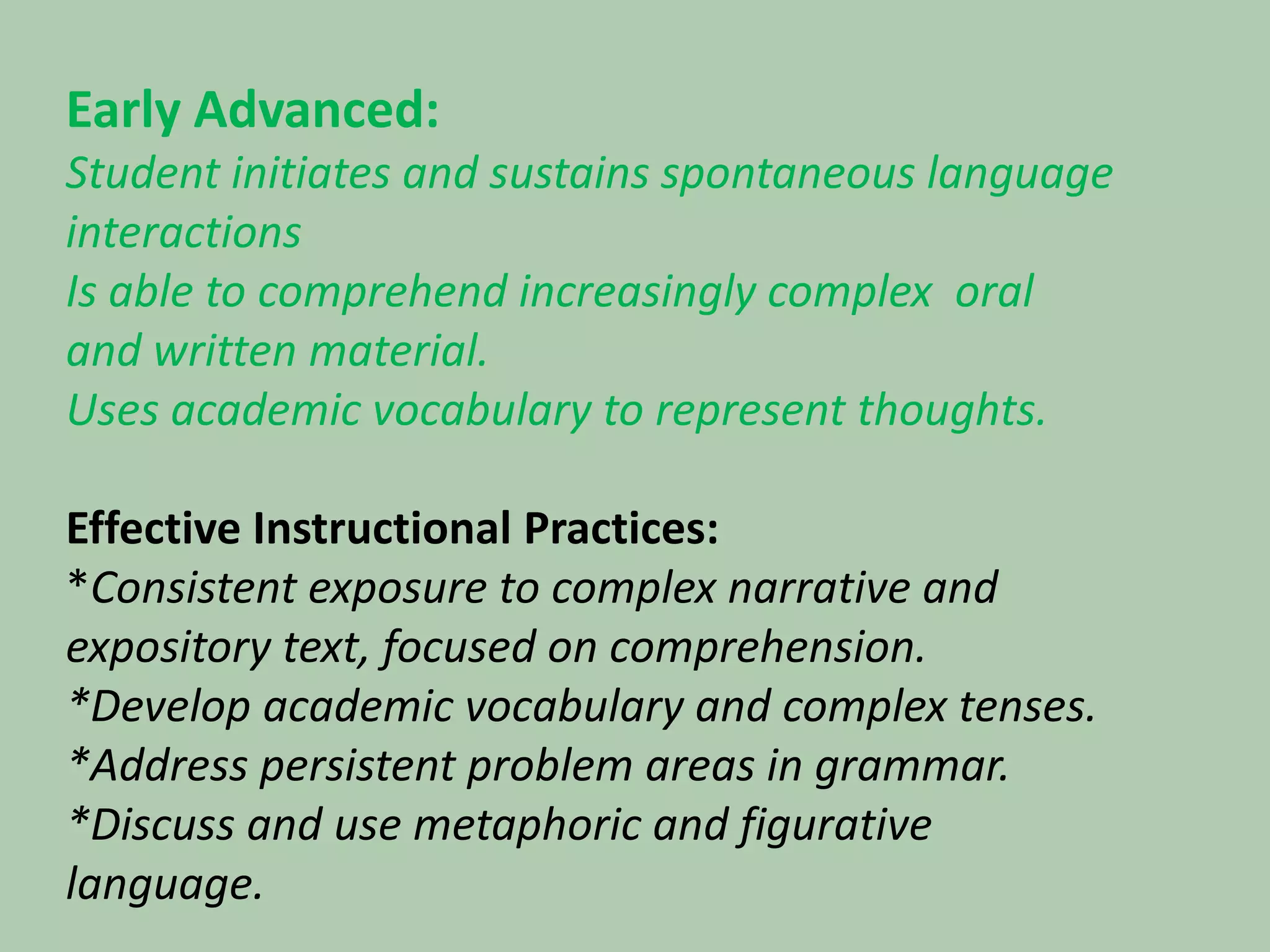
Early Advanced:Student initiates and sustains spontaneous language interactions Is able to comprehend increasingly complex  oral and written material.Uses academic vocabulary to represent thoughts.   Effective Instructional Practices:*Consistent exposure to complex narrative and expository text, focused on comprehension.*Develop academic vocabulary and complex tenses.*Address persistent problem areas in grammar.*Discuss and use metaphoric and figurative language.,
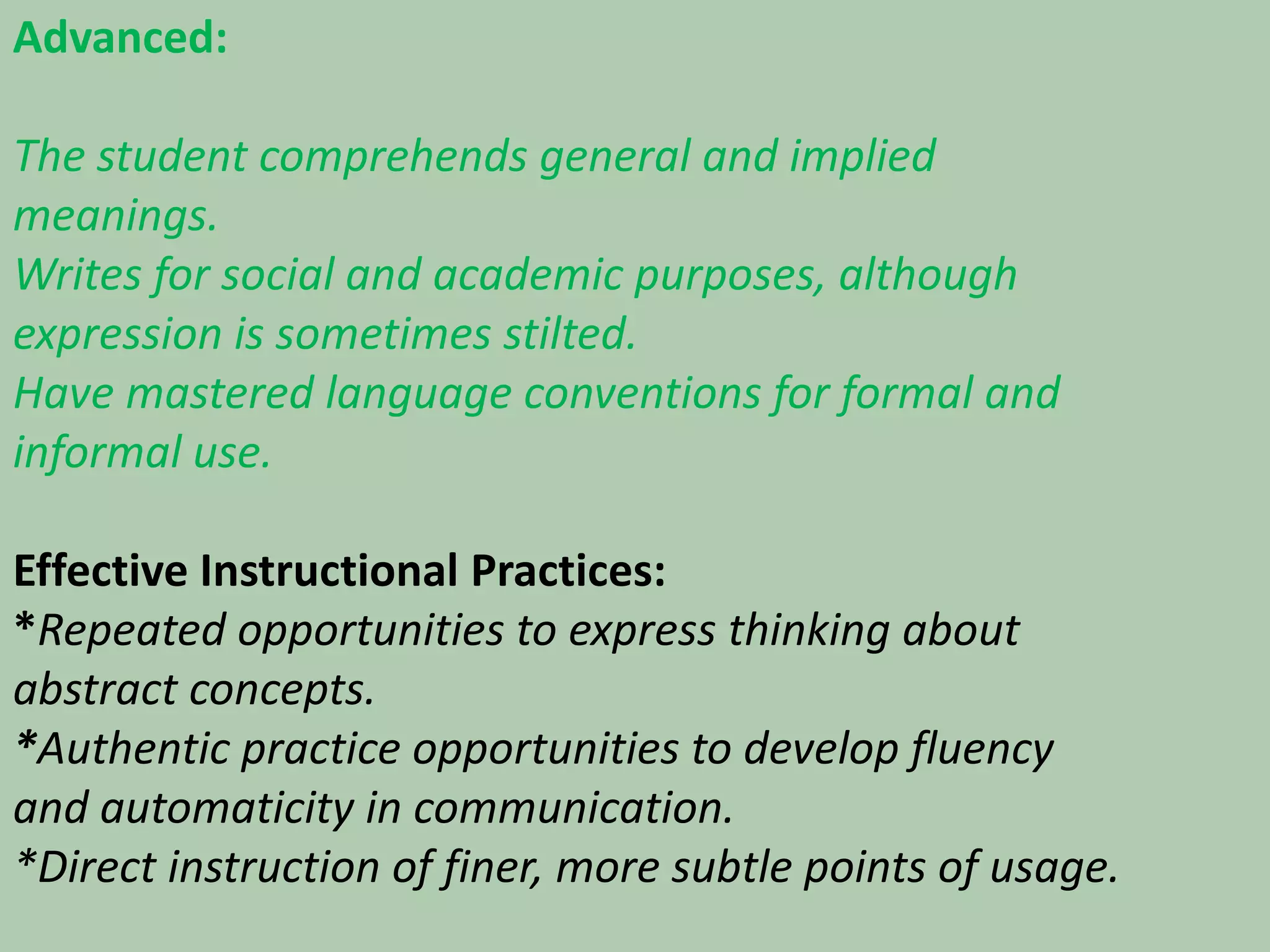
Advanced:The student comprehends general and implied meanings.Writes for social and academic purposes, although expression is sometimes stilted.Have mastered language conventions for formal and informal use.Effective Instructional Practices:*Repeated opportunities to express thinking about abstract concepts.*Authentic practice opportunities to develop fluency and automaticity in communication.*Direct instruction of finer, more subtle points of usage.
Addressing the needs of ELLs through Research- Based Strategies will:Help to close the wide learning gap between Ells and English speaking students.Benefit L1 and L2 students through best Instructional practices.Reduce the costs of large scale under-achievement in the future of US society. If any of these arguments appeals to you, thenAdvocate for research-based, ESOL instruction.

Research based information

  • 1.
    Research-Based Informationto keepin mind while teaching English Language LearnersBibliography:American Educator, Summer 2008, Teaching English Language Learners.Susana Dutro/2008, A Focused Approach to Systematic ELD.
  • 2.
    Achievement Gap forELLs2007 National Assessment of EducationalProgress, Fourth Grade ELLs:* scored 36 points below non-ELLs in reading. * scored 25 points below non-ELLs in math.Eighth grade scores: 42 points below in reading 37 points below in math
  • 3.
    Statistics 1990 –1 in 20 students 2008 – 1 in 9 students2028 – demographers project 1 in 4 students 80% of ELLs are Spanish speakers *24% are from families below poverty level before immigrating. *Less than 40% of the adult immigrants have a high school education. *87.5% of ELL population were born in the US.Language and socioeconomic factors put ELLs atrisk of poor educational outcomes.
  • 4.
    CREDE ReviewA reporton researched findings about educating English language learners:*Teaching students to read in their L1 promotes higher levels of reading in English.*What we know about good instruction and curriculum in general holds true for ELLs as well; but*When instructing ELLs in English, teachers must modify instruction, taking into account students ‘ language limitations.
  • 5.
    Overview of EnglishProficiency LevelsBeginning: Student uses gestures, learns high-frequency words and basic phrases.Effective Instructional Practices:*Exposure to abundant basic vocabulary supported with visuals and realia.*Making explicit connections to known vocabulary/concepts in L1 if possible.*Model simple sentence patterns.*Provide many repetitions.
  • 6.
    Early intermediate:Student learnsto use routine expressions independently, responds orally/writing using simple sentences when provided scaffold.Effective Instructional Practices:*Give extensive practice in variety of ways to communicate thoughts.*Provide instructional feedback.*Repetitive and patterned text extends grammatical forms practice.*Begin building standard content vocabulary around standard content themes.
  • 7.
    Intermediate:Student learns touse a variety of verb tenses and grammatical structures, express ideas, describe events, give information orally/writing, comprehend basic content learning. (All using scaffolds)Suggested Teaching Strategies:*Focus on array of academic purposes.*Explore word relationships: word sorts/graphic organizers.*Increasingly precise vocabulary using frames, stems …Exposure to varied and extended texts with scaffolds. *Build English content vocabulary within thematic content.
  • 8.
    Early Advanced:Student initiatesand sustains spontaneous language interactions Is able to comprehend increasingly complex oral and written material.Uses academic vocabulary to represent thoughts. Effective Instructional Practices:*Consistent exposure to complex narrative and expository text, focused on comprehension.*Develop academic vocabulary and complex tenses.*Address persistent problem areas in grammar.*Discuss and use metaphoric and figurative language.,
  • 9.
    Advanced:The student comprehendsgeneral and implied meanings.Writes for social and academic purposes, although expression is sometimes stilted.Have mastered language conventions for formal and informal use.Effective Instructional Practices:*Repeated opportunities to express thinking about abstract concepts.*Authentic practice opportunities to develop fluency and automaticity in communication.*Direct instruction of finer, more subtle points of usage.
  • 10.
    Addressing the needsof ELLs through Research- Based Strategies will:Help to close the wide learning gap between Ells and English speaking students.Benefit L1 and L2 students through best Instructional practices.Reduce the costs of large scale under-achievement in the future of US society. If any of these arguments appeals to you, thenAdvocate for research-based, ESOL instruction.