Knowledge is having
the right answer.
Intelligence is asking
the right question
Welcome to my
presentation
Classroom
questioning
A question is any sentence which has
an interrogative form or function
The use of questions is one of the
most important teaching techniques.
Asking questions forms part of any
lesson because it invites the student to
think, Teachers use questions to
engage the students and sustain an
‘active’ style to the learning.
WHY ASK QUESTIONS?
• To actively involve students in the lesson
• To increase motivation or interest
• To evaluate students’ preparation
• To check on completion of work
• To develop critical thinking skills
• To review previous lessons
• To nurture insights
• To assess achievement or mastery of goals
and objectives
• To stimulate independent learning
• To test students’ knowledge
• To stimulate creativity
• To modifying students’ perception of the
subject
• To encourage students to become self-
directed learners
• To focus attention on a particular issue or
concept
• To develop an active approach to learning
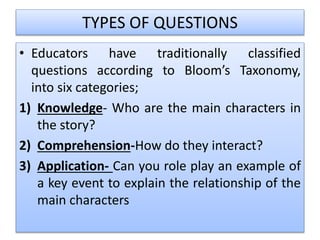
TYPES OF QUESTIONS
• Educators have traditionally classified
questions according to Bloom’s Taxonomy,
into six categories;
1) Knowledge- Who are the main characters in
the story?
2) Comprehension-How do they interact?
3) Application- Can you role play an example of
a key event to explain the relationship of the
main characters
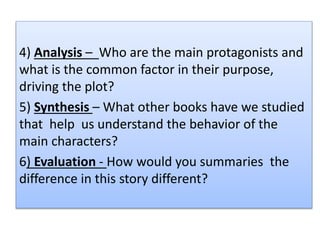
4) Analysis – Who are the main protagonists and
what is the common factor in their purpose,
driving the plot?
5) Synthesis – What other books have we studied
that help us understand the behavior of the
main characters?
6) Evaluation - How would you summaries the
difference in this story different?
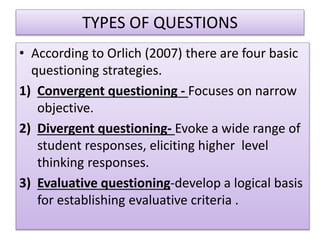
TYPES OF QUESTIONS
• According to Orlich (2007) there are four basic
questioning strategies.
1) Convergent questioning - Focuses on narrow
objective.
2) Divergent questioning- Evoke a wide range of
student responses, eliciting higher level
thinking responses.
3) Evaluative questioning-develop a logical basis
for establishing evaluative criteria .
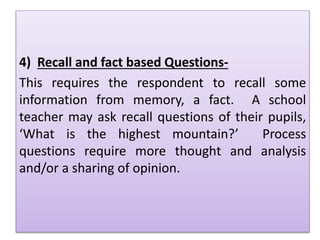
4) Recall and fact based Questions-
This requires the respondent to recall some
information from memory, a fact. A school
teacher may ask recall questions of their pupils,
‘What is the highest mountain?’ Process
questions require more thought and analysis
and/or a sharing of opinion.
• Reflective questioning-
It often assess metacognitive skills. It draws its
historical perspective from the classical
Socratic method of questioning. This strategy
stimulates a wide range of student responses,
having also evaluative element, the goal being
to require students to develop higher order
thinking . The process initiated by reflective
questions may also be called critical or analytical
thinking.
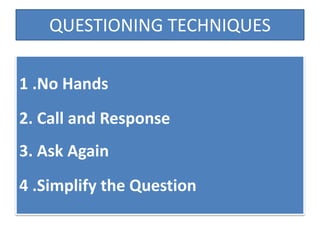
QUESTIONING TECHNIQUES
1 .No Hands
2. Call and Response
3. Ask Again
4 .Simplify the Question
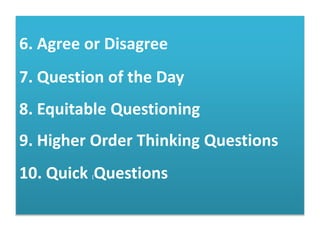
6. Agree or Disagree
7. Question of the Day
8. Equitable Questioning
9. Higher Order Thinking Questions
10. Quick [Questions
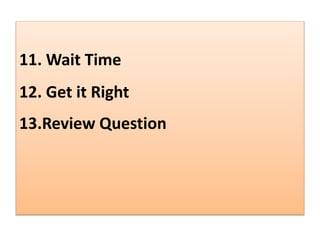
11. Wait Time
12. Get it Right
13.Review Question
Framing the questions
• Framing refers to how important issues are
presented or 'framed' in a survey question.
The interrogative pronouns who, what, whom,
whose, which and the interrogative adverbs
where, when, why and how are used to frame
information questions.
• The structure ‘how + an adjective/adverb’ may
also be used to frame information questions
References:
• 1.https://www.slideshare.net/JavedIqbal15/presenta
tion-on-questioning
• 2 https://pdst.ie/sites/default/files/Assessment%20-
%20Workshop%202%20Questioning.ppt
• 3 https://www.ncca.ie/media/1950/workshop-
02speaker-notes-en.pdf
• 4 https://www.slideshare.net/madsen720/summit-
question-techniques
• 5 https://www.slideshare.net/rajeevelt/questioning-
technique-7042677
• 6 https://www.slideshare.net/martianne21/effective-
questioning-24590742
Course: Teaching English..
Submitted To:
Rahul Chandra Shaha
Lecturer, IER.
Jagannath university.
Submitted By:
MORIOM AKTER ELA
ID NO: B160110002
Batch: 2nd (IER),
Jagannath University
Thank you

classroom questioning

  • 1.
    Knowledge is having theright answer. Intelligence is asking the right question
  • 2.
  • 3.
  • 5.
    A question isany sentence which has an interrogative form or function The use of questions is one of the most important teaching techniques. Asking questions forms part of any lesson because it invites the student to think, Teachers use questions to engage the students and sustain an ‘active’ style to the learning.
  • 6.
    WHY ASK QUESTIONS? •To actively involve students in the lesson • To increase motivation or interest • To evaluate students’ preparation • To check on completion of work • To develop critical thinking skills • To review previous lessons • To nurture insights
  • 7.
    • To assessachievement or mastery of goals and objectives • To stimulate independent learning • To test students’ knowledge • To stimulate creativity • To modifying students’ perception of the subject • To encourage students to become self- directed learners • To focus attention on a particular issue or concept • To develop an active approach to learning
  • 8.
    TYPES OF QUESTIONS •Educators have traditionally classified questions according to Bloom’s Taxonomy, into six categories; 1) Knowledge- Who are the main characters in the story? 2) Comprehension-How do they interact? 3) Application- Can you role play an example of a key event to explain the relationship of the main characters
  • 9.
    4) Analysis –Who are the main protagonists and what is the common factor in their purpose, driving the plot? 5) Synthesis – What other books have we studied that help us understand the behavior of the main characters? 6) Evaluation - How would you summaries the difference in this story different?
  • 10.
    TYPES OF QUESTIONS •According to Orlich (2007) there are four basic questioning strategies. 1) Convergent questioning - Focuses on narrow objective. 2) Divergent questioning- Evoke a wide range of student responses, eliciting higher level thinking responses. 3) Evaluative questioning-develop a logical basis for establishing evaluative criteria .
  • 11.
    4) Recall andfact based Questions- This requires the respondent to recall some information from memory, a fact. A school teacher may ask recall questions of their pupils, ‘What is the highest mountain?’ Process questions require more thought and analysis and/or a sharing of opinion.
  • 12.
    • Reflective questioning- Itoften assess metacognitive skills. It draws its historical perspective from the classical Socratic method of questioning. This strategy stimulates a wide range of student responses, having also evaluative element, the goal being to require students to develop higher order thinking . The process initiated by reflective questions may also be called critical or analytical thinking.
  • 13.
    QUESTIONING TECHNIQUES 1 .NoHands 2. Call and Response 3. Ask Again 4 .Simplify the Question
  • 14.
    6. Agree orDisagree 7. Question of the Day 8. Equitable Questioning 9. Higher Order Thinking Questions 10. Quick [Questions
  • 15.
    11. Wait Time 12.Get it Right 13.Review Question
  • 16.
    Framing the questions •Framing refers to how important issues are presented or 'framed' in a survey question. The interrogative pronouns who, what, whom, whose, which and the interrogative adverbs where, when, why and how are used to frame information questions. • The structure ‘how + an adjective/adverb’ may also be used to frame information questions
  • 17.
    References: • 1.https://www.slideshare.net/JavedIqbal15/presenta tion-on-questioning • 2https://pdst.ie/sites/default/files/Assessment%20- %20Workshop%202%20Questioning.ppt • 3 https://www.ncca.ie/media/1950/workshop- 02speaker-notes-en.pdf • 4 https://www.slideshare.net/madsen720/summit- question-techniques • 5 https://www.slideshare.net/rajeevelt/questioning- technique-7042677 • 6 https://www.slideshare.net/martianne21/effective- questioning-24590742
  • 18.
    Course: Teaching English.. SubmittedTo: Rahul Chandra Shaha Lecturer, IER. Jagannath university. Submitted By: MORIOM AKTER ELA ID NO: B160110002 Batch: 2nd (IER), Jagannath University
  • 19.