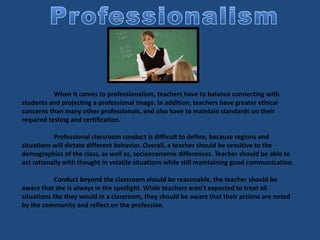
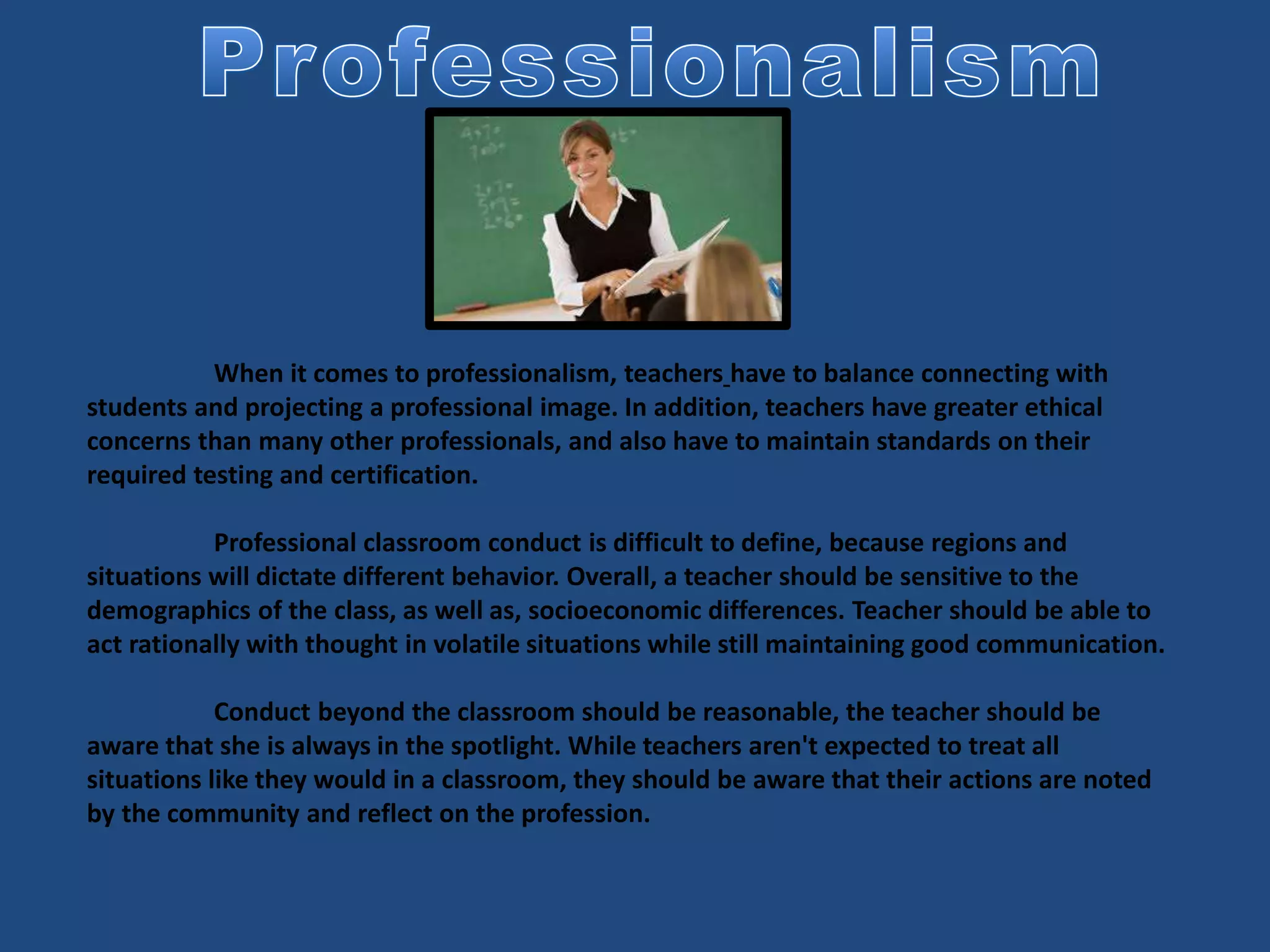


When it comes to professionalism, teachers have to balance connecting with
students and projecting a professional image. In addition, teachers have greater ethical
concerns than many other professionals, and also have to maintain standards on their
required testing and certification.
Professional classroom conduct is difficult to define, because regions and
situations will dictate different behavior. Overall, a teacher should be sensitive to the
demographics of the class, as well as, socioeconomic differences. Teacher should be able to
act rationally with thought in volatile situations while still maintaining good communication.
Conduct beyond the classroom should be reasonable, the teacher should be
aware that she is always in the spotlight. While teachers aren't expected to treat all
situations like they would in a classroom, they should be aware that their actions are noted
by the community and reflect on the profession.
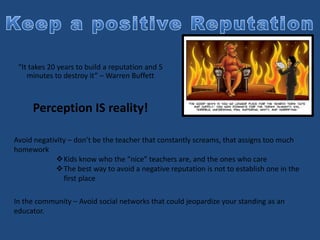
“It takes 20 years to build a reputation and 5
minutes to destroy it” – Warren Buffett
Perception IS reality!
Avoid negativity – don’t be the teacher that constantly screams, that assigns too much
homework
Kids know who the “nice” teachers are, and the ones who care
The best way to avoid a negative reputation is not to establish one in the
first place
In the community – Avoid social networks that could jeopardize your standing as an
educator.
 Teachers are not victims
of their jobs. We chose
it and can leave it at any
time. Avoid
unwarranted complaints
about the job (it’s
tougher in the “real
world”).
 Victimization leads to
frustration, anger, and
burnout, and it affects our
students.
We aren’t victims! Instead we are the individuals in
whose hands your district and society entrusts its
hopes and dreams for the future!
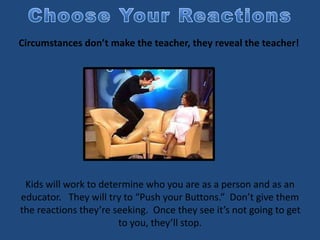
Circumstances don’t make the teacher, they reveal the teacher!
Kids will work to determine who you are as a person and as an
educator. They will try to “Push your Buttons.” Don’t give them
the reactions they’re seeking. Once they see it’s not going to get
to you, they’ll stop.
EVERY faculty has negative individuals. Don’t
fall in with them.
It’s all about choices…
Ask yourself…
Do I want to blame society, administration, parents, and students, everyone BUT myself for
things that are not going the way I would like them to go?
The result will be…
The negative people will love you. Your workload will be lightened by the shortcuts
(worksheets, videos, busy work, etc.) you take. You’ll get all the latest gossip, but the respected peers will
have no respect for you!
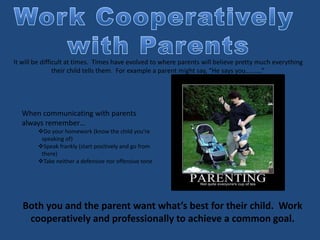
It will be difficult at times. Times have evolved to where parents will believe pretty much everything
their child tells them. For example a parent might say, “He says you……….”
When communicating with parents
always remember…
Do your homework (know the child you’re
speaking of)
Speak frankly (start positively and go from
there)
Take neither a defensive nor offensive tone
Both you and the parent want what’s best for their child. Work
cooperatively and professionally to achieve a common goal.
Take them from where they are and help them grow from
there.
Commit to doing that and you’ll have no time for blame.
 Who’s to blame? High
school blames Middle
School. Middle blames
Elementary School.
Elementary blames
Mom. Mom blames
Dad.
 We are assigned the
kids each year. We
don’t get to pick
them (nor their
parents)
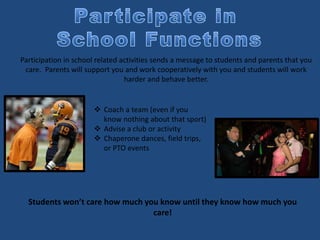
Participation in school related activities sends a message to students and parents that you
care. Parents will support you and work cooperatively with you and students will work
harder and behave better.
 Coach a team (even if you
know nothing about that sport)
 Advise a club or activity
 Chaperone dances, field trips,
or PTO events
Students won’t care how much you know until they know how much you
care!
No parent, teacher, or administrator would opt to have a child in a high tech building being overseen by
ineffective teachers.
Yes…integrate (technology, resources, etc.) into classroom, but not at the expense of improving
teaching skills. Instead, what’s needed are good models, supportive surroundings, and a desire to
improve our teacher skills.
When kids are not achieving
academically, society (i.e. politicians),
have simply thrown money at the
problem. Historically this has not
worked. If patients are dying on a
particular surgeons operating table,
would you buy him a new scalpel?
Instead, a greater emphasis needs to
be placed on effective teaching
strategies!
“By swallowing evil words unsaid, no one has ever yet
harmed his stomach.”
– Winston Churchill
Anyone who will gossip with you will gossip about you!
No one has ever earned the respect of others by
gossiping!
 Unfortunately, many students start out on the wrong foot
because of careless, harmful words spoken about them by
teachers. Imagine if a teacher was judged and evaluated by
administration on previous mistakes in their teaching, or
their life.
 You’ll encounter colleagues who will try to engage you with empty meaningless gossip,
often times in the lunch room. Keep your discussions related to anything (movies, family,
vacations, etc.) but kids. It’s unprofessional – and goes against everything you stand for –
educating and helping others!
Rely on anyone who can provide
assistance in helping students learn.
For example…
 Have students help in decorating the room
 Recruit guest speakers
 Enlist parents to help with tasks
 Have other teachers demonstrate techniques to your students
The Result…
 Your students will see you asking and will do the same. They’ll give
something back. Teaching isn’t an exact science so always remain in a
state of questioning.
Remember..
 Be confident enough to work autonomously, smart enough to know when to ask
questions. There is NO such thing as a bad question??
 Take initiative, but communicate. You won’t look incompetent but instead look
dedicated.
Nothing is more rewarding than knowing you left nothing in the
tank. You’ve done something and given it your best!
No one is perfect. You’re going to make mistakes, but make those mistakes going
at 100%. There are going to be days when you come in not feeling well. But if you come to
school, you MUST teach your best. When students try your patience because they don’t
understand what you’re trying to teach. Try a new way of teaching it. Do not give up, and
do not give in. Rather, give all you’ve got, and then some.
You cannot ask for the best from your students if you’re not giving yours!
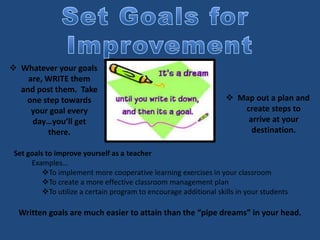
 Whatever your goals
are, WRITE them
and post them. Take
one step towards
your goal every
day…you’ll get
there.
 Map out a plan and
create steps to
arrive at your
destination.
Set goals to improve yourself as a teacher
Examples…
To implement more cooperative learning exercises in your classroom
To create a more effective classroom management plan
To utilize a certain program to encourage additional skills in your students
Written goals are much easier to attain than the “pipe dreams” in your head.
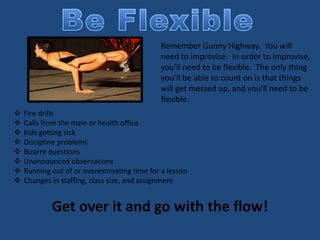
Remember Gunny Highway. You will
need to improvise. In order to improvise,
you’ll need to be flexible. The only thing
you’ll be able to count on is that things
will get messed up, and you’ll need to be
flexible.
 Fire drills
 Calls from the main or health office
 Kids getting sick
 Discipline problems
 Bizarre questions
 Unannounced observations
 Running out of or overestimating time for a lesson
 Changes in staffing, class size, and assignment
Get over it and go with the flow!
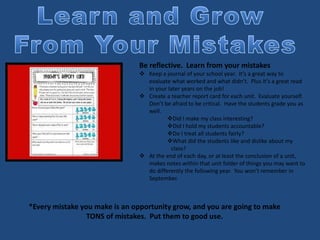
Be reflective. Learn from your mistakes
 Keep a journal of your school year. It’s a great way to
evaluate what worked and what didn’t. Plus it’s a great read
in your later years on the job!
 Create a teacher report card for each unit. Evaluate yourself.
Don’t be afraid to be critical. Have the students grade you as
well.
Did I make my class interesting?
Did I hold my students accountable?
Do I treat all students fairly?
What did the students like and dislike about my
class?
 At the end of each day, or at least the conclusion of a unit,
makes notes within that unit folder of things you may want to
do differently the following year. You won’t remember in
September.
*Every mistake you make is an opportunity grow, and you are going to make
TONS of mistakes. Put them to good use.
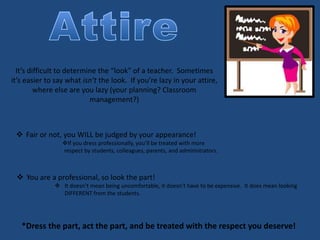
It’s difficult to determine the “look” of a teacher. Sometimes
it’s easier to say what isn’t the look. If you’re lazy in your attire,
where else are you lazy (your planning? Classroom
management?)
 Fair or not, you WILL be judged by your appearance!
If you dress professionally, you’ll be treated with more
respect by students, colleagues, parents, and administrators.
 You are a professional, so look the part!
 It doesn’t mean being uncomfortable, it doesn’t have to be expensive. It does mean looking
DIFFERENT from the students.
*Dress the part, act the part, and be treated with the respect you deserve!
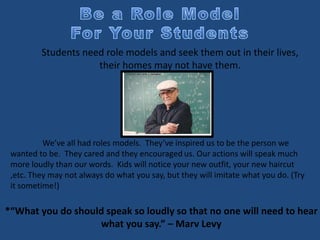
*“What you do should speak so loudly so that no one will need to hear
what you say.” – Marv Levy
Students need role models and seek them out in their lives,
their homes may not have them.
We’ve all had roles models. They’ve inspired us to be the person we
wanted to be. They cared and they encouraged us. Our actions will speak much
more loudly than our words. Kids will notice your new outfit, your new haircut
,etc. They may not always do what you say, but they will imitate what you do. (Try
it sometime!)
*Have fun with it. Intersperse humor within the interaction.
You’ll earn their respect and in turn, serve as a role model.
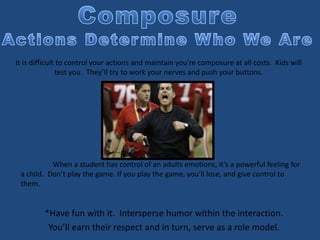
It is difficult to control your actions and maintain you’re composure at all costs. Kids will
test you. They’ll try to work your nerves and push your buttons.
When a student has control of an adults emotions, it’s a powerful feeling for
a child. Don’t play the game. If you play the game, you’ll lose, and give control to
them.
You’ll never agree with all
administrative decisions all of the
time. Try to respect where they are
coming from with their decision
making process.
 You should develop a comfortable working relationship so that you can discuss matters
professionally with your administrator.
 Don’t get caught up in power struggles, gossip, or pettiness that can lead to
breakdowns in communication and cooperation.
 Focus on what you can change – not on what you can’t.
 Always keep the students best interest at heart.
*If you’re so angry you can’t think straight, you’re
right, you can’t!
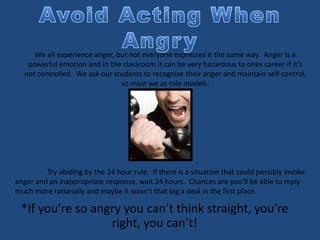
We all experience anger, but not everyone expresses it the same way. Anger is a
powerful emotion and in the classroom it can be very hazardous to ones career if it’s
not controlled. We ask our students to recognize their anger and maintain self control,
so must we as role models.
Try abiding by the 24 hour rule. If there is a situation that could possibly invoke
anger and an inappropriate response, wait 24 hours. Chances are you’ll be able to reply
much more rationally and maybe it wasn’t that big a deal in the first place.
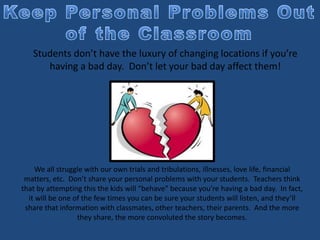
Students don’t have the luxury of changing locations if you’re
having a bad day. Don’t let your bad day affect them!
We all struggle with our own trials and tribulations, illnesses, love life, financial
matters, etc. Don’t share your personal problems with your students. Teachers think
that by attempting this the kids will “behave” because you’re having a bad day. In fact,
it will be one of the few times you can be sure your students will listen, and they’ll
share that information with classmates, other teachers, their parents. And the more
they share, the more convoluted the story becomes.
You have them for 8 hours a day, what about
the other 16?
The fact is, school may be the best part of their day. They may go home
to an empty house, may have to care for a sibling, or may be in an abusive
home. Focus on the time your students are with you. Pay note of signs
that there may be problems occurring in the other sixteen. Should you
notice it, take steps to have it looked into.
Never become such an expert that you stop
gaining expertise (Do you teach for 30 years or
teach 1 year 30 times?)
Perfection? No Improvement? Yes!!
“Who dares to teach must never cease to learn.”
John Cotton Dana

Professionalism

  • 1.
    When it comesto professionalism, teachers have to balance connecting with students and projecting a professional image. In addition, teachers have greater ethical concerns than many other professionals, and also have to maintain standards on their required testing and certification. Professional classroom conduct is difficult to define, because regions and situations will dictate different behavior. Overall, a teacher should be sensitive to the demographics of the class, as well as, socioeconomic differences. Teacher should be able to act rationally with thought in volatile situations while still maintaining good communication. Conduct beyond the classroom should be reasonable, the teacher should be aware that she is always in the spotlight. While teachers aren't expected to treat all situations like they would in a classroom, they should be aware that their actions are noted by the community and reflect on the profession.
  • 2.
    “It takes 20years to build a reputation and 5 minutes to destroy it” – Warren Buffett Perception IS reality! Avoid negativity – don’t be the teacher that constantly screams, that assigns too much homework Kids know who the “nice” teachers are, and the ones who care The best way to avoid a negative reputation is not to establish one in the first place In the community – Avoid social networks that could jeopardize your standing as an educator.
  • 3.
     Teachers arenot victims of their jobs. We chose it and can leave it at any time. Avoid unwarranted complaints about the job (it’s tougher in the “real world”).  Victimization leads to frustration, anger, and burnout, and it affects our students. We aren’t victims! Instead we are the individuals in whose hands your district and society entrusts its hopes and dreams for the future!
  • 4.
    Circumstances don’t makethe teacher, they reveal the teacher! Kids will work to determine who you are as a person and as an educator. They will try to “Push your Buttons.” Don’t give them the reactions they’re seeking. Once they see it’s not going to get to you, they’ll stop.
  • 5.
    EVERY faculty hasnegative individuals. Don’t fall in with them. It’s all about choices… Ask yourself… Do I want to blame society, administration, parents, and students, everyone BUT myself for things that are not going the way I would like them to go? The result will be… The negative people will love you. Your workload will be lightened by the shortcuts (worksheets, videos, busy work, etc.) you take. You’ll get all the latest gossip, but the respected peers will have no respect for you!
  • 6.
    It will bedifficult at times. Times have evolved to where parents will believe pretty much everything their child tells them. For example a parent might say, “He says you……….” When communicating with parents always remember… Do your homework (know the child you’re speaking of) Speak frankly (start positively and go from there) Take neither a defensive nor offensive tone Both you and the parent want what’s best for their child. Work cooperatively and professionally to achieve a common goal.
  • 7.
    Take them fromwhere they are and help them grow from there. Commit to doing that and you’ll have no time for blame.  Who’s to blame? High school blames Middle School. Middle blames Elementary School. Elementary blames Mom. Mom blames Dad.  We are assigned the kids each year. We don’t get to pick them (nor their parents)
  • 8.
    Participation in schoolrelated activities sends a message to students and parents that you care. Parents will support you and work cooperatively with you and students will work harder and behave better.  Coach a team (even if you know nothing about that sport)  Advise a club or activity  Chaperone dances, field trips, or PTO events Students won’t care how much you know until they know how much you care!
  • 9.
    No parent, teacher,or administrator would opt to have a child in a high tech building being overseen by ineffective teachers. Yes…integrate (technology, resources, etc.) into classroom, but not at the expense of improving teaching skills. Instead, what’s needed are good models, supportive surroundings, and a desire to improve our teacher skills. When kids are not achieving academically, society (i.e. politicians), have simply thrown money at the problem. Historically this has not worked. If patients are dying on a particular surgeons operating table, would you buy him a new scalpel? Instead, a greater emphasis needs to be placed on effective teaching strategies!
  • 10.
    “By swallowing evilwords unsaid, no one has ever yet harmed his stomach.” – Winston Churchill Anyone who will gossip with you will gossip about you! No one has ever earned the respect of others by gossiping!  Unfortunately, many students start out on the wrong foot because of careless, harmful words spoken about them by teachers. Imagine if a teacher was judged and evaluated by administration on previous mistakes in their teaching, or their life.  You’ll encounter colleagues who will try to engage you with empty meaningless gossip, often times in the lunch room. Keep your discussions related to anything (movies, family, vacations, etc.) but kids. It’s unprofessional – and goes against everything you stand for – educating and helping others!
  • 11.
    Rely on anyonewho can provide assistance in helping students learn. For example…  Have students help in decorating the room  Recruit guest speakers  Enlist parents to help with tasks  Have other teachers demonstrate techniques to your students The Result…  Your students will see you asking and will do the same. They’ll give something back. Teaching isn’t an exact science so always remain in a state of questioning. Remember..  Be confident enough to work autonomously, smart enough to know when to ask questions. There is NO such thing as a bad question??  Take initiative, but communicate. You won’t look incompetent but instead look dedicated.
  • 12.
    Nothing is morerewarding than knowing you left nothing in the tank. You’ve done something and given it your best! No one is perfect. You’re going to make mistakes, but make those mistakes going at 100%. There are going to be days when you come in not feeling well. But if you come to school, you MUST teach your best. When students try your patience because they don’t understand what you’re trying to teach. Try a new way of teaching it. Do not give up, and do not give in. Rather, give all you’ve got, and then some. You cannot ask for the best from your students if you’re not giving yours!
  • 13.
     Whatever yourgoals are, WRITE them and post them. Take one step towards your goal every day…you’ll get there.  Map out a plan and create steps to arrive at your destination. Set goals to improve yourself as a teacher Examples… To implement more cooperative learning exercises in your classroom To create a more effective classroom management plan To utilize a certain program to encourage additional skills in your students Written goals are much easier to attain than the “pipe dreams” in your head.
  • 14.
    Remember Gunny Highway.You will need to improvise. In order to improvise, you’ll need to be flexible. The only thing you’ll be able to count on is that things will get messed up, and you’ll need to be flexible.  Fire drills  Calls from the main or health office  Kids getting sick  Discipline problems  Bizarre questions  Unannounced observations  Running out of or overestimating time for a lesson  Changes in staffing, class size, and assignment Get over it and go with the flow!
  • 15.
    Be reflective. Learnfrom your mistakes  Keep a journal of your school year. It’s a great way to evaluate what worked and what didn’t. Plus it’s a great read in your later years on the job!  Create a teacher report card for each unit. Evaluate yourself. Don’t be afraid to be critical. Have the students grade you as well. Did I make my class interesting? Did I hold my students accountable? Do I treat all students fairly? What did the students like and dislike about my class?  At the end of each day, or at least the conclusion of a unit, makes notes within that unit folder of things you may want to do differently the following year. You won’t remember in September. *Every mistake you make is an opportunity grow, and you are going to make TONS of mistakes. Put them to good use.
  • 16.
    It’s difficult todetermine the “look” of a teacher. Sometimes it’s easier to say what isn’t the look. If you’re lazy in your attire, where else are you lazy (your planning? Classroom management?)  Fair or not, you WILL be judged by your appearance! If you dress professionally, you’ll be treated with more respect by students, colleagues, parents, and administrators.  You are a professional, so look the part!  It doesn’t mean being uncomfortable, it doesn’t have to be expensive. It does mean looking DIFFERENT from the students. *Dress the part, act the part, and be treated with the respect you deserve!
  • 17.
    *“What you doshould speak so loudly so that no one will need to hear what you say.” – Marv Levy Students need role models and seek them out in their lives, their homes may not have them. We’ve all had roles models. They’ve inspired us to be the person we wanted to be. They cared and they encouraged us. Our actions will speak much more loudly than our words. Kids will notice your new outfit, your new haircut ,etc. They may not always do what you say, but they will imitate what you do. (Try it sometime!)
  • 18.
    *Have fun withit. Intersperse humor within the interaction. You’ll earn their respect and in turn, serve as a role model. It is difficult to control your actions and maintain you’re composure at all costs. Kids will test you. They’ll try to work your nerves and push your buttons. When a student has control of an adults emotions, it’s a powerful feeling for a child. Don’t play the game. If you play the game, you’ll lose, and give control to them.
  • 19.
    You’ll never agreewith all administrative decisions all of the time. Try to respect where they are coming from with their decision making process.  You should develop a comfortable working relationship so that you can discuss matters professionally with your administrator.  Don’t get caught up in power struggles, gossip, or pettiness that can lead to breakdowns in communication and cooperation.  Focus on what you can change – not on what you can’t.  Always keep the students best interest at heart.
  • 20.
    *If you’re soangry you can’t think straight, you’re right, you can’t! We all experience anger, but not everyone expresses it the same way. Anger is a powerful emotion and in the classroom it can be very hazardous to ones career if it’s not controlled. We ask our students to recognize their anger and maintain self control, so must we as role models. Try abiding by the 24 hour rule. If there is a situation that could possibly invoke anger and an inappropriate response, wait 24 hours. Chances are you’ll be able to reply much more rationally and maybe it wasn’t that big a deal in the first place.
  • 21.
    Students don’t havethe luxury of changing locations if you’re having a bad day. Don’t let your bad day affect them! We all struggle with our own trials and tribulations, illnesses, love life, financial matters, etc. Don’t share your personal problems with your students. Teachers think that by attempting this the kids will “behave” because you’re having a bad day. In fact, it will be one of the few times you can be sure your students will listen, and they’ll share that information with classmates, other teachers, their parents. And the more they share, the more convoluted the story becomes.
  • 22.
    You have themfor 8 hours a day, what about the other 16? The fact is, school may be the best part of their day. They may go home to an empty house, may have to care for a sibling, or may be in an abusive home. Focus on the time your students are with you. Pay note of signs that there may be problems occurring in the other sixteen. Should you notice it, take steps to have it looked into.
  • 23.
    Never become suchan expert that you stop gaining expertise (Do you teach for 30 years or teach 1 year 30 times?) Perfection? No Improvement? Yes!! “Who dares to teach must never cease to learn.” John Cotton Dana