American History
Reconstruction
Copyright © by Houghton Mifflin Harcourt Publishing Company
1
The U.S. begins to rebuild the South, but former slaves face new challenges as support fades for the
policies of Reconstruction.
American History
ESSENTIAL QUESTION
Reconstruction
Copyright © by Houghton Mifflin Harcourt Publishing Company
2
LESSON 1
LESSON 2 Reconstructing the South
LESSON 3 Life After Slavery
Did the government’s decisions during Reconstruction help or hinder the rebuilding of the South?
LESSON 4 The Collapse of Reconstruction
The Politics of Reconstruction
LESSON 3
LESSON 3
American History
Copyright © by Houghton Mifflin Harcourt Publishing Company
3
The Politics of Reconstruction
Lesson 1
Congress opposes Lincoln’s and Johnson’s plans for Reconstruction and instead
implements its own plan to rebuild the South.
American History
Copyright © by Houghton Mifflin Harcourt Publishing Company
4
The Politics of Reconstruction
Lesson 1
Lincoln’s Plan for Reconstruction
• Reconstruction: period of rebuilding after Civil War, 1865–1877
—process used by federal government to readmit Confederate states
The Need for Reconstruction
• Post-Civil War, leaders need to create programs to:
—rebuild from devastation; reunite country
—address those who had taken up arms against government
—former slaves and their newly found freedom
• Lincoln, Johnson have differing ideas on handling Reconstruction
Continued…
American History
Lesson 1
Copyright © by Houghton Mifflin Harcourt Publishing Company
5
Lincoln’s Plan for Reconstruction (continued)
Lincoln’s Ten-Percent Plan
• Lincoln favors a lenient Reconstruction policy, easy return to Union for Southern states
• Proclamation of Amnesty and Reconstruction calls for 10% allegiance
—all Confederates receive pardons, except high-ranking officials; those accused of POW crimes
• Those exceptions swear allegiance to Union
• After 10% on the 1860 voting lists take oath of allegiance, Confederate state readmitted
• Charles Sumner and Thaddeus Stevens lead Radical Republicans
—want to destroy power of former slaveholders
—give full citizenship, suffrage to African Americans
Radical Reaction
• 1864 Wade-Davis Bill makes Congress responsible for Reconstruction
• Lincoln uses pocket veto to kill Wade-Davis; Radicals outraged
American History
Lesson 1
Copyright © by Houghton Mifflin Harcourt Publishing Company
6
Johnson’s Plan
• Lincoln’s assassination leaves Andrew Johnson with Reconstruction controversy
• Johnson intends to deal harshly with Confederate leaders
• White southerners consider Johnson a traitor; Radicals believe he is one of them
Johnson Continues Lincoln’s Policies
• President Andrew Johnson proposes own Presidential Reconstruction:
—states must swear allegiance, annul war debts, ratify 13th Amendment
—does not address voting rights, land, laws for former slaves
• States that had not applied under Lincoln agree to Johnson’s terms
—some states do not fully comply
Continued…
American History
Lesson 1
Copyright © by Houghton Mifflin Harcourt Publishing Company
7
Johnson’s Plan (continued)
Presidential Reconstruction Comes to a Standstill
• Radical Republicans in Congress refuse new Southern legislators
• Congress enlarges Freedmen’s Bureau—helps former slaves, poor whites
—gives social services, medical care, education
• Congress passes Civil Rights Act of 1866:
—grants citizenship to African Americans
—forbids black codes or discriminatory laws
• Black codes restore many restrictions of slavery
• Whites use violence to prevent blacks from improving their lives
• Johnson vetoes Freedmen’s Bureau and Civil Rights Act
• Alienates moderate Republicans; angers Radicals
American History
Lesson 1
Copyright © by Houghton Mifflin Harcourt Publishing Company
8
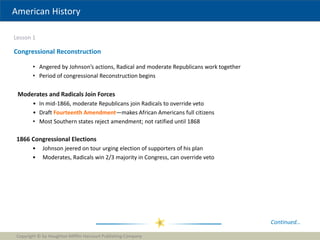
Congressional Reconstruction
• Angered by Johnson’s actions, Radical and moderate Republicans work together
• Period of congressional Reconstruction begins
Moderates and Radicals Join Forces
• In mid-1866, moderate Republicans join Radicals to override veto
• Draft Fourteenth Amendment—makes African Americans full citizens
• Most Southern states reject amendment; not ratified until 1868
Continued…
1866 Congressional Elections
• Johnson jeered on tour urging election of supporters of his plan
• Moderates, Radicals win 2/3 majority in Congress, can override veto
American History
Lesson 1
Copyright © by Houghton Mifflin Harcourt Publishing Company
9
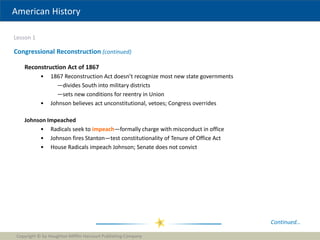
Congressional Reconstruction (continued)
Continued…
Reconstruction Act of 1867
• 1867 Reconstruction Act doesn’t recognize most new state governments
—divides South into military districts
—sets new conditions for reentry in Union
• Johnson believes act unconstitutional, vetoes; Congress overrides
Johnson Impeached
• Radicals seek to impeach—formally charge with misconduct in office
• Johnson fires Stanton—test constitutionality of Tenure of Office Act
• House Radicals impeach Johnson; Senate does not convict
American History
Lesson 1
Copyright © by Houghton Mifflin Harcourt Publishing Company
10
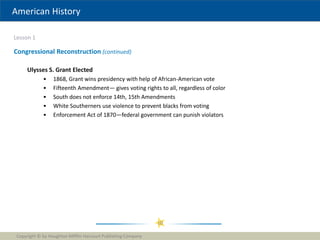
Congressional Reconstruction (continued)
Ulysses S. Grant Elected
• 1868, Grant wins presidency with help of African-American vote
• Fifteenth Amendment— gives voting rights to all, regardless of color
• South does not enforce 14th, 15th Amendments
• White Southerners use violence to prevent blacks from voting
• Enforcement Act of 1870—federal government can punish violators
American History
Copyright © by Houghton Mifflin Harcourt Publishing Company
11
Reconstructing the South
Lesson 2
Various groups contribute to the rebuilding of southern society after the war.
American History
Copyright © by Houghton Mifflin Harcourt Publishing Company
12
Reconstructing the South
Lesson 2
Conditions in the Postwar South
• The war leaves much of the South in ruins; economy in shambles
• Southerners endure interference by northerners who move in to help reconstruct region
Northerners Move South
• Floods of Northerners with mixed motives migrate into war-torn South
—some feel moral duty to help slaves;
—some seek southern government positions;
—others want to invest, buy land, start new industries legitimately
—some dishonest, greedy businesspeople and politicians seek to profit on misfortunes in South
• Most white southerners mistrust all new northern arrivals
• Southern Democrats refer to new northerners as carpetbaggers
American History
Lesson 2
Copyright © by Houghton Mifflin Harcourt Publishing Company
13
Politics in the Postwar South
• Democratic Party loses influence in southern politics with demise of Confederacy
• Republican Party sweeps in to take control of the region
Continued…
The Republicans in Charge
• Southern Republican Party during Reconstruction consists of:
—carpetbaggers, newly freed African Americans, number of white
• southerners Democrats call Southern white Republicans scalawags
• Three groups disagree on issues; many return to Democratic Party
American History
Lesson 2
Copyright © by Houghton Mifflin Harcourt Publishing Company
14
Politics in the Postwar South (continued)
New Republican Governments
• Southern states need to create new government, constitution for readmission to Union
• Southern voters elect new, Republican-dominated governments in the 1860s
• New leaders abolish property requirements for voting, holding office
• Repeal black codes throughout South
• Transportation; homes for orphans, disabled; public schools built
• Northern capitalists do not invest in South; states must raise taxes
• By 1870, all Confederate states are back in the Union
Ongoing Conflicts
• Republican governors appoint Democrats; do not win white support
• Some whites support Republicans; think end of slavery good for South
• Many whites refuse to accept new status or equal rights for blacks
American History
Lesson 2
Copyright © by Houghton Mifflin Harcourt Publishing Company
15
Changes in the Southern Economy
• Plantation system collapses after Civil War
• Backbone of southern society, economy are gone
Restoration of Plantations
• African Americans, poor whites want small farms
• Planters, Northern merchants, mill owners want cotton plantations
• Planters fear will be unable to make profit if must pay wages
• Freedmen work in mills, railroad, farming
—planters prevent them getting land
Continued…
American History
Lesson 2
Copyright © by Houghton Mifflin Harcourt Publishing Company
16
Changes in the Southern Economy
Industrial Growth
• South’s railroad system improves; links to northern lines
• Atlanta, other cities become important business centers
• Southern business leaders join with northern investors in manufacturing ventures
• By late 1880s, southern industry shows major growth
American History
Copyright © by Houghton Mifflin Harcourt Publishing Company
17
Life After Slavery
Lesson 3
During Reconstruction, African Americans gain new political and social rights but still
face discrimination in many areas.
American History
Copyright © by Houghton Mifflin Harcourt Publishing Company
18
Life After Slavery
Lesson 3
Adjusting to Freedom
• African Americans look forward to a new life after Thirteenth Amendment abolishes slavery
Continued…
Uncertain Status
• At first, former slaves cautious about testing limits of freedom
• Some travel to new places
• Many leave plantations to find work in Southern towns or; many head north for new
opportunities
• Many choose to change their slaves names for new
American History
Lesson 3
Copyright © by Houghton Mifflin Harcourt Publishing Company
19
Adjusting to Freedom (continued)
Reunification of Families
• Many search for loved ones on different plantations
• Couples can marry legally and be sure of keeping their children
Education
• Freed people of all ages seek education
• African Americans establish schools and universities
• Initially, most teachers Northern whites; by 1869, most are black
Churches and Volunteer Groups
• Many African Americans found churches; mostly Baptist, Methodist
• Black ministers become influential community leaders
• African Americans form thousands of volunteer organizations:
—foster independence
—give financial, emotional support
—offer leadership opportunities
American History
Lesson 3
Copyright © by Houghton Mifflin Harcourt Publishing Company
20
New Roles in Politics
• Political opportunities for African Americans—greatest gain following the Civil War
• Many hope to improve, protect newfound freedoms through political activity
Continued…
African Americans as Voters
• African Americans are largest group of southern Republicans
• Eager to exercise voting rights; almost 90% voted
Politics and African Americans
• 1865–1877, African Americans hold local, state, federal office
• At first, most officeholders freeborn; by 1867 some former slaves
• Almost as many black as white citizens; black officeholders minority
—Hiram Revels is first black senator
—only 16 African Americans in Congress
American History
Lesson 3
Copyright © by Houghton Mifflin Harcourt Publishing Company
21
New Roles in Politics (continued)
Laws Against Segregation
• By 1866, Republican governments repeal most black codes
• Anti-segregation laws created, but many not enforced
• Blacks focus on building up their community, not total integration
American History
Lesson 3
Copyright © by Houghton Mifflin Harcourt Publishing Company
22
Economic Opportunities
• End of slavery brings chances for new economic life, opportunities
• Freed slaves seek new jobs, often away from plantations, some build new lives closer to home
In Search of New Jobs
• Thousands of former slaves eager to leave plantations
• Most move to southern towns and cities to find jobs
• Smaller numbers move to the North
• Often, all cities offer only segregation, poor housing, low pay
• Majority remain in rural south; some work for former owners, receive wages
• Others in south are determined to build farms for themselves
Continued…
American History
Lesson 3
Copyright © by Houghton Mifflin Harcourt Publishing Company
23
Economic Opportunities (continued)
Continued…
40 Acres and a Mule
• Sherman: slaves who follow him can have 40 acres, use of army mules
—freed slaves settle on abandoned land
—Johnson orders them evicted
• Many Republicans reject seizing property; pass weak land-reform laws
• 1866 Homestead Act—set aside 44 million acres for freed blacks, loyal whites
—land is swampy, unsuitable for farming; few had resources to successfully farm
• Many African Americans find landowners unwilling to sell to them
• Some find ways to purchase; by 1870, 1 out of 12 African American families in MS own land
American History
Lesson 3
Copyright © by Houghton Mifflin Harcourt Publishing Company
24
Economic Opportunities (continued)
Sharecropping and Tenant Farming
• Landless African Americans sign labor contracts with planters
—neither freedmen nor planters happy with system
• Sharecropping—owner gives land, seed, tools for part of crops
• Tenant farming—rent land from owner; buy own tools
• Constant cycle of debt for all involved
American History
Copyright © by Houghton Mifflin Harcourt Publishing Company
25
The Collapse of Reconstruction
Lesson 4
Southern opposition to Radical Reconstruction, along with economic problems in the
North, ended Reconstruction.
American History
Copyright © by Houghton Mifflin Harcourt Publishing Company
26
The Collapse of Reconstruction
Lesson 4
Opposition to Reconstruction
• Most white southerners accept African Americans’ change in status
• Small groups of individuals rely on violence to keep African Americans away from politics
Ku Klux Klan
• Ku Klux Klan (KKK)—Confederate veterans group that turns terrorist
• Grows rapidly; aims to restore white supremacy
• 1868–1871 Klan, others kill thousands, burn schools, churches, homes
• Klan works to force Republican state governments out of power
• Southern Democrats use violence to intimidate black voters
• White Democratic candidates win state elections in 1875, 1876
Continued…
American History
Lesson 4
Copyright © by Houghton Mifflin Harcourt Publishing Company
27
Opposition to Reconstruction (continued)
Economic Pressure
• Black landowners, non-farmers attacked, have property destroyed
• Need forces freedmen into wage labor, sharecropping for whites
Legislative Response
• 1870, 1871 Enforcement Acts passed to curtail Klan, Democrats
—Supreme Court rules 1871 act unconstitutional
• Klan violence decreases because restore white supremacy in South
Shifts in Political Power
• 1872 Amnesty Act returns voting rights to many former Confederates
• Congress allows Freedmen’s Bureau to expire
American History
Lesson 4
Copyright © by Houghton Mifflin Harcourt Publishing Company
28
Scandals Hurt Republicans
• Highly publicized political corruption weakens Republican party
• Scandals plague Grant administration; divert public attention away from South
Fraud and Bribery
• Grant considered honest; appoints friends to political office
• Beginning in 1872, series of Grant administration scandals exposed
Republican Unity Shattered
• 1872, Liberal Republican Party forms, nominates Horace Greeley
• Democrats also nominate Greeley; Grant wins by wide margin
• Liberal Republicans weaken Radicals, make Reconstruction difficult
Continued Scandal
• Administration corruption continues; Grant does not seek reelection
American History
Lesson 4
Copyright © by Houghton Mifflin Harcourt Publishing Company
29
Economic Turmoil
• Two economic crises further weaken the Republicans’ position
The Panic of 1873
• Business opportunities in South lead investors to excessive debt
• Largest government securities dealer bankrupts, starts panic of 1873
—banks, businesses close; stock market collapses
• Panic triggers 5-year economic depression
• Americans blame Republicans; Democrats win majority of Congressional seats in 1874
Currency Dispute
• Panic of 1873 fuels dispute over currency
—financial experts want return to gold standard
—South, West want more greenbacks to pay debts
• 1875, Specie Resumption Act puts country back on gold standard
American History
Lesson 4
Copyright © by Houghton Mifflin Harcourt Publishing Company
30
Judicial and Popular Support Fades
• Supreme Court begins to undo Radicals’ social, political changes
Supreme Court Decisions
• 1870s Supreme Court decisions undermine 14th, 15th Amendments
• Federal government loses power to protect African-American rights
Northern Support Fades
• Northerners grow indifferent to events in South:
—shift attention to national problems
—want reconciliation between regions
—begin to dislike Reconstruction policies
• Republicans give up from lack of judicial, public support, leaders
• Republicans conclude government cannot impose moral, social changes
American History
Lesson 4
Copyright © by Houghton Mifflin Harcourt Publishing Company
31
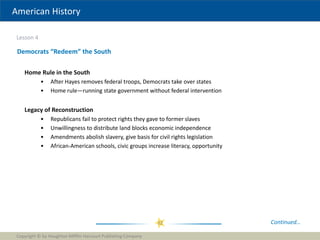
Democrats “Redeem” the South
• Redemption—return of Democrats to power in the South, 1869-1875
Continued…
Election of 1876
• Republicans nominate Governor Rutherford B. Hayes, not Grant
• Democrats choose Governor Samuel J. Tilden
• Tilden wins popular vote, 1 shy of electoral; 20 electoral disputed
• Compromise of 1877—Hayes gets presidency, Democrats get:
—federal troops leave LA, SC
—funding for Southern railroad, waterways
—conservative Southerner in cabinet
• Compromise means end of Reconstruction
American History
Lesson 4
Copyright © by Houghton Mifflin Harcourt Publishing Company
32
Democrats “Redeem” the South
Continued…
Home Rule in the South
• After Hayes removes federal troops, Democrats take over states
• Home rule—running state government without federal intervention
Legacy of Reconstruction
• Republicans fail to protect rights they gave to former slaves
• Unwillingness to distribute land blocks economic independence
• Amendments abolish slavery, give basis for civil rights legislation
• African-American schools, civic groups increase literacy, opportunity
American History
This is the end of the chapter presentation of lecture notes.
Click the HOME or EXIT button.
Copyright © by Houghton Mifflin Harcourt Publishing Company
33
American History
1. On the File menu, select Print
2. In the pop-up menu, select Microsoft
PowerPoint If the dialog box does not
include this pop-up, continue to step 4
3. In the Print what box, choose the
presentation format you want to print:
slides, notes, handouts, or outline
4. Click the Print button to print the
PowerPoint presentation
Copyright © by Houghton Mifflin Harcourt Publishing Company
34
Print Slide Show

Teacher Notes MODULE 10.pptx

  • 1.
    American History Reconstruction Copyright ©by Houghton Mifflin Harcourt Publishing Company 1 The U.S. begins to rebuild the South, but former slaves face new challenges as support fades for the policies of Reconstruction.
  • 2.
    American History ESSENTIAL QUESTION Reconstruction Copyright© by Houghton Mifflin Harcourt Publishing Company 2 LESSON 1 LESSON 2 Reconstructing the South LESSON 3 Life After Slavery Did the government’s decisions during Reconstruction help or hinder the rebuilding of the South? LESSON 4 The Collapse of Reconstruction The Politics of Reconstruction LESSON 3 LESSON 3
  • 3.
    American History Copyright ©by Houghton Mifflin Harcourt Publishing Company 3 The Politics of Reconstruction Lesson 1 Congress opposes Lincoln’s and Johnson’s plans for Reconstruction and instead implements its own plan to rebuild the South.
  • 4.
    American History Copyright ©by Houghton Mifflin Harcourt Publishing Company 4 The Politics of Reconstruction Lesson 1 Lincoln’s Plan for Reconstruction • Reconstruction: period of rebuilding after Civil War, 1865–1877 —process used by federal government to readmit Confederate states The Need for Reconstruction • Post-Civil War, leaders need to create programs to: —rebuild from devastation; reunite country —address those who had taken up arms against government —former slaves and their newly found freedom • Lincoln, Johnson have differing ideas on handling Reconstruction Continued…
  • 5.
    American History Lesson 1 Copyright© by Houghton Mifflin Harcourt Publishing Company 5 Lincoln’s Plan for Reconstruction (continued) Lincoln’s Ten-Percent Plan • Lincoln favors a lenient Reconstruction policy, easy return to Union for Southern states • Proclamation of Amnesty and Reconstruction calls for 10% allegiance —all Confederates receive pardons, except high-ranking officials; those accused of POW crimes • Those exceptions swear allegiance to Union • After 10% on the 1860 voting lists take oath of allegiance, Confederate state readmitted • Charles Sumner and Thaddeus Stevens lead Radical Republicans —want to destroy power of former slaveholders —give full citizenship, suffrage to African Americans Radical Reaction • 1864 Wade-Davis Bill makes Congress responsible for Reconstruction • Lincoln uses pocket veto to kill Wade-Davis; Radicals outraged
  • 6.
    American History Lesson 1 Copyright© by Houghton Mifflin Harcourt Publishing Company 6 Johnson’s Plan • Lincoln’s assassination leaves Andrew Johnson with Reconstruction controversy • Johnson intends to deal harshly with Confederate leaders • White southerners consider Johnson a traitor; Radicals believe he is one of them Johnson Continues Lincoln’s Policies • President Andrew Johnson proposes own Presidential Reconstruction: —states must swear allegiance, annul war debts, ratify 13th Amendment —does not address voting rights, land, laws for former slaves • States that had not applied under Lincoln agree to Johnson’s terms —some states do not fully comply Continued…
  • 7.
    American History Lesson 1 Copyright© by Houghton Mifflin Harcourt Publishing Company 7 Johnson’s Plan (continued) Presidential Reconstruction Comes to a Standstill • Radical Republicans in Congress refuse new Southern legislators • Congress enlarges Freedmen’s Bureau—helps former slaves, poor whites —gives social services, medical care, education • Congress passes Civil Rights Act of 1866: —grants citizenship to African Americans —forbids black codes or discriminatory laws • Black codes restore many restrictions of slavery • Whites use violence to prevent blacks from improving their lives • Johnson vetoes Freedmen’s Bureau and Civil Rights Act • Alienates moderate Republicans; angers Radicals
  • 8.
    American History Lesson 1 Copyright© by Houghton Mifflin Harcourt Publishing Company 8 Congressional Reconstruction • Angered by Johnson’s actions, Radical and moderate Republicans work together • Period of congressional Reconstruction begins Moderates and Radicals Join Forces • In mid-1866, moderate Republicans join Radicals to override veto • Draft Fourteenth Amendment—makes African Americans full citizens • Most Southern states reject amendment; not ratified until 1868 Continued… 1866 Congressional Elections • Johnson jeered on tour urging election of supporters of his plan • Moderates, Radicals win 2/3 majority in Congress, can override veto
  • 9.
    American History Lesson 1 Copyright© by Houghton Mifflin Harcourt Publishing Company 9 Congressional Reconstruction (continued) Continued… Reconstruction Act of 1867 • 1867 Reconstruction Act doesn’t recognize most new state governments —divides South into military districts —sets new conditions for reentry in Union • Johnson believes act unconstitutional, vetoes; Congress overrides Johnson Impeached • Radicals seek to impeach—formally charge with misconduct in office • Johnson fires Stanton—test constitutionality of Tenure of Office Act • House Radicals impeach Johnson; Senate does not convict
  • 10.
    American History Lesson 1 Copyright© by Houghton Mifflin Harcourt Publishing Company 10 Congressional Reconstruction (continued) Ulysses S. Grant Elected • 1868, Grant wins presidency with help of African-American vote • Fifteenth Amendment— gives voting rights to all, regardless of color • South does not enforce 14th, 15th Amendments • White Southerners use violence to prevent blacks from voting • Enforcement Act of 1870—federal government can punish violators
  • 11.
    American History Copyright ©by Houghton Mifflin Harcourt Publishing Company 11 Reconstructing the South Lesson 2 Various groups contribute to the rebuilding of southern society after the war.
  • 12.
    American History Copyright ©by Houghton Mifflin Harcourt Publishing Company 12 Reconstructing the South Lesson 2 Conditions in the Postwar South • The war leaves much of the South in ruins; economy in shambles • Southerners endure interference by northerners who move in to help reconstruct region Northerners Move South • Floods of Northerners with mixed motives migrate into war-torn South —some feel moral duty to help slaves; —some seek southern government positions; —others want to invest, buy land, start new industries legitimately —some dishonest, greedy businesspeople and politicians seek to profit on misfortunes in South • Most white southerners mistrust all new northern arrivals • Southern Democrats refer to new northerners as carpetbaggers
  • 13.
    American History Lesson 2 Copyright© by Houghton Mifflin Harcourt Publishing Company 13 Politics in the Postwar South • Democratic Party loses influence in southern politics with demise of Confederacy • Republican Party sweeps in to take control of the region Continued… The Republicans in Charge • Southern Republican Party during Reconstruction consists of: —carpetbaggers, newly freed African Americans, number of white • southerners Democrats call Southern white Republicans scalawags • Three groups disagree on issues; many return to Democratic Party
  • 14.
    American History Lesson 2 Copyright© by Houghton Mifflin Harcourt Publishing Company 14 Politics in the Postwar South (continued) New Republican Governments • Southern states need to create new government, constitution for readmission to Union • Southern voters elect new, Republican-dominated governments in the 1860s • New leaders abolish property requirements for voting, holding office • Repeal black codes throughout South • Transportation; homes for orphans, disabled; public schools built • Northern capitalists do not invest in South; states must raise taxes • By 1870, all Confederate states are back in the Union Ongoing Conflicts • Republican governors appoint Democrats; do not win white support • Some whites support Republicans; think end of slavery good for South • Many whites refuse to accept new status or equal rights for blacks
  • 15.
    American History Lesson 2 Copyright© by Houghton Mifflin Harcourt Publishing Company 15 Changes in the Southern Economy • Plantation system collapses after Civil War • Backbone of southern society, economy are gone Restoration of Plantations • African Americans, poor whites want small farms • Planters, Northern merchants, mill owners want cotton plantations • Planters fear will be unable to make profit if must pay wages • Freedmen work in mills, railroad, farming —planters prevent them getting land Continued…
  • 16.
    American History Lesson 2 Copyright© by Houghton Mifflin Harcourt Publishing Company 16 Changes in the Southern Economy Industrial Growth • South’s railroad system improves; links to northern lines • Atlanta, other cities become important business centers • Southern business leaders join with northern investors in manufacturing ventures • By late 1880s, southern industry shows major growth
  • 17.
    American History Copyright ©by Houghton Mifflin Harcourt Publishing Company 17 Life After Slavery Lesson 3 During Reconstruction, African Americans gain new political and social rights but still face discrimination in many areas.
  • 18.
    American History Copyright ©by Houghton Mifflin Harcourt Publishing Company 18 Life After Slavery Lesson 3 Adjusting to Freedom • African Americans look forward to a new life after Thirteenth Amendment abolishes slavery Continued… Uncertain Status • At first, former slaves cautious about testing limits of freedom • Some travel to new places • Many leave plantations to find work in Southern towns or; many head north for new opportunities • Many choose to change their slaves names for new
  • 19.
    American History Lesson 3 Copyright© by Houghton Mifflin Harcourt Publishing Company 19 Adjusting to Freedom (continued) Reunification of Families • Many search for loved ones on different plantations • Couples can marry legally and be sure of keeping their children Education • Freed people of all ages seek education • African Americans establish schools and universities • Initially, most teachers Northern whites; by 1869, most are black Churches and Volunteer Groups • Many African Americans found churches; mostly Baptist, Methodist • Black ministers become influential community leaders • African Americans form thousands of volunteer organizations: —foster independence —give financial, emotional support —offer leadership opportunities
  • 20.
    American History Lesson 3 Copyright© by Houghton Mifflin Harcourt Publishing Company 20 New Roles in Politics • Political opportunities for African Americans—greatest gain following the Civil War • Many hope to improve, protect newfound freedoms through political activity Continued… African Americans as Voters • African Americans are largest group of southern Republicans • Eager to exercise voting rights; almost 90% voted Politics and African Americans • 1865–1877, African Americans hold local, state, federal office • At first, most officeholders freeborn; by 1867 some former slaves • Almost as many black as white citizens; black officeholders minority —Hiram Revels is first black senator —only 16 African Americans in Congress
  • 21.
    American History Lesson 3 Copyright© by Houghton Mifflin Harcourt Publishing Company 21 New Roles in Politics (continued) Laws Against Segregation • By 1866, Republican governments repeal most black codes • Anti-segregation laws created, but many not enforced • Blacks focus on building up their community, not total integration
  • 22.
    American History Lesson 3 Copyright© by Houghton Mifflin Harcourt Publishing Company 22 Economic Opportunities • End of slavery brings chances for new economic life, opportunities • Freed slaves seek new jobs, often away from plantations, some build new lives closer to home In Search of New Jobs • Thousands of former slaves eager to leave plantations • Most move to southern towns and cities to find jobs • Smaller numbers move to the North • Often, all cities offer only segregation, poor housing, low pay • Majority remain in rural south; some work for former owners, receive wages • Others in south are determined to build farms for themselves Continued…
  • 23.
    American History Lesson 3 Copyright© by Houghton Mifflin Harcourt Publishing Company 23 Economic Opportunities (continued) Continued… 40 Acres and a Mule • Sherman: slaves who follow him can have 40 acres, use of army mules —freed slaves settle on abandoned land —Johnson orders them evicted • Many Republicans reject seizing property; pass weak land-reform laws • 1866 Homestead Act—set aside 44 million acres for freed blacks, loyal whites —land is swampy, unsuitable for farming; few had resources to successfully farm • Many African Americans find landowners unwilling to sell to them • Some find ways to purchase; by 1870, 1 out of 12 African American families in MS own land
  • 24.
    American History Lesson 3 Copyright© by Houghton Mifflin Harcourt Publishing Company 24 Economic Opportunities (continued) Sharecropping and Tenant Farming • Landless African Americans sign labor contracts with planters —neither freedmen nor planters happy with system • Sharecropping—owner gives land, seed, tools for part of crops • Tenant farming—rent land from owner; buy own tools • Constant cycle of debt for all involved
  • 25.
    American History Copyright ©by Houghton Mifflin Harcourt Publishing Company 25 The Collapse of Reconstruction Lesson 4 Southern opposition to Radical Reconstruction, along with economic problems in the North, ended Reconstruction.
  • 26.
    American History Copyright ©by Houghton Mifflin Harcourt Publishing Company 26 The Collapse of Reconstruction Lesson 4 Opposition to Reconstruction • Most white southerners accept African Americans’ change in status • Small groups of individuals rely on violence to keep African Americans away from politics Ku Klux Klan • Ku Klux Klan (KKK)—Confederate veterans group that turns terrorist • Grows rapidly; aims to restore white supremacy • 1868–1871 Klan, others kill thousands, burn schools, churches, homes • Klan works to force Republican state governments out of power • Southern Democrats use violence to intimidate black voters • White Democratic candidates win state elections in 1875, 1876 Continued…
  • 27.
    American History Lesson 4 Copyright© by Houghton Mifflin Harcourt Publishing Company 27 Opposition to Reconstruction (continued) Economic Pressure • Black landowners, non-farmers attacked, have property destroyed • Need forces freedmen into wage labor, sharecropping for whites Legislative Response • 1870, 1871 Enforcement Acts passed to curtail Klan, Democrats —Supreme Court rules 1871 act unconstitutional • Klan violence decreases because restore white supremacy in South Shifts in Political Power • 1872 Amnesty Act returns voting rights to many former Confederates • Congress allows Freedmen’s Bureau to expire
  • 28.
    American History Lesson 4 Copyright© by Houghton Mifflin Harcourt Publishing Company 28 Scandals Hurt Republicans • Highly publicized political corruption weakens Republican party • Scandals plague Grant administration; divert public attention away from South Fraud and Bribery • Grant considered honest; appoints friends to political office • Beginning in 1872, series of Grant administration scandals exposed Republican Unity Shattered • 1872, Liberal Republican Party forms, nominates Horace Greeley • Democrats also nominate Greeley; Grant wins by wide margin • Liberal Republicans weaken Radicals, make Reconstruction difficult Continued Scandal • Administration corruption continues; Grant does not seek reelection
  • 29.
    American History Lesson 4 Copyright© by Houghton Mifflin Harcourt Publishing Company 29 Economic Turmoil • Two economic crises further weaken the Republicans’ position The Panic of 1873 • Business opportunities in South lead investors to excessive debt • Largest government securities dealer bankrupts, starts panic of 1873 —banks, businesses close; stock market collapses • Panic triggers 5-year economic depression • Americans blame Republicans; Democrats win majority of Congressional seats in 1874 Currency Dispute • Panic of 1873 fuels dispute over currency —financial experts want return to gold standard —South, West want more greenbacks to pay debts • 1875, Specie Resumption Act puts country back on gold standard
  • 30.
    American History Lesson 4 Copyright© by Houghton Mifflin Harcourt Publishing Company 30 Judicial and Popular Support Fades • Supreme Court begins to undo Radicals’ social, political changes Supreme Court Decisions • 1870s Supreme Court decisions undermine 14th, 15th Amendments • Federal government loses power to protect African-American rights Northern Support Fades • Northerners grow indifferent to events in South: —shift attention to national problems —want reconciliation between regions —begin to dislike Reconstruction policies • Republicans give up from lack of judicial, public support, leaders • Republicans conclude government cannot impose moral, social changes
  • 31.
    American History Lesson 4 Copyright© by Houghton Mifflin Harcourt Publishing Company 31 Democrats “Redeem” the South • Redemption—return of Democrats to power in the South, 1869-1875 Continued… Election of 1876 • Republicans nominate Governor Rutherford B. Hayes, not Grant • Democrats choose Governor Samuel J. Tilden • Tilden wins popular vote, 1 shy of electoral; 20 electoral disputed • Compromise of 1877—Hayes gets presidency, Democrats get: —federal troops leave LA, SC —funding for Southern railroad, waterways —conservative Southerner in cabinet • Compromise means end of Reconstruction
  • 32.
    American History Lesson 4 Copyright© by Houghton Mifflin Harcourt Publishing Company 32 Democrats “Redeem” the South Continued… Home Rule in the South • After Hayes removes federal troops, Democrats take over states • Home rule—running state government without federal intervention Legacy of Reconstruction • Republicans fail to protect rights they gave to former slaves • Unwillingness to distribute land blocks economic independence • Amendments abolish slavery, give basis for civil rights legislation • African-American schools, civic groups increase literacy, opportunity
  • 33.
    American History This isthe end of the chapter presentation of lecture notes. Click the HOME or EXIT button. Copyright © by Houghton Mifflin Harcourt Publishing Company 33
  • 34.
    American History 1. Onthe File menu, select Print 2. In the pop-up menu, select Microsoft PowerPoint If the dialog box does not include this pop-up, continue to step 4 3. In the Print what box, choose the presentation format you want to print: slides, notes, handouts, or outline 4. Click the Print button to print the PowerPoint presentation Copyright © by Houghton Mifflin Harcourt Publishing Company 34 Print Slide Show