


American History
Westward Expansion
Copyright © by Houghton Mifflin Harcourt Publishing Company
1
The culture of the Plains Indians declines as white settlers transform the Great
Plains. Meanwhile, farmers form the Populist movement to address their economic
concerns.
American History
ESSENTIAL QUESTION
Westward Expansion
Copyright © by Houghton Mifflin Harcourt Publishing Company
2
Cultures Clash on the Prairie
LESSON 1
LESSON 2 Mining and Ranching
LESSON 3 Settling on the Great Plains
LESSON 4 Farmers and the Populist Movement
Was the “settlement” of the American western frontier inevitable?
American History
Copyright © by Houghton Mifflin Harcourt Publishing Company
3
Cultures Clash on the Prairie
Lesson 1
As the government encourages white settlers to move West, the culture of the Plains
Indians declines.
American History
Copyright © by Houghton Mifflin Harcourt Publishing Company
4
Cultures Clash on the Prairie
Lesson 1
The Culture of the Plains Indians
Continued…
• Great Plains—grasslands in west-central portion of the U.S.
• East: hunting, farming villages; west: nomadic hunting, gathering
The Horse and the Buffalo
• Horses, guns lead most Plains tribes to nomadic life by mid-1700s
• Trespassing others’ hunting lands causes war; count coup for status
• Buffalo provides many basic needs:
— worship without formal ministers
— meat used for jerky, pemmican
American History
Lesson 1
Copyright © by Houghton Mifflin Harcourt Publishing Company
5
The Culture of the Plains Indians(continued)
Family Life
• Form family groups with ties to other bands that speak same language
• Men are hunters, warriors; women butcher meat, prepare hides
• Believe in powerful spirits that control natural world
— men or women can become shamans
• Children learn through myths, stories, games, example
• Communal life; leaders rule by counsel
American History
Lesson 1
Copyright © by Houghton Mifflin Harcourt Publishing Company
6
The Government Restricts Native Americans
• Native Americans: land cannot be owned; settlers: want to own land
• Settlers think natives forfeited land because did not improve it
• Since consider land unsettled, migrants go west to claim it
Massacre at Sand Creek
• Troops kill over 150 Cheyenne, Arapaho at Sand Creek winter camp
• 1834, government designates Great Plains as one huge reservation
• 1850s, treaties define specific boundaries for each tribe
Continued…
American History
Lesson 1
Copyright © by Houghton Mifflin Harcourt Publishing Company
7
The Government Restricts Native Americans (continued)
Death on the Bozeman Trail
• Bozeman Trail crosses Sioux hunting grounds
— men or women can become shamans
• Treaty of Fort Laramie—U.S. closes trail; Sioux to reservation
• Sitting Bull, leader of Hunkpapa Sioux, does not sign treaty
American History
Lesson 1
Copyright © by Houghton Mifflin Harcourt Publishing Company
8
Bloody Battles Continue
• Conflicts continue as settlers move westward and Native Americans resist
Red River War
• 1868, Kiowa, Comanche engage in 6 years of raiding
• 1874–1875, U. S. Army crushes resistance on Plains in Red River War
Gold Rush
• 1874 George A. Custer reports much gold in Black Hills, rush begins
Custer’s Last Stand
• 1876, Sitting Bull has vision of war at sun dance
• Sitting Bull, Crazy Horse, Gall crush Custer’s troops
• By late 1876, Sioux are defeated; some take refuge in Canada
— people starving; Sitting Bull surrenders 1881
American History
Lesson 1
Copyright © by Houghton Mifflin Harcourt Publishing Company
9
The Government Supports Assimilation
• Government encourages Native Americans to abandon traditions, live like white Americans
Americanization
• Assimilation—natives to give up way of life, join white culture
• 1881, Helen Hunt Jackson exposes problems in A Century of Dishonor
The Destruction of the Buffalo
• Destruction of buffalo most significant blow to tribal life
• Tourists, fur traders shoot for sport, destroy buffalo population
Continued…
American History
Lesson 1
Copyright © by Houghton Mifflin Harcourt Publishing Company
10
The Government Supports Assimilation (continued)
The Dawes Act
• 1887, Dawes Act to “Americanize” natives, break up reservations
— gives land to individual Native Americans
— sell remainder of land to settlers
— money for farm implements for natives
• In the end, Natives Americans receive only 1/3 of land, no money
American History
Lesson 1
Copyright © by Houghton Mifflin Harcourt Publishing Company
11
The Battle of Wounded Knee
Wounded Knee
• Ghost Dance—ritual to regain lost lands
— spreads among Sioux on Dakota reservation
• Dec. 1890, Sitting Bull is killed when police try to arrest him
• Seventh Cavalry takes about 350 Sioux to Wounded Knee Creek
• Battle of Wounded Knee—cavalry kill 300 unarmed Native Americans
• Battle ends Indian wars, Sioux dream of regaining old life
American History
Copyright © by Houghton Mifflin Harcourt Publishing Company
12
Mining and Ranching
Lesson 2
The mining and cattle booms of the American West sent many people on a quest for
wealth.
American History
Copyright © by Houghton Mifflin Harcourt Publishing Company
13
Mining and Ranching
Lesson 2
The Lure of Silver and Gold
Continued…
• The prospect of striking it rich attracts many to the West
The Mining Boom
• 1858 discovery of gold in Colorado draws tens of thousands
• Mining camps, tiny frontier towns have filthy, ramshackle dwellings
• Miners at Comstock Lode make nearly $500 million
• Fortune seekers of different cultures, races; mostly men
Difficult Work
• Miners use placer mining techniques such as panning and sluicing at surface level
• Hydraulic mining and hard-rock mining methods use extraction equipment
• Miners face collapsing tunnels, extreme temperatures, and explosions
American History
Lesson 2
Copyright © by Houghton Mifflin Harcourt Publishing Company
14
The Lure of Silver and Gold (continued)
Injustices of the West
• No law enforcement in camps
— violence and thefts
— immigrants wrongly accused
— hangings after unofficial “trials”
• Native Americans and Mexican Americans continue to lose their land
American History
Lesson 2
Copyright © by Houghton Mifflin Harcourt Publishing Company
15
Cattle Become Big Business
• Great Plains open up for big business; ranching becomes profitable investment
Vaqueros and Cowboys
• American settlers learn to manage large herds from Mexican vaqueros
— adopt way of life, clothing, vocabulary
• Texas longhorns—sturdy, short-tempered breeds brought by Spanish
• Cowboys not in demand until railroads reach Great Plains
Growing Demand for Beef
• After Civil War demand for meat increases in rapidly growing cities
Continued…
American History
Lesson 2
Copyright © by Houghton Mifflin Harcourt Publishing Company
16
Cattle Becomes Big Business (continued)
The Cow Town
• Cattlemen establish shipping yards where trails and rail lines meet
• Chisholm Trail becomes major cattle route from San Antonio to Kansas
American History
Lesson 2
Copyright © by Houghton Mifflin Harcourt Publishing Company
17
A Day in the Life of a Cowboy
• Romanticized American cowboy rides the open range, herds cattle and fights villains
• Real-life cowboys working nonstop
A Day’s Work
• 1866–1885, up to 55,000 cowboys on plains
— 25% African American, 12% Mexican
• Cowboy works 10–14 hours on ranch; 14 or more on trail
• Expert rider, roper; alert for dangers that may harm, upset cattle
Roundup
• During spring roundup, longhorns found, herded into corral
• Separate cattle marked with own ranch’s brand; brand calves
Continued…
American History
Lesson 2
Copyright © by Houghton Mifflin Harcourt Publishing Company
18
A Day in the Life of a Cowboy (continued)
The Long Drive
• Herding of animals or long drive lasts about 3 months
• Cowboy in saddle dawn to dusk; sleeps on ground; bathes in rivers
Legends of the West
• Celebrities like “Wild Bill” Hickok, Calamity Jane never handled cows
American History
Lesson 2
Copyright © by Houghton Mifflin Harcourt Publishing Company
19
The End of the Open Range
Changes in Ranching
• Overgrazing, bad weather from 1883 to 1887 destroy whole herds
• Ranchers keep smaller herds that yield more meat per animal
• Fence land with barbed wire; turn open range into separate ranches
American History
Copyright © by Houghton Mifflin Harcourt Publishing Company
20
Settling on the Great Plains
Lesson 3
Settlers on the Great Plains transform the land despite great hardships.
American History
Copyright © by Houghton Mifflin Harcourt Publishing Company
21
Settling on the Great Plains
Lesson 3
Settlers Move Westward to Farm
Continued…
• Federal land policy and the completion of transcontinental railroad lines open the West for
settlement
Railroads Open the West
• 1850–1871, huge land grants to railroads for laying track in West
• 1860s, Central Pacific goes east, Union Pacific west, meet in Utah
• By 1880s, 5 transcontinental railroads completed
• Railroads sell land to farmers, attract many European immigrants
American History
Lesson 3
Copyright © by Houghton Mifflin Harcourt Publishing Company
22
Settlers Move Westward to Farm (continued)
Government Support for Settlement
• 1862 Homestead Act offers 160 acres free to any head of household
— 1862–1900, up to 600,000 families settle
• Exodusters—Southern African-American settlers in Kansas
• Railroad, state agents, speculators profit; 10% of land to families
• Government strengthens act, passes new legislation for settlers
The Closing of the Frontier
• 1872, Yellowstone National Park created to protect some wilderness
• 1890s, no frontier left; some regret loss of unique American feature
American History
Lesson 3
Copyright © by Houghton Mifflin Harcourt Publishing Company
23
Settlers Meet the Challenges of the Plains
• Frontier settlers face extreme hardships
— Environmental: freezing winters, scorching summers, tornadoes, pests
— Social: loneliness, boredom, isolation
— Dangers: raids by outlaws, Native Americans, grueling farm work
Dugouts and Soddies
• Few trees, so many settlers dig homes into sides of ravines or hills
• In plains, make soddy or sod home by stacking blocks of turf
Women’s Work
• Homesteaders virtually alone, must be self-sufficient
• Women do men’s work—plowing, harvesting, shearing sheep
• Do traditional work—carding wool, making soap, canning vegetables
• Work for communities—sponsor schools, churches
Continued…
American History
Lesson 3
Copyright © by Houghton Mifflin Harcourt Publishing Company
24
Settlers Meet the Challenges of the Plains (continued)
Technical Support for Farmers
• Mass market for farm machines develops with migration to plains
Agricultural Education
• Morrill Acts of 1862, 1890 finances agricultural colleges
• 1887 Hatch Act creates agricultural experiment stations
Farmers in Debt
• Railroads, investors create bonanza farms— huge, single-crop spreads
• 1885–1890 droughts bankrupt single-crop operations
• Rising cost of shipping grain pushes farmers into debt
American History
Copyright © by Houghton Mifflin Harcourt Publishing Company
25
Farmers and the Populist Movement
Lesson 4
Farmers unite to address their economic problems, giving rise to the Populist
movement.
American History
Copyright © by Houghton Mifflin Harcourt Publishing Company
26
Farmers and the Populist Movement
Lesson 4
Farmers Unite to Address Common Problems
Continued…
• In the late 1800s many farmers are trapped in a vicious economic cycle
Economic Distress
• Farmers buy more land to grow more crops to pay off debts
• After Civil War, government takes greenbacks out of circulation
• Debtors have to pay loans in dollars worth more than those borrowed
• Prices of crops fall dramatically
• 1870s, debtors push government to put more money in circulation
• 1878 Bland-Allison Act—money supply increase not enough for farmers
American History
Lesson 4
Copyright © by Houghton Mifflin Harcourt Publishing Company
27
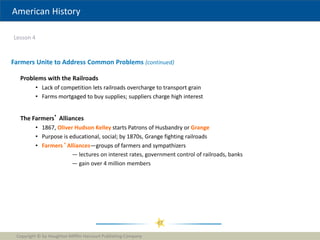
Farmers Unite to Address Common Problems (continued)
Problems with the Railroads
• Lack of competition lets railroads overcharge to transport grain
• Farms mortgaged to buy supplies; suppliers charge high interest
The Farmers’ Alliances
• 1867, Oliver Hudson Kelley starts Patrons of Husbandry or Grange
• Purpose is educational, social; by 1870s, Grange fighting railroads
• Farmers‘ Alliances—groups of farmers and sympathizers
— lectures on interest rates, government control of railroads, banks
— gain over 4 million members
American History
Lesson 4
Copyright © by Houghton Mifflin Harcourt Publishing Company
28
The Rise and Fall of Populism
• Leaders of the alliance movement realize the need for change; build a base for political power
The Populist Party Platform
• Populism—movement of the people; Populist Party wants reforms
• Economic: increase money supply, graduated income tax, federal loans
• Political: Senate elected by popular vote; secret ballot; 8-hour day
• 1892, Populist candidates elected at different levels of government
— Democratic Party eventually adopts platform
Continued…
American History
Lesson 4
Copyright © by Houghton Mifflin Harcourt Publishing Company
29
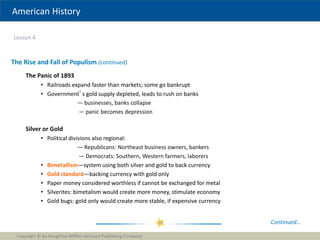
The Rise and Fall of Populism (continued)
The Panic of 1893
• Railroads expand faster than markets; some go bankrupt
• Government’s gold supply depleted, leads to rush on banks
— businesses, banks collapse
— panic becomes depression
Silver or Gold
• Political divisions also regional:
— Republicans: Northeast business owners, bankers
— Democrats: Southern, Western farmers, laborers
• Bimetallism—system using both silver and gold to back currency
• Gold standard—backing currency with gold only
• Paper money considered worthless if cannot be exchanged for metal
• Silverites: bimetalism would create more money, stimulate economy
• Gold bugs: gold only would create more stable, if expensive currency
Continued…
American History
Lesson 4
Copyright © by Houghton Mifflin Harcourt Publishing Company
30
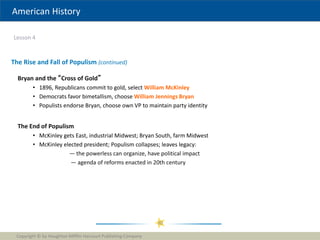
The Rise and Fall of Populism (continued)
Bryan and the “Cross of Gold”
• 1896, Republicans commit to gold, select William McKinley
• Democrats favor bimetallism, choose William Jennings Bryan
• Populists endorse Bryan, choose own VP to maintain party identity
The End of Populism
• McKinley gets East, industrial Midwest; Bryan South, farm Midwest
• McKinley elected president; Populism collapses; leaves legacy:
— the powerless can organize, have political impact
— agenda of reforms enacted in 20th century
American History
This is the end of the chapter presentation of lecture notes.
Click the HOME or EXIT button.
Copyright © by Houghton Mifflin Harcourt Publishing Company
31
American History
1. On the File menu, select Print
2. In the pop-up menu, select Microsoft
PowerPoint If the dialog box does not
include this pop-up, continue to step 4
3. In the Print what box, choose the
presentation format you want to print:
slides, notes, handouts, or outline
4. Click the Print button to print the
PowerPoint presentation
Copyright © by Houghton Mifflin Harcourt Publishing Company
32
Print Slide Show

Teacher Notes MODULE 11.pptx

  • 1.
    American History Westward Expansion Copyright© by Houghton Mifflin Harcourt Publishing Company 1 The culture of the Plains Indians declines as white settlers transform the Great Plains. Meanwhile, farmers form the Populist movement to address their economic concerns.
  • 2.
    American History ESSENTIAL QUESTION WestwardExpansion Copyright © by Houghton Mifflin Harcourt Publishing Company 2 Cultures Clash on the Prairie LESSON 1 LESSON 2 Mining and Ranching LESSON 3 Settling on the Great Plains LESSON 4 Farmers and the Populist Movement Was the “settlement” of the American western frontier inevitable?
  • 3.
    American History Copyright ©by Houghton Mifflin Harcourt Publishing Company 3 Cultures Clash on the Prairie Lesson 1 As the government encourages white settlers to move West, the culture of the Plains Indians declines.
  • 4.
    American History Copyright ©by Houghton Mifflin Harcourt Publishing Company 4 Cultures Clash on the Prairie Lesson 1 The Culture of the Plains Indians Continued… • Great Plains—grasslands in west-central portion of the U.S. • East: hunting, farming villages; west: nomadic hunting, gathering The Horse and the Buffalo • Horses, guns lead most Plains tribes to nomadic life by mid-1700s • Trespassing others’ hunting lands causes war; count coup for status • Buffalo provides many basic needs: — worship without formal ministers — meat used for jerky, pemmican
  • 5.
    American History Lesson 1 Copyright© by Houghton Mifflin Harcourt Publishing Company 5 The Culture of the Plains Indians(continued) Family Life • Form family groups with ties to other bands that speak same language • Men are hunters, warriors; women butcher meat, prepare hides • Believe in powerful spirits that control natural world — men or women can become shamans • Children learn through myths, stories, games, example • Communal life; leaders rule by counsel
  • 6.
    American History Lesson 1 Copyright© by Houghton Mifflin Harcourt Publishing Company 6 The Government Restricts Native Americans • Native Americans: land cannot be owned; settlers: want to own land • Settlers think natives forfeited land because did not improve it • Since consider land unsettled, migrants go west to claim it Massacre at Sand Creek • Troops kill over 150 Cheyenne, Arapaho at Sand Creek winter camp • 1834, government designates Great Plains as one huge reservation • 1850s, treaties define specific boundaries for each tribe Continued…
  • 7.
    American History Lesson 1 Copyright© by Houghton Mifflin Harcourt Publishing Company 7 The Government Restricts Native Americans (continued) Death on the Bozeman Trail • Bozeman Trail crosses Sioux hunting grounds — men or women can become shamans • Treaty of Fort Laramie—U.S. closes trail; Sioux to reservation • Sitting Bull, leader of Hunkpapa Sioux, does not sign treaty
  • 8.
    American History Lesson 1 Copyright© by Houghton Mifflin Harcourt Publishing Company 8 Bloody Battles Continue • Conflicts continue as settlers move westward and Native Americans resist Red River War • 1868, Kiowa, Comanche engage in 6 years of raiding • 1874–1875, U. S. Army crushes resistance on Plains in Red River War Gold Rush • 1874 George A. Custer reports much gold in Black Hills, rush begins Custer’s Last Stand • 1876, Sitting Bull has vision of war at sun dance • Sitting Bull, Crazy Horse, Gall crush Custer’s troops • By late 1876, Sioux are defeated; some take refuge in Canada — people starving; Sitting Bull surrenders 1881
  • 9.
    American History Lesson 1 Copyright© by Houghton Mifflin Harcourt Publishing Company 9 The Government Supports Assimilation • Government encourages Native Americans to abandon traditions, live like white Americans Americanization • Assimilation—natives to give up way of life, join white culture • 1881, Helen Hunt Jackson exposes problems in A Century of Dishonor The Destruction of the Buffalo • Destruction of buffalo most significant blow to tribal life • Tourists, fur traders shoot for sport, destroy buffalo population Continued…
  • 10.
    American History Lesson 1 Copyright© by Houghton Mifflin Harcourt Publishing Company 10 The Government Supports Assimilation (continued) The Dawes Act • 1887, Dawes Act to “Americanize” natives, break up reservations — gives land to individual Native Americans — sell remainder of land to settlers — money for farm implements for natives • In the end, Natives Americans receive only 1/3 of land, no money
  • 11.
    American History Lesson 1 Copyright© by Houghton Mifflin Harcourt Publishing Company 11 The Battle of Wounded Knee Wounded Knee • Ghost Dance—ritual to regain lost lands — spreads among Sioux on Dakota reservation • Dec. 1890, Sitting Bull is killed when police try to arrest him • Seventh Cavalry takes about 350 Sioux to Wounded Knee Creek • Battle of Wounded Knee—cavalry kill 300 unarmed Native Americans • Battle ends Indian wars, Sioux dream of regaining old life
  • 12.
    American History Copyright ©by Houghton Mifflin Harcourt Publishing Company 12 Mining and Ranching Lesson 2 The mining and cattle booms of the American West sent many people on a quest for wealth.
  • 13.
    American History Copyright ©by Houghton Mifflin Harcourt Publishing Company 13 Mining and Ranching Lesson 2 The Lure of Silver and Gold Continued… • The prospect of striking it rich attracts many to the West The Mining Boom • 1858 discovery of gold in Colorado draws tens of thousands • Mining camps, tiny frontier towns have filthy, ramshackle dwellings • Miners at Comstock Lode make nearly $500 million • Fortune seekers of different cultures, races; mostly men Difficult Work • Miners use placer mining techniques such as panning and sluicing at surface level • Hydraulic mining and hard-rock mining methods use extraction equipment • Miners face collapsing tunnels, extreme temperatures, and explosions
  • 14.
    American History Lesson 2 Copyright© by Houghton Mifflin Harcourt Publishing Company 14 The Lure of Silver and Gold (continued) Injustices of the West • No law enforcement in camps — violence and thefts — immigrants wrongly accused — hangings after unofficial “trials” • Native Americans and Mexican Americans continue to lose their land
  • 15.
    American History Lesson 2 Copyright© by Houghton Mifflin Harcourt Publishing Company 15 Cattle Become Big Business • Great Plains open up for big business; ranching becomes profitable investment Vaqueros and Cowboys • American settlers learn to manage large herds from Mexican vaqueros — adopt way of life, clothing, vocabulary • Texas longhorns—sturdy, short-tempered breeds brought by Spanish • Cowboys not in demand until railroads reach Great Plains Growing Demand for Beef • After Civil War demand for meat increases in rapidly growing cities Continued…
  • 16.
    American History Lesson 2 Copyright© by Houghton Mifflin Harcourt Publishing Company 16 Cattle Becomes Big Business (continued) The Cow Town • Cattlemen establish shipping yards where trails and rail lines meet • Chisholm Trail becomes major cattle route from San Antonio to Kansas
  • 17.
    American History Lesson 2 Copyright© by Houghton Mifflin Harcourt Publishing Company 17 A Day in the Life of a Cowboy • Romanticized American cowboy rides the open range, herds cattle and fights villains • Real-life cowboys working nonstop A Day’s Work • 1866–1885, up to 55,000 cowboys on plains — 25% African American, 12% Mexican • Cowboy works 10–14 hours on ranch; 14 or more on trail • Expert rider, roper; alert for dangers that may harm, upset cattle Roundup • During spring roundup, longhorns found, herded into corral • Separate cattle marked with own ranch’s brand; brand calves Continued…
  • 18.
    American History Lesson 2 Copyright© by Houghton Mifflin Harcourt Publishing Company 18 A Day in the Life of a Cowboy (continued) The Long Drive • Herding of animals or long drive lasts about 3 months • Cowboy in saddle dawn to dusk; sleeps on ground; bathes in rivers Legends of the West • Celebrities like “Wild Bill” Hickok, Calamity Jane never handled cows
  • 19.
    American History Lesson 2 Copyright© by Houghton Mifflin Harcourt Publishing Company 19 The End of the Open Range Changes in Ranching • Overgrazing, bad weather from 1883 to 1887 destroy whole herds • Ranchers keep smaller herds that yield more meat per animal • Fence land with barbed wire; turn open range into separate ranches
  • 20.
    American History Copyright ©by Houghton Mifflin Harcourt Publishing Company 20 Settling on the Great Plains Lesson 3 Settlers on the Great Plains transform the land despite great hardships.
  • 21.
    American History Copyright ©by Houghton Mifflin Harcourt Publishing Company 21 Settling on the Great Plains Lesson 3 Settlers Move Westward to Farm Continued… • Federal land policy and the completion of transcontinental railroad lines open the West for settlement Railroads Open the West • 1850–1871, huge land grants to railroads for laying track in West • 1860s, Central Pacific goes east, Union Pacific west, meet in Utah • By 1880s, 5 transcontinental railroads completed • Railroads sell land to farmers, attract many European immigrants
  • 22.
    American History Lesson 3 Copyright© by Houghton Mifflin Harcourt Publishing Company 22 Settlers Move Westward to Farm (continued) Government Support for Settlement • 1862 Homestead Act offers 160 acres free to any head of household — 1862–1900, up to 600,000 families settle • Exodusters—Southern African-American settlers in Kansas • Railroad, state agents, speculators profit; 10% of land to families • Government strengthens act, passes new legislation for settlers The Closing of the Frontier • 1872, Yellowstone National Park created to protect some wilderness • 1890s, no frontier left; some regret loss of unique American feature
  • 23.
    American History Lesson 3 Copyright© by Houghton Mifflin Harcourt Publishing Company 23 Settlers Meet the Challenges of the Plains • Frontier settlers face extreme hardships — Environmental: freezing winters, scorching summers, tornadoes, pests — Social: loneliness, boredom, isolation — Dangers: raids by outlaws, Native Americans, grueling farm work Dugouts and Soddies • Few trees, so many settlers dig homes into sides of ravines or hills • In plains, make soddy or sod home by stacking blocks of turf Women’s Work • Homesteaders virtually alone, must be self-sufficient • Women do men’s work—plowing, harvesting, shearing sheep • Do traditional work—carding wool, making soap, canning vegetables • Work for communities—sponsor schools, churches Continued…
  • 24.
    American History Lesson 3 Copyright© by Houghton Mifflin Harcourt Publishing Company 24 Settlers Meet the Challenges of the Plains (continued) Technical Support for Farmers • Mass market for farm machines develops with migration to plains Agricultural Education • Morrill Acts of 1862, 1890 finances agricultural colleges • 1887 Hatch Act creates agricultural experiment stations Farmers in Debt • Railroads, investors create bonanza farms— huge, single-crop spreads • 1885–1890 droughts bankrupt single-crop operations • Rising cost of shipping grain pushes farmers into debt
  • 25.
    American History Copyright ©by Houghton Mifflin Harcourt Publishing Company 25 Farmers and the Populist Movement Lesson 4 Farmers unite to address their economic problems, giving rise to the Populist movement.
  • 26.
    American History Copyright ©by Houghton Mifflin Harcourt Publishing Company 26 Farmers and the Populist Movement Lesson 4 Farmers Unite to Address Common Problems Continued… • In the late 1800s many farmers are trapped in a vicious economic cycle Economic Distress • Farmers buy more land to grow more crops to pay off debts • After Civil War, government takes greenbacks out of circulation • Debtors have to pay loans in dollars worth more than those borrowed • Prices of crops fall dramatically • 1870s, debtors push government to put more money in circulation • 1878 Bland-Allison Act—money supply increase not enough for farmers
  • 27.
    American History Lesson 4 Copyright© by Houghton Mifflin Harcourt Publishing Company 27 Farmers Unite to Address Common Problems (continued) Problems with the Railroads • Lack of competition lets railroads overcharge to transport grain • Farms mortgaged to buy supplies; suppliers charge high interest The Farmers’ Alliances • 1867, Oliver Hudson Kelley starts Patrons of Husbandry or Grange • Purpose is educational, social; by 1870s, Grange fighting railroads • Farmers‘ Alliances—groups of farmers and sympathizers — lectures on interest rates, government control of railroads, banks — gain over 4 million members
  • 28.
    American History Lesson 4 Copyright© by Houghton Mifflin Harcourt Publishing Company 28 The Rise and Fall of Populism • Leaders of the alliance movement realize the need for change; build a base for political power The Populist Party Platform • Populism—movement of the people; Populist Party wants reforms • Economic: increase money supply, graduated income tax, federal loans • Political: Senate elected by popular vote; secret ballot; 8-hour day • 1892, Populist candidates elected at different levels of government — Democratic Party eventually adopts platform Continued…
  • 29.
    American History Lesson 4 Copyright© by Houghton Mifflin Harcourt Publishing Company 29 The Rise and Fall of Populism (continued) The Panic of 1893 • Railroads expand faster than markets; some go bankrupt • Government’s gold supply depleted, leads to rush on banks — businesses, banks collapse — panic becomes depression Silver or Gold • Political divisions also regional: — Republicans: Northeast business owners, bankers — Democrats: Southern, Western farmers, laborers • Bimetallism—system using both silver and gold to back currency • Gold standard—backing currency with gold only • Paper money considered worthless if cannot be exchanged for metal • Silverites: bimetalism would create more money, stimulate economy • Gold bugs: gold only would create more stable, if expensive currency Continued…
  • 30.
    American History Lesson 4 Copyright© by Houghton Mifflin Harcourt Publishing Company 30 The Rise and Fall of Populism (continued) Bryan and the “Cross of Gold” • 1896, Republicans commit to gold, select William McKinley • Democrats favor bimetallism, choose William Jennings Bryan • Populists endorse Bryan, choose own VP to maintain party identity The End of Populism • McKinley gets East, industrial Midwest; Bryan South, farm Midwest • McKinley elected president; Populism collapses; leaves legacy: — the powerless can organize, have political impact — agenda of reforms enacted in 20th century
  • 31.
    American History This isthe end of the chapter presentation of lecture notes. Click the HOME or EXIT button. Copyright © by Houghton Mifflin Harcourt Publishing Company 31
  • 32.
    American History 1. Onthe File menu, select Print 2. In the pop-up menu, select Microsoft PowerPoint If the dialog box does not include this pop-up, continue to step 4 3. In the Print what box, choose the presentation format you want to print: slides, notes, handouts, or outline 4. Click the Print button to print the PowerPoint presentation Copyright © by Houghton Mifflin Harcourt Publishing Company 32 Print Slide Show