
Collaborative writing
The term collaborative writing refers to projects where written works are created by multiple people together (collaboratively) rather than individually.  This allows for the editing and reviewing of a text document by multiple individuals either in real-time or asynchronously. Collaborative groups draw upon the strengths of all their members Students practice workplace readiness skills by working collaboratively. Facilitates built-in peer review
An Adjustment for Students They are not used to collaborative writing They are used to writing it and turning it in for a grade Only the student & instructor see it It’s individual work They don’t revise it or even think about it again
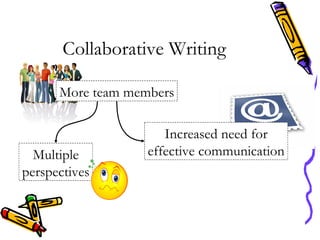
Collaborative Writing More team members Increased need for effective communication Multiple perspectives
Effective Teamwork Know your teammates What areas of expertise to team members have? What does each team member hope to achieve? Define roles Team leader Lead writer Proofreader
An Adjustment for Teachers Creating an appropriate group task Providing clear expectations Providing group skills training Monitoring group process Conveying assessment criteria clearly Fairly assessing student work
Theorists’ Suggestions Don’t begin collaborative writing assignments right away—but do start learning collaboratively from the first day Collaborative assignment should be something better accomplished by a group than by an individual Allow student-initiated collaboration Let the class decide how groups will be constituted
Theorists’ Suggestions Give groups flexibility to decide their methods and timetables, but require that they commit them to writing Explain in advance how the project will be graded—ideally, ask for students’ input  Give student groups “real purposes” and ”real freedom” Make it fun—”play” can be an additional source of motivation
Students’ Suggestions The larger they are, the harder they fall—often, the groups that do best are twos and threes Projects should connect to how a given discourse works in the “real” world Project should require a lot of thought and discussion
Students’ Suggestions Assignments often work best when group members can divide work into distinct chunks—but not too many specific components.  Don’t make it too large or complex–“Too much work for too many students will totally bring down the quality of the project.” Assignments with low stakes work best—a smaller portion of the grade + more fun/play Assignments that allow creativity are “a plus”
Pitfalls & Stumbling Blocks How to grade  (“It’s not my fault!”) Too many cooks  (“It doesn’t fit together.”) Introverts can get left behind  (No one listened.) Too few cooks  (“I did all the work.”)
Pitfalls & Stumbling Blocks Remembering group decisions  (“People forget and go off in their own directions.”) Scheduling  (“Scheduling!”) Groups with dissimilar interests  (“We couldn’t even agree on a topic.”) Other group problems  (“I was working with a complete moron!”)
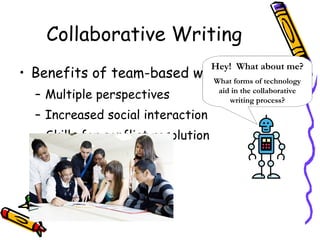
Collaborative Writing Benefits of team-based writing: Multiple perspectives Increased social interaction Skills for conflict resolution Hey!  What about me? What forms of technology aid in the collaborative writing process?
Applications that Facilitate Collaborative Writing Blogs  - http://dowell.typepad.com/harriet_tubman/   Wikis –  Cornwall Hill VoiceThreads –  Sample Photostory
Applications that Facilitate Collaborative Writing PowerPoint –  Choose your own Adventure Google Docs Writeboard  – collaborative writing software application Zoho  Writer  – online word processing application

TEACH Academy Collaborative Writing

  • 1.
  • 2.
    The term collaborativewriting refers to projects where written works are created by multiple people together (collaboratively) rather than individually. This allows for the editing and reviewing of a text document by multiple individuals either in real-time or asynchronously. Collaborative groups draw upon the strengths of all their members Students practice workplace readiness skills by working collaboratively. Facilitates built-in peer review
  • 3.
    An Adjustment forStudents They are not used to collaborative writing They are used to writing it and turning it in for a grade Only the student & instructor see it It’s individual work They don’t revise it or even think about it again
  • 4.
    Collaborative Writing Moreteam members Increased need for effective communication Multiple perspectives
  • 5.
    Effective Teamwork Knowyour teammates What areas of expertise to team members have? What does each team member hope to achieve? Define roles Team leader Lead writer Proofreader
  • 6.
    An Adjustment forTeachers Creating an appropriate group task Providing clear expectations Providing group skills training Monitoring group process Conveying assessment criteria clearly Fairly assessing student work
  • 7.
    Theorists’ Suggestions Don’tbegin collaborative writing assignments right away—but do start learning collaboratively from the first day Collaborative assignment should be something better accomplished by a group than by an individual Allow student-initiated collaboration Let the class decide how groups will be constituted
  • 8.
    Theorists’ Suggestions Givegroups flexibility to decide their methods and timetables, but require that they commit them to writing Explain in advance how the project will be graded—ideally, ask for students’ input Give student groups “real purposes” and ”real freedom” Make it fun—”play” can be an additional source of motivation
  • 9.
    Students’ Suggestions Thelarger they are, the harder they fall—often, the groups that do best are twos and threes Projects should connect to how a given discourse works in the “real” world Project should require a lot of thought and discussion
  • 10.
    Students’ Suggestions Assignmentsoften work best when group members can divide work into distinct chunks—but not too many specific components. Don’t make it too large or complex–“Too much work for too many students will totally bring down the quality of the project.” Assignments with low stakes work best—a smaller portion of the grade + more fun/play Assignments that allow creativity are “a plus”
  • 11.
    Pitfalls & StumblingBlocks How to grade (“It’s not my fault!”) Too many cooks (“It doesn’t fit together.”) Introverts can get left behind (No one listened.) Too few cooks (“I did all the work.”)
  • 12.
    Pitfalls & StumblingBlocks Remembering group decisions (“People forget and go off in their own directions.”) Scheduling (“Scheduling!”) Groups with dissimilar interests (“We couldn’t even agree on a topic.”) Other group problems (“I was working with a complete moron!”)
  • 13.
    Collaborative Writing Benefitsof team-based writing: Multiple perspectives Increased social interaction Skills for conflict resolution Hey! What about me? What forms of technology aid in the collaborative writing process?
  • 14.
    Applications that FacilitateCollaborative Writing Blogs - http://dowell.typepad.com/harriet_tubman/ Wikis – Cornwall Hill VoiceThreads – Sample Photostory
  • 15.
    Applications that FacilitateCollaborative Writing PowerPoint – Choose your own Adventure Google Docs Writeboard – collaborative writing software application Zoho Writer – online word processing application

Editor's Notes

  • #3 Collaborative groups draw upon the strengths of all their members. Although one student may be stronger in critical thinking skills, another may excel in organizing. By working in groups, students learn from each other while they complete assigned tasks. More and more workplace activities involve project teams. Giving students opportunities to work collaboratively on academic projects can help prepare them for the advantages and pitfalls of collaborative work on the job. Students working in collaborative groups can take advantage of group members for built-in peer review as they complete writing projects. Not least important, collaborative writing assignments usually entail much less grading time for the instructor.