Unite-IT
Uniting Europe through digital
empowerment
Overview of the UniteIT project and
discussion towards common views:
objectives, deliverables, schedule,
impact

With the support of the KA3 Multilateral Networks programme of the European Union
Key Activity 3
• To complement ICT enhanced learning activities and
projects under the sectoral programmes Comenius,
Erasmus, Grundtvig and Leonardo da Vinci by
addressing ICT teaching and learning needs across two
or more of those sectors = TRANSVERSALITY.
• EU action aims to utilize the power of ICT to develop
innovative education and training practices, improve
access to lifelong learning and help develop advanced
management systems.
• To support the development of innovative ICT based
content, services, pedagogies and practice for lifelong
learning.
ICT actions in LLP
1. Multilateral projects to encourage innovation and
creativity in learning and teaching and boost the use
of new ICT tools and trends, particularly for groups at
risk of exclusion such as early school leavers, ethnic
minorities and elderly people (21 projects selected
for funding in 2012)
2. Multilateral Networks to promote greater linking up
and connectivity between learning communities and
to foster creativity and innovation through the use of
ICT (4 projects selected for funding in 2012)
Network Priorities
Priority 1:
• European-wide stakeholders' communities promoting digital competence and
other key transversal competences for life and employability
Priority 2:
European-wide stakeholders' communities tackling the socio-economic digital divide
• Analysing, reinforcing and disseminating findings on how digital competences can
assist groups at risk of exclusion
• Sharing knowledge, exchanging good practices and developing new strategic
partnerships involving all relevant actors across all societal domains;
• Developing foresight scenarios, recommendations and operational guidelines on
what education can do to tackle these digital divides and re-connect otherwise
excluded individuals.
Godelieve Van Den Brande
http://webcast.ec.europa.eu/eutv/portal/eac/_v_fl_300_fr/player/index_player.html?
id=13086&pId=13023
ICT Networks
ICT Networks are expected to:
• Support the building of partnerships and the
networking of learning communities for exchanging
ideas and experiences related to ICT for learning
• Networks should support knowledge sharing, increase
the visibility and awareness of the benefits and impacts
of ICT for learning
• Contribute to policy-making to the uptake and efficient
use of ICT enabled learning
• Organize conferences, workshops, fora, summer
universities, etc. designed to help attain the objectives
of the network and disseminate results
Expected impact
UniteIT is a network project that
–
–
–
–

aims at sharing knowledge,
exchange practices,
set up debates in key topics and
develop new strategic partnership involving actors
across societal domains

in order to contribute to overcome digital divide
and promote the acquisition of digital competence
by groups-at-risk of exclusion.
Aims
The objective of the Unite-IT project is to create and establish
a network in order

• To collect and share practices and findings on how digital
competence can assist groups at risk of exclusion to
reconnect with learning, as a mean to foster employability,
social inclusion an social cohesion;
• To create new links and dialogue across societal domains to
promote joint initiatives to tackle digital divides;
• To empower organisations and individuals about their
contribution to overcome the challenge of digital divide in
Europe
Acting levels
• Practitioner level, by identifying successful practices of digital
competence learning for inclusion and social cohesion, disseminate
them, and make them available and transferrable across
institutions, learning providers and teachers/trainers in Europe;
• Societal level, by strengthening links between education/training,
business, users organisations, societal organisations and
local/national authorities, to promote synergies, mutual
understanding, common actions to tackle digital divide and
promote the acquisition of digital competence;
• Policy level, by promoting networking and exchange of experiences
and practices about ICT supporting inclusion and social cohesion, in
order to make them available and transferrable across Europe.
Objectives 1/2
1.

2.

3.
4.

Establishing the network, providing the operational and administrative
ground on which the members can act by exchanging practices, sharing
resources and visions on digital competence for inclusion, as well as to
take advantage of successful practices already in place.
Developing an online portal to serve the network, containing
information, news, materials, access to network databases of practices
and policies in Europe with specific regard to ICT for inclusion and social
cohesion;
Pooling resources both in terms of documents and practices, collected
and coded by means of structured tools;
Establishing working groups in identified sub-areas related to digital
competence for inclusion, i.e. employability, access to education for
groups-at-risk, access to ICTs, gender equality in digital competence
etc.: these working groups will be enriched by the participation of
relevant stakeholders coming from business, society, policy fields
during the running of the network;
Objectives 2/2
5. Raising awareness about the value of digital competence
for inclusion and social cohesion purposes, dealing with
policy makers and stakeholders at all levels, national and
regional authorities, others concerned with the field;
6. Promoting links and positive synergies at a horizontal
level (between policy makers, between practitioners in
Europe, between stakeholders), and at vertical level
(between policy and practice)
7. Providing updated state-of-the-art reports on yearly
basis;
8. Organising a yearly conference Digital Empowerment AllInclusive, bringing together policy makers, stakeholders,
and education and training organisations.
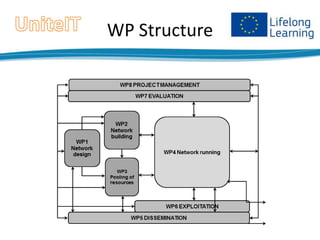
WP Structure
WP1, WP2
WP1 Network design is aimed at setting the ground on
which the network is to be built.
–
–

Deliverable: 01 Procedure Handbook M7
Leader: LIKTA

WP2 Network building is the operational outcome of
WP1, developed on the basis of the designed
framework.
–
–

Deliverables: 02 Online portal M9, 09 Network toolkit
M9, 04 Working groups description M12
Leader: IAN
WP3
WP3 Pooling of resources
–

collecting practices on successful cases and strategies
that lead to an improvement of social inclusion for those
suffering from digital divide;
– pooling present policies, initiatives, trends, policy
agendas addressing digital divide in Europe, and related
documents, from local to European level, covering the 27
members states, EEA countries, accession countries.
Deliverables: Collection of practices M12, Policy observatory
M12
Leader: Interface3
WP4
WP4 Network running.
• Having established the formal and operational background, prepared the
tools and resources, established the first core working groups, the
network will be officially launched by means of the first conference.
• The networking action will include
– continuous updating of the website and of the databases,
– keeping contacts with policy and decision makers and with other organisations
concerned by the topic to involve them within the activities,
– organisation of webinars,
– writing of yearly reports and sending them to the targeted audience, and
– coordination of transnational working groups debates on specific topics.

• Deliverables:
– 07 Yearly report Digitally Empowered Europe M12/24/36
– 08 Webinars M18/24/30/35
– 09 Yearly conference: Digital Empowerment All-Inclusive M12/24/36

• Leader: EOS
WP5, WP6
WP5 Dissemination. Aims at ensuring that the project outputs and outcomes reach
the target groups, promoting involvement of new members in the network,
positive synergies across policy makers, practictioners in the field and all
concerned stakeholders across Europe, and raising awareness about the addressed
topic.
• Deliverables:
– 10 Dissemination plan M3
– 11 Dissemination material M6
– 12 Dissemination report M36

•

Leader: DemNet

WP6 Exploitation. Aimed at promoting mainstreaming of the results, therefore access
and active contribution to by organisations and individuals outside the
consortium, enlargement of the network.
• Deliverables:
– 13 Exploitation plan M13-36
– 14 Sustainability plan M36

•

Leader: Telecentre-Europe
WP7, WP8
WP7 Evaluation and quality assurance is aimed at ensuring formative and
summative monitoring and evaluation as a support for project
management and to quality control.
– Mechanisms for the monitoring and evaluation of the network will be here
established, and to collect data from the audiences, together with the
development of the tools for this purpose.
– Deliverables: 15 Evaluation and quality plan M4, 16 Evaluation and quality
report M36
– Leader: Malta

WP8 Project management. This WP groups the management activities, aimed
at ensuring legal, ethical, financial and administrative management, and
the achievement of the objectives in time and in the budget.
– Deliverables: 17 Agreements M3, 18 Project Handbook M3, 19 Project reports
M19/37
– Leader: Telecentre-Europe
Areas of impact
Changes in attitudes:
• by means of the sharing of resources and by means of debates on key
topics, mutual understanding among societal organisations, business,
education and training organisation will be enhanced, and the attitude
toward the issue is expected to change
• from local to European, from being one player to being one of the players
concurring to overcome barriers in acquisition of digital competences, etc.
Changes in knowledge:
• by means of the work of collection, discussion and analysis, the network
will enhance knowledge on how digital divide can be overcome and
therefore how digital competence can be promoted in disadvantaged
groups
• it will also enhance mutual understanding and knowledge among the
different players, coming from education, training, academia, business,
and societal organisation, as well as among them and policy makers and
among policy makers across countries
Areas of impact
Changes in awareness:
• enhanced awareness of all the involved stakeholders, included
policy and decision makers, about the value of working together
• establishing channels of effective communication
• bringing sectors and areas of intervention within a broader picture
where joint actions can make the difference in improving digital
competences for those at-risk and therefore contribute to
overcome digital divide in Europe

Changes in skills:
• transfer of practices is expected to enhance competences of
organizations in tackling digital divide for those at risk of exclusion,
• debating within the working groups is expected to improve mutual
understanding among different organisations and sections, thus
promoting new forms of cooperation
Project factsheet
•
•
•
•
•
•

Project duration: 36 months
Start/end date: 01.11.2012-31.10.2015
Total eligible budget: 547 582 EUR
EU grant: 407 736 EUR (74,46% )
Own contribution: 139 846 EUR (25,54%)
Payment structure: 40%-40%-20%
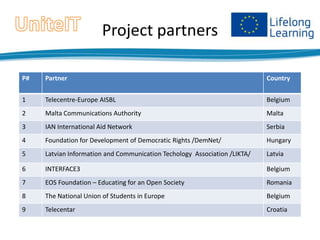
Project partners
P#

Partner

Country

1

Telecentre-Europe AISBL

Belgium

2

Malta Communications Authority

Malta

3

IAN International Aid Network

Serbia

4

Foundation for Development of Democratic Rights /DemNet/

Hungary

5

Latvian Information and Communication Techology Association /LIKTA/

Latvia

6

INTERFACE3

Belgium

7

EOS Foundation – Educating for an Open Society

Romania

8

The National Union of Students in Europe

Belgium

9

Telecentar

Croatia
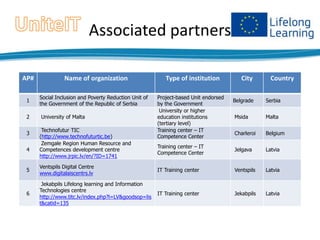
Associated partners
AP#

Name of organization

1

Social Inclusion and Poverty Reduction Unit of
the Government of the Republic of Serbia

2

University of Malta

3
4

Technofutur TIC
(http://www.technofuturtic.be)
Zemgale Region Human Resource and
Competences development centre
http://www.jrpic.lv/en/?ID=1741

Type of institution
Project-based Unit endorsed
by the Government
University or higher
education institutions
(tertiary level)
Training center – IT
Competence Center

City

Country

Belgrade

Serbia

Msida

Malta

Charleroi

Belgium

Training center – IT
Competence Center

Jelgava

Latvia

5

Ventspils Digital Centre
www.digitalaiscentrs.lv

IT Training center

Ventspils

Latvia

6

Jekabpils Lifelong learning and Information
Technologies centre
http://www.titc.lv/index.php?l=LV&goodsop=lis
t&catid=135

IT Training center

Jekabpils

Latvia

TE Summit 23-24.10.2013.-UNITE IT

  • 1.
    Unite-IT Uniting Europe throughdigital empowerment Overview of the UniteIT project and discussion towards common views: objectives, deliverables, schedule, impact With the support of the KA3 Multilateral Networks programme of the European Union
  • 2.
    Key Activity 3 •To complement ICT enhanced learning activities and projects under the sectoral programmes Comenius, Erasmus, Grundtvig and Leonardo da Vinci by addressing ICT teaching and learning needs across two or more of those sectors = TRANSVERSALITY. • EU action aims to utilize the power of ICT to develop innovative education and training practices, improve access to lifelong learning and help develop advanced management systems. • To support the development of innovative ICT based content, services, pedagogies and practice for lifelong learning.
  • 3.
    ICT actions inLLP 1. Multilateral projects to encourage innovation and creativity in learning and teaching and boost the use of new ICT tools and trends, particularly for groups at risk of exclusion such as early school leavers, ethnic minorities and elderly people (21 projects selected for funding in 2012) 2. Multilateral Networks to promote greater linking up and connectivity between learning communities and to foster creativity and innovation through the use of ICT (4 projects selected for funding in 2012)
  • 4.
    Network Priorities Priority 1: •European-wide stakeholders' communities promoting digital competence and other key transversal competences for life and employability Priority 2: European-wide stakeholders' communities tackling the socio-economic digital divide • Analysing, reinforcing and disseminating findings on how digital competences can assist groups at risk of exclusion • Sharing knowledge, exchanging good practices and developing new strategic partnerships involving all relevant actors across all societal domains; • Developing foresight scenarios, recommendations and operational guidelines on what education can do to tackle these digital divides and re-connect otherwise excluded individuals. Godelieve Van Den Brande http://webcast.ec.europa.eu/eutv/portal/eac/_v_fl_300_fr/player/index_player.html? id=13086&pId=13023
  • 5.
    ICT Networks ICT Networksare expected to: • Support the building of partnerships and the networking of learning communities for exchanging ideas and experiences related to ICT for learning • Networks should support knowledge sharing, increase the visibility and awareness of the benefits and impacts of ICT for learning • Contribute to policy-making to the uptake and efficient use of ICT enabled learning • Organize conferences, workshops, fora, summer universities, etc. designed to help attain the objectives of the network and disseminate results
  • 6.
    Expected impact UniteIT isa network project that – – – – aims at sharing knowledge, exchange practices, set up debates in key topics and develop new strategic partnership involving actors across societal domains in order to contribute to overcome digital divide and promote the acquisition of digital competence by groups-at-risk of exclusion.
  • 7.
    Aims The objective ofthe Unite-IT project is to create and establish a network in order • To collect and share practices and findings on how digital competence can assist groups at risk of exclusion to reconnect with learning, as a mean to foster employability, social inclusion an social cohesion; • To create new links and dialogue across societal domains to promote joint initiatives to tackle digital divides; • To empower organisations and individuals about their contribution to overcome the challenge of digital divide in Europe
  • 8.
    Acting levels • Practitionerlevel, by identifying successful practices of digital competence learning for inclusion and social cohesion, disseminate them, and make them available and transferrable across institutions, learning providers and teachers/trainers in Europe; • Societal level, by strengthening links between education/training, business, users organisations, societal organisations and local/national authorities, to promote synergies, mutual understanding, common actions to tackle digital divide and promote the acquisition of digital competence; • Policy level, by promoting networking and exchange of experiences and practices about ICT supporting inclusion and social cohesion, in order to make them available and transferrable across Europe.
  • 9.
    Objectives 1/2 1. 2. 3. 4. Establishing thenetwork, providing the operational and administrative ground on which the members can act by exchanging practices, sharing resources and visions on digital competence for inclusion, as well as to take advantage of successful practices already in place. Developing an online portal to serve the network, containing information, news, materials, access to network databases of practices and policies in Europe with specific regard to ICT for inclusion and social cohesion; Pooling resources both in terms of documents and practices, collected and coded by means of structured tools; Establishing working groups in identified sub-areas related to digital competence for inclusion, i.e. employability, access to education for groups-at-risk, access to ICTs, gender equality in digital competence etc.: these working groups will be enriched by the participation of relevant stakeholders coming from business, society, policy fields during the running of the network;
  • 10.
    Objectives 2/2 5. Raisingawareness about the value of digital competence for inclusion and social cohesion purposes, dealing with policy makers and stakeholders at all levels, national and regional authorities, others concerned with the field; 6. Promoting links and positive synergies at a horizontal level (between policy makers, between practitioners in Europe, between stakeholders), and at vertical level (between policy and practice) 7. Providing updated state-of-the-art reports on yearly basis; 8. Organising a yearly conference Digital Empowerment AllInclusive, bringing together policy makers, stakeholders, and education and training organisations.
  • 11.
  • 12.
    WP1, WP2 WP1 Networkdesign is aimed at setting the ground on which the network is to be built. – – Deliverable: 01 Procedure Handbook M7 Leader: LIKTA WP2 Network building is the operational outcome of WP1, developed on the basis of the designed framework. – – Deliverables: 02 Online portal M9, 09 Network toolkit M9, 04 Working groups description M12 Leader: IAN
  • 13.
    WP3 WP3 Pooling ofresources – collecting practices on successful cases and strategies that lead to an improvement of social inclusion for those suffering from digital divide; – pooling present policies, initiatives, trends, policy agendas addressing digital divide in Europe, and related documents, from local to European level, covering the 27 members states, EEA countries, accession countries. Deliverables: Collection of practices M12, Policy observatory M12 Leader: Interface3
  • 14.
    WP4 WP4 Network running. •Having established the formal and operational background, prepared the tools and resources, established the first core working groups, the network will be officially launched by means of the first conference. • The networking action will include – continuous updating of the website and of the databases, – keeping contacts with policy and decision makers and with other organisations concerned by the topic to involve them within the activities, – organisation of webinars, – writing of yearly reports and sending them to the targeted audience, and – coordination of transnational working groups debates on specific topics. • Deliverables: – 07 Yearly report Digitally Empowered Europe M12/24/36 – 08 Webinars M18/24/30/35 – 09 Yearly conference: Digital Empowerment All-Inclusive M12/24/36 • Leader: EOS
  • 15.
    WP5, WP6 WP5 Dissemination.Aims at ensuring that the project outputs and outcomes reach the target groups, promoting involvement of new members in the network, positive synergies across policy makers, practictioners in the field and all concerned stakeholders across Europe, and raising awareness about the addressed topic. • Deliverables: – 10 Dissemination plan M3 – 11 Dissemination material M6 – 12 Dissemination report M36 • Leader: DemNet WP6 Exploitation. Aimed at promoting mainstreaming of the results, therefore access and active contribution to by organisations and individuals outside the consortium, enlargement of the network. • Deliverables: – 13 Exploitation plan M13-36 – 14 Sustainability plan M36 • Leader: Telecentre-Europe
  • 16.
    WP7, WP8 WP7 Evaluationand quality assurance is aimed at ensuring formative and summative monitoring and evaluation as a support for project management and to quality control. – Mechanisms for the monitoring and evaluation of the network will be here established, and to collect data from the audiences, together with the development of the tools for this purpose. – Deliverables: 15 Evaluation and quality plan M4, 16 Evaluation and quality report M36 – Leader: Malta WP8 Project management. This WP groups the management activities, aimed at ensuring legal, ethical, financial and administrative management, and the achievement of the objectives in time and in the budget. – Deliverables: 17 Agreements M3, 18 Project Handbook M3, 19 Project reports M19/37 – Leader: Telecentre-Europe
  • 17.
    Areas of impact Changesin attitudes: • by means of the sharing of resources and by means of debates on key topics, mutual understanding among societal organisations, business, education and training organisation will be enhanced, and the attitude toward the issue is expected to change • from local to European, from being one player to being one of the players concurring to overcome barriers in acquisition of digital competences, etc. Changes in knowledge: • by means of the work of collection, discussion and analysis, the network will enhance knowledge on how digital divide can be overcome and therefore how digital competence can be promoted in disadvantaged groups • it will also enhance mutual understanding and knowledge among the different players, coming from education, training, academia, business, and societal organisation, as well as among them and policy makers and among policy makers across countries
  • 18.
    Areas of impact Changesin awareness: • enhanced awareness of all the involved stakeholders, included policy and decision makers, about the value of working together • establishing channels of effective communication • bringing sectors and areas of intervention within a broader picture where joint actions can make the difference in improving digital competences for those at-risk and therefore contribute to overcome digital divide in Europe Changes in skills: • transfer of practices is expected to enhance competences of organizations in tackling digital divide for those at risk of exclusion, • debating within the working groups is expected to improve mutual understanding among different organisations and sections, thus promoting new forms of cooperation
  • 19.
    Project factsheet • • • • • • Project duration:36 months Start/end date: 01.11.2012-31.10.2015 Total eligible budget: 547 582 EUR EU grant: 407 736 EUR (74,46% ) Own contribution: 139 846 EUR (25,54%) Payment structure: 40%-40%-20%
  • 20.
    Project partners P# Partner Country 1 Telecentre-Europe AISBL Belgium 2 MaltaCommunications Authority Malta 3 IAN International Aid Network Serbia 4 Foundation for Development of Democratic Rights /DemNet/ Hungary 5 Latvian Information and Communication Techology Association /LIKTA/ Latvia 6 INTERFACE3 Belgium 7 EOS Foundation – Educating for an Open Society Romania 8 The National Union of Students in Europe Belgium 9 Telecentar Croatia
  • 21.
    Associated partners AP# Name oforganization 1 Social Inclusion and Poverty Reduction Unit of the Government of the Republic of Serbia 2 University of Malta 3 4 Technofutur TIC (http://www.technofuturtic.be) Zemgale Region Human Resource and Competences development centre http://www.jrpic.lv/en/?ID=1741 Type of institution Project-based Unit endorsed by the Government University or higher education institutions (tertiary level) Training center – IT Competence Center City Country Belgrade Serbia Msida Malta Charleroi Belgium Training center – IT Competence Center Jelgava Latvia 5 Ventspils Digital Centre www.digitalaiscentrs.lv IT Training center Ventspils Latvia 6 Jekabpils Lifelong learning and Information Technologies centre http://www.titc.lv/index.php?l=LV&goodsop=lis t&catid=135 IT Training center Jekabpils Latvia