TCP/IP
Architecture
Networking
By Saranga Prabod weeramanne
Content
• Why Layer architecture
came in to existence
• What is TCP/IP Model
• Layers of TCP/IP model
• Application Layer
• Transport Layer
• Internet Layer
• Network Access Layer
• TCP/IP vs OSI Model
• Conclusion
2
Why Layer architecture
came in to existence
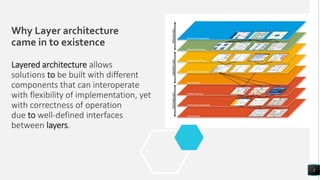
Layered architecture allows
solutions to be built with different
components that can interoperate
with flexibility of implementation, yet
with correctness of operation
due to well-defined interfaces
between layers.
3
What isTCP/IP Model
TCP/IP is short
for Transmission Control Protocol/Internet Protocol.
TCP/IP is the suite of communications
protocols used to connect hosts on the Internet.
TCP/IP uses several protocols, the two main ones
being TCP and IP.
4
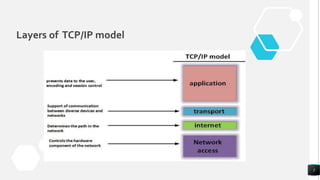
Layers of TCP/IP model
5
Application
Layer
6
7
Application Layer
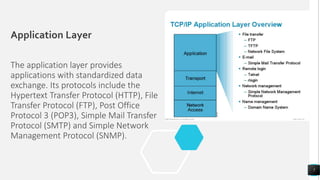
The application layer provides
applications with standardized data
exchange. Its protocols include the
Hypertext Transfer Protocol (HTTP), File
Transfer Protocol (FTP), Post Office
Protocol 3 (POP3), Simple Mail Transfer
Protocol (SMTP) and Simple Network
Management Protocol (SNMP).
Transport
Layer
8
9
Transport Layer
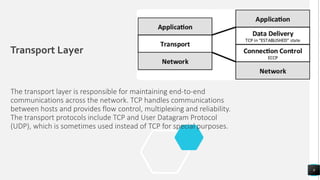
The transport layer is responsible for maintaining end-to-end
communications across the network. TCP handles communications
between hosts and provides flow control, multiplexing and reliability.
The transport protocols include TCP and User Datagram Protocol
(UDP), which is sometimes used instead of TCP for special purposes.
Internet
Layer
10
11
Internet Layer
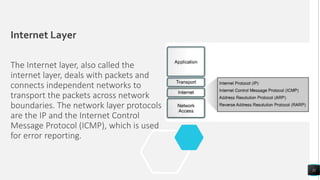
The Internet layer, also called the
internet layer, deals with packets and
connects independent networks to
transport the packets across network
boundaries. The network layer protocols
are the IP and the Internet Control
Message Protocol (ICMP), which is used
for error reporting.
Network Access
Layer
12
13
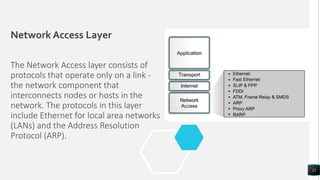
Network Access Layer
The Network Access layer consists of
protocols that operate only on a link -
the network component that
interconnects nodes or hosts in the
network. The protocols in this layer
include Ethernet for local area networks
(LANs) and the Address Resolution
Protocol (ARP).
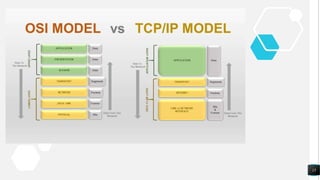
TCP/IP vs OSI
Model
14
15
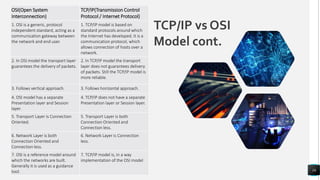
TCP/IP vs OSI
Model cont.
16
OSI(Open System
Interconnection)
TCP/IP(Transmission Control
Protocol / Internet Protocol)
1. OSI is a generic, protocol
independent standard, acting as a
communication gateway between
the network and end user.
1. TCP/IP model is based on
standard protocols around which
the Internet has developed. It is a
communication protocol, which
allows connection of hosts over a
network.
2. In OSI model the transport layer
guarantees the delivery of packets.
2. In TCP/IP model the transport
layer does not guarantees delivery
of packets. Still the TCP/IP model is
more reliable.
3. Follows vertical approach. 3. Follows horizontal approach.
4. OSI model has a separate
Presentation layer and Session
layer.
4. TCP/IP does not have a separate
Presentation layer or Session layer.
5. Transport Layer is Connection
Oriented.
5. Transport Layer is both
Connection Oriented and
Connection less.
6. Network Layer is both
Connection Oriented and
Connection less.
6. Network Layer is Connection
less.
7. OSI is a reference model around
which the networks are built.
Generally it is used as a guidance
tool.
7. TCP/IP model is, in a way
implementation of the OSI model
Conclusion
17
TCP/IP is the older of the two approaches to data
communication and is very well established.The OSI
model is a proven concept that can be used as a base to
apply to most new applications or at least considered
when improving or building current infrastructure. It will
be continually used as a guideline for years to come for
all communications applications.TCP/IP will continue to
dominate the net due to its constant improvements and
relatively low failure rate.
Thank You…!

TCP/IP model

  • 1.
  • 2.
    Content • Why Layerarchitecture came in to existence • What is TCP/IP Model • Layers of TCP/IP model • Application Layer • Transport Layer • Internet Layer • Network Access Layer • TCP/IP vs OSI Model • Conclusion 2
  • 3.
    Why Layer architecture camein to existence Layered architecture allows solutions to be built with different components that can interoperate with flexibility of implementation, yet with correctness of operation due to well-defined interfaces between layers. 3
  • 4.
    What isTCP/IP Model TCP/IPis short for Transmission Control Protocol/Internet Protocol. TCP/IP is the suite of communications protocols used to connect hosts on the Internet. TCP/IP uses several protocols, the two main ones being TCP and IP. 4
  • 5.
  • 6.
  • 7.
    7 Application Layer The applicationlayer provides applications with standardized data exchange. Its protocols include the Hypertext Transfer Protocol (HTTP), File Transfer Protocol (FTP), Post Office Protocol 3 (POP3), Simple Mail Transfer Protocol (SMTP) and Simple Network Management Protocol (SNMP).
  • 8.
  • 9.
    9 Transport Layer The transportlayer is responsible for maintaining end-to-end communications across the network. TCP handles communications between hosts and provides flow control, multiplexing and reliability. The transport protocols include TCP and User Datagram Protocol (UDP), which is sometimes used instead of TCP for special purposes.
  • 10.
  • 11.
    11 Internet Layer The Internetlayer, also called the internet layer, deals with packets and connects independent networks to transport the packets across network boundaries. The network layer protocols are the IP and the Internet Control Message Protocol (ICMP), which is used for error reporting.
  • 12.
  • 13.
    13 Network Access Layer TheNetwork Access layer consists of protocols that operate only on a link - the network component that interconnects nodes or hosts in the network. The protocols in this layer include Ethernet for local area networks (LANs) and the Address Resolution Protocol (ARP).
  • 14.
  • 15.
  • 16.
    TCP/IP vs OSI Modelcont. 16 OSI(Open System Interconnection) TCP/IP(Transmission Control Protocol / Internet Protocol) 1. OSI is a generic, protocol independent standard, acting as a communication gateway between the network and end user. 1. TCP/IP model is based on standard protocols around which the Internet has developed. It is a communication protocol, which allows connection of hosts over a network. 2. In OSI model the transport layer guarantees the delivery of packets. 2. In TCP/IP model the transport layer does not guarantees delivery of packets. Still the TCP/IP model is more reliable. 3. Follows vertical approach. 3. Follows horizontal approach. 4. OSI model has a separate Presentation layer and Session layer. 4. TCP/IP does not have a separate Presentation layer or Session layer. 5. Transport Layer is Connection Oriented. 5. Transport Layer is both Connection Oriented and Connection less. 6. Network Layer is both Connection Oriented and Connection less. 6. Network Layer is Connection less. 7. OSI is a reference model around which the networks are built. Generally it is used as a guidance tool. 7. TCP/IP model is, in a way implementation of the OSI model
  • 17.
    Conclusion 17 TCP/IP is theolder of the two approaches to data communication and is very well established.The OSI model is a proven concept that can be used as a base to apply to most new applications or at least considered when improving or building current infrastructure. It will be continually used as a guideline for years to come for all communications applications.TCP/IP will continue to dominate the net due to its constant improvements and relatively low failure rate.

  • 18.

Editor's Notes

  • #4 Most common
  • #5 Tcp/ip was designed in 1970s by US defence advanced research project agency scientists vint chef and bob kahn. Tcp/ip work together to provide end to end connection by specifying how data should be segmented, addressed and rout across over networks.
  • #6 TCP/IP functionality is divided into four layers, each of which include specific protocols. Application – data generation,translation,conversion,compression,encryption use http,smtp,ftp Transport – segmentation,flow control,error checking use tcp,udp Internet – ip addressing,routering use ipv4,ipv6,icmp Network – mac addressing,switching,physical cabeling use eathernet,arp,rarp,ndp and so on.
  • #8 The application layer provides applications with standardized data exchange. Its protocols include the Hypertext Transfer Protocol (HTTP), File Transfer Protocol (FTP), Post Office Protocol 3 (POP3), Simple Mail Transfer Protocol (SMTP) and Simple Network Management Protocol (SNMP).
  • #10 The transport layer is responsible for maintaining end-to-end communications across the network. TCP handles communications between hosts and provides flow control, multiplexing and reliability. The transport protocols include TCP and User Datagram Protocol (UDP), which is sometimes used instead of TCP for special purposes.
  • #16 TCP/IP functionality is divided into four layers, each of which include specific protocols.