Fostering competitiveness through transnational 
clusters networks 
Jacques Bersier 
Parallel 2.1 Clusters as a tool to create global innovation winners and 
increase competitiveness 
11 November 2014
Fostering competitiveness through 
transnational clusters networks 
Best practices issued from the European Alpine Space Program 
Jacques P. Bersier 
HES-SO//Fribourg EIA-FR Deputy director 
PST-FR Vice-president 
Ivan Boesso 
Veneto Innovazione S.p.A. European, 
Project Coordinator 
November 12th 2014
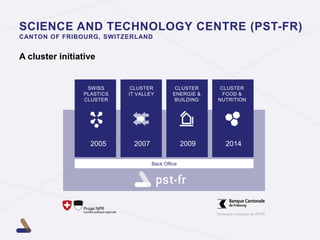
SCIENCE AND TECHNOLOGY CENTRE (PST-FR) 
CANTON OF FRIBOURG, SWITZERLAND 
SWISS 
PLASTICS 
CLUSTER 
CLUSTER 
IT VALLEY 
CLUSTER 
ENERGIE & 
BUILDING 
CLUSTER 
FOOD & 
NUTRITION 
2005 2007 2009 2014 
Back Office 
A cluster initiative
VENETO INNOVAZIONE 
ABOUT US 
• Veneto Innovazione was founded as a public-private joint-stock 
company 
• Supports innovation and applied research in Veneto 
– Strengthening the regional innovation and research system 
– Offer of a growing international network 
– EU best practices 
– Foster the excellence 
• In July 2009 the Veneto Region acquired private stocks 
• On July the 30th 2009 the assembly voted the new statute 
and Veneto Innovazione was turned into an “in house 
providing” company
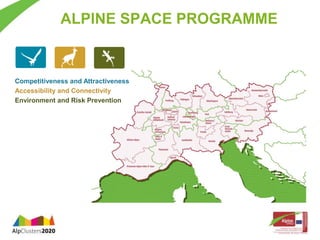
ALPINE SPACE PROGRAMME 
Competitiveness and Attractiveness 
Accessibility and Connectivity 
Environment and Risk Prevention
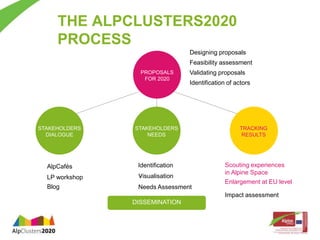
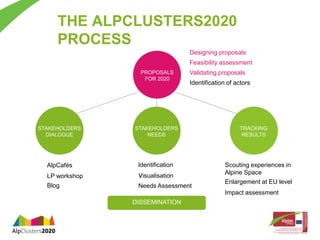
THE ALPCLUSTERS2020 
PROCESS 
STAKEHOLDERS 
DIALOGUE 
PROPOSALS 
FOR 2020 
STAKEHOLDERS 
NEEDS 
Designing proposals 
Feasibility assessment 
Validating proposals 
Identification of actors 
TRACKING 
RESULTS 
AlpCafés 
LP workshop 
Blog 
Identification 
visualisation 
Needs Assessment 
Needs Assessment 
Scouting experiences 
in Alpine Space 
Enlargement at EU level 
Impact assessment 
DISSEMINATION
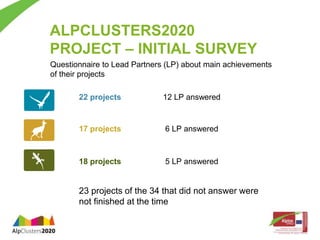
ALPCLUSTERS2020 
PROJECT – INITIAL SURVEY 
Questionnaire to Lead Partners (LP) about main achievements 
of their projects 
22 projects 12 LP answered 
17 projects 6 LP answered 
18 projects 5 LP answered 
23 projects of the 34 that did not answer were 
not finished at the time
ALPCLUSTERS2020 
PROJECT – GLOBAL SURVEY 
Questionnaire to project partners with 6 closed questions 
and 6 open questions and an open field for remarks 
170 responses to the 650 questionnaires sent 
Responses from 53 of the 57 projects 
In the 4 remaining projects, 3 were not finished
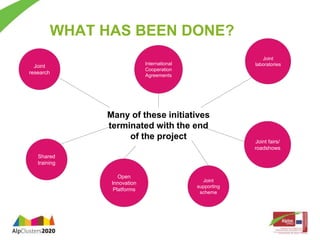
WHAT HAS BEEN DONE? 
Many of these initiatives 
terminated with the end 
of the project 
Joint 
research 
International 
Cooperation 
Agreements 
Joint 
laboratories 
Shared 
training 
Open 
Innovation 
Platforms 
Joint 
supporting 
scheme 
Joint fairs/ 
roadshows
WHY? 
+ What was the real impact? 
+ What is the cost to sustain these initiatives? 
+ How much commitment do these initiatives need? 
+ Are these initiatives in line with the real needs of beneficiaries? 
+ Are the beneficiaries aware of the opportunities? 
+ Are the beneficiaries keen to sustain the activities after the initial 
project is completed? 
+ What is the position of decision makers ? 
+ What would be the added value at a strategic level? 
+ How can shared strategies be implemented?
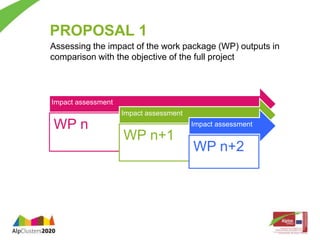
PROPOSAL 1 
Assessing the impact of the work package (WP) outputs in 
comparison with the objective of the full project 
Impact assessment 
WP n 
Impact assessment 
WP n+1 
Impact assessment 
WP n+2
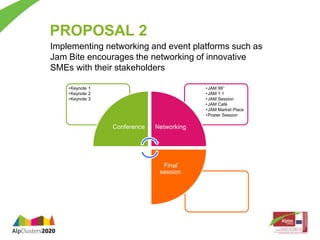
PROPOSAL 2 
Implementing networking and event platforms such as 
Jam Bite encourages the networking of innovative 
SMEs with their stakeholders 
• JAM 99’’ 
•JAM 1:1 
•JAM Session 
•JAM Café 
•JAM Market Place 
•Poster Session 
•Keynote 1 
•Keynote 2 
•Keynote 3 
Conference Networking 
Final 
session
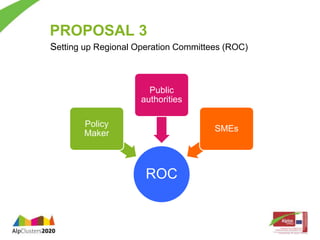
PROPOSAL 3 
Setting up Regional Operation Committees (ROC) 
ROC 
Policy 
Maker 
Public 
authorities 
SMEs
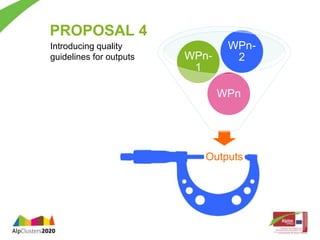
PROPOSAL 4 
Introducing quality 
guidelines for outputs 
WPn 
WPn- 
Outputs 
1 
WPn- 
2
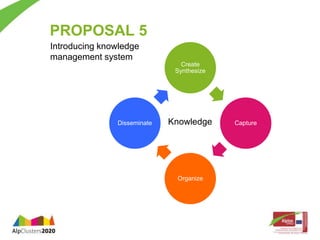
PROPOSAL 5 
Introducing knowledge 
management system 
Create 
Synthesize 
Capture 
Disseminate Knowledge 
Organize
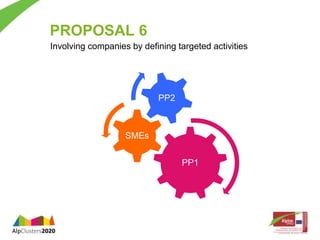
PROPOSAL 6 
Involving companies by defining targeted activities 
PP1 
SMEs 
PP2
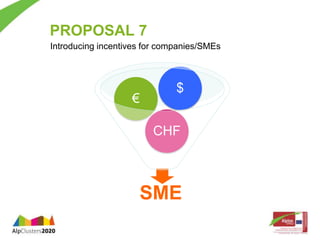
PROPOSAL 7 
Introducing incentives for companies/SMEs 
CHF 
€ 
$ 
SME
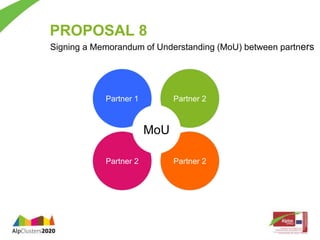
PROPOSAL 8 
Signing a Memorandum of Understanding (MoU) between partners 
Partner 1 Partner 2 
MoU 
Partner 2 Partner 2
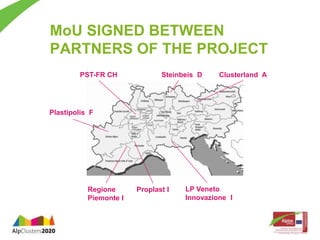
MoU SIGNED BETWEEN 
PARTNERS OF THE PROJECT 
Steinbeis D Clusterland A 
LP Veneto 
Innovazione I 
PST-FR CH 
Regione 
Piemonte I 
Proplast I 
Plastipolis F
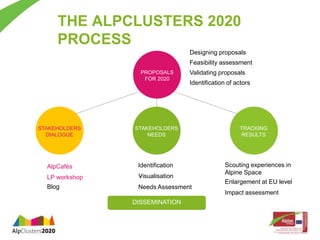
THE ALPCLUSTERS 2020 
PROCESS 
STAKEHOLDERS 
DIALOGUE 
PROPOSALS 
FOR 2020 
STAKEHOLDERS 
NEEDS 
Designing proposals 
Feasibility assessment 
Validating proposals 
Identification of actors 
TRACKING 
RESULTS 
Needs Assessment 
DISSEMINATION 
AlpCafés 
LP workshop 
Blog 
Identification 
visualisation 
Scouting experiences in 
Alpine Space 
Enlargement at EU level 
Impact assessment 
Needs Assessment
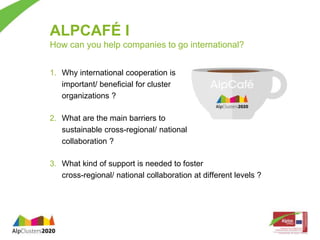
ALPCAFÉ I 
How can you help companies to go international? 
1. Why international cooperation is 
important/ beneficial for cluster 
organizations ? 
2. What are the main barriers to 
sustainable cross-regional/ national 
collaboration ? 
3. What kind of support is needed to foster 
cross-regional/ national collaboration at different levels ?
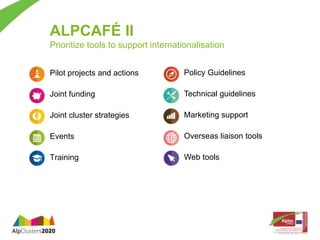
ALPCAFÉ II 
Prioritize tools to support internationalisation 
Pilot projects and actions 
Joint funding 
Joint cluster strategies 
Events 
Training 
Policy Guidelines 
Technical guidelines 
Marketing support 
Overseas liaison tools 
Web tools
TOOL 1 – Pilot projects and actions 
Projects can include the possibility to implement 
pilot projects and activities to test the findings deriving 
from previous more theoretical activities and research
TOOL 2 – Joint funding 
The cooperation of different public administrations in a European 
Framework aims to launch financial support tools for companies and 
clusters, such as: 
 Transnational funding schemes 
 Transnational innovation
TOOL 3 – Joint cluster strategies 
Project partners can cooperate in defining joint strategies, 
to solve common or shared problems. These often take the form 
of Joint Action Plans.
TOOL 4 – Events 
Events are frequently organized within projects to stimulate the debate 
around specific topics and to create networking occasions. 
For instance, they can consist of: 
 Networking events 
 Thematic workshops 
 Conferences
TOOL 5 – Training 
Project activities often include training opportunities for different 
Targets groups (e.g. students, practitioners, administrators, companies etc.). 
Training enables an increase of knowledge on specific issues and to 
ensure the sustainability of project findings. They can take the form of: 
 Study visits 
 Summer schools and academies 
 Courses and seminars 
 Staff exchanges
THE ALPCLUSTERS2020 
PROCESS 
STAKEHOLDERS 
DIALOGUE 
PROPOSALS 
FOR 2020 
STAKEHOLDERS 
NEEDS 
Designing proposals 
Feasibility assessment 
Validating proposals 
TRACKING 
RESULTS 
AlpCafés 
LP workshop 
Blog 
Identification 
visualisation 
Needs Assessment 
Needs Assessment 
DISSEMINATION 
Identification of actors 
Scouting experiences in 
Alpine Space 
Enlargement at EU level 
Impact assessment
CONCLUSION 
+ This work will be used for the next Alpine Space Call 2014-2020 
+ Proposals are useful not only for Alpine Space Projects but for 
any project involving international partners 
+ Brochure detailing the results available at the end 
of November 2014 
+ For further information or questions please contact: 
jacques.bersier@hefr.ch or ivan.boesso@venetoinnovazione.it
Thank you for your attention

TCI 2014 Fostering competitiveness through transnational clusters networks

  • 1.
    Fostering competitiveness throughtransnational clusters networks Jacques Bersier Parallel 2.1 Clusters as a tool to create global innovation winners and increase competitiveness 11 November 2014
  • 2.
    Fostering competitiveness through transnational clusters networks Best practices issued from the European Alpine Space Program Jacques P. Bersier HES-SO//Fribourg EIA-FR Deputy director PST-FR Vice-president Ivan Boesso Veneto Innovazione S.p.A. European, Project Coordinator November 12th 2014
  • 3.
    SCIENCE AND TECHNOLOGYCENTRE (PST-FR) CANTON OF FRIBOURG, SWITZERLAND SWISS PLASTICS CLUSTER CLUSTER IT VALLEY CLUSTER ENERGIE & BUILDING CLUSTER FOOD & NUTRITION 2005 2007 2009 2014 Back Office A cluster initiative
  • 4.
    VENETO INNOVAZIONE ABOUTUS • Veneto Innovazione was founded as a public-private joint-stock company • Supports innovation and applied research in Veneto – Strengthening the regional innovation and research system – Offer of a growing international network – EU best practices – Foster the excellence • In July 2009 the Veneto Region acquired private stocks • On July the 30th 2009 the assembly voted the new statute and Veneto Innovazione was turned into an “in house providing” company
  • 5.
    ALPINE SPACE PROGRAMME Competitiveness and Attractiveness Accessibility and Connectivity Environment and Risk Prevention
  • 6.
    THE ALPCLUSTERS2020 PROCESS STAKEHOLDERS DIALOGUE PROPOSALS FOR 2020 STAKEHOLDERS NEEDS Designing proposals Feasibility assessment Validating proposals Identification of actors TRACKING RESULTS AlpCafés LP workshop Blog Identification visualisation Needs Assessment Needs Assessment Scouting experiences in Alpine Space Enlargement at EU level Impact assessment DISSEMINATION
  • 7.
    ALPCLUSTERS2020 PROJECT –INITIAL SURVEY Questionnaire to Lead Partners (LP) about main achievements of their projects 22 projects 12 LP answered 17 projects 6 LP answered 18 projects 5 LP answered 23 projects of the 34 that did not answer were not finished at the time
  • 8.
    ALPCLUSTERS2020 PROJECT –GLOBAL SURVEY Questionnaire to project partners with 6 closed questions and 6 open questions and an open field for remarks 170 responses to the 650 questionnaires sent Responses from 53 of the 57 projects In the 4 remaining projects, 3 were not finished
  • 9.
    WHAT HAS BEENDONE? Many of these initiatives terminated with the end of the project Joint research International Cooperation Agreements Joint laboratories Shared training Open Innovation Platforms Joint supporting scheme Joint fairs/ roadshows
  • 10.
    WHY? + Whatwas the real impact? + What is the cost to sustain these initiatives? + How much commitment do these initiatives need? + Are these initiatives in line with the real needs of beneficiaries? + Are the beneficiaries aware of the opportunities? + Are the beneficiaries keen to sustain the activities after the initial project is completed? + What is the position of decision makers ? + What would be the added value at a strategic level? + How can shared strategies be implemented?
  • 11.
    PROPOSAL 1 Assessingthe impact of the work package (WP) outputs in comparison with the objective of the full project Impact assessment WP n Impact assessment WP n+1 Impact assessment WP n+2
  • 12.
    PROPOSAL 2 Implementingnetworking and event platforms such as Jam Bite encourages the networking of innovative SMEs with their stakeholders • JAM 99’’ •JAM 1:1 •JAM Session •JAM Café •JAM Market Place •Poster Session •Keynote 1 •Keynote 2 •Keynote 3 Conference Networking Final session
  • 13.
    PROPOSAL 3 Settingup Regional Operation Committees (ROC) ROC Policy Maker Public authorities SMEs
  • 14.
    PROPOSAL 4 Introducingquality guidelines for outputs WPn WPn- Outputs 1 WPn- 2
  • 15.
    PROPOSAL 5 Introducingknowledge management system Create Synthesize Capture Disseminate Knowledge Organize
  • 16.
    PROPOSAL 6 Involvingcompanies by defining targeted activities PP1 SMEs PP2
  • 17.
    PROPOSAL 7 Introducingincentives for companies/SMEs CHF € $ SME
  • 18.
    PROPOSAL 8 Signinga Memorandum of Understanding (MoU) between partners Partner 1 Partner 2 MoU Partner 2 Partner 2
  • 19.
    MoU SIGNED BETWEEN PARTNERS OF THE PROJECT Steinbeis D Clusterland A LP Veneto Innovazione I PST-FR CH Regione Piemonte I Proplast I Plastipolis F
  • 20.
    THE ALPCLUSTERS 2020 PROCESS STAKEHOLDERS DIALOGUE PROPOSALS FOR 2020 STAKEHOLDERS NEEDS Designing proposals Feasibility assessment Validating proposals Identification of actors TRACKING RESULTS Needs Assessment DISSEMINATION AlpCafés LP workshop Blog Identification visualisation Scouting experiences in Alpine Space Enlargement at EU level Impact assessment Needs Assessment
  • 21.
    ALPCAFÉ I Howcan you help companies to go international? 1. Why international cooperation is important/ beneficial for cluster organizations ? 2. What are the main barriers to sustainable cross-regional/ national collaboration ? 3. What kind of support is needed to foster cross-regional/ national collaboration at different levels ?
  • 22.
    ALPCAFÉ II Prioritizetools to support internationalisation Pilot projects and actions Joint funding Joint cluster strategies Events Training Policy Guidelines Technical guidelines Marketing support Overseas liaison tools Web tools
  • 23.
    TOOL 1 –Pilot projects and actions Projects can include the possibility to implement pilot projects and activities to test the findings deriving from previous more theoretical activities and research
  • 24.
    TOOL 2 –Joint funding The cooperation of different public administrations in a European Framework aims to launch financial support tools for companies and clusters, such as:  Transnational funding schemes  Transnational innovation
  • 25.
    TOOL 3 –Joint cluster strategies Project partners can cooperate in defining joint strategies, to solve common or shared problems. These often take the form of Joint Action Plans.
  • 26.
    TOOL 4 –Events Events are frequently organized within projects to stimulate the debate around specific topics and to create networking occasions. For instance, they can consist of:  Networking events  Thematic workshops  Conferences
  • 27.
    TOOL 5 –Training Project activities often include training opportunities for different Targets groups (e.g. students, practitioners, administrators, companies etc.). Training enables an increase of knowledge on specific issues and to ensure the sustainability of project findings. They can take the form of:  Study visits  Summer schools and academies  Courses and seminars  Staff exchanges
  • 28.
    THE ALPCLUSTERS2020 PROCESS STAKEHOLDERS DIALOGUE PROPOSALS FOR 2020 STAKEHOLDERS NEEDS Designing proposals Feasibility assessment Validating proposals TRACKING RESULTS AlpCafés LP workshop Blog Identification visualisation Needs Assessment Needs Assessment DISSEMINATION Identification of actors Scouting experiences in Alpine Space Enlargement at EU level Impact assessment
  • 29.
    CONCLUSION + Thiswork will be used for the next Alpine Space Call 2014-2020 + Proposals are useful not only for Alpine Space Projects but for any project involving international partners + Brochure detailing the results available at the end of November 2014 + For further information or questions please contact: jacques.bersier@hefr.ch or ivan.boesso@venetoinnovazione.it
  • 30.
    Thank you foryour attention