welcome
PM4SD
Project Management for Sustainable DevelopmentSummer School |
Leadership and Governance for Sustainable TourismNaples, Italy8th-12th
July 2013
8th-12th July 2013
8th-12th July 2013
8th-12th July 2013
Silvia Barbone | Jlag
Summer School
Leadership and Governance
for Sustainable Tourism
Leadership and Management in Sustainable Tourism
addresses one of the most important themes in the
tourism industry
HOW TO PLAN, MANAGE, AND MONITOR TOURISM PROJECTS WITH SUSTAINABILITY
•A knowledge hub
•A training event
•A funding marketplaceA networking
event
•A leading event to promote PM4SD™
as best management practice
PM4SD
key factors of success and competitiveness
GOVERNANCE MANAGEMENT
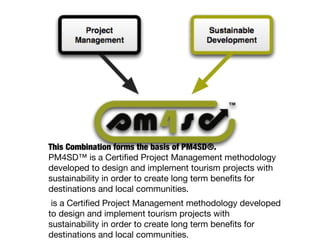
This Combination forms the basis of PM4SD®.
PM4SD™ is a Certified Project Management methodology
developed to design and implement tourism projects with
sustainability in order to create long term benefits for
destinations and local communities.
is a Certified Project Management methodology developed
to design and implement tourism projects with
sustainability in order to create long term benefits for
destinations and local communities.
PM4SD® is based on
PRINCE2®, a structured
method for effective project
management. PM4SD®
has innovated and adapted
PRINCE2® to the tourism
sector, combining
management aspects with
sustainable tourism
criteria and principles.
The PM4SD Methodology discerns three
different levels of governance
PM4SD METHODOLOGY AND QUALIFICATION
PM4SD Manual
5 Languages
English
Italian
German
Turkish
Polish
2 more languages in
September 2013
French and Spanish
The Structure of
PM4SD
VariablesVariables PrinciplesPrinciples ProcessesProcesses ComponentsComponents TechniquesTechniques ProductsProducts
6 10 5 6 4 2
Costs Continuous Business Justification Project Direction Business Case Product Based Planning Tourism Specialist Product
Timescales Learning from Experience Project Initiation
Risk, Issue and Change
Management
Team Building
Management Specialist
Product
Quality Roles and Responsibilities Stage Definition and Planning Organisation Logical Framework Approach
Scope Managing by Stages
Stage Control and Product
Delivery
Quality Benefits Maps
Risks Management by Exception Project Closure Planning
Benefits Focus on Products Progress Control
Tailor to Suit the Project
Environment
Collaborative approach
Sustainability
Application of Best Practices
The Structure of
PM4SD
project environment
PM4SD Qualifications
Foundation Qualification
The purpose of the Foundation
qualification is to confirm that a
candidate has sufficient knowledge
and understanding of the PM4SD
method to be able to work effectively
with, or as a member of, a project
management team working within an
environment supporting PM4SD
Exams certified by APM GROUP
Practitioner Qualification
The purpose of the Practitioner
qualification is to confirm whether the
candidate has achieved sufficient
understanding of how to apply and
tailor PM4SD in a scenario situation.
Candidates should be able to apply
and understand how to tailor PM4SD
effectively to a project within an
organization environment supporting
PM4SD.
Exams certified by APM GROUP
3 DAYS INTENSIVE COURSE & FINAL EXAM 2 DAYS INTENSIVE COURSE & FINAL EXAM
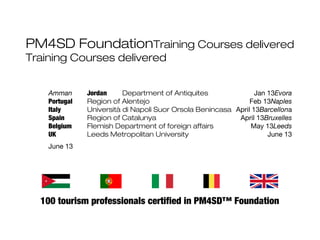
Amman Jordan Department of Antiquites Jan 13Evora
Portugal Region of Alentejo Feb 13Naples
Italy Università di Napoli Suor Orsola Benincasa April 13Barcellona
Spain Region of Catalunya April 13Bruxelles
Belgium Flemish Department of foreign affairs May 13Leeds
UK Leeds Metropolitan University June 13
June 13
100 tourism professionals certified in PM4SD™ Foundation
PM4SD FoundationTraining Courses delivered
Training Courses delivered
21 attended
PM4SD PractitionerTraining Courses delivered
Training Courses delivered
Naples Italy Università di Napoli Suor Orsola Benincasa July 13
Results will come soon
:-)
PM4SD® applies whenever an organisation,
whatever public or private, needs to plan and
manage a sustainable tourism initiative.
It provides a guarantee for public authorities
that the project will be transformed into
concrete actions with clearly defined
objectives, clear roles and responsibilities
and that these actions will have a real
impact on local communities.
It helps government, donors and
implementers to plan and manage
transparently and not to forget that every
action must have corresponding benefits. It
is a practice to be adopted for participatory,
transparent and effective management.
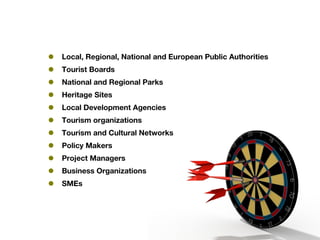
• Local, Regional, National and European Public Authorities
• Tourist Boards
• National and Regional Parks
• Heritage Sites
• Local Development Agencies
• Tourism organizations
• Tourism and Cultural Networks
• Policy Makers
• Project Managers
• Business Organizations
• SMEs
General benefits
Technical benefits
★ It is a flexible method applicable to every context
★ It can be taught
★ It is based on project best-practise experience
★ It focuses on quality for the entire duration of the project
★ It defines roles and responsibilities
★ It includes risk management techniques
★ It is a proactive method
★ It follows sustainable tourism policies and guidelines
★ It focuses on the objectives, benefits and results
★ It is a low-cost but high impact procedure
10 reasons to adopt
PM4SD
PM4SD key actors
APM GROUP is the certification
body for PM4SD
FEST owns the PM4SD
copyright and promote
the use of PM4SD
ATOs deliver the training
Opportunities to connect
Join the PM4SD community
10-12 Sept Prague
PM4SD™ Foundation Training Course
Sign an agreement with FEST
to use PM4SD
Sign the Naples Declaration
Become an (ATO) in PM4SD™
Accredited Training Organisation
Become the host organization
for the 2014 Summer School
thanks
designed by Jlag
silvia@jlageurope.com
www.jlageurope.com
www.festfoundation.eu

1 silvia barbone

  • 1.
  • 2.
    PM4SD Project Management forSustainable DevelopmentSummer School | Leadership and Governance for Sustainable TourismNaples, Italy8th-12th July 2013 8th-12th July 2013 8th-12th July 2013 8th-12th July 2013 Silvia Barbone | Jlag
  • 3.
    Summer School Leadership andGovernance for Sustainable Tourism for Sustainable Tourism for Sustainable Tourism
  • 4.
    Leadership and Managementin Sustainable Tourism addresses one of the most important themes in the tourism industry HOW TO PLAN, MANAGE, AND MONITOR TOURISM PROJECTS WITH SUSTAINABILITY
  • 5.
    •A knowledge hub •Atraining event •A funding marketplaceA networking event •A leading event to promote PM4SD™ as best management practice
  • 6.
  • 7.
    key factors ofsuccess and competitiveness GOVERNANCE MANAGEMENT
  • 8.
    This Combination formsthe basis of PM4SD®. PM4SD™ is a Certified Project Management methodology developed to design and implement tourism projects with sustainability in order to create long term benefits for destinations and local communities. is a Certified Project Management methodology developed to design and implement tourism projects with sustainability in order to create long term benefits for destinations and local communities.
  • 9.
    PM4SD® is basedon PRINCE2®, a structured method for effective project management. PM4SD® has innovated and adapted PRINCE2® to the tourism sector, combining management aspects with sustainable tourism criteria and principles.
  • 10.
    The PM4SD Methodologydiscerns three different levels of governance
  • 13.
    PM4SD METHODOLOGY ANDQUALIFICATION
  • 14.
    PM4SD Manual 5 Languages English Italian German Turkish Polish 2more languages in September 2013 French and Spanish
  • 15.
    The Structure of PM4SD VariablesVariablesPrinciplesPrinciples ProcessesProcesses ComponentsComponents TechniquesTechniques ProductsProducts 6 10 5 6 4 2 Costs Continuous Business Justification Project Direction Business Case Product Based Planning Tourism Specialist Product Timescales Learning from Experience Project Initiation Risk, Issue and Change Management Team Building Management Specialist Product Quality Roles and Responsibilities Stage Definition and Planning Organisation Logical Framework Approach Scope Managing by Stages Stage Control and Product Delivery Quality Benefits Maps Risks Management by Exception Project Closure Planning Benefits Focus on Products Progress Control Tailor to Suit the Project Environment Collaborative approach Sustainability Application of Best Practices
  • 16.
  • 17.
  • 18.
    Foundation Qualification The purposeof the Foundation qualification is to confirm that a candidate has sufficient knowledge and understanding of the PM4SD method to be able to work effectively with, or as a member of, a project management team working within an environment supporting PM4SD Exams certified by APM GROUP Practitioner Qualification The purpose of the Practitioner qualification is to confirm whether the candidate has achieved sufficient understanding of how to apply and tailor PM4SD in a scenario situation. Candidates should be able to apply and understand how to tailor PM4SD effectively to a project within an organization environment supporting PM4SD. Exams certified by APM GROUP 3 DAYS INTENSIVE COURSE & FINAL EXAM 2 DAYS INTENSIVE COURSE & FINAL EXAM
  • 19.
    Amman Jordan Departmentof Antiquites Jan 13Evora Portugal Region of Alentejo Feb 13Naples Italy Università di Napoli Suor Orsola Benincasa April 13Barcellona Spain Region of Catalunya April 13Bruxelles Belgium Flemish Department of foreign affairs May 13Leeds UK Leeds Metropolitan University June 13 June 13 100 tourism professionals certified in PM4SD™ Foundation PM4SD FoundationTraining Courses delivered Training Courses delivered
  • 20.
    21 attended PM4SD PractitionerTrainingCourses delivered Training Courses delivered Naples Italy Università di Napoli Suor Orsola Benincasa July 13 Results will come soon :-)
  • 21.
    PM4SD® applies wheneveran organisation, whatever public or private, needs to plan and manage a sustainable tourism initiative. It provides a guarantee for public authorities that the project will be transformed into concrete actions with clearly defined objectives, clear roles and responsibilities and that these actions will have a real impact on local communities. It helps government, donors and implementers to plan and manage transparently and not to forget that every action must have corresponding benefits. It is a practice to be adopted for participatory, transparent and effective management.
  • 22.
    • Local, Regional,National and European Public Authorities • Tourist Boards • National and Regional Parks • Heritage Sites • Local Development Agencies • Tourism organizations • Tourism and Cultural Networks • Policy Makers • Project Managers • Business Organizations • SMEs
  • 23.
  • 25.
  • 26.
    ★ It isa flexible method applicable to every context ★ It can be taught ★ It is based on project best-practise experience ★ It focuses on quality for the entire duration of the project ★ It defines roles and responsibilities ★ It includes risk management techniques ★ It is a proactive method ★ It follows sustainable tourism policies and guidelines ★ It focuses on the objectives, benefits and results ★ It is a low-cost but high impact procedure 10 reasons to adopt PM4SD
  • 27.
  • 28.
    APM GROUP isthe certification body for PM4SD FEST owns the PM4SD copyright and promote the use of PM4SD ATOs deliver the training
  • 29.
  • 30.
    Join the PM4SDcommunity 10-12 Sept Prague PM4SD™ Foundation Training Course Sign an agreement with FEST to use PM4SD Sign the Naples Declaration Become an (ATO) in PM4SD™ Accredited Training Organisation Become the host organization for the 2014 Summer School
  • 32.

Editor's Notes

  • #6 The Summer School aims to be: 1. A knowledge hub to share practices on how to plan and manage tourism funding with sustainability 2. A knowledge hub to improve project management and effectiveness in the tourism sector 3. A training event leading to a qualification for trainers and senior practitioners in project management for sustainable tourism 4. A f unding marketplace to develop joint funding proposals, developing concept notes and matching skill sets between professional project managers and organisations 5. A networking event to disseminate best practices and papers related to the theme “Project Management and Sustainable Tourism” 6. A leading event to promote PM4SD™ as best management practice
  • #7 Rationale (Reasons Why) What: methodology to be applied, certification Who: targets When: from the pilot to the market How:
  • #8 In order to achieve sustainable tourism it is crucial to consider governance and management as key factors in success and competitiveness. Tourism is one of the largest industriesin the world. It can make an important contribution to the economic, cultural and social development of tourist destinations, if attractions and initiatives are managed in a different way, by looking beyond short-term benefits, and by promoting a new sense of partnershipbetween the private sector and public authorities.
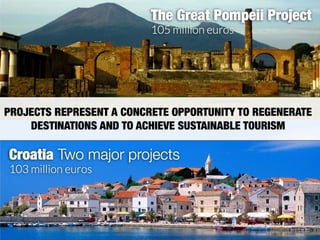
  • #13 The European Commission has approved a contribution of nearly €103 million for the first two major projects to be implemented under the EU’s Cohesion Fund for Croatia.
  • #17 The Structure of PM4SD The PM4SD method addresses project management with four integrated elements of principles, components, processes and the project environment. The principles These are the guiding obligations and good practices which determine whether the project is genuinely being managed using PM4SD. There are ten principles and unless all of them are applied, it is not a PM4SD project. The components These describe aspects of project management that must be addressed continually and in parallel throughout the project. The six components explain the specific treatment required by PM4SD for various project management disciplines and why they are necessary. The processes These describe a step-wise progression through the project lifecycle, from getting started to project closure. Each process provides checklists of recommended activities, products and related responsibilities. Tailoring PM4SD to the project environment This addresses the need to tailor PM4SD to the specific context of the project. PM4SD is not a ‘one size fits all’ solution; it is a flexible framework that can readily be tailored to any type or size of project.
  • #22 PM4SD® applies whenever an organisation, whatever public or private, needs to plan and manage a sustainable tourism initiative.It provides a guarantee for public authorities that the project will be transformed into concrete actions with clearly defined objectives, clear roles and responsibilities and that these actions will have a real impact on local communities. It helps government, donors and implementers to plan and manage transparently and not to forget that every action must have corresponding benefits. It is a practice to be adopted for participatory, transparent and effective management.