
Cluster Initiatives as Tools for Shared Value Creation 
The Case of Healthcare in Barranquilla 
Andrés Guimón 
Parallel 1.1 Common problems, common markets and shared value 
creation 
11 November 2014
Cluster Initiatives as Tools for Shared Value 
Creation 
The Case of Healthcare in Barranquilla 
TCI 2014, Monterrey 
Andrés Guimón
3 
Shared Value: 
“Addressing a Social Issue with a Business Model” 
Source: Michael Porter
4 
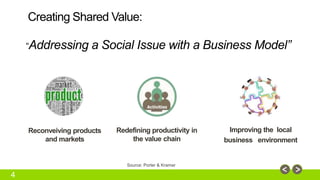
Creating Shared Value: 
“Addressing a Social Issue with a Business Model” 
Reconveiving products 
and markets 
Redefining productivity in 
the value chain 
Improving the local 
business environment 
Source: Porter & Kramer
Competitive Reinforcement Initiatives (CRIs) 
5 
How can they help?
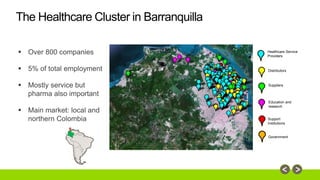
Healthcare Service 
Providers 
Distributors 
Suppliers 
Education and 
research 
Support 
Institutions 
Government 
The Healthcare Cluster in Barranquilla 
 Over 800 companies 
 5% of total employment 
 Mostly service but 
pharma also important 
 Main market: local and 
northern Colombia
7 
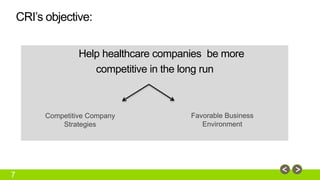
CRI’s objective: 
Help healthcare companies be more 
competitive in the long run 
Competitive Company 
Strategies 
Favorable Business 
Environment
8 
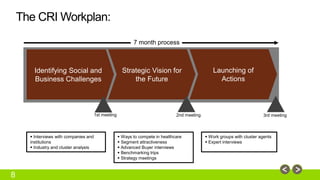
 Interviews with companies and 
institutions 
 Industry and cluster analysis 
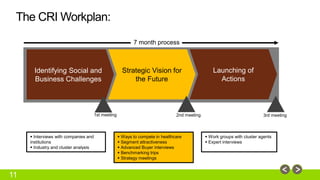
 Ways to compete in healthcare 
 Segment attractiveness 
 Advanced Buyer interviews 
 Benchmarking trips 
 Strategy meetings 
 Work groups with cluster agents 
 Expert interviews 
The CRI Workplan: 
Strategic Vision for 
the Future 
Launching of 
Actions 
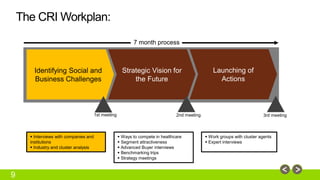
Identifying Social and 
Business Challenges 
7 month process 
1st meeting 2nd meeting 3rd meeting
9 
 Interviews with companies and 
institutions 
 Industry and cluster analysis 
 Ways to compete in healthcare 
 Segment attractiveness 
 Advanced Buyer interviews 
 Benchmarking trips 
 Strategy meetings 
 Work groups with cluster agents 
 Expert interviews 
The CRI Workplan: 
Strategic Vision for 
the Future 
Launching of 
Actions 
Identifying Social and 
Business Challenges 
7 month process 
1st meeting 2nd meeting 3rd meeting
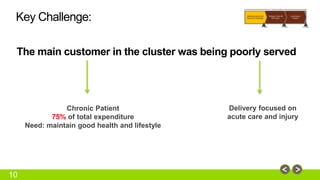
Key Challenge: 
The main customer in the cluster was being poorly served 
10 
Chronic Patient 
75% of total expenditure 
Need: maintain good health and lifestyle 
Delivery focused on 
acute care and injury
11 
 Interviews with companies and 
institutions 
 Industry and cluster analysis 
 Ways to compete in healthcare 
 Segment attractiveness 
 Advanced Buyer interviews 
 Benchmarking trips 
 Strategy meetings 
 Work groups with cluster agents 
 Expert interviews 
The CRI Workplan: 
Strategic Vision for 
the Future 
Launching of 
Actions 
Identifying Social and 
Business Challenges 
7 month process 
1st meeting 2nd meeting 3rd meeting
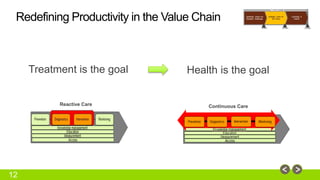
Redefining Productivity in the Value Chain 
12 
Treatment is the goal Health is the goal 
Reactive Care Continuous Care
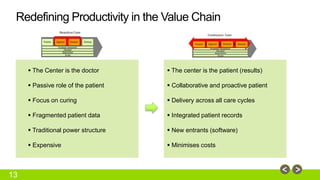
Redefining Productivity in the Value Chain 
13 
 The Center is the doctor 
 Passive role of the patient 
 Focus on curing 
 Fragmented patient data 
 Traditional power structure 
 Expensive 
 The center is the patient (results) 
 Collaborative and proactive patient 
 Delivery across all care cycles 
 Integrated patient records 
 New entrants (software) 
 Minimises costs
14 
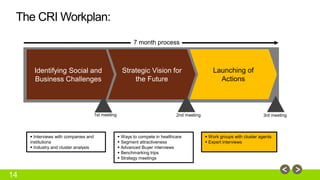
 Interviews with companies and 
institutions 
 Industry and cluster analysis 
 Ways to compete in healthcare 
 Segment attractiveness 
 Advanced Buyer interviews 
 Benchmarking trips 
 Strategy meetings 
 Work groups with cluster agents 
 Expert interviews 
The CRI Workplan: 
Strategic Vision for 
the Future 
Launching of 
Actions 
Identifying Social and 
Business Challenges 
7 month process 
1st meeting 2nd meeting 3rd meeting
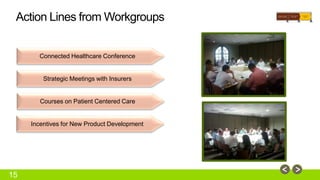
Action Lines from Workgroups 
15 
Connected Healthcare Conference 
Strategic Meetings with Insurers 
Courses on Patient Centered Care 
Incentives for New Product Development
16 
How has this vision developed 
over the years?
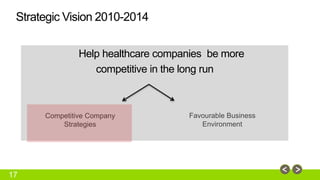
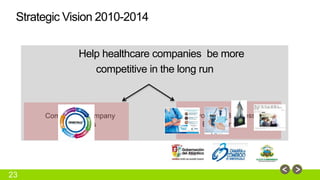
Strategic Vision 2010-2014 
17 
Help healthcare companies be more 
competitive in the long run 
Competitive Company 
Strategies 
Favourable Business 
Environment
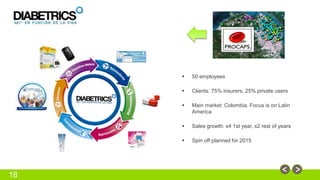
18 
 50 employees 
 Clients: 75% insurers, 25% private users 
 Main market: Colombia. Focus is on Latin 
America 
 Sales growth: x4 1st year, x2 rest of years 
 Spin off planned for 2015
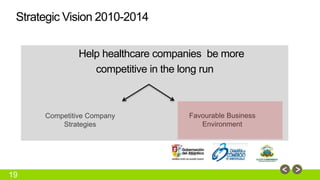
19 
Help healthcare companies be more 
competitive in the long run 
Competitive Company 
Strategies 
Favourable Business 
Environment 
Strategic Vision 2010-2014
Specific Skill Building 
20 
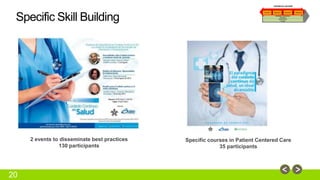
2 events to disseminate best practices 
130 participants 
Specific courses in Patient Centered Care 
35 participants
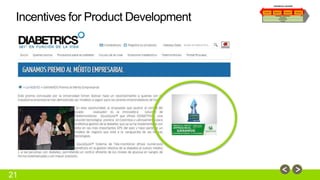
Incentives for Product Development 
21
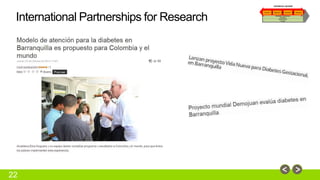
International Partnerships for Research 
22
23 
Help healthcare companies be more 
competitive in the long run 
Competitive Company 
Strategies 
Favourable Business 
Environment 
Strategic Vision 2010-2014
24 
Did The CRI Help Promote Shared Value?
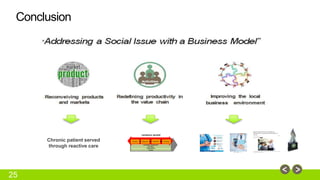
Conclusion 
25 
Chronic patient served 
through reactive care
26 
Thank You 
andres.guimon@competitiveness.com 
www.competitiveness.com

TCI 2014 Cluster Initiatives as Tools for Shared Value Creation The Case of Healthcare in Barranquilla

  • 1.
    Cluster Initiatives asTools for Shared Value Creation The Case of Healthcare in Barranquilla Andrés Guimón Parallel 1.1 Common problems, common markets and shared value creation 11 November 2014
  • 2.
    Cluster Initiatives asTools for Shared Value Creation The Case of Healthcare in Barranquilla TCI 2014, Monterrey Andrés Guimón
  • 3.
    3 Shared Value: “Addressing a Social Issue with a Business Model” Source: Michael Porter
  • 4.
    4 Creating SharedValue: “Addressing a Social Issue with a Business Model” Reconveiving products and markets Redefining productivity in the value chain Improving the local business environment Source: Porter & Kramer
  • 5.
    Competitive Reinforcement Initiatives(CRIs) 5 How can they help?
  • 6.
    Healthcare Service Providers Distributors Suppliers Education and research Support Institutions Government The Healthcare Cluster in Barranquilla  Over 800 companies  5% of total employment  Mostly service but pharma also important  Main market: local and northern Colombia
  • 7.
    7 CRI’s objective: Help healthcare companies be more competitive in the long run Competitive Company Strategies Favorable Business Environment
  • 8.
    8  Interviewswith companies and institutions  Industry and cluster analysis  Ways to compete in healthcare  Segment attractiveness  Advanced Buyer interviews  Benchmarking trips  Strategy meetings  Work groups with cluster agents  Expert interviews The CRI Workplan: Strategic Vision for the Future Launching of Actions Identifying Social and Business Challenges 7 month process 1st meeting 2nd meeting 3rd meeting
  • 9.
    9  Interviewswith companies and institutions  Industry and cluster analysis  Ways to compete in healthcare  Segment attractiveness  Advanced Buyer interviews  Benchmarking trips  Strategy meetings  Work groups with cluster agents  Expert interviews The CRI Workplan: Strategic Vision for the Future Launching of Actions Identifying Social and Business Challenges 7 month process 1st meeting 2nd meeting 3rd meeting
  • 10.
    Key Challenge: Themain customer in the cluster was being poorly served 10 Chronic Patient 75% of total expenditure Need: maintain good health and lifestyle Delivery focused on acute care and injury
  • 11.
    11  Interviewswith companies and institutions  Industry and cluster analysis  Ways to compete in healthcare  Segment attractiveness  Advanced Buyer interviews  Benchmarking trips  Strategy meetings  Work groups with cluster agents  Expert interviews The CRI Workplan: Strategic Vision for the Future Launching of Actions Identifying Social and Business Challenges 7 month process 1st meeting 2nd meeting 3rd meeting
  • 12.
    Redefining Productivity inthe Value Chain 12 Treatment is the goal Health is the goal Reactive Care Continuous Care
  • 13.
    Redefining Productivity inthe Value Chain 13  The Center is the doctor  Passive role of the patient  Focus on curing  Fragmented patient data  Traditional power structure  Expensive  The center is the patient (results)  Collaborative and proactive patient  Delivery across all care cycles  Integrated patient records  New entrants (software)  Minimises costs
  • 14.
    14  Interviewswith companies and institutions  Industry and cluster analysis  Ways to compete in healthcare  Segment attractiveness  Advanced Buyer interviews  Benchmarking trips  Strategy meetings  Work groups with cluster agents  Expert interviews The CRI Workplan: Strategic Vision for the Future Launching of Actions Identifying Social and Business Challenges 7 month process 1st meeting 2nd meeting 3rd meeting
  • 15.
    Action Lines fromWorkgroups 15 Connected Healthcare Conference Strategic Meetings with Insurers Courses on Patient Centered Care Incentives for New Product Development
  • 16.
    16 How hasthis vision developed over the years?
  • 17.
    Strategic Vision 2010-2014 17 Help healthcare companies be more competitive in the long run Competitive Company Strategies Favourable Business Environment
  • 18.
    18  50employees  Clients: 75% insurers, 25% private users  Main market: Colombia. Focus is on Latin America  Sales growth: x4 1st year, x2 rest of years  Spin off planned for 2015
  • 19.
    19 Help healthcarecompanies be more competitive in the long run Competitive Company Strategies Favourable Business Environment Strategic Vision 2010-2014
  • 20.
    Specific Skill Building 20 2 events to disseminate best practices 130 participants Specific courses in Patient Centered Care 35 participants
  • 21.
    Incentives for ProductDevelopment 21
  • 22.
  • 23.
    23 Help healthcarecompanies be more competitive in the long run Competitive Company Strategies Favourable Business Environment Strategic Vision 2010-2014
  • 24.
    24 Did TheCRI Help Promote Shared Value?
  • 25.
    Conclusion 25 Chronicpatient served through reactive care
  • 26.
    26 Thank You andres.guimon@competitiveness.com www.competitiveness.com

Editor's Notes

  • #3 Thank you and good afternoon everyone. I work with cluster initiatives and one of the subjects of the conference is shared value so I thought I would talk about how cluster initiatives, and more specifically, Competitive reinforcement initiatives, can be very useful tools for shared value creation. Lets stop for one minute at the concept of shared value. What does it mean and imply?
  • #4 There is a longer official definition but I thought this one was very clear and concise. SV means addressing social needs with a business model. It implies that businesses should start thinking on putting both profits and positive social impact at the center of their value proposition. Why do we care about shared value? Well, it has been identified by experts as one of the main areas for growth and innovation in the coming decades so we should care. There are many social needs to be resolved. If we can do this at a profit then we can scale the operation and ultimately resolve many social problems. This should be the aspiration of businesses and capitalism ultimately. How do Porter and Kramer, creators of the concept, explain SV can be created?
  • #5 They say there are three ways: By redefining products and markets: businesses need to learn how to identify unmet socal needs, unserved or underserved customers and think more in terms of improving lives than in terms of creating products and services. The second way is by redefining productivity in the value chain: businesses need to adapt their value chain activities and change them, use logistics, resources, suppliers and partners differently to address those social needs. The third way is by improving the local business environment and developing strong local clusters that allow those businesses to be able to work and be competitive locally. As you see, all three ways require companies to change, sometimes even to redefine their mission! It is a dynamic concept.
  • #6 Ok so I said SV is desirable both for businesses and society. Now, how can CRIs help create it?
  • #7 I will dedicate the minutes left to answer this question, and I would like to put as an example a real CRI I was involved in the healthcare cluster of Barranquilla. Here you can see a picture and some data of the cluster. Barranquilla is a city in northern colombia that lies by the carribbean sea. As you can see the healthcare cluster had a strong concentration of healthcare actores in the city. There were over 800 companies were we had laboratories, pharma companies, service providers, and support institutions. The CRI was initiated by the chamber of commerce of Barranquilla, and what was its objective?
  • #8 It was very concrete: help companies be more profitable in the long run. So really help companies earn more money and grow in the long term. To be more competitive companies need two things: Companies with the right competitive strategies (indivdual decisions): CRI works with the companies on this aspect of things A favorable business environment were companies can perform those strategies. So it also involves firms, government, knowledge actors, etc. to make decisions regarding improvements in the environment for companies. So in order to tackle these objective
  • #9 To meet this objective the CRI provided an ORGANIZED 7 MONTH PROCESS through which healthcare companies and institutions in the cluster got to THINK CRITICALLY ABOUT THEIR BUSINESSES AND COMPETITIVE POSITION AND ANALIZE THE DIFFERENT STRATEGIC OPTIONS AVAILABLE TO BE MORE PROFITABLE GOING FORWARD. As you can see the methodology we applied had three distinct phases:
  • #10 What happened during the fist phase in Barranquilla? We carried out 40-50 interviews with cluster agents and studied the cluster and health industry in depth both at the local, nacional and internaiconal levels. The main challenge that was identified was that
  • #11 The main customer of the cluster was being poorly served. Who was the main customer? the chronic patient (75% of costs). How were they being served? With an offer that focused on acute care, on curing, instead of an offer that focused on keeping their condition at the best level possible and improving their lifestyles. So large hospitals, expensive doctors and machinary and equipment. This problem was affecting everyone:
  • #12 Ok, once this problem was identified and agreed upon, the CRI entered in a second phase where we helped the cluster define a strategic vision to address the social need and also to understand the value chain and key success factors they needed to develop to solve the problem. In this phase, a lot of strategic analysis was done using common tools used in business, we segmented the business, we talked to advanved buyers, we did extensive benchmarking, strategic meeting with companies, etc. What were the results?
  • #13 The key here was to shift from treatment as the goal to health as the goal. The patient results should be at the center of the business activity. There were new opportunities to add value especially in prevention and monitoring activities but for this changes needed to take place: Patients needed to be educated to be more proactive sharing their data and using monitoring equipment Doctors had to build multidsiciplinary teams with software companies to develop adequate monitoring and prevention systems Data management emerged as a key activity in order to track patient health Equipment providers needed to develop ready to use light equipment Insurers needed to change their health plans incorporating specific programs and technology Etc.
  • #14 But in order to do this activities and partners in the value chain need to change. Productivity needs to be redefined. Explain different in value chains
  • #15 Ok so this vision, opportunity and new value chain were presented to the companies to promote the vision In a third phase, companies and institutions, with our guide, got together in two workgroups that met 3 times each to: - Identify key areas of improvement for the business environment - Define a specific action plan to tacke those areas.
  • #16 Here are some of the actions that came out from those workgroups. They planned: A conference Strategic meetings with insurers Courses in connected health An award for healthcare products And others.
  • #17 So this was what was done in 2010-2011. Now how has this vision evolved over the years?
  • #18 I will divide the results in actions at the firm level and actions at the institutional level, more related to the business environment. What can we see at the individual firm level?
  • #19 Today, 3 years after lauch, It has 50 employees (software, commercial, etc.) 75% of its customer base are insurers that have adopted their services and products in their health plans (they save them money) Sales cuatripled the first year and have been doubling since. They are planning a spin off were diabetrics becomes a company independent from Procaps. As you can see, they hace comprehensive care, - Education with this program (circulo de la vida); Medical equipment: they bought a pantent and developed it further. Software for patient and doctor use Pills Nutrition and cosmoceuticals This is probably the clearer example in the region of a traditional pharma company making pills that develops this value chain to attend unmet social needs.
  • #20 The objective was very concrete, help companies be more profitable in the long run. As you and this is something that depends: On companies themselves, applying the right competitive strategy But also on developing the favorable business environment (skills, infrastructure, etc.) for businesses to compete adequately This is why the CRI not only involves local firms but also the government and all relevant support institutions in the region.
  • #21 They implemented networking and skillbuilding activities: Two networking events with leaders in connected health to talk to companies and institutions on how to start competing in this area. Also universities have been updating their education offer. Here you have a new diploma that was created with a focus on connected health and that was already delivered to 35 medical institutions in the region.
  • #22 A new award for product development in connected health was created. I selected here this article were you can see that diabetrics, the company I showed before has already won this award twice. This is an important motivation factor for businesses in the region to innovate in this direction
  • #23 In terms of reseach projects Barranquilla the city hall has been really working to position Barranquilla as a reference in diabetes and they have had some success. They have entered in mportant reseach projects cofunded by the international diabetes foundation wth other european universities. Two examples a re DemoJuan and Vida nueva, were fieldwork is being carried out in the city of Barranquilla. This is also very good to get nice data on the current situation for diabetes in Barranquilla.
  • #24 The objective was very concrete, help companies be more profitable in the long run. As you and this is something that depends: On companies themselves, applying the right competitive strategy But also on developing the favorable business environment (skills, infrastructure, etc.) for businesses to compete adequately This is why the CRI not only involves local firms but also the government and all relevant support institutions in the region.
  • #25 Ok so I said SV is desirable both for businesses and society. Now, how can CRIs help create it?
  • #26 So, as a conclusion, this is how CRIs can help create shared value: Identifying needs Understanding value chains and key factors for success Promoting change Empowering firms and institutions for that change.