StressTesting  Regional  Approaches  
Conducive  to  Implement  S3  through  
Clusters  
  
Synthesis  Report    
for  the  Alpine  Space  Region  


October  2017  
  
S3-­4AlpClusters  is  cofinanced  by  the  European  Regional  Development  
Fund  through  the  Interreg  Alpine  Space  programme  


      Page  2  


This  report  has  been  produced  within  the  frame  of  the  S3-­4AlpClusters  project,  funded  by  the  Alpine  
Space  INTERREG  Programme  of  the  European  Commission.  It  was  prepared  by  Dr.  Gerd  Meier  zu  
Köcker  (ClusterAgentur  BW)  and  Mateja  Dermastia  (Anteja  ECG  –  Poly4emi).    
  
This  report  was  drafted  with  input  gathered  from  all  project  partners  over  the  first  phase  of  the  project  
implementation  (January  –  June  2017),  based  on  individual  regional  StressTest  reports.  The  authors  
would   like   to   thank   Michael   Keller   for   his   contribution   and   all   project   partners   for   their   significant  
efforts.  
  
doi:  10.23776/001  
  
Disclaimer  
The  information  and  perspectives  set  out  in  this  Policy  Report  are  those  of  the  authors  and  do  not  
necessarily  reflect  the  official  opinion  of  the  European  Commission  or  the  project  partners’  regions.  
Neither  the  European  Commission  institutions  and  bodies  nor  any  person  acting  on  their  behalf  may  
be  held  responsible  for  the  use  that  may  be  made  of  the  information  contained  therein.  Reproduction  
is  authorised,  provided  the  source  is  acknowledged,  unless  otherwise  stated.  For  use/reproduction  of  
third  party  material  specified  as  such,  permission  must  be  obtained  from  the  copyright.  
  
For  further  information  about  the  S3-­4AlpClusters  project,  you  will  find  a  short  description  at  the  end  of  
the  document.  To  learn  more  and  to  download  additional  resources  please  refer  to  the  project  website  
http://www.alpine-­space.eu/projects/s3-­4alpclusters/en/home.  
  
The  information  is  provided  without  assuming  any  legal  responsibility  for  correctness  or  completeness.  
The  data  presented  in  the  report  are  based  on  the  information  given  by  the  project  partners.    
  
©  S3-­4AlpClusters,  2017     
       
      Page  3  
  
Table  of  Contents    
Concepts  and  Definitions  ...........................................................................................................  4	
  
Summary  ......................................................................................................................................  5	
  
The  Context:  Interplay  between  Smart  Specialisation  and  Clusters  ......................................  6	
  
The  StressTest  Approach  ...........................................................................................................  7	
  
Learnings  from  the  Analysis  of  Partner  Regions  and  Related  S3  ........................................  10	
  
StressTest  Findings  ..................................................................................................................  12	
  
Involvement  of  Cluster  Initiatives  during  S3  Development  ...................................................  12	
  
Coordination  and  Alignment  of  S3  ........................................................................................  13	
  
Implementation  of  S3  ...........................................................................................................  15	
  
Monitoring  and  Evaluation  ....................................................................................................  18	
  
Impact  of  S3  on  Cluster  Organisations  .................................................................................  19	
  
Reflections  .................................................................................................................................  21	
  
Concluding  Observations  .........................................................................................................  23	
  
S3-­4AlpClusters  in  a  Nutshell  ..................................................................................................  24	


      Page  4  
  
Concepts  and  Definitions  
For  the  purpose  of  this  report  the  key  concepts  and  definitions  are  understood  as  follows:    
n   Clusters:  Clusters  are  generally  described  as  groups  of  companies,  mainly  SMEs,  and  other  
actors   (government,   research,   and   academic   community,   institutions   for   collaboration,  
financial  institutions)  co-­locating  within  a  geographic  area,  cooperating  around  a  specialised  
niche,  and  establishing  close  linkage  and  working  alliances  to  improve  their  competitiveness.  
n   Cluster   initiatives:   A   cluster   initiative   is   an   organised   effort   aimed   at   fostering   the  
development  of  the  cluster  either  by  strengthening  the  potential  of  cluster  actors  or  shaping  
relationships   between   them.   They   often   have   a   character   like   a   regional   network.   Cluster  
initiatives  are  usually  managed  by  cluster  organisations.  
n   Cluster   organisations:   Cluster   organisations   are   entities   that   support   the   strengthening   of  
collaboration,   networking,   and   learning   in   innovation   clusters   and   act   as   innovation   support  
providers  by  providing  or  channelling  specialised  and  customised  business  support  services  to  
stimulate  innovation  activities,  especially  in  SMEs.  They  are  usually  the  actors  that  facilitate  
strategic   partnering   across   clusters.   Cluster   organisations   are   also   called   cluster  
managements.  
n   Cluster  participants:  Cluster  participants  are  representatives  of  industry,  academia  or  other  
intermediaries,  which  are  commonly  engaged  in  a  cluster  initiative.  Given  the  case  a  cluster  
initiative  has  a  certain  legal  form,  like  associations,  cluster  participants  are  often  called  cluster  
members.  
n   Cluster  policy:  Cluster  policy  is  an  expression  of  political  commitment,  composed  of  a  set  of  
specific   government   policy   interventions   that   aim   to   strengthen   existing   clusters   and/or  
facilitate  the  emergence  of  new  ones.  Cluster  policy  is  to  be  seen  as  a  framework  policy  that  
opens  the  way  for  the  bottom-­up  dynamics  seen  in  clusters  and  cluster  initiatives.  This  differs  
from   the   approach   taken   by   traditional   industrial   policies,   which   try   (and   most   often   fail)   to  
create  or  back  winners.  
n   Programme:  Programmes  are  a  vehicle  to  implement  a  policy,  e.  g.  funding  programme  for  
R&D  in  environmental  technology.  In  addition  to  programmes,  policies  are  also  implemented  
through  regulation  (=  regulatory  framework,  e.  g.  law  on  consumer  protection).  
n   S3-­Smart   Specialisation   Strategies:   Smart   Specialisation   is   a   strategic   approach   to  
economic   development   through   targeted   support   for   research   and   innovation.   It   involves   a  
process   of   developing   a   vision,   identifying   the   place-­based   areas   of   greatest   strategic  
potential,   developing   multi-­stakeholder   governance   mechanisms,   setting   strategic   priorities  
and  using  smart  policies  to  maximise  the  knowledge-­based  development  potential  of  a  region,  
regardless  of  whether  it  is  strong  or  weak,  high-­tech  or  low-­tech
1
.  
We   will   clearly   distinguish   between   clusters,   cluster   initiatives   and   cluster   organisations   to   make   it  
easier  for  the  interviewee  to  understand  what  is  intended  with  the  corresponding  question.  


1
  Foray  (2015):  Smart  Specialisation,  Opportunities  and  Challenges  for  Regional  Innovation  Policy,  Routledge.  
       
      Page  5  
  
Summary  
Several   European   Union   (EU)   regions   have   developed   Smart   Specialisation   Strategies   (S3)   as  
integrated   part   of   their   regional   innovation   strategies.   The   challenge   is   to   implement   S3   through  
clusters   in   order   to   gain   sustainable   and   inclusive   growth   while   generating   critical   mass   of  
economically  viable  activities.    
The   objective   of   the   S3-­4AlpCusters   project   is   to   improve   framework   conditions   for   innovations  
induced   by   clusters   and   SMEs   as   well   as   to   create   new   jobs   and   employment   opportunities.   As  
implemented  by  clusters  and  cluster  organisations,  S3  can  offer  an  innovative  approach  to  improve  
innovation   in   the   Alpine   Space.   Cross-­regional   approaches   can   serve   as   support   for   coordinated  
actions   between   the   different   sectors/regions.   Transnational   cluster   cooperation   facilitates   the  
achievements  of  a  critical  mass  of  SMEs  and  enhances  cross-­regional  collaboration  to  innovate  for  
new  products  in  areas  relevant  to  the  Alpine  Space.  
Against  this  background,  each  of  the  11  partner  regions  of  the  S3-­4AlpClusters  conducted  a  policy  
benchmarking  (StressTesting)  to  ascertain  how  to  implement  S3  through  clusters  as  individual  benefit.  
Additionally,  the  StressTesting  provided  a  joint  benefit  to  the  S3-­4AlpClusters  partnership  by  allowing  
for   a   better   understanding   of   each   other’s   policy   instruments.   The   StressTesting   addressed   policy  
making  and  implementation  processes,  namely  the  role  of  clusters  in  the  design  and  implementation  
of   the   S3,   regional   support   schemes   for   cluster   initiatives,   coordination   and   alignment   of   S3   at   the  
regional   and   national   level.   Benchmarking   also   explores   the   role   of   a   regional   cluster   excellence  
portfolio   to   provide   inputs   for   development   and   testing   innovation   models   initiated   by   cluster  
organisations  and  subsequently  identifies  areas  for  (common)  improvements.    
The   present   Policy   Report   summarises   the   findings   of   the   partner   regions’   StressTest   reports   and  
provides  reflections  how  to  make  more  use  of  cluster-­based  approaches  in  implementing  S3.    
The  main  conclusions  are:  
•   Cluster   initiatives   have   been   strongly   involved   in   the   development   process   of   S3   and  
significantly  contributed  to  it.  Their  expertise  was  requested  in  a  very  different  way.  
•   Cluster  initiatives  are  significantly  involved  during  the  implementation  process  of  S3,  whereas  
extent  and  manner  varies  significantly.  
•   Monitoring  and  evaluation  is  understood  as  tool  to  improve  policies,  but  there  is  a  significant  
lack  of  appropriate  evaluation  schemes.  
•   A  significant  impact  of  S3  on  cluster  initiatives  can  already  be  identified.  
•   Aligning  S3  and  related  policy  instruments  with  policies  on  national  or  neighbouring  regional  
level  remains  a  challenge.    
The  last  conclusion  is  of  significant  importance  since  it  indicates  that  cross-­regional  cooperation  is  not  
sufficiently  supported.  Respective  policies  and  related  policy  instruments  are  missing.  The  Report  on  
“Strategy  Alpine  Space  Areas  for  Cross-­regional  Cooperation”  clearly  highlighted  the  need  for  cross-­
regional  cooperation  as  well  as  deducted  promising  strategic  areas.    
Both   reports   will   lay   the   foundation   for   the   first   attempt   to   design   a   joint   Alpine   Cluster   Innovation  
Express   –   ACIE.   The   ACIE   is   a   synchronised   scheme   for   cross-­regional   funding,   which   is   built   on  
existing   regional   programmes.   By   aligning   these   programmes   cross-­regional   consortia   can   be  
supported   through   a   joint   call   for   proposals,   which   are   implemented   according   to   regional   funding  
procedures.   A   synchronised   scheme   neither   requires   additional   funds   nor   leads   to   modifications   of  
regional  funding  procedures.  
       
      Page  6  
  
The  Context:  Interplay  between  Smart  
Specialisation  and  Clusters    
Clusters  are  a  fundamental  part  of  the  European  industrial  landscape  as  38  %  of  European  jobs  are  
based   in   clusters.   They   are   key   drivers   for   the   European   economy   with   regard   to   competitiveness,  
growth  and  jobs.  Over  the  last  years,  cluster  policy  in  the  EU  has  increasingly  gained  importance  to  
improve   competitiveness   of   local   industries   and   facilitate   industrial   transformation   processes   by  
stimulating  the  development  of  infrastructure  in  support  of  business  innovation.  The  recent  economic  
crisis  and  on-­going  global  industrial  transformations  have  highlighted  the  need  to  modernise  regional  
industrial  structures  and  build  new  industrial  competences  in  order  to  respond  to  global  competition  
and  to  address  societal  challenges,  such  as  environment,  health  and  resource  efficiency.  
Starting  from  the  observation  that  the  implementation  of  Smart  Specialisation  Strategies  often  fails  to  
generate  the  desired  effects,  there  is  a  strong  need  to  better  understand  the  relationship  between  S3  
and   clusters.   The   underlying   problem   in   the   implementation   of   S3   has   been   detected   at   two  
fundamental  levels:  a  lack  of  experience  among  regions  on  how  to  use  clusters  in  the  implementation  
of   Smart   Specialisation   Strategies   and   a   lack   of   alignment   between   and   knowledge   about   other  
regions’  strategies.    
The  interplay  between  S3  and  clusters  implies  a  two-­way  relationship  between  the  two  concepts.  As  
suggested   by   the   overall   title   of   the   project   (“S3-­4AlpClusters   –   Smart   Specialisation   Strategies   to  
build  an  Innovation  Model  for  Alp  Clusters”),  a  first  way  to  study  the  interdependency  is  to  look  at  how  
S3   can   be   used   to   foster   innovation   processes   and   spark   entrepreneurship   within   clusters   (“S3   →  
Clusters”).   Turning   the   relationship   on   its   head,   existing   clusters   can   also   be   used   as   a   tool   in   the  
implementation  of  S3  (“Clusters  →  S3”).  The  overall  design  of  the  project  allows  focusing  on  different  
aspects  of  the  interplay  between  S3  and  clusters  in  its  different  work  packages.    
Taking   the   above-­mentioned   into   account,   regions   should   apply   a   broad   set   of   policy   instruments  
when   implementing   their   S3   through   clusters.   History   has   shown   that   there   is   no   single   policy  
appropriate   to   cope   with   all   regional   challenges
2
.   This   also   leads   the   attention   away   from   single  
clusters  rather  than  to  the  regional  cluster  portfolio.    
A  well-­balanced,  matured  regional  cluster  portfolio  is  necessary  to  have  capable  clusters  and  cluster  
managements  in  place  as  tool  to  support  the  entrepreneurial  discovery  and  identify  those  opportunities  
a  region  can  benefit  most.  Consequently,  regions  need  
•   Strong   clusters,   since   enterprises   located   in   strong   clusters   have   a   higher   growth   rate   and  
higher  productivities
3
.    
•   Strong   cluster   managements   that   can   provide   higher   impact   in   terms   of   innovation   and  
competitiveness  than  weak  ones
4
.  
•   Systematic  implementation  approach.  If  a  region  intends  to  use  clusters  as  a  tool  to  implement  
S3,  it  has  to  follow  a  throughout  and  systematic  approach.  
2
  Izsak,  Ketels,  Lämmer-­Gamp,  Meier  zu  Köcker  (2016):  Smart  Guide  to  Cluster  Policy,  European  Cluster  Observatory,  
Brussels,  http://ec.europa.eu/enterprise/initiatives/cluster/observatory/cluster-­mapping-­services/services/index_en.htm.  
3
  Ketels,  Protsiv  (2013):  Clusters  and  the  New  Growth  Path  for  Europe,  WWWforEurope  Working  Paper,  WIFO,  Vienna.  
4
  Lämmer-­Gamp,  Meier  zu  Köcker,  Christensen  (2012):  Clusters  are  Individuals.  New  Findings  from  the  European  Cluster  
Management  and  Cluster  Program  Benchmarking,  Danish  Ministry  of  Science,  Technology  and  Innovation,  ISBN:  978-­87-­
92776-­22-­8,  Copenhagen/Berlin.  
       
      Page  7  
  
The  StressTest  Approach  
StressTesting  is  a  transnational  benchmarking-­based  approach  that  enables  an  empirical  review  and  
assessment   of   regional   policies   for   implementation   of   Smart   Specialisation   Strategies   (S3)   through  
clusters.   StressTesting   determines   how   and   where   clusters   can   be   most   supportive   of   industrial  
transformation  and  growth  in  an  integrated,  coordinated  and  sustained  manner.  The  overall  aim  is  to  
develop  new  and  better  ways  of  designing  and  implementing  modern  cluster-­based  regional  economic  
development  policies.  The  approach  draws  maximum  advantage  from  analysis  of  the  regional  cluster  
portfolio   to   better   understand   the   forces   that   shape   new   industrial   value   chains   and   sectors.  
StressTesting   is   intended   for   regional   implementation   organisations,   policy   makers   and   business  
development   entities   that   are   interested   in   comparing   their   own   region   with   European   frontrunner  
regions.  
The  StressTest  and  its  related  report  will  thus  mainly  focus  on  the  question  of  how  clusters  are  used  
as  a  tool  of  S3  and  study  the  modality  of  use  and  influence  of  clusters  in  the  implementation  of  S3.  By  
including   questions   about   the   ability   of   cluster   initiatives   to   implement   new   innovation   models,   the  
results  of  the  StressTest  will  nevertheless  also  pave  the  way  for  another  important  question  of  how  S3  
can  contribute  to  define  new  innovation  models  in  further  detail.  It  thus  fully  considers  the  two-­way  
interplay  between  clusters  and  S3.    
StressTesting  addresses  both  policymaking  and  implementation  processes.  The  approach  examines  
the   role   of   clusters   in   the   design   of   S3   and   the   regional   support   schemes   for   cluster   initiatives.   It  
provides   insight   views   on   the   coordination   and   alignment   of   S3   at   the   regional   and   national   level.  
Furthermore,  it  identifies  the  current  and  potential  role  of  clusters  in  the  implementation  of  S3.    
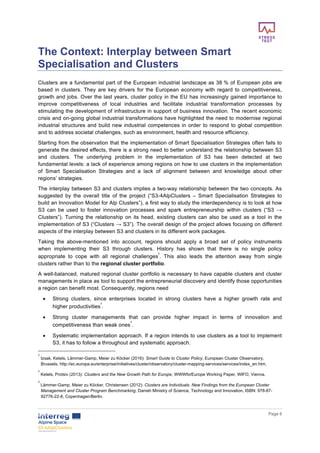
The   process   of   using   clusters   as   tool   to   implement   S3   is   a   multi-­facetted   and   complex   process.  
However,  although  regions  are  very  different,  it  follows  the  six  key  dimensions  shown  in  Fig.  1.  
Figure  1:  Dimensions  of  policy-­making  and  implementation  process  in  connection  with  S3  


      Page  8  
  
The  importance  of  the  regional  cluster  portfolio  and  individual  clusters  already  starts  during  the  design  
phase  of  S3.  Clusters  can  act  as  a  more  efficient  tool,  if  the  respective  S3  is  built  upon  them  and  takes  
the   needs   and   potentials   of   the   cluster   actors   into   account.   The   main   challenge   then   is   the  
implementation  of  S3,  meaning  to  turn  the  S3  into  a  set  of  policy  instruments  that  helps  to  meet  the  
desired  objectives.    
Even  if  the  concept  of  S3  helps  to  concentrate  the  resources  on  selected  priority  areas,  regions  often  
do   not   have   the   critical   mass   or   capacity   to   successfully   develop   the   necessary   transformative  
activities  completely  on  their  own.    
Thus,   aligning   S3   related   policy   instruments   with   those   on   national   level   or   with   those   of   the  
neighbouring   regions,   enables   regions   to   attract   additional   funding   or   other   kinds   of   support.  
Evaluation  and  monitoring  as  tool  to  do  better  policies  is  also  an  important  dimension,  thus  considered  
during  the  StressTesting.  
The  StressTesting  exercises  (online  questionnaire)  were  completed  by  all  partner  regions,  based  on  
the  involvement  of  representative  group  of  regional  stakeholders  from  three  different  levels  
•   Regional  policy  makers  in  charge  with  the  development  and  implementation  of  S3  
•   Cluster  managers  
•   Other   stakeholders   like   representatives   from   regional   development   agencies,   regional  
councils  or  other  entities  closely  involved  in  the  development  and  implementation  of  S3.  
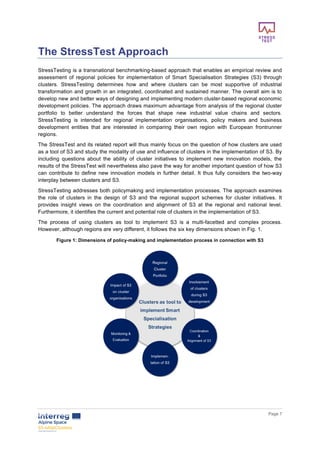
In  total  more  than  130  stakeholders  from  all  levels  (cluster  organisation,  stakeholder  responsible  to  
implement   S3   and   policy   makers)   participated   in   the   online   survey   (s.   Fig.   2),   incl.   48   cluster  
managers.  Most  participants  came  from  smaller  Alpine  Space  regions,  like  Slovenia,  Franche-­Comté  
and  Fribourg
5
.  
Figure  2:  Distribution  of  participants  of  the  StressTest  exercises  


5
  Comparable  high  number  of  participants  also  came  from  Baden-­Württemberg.  
       
      Page  9  
  
Thus,  the  data  gathered  provides  a  unique  source  of  insight  and  a  “snap-­shot”  portrait  of  each  region’s  
theoretical  and  practical  approach  in  order  to  implement  S3  through  clusters.  As  an  integrated  part  of  
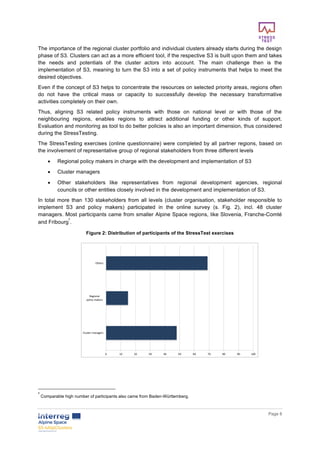
the  StressTesting,  the  region  specific  data  were  compared  among  25  European  regions  in  order  to  
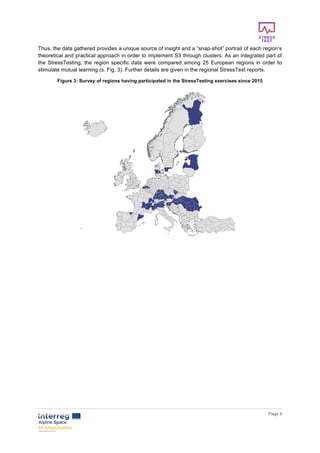
stimulate  mutual  learning  (s.  Fig.  3).  Further  details  are  given  in  the  regional  StressTest  reports.  
Figure  3:  Survey  of  regions  having  participated  in  the  StressTesting  exercises  since  2015  


      Page  10  
  
Learnings  from  the  Analysis  of  Partner  
Regions  and  Related  S3  
The   report   “Strategic   Alpine   Space   Areas   for   Cross-­regional   Cooperation”   identified   potential  
synergies  among  Smart  Specialisation  Strategies  (S3)  of  the  S3-­4AlpClusters  partners
6
.  The  findings  
went  beyond  the  current  state  of  discussion  on  S3  formulation  and  promoted  a  better  understanding  of  
the  implications  of  cross-­regional  collaboration  and  resulting  synergies  have  for  the  selected  partners  
from  the  Alpine  Region  in  the  context  of  Smart  Specialisation.  The  learnings  from  the  report  can  be  
summarised  as  follows:  
•   The  partner  regions  are  innovation  front-­runners,  but  their  investments  in  R&D  and  Innovation  
differs  significantly.  
•   The   related   S3   of   the   partner   regions   are   very   different,   but   most   of   them   focus   on   similar  
Priority  Areas.    
•   The   partner   regions   vary   significantly   in   terms   of   industrial   critical   mass,   but   they   can   be  
grouped  into  three  areas.    
•   None   of   the   S3   or   related   policy   instruments   actively   promote   cross-­regional   cooperation,  
although  many  smaller  regions  have  to  go  cross-­border  due  to  limited  size  or  critical  mass.  
•   Five  Strategic  Alpine  Space  Areas  for  Cross-­regional  Cooperation  can  be  defined,  based  on  
common  needs  and  interests  outlined  in  the  related  S3  and  the  Alpine  Space  Macro-­regional  
Strategy  (EUSALP)
7
.  
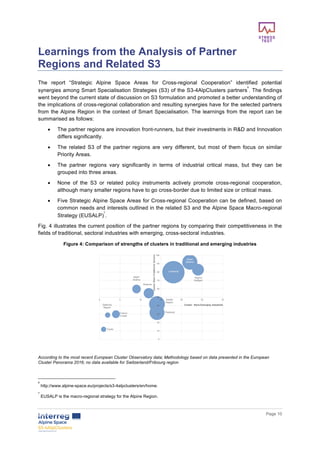
Fig.  4  illustrates  the  current  position  of  the  partner  regions  by  comparing  their  competitiveness  in  the  
fields  of  traditional,  sectoral  industries  with  emerging,  cross-­sectoral  industries.    
Figure  4:  Comparison  of  strengths  of  clusters  in  traditional  and  emerging  industries
  
According  to  the  most  recent  European  Cluster  Observatory  data;;  Methodology  based  on  data  presented  in  the  European  
Cluster  Panorama  2016;;  no  data  available  for  Switzerland/Fribourg  region  
  
6
  http://www.alpine-­space.eu/projects/s3-­4alpclusters/en/home.  
7
  EUSALP  is  the  macro-­regional  strategy  for  the  Alpine  Region.  
       
      Page  11  
  
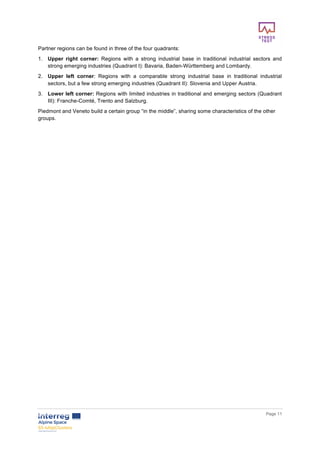
Partner  regions  can  be  found  in  three  of  the  four  quadrants:  
1.   Upper   right   corner:   Regions   with   a   strong   industrial   base   in   traditional   industrial   sectors   and  
strong  emerging  industries  (Quadrant  I):  Bavaria,  Baden-­Württemberg  and  Lombardy.  
2.   Upper   left   corner:   Regions   with   a   comparable   strong   industrial   base   in   traditional   industrial  
sectors,  but  a  few  strong  emerging  industries  (Quadrant  II):  Slovenia  and  Upper  Austria.    
3.   Lower  left  corner:  Regions  with  limited  industries  in  traditional  and  emerging  sectors  (Quadrant  
III):  Franche-­Comté,  Trento  and  Salzburg.    
Piedmont  and  Veneto  build  a  certain  group  “in  the  middle”,  sharing  some  characteristics  of  the  other  
groups.    


      Page  12  
  
StressTest  Findings  
In  the  following,  the  main  findings  of  the  StressTest  exercises,  conducted  in  the  11  regions  of  the  S3-­
4AlpCluster  partners,  are  presented  and  discussed.  They  allow  for  further  insights  into  the  interplay  
between  S3  and  cluster  initiatives.  These  findings  clearly  move  beyond  the  current  state  of  discussion.  
This   chapter   is   structured   according   to   the   dimension   of   policy   making   and   implementation   as  
presented  in  Figure  1.    
    
Involvement  of  Cluster  Initiatives  during  S3  Development    
Cluster   initiatives   have   strongly   been   involved   in   the   development   process   of   S3,   but   have  
contributed  in  a  very  different  way.    
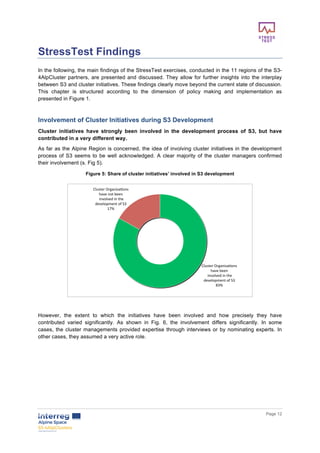
As  far  as  the  Alpine  Region  is  concerned,  the  idea  of  involving  cluster  initiatives  in  the  development  
process  of  S3  seems  to  be  well  acknowledged.  A  clear  majority  of  the  cluster  managers  confirmed  
their  involvement  (s.  Fig  5).    
Figure  5:  Share  of  cluster  initiatives’  involved  in  S3  development  
  
  
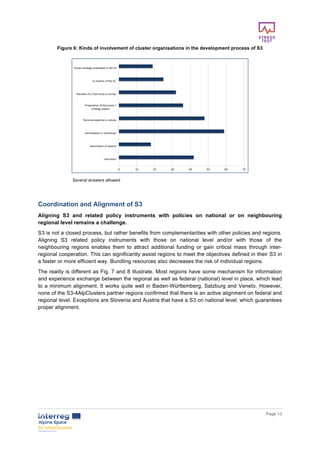
However,   the   extent   to   which   the   initiatives   have   been   involved   and   how   precisely   they   have  
contributed   varied   significantly.   As   shown   in   Fig.   6,   the   involvement   differs   significantly.   In   some  
cases,  the  cluster  managements  provided  expertise  through  interviews  or  by  nominating  experts.  In  
other  cases,  they  assumed  a  very  active  role.  
     
Cluster	Organisa.ons	
have	been	
	involved	in	the	
development	of	S3	
83%	
Cluster	Organisa.ons	
have	not	been	
	involved	in	the	
development	of	S3	
17%
       
      Page  13  
  
Figure  6:  Kinds  of  involvement  of  cluster  organisations  in  the  development  process  of  S3  
  
Several  answers  allowed  
  
Coordination  and  Alignment  of  S3  
Aligning   S3   and   related   policy   instruments   with   policies   on   national   or   on   neighbouring  
regional  level  remains  a  challenge.    
S3  is  not  a  closed  process,  but  rather  benefits  from  complementarities  with  other  policies  and  regions.  
Aligning   S3   related   policy   instruments   with   those   on   national   level   and/or   with   those   of   the  
neighbouring   regions   enables   them   to   attract   additional   funding   or   gain   critical   mass   through   inter-­
regional  cooperation.  This  can  significantly  assist  regions  to  meet  the  objectives  defined  in  their  S3  in  
a  faster  or  more  efficient  way.  Bundling  resources  also  decreases  the  risk  of  individual  regions.    
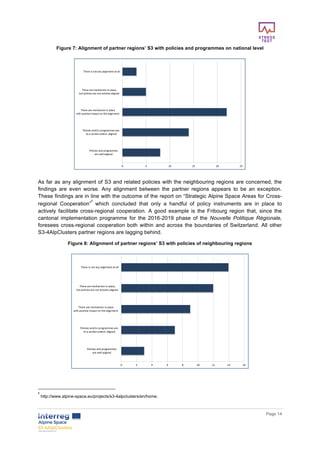
The  reality  is  different  as  Fig.  7  and  8  illustrate.  Most  regions  have  some  mechanism  for  information  
and  experience  exchange  between  the  regional  as  well  as  federal  (national)  level  in  place,  which  lead  
to  a  minimum  alignment.  It  works  quite  well  in  Baden-­Württemberg,  Salzburg  and  Veneto.  However,  
none  of  the  S3-­4AlpClusters  partner  regions  confirmed  that  there  is  an  active  alignment  on  federal  and  
regional  level.  Exceptions  are  Slovenia  and  Austria  that  have  a  S3  on  national  level,  which  guarantees  
proper  alignment.  


      Page  14  
  
Figure  7:  Alignment  of  partner  regions’  S3  with  policies  and  programmes  on  national  level  
  
  
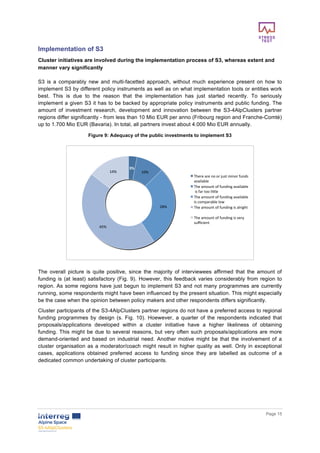
As  far  as  any  alignment  of  S3  and  related  policies  with  the  neighbouring  regions  are  concerned,  the  
findings   are   even   worse.   Any   alignment   between   the   partner   regions   appears   to   be   an   exception.  
These  findings  are  in  line  with  the  outcome  of  the  report  on  “Strategic  Alpine  Space  Areas  for  Cross-­
regional   Cooperation”
8
   which   concluded   that   only   a   handful   of   policy   instruments   are   in   place   to  
actively   facilitate   cross-­regional   cooperation.   A   good   example   is   the   Fribourg   region   that,   since   the  
cantonal   implementation   programme   for   the   2016-­2019   phase   of   the   Nouvelle   Politique   Régionale,  
foresees  cross-­regional  cooperation  both  within  and  across  the  boundaries  of  Switzerland.  All  other  
S3-­4AlpClusters  partner  regions  are  lagging  behind.  
Figure  8:  Alignment  of  partner  regions’  S3  with  policies  of  neighbouring  regions  
  
  
8
  http://www.alpine-­space.eu/projects/s3-­4alpclusters/en/home.  
       
      Page  15  
  
Implementation  of  S3  
Cluster  initiatives  are  involved  during  the  implementation  process  of  S3,  whereas  extent  and  
manner  vary  significantly    
  
S3   is   a   comparably   new   and   multi-­facetted   approach,   without   much   experience   present   on   how   to  
implement  S3  by  different  policy  instruments  as  well  as  on  what  implementation  tools  or  entities  work  
best.   This   is   due   to   the   reason   that   the   implementation   has   just   started   recently.   To   seriously  
implement  a  given  S3  it  has  to  be  backed  by  appropriate  policy  instruments  and  public  funding.  The  
amount   of   investment   research,   development   and   innovation   between   the   S3-­4AlpClusters   partner  
regions  differ  significantly  -­  from  less  than  10  Mio  EUR  per  anno  (Fribourg  region  and  Franche-­Comté)  
up  to  1.700  Mio  EUR  (Bavaria).  In  total,  all  partners  invest  about  4.000  Mio  EUR  annually.  
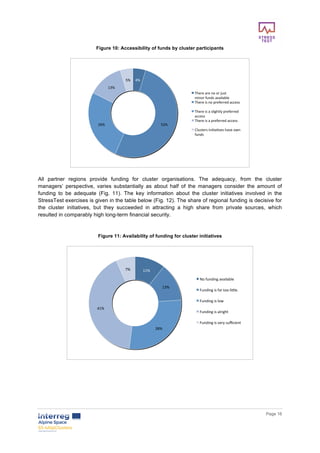
Figure  9:  Adequacy  of  the  public  investments  to  implement  S3  
  
  
The   overall   picture   is   quite   positive,   since   the   majority   of   interviewees   affirmed   that   the   amount   of  
funding  is  (at  least)  satisfactory  (Fig.  9).  However,  this  feedback  varies  considerably  from  region  to  
region.  As  some  regions  have  just  begun  to  implement  S3  and  not  many  programmes  are  currently  
running,  some  respondents  might  have  been  influenced  by  the  present  situation.  This  might  especially  
be  the  case  when  the  opinion  between  policy  makers  and  other  respondents  differs  significantly.  
Cluster  participants  of  the  S3-­4AlpClusters  partner  regions  do  not  have  a  preferred  access  to  regional  
funding   programmes   by   design   (s.   Fig.   10).   Hoewever,   a   quarter   of   the   respondents   indicated   that  
proposals/applications   developed   within   a   cluster   initiative   have   a   higher   likeliness   of   obtaining  
funding.  This  might  be  due  to  several  reasons,  but  very  often  such  proposals/applications  are  more  
demand-­oriented   and   based   on   industrial   need.   Another   motive   might   be   that   the   involvement   of   a  
cluster  organisation  as  a  moderator/coach  might  result  in  higher  quality  as  well.  Only  in  exceptional  
cases,   applications   obtained   preferred   access   to   funding   since   they   are   labelled   as   outcome   of   a  
dedicated  common  undertaking  of  cluster  participants.    
     
3%	
10%	
28%	
45%	
14%	
There	are	no	or	just	minor	funds	
available	
The	amount	of	funding	available	
	is	far	too	li<le		
The	amount	of	funding	available		
is	comparable	low	
The	amount	of	funding	is	alright	
The	amount	of	funding	is	very	
sufficient
       
      Page  16  
  
Figure  10:  Accessibility  of  funds  by  cluster  participants  
  
  
All   partner   regions   provide   funding   for   cluster   organisations.   The   adequacy,   from   the   cluster  
managers’   perspective,   varies   substantially   as   about   half   of   the   managers   consider   the   amount   of  
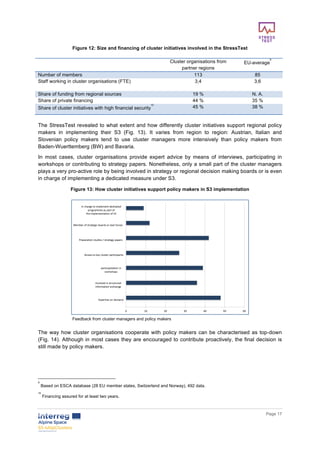
funding   to   be   adequate   (Fig.   11).   The   key   information   about   the   cluster   initiatives   involved   in   the  
StressTest  exercises  is  given  in  the  table  below  (Fig.  12).  The  share  of  regional  funding  is  decisive  for  
the   cluster   initiatives,   but   they   succeeded   in   attracting   a   high   share   from   private   sources,   which  
resulted  in  comparably  high  long-­term  financial  security.  
  
Figure  11:  Availability  of  funding  for  cluster  initiatives  


4%	
52%	26%	
13%	
5%	
There	are	no	or	just		
minor	funds	available	
There	is	no	preferred	access	
There	is	a	slightly	preferred	
access		
There	is	a	preferred	access	
Clusters	ini@a@ves	have	own	
funds	
11%	
13%	
28%	
41%	
7%	
No	funding	available	
Funding	is	far	too	li:le.	
Funding	is	low		
Funding	is	alright			
Funding	is	very	sufficient
       
      Page  17  
  
Figure  12:  Size  and  financing  of  cluster  initiatives  involved  in  the  StressTest  
   Cluster  organisations  from  
partner  regions  
EU-­average
9
  
Number  of  members   113   85  
Staff  working  in  cluster  organisations  (FTE)   3,4   3,6  
  
Share  of  funding  from  regional  sources   19  %   N.  A.  
Share  of  private  financing   44  %   35  %  
Share  of  cluster  initiatives  with  high  financial  security
10
   45  %   38  %  
  
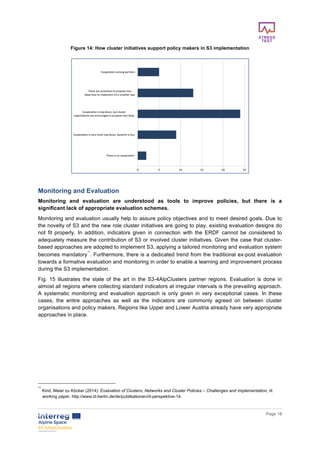
The  StressTest  revealed  to  what  extent  and  how  differently  cluster  initiatives  support  regional  policy  
makers   in   implementing   their   S3   (Fig.   13).   It   varies   from   region   to   region:   Austrian,   Italian   and  
Slovenian   policy   makers   tend   to   use   cluster   managers   more   intensively   than   policy   makers   from  
Baden-­Wuerttemberg  (BW)  and  Bavaria.    
In   most   cases,   cluster   organisations   provide   expert   advice   by   means   of   interviews,   participating   in  
workshops  or  contributing  to  strategy  papers.  Nonetheless,  only  a  small  part  of  the  cluster  managers  
plays  a  very  pro-­active  role  by  being  involved  in  strategy  or  regional  decision  making  boards  or  is  even  
in  charge  of  implementing  a  dedicated  measure  under  S3.    
Figure  13:  How  cluster  initiatives  support  policy  makers  in  S3  implementation  
  
Feedback  from  cluster  managers  and  policy  makers    
  
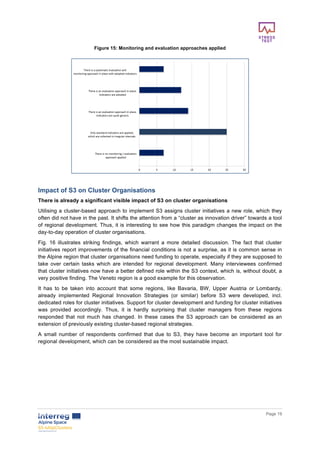
The  way  how  cluster  organisations  cooperate  with  policy  makers  can  be  characterised  as  top-­down  
(Fig.  14).  Although  in  most  cases  they  are  encouraged  to  contribute  proactively,  the  final  decision  is  
still  made  by  policy  makers.  
     
9
  Based  on  ESCA  database  (28  EU  member  states,  Switzerland  and  Norway),  492  data.    
10
  Financing  assured  for  at  least  two  years.  
       
      Page  18  
  
Figure  14:  How  cluster  initiatives  support  policy  makers  in  S3  implementation  
  
  
Monitoring  and  Evaluation  
Monitoring   and   evaluation   are   understood   as   tools   to   improve   policies,   but   there   is   a  
significant  lack  of  appropriate  evaluation  schemes.  
Monitoring  and  evaluation  usually  help  to  assure  policy  objectives  and  to  meet  desired  goals.  Due  to  
the  novelty  of  S3  and  the  new  role  cluster  initiatives  are  going  to  play,  existing  evaluation  designs  do  
not   fit   properly.   In   addition,   indicators   given   in   connection   with   the   ERDF   cannot   be   considered   to  
adequately  measure  the  contribution  of  S3  or  involved  cluster  initiatives.  Given  the  case  that  cluster-­
based  approaches  are  adopted  to  implement  S3,  applying  a  tailored  monitoring  and  evaluation  system  
becomes  mandatory
11
.  Furthermore,  there  is  a  dedicated  trend  from  the  traditional  ex-­post  evaluation  
towards  a  formative  evaluation  and  monitoring  in  order  to  enable  a  learning  and  improvement  process  
during  the  S3  implementation.    
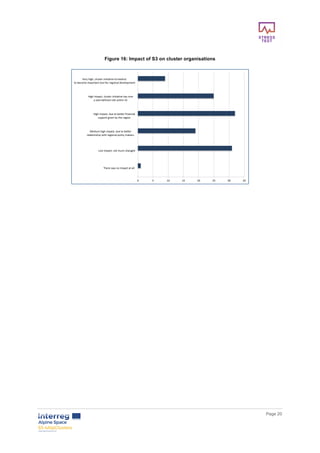
Fig.   15   illustrates   the   state   of   the   art   in   the   S3-­4AlpClusters   partner   regions.   Evaluation   is   done   in  
almost  all  regions  where  collecting  standard  indicators  at  irregular  intervals  is  the  prevailing  approach.  
A   systematic   monitoring   and   evaluation   approach   is   only   given   in   very   exceptional   cases.   In   these  
cases,   the   entire   approaches   as   well   as   the   indicators   are   commonly   agreed   on   between   cluster  
organisations  and  policy  makers.  Regions  like  Upper  and  Lower  Austria  already  have  very  appropriate  
approaches  in  place.  
     
11
  Kind,  Meier  zu  Köcker  (2014):  Evaluation  of  Clusters,  Networks  and  Cluster  Policies  –  Challenges  and  Implementation,  iit  
working  paper,  http://www.iit-­berlin.de/de/publikationen/iit-­perspektive-­14.  
       
      Page  19  
  
Figure  15:  Monitoring  and  evaluation  approaches  applied  
  
  
Impact  of  S3  on  Cluster  Organisations  
There  is  already  a  significant  visible  impact  of  S3  on  cluster  organisations  
Utilising  a  cluster-­based  approach  to  implement  S3  assigns  cluster  initiatives  a  new  role,  which  they  
often  did  not  have  in  the  past.  It  shifts  the  attention  from  a  “cluster  as  innovation  driver”  towards  a  tool  
of  regional  development.  Thus,  it  is  interesting  to  see  how  this  paradigm  changes  the  impact  on  the  
day-­to-­day  operation  of  cluster  organisations.  
Fig.   16   illustrates   striking   findings,   which   warrant   a   more   detailed   discussion.   The   fact   that   cluster  
initiatives  report  improvements  of  the  financial  conditions  is  not  a  surprise,  as  it  is  common  sense  in  
the  Alpine  region  that  cluster  organisations  need  funding  to  operate,  especially  if  they  are  supposed  to  
take   over   certain   tasks   which   are   intended   for   regional   development.   Many   interviewees   confirmed  
that  cluster  initiatives  now  have  a  better  defined  role  within  the  S3  context,  which  is,  without  doubt,  a  
very  positive  finding.  The  Veneto  region  is  a  good  example  for  this  observation.    
It   has   to   be   taken   into   account   that   some   regions,   like   Bavaria,   BW,   Upper   Austria   or   Lombardy,  
already   implemented   Regional   Innovation   Strategies   (or   similar)   before   S3   were   developed,   incl.  
dedicated  roles  for  cluster  initiatives.  Support  for  cluster  development  and  funding  for  cluster  initiatives  
was   provided   accordingly.   Thus,   it   is   hardly   surprising   that   cluster   managers   from   these   regions  
responded   that   not   much   has   changed.   In   these   cases   the   S3   approach   can   be   considered   as   an  
extension  of  previously  existing  cluster-­based  regional  strategies.  
A   small   number   of   respondents   confirmed   that   due   to   S3,   they   have   become   an   important   tool   for  
regional  development,  which  can  be  considered  as  the  most  sustainable  impact.  


      Page  20  
  
  
Figure  16:  Impact  of  S3  on  cluster  organisations  


      Page  21  
  
Reflections    
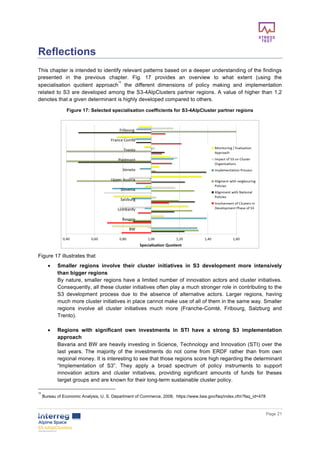
This  chapter  is  intended  to  identify  relevant  patterns  based  on  a  deeper  understanding  of  the  findings  
presented   in   the   previous   chapter.   Fig.   17   provides   an   overview   to   what   extent   (using   the  
specialisation   quotient   approach
12
   the   different   dimensions   of   policy   making   and   implementation  
related  to  S3  are  developed  among  the  S3-­4AlpClusters  partner  regions.  A  value  of  higher  than  1,2  
denotes  that  a  given  determinant  is  highly  developed  compared  to  others.    
Figure  17:  Selected  specialisation  coefficients  for  S3-­4AlpCluster  partner  regions  
  
Figure  17  illustrates  that    
•   Smaller   regions   involve   their   cluster   initiatives   in   S3   development   more   intensively  
than  bigger  regions    
By  nature,  smaller  regions  have  a  limited  number  of  innovation  actors  and  cluster  initiatives.  
Consequently,  all  these  cluster  initiatives  often  play  a  much  stronger  role  in  contributing  to  the  
S3   development   process   due   to   the   absence   of   alternative   actors.   Larger   regions,   having  
much  more  cluster  initiatives  in  place  cannot  make  use  of  all  of  them  in  the  same  way.  Smaller  
regions   involve   all   cluster   initiatives   much   more   (Franche-­Comté,   Fribourg,   Salzburg   and  
Trento).    
  
•   Regions   with   significant   own   investments   in   STI   have   a   strong   S3   implementation  
approach  
Bavaria  and  BW  are  heavily  investing  in  Science,  Technology  and  Innovation  (STI)  over  the  
last   years.   The   majority   of   the   investments   do   not   come   from   ERDF   rather   than   from   own  
regional  money.  It  is  interesting  to  see  that  those  regions  score  high  regarding  the  determinant  
“Implementation   of   S3”.   They   apply   a   broad   spectrum   of   policy   instruments   to   support  
innovation   actors   and   cluster   initiatives,   providing   significant   amounts   of   funds   for   theses  
target  groups  and  are  known  for  their  long-­term  sustainable  cluster  policy.  
12
  Bureau  of  Economic  Analysis,  U.  S.  Department  of  Commerce,  2008,    https://www.bea.gov/faq/index.cfm?faq_id=478  
       
      Page  22  
  
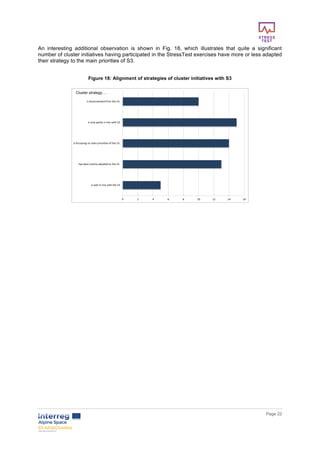
An   interesting   additional   observation   is   shown   in   Fig.   18,   which   illustrates   that   quite   a   significant  
number  of  cluster  initiatives  having  participated  in  the  StressTest  exercises  have  more  or  less  adapted  
their  strategy  to  the  main  priorities  of  S3.    
  
Figure  18:  Alignment  of  strategies  of  cluster  initiatives  with  S3  


Cluster  strategy….    
       
      Page  23  
  
Concluding  Observations  
The  StressTest  exercises  conducted  with  the  11  project  partner  regions  confirmed  the  relevance  of  
cluster-­based   development   and   implementation   of   S3.   This   report   contributes   to   an   increased  
understanding  of  the  interplay  between  S3  and  clusters.  It  provides  valuable  insights  on  how  regions  
make  use  of  clusters.  The  Alpine  Space  regions  are,  on  the  one  hand,  very  heterogeneous.  On  the  
other  hand,  the  regions  apply  similar  cluster-­based  approaches  of  S3  implementation.    
The  observations  described  in  the  previous  chapters,  lead  to  the  following  8  key  finding:  
  
1.   Regions   applied   different   approaches   on   how   to   develop   their   S3.   There   is   no   “golden  
standard”  since  regions  are  individuals.  It  has  to  be  acknowledged  that  regions  need  sufficient  
flexibility   in   this   regard   in   order   to   consider   S3   as   a   strategic   approach   to   economic  
development  and  not  just  as  an  ex-­ante  conditionality  to  receive  ERDF.  
2.   The   StressTest   exercises   in   11   regions   provided   good   evidence   that   a   cluster-­based  
approach  to  develop  and  implement  S3  can  offer  added  value  for  the  regions.  However,  the  
S3  approach  has  to  be  consequently  designed  and  implemented.    
3.   The  interplay  between  cluster  initiatives  and  S3  matters.  For  this  purpose,  strategies  of  
cluster  initiatives  should  be  in  line  with  respective  S3  in  order  to  assure  that  cluster  initiatives  
can  provide  tailor-­made  support  for  implementing  S3.    
4.   The   implementation   of   S3   is   of   highest   relevance.   It   has   to   be   supported   with   a   proper  
spectrum  of  policy  instruments  for  tailor-­made  support  and  sufficient  public  investments.  
5.   If  cluster  initiatives  play  a  dedicated  role  in  the  implementation  of  S3,  they  have  to  be  properly  
enabled   to   fulfil   their   role.   This   contains,   among   others,   sufficient   capacities   within   cluster  
organisations,   a   critical   mass   of   cluster   participants   and   a   broad   spectrum   of   activities  
implemented  by  the  cluster  management.  
6.   The   S3   approach   shifts   cluster   policy   towards   cluster-­based   regional   development  
policy.  This  leads  to  the  consequence  that  less  emphasis  should  be  placed  on  just  funding  
cluster  initiatives,  and  more  on  taking  measures  that  enable  cluster  initiatives  to  become  a  tool  
for  regional  development.  
7.   Aligning   S3   and   related   policy   instruments   among   neighbouring   regions   is   still   a  
challenge.   The   insight   gained   at   the   macro-­regional   level   so   far   indicates   that   much   more  
work   is   needed   to   overcome   the   obstacles   that   arise   from   the   local   context   of   S3   and   the  
absence  of  alignment.  The  challenge  remains  to  understand  the  potential  of  the  market  and  
the   mechanisms   required   to   facilitate   linkages   among   Alpine   Space   actors   for   purposes   of  
initiating   transformative   actions   through   cross-­regional   cooperation.   Smaller   regions   in  
particular  need  to  improve  framework  conditions  for  cross-­regional  activities  in  order  to  reach  
a  critical  mass  in  terms  of  companies  and  public  investments.  Existing  funding  schemes  like  
INTERREG  or  Horizon  2020  are  not  an  appropriate  option.    
8.   Since   S3   is   a   new   approach,   appropriate   monitoring   and   evaluation   approaches   are  
missing.   More   attention   shall   be   directed   towards   development   and   implementation  
approaches  in  a  cross-­regional  and  international  exchange  of  experiences.  


      Page  24  
  
S3-­4AlpClusters  in  a  Nutshell  
  
  
Smart  Specialisation  with  Smart  Clusters  


Smart  Specialisation  Strategies  (S3)  are  a  lever  of  EU  Cohesion  Policy.  One  of  the  biggest  challenges  
is  to  make  use  of  the  interplay  between  S3  and  clusters.  How  can  S3  be  used  to  foster  innovation  
processes  and  spark  entrepreneurship  within  clusters?  How  can  S3  be  implemented  through  clusters  
to  gain  sustainable  and  inclusive  growth?  There  is  a  lack  of  experience  among  regions  on  how  to  use  
clusters  in  the  implementation  of  S3  and  how  to  develop  implementation  tools  to  fully  benefit  SMEs.  In  
addition,  alignment  between  and  knowledge  about  other  regions’  strategies  are  very  limited.    
This  is  exactly  the  focus  of  the  S3-­4AlpClusters  project,  which  believes  that  the  interplay  between  S3  
and  clusters  is  an  innovative  approach  that  could  spread  innovation  in  the  whole  Alpine  Space.  S3-­
4AlpClusters   will   launch   cross-­regional   coordinated   actions   between   the   different   sectors/regions  
involved  and  enhance  transnational  cluster  cooperation.  The  final  aim  is  to  generate  critical  mass  for  
SMEs  and  to  improve  the  framework  conditions  for  innovation  in  the  Alpine  Space.    
S3-­4AlpClusters  will  develop:
ü   A  joint  transnational  cluster  action  plan  to  improve  transnational,  cluster-­based  cooperation  
ü   An  S3-­based  innovation  model  for  cluster  development  
ü   A  fully  synchronized  call  scheme    
ü   New  services  validated  by  pilot  clusters    
The   S3-­4AlpClusters   community   includes   cluster   managers,   entrepreneurs,   academics   and  
policymakers,  and  is  supported  by  public  authorities  and  S3  experts.
  
The  NUMBERS  of  S3-­4ALPCLUSTERS  
15  Partners   35  decision  makers    
9  Observers   11  Alpine  Regions     
830  SME     10  pilot  clusters  to  be  involved  
  
  
FOLLOW    S3-­4AlpClusters  
  
www.alpine-­space.eu/projects/s3-­4alpclusters/en/home    


      Page  25  
  
S3-­‐‑4ALPCLUSTERS	
  Partners	
  
HES-SO // FR-HEIA-FR INNOSQUARE CLUSTERS Business Upper Austria - OÖ Wirtschaftsagentur GmbH
ClusterAgentur Baden-Württemberg Veneto Region - Research Clusters and Networks Unit
Poly4EMI hosts by Anteja ECG d.o.o Innovation and Technology Transfer Salzburg GmbH
University of Franche-Comté - FEMTO-ST PROPLAST - Consortium for the Plastic Culture Promotion
Cluster Technologies for Smart Cities & Communities Lombardy Foundation Autonomous Province of Trento (PAT)
Trentino Innovation Hub Lombardy Region Government
Bavarian Research Alliance GmbH Government Office for Development and European Cohesion Policy
Veneto Innovazione S.p.A.
  

StressTesting Regional Approaches Conducive to Implement S3 through Clusters

  • 1.
              StressTesting  Regional  Approaches   Conducive  to  Implement  S3  through   Clusters     Synthesis  Report     for  the  Alpine  Space  Region                                       October  2017     S3-­4AlpClusters  is  cofinanced  by  the  European  Regional  Development   Fund  through  the  Interreg  Alpine  Space  programme      
  • 2.
              Page  2                                 This  report  has  been  produced  within  the  frame  of  the  S3-­4AlpClusters  project,  funded  by  the  Alpine   Space  INTERREG  Programme  of  the  European  Commission.  It  was  prepared  by  Dr.  Gerd  Meier  zu   Köcker  (ClusterAgentur  BW)  and  Mateja  Dermastia  (Anteja  ECG  –  Poly4emi).       This  report  was  drafted  with  input  gathered  from  all  project  partners  over  the  first  phase  of  the  project   implementation  (January  –  June  2017),  based  on  individual  regional  StressTest  reports.  The  authors   would   like   to   thank   Michael   Keller   for   his   contribution   and   all   project   partners   for   their   significant   efforts.     doi:  10.23776/001     Disclaimer   The  information  and  perspectives  set  out  in  this  Policy  Report  are  those  of  the  authors  and  do  not   necessarily  reflect  the  official  opinion  of  the  European  Commission  or  the  project  partners’  regions.   Neither  the  European  Commission  institutions  and  bodies  nor  any  person  acting  on  their  behalf  may   be  held  responsible  for  the  use  that  may  be  made  of  the  information  contained  therein.  Reproduction   is  authorised,  provided  the  source  is  acknowledged,  unless  otherwise  stated.  For  use/reproduction  of   third  party  material  specified  as  such,  permission  must  be  obtained  from  the  copyright.     For  further  information  about  the  S3-­4AlpClusters  project,  you  will  find  a  short  description  at  the  end  of   the  document.  To  learn  more  and  to  download  additional  resources  please  refer  to  the  project  website   http://www.alpine-­space.eu/projects/s3-­4alpclusters/en/home.     The  information  is  provided  without  assuming  any  legal  responsibility  for  correctness  or  completeness.   The  data  presented  in  the  report  are  based  on  the  information  given  by  the  project  partners.       ©  S3-­4AlpClusters,  2017    
  • 3.
              Page  3     Table  of  Contents     Concepts  and  Definitions  ...........................................................................................................  4   Summary  ......................................................................................................................................  5   The  Context:  Interplay  between  Smart  Specialisation  and  Clusters  ......................................  6   The  StressTest  Approach  ...........................................................................................................  7   Learnings  from  the  Analysis  of  Partner  Regions  and  Related  S3  ........................................  10   StressTest  Findings  ..................................................................................................................  12   Involvement  of  Cluster  Initiatives  during  S3  Development  ...................................................  12   Coordination  and  Alignment  of  S3  ........................................................................................  13   Implementation  of  S3  ...........................................................................................................  15   Monitoring  and  Evaluation  ....................................................................................................  18   Impact  of  S3  on  Cluster  Organisations  .................................................................................  19   Reflections  .................................................................................................................................  21   Concluding  Observations  .........................................................................................................  23   S3-­4AlpClusters  in  a  Nutshell  ..................................................................................................  24        
  • 4.
              Page  4     Concepts  and  Definitions   For  the  purpose  of  this  report  the  key  concepts  and  definitions  are  understood  as  follows:     n   Clusters:  Clusters  are  generally  described  as  groups  of  companies,  mainly  SMEs,  and  other   actors   (government,   research,   and   academic   community,   institutions   for   collaboration,   financial  institutions)  co-­locating  within  a  geographic  area,  cooperating  around  a  specialised   niche,  and  establishing  close  linkage  and  working  alliances  to  improve  their  competitiveness.   n   Cluster   initiatives:   A   cluster   initiative   is   an   organised   effort   aimed   at   fostering   the   development  of  the  cluster  either  by  strengthening  the  potential  of  cluster  actors  or  shaping   relationships   between   them.   They   often   have   a   character   like   a   regional   network.   Cluster   initiatives  are  usually  managed  by  cluster  organisations.   n   Cluster   organisations:   Cluster   organisations   are   entities   that   support   the   strengthening   of   collaboration,   networking,   and   learning   in   innovation   clusters   and   act   as   innovation   support   providers  by  providing  or  channelling  specialised  and  customised  business  support  services  to   stimulate  innovation  activities,  especially  in  SMEs.  They  are  usually  the  actors  that  facilitate   strategic   partnering   across   clusters.   Cluster   organisations   are   also   called   cluster   managements.   n   Cluster  participants:  Cluster  participants  are  representatives  of  industry,  academia  or  other   intermediaries,  which  are  commonly  engaged  in  a  cluster  initiative.  Given  the  case  a  cluster   initiative  has  a  certain  legal  form,  like  associations,  cluster  participants  are  often  called  cluster   members.   n   Cluster  policy:  Cluster  policy  is  an  expression  of  political  commitment,  composed  of  a  set  of   specific   government   policy   interventions   that   aim   to   strengthen   existing   clusters   and/or   facilitate  the  emergence  of  new  ones.  Cluster  policy  is  to  be  seen  as  a  framework  policy  that   opens  the  way  for  the  bottom-­up  dynamics  seen  in  clusters  and  cluster  initiatives.  This  differs   from   the   approach   taken   by   traditional   industrial   policies,   which   try   (and   most   often   fail)   to   create  or  back  winners.   n   Programme:  Programmes  are  a  vehicle  to  implement  a  policy,  e.  g.  funding  programme  for   R&D  in  environmental  technology.  In  addition  to  programmes,  policies  are  also  implemented   through  regulation  (=  regulatory  framework,  e.  g.  law  on  consumer  protection).   n   S3-­Smart   Specialisation   Strategies:   Smart   Specialisation   is   a   strategic   approach   to   economic   development   through   targeted   support   for   research   and   innovation.   It   involves   a   process   of   developing   a   vision,   identifying   the   place-­based   areas   of   greatest   strategic   potential,   developing   multi-­stakeholder   governance   mechanisms,   setting   strategic   priorities   and  using  smart  policies  to  maximise  the  knowledge-­based  development  potential  of  a  region,   regardless  of  whether  it  is  strong  or  weak,  high-­tech  or  low-­tech 1 .   We   will   clearly   distinguish   between   clusters,   cluster   initiatives   and   cluster   organisations   to   make   it   easier  for  the  interviewee  to  understand  what  is  intended  with  the  corresponding  question.         1  Foray  (2015):  Smart  Specialisation,  Opportunities  and  Challenges  for  Regional  Innovation  Policy,  Routledge.  
  • 5.
              Page  5     Summary   Several   European   Union   (EU)   regions   have   developed   Smart   Specialisation   Strategies   (S3)   as   integrated   part   of   their   regional   innovation   strategies.   The   challenge   is   to   implement   S3   through   clusters   in   order   to   gain   sustainable   and   inclusive   growth   while   generating   critical   mass   of   economically  viable  activities.     The   objective   of   the   S3-­4AlpCusters   project   is   to   improve   framework   conditions   for   innovations   induced   by   clusters   and   SMEs   as   well   as   to   create   new   jobs   and   employment   opportunities.   As   implemented  by  clusters  and  cluster  organisations,  S3  can  offer  an  innovative  approach  to  improve   innovation   in   the   Alpine   Space.   Cross-­regional   approaches   can   serve   as   support   for   coordinated   actions   between   the   different   sectors/regions.   Transnational   cluster   cooperation   facilitates   the   achievements  of  a  critical  mass  of  SMEs  and  enhances  cross-­regional  collaboration  to  innovate  for   new  products  in  areas  relevant  to  the  Alpine  Space.   Against  this  background,  each  of  the  11  partner  regions  of  the  S3-­4AlpClusters  conducted  a  policy   benchmarking  (StressTesting)  to  ascertain  how  to  implement  S3  through  clusters  as  individual  benefit.   Additionally,  the  StressTesting  provided  a  joint  benefit  to  the  S3-­4AlpClusters  partnership  by  allowing   for   a   better   understanding   of   each   other’s   policy   instruments.   The   StressTesting   addressed   policy   making  and  implementation  processes,  namely  the  role  of  clusters  in  the  design  and  implementation   of   the   S3,   regional   support   schemes   for   cluster   initiatives,   coordination   and   alignment   of   S3   at   the   regional   and   national   level.   Benchmarking   also   explores   the   role   of   a   regional   cluster   excellence   portfolio   to   provide   inputs   for   development   and   testing   innovation   models   initiated   by   cluster   organisations  and  subsequently  identifies  areas  for  (common)  improvements.     The   present   Policy   Report   summarises   the   findings   of   the   partner   regions’   StressTest   reports   and   provides  reflections  how  to  make  more  use  of  cluster-­based  approaches  in  implementing  S3.     The  main  conclusions  are:   •   Cluster   initiatives   have   been   strongly   involved   in   the   development   process   of   S3   and   significantly  contributed  to  it.  Their  expertise  was  requested  in  a  very  different  way.   •   Cluster  initiatives  are  significantly  involved  during  the  implementation  process  of  S3,  whereas   extent  and  manner  varies  significantly.   •   Monitoring  and  evaluation  is  understood  as  tool  to  improve  policies,  but  there  is  a  significant   lack  of  appropriate  evaluation  schemes.   •   A  significant  impact  of  S3  on  cluster  initiatives  can  already  be  identified.   •   Aligning  S3  and  related  policy  instruments  with  policies  on  national  or  neighbouring  regional   level  remains  a  challenge.     The  last  conclusion  is  of  significant  importance  since  it  indicates  that  cross-­regional  cooperation  is  not   sufficiently  supported.  Respective  policies  and  related  policy  instruments  are  missing.  The  Report  on   “Strategy  Alpine  Space  Areas  for  Cross-­regional  Cooperation”  clearly  highlighted  the  need  for  cross-­ regional  cooperation  as  well  as  deducted  promising  strategic  areas.     Both   reports   will   lay   the   foundation   for   the   first   attempt   to   design   a   joint   Alpine   Cluster   Innovation   Express   –   ACIE.   The   ACIE   is   a   synchronised   scheme   for   cross-­regional   funding,   which   is   built   on   existing   regional   programmes.   By   aligning   these   programmes   cross-­regional   consortia   can   be   supported   through   a   joint   call   for   proposals,   which   are   implemented   according   to   regional   funding   procedures.   A   synchronised   scheme   neither   requires   additional   funds   nor   leads   to   modifications   of   regional  funding  procedures.  
  • 6.
              Page  6     The  Context:  Interplay  between  Smart   Specialisation  and  Clusters     Clusters  are  a  fundamental  part  of  the  European  industrial  landscape  as  38  %  of  European  jobs  are   based   in   clusters.   They   are   key   drivers   for   the   European   economy   with   regard   to   competitiveness,   growth  and  jobs.  Over  the  last  years,  cluster  policy  in  the  EU  has  increasingly  gained  importance  to   improve   competitiveness   of   local   industries   and   facilitate   industrial   transformation   processes   by   stimulating  the  development  of  infrastructure  in  support  of  business  innovation.  The  recent  economic   crisis  and  on-­going  global  industrial  transformations  have  highlighted  the  need  to  modernise  regional   industrial  structures  and  build  new  industrial  competences  in  order  to  respond  to  global  competition   and  to  address  societal  challenges,  such  as  environment,  health  and  resource  efficiency.   Starting  from  the  observation  that  the  implementation  of  Smart  Specialisation  Strategies  often  fails  to   generate  the  desired  effects,  there  is  a  strong  need  to  better  understand  the  relationship  between  S3   and   clusters.   The   underlying   problem   in   the   implementation   of   S3   has   been   detected   at   two   fundamental  levels:  a  lack  of  experience  among  regions  on  how  to  use  clusters  in  the  implementation   of   Smart   Specialisation   Strategies   and   a   lack   of   alignment   between   and   knowledge   about   other   regions’  strategies.     The  interplay  between  S3  and  clusters  implies  a  two-­way  relationship  between  the  two  concepts.  As   suggested   by   the   overall   title   of   the   project   (“S3-­4AlpClusters   –   Smart   Specialisation   Strategies   to   build  an  Innovation  Model  for  Alp  Clusters”),  a  first  way  to  study  the  interdependency  is  to  look  at  how   S3   can   be   used   to   foster   innovation   processes   and   spark   entrepreneurship   within   clusters   (“S3   →   Clusters”).   Turning   the   relationship   on   its   head,   existing   clusters   can   also   be   used   as   a   tool   in   the   implementation  of  S3  (“Clusters  →  S3”).  The  overall  design  of  the  project  allows  focusing  on  different   aspects  of  the  interplay  between  S3  and  clusters  in  its  different  work  packages.     Taking   the   above-­mentioned   into   account,   regions   should   apply   a   broad   set   of   policy   instruments   when   implementing   their   S3   through   clusters.   History   has   shown   that   there   is   no   single   policy   appropriate   to   cope   with   all   regional   challenges 2 .   This   also   leads   the   attention   away   from   single   clusters  rather  than  to  the  regional  cluster  portfolio.     A  well-­balanced,  matured  regional  cluster  portfolio  is  necessary  to  have  capable  clusters  and  cluster   managements  in  place  as  tool  to  support  the  entrepreneurial  discovery  and  identify  those  opportunities   a  region  can  benefit  most.  Consequently,  regions  need   •   Strong   clusters,   since   enterprises   located   in   strong   clusters   have   a   higher   growth   rate   and   higher  productivities 3 .     •   Strong   cluster   managements   that   can   provide   higher   impact   in   terms   of   innovation   and   competitiveness  than  weak  ones 4 .   •   Systematic  implementation  approach.  If  a  region  intends  to  use  clusters  as  a  tool  to  implement   S3,  it  has  to  follow  a  throughout  and  systematic  approach.   2  Izsak,  Ketels,  Lämmer-­Gamp,  Meier  zu  Köcker  (2016):  Smart  Guide  to  Cluster  Policy,  European  Cluster  Observatory,   Brussels,  http://ec.europa.eu/enterprise/initiatives/cluster/observatory/cluster-­mapping-­services/services/index_en.htm.   3  Ketels,  Protsiv  (2013):  Clusters  and  the  New  Growth  Path  for  Europe,  WWWforEurope  Working  Paper,  WIFO,  Vienna.   4  Lämmer-­Gamp,  Meier  zu  Köcker,  Christensen  (2012):  Clusters  are  Individuals.  New  Findings  from  the  European  Cluster   Management  and  Cluster  Program  Benchmarking,  Danish  Ministry  of  Science,  Technology  and  Innovation,  ISBN:  978-­87-­ 92776-­22-­8,  Copenhagen/Berlin.  
  • 7.
              Page  7     The  StressTest  Approach   StressTesting  is  a  transnational  benchmarking-­based  approach  that  enables  an  empirical  review  and   assessment   of   regional   policies   for   implementation   of   Smart   Specialisation   Strategies   (S3)   through   clusters.   StressTesting   determines   how   and   where   clusters   can   be   most   supportive   of   industrial   transformation  and  growth  in  an  integrated,  coordinated  and  sustained  manner.  The  overall  aim  is  to   develop  new  and  better  ways  of  designing  and  implementing  modern  cluster-­based  regional  economic   development  policies.  The  approach  draws  maximum  advantage  from  analysis  of  the  regional  cluster   portfolio   to   better   understand   the   forces   that   shape   new   industrial   value   chains   and   sectors.   StressTesting   is   intended   for   regional   implementation   organisations,   policy   makers   and   business   development   entities   that   are   interested   in   comparing   their   own   region   with   European   frontrunner   regions.   The  StressTest  and  its  related  report  will  thus  mainly  focus  on  the  question  of  how  clusters  are  used   as  a  tool  of  S3  and  study  the  modality  of  use  and  influence  of  clusters  in  the  implementation  of  S3.  By   including   questions   about   the   ability   of   cluster   initiatives   to   implement   new   innovation   models,   the   results  of  the  StressTest  will  nevertheless  also  pave  the  way  for  another  important  question  of  how  S3   can  contribute  to  define  new  innovation  models  in  further  detail.  It  thus  fully  considers  the  two-­way   interplay  between  clusters  and  S3.     StressTesting  addresses  both  policymaking  and  implementation  processes.  The  approach  examines   the   role   of   clusters   in   the   design   of   S3   and   the   regional   support   schemes   for   cluster   initiatives.   It   provides   insight   views   on   the   coordination   and   alignment   of   S3   at   the   regional   and   national   level.   Furthermore,  it  identifies  the  current  and  potential  role  of  clusters  in  the  implementation  of  S3.     The   process   of   using   clusters   as   tool   to   implement   S3   is   a   multi-­facetted   and   complex   process.   However,  although  regions  are  very  different,  it  follows  the  six  key  dimensions  shown  in  Fig.  1.   Figure  1:  Dimensions  of  policy-­making  and  implementation  process  in  connection  with  S3        
  • 8.
              Page  8     The  importance  of  the  regional  cluster  portfolio  and  individual  clusters  already  starts  during  the  design   phase  of  S3.  Clusters  can  act  as  a  more  efficient  tool,  if  the  respective  S3  is  built  upon  them  and  takes   the   needs   and   potentials   of   the   cluster   actors   into   account.   The   main   challenge   then   is   the   implementation  of  S3,  meaning  to  turn  the  S3  into  a  set  of  policy  instruments  that  helps  to  meet  the   desired  objectives.     Even  if  the  concept  of  S3  helps  to  concentrate  the  resources  on  selected  priority  areas,  regions  often   do   not   have   the   critical   mass   or   capacity   to   successfully   develop   the   necessary   transformative   activities  completely  on  their  own.     Thus,   aligning   S3   related   policy   instruments   with   those   on   national   level   or   with   those   of   the   neighbouring   regions,   enables   regions   to   attract   additional   funding   or   other   kinds   of   support.   Evaluation  and  monitoring  as  tool  to  do  better  policies  is  also  an  important  dimension,  thus  considered   during  the  StressTesting.   The  StressTesting  exercises  (online  questionnaire)  were  completed  by  all  partner  regions,  based  on   the  involvement  of  representative  group  of  regional  stakeholders  from  three  different  levels   •   Regional  policy  makers  in  charge  with  the  development  and  implementation  of  S3   •   Cluster  managers   •   Other   stakeholders   like   representatives   from   regional   development   agencies,   regional   councils  or  other  entities  closely  involved  in  the  development  and  implementation  of  S3.   In  total  more  than  130  stakeholders  from  all  levels  (cluster  organisation,  stakeholder  responsible  to   implement   S3   and   policy   makers)   participated   in   the   online   survey   (s.   Fig.   2),   incl.   48   cluster   managers.  Most  participants  came  from  smaller  Alpine  Space  regions,  like  Slovenia,  Franche-­Comté   and  Fribourg 5 .   Figure  2:  Distribution  of  participants  of  the  StressTest  exercises         5  Comparable  high  number  of  participants  also  came  from  Baden-­Württemberg.  
  • 9.
              Page  9     Thus,  the  data  gathered  provides  a  unique  source  of  insight  and  a  “snap-­shot”  portrait  of  each  region’s   theoretical  and  practical  approach  in  order  to  implement  S3  through  clusters.  As  an  integrated  part  of   the  StressTesting,  the  region  specific  data  were  compared  among  25  European  regions  in  order  to   stimulate  mutual  learning  (s.  Fig.  3).  Further  details  are  given  in  the  regional  StressTest  reports.   Figure  3:  Survey  of  regions  having  participated  in  the  StressTesting  exercises  since  2015                  
  • 10.
              Page  10     Learnings  from  the  Analysis  of  Partner   Regions  and  Related  S3   The   report   “Strategic   Alpine   Space   Areas   for   Cross-­regional   Cooperation”   identified   potential   synergies  among  Smart  Specialisation  Strategies  (S3)  of  the  S3-­4AlpClusters  partners 6 .  The  findings   went  beyond  the  current  state  of  discussion  on  S3  formulation  and  promoted  a  better  understanding  of   the  implications  of  cross-­regional  collaboration  and  resulting  synergies  have  for  the  selected  partners   from  the  Alpine  Region  in  the  context  of  Smart  Specialisation.  The  learnings  from  the  report  can  be   summarised  as  follows:   •   The  partner  regions  are  innovation  front-­runners,  but  their  investments  in  R&D  and  Innovation   differs  significantly.   •   The   related   S3   of   the   partner   regions   are   very   different,   but   most   of   them   focus   on   similar   Priority  Areas.     •   The   partner   regions   vary   significantly   in   terms   of   industrial   critical   mass,   but   they   can   be   grouped  into  three  areas.     •   None   of   the   S3   or   related   policy   instruments   actively   promote   cross-­regional   cooperation,   although  many  smaller  regions  have  to  go  cross-­border  due  to  limited  size  or  critical  mass.   •   Five  Strategic  Alpine  Space  Areas  for  Cross-­regional  Cooperation  can  be  defined,  based  on   common  needs  and  interests  outlined  in  the  related  S3  and  the  Alpine  Space  Macro-­regional   Strategy  (EUSALP) 7 .   Fig.  4  illustrates  the  current  position  of  the  partner  regions  by  comparing  their  competitiveness  in  the   fields  of  traditional,  sectoral  industries  with  emerging,  cross-­sectoral  industries.     Figure  4:  Comparison  of  strengths  of  clusters  in  traditional  and  emerging  industries   According  to  the  most  recent  European  Cluster  Observatory  data;;  Methodology  based  on  data  presented  in  the  European   Cluster  Panorama  2016;;  no  data  available  for  Switzerland/Fribourg  region     6  http://www.alpine-­space.eu/projects/s3-­4alpclusters/en/home.   7  EUSALP  is  the  macro-­regional  strategy  for  the  Alpine  Region.  
  • 11.
              Page  11     Partner  regions  can  be  found  in  three  of  the  four  quadrants:   1.   Upper   right   corner:   Regions   with   a   strong   industrial   base   in   traditional   industrial   sectors   and   strong  emerging  industries  (Quadrant  I):  Bavaria,  Baden-­Württemberg  and  Lombardy.   2.   Upper   left   corner:   Regions   with   a   comparable   strong   industrial   base   in   traditional   industrial   sectors,  but  a  few  strong  emerging  industries  (Quadrant  II):  Slovenia  and  Upper  Austria.     3.   Lower  left  corner:  Regions  with  limited  industries  in  traditional  and  emerging  sectors  (Quadrant   III):  Franche-­Comté,  Trento  and  Salzburg.     Piedmont  and  Veneto  build  a  certain  group  “in  the  middle”,  sharing  some  characteristics  of  the  other   groups.              
  • 12.
              Page  12     StressTest  Findings   In  the  following,  the  main  findings  of  the  StressTest  exercises,  conducted  in  the  11  regions  of  the  S3-­ 4AlpCluster  partners,  are  presented  and  discussed.  They  allow  for  further  insights  into  the  interplay   between  S3  and  cluster  initiatives.  These  findings  clearly  move  beyond  the  current  state  of  discussion.   This   chapter   is   structured   according   to   the   dimension   of   policy   making   and   implementation   as   presented  in  Figure  1.         Involvement  of  Cluster  Initiatives  during  S3  Development     Cluster   initiatives   have   strongly   been   involved   in   the   development   process   of   S3,   but   have   contributed  in  a  very  different  way.     As  far  as  the  Alpine  Region  is  concerned,  the  idea  of  involving  cluster  initiatives  in  the  development   process  of  S3  seems  to  be  well  acknowledged.  A  clear  majority  of  the  cluster  managers  confirmed   their  involvement  (s.  Fig  5).     Figure  5:  Share  of  cluster  initiatives’  involved  in  S3  development       However,   the   extent   to   which   the   initiatives   have   been   involved   and   how   precisely   they   have   contributed   varied   significantly.   As   shown   in   Fig.   6,   the   involvement   differs   significantly.   In   some   cases,  the  cluster  managements  provided  expertise  through  interviews  or  by  nominating  experts.  In   other  cases,  they  assumed  a  very  active  role.       Cluster Organisa.ons have been involved in the development of S3 83% Cluster Organisa.ons have not been involved in the development of S3 17%
  • 13.
              Page  13     Figure  6:  Kinds  of  involvement  of  cluster  organisations  in  the  development  process  of  S3     Several  answers  allowed     Coordination  and  Alignment  of  S3   Aligning   S3   and   related   policy   instruments   with   policies   on   national   or   on   neighbouring   regional  level  remains  a  challenge.     S3  is  not  a  closed  process,  but  rather  benefits  from  complementarities  with  other  policies  and  regions.   Aligning   S3   related   policy   instruments   with   those   on   national   level   and/or   with   those   of   the   neighbouring   regions   enables   them   to   attract   additional   funding   or   gain   critical   mass   through   inter-­ regional  cooperation.  This  can  significantly  assist  regions  to  meet  the  objectives  defined  in  their  S3  in   a  faster  or  more  efficient  way.  Bundling  resources  also  decreases  the  risk  of  individual  regions.     The  reality  is  different  as  Fig.  7  and  8  illustrate.  Most  regions  have  some  mechanism  for  information   and  experience  exchange  between  the  regional  as  well  as  federal  (national)  level  in  place,  which  lead   to  a  minimum  alignment.  It  works  quite  well  in  Baden-­Württemberg,  Salzburg  and  Veneto.  However,   none  of  the  S3-­4AlpClusters  partner  regions  confirmed  that  there  is  an  active  alignment  on  federal  and   regional  level.  Exceptions  are  Slovenia  and  Austria  that  have  a  S3  on  national  level,  which  guarantees   proper  alignment.        
  • 14.
              Page  14     Figure  7:  Alignment  of  partner  regions’  S3  with  policies  and  programmes  on  national  level       As  far  as  any  alignment  of  S3  and  related  policies  with  the  neighbouring  regions  are  concerned,  the   findings   are   even   worse.   Any   alignment   between   the   partner   regions   appears   to   be   an   exception.   These  findings  are  in  line  with  the  outcome  of  the  report  on  “Strategic  Alpine  Space  Areas  for  Cross-­ regional   Cooperation” 8   which   concluded   that   only   a   handful   of   policy   instruments   are   in   place   to   actively   facilitate   cross-­regional   cooperation.   A   good   example   is   the   Fribourg   region   that,   since   the   cantonal   implementation   programme   for   the   2016-­2019   phase   of   the   Nouvelle   Politique   Régionale,   foresees  cross-­regional  cooperation  both  within  and  across  the  boundaries  of  Switzerland.  All  other   S3-­4AlpClusters  partner  regions  are  lagging  behind.   Figure  8:  Alignment  of  partner  regions’  S3  with  policies  of  neighbouring  regions       8  http://www.alpine-­space.eu/projects/s3-­4alpclusters/en/home.  
  • 15.
              Page  15     Implementation  of  S3   Cluster  initiatives  are  involved  during  the  implementation  process  of  S3,  whereas  extent  and   manner  vary  significantly       S3   is   a   comparably   new   and   multi-­facetted   approach,   without   much   experience   present   on   how   to   implement  S3  by  different  policy  instruments  as  well  as  on  what  implementation  tools  or  entities  work   best.   This   is   due   to   the   reason   that   the   implementation   has   just   started   recently.   To   seriously   implement  a  given  S3  it  has  to  be  backed  by  appropriate  policy  instruments  and  public  funding.  The   amount   of   investment   research,   development   and   innovation   between   the   S3-­4AlpClusters   partner   regions  differ  significantly  -­  from  less  than  10  Mio  EUR  per  anno  (Fribourg  region  and  Franche-­Comté)   up  to  1.700  Mio  EUR  (Bavaria).  In  total,  all  partners  invest  about  4.000  Mio  EUR  annually.   Figure  9:  Adequacy  of  the  public  investments  to  implement  S3       The   overall   picture   is   quite   positive,   since   the   majority   of   interviewees   affirmed   that   the   amount   of   funding  is  (at  least)  satisfactory  (Fig.  9).  However,  this  feedback  varies  considerably  from  region  to   region.  As  some  regions  have  just  begun  to  implement  S3  and  not  many  programmes  are  currently   running,  some  respondents  might  have  been  influenced  by  the  present  situation.  This  might  especially   be  the  case  when  the  opinion  between  policy  makers  and  other  respondents  differs  significantly.   Cluster  participants  of  the  S3-­4AlpClusters  partner  regions  do  not  have  a  preferred  access  to  regional   funding   programmes   by   design   (s.   Fig.   10).   Hoewever,   a   quarter   of   the   respondents   indicated   that   proposals/applications   developed   within   a   cluster   initiative   have   a   higher   likeliness   of   obtaining   funding.  This  might  be  due  to  several  reasons,  but  very  often  such  proposals/applications  are  more   demand-­oriented   and   based   on   industrial   need.   Another   motive   might   be   that   the   involvement   of   a   cluster  organisation  as  a  moderator/coach  might  result  in  higher  quality  as  well.  Only  in  exceptional   cases,   applications   obtained   preferred   access   to   funding   since   they   are   labelled   as   outcome   of   a   dedicated  common  undertaking  of  cluster  participants.         3% 10% 28% 45% 14% There are no or just minor funds available The amount of funding available is far too li<le The amount of funding available is comparable low The amount of funding is alright The amount of funding is very sufficient
  • 16.
              Page  16     Figure  10:  Accessibility  of  funds  by  cluster  participants       All   partner   regions   provide   funding   for   cluster   organisations.   The   adequacy,   from   the   cluster   managers’   perspective,   varies   substantially   as   about   half   of   the   managers   consider   the   amount   of   funding   to   be   adequate   (Fig.   11).   The   key   information   about   the   cluster   initiatives   involved   in   the   StressTest  exercises  is  given  in  the  table  below  (Fig.  12).  The  share  of  regional  funding  is  decisive  for   the   cluster   initiatives,   but   they   succeeded   in   attracting   a   high   share   from   private   sources,   which   resulted  in  comparably  high  long-­term  financial  security.     Figure  11:  Availability  of  funding  for  cluster  initiatives           4% 52% 26% 13% 5% There are no or just minor funds available There is no preferred access There is a slightly preferred access There is a preferred access Clusters ini@a@ves have own funds 11% 13% 28% 41% 7% No funding available Funding is far too li:le. Funding is low Funding is alright Funding is very sufficient
  • 17.
              Page  17     Figure  12:  Size  and  financing  of  cluster  initiatives  involved  in  the  StressTest     Cluster  organisations  from   partner  regions   EU-­average 9   Number  of  members   113   85   Staff  working  in  cluster  organisations  (FTE)   3,4   3,6     Share  of  funding  from  regional  sources   19  %   N.  A.   Share  of  private  financing   44  %   35  %   Share  of  cluster  initiatives  with  high  financial  security 10   45  %   38  %     The  StressTest  revealed  to  what  extent  and  how  differently  cluster  initiatives  support  regional  policy   makers   in   implementing   their   S3   (Fig.   13).   It   varies   from   region   to   region:   Austrian,   Italian   and   Slovenian   policy   makers   tend   to   use   cluster   managers   more   intensively   than   policy   makers   from   Baden-­Wuerttemberg  (BW)  and  Bavaria.     In   most   cases,   cluster   organisations   provide   expert   advice   by   means   of   interviews,   participating   in   workshops  or  contributing  to  strategy  papers.  Nonetheless,  only  a  small  part  of  the  cluster  managers   plays  a  very  pro-­active  role  by  being  involved  in  strategy  or  regional  decision  making  boards  or  is  even   in  charge  of  implementing  a  dedicated  measure  under  S3.     Figure  13:  How  cluster  initiatives  support  policy  makers  in  S3  implementation     Feedback  from  cluster  managers  and  policy  makers       The  way  how  cluster  organisations  cooperate  with  policy  makers  can  be  characterised  as  top-­down   (Fig.  14).  Although  in  most  cases  they  are  encouraged  to  contribute  proactively,  the  final  decision  is   still  made  by  policy  makers.       9  Based  on  ESCA  database  (28  EU  member  states,  Switzerland  and  Norway),  492  data.     10  Financing  assured  for  at  least  two  years.  
  • 18.
              Page  18     Figure  14:  How  cluster  initiatives  support  policy  makers  in  S3  implementation       Monitoring  and  Evaluation   Monitoring   and   evaluation   are   understood   as   tools   to   improve   policies,   but   there   is   a   significant  lack  of  appropriate  evaluation  schemes.   Monitoring  and  evaluation  usually  help  to  assure  policy  objectives  and  to  meet  desired  goals.  Due  to   the  novelty  of  S3  and  the  new  role  cluster  initiatives  are  going  to  play,  existing  evaluation  designs  do   not   fit   properly.   In   addition,   indicators   given   in   connection   with   the   ERDF   cannot   be   considered   to   adequately  measure  the  contribution  of  S3  or  involved  cluster  initiatives.  Given  the  case  that  cluster-­ based  approaches  are  adopted  to  implement  S3,  applying  a  tailored  monitoring  and  evaluation  system   becomes  mandatory 11 .  Furthermore,  there  is  a  dedicated  trend  from  the  traditional  ex-­post  evaluation   towards  a  formative  evaluation  and  monitoring  in  order  to  enable  a  learning  and  improvement  process   during  the  S3  implementation.     Fig.   15   illustrates   the   state   of   the   art   in   the   S3-­4AlpClusters   partner   regions.   Evaluation   is   done   in   almost  all  regions  where  collecting  standard  indicators  at  irregular  intervals  is  the  prevailing  approach.   A   systematic   monitoring   and   evaluation   approach   is   only   given   in   very   exceptional   cases.   In   these   cases,   the   entire   approaches   as   well   as   the   indicators   are   commonly   agreed   on   between   cluster   organisations  and  policy  makers.  Regions  like  Upper  and  Lower  Austria  already  have  very  appropriate   approaches  in  place.       11  Kind,  Meier  zu  Köcker  (2014):  Evaluation  of  Clusters,  Networks  and  Cluster  Policies  –  Challenges  and  Implementation,  iit   working  paper,  http://www.iit-­berlin.de/de/publikationen/iit-­perspektive-­14.  
  • 19.
              Page  19     Figure  15:  Monitoring  and  evaluation  approaches  applied       Impact  of  S3  on  Cluster  Organisations   There  is  already  a  significant  visible  impact  of  S3  on  cluster  organisations   Utilising  a  cluster-­based  approach  to  implement  S3  assigns  cluster  initiatives  a  new  role,  which  they   often  did  not  have  in  the  past.  It  shifts  the  attention  from  a  “cluster  as  innovation  driver”  towards  a  tool   of  regional  development.  Thus,  it  is  interesting  to  see  how  this  paradigm  changes  the  impact  on  the   day-­to-­day  operation  of  cluster  organisations.   Fig.   16   illustrates   striking   findings,   which   warrant   a   more   detailed   discussion.   The   fact   that   cluster   initiatives  report  improvements  of  the  financial  conditions  is  not  a  surprise,  as  it  is  common  sense  in   the  Alpine  region  that  cluster  organisations  need  funding  to  operate,  especially  if  they  are  supposed  to   take   over   certain   tasks   which   are   intended   for   regional   development.   Many   interviewees   confirmed   that  cluster  initiatives  now  have  a  better  defined  role  within  the  S3  context,  which  is,  without  doubt,  a   very  positive  finding.  The  Veneto  region  is  a  good  example  for  this  observation.     It   has   to   be   taken   into   account   that   some   regions,   like   Bavaria,   BW,   Upper   Austria   or   Lombardy,   already   implemented   Regional   Innovation   Strategies   (or   similar)   before   S3   were   developed,   incl.   dedicated  roles  for  cluster  initiatives.  Support  for  cluster  development  and  funding  for  cluster  initiatives   was   provided   accordingly.   Thus,   it   is   hardly   surprising   that   cluster   managers   from   these   regions   responded   that   not   much   has   changed.   In   these   cases   the   S3   approach   can   be   considered   as   an   extension  of  previously  existing  cluster-­based  regional  strategies.   A   small   number   of   respondents   confirmed   that   due   to   S3,   they   have   become   an   important   tool   for   regional  development,  which  can  be  considered  as  the  most  sustainable  impact.            
  • 20.
              Page  20       Figure  16:  Impact  of  S3  on  cluster  organisations                
  • 21.
              Page  21     Reflections     This  chapter  is  intended  to  identify  relevant  patterns  based  on  a  deeper  understanding  of  the  findings   presented   in   the   previous   chapter.   Fig.   17   provides   an   overview   to   what   extent   (using   the   specialisation   quotient   approach 12   the   different   dimensions   of   policy   making   and   implementation   related  to  S3  are  developed  among  the  S3-­4AlpClusters  partner  regions.  A  value  of  higher  than  1,2   denotes  that  a  given  determinant  is  highly  developed  compared  to  others.     Figure  17:  Selected  specialisation  coefficients  for  S3-­4AlpCluster  partner  regions     Figure  17  illustrates  that     •   Smaller   regions   involve   their   cluster   initiatives   in   S3   development   more   intensively   than  bigger  regions     By  nature,  smaller  regions  have  a  limited  number  of  innovation  actors  and  cluster  initiatives.   Consequently,  all  these  cluster  initiatives  often  play  a  much  stronger  role  in  contributing  to  the   S3   development   process   due   to   the   absence   of   alternative   actors.   Larger   regions,   having   much  more  cluster  initiatives  in  place  cannot  make  use  of  all  of  them  in  the  same  way.  Smaller   regions   involve   all   cluster   initiatives   much   more   (Franche-­Comté,   Fribourg,   Salzburg   and   Trento).       •   Regions   with   significant   own   investments   in   STI   have   a   strong   S3   implementation   approach   Bavaria  and  BW  are  heavily  investing  in  Science,  Technology  and  Innovation  (STI)  over  the   last   years.   The   majority   of   the   investments   do   not   come   from   ERDF   rather   than   from   own   regional  money.  It  is  interesting  to  see  that  those  regions  score  high  regarding  the  determinant   “Implementation   of   S3”.   They   apply   a   broad   spectrum   of   policy   instruments   to   support   innovation   actors   and   cluster   initiatives,   providing   significant   amounts   of   funds   for   theses   target  groups  and  are  known  for  their  long-­term  sustainable  cluster  policy.   12  Bureau  of  Economic  Analysis,  U.  S.  Department  of  Commerce,  2008,    https://www.bea.gov/faq/index.cfm?faq_id=478  
  • 22.
              Page  22     An   interesting   additional   observation   is   shown   in   Fig.   18,   which   illustrates   that   quite   a   significant   number  of  cluster  initiatives  having  participated  in  the  StressTest  exercises  have  more  or  less  adapted   their  strategy  to  the  main  priorities  of  S3.       Figure  18:  Alignment  of  strategies  of  cluster  initiatives  with  S3           Cluster  strategy….    
  • 23.
              Page  23     Concluding  Observations   The  StressTest  exercises  conducted  with  the  11  project  partner  regions  confirmed  the  relevance  of   cluster-­based   development   and   implementation   of   S3.   This   report   contributes   to   an   increased   understanding  of  the  interplay  between  S3  and  clusters.  It  provides  valuable  insights  on  how  regions   make  use  of  clusters.  The  Alpine  Space  regions  are,  on  the  one  hand,  very  heterogeneous.  On  the   other  hand,  the  regions  apply  similar  cluster-­based  approaches  of  S3  implementation.     The  observations  described  in  the  previous  chapters,  lead  to  the  following  8  key  finding:     1.   Regions   applied   different   approaches   on   how   to   develop   their   S3.   There   is   no   “golden   standard”  since  regions  are  individuals.  It  has  to  be  acknowledged  that  regions  need  sufficient   flexibility   in   this   regard   in   order   to   consider   S3   as   a   strategic   approach   to   economic   development  and  not  just  as  an  ex-­ante  conditionality  to  receive  ERDF.   2.   The   StressTest   exercises   in   11   regions   provided   good   evidence   that   a   cluster-­based   approach  to  develop  and  implement  S3  can  offer  added  value  for  the  regions.  However,  the   S3  approach  has  to  be  consequently  designed  and  implemented.     3.   The  interplay  between  cluster  initiatives  and  S3  matters.  For  this  purpose,  strategies  of   cluster  initiatives  should  be  in  line  with  respective  S3  in  order  to  assure  that  cluster  initiatives   can  provide  tailor-­made  support  for  implementing  S3.     4.   The   implementation   of   S3   is   of   highest   relevance.   It   has   to   be   supported   with   a   proper   spectrum  of  policy  instruments  for  tailor-­made  support  and  sufficient  public  investments.   5.   If  cluster  initiatives  play  a  dedicated  role  in  the  implementation  of  S3,  they  have  to  be  properly   enabled   to   fulfil   their   role.   This   contains,   among   others,   sufficient   capacities   within   cluster   organisations,   a   critical   mass   of   cluster   participants   and   a   broad   spectrum   of   activities   implemented  by  the  cluster  management.   6.   The   S3   approach   shifts   cluster   policy   towards   cluster-­based   regional   development   policy.  This  leads  to  the  consequence  that  less  emphasis  should  be  placed  on  just  funding   cluster  initiatives,  and  more  on  taking  measures  that  enable  cluster  initiatives  to  become  a  tool   for  regional  development.   7.   Aligning   S3   and   related   policy   instruments   among   neighbouring   regions   is   still   a   challenge.   The   insight   gained   at   the   macro-­regional   level   so   far   indicates   that   much   more   work   is   needed   to   overcome   the   obstacles   that   arise   from   the   local   context   of   S3   and   the   absence  of  alignment.  The  challenge  remains  to  understand  the  potential  of  the  market  and   the   mechanisms   required   to   facilitate   linkages   among   Alpine   Space   actors   for   purposes   of   initiating   transformative   actions   through   cross-­regional   cooperation.   Smaller   regions   in   particular  need  to  improve  framework  conditions  for  cross-­regional  activities  in  order  to  reach   a  critical  mass  in  terms  of  companies  and  public  investments.  Existing  funding  schemes  like   INTERREG  or  Horizon  2020  are  not  an  appropriate  option.     8.   Since   S3   is   a   new   approach,   appropriate   monitoring   and   evaluation   approaches   are   missing.   More   attention   shall   be   directed   towards   development   and   implementation   approaches  in  a  cross-­regional  and  international  exchange  of  experiences.        
  • 24.
              Page  24     S3-­4AlpClusters  in  a  Nutshell       Smart  Specialisation  with  Smart  Clusters         Smart  Specialisation  Strategies  (S3)  are  a  lever  of  EU  Cohesion  Policy.  One  of  the  biggest  challenges   is  to  make  use  of  the  interplay  between  S3  and  clusters.  How  can  S3  be  used  to  foster  innovation   processes  and  spark  entrepreneurship  within  clusters?  How  can  S3  be  implemented  through  clusters   to  gain  sustainable  and  inclusive  growth?  There  is  a  lack  of  experience  among  regions  on  how  to  use   clusters  in  the  implementation  of  S3  and  how  to  develop  implementation  tools  to  fully  benefit  SMEs.  In   addition,  alignment  between  and  knowledge  about  other  regions’  strategies  are  very  limited.     This  is  exactly  the  focus  of  the  S3-­4AlpClusters  project,  which  believes  that  the  interplay  between  S3   and  clusters  is  an  innovative  approach  that  could  spread  innovation  in  the  whole  Alpine  Space.  S3-­ 4AlpClusters   will   launch   cross-­regional   coordinated   actions   between   the   different   sectors/regions   involved  and  enhance  transnational  cluster  cooperation.  The  final  aim  is  to  generate  critical  mass  for   SMEs  and  to  improve  the  framework  conditions  for  innovation  in  the  Alpine  Space.     S3-­4AlpClusters  will  develop: ü   A  joint  transnational  cluster  action  plan  to  improve  transnational,  cluster-­based  cooperation   ü   An  S3-­based  innovation  model  for  cluster  development   ü   A  fully  synchronized  call  scheme     ü   New  services  validated  by  pilot  clusters     The   S3-­4AlpClusters   community   includes   cluster   managers,   entrepreneurs,   academics   and   policymakers,  and  is  supported  by  public  authorities  and  S3  experts.   The  NUMBERS  of  S3-­4ALPCLUSTERS   15  Partners   35  decision  makers     9  Observers   11  Alpine  Regions     830  SME     10  pilot  clusters  to  be  involved       FOLLOW    S3-­4AlpClusters     www.alpine-­space.eu/projects/s3-­4alpclusters/en/home        
  • 25.
              Page  25     S3-­‐‑4ALPCLUSTERS  Partners   HES-SO // FR-HEIA-FR INNOSQUARE CLUSTERS Business Upper Austria - OÖ Wirtschaftsagentur GmbH ClusterAgentur Baden-Württemberg Veneto Region - Research Clusters and Networks Unit Poly4EMI hosts by Anteja ECG d.o.o Innovation and Technology Transfer Salzburg GmbH University of Franche-Comté - FEMTO-ST PROPLAST - Consortium for the Plastic Culture Promotion Cluster Technologies for Smart Cities & Communities Lombardy Foundation Autonomous Province of Trento (PAT) Trentino Innovation Hub Lombardy Region Government Bavarian Research Alliance GmbH Government Office for Development and European Cohesion Policy Veneto Innovazione S.p.A.