Exploring the Miracle:
a Pragmatic Approach to Evaluating
Collaborative Dynamics in Clusters
Emily Wise, Research Fellow Lund
University, Sweden
Parallel Session 1.2: Analysis of Cluster Models and Cluster Ecosystems
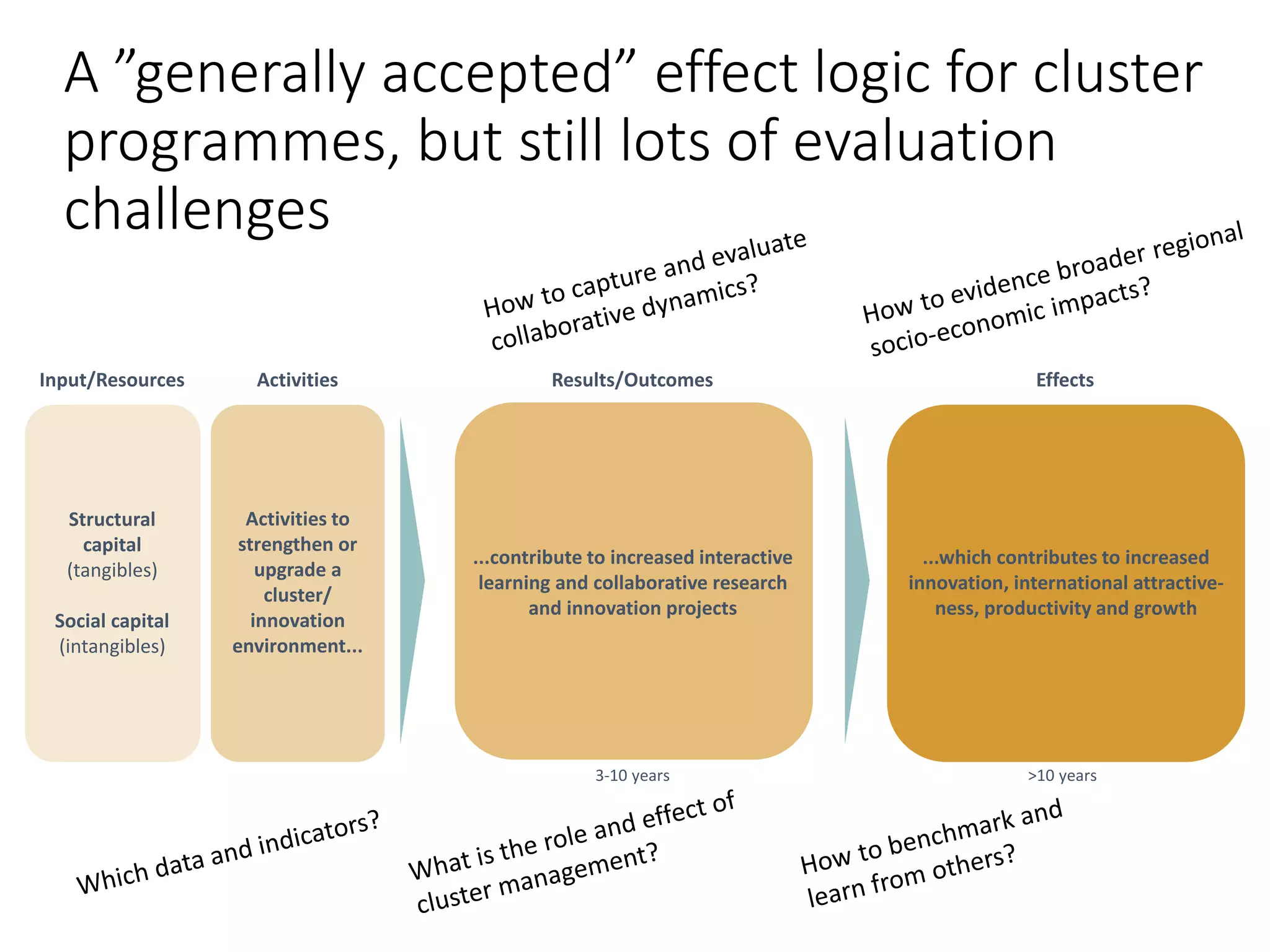
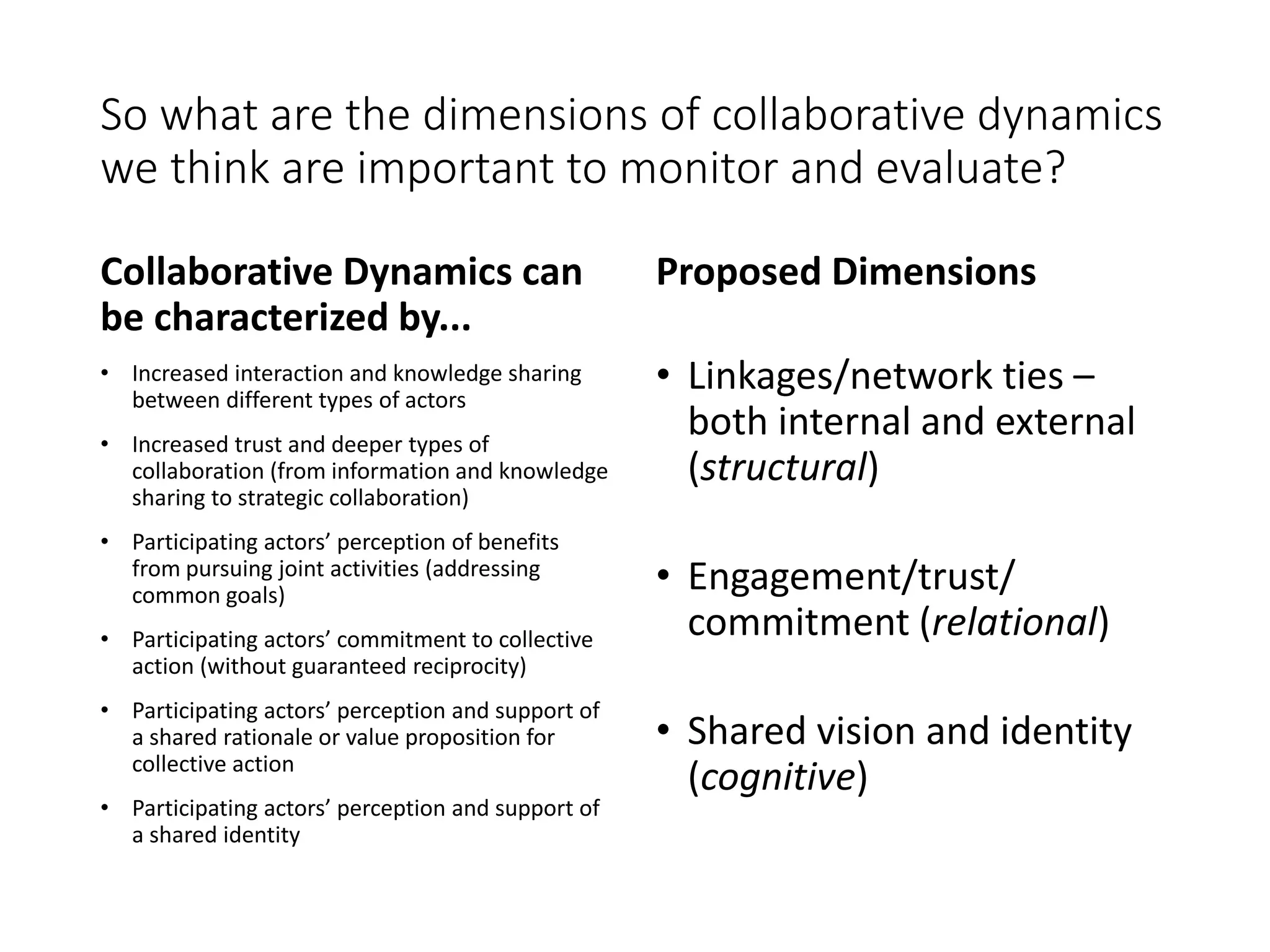
A ”generally accepted” effect logic for cluster
programmes, but still lots of evaluation
challenges
...contribute to increased interactive
learning and collaborative research
and innovation projects
...which contributes to increased
innovation, international attractive-
ness, productivity and growth
Activities to
strengthen or
upgrade a
cluster/
innovation
environment...
Input/Resources Activities Results/Outcomes Effects
3-10 years >10 years
Structural
capital
(tangibles)
Social capital
(intangibles)
Results/Outcomes
3-10 years
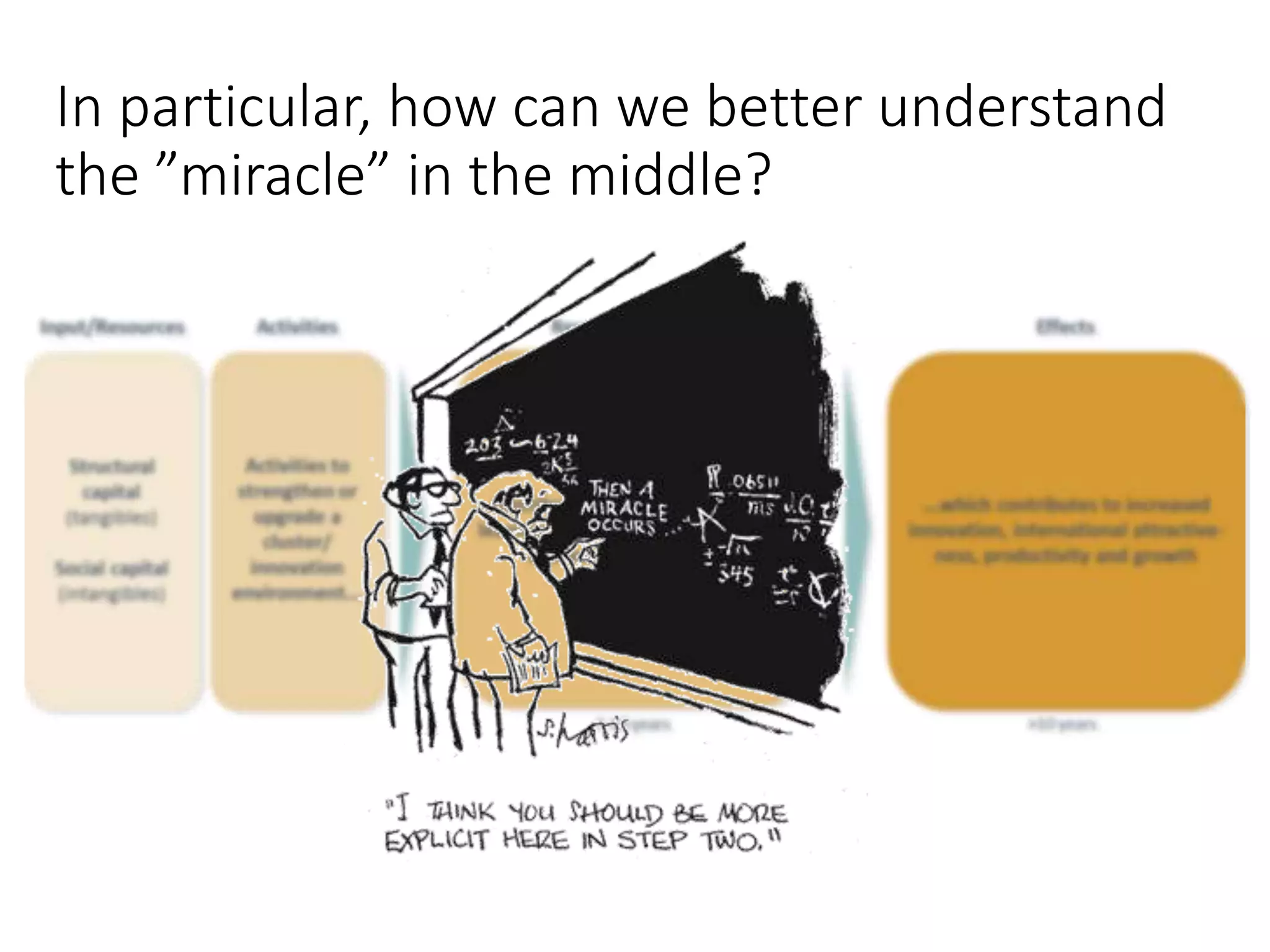
In particular, how can we better understand
the ”miracle” in the middle?
Previous academic work provides an overview of the
importance and characteristics of collaborative
dynamics
• Saxenian (1994) points out the importance of an ”open management
culture” and ”repeated interaction and mutual trust” to foster collective
learning and collaboration
• Gordon and McCann (2000) introduce the ”social network model” of
clusters where firms engage in ”more risky cooperation without fear of
opportunism” in order to pursue ”mutually beneficial goals”
• Smith and Brown (2009) propose a five-stage conceptual model that
helps explain how a cluster develops, based on changes in company
behaviour and company interaction at different stages of development
• Giuliani et al. (2013) highlight that a ”significant element of clusters is the
development of non-market-related networks…that are expected to
improve economic coordination and reduce transaction costs”
• Aragón et al. (2014) highlight the interaction between structural,
relational and cognitive dimensions of social capital which drive networking
behaviour and affect network outcomes
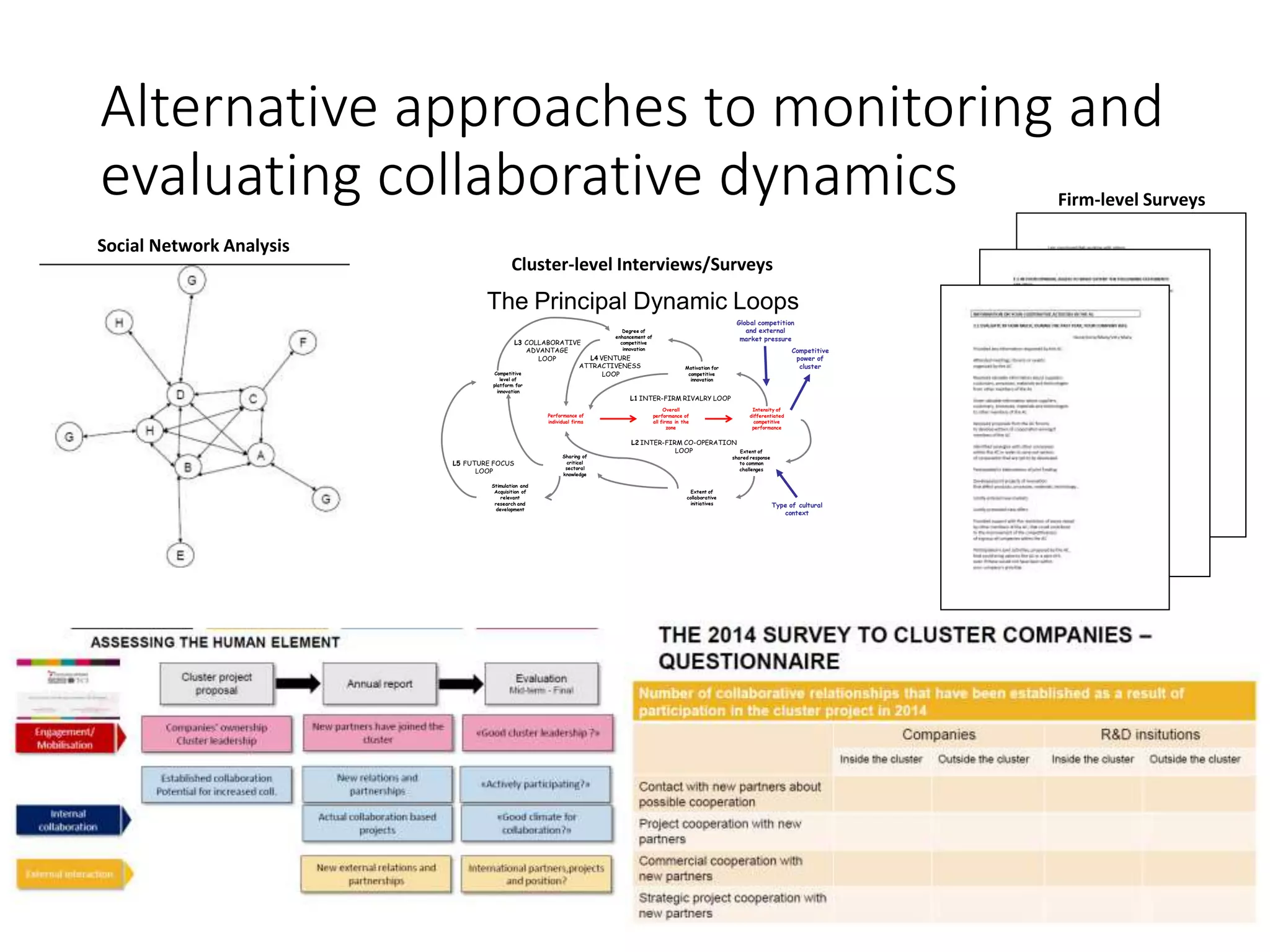
So what are the dimensions of collaborative dynamics
we think are important to monitor and evaluate?
Collaborative Dynamics can
be characterized by...
• Increased interaction and knowledge sharing
between different types of actors
• Increased trust and deeper types of
collaboration (from information and knowledge
sharing to strategic collaboration)
• Participating actors’ perception of benefits
from pursuing joint activities (addressing
common goals)
• Participating actors’ commitment to collective
action (without guaranteed reciprocity)
• Participating actors’ perception and support of
a shared rationale or value proposition for
collective action
• Participating actors’ perception and support of
a shared identity
Proposed Dimensions
• Linkages/network ties –
both internal and external
(structural)
• Engagement/trust/
commitment (relational)
• Shared vision and identity
(cognitive)
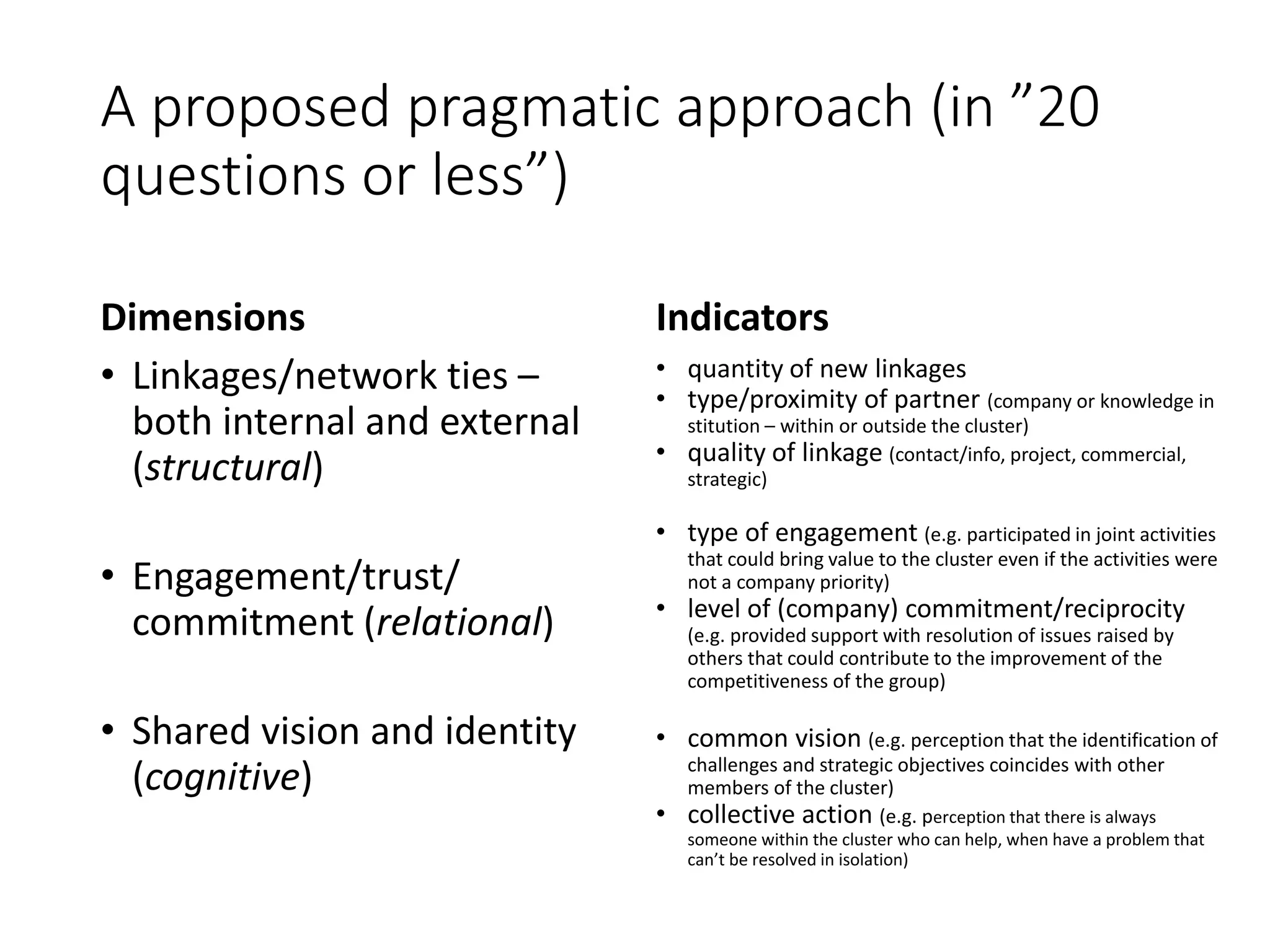
Alternative approaches to monitoring and
evaluating collaborative dynamics
StarDust WP7 Question Set
#2
Stimulation and
Acquisition of
relevant
research and
development
L5 FUTURE FOCUS
LOOP
Performance of
individual firms
Overall
performance of
all firms in the
zone
Intensity of
differentiated
competitive
performance
Motivation for
competitive
innovation
Degree of
enhancement of
competitive
innovation
Competitive
level of
platform for
innovation
Sharing of
critical
sectoral
knowledge
Extent of
collaborative
initiatives
Extent of
shared response
to common
challenges
L1 INTER-FIRM RIVALRY LOOP
L2 INTER-FIRM CO-OPERATION
LOOP
Global competition
and external
market pressure
Type of cultural
context
L3 COLLABORATIVE
ADVANTAGE
LOOP L4 VENTURE
ATTRACTIVENESS
LOOP
The Principal Dynamic Loops
Competitive
power of
cluster
Social Network Analysis
Firm-level Surveys
Cluster-level Interviews/Surveys
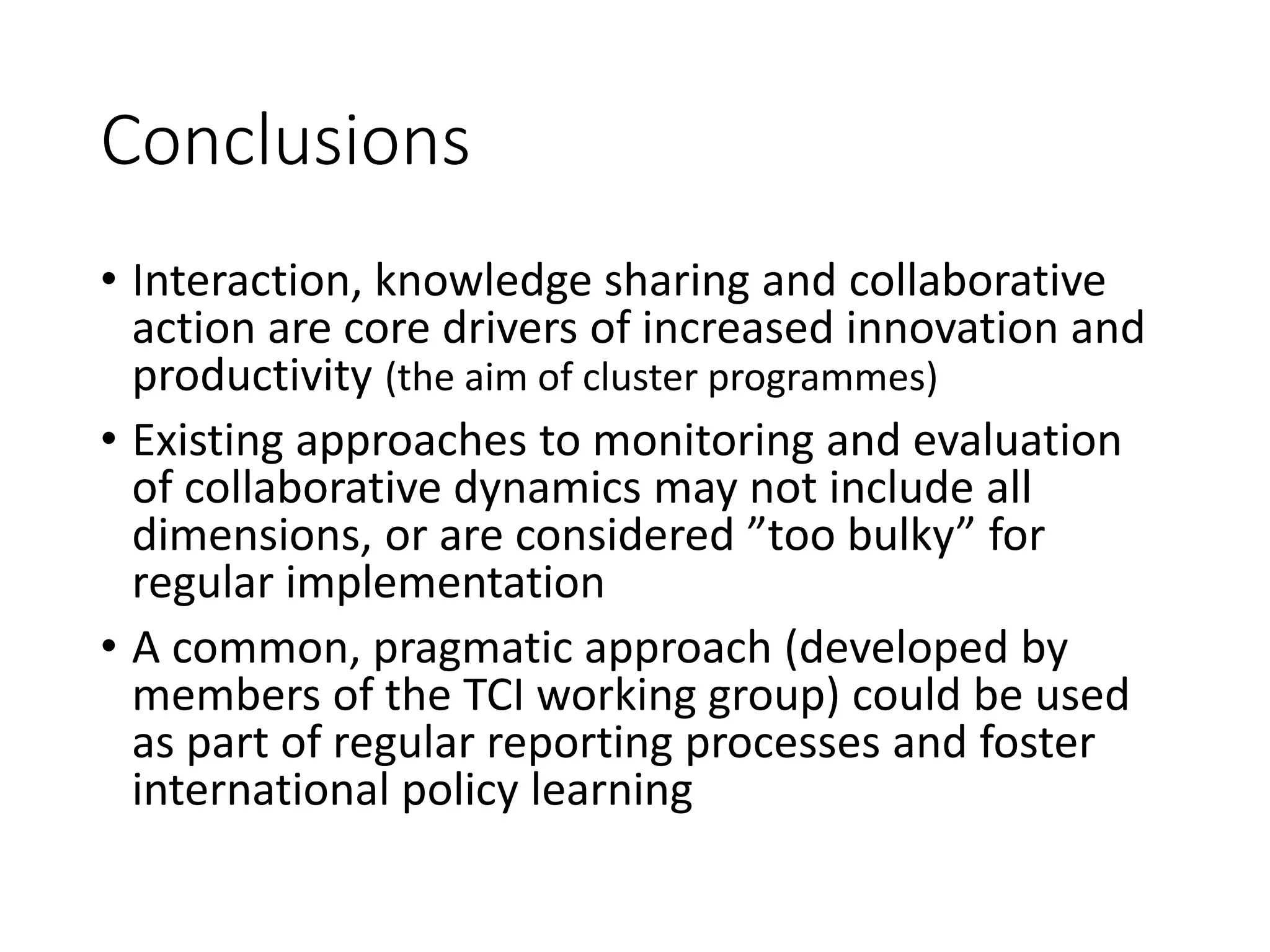
A proposed pragmatic approach (in ”20
questions or less”)
Dimensions
• Linkages/network ties –
both internal and external
(structural)
• Engagement/trust/
commitment (relational)
• Shared vision and identity
(cognitive)
Indicators
• quantity of new linkages
• type/proximity of partner (company or knowledge in
stitution – within or outside the cluster)
• quality of linkage (contact/info, project, commercial,
strategic)
• type of engagement (e.g. participated in joint activities
that could bring value to the cluster even if the activities were
not a company priority)
• level of (company) commitment/reciprocity
(e.g. provided support with resolution of issues raised by
others that could contribute to the improvement of the
competitiveness of the group)
• common vision (e.g. perception that the identification of
challenges and strategic objectives coincides with other
members of the cluster)
• collective action (e.g. perception that there is always
someone within the cluster who can help, when have a problem that
can’t be resolved in isolation)
Conclusions
• Interaction, knowledge sharing and collaborative
action are core drivers of increased innovation and
productivity (the aim of cluster programmes)
• Existing approaches to monitoring and evaluation
of collaborative dynamics may not include all
dimensions, or are considered ”too bulky” for
regular implementation
• A common, pragmatic approach (developed by
members of the TCI working group) could be used
as part of regular reporting processes and foster
international policy learning
Next steps (a wish list)
• Establish a ”coalition of the willing” (a group of regions/
countries who want to work together to develop
approaches to better understand cluster dynamics)
• Agree on a limited list of questions to be incorporated in
firm-level (and cluster-level) surveys conducted as part of
regular reporting/monitoring processes
• Test and work together to establish ’standard’ methods of
data collection and analysis – and compare results

TCI 2015 Pragmatic Approach to Evaluating Collaborative Dynamics in Clusters

  • 1.
    Exploring the Miracle: aPragmatic Approach to Evaluating Collaborative Dynamics in Clusters Emily Wise, Research Fellow Lund University, Sweden Parallel Session 1.2: Analysis of Cluster Models and Cluster Ecosystems
  • 2.
    A ”generally accepted”effect logic for cluster programmes, but still lots of evaluation challenges ...contribute to increased interactive learning and collaborative research and innovation projects ...which contributes to increased innovation, international attractive- ness, productivity and growth Activities to strengthen or upgrade a cluster/ innovation environment... Input/Resources Activities Results/Outcomes Effects 3-10 years >10 years Structural capital (tangibles) Social capital (intangibles) Results/Outcomes 3-10 years
  • 3.
    In particular, howcan we better understand the ”miracle” in the middle?
  • 4.
    Previous academic workprovides an overview of the importance and characteristics of collaborative dynamics • Saxenian (1994) points out the importance of an ”open management culture” and ”repeated interaction and mutual trust” to foster collective learning and collaboration • Gordon and McCann (2000) introduce the ”social network model” of clusters where firms engage in ”more risky cooperation without fear of opportunism” in order to pursue ”mutually beneficial goals” • Smith and Brown (2009) propose a five-stage conceptual model that helps explain how a cluster develops, based on changes in company behaviour and company interaction at different stages of development • Giuliani et al. (2013) highlight that a ”significant element of clusters is the development of non-market-related networks…that are expected to improve economic coordination and reduce transaction costs” • Aragón et al. (2014) highlight the interaction between structural, relational and cognitive dimensions of social capital which drive networking behaviour and affect network outcomes
  • 5.
    So what arethe dimensions of collaborative dynamics we think are important to monitor and evaluate? Collaborative Dynamics can be characterized by... • Increased interaction and knowledge sharing between different types of actors • Increased trust and deeper types of collaboration (from information and knowledge sharing to strategic collaboration) • Participating actors’ perception of benefits from pursuing joint activities (addressing common goals) • Participating actors’ commitment to collective action (without guaranteed reciprocity) • Participating actors’ perception and support of a shared rationale or value proposition for collective action • Participating actors’ perception and support of a shared identity Proposed Dimensions • Linkages/network ties – both internal and external (structural) • Engagement/trust/ commitment (relational) • Shared vision and identity (cognitive)
  • 6.
    Alternative approaches tomonitoring and evaluating collaborative dynamics StarDust WP7 Question Set #2 Stimulation and Acquisition of relevant research and development L5 FUTURE FOCUS LOOP Performance of individual firms Overall performance of all firms in the zone Intensity of differentiated competitive performance Motivation for competitive innovation Degree of enhancement of competitive innovation Competitive level of platform for innovation Sharing of critical sectoral knowledge Extent of collaborative initiatives Extent of shared response to common challenges L1 INTER-FIRM RIVALRY LOOP L2 INTER-FIRM CO-OPERATION LOOP Global competition and external market pressure Type of cultural context L3 COLLABORATIVE ADVANTAGE LOOP L4 VENTURE ATTRACTIVENESS LOOP The Principal Dynamic Loops Competitive power of cluster Social Network Analysis Firm-level Surveys Cluster-level Interviews/Surveys
  • 7.
    A proposed pragmaticapproach (in ”20 questions or less”) Dimensions • Linkages/network ties – both internal and external (structural) • Engagement/trust/ commitment (relational) • Shared vision and identity (cognitive) Indicators • quantity of new linkages • type/proximity of partner (company or knowledge in stitution – within or outside the cluster) • quality of linkage (contact/info, project, commercial, strategic) • type of engagement (e.g. participated in joint activities that could bring value to the cluster even if the activities were not a company priority) • level of (company) commitment/reciprocity (e.g. provided support with resolution of issues raised by others that could contribute to the improvement of the competitiveness of the group) • common vision (e.g. perception that the identification of challenges and strategic objectives coincides with other members of the cluster) • collective action (e.g. perception that there is always someone within the cluster who can help, when have a problem that can’t be resolved in isolation)
  • 8.
    Conclusions • Interaction, knowledgesharing and collaborative action are core drivers of increased innovation and productivity (the aim of cluster programmes) • Existing approaches to monitoring and evaluation of collaborative dynamics may not include all dimensions, or are considered ”too bulky” for regular implementation • A common, pragmatic approach (developed by members of the TCI working group) could be used as part of regular reporting processes and foster international policy learning
  • 9.
    Next steps (awish list) • Establish a ”coalition of the willing” (a group of regions/ countries who want to work together to develop approaches to better understand cluster dynamics) • Agree on a limited list of questions to be incorporated in firm-level (and cluster-level) surveys conducted as part of regular reporting/monitoring processes • Test and work together to establish ’standard’ methods of data collection and analysis – and compare results

Editor's Notes

  • #3 Over the years, a ”generally accepted” effect logic for cluster programmes has emerged: Cluster initiatives aim at building on various types of input factors (both the tangible ”structural capital” including people, money and various types of infrastructure, and the intangible ”social/relational capital”) to upgrade the cluster/innovation environment. The direct results – experienced in the near(er) term – are in the form of strengthened linkages/interactive learning processes...and collaborative R&I projects. These direct results (a more efficient/coordinated innovation system) then enhance longer-term outcomes/impacts on economic performance. There are lots of challenges related to monitoring and evaluating the impacts of cluster programmes – which is the focus on tomorrow’s cluster lab
  • #8 - We are confident that the members of the AC will try to help us even if the issues go far beyond their own interests - When I have a problem that cannot be resolved in isolation, there is always someone in the AC that can support me The majority of the members of the AC are willing to exchange information about suppliers, clients and experiences about processes or elements of expertise that each company has and that could be of interest to me How much the company coincides in the identification of challenges and strategic objectives with members of the cluster