Download as PDF, PPTX


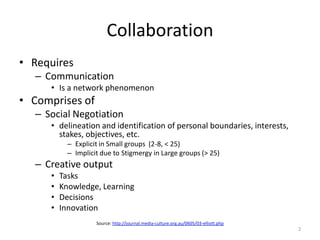
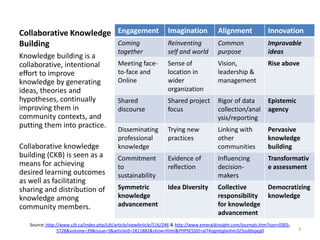
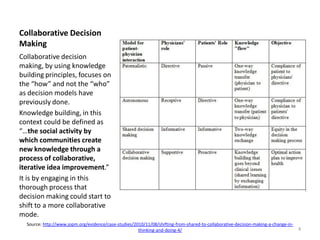
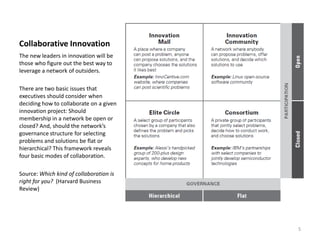
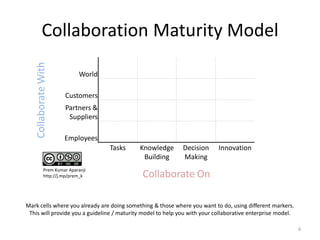


Collaboration requires communication and is a network phenomenon that comprises social negotiation and delineation of interests and objectives. Collaboration can be explicit in small groups but is implicit in large groups due to the concept of stigmergy. Collaboration results in creative outputs like tasks, knowledge, learning, decisions, and innovation. Effective collaboration involves engagement, imagination, alignment, and innovation to build knowledge through a shared discourse and commitment to knowledge advancement. Collaborative decision making focuses on the process rather than individuals and uses knowledge building principles to iteratively improve ideas. When deciding how to collaborate for innovation, organizations should consider whether network membership and governance should be open or closed, and flat or hierarchical.


