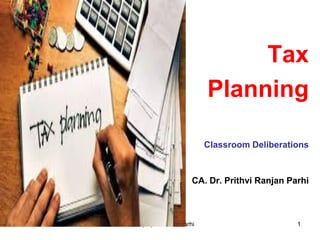
Tax
Planning
Classroom Deliberations
CA. Dr. Prithvi Ranjan Parhi
11:48 AM © CA (Dr) Prithvi R Parhi 1
2
Quotable Quotes…..
© CA (Dr) Prithvi R Parhi
11:48 AM
Nothing is certain
but death and
taxes.
-Benjamin Franklin
3
Quotable Quotes…..
© CA (Dr) Prithvi R Parhi
11:48 AM
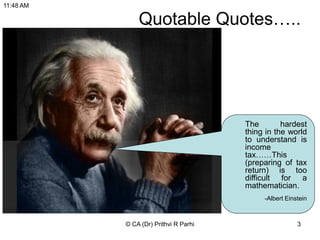
The hardest
thing in the world
to understand is
income
tax……This
(preparing of tax
return) is too
difficult for a
mathematician.
-Albert Einstein
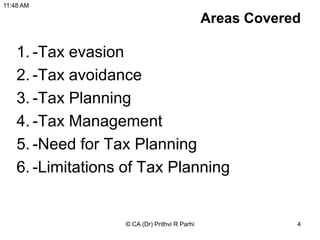
Areas Covered
1. -Tax evasion
2. -Tax avoidance
3. -Tax Planning
4. -Tax Management
5. -Need for Tax Planning
6. -Limitations of Tax Planning
11:48 AM
© CA (Dr) Prithvi R Parhi 4
Tax Evasion
All method by which tax liability is illegally avoided are termed as tax evasion. An
assesse guilty of tax evasion may be punished under the relevant law.
Tax` evasion may involve stating an untrue statement knowingly, submitting
misleading documents, suppression of facts, not maintaining proper accounts of
income earned (if required under law), omission of material facts on assessment.
All such procedures and method are required by the statute to be abided with but
the assessee who dishonestly claims the benefit under the statue before complying
with the said abidance by making false statements, would be within the ambit of tax
evasion.
A person may plan his finances in such a manner, strictly within the four corners of
the taxing statue that his tax liability is minimised or made nil.
If this is done and as observed strictly in accordance with and taking advantage of
the provision contained in the Act, by no stretch of imagination can it be said that
payment of tax has been evaded for.
In the context of payment of tax, ‘evasion’ necessarily means, ‘to try illegally to avoid
paying tax’ – CIT v. Sri Abhayananda Rath Family Benefit Trust [2002] 123 Taxman
81 (Ori.).
6
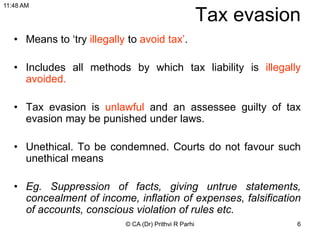
Tax evasion
• Means to ‘try illegally to avoid tax’.
• Includes all methods by which tax liability is illegally
avoided.
• Tax evasion is unlawful and an assessee guilty of tax
evasion may be punished under laws.
• Unethical. To be condemned. Courts do not favour such
unethical means
• Eg. Suppression of facts, giving untrue statements,
concealment of income, inflation of expenses, falsification
of accounts, conscious violation of rules etc.
© CA (Dr) Prithvi R Parhi
11:48 AM
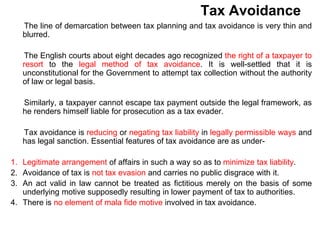
Tax Avoidance
The line of demarcation between tax planning and tax avoidance is very thin and
blurred.
The English courts about eight decades ago recognized the right of a taxpayer to
resort to the legal method of tax avoidance. It is well-settled that it is
unconstitutional for the Government to attempt tax collection without the authority
of law or legal basis.
Similarly, a taxpayer cannot escape tax payment outside the legal framework, as
he renders himself liable for prosecution as a tax evader.
Tax avoidance is reducing or negating tax liability in legally permissible ways and
has legal sanction. Essential features of tax avoidance are as under-
1. Legitimate arrangement of affairs in such a way so as to minimize tax liability.
2. Avoidance of tax is not tax evasion and carries no public disgrace with it.
3. An act valid in law cannot be treated as fictitious merely on the basis of some
underlying motive supposedly resulting in lower payment of tax to authorities.
4. There is no element of mala fide motive involved in tax avoidance.
8
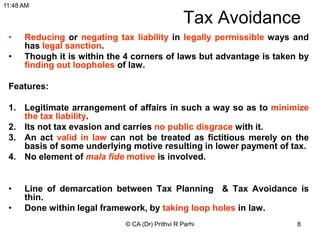
Tax Avoidance
• Reducing or negating tax liability in legally permissible ways and
has legal sanction.
• Though it is within the 4 corners of laws but advantage is taken by
finding out loopholes of law.
Features:
1. Legitimate arrangement of affairs in such a way so as to minimize
the tax liability.
2. Its not tax evasion and carries no public disgrace with it.
3. An act valid in law can not be treated as fictitious merely on the
basis of some underlying motive resulting in lower payment of tax.
4. No element of mala fide motive is involved.
• Line of demarcation between Tax Planning & Tax Avoidance is
thin.
• Done within legal framework, by taking loop holes in law.
© CA (Dr) Prithvi R Parhi
11:48 AM
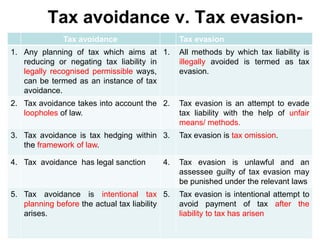
Tax avoidance v. Tax evasion-
Tax avoidance Tax evasion
1. Any planning of tax which aims at
reducing or negating tax liability in
legally recognised permissible ways,
can be termed as an instance of tax
avoidance.
1. All methods by which tax liability is
illegally avoided is termed as tax
evasion.
2. Tax avoidance takes into account the
loopholes of law.
2. Tax evasion is an attempt to evade
tax liability with the help of unfair
means/ methods.
3. Tax avoidance is tax hedging within
the framework of law.
3. Tax evasion is tax omission.
4. Tax avoidance has legal sanction 4. Tax evasion is unlawful and an
assessee guilty of tax evasion may
be punished under the relevant laws
5. Tax avoidance is intentional tax
planning before the actual tax liability
arises.
5. Tax evasion is intentional attempt to
avoid payment of tax after the
liability to tax has arisen
10
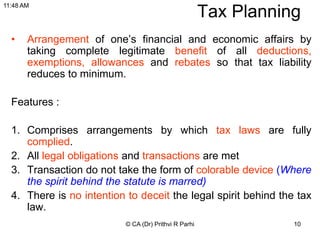
Tax Planning
• Arrangement of one’s financial and economic affairs by
taking complete legitimate benefit of all deductions,
exemptions, allowances and rebates so that tax liability
reduces to minimum.
Features :
1. Comprises arrangements by which tax laws are fully
complied.
2. All legal obligations and transactions are met
3. Transaction do not take the form of colorable device (Where
the spirit behind the statute is marred)
4. There is no intention to deceit the legal spirit behind the tax
law.
© CA (Dr) Prithvi R Parhi
11:48 AM
11
Tax Planning
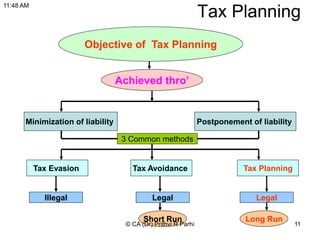
Objective of Tax Planning
Achieved thro’
Minimization of liability Postponement of liability
Tax Evasion Tax Avoidance Tax Planning
Illegal Legal Legal
Short Run Long Run
3 Common methods
© CA (Dr) Prithvi R Parhi
11:48 AM
Tax Management :
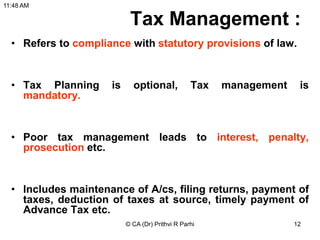
• Refers to compliance with statutory provisions of law.
• Tax Planning is optional, Tax management is
mandatory.
• Poor tax management leads to interest, penalty,
prosecution etc.
• Includes maintenance of A/cs, filing returns, payment of
taxes, deduction of taxes at source, timely payment of
Advance Tax etc.
11:48 AM
© CA (Dr) Prithvi R Parhi 12
Tax planning v. Tax Management
Tax Planning Tax Management
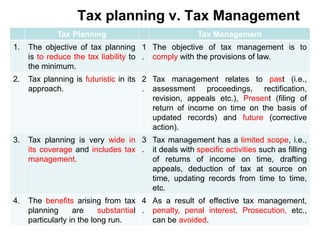
1. The objective of tax planning
is to reduce the tax liability to
the minimum.
1
.
The objective of tax management is to
comply with the provisions of law.
2. Tax planning is futuristic in its
approach.
2
.
Tax management relates to past (i.e.,
assessment proceedings, rectification,
revision, appeals etc.), Present (filing of
return of income on time on the basis of
updated records) and future (corrective
action).
3. Tax planning is very wide in
its coverage and includes tax
management.
3
.
Tax management has a limited scope, i.e.,
it deals with specific activities such as filling
of returns of income on time, drafting
appeals, deduction of tax at source on
time, updating records from time to time,
etc.
4. The benefits arising from tax
planning are substantial
particularly in the long run.
4
.
As a result of effective tax management,
penalty, penal interest, Prosecution, etc.,
can be avoided.
Why Tax Planning
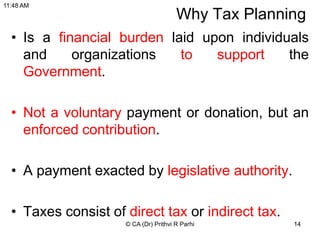
• Is a financial burden laid upon individuals
and organizations to support the
Government.
• Not a voluntary payment or donation, but an
enforced contribution.
• A payment exacted by legislative authority.
• Taxes consist of direct tax or indirect tax.
© CA (Dr) Prithvi R Parhi 14
11:48 AM
Need for Tax Planning
• To save tax
• To defer liability
• Incidental benefits
11:48 AM
© CA (Dr) Prithvi R Parhi 15
Limitations of Tax Planning
• Complex
• May need expert advice
• May involve litigation
11:48 AM
© CA (Dr) Prithvi R Parhi 16
11:48 AM © CA. Dr Prithvi Ranjan Parhi 17
Keep Learning
Keep Growing
Thank you.

Tax Planning Basics

  • 1.
    Tax Planning Classroom Deliberations CA. Dr.Prithvi Ranjan Parhi 11:48 AM © CA (Dr) Prithvi R Parhi 1
  • 2.
    2 Quotable Quotes….. © CA(Dr) Prithvi R Parhi 11:48 AM Nothing is certain but death and taxes. -Benjamin Franklin
  • 3.
    3 Quotable Quotes….. © CA(Dr) Prithvi R Parhi 11:48 AM The hardest thing in the world to understand is income tax……This (preparing of tax return) is too difficult for a mathematician. -Albert Einstein
  • 4.
    Areas Covered 1. -Taxevasion 2. -Tax avoidance 3. -Tax Planning 4. -Tax Management 5. -Need for Tax Planning 6. -Limitations of Tax Planning 11:48 AM © CA (Dr) Prithvi R Parhi 4
  • 5.
    Tax Evasion All methodby which tax liability is illegally avoided are termed as tax evasion. An assesse guilty of tax evasion may be punished under the relevant law. Tax` evasion may involve stating an untrue statement knowingly, submitting misleading documents, suppression of facts, not maintaining proper accounts of income earned (if required under law), omission of material facts on assessment. All such procedures and method are required by the statute to be abided with but the assessee who dishonestly claims the benefit under the statue before complying with the said abidance by making false statements, would be within the ambit of tax evasion. A person may plan his finances in such a manner, strictly within the four corners of the taxing statue that his tax liability is minimised or made nil. If this is done and as observed strictly in accordance with and taking advantage of the provision contained in the Act, by no stretch of imagination can it be said that payment of tax has been evaded for. In the context of payment of tax, ‘evasion’ necessarily means, ‘to try illegally to avoid paying tax’ – CIT v. Sri Abhayananda Rath Family Benefit Trust [2002] 123 Taxman 81 (Ori.).
  • 6.
    6 Tax evasion • Meansto ‘try illegally to avoid tax’. • Includes all methods by which tax liability is illegally avoided. • Tax evasion is unlawful and an assessee guilty of tax evasion may be punished under laws. • Unethical. To be condemned. Courts do not favour such unethical means • Eg. Suppression of facts, giving untrue statements, concealment of income, inflation of expenses, falsification of accounts, conscious violation of rules etc. © CA (Dr) Prithvi R Parhi 11:48 AM
  • 7.
    Tax Avoidance The lineof demarcation between tax planning and tax avoidance is very thin and blurred. The English courts about eight decades ago recognized the right of a taxpayer to resort to the legal method of tax avoidance. It is well-settled that it is unconstitutional for the Government to attempt tax collection without the authority of law or legal basis. Similarly, a taxpayer cannot escape tax payment outside the legal framework, as he renders himself liable for prosecution as a tax evader. Tax avoidance is reducing or negating tax liability in legally permissible ways and has legal sanction. Essential features of tax avoidance are as under- 1. Legitimate arrangement of affairs in such a way so as to minimize tax liability. 2. Avoidance of tax is not tax evasion and carries no public disgrace with it. 3. An act valid in law cannot be treated as fictitious merely on the basis of some underlying motive supposedly resulting in lower payment of tax to authorities. 4. There is no element of mala fide motive involved in tax avoidance.
  • 8.
    8 Tax Avoidance • Reducingor negating tax liability in legally permissible ways and has legal sanction. • Though it is within the 4 corners of laws but advantage is taken by finding out loopholes of law. Features: 1. Legitimate arrangement of affairs in such a way so as to minimize the tax liability. 2. Its not tax evasion and carries no public disgrace with it. 3. An act valid in law can not be treated as fictitious merely on the basis of some underlying motive resulting in lower payment of tax. 4. No element of mala fide motive is involved. • Line of demarcation between Tax Planning & Tax Avoidance is thin. • Done within legal framework, by taking loop holes in law. © CA (Dr) Prithvi R Parhi 11:48 AM
  • 9.
    Tax avoidance v.Tax evasion- Tax avoidance Tax evasion 1. Any planning of tax which aims at reducing or negating tax liability in legally recognised permissible ways, can be termed as an instance of tax avoidance. 1. All methods by which tax liability is illegally avoided is termed as tax evasion. 2. Tax avoidance takes into account the loopholes of law. 2. Tax evasion is an attempt to evade tax liability with the help of unfair means/ methods. 3. Tax avoidance is tax hedging within the framework of law. 3. Tax evasion is tax omission. 4. Tax avoidance has legal sanction 4. Tax evasion is unlawful and an assessee guilty of tax evasion may be punished under the relevant laws 5. Tax avoidance is intentional tax planning before the actual tax liability arises. 5. Tax evasion is intentional attempt to avoid payment of tax after the liability to tax has arisen
  • 10.
    10 Tax Planning • Arrangementof one’s financial and economic affairs by taking complete legitimate benefit of all deductions, exemptions, allowances and rebates so that tax liability reduces to minimum. Features : 1. Comprises arrangements by which tax laws are fully complied. 2. All legal obligations and transactions are met 3. Transaction do not take the form of colorable device (Where the spirit behind the statute is marred) 4. There is no intention to deceit the legal spirit behind the tax law. © CA (Dr) Prithvi R Parhi 11:48 AM
  • 11.
    11 Tax Planning Objective ofTax Planning Achieved thro’ Minimization of liability Postponement of liability Tax Evasion Tax Avoidance Tax Planning Illegal Legal Legal Short Run Long Run 3 Common methods © CA (Dr) Prithvi R Parhi 11:48 AM
  • 12.
    Tax Management : •Refers to compliance with statutory provisions of law. • Tax Planning is optional, Tax management is mandatory. • Poor tax management leads to interest, penalty, prosecution etc. • Includes maintenance of A/cs, filing returns, payment of taxes, deduction of taxes at source, timely payment of Advance Tax etc. 11:48 AM © CA (Dr) Prithvi R Parhi 12
  • 13.
    Tax planning v.Tax Management Tax Planning Tax Management 1. The objective of tax planning is to reduce the tax liability to the minimum. 1 . The objective of tax management is to comply with the provisions of law. 2. Tax planning is futuristic in its approach. 2 . Tax management relates to past (i.e., assessment proceedings, rectification, revision, appeals etc.), Present (filing of return of income on time on the basis of updated records) and future (corrective action). 3. Tax planning is very wide in its coverage and includes tax management. 3 . Tax management has a limited scope, i.e., it deals with specific activities such as filling of returns of income on time, drafting appeals, deduction of tax at source on time, updating records from time to time, etc. 4. The benefits arising from tax planning are substantial particularly in the long run. 4 . As a result of effective tax management, penalty, penal interest, Prosecution, etc., can be avoided.
  • 14.
    Why Tax Planning •Is a financial burden laid upon individuals and organizations to support the Government. • Not a voluntary payment or donation, but an enforced contribution. • A payment exacted by legislative authority. • Taxes consist of direct tax or indirect tax. © CA (Dr) Prithvi R Parhi 14 11:48 AM
  • 15.
    Need for TaxPlanning • To save tax • To defer liability • Incidental benefits 11:48 AM © CA (Dr) Prithvi R Parhi 15
  • 16.
    Limitations of TaxPlanning • Complex • May need expert advice • May involve litigation 11:48 AM © CA (Dr) Prithvi R Parhi 16
  • 17.
    11:48 AM ©CA. Dr Prithvi Ranjan Parhi 17 Keep Learning Keep Growing Thank you.