J.Dilip Rathnam
Sai Praveen
Vikram
Jahangir
Ivan Bose
Veeral Bopanna
INTRODUCTION:
Company Background
Tata Steel, formerly known as TISCO and Tata Iron and Steel
Company Limited, is the world's sixth largest steel company, with an
annual crude steel capacity of 31 million tonnes.
It is the largest private sector steel company in India in terms of
domestic production.
Tata Steel is also India's second-largest and second-most
profitable company in private sector.
Backed by 100 glorious years of experience in steel making, Tata
Steel is among the top ten steel producers in the world with an
existing annual crude steel production capacity of 30 Million Tonnes
Per Annum (MTPA).
Vision statement of Tata Steel:
They aspire to be the global steel industry benchmark for Value Creation and
Corporate Citizenship.
They make the difference through:
 There people, by fostering team work, nurturing talent, enhancing leadership
capability and acting with pace, pride and passion.
 There offer, by becoming the supplier of choice, delivering premium products
and services, and creating value with our customers.
 There innovative approach, by developing leading edge solutions in
technology, processes and products.
 There conduct, by providing a safe working place, respecting the
environment, caring for our communities and demonstrating high ethical
standards.
Mission Statement of
Tata Steel
• Achieve sustainable, profitable growth in steel and related businesses.
• Create differential value for our customers through innovative offerings.
• Continuous improvement of business processes and technologies.
• Enhance employees competencies to create a high performing and
innovative organization.
Be a responsible corporate citizen and enhance the quality of life of employees
and key community.
MARKETING MIX:
4 P’S OF MARKETING:
1. PRODUCT:
Tata Steel Products
The Company’s products consist of TSL products, TSL’s products can be divided
into three main categories:
1. Finished and semi-finished steel products;
2. Ferro alloys products; and
3. Other products and services, including
Tube products,
Bearing products,
Refractory products,
Pigments,
Municipal services and investment activities.
2. PRICE:
Pricing is one of the most crucial elements behind a successful product. It is more
pragmatic and fact oriented in industrial marketing as compared to pricing for
consumer products. Pricing in industrial marketing is closely related to the firm’s
product, distribution and communication strategies.
Factors Influencing Pricing Strategy in Steel Industry
The most important factors which affect pricing strategies in steel industry are:
 Production Costs
 Market demand (derived in nature)
 Competition
 Government regulations
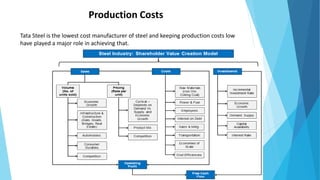
Production Costs
Tata Steel is the lowest cost manufacturer of steel and keeping production costs low
have played a major role in achieving that.
Market Demand:
Demand for steel is derived in nature since it is majorly used as an
input. The following facts and figures suggest that there exist
healthy demand in market for Tata Steel to serve.
• World consumption of steel is expected to be 1.23 billion tonnes
in 2010 registering a growth of 10% over 2009. The exports
during 2010 are expected to be higher by around 4% as
compared to 2009.
• In India, apparent consumption is expected to increase by more
than 10% in FY 11 buoyed by expected strong performances from
consuming segments like automotive, construction,
infrastructure and capital goods.
Competition:
The amount of latitude a firm has in its pricing decision largely depends on the degree to
which it can differentiate its products in the minds of buyers.
Pricing strategy is also influenced by the anticipated reactions of competitors to pricing
decisions.
The major competitors of Tata Steel in India are Steel Authority of India Ltd, JSW Steel Ltd
and Essar Steel Limited. Tata Steel's rare advantage is that it has captive iron ore mines
with capacities far in excess of its current needs. Therefore, it makes imminent sense to
expand its primary steel-making facilities in India and look for finishing capabilities
elsewhere. Greater the volumes, lower the production costs and hence lower the prices at
which its products are offered.
This shows that the ability to maintain lower prices of its products have given Tata Steel
the edge over its competitors.
3. PLACE:
Place represents the location where a product can be purchased. But in industrial
marketing place is often referred to as the distribution channel.
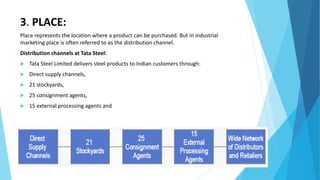
Distribution channels at Tata Steel:
 Tata Steel Limited delivers steel products to Indian customers through:
 Direct supply channels,
 21 stockyards,
 25 consignment agents,
 15 external processing agents and
4. PROMOTION:
In B2B marketing advertising, promotions and publicity plays an important role in the
communication strategies. Hence, to contribute to the overall effectiveness of the
promotional strategies utmost care must be taken by the companies.
B2B promotion is used to create awareness of the company, to increase the sales of the
product and to increase the overall effectiveness of the selling efforts. The promotional
programme begins with carefully developed advertising objectives that must be
formulated from corporate and marketing objectives in such a manner as to set the
direction for creating, co-coordinating, and evaluating entire promotional programme.
Strategy at Tata Steel
 Five key strategic priorities have been identified:
Customer focus:
 A major 'Supply Chain Transformation' project aimed at improving customer service
levels.
 Invested in projects to improve product mix and service offering.
Innovation
 14 new products launched in the Financial Year 2012-13, with the majority in
automotive.
 A new chair for research into low carbon materials technology at the University of
Warwick, jointly funded with the Royal Academy of Engineering.
 Implementation of a Project and Portfolio Management Tool known as 'Trakker' to manage
the Company's new product development process.
Operational excellence
 Over the last two years Tata Steel has aligned its industrial footprint with
market conditions. The Company continues to upgrade its plants with the aim
of improving asset performance and cost competitiveness.
Responsible behavior
 Tata Steel aims to act responsibly in all areas of its business, and in particular
in relation to the environment, the communities within which it operates and
its employees' safety.
 Leading role in the European Ultra Low CO2 Steelmaking ('ULCOS') collaborative
project.
People
 Tata Steel is committed to its people who are instrumental in its
success. In managing its people, the focus is on the following three
areas:
 Engaging employees at all levels of the organization.
 Developing the capabilities of the workforce through training and
recruitment targeted at filling capability gaps.
 The Company invests significantly in the up-skilling and
development of its employees.
Thank You

Project Tata steel dd

  • 1.
  • 2.
    INTRODUCTION: Company Background Tata Steel,formerly known as TISCO and Tata Iron and Steel Company Limited, is the world's sixth largest steel company, with an annual crude steel capacity of 31 million tonnes. It is the largest private sector steel company in India in terms of domestic production. Tata Steel is also India's second-largest and second-most profitable company in private sector. Backed by 100 glorious years of experience in steel making, Tata Steel is among the top ten steel producers in the world with an existing annual crude steel production capacity of 30 Million Tonnes Per Annum (MTPA).
  • 3.
    Vision statement ofTata Steel: They aspire to be the global steel industry benchmark for Value Creation and Corporate Citizenship. They make the difference through:  There people, by fostering team work, nurturing talent, enhancing leadership capability and acting with pace, pride and passion.  There offer, by becoming the supplier of choice, delivering premium products and services, and creating value with our customers.  There innovative approach, by developing leading edge solutions in technology, processes and products.  There conduct, by providing a safe working place, respecting the environment, caring for our communities and demonstrating high ethical standards.
  • 4.
    Mission Statement of TataSteel • Achieve sustainable, profitable growth in steel and related businesses. • Create differential value for our customers through innovative offerings. • Continuous improvement of business processes and technologies. • Enhance employees competencies to create a high performing and innovative organization. Be a responsible corporate citizen and enhance the quality of life of employees and key community.
  • 5.
    MARKETING MIX: 4 P’SOF MARKETING: 1. PRODUCT: Tata Steel Products The Company’s products consist of TSL products, TSL’s products can be divided into three main categories: 1. Finished and semi-finished steel products; 2. Ferro alloys products; and 3. Other products and services, including Tube products, Bearing products, Refractory products, Pigments, Municipal services and investment activities.
  • 6.
    2. PRICE: Pricing isone of the most crucial elements behind a successful product. It is more pragmatic and fact oriented in industrial marketing as compared to pricing for consumer products. Pricing in industrial marketing is closely related to the firm’s product, distribution and communication strategies. Factors Influencing Pricing Strategy in Steel Industry The most important factors which affect pricing strategies in steel industry are:  Production Costs  Market demand (derived in nature)  Competition  Government regulations
  • 7.
    Production Costs Tata Steelis the lowest cost manufacturer of steel and keeping production costs low have played a major role in achieving that.
  • 8.
    Market Demand: Demand forsteel is derived in nature since it is majorly used as an input. The following facts and figures suggest that there exist healthy demand in market for Tata Steel to serve. • World consumption of steel is expected to be 1.23 billion tonnes in 2010 registering a growth of 10% over 2009. The exports during 2010 are expected to be higher by around 4% as compared to 2009. • In India, apparent consumption is expected to increase by more than 10% in FY 11 buoyed by expected strong performances from consuming segments like automotive, construction, infrastructure and capital goods.
  • 9.
    Competition: The amount oflatitude a firm has in its pricing decision largely depends on the degree to which it can differentiate its products in the minds of buyers. Pricing strategy is also influenced by the anticipated reactions of competitors to pricing decisions. The major competitors of Tata Steel in India are Steel Authority of India Ltd, JSW Steel Ltd and Essar Steel Limited. Tata Steel's rare advantage is that it has captive iron ore mines with capacities far in excess of its current needs. Therefore, it makes imminent sense to expand its primary steel-making facilities in India and look for finishing capabilities elsewhere. Greater the volumes, lower the production costs and hence lower the prices at which its products are offered. This shows that the ability to maintain lower prices of its products have given Tata Steel the edge over its competitors.
  • 10.
    3. PLACE: Place representsthe location where a product can be purchased. But in industrial marketing place is often referred to as the distribution channel. Distribution channels at Tata Steel:  Tata Steel Limited delivers steel products to Indian customers through:  Direct supply channels,  21 stockyards,  25 consignment agents,  15 external processing agents and
  • 11.
    4. PROMOTION: In B2Bmarketing advertising, promotions and publicity plays an important role in the communication strategies. Hence, to contribute to the overall effectiveness of the promotional strategies utmost care must be taken by the companies. B2B promotion is used to create awareness of the company, to increase the sales of the product and to increase the overall effectiveness of the selling efforts. The promotional programme begins with carefully developed advertising objectives that must be formulated from corporate and marketing objectives in such a manner as to set the direction for creating, co-coordinating, and evaluating entire promotional programme.
  • 12.
    Strategy at TataSteel  Five key strategic priorities have been identified: Customer focus:  A major 'Supply Chain Transformation' project aimed at improving customer service levels.  Invested in projects to improve product mix and service offering. Innovation  14 new products launched in the Financial Year 2012-13, with the majority in automotive.  A new chair for research into low carbon materials technology at the University of Warwick, jointly funded with the Royal Academy of Engineering.  Implementation of a Project and Portfolio Management Tool known as 'Trakker' to manage the Company's new product development process.
  • 13.
    Operational excellence  Overthe last two years Tata Steel has aligned its industrial footprint with market conditions. The Company continues to upgrade its plants with the aim of improving asset performance and cost competitiveness. Responsible behavior  Tata Steel aims to act responsibly in all areas of its business, and in particular in relation to the environment, the communities within which it operates and its employees' safety.  Leading role in the European Ultra Low CO2 Steelmaking ('ULCOS') collaborative project.
  • 14.
    People  Tata Steelis committed to its people who are instrumental in its success. In managing its people, the focus is on the following three areas:  Engaging employees at all levels of the organization.  Developing the capabilities of the workforce through training and recruitment targeted at filling capability gaps.  The Company invests significantly in the up-skilling and development of its employees.
  • 15.