STRATEGIC
MARKETING OF
TATA Group
• Submitted by
Vaishali , M.com
Roll No. 84
Submitted to
Prof. Narendra Singh
Dept. of Commerce,KUK
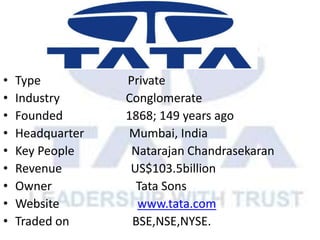
• Type Private
• Industry Conglomerate
• Founded 1868; 149 years ago
• Headquarter Mumbai, India
• Key People Natarajan Chandrasekaran
• Revenue US$103.5billion
• Owner Tata Sons
• Website www.tata.com
• Traded on BSE,NSE,NYSE.
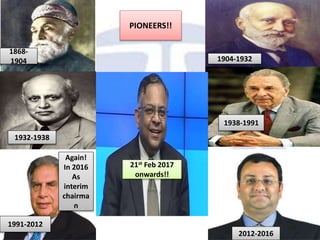
1868-
1904 1904-1932
1932-1938
1938-1991
1991-2012
2012-2016
Again!
In 2016
As
interim
chairma
n
21st Feb 2017
onwards!!
PIONEERS!!
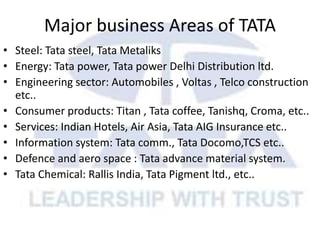
Major business Areas of TATA
• Steel: Tata steel, Tata Metaliks
• Energy: Tata power, Tata power Delhi Distribution ltd.
• Engineering sector: Automobiles , Voltas , Telco construction
etc..
• Consumer products: Titan , Tata coffee, Tanishq, Croma, etc..
• Services: Indian Hotels, Air Asia, Tata AIG Insurance etc..
• Information system: Tata comm., Tata Docomo,TCS etc..
• Defence and aero space : Tata advance material system.
• Tata Chemical: Rallis India, Tata Pigment ltd., etc..
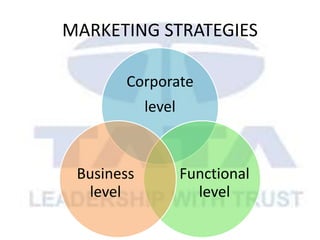
MARKETING STRATEGIES
Corporate
level
Functional
level
Business
level
• Corporate strategies:
Growth
Disinvestment
• Business level Strategies:
Cost leadership
Product differentiation
• Functional level strategies:
R&D Strategy(technological leader, innovation)
Operation strategy(Production strategy)
Sustainability strategy
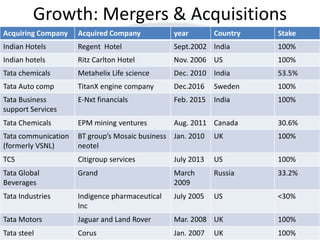
Growth: Mergers & Acquisitions
Acquiring Company Acquired Company year Country Stake
Indian Hotels Regent Hotel Sept.2002 India 100%
Indian hotels Ritz Carlton Hotel Nov. 2006 US 100%
Tata chemicals Metahelix Life science Dec. 2010 India 53.5%
Tata Auto comp TitanX engine company Dec.2016 Sweden 100%
Tata Business
support Services
E-Nxt financials Feb. 2015 India 100%
Tata Chemicals EPM mining ventures Aug. 2011 Canada 30.6%
Tata communication
(formerly VSNL)
BT group’s Mosaic business
neotel
Jan. 2010 UK 100%
TCS Citigroup services July 2013 US 100%
Tata Global
Beverages
Grand March
2009
Russia 33.2%
Tata Industries Indigence pharmaceutical
Inc
July 2005 US <30%
Tata Motors Jaguar and Land Rover Mar. 2008 UK 100%
Tata steel Corus Jan. 2007 UK 100%
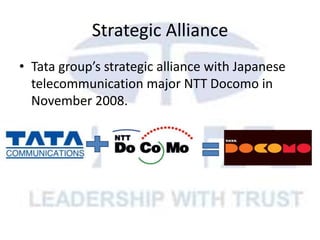
Strategic Alliance
• Tata group’s strategic alliance with Japanese
telecommunication major NTT Docomo in
November 2008.
Joint venture
• Tata & Fiat Since 2006
• Tata & Starbucks
• Tata motors with Tata Africa
Holdings.
• Tata and engineer India ltd.
• Tesco and Tata(2014)
Disinvestment strategy
• Tata oil mill was divested and sold to Hindustan
levers as soap and detergent was not considered
as core business.
• The pharmaceutical companies of Tata’s Merind and
Tata pharma=were Divested to Wockhardt.
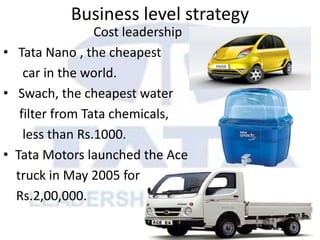
• The cosmetic company lakme was divested and sold
to Hindustan lever.
At present Tata steel is planning to divest its UK Plant.
Business level strategy
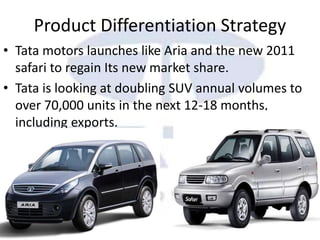
Cost leadership
• Tata Nano , the cheapest
car in the world.
• Swach, the cheapest water
filter from Tata chemicals,
less than Rs.1000.
• Tata Motors launched the Ace
truck in May 2005 for
Rs.2,00,000.
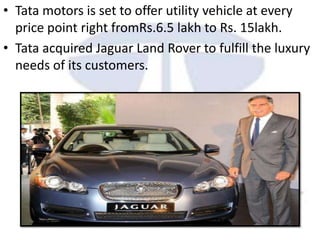
Product Differentiation Strategy
• Tata motors launches like Aria and the new 2011
safari to regain Its new market share.
• Tata is looking at doubling SUV annual volumes to
over 70,000 units in the next 12-18 months,
including exports.
• Tata motors is set to offer utility vehicle at every
price point right fromRs.6.5 lakh to Rs. 15lakh.
• Tata acquired Jaguar Land Rover to fulfill the luxury
needs of its customers.
3.Functional level strategy
R & D Strategy
• Automotive engineering group UK focus is on
cost-effective light weighting, to keep steel
positioned as the automotive material of choice in
the transition to a low carbon economy. It services
the automotive, construction, materials handling
and defense market sectors.
• Tata steel has 5 research centers with over 1000
people In Europe.
• An engine “start-stop” technology
developed by Jaguar Rover.
• High performance rail steel that saved £1,50,000
Over 5 years was developed by Tata steel Europe.
• Acc. To ET survey Tata Is among Top 50 companies
spending huge on R&D.
• After spending a decade on R&D Tata steel innovate
a new way of getting iron is called Direct reduction
of iron(DRI), that help them in reducing cost.
OPERATIONAL STRETGY
• Jaguar Land Rover has re-hauled its supply chain to
secure cost saving as well as sustainability equation
that gives the company a green edge.
• A redesigning of process equipment at Tata
chemicals’ Haldia Plant that cut process downtime
by 40%.
• Tata motors realized operational excellence by
cutting its cost with a loss of 500crore in 2001 to a
profit of Rs. 28 crore in the first quarter of 2002.
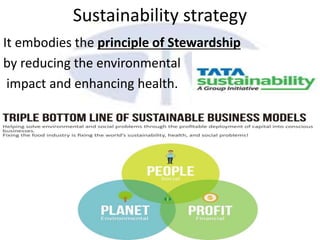
Sustainability strategy
It embodies the principle of Stewardship
by reducing the environmental
impact and enhancing health.
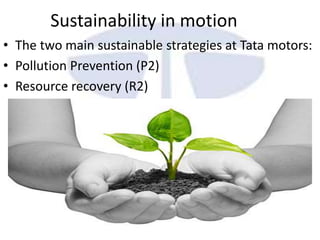
Sustainability in motion
• The two main sustainable strategies at Tata motors:
• Pollution Prevention (P2)
• Resource recovery (R2)
P2 Strategies
• P2 or pollution prevention is a proactive strategy
that uses fewer or smarter resources and It is done
by reducing or eliminating waste at the source by
modifying production process, promoting the use of
non- toxic or less-toxic substances, implementing
conservation techniques, and reuse materials rather
than putting them in to a waste stream.
• It assume no waste will occur. It is an effective
‘getting more from less’ strategy.
• Reducing packaging material by either by using
sustainable packaging (replacing wood with metal)
or reusing existing packaging (recycling wood).
• The company recycles close to69%of wood
packaging thus eliminating use of fresh wood.
• Development of vendor park.
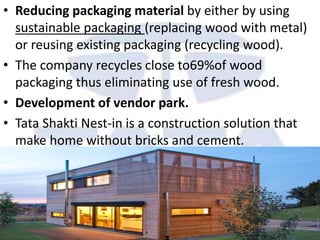
• Tata Shakti Nest-in is a construction solution that
make home without bricks and cement.
R2 strategies
• This is ‘getting more from the same’ strategy where
otherwise wasted resources are recovered by way
of proper disposal- recycling or reconditioning.
• Increasing life of aggregates-’recon’ business.
• In2010-2011 a total of 13,788 engines and 8,690
other parts were reconditioned.
• others resource conservation techniques like
reusing engine oil or multiple testing cycles has
been employed.
• a 200 liter engine oil barrel can now be used to test
170 engines instead of 85.
• Reusing paint sludge and thinner
• Approximately 390 tones or hazardous paint sludge was converted to
low quality paint suitable for floor painting.
• Tata motors has also developed a process to convert the incinerator
ash to pavement bricks that can be used in walkways within the
plant.
• This model has been very successful and has significantly reduced the
amount of hazardous incinerated ash sent to landfills.
• Free take-back network for Tata Motors; ELVs (end-of –life vehicles)
• under the End-of-life Vehicle(ELV) regulations in the UK, Tata Motors
has contracted with a national ELV service provider called
Cartakeback.com Ltd. To provide owners of qualifying Tata vehicles,
who wish to dispose of their vehicle at the end its life, with access to
a network of authorized Treatment Facilities(ATF).
• Tata chemicals attempts to repopulate Gujarat’s sea with whale
shark.
• Tata steel to focus on manufacturing products of at least from 85% of
recycled items.
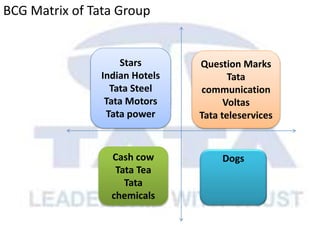
BCG Matrix of Tata Group
Stars
Indian Hotels
Tata Steel
Tata Motors
Tata power
Question Marks
Tata
communication
Voltas
Tata teleservices
Cash cow
Tata Tea
Tata
chemicals
Dogs
THANK
YOU!!!
Tata marketing stretagy

Tata marketing stretagy

  • 1.
  • 2.
    • Submitted by Vaishali, M.com Roll No. 84 Submitted to Prof. Narendra Singh Dept. of Commerce,KUK
  • 3.
    • Type Private •Industry Conglomerate • Founded 1868; 149 years ago • Headquarter Mumbai, India • Key People Natarajan Chandrasekaran • Revenue US$103.5billion • Owner Tata Sons • Website www.tata.com • Traded on BSE,NSE,NYSE.
  • 4.
  • 5.
    Major business Areasof TATA • Steel: Tata steel, Tata Metaliks • Energy: Tata power, Tata power Delhi Distribution ltd. • Engineering sector: Automobiles , Voltas , Telco construction etc.. • Consumer products: Titan , Tata coffee, Tanishq, Croma, etc.. • Services: Indian Hotels, Air Asia, Tata AIG Insurance etc.. • Information system: Tata comm., Tata Docomo,TCS etc.. • Defence and aero space : Tata advance material system. • Tata Chemical: Rallis India, Tata Pigment ltd., etc..
  • 6.
  • 7.
    • Corporate strategies: Growth Disinvestment •Business level Strategies: Cost leadership Product differentiation • Functional level strategies: R&D Strategy(technological leader, innovation) Operation strategy(Production strategy) Sustainability strategy
  • 8.
    Growth: Mergers &Acquisitions Acquiring Company Acquired Company year Country Stake Indian Hotels Regent Hotel Sept.2002 India 100% Indian hotels Ritz Carlton Hotel Nov. 2006 US 100% Tata chemicals Metahelix Life science Dec. 2010 India 53.5% Tata Auto comp TitanX engine company Dec.2016 Sweden 100% Tata Business support Services E-Nxt financials Feb. 2015 India 100% Tata Chemicals EPM mining ventures Aug. 2011 Canada 30.6% Tata communication (formerly VSNL) BT group’s Mosaic business neotel Jan. 2010 UK 100% TCS Citigroup services July 2013 US 100% Tata Global Beverages Grand March 2009 Russia 33.2% Tata Industries Indigence pharmaceutical Inc July 2005 US <30% Tata Motors Jaguar and Land Rover Mar. 2008 UK 100% Tata steel Corus Jan. 2007 UK 100%
  • 9.
    Strategic Alliance • Tatagroup’s strategic alliance with Japanese telecommunication major NTT Docomo in November 2008.
  • 10.
    Joint venture • Tata& Fiat Since 2006 • Tata & Starbucks • Tata motors with Tata Africa Holdings. • Tata and engineer India ltd. • Tesco and Tata(2014)
  • 11.
    Disinvestment strategy • Tataoil mill was divested and sold to Hindustan levers as soap and detergent was not considered as core business. • The pharmaceutical companies of Tata’s Merind and Tata pharma=were Divested to Wockhardt.
  • 12.
    • The cosmeticcompany lakme was divested and sold to Hindustan lever. At present Tata steel is planning to divest its UK Plant.
  • 13.
    Business level strategy Costleadership • Tata Nano , the cheapest car in the world. • Swach, the cheapest water filter from Tata chemicals, less than Rs.1000. • Tata Motors launched the Ace truck in May 2005 for Rs.2,00,000.
  • 14.
    Product Differentiation Strategy •Tata motors launches like Aria and the new 2011 safari to regain Its new market share. • Tata is looking at doubling SUV annual volumes to over 70,000 units in the next 12-18 months, including exports.
  • 15.
    • Tata motorsis set to offer utility vehicle at every price point right fromRs.6.5 lakh to Rs. 15lakh. • Tata acquired Jaguar Land Rover to fulfill the luxury needs of its customers.
  • 16.
    3.Functional level strategy R& D Strategy • Automotive engineering group UK focus is on cost-effective light weighting, to keep steel positioned as the automotive material of choice in the transition to a low carbon economy. It services the automotive, construction, materials handling and defense market sectors. • Tata steel has 5 research centers with over 1000 people In Europe. • An engine “start-stop” technology developed by Jaguar Rover.
  • 17.
    • High performancerail steel that saved £1,50,000 Over 5 years was developed by Tata steel Europe. • Acc. To ET survey Tata Is among Top 50 companies spending huge on R&D. • After spending a decade on R&D Tata steel innovate a new way of getting iron is called Direct reduction of iron(DRI), that help them in reducing cost.
  • 18.
    OPERATIONAL STRETGY • JaguarLand Rover has re-hauled its supply chain to secure cost saving as well as sustainability equation that gives the company a green edge. • A redesigning of process equipment at Tata chemicals’ Haldia Plant that cut process downtime by 40%. • Tata motors realized operational excellence by cutting its cost with a loss of 500crore in 2001 to a profit of Rs. 28 crore in the first quarter of 2002.
  • 19.
    Sustainability strategy It embodiesthe principle of Stewardship by reducing the environmental impact and enhancing health.
  • 20.
    Sustainability in motion •The two main sustainable strategies at Tata motors: • Pollution Prevention (P2) • Resource recovery (R2)
  • 21.
    P2 Strategies • P2or pollution prevention is a proactive strategy that uses fewer or smarter resources and It is done by reducing or eliminating waste at the source by modifying production process, promoting the use of non- toxic or less-toxic substances, implementing conservation techniques, and reuse materials rather than putting them in to a waste stream. • It assume no waste will occur. It is an effective ‘getting more from less’ strategy.
  • 22.
    • Reducing packagingmaterial by either by using sustainable packaging (replacing wood with metal) or reusing existing packaging (recycling wood). • The company recycles close to69%of wood packaging thus eliminating use of fresh wood. • Development of vendor park. • Tata Shakti Nest-in is a construction solution that make home without bricks and cement.
  • 23.
    R2 strategies • Thisis ‘getting more from the same’ strategy where otherwise wasted resources are recovered by way of proper disposal- recycling or reconditioning. • Increasing life of aggregates-’recon’ business. • In2010-2011 a total of 13,788 engines and 8,690 other parts were reconditioned. • others resource conservation techniques like reusing engine oil or multiple testing cycles has been employed. • a 200 liter engine oil barrel can now be used to test 170 engines instead of 85.
  • 24.
    • Reusing paintsludge and thinner • Approximately 390 tones or hazardous paint sludge was converted to low quality paint suitable for floor painting. • Tata motors has also developed a process to convert the incinerator ash to pavement bricks that can be used in walkways within the plant. • This model has been very successful and has significantly reduced the amount of hazardous incinerated ash sent to landfills. • Free take-back network for Tata Motors; ELVs (end-of –life vehicles) • under the End-of-life Vehicle(ELV) regulations in the UK, Tata Motors has contracted with a national ELV service provider called Cartakeback.com Ltd. To provide owners of qualifying Tata vehicles, who wish to dispose of their vehicle at the end its life, with access to a network of authorized Treatment Facilities(ATF). • Tata chemicals attempts to repopulate Gujarat’s sea with whale shark. • Tata steel to focus on manufacturing products of at least from 85% of recycled items.
  • 25.
    BCG Matrix ofTata Group Stars Indian Hotels Tata Steel Tata Motors Tata power Question Marks Tata communication Voltas Tata teleservices Cash cow Tata Tea Tata chemicals Dogs
  • 26.