EXPERIMENTAL PHOTOGRAPHY
Task 1
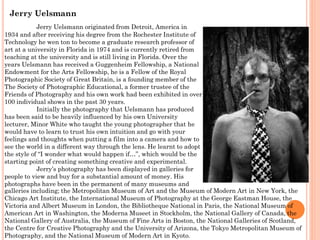
Jerry Uelsmann
Jerry Uelsmann originated from Detroit, America in
1934 and after receiving his degree from the Rochester Institute of
Technology he wen ton to become a graduate research professor of
art at a university in Florida in 1974 and is currently retired from
teaching at the university and is still living in Florida. Over the
years Uelsmann has received a Guggenheim Fellowship, a National
Endowment for the Arts Fellowship, he is a Fellow of the Royal
Photographic Society of Great Britain, is a founding member of the
The Society of Photographic Educational, a former trustee of the
Friends of Photography and his own work had been exhibited in over
100 individual shows in the past 30 years.
Initially the photography that Uelsmann has produced
has been said to be heavily influenced by his own University
lecturer, Minor White who taught the young photographer that he
would have to learn to trust his own intuition and go with your
feelings and thoughts when putting a film into a camera and how to
see the world in a different way through the lens. He learnt to adopt
the style of “I wonder what would happen if…”, which would be the
starting point of creating something creative and experimental.
Jerry’s photography has been displayed in galleries for
people to view and buy for a substantial amount of money. His
photographs have been in the permanent of many museums and
galleries including; the Metropolitan Museum of Art and the Museum of Modern Art in New York, the
Chicago Art Institute, the International Museum of Photography at the George Eastman House, the
Victoria and Albert Museum in London, the Bibliotheque National in Paris, the National Museum of
American Art in Washington, the Moderna Museet in Stockholm, the National Gallery of Canada, the
National Gallery of Australia, the Museum of Fine Arts in Boston, the National Galleries of Scotland,
the Centre for Creative Photography and the University of Arizona, the Tokyo Metropolitan Museum of
Photography, and the National Museum of Modern Art in Kyoto.
Jerry Uelsmann
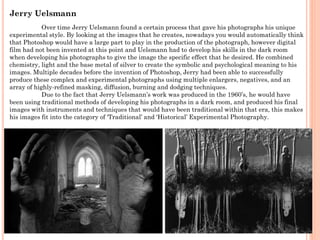
Over time Jerry Uelsmann found a certain process that gave his photographs his unique
experimental style. By looking at the images that he creates, nowadays you would automatically think
that Photoshop would have a large part to play in the production of the photograph, however digital
film had not been invented at this point and Uelsmann had to develop his skills in the dark room
when developing his photographs to give the image the specific effect that he desired. He combined
chemistry, light and the base metal of silver to create the symbolic and psychological meaning to his
images. Multiple decades before the invention of Photoshop, Jerry had been able to successfully
produce these complex and experimental photographs using multiple enlargers, negatives, and an
array of highly-refined masking, diffusion, burning and dodging techniques.
Due to the fact that Jerry Uelsmann’s work was produced in the 1960’s, he would have
been using traditional methods of developing his photographs in a dark room, and produced his final
images with instruments and techniques that would have been traditional within that era, this makes
his images fit into the category of ‘Traditional’ and ‘Historical’ Experimental Photography.
Christophe Dessaigne
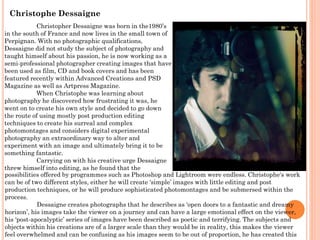
Christopher Dessaigne was born in the1980’s
in the south of France and now lives in the small town of
Perpignan. With no photographic qualifications,
Dessaigne did not study the subject of photography and
taught himself about his passion, he is now working as a
semi-professional photographer creating images that have
been used as film, CD and book covers and has been
featured recently within Advanced Creations and PSD
Magazine as well as Artpress Magazine.
When Christophe was learning about
photography he discovered how frustrating it was, he
went on to create his own style and decided to go down
the route of using mostly post production editing
techniques to create his surreal and complex
photomontages and considers digital experimental
photography an extraordinary way to alter and
experiment with an image and ultimately bring it to be
something fantastic.
Carrying on with his creative urge Dessaigne
threw himself into editing, as he found that the
possibilities offered by programmes such as Photoshop and Lightroom were endless. Christophe's work
can be of two different styles, either he will create ‘simple’ images with little editing and post
production techniques, or he will produce sophisticated photomontages and be submersed within the
process.
Dessaigne creates photographs that he describes as ‘open doors to a fantastic and dreamy
horizon’, his images take the viewer on a journey and can have a large emotional effect on the viewer,
his ‘post-apocalyptic’ series of images have been described as poetic and terrifying. The subjects and
objects within his creations are of a larger scale than they would be in reality, this makes the viewer
feel overwhelmed and can be confusing as his images seem to be out of proportion, he has created this
Christophe Dessaigne
effect with his very skilful usage of Photoshop, which has been used in such a way that upon first look,
you can almost not tell that the subjects have been tampered with.
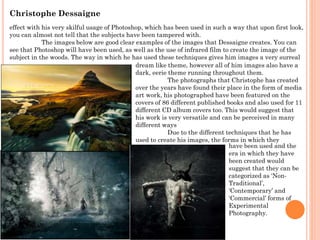
The images below are good clear examples of the images that Dessaigne creates. You can
see that Photoshop will have been used, as well as the use of infrared film to create the image of the
subject in the woods. The way in which he has used these techniques gives him images a very surreal
dream like theme, however all of him images also have a
dark, eerie theme running throughout them.
The photographs that Christophe has created
over the years have found their place in the form of media
art work, his photographed have been featured on the
covers of 86 different published books and also used for 11
different CD album covers too. This would suggest that
his work is very versatile and can be perceived in many
different ways
Due to the different techniques that he has
used to create his images, the forms in which they
have been used and the
era in which they have
been created would
suggest that they can be
categorized as ‘NonTraditional’,
‘Contemporary’ and
‘Commercial’ forms of
Experimental
Photography.

Task 1 ep

  • 1.
  • 2.
    Jerry Uelsmann Jerry Uelsmannoriginated from Detroit, America in 1934 and after receiving his degree from the Rochester Institute of Technology he wen ton to become a graduate research professor of art at a university in Florida in 1974 and is currently retired from teaching at the university and is still living in Florida. Over the years Uelsmann has received a Guggenheim Fellowship, a National Endowment for the Arts Fellowship, he is a Fellow of the Royal Photographic Society of Great Britain, is a founding member of the The Society of Photographic Educational, a former trustee of the Friends of Photography and his own work had been exhibited in over 100 individual shows in the past 30 years. Initially the photography that Uelsmann has produced has been said to be heavily influenced by his own University lecturer, Minor White who taught the young photographer that he would have to learn to trust his own intuition and go with your feelings and thoughts when putting a film into a camera and how to see the world in a different way through the lens. He learnt to adopt the style of “I wonder what would happen if…”, which would be the starting point of creating something creative and experimental. Jerry’s photography has been displayed in galleries for people to view and buy for a substantial amount of money. His photographs have been in the permanent of many museums and galleries including; the Metropolitan Museum of Art and the Museum of Modern Art in New York, the Chicago Art Institute, the International Museum of Photography at the George Eastman House, the Victoria and Albert Museum in London, the Bibliotheque National in Paris, the National Museum of American Art in Washington, the Moderna Museet in Stockholm, the National Gallery of Canada, the National Gallery of Australia, the Museum of Fine Arts in Boston, the National Galleries of Scotland, the Centre for Creative Photography and the University of Arizona, the Tokyo Metropolitan Museum of Photography, and the National Museum of Modern Art in Kyoto.
  • 3.
    Jerry Uelsmann Over timeJerry Uelsmann found a certain process that gave his photographs his unique experimental style. By looking at the images that he creates, nowadays you would automatically think that Photoshop would have a large part to play in the production of the photograph, however digital film had not been invented at this point and Uelsmann had to develop his skills in the dark room when developing his photographs to give the image the specific effect that he desired. He combined chemistry, light and the base metal of silver to create the symbolic and psychological meaning to his images. Multiple decades before the invention of Photoshop, Jerry had been able to successfully produce these complex and experimental photographs using multiple enlargers, negatives, and an array of highly-refined masking, diffusion, burning and dodging techniques. Due to the fact that Jerry Uelsmann’s work was produced in the 1960’s, he would have been using traditional methods of developing his photographs in a dark room, and produced his final images with instruments and techniques that would have been traditional within that era, this makes his images fit into the category of ‘Traditional’ and ‘Historical’ Experimental Photography.
  • 4.
    Christophe Dessaigne Christopher Dessaignewas born in the1980’s in the south of France and now lives in the small town of Perpignan. With no photographic qualifications, Dessaigne did not study the subject of photography and taught himself about his passion, he is now working as a semi-professional photographer creating images that have been used as film, CD and book covers and has been featured recently within Advanced Creations and PSD Magazine as well as Artpress Magazine. When Christophe was learning about photography he discovered how frustrating it was, he went on to create his own style and decided to go down the route of using mostly post production editing techniques to create his surreal and complex photomontages and considers digital experimental photography an extraordinary way to alter and experiment with an image and ultimately bring it to be something fantastic. Carrying on with his creative urge Dessaigne threw himself into editing, as he found that the possibilities offered by programmes such as Photoshop and Lightroom were endless. Christophe's work can be of two different styles, either he will create ‘simple’ images with little editing and post production techniques, or he will produce sophisticated photomontages and be submersed within the process. Dessaigne creates photographs that he describes as ‘open doors to a fantastic and dreamy horizon’, his images take the viewer on a journey and can have a large emotional effect on the viewer, his ‘post-apocalyptic’ series of images have been described as poetic and terrifying. The subjects and objects within his creations are of a larger scale than they would be in reality, this makes the viewer feel overwhelmed and can be confusing as his images seem to be out of proportion, he has created this
  • 5.
    Christophe Dessaigne effect withhis very skilful usage of Photoshop, which has been used in such a way that upon first look, you can almost not tell that the subjects have been tampered with. The images below are good clear examples of the images that Dessaigne creates. You can see that Photoshop will have been used, as well as the use of infrared film to create the image of the subject in the woods. The way in which he has used these techniques gives him images a very surreal dream like theme, however all of him images also have a dark, eerie theme running throughout them. The photographs that Christophe has created over the years have found their place in the form of media art work, his photographed have been featured on the covers of 86 different published books and also used for 11 different CD album covers too. This would suggest that his work is very versatile and can be perceived in many different ways Due to the different techniques that he has used to create his images, the forms in which they have been used and the era in which they have been created would suggest that they can be categorized as ‘NonTraditional’, ‘Contemporary’ and ‘Commercial’ forms of Experimental Photography.