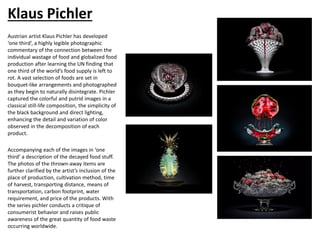
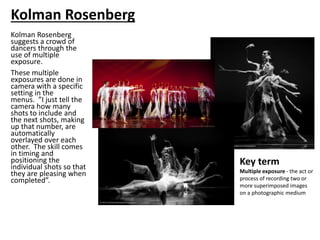
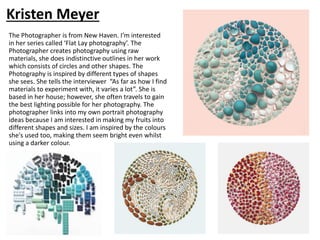
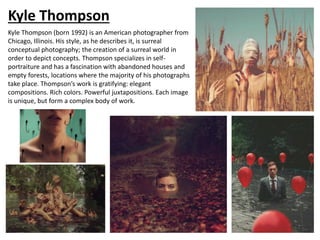
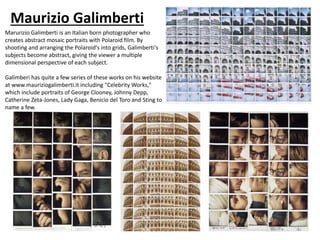
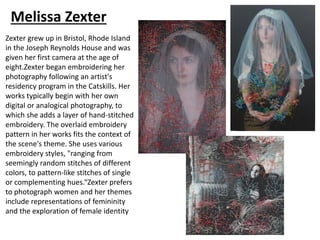
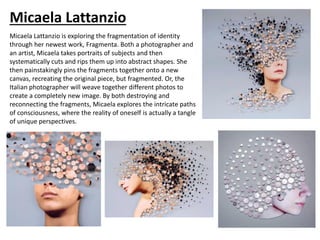
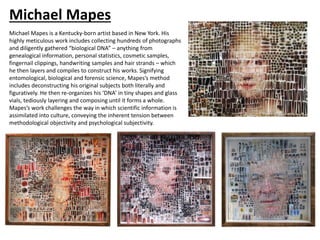
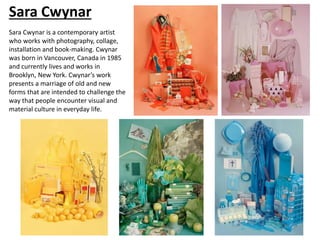
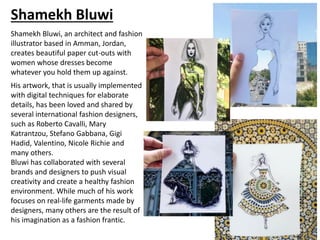
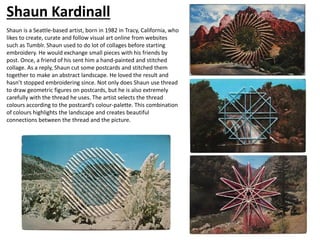
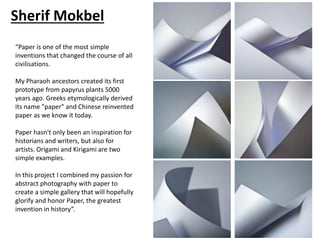
Photographers
A-Z
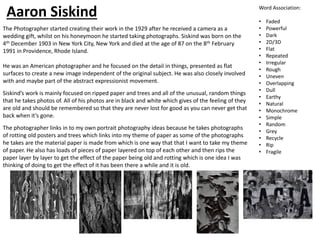
The Photographer started creating their work in the 1929 after he received a camera as a
wedding gift, whilst on his honeymoon he started taking photographs. Siskind was born on the
4th December 1903 in New York City, New York and died at the age of 87 on the 8th February
1991 in Providence, Rhode Island.
He was an American photographer and he focused on the detail in things, presented as flat
surfaces to create a new image independent of the original subject. He was also closely involved
with and maybe part of the abstract expressionist movement.
Siskind’s work is mainly focused on ripped paper and trees and all of the unusual, random things
that he takes photos of. All of his photos are in black and white which gives of the feeling of they
are old and should be remembered so that they are never lost for good as you can never get that
back when it’s gone.
The photographer links in to my own portrait photography ideas because he takes photographs
of rotting old posters and trees which links into my theme of paper as some of the photographs
he takes are the material paper is made from which is one way that that I want to take my theme
of paper. He also has loads of pieces of paper layered on top of each other and then rips the
paper layer by layer to get the effect of the paper being old and rotting which is one idea I was
thinking of doing to get the effect of it has been there a while and it is old.
Word Association:
• Faded
• Powerful
• Dark
• 2D/3D
• Flat
• Repeated
• Irregular
• Rough
• Uneven
• Overlapping
• Dull
• Earthy
• Natural
• Monochrome
• Simple
• Random
• Grey
• Recycle
• Rip
• Fragile
Aaron Siskind
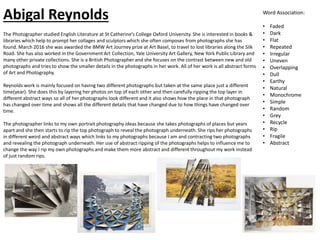
The Photographer studied English Literature at St Catherine’s College Oxford University. She is interested in books &
libraries which help to prompt her collages and sculptors which she often composes from photographs she has
found. March 2016 she was awarded the BMW Art Journey prize at Art Basel, to travel to lost libraries along the Silk
Road. She has also worked in the Government Art Collection, Yale University Art Gallery, New York Public Library and
many other private collections. She is a British Photographer and she focuses on the contrast between new and old
photographs and tries to show the smaller details in the photographs in her work. All of her work is all abstract forms
of Art and Photography.
Reynolds work is mainly focused on having two different photographs but taken at the same place just a different
time(year). She does this by layering her photos on top of each other and then carefully ripping the top layer in
different abstract ways so all of her photographs look different and it also shows how the place in that photograph
has changed over time and shows all the different details that have changed due to how things have changed over
time.
The photographer links to my own portrait photography ideas because she takes photographs of places but years
apart and she then starts to rip the top photograph to reveal the photograph underneath. She rips her photographs
in different weird and abstract ways which links to my photographs because I am and contracting two photographs
and revealing the photograph underneath. Her use of abstract ripping of the photographs helps to influence me to
change the way I rip my own photographs and make them more abstract and different throughout my work instead
of just random rips.
Word Association:
• Faded
• Dark
• Flat
• Repeated
• Irregular
• Uneven
• Overlapping
• Dull
• Earthy
• Natural
• Monochrome
• Simple
• Random
• Grey
• Recycle
• Rip
• Fragile
• Abstract
Abigal Reynolds
Alana Dee Haynes
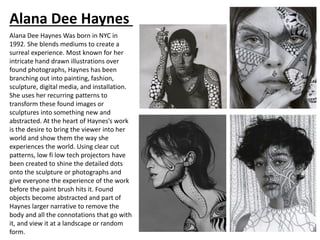
Alana Dee Haynes Was born in NYC in
1992. She blends mediums to create a
surreal experience. Most known for her
intricate hand drawn illustrations over
found photographs, Haynes has been
branching out into painting, fashion,
sculpture, digital media, and installation.
She uses her recurring patterns to
transform these found images or
sculptures into something new and
abstracted. At the heart of Haynes’s work
is the desire to bring the viewer into her
world and show them the way she
experiences the world. Using clear cut
patterns, low fi low tech projectors have
been created to shine the detailed dots
onto the sculpture or photographs and
give everyone the experience of the work
before the paint brush hits it. Found
objects become abstracted and part of
Haynes larger narrative to remove the
body and all the connotations that go with
it, and view it at a landscape or random
form.
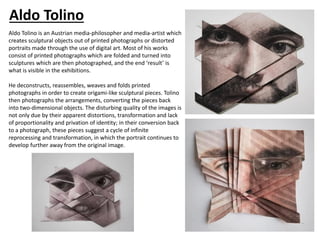
Aldo Tolino
Aldo Tolino is an Austrian media-philosopher and media-artist which
creates sculptural objects out of printed photographs or distorted
portraits made through the use of digital art. Most of his works
consist of printed photographs which are folded and turned into
sculptures which are then photographed, and the end ‘result’ is
what is visible in the exhibitions.
He deconstructs, reassembles, weaves and folds printed
photographs in order to create origami-like sculptural pieces. Tolino
then photographs the arrangements, converting the pieces back
into two-dimensional objects. The disturbing quality of the images is
not only due by their apparent distortions, transformation and lack
of proportionality and privation of identity; in their conversion back
to a photograph, these pieces suggest a cycle of infinite
reprocessing and transformation, in which the portrait continues to
develop further away from the original image.
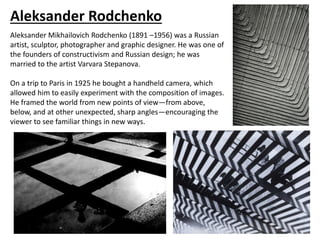
Aleksander Rodchenko
Aleksander Mikhailovich Rodchenko (1891 –1956) was a Russian
artist, sculptor, photographer and graphic designer. He was one of
the founders of constructivism and Russian design; he was
married to the artist Varvara Stepanova.
On a trip to Paris in 1925 he bought a handheld camera, which
allowed him to easily experiment with the composition of images.
He framed the world from new points of view—from above,
below, and at other unexpected, sharp angles—encouraging the
viewer to see familiar things in new ways.
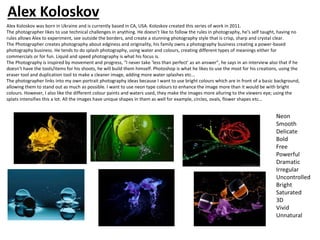
Alex Koloskov was born in Ukraine and is currently based in CA, USA. Koloskov created this series of work in 2011.
The photographer likes to use technical challenges in anything. He doesn’t like to follow the rules in photography, he's self taught, having no
rules allows Alex to experiment, see outside the borders, and create a stunning photography style that is crisp, sharp and crystal clear.
The Photographer creates photography about edginess and originality, his family owns a photography business creating a power-based
photography business. He tends to do splash photography, using water and colours, creating different types of meanings either for
commercials or for fun. Liquid and speed photography is what his focus is.
The Photography is inspired by movement and progress, “I never take ‘less than perfect’ as an answer”, he says in an interview also that if he
doesn’t have the tools/items for his shoots, he will build them himself. Photoshop is what he likes to use the most for his creations, using the
eraser tool and duplication tool to make a cleaner image, adding more water splashes etc…
The photographer links into my own portrait photography ideas because I want to use bright colours which are in front of a basic background,
allowing them to stand out as much as possible. I want to use neon type colours to enhance the image more than it would be with bright
colours. However, I also like the different colour paints and waters used, they make the images more alluring to the viewers eye; using the
splats intensifies this a lot. All the images have unique shapes in them as well for example, circles, ovals, flower shapes etc…
Alex Koloskov
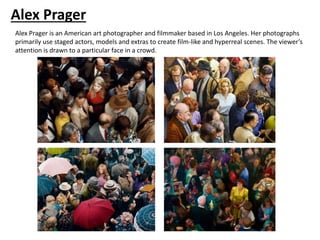
Alex Prager
Alex Prager is an American art photographer and filmmaker based in Los Angeles. Her photographs
primarily use staged actors, models and extras to create film-like and hyperreal scenes. The viewer’s
attention is drawn to a particular face in a crowd.
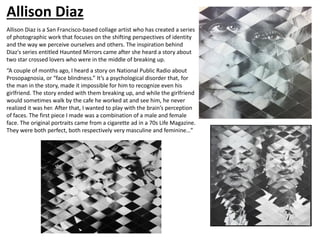
Allison Diaz
Allison Diaz is a San Francisco-based collage artist who has created a series
of photographic work that focuses on the shifting perspectives of identity
and the way we perceive ourselves and others. The inspiration behind
Diaz's series entitled Haunted Mirrors came after she heard a story about
two star crossed lovers who were in the middle of breaking up.
“A couple of months ago, I heard a story on National Public Radio about
Prosopagnosia, or “face blindness.” It’s a psychological disorder that, for
the man in the story, made it impossible for him to recognize even his
girlfriend. The story ended with them breaking up, and while the girlfriend
would sometimes walk by the cafe he worked at and see him, he never
realized it was her. After that, I wanted to play with the brain’s perception
of faces. The first piece I made was a combination of a male and female
face. The original portraits came from a cigarette ad in a 70s Life Magazine.
They were both perfect, both respectively very masculine and feminine…”
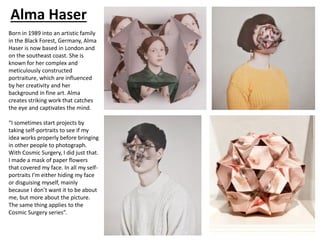
Alma Haser
Born in 1989 into an artistic family
in the Black Forest, Germany, Alma
Haser is now based in London and
on the southeast coast. She is
known for her complex and
meticulously constructed
portraiture, which are influenced
by her creativity and her
background in fine art. Alma
creates striking work that catches
the eye and captivates the mind.
“I sometimes start projects by
taking self-portraits to see if my
idea works properly before bringing
in other people to photograph.
With Cosmic Surgery, I did just that.
I made a mask of paper flowers
that covered my face. In all my self-
portraits I’m either hiding my face
or disguising myself, mainly
because I don’t want it to be about
me, but more about the picture.
The same thing applies to the
Cosmic Surgery series”.
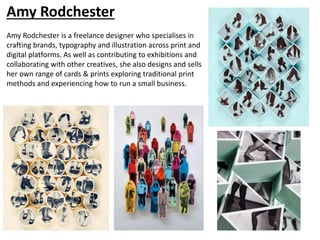
Amy Rodchester
Amy Rodchester is a freelance designer who specialises in
crafting brands, typography and illustration across print and
digital platforms. As well as contributing to exhibitions and
collaborating with other creatives, she also designs and sells
her own range of cards & prints exploring traditional print
methods and experiencing how to run a small business.
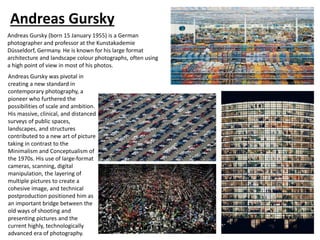
Andreas Gursky
Andreas Gursky (born 15 January 1955) is a German
photographer and professor at the Kunstakademie
Düsseldorf, Germany. He is known for his large format
architecture and landscape colour photographs, often using
a high point of view in most of his photos.
Andreas Gursky was pivotal in
creating a new standard in
contemporary photography, a
pioneer who furthered the
possibilities of scale and ambition.
His massive, clinical, and distanced
surveys of public spaces,
landscapes, and structures
contributed to a new art of picture
taking in contrast to the
Minimalism and Conceptualism of
the 1970s. His use of large-format
cameras, scanning, digital
manipulation, the layering of
multiple pictures to create a
cohesive image, and technical
postproduction positioned him as
an important bridge between the
old ways of shooting and
presenting pictures and the
current highly, technologically
advanced era of photography.
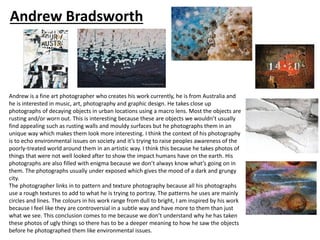
Andrew is a fine art photographer who creates his work currently, he is from Australia and
he is interested in music, art, photography and graphic design. He takes close up
photographs of decaying objects in urban locations using a macro lens. Most the objects are
rusting and/or worn out. This is interesting because these are objects we wouldn’t usually
find appealing such as rusting walls and mouldy surfaces but he photographs them in an
unique way which makes them look more interesting. I think the context of his photography
is to echo environmental issues on society and it’s trying to raise peoples awareness of the
poorly-treated world around them in an artistic way. I think this because he takes photos of
things that were not well looked after to show the impact humans have on the earth. His
photographs are also filled with enigma because we don’t always know what’s going on in
them. The photographs usually under exposed which gives the mood of a dark and grungy
city.
The photographer links in to pattern and texture photography because all his photographs
use a rough textures to add to what he is trying to portray. The patterns he uses are mainly
circles and lines. The colours in his work range from dull to bright, I am inspired by his work
because I feel like they are controversial in a subtle way and have more to them than just
what we see. This conclusion comes to me because we don’t understand why he has taken
these photos of ugly things so there has to be a deeper meaning to how he saw the objects
before he photographed them like environmental issues.
Andrew Bradsworth
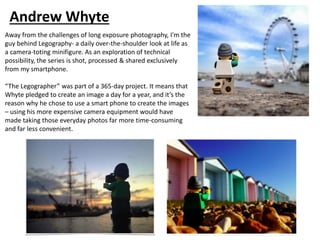
Away from the challenges of long exposure photography, I'm the
guy behind Legography- a daily over-the-shoulder look at life as
a camera-toting minifigure. As an exploration of technical
possibility, the series is shot, processed & shared exclusively
from my smartphone.
“The Legographer” was part of a 365-day project. It means that
Whyte pledged to create an image a day for a year, and it’s the
reason why he chose to use a smart phone to create the images
– using his more expensive camera equipment would have
made taking those everyday photos far more time-consuming
and far less convenient.
Andrew Whyte
Aneta Ivanova
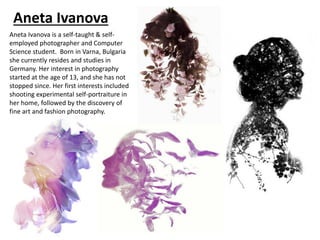
Aneta Ivanova is a self-taught & self-
employed photographer and Computer
Science student. Born in Varna, Bulgaria
she currently resides and studies in
Germany. Her interest in photography
started at the age of 13, and she has not
stopped since. Her first interests included
shooting experimental self-portraiture in
her home, followed by the discovery of
fine art and fashion photography.
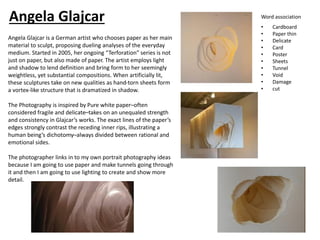
Angela Glajcar is a German artist who chooses paper as her main
material to sculpt, proposing dueling analyses of the everyday
medium. Started in 2005, her ongoing “Terforation” series is not
just on paper, but also made of paper. The artist employs light
and shadow to lend definition and bring form to her seemingly
weightless, yet substantial compositions. When artificially lit,
these sculptures take on new qualities as hand-torn sheets form
a vortex-like structure that is dramatized in shadow.
The Photography is inspired by Pure white paper–often
considered fragile and delicate–takes on an unequaled strength
and consistency in Glajcar’s works. The exact lines of the paper’s
edges strongly contrast the receding inner rips, illustrating a
human being’s dichotomy–always divided between rational and
emotional sides.
The photographer links in to my own portrait photography ideas
because I am going to use paper and make tunnels going through
it and then I am going to use lighting to create and show more
detail.
Word association
• Cardboard
• Paper thin
• Delicate
• Card
• Poster
• Sheets
• Tunnel
• Void
• Damage
• cut
Angela Glajcar
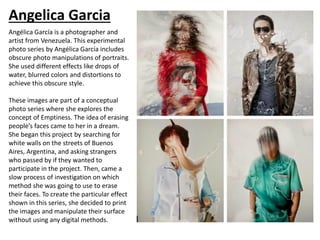
Angelica Garcia
Angélica García is a photographer and
artist from Venezuela. This experimental
photo series by Angélica García includes
obscure photo manipulations of portraits.
She used different effects like drops of
water, blurred colors and distortions to
achieve this obscure style.
These images are part of a conceptual
photo series where she explores the
concept of Emptiness. The idea of erasing
people’s faces came to her in a dream.
She began this project by searching for
white walls on the streets of Buenos
Aires, Argentina, and asking strangers
who passed by if they wanted to
participate in the project. Then, came a
slow process of investigation on which
method she was going to use to erase
their faces. To create the particular effect
shown in this series, she decided to print
the images and manipulate their surface
without using any digital methods.
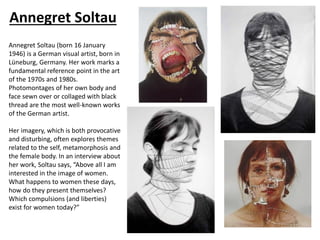
Annegret Soltau
Annegret Soltau (born 16 January
1946) is a German visual artist, born in
Lüneburg, Germany. Her work marks a
fundamental reference point in the art
of the 1970s and 1980s.
Photomontages of her own body and
face sewn over or collaged with black
thread are the most well-known works
of the German artist.
Her imagery, which is both provocative
and disturbing, often explores themes
related to the self, metamorphosis and
the female body. In an interview about
her work, Soltau says, “Above all I am
interested in the image of women.
What happens to women these days,
how do they present themselves?
Which compulsions (and liberties)
exist for women today?”
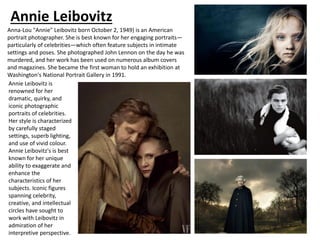
Annie Leibovitz
Anna-Lou "Annie" Leibovitz born October 2, 1949) is an American
portrait photographer. She is best known for her engaging portraits—
particularly of celebrities—which often feature subjects in intimate
settings and poses. She photographed John Lennon on the day he was
murdered, and her work has been used on numerous album covers
and magazines. She became the first woman to hold an exhibition at
Washington's National Portrait Gallery in 1991.
Annie Leibovitz is
renowned for her
dramatic, quirky, and
iconic photographic
portraits of celebrities.
Her style is characterized
by carefully staged
settings, superb lighting,
and use of vivid colour.
Annie Leibovitz's is best
known for her unique
ability to exaggerate and
enhance the
characteristics of her
subjects. Iconic figures
spanning celebrity,
creative, and intellectual
circles have sought to
work with Leibovitz in
admiration of her
interpretive perspective.
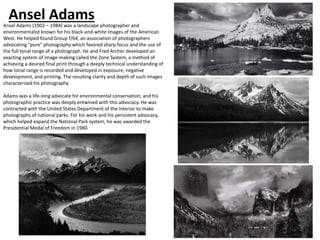
Ansel Adams
Ansel Adams (1902 – 1984) was a landscape photographer and
environmentalist known for his black-and-white images of the American
West. He helped found Group f/64, an association of photographers
advocating "pure" photography which favored sharp focus and the use of
the full tonal range of a photograph. He and Fred Archer developed an
exacting system of image-making called the Zone System, a method of
achieving a desired final print through a deeply technical understanding of
how tonal range is recorded and developed in exposure, negative
development, and printing. The resulting clarity and depth of such images
characterized his photography.
Adams was a life-long advocate for environmental conservation, and his
photographic practice was deeply entwined with this advocacy. He was
contracted with the United States Department of the Interior to make
photographs of national parks. For his work and his persistent advocacy,
which helped expand the National Park system, he was awarded the
Presidential Medal of Freedom in 1980.
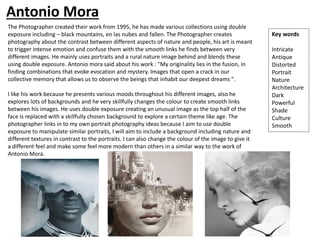
The Photographer created their work from 1995, he has made various collections using double
exposure including – black mountains, en las nubes and fallen. The Photographer creates
photography about the contrast between different aspects of nature and people, his art is meant
to trigger intense emotion and confuse them with the smooth links he finds between very
different images. He mainly uses portraits and a rural nature image behind and blends these
using double exposure. Antonio mora said about his work : "My originality lies in the fusion, in
finding combinations that evoke evocation and mystery. Images that open a crack in our
collective memory that allows us to observe the beings that inhabit our deepest dreams ".
I like his work because he presents various moods throughout his different images, also he
explores lots of backgrounds and he very skillfully changes the colour to create smooth links
between his images. He uses double exposure creating an unusual image as the top half of the
face is replaced with a skillfully chosen background to explore a certain theme like age. The
photographer links in to my own portrait photography ideas because I aim to use double
exposure to manipulate similar portraits, I will aim to include a background including nature and
different textures in contrast to the portraits. I can also change the colour of the image to give it
a different feel and make some feel more modern than others in a similar way to the work of
Antonio Mora.
Key words
Intricate
Antique
Distorted
Portrait
Nature
Architecture
Dark
Powerful
Shade
Culture
Smooth
Antonio Mora
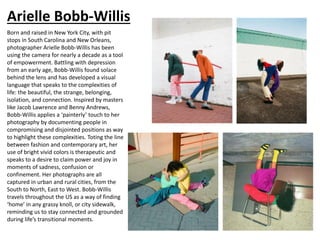
Arielle Bobb-Willis
Born and raised in New York City, with pit
stops in South Carolina and New Orleans,
photographer Arielle Bobb-Willis has been
using the camera for nearly a decade as a tool
of empowerment. Battling with depression
from an early age, Bobb-Willis found solace
behind the lens and has developed a visual
language that speaks to the complexities of
life: the beautiful, the strange, belonging,
isolation, and connection. Inspired by masters
like Jacob Lawrence and Benny Andrews,
Bobb-Willis applies a ‘painterly’ touch to her
photography by documenting people in
compromising and disjointed positions as way
to highlight these complexities. Toting the line
between fashion and contemporary art, her
use of bright vivid colors is therapeutic and
speaks to a desire to claim power and joy in
moments of sadness, confusion or
confinement. Her photographs are all
captured in urban and rural cities, from the
South to North, East to West. Bobb-Willis
travels throughout the US as a way of finding
‘home’ in any grassy knoll, or city sidewalk,
reminding us to stay connected and grounded
during life’s transitional moments.
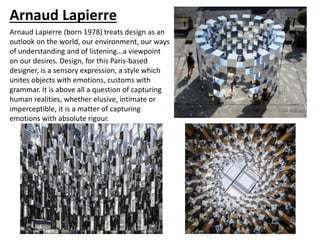
Arnaud Lapierre
Arnaud Lapierre (born 1978) treats design as an
outlook on the world, our environment, our ways
of understanding and of listening...a viewpoint
on our desires. Design, for this Paris-based
designer, is a sensory expression, a style which
unites objects with emotions, customs with
grammar. It is above all a question of capturing
human realities, whether elusive, intimate or
imperceptible, it is a matter of capturing
emotions with absolute rigour.
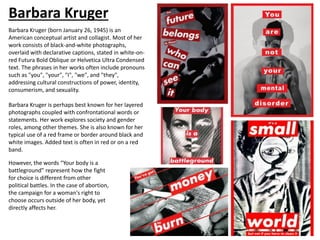
Barbara Kruger
Barbara Kruger (born January 26, 1945) is an
American conceptual artist and collagist. Most of her
work consists of black-and-white photographs,
overlaid with declarative captions, stated in white-on-
red Futura Bold Oblique or Helvetica Ultra Condensed
text. The phrases in her works often include pronouns
such as "you", "your", "I", "we", and "they",
addressing cultural constructions of power, identity,
consumerism, and sexuality.
Barbara Kruger is perhaps best known for her layered
photographs coupled with confrontational words or
statements. Her work explores society and gender
roles, among other themes. She is also known for her
typical use of a red frame or border around black and
white images. Added text is often in red or on a red
band.
However, the words “Your body is a
battleground” represent how the fight
for choice is different from other
political battles. In the case of abortion,
the campaign for a woman's right to
choose occurs outside of her body, yet
directly affects her.
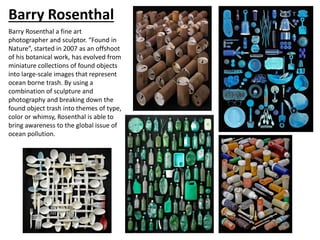
Barry Rosenthal
Barry Rosenthal a fine art
photographer and sculptor. “Found in
Nature”, started in 2007 as an offshoot
of his botanical work, has evolved from
miniature collections of found objects
into large-scale images that represent
ocean borne trash. By using a
combination of sculpture and
photography and breaking down the
found object trash into themes of type,
color or whimsy, Rosenthal is able to
bring awareness to the global issue of
ocean pollution.
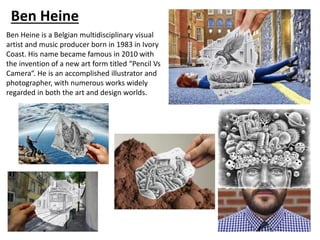
Ben Heine
Ben Heine is a Belgian multidisciplinary visual
artist and music producer born in 1983 in Ivory
Coast. His name became famous in 2010 with
the invention of a new art form titled “Pencil Vs
Camera“. He is an accomplished illustrator and
photographer, with numerous works widely
regarded in both the art and design worlds.
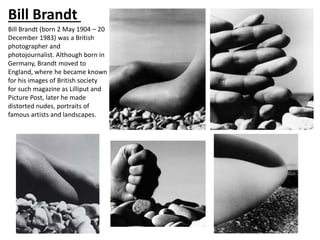
Bill Brandt
Bill Brandt (born 2 May 1904 – 20
December 1983) was a British
photographer and
photojournalist. Although born in
Germany, Brandt moved to
England, where he became known
for his images of British society
for such magazine as Lilliput and
Picture Post, later he made
distorted nudes, portraits of
famous artists and landscapes.
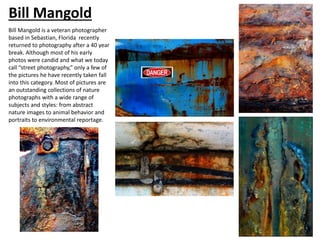
Bill Mangold
Bill Mangold is a veteran photographer
based in Sebastian, Florida recently
returned to photography after a 40 year
break. Although most of his early
photos were candid and what we today
call “street photography,” only a few of
the pictures he have recently taken fall
into this category. Most of pictures are
an outstanding collections of nature
photographs with a wide range of
subjects and styles: from abstract
nature images to animal behavior and
portraits to environmental reportage.
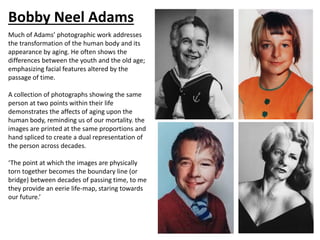
Bobby Neel Adams
Much of Adams’ photographic work addresses
the transformation of the human body and its
appearance by aging. He often shows the
differences between the youth and the old age;
emphasizing facial features altered by the
passage of time.
A collection of photographs showing the same
person at two points within their life
demonstrates the affects of aging upon the
human body, reminding us of our mortality. the
images are printed at the same proportions and
hand spliced to create a dual representation of
the person across decades.
‘The point at which the images are physically
torn together becomes the boundary line (or
bridge) between decades of passing time, to me
they provide an eerie life-map, staring towards
our future.’
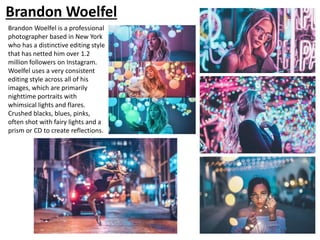
Brandon Woelfel
Brandon Woelfel is a professional
photographer based in New York
who has a distinctive editing style
that has netted him over 1.2
million followers on Instagram.
Woelfel uses a very consistent
editing style across all of his
images, which are primarily
nighttime portraits with
whimsical lights and flares.
Crushed blacks, blues, pinks,
often shot with fairy lights and a
prism or CD to create reflections.
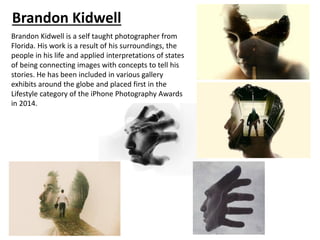
Brandon Kidwell
Brandon Kidwell is a self taught photographer from
Florida. His work is a result of his surroundings, the
people in his life and applied interpretations of states
of being connecting images with concepts to tell his
stories. He has been included in various gallery
exhibits around the globe and placed first in the
Lifestyle category of the iPhone Photography Awards
in 2014.
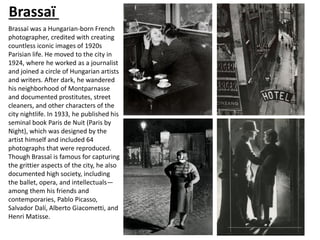
Brassaï was a Hungarian-born French
photographer, credited with creating
countless iconic images of 1920s
Parisian life. He moved to the city in
1924, where he worked as a journalist
and joined a circle of Hungarian artists
and writers. After dark, he wandered
his neighborhood of Montparnasse
and documented prostitutes, street
cleaners, and other characters of the
city nightlife. In 1933, he published his
seminal book Paris de Nuit (Paris by
Night), which was designed by the
artist himself and included 64
photographs that were reproduced.
Though Brassaï is famous for capturing
the grittier aspects of the city, he also
documented high society, including
the ballet, opera, and intellectuals—
among them his friends and
contemporaries, Pablo Picasso,
Salvador Dalí, Alberto Giacometti, and
Henri Matisse.
Brassaï
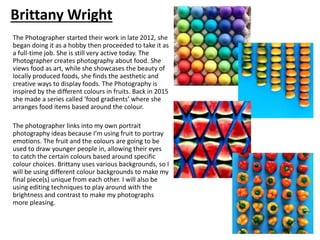
The Photographer started their work in late 2012, she
began doing it as a hobby then proceeded to take it as
a full-time job. She is still very active today. The
Photographer creates photography about food. She
views food as art, while she showcases the beauty of
locally produced foods, she finds the aesthetic and
creative ways to display foods. The Photography is
inspired by the different colours in fruits. Back in 2015
she made a series called ‘food gradients’ where she
arranges food items based around the colour.
The photographer links into my own portrait
photography ideas because I’m using fruit to portray
emotions. The fruit and the colours are going to be
used to draw younger people in, allowing their eyes
to catch the certain colours based around specific
colour choices. Brittany uses various backgrounds, so I
will be using different colour backgrounds to make my
final piece(s) unique from each other. I will also be
using editing techniques to play around with the
brightness and contrast to make my photographs
more pleasing.
Brittany Wright
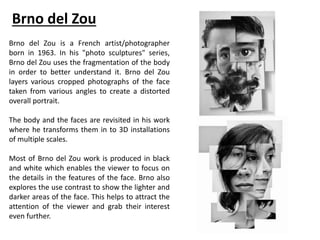
Brno del Zou
Brno del Zou is a French artist/photographer
born in 1963. In his "photo sculptures" series,
Brno del Zou uses the fragmentation of the body
in order to better understand it. Brno del Zou
layers various cropped photographs of the face
taken from various angles to create a distorted
overall portrait.
The body and the faces are revisited in his work
where he transforms them in to 3D installations
of multiple scales.
Most of Brno del Zou work is produced in black
and white which enables the viewer to focus on
the details in the features of the face. Brno also
explores the use contrast to show the lighter and
darker areas of the face. This helps to attract the
attention of the viewer and grab their interest
even further.
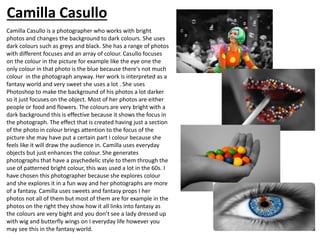
Camilla Casullo is a photographer who works with bright
photos and changes the background to dark colours. She uses
dark colours such as greys and black. She has a range of photos
with different focuses and an array of colour. Casullo focuses
on the colour in the picture for example like the eye one the
only colour in that photo is the blue because there's not much
colour in the photograph anyway. Her work is interpreted as a
fantasy world and very sweet she uses a lot . She uses
Photoshop to make the background of his photos a lot darker
so it just focuses on the object. Most of her photos are either
people or food and flowers. The colours are very bright with a
dark background this is effective because it shows the focus in
the photograph. The effect that is created having just a section
of the photo in colour brings attention to the focus of the
picture she may have put a certain part I colour because she
feels like it will draw the audience in. Camilla uses everyday
objects but just enhances the colour. She generates
photographs that have a psychedelic style to them through the
use of patterned bright colour, this was used a lot in the 60s. I
have chosen this photographer because she explores colour
and she explores it in a fun way and her photographs are more
of a fantasy. Camilla uses sweets and fantasy props I her
photos not all of them but most of them are for example in the
photos on the right they show how it all links into fantasy as
the colours are very bight and you don’t see a lady dressed up
with wig and butterfly wings on I everyday life however you
may see this in the fantasy world.
Camilla Casullo
Carlo Muttoni
Carl Warner
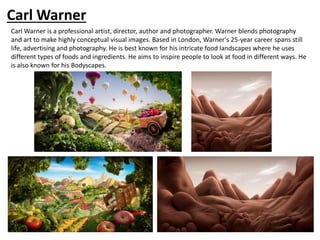
Carl Warner is a professional artist, director, author and photographer. Warner blends photography
and art to make highly conceptual visual images. Based in London, Warner's 25-year career spans still
life, advertising and photography. He is best known for his intricate food landscapes where he uses
different types of foods and ingredients. He aims to inspire people to look at food in different ways. He
is also known for his Bodyscapes.
Cecilia Paredes
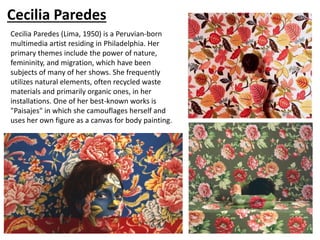
Cecilia Paredes (Lima, 1950) is a Peruvian-born
multimedia artist residing in Philadelphia. Her
primary themes include the power of nature,
femininity, and migration, which have been
subjects of many of her shows. She frequently
utilizes natural elements, often recycled waste
materials and primarily organic ones, in her
installations. One of her best-known works is
"Paisajes" in which she camouflages herself and
uses her own figure as a canvas for body painting.
Cindy Sherman
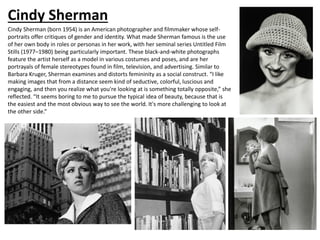
Cindy Sherman (born 1954) is an American photographer and filmmaker whose self-
portraits offer critiques of gender and identity. What made Sherman famous is the use
of her own body in roles or personas in her work, with her seminal series Untitled Film
Stills (1977–1980) being particularly important. These black-and-white photographs
feature the artist herself as a model in various costumes and poses, and are her
portrayals of female stereotypes found in film, television, and advertising. Similar to
Barbara Kruger, Sherman examines and distorts femininity as a social construct. “I like
making images that from a distance seem kind of seductive, colorful, luscious and
engaging, and then you realize what you're looking at is something totally opposite,” she
reflected. “It seems boring to me to pursue the typical idea of beauty, because that is
the easiest and the most obvious way to see the world. It's more challenging to look at
the other side.”
Chloe Ostmo
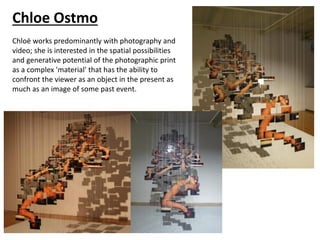
Chloë works predominantly with photography and
video; she is interested in the spatial possibilities
and generative potential of the photographic print
as a complex 'material' that has the ability to
confront the viewer as an object in the present as
much as an image of some past event.
Cory Stevens
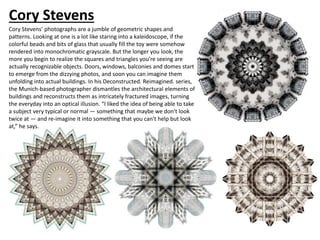
Cory Stevens’ photographs are a jumble of geometric shapes and
patterns. Looking at one is a lot like staring into a kaleidoscope, if the
colorful beads and bits of glass that usually fill the toy were somehow
rendered into monochromatic grayscale. But the longer you look, the
more you begin to realize the squares and triangles you’re seeing are
actually recognizable objects. Doors, windows, balconies and domes start
to emerge from the dizzying photos, and soon you can imagine them
unfolding into actual buildings. In his Deconstructed. Reimagined. series,
the Munich-based photographer dismantles the architectural elements of
buildings and reconstructs them as intricately fractured images, turning
the everyday into an optical illusion. “I liked the idea of being able to take
a subject very typical or normal — something that maybe we don't look
twice at — and re-imagine it into something that you can't help but look
at,” he says.
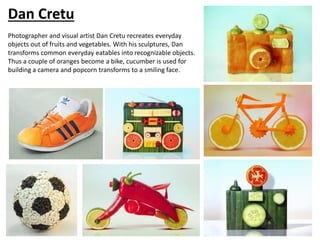
Dan Cretu
Photographer and visual artist Dan Cretu recreates everyday
objects out of fruits and vegetables. With his sculptures, Dan
transforms common everyday eatables into recognizable objects.
Thus a couple of oranges become a bike, cucumber is used for
building a camera and popcorn transforms to a smiling face.
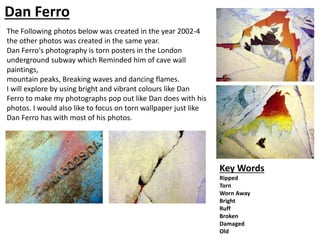
The Following photos below was created in the year 2002-4
the other photos was created in the same year.
Dan Ferro's photography is torn posters in the London
underground subway which Reminded him of cave wall
paintings,
mountain peaks, Breaking waves and dancing flames.
I will explore by using bright and vibrant colours like Dan
Ferro to make my photographs pop out like Dan does with his
photos. I would also like to focus on torn wallpaper just like
Dan Ferro has with most of his photos.
Key Words
Ripped
Torn
Worn Away
Bright
Ruff
Broken
Damaged
Old
Dan Ferro
Daniel Regan
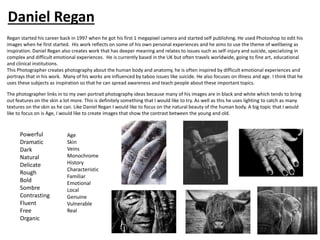
Regan started his career back in 1997 when he got his first 1 megapixel camera and started self publishing. He used Photoshop to edit his
images when he first started. His work reflects on some of his own personal experiences and he aims to use the theme of wellbeing as
inspiration. Daniel Regan also creates work that has deeper meaning and relates to issues such as self-injury and suicide, specializing in
complex and difficult emotional experiences. He is currently based in the UK but often travels worldwide, going to fine art, educational
and clinical institutions.
This Photographer creates photography about the human body and anatomy, he is often inspired by difficult emotional experiences and
portrays that in his work. Many of his works are influenced by taboo issues like suicide. He also focuses on illness and age. I think that he
uses these subjects as inspiration so that he can spread awareness and teach people about these important topics.
The photographer links in to my own portrait photography ideas because many of his images are in black and white which tends to bring
out features on the skin a lot more. This is definitely something that I would like to try. As well as this he uses lighting to catch as many
textures on the skin as he can. Like Daniel Regan I would like to focus on the natural beauty of the human body. A big topic that I would
like to focus on is Age, I would like to create images that show the contrast between the young and old.
Powerful
Dramatic
Dark
Natural
Delicate
Rough
Bold
Sombre
Contrasting
Fluent
Free
Organic
Age
Skin
Veins
Monochrome
History
Characteristic
Familiar
Emotional
Local
Genuine
Vulnerable
Real
Daniel Regan
Damien Blottiere
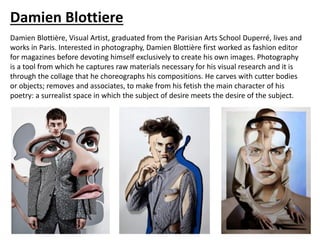
Damien Blottière, Visual Artist, graduated from the Parisian Arts School Duperré, lives and
works in Paris. Interested in photography, Damien Blottière first worked as fashion editor
for magazines before devoting himself exclusively to create his own images. Photography
is a tool from which he captures raw materials necessary for his visual research and it is
through the collage that he choreographs his compositions. He carves with cutter bodies
or objects; removes and associates, to make from his fetish the main character of his
poetry: a surrealist space in which the subject of desire meets the desire of the subject.
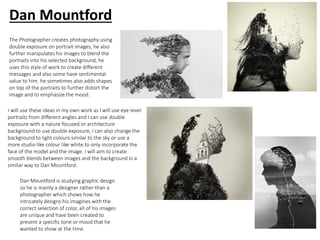
The Photographer creates photography using
double exposure on portrait images, he also
further manipulates his images to blend the
portraits into his selected background, he
uses this style of work to create different
messages and also some have sentimental
value to him. he sometimes also adds shapes
on top of the portraits to further distort the
image and to emphasize the mood.
Dan Mountford is studying graphic design
so he is mainly a designer rather than a
photographer which shows how he
intricately designs his imagines with the
correct selection of color, all of his images
are unique and have been created to
present a specific tone or mood that he
wanted to show at the time.
I will use these ideas in my own work as I will use eye-level
portraits from different angles and I can use double
exposure with a nature focused or architecture
background to use double exposure, I can also change the
background to light colours similar to the sky or use a
more studio like colour like white.to only incorporate the
face of the model and the image. I will aim to create
smooth blends between images and the background in a
similar way to Dan Mountford.
Dan Mountford
David Hilliard
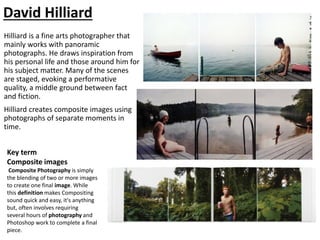
Hilliard is a fine arts photographer that
mainly works with panoramic
photographs. He draws inspiration from
his personal life and those around him for
his subject matter. Many of the scenes
are staged, evoking a performative
quality, a middle ground between fact
and fiction.
Hilliard creates composite images using
photographs of separate moments in
time.
Key term
Composite images
Composite Photography is simply
the blending of two or more images
to create one final image. While
this definition makes Compositing
sound quick and easy, it's anything
but, often involves requiring
several hours of photography and
Photoshop work to complete a final
piece.
David Hockney
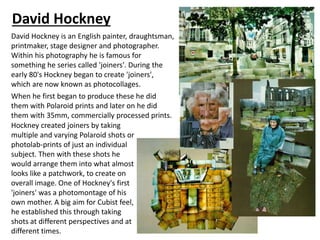
David Hockney is an English painter, draughtsman,
printmaker, stage designer and photographer.
Within his photography he is famous for
something he series called 'joiners'. During the
early 80's Hockney began to create 'joiners',
which are now known as photocollages.
When he first began to produce these he did
them with Polaroid prints and later on he did
them with 35mm, commercially processed prints.
Hockney created joiners by taking
multiple and varying Polaroid shots or
photolab-prints of just an individual
subject. Then with these shots he
would arrange them into what almost
looks like a patchwork, to create on
overall image. One of Hockney's first
'joiners' was a photomontage of his
own mother. A big aim for Cubist feel,
he established this through taking
shots at different perspectives and at
different times.
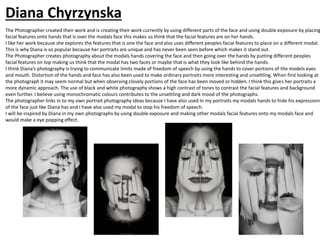
The Photographer created their work and is creating their work currently by using different parts of the face and using double exposure by placing
facial features onto hands that is over the modals face this makes us think that the facial features are on her hands.
I like her work because she explores the features that is one the face and also uses different peoples facial features to place on a different modal.
This is why Diana is so popular because her portraits are unique and has never been seen before which makes it stand out.
The Photographer creates photography about the modals hands covering the face and then going over the hands by putting different peoples
facial features on top making us think that the modal has two faces or maybe that is what they look like behind the hands.
I think Diana’s photography is trying to communicate limits made of freedom of speech by using the hands to cover portions of the models eyes
and mouth. Distortion of the hands and face has also been used to make ordinary portraits more interesting and unsettling. When first looking at
the photograph it may seem normal but when observing closely portions of the face has been moved or hidden. I think this gives her portraits a
more dynamic approach. The use of black and white photography shows a high contrast of tones to contrast the facial features and background
even further. I believe using monochromatic colours contributes to the unsettling and dark mood of the photographs.
The photographer links in to my own portrait photography ideas because I have also used In my portraits my modals hands to hide his expressions
of the face just like Diana has and I have also used my modal to stop his freedom of speech.
I will be inspired by Diana in my own photographs by using double exposure and making other modals facial features onto my modals face and
would make a eye popping effect.
Diana Chyrzynska
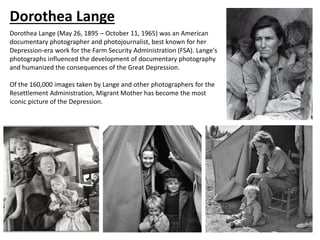
Dorothea Lange
Dorothea Lange (May 26, 1895 – October 11, 1965) was an American
documentary photographer and photojournalist, best known for her
Depression-era work for the Farm Security Administration (FSA). Lange's
photographs influenced the development of documentary photography
and humanized the consequences of the Great Depression.
Of the 160,000 images taken by Lange and other photographers for the
Resettlement Administration, Migrant Mother has become the most
iconic picture of the Depression.
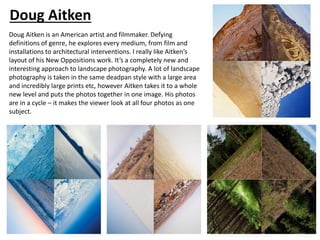
Doug Aitken
Doug Aitken is an American artist and filmmaker. Defying
definitions of genre, he explores every medium, from film and
installations to architectural interventions. I really like Aitken’s
layout of his New Oppositions work. It’s a completely new and
interesting approach to landscape photography. A lot of landscape
photography is taken in the same deadpan style with a large area
and incredibly large prints etc, however Aitken takes it to a whole
new level and puts the photos together in one image. His photos
are in a cycle – it makes the viewer look at all four photos as one
subject.
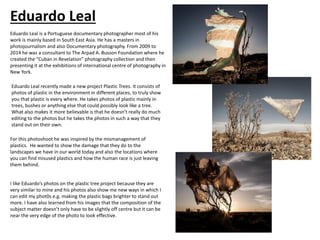
Eduardo Leal is a Portuguese documentary photographer most of his
work is mainly based in South East Asia. He has a masters in
photojournalism and also Documentary photography. From 2009 to
2014 he was a consultant to The Arpad A. Busson Foundation where he
created the “Cuban in Revelation” photography collection and then
presenting it at the exhibitions of international centre of photography in
New York.
Eduardo Leal recently made a new project Plastic Trees. It consists of
photos of plastic in the environment in different places, to truly show
you that plastic is every where. He takes photos of plastic mainly in
trees, bushes or anything else that could possibly look like a tree.
What also makes it more believable is that he doesn’t really do much
editing to the photos but he takes the photos in such a way that they
stand out on their own.
For this photoshoot he was inspired by the mismanagement of
plastics. He wanted to show the damage that they do to the
landscapes we have in our world today and also the locations where
you can find misused plastics and how the human race is just leaving
them behind.
I like Eduardo’s photos on the plastic tree project because they are
very similar to mine and his photos also show me new ways in which I
can edit my phot0s e.g. making the plastic bags brighter to stand out
more. I have also learned from his images that the composition of the
subject matter doesn’t only have to be slightly off centre but it can be
near the very edge of the photo to look effective.
Eduardo Leal
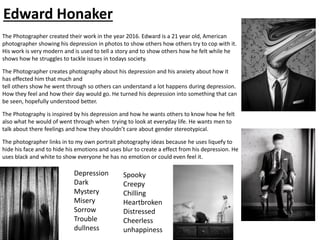
The Photographer created their work in the year 2016. Edward is a 21 year old, American
photographer showing his depression in photos to show others how others try to cop with it.
His work is very modern and is used to tell a story and to show others how he felt while he
shows how he struggles to tackle issues in todays society.
The Photographer creates photography about his depression and his anxiety about how it
has effected him that much and
tell others show he went through so others can understand a lot happens during depression.
How they feel and how their day would go. He turned his depression into something that can
be seen, hopefully understood better.
The Photography is inspired by his depression and how he wants others to know how he felt
also what he would of went through when trying to look at everyday life. He wants men to
talk about there feelings and how they shouldn’t care about gender stereotypical.
The photographer links in to my own portrait photography ideas because he uses liquefy to
hide his face and to hide his emotions and uses blur to create a effect from his depression. He
uses black and white to show everyone he has no emotion or could even feel it.
Depression
Dark
Mystery
Misery
Sorrow
Trouble
dullness
Spooky
Creepy
Chilling
Heartbroken
Distressed
Cheerless
unhappiness
Edward Honaker
Edward Weston
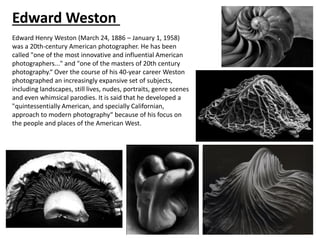
Edward Henry Weston (March 24, 1886 – January 1, 1958)
was a 20th-century American photographer. He has been
called "one of the most innovative and influential American
photographers..." and "one of the masters of 20th century
photography.“ Over the course of his 40-year career Weston
photographed an increasingly expansive set of subjects,
including landscapes, still lives, nudes, portraits, genre scenes
and even whimsical parodies. It is said that he developed a
"quintessentially American, and specially Californian,
approach to modern photography“ because of his focus on
the people and places of the American West.
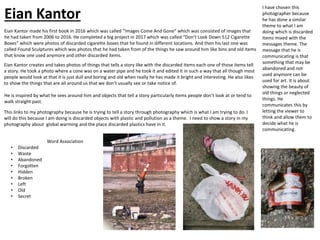
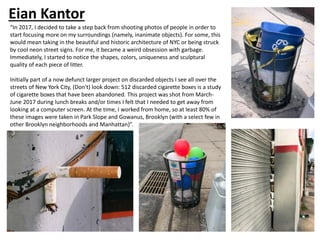
Eian Kantor made his first book in 2016 which was called “Images Come And Gone” which was consisted of images that
he had taken from 2006 to 2016. He completed a big project in 2017 which was called “Don’t Look Down 512 Cigarette
Boxes” which were photos of discarded cigarette boxes that he found in different locations. And then his last one was
called Found Sculptures which was photos that he had taken from of the things he saw around him like bins and old items
that know one used anymore and other discarded items.
Eian Kantor creates and takes photos of things that tells a story like with the discarded items each one of those items tell
a story. He took a photo where a cone was on a water pipe and he took it and edited it in such a way that all though most
people would look at that it is just dull and boring and old when really he has made it bright and interesting. He also likes
to show the things that are all around us that we don’t usually see or take notice of.
He is inspired by what he sees around him and objects that tell a story particularly items people don’t look at or tend to
walk straight past.
Word Association
• Discarded
• Waste
• Abandoned
• Forgotten
• Hidden
• Broken
• Left
• Old
• Secret
This links to my photography because he is trying to tell a story through photography which is what I am trying to do. I
will do this because I am doing is discarded objects with plastic and pollution as a theme. I need to show a story in my
photography about global warming and the place discarded plastics have in it.
I have chosen this
photographer because
he has done a similar
theme to what I am
doing which is discarded
items mixed with the
messages theme. The
message that he is
communicating is that
something that may be
abandoned and not
used anymore can be
used for art. It is about
showing the beauty of
old things or neglected
things. He
communicates this by
letting the viewer to
think and allow them to
decide what he is
communicating.
Eian Kantor
Elliott Erwitt
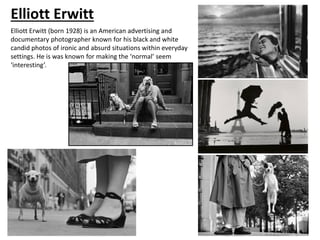
Elliott Erwitt (born 1928) is an American advertising and
documentary photographer known for his black and white
candid photos of ironic and absurd situations within everyday
settings. He is was known for making the ‘normal’ seem
‘interesting’.
Eian Kantor
“In 2017, I decided to take a step back from shooting photos of people in order to
start focusing more on my surroundings (namely, inanimate objects). For some, this
would mean taking in the beautiful and historic architecture of NYC or being struck
by cool neon street signs. For me, it became a weird obsession with garbage.
Immediately, I started to notice the shapes, colors, uniqueness and sculptural
quality of each piece of litter.
Initially part of a now defunct larger project on discarded objects I see all over the
streets of New York City, (Don't) look down: 512 discarded cigarette boxes is a study
of cigarette boxes that have been abandoned. This project was shot from March-
June 2017 during lunch breaks and/or times I felt that I needed to get away from
looking at a computer screen. At the time, I worked from home, so at least 80% of
these images were taken in Park Slope and Gowanus, Brooklyn (with a select few in
other Brooklyn neighborhoods and Manhattan)”.
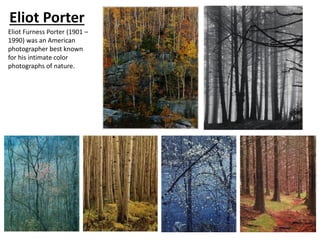
Eliot Porter
Eliot Furness Porter (1901 –
1990) was an American
photographer best known
for his intimate color
photographs of nature.
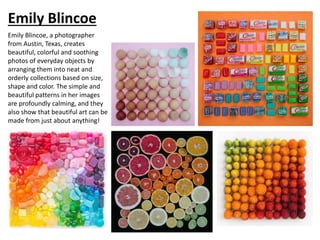
Emily Blincoe
Emily Blincoe, a photographer
from Austin, Texas, creates
beautiful, colorful and soothing
photos of everyday objects by
arranging them into neat and
orderly collections based on size,
shape and color. The simple and
beautiful patterns in her images
are profoundly calming, and they
also show that beautiful art can be
made from just about anything!
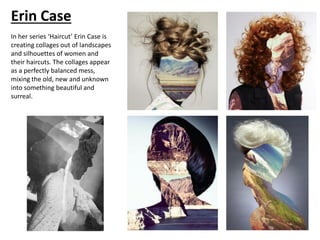
Erin Case
In her series ‘Haircut’ Erin Case is
creating collages out of landscapes
and silhouettes of women and
their haircuts. The collages appear
as a perfectly balanced mess,
mixing the old, new and unknown
into something beautiful and
surreal.
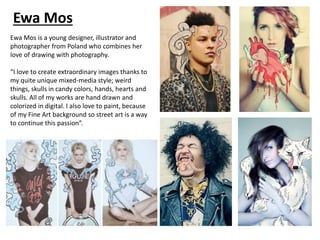
Ewa Mos
Ewa Mos is a young designer, illustrator and
photographer from Poland who combines her
love of drawing with photography.
“I love to create extraordinary images thanks to
my quite unique mixed-media style; weird
things, skulls in candy colors, hands, hearts and
skulls. All of my works are hand drawn and
colorized in digital. I also love to paint, because
of my Fine Art background so street art is a way
to continue this passion”.
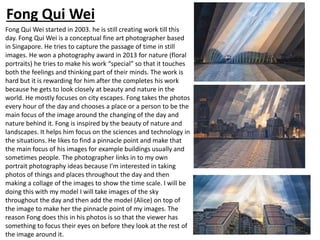
Fong Qui Wei started in 2003. he is still creating work till this
day. Fong Qui Wei is a conceptual fine art photographer based
in Singapore. He tries to capture the passage of time in still
images. He won a photography award in 2013 for nature (floral
portraits) he tries to make his work “special” so that it touches
both the feelings and thinking part of their minds. The work is
hard but it is rewarding for him after the completes his work
because he gets to look closely at beauty and nature in the
world. He mostly focuses on city escapes. Fong takes the photos
every hour of the day and chooses a place or a person to be the
main focus of the image around the changing of the day and
nature behind it. Fong is inspired by the beauty of nature and
landscapes. It helps him focus on the sciences and technology in
the situations. He likes to find a pinnacle point and make that
the main focus of his images for example buildings usually and
sometimes people. The photographer links in to my own
portrait photography ideas because I'm interested in taking
photos of things and places throughout the day and then
making a collage of the images to show the time scale. I will be
doing this with my model I will take images of the sky
throughout the day and then add the model (Alice) on top of
the image to make her the pinnacle point of my images. The
reason Fong does this in his photos is so that the viewer has
something to focus their eyes on before they look at the rest of
the image around it.
Fong Qui Wei
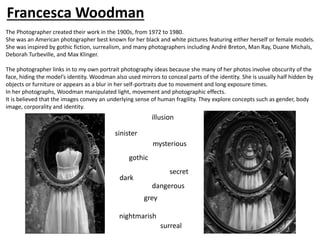
The Photographer created their work in the 1900s, from 1972 to 1980.
She was an American photographer best known for her black and white pictures featuring either herself or female models.
She was inspired by gothic fiction, surrealism, and many photographers including André Breton, Man Ray, Duane Michals,
Deborah Turbeville, and Max Klinger.
The photographer links in to my own portrait photography ideas because she many of her photos involve obscurity of the
face, hiding the model’s identity. Woodman also used mirrors to conceal parts of the identity. She is usually half hidden by
objects or furniture or appears as a blur in her self-portraits due to movement and long exposure times.
In her photographs, Woodman manipulated light, movement and photographic effects.
It is believed that the images convey an underlying sense of human fragility. They explore concepts such as gender, body
image, corporality and identity.
gothic
dark
secret
mysterious
sinister
grey
Francesca Woodman
illusion
nightmarish
dangerous
surreal
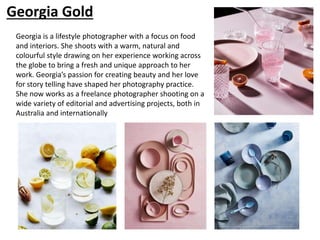
Georgia Gold
Georgia is a lifestyle photographer with a focus on food
and interiors. She shoots with a warm, natural and
colourful style drawing on her experience working across
the globe to bring a fresh and unique approach to her
work. Georgia’s passion for creating beauty and her love
for story telling have shaped her photography practice.
She now works as a freelance photographer shooting on a
wide variety of editorial and advertising projects, both in
Australia and internationally
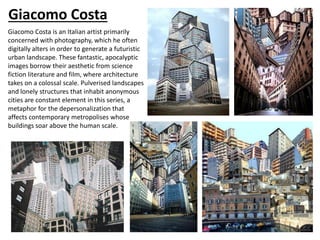
Giacomo Costa
Giacomo Costa is an Italian artist primarily
concerned with photography, which he often
digitally alters in order to generate a futuristic
urban landscape. These fantastic, apocalyptic
images borrow their aesthetic from science
fiction literature and film, where architecture
takes on a colossal scale. Pulverised landscapes
and lonely structures that inhabit anonymous
cities are constant element in this series, a
metaphor for the depersonalization that
affects contemporary metropolises whose
buildings soar above the human scale.
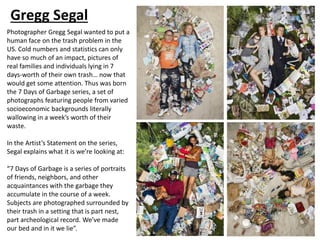
Gregg Segal
Photographer Gregg Segal wanted to put a
human face on the trash problem in the
US. Cold numbers and statistics can only
have so much of an impact, pictures of
real families and individuals lying in 7
days-worth of their own trash… now that
would get some attention. Thus was born
the 7 Days of Garbage series, a set of
photographs featuring people from varied
socioeconomic backgrounds literally
wallowing in a week’s worth of their
waste.
In the Artist’s Statement on the series,
Segal explains what it is we’re looking at:
“7 Days of Garbage is a series of portraits
of friends, neighbors, and other
acquaintances with the garbage they
accumulate in the course of a week.
Subjects are photographed surrounded by
their trash in a setting that is part nest,
part archeological record. We’ve made
our bed and in it we lie”.
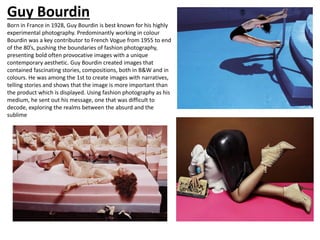
Born in France in 1928, Guy Bourdin is best known for his highly
experimental photography. Predominantly working in colour
Bourdin was a key contributor to French Vogue from 1955 to end
of the 80’s, pushing the boundaries of fashion photography,
presenting bold often provocative images with a unique
contemporary aesthetic. Guy Bourdin created images that
contained fascinating stories, compositions, both in B&W and in
colours. He was among the 1st to create images with narratives,
telling stories and shows that the image is more important than
the product which is displayed. Using fashion photography as his
medium, he sent out his message, one that was difficult to
decode, exploring the realms between the absurd and the
sublime
Guy Bourdin
Hattie Stewart
Hattie Stewart is a London-based
illustrator and title designer. A self-
professed 'professional doodler,' Hattie
has had work exhibited in Los Angeles,
Miami, New York, Berlin, and London,
and collaborated with designers such as
House Of Holland, Marc By Marc Jacobs,
and Adidas.
"Predominantly, I'm an illustrator – but
then I work in so many different fields as
well, [including] photography and
fashion, and I also consider myself an
artist. I think I chose illustration as a field
particularly because my key thing was
always to draw - and my interests in all
those other creative realms weren't as
intense. I really wanted to be a part of
them also, and focussing on illustration
enabled me to branch out into all the
different areas that I wanted to."
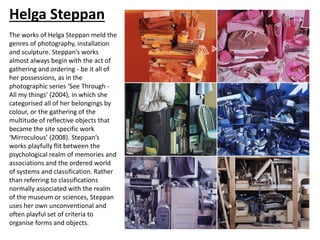
Helga Steppan
The works of Helga Steppan meld the
genres of photography, installation
and sculpture. Steppan’s works
almost always begin with the act of
gathering and ordering - be it all of
her possessions, as in the
photographic series ‘See Through -
All my things’ (2004), in which she
categorised all of her belongings by
colour, or the gathering of the
multitude of reflective objects that
became the site specific work
‘Mirroculous’ (2008). Steppan’s
works playfully flit between the
psychological realm of memories and
associations and the ordered world
of systems and classification. Rather
than referring to classifications
normally associated with the realm
of the museum or sciences, Steppan
uses her own unconventional and
often playful set of criteria to
organise forms and objects.
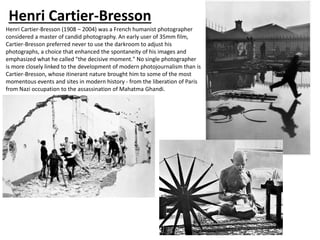
Henri Cartier-Bresson
Henri Cartier-Bresson (1908 – 2004) was a French humanist photographer
considered a master of candid photography. An early user of 35mm film,
Cartier-Bresson preferred never to use the darkroom to adjust his
photographs, a choice that enhanced the spontaneity of his images and
emphasized what he called "the decisive moment." No single photographer
is more closely linked to the development of modern photojournalism than is
Cartier-Bresson, whose itinerant nature brought him to some of the most
momentous events and sites in modern history - from the liberation of Paris
from Nazi occupation to the assassination of Mahatma Ghandi.
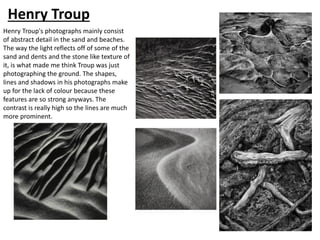
Henry Troup
Henry Troup's photographs mainly consist
of abstract detail in the sand and beaches.
The way the light reflects off of some of the
sand and dents and the stone like texture of
it, is what made me think Troup was just
photographing the ground. The shapes,
lines and shadows in his photographs make
up for the lack of colour because these
features are so strong anyways. The
contrast is really high so the lines are much
more prominent.
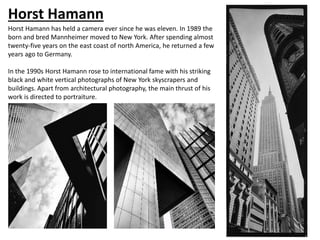
Horst Hamann
Horst Hamann has held a camera ever since he was eleven. In 1989 the
born and bred Mannheimer moved to New York. After spending almost
twenty-five years on the east coast of north America, he returned a few
years ago to Germany.
In the 1990s Horst Hamann rose to international fame with his striking
black and white vertical photographs of New York skyscrapers and
buildings. Apart from architectural photography, the main thrust of his
work is directed to portraiture.
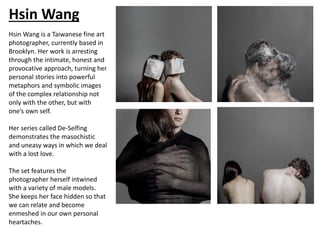
Hsin Wang
Hsin Wang is a Taiwanese fine art
photographer, currently based in
Brooklyn. Her work is arresting
through the intimate, honest and
provocative approach, turning her
personal stories into powerful
metaphors and symbolic images
of the complex relationship not
only with the other, but with
one’s own self.
Her series called De-Selfing
demonstrates the masochistic
and uneasy ways in which we deal
with a lost love.
The set features the
photographer herself intwined
with a variety of male models.
She keeps her face hidden so that
we can relate and become
enmeshed in our own personal
heartaches.
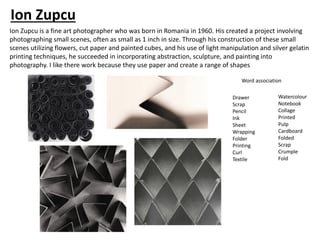
Ion Zupcu is a fine art photographer who was born in Romania in 1960. His created a project involving
photographing small scenes, often as small as 1 inch in size. Through his construction of these small
scenes utilizing flowers, cut paper and painted cubes, and his use of light manipulation and silver gelatin
printing techniques, he succeeded in incorporating abstraction, sculpture, and painting into
photography. I like there work because they use paper and create a range of shapes
Word association
Drawer
Scrap
Pencil
Ink
Sheet
Wrapping
Folder
Printing
Curl
Textile
Watercolour
Notebook
Collage
Printed
Pulp
Cardboard
Folded
Scrap
Crumple
Fold
Ion Zupcu
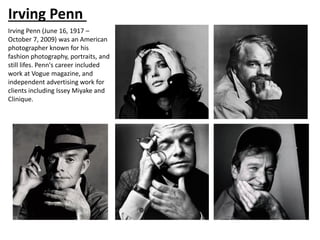
Irving Penn
Irving Penn (June 16, 1917 –
October 7, 2009) was an American
photographer known for his
fashion photography, portraits, and
still lifes. Penn's career included
work at Vogue magazine, and
independent advertising work for
clients including Issey Miyake and
Clinique.
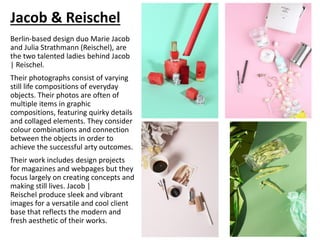
Jacob & Reischel
Berlin-based design duo Marie Jacob
and Julia Strathmann (Reischel), are
the two talented ladies behind Jacob
| Reischel.
Their photographs consist of varying
still life compositions of everyday
objects. Their photos are often of
multiple items in graphic
compositions, featuring quirky details
and collaged elements. They consider
colour combinations and connection
between the objects in order to
achieve the successful arty outcomes.
Their work includes design projects
for magazines and webpages but they
focus largely on creating concepts and
making still lives. Jacob |
Reischel produce sleek and vibrant
images for a versatile and cool client
base that reflects the modern and
fresh aesthetic of their works.
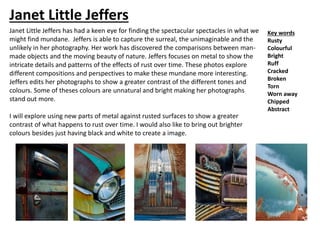
Janet Little Jeffers has had a keen eye for finding the spectacular spectacles in what we
might find mundane. Jeffers is able to capture the surreal, the unimaginable and the
unlikely in her photography. Her work has discovered the comparisons between man-
made objects and the moving beauty of nature. Jeffers focuses on metal to show the
intricate details and patterns of the effects of rust over time. These photos explore
different compositions and perspectives to make these mundane more interesting.
Jeffers edits her photographs to show a greater contrast of the different tones and
colours. Some of theses colours are unnatural and bright making her photographs
stand out more.
I will explore using new parts of metal against rusted surfaces to show a greater
contrast of what happens to rust over time. I would also like to bring out brighter
colours besides just having black and white to create a image.
Key words
Rusty
Colourful
Bright
Ruff
Cracked
Broken
Torn
Worn away
Chipped
Abstract
Janet Little Jeffers
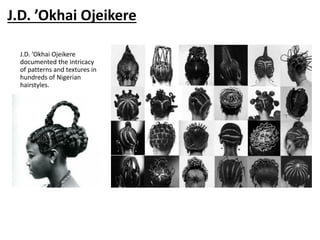
J.D. ’Okhai Ojeikere
documented the intricacy
of patterns and textures in
hundreds of Nigerian
hairstyles.
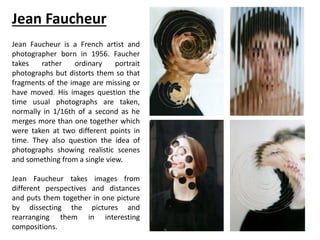
Jean Faucheur
Jean Faucheur is a French artist and
photographer born in 1956. Faucher
takes rather ordinary portrait
photographs but distorts them so that
fragments of the image are missing or
have moved. His images question the
time usual photographs are taken,
normally in 1/16th of a second as he
merges more than one together which
were taken at two different points in
time. They also question the idea of
photographs showing realistic scenes
and something from a single view.
Jean Faucheur takes images from
different perspectives and distances
and puts them together in one picture
by dissecting the pictures and
rearranging them in interesting
compositions.
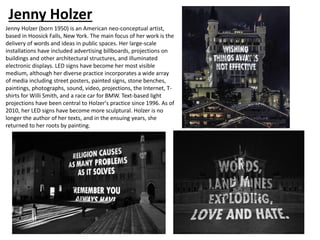
Jenny Holzer
Jenny Holzer (born 1950) is an American neo-conceptual artist,
based in Hoosick Falls, New York. The main focus of her work is the
delivery of words and ideas in public spaces. Her large-scale
installations have included advertising billboards, projections on
buildings and other architectural structures, and illuminated
electronic displays. LED signs have become her most visible
medium, although her diverse practice incorporates a wide array
of media including street posters, painted signs, stone benches,
paintings, photographs, sound, video, projections, the Internet, T-
shirts for Willi Smith, and a race car for BMW. Text-based light
projections have been central to Holzer's practice since 1996. As of
2010, her LED signs have become more sculptural. Holzer is no
longer the author of her texts, and in the ensuing years, she
returned to her roots by painting.
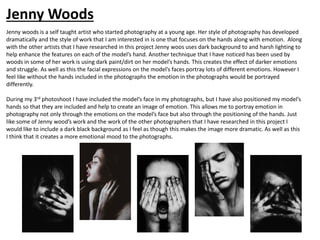
Jenny woods is a self taught artist who started photography at a young age. Her style of photography has developed
dramatically and the style of work that I am interested in is one that focuses on the hands along with emotion. Along
with the other artists that I have researched in this project Jenny woos uses dark background to and harsh lighting to
help enhance the features on each of the model’s hand. Another technique that I have noticed has been used by
woods in some of her work is using dark paint/dirt on her model’s hands. This creates the effect of darker emotions
and struggle. As well as this the facial expressions on the model’s faces portray lots of different emotions. However I
feel like without the hands included in the photographs the emotion in the photographs would be portrayed
differently.
During my 3rd photoshoot I have included the model’s face in my photographs, but I have also positioned my model’s
hands so that they are included and help to create an image of emotion. This allows me to portray emotion in
photography not only through the emotions on the model’s face but also through the positioning of the hands. Just
like some of Jenny wood’s work and the work of the other photographers that I have researched in this project I
would like to include a dark black background as I feel as though this makes the image more dramatic. As well as this
I think that it creates a more emotional mood to the photographs.
Jenny Woods
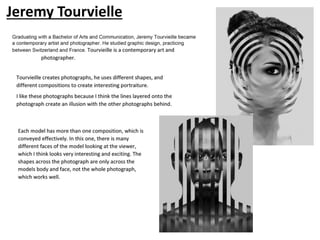
Jeremy Tourvielle
J Henry Fair
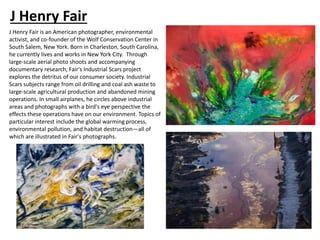
J Henry Fair is an American photographer, environmental
activist, and co-founder of the Wolf Conservation Center in
South Salem, New York. Born in Charleston, South Carolina,
he currently lives and works in New York City. Through
large-scale aerial photo shoots and accompanying
documentary research, Fair's Industrial Scars project
explores the detritus of our consumer society. Industrial
Scars subjects range from oil drilling and coal ash waste to
large-scale agricultural production and abandoned mining
operations. In small airplanes, he circles above industrial
areas and photographs with a bird's eye perspective the
effects these operations have on our environment. Topics of
particular interest include the global warming process,
environmental pollution, and habitat destruction—all of
which are illustrated in Fair's photographs.
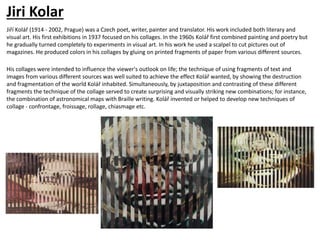
Jiri Kolar
Jiří Kolář (1914 - 2002, Prague) was a Czech poet, writer, painter and translator. His work included both literary and
visual art. His first exhibitions in 1937 focused on his collages. In the 1960s Kolář first combined painting and poetry but
he gradually turned completely to experiments in visual art. In his work he used a scalpel to cut pictures out of
magazines. He produced colors in his collages by gluing on printed fragments of paper from various different sources.
His collages were intended to influence the viewer's outlook on life; the technique of using fragments of text and
images from various different sources was well suited to achieve the effect Kolář wanted, by showing the destruction
and fragmentation of the world Kolář inhabited. Simultaneously, by juxtaposition and contrasting of these different
fragments the technique of the collage served to create surprising and visually striking new combinations; for instance,
the combination of astronomical maps with Braille writing. Kolář invented or helped to develop new techniques of
collage - confrontage, froissage, rollage, chiasmage etc.
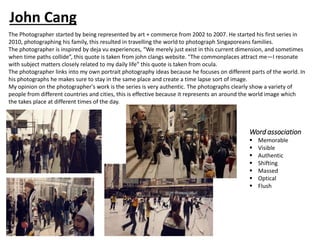
The Photographer started by being represented by art + commerce from 2002 to 2007. He started his first series in
2010, photographing his family, this resulted in travelling the world to photograph Singaporeans families.
The photographer is inspired by deja vu experiences, “We merely just exist in this current dimension, and sometimes
when time paths collide”, this quote is taken from john clangs website. "The commonplaces attract me—I resonate
with subject matters closely related to my daily life” this quote is taken from ocula.
The photographer links into my own portrait photography ideas because he focuses on different parts of the world. In
his photographs he makes sure to stay in the same place and create a time lapse sort of image.
My opinion on the photographer's work is the series is very authentic. The photographs clearly show a variety of
people from different countries and cities, this is effective because it represents an around the world image which
the takes place at different times of the day.
Word association
▪ Memorable
▪ Visible
▪ Authentic
▪ Shifting
▪ Massed
▪ Optical
▪ Flush
John Cang
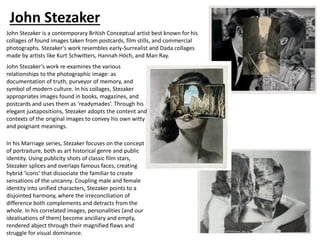
John Stezaker
John Stezaker is a contemporary British Conceptual artist best known for his
collages of found images taken from postcards, film stills, and commercial
photographs. Stezaker's work resembles early-Surrealist and Dada collages
made by artists like Kurt Schwitters, Hannah Höch, and Man Ray.
John Stezaker’s work re-examines the various
relationships to the photographic image: as
documentation of truth, purveyor of memory, and
symbol of modern culture. In his collages, Stezaker
appropriates images found in books, magazines, and
postcards and uses them as ‘readymades’. Through his
elegant juxtapositions, Stezaker adopts the content and
contexts of the original images to convey his own witty
and poignant meanings.
In his Marriage series, Stezaker focuses on the concept
of portraiture, both as art historical genre and public
identity. Using publicity shots of classic film stars,
Stezaker splices and overlaps famous faces, creating
hybrid ‘icons’ that dissociate the familiar to create
sensations of the uncanny. Coupling male and female
identity into unified characters, Stezaker points to a
disjointed harmony, where the irreconciliation of
difference both complements and detracts from the
whole. In his correlated images, personalities (and our
idealisations of them) become ancillary and empty,
rendered abject through their magnified flaws and
struggle for visual dominance.
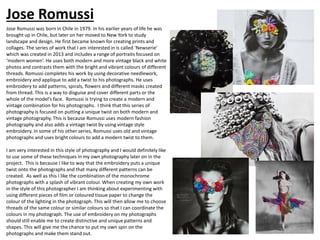
Photography Research: Jose Romussi
Jose Romussi was born in Chile in 1979. In his earlier years of life he was
brought up in Chile, but later on her moved to New York to study
landscape and design. He first became known for creating prints and
collages. The series of work that I am interested in is called ‘Newserie’
which was created in 2013 and includes a range of portraits focused on
‘modern women’. He uses both modern and more vintage black and white
photos and contrasts them with the bright and vibrant colours of different
threads. Romussi completes his work by using decorative needlework,
embroidery and applique to add a twist to his photographs. He uses
embroidery to add patterns, spirals, flowers and different masks created
from thread. This is a way to disguise and cover different parts or the
whole of the model’s face. Romussi is trying to create a modern and
vintage combination for his photographs. I think that this series of
photography is focused on putting a unique twist on both modern and
vintage photography. This is because Romussi uses modern fashion
photography and also adds a vintage twist by using vintage style
embroidery. In some of his other series, Romussi uses old and vintage
photographs and uses bright colours to add a modern twist to them.
I am very interested in this style of photography and I would definitely like
to use some of these techniques in my own photography later on in the
project. This is because I like to way that the embroidery puts a unique
twist onto the photographs and that many different patterns can be
created. As well as this I like the combination of the monochrome
photographs with a splash of vibrant colour. When creating my own work
in the style of this photographer I am thinking about experimenting with
using different pieces of film or coloured tissue paper to change the
colour of the lighting in the photograph. This will then allow me to choose
threads of the same colour or similar colours so that I can coordinate the
colours in my photograph. The use of embroidery on my photographs
should still enable me to create distinctive and unique patterns and
shapes. This will give me the chance to put my own spin on the
photographs and make them stand out.
Jose Romussi
The Photographer created their work in 2005 – 2007 and is still actively doing photography today. He has always been
naturally artistic since childhood but it was only in 2005 he bought a professional camera and started taking professional
photos. The Photographer creates photography about the real world with unnatural ideas incorporated, creating a photo that
to me , shows a child like creativity. His use of editing is nightmarish and unsettling to the viewer as he manipulates part of
the human body to give an unnatural appearance. His aim is to get a reaction from the viewer which ties in with my idea of
manipulating reality and creating nightmare-esque pictures as most scary or unusual photos would indeed get a reaction
My opinion on his work is that he has a large variety of interesting photos that I may borrow small parts of for my own final
pieces to show my dystopian themed ideas in an unsettling manner. The photographer links in to my own portrait
photography ideas because he uses manipulation of reality to make very advanced photography that seems infantile in style
but also very professional in skill. This style ties in with my theme as I aim to create powerful messages that could be
unsettling or hard to accept for some.
Josh Sommers
Julie Cockburn
Julie Cockburn (b. 1966) transforms
second-hand objects and images to
produce entirely new pieces,
injecting new life into mundane and
forgotten items. She alters found-
photographs, using embroidered and
painted embellishments, to enhance
the fading scenery and characters
depicted.
“There is something about the found
object that has inspired me since
doing my sculpture degree at St
Martins, where we were encouraged
to skip dive for our materials.
Working with old photographs is
similar to engaging in a dialogue. I am
not working on a blank canvas.
Rather, I am entering into a pre-
existing conversation that took place
between the photographer and sitter,
and where I experiment with a
personal visual language”.
Justine Khamara
Justine Khamara lives and works in
Melbourne, Australia. In 2003 she
graduated with a Bachelor of Fine Art
(Honours) from the Victorian College of
the Arts.
Khamara's practice to date has sought to
disrupt photography's smooth, two-
dimensional surfaces by building
sculptures and collages entirely out of
photographs. A flat image, usually
figurative, is transformed either by slicing
directly into the photographic skin and
pulling features into three dimensional
form, or by taking multiple shots of a
single subject which are then collaged.
Often evoking biological processes of
replication while also engaging with
notions of self-representaiton in an era
of instant, endlessly generative
(re)productions technologies, her work is
best understood as a deeply
psychological response to contemporary
notions of being (in the existentialist
sense).
Karl Blossfeldt
Karl Blossfeldt (June 13, 1865 – December 9, 1932)
was a German photographer, sculptor, teacher, and
artist who worked in Berlin, Germany. He is best
known for his close-up photographs of plants and
living things, published in 1929 as Urformen der
Kunst. He was inspired, as was his father, by nature
and the ways in which plants grow. He believed that
"the plant must be valued as a totally artistic and
architectural structure."
Kay Montano began her career in make-up at 16 years
old. She has since worked with some of the world's
most famous models, celebrities and leading
photographers. In her recent work Montano explores
body issues that are normally expressed through
fashion magazines. Using makeup Montano has written
notes on parts of the face that resemble surgical lines
and improvements that need to be made to the model.
These are common body issues and misconceptions
that people experience inside and out of the industry.
I am interested in Montano’s work because as she
explores the problems with body image, and how she
pokes fun at how it is seen. I would like to use this
technique to highlight male body issues because it is
very unique and can portray my message perfectly, in a
variety of ways. I will do this by using charcoal and chalk
to draw on top of a photo. I can add surgical lines to the
face, to show ‘imperfections’ like Montano’s work.
Kay Montano
Kenneth Josephson
New York State (1970) is one of
Josephson’s most well known
photographs, and one of a much
larger series incorporating
pictures within pictures. We see
the artist’s arm, stretching over a
body of water, and just above the
horizon line he holds a picture of
a ship. Positioning this ship so
that it appears proportionally
equal to a full-sized ship in the
distance, the photograph is
deliberately composed to draw
attention to its artifice.
Kenneth Josephson is recognized as one of the
pioneers of conceptual photography. He has
explored the concepts of photographic truth
and illusion throughout his career, producing a
varied oeuvre that utilizes a range of techniques
from collage and construction to multiple
exposures and single negative photographs.
Focusing on what it means to make a picture,
Josephson’s work playfully highlights the illusive
nature of photography.
The Photographer has been creating their work for the past five years. He was born in 1992, therefore he
is around 28.The Photographer creates photography about abstract concepts of life. He also utilises
frames a great amount which is useful for me as in my photography, I plan on using frames as well to
create a division in my photosThe photographer links in to my own portrait photography ideas because it
manipulates reality and creates an idea of abstractness. The composition of the photos are similar to my
compositions as the majority of his photos use frames.
The project started off as a playful ideology of the ocean
being a massive sea of blue paint instead than water. The
idea of a blue sea is so engraved into our minds, even
though in most cases, water isn’t really blue. In all three
pieces, a hand becomes covered in paint by touching a
landscape of that color. The project speaks about our
intimate connection between common landscapes and
their assigned colors. Possibly something that was instilled
in us during our elementary days. The project also
addresses my role as an artist, and what color I will choose
for my landscapes, even though my tool of choice is a
camera (a tad bit ironic). A painter is given the task to paint
a tree, but that painter must choose to use green paint.
Kevin Corrado
Klaus Pichler
Austrian artist Klaus Pichler has developed
‘one third’, a highly legible photographic
commentary of the connection between the
individual wastage of food and globalized food
production after learning the UN finding that
one third of the world’s food supply is left to
rot. A vast selection of foods are set in
bouquet-like arrangements and photographed
as they begin to naturally disintegrate. Pichler
captured the colorful and putrid images in a
classical still-life composition, the simplicity of
the black background and direct lighting,
enhancing the detail and variation of color
observed in the decomposition of each
product.
Accompanying each of the images in ‘one
third’ a description of the decayed food stuff.
The photos of the thrown-away items are
further clarified by the artist’s inclusion of the
place of production, cultivation method, time
of harvest, transporting distance, means of
transportation, carbon footprint, water
requirement, and price of the products. With
the series pichler conducts a critique of
consumerist behavior and raises public
awareness of the great quantity of food waste
occurring worldwide.
Kolman Rosenberg
suggests a crowd of
dancers through the
use of multiple
exposure.
These multiple
exposures are done in
camera with a specific
setting in the
menus. ”I just tell the
camera how many
shots to include and
the next shots, making
up that number, are
automatically
overlayed over each
other. The skill comes
in timing and
positioning the
individual shots so that
they are pleasing when
completed”.
Key term
Multiple exposure - the act or
process of recording two or
more superimposed images
on a photographic medium
Kolman Rosenberg
The Photographer is from New Haven. I’m interested
in her series called ‘Flat Lay photography’. The
Photographer creates photography using raw
materials, she does indistinctive outlines in her work
which consists of circles and other shapes. The
Photography is inspired by different types of shapes
she sees. She tells the interviewer “As far as how I find
materials to experiment with, it varies a lot”. She is
based in her house; however, she often travels to gain
the best lighting possible for her photography. The
photographer links into my own portrait photography
ideas because I am interested in making my fruits into
different shapes and sizes. I am inspired by the colours
she's used too, making them seem bright even whilst
using a darker colour.
Kristen Meyer
Kyle Thompson
Kyle Thompson (born 1992) is an American photographer from
Chicago, Illinois. His style, as he describes it, is surreal
conceptual photography; the creation of a surreal world in
order to depict concepts. Thompson specializes in self-
portraiture and has a fascination with abandoned houses and
empty forests, locations where the majority of his photographs
take place. Thompson’s work is gratifying: elegant
compositions. Rich colors. Powerful juxtapositions. Each image
is unique, but form a complex body of work.
Lark Foord
Lark Foord is a self taught photographer based in
Venice, CA. Most of these images are from Plain
Sight, a continuing analog film series I'm working on.
On the surface it's a simple study in found
abstractions, ordinary objects and the spaces in
between spaces.
The photographer’s choice of using a pseudonym and giving away only vague personal details is mainly to protect his
privacy, but it also reflects the secretive point of view that emerges from his photographs. Foord’s neat and tidy
compositions seem to be captured by an almost intangible presence, external to the landscape portrayed but at the same
time a part of it. The photographer becomes a subtle yet discerning eye, exposing usually overlooked details of common
urban sights.
Laura Williams is a photographer and designer from Suffolk, UK. She specialises in fine art portraits and documentary style
wedding photography. She uses digital editing techniques such as layer masks on Photoshop to manipulate her images. I find
this interesting because it makes her photographs look surreal and fantasy-like.
She attended college to study both photography and graphic design.
The Photography is inspired by everything around her including nature, light, and other photographers. She became
particularly popular after she uploaded a series of photographs using mirrors to conceal her body and make it seem as if it is
not there, deceiving the viewer’s perspectives.
Williams likes the idea of creating an image that is ‘’less obvious’’, like an illusion. She invites the viewer to closely examine
every detail in the shot in an effort to learn the story behind each image.
The message that she tries to convey in her photos is the feeling of not being heard, which she says it’s something we can all
relate to.
deceptive
surreal
invisible
unusual
mysterious
nature
Laura Williams
hidden
identity
shy
illusion
Legan Rooster is a talented self-taught artist, who
initially studying architecture, realised that his real
passion was for painting. He has since built up a
broad portfolio of graphic design, digital and paint-
based pieces blending a strong eye for geometric
shapes with a playful style and mixed media
approach, some paintings incorporating collage.
Legan Rooster
Leticia Lampert
Brazilian artist and designer, Leticia
works mainly with photography, collage
and artist’s books. Her work is focused
on ways of seeing the landscape,
especially in an urban environment, and
how architecture mediates our
relationship with places.
In the series (De) Construction, Lampert
creates 19 collages that explores various
buildings in Brazil. Lampert explains, “The
city grows spontaneously. Disordered. Up
and down, wherever there is space. Every
style is mixed together. There is no
development plan for the cities in Brazil,
so they become a huge architectonic
collage. It is after this perception of the
city that this work was created. As a play,
collages are made from disconnected
pieces of houses and buildings in order to
create other ones. These new buildings
are strange but, even though, they seem
very familiar, once it is like that our
perception works”.
Lev Akhsanov
Lev Akhsanov uses a fast
shutter speed to freeze a
moment in time focusing on
skiing to capture all
movements from the
athletes.
Lewis Baltz
Lewis Baltz was an American photographer
best known for his involvement in the
seminal “New Topographics: Photographs
of a Man-Altered Landscape” exhibition of
1975. Baltz's photo series document the
side effects of industrial civilization on the
landscape, focusing on places that lie
outside the bounds of canonical reception:
urban wastelands, abandoned industrial
sites, warehouses. His photographs
uncover the correspondences between
spatial forms that occur in the everyday
world and advanced forms found in art.
Liesl Pfeffer
Liesl Pfeffer is a Berlin-based
Australian visual artist working
primarily with photography,
drawing, collage and printmaking.
Her art practice is a material
exploration of photography in an
era of digitalisation, using the
darkroom and studio as sites for
experimentation.
Each collage is hand-cut and
reconstructed from various photos
inspired by nature. Her photo-
media collages are whimsical and
playful, but convey nostalgia at the
same time. Homes are comprised
of memories and her visual
compositions feel like getting a
peak into someone’s past.
Liz Orton is a visual artist working with photography text and film to explore
the relationship between images knowledge and authorship. She looks into
tension in scientific forms. Liz worked as a participatory practitioner
involving sciences. Liz started her work in 2003 until 2012 but no longer is a
photographer and now gives lectures. She’s from London and currently still
lives in London.
The collages are created from prints of scanned photocrom postcards. The
original postcards circulated widely at the turn of the twentieth century, as
part of the first wave of mass production and replication of photographs.
They opened up views of Alpine Europe to a new consumer market around
the world.
The ground is smaller and viewing positions and outcomes are disrupted.
Landscape is reconfigured, between then and now between partiality and
excess creating new unfamiliar abstractions. The centre once the stable
ground appears empty as a void.
I think Liz's work is inspired by the pinnacle points of the day meaning the
best parts and not the worst. I will be inspired by her work because I am
using slices of the day to create one whole image of the day in one.
Liz Orton
Lisa Kokin
Lisa Kokin’s work in artist’s books, mixed media
installation, assemblage and sculpture is about
memory, history, and social commentary. She
used photographs as objects to create new ways
of considering the photographic image and the
results are layered, whimsical, artful, and
unique.
“I am intrigued with other people’s
photographic recording of their lives both for
the generic quality they possess -- the family
and social rituals, studio portraits, vacation
shots -- and for the feeling of sadness and
nostalgia that acquiring other people’s
memories provokes in me. I feel somehow that
it should be illegal to own them, yet since they
are for sale it might as well be me who buys
them”.
Lisa Larsen was one of
LIFE's pioneering
female
photojournalists. Lisa
Larsen found a way to
make pictures of
crowds that both
captured the energy of
multitudes (and smaller
gatherings) while
making sure that
individual faces weren't
lost in the mix.
Source;
https://www.icp.org/browse/archive/constituents/lis
a-larsen?all/all/all/all/0
Lisa Larsen
Lorna Simpson
Lorna Simpson is an
American artist, born in
1960, who lives and works in
New York. She uses
photography, video and
collage to explore identity –
which means what makes us
who we are – using her own
experiences as a black
woman to inspire her work.
In her most famous work
Stereo Styles (1988), she
explores the way in which
identity is externally
projected, displaying 10
images of an African
American woman in different
hairstyles alongside text that
reads “Sweet,” “Ageless,” and
“Magnetic.”
Lucas Simoes
Lucas Simões is a contemporary artist born in 1980 from Brazil.
In his artwork he uses sources such as maps and portrait
photographs which he then cuts and folds to make new forms.
Simoes uses various portrait photographs taken from different
angles and perspectives to create various distortions.
In these images he works to change the original meaning of it
and make a new representation that sways between beauty
and strangeness. Each portrait image is cut differently to
reveal fragments of each individual layer. This makes some of
the images very distorted where it is not clear to see what the
subject is.
Lucy Shires is a British modern photographer
who focuses on textures within urban
abstractions. She travelled across Europe after
she left North West England. She is inspired by
life and senses. She links to my photography
because I am trying to communicate textures
that affect the way people feel. She chooses
textures depending on their look, feel, colour
and depth. She said “Texture is everywhere in
simple and complex forms” I agree with this
statement because there are many simple
textures that people ignore and I want to bring
them out in my photography. Originally she
captured rusty textures she said it’s a
“recognisable” texture that “fingertips have felt
before” She believes that textures tell stories
and I would like to reflect this in my
photography. I like her photos because they
capture unique textures.
Lucy Shires
Luis Dourado
Luis Dourado was born in Porto, Portugal and now
lives and works in Berlin, Germany. Dourado uses
digital photo manipulation and collage to create
dreamy and distorted landscapes and
atmospheres. His manipulated images are edited
to the point that they take on a new and almost
hallucinatory form, his vivid and abstract digital
collages strike a disorientating chord.
Dourado describes his style as, “I think my style
varies a little bit from series to series but it is
always connected; crossing a couple of techniques
such as collage, manipulation, and drawing. I do
prefer to "touch" a couple of different aesthetics
and try to create links between works using
ambiences, usually dark and dreamy”. By layering
and repeating sections of the image it can make
landscape look more creepy and surreal as this is
something that can not be normally seen.
Luke Gram
Luke is a Canadian Swiss
photographer that is currently
travelling through Europe, Asia
and Africa. He is specialized in
landscape and portraits, using
the technique of multiple
exposure he manages to achieve
amazing photographs.
Manny Robertson
Manny Robertson is a 23 year old student
studying his masters degree. his art style
varies but he says he is mainly inspired by
magic, Science and Religion. I'm mainly
interested in his range of photos that he
calls his 'metropolis'(the photos have a
robotic, futuristic aesthetic as he was
inspired after the film metropolis) in this
range of photos he incorporates stitching
into them and geometric shapes.
This series of photos were created to
represent how mental illnesses like
Depression can make people wear a mask,
and these photos are all about stripping
away and removing the mask. the images
are powerful and provoking to look at.
Man-Ray
Man Ray was an American visual artist
who spent most of his career in Paris. He
was a significant contributor to the Dada
and Surrealist movements, although his
ties to each were informal.
Man Ray made his "rayographs" without
a camera by placing objects-such as the
thumbtacks, coil of wire, and other
circular forms used here-directly on a
sheet of photosensitized paper and
exposing it to light. Man Ray had
photographed everyday objects before,
but these unique, visionary images
immediately put the photographer on
par with the avant-garde painters of the
day. Hovering between the abstract and
the representational, the rayographs
revealed a new way of seeing that
delighted the Dadaist poets who
championed his work, and that pointed
the way to the dreamlike visions of the
Surrealist writers and painters who
followed.
Anderson is a fine art photographer who creates his work currently, He is from
Australia and he is interested in music, art, photography and graphic design. He
takes close up photographs of natural surfaces in outdoor locations using a macro
lens. Most of the surfaces are filled with intricate details and vibrant colours. This is
interesting because these are surfaces we wouldn’t usually find appealing such as
tree bark and rock surfaces but he photographs them in an unique way which
makes them look more interesting. I think the context of his photography is about
environmental issues on society and it’s trying to raise peoples awareness of the
poorly-treated world around them in an artistic way. I think this because he takes
photos of things that were not well looked after to show the impact humans have
on the earth. His photographs are also filled with enigma because we don’t always
know what’s going on in them.
The photographer links in to pattern and texture photography because all his
photographs use rough textures to add to what he is trying to portray. The patterns
he uses are mainly lines intertwined with each other. The colours in his work range
from dull to bright. I am inspired by his work because I want to begin looking at
objects and surfaces around me more closely in order to appreciate them more. I
like how Anderson uses macro photography to question the viewer what the
photograph is about and therefore makes us appreciate all the intricate patterns
and colours found on these surfaces. I believe Anderson is trying the highlight the
importance of nature by capturing these striking photographs.
Marc Anderson
Marcelo Monreal
Marcelo Monreal is an artist from Brazil who focuses on the
idea of inner beauty. He cleverly manipulates his
photographs and deconstructs his model’s faces to fill the
gaps with flowers. He created his series called Faces
[UN]bonded around the time of 2015-2016. Monreal uses
celebrities and famous figures as his model’s which I think
is an effective way of conveying his message of personalities
and hidden beauty being more important than physical
appearance. His work is inspired by the idea od natural
hidden beauty and the underlying beauty of a person. He
also plays with the idea of people being who they want to
be around others and keeping their real-selves hidden.
In my opinion the message that Monreal is conveying
through his work is a very positive one. I really like the way
that he uses a different variety of flowers that are both
bright and vary in shape and size as I feel as though this
gives a really good impression of what the model’s
personality may be like. As well as this I think that his use of
vivid colours as a block coloured background is really
effective and lifts the tone of the photograph completely.
However his monochrome photographs are also very
powerful and the contrast of the bright plants and flowers
against the dark background is very eye-catching.
Marc Laroche
Marc Laroche often
photographs the movement
and structure of hair using
black and white
photography.
Martin Parr
Martin Parr (born 23 May 1952) is a British
documentary photographer,
photojournalist and photobook collector.
He is known for his photographic projects
that take an intimate, satirical and
anthropological look at aspects of modern
life, in particular documenting the social
classes of England, and more broadly the
wealth of the Western world.
Big and bright and brash continue to spell
seduction for Parr; his appetite for the
peculiarities of human behavior have since
led him further afield—to Benidorm in
Spain, and Argentina’s “completely insane”
Mar del Plata. (“It’s the most busy I’ve ever
seen anywhere in the world. There are so
many people! The more people you’ve got,
the better it is,” he exclaims. “In fact the
main beach there is called Bristol Beach, so
I feel at home.”) But crowds on beaches,
and very often British ones, have made for
some of his most unforgettable shots.
Humor and horror prevail, and often in
equal measure; one need only look at his
1985 series The Last Resort for proof of how
many different shots might jump out of any
one scene.
Most of his work was made between 2014 and 2018. He has focused on
developing his own photographic language. Focusing his lens on architectural
details and adopting fairly constructivist angles, the artist succeeds in creating
abstract geometric images. He only photographs when the weather is
incredibly good and thus Matthieu uses the immaculate sky like the
background in a studio.
I like his work because he explores many bright colours and uses them smartly
In contrast to pastel colours, also because he use rule of thirds in the
placement of the architecture, his choice of architecture is also effective
because he chooses buildings with ridged shapes and uses colours that can still
keep a natural effect on the building.
This links to my own work because I aim to use similar colours on the building
exploring many ridged edges to express the strong contrast between the
colours used. Furthermore I will use one solid colour in the sky for my image,
which will also sometimes be a more natural blue, similar to his work.
Matthieu Venot
She is a Swiss photographer/artist who was born in 1974. she created most of her pieces from 2004-
2014. Her photography explores replacing buildings with blocks of bold colours contrasting the natural
mundane colours of the street around it, this creates strong contrast, making the image more striking.
She takes normal, everyday images and edits it abstractly with bold colours.
The Photography is inspired by the contrast between belonging and not belonging, this fueled her
fascination with the small details of our lives—”the stories we tell ourselves and others, our dreams,
how we express our emotions and individuality, our experience of noise, and the visual tableaus found
throughout our days.”
I will reflect this in my own work because I will take pictures of architecture including boring colours and
then edit one block of the building, changing it to a solid bold colour which heavily contrasts to the rest
of the image. I could also portray this with manual techniques like cutting out a block of coloured card
and sticking it over a building adding definition to my work, and exploring similar techniques.
Key words :
• Bold
• Bright
• Contrast
• Urban
• Abstract
• Unnatural
• Striking
• Smooth
• Strong
• Light
• Vivid
• Positive
• 3D
Maureen Broadbeck
Maurizo Anzeri
Born in Loiano, Italy in 1969, Maurizio
Anzeri studied Sculpture and Graphic
Design at the Camberwell College of Fine
Arts (1996 -99) and at The Slade School of
Fine Art, London (2002-2005) obtaining an
MA in Fine Art and Sculpture. He lives and
works in London, England.
“I work with sewing, embroidery and
drawing to explore the essence of signs in
their physical manifestation. I take
inspiration from my own personal
experience and observation of how, in
other cultures, bodies themselves are
treated as living graphic symbols. I then use
sewing and embroidery in a further
attempt to re-signify, and mark the space
with a man-made sign, a trace. The
intimate human action of embroidery is a
ritual of making and reshaping stories and
history of these people. I am interested in
the relation between intimacy and the
outer world”.
Maurizio Galimberti
Marurizio Galimberti is an Italian born photographer who
creates abstract mosaic portraits with Polaroid film. By
shooting and arranging the Polaroid's into grids, Galimberti's
subjects become abstract, giving the viewer a multiple
dimensional perspective of each subject.
Galimberi has quite a few series of these works on his website
at www.mauriziogalimberti.it including "Celebrity Works,"
which include portraits of George Clooney, Johnny Depp,
Catherine Zeta-Jones, Lady Gaga, Benicio del Toro and Sting to
name a few.
Melissa Zexter
Zexter grew up in Bristol, Rhode Island
in the Joseph Reynolds House and was
given her first camera at the age of
eight.Zexter began embroidering her
photography following an artist's
residency program in the Catskills. Her
works typically begin with her own
digital or analogical photography, to
which she adds a layer of hand-stitched
embroidery. The overlaid embroidery
pattern in her works fits the context of
the scene's theme. She uses various
embroidery styles, "ranging from
seemingly random stitches of different
colors, to pattern-like stitches of single
or complementing hues.“Zexter prefers
to photograph women and her themes
include representations of femininity
and the exploration of female identity
Micaela Lattanzio
Micaela Lattanzio is exploring the fragmentation of identity
through her newest work, Fragmenta. Both a photographer and
an artist, Micaela takes portraits of subjects and then
systematically cuts and rips them up into abstract shapes. She
then painstakingly pins the fragments together onto a new
canvas, recreating the original piece, but fragmented. Or, the
Italian photographer will weave together different photos to
create a completely new image. By both destroying and
reconnecting the fragments, Micaela explores the intricate paths
of consciousness, where the reality of oneself is actually a tangle
of unique perspectives.
Michael Mapes
Michael Mapes is a Kentucky-born artist based in New York. His
highly meticulous work includes collecting hundreds of photographs
and diligently gathered “biological DNA” – anything from
genealogical information, personal statistics, cosmetic samples,
fingernail clippings, handwriting samples and hair strands – which
he then layers and compiles to construct his works. Signifying
entomological, biological and forensic science, Mapes’s method
includes deconstructing his original subjects both literally and
figuratively. He then re-organizes his ‘DNA’ in tiny shapes and glass
vials, tediously layering and composing until it forms a whole.
Mapes’s work challenges the way in which scientific information is
assimilated into culture, conveying the inherent tension between
methodological objectivity and psychological subjectivity.
Myungkeun Koh
Naomi White
In “Plastic Currents”, the everyday
plastic bag is transformed by light, it
is turned from something familiar
into something strange. “Undulating
and fluid these forms transition from
non-biodegradable, reviled plastic
bags into seemingly organic forms,”
continues the artist, “imitating the
very nature they threaten. I am
interested in the way plastic
responds to touch, its surface, its
weight, how it clings to lighter
elements like lint and dirt through
static electricity, and the way each
bag is its own marvel. By isolating
plastic bags, icons of waste and
convenience, we are asked to
consider our role in their effects, but
also to question the transformative
power of the photograph and its
ability to reconcile a simple bag into
something other worldly, full of
possibilities.” At this point, film
lovers will surely remember the
“Dancing Bag” scene from American
Beauty (1999).
The Photographer is currently creating work and has been for a decade.
Some of his achievements are:
2014: Listed in the global Top 100 Most Socially Influential Photographers
2015: Listed in the 20 Most Influential Street Photographers
2016: the Top 20 UK Photographers on the Web.
2018: Ranked 4 in the Top 100 UK Photography Blogs
The effects he creates are splashes of colour contrasting with dull colours of the city to make the image more striking. The Photographer
creates urban photography contrasting black and white with brighter colours. He also takes photos in marketing to promote different
items. He also explores with different lighting and night time photography. He also portrays his other interests of food and travel in his
work, making it more personal to him. Rather than commercial photography. Some of his clients include Adidas, Citroen, sky sports and
peugeot. The Photography is inspired by marketing, photography trends and items in the street like transport and graffiti. He expresses
this using various colours and striking images. I think the message behind his work is mostly not to leave buildings due to the dull colours
expressed as a contrast to a bright sky. Or a certain bright element.
Key words
-bright –dull –urban –graffiti -society
-mundane -striking -vivid
Nico Gooden
Nick Frank
Munich born award-winning Fine Art Photographer
Nick Frank captures the beauty of some of the
world’s most famous architectural spaces. With an
exceptional sense for detail he creates eye catching
visual representations of buildings that almost
appear like hyper-realistic paintings. Inspired by
giving unusual spaces and buildings an entirely new
perspective. He gets inspiration for his
photographers from the internet, television, the
subway, and even in the shower. In his photography
he does not try and portray reality, but instead try's
to show his own subjective view. The end result is
these stunning minimal photographs.
Nicholas Goodden is a writer and an urban photographer who is
based in London. He has a range of photos which focus on the
choice of colour. His street photography has been exhibited both
in London but also internationally. He uses Photoshop to make
his photos black and white and then leaving a section of colour.
He feels it’s more precise than apps or other software. Nicholas
uses the technique of ‘a splash of colour’ to focus on an aspect of
a photo to emphasise the colours involved. He does photograph
‘natural’ photos but also his range includes man-made objects.
He also has a range of live photos which include the clouds in the
sky moving or a drink in a glass being swirled round. His father
was cabin crew when he was growing up so he travelled a lot.
This inspired Nicholas to capture places around the world.
‘All this exposure to travel kept fuelling my interest in visiting
new places, tasting culinary delights, discovering people and it
translates perfectly into soulful photography.’
Flowers
Petals
Colour
Bugs
Leaves
Pollen
Detailed
White
Bouquet
Fields
Odour
Daisy
Petrol
Vehicle
Roads
Oil
Leaks
Nicholas Goodden
Nigel Parry
Nigel Parry is a New York-based
photographer of celebrities, who
started his career in London in 1987
and moved to New York in 1994. His
work has been seen in magazine
features, such as Elle, InStyle, Vanity
Fair, Men's Health and Maxim.
I think the photographers work is about crumpling up the work and distorting the face but having the
final picture have a really positive effect. I also think that it is about distorting the look of celebrities
and good looking models and brings them down to realistic level of beauty in todays society. Nigel
Tomm sends a message out to society that the paper is purposefully broken, crumpled and imperfect
creations. Just as people aren't perfect, art often mimics life in this regard.
The photographer links in to my own portrait photography ideas because it creates an idea of
concealment and different ways to hide the natural beauty. It also hides different parts of the body
you may feel insecure about and not want to show. Nigel Tomm is hiding the natural beauty of his
models so people in todays society cant put name on people just through an image because they
haven’t seen the whole photograph. The use of covering up and crumpling the photograph creates an
effect of making you wonder what the actual photograph looks like and what there natural beauty
looks like instead of being crumpled up and seen as imperfect.
Nigel Tomm
Olivier Ratsi
Olivier Ratsi lives and work in France, Paris. His work is mainly based upon representations of space’s
perception and the experience of reality. He developed a creative process based on the deconstruction
of spatio- temporal. The deconstruction or fragmentation acts mainly as an emotion trigger, which does
not aim at showing what things could be, but more at questioning their references. Its objective is to
generate a break with the meaning of the original items, to propose a new viewing angle and to
provide the public a new field of experience, another way of looking at space and time. His works take
shape through different artistic fields: photography, digital painting, video, installation volume and
performance.
Pablo Thecuadro
Pablo Thecuadro loves simple but strong pictures, a kind of
‘minimalistic’ collage. Pablo thecuadro creates there work
for both commissioned and self initiated projects. Pablo
Thecuadro was born in 1992 in Zaragoza, Spain. Pablo
Thecuadro says his collages are expressions of the duality of
our personality. The Pablo Thecuadro is inspired by the
internet.
Madrid-based artist and photographer Pablo Thecuadro
uses fashion editorials, some photos shot by himself some
shot by other photographers, to create something new.
He crafts abstract art by cutting given picture composition
digitally as well as physically and in this way builds an
extraordinary imagery. Thecuadro breaks away from
viewing habits in fashion industry and advertising. Even if
the artist works with fashion, he plays with norms. In this
way he blurs the line between fine art and haute couture
while expressing the ambivalence of mankind. In a
statement the artist explained his works: The collages I
make express the duality in the human being, who we
want to be versus who we really are and what part of us
we show to others. Collage art is a never ending process,
you can put as many images you want together over and
over again.
I am inspired by his work as its similar to the first
photographer ‘Rosanna jones’ the artist Pablo Thecuadro
cuts some pictures in half to show the other persons
emotion. In my next edit I will do my work manually and
also on Photoshop. This is because the artist rips the image
in half and then goes on Photoshop and removes one part
of the face and puts a different one in.
Patric Dreier
In his series ‘IffBe’, Patric Dreier is
playing with the contrasts between
urban and rural architecture. He
focuses on distinctive elements,
stripping the picture down to an
accumulation of lines and forms,
creating a fictional space. The series
aims to depict the conformity of our
habitat and raise questions about the
putative idyll of the single-family home
as we know it.
Paul Butler
Created by Paul Butler, the 'What’s Within' collage
series centers around portraits of people who have
actually been cut out of each photograph. The void
space left is partly filled by another shot of the same
scenery. The pieces, paired with the series title
'What’s Within,' really makes one question the idea of
identity and self-discovery. Overall, this series of
works is surely unique and creative, making the
viewer thoroughly think about its meaning.
Pelle Cass
Pelle has been making work for an ongoing
series, Crowded Fields, composing images
which see your average diving competition,
hockey game or tennis match repeating
until they fill his frame with frenzy.
Describing the project as “the sports
department” of his wider street
photography portfolio, Pelle’s practice sees
him arranging photographs that have
“dozens of moments instead of just the
one”.
In Pelle’s work “each person is in their
exact spot”, he tells us, “I never move
anything”. To make his work, the
photographer will head to a sports
eventplaces his camera on a tripod and
takes up to a thousand pictures. Then he’ll
head home, and “compile selected figures
into a final photograph that is kind of a still
time-lapse,” he describes. “I change
nothing – not a pixel – only select what to
keep and what to omit. It all happened just
as you see it, just not at the same time.”
Pery Burge died in 2013, she was an English
photographer who explored how ink reacts with water.
She captured how the ink flows and created marble
effects on paper to get the best shots she could. She
liked to use natural processes to produce images. Her
work relates to mine as I want to explore the different
shapes and patterns that ink makes with water. I really
like her photography because in some images it is
unclear to see that it was ink and it could be compared
to an alien-like world. In my next shoot I will create
marble effects like Pery Burge did and use many more
colours to make the photos as interesting as possible. I
want to take my photographs like hers because they
are really interesting and colourful.
Perry Burge
Photographer Hal
Photographer Hal is an artist working and living in
Tokyo, Japan. With bathtubs, couples and love being
important themes throughout his work, he returns
with a new series of disturbing photographs of lovers
in vacuum sealed package. Through the medium of
photography, the couple has become Photographer
Hal’s chosen topic to express and speak about the
love, “a grand theme in mankind”, as he calls it. The
images from ‘Flesh Love Returns’, a continuation of
the project ‘Flesh Love’, depict fresh couples wrapped
in plastic bag in different locations in Tokyo.
Quenton Jones
Quentin Jones is a mixed-media
artist known for her short, black and
white, surrealist videos. She was
born in London and is based in New
York. Jones (1983, Toronto, Canada)
studied philosophy at Cambridge
and received a master's in
illustration from Central Saint
Martins in 2010.The daughter of
architect Edward Jones, Jones also
has a background in modeling.
Jones's style montages images with
graffiti-style collages. Themes in her
work include contemporary beauty,
fashion, and femininity. Her process
begins with a sketching phase, so
her participants can see her ideas,
before making and painting props.
Jones has said that her favorite part
is adding collaged elements in post-
production.
Randy Grskovic
Randy Grskovic is an artist and collector
living in Toronto, Ontario. Distortions of
the Past; Collaborations for the Future is
a culmination of the artist’s intuitive
response to found photographs and the
distortion of memories captured within
each frame. After discovering and
collecting his photographic canvases at
flea markets and antique stores, Grskovic
slices and reassembles his medium into
puzzling arrangements.
Grskovic says, “I make some stylistic cuts
depending on the mood that the image
projects to me, which is essentially a
projection of myself onto the image. It’s
an anonymous collaboration. The
document is now skewed. The memory
has changed and so has the document.
The photograph as well as any other
document is never an accurate depiction
of truth.”
Randy Olson is an
American documentary
photographer
artwork has taken him all
around the world.
In 2011 the worlds
population reached
seven billion where Olson
created his series for the
National Geographic
magazine. Using a bokeh
effect by manipulating
shutter speed this
emphasised movement in
crowds.
Key term
Bokeh - It comes from the
Japanese word boke,
which means 'blur
Bokeh is defined as “the
effect of a soft out-of-
focus background that you
get when shooting a
subject. Simply
put, bokeh is the pleasing
or aesthetic quality of out-
of-focus blur in
a photograph.
Randy Olson
Rankin
Best known as the founder of Dazed and Confused magazine
and for his photography of models including Kate Moss and
Heidi Klum, celebrities such as Madonna and David Bowie
and his portrait of Elizabeth II.
Rankin's "destroy" project was a concept which involved
teaming up with a children's music charity; Youth Music!
Due to the charities 10th birthday, Rankin asked 70
musicians and visual artists to "destroy" their own portraits
taken by the iconic photographer.
Ray Demski
Ray Demski uses a fast
shutter speed to freeze a
moment in time focusing on
various sports and action
activities. Demski travels the
world in order to capture
striking photographs with
added contrast of colours.
Reynald Drouhin (1969) is a multimedia artist who lives and works in Paris, France. He
currently teaches at the Fine Arts School of Rennes. Drouhin combines photography and
digital manipulation to create unusual landscape photos. In his series called “Landscape
Monolith” they consist of digitally manipulated images of natural landscapes. Reynald
places a mysterious prismatic shape directly in the centre of the horizon and then flips it,
creating a mirrored reflection and a confusing visual. The artist offers his viewers the
chance to see the world from these unique perspectives.
Drouhin describes his work as resulting from, “codified data or an established protocol –
sometimes generative – and reveal a profusion of random and fragmentary
representations”. By using one simple shape Drouhin is able to make his landscape
photographs stand out and make them more eye-catching to the viewer.
I believe Drouhin edits his photos on Photoshop by outlining his desired shape on the
image. It is important that the shape has an equal height when going over the horizon
line. This selection can then be flipped to create this eye-catching effect.
I am inspired by Drouhin’s work as I would like to take landscape photographs of where I
live and make them more interesting. For example, Weston Pier, Knightstone Island and
various areas in the city centre. These landscapes can normally be taken for granted and
I would like to make them look more captivating and interesting.
Reynald Drouhin
Robin Broadbent
UK photographer Robin Broadbent left the UK for New York in 1999. Though he had
published some personal work in the photobooks Marmalade and Minus Sixteen (both
published by Browns), he had become frustrated with the still life photography he was
asked to do by London art directors. In New York he found a milieu more appreciative of
his talent for ‘lighting and shooting objects beautifully’, and his career began in earnest.
He has worked on advertising campaigns for luxury brands such as Rolex, Burberry and
Prada and has shot editorial stories for magazines including Harper’s Bazaar (when
edited by Fabien Baron), GQ, Intermission and W in the US and Port in the UK.
Mixing commercial practice with personal work, he has exhibited in solo and group
shows in London, New York and Los Angeles. His latest work, The photographic work of
Robin Broadbent, is a sumptuously printed photobook for Italian art publisher Damiani,
which develops further the patient and obsessive investigation of shadow and texture
seen in his work for big brands. It features a bold sequence of images, predominantly
black and white, with what Broadbent calls ‘pockets of colour’. Some of the prints are
identifiable as familiar items shown large: pills, crayons, pipettes, a syringe … a
monstrously large gold tooth. There are silhouettes of combs, brushes, fishnets, knives,
plus patterns and structures and shadows that are impossible to identify; Broadbent’s
work has a graphic, reductive simplicity
Rosanna jones started her work when she was 19 years old and she still does it. The Photographer creates photography
about Rosanna Jones is a fashion photographer and mixed media image maker and Her work specialises in an
experimental blend of art, illustration and fashion photography. she also bleaches, burns, and rips up images for a fresh
take on fashion photography. Her art are just about faces and bodies. The Photography is inspired by people faces and
bodies. She also covers their faces to hide their emotion. The photographer links in to my own portrait photography
ideas because I am doing the same shapes like cupping, ripping and enlarging section of the body or the face.
Her work is a metaphor for a wider meaning, that our perception of beauty is just blurring us into the background, that
background being the norm of society. This gives us the appearance to all be the same, that we don’t have an identity
anymore because we are just blending into the background of society’s norm. The use of the pastel colours give an
alluring feel to the image but at the same time a very morbid feel, as if we are just ‘blending’ away into nothing, that
overtime there will be nothing left of our unique identity because we have succumbed to our society’sideals.
Rosanna Jones
Russ Rowland
Rowland commenting on his series, ‘Through
The Looking Glass’:
“It brings together a number of things that
continue to fascinate me: shooting
portraits…the ways photographing through
glass alters and enhances faces…my love of
paintings, abstraction and the texture of
brush strokes…and trying to find something
transcendent in the utterly mundane (in this
case using a shower as a medium)”.
What led to this project?
“Basically I just love the way glass, water and
steam can be manipulated to create a
painterly look, and evoke texture and
emotion. It creates a look I covet. Also, I’ve
been taken with creating images in camera
that look like they must have been photo-
shopped. It’s a challenge that fascinates me
(probably because I was doing a lot of photo-
shopping and wondered if I could save myself
some time)”.
Sabrina Santiago
In her project ‘East Flatbush, Brooklyn’,
Sabrina Santiago documents hair salons
and the part they play in the African
Caribbean community.
Sabrina Santiago (b. 1996) is a
photographer based in New York, NY. She
is a graduate from New York University’s
Gallatin School of Individualized Study.
Portraiture and storytelling are her
passions, hoping to capture the essence
and beauty of her subjects. She is
intrigued by moments of everyday life
and how photography can bridge the gap
between reality and fantasy. Personal
ongoing projects focus on subcultures
within New York and hair as an
expression of identity.
Sam Kaplan
Sam Kaplan is a photographer based in New York.
His crisp, clean photographs feature food, drinks,
beauty products and other still-life objects on
monochromatic backgrounds with stark, lighting.
A recent project of Kaplan's saw the artist creating
expansive landscapes out of food products.
Sara Cwynar
Sara Cwynar is a contemporary artist
who works with photography, collage,
installation and book-making. Cwynar
was born in Vancouver, Canada in 1985
and currently lives and works in
Brooklyn, New York. Cwynar’s work
presents a marriage of old and new
forms that are intended to challenge the
way that people encounter visual and
material culture in everyday life.
Shamekh Bluwi, an architect and fashion
illustrator based in Amman, Jordan,
creates beautiful paper cut-outs with
women whose dresses become
whatever you hold them up against.
His artwork, that is usually implemented
with digital techniques for elaborate
details, has been loved and shared by
several international fashion designers,
such as Roberto Cavalli, Mary
Katrantzou, Stefano Gabbana, Gigi
Hadid, Valentino, Nicole Richie and
many others.
Bluwi has collaborated with several
brands and designers to push visual
creativity and create a healthy fashion
environment. While much of his work
focuses on real-life garments made by
designers, many others are the result of
his imagination as a fashion frantic.
Shamekh Bluwi
Shaun Kardinall
Shaun is a Seattle-based artist, born in 1982 in Tracy, California, who
likes to create, curate and follow visual art online from websites
such as Tumblr. Shaun used to do lot of collages before starting
embroidery. He would exchange small pieces with his friends by
post. Once, a friend of his sent him a hand-painted and stitched
collage. As a reply, Shaun cut some postcards and stitched them
together to make an abstract landscape. He loved the result and
hasn’t stopped embroidering since. Not only does Shaun use thread
to draw geometric figures on postcards, but he is also extremely
carefully with the thread he uses. The artist selects the thread
colours according to the postcard’s colour-palette. This combination
of colours highlights the landscape and creates beautiful
connections between the thread and the picture.
Sherif Mokbel
“Paper is one of the most simple
inventions that changed the course of all
civilisations.
My Pharaoh ancestors created its first
prototype from papyrus plants 5000
years ago. Greeks etymologically derived
its name "paper" and Chinese reinvented
paper as we know it today.
Paper hasn't only been an inspiration for
historians and writers, but also for
artists. Origami and Kirigami are two
simple examples.
In this project I combined my passion for
abstract photography with paper to
create a simple gallery that will hopefully
glorify and honor Paper, the greatest
invention in history”.
Shirin Neshat
Shirin Neshat is a contemporary Iranian
visual artist best known for her work in
photography, video, and film (such as
her 1999 film Rapture),which explore
the relationship between women and
the religious and cultural value systems
of Islam. She has said that she hopes the
viewers of her work “take away with
them not some heavy political
statement, but something that really
touches them on the most emotional
level.” Born on March 26, 1957 in Qazin,
Iran, she left to study in the United
States at the University of California at
Berkeley before her the Iranian
Revolution in 1979. While her early
photographs were overtly political, her
film narratives tend to be more abstract,
focusing around themes of gender,
identity, and society. Her Women of
Allah series, created in the mid-1990s,
introduced themes of the discrepancies
of public and private identities in both
Iranian and Western cultures
The 'Little People Project' started in 2006. It involves the remodelling
and painting of miniature model train set characters, which I then
place, photograph and leave on the street. It is both a street art
installation project and a photography project.
The street-based side of my work plays with the notion of surprise and
I aim to encourage city-dwellers to be more aware of their
surroundings. The scenes I set up, more evident through the
photography and the titles I give these scenes, aim to reflect the
loneliness and melancholy of living in a big city, almost being lost and
overwhelmed. But underneath this, there is always some humour. I
want people to be able to empathise with the tiny people in my works.
Slinkachu
Soo Kim is a Korean-American artist. She was born in
South Korea in 1969 and moved to Los Angeles in
1980. She earned a B.A. from the University of
California, Riverside, and a MFA from California
Institute of the Arts. Kim lives in Los Angeles and is on
the faculty at Otis College of Art and Design. Kim often
employs techniques of cutting and layering in order to
introduce areas of absence or disruption in what we
tend to take for granted—the interpretation of
photographic images
Soo Kim
Sophie Calle
Sophie Calle (born 1953) is a French writer,
photographer, installation artist, and conceptual artist.
Calle's work is distinguished by its use of arbitrary sets of
constraints, and evokes the French literary movement of
the 1960s known as Oulipo. Her work frequently depicts
human vulnerability, and examines identity and intimacy.
She is recognized for her detective-like ability to follow
strangers and investigate their private lives. Her
photographic work often includes panels of text of her
own writing.
The photographer links in to my own portrait photography ideas because the
background stays the same however, Stephanie just edits the image so it
looks as if its shaking normally. The colours are relatively the same also,
keeping them natural without editing but looks like the brightness and
contrast has been adjusted. She's also focused on people and objects such as
cars and building to make more of a tense image, especially on the first
image down below. None of the people or building have been placed there on
purpose but the effect of them being there is effective. I will be thinking
about all of these as I'm photographing and editing my images to make sure
I’m focusing on the effect that my photographs have on the viewer.
Stephanie Jung
The Photographer created their work in the freelance photographer based in Berlin.
The Photographer creates photography with hazy and experimental cityscapes, conveying the intrusive bright lights
and disorienting chaos of New York, Tokyo and Paris, as well as many others.
The Photography is inspired by her father, he was a passionate photographer when she was growing up. In 2008-2010
she studied visual communication, this was when she fell in love with photography.
Stephen Candler is a photographer who has a series of photos
that use the technique of Spot Colour.
Candler focuses on buildings and architecture but at the same
time shoots a range of different photos. I’ve chosen to
research Candler because in his Spot Colour photography he
focuses on certain objects and colours. He chooses colours
and then emphasizes them by making the rest of the photo in
black and white. This links in with my work because I want to
put a focus on objects that don’t necessarily get noticed that
much. I will be enhancing the colours to make them stand out
even more when the background is in black and white.
Stephen Candler
Stephen Shore
Stephen Shore (born 1947) is an
American photographer known for
his images of banal scenes and
objects in the United States, and for
his pioneering use of color in art
photography. His books include
Uncommon Places (1982) and
American Surfaces (1999),
photographs that he took on cross-
country road trips in the 1970s.
Shore's best-known work, taken over
the course of long drives across the
United States and Canada,
reconsiders the North American
interior, showing these countries
through overlooked details rather
than romantic formulas and
challenging the photographic
establishment's dismissal of color
through unapologetic use of bright
shades and unusual tonal contrasts.
Steve McCurry
Steve McCurry (born April 23, 1950 in
Philadelphia, Pennsylvania) is an American
photographer, freelancer and photojournalist.
His photo "Afghan Girl", of a girl with piercing
green eyes, has appeared on the cover of
National Geographic several times. McCurry
has photographed many assignments for
National Geographic and has been a member
of Magnum Photos since 1986.
He is recognized universally as one of today's
finest image-makers, is best known for his
evocative color photography. In the finest
documentary tradition, McCurry captures the
essence of human struggle and joy.
Taylor Jones
Dear photograph is a web-based project by Canadian artist Taylor Jones,
calling for people to ‘take a picture of a picture from the past, in the present’
by recapturing the sites of old photographs. each image has a caption that
begins with ‘Dear photograph,’ followed by a memory– sometimes poignant,
often funny– sharing nostalgic images layered in time.
“I believe the emotional impact that comes with each photo and the caption
ties it altogether and reaches out and touches a little piece of each of us in
some way. Time travelling for a quick moment is possible via Dear
Photograph and allows people to revisit a time…that we, in some way,
identify with”.
Tim Booth is an English Photographer currently situated in Dorset, England. The series of work that I am interested in
is called ‘ A show of hands ’ and it focuses on the emotions and experience conveyed through people’s hands. He uses
both black and white backgrounds to make his photographs more striking and dramatic. The use of the dark
background in a majority of his photographs has inspired some of my work during this project as well as being one of
the main ideas for my final piece.
Booth aims to capture both the experience and life stories in the photographs of his model’s hands. He captures this
best using a monochrome filter when taking his photographs and editing them, this allows the smaller more intricate
details on the hands. As well as this shadows and highlights on the hands are enhanced which is also helped by later
editing the image. This is definitely something that I would like to include when competing my final piece as I feel as
though this is the best method to capture all of the details and features on my model’s hands. However unlike Booth I
would like to focus more on the emotions and feelings portrayed through my model’s hands instead of experience and
life stories.
Tim Booth
Tim Walker
Timothy "Tim" Walker (born 1970) is a British fashion photographer, who regularly works for
Vogue, W and Love magazines. He is based in London. Tim creates photographs that evoke
wonder – a skill as rare and fragile as one of his butterflies. In presenting his imagination to
us, his photographs remind us of our own capacity to dream. And, even though his images are
pure whimsy, they feel true because they have been meticulously executed. Understandably,
then, in an age when wonder is in such short shortage, Walker’s work is both the subject of
an exhibition, Tim Walker, at the Design Museum, SE1 and a new book, Tim Walker: Pictures
Tomas Teodosijev
After the death of his father
Tom Teodosijev began
photographing drawers of his
father’s belongings exactly as
he left them, as mean of
representing a person without
a physical being. Teodosijev
has created a series of very
powerful, melancholy images
which represent the
personality of the deceased
through the organisation of
beloved items. I am interested
in this link between man and
the object, and similarly to
Teodosijev’s work I would like
to explore the representation
of someone who cannot be
there through material goods.
Tom Hunter
Tom Hunter (born 1965) is a London-based British artist
working in photography and film. His photographs often
reference and reimagine classical paintings. Most of his
work is loosely inspired by famous masterpieces and
Flavorwire recently posted a great comparison between
Tom's work and the masters that they are inspired by.
While they are not intended to be photographic
reconstructions of the paintings, side by side you can see
that Tom's work draws heavily from these old
masterpieces.
Tommy Ingberg
Tommy Ingberg is a photographer and
visual artist, born 1980 in Sweden. He
works with photography and digital
image editing, creating minimalistic
and self-reflecting surreal photo
montages dealing with human nature,
feelings and thoughts. Tommy leaves
the interpretation of his work up to the
viewer but says, "For me, surrealism is
about trying to explain something
abstract like a feeling or a thought,
expressing the subconscious with a
picture. For my work I use my own
inner life, thoughts and feelings as
seeds to my pictures. In that sense the
work is very personal, almost like a
visual diary. Despite this subjectiveness
in the process I hope that the work can
engage the viewer in her or his own
terms. I want the viewers to produce
their own questions and answers when
looking at the pictures, my own
interpretations are really irrelevant in
this context. "
Victoria Villasana
Victoria Villasana (born 1982 in
Guadalajara, Mexico) is a textile
artist, interested in cultures & human
spirit, looking at how people connect
to each other in a fragmented, post-
digital world.
The dynamism in her work derives
from the way the yarn is left uncut,
far below the frame like yet untold
stories, giving a surreal aesthetic
reflecting in the acceptance of
transience and imperfection. Using
art as a tool to connect with people in
a more emotional level to produce an
impact for change. Now residing in
Mexico, her work is shown in
exhibitions and public installations.
Vilde Rolfsen
Norwegian photographer Vilde Rolfsen extracts
beauty from discarded plastic bags while raising
awareness about throw-away culture. Vilde
Rolfsen is a fine art photographer based in
Oslo. Her series “Plastic Bag Landscapes”
addresses the detrimental effects of plastic
waste to our land and our oceans. While
highlighting the abstract beauty of discarded
bags found on Oslo’s streets by exposing them
from a macroscopic perspective, Rolfsen also
hopes her work will remind viewers to look
more closely at their own consumption
patterns.
From the photographer:
“But as I lived in London I started noticing all
the waste around on the ground and in parks,
and I also noticed that most of it was used
plastic bags. I wanted to do a project to draw
attention towards this issue. I didn’t want to do
something that was too in-your-face, because I
think that puts people off. No one likes being
told to do something. So I landed on creating a
body of work where the images are
aesthetically pleasing to look at, and the viewer
can make up their own minds when they see
what the image is. It was natural to me to take
inspiration from mountains and glaciers, which
I have grown up with in Norway.”
Wallace Juma
Wallace Juma (Kenya, 1987), studied Art
and Design at Buruburu Institute of Fine
Art from 2010. In his art, he uses an
array of material and technique to
visualize his message and thoughts.
Wallace Juma partially conceals the
identity of the sitter by physically
working onto the collaged photographic
image.
William Eggleston
William Eggleston (born 1939) is an American photographer. Over
the past five decades, Eggleston’s work—filled with fast-food
wrappers, fading billboards, anonymous storefronts, and cracked
highways—has documented a rapidly developing suburban
landscape while encapsulating its alluring mundanity. His images
also offered a powerful argument for the use of color
photography in art, paving the way for the generations of color
photographers that followed.
Xan Padron
An ongoing series of urban “portraits” by
Spain-born, New York City-based photographer
Xan Padrón. Inspired by a 2-year project spent
shooting a NYC bus through every
neighbourhood, “Time Lapse” is about
capturing the soul of a city through its people
— random, regular and without showing any of
the surrounding landscape:
“I’m fascinated about how much life happens
even at the most remote corner of a city. My
itinerant life takes me around the world on a
constant basis and I love walking around cities,
finding a spot to sit for a couple of hours and,
unnoticed, photograph random people passing
by against a wall. I consider my works a kind of
documentation of a city or a specific
neighborhood. This series is not about the
pictures I take but about the life that emanates
from a moment of observation; a moment of
pause.”
Yuji Hamada
Inspired by a postcard picturing
beautiful Swiss mountains, sent by a
friend shortly after the Great East
Japan Earthquake in 2011, Japanese
photographer Yuji Hamada began
photographing crumpled up aluminum
foil in front of the Tokyo sky. Formed
to resemble ridges and cliffs and
typical shadows, the aluminum shapes
resemble mountains, an effect
carefully enhanced by Hamada.
“What I tried to do with this series was
to allow the viewer to create their own
image of a mountain in their mind. The
title of the series, Primal Mountain,
refers to the very first image of a
mountain that the viewer sees in their
mind, as opposed to the images that
are complete in the subjective view of
the artist,” writes Hamada in his
afterword.
a-z_photographers_forbeginner-practicephotograph.pdf

a-z_photographers_forbeginner-practicephotograph.pdf

  • 1.
  • 3.
    The Photographer startedcreating their work in the 1929 after he received a camera as a wedding gift, whilst on his honeymoon he started taking photographs. Siskind was born on the 4th December 1903 in New York City, New York and died at the age of 87 on the 8th February 1991 in Providence, Rhode Island. He was an American photographer and he focused on the detail in things, presented as flat surfaces to create a new image independent of the original subject. He was also closely involved with and maybe part of the abstract expressionist movement. Siskind’s work is mainly focused on ripped paper and trees and all of the unusual, random things that he takes photos of. All of his photos are in black and white which gives of the feeling of they are old and should be remembered so that they are never lost for good as you can never get that back when it’s gone. The photographer links in to my own portrait photography ideas because he takes photographs of rotting old posters and trees which links into my theme of paper as some of the photographs he takes are the material paper is made from which is one way that that I want to take my theme of paper. He also has loads of pieces of paper layered on top of each other and then rips the paper layer by layer to get the effect of the paper being old and rotting which is one idea I was thinking of doing to get the effect of it has been there a while and it is old. Word Association: • Faded • Powerful • Dark • 2D/3D • Flat • Repeated • Irregular • Rough • Uneven • Overlapping • Dull • Earthy • Natural • Monochrome • Simple • Random • Grey • Recycle • Rip • Fragile Aaron Siskind
  • 4.
    The Photographer studiedEnglish Literature at St Catherine’s College Oxford University. She is interested in books & libraries which help to prompt her collages and sculptors which she often composes from photographs she has found. March 2016 she was awarded the BMW Art Journey prize at Art Basel, to travel to lost libraries along the Silk Road. She has also worked in the Government Art Collection, Yale University Art Gallery, New York Public Library and many other private collections. She is a British Photographer and she focuses on the contrast between new and old photographs and tries to show the smaller details in the photographs in her work. All of her work is all abstract forms of Art and Photography. Reynolds work is mainly focused on having two different photographs but taken at the same place just a different time(year). She does this by layering her photos on top of each other and then carefully ripping the top layer in different abstract ways so all of her photographs look different and it also shows how the place in that photograph has changed over time and shows all the different details that have changed due to how things have changed over time. The photographer links to my own portrait photography ideas because she takes photographs of places but years apart and she then starts to rip the top photograph to reveal the photograph underneath. She rips her photographs in different weird and abstract ways which links to my photographs because I am and contracting two photographs and revealing the photograph underneath. Her use of abstract ripping of the photographs helps to influence me to change the way I rip my own photographs and make them more abstract and different throughout my work instead of just random rips. Word Association: • Faded • Dark • Flat • Repeated • Irregular • Uneven • Overlapping • Dull • Earthy • Natural • Monochrome • Simple • Random • Grey • Recycle • Rip • Fragile • Abstract Abigal Reynolds
  • 5.
    Alana Dee Haynes AlanaDee Haynes Was born in NYC in 1992. She blends mediums to create a surreal experience. Most known for her intricate hand drawn illustrations over found photographs, Haynes has been branching out into painting, fashion, sculpture, digital media, and installation. She uses her recurring patterns to transform these found images or sculptures into something new and abstracted. At the heart of Haynes’s work is the desire to bring the viewer into her world and show them the way she experiences the world. Using clear cut patterns, low fi low tech projectors have been created to shine the detailed dots onto the sculpture or photographs and give everyone the experience of the work before the paint brush hits it. Found objects become abstracted and part of Haynes larger narrative to remove the body and all the connotations that go with it, and view it at a landscape or random form.
  • 6.
    Aldo Tolino Aldo Tolinois an Austrian media-philosopher and media-artist which creates sculptural objects out of printed photographs or distorted portraits made through the use of digital art. Most of his works consist of printed photographs which are folded and turned into sculptures which are then photographed, and the end ‘result’ is what is visible in the exhibitions. He deconstructs, reassembles, weaves and folds printed photographs in order to create origami-like sculptural pieces. Tolino then photographs the arrangements, converting the pieces back into two-dimensional objects. The disturbing quality of the images is not only due by their apparent distortions, transformation and lack of proportionality and privation of identity; in their conversion back to a photograph, these pieces suggest a cycle of infinite reprocessing and transformation, in which the portrait continues to develop further away from the original image.
  • 7.
    Aleksander Rodchenko Aleksander MikhailovichRodchenko (1891 –1956) was a Russian artist, sculptor, photographer and graphic designer. He was one of the founders of constructivism and Russian design; he was married to the artist Varvara Stepanova. On a trip to Paris in 1925 he bought a handheld camera, which allowed him to easily experiment with the composition of images. He framed the world from new points of view—from above, below, and at other unexpected, sharp angles—encouraging the viewer to see familiar things in new ways.
  • 8.
    Alex Koloskov wasborn in Ukraine and is currently based in CA, USA. Koloskov created this series of work in 2011. The photographer likes to use technical challenges in anything. He doesn’t like to follow the rules in photography, he's self taught, having no rules allows Alex to experiment, see outside the borders, and create a stunning photography style that is crisp, sharp and crystal clear. The Photographer creates photography about edginess and originality, his family owns a photography business creating a power-based photography business. He tends to do splash photography, using water and colours, creating different types of meanings either for commercials or for fun. Liquid and speed photography is what his focus is. The Photography is inspired by movement and progress, “I never take ‘less than perfect’ as an answer”, he says in an interview also that if he doesn’t have the tools/items for his shoots, he will build them himself. Photoshop is what he likes to use the most for his creations, using the eraser tool and duplication tool to make a cleaner image, adding more water splashes etc… The photographer links into my own portrait photography ideas because I want to use bright colours which are in front of a basic background, allowing them to stand out as much as possible. I want to use neon type colours to enhance the image more than it would be with bright colours. However, I also like the different colour paints and waters used, they make the images more alluring to the viewers eye; using the splats intensifies this a lot. All the images have unique shapes in them as well for example, circles, ovals, flower shapes etc… Alex Koloskov
  • 9.
    Alex Prager Alex Prageris an American art photographer and filmmaker based in Los Angeles. Her photographs primarily use staged actors, models and extras to create film-like and hyperreal scenes. The viewer’s attention is drawn to a particular face in a crowd.
  • 10.
    Allison Diaz Allison Diazis a San Francisco-based collage artist who has created a series of photographic work that focuses on the shifting perspectives of identity and the way we perceive ourselves and others. The inspiration behind Diaz's series entitled Haunted Mirrors came after she heard a story about two star crossed lovers who were in the middle of breaking up. “A couple of months ago, I heard a story on National Public Radio about Prosopagnosia, or “face blindness.” It’s a psychological disorder that, for the man in the story, made it impossible for him to recognize even his girlfriend. The story ended with them breaking up, and while the girlfriend would sometimes walk by the cafe he worked at and see him, he never realized it was her. After that, I wanted to play with the brain’s perception of faces. The first piece I made was a combination of a male and female face. The original portraits came from a cigarette ad in a 70s Life Magazine. They were both perfect, both respectively very masculine and feminine…”
  • 11.
    Alma Haser Born in1989 into an artistic family in the Black Forest, Germany, Alma Haser is now based in London and on the southeast coast. She is known for her complex and meticulously constructed portraiture, which are influenced by her creativity and her background in fine art. Alma creates striking work that catches the eye and captivates the mind. “I sometimes start projects by taking self-portraits to see if my idea works properly before bringing in other people to photograph. With Cosmic Surgery, I did just that. I made a mask of paper flowers that covered my face. In all my self- portraits I’m either hiding my face or disguising myself, mainly because I don’t want it to be about me, but more about the picture. The same thing applies to the Cosmic Surgery series”.
  • 12.
    Amy Rodchester Amy Rodchesteris a freelance designer who specialises in crafting brands, typography and illustration across print and digital platforms. As well as contributing to exhibitions and collaborating with other creatives, she also designs and sells her own range of cards & prints exploring traditional print methods and experiencing how to run a small business.
  • 13.
    Andreas Gursky Andreas Gursky(born 15 January 1955) is a German photographer and professor at the Kunstakademie Düsseldorf, Germany. He is known for his large format architecture and landscape colour photographs, often using a high point of view in most of his photos. Andreas Gursky was pivotal in creating a new standard in contemporary photography, a pioneer who furthered the possibilities of scale and ambition. His massive, clinical, and distanced surveys of public spaces, landscapes, and structures contributed to a new art of picture taking in contrast to the Minimalism and Conceptualism of the 1970s. His use of large-format cameras, scanning, digital manipulation, the layering of multiple pictures to create a cohesive image, and technical postproduction positioned him as an important bridge between the old ways of shooting and presenting pictures and the current highly, technologically advanced era of photography.
  • 14.
    Andrew is afine art photographer who creates his work currently, he is from Australia and he is interested in music, art, photography and graphic design. He takes close up photographs of decaying objects in urban locations using a macro lens. Most the objects are rusting and/or worn out. This is interesting because these are objects we wouldn’t usually find appealing such as rusting walls and mouldy surfaces but he photographs them in an unique way which makes them look more interesting. I think the context of his photography is to echo environmental issues on society and it’s trying to raise peoples awareness of the poorly-treated world around them in an artistic way. I think this because he takes photos of things that were not well looked after to show the impact humans have on the earth. His photographs are also filled with enigma because we don’t always know what’s going on in them. The photographs usually under exposed which gives the mood of a dark and grungy city. The photographer links in to pattern and texture photography because all his photographs use a rough textures to add to what he is trying to portray. The patterns he uses are mainly circles and lines. The colours in his work range from dull to bright, I am inspired by his work because I feel like they are controversial in a subtle way and have more to them than just what we see. This conclusion comes to me because we don’t understand why he has taken these photos of ugly things so there has to be a deeper meaning to how he saw the objects before he photographed them like environmental issues. Andrew Bradsworth
  • 15.
    Away from thechallenges of long exposure photography, I'm the guy behind Legography- a daily over-the-shoulder look at life as a camera-toting minifigure. As an exploration of technical possibility, the series is shot, processed & shared exclusively from my smartphone. “The Legographer” was part of a 365-day project. It means that Whyte pledged to create an image a day for a year, and it’s the reason why he chose to use a smart phone to create the images – using his more expensive camera equipment would have made taking those everyday photos far more time-consuming and far less convenient. Andrew Whyte
  • 16.
    Aneta Ivanova Aneta Ivanovais a self-taught & self- employed photographer and Computer Science student. Born in Varna, Bulgaria she currently resides and studies in Germany. Her interest in photography started at the age of 13, and she has not stopped since. Her first interests included shooting experimental self-portraiture in her home, followed by the discovery of fine art and fashion photography.
  • 17.
    Angela Glajcar isa German artist who chooses paper as her main material to sculpt, proposing dueling analyses of the everyday medium. Started in 2005, her ongoing “Terforation” series is not just on paper, but also made of paper. The artist employs light and shadow to lend definition and bring form to her seemingly weightless, yet substantial compositions. When artificially lit, these sculptures take on new qualities as hand-torn sheets form a vortex-like structure that is dramatized in shadow. The Photography is inspired by Pure white paper–often considered fragile and delicate–takes on an unequaled strength and consistency in Glajcar’s works. The exact lines of the paper’s edges strongly contrast the receding inner rips, illustrating a human being’s dichotomy–always divided between rational and emotional sides. The photographer links in to my own portrait photography ideas because I am going to use paper and make tunnels going through it and then I am going to use lighting to create and show more detail. Word association • Cardboard • Paper thin • Delicate • Card • Poster • Sheets • Tunnel • Void • Damage • cut Angela Glajcar
  • 18.
    Angelica Garcia Angélica Garcíais a photographer and artist from Venezuela. This experimental photo series by Angélica García includes obscure photo manipulations of portraits. She used different effects like drops of water, blurred colors and distortions to achieve this obscure style. These images are part of a conceptual photo series where she explores the concept of Emptiness. The idea of erasing people’s faces came to her in a dream. She began this project by searching for white walls on the streets of Buenos Aires, Argentina, and asking strangers who passed by if they wanted to participate in the project. Then, came a slow process of investigation on which method she was going to use to erase their faces. To create the particular effect shown in this series, she decided to print the images and manipulate their surface without using any digital methods.
  • 19.
    Annegret Soltau Annegret Soltau(born 16 January 1946) is a German visual artist, born in Lüneburg, Germany. Her work marks a fundamental reference point in the art of the 1970s and 1980s. Photomontages of her own body and face sewn over or collaged with black thread are the most well-known works of the German artist. Her imagery, which is both provocative and disturbing, often explores themes related to the self, metamorphosis and the female body. In an interview about her work, Soltau says, “Above all I am interested in the image of women. What happens to women these days, how do they present themselves? Which compulsions (and liberties) exist for women today?”
  • 20.
    Annie Leibovitz Anna-Lou "Annie"Leibovitz born October 2, 1949) is an American portrait photographer. She is best known for her engaging portraits— particularly of celebrities—which often feature subjects in intimate settings and poses. She photographed John Lennon on the day he was murdered, and her work has been used on numerous album covers and magazines. She became the first woman to hold an exhibition at Washington's National Portrait Gallery in 1991. Annie Leibovitz is renowned for her dramatic, quirky, and iconic photographic portraits of celebrities. Her style is characterized by carefully staged settings, superb lighting, and use of vivid colour. Annie Leibovitz's is best known for her unique ability to exaggerate and enhance the characteristics of her subjects. Iconic figures spanning celebrity, creative, and intellectual circles have sought to work with Leibovitz in admiration of her interpretive perspective.
  • 21.
    Ansel Adams Ansel Adams(1902 – 1984) was a landscape photographer and environmentalist known for his black-and-white images of the American West. He helped found Group f/64, an association of photographers advocating "pure" photography which favored sharp focus and the use of the full tonal range of a photograph. He and Fred Archer developed an exacting system of image-making called the Zone System, a method of achieving a desired final print through a deeply technical understanding of how tonal range is recorded and developed in exposure, negative development, and printing. The resulting clarity and depth of such images characterized his photography. Adams was a life-long advocate for environmental conservation, and his photographic practice was deeply entwined with this advocacy. He was contracted with the United States Department of the Interior to make photographs of national parks. For his work and his persistent advocacy, which helped expand the National Park system, he was awarded the Presidential Medal of Freedom in 1980.
  • 22.
    The Photographer createdtheir work from 1995, he has made various collections using double exposure including – black mountains, en las nubes and fallen. The Photographer creates photography about the contrast between different aspects of nature and people, his art is meant to trigger intense emotion and confuse them with the smooth links he finds between very different images. He mainly uses portraits and a rural nature image behind and blends these using double exposure. Antonio mora said about his work : "My originality lies in the fusion, in finding combinations that evoke evocation and mystery. Images that open a crack in our collective memory that allows us to observe the beings that inhabit our deepest dreams ". I like his work because he presents various moods throughout his different images, also he explores lots of backgrounds and he very skillfully changes the colour to create smooth links between his images. He uses double exposure creating an unusual image as the top half of the face is replaced with a skillfully chosen background to explore a certain theme like age. The photographer links in to my own portrait photography ideas because I aim to use double exposure to manipulate similar portraits, I will aim to include a background including nature and different textures in contrast to the portraits. I can also change the colour of the image to give it a different feel and make some feel more modern than others in a similar way to the work of Antonio Mora. Key words Intricate Antique Distorted Portrait Nature Architecture Dark Powerful Shade Culture Smooth Antonio Mora
  • 23.
    Arielle Bobb-Willis Born andraised in New York City, with pit stops in South Carolina and New Orleans, photographer Arielle Bobb-Willis has been using the camera for nearly a decade as a tool of empowerment. Battling with depression from an early age, Bobb-Willis found solace behind the lens and has developed a visual language that speaks to the complexities of life: the beautiful, the strange, belonging, isolation, and connection. Inspired by masters like Jacob Lawrence and Benny Andrews, Bobb-Willis applies a ‘painterly’ touch to her photography by documenting people in compromising and disjointed positions as way to highlight these complexities. Toting the line between fashion and contemporary art, her use of bright vivid colors is therapeutic and speaks to a desire to claim power and joy in moments of sadness, confusion or confinement. Her photographs are all captured in urban and rural cities, from the South to North, East to West. Bobb-Willis travels throughout the US as a way of finding ‘home’ in any grassy knoll, or city sidewalk, reminding us to stay connected and grounded during life’s transitional moments.
  • 24.
    Arnaud Lapierre Arnaud Lapierre(born 1978) treats design as an outlook on the world, our environment, our ways of understanding and of listening...a viewpoint on our desires. Design, for this Paris-based designer, is a sensory expression, a style which unites objects with emotions, customs with grammar. It is above all a question of capturing human realities, whether elusive, intimate or imperceptible, it is a matter of capturing emotions with absolute rigour.
  • 26.
    Barbara Kruger Barbara Kruger(born January 26, 1945) is an American conceptual artist and collagist. Most of her work consists of black-and-white photographs, overlaid with declarative captions, stated in white-on- red Futura Bold Oblique or Helvetica Ultra Condensed text. The phrases in her works often include pronouns such as "you", "your", "I", "we", and "they", addressing cultural constructions of power, identity, consumerism, and sexuality. Barbara Kruger is perhaps best known for her layered photographs coupled with confrontational words or statements. Her work explores society and gender roles, among other themes. She is also known for her typical use of a red frame or border around black and white images. Added text is often in red or on a red band. However, the words “Your body is a battleground” represent how the fight for choice is different from other political battles. In the case of abortion, the campaign for a woman's right to choose occurs outside of her body, yet directly affects her.
  • 27.
    Barry Rosenthal Barry Rosenthala fine art photographer and sculptor. “Found in Nature”, started in 2007 as an offshoot of his botanical work, has evolved from miniature collections of found objects into large-scale images that represent ocean borne trash. By using a combination of sculpture and photography and breaking down the found object trash into themes of type, color or whimsy, Rosenthal is able to bring awareness to the global issue of ocean pollution.
  • 28.
    Ben Heine Ben Heineis a Belgian multidisciplinary visual artist and music producer born in 1983 in Ivory Coast. His name became famous in 2010 with the invention of a new art form titled “Pencil Vs Camera“. He is an accomplished illustrator and photographer, with numerous works widely regarded in both the art and design worlds.
  • 29.
    Bill Brandt Bill Brandt(born 2 May 1904 – 20 December 1983) was a British photographer and photojournalist. Although born in Germany, Brandt moved to England, where he became known for his images of British society for such magazine as Lilliput and Picture Post, later he made distorted nudes, portraits of famous artists and landscapes.
  • 30.
    Bill Mangold Bill Mangoldis a veteran photographer based in Sebastian, Florida recently returned to photography after a 40 year break. Although most of his early photos were candid and what we today call “street photography,” only a few of the pictures he have recently taken fall into this category. Most of pictures are an outstanding collections of nature photographs with a wide range of subjects and styles: from abstract nature images to animal behavior and portraits to environmental reportage.
  • 31.
    Bobby Neel Adams Muchof Adams’ photographic work addresses the transformation of the human body and its appearance by aging. He often shows the differences between the youth and the old age; emphasizing facial features altered by the passage of time. A collection of photographs showing the same person at two points within their life demonstrates the affects of aging upon the human body, reminding us of our mortality. the images are printed at the same proportions and hand spliced to create a dual representation of the person across decades. ‘The point at which the images are physically torn together becomes the boundary line (or bridge) between decades of passing time, to me they provide an eerie life-map, staring towards our future.’
  • 32.
    Brandon Woelfel Brandon Woelfelis a professional photographer based in New York who has a distinctive editing style that has netted him over 1.2 million followers on Instagram. Woelfel uses a very consistent editing style across all of his images, which are primarily nighttime portraits with whimsical lights and flares. Crushed blacks, blues, pinks, often shot with fairy lights and a prism or CD to create reflections.
  • 33.
    Brandon Kidwell Brandon Kidwellis a self taught photographer from Florida. His work is a result of his surroundings, the people in his life and applied interpretations of states of being connecting images with concepts to tell his stories. He has been included in various gallery exhibits around the globe and placed first in the Lifestyle category of the iPhone Photography Awards in 2014.
  • 34.
    Brassaï was aHungarian-born French photographer, credited with creating countless iconic images of 1920s Parisian life. He moved to the city in 1924, where he worked as a journalist and joined a circle of Hungarian artists and writers. After dark, he wandered his neighborhood of Montparnasse and documented prostitutes, street cleaners, and other characters of the city nightlife. In 1933, he published his seminal book Paris de Nuit (Paris by Night), which was designed by the artist himself and included 64 photographs that were reproduced. Though Brassaï is famous for capturing the grittier aspects of the city, he also documented high society, including the ballet, opera, and intellectuals— among them his friends and contemporaries, Pablo Picasso, Salvador Dalí, Alberto Giacometti, and Henri Matisse. Brassaï
  • 35.
    The Photographer startedtheir work in late 2012, she began doing it as a hobby then proceeded to take it as a full-time job. She is still very active today. The Photographer creates photography about food. She views food as art, while she showcases the beauty of locally produced foods, she finds the aesthetic and creative ways to display foods. The Photography is inspired by the different colours in fruits. Back in 2015 she made a series called ‘food gradients’ where she arranges food items based around the colour. The photographer links into my own portrait photography ideas because I’m using fruit to portray emotions. The fruit and the colours are going to be used to draw younger people in, allowing their eyes to catch the certain colours based around specific colour choices. Brittany uses various backgrounds, so I will be using different colour backgrounds to make my final piece(s) unique from each other. I will also be using editing techniques to play around with the brightness and contrast to make my photographs more pleasing. Brittany Wright
  • 36.
    Brno del Zou Brnodel Zou is a French artist/photographer born in 1963. In his "photo sculptures" series, Brno del Zou uses the fragmentation of the body in order to better understand it. Brno del Zou layers various cropped photographs of the face taken from various angles to create a distorted overall portrait. The body and the faces are revisited in his work where he transforms them in to 3D installations of multiple scales. Most of Brno del Zou work is produced in black and white which enables the viewer to focus on the details in the features of the face. Brno also explores the use contrast to show the lighter and darker areas of the face. This helps to attract the attention of the viewer and grab their interest even further.
  • 38.
    Camilla Casullo isa photographer who works with bright photos and changes the background to dark colours. She uses dark colours such as greys and black. She has a range of photos with different focuses and an array of colour. Casullo focuses on the colour in the picture for example like the eye one the only colour in that photo is the blue because there's not much colour in the photograph anyway. Her work is interpreted as a fantasy world and very sweet she uses a lot . She uses Photoshop to make the background of his photos a lot darker so it just focuses on the object. Most of her photos are either people or food and flowers. The colours are very bright with a dark background this is effective because it shows the focus in the photograph. The effect that is created having just a section of the photo in colour brings attention to the focus of the picture she may have put a certain part I colour because she feels like it will draw the audience in. Camilla uses everyday objects but just enhances the colour. She generates photographs that have a psychedelic style to them through the use of patterned bright colour, this was used a lot in the 60s. I have chosen this photographer because she explores colour and she explores it in a fun way and her photographs are more of a fantasy. Camilla uses sweets and fantasy props I her photos not all of them but most of them are for example in the photos on the right they show how it all links into fantasy as the colours are very bight and you don’t see a lady dressed up with wig and butterfly wings on I everyday life however you may see this in the fantasy world. Camilla Casullo
  • 39.
  • 40.
    Carl Warner Carl Warneris a professional artist, director, author and photographer. Warner blends photography and art to make highly conceptual visual images. Based in London, Warner's 25-year career spans still life, advertising and photography. He is best known for his intricate food landscapes where he uses different types of foods and ingredients. He aims to inspire people to look at food in different ways. He is also known for his Bodyscapes.
  • 41.
    Cecilia Paredes Cecilia Paredes(Lima, 1950) is a Peruvian-born multimedia artist residing in Philadelphia. Her primary themes include the power of nature, femininity, and migration, which have been subjects of many of her shows. She frequently utilizes natural elements, often recycled waste materials and primarily organic ones, in her installations. One of her best-known works is "Paisajes" in which she camouflages herself and uses her own figure as a canvas for body painting.
  • 42.
    Cindy Sherman Cindy Sherman(born 1954) is an American photographer and filmmaker whose self- portraits offer critiques of gender and identity. What made Sherman famous is the use of her own body in roles or personas in her work, with her seminal series Untitled Film Stills (1977–1980) being particularly important. These black-and-white photographs feature the artist herself as a model in various costumes and poses, and are her portrayals of female stereotypes found in film, television, and advertising. Similar to Barbara Kruger, Sherman examines and distorts femininity as a social construct. “I like making images that from a distance seem kind of seductive, colorful, luscious and engaging, and then you realize what you're looking at is something totally opposite,” she reflected. “It seems boring to me to pursue the typical idea of beauty, because that is the easiest and the most obvious way to see the world. It's more challenging to look at the other side.”
  • 43.
    Chloe Ostmo Chloë workspredominantly with photography and video; she is interested in the spatial possibilities and generative potential of the photographic print as a complex 'material' that has the ability to confront the viewer as an object in the present as much as an image of some past event.
  • 44.
    Cory Stevens Cory Stevens’photographs are a jumble of geometric shapes and patterns. Looking at one is a lot like staring into a kaleidoscope, if the colorful beads and bits of glass that usually fill the toy were somehow rendered into monochromatic grayscale. But the longer you look, the more you begin to realize the squares and triangles you’re seeing are actually recognizable objects. Doors, windows, balconies and domes start to emerge from the dizzying photos, and soon you can imagine them unfolding into actual buildings. In his Deconstructed. Reimagined. series, the Munich-based photographer dismantles the architectural elements of buildings and reconstructs them as intricately fractured images, turning the everyday into an optical illusion. “I liked the idea of being able to take a subject very typical or normal — something that maybe we don't look twice at — and re-imagine it into something that you can't help but look at,” he says.
  • 46.
    Dan Cretu Photographer andvisual artist Dan Cretu recreates everyday objects out of fruits and vegetables. With his sculptures, Dan transforms common everyday eatables into recognizable objects. Thus a couple of oranges become a bike, cucumber is used for building a camera and popcorn transforms to a smiling face.
  • 47.
    The Following photosbelow was created in the year 2002-4 the other photos was created in the same year. Dan Ferro's photography is torn posters in the London underground subway which Reminded him of cave wall paintings, mountain peaks, Breaking waves and dancing flames. I will explore by using bright and vibrant colours like Dan Ferro to make my photographs pop out like Dan does with his photos. I would also like to focus on torn wallpaper just like Dan Ferro has with most of his photos. Key Words Ripped Torn Worn Away Bright Ruff Broken Damaged Old Dan Ferro
  • 48.
    Daniel Regan Regan startedhis career back in 1997 when he got his first 1 megapixel camera and started self publishing. He used Photoshop to edit his images when he first started. His work reflects on some of his own personal experiences and he aims to use the theme of wellbeing as inspiration. Daniel Regan also creates work that has deeper meaning and relates to issues such as self-injury and suicide, specializing in complex and difficult emotional experiences. He is currently based in the UK but often travels worldwide, going to fine art, educational and clinical institutions. This Photographer creates photography about the human body and anatomy, he is often inspired by difficult emotional experiences and portrays that in his work. Many of his works are influenced by taboo issues like suicide. He also focuses on illness and age. I think that he uses these subjects as inspiration so that he can spread awareness and teach people about these important topics. The photographer links in to my own portrait photography ideas because many of his images are in black and white which tends to bring out features on the skin a lot more. This is definitely something that I would like to try. As well as this he uses lighting to catch as many textures on the skin as he can. Like Daniel Regan I would like to focus on the natural beauty of the human body. A big topic that I would like to focus on is Age, I would like to create images that show the contrast between the young and old. Powerful Dramatic Dark Natural Delicate Rough Bold Sombre Contrasting Fluent Free Organic Age Skin Veins Monochrome History Characteristic Familiar Emotional Local Genuine Vulnerable Real Daniel Regan
  • 49.
    Damien Blottiere Damien Blottière,Visual Artist, graduated from the Parisian Arts School Duperré, lives and works in Paris. Interested in photography, Damien Blottière first worked as fashion editor for magazines before devoting himself exclusively to create his own images. Photography is a tool from which he captures raw materials necessary for his visual research and it is through the collage that he choreographs his compositions. He carves with cutter bodies or objects; removes and associates, to make from his fetish the main character of his poetry: a surrealist space in which the subject of desire meets the desire of the subject.
  • 50.
    The Photographer createsphotography using double exposure on portrait images, he also further manipulates his images to blend the portraits into his selected background, he uses this style of work to create different messages and also some have sentimental value to him. he sometimes also adds shapes on top of the portraits to further distort the image and to emphasize the mood. Dan Mountford is studying graphic design so he is mainly a designer rather than a photographer which shows how he intricately designs his imagines with the correct selection of color, all of his images are unique and have been created to present a specific tone or mood that he wanted to show at the time. I will use these ideas in my own work as I will use eye-level portraits from different angles and I can use double exposure with a nature focused or architecture background to use double exposure, I can also change the background to light colours similar to the sky or use a more studio like colour like white.to only incorporate the face of the model and the image. I will aim to create smooth blends between images and the background in a similar way to Dan Mountford. Dan Mountford
  • 51.
    David Hilliard Hilliard isa fine arts photographer that mainly works with panoramic photographs. He draws inspiration from his personal life and those around him for his subject matter. Many of the scenes are staged, evoking a performative quality, a middle ground between fact and fiction. Hilliard creates composite images using photographs of separate moments in time. Key term Composite images Composite Photography is simply the blending of two or more images to create one final image. While this definition makes Compositing sound quick and easy, it's anything but, often involves requiring several hours of photography and Photoshop work to complete a final piece.
  • 52.
    David Hockney David Hockneyis an English painter, draughtsman, printmaker, stage designer and photographer. Within his photography he is famous for something he series called 'joiners'. During the early 80's Hockney began to create 'joiners', which are now known as photocollages. When he first began to produce these he did them with Polaroid prints and later on he did them with 35mm, commercially processed prints. Hockney created joiners by taking multiple and varying Polaroid shots or photolab-prints of just an individual subject. Then with these shots he would arrange them into what almost looks like a patchwork, to create on overall image. One of Hockney's first 'joiners' was a photomontage of his own mother. A big aim for Cubist feel, he established this through taking shots at different perspectives and at different times.
  • 53.
    The Photographer createdtheir work and is creating their work currently by using different parts of the face and using double exposure by placing facial features onto hands that is over the modals face this makes us think that the facial features are on her hands. I like her work because she explores the features that is one the face and also uses different peoples facial features to place on a different modal. This is why Diana is so popular because her portraits are unique and has never been seen before which makes it stand out. The Photographer creates photography about the modals hands covering the face and then going over the hands by putting different peoples facial features on top making us think that the modal has two faces or maybe that is what they look like behind the hands. I think Diana’s photography is trying to communicate limits made of freedom of speech by using the hands to cover portions of the models eyes and mouth. Distortion of the hands and face has also been used to make ordinary portraits more interesting and unsettling. When first looking at the photograph it may seem normal but when observing closely portions of the face has been moved or hidden. I think this gives her portraits a more dynamic approach. The use of black and white photography shows a high contrast of tones to contrast the facial features and background even further. I believe using monochromatic colours contributes to the unsettling and dark mood of the photographs. The photographer links in to my own portrait photography ideas because I have also used In my portraits my modals hands to hide his expressions of the face just like Diana has and I have also used my modal to stop his freedom of speech. I will be inspired by Diana in my own photographs by using double exposure and making other modals facial features onto my modals face and would make a eye popping effect. Diana Chyrzynska
  • 54.
    Dorothea Lange Dorothea Lange(May 26, 1895 – October 11, 1965) was an American documentary photographer and photojournalist, best known for her Depression-era work for the Farm Security Administration (FSA). Lange's photographs influenced the development of documentary photography and humanized the consequences of the Great Depression. Of the 160,000 images taken by Lange and other photographers for the Resettlement Administration, Migrant Mother has become the most iconic picture of the Depression.
  • 55.
    Doug Aitken Doug Aitkenis an American artist and filmmaker. Defying definitions of genre, he explores every medium, from film and installations to architectural interventions. I really like Aitken’s layout of his New Oppositions work. It’s a completely new and interesting approach to landscape photography. A lot of landscape photography is taken in the same deadpan style with a large area and incredibly large prints etc, however Aitken takes it to a whole new level and puts the photos together in one image. His photos are in a cycle – it makes the viewer look at all four photos as one subject.
  • 57.
    Eduardo Leal isa Portuguese documentary photographer most of his work is mainly based in South East Asia. He has a masters in photojournalism and also Documentary photography. From 2009 to 2014 he was a consultant to The Arpad A. Busson Foundation where he created the “Cuban in Revelation” photography collection and then presenting it at the exhibitions of international centre of photography in New York. Eduardo Leal recently made a new project Plastic Trees. It consists of photos of plastic in the environment in different places, to truly show you that plastic is every where. He takes photos of plastic mainly in trees, bushes or anything else that could possibly look like a tree. What also makes it more believable is that he doesn’t really do much editing to the photos but he takes the photos in such a way that they stand out on their own. For this photoshoot he was inspired by the mismanagement of plastics. He wanted to show the damage that they do to the landscapes we have in our world today and also the locations where you can find misused plastics and how the human race is just leaving them behind. I like Eduardo’s photos on the plastic tree project because they are very similar to mine and his photos also show me new ways in which I can edit my phot0s e.g. making the plastic bags brighter to stand out more. I have also learned from his images that the composition of the subject matter doesn’t only have to be slightly off centre but it can be near the very edge of the photo to look effective. Eduardo Leal
  • 58.
    The Photographer createdtheir work in the year 2016. Edward is a 21 year old, American photographer showing his depression in photos to show others how others try to cop with it. His work is very modern and is used to tell a story and to show others how he felt while he shows how he struggles to tackle issues in todays society. The Photographer creates photography about his depression and his anxiety about how it has effected him that much and tell others show he went through so others can understand a lot happens during depression. How they feel and how their day would go. He turned his depression into something that can be seen, hopefully understood better. The Photography is inspired by his depression and how he wants others to know how he felt also what he would of went through when trying to look at everyday life. He wants men to talk about there feelings and how they shouldn’t care about gender stereotypical. The photographer links in to my own portrait photography ideas because he uses liquefy to hide his face and to hide his emotions and uses blur to create a effect from his depression. He uses black and white to show everyone he has no emotion or could even feel it. Depression Dark Mystery Misery Sorrow Trouble dullness Spooky Creepy Chilling Heartbroken Distressed Cheerless unhappiness Edward Honaker
  • 59.
    Edward Weston Edward HenryWeston (March 24, 1886 – January 1, 1958) was a 20th-century American photographer. He has been called "one of the most innovative and influential American photographers..." and "one of the masters of 20th century photography.“ Over the course of his 40-year career Weston photographed an increasingly expansive set of subjects, including landscapes, still lives, nudes, portraits, genre scenes and even whimsical parodies. It is said that he developed a "quintessentially American, and specially Californian, approach to modern photography“ because of his focus on the people and places of the American West.
  • 60.
    Eian Kantor madehis first book in 2016 which was called “Images Come And Gone” which was consisted of images that he had taken from 2006 to 2016. He completed a big project in 2017 which was called “Don’t Look Down 512 Cigarette Boxes” which were photos of discarded cigarette boxes that he found in different locations. And then his last one was called Found Sculptures which was photos that he had taken from of the things he saw around him like bins and old items that know one used anymore and other discarded items. Eian Kantor creates and takes photos of things that tells a story like with the discarded items each one of those items tell a story. He took a photo where a cone was on a water pipe and he took it and edited it in such a way that all though most people would look at that it is just dull and boring and old when really he has made it bright and interesting. He also likes to show the things that are all around us that we don’t usually see or take notice of. He is inspired by what he sees around him and objects that tell a story particularly items people don’t look at or tend to walk straight past. Word Association • Discarded • Waste • Abandoned • Forgotten • Hidden • Broken • Left • Old • Secret This links to my photography because he is trying to tell a story through photography which is what I am trying to do. I will do this because I am doing is discarded objects with plastic and pollution as a theme. I need to show a story in my photography about global warming and the place discarded plastics have in it. I have chosen this photographer because he has done a similar theme to what I am doing which is discarded items mixed with the messages theme. The message that he is communicating is that something that may be abandoned and not used anymore can be used for art. It is about showing the beauty of old things or neglected things. He communicates this by letting the viewer to think and allow them to decide what he is communicating. Eian Kantor
  • 61.
    Elliott Erwitt Elliott Erwitt(born 1928) is an American advertising and documentary photographer known for his black and white candid photos of ironic and absurd situations within everyday settings. He is was known for making the ‘normal’ seem ‘interesting’.
  • 62.
    Eian Kantor “In 2017,I decided to take a step back from shooting photos of people in order to start focusing more on my surroundings (namely, inanimate objects). For some, this would mean taking in the beautiful and historic architecture of NYC or being struck by cool neon street signs. For me, it became a weird obsession with garbage. Immediately, I started to notice the shapes, colors, uniqueness and sculptural quality of each piece of litter. Initially part of a now defunct larger project on discarded objects I see all over the streets of New York City, (Don't) look down: 512 discarded cigarette boxes is a study of cigarette boxes that have been abandoned. This project was shot from March- June 2017 during lunch breaks and/or times I felt that I needed to get away from looking at a computer screen. At the time, I worked from home, so at least 80% of these images were taken in Park Slope and Gowanus, Brooklyn (with a select few in other Brooklyn neighborhoods and Manhattan)”.
  • 63.
    Eliot Porter Eliot FurnessPorter (1901 – 1990) was an American photographer best known for his intimate color photographs of nature.
  • 64.
    Emily Blincoe Emily Blincoe,a photographer from Austin, Texas, creates beautiful, colorful and soothing photos of everyday objects by arranging them into neat and orderly collections based on size, shape and color. The simple and beautiful patterns in her images are profoundly calming, and they also show that beautiful art can be made from just about anything!
  • 65.
    Erin Case In herseries ‘Haircut’ Erin Case is creating collages out of landscapes and silhouettes of women and their haircuts. The collages appear as a perfectly balanced mess, mixing the old, new and unknown into something beautiful and surreal.
  • 66.
    Ewa Mos Ewa Mosis a young designer, illustrator and photographer from Poland who combines her love of drawing with photography. “I love to create extraordinary images thanks to my quite unique mixed-media style; weird things, skulls in candy colors, hands, hearts and skulls. All of my works are hand drawn and colorized in digital. I also love to paint, because of my Fine Art background so street art is a way to continue this passion”.
  • 68.
    Fong Qui Weistarted in 2003. he is still creating work till this day. Fong Qui Wei is a conceptual fine art photographer based in Singapore. He tries to capture the passage of time in still images. He won a photography award in 2013 for nature (floral portraits) he tries to make his work “special” so that it touches both the feelings and thinking part of their minds. The work is hard but it is rewarding for him after the completes his work because he gets to look closely at beauty and nature in the world. He mostly focuses on city escapes. Fong takes the photos every hour of the day and chooses a place or a person to be the main focus of the image around the changing of the day and nature behind it. Fong is inspired by the beauty of nature and landscapes. It helps him focus on the sciences and technology in the situations. He likes to find a pinnacle point and make that the main focus of his images for example buildings usually and sometimes people. The photographer links in to my own portrait photography ideas because I'm interested in taking photos of things and places throughout the day and then making a collage of the images to show the time scale. I will be doing this with my model I will take images of the sky throughout the day and then add the model (Alice) on top of the image to make her the pinnacle point of my images. The reason Fong does this in his photos is so that the viewer has something to focus their eyes on before they look at the rest of the image around it. Fong Qui Wei
  • 69.
    The Photographer createdtheir work in the 1900s, from 1972 to 1980. She was an American photographer best known for her black and white pictures featuring either herself or female models. She was inspired by gothic fiction, surrealism, and many photographers including André Breton, Man Ray, Duane Michals, Deborah Turbeville, and Max Klinger. The photographer links in to my own portrait photography ideas because she many of her photos involve obscurity of the face, hiding the model’s identity. Woodman also used mirrors to conceal parts of the identity. She is usually half hidden by objects or furniture or appears as a blur in her self-portraits due to movement and long exposure times. In her photographs, Woodman manipulated light, movement and photographic effects. It is believed that the images convey an underlying sense of human fragility. They explore concepts such as gender, body image, corporality and identity. gothic dark secret mysterious sinister grey Francesca Woodman illusion nightmarish dangerous surreal
  • 71.
    Georgia Gold Georgia isa lifestyle photographer with a focus on food and interiors. She shoots with a warm, natural and colourful style drawing on her experience working across the globe to bring a fresh and unique approach to her work. Georgia’s passion for creating beauty and her love for story telling have shaped her photography practice. She now works as a freelance photographer shooting on a wide variety of editorial and advertising projects, both in Australia and internationally
  • 72.
    Giacomo Costa Giacomo Costais an Italian artist primarily concerned with photography, which he often digitally alters in order to generate a futuristic urban landscape. These fantastic, apocalyptic images borrow their aesthetic from science fiction literature and film, where architecture takes on a colossal scale. Pulverised landscapes and lonely structures that inhabit anonymous cities are constant element in this series, a metaphor for the depersonalization that affects contemporary metropolises whose buildings soar above the human scale.
  • 73.
    Gregg Segal Photographer GreggSegal wanted to put a human face on the trash problem in the US. Cold numbers and statistics can only have so much of an impact, pictures of real families and individuals lying in 7 days-worth of their own trash… now that would get some attention. Thus was born the 7 Days of Garbage series, a set of photographs featuring people from varied socioeconomic backgrounds literally wallowing in a week’s worth of their waste. In the Artist’s Statement on the series, Segal explains what it is we’re looking at: “7 Days of Garbage is a series of portraits of friends, neighbors, and other acquaintances with the garbage they accumulate in the course of a week. Subjects are photographed surrounded by their trash in a setting that is part nest, part archeological record. We’ve made our bed and in it we lie”.
  • 74.
    Born in Francein 1928, Guy Bourdin is best known for his highly experimental photography. Predominantly working in colour Bourdin was a key contributor to French Vogue from 1955 to end of the 80’s, pushing the boundaries of fashion photography, presenting bold often provocative images with a unique contemporary aesthetic. Guy Bourdin created images that contained fascinating stories, compositions, both in B&W and in colours. He was among the 1st to create images with narratives, telling stories and shows that the image is more important than the product which is displayed. Using fashion photography as his medium, he sent out his message, one that was difficult to decode, exploring the realms between the absurd and the sublime Guy Bourdin
  • 76.
    Hattie Stewart Hattie Stewartis a London-based illustrator and title designer. A self- professed 'professional doodler,' Hattie has had work exhibited in Los Angeles, Miami, New York, Berlin, and London, and collaborated with designers such as House Of Holland, Marc By Marc Jacobs, and Adidas. "Predominantly, I'm an illustrator – but then I work in so many different fields as well, [including] photography and fashion, and I also consider myself an artist. I think I chose illustration as a field particularly because my key thing was always to draw - and my interests in all those other creative realms weren't as intense. I really wanted to be a part of them also, and focussing on illustration enabled me to branch out into all the different areas that I wanted to."
  • 77.
    Helga Steppan The worksof Helga Steppan meld the genres of photography, installation and sculpture. Steppan’s works almost always begin with the act of gathering and ordering - be it all of her possessions, as in the photographic series ‘See Through - All my things’ (2004), in which she categorised all of her belongings by colour, or the gathering of the multitude of reflective objects that became the site specific work ‘Mirroculous’ (2008). Steppan’s works playfully flit between the psychological realm of memories and associations and the ordered world of systems and classification. Rather than referring to classifications normally associated with the realm of the museum or sciences, Steppan uses her own unconventional and often playful set of criteria to organise forms and objects.
  • 78.
    Henri Cartier-Bresson Henri Cartier-Bresson(1908 – 2004) was a French humanist photographer considered a master of candid photography. An early user of 35mm film, Cartier-Bresson preferred never to use the darkroom to adjust his photographs, a choice that enhanced the spontaneity of his images and emphasized what he called "the decisive moment." No single photographer is more closely linked to the development of modern photojournalism than is Cartier-Bresson, whose itinerant nature brought him to some of the most momentous events and sites in modern history - from the liberation of Paris from Nazi occupation to the assassination of Mahatma Ghandi.
  • 79.
    Henry Troup Henry Troup'sphotographs mainly consist of abstract detail in the sand and beaches. The way the light reflects off of some of the sand and dents and the stone like texture of it, is what made me think Troup was just photographing the ground. The shapes, lines and shadows in his photographs make up for the lack of colour because these features are so strong anyways. The contrast is really high so the lines are much more prominent.
  • 80.
    Horst Hamann Horst Hamannhas held a camera ever since he was eleven. In 1989 the born and bred Mannheimer moved to New York. After spending almost twenty-five years on the east coast of north America, he returned a few years ago to Germany. In the 1990s Horst Hamann rose to international fame with his striking black and white vertical photographs of New York skyscrapers and buildings. Apart from architectural photography, the main thrust of his work is directed to portraiture.
  • 81.
    Hsin Wang Hsin Wangis a Taiwanese fine art photographer, currently based in Brooklyn. Her work is arresting through the intimate, honest and provocative approach, turning her personal stories into powerful metaphors and symbolic images of the complex relationship not only with the other, but with one’s own self. Her series called De-Selfing demonstrates the masochistic and uneasy ways in which we deal with a lost love. The set features the photographer herself intwined with a variety of male models. She keeps her face hidden so that we can relate and become enmeshed in our own personal heartaches.
  • 83.
    Ion Zupcu isa fine art photographer who was born in Romania in 1960. His created a project involving photographing small scenes, often as small as 1 inch in size. Through his construction of these small scenes utilizing flowers, cut paper and painted cubes, and his use of light manipulation and silver gelatin printing techniques, he succeeded in incorporating abstraction, sculpture, and painting into photography. I like there work because they use paper and create a range of shapes Word association Drawer Scrap Pencil Ink Sheet Wrapping Folder Printing Curl Textile Watercolour Notebook Collage Printed Pulp Cardboard Folded Scrap Crumple Fold Ion Zupcu
  • 84.
    Irving Penn Irving Penn(June 16, 1917 – October 7, 2009) was an American photographer known for his fashion photography, portraits, and still lifes. Penn's career included work at Vogue magazine, and independent advertising work for clients including Issey Miyake and Clinique.
  • 86.
    Jacob & Reischel Berlin-baseddesign duo Marie Jacob and Julia Strathmann (Reischel), are the two talented ladies behind Jacob | Reischel. Their photographs consist of varying still life compositions of everyday objects. Their photos are often of multiple items in graphic compositions, featuring quirky details and collaged elements. They consider colour combinations and connection between the objects in order to achieve the successful arty outcomes. Their work includes design projects for magazines and webpages but they focus largely on creating concepts and making still lives. Jacob | Reischel produce sleek and vibrant images for a versatile and cool client base that reflects the modern and fresh aesthetic of their works.
  • 87.
    Janet Little Jeffershas had a keen eye for finding the spectacular spectacles in what we might find mundane. Jeffers is able to capture the surreal, the unimaginable and the unlikely in her photography. Her work has discovered the comparisons between man- made objects and the moving beauty of nature. Jeffers focuses on metal to show the intricate details and patterns of the effects of rust over time. These photos explore different compositions and perspectives to make these mundane more interesting. Jeffers edits her photographs to show a greater contrast of the different tones and colours. Some of theses colours are unnatural and bright making her photographs stand out more. I will explore using new parts of metal against rusted surfaces to show a greater contrast of what happens to rust over time. I would also like to bring out brighter colours besides just having black and white to create a image. Key words Rusty Colourful Bright Ruff Cracked Broken Torn Worn away Chipped Abstract Janet Little Jeffers
  • 88.
    J.D. ’Okhai Ojeikere J.D.’Okhai Ojeikere documented the intricacy of patterns and textures in hundreds of Nigerian hairstyles.
  • 89.
    Jean Faucheur Jean Faucheuris a French artist and photographer born in 1956. Faucher takes rather ordinary portrait photographs but distorts them so that fragments of the image are missing or have moved. His images question the time usual photographs are taken, normally in 1/16th of a second as he merges more than one together which were taken at two different points in time. They also question the idea of photographs showing realistic scenes and something from a single view. Jean Faucheur takes images from different perspectives and distances and puts them together in one picture by dissecting the pictures and rearranging them in interesting compositions.
  • 90.
    Jenny Holzer Jenny Holzer(born 1950) is an American neo-conceptual artist, based in Hoosick Falls, New York. The main focus of her work is the delivery of words and ideas in public spaces. Her large-scale installations have included advertising billboards, projections on buildings and other architectural structures, and illuminated electronic displays. LED signs have become her most visible medium, although her diverse practice incorporates a wide array of media including street posters, painted signs, stone benches, paintings, photographs, sound, video, projections, the Internet, T- shirts for Willi Smith, and a race car for BMW. Text-based light projections have been central to Holzer's practice since 1996. As of 2010, her LED signs have become more sculptural. Holzer is no longer the author of her texts, and in the ensuing years, she returned to her roots by painting.
  • 91.
    Jenny woods isa self taught artist who started photography at a young age. Her style of photography has developed dramatically and the style of work that I am interested in is one that focuses on the hands along with emotion. Along with the other artists that I have researched in this project Jenny woos uses dark background to and harsh lighting to help enhance the features on each of the model’s hand. Another technique that I have noticed has been used by woods in some of her work is using dark paint/dirt on her model’s hands. This creates the effect of darker emotions and struggle. As well as this the facial expressions on the model’s faces portray lots of different emotions. However I feel like without the hands included in the photographs the emotion in the photographs would be portrayed differently. During my 3rd photoshoot I have included the model’s face in my photographs, but I have also positioned my model’s hands so that they are included and help to create an image of emotion. This allows me to portray emotion in photography not only through the emotions on the model’s face but also through the positioning of the hands. Just like some of Jenny wood’s work and the work of the other photographers that I have researched in this project I would like to include a dark black background as I feel as though this makes the image more dramatic. As well as this I think that it creates a more emotional mood to the photographs. Jenny Woods
  • 92.
  • 93.
    J Henry Fair JHenry Fair is an American photographer, environmental activist, and co-founder of the Wolf Conservation Center in South Salem, New York. Born in Charleston, South Carolina, he currently lives and works in New York City. Through large-scale aerial photo shoots and accompanying documentary research, Fair's Industrial Scars project explores the detritus of our consumer society. Industrial Scars subjects range from oil drilling and coal ash waste to large-scale agricultural production and abandoned mining operations. In small airplanes, he circles above industrial areas and photographs with a bird's eye perspective the effects these operations have on our environment. Topics of particular interest include the global warming process, environmental pollution, and habitat destruction—all of which are illustrated in Fair's photographs.
  • 94.
    Jiri Kolar Jiří Kolář(1914 - 2002, Prague) was a Czech poet, writer, painter and translator. His work included both literary and visual art. His first exhibitions in 1937 focused on his collages. In the 1960s Kolář first combined painting and poetry but he gradually turned completely to experiments in visual art. In his work he used a scalpel to cut pictures out of magazines. He produced colors in his collages by gluing on printed fragments of paper from various different sources. His collages were intended to influence the viewer's outlook on life; the technique of using fragments of text and images from various different sources was well suited to achieve the effect Kolář wanted, by showing the destruction and fragmentation of the world Kolář inhabited. Simultaneously, by juxtaposition and contrasting of these different fragments the technique of the collage served to create surprising and visually striking new combinations; for instance, the combination of astronomical maps with Braille writing. Kolář invented or helped to develop new techniques of collage - confrontage, froissage, rollage, chiasmage etc.
  • 95.
    The Photographer startedby being represented by art + commerce from 2002 to 2007. He started his first series in 2010, photographing his family, this resulted in travelling the world to photograph Singaporeans families. The photographer is inspired by deja vu experiences, “We merely just exist in this current dimension, and sometimes when time paths collide”, this quote is taken from john clangs website. "The commonplaces attract me—I resonate with subject matters closely related to my daily life” this quote is taken from ocula. The photographer links into my own portrait photography ideas because he focuses on different parts of the world. In his photographs he makes sure to stay in the same place and create a time lapse sort of image. My opinion on the photographer's work is the series is very authentic. The photographs clearly show a variety of people from different countries and cities, this is effective because it represents an around the world image which the takes place at different times of the day. Word association ▪ Memorable ▪ Visible ▪ Authentic ▪ Shifting ▪ Massed ▪ Optical ▪ Flush John Cang
  • 96.
    John Stezaker John Stezakeris a contemporary British Conceptual artist best known for his collages of found images taken from postcards, film stills, and commercial photographs. Stezaker's work resembles early-Surrealist and Dada collages made by artists like Kurt Schwitters, Hannah Höch, and Man Ray. John Stezaker’s work re-examines the various relationships to the photographic image: as documentation of truth, purveyor of memory, and symbol of modern culture. In his collages, Stezaker appropriates images found in books, magazines, and postcards and uses them as ‘readymades’. Through his elegant juxtapositions, Stezaker adopts the content and contexts of the original images to convey his own witty and poignant meanings. In his Marriage series, Stezaker focuses on the concept of portraiture, both as art historical genre and public identity. Using publicity shots of classic film stars, Stezaker splices and overlaps famous faces, creating hybrid ‘icons’ that dissociate the familiar to create sensations of the uncanny. Coupling male and female identity into unified characters, Stezaker points to a disjointed harmony, where the irreconciliation of difference both complements and detracts from the whole. In his correlated images, personalities (and our idealisations of them) become ancillary and empty, rendered abject through their magnified flaws and struggle for visual dominance.
  • 97.
    Photography Research: JoseRomussi Jose Romussi was born in Chile in 1979. In his earlier years of life he was brought up in Chile, but later on her moved to New York to study landscape and design. He first became known for creating prints and collages. The series of work that I am interested in is called ‘Newserie’ which was created in 2013 and includes a range of portraits focused on ‘modern women’. He uses both modern and more vintage black and white photos and contrasts them with the bright and vibrant colours of different threads. Romussi completes his work by using decorative needlework, embroidery and applique to add a twist to his photographs. He uses embroidery to add patterns, spirals, flowers and different masks created from thread. This is a way to disguise and cover different parts or the whole of the model’s face. Romussi is trying to create a modern and vintage combination for his photographs. I think that this series of photography is focused on putting a unique twist on both modern and vintage photography. This is because Romussi uses modern fashion photography and also adds a vintage twist by using vintage style embroidery. In some of his other series, Romussi uses old and vintage photographs and uses bright colours to add a modern twist to them. I am very interested in this style of photography and I would definitely like to use some of these techniques in my own photography later on in the project. This is because I like to way that the embroidery puts a unique twist onto the photographs and that many different patterns can be created. As well as this I like the combination of the monochrome photographs with a splash of vibrant colour. When creating my own work in the style of this photographer I am thinking about experimenting with using different pieces of film or coloured tissue paper to change the colour of the lighting in the photograph. This will then allow me to choose threads of the same colour or similar colours so that I can coordinate the colours in my photograph. The use of embroidery on my photographs should still enable me to create distinctive and unique patterns and shapes. This will give me the chance to put my own spin on the photographs and make them stand out. Jose Romussi
  • 98.
    The Photographer createdtheir work in 2005 – 2007 and is still actively doing photography today. He has always been naturally artistic since childhood but it was only in 2005 he bought a professional camera and started taking professional photos. The Photographer creates photography about the real world with unnatural ideas incorporated, creating a photo that to me , shows a child like creativity. His use of editing is nightmarish and unsettling to the viewer as he manipulates part of the human body to give an unnatural appearance. His aim is to get a reaction from the viewer which ties in with my idea of manipulating reality and creating nightmare-esque pictures as most scary or unusual photos would indeed get a reaction My opinion on his work is that he has a large variety of interesting photos that I may borrow small parts of for my own final pieces to show my dystopian themed ideas in an unsettling manner. The photographer links in to my own portrait photography ideas because he uses manipulation of reality to make very advanced photography that seems infantile in style but also very professional in skill. This style ties in with my theme as I aim to create powerful messages that could be unsettling or hard to accept for some. Josh Sommers
  • 99.
    Julie Cockburn Julie Cockburn(b. 1966) transforms second-hand objects and images to produce entirely new pieces, injecting new life into mundane and forgotten items. She alters found- photographs, using embroidered and painted embellishments, to enhance the fading scenery and characters depicted. “There is something about the found object that has inspired me since doing my sculpture degree at St Martins, where we were encouraged to skip dive for our materials. Working with old photographs is similar to engaging in a dialogue. I am not working on a blank canvas. Rather, I am entering into a pre- existing conversation that took place between the photographer and sitter, and where I experiment with a personal visual language”.
  • 100.
    Justine Khamara Justine Khamaralives and works in Melbourne, Australia. In 2003 she graduated with a Bachelor of Fine Art (Honours) from the Victorian College of the Arts. Khamara's practice to date has sought to disrupt photography's smooth, two- dimensional surfaces by building sculptures and collages entirely out of photographs. A flat image, usually figurative, is transformed either by slicing directly into the photographic skin and pulling features into three dimensional form, or by taking multiple shots of a single subject which are then collaged. Often evoking biological processes of replication while also engaging with notions of self-representaiton in an era of instant, endlessly generative (re)productions technologies, her work is best understood as a deeply psychological response to contemporary notions of being (in the existentialist sense).
  • 102.
    Karl Blossfeldt Karl Blossfeldt(June 13, 1865 – December 9, 1932) was a German photographer, sculptor, teacher, and artist who worked in Berlin, Germany. He is best known for his close-up photographs of plants and living things, published in 1929 as Urformen der Kunst. He was inspired, as was his father, by nature and the ways in which plants grow. He believed that "the plant must be valued as a totally artistic and architectural structure."
  • 103.
    Kay Montano beganher career in make-up at 16 years old. She has since worked with some of the world's most famous models, celebrities and leading photographers. In her recent work Montano explores body issues that are normally expressed through fashion magazines. Using makeup Montano has written notes on parts of the face that resemble surgical lines and improvements that need to be made to the model. These are common body issues and misconceptions that people experience inside and out of the industry. I am interested in Montano’s work because as she explores the problems with body image, and how she pokes fun at how it is seen. I would like to use this technique to highlight male body issues because it is very unique and can portray my message perfectly, in a variety of ways. I will do this by using charcoal and chalk to draw on top of a photo. I can add surgical lines to the face, to show ‘imperfections’ like Montano’s work. Kay Montano
  • 104.
    Kenneth Josephson New YorkState (1970) is one of Josephson’s most well known photographs, and one of a much larger series incorporating pictures within pictures. We see the artist’s arm, stretching over a body of water, and just above the horizon line he holds a picture of a ship. Positioning this ship so that it appears proportionally equal to a full-sized ship in the distance, the photograph is deliberately composed to draw attention to its artifice. Kenneth Josephson is recognized as one of the pioneers of conceptual photography. He has explored the concepts of photographic truth and illusion throughout his career, producing a varied oeuvre that utilizes a range of techniques from collage and construction to multiple exposures and single negative photographs. Focusing on what it means to make a picture, Josephson’s work playfully highlights the illusive nature of photography.
  • 105.
    The Photographer hasbeen creating their work for the past five years. He was born in 1992, therefore he is around 28.The Photographer creates photography about abstract concepts of life. He also utilises frames a great amount which is useful for me as in my photography, I plan on using frames as well to create a division in my photosThe photographer links in to my own portrait photography ideas because it manipulates reality and creates an idea of abstractness. The composition of the photos are similar to my compositions as the majority of his photos use frames. The project started off as a playful ideology of the ocean being a massive sea of blue paint instead than water. The idea of a blue sea is so engraved into our minds, even though in most cases, water isn’t really blue. In all three pieces, a hand becomes covered in paint by touching a landscape of that color. The project speaks about our intimate connection between common landscapes and their assigned colors. Possibly something that was instilled in us during our elementary days. The project also addresses my role as an artist, and what color I will choose for my landscapes, even though my tool of choice is a camera (a tad bit ironic). A painter is given the task to paint a tree, but that painter must choose to use green paint. Kevin Corrado
  • 106.
    Klaus Pichler Austrian artistKlaus Pichler has developed ‘one third’, a highly legible photographic commentary of the connection between the individual wastage of food and globalized food production after learning the UN finding that one third of the world’s food supply is left to rot. A vast selection of foods are set in bouquet-like arrangements and photographed as they begin to naturally disintegrate. Pichler captured the colorful and putrid images in a classical still-life composition, the simplicity of the black background and direct lighting, enhancing the detail and variation of color observed in the decomposition of each product. Accompanying each of the images in ‘one third’ a description of the decayed food stuff. The photos of the thrown-away items are further clarified by the artist’s inclusion of the place of production, cultivation method, time of harvest, transporting distance, means of transportation, carbon footprint, water requirement, and price of the products. With the series pichler conducts a critique of consumerist behavior and raises public awareness of the great quantity of food waste occurring worldwide.
  • 107.
    Kolman Rosenberg suggests acrowd of dancers through the use of multiple exposure. These multiple exposures are done in camera with a specific setting in the menus. ”I just tell the camera how many shots to include and the next shots, making up that number, are automatically overlayed over each other. The skill comes in timing and positioning the individual shots so that they are pleasing when completed”. Key term Multiple exposure - the act or process of recording two or more superimposed images on a photographic medium Kolman Rosenberg
  • 108.
    The Photographer isfrom New Haven. I’m interested in her series called ‘Flat Lay photography’. The Photographer creates photography using raw materials, she does indistinctive outlines in her work which consists of circles and other shapes. The Photography is inspired by different types of shapes she sees. She tells the interviewer “As far as how I find materials to experiment with, it varies a lot”. She is based in her house; however, she often travels to gain the best lighting possible for her photography. The photographer links into my own portrait photography ideas because I am interested in making my fruits into different shapes and sizes. I am inspired by the colours she's used too, making them seem bright even whilst using a darker colour. Kristen Meyer
  • 109.
    Kyle Thompson Kyle Thompson(born 1992) is an American photographer from Chicago, Illinois. His style, as he describes it, is surreal conceptual photography; the creation of a surreal world in order to depict concepts. Thompson specializes in self- portraiture and has a fascination with abandoned houses and empty forests, locations where the majority of his photographs take place. Thompson’s work is gratifying: elegant compositions. Rich colors. Powerful juxtapositions. Each image is unique, but form a complex body of work.
  • 111.
    Lark Foord Lark Foordis a self taught photographer based in Venice, CA. Most of these images are from Plain Sight, a continuing analog film series I'm working on. On the surface it's a simple study in found abstractions, ordinary objects and the spaces in between spaces. The photographer’s choice of using a pseudonym and giving away only vague personal details is mainly to protect his privacy, but it also reflects the secretive point of view that emerges from his photographs. Foord’s neat and tidy compositions seem to be captured by an almost intangible presence, external to the landscape portrayed but at the same time a part of it. The photographer becomes a subtle yet discerning eye, exposing usually overlooked details of common urban sights.
  • 112.
    Laura Williams isa photographer and designer from Suffolk, UK. She specialises in fine art portraits and documentary style wedding photography. She uses digital editing techniques such as layer masks on Photoshop to manipulate her images. I find this interesting because it makes her photographs look surreal and fantasy-like. She attended college to study both photography and graphic design. The Photography is inspired by everything around her including nature, light, and other photographers. She became particularly popular after she uploaded a series of photographs using mirrors to conceal her body and make it seem as if it is not there, deceiving the viewer’s perspectives. Williams likes the idea of creating an image that is ‘’less obvious’’, like an illusion. She invites the viewer to closely examine every detail in the shot in an effort to learn the story behind each image. The message that she tries to convey in her photos is the feeling of not being heard, which she says it’s something we can all relate to. deceptive surreal invisible unusual mysterious nature Laura Williams hidden identity shy illusion
  • 113.
    Legan Rooster isa talented self-taught artist, who initially studying architecture, realised that his real passion was for painting. He has since built up a broad portfolio of graphic design, digital and paint- based pieces blending a strong eye for geometric shapes with a playful style and mixed media approach, some paintings incorporating collage. Legan Rooster
  • 114.
    Leticia Lampert Brazilian artistand designer, Leticia works mainly with photography, collage and artist’s books. Her work is focused on ways of seeing the landscape, especially in an urban environment, and how architecture mediates our relationship with places. In the series (De) Construction, Lampert creates 19 collages that explores various buildings in Brazil. Lampert explains, “The city grows spontaneously. Disordered. Up and down, wherever there is space. Every style is mixed together. There is no development plan for the cities in Brazil, so they become a huge architectonic collage. It is after this perception of the city that this work was created. As a play, collages are made from disconnected pieces of houses and buildings in order to create other ones. These new buildings are strange but, even though, they seem very familiar, once it is like that our perception works”.
  • 115.
    Lev Akhsanov Lev Akhsanovuses a fast shutter speed to freeze a moment in time focusing on skiing to capture all movements from the athletes.
  • 116.
    Lewis Baltz Lewis Baltzwas an American photographer best known for his involvement in the seminal “New Topographics: Photographs of a Man-Altered Landscape” exhibition of 1975. Baltz's photo series document the side effects of industrial civilization on the landscape, focusing on places that lie outside the bounds of canonical reception: urban wastelands, abandoned industrial sites, warehouses. His photographs uncover the correspondences between spatial forms that occur in the everyday world and advanced forms found in art.
  • 117.
    Liesl Pfeffer Liesl Pfefferis a Berlin-based Australian visual artist working primarily with photography, drawing, collage and printmaking. Her art practice is a material exploration of photography in an era of digitalisation, using the darkroom and studio as sites for experimentation. Each collage is hand-cut and reconstructed from various photos inspired by nature. Her photo- media collages are whimsical and playful, but convey nostalgia at the same time. Homes are comprised of memories and her visual compositions feel like getting a peak into someone’s past.
  • 118.
    Liz Orton isa visual artist working with photography text and film to explore the relationship between images knowledge and authorship. She looks into tension in scientific forms. Liz worked as a participatory practitioner involving sciences. Liz started her work in 2003 until 2012 but no longer is a photographer and now gives lectures. She’s from London and currently still lives in London. The collages are created from prints of scanned photocrom postcards. The original postcards circulated widely at the turn of the twentieth century, as part of the first wave of mass production and replication of photographs. They opened up views of Alpine Europe to a new consumer market around the world. The ground is smaller and viewing positions and outcomes are disrupted. Landscape is reconfigured, between then and now between partiality and excess creating new unfamiliar abstractions. The centre once the stable ground appears empty as a void. I think Liz's work is inspired by the pinnacle points of the day meaning the best parts and not the worst. I will be inspired by her work because I am using slices of the day to create one whole image of the day in one. Liz Orton
  • 119.
    Lisa Kokin Lisa Kokin’swork in artist’s books, mixed media installation, assemblage and sculpture is about memory, history, and social commentary. She used photographs as objects to create new ways of considering the photographic image and the results are layered, whimsical, artful, and unique. “I am intrigued with other people’s photographic recording of their lives both for the generic quality they possess -- the family and social rituals, studio portraits, vacation shots -- and for the feeling of sadness and nostalgia that acquiring other people’s memories provokes in me. I feel somehow that it should be illegal to own them, yet since they are for sale it might as well be me who buys them”.
  • 120.
    Lisa Larsen wasone of LIFE's pioneering female photojournalists. Lisa Larsen found a way to make pictures of crowds that both captured the energy of multitudes (and smaller gatherings) while making sure that individual faces weren't lost in the mix. Source; https://www.icp.org/browse/archive/constituents/lis a-larsen?all/all/all/all/0 Lisa Larsen
  • 121.
    Lorna Simpson Lorna Simpsonis an American artist, born in 1960, who lives and works in New York. She uses photography, video and collage to explore identity – which means what makes us who we are – using her own experiences as a black woman to inspire her work. In her most famous work Stereo Styles (1988), she explores the way in which identity is externally projected, displaying 10 images of an African American woman in different hairstyles alongside text that reads “Sweet,” “Ageless,” and “Magnetic.”
  • 122.
    Lucas Simoes Lucas Simõesis a contemporary artist born in 1980 from Brazil. In his artwork he uses sources such as maps and portrait photographs which he then cuts and folds to make new forms. Simoes uses various portrait photographs taken from different angles and perspectives to create various distortions. In these images he works to change the original meaning of it and make a new representation that sways between beauty and strangeness. Each portrait image is cut differently to reveal fragments of each individual layer. This makes some of the images very distorted where it is not clear to see what the subject is.
  • 123.
    Lucy Shires isa British modern photographer who focuses on textures within urban abstractions. She travelled across Europe after she left North West England. She is inspired by life and senses. She links to my photography because I am trying to communicate textures that affect the way people feel. She chooses textures depending on their look, feel, colour and depth. She said “Texture is everywhere in simple and complex forms” I agree with this statement because there are many simple textures that people ignore and I want to bring them out in my photography. Originally she captured rusty textures she said it’s a “recognisable” texture that “fingertips have felt before” She believes that textures tell stories and I would like to reflect this in my photography. I like her photos because they capture unique textures. Lucy Shires
  • 124.
    Luis Dourado Luis Douradowas born in Porto, Portugal and now lives and works in Berlin, Germany. Dourado uses digital photo manipulation and collage to create dreamy and distorted landscapes and atmospheres. His manipulated images are edited to the point that they take on a new and almost hallucinatory form, his vivid and abstract digital collages strike a disorientating chord. Dourado describes his style as, “I think my style varies a little bit from series to series but it is always connected; crossing a couple of techniques such as collage, manipulation, and drawing. I do prefer to "touch" a couple of different aesthetics and try to create links between works using ambiences, usually dark and dreamy”. By layering and repeating sections of the image it can make landscape look more creepy and surreal as this is something that can not be normally seen.
  • 125.
    Luke Gram Luke isa Canadian Swiss photographer that is currently travelling through Europe, Asia and Africa. He is specialized in landscape and portraits, using the technique of multiple exposure he manages to achieve amazing photographs.
  • 127.
    Manny Robertson Manny Robertsonis a 23 year old student studying his masters degree. his art style varies but he says he is mainly inspired by magic, Science and Religion. I'm mainly interested in his range of photos that he calls his 'metropolis'(the photos have a robotic, futuristic aesthetic as he was inspired after the film metropolis) in this range of photos he incorporates stitching into them and geometric shapes. This series of photos were created to represent how mental illnesses like Depression can make people wear a mask, and these photos are all about stripping away and removing the mask. the images are powerful and provoking to look at.
  • 128.
    Man-Ray Man Ray wasan American visual artist who spent most of his career in Paris. He was a significant contributor to the Dada and Surrealist movements, although his ties to each were informal. Man Ray made his "rayographs" without a camera by placing objects-such as the thumbtacks, coil of wire, and other circular forms used here-directly on a sheet of photosensitized paper and exposing it to light. Man Ray had photographed everyday objects before, but these unique, visionary images immediately put the photographer on par with the avant-garde painters of the day. Hovering between the abstract and the representational, the rayographs revealed a new way of seeing that delighted the Dadaist poets who championed his work, and that pointed the way to the dreamlike visions of the Surrealist writers and painters who followed.
  • 129.
    Anderson is afine art photographer who creates his work currently, He is from Australia and he is interested in music, art, photography and graphic design. He takes close up photographs of natural surfaces in outdoor locations using a macro lens. Most of the surfaces are filled with intricate details and vibrant colours. This is interesting because these are surfaces we wouldn’t usually find appealing such as tree bark and rock surfaces but he photographs them in an unique way which makes them look more interesting. I think the context of his photography is about environmental issues on society and it’s trying to raise peoples awareness of the poorly-treated world around them in an artistic way. I think this because he takes photos of things that were not well looked after to show the impact humans have on the earth. His photographs are also filled with enigma because we don’t always know what’s going on in them. The photographer links in to pattern and texture photography because all his photographs use rough textures to add to what he is trying to portray. The patterns he uses are mainly lines intertwined with each other. The colours in his work range from dull to bright. I am inspired by his work because I want to begin looking at objects and surfaces around me more closely in order to appreciate them more. I like how Anderson uses macro photography to question the viewer what the photograph is about and therefore makes us appreciate all the intricate patterns and colours found on these surfaces. I believe Anderson is trying the highlight the importance of nature by capturing these striking photographs. Marc Anderson
  • 130.
    Marcelo Monreal Marcelo Monrealis an artist from Brazil who focuses on the idea of inner beauty. He cleverly manipulates his photographs and deconstructs his model’s faces to fill the gaps with flowers. He created his series called Faces [UN]bonded around the time of 2015-2016. Monreal uses celebrities and famous figures as his model’s which I think is an effective way of conveying his message of personalities and hidden beauty being more important than physical appearance. His work is inspired by the idea od natural hidden beauty and the underlying beauty of a person. He also plays with the idea of people being who they want to be around others and keeping their real-selves hidden. In my opinion the message that Monreal is conveying through his work is a very positive one. I really like the way that he uses a different variety of flowers that are both bright and vary in shape and size as I feel as though this gives a really good impression of what the model’s personality may be like. As well as this I think that his use of vivid colours as a block coloured background is really effective and lifts the tone of the photograph completely. However his monochrome photographs are also very powerful and the contrast of the bright plants and flowers against the dark background is very eye-catching.
  • 131.
    Marc Laroche Marc Larocheoften photographs the movement and structure of hair using black and white photography.
  • 132.
    Martin Parr Martin Parr(born 23 May 1952) is a British documentary photographer, photojournalist and photobook collector. He is known for his photographic projects that take an intimate, satirical and anthropological look at aspects of modern life, in particular documenting the social classes of England, and more broadly the wealth of the Western world. Big and bright and brash continue to spell seduction for Parr; his appetite for the peculiarities of human behavior have since led him further afield—to Benidorm in Spain, and Argentina’s “completely insane” Mar del Plata. (“It’s the most busy I’ve ever seen anywhere in the world. There are so many people! The more people you’ve got, the better it is,” he exclaims. “In fact the main beach there is called Bristol Beach, so I feel at home.”) But crowds on beaches, and very often British ones, have made for some of his most unforgettable shots. Humor and horror prevail, and often in equal measure; one need only look at his 1985 series The Last Resort for proof of how many different shots might jump out of any one scene.
  • 133.
    Most of hiswork was made between 2014 and 2018. He has focused on developing his own photographic language. Focusing his lens on architectural details and adopting fairly constructivist angles, the artist succeeds in creating abstract geometric images. He only photographs when the weather is incredibly good and thus Matthieu uses the immaculate sky like the background in a studio. I like his work because he explores many bright colours and uses them smartly In contrast to pastel colours, also because he use rule of thirds in the placement of the architecture, his choice of architecture is also effective because he chooses buildings with ridged shapes and uses colours that can still keep a natural effect on the building. This links to my own work because I aim to use similar colours on the building exploring many ridged edges to express the strong contrast between the colours used. Furthermore I will use one solid colour in the sky for my image, which will also sometimes be a more natural blue, similar to his work. Matthieu Venot
  • 134.
    She is aSwiss photographer/artist who was born in 1974. she created most of her pieces from 2004- 2014. Her photography explores replacing buildings with blocks of bold colours contrasting the natural mundane colours of the street around it, this creates strong contrast, making the image more striking. She takes normal, everyday images and edits it abstractly with bold colours. The Photography is inspired by the contrast between belonging and not belonging, this fueled her fascination with the small details of our lives—”the stories we tell ourselves and others, our dreams, how we express our emotions and individuality, our experience of noise, and the visual tableaus found throughout our days.” I will reflect this in my own work because I will take pictures of architecture including boring colours and then edit one block of the building, changing it to a solid bold colour which heavily contrasts to the rest of the image. I could also portray this with manual techniques like cutting out a block of coloured card and sticking it over a building adding definition to my work, and exploring similar techniques. Key words : • Bold • Bright • Contrast • Urban • Abstract • Unnatural • Striking • Smooth • Strong • Light • Vivid • Positive • 3D Maureen Broadbeck
  • 135.
    Maurizo Anzeri Born inLoiano, Italy in 1969, Maurizio Anzeri studied Sculpture and Graphic Design at the Camberwell College of Fine Arts (1996 -99) and at The Slade School of Fine Art, London (2002-2005) obtaining an MA in Fine Art and Sculpture. He lives and works in London, England. “I work with sewing, embroidery and drawing to explore the essence of signs in their physical manifestation. I take inspiration from my own personal experience and observation of how, in other cultures, bodies themselves are treated as living graphic symbols. I then use sewing and embroidery in a further attempt to re-signify, and mark the space with a man-made sign, a trace. The intimate human action of embroidery is a ritual of making and reshaping stories and history of these people. I am interested in the relation between intimacy and the outer world”.
  • 136.
    Maurizio Galimberti Marurizio Galimbertiis an Italian born photographer who creates abstract mosaic portraits with Polaroid film. By shooting and arranging the Polaroid's into grids, Galimberti's subjects become abstract, giving the viewer a multiple dimensional perspective of each subject. Galimberi has quite a few series of these works on his website at www.mauriziogalimberti.it including "Celebrity Works," which include portraits of George Clooney, Johnny Depp, Catherine Zeta-Jones, Lady Gaga, Benicio del Toro and Sting to name a few.
  • 137.
    Melissa Zexter Zexter grewup in Bristol, Rhode Island in the Joseph Reynolds House and was given her first camera at the age of eight.Zexter began embroidering her photography following an artist's residency program in the Catskills. Her works typically begin with her own digital or analogical photography, to which she adds a layer of hand-stitched embroidery. The overlaid embroidery pattern in her works fits the context of the scene's theme. She uses various embroidery styles, "ranging from seemingly random stitches of different colors, to pattern-like stitches of single or complementing hues.“Zexter prefers to photograph women and her themes include representations of femininity and the exploration of female identity
  • 138.
    Micaela Lattanzio Micaela Lattanziois exploring the fragmentation of identity through her newest work, Fragmenta. Both a photographer and an artist, Micaela takes portraits of subjects and then systematically cuts and rips them up into abstract shapes. She then painstakingly pins the fragments together onto a new canvas, recreating the original piece, but fragmented. Or, the Italian photographer will weave together different photos to create a completely new image. By both destroying and reconnecting the fragments, Micaela explores the intricate paths of consciousness, where the reality of oneself is actually a tangle of unique perspectives.
  • 139.
    Michael Mapes Michael Mapesis a Kentucky-born artist based in New York. His highly meticulous work includes collecting hundreds of photographs and diligently gathered “biological DNA” – anything from genealogical information, personal statistics, cosmetic samples, fingernail clippings, handwriting samples and hair strands – which he then layers and compiles to construct his works. Signifying entomological, biological and forensic science, Mapes’s method includes deconstructing his original subjects both literally and figuratively. He then re-organizes his ‘DNA’ in tiny shapes and glass vials, tediously layering and composing until it forms a whole. Mapes’s work challenges the way in which scientific information is assimilated into culture, conveying the inherent tension between methodological objectivity and psychological subjectivity.
  • 140.
  • 142.
    Naomi White In “PlasticCurrents”, the everyday plastic bag is transformed by light, it is turned from something familiar into something strange. “Undulating and fluid these forms transition from non-biodegradable, reviled plastic bags into seemingly organic forms,” continues the artist, “imitating the very nature they threaten. I am interested in the way plastic responds to touch, its surface, its weight, how it clings to lighter elements like lint and dirt through static electricity, and the way each bag is its own marvel. By isolating plastic bags, icons of waste and convenience, we are asked to consider our role in their effects, but also to question the transformative power of the photograph and its ability to reconcile a simple bag into something other worldly, full of possibilities.” At this point, film lovers will surely remember the “Dancing Bag” scene from American Beauty (1999).
  • 143.
    The Photographer iscurrently creating work and has been for a decade. Some of his achievements are: 2014: Listed in the global Top 100 Most Socially Influential Photographers 2015: Listed in the 20 Most Influential Street Photographers 2016: the Top 20 UK Photographers on the Web. 2018: Ranked 4 in the Top 100 UK Photography Blogs The effects he creates are splashes of colour contrasting with dull colours of the city to make the image more striking. The Photographer creates urban photography contrasting black and white with brighter colours. He also takes photos in marketing to promote different items. He also explores with different lighting and night time photography. He also portrays his other interests of food and travel in his work, making it more personal to him. Rather than commercial photography. Some of his clients include Adidas, Citroen, sky sports and peugeot. The Photography is inspired by marketing, photography trends and items in the street like transport and graffiti. He expresses this using various colours and striking images. I think the message behind his work is mostly not to leave buildings due to the dull colours expressed as a contrast to a bright sky. Or a certain bright element. Key words -bright –dull –urban –graffiti -society -mundane -striking -vivid Nico Gooden
  • 144.
    Nick Frank Munich bornaward-winning Fine Art Photographer Nick Frank captures the beauty of some of the world’s most famous architectural spaces. With an exceptional sense for detail he creates eye catching visual representations of buildings that almost appear like hyper-realistic paintings. Inspired by giving unusual spaces and buildings an entirely new perspective. He gets inspiration for his photographers from the internet, television, the subway, and even in the shower. In his photography he does not try and portray reality, but instead try's to show his own subjective view. The end result is these stunning minimal photographs.
  • 145.
    Nicholas Goodden isa writer and an urban photographer who is based in London. He has a range of photos which focus on the choice of colour. His street photography has been exhibited both in London but also internationally. He uses Photoshop to make his photos black and white and then leaving a section of colour. He feels it’s more precise than apps or other software. Nicholas uses the technique of ‘a splash of colour’ to focus on an aspect of a photo to emphasise the colours involved. He does photograph ‘natural’ photos but also his range includes man-made objects. He also has a range of live photos which include the clouds in the sky moving or a drink in a glass being swirled round. His father was cabin crew when he was growing up so he travelled a lot. This inspired Nicholas to capture places around the world. ‘All this exposure to travel kept fuelling my interest in visiting new places, tasting culinary delights, discovering people and it translates perfectly into soulful photography.’ Flowers Petals Colour Bugs Leaves Pollen Detailed White Bouquet Fields Odour Daisy Petrol Vehicle Roads Oil Leaks Nicholas Goodden
  • 146.
    Nigel Parry Nigel Parryis a New York-based photographer of celebrities, who started his career in London in 1987 and moved to New York in 1994. His work has been seen in magazine features, such as Elle, InStyle, Vanity Fair, Men's Health and Maxim.
  • 147.
    I think thephotographers work is about crumpling up the work and distorting the face but having the final picture have a really positive effect. I also think that it is about distorting the look of celebrities and good looking models and brings them down to realistic level of beauty in todays society. Nigel Tomm sends a message out to society that the paper is purposefully broken, crumpled and imperfect creations. Just as people aren't perfect, art often mimics life in this regard. The photographer links in to my own portrait photography ideas because it creates an idea of concealment and different ways to hide the natural beauty. It also hides different parts of the body you may feel insecure about and not want to show. Nigel Tomm is hiding the natural beauty of his models so people in todays society cant put name on people just through an image because they haven’t seen the whole photograph. The use of covering up and crumpling the photograph creates an effect of making you wonder what the actual photograph looks like and what there natural beauty looks like instead of being crumpled up and seen as imperfect. Nigel Tomm
  • 149.
    Olivier Ratsi Olivier Ratsilives and work in France, Paris. His work is mainly based upon representations of space’s perception and the experience of reality. He developed a creative process based on the deconstruction of spatio- temporal. The deconstruction or fragmentation acts mainly as an emotion trigger, which does not aim at showing what things could be, but more at questioning their references. Its objective is to generate a break with the meaning of the original items, to propose a new viewing angle and to provide the public a new field of experience, another way of looking at space and time. His works take shape through different artistic fields: photography, digital painting, video, installation volume and performance.
  • 151.
    Pablo Thecuadro Pablo Thecuadroloves simple but strong pictures, a kind of ‘minimalistic’ collage. Pablo thecuadro creates there work for both commissioned and self initiated projects. Pablo Thecuadro was born in 1992 in Zaragoza, Spain. Pablo Thecuadro says his collages are expressions of the duality of our personality. The Pablo Thecuadro is inspired by the internet. Madrid-based artist and photographer Pablo Thecuadro uses fashion editorials, some photos shot by himself some shot by other photographers, to create something new. He crafts abstract art by cutting given picture composition digitally as well as physically and in this way builds an extraordinary imagery. Thecuadro breaks away from viewing habits in fashion industry and advertising. Even if the artist works with fashion, he plays with norms. In this way he blurs the line between fine art and haute couture while expressing the ambivalence of mankind. In a statement the artist explained his works: The collages I make express the duality in the human being, who we want to be versus who we really are and what part of us we show to others. Collage art is a never ending process, you can put as many images you want together over and over again. I am inspired by his work as its similar to the first photographer ‘Rosanna jones’ the artist Pablo Thecuadro cuts some pictures in half to show the other persons emotion. In my next edit I will do my work manually and also on Photoshop. This is because the artist rips the image in half and then goes on Photoshop and removes one part of the face and puts a different one in.
  • 152.
    Patric Dreier In hisseries ‘IffBe’, Patric Dreier is playing with the contrasts between urban and rural architecture. He focuses on distinctive elements, stripping the picture down to an accumulation of lines and forms, creating a fictional space. The series aims to depict the conformity of our habitat and raise questions about the putative idyll of the single-family home as we know it.
  • 153.
    Paul Butler Created byPaul Butler, the 'What’s Within' collage series centers around portraits of people who have actually been cut out of each photograph. The void space left is partly filled by another shot of the same scenery. The pieces, paired with the series title 'What’s Within,' really makes one question the idea of identity and self-discovery. Overall, this series of works is surely unique and creative, making the viewer thoroughly think about its meaning.
  • 154.
    Pelle Cass Pelle hasbeen making work for an ongoing series, Crowded Fields, composing images which see your average diving competition, hockey game or tennis match repeating until they fill his frame with frenzy. Describing the project as “the sports department” of his wider street photography portfolio, Pelle’s practice sees him arranging photographs that have “dozens of moments instead of just the one”. In Pelle’s work “each person is in their exact spot”, he tells us, “I never move anything”. To make his work, the photographer will head to a sports eventplaces his camera on a tripod and takes up to a thousand pictures. Then he’ll head home, and “compile selected figures into a final photograph that is kind of a still time-lapse,” he describes. “I change nothing – not a pixel – only select what to keep and what to omit. It all happened just as you see it, just not at the same time.”
  • 155.
    Pery Burge diedin 2013, she was an English photographer who explored how ink reacts with water. She captured how the ink flows and created marble effects on paper to get the best shots she could. She liked to use natural processes to produce images. Her work relates to mine as I want to explore the different shapes and patterns that ink makes with water. I really like her photography because in some images it is unclear to see that it was ink and it could be compared to an alien-like world. In my next shoot I will create marble effects like Pery Burge did and use many more colours to make the photos as interesting as possible. I want to take my photographs like hers because they are really interesting and colourful. Perry Burge
  • 156.
    Photographer Hal Photographer Halis an artist working and living in Tokyo, Japan. With bathtubs, couples and love being important themes throughout his work, he returns with a new series of disturbing photographs of lovers in vacuum sealed package. Through the medium of photography, the couple has become Photographer Hal’s chosen topic to express and speak about the love, “a grand theme in mankind”, as he calls it. The images from ‘Flesh Love Returns’, a continuation of the project ‘Flesh Love’, depict fresh couples wrapped in plastic bag in different locations in Tokyo.
  • 158.
    Quenton Jones Quentin Jonesis a mixed-media artist known for her short, black and white, surrealist videos. She was born in London and is based in New York. Jones (1983, Toronto, Canada) studied philosophy at Cambridge and received a master's in illustration from Central Saint Martins in 2010.The daughter of architect Edward Jones, Jones also has a background in modeling. Jones's style montages images with graffiti-style collages. Themes in her work include contemporary beauty, fashion, and femininity. Her process begins with a sketching phase, so her participants can see her ideas, before making and painting props. Jones has said that her favorite part is adding collaged elements in post- production.
  • 160.
    Randy Grskovic Randy Grskovicis an artist and collector living in Toronto, Ontario. Distortions of the Past; Collaborations for the Future is a culmination of the artist’s intuitive response to found photographs and the distortion of memories captured within each frame. After discovering and collecting his photographic canvases at flea markets and antique stores, Grskovic slices and reassembles his medium into puzzling arrangements. Grskovic says, “I make some stylistic cuts depending on the mood that the image projects to me, which is essentially a projection of myself onto the image. It’s an anonymous collaboration. The document is now skewed. The memory has changed and so has the document. The photograph as well as any other document is never an accurate depiction of truth.”
  • 161.
    Randy Olson isan American documentary photographer artwork has taken him all around the world. In 2011 the worlds population reached seven billion where Olson created his series for the National Geographic magazine. Using a bokeh effect by manipulating shutter speed this emphasised movement in crowds. Key term Bokeh - It comes from the Japanese word boke, which means 'blur Bokeh is defined as “the effect of a soft out-of- focus background that you get when shooting a subject. Simply put, bokeh is the pleasing or aesthetic quality of out- of-focus blur in a photograph. Randy Olson
  • 162.
    Rankin Best known asthe founder of Dazed and Confused magazine and for his photography of models including Kate Moss and Heidi Klum, celebrities such as Madonna and David Bowie and his portrait of Elizabeth II. Rankin's "destroy" project was a concept which involved teaming up with a children's music charity; Youth Music! Due to the charities 10th birthday, Rankin asked 70 musicians and visual artists to "destroy" their own portraits taken by the iconic photographer.
  • 163.
    Ray Demski Ray Demskiuses a fast shutter speed to freeze a moment in time focusing on various sports and action activities. Demski travels the world in order to capture striking photographs with added contrast of colours.
  • 164.
    Reynald Drouhin (1969)is a multimedia artist who lives and works in Paris, France. He currently teaches at the Fine Arts School of Rennes. Drouhin combines photography and digital manipulation to create unusual landscape photos. In his series called “Landscape Monolith” they consist of digitally manipulated images of natural landscapes. Reynald places a mysterious prismatic shape directly in the centre of the horizon and then flips it, creating a mirrored reflection and a confusing visual. The artist offers his viewers the chance to see the world from these unique perspectives. Drouhin describes his work as resulting from, “codified data or an established protocol – sometimes generative – and reveal a profusion of random and fragmentary representations”. By using one simple shape Drouhin is able to make his landscape photographs stand out and make them more eye-catching to the viewer. I believe Drouhin edits his photos on Photoshop by outlining his desired shape on the image. It is important that the shape has an equal height when going over the horizon line. This selection can then be flipped to create this eye-catching effect. I am inspired by Drouhin’s work as I would like to take landscape photographs of where I live and make them more interesting. For example, Weston Pier, Knightstone Island and various areas in the city centre. These landscapes can normally be taken for granted and I would like to make them look more captivating and interesting. Reynald Drouhin
  • 165.
    Robin Broadbent UK photographerRobin Broadbent left the UK for New York in 1999. Though he had published some personal work in the photobooks Marmalade and Minus Sixteen (both published by Browns), he had become frustrated with the still life photography he was asked to do by London art directors. In New York he found a milieu more appreciative of his talent for ‘lighting and shooting objects beautifully’, and his career began in earnest. He has worked on advertising campaigns for luxury brands such as Rolex, Burberry and Prada and has shot editorial stories for magazines including Harper’s Bazaar (when edited by Fabien Baron), GQ, Intermission and W in the US and Port in the UK. Mixing commercial practice with personal work, he has exhibited in solo and group shows in London, New York and Los Angeles. His latest work, The photographic work of Robin Broadbent, is a sumptuously printed photobook for Italian art publisher Damiani, which develops further the patient and obsessive investigation of shadow and texture seen in his work for big brands. It features a bold sequence of images, predominantly black and white, with what Broadbent calls ‘pockets of colour’. Some of the prints are identifiable as familiar items shown large: pills, crayons, pipettes, a syringe … a monstrously large gold tooth. There are silhouettes of combs, brushes, fishnets, knives, plus patterns and structures and shadows that are impossible to identify; Broadbent’s work has a graphic, reductive simplicity
  • 166.
    Rosanna jones startedher work when she was 19 years old and she still does it. The Photographer creates photography about Rosanna Jones is a fashion photographer and mixed media image maker and Her work specialises in an experimental blend of art, illustration and fashion photography. she also bleaches, burns, and rips up images for a fresh take on fashion photography. Her art are just about faces and bodies. The Photography is inspired by people faces and bodies. She also covers their faces to hide their emotion. The photographer links in to my own portrait photography ideas because I am doing the same shapes like cupping, ripping and enlarging section of the body or the face. Her work is a metaphor for a wider meaning, that our perception of beauty is just blurring us into the background, that background being the norm of society. This gives us the appearance to all be the same, that we don’t have an identity anymore because we are just blending into the background of society’s norm. The use of the pastel colours give an alluring feel to the image but at the same time a very morbid feel, as if we are just ‘blending’ away into nothing, that overtime there will be nothing left of our unique identity because we have succumbed to our society’sideals. Rosanna Jones
  • 167.
    Russ Rowland Rowland commentingon his series, ‘Through The Looking Glass’: “It brings together a number of things that continue to fascinate me: shooting portraits…the ways photographing through glass alters and enhances faces…my love of paintings, abstraction and the texture of brush strokes…and trying to find something transcendent in the utterly mundane (in this case using a shower as a medium)”. What led to this project? “Basically I just love the way glass, water and steam can be manipulated to create a painterly look, and evoke texture and emotion. It creates a look I covet. Also, I’ve been taken with creating images in camera that look like they must have been photo- shopped. It’s a challenge that fascinates me (probably because I was doing a lot of photo- shopping and wondered if I could save myself some time)”.
  • 169.
    Sabrina Santiago In herproject ‘East Flatbush, Brooklyn’, Sabrina Santiago documents hair salons and the part they play in the African Caribbean community. Sabrina Santiago (b. 1996) is a photographer based in New York, NY. She is a graduate from New York University’s Gallatin School of Individualized Study. Portraiture and storytelling are her passions, hoping to capture the essence and beauty of her subjects. She is intrigued by moments of everyday life and how photography can bridge the gap between reality and fantasy. Personal ongoing projects focus on subcultures within New York and hair as an expression of identity.
  • 170.
    Sam Kaplan Sam Kaplanis a photographer based in New York. His crisp, clean photographs feature food, drinks, beauty products and other still-life objects on monochromatic backgrounds with stark, lighting. A recent project of Kaplan's saw the artist creating expansive landscapes out of food products.
  • 171.
    Sara Cwynar Sara Cwynaris a contemporary artist who works with photography, collage, installation and book-making. Cwynar was born in Vancouver, Canada in 1985 and currently lives and works in Brooklyn, New York. Cwynar’s work presents a marriage of old and new forms that are intended to challenge the way that people encounter visual and material culture in everyday life.
  • 172.
    Shamekh Bluwi, anarchitect and fashion illustrator based in Amman, Jordan, creates beautiful paper cut-outs with women whose dresses become whatever you hold them up against. His artwork, that is usually implemented with digital techniques for elaborate details, has been loved and shared by several international fashion designers, such as Roberto Cavalli, Mary Katrantzou, Stefano Gabbana, Gigi Hadid, Valentino, Nicole Richie and many others. Bluwi has collaborated with several brands and designers to push visual creativity and create a healthy fashion environment. While much of his work focuses on real-life garments made by designers, many others are the result of his imagination as a fashion frantic. Shamekh Bluwi
  • 173.
    Shaun Kardinall Shaun isa Seattle-based artist, born in 1982 in Tracy, California, who likes to create, curate and follow visual art online from websites such as Tumblr. Shaun used to do lot of collages before starting embroidery. He would exchange small pieces with his friends by post. Once, a friend of his sent him a hand-painted and stitched collage. As a reply, Shaun cut some postcards and stitched them together to make an abstract landscape. He loved the result and hasn’t stopped embroidering since. Not only does Shaun use thread to draw geometric figures on postcards, but he is also extremely carefully with the thread he uses. The artist selects the thread colours according to the postcard’s colour-palette. This combination of colours highlights the landscape and creates beautiful connections between the thread and the picture.
  • 174.
    Sherif Mokbel “Paper isone of the most simple inventions that changed the course of all civilisations. My Pharaoh ancestors created its first prototype from papyrus plants 5000 years ago. Greeks etymologically derived its name "paper" and Chinese reinvented paper as we know it today. Paper hasn't only been an inspiration for historians and writers, but also for artists. Origami and Kirigami are two simple examples. In this project I combined my passion for abstract photography with paper to create a simple gallery that will hopefully glorify and honor Paper, the greatest invention in history”.
  • 175.
    Shirin Neshat Shirin Neshatis a contemporary Iranian visual artist best known for her work in photography, video, and film (such as her 1999 film Rapture),which explore the relationship between women and the religious and cultural value systems of Islam. She has said that she hopes the viewers of her work “take away with them not some heavy political statement, but something that really touches them on the most emotional level.” Born on March 26, 1957 in Qazin, Iran, she left to study in the United States at the University of California at Berkeley before her the Iranian Revolution in 1979. While her early photographs were overtly political, her film narratives tend to be more abstract, focusing around themes of gender, identity, and society. Her Women of Allah series, created in the mid-1990s, introduced themes of the discrepancies of public and private identities in both Iranian and Western cultures
  • 176.
    The 'Little PeopleProject' started in 2006. It involves the remodelling and painting of miniature model train set characters, which I then place, photograph and leave on the street. It is both a street art installation project and a photography project. The street-based side of my work plays with the notion of surprise and I aim to encourage city-dwellers to be more aware of their surroundings. The scenes I set up, more evident through the photography and the titles I give these scenes, aim to reflect the loneliness and melancholy of living in a big city, almost being lost and overwhelmed. But underneath this, there is always some humour. I want people to be able to empathise with the tiny people in my works. Slinkachu
  • 177.
    Soo Kim isa Korean-American artist. She was born in South Korea in 1969 and moved to Los Angeles in 1980. She earned a B.A. from the University of California, Riverside, and a MFA from California Institute of the Arts. Kim lives in Los Angeles and is on the faculty at Otis College of Art and Design. Kim often employs techniques of cutting and layering in order to introduce areas of absence or disruption in what we tend to take for granted—the interpretation of photographic images Soo Kim
  • 178.
    Sophie Calle Sophie Calle(born 1953) is a French writer, photographer, installation artist, and conceptual artist. Calle's work is distinguished by its use of arbitrary sets of constraints, and evokes the French literary movement of the 1960s known as Oulipo. Her work frequently depicts human vulnerability, and examines identity and intimacy. She is recognized for her detective-like ability to follow strangers and investigate their private lives. Her photographic work often includes panels of text of her own writing.
  • 179.
    The photographer linksin to my own portrait photography ideas because the background stays the same however, Stephanie just edits the image so it looks as if its shaking normally. The colours are relatively the same also, keeping them natural without editing but looks like the brightness and contrast has been adjusted. She's also focused on people and objects such as cars and building to make more of a tense image, especially on the first image down below. None of the people or building have been placed there on purpose but the effect of them being there is effective. I will be thinking about all of these as I'm photographing and editing my images to make sure I’m focusing on the effect that my photographs have on the viewer. Stephanie Jung The Photographer created their work in the freelance photographer based in Berlin. The Photographer creates photography with hazy and experimental cityscapes, conveying the intrusive bright lights and disorienting chaos of New York, Tokyo and Paris, as well as many others. The Photography is inspired by her father, he was a passionate photographer when she was growing up. In 2008-2010 she studied visual communication, this was when she fell in love with photography.
  • 180.
    Stephen Candler isa photographer who has a series of photos that use the technique of Spot Colour. Candler focuses on buildings and architecture but at the same time shoots a range of different photos. I’ve chosen to research Candler because in his Spot Colour photography he focuses on certain objects and colours. He chooses colours and then emphasizes them by making the rest of the photo in black and white. This links in with my work because I want to put a focus on objects that don’t necessarily get noticed that much. I will be enhancing the colours to make them stand out even more when the background is in black and white. Stephen Candler
  • 181.
    Stephen Shore Stephen Shore(born 1947) is an American photographer known for his images of banal scenes and objects in the United States, and for his pioneering use of color in art photography. His books include Uncommon Places (1982) and American Surfaces (1999), photographs that he took on cross- country road trips in the 1970s. Shore's best-known work, taken over the course of long drives across the United States and Canada, reconsiders the North American interior, showing these countries through overlooked details rather than romantic formulas and challenging the photographic establishment's dismissal of color through unapologetic use of bright shades and unusual tonal contrasts.
  • 182.
    Steve McCurry Steve McCurry(born April 23, 1950 in Philadelphia, Pennsylvania) is an American photographer, freelancer and photojournalist. His photo "Afghan Girl", of a girl with piercing green eyes, has appeared on the cover of National Geographic several times. McCurry has photographed many assignments for National Geographic and has been a member of Magnum Photos since 1986. He is recognized universally as one of today's finest image-makers, is best known for his evocative color photography. In the finest documentary tradition, McCurry captures the essence of human struggle and joy.
  • 184.
    Taylor Jones Dear photographis a web-based project by Canadian artist Taylor Jones, calling for people to ‘take a picture of a picture from the past, in the present’ by recapturing the sites of old photographs. each image has a caption that begins with ‘Dear photograph,’ followed by a memory– sometimes poignant, often funny– sharing nostalgic images layered in time. “I believe the emotional impact that comes with each photo and the caption ties it altogether and reaches out and touches a little piece of each of us in some way. Time travelling for a quick moment is possible via Dear Photograph and allows people to revisit a time…that we, in some way, identify with”.
  • 185.
    Tim Booth isan English Photographer currently situated in Dorset, England. The series of work that I am interested in is called ‘ A show of hands ’ and it focuses on the emotions and experience conveyed through people’s hands. He uses both black and white backgrounds to make his photographs more striking and dramatic. The use of the dark background in a majority of his photographs has inspired some of my work during this project as well as being one of the main ideas for my final piece. Booth aims to capture both the experience and life stories in the photographs of his model’s hands. He captures this best using a monochrome filter when taking his photographs and editing them, this allows the smaller more intricate details on the hands. As well as this shadows and highlights on the hands are enhanced which is also helped by later editing the image. This is definitely something that I would like to include when competing my final piece as I feel as though this is the best method to capture all of the details and features on my model’s hands. However unlike Booth I would like to focus more on the emotions and feelings portrayed through my model’s hands instead of experience and life stories. Tim Booth
  • 186.
    Tim Walker Timothy "Tim"Walker (born 1970) is a British fashion photographer, who regularly works for Vogue, W and Love magazines. He is based in London. Tim creates photographs that evoke wonder – a skill as rare and fragile as one of his butterflies. In presenting his imagination to us, his photographs remind us of our own capacity to dream. And, even though his images are pure whimsy, they feel true because they have been meticulously executed. Understandably, then, in an age when wonder is in such short shortage, Walker’s work is both the subject of an exhibition, Tim Walker, at the Design Museum, SE1 and a new book, Tim Walker: Pictures
  • 187.
    Tomas Teodosijev After thedeath of his father Tom Teodosijev began photographing drawers of his father’s belongings exactly as he left them, as mean of representing a person without a physical being. Teodosijev has created a series of very powerful, melancholy images which represent the personality of the deceased through the organisation of beloved items. I am interested in this link between man and the object, and similarly to Teodosijev’s work I would like to explore the representation of someone who cannot be there through material goods.
  • 188.
    Tom Hunter Tom Hunter(born 1965) is a London-based British artist working in photography and film. His photographs often reference and reimagine classical paintings. Most of his work is loosely inspired by famous masterpieces and Flavorwire recently posted a great comparison between Tom's work and the masters that they are inspired by. While they are not intended to be photographic reconstructions of the paintings, side by side you can see that Tom's work draws heavily from these old masterpieces.
  • 189.
    Tommy Ingberg Tommy Ingbergis a photographer and visual artist, born 1980 in Sweden. He works with photography and digital image editing, creating minimalistic and self-reflecting surreal photo montages dealing with human nature, feelings and thoughts. Tommy leaves the interpretation of his work up to the viewer but says, "For me, surrealism is about trying to explain something abstract like a feeling or a thought, expressing the subconscious with a picture. For my work I use my own inner life, thoughts and feelings as seeds to my pictures. In that sense the work is very personal, almost like a visual diary. Despite this subjectiveness in the process I hope that the work can engage the viewer in her or his own terms. I want the viewers to produce their own questions and answers when looking at the pictures, my own interpretations are really irrelevant in this context. "
  • 192.
    Victoria Villasana Victoria Villasana(born 1982 in Guadalajara, Mexico) is a textile artist, interested in cultures & human spirit, looking at how people connect to each other in a fragmented, post- digital world. The dynamism in her work derives from the way the yarn is left uncut, far below the frame like yet untold stories, giving a surreal aesthetic reflecting in the acceptance of transience and imperfection. Using art as a tool to connect with people in a more emotional level to produce an impact for change. Now residing in Mexico, her work is shown in exhibitions and public installations.
  • 193.
    Vilde Rolfsen Norwegian photographerVilde Rolfsen extracts beauty from discarded plastic bags while raising awareness about throw-away culture. Vilde Rolfsen is a fine art photographer based in Oslo. Her series “Plastic Bag Landscapes” addresses the detrimental effects of plastic waste to our land and our oceans. While highlighting the abstract beauty of discarded bags found on Oslo’s streets by exposing them from a macroscopic perspective, Rolfsen also hopes her work will remind viewers to look more closely at their own consumption patterns. From the photographer: “But as I lived in London I started noticing all the waste around on the ground and in parks, and I also noticed that most of it was used plastic bags. I wanted to do a project to draw attention towards this issue. I didn’t want to do something that was too in-your-face, because I think that puts people off. No one likes being told to do something. So I landed on creating a body of work where the images are aesthetically pleasing to look at, and the viewer can make up their own minds when they see what the image is. It was natural to me to take inspiration from mountains and glaciers, which I have grown up with in Norway.”
  • 195.
    Wallace Juma Wallace Juma(Kenya, 1987), studied Art and Design at Buruburu Institute of Fine Art from 2010. In his art, he uses an array of material and technique to visualize his message and thoughts. Wallace Juma partially conceals the identity of the sitter by physically working onto the collaged photographic image.
  • 196.
    William Eggleston William Eggleston(born 1939) is an American photographer. Over the past five decades, Eggleston’s work—filled with fast-food wrappers, fading billboards, anonymous storefronts, and cracked highways—has documented a rapidly developing suburban landscape while encapsulating its alluring mundanity. His images also offered a powerful argument for the use of color photography in art, paving the way for the generations of color photographers that followed.
  • 198.
    Xan Padron An ongoingseries of urban “portraits” by Spain-born, New York City-based photographer Xan Padrón. Inspired by a 2-year project spent shooting a NYC bus through every neighbourhood, “Time Lapse” is about capturing the soul of a city through its people — random, regular and without showing any of the surrounding landscape: “I’m fascinated about how much life happens even at the most remote corner of a city. My itinerant life takes me around the world on a constant basis and I love walking around cities, finding a spot to sit for a couple of hours and, unnoticed, photograph random people passing by against a wall. I consider my works a kind of documentation of a city or a specific neighborhood. This series is not about the pictures I take but about the life that emanates from a moment of observation; a moment of pause.”
  • 200.
    Yuji Hamada Inspired bya postcard picturing beautiful Swiss mountains, sent by a friend shortly after the Great East Japan Earthquake in 2011, Japanese photographer Yuji Hamada began photographing crumpled up aluminum foil in front of the Tokyo sky. Formed to resemble ridges and cliffs and typical shadows, the aluminum shapes resemble mountains, an effect carefully enhanced by Hamada. “What I tried to do with this series was to allow the viewer to create their own image of a mountain in their mind. The title of the series, Primal Mountain, refers to the very first image of a mountain that the viewer sees in their mind, as opposed to the images that are complete in the subjective view of the artist,” writes Hamada in his afterword.