FMP Theory
Research Intentions
What I will research is 3 different artist and will go in depth of their life what they did to get to where they are now, if
they have any books about themselves or their work. Some images of their work too as I think its helpful when you
can see their work. I’m thinking on researching photography and graphic design what the meaning is to them both
and then find people who have businesses with them topics so I will do more graphic designs than photography as
my work is focused more on graphic design than photography but I wanted to include that because I will be taking
photos so I wanted to get some information about it to see what might help me when it comes to taking my pictures.
I will try and include some booms about them if there is a book about some of their work with an image of them so
you know who am on about so it’s a clearer picture when reading my work.
Graphic Design
A graphic designer is a professional within the graphic design and graphic arts industry who assembles together images, typography, or motion graphics to
create a piece of design.A graphic designer creates the graphics primarily for published, printed or electronic media, such as brochures (sometimes)
and advertising.They are also sometimes responsible for typesetting, illustration, user interfaces, and web design.A core responsibility of the designer's job
is to present information in a way that is both accessible and memorable.
Covers a number of basic graphic design principles, including balance, contrast, emphasis and subordination, directional forces,
proportion, scale, repetition and rhythm, and unity, all with illustrations. Discusses how important balance is to creating an
effective design.
Photography
The word "photography" was created from the Greek roots. Photography is the art, application and practice of creating durable images by recording light
or other electromagnetic radiation, either electronically by means of an images sensor, or chemically by means of a light-sensitive material such
as photographic film. It is employed in many fields of science, manufacturing (e.g., photolithography), and business, as well as its more direct uses for art,
film and video production, recreational purposes, hobby, and mass communication.
Milton Glaser (born June 26, 1929). Was born inThe Bronx, NewYork, to Hungarian Jewish immigrants.
Glaser is an American graphic designer. His designs include the I ‘heart’ NY logo, the psychedelic Bob Dylan poster, and the logos
for DC Comics and Brooklyn Brewery. His artwork has been featured in exhibits, and placed in permanent collections in many
museums worldwide.Throughout his long career, he has designed many posters, publications and architectural designs. He has
received many awards for his work, including the National Medal of the Arts award from President Barack Obama in 2009, and was
the first graphic designer to receive this award.
Over his career, Glaser has personally designed and illustrated more than 300 poster. His work is displayed in the Cooper Hewitt
Design Museum, NewYork; theVictoria and Albert Museum, London; and the Israel Museum, Jerusalem. His work has also been
featured in exhibits all over the world. He has also done one-man shows at the Centre Georges Pompidou in Paris and the Museum of
Modern Art in NewYork City.
In 2004, Glaser won a National Design Award Lifetime Achievement from the Cooper-Hewitt National Design Museum for his
profound and meaningful long-term contributions to the contemporary practice of design.
In 2009, he was awarded the National Medal of Arts by President Barack Obama and
Mrs. Michelle Obama at the White House.
Milton Glaser
Twenty years after "Milton Glaser Graphic Design", the longest-selling design book in publishing history, the
distinguished designer looks to the future. Examples of well-known projects abound, from newspapers and
magazines to toys, textiles, interiors, posters, and CD covers. 500 full-colour illustrations.
Art is Work
After graduating at the Cooper Union in New York City, Reynold Ruffins, Seymour Chwast, Edward Sorel and Glaser, founded Push Pin
Studios in 1954. Glaser joined after his return in Italy. In 1957, the "Push Pin Monthly Graphic," was sent out to friends and clients. They rejected
tradition and favoured "reinvigorated interpretations of historical styles." The studio "redefined and expanded the imprimatur of the designer,
illustrator, and visual culture at large."
His work has also been featured in exhibits all over the world. He has also done one-man shows at the Centre Georges Pompidou in Paris
and the Museum of Modern Art in New York City. A tribute to Glaser, still working in his 90th year, was published in the New York Times in
2019.
https://www.amazon.co.uk/Art-Work-Graphic-Interiors-Illustration/dp/0715637584
Stefan Sagmeister
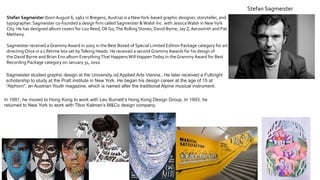
Stefan Sagmeister (born August 6, 1962 in Bregenz, Austria) is a NewYork-based graphic designer, storyteller, and
typographer. Sagmeister co-founded a design firm called Sagmeister &Walsh Inc. with JessicaWalsh in NewYork
City. He has designed album covers for Lou Reed, Ok Go,The Rolling Stones, David Byrne, Jay Z,Aerosmith and Pat
Metheny.
Sagmeister received a Grammy Award in 2005 in the Best Boxed of Special Limited Edition Package category for art
directing Once in a Lifetime box set byTalking Heads. He received a second Grammy Awards for his design of
the David Byrne and Brian Eno album EverythingThat HappensWill HappenToday in the Grammy Award for Best
Recording Package category on January 31, 2010.
Sagmeister studied graphic design at the University od Applied Arts Vienna.. He later received a Fulbright
scholarship to study at the Pratt institute in New York. He began his design career at the age of 15 at
“Alphorn", an Austrian Youth magazine, which is named after the traditional Alpine musical instrument.
In 1991, he moved to Hong Kong to work with Leo Burnett’s Hong Kong Design Group. In 1993, he
returned to New York to work with Tibor Kalman’s M&Co design company.
Things I Have Learned in My Life So Far
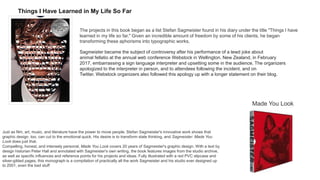
The projects in this book began as a list Stefan Sagmeister found in his diary under the title "Things I have
learned in my life so far." Given an incredible amount of freedom by some of his clients, he began
transforming these aphorisms into typographic works.
Sagmeister became the subject of controversy after his performance of a lewd joke about
animal fellatio at the annual web conference Webstock in Wellington, New Zealand, in February
2017, embarrassing a sign language interpreter and upsetting some in the audience. The organizers
apologized to the interpreter in person, and to attendees following the incident, and on
Twitter. Webstock organizers also followed this apology up with a longer statement on their blog.
Just as film, art, music, and literature have the power to move people, Stefan Sagmeister's innovative work shows that
graphic design, too, can cut to the emotional quick. His desire is to transform stale thinking, and Sagmeister: Made You
Look does just that.
Compelling, honest, and intensely personal, Made You Look covers 20 years of Sagmeister's graphic design. With a text by
design historian Peter Hall and annotated with Sagmeister's own writing, the book features images from the studio archive,
as well as specific influences and reference points for his projects and ideas. Fully illustrated with a red PVC slipcase and
silver-gilded pages, this monograph is a compilation of practically all the work Sagmeister and his studio ever designed up
to 2001, even the bad stuff
Made You Look
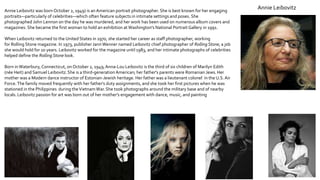
Annie LeibovitzAnnie Leibovitz was born October 2, 1949) is an American portrait photographer. She is best known for her engaging
portraits—particularly of celebrities—which often feature subjects in intimate settings and poses. She
photographed John Lennon on the day he was murdered, and her work has been used on numerous album covers and
magazines. She became the first woman to hold an exhibition at Washington's National Portrait Gallery in 1991.
When Leibovitz returned to the United States in 1970, she started her career as staff photographer, working
for Rolling Stone magazine. In 1973, publisher JannWenner named Leibovitz chief photographer of Rolling Stone, a job
she would hold for 10 years. Leibovitz worked for the magazine until 1983, and her intimate photographs of celebrities
helped define the Rolling Stone look.
Born inWaterbury, Connecticut, on October 2, 1949,Anna-Lou Leibovitz is the third of six children of Marilyn Edith
(née Heit) and Samuel Leibovitz.She is a third-generation American; her father's parents were Romanian Jews.Her
mother was a Modern dance instructor of Estonian-Jewish heritage. Her father was a lieutenant colonel in the U.S.Air
Force.The family moved frequently with her father's duty assignments, and she took her first pictures when he was
stationed in the Philippines during theVietnamWar.She took photographs around the military base and of nearby
locals.Leibovitz passion for art was born out of her mother's engagement with dance, music, and painting
Annie Leibovitz at Work
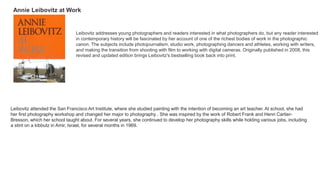
Leibovitz addresses young photographers and readers interested in what photographers do, but any reader interested
in contemporary history will be fascinated by her account of one of the richest bodies of work in the photographic
canon. The subjects include photojournalism, studio work, photographing dancers and athletes, working with writers,
and making the transition from shooting with film to working with digital cameras. Originally published in 2008, this
revised and updated edition brings Leibovitz's bestselling book back into print.
Leibovitz attended the San Francisco Art Institute, where she studied painting with the intention of becoming an art teacher. At school, she had
her first photography workshop and changed her major to photography . She was inspired by the work of Robert Frank and Henri Cartier-
Bresson, which her school taught about. For several years, she continued to develop her photography skills while holding various jobs, including
a stint on a kibbutz in Amir, Israel, for several months in 1969.

Fmp Theory

  • 1.
  • 2.
    Research Intentions What Iwill research is 3 different artist and will go in depth of their life what they did to get to where they are now, if they have any books about themselves or their work. Some images of their work too as I think its helpful when you can see their work. I’m thinking on researching photography and graphic design what the meaning is to them both and then find people who have businesses with them topics so I will do more graphic designs than photography as my work is focused more on graphic design than photography but I wanted to include that because I will be taking photos so I wanted to get some information about it to see what might help me when it comes to taking my pictures. I will try and include some booms about them if there is a book about some of their work with an image of them so you know who am on about so it’s a clearer picture when reading my work.
  • 3.
    Graphic Design A graphicdesigner is a professional within the graphic design and graphic arts industry who assembles together images, typography, or motion graphics to create a piece of design.A graphic designer creates the graphics primarily for published, printed or electronic media, such as brochures (sometimes) and advertising.They are also sometimes responsible for typesetting, illustration, user interfaces, and web design.A core responsibility of the designer's job is to present information in a way that is both accessible and memorable. Covers a number of basic graphic design principles, including balance, contrast, emphasis and subordination, directional forces, proportion, scale, repetition and rhythm, and unity, all with illustrations. Discusses how important balance is to creating an effective design. Photography The word "photography" was created from the Greek roots. Photography is the art, application and practice of creating durable images by recording light or other electromagnetic radiation, either electronically by means of an images sensor, or chemically by means of a light-sensitive material such as photographic film. It is employed in many fields of science, manufacturing (e.g., photolithography), and business, as well as its more direct uses for art, film and video production, recreational purposes, hobby, and mass communication.
  • 4.
    Milton Glaser (bornJune 26, 1929). Was born inThe Bronx, NewYork, to Hungarian Jewish immigrants. Glaser is an American graphic designer. His designs include the I ‘heart’ NY logo, the psychedelic Bob Dylan poster, and the logos for DC Comics and Brooklyn Brewery. His artwork has been featured in exhibits, and placed in permanent collections in many museums worldwide.Throughout his long career, he has designed many posters, publications and architectural designs. He has received many awards for his work, including the National Medal of the Arts award from President Barack Obama in 2009, and was the first graphic designer to receive this award. Over his career, Glaser has personally designed and illustrated more than 300 poster. His work is displayed in the Cooper Hewitt Design Museum, NewYork; theVictoria and Albert Museum, London; and the Israel Museum, Jerusalem. His work has also been featured in exhibits all over the world. He has also done one-man shows at the Centre Georges Pompidou in Paris and the Museum of Modern Art in NewYork City. In 2004, Glaser won a National Design Award Lifetime Achievement from the Cooper-Hewitt National Design Museum for his profound and meaningful long-term contributions to the contemporary practice of design. In 2009, he was awarded the National Medal of Arts by President Barack Obama and Mrs. Michelle Obama at the White House. Milton Glaser
  • 5.
    Twenty years after"Milton Glaser Graphic Design", the longest-selling design book in publishing history, the distinguished designer looks to the future. Examples of well-known projects abound, from newspapers and magazines to toys, textiles, interiors, posters, and CD covers. 500 full-colour illustrations. Art is Work After graduating at the Cooper Union in New York City, Reynold Ruffins, Seymour Chwast, Edward Sorel and Glaser, founded Push Pin Studios in 1954. Glaser joined after his return in Italy. In 1957, the "Push Pin Monthly Graphic," was sent out to friends and clients. They rejected tradition and favoured "reinvigorated interpretations of historical styles." The studio "redefined and expanded the imprimatur of the designer, illustrator, and visual culture at large." His work has also been featured in exhibits all over the world. He has also done one-man shows at the Centre Georges Pompidou in Paris and the Museum of Modern Art in New York City. A tribute to Glaser, still working in his 90th year, was published in the New York Times in 2019. https://www.amazon.co.uk/Art-Work-Graphic-Interiors-Illustration/dp/0715637584
  • 6.
    Stefan Sagmeister Stefan Sagmeister(born August 6, 1962 in Bregenz, Austria) is a NewYork-based graphic designer, storyteller, and typographer. Sagmeister co-founded a design firm called Sagmeister &Walsh Inc. with JessicaWalsh in NewYork City. He has designed album covers for Lou Reed, Ok Go,The Rolling Stones, David Byrne, Jay Z,Aerosmith and Pat Metheny. Sagmeister received a Grammy Award in 2005 in the Best Boxed of Special Limited Edition Package category for art directing Once in a Lifetime box set byTalking Heads. He received a second Grammy Awards for his design of the David Byrne and Brian Eno album EverythingThat HappensWill HappenToday in the Grammy Award for Best Recording Package category on January 31, 2010. Sagmeister studied graphic design at the University od Applied Arts Vienna.. He later received a Fulbright scholarship to study at the Pratt institute in New York. He began his design career at the age of 15 at “Alphorn", an Austrian Youth magazine, which is named after the traditional Alpine musical instrument. In 1991, he moved to Hong Kong to work with Leo Burnett’s Hong Kong Design Group. In 1993, he returned to New York to work with Tibor Kalman’s M&Co design company.
  • 7.
    Things I HaveLearned in My Life So Far The projects in this book began as a list Stefan Sagmeister found in his diary under the title "Things I have learned in my life so far." Given an incredible amount of freedom by some of his clients, he began transforming these aphorisms into typographic works. Sagmeister became the subject of controversy after his performance of a lewd joke about animal fellatio at the annual web conference Webstock in Wellington, New Zealand, in February 2017, embarrassing a sign language interpreter and upsetting some in the audience. The organizers apologized to the interpreter in person, and to attendees following the incident, and on Twitter. Webstock organizers also followed this apology up with a longer statement on their blog. Just as film, art, music, and literature have the power to move people, Stefan Sagmeister's innovative work shows that graphic design, too, can cut to the emotional quick. His desire is to transform stale thinking, and Sagmeister: Made You Look does just that. Compelling, honest, and intensely personal, Made You Look covers 20 years of Sagmeister's graphic design. With a text by design historian Peter Hall and annotated with Sagmeister's own writing, the book features images from the studio archive, as well as specific influences and reference points for his projects and ideas. Fully illustrated with a red PVC slipcase and silver-gilded pages, this monograph is a compilation of practically all the work Sagmeister and his studio ever designed up to 2001, even the bad stuff Made You Look
  • 8.
    Annie LeibovitzAnnie Leibovitzwas born October 2, 1949) is an American portrait photographer. She is best known for her engaging portraits—particularly of celebrities—which often feature subjects in intimate settings and poses. She photographed John Lennon on the day he was murdered, and her work has been used on numerous album covers and magazines. She became the first woman to hold an exhibition at Washington's National Portrait Gallery in 1991. When Leibovitz returned to the United States in 1970, she started her career as staff photographer, working for Rolling Stone magazine. In 1973, publisher JannWenner named Leibovitz chief photographer of Rolling Stone, a job she would hold for 10 years. Leibovitz worked for the magazine until 1983, and her intimate photographs of celebrities helped define the Rolling Stone look. Born inWaterbury, Connecticut, on October 2, 1949,Anna-Lou Leibovitz is the third of six children of Marilyn Edith (née Heit) and Samuel Leibovitz.She is a third-generation American; her father's parents were Romanian Jews.Her mother was a Modern dance instructor of Estonian-Jewish heritage. Her father was a lieutenant colonel in the U.S.Air Force.The family moved frequently with her father's duty assignments, and she took her first pictures when he was stationed in the Philippines during theVietnamWar.She took photographs around the military base and of nearby locals.Leibovitz passion for art was born out of her mother's engagement with dance, music, and painting
  • 9.
    Annie Leibovitz atWork Leibovitz addresses young photographers and readers interested in what photographers do, but any reader interested in contemporary history will be fascinated by her account of one of the richest bodies of work in the photographic canon. The subjects include photojournalism, studio work, photographing dancers and athletes, working with writers, and making the transition from shooting with film to working with digital cameras. Originally published in 2008, this revised and updated edition brings Leibovitz's bestselling book back into print. Leibovitz attended the San Francisco Art Institute, where she studied painting with the intention of becoming an art teacher. At school, she had her first photography workshop and changed her major to photography . She was inspired by the work of Robert Frank and Henri Cartier- Bresson, which her school taught about. For several years, she continued to develop her photography skills while holding various jobs, including a stint on a kibbutz in Amir, Israel, for several months in 1969.

Editor's Notes

  • #3 What you will research, how it will help you, what you hope to take away from each piece. Also consider referencing potential experiments and other research you may conduct (primary/secondary etc.)