
Market Research
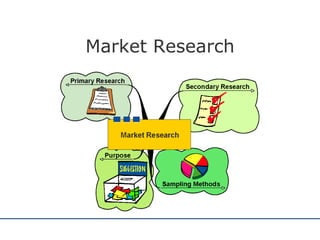
Market Research
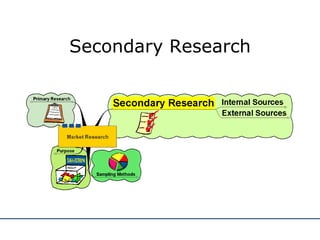
Secondary Research
Internal Sources Company Accounts Internal Reports and Analysis Stock Analysis Retail data - loyalty cards, till data, etc.
External Sources Government Statistics (ONS) EU - Euro Stat Trade publications Commercial Data - Gallup, Mintel, etc. Household Expenditure Survey Magazine surveys Other firms’ research Research documents – publications, journals, etc.
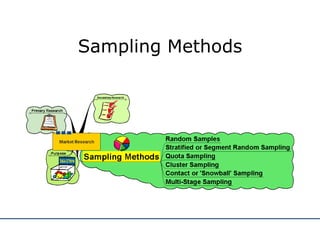
Sampling Methods
Market Research Sampling Methods: Random Samples  – equal chance of anyone being picked May select those not in the target group – indiscriminate Sample sizes may need to be large to be representative Can be very expensive
Market Research Stratified or Segment Random Sampling Samples on the basis of a representative strata or segment Still random but more focussed May give more relevant information May be more cost effective
Market Research Quota Sampling Again – by segment Not randomly selected Specific number on each segment are interviewed, etc. May not be fully representative Cheaper method
Market Research Cluster Sampling Primarily based on geographical areas or ‘clusters’ that can be seen as being representative of the whole population Multi-Stage Sampling Sample selected from multi stage sub-groups Snowball Sampling Samples developed from contacts of existing customers – ‘word of mouth’ type approach!
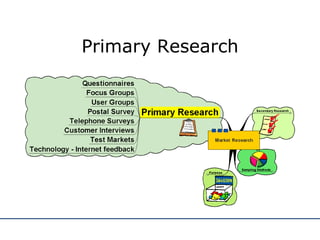
Primary Research
Market Research Primary Research First hand information Expensive to collect, analyse and evaluate Can be highly focussed and relevant Care needs to be taken with the approach and methodology to ensure accuracy Types of question – closed – limited information gained; open – useful information but difficult to analyse
Market Research Quantitative and Qualitative Information: Quantitative  – based on numbers – 56% of 18 year olds drink alcohol at least four times a week - doesn’t tell you why, when, how Qualitative  – more detail – tells you why, when and how!
Purpose
Market Research Advantages of Market Research Helps focus attention on objectives Aids forecasting, planning and strategic development May help to reduce risk of new product development Communicates image, vision, etc.  Globalisation makes market information valuable (HSBC adverts!!)
Market Research Disadvantages of Market Research Information only as good as the methodology used Can be inaccurate or unreliable Results may not be what the business wants to hear! May stifle initiative and ‘gut feeling’ Always a problem that we may never know enough to be sure!
Market Research Methods in Travel and Tourism BTEC Travel and Tourism
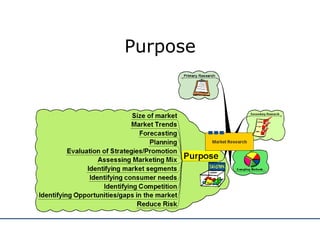
Why Do Market Research? Market research is commonly seen as finding out if a product or service will be successful But there is more to it than that Market research can have many different purposes
Research Purposes To identify customer needs and then meet those needs To learn about customer attitudes and values To help develop products and services that meet identified needs
Research Purposes To discover sales trends To find out about competitors’ activities To measure the effectiveness of promotional activity To classify customers into groups or types
How Is It Done? Unique research that uses surveys, interviews and questionnaires to find out about markets This is known as ‘primary’ research Using existing information such as internal or external records and statistics to learn more about markets This is called ‘secondary’ research
Why Use Different Methods? Each different method has its advantages and disadvantages Each may only be appropriate in certain circumstances Users need to work out if the method is right for them according to its cost, reliability, validity, accessibility and the time it will take to gather
What Now? Go to the Activity that accompanies this Presentation to find out more about how market research is used in the travel and tourism industry

Market Research

  • 1.
  • 2.
  • 3.
  • 4.
    Internal Sources CompanyAccounts Internal Reports and Analysis Stock Analysis Retail data - loyalty cards, till data, etc.
  • 5.
    External Sources GovernmentStatistics (ONS) EU - Euro Stat Trade publications Commercial Data - Gallup, Mintel, etc. Household Expenditure Survey Magazine surveys Other firms’ research Research documents – publications, journals, etc.
  • 6.
  • 7.
    Market Research SamplingMethods: Random Samples – equal chance of anyone being picked May select those not in the target group – indiscriminate Sample sizes may need to be large to be representative Can be very expensive
  • 8.
    Market Research Stratifiedor Segment Random Sampling Samples on the basis of a representative strata or segment Still random but more focussed May give more relevant information May be more cost effective
  • 9.
    Market Research QuotaSampling Again – by segment Not randomly selected Specific number on each segment are interviewed, etc. May not be fully representative Cheaper method
  • 10.
    Market Research ClusterSampling Primarily based on geographical areas or ‘clusters’ that can be seen as being representative of the whole population Multi-Stage Sampling Sample selected from multi stage sub-groups Snowball Sampling Samples developed from contacts of existing customers – ‘word of mouth’ type approach!
  • 11.
  • 12.
    Market Research PrimaryResearch First hand information Expensive to collect, analyse and evaluate Can be highly focussed and relevant Care needs to be taken with the approach and methodology to ensure accuracy Types of question – closed – limited information gained; open – useful information but difficult to analyse
  • 13.
    Market Research Quantitativeand Qualitative Information: Quantitative – based on numbers – 56% of 18 year olds drink alcohol at least four times a week - doesn’t tell you why, when, how Qualitative – more detail – tells you why, when and how!
  • 14.
  • 15.
    Market Research Advantagesof Market Research Helps focus attention on objectives Aids forecasting, planning and strategic development May help to reduce risk of new product development Communicates image, vision, etc. Globalisation makes market information valuable (HSBC adverts!!)
  • 16.
    Market Research Disadvantagesof Market Research Information only as good as the methodology used Can be inaccurate or unreliable Results may not be what the business wants to hear! May stifle initiative and ‘gut feeling’ Always a problem that we may never know enough to be sure!
  • 17.
    Market Research Methodsin Travel and Tourism BTEC Travel and Tourism
  • 18.
    Why Do MarketResearch? Market research is commonly seen as finding out if a product or service will be successful But there is more to it than that Market research can have many different purposes
  • 19.
    Research Purposes Toidentify customer needs and then meet those needs To learn about customer attitudes and values To help develop products and services that meet identified needs
  • 20.
    Research Purposes Todiscover sales trends To find out about competitors’ activities To measure the effectiveness of promotional activity To classify customers into groups or types
  • 21.
    How Is ItDone? Unique research that uses surveys, interviews and questionnaires to find out about markets This is known as ‘primary’ research Using existing information such as internal or external records and statistics to learn more about markets This is called ‘secondary’ research
  • 22.
    Why Use DifferentMethods? Each different method has its advantages and disadvantages Each may only be appropriate in certain circumstances Users need to work out if the method is right for them according to its cost, reliability, validity, accessibility and the time it will take to gather
  • 23.
    What Now? Goto the Activity that accompanies this Presentation to find out more about how market research is used in the travel and tourism industry