Talking about the future
Present continuous for near future
• Dates, appointments, arrangements,
definite plans …
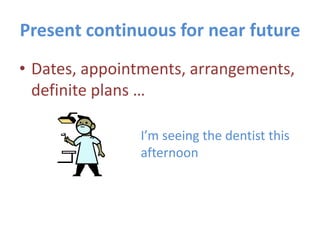
I’m seeing the dentist this
afternoon
Present continuous for near future
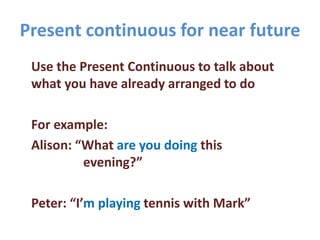
Use the Present Continuous to talk about
what you have already arranged to do
For example:
Alison: “What are you doing this
evening?”
Peter: “I’m playing tennis with Mark”
Present continuous for near future
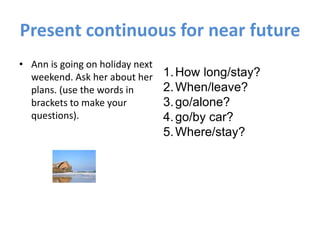
• Ann is going on holiday next
weekend. Ask her about her
plans. (use the words in
brackets to make your
questions).
1.How long/stay?
2.When/leave?
3.go/alone?
4.go/by car?
5.Where/stay?
Present continuous for near future
• How long are you staying?
• When are you leaving?
• Are you going alone?
• Are you going by car?
• Where are you staying?
Present continuous or “going to”
We prefer to use the present continuous when
we say what someone has arranged to do, but
“going to” is also possible.
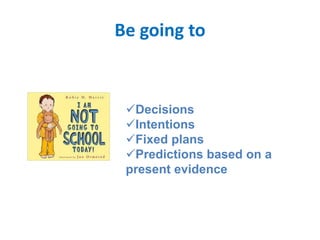
Be going to
Decisions
Intentions
Fixed plans
Predictions based on a
present evidence
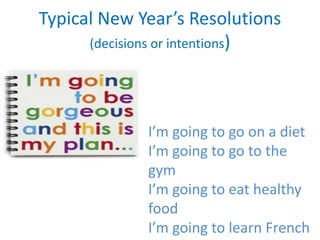
Typical New Year’s Resolutions
(decisions or intentions)
I’m going to go on a diet
I’m going to go to the
gym
I’m going to eat healthy
food
I’m going to learn French
Fixed plans
• Future actions which we have already decided
about:
Next July I am going to work in a restaurant
They’re going to stay here for at least a year
She is going to rent a house here
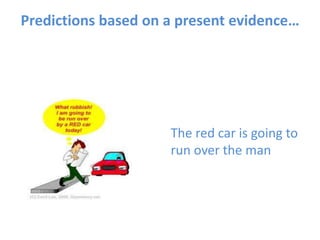
Predictions based on a present evidence…
The red car is going to
run over the man
Now write your own examples:
“GOING TO” for:
• Intentions
• Resolutions
• Fixed plans
• Predictions based on a present evidence
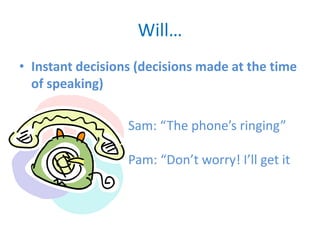
Will…
• Instant decisions (decisions made at the time
of speaking)
Sam: “The phone’s ringing”
Pam: “Don’t worry! I’ll get it
Will…
• We use “will” for anything which is uncertain,
especially with probably, maybe, I think, I
expect and I hope
– I probably won’t be back in time
– I think I’ll get a meal in town
Will…
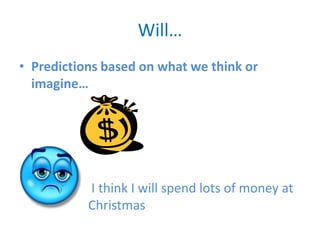
• Predictions based on what we think or
imagine…
I think I will spend lots of money at
Christmas
Will…
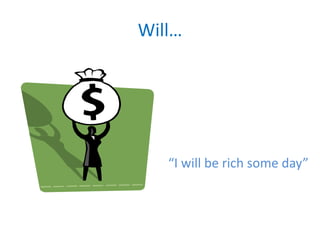
“I will be rich some day”
Will…
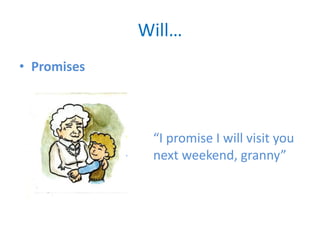
• Promises
“I promise I will visit you
next weekend, granny”
Will…
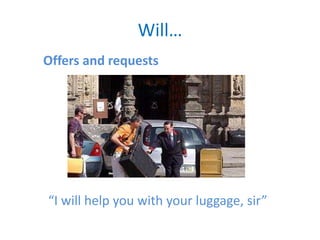
Offers and requests
“I will help you with your luggage, sir”

Talking about the future

  • 1.
  • 2.
    Present continuous fornear future • Dates, appointments, arrangements, definite plans … I’m seeing the dentist this afternoon
  • 3.
    Present continuous fornear future Use the Present Continuous to talk about what you have already arranged to do For example: Alison: “What are you doing this evening?” Peter: “I’m playing tennis with Mark”
  • 4.
    Present continuous fornear future • Ann is going on holiday next weekend. Ask her about her plans. (use the words in brackets to make your questions). 1.How long/stay? 2.When/leave? 3.go/alone? 4.go/by car? 5.Where/stay?
  • 5.
    Present continuous fornear future • How long are you staying? • When are you leaving? • Are you going alone? • Are you going by car? • Where are you staying?
  • 6.
    Present continuous or“going to” We prefer to use the present continuous when we say what someone has arranged to do, but “going to” is also possible.
  • 7.
    Be going to Decisions Intentions Fixedplans Predictions based on a present evidence
  • 8.
    Typical New Year’sResolutions (decisions or intentions) I’m going to go on a diet I’m going to go to the gym I’m going to eat healthy food I’m going to learn French
  • 9.
    Fixed plans • Futureactions which we have already decided about: Next July I am going to work in a restaurant They’re going to stay here for at least a year She is going to rent a house here
  • 10.
    Predictions based ona present evidence… The red car is going to run over the man
  • 11.
    Now write yourown examples: “GOING TO” for: • Intentions • Resolutions • Fixed plans • Predictions based on a present evidence
  • 12.
    Will… • Instant decisions(decisions made at the time of speaking) Sam: “The phone’s ringing” Pam: “Don’t worry! I’ll get it
  • 13.
    Will… • We use“will” for anything which is uncertain, especially with probably, maybe, I think, I expect and I hope – I probably won’t be back in time – I think I’ll get a meal in town
  • 14.
    Will… • Predictions basedon what we think or imagine… I think I will spend lots of money at Christmas
  • 15.
    Will… “I will berich some day”
  • 16.
    Will… • Promises “I promiseI will visit you next weekend, granny”
  • 17.
    Will… Offers and requests “Iwill help you with your luggage, sir”