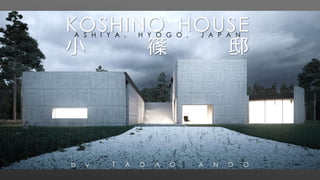
KOSHINO HOUSE
小 篠 邸
A S H I Y A , H Y O G O , J A P A N
b y T A D A O A N D O
“I don’t believe architecture has to speak too much.
It should remain silent and let nature in the
guise of sunlight and wind.”
-TADAO ANDO-
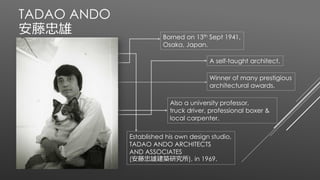
TADAO ANDO
安藤忠雄 Borned on 13th Sept 1941,
Osaka, Japan.
A self-taught architect.
Also a university professor,
truck driver, professional boxer &
local carpenter.
Established his own design studio,
TADAO ANDO ARCHITECTS
AND ASSOCIATES
(安藤忠雄建築研究所), in 1969.
Winner of many prestigious
architectural awards.
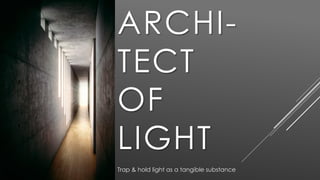
ARCHI-
TECT
OF
LIGHT
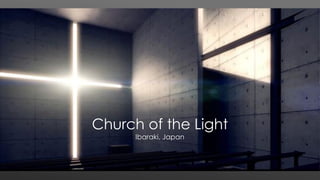
Trap & hold light as a tangible substance
Church of the Light
Ibaraki, Japan
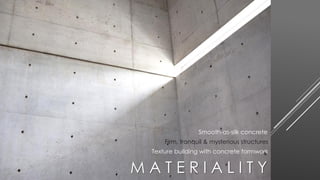
Smooth-as-silk concrete
Texture building with concrete formwork
Firm, tranquil & mysterious structures
M A T E R I A L I T Y
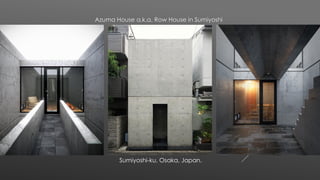
Azuma House a.k.a. Row House in Sumiyoshi
Sumiyoshi-ku, Osaka, Japan.
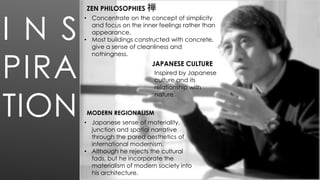
I N S
PIRA
TION
• Concentrate on the concept of simplicity
and focus on the inner feelings rather than
appearance.
• Most buildings constructed with concrete,
give a sense of cleanliness and
nothingness.
• Japanese sense of materiality,
junction and spatial narrative
through the pared aesthetics of
international modernism.
• Although he rejects the cultural
fads, but he incorporate the
materialism of modern society into
his architecture.
Inspired by Japanese
culture and its
relationship with
nature.
ZEN PHILOSOPHIES 禅
JAPANESE CULTURE
MODERN REGIONALISM
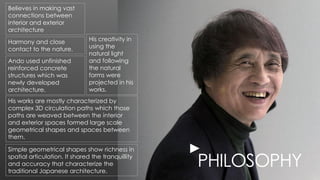
PHILOSOPHY
Simple geometrical shapes show richness in
spatial articulation. It shared the tranquillity
and accuracy that characterize the
traditional Japanese architecture.
►
Harmony and close
contact to the nature.
Believes in making vast
connections between
interior and exterior
architecture
His creativity in
using the
natural light
and following
the natural
forms were
projected in his
works.
His works are mostly characterized by
complex 3D circulation paths which those
paths are weaved between the interior
and exterior spaces formed large scale
geometrical shapes and spaces between
them.
Ando used unfinished
reinforced concrete
structures which was
newly developed
architecture.
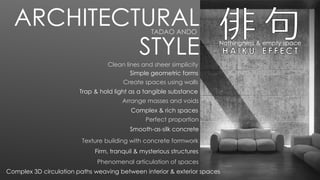
Nothingness & empty space
Clean lines and sheer simplicity
Simple geometric forms
Arrange masses and voids
Firm, tranquil & mysterious structures
Smooth-as-silk concrete
Create spaces using walls
Complex & rich spaces
Texture building with concrete formwork
Phenomenal articulation of spaces
Perfect proportion
Trap & hold light as a tangible substance
ARCHITECTURAL
STYLE
Complex 3D circulation paths weaving between interior & exterior spaces
TADAO ANDO
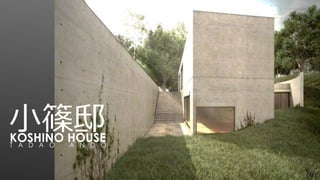
KOSHINO HOUSET A D A O A N D O
小篠邸
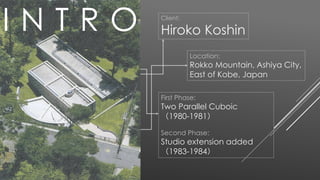
Client:
Hiroko Koshin
Location:
Rokko Mountain, Ashiya City,
East of Kobe, Japan
First Phase:
Two Parallel Cuboic
(1980-1981)
Second Phase:
Studio extension added
(1983-1984)
I N T R O
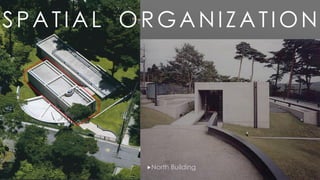
North Building
SPATIAL ORGANIZATION
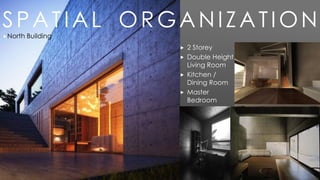
North Building
 2 Storey
 Double Height
Living Room
 Kitchen /
Dining Room
 Master
Bedroom
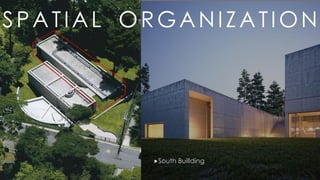
SPATIAL ORGANIZATION
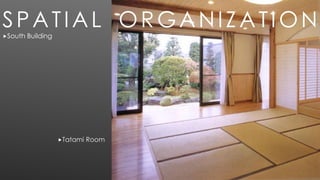
South Buillding
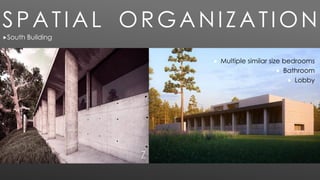
SPATIAL ORGANIZATION
 Multiple similar size bedrooms
 Bathroom
 Lobby
South Building
SPATIAL ORGANIZATION
Tatami Room
South Building
SPATIAL ORGANIZATION
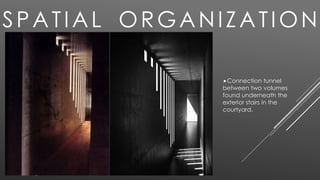
Connection tunnel
between two volumes
found underneath the
exterior stairs in the
courtyard.
SPATIAL ORGANIZATION
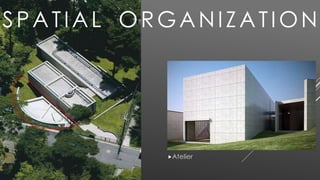
Atelier
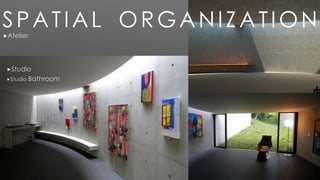
SPATIAL ORGANIZATIONAtelier
Studio
Studio Bathroom
M A T E R I A L
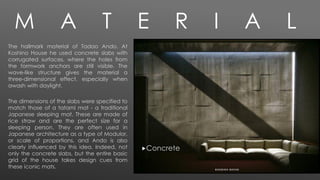
The hallmark material of Tadao Ando. At
Koshino House he used concrete slabs with
corrugated surfaces, where the holes from
the formwork anchors are still visible. The
wave-like structure gives the material a
three-dimensional effect, especially when
awash with daylight.
The dimensions of the slabs were specified to
match those of a tatami mat - a traditional
Japanese sleeping mat. These are made of
rice straw and are the perfect size for a
sleeping person. They are often used in
Japanese architecture as a type of Modulor,
or scale of proportions, and Ando is also
clearly influenced by this idea. Indeed, not
only the concrete slabs, but the entire basic
grid of the house takes design cues from
these iconic mats.
Concrete
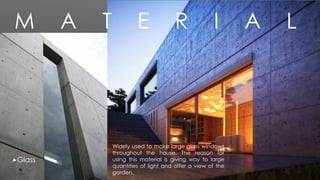
Widely used to make large glass windows
throughout the house. The reason for
using this material is giving way to large
quantities of light and offer a view of the
garden.
Glass
M A T E R I A L
D E S I G N
P R I N C I P L E S
Brutalism
Asymmetry
Non-separated
Alignment
D E S I G N
P R I N C I P L E S
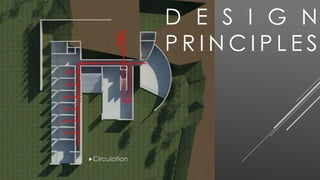
Circulation
D E S I G N
P R I N C I P L E S
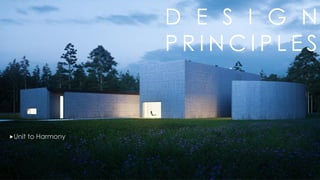
Unit to Harmony
D E S I G N
P R I N C I P L E S
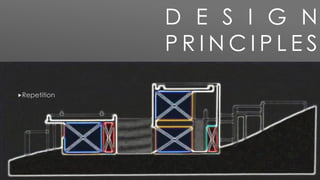
Repetition
D E S I G N
P R I N C I P L E S
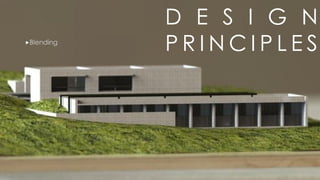
Blending
D E S I G N
P R I N C I P L E S
Joomun, N. (2015). Tadao Ando- Koshino house. Slideshare.net. Retrieved 30 March 2016, from
http://www.slideshare.net/nabeelajoomun/presentation-final-1-50381306
『安藤忠雄設計の「小篠邸」!』. (2012). とんとん・にっき. Retrieved 30 March 2016, from
http://ameblo.jp/tonton3/entry-11209696187.html
AD Classics: Koshino House / Tadao Ando. (2011). ArchDaily. Retrieved 30 March 2016, from
http://www.archdaily.com/161522/ad-classics-koshino-house-tadao-ando
Tadao Ando Facts, information, pictures | Encyclopedia.com articles about Tadao Ando.
(2016). Encyclopedia.com. Retrieved 30 March 2016, from
http://www.encyclopedia.com/topic/Tadao_Ando.aspx
建築家・安藤忠雄のページ+作品リンク集. (2016). Нет 大阪建築. Retrieved 30 March 2016, from
http://www.hetgallery.com/ando.html
Bhattacharjee, S. (2016). residences- gehry residence and koshino house. Slideshare.net. Retrieved 30 March
2016, from http://www.slideshare.net/SonakshiBhattacharjee/residences-gehry-residence-and-koshino-
house
Koshino House - Architecture of the World - WikiArquitectura. (2016). En.wikiarquitectura.com. Retrieved 30
March 2016, from https://en.wikiarquitectura.com/index.php/Koshino_House
Behance. (2016). Behance.net. Retrieved 30 March 2016, from
https://www.behance.net/gallery/23957891/Koshino-House-Study
Spotlight: Tadao Ando. (2015). ArchDaily. Retrieved 30 March 2016, from
http://www.archdaily.com/427695/happy-birthday-tadao-ando
Tadao Ando | foundations. (2016). Foundationsakc.com. Retrieved 30 March 2016, from
http://foundationsakc.com/people/legends/tadao-ando
Mirajkar, D. (2016). Minimalism ppt. Slideshare.net. Retrieved 30 March 2016, from
http://www.slideshare.net/DhanashriMirajkar1/minimalism-ppt-57790646
R E F F E R E N C E S

小篠邸Final

  • 1.
    KOSHINO HOUSE 小 篠邸 A S H I Y A , H Y O G O , J A P A N b y T A D A O A N D O
  • 2.
    “I don’t believearchitecture has to speak too much. It should remain silent and let nature in the guise of sunlight and wind.” -TADAO ANDO-
  • 3.
    TADAO ANDO 安藤忠雄 Bornedon 13th Sept 1941, Osaka, Japan. A self-taught architect. Also a university professor, truck driver, professional boxer & local carpenter. Established his own design studio, TADAO ANDO ARCHITECTS AND ASSOCIATES (安藤忠雄建築研究所), in 1969. Winner of many prestigious architectural awards.
  • 4.
    ARCHI- TECT OF LIGHT Trap & holdlight as a tangible substance
  • 5.
    Church of theLight Ibaraki, Japan
  • 6.
    Smooth-as-silk concrete Texture buildingwith concrete formwork Firm, tranquil & mysterious structures M A T E R I A L I T Y
  • 7.
    Azuma House a.k.a.Row House in Sumiyoshi Sumiyoshi-ku, Osaka, Japan.
  • 8.
    I N S PIRA TION •Concentrate on the concept of simplicity and focus on the inner feelings rather than appearance. • Most buildings constructed with concrete, give a sense of cleanliness and nothingness. • Japanese sense of materiality, junction and spatial narrative through the pared aesthetics of international modernism. • Although he rejects the cultural fads, but he incorporate the materialism of modern society into his architecture. Inspired by Japanese culture and its relationship with nature. ZEN PHILOSOPHIES 禅 JAPANESE CULTURE MODERN REGIONALISM
  • 9.
    PHILOSOPHY Simple geometrical shapesshow richness in spatial articulation. It shared the tranquillity and accuracy that characterize the traditional Japanese architecture. ► Harmony and close contact to the nature. Believes in making vast connections between interior and exterior architecture His creativity in using the natural light and following the natural forms were projected in his works. His works are mostly characterized by complex 3D circulation paths which those paths are weaved between the interior and exterior spaces formed large scale geometrical shapes and spaces between them. Ando used unfinished reinforced concrete structures which was newly developed architecture.
  • 10.
    Nothingness & emptyspace Clean lines and sheer simplicity Simple geometric forms Arrange masses and voids Firm, tranquil & mysterious structures Smooth-as-silk concrete Create spaces using walls Complex & rich spaces Texture building with concrete formwork Phenomenal articulation of spaces Perfect proportion Trap & hold light as a tangible substance ARCHITECTURAL STYLE Complex 3D circulation paths weaving between interior & exterior spaces TADAO ANDO
  • 11.
    KOSHINO HOUSET AD A O A N D O 小篠邸
  • 12.
    Client: Hiroko Koshin Location: Rokko Mountain,Ashiya City, East of Kobe, Japan First Phase: Two Parallel Cuboic (1980-1981) Second Phase: Studio extension added (1983-1984) I N T R O
  • 13.
  • 14.
    North Building  2Storey  Double Height Living Room  Kitchen / Dining Room  Master Bedroom SPATIAL ORGANIZATION
  • 15.
  • 16.
     Multiple similarsize bedrooms  Bathroom  Lobby South Building SPATIAL ORGANIZATION
  • 17.
  • 18.
    Connection tunnel between twovolumes found underneath the exterior stairs in the courtyard. SPATIAL ORGANIZATION
  • 19.
  • 20.
  • 21.
    M A TE R I A L The hallmark material of Tadao Ando. At Koshino House he used concrete slabs with corrugated surfaces, where the holes from the formwork anchors are still visible. The wave-like structure gives the material a three-dimensional effect, especially when awash with daylight. The dimensions of the slabs were specified to match those of a tatami mat - a traditional Japanese sleeping mat. These are made of rice straw and are the perfect size for a sleeping person. They are often used in Japanese architecture as a type of Modulor, or scale of proportions, and Ando is also clearly influenced by this idea. Indeed, not only the concrete slabs, but the entire basic grid of the house takes design cues from these iconic mats. Concrete
  • 22.
    Widely used tomake large glass windows throughout the house. The reason for using this material is giving way to large quantities of light and offer a view of the garden. Glass M A T E R I A L
  • 23.
    D E SI G N P R I N C I P L E S Brutalism
  • 24.
  • 25.
    Circulation D E SI G N P R I N C I P L E S
  • 26.
    Unit to Harmony DE S I G N P R I N C I P L E S
  • 27.
    Repetition D E SI G N P R I N C I P L E S
  • 28.
    Blending D E SI G N P R I N C I P L E S
  • 29.
    Joomun, N. (2015).Tadao Ando- Koshino house. Slideshare.net. Retrieved 30 March 2016, from http://www.slideshare.net/nabeelajoomun/presentation-final-1-50381306 『安藤忠雄設計の「小篠邸」!』. (2012). とんとん・にっき. Retrieved 30 March 2016, from http://ameblo.jp/tonton3/entry-11209696187.html AD Classics: Koshino House / Tadao Ando. (2011). ArchDaily. Retrieved 30 March 2016, from http://www.archdaily.com/161522/ad-classics-koshino-house-tadao-ando Tadao Ando Facts, information, pictures | Encyclopedia.com articles about Tadao Ando. (2016). Encyclopedia.com. Retrieved 30 March 2016, from http://www.encyclopedia.com/topic/Tadao_Ando.aspx 建築家・安藤忠雄のページ+作品リンク集. (2016). Нет 大阪建築. Retrieved 30 March 2016, from http://www.hetgallery.com/ando.html Bhattacharjee, S. (2016). residences- gehry residence and koshino house. Slideshare.net. Retrieved 30 March 2016, from http://www.slideshare.net/SonakshiBhattacharjee/residences-gehry-residence-and-koshino- house Koshino House - Architecture of the World - WikiArquitectura. (2016). En.wikiarquitectura.com. Retrieved 30 March 2016, from https://en.wikiarquitectura.com/index.php/Koshino_House Behance. (2016). Behance.net. Retrieved 30 March 2016, from https://www.behance.net/gallery/23957891/Koshino-House-Study Spotlight: Tadao Ando. (2015). ArchDaily. Retrieved 30 March 2016, from http://www.archdaily.com/427695/happy-birthday-tadao-ando Tadao Ando | foundations. (2016). Foundationsakc.com. Retrieved 30 March 2016, from http://foundationsakc.com/people/legends/tadao-ando Mirajkar, D. (2016). Minimalism ppt. Slideshare.net. Retrieved 30 March 2016, from http://www.slideshare.net/DhanashriMirajkar1/minimalism-ppt-57790646 R E F F E R E N C E S