1983-1999
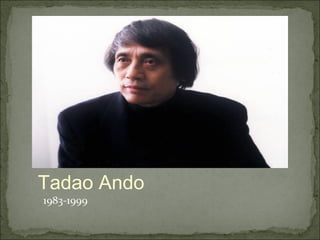
Tadao Ando
He believed that the way people
live can be little directed by
architecture.
“ You cant really say what is
beautiful about a place, but the
image of the place remains vividly
within you..”
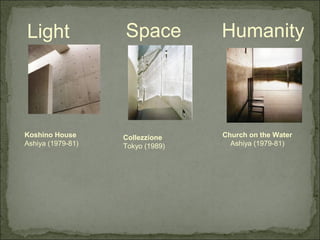
Church on the Water
Ashiya (1979-81)
Collezzione
Tokyo (1989)
Light Space Humanity
Koshino House
Ashiya (1979-81)
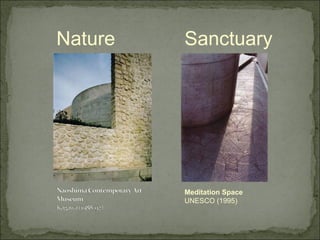
Meditation Space
UNESCO (1995)
Nature Sanctuary
Ando has a strong background in Japanese culture. He was
raised in Japan and lives there. Japanese religion and style
of life strongly influenced his architecture and design.
Ando's architectural style is said to create a "haiku" effect,
emphasizing nothingness and empty space to represent the
beauty of simplicity. He favors designing complex spatial
circulation while maintaining the appearance of simplicity. A
self-taught architect, he keeps his Japanese culture and
language in mind while he travels around Europe for
research. As an architect, he believes that architecture can
change society, that "to change the dwelling is to change
the city and to reform society". "Reform society" could be a
promotion of a place or a change of the identity of that
place. According to Werner Blaser, "Good buildings by
Tadao Ando create memorable identity and therefore
publicity, which in turn attracts the public and promotes
market penetration".
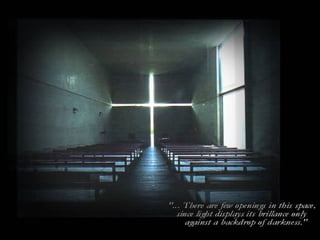
For Ando, Light is an architecture of duality – the dual
nature of [co]existence – solid/void, light/dark,
stark/serene. The coexisting differences leave the
church void of any, and all, ornament creating a pure,
unadorned space. The intersection of light and solid
raises the occupants awareness of the spiritual and
secular within themselves.
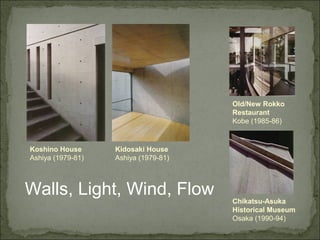
Walls, Light, Wind, Flow
Koshino House
Ashiya (1979-81)
Kidosaki House
Ashiya (1979-81)
Old/New Rokko
Restaurant
Kobe (1985-86)
Chikatsu-Asuka
Historical Museum
Osaka (1990-94)
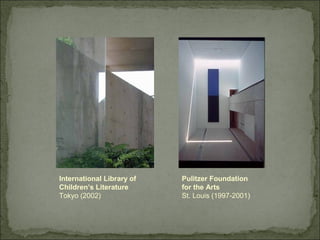
International Library of
Children’s Literature
Tokyo (2002)
Pulitzer Foundation
for the Arts
St. Louis (1997-2001)
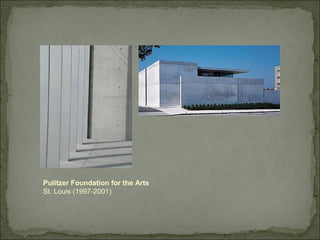
Pulitzer Foundation for the Arts
St. Louis (1997-2001)
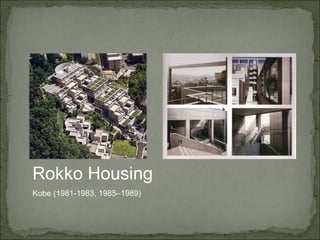
Rokko Housing
Kobe (1981-1983, 1985–1989)
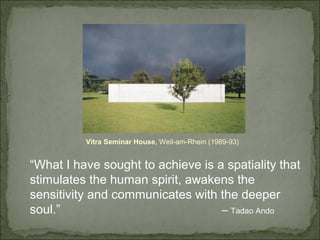
Vitra Seminar House, Weil-am-Rhein (1989-93)
“What I have sought to achieve is a spatiality that
stimulates the human spirit, awakens the
sensitivity and communicates with the deeper
soul.” – Tadao Ando
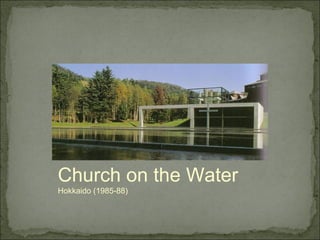
Church on the Water
Hokkaido (1985-88)
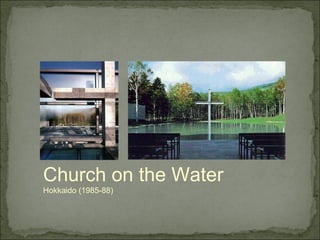
Church on the Water
Hokkaido (1985-88)
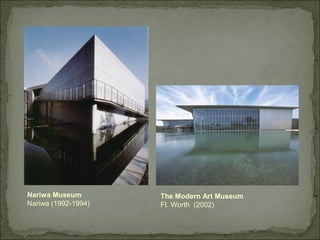
Nariwa Museum
Nariwa (1992-1994)
The Modern Art Museum
Ft. Worth (2002)
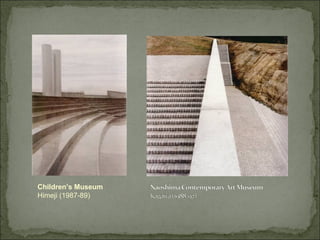
Children’s Museum
Himeji (1987-89)
Light is the origin of all being. Light gives with each
moment new form to being and new interrelationship
to things and architecture condenses light to its most
concise being. The creation of space in architecture is
simply the condensation and purification of the power
of light.
“I do not believe architecture should speak too much.
It should remain silent and let nature in the guise of
sunlight and wind speak”
Creates spaces that respond to human needs and
spirit juxtaposing powerful concrete walls with light
and nature, deep sense of peace, simple materials and
geometry.

Tadao ando-powerpoint-presentation

  • 3.
  • 4.
    He believed thatthe way people live can be little directed by architecture. “ You cant really say what is beautiful about a place, but the image of the place remains vividly within you..”
  • 5.
    Church on theWater Ashiya (1979-81) Collezzione Tokyo (1989) Light Space Humanity Koshino House Ashiya (1979-81)
  • 6.
  • 7.
    Ando has astrong background in Japanese culture. He was raised in Japan and lives there. Japanese religion and style of life strongly influenced his architecture and design. Ando's architectural style is said to create a "haiku" effect, emphasizing nothingness and empty space to represent the beauty of simplicity. He favors designing complex spatial circulation while maintaining the appearance of simplicity. A self-taught architect, he keeps his Japanese culture and language in mind while he travels around Europe for research. As an architect, he believes that architecture can change society, that "to change the dwelling is to change the city and to reform society". "Reform society" could be a promotion of a place or a change of the identity of that place. According to Werner Blaser, "Good buildings by Tadao Ando create memorable identity and therefore publicity, which in turn attracts the public and promotes market penetration".
  • 8.
    For Ando, Lightis an architecture of duality – the dual nature of [co]existence – solid/void, light/dark, stark/serene. The coexisting differences leave the church void of any, and all, ornament creating a pure, unadorned space. The intersection of light and solid raises the occupants awareness of the spiritual and secular within themselves.
  • 10.
    Walls, Light, Wind,Flow Koshino House Ashiya (1979-81) Kidosaki House Ashiya (1979-81) Old/New Rokko Restaurant Kobe (1985-86) Chikatsu-Asuka Historical Museum Osaka (1990-94)
  • 11.
    International Library of Children’sLiterature Tokyo (2002) Pulitzer Foundation for the Arts St. Louis (1997-2001)
  • 12.
    Pulitzer Foundation forthe Arts St. Louis (1997-2001)
  • 13.
  • 14.
    Vitra Seminar House,Weil-am-Rhein (1989-93) “What I have sought to achieve is a spatiality that stimulates the human spirit, awakens the sensitivity and communicates with the deeper soul.” – Tadao Ando
  • 15.
    Church on theWater Hokkaido (1985-88)
  • 16.
    Church on theWater Hokkaido (1985-88)
  • 17.
    Nariwa Museum Nariwa (1992-1994) TheModern Art Museum Ft. Worth (2002)
  • 18.
  • 19.
    Light is theorigin of all being. Light gives with each moment new form to being and new interrelationship to things and architecture condenses light to its most concise being. The creation of space in architecture is simply the condensation and purification of the power of light.
  • 20.
    “I do notbelieve architecture should speak too much. It should remain silent and let nature in the guise of sunlight and wind speak” Creates spaces that respond to human needs and spirit juxtaposing powerful concrete walls with light and nature, deep sense of peace, simple materials and geometry.

Editor's Notes

  • #4 Born in 1941 in Osaka, Japan Carpenter Self-taught Architect Apprenticed, but mostly traveled and drew Influenced by Le Corbusier, Mies van der Rohe, Alvar Aalto, Frank Lloyd Wright and Louis Kahn
  • #6 Architect of Light Master of Space Builder for Humanity
  • #7 Unifies Building and Nature to create deep sense of Sanctuary
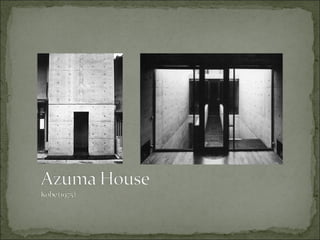
  • #10 Opened own firm 1969 Became known with Azuma House Narrow Private barrier Open to nature Return to traditional Japanese life-style of contact with light, air, rain and other natural elements Connect building to life that will be lived there
  • #11 Independent of movements or schools of architecture Key elements: walls, light, wind, and flow Juxtaposition Private zone against urban chaos
  • #12 Uses glass and play of light and wind to bring calming nature inside Timeless and Universal
  • #13 Primary material = Concrete Precisely crafted wooden forms Varnished and polished\ Smooth as silk
  • #14 1980s Complex of apartments Modular cubes 18’ Central stair Unique apartments
  • #15 The Box that provokes “I do not believe architecture should speak too much. It should remain silent and let nature in the guise of sunlight and wind speak” Creates spaces that respond to human needs and spirit Juxtaposing powerful concrete walls with light and nature Deep sense of peace Simple materials and geometry Exquisite body of work
  • #16 Importance of water Set in wooded hills
  • #17 Enter into glass cube room Descend darkened curved stairway Open to dramatic vista Cross in water Open end to nature
  • #18 Water used in other works Nawira Museum entry ramp Modern rises from water
  • #19 Water also creates paths Paths an important theme Children’s Museum = waterfall terraces Naoshima = wide stairway and diagonals lead to top 1995 Pritzker Prize