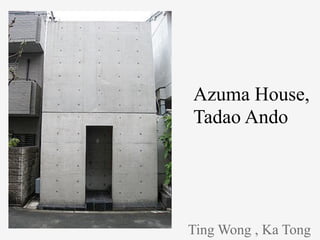
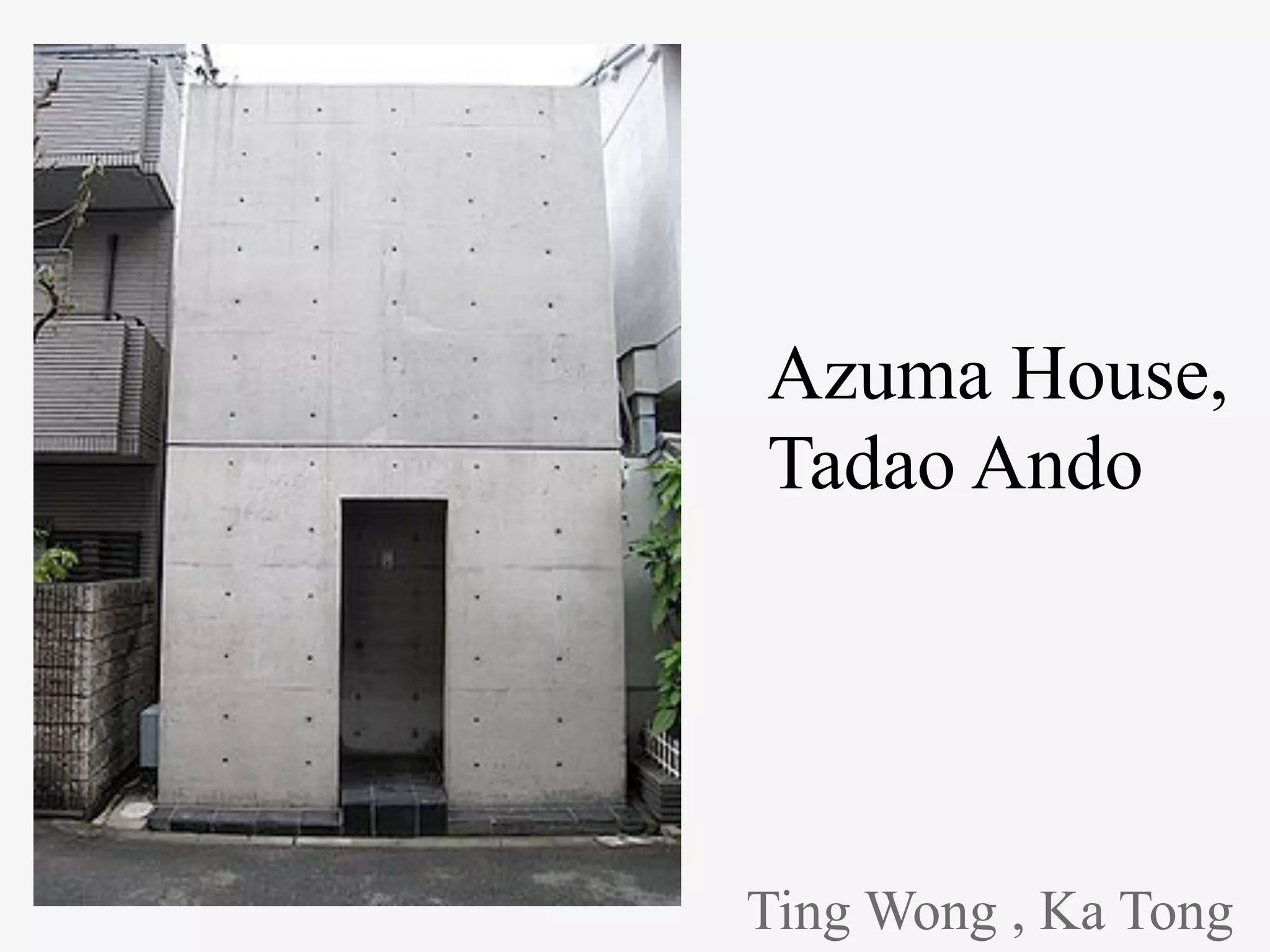
Azuma House,
Tadao Ando


Ting Wong , Ka Tong
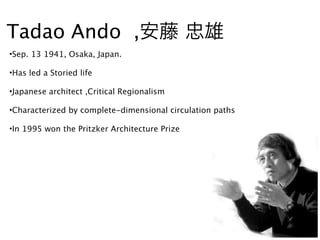
Tadao Ando ,安藤 忠雄
•Sep. 13 1941, Osaka, Japan.

•Has led a Storied life

•Japanese architect ,Critical Regionalism

•Characterized by complete-dimensional circulation paths

•In 1995 won the Pritzker Architecture Prize
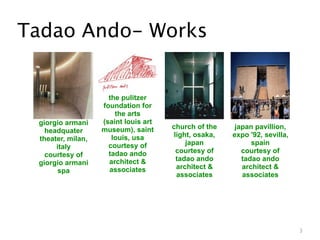
Tadao Ando- Works


                     the pulitzer
                   foundation for
                       the arts
 giorgio armani    (saint louis art
                   museum), saint     church of the    japan pavillion,
   headquater
                      louis, usa      light, osaka,   expo '92, sevilla,
 theater, milan,
                     courtesy of          japan             spain
      italy
                     tadao ando        courtesy of       courtesy of
   courtesy of
                     architect &       tadao ando        tadao ando
 giorgio armani
                     associates        architect &       architect &
       spa
                                       associates        associates


                                                                           3
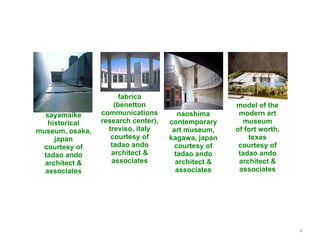
fabrica
                     (benetton                       model of the
  sayamaike      communications         naoshima      modern art
   historical    research center),   contemporary      museum
museum, osaka,     treviso, italy     art museum,    of fort worth,
     japan          courtesy of      kagawa, japan       texas
 courtesy of        tadao ando        courtesy of     courtesy of
  tadao ando        architect &        tadao ando     tadao ando
  architect &       associates         architect &    architect &
  associates                           associates     associates


                                                                      4
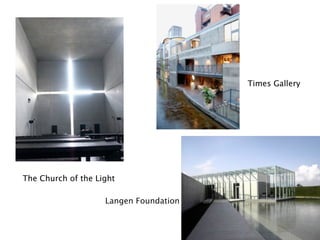
Times Gallery


The Church of the Light

                    Langen Foundation
Azuma House 住吉の長屋
•   Introduction
•   One of the earliest works
    of the self-taught architect
    Tadao Ando is the Azuma
    House in Sumiyoshi, where
    the house is split into a
    spaces devoted to daily life
    (composed of an austere
    geometry) by the insertion
    of an abstract space for
    the games of wind and
    light. His goal, he says,
    was to introduce a
    question on the inertia that
    has invaded human
    dwellings.
•   Situation
•   Located in Sumiyoshi,
    Osaka, Azuma House
    replaces one of the
    traditional houses in the
    area built in wood. While
    this area is not the most
    chaotic of the city, there
    is a clear contrast
    between this "concrete
    box" and its surrounding
    buildings.


                                 7
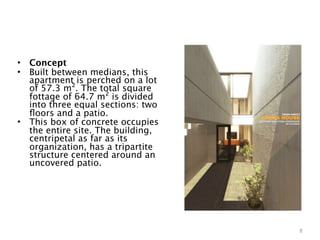
•   Concept
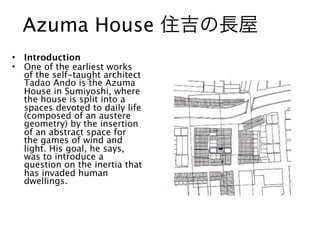
•   Built between medians, this
    apartment is perched on a lot
    of 57.3 m². The total square
    fottage of 64.7 m² is divided
    into three equal sections: two
    floors and a patio.
•   This box of concrete occupies
    the entire site. The building,
    centripetal as far as its
    organization, has a tripartite
    structure centered around an
    uncovered patio.


                                     8
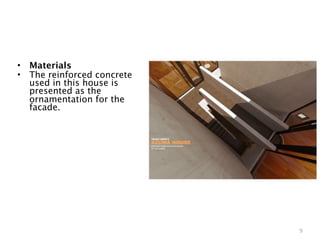
•   Materials
•   The reinforced concrete
    used in this house is
    presented as the
    ornamentation for the
    facade.


                              9
•   http://www.youtube.com/watch?
    v=5wGUIol3bko
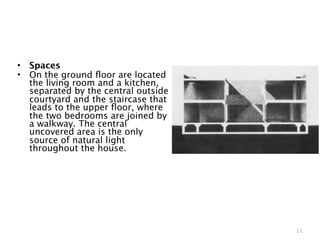
•   Spaces
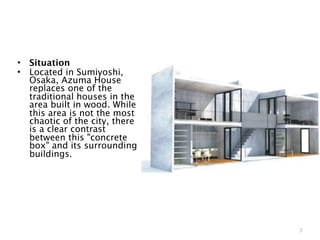
•   On the ground floor are located
    the living room and a kitchen,
    separated by the central outside
    courtyard and the staircase that
    leads to the upper floor, where
    the two bedrooms are joined by
    a walkway. The central
    uncovered area is the only
    source of natural light
    throughout the house.


                                       11
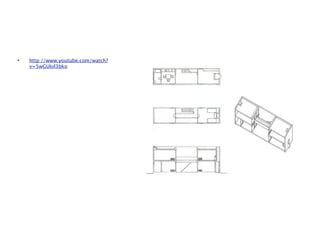
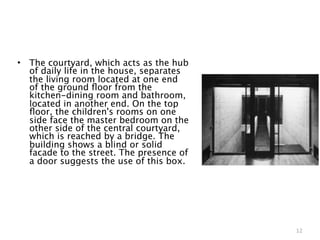
•   The courtyard, which acts as the hub
    of daily life in the house, separates
    the living room located at one end
    of the ground floor from the
    kitchen-dining room and bathroom,
    located in another end. On the top
    floor, the children's rooms on one
    side face the master bedroom on the
    other side of the central courtyard,
    which is reached by a bridge. The
    building shows a blind or solid
    facade to the street. The presence of
    a door suggests the use of this box.


                                            12
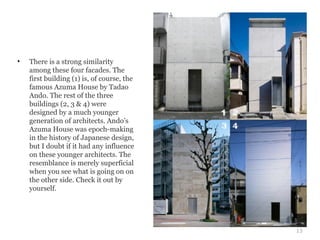
•   There is a strong similarity
    among these four facades. The
    first building (1) is, of course, the
    famous Azuma House by Tadao
    Ando. The rest of the three
    buildings (2, 3 & 4) were
    designed by a much younger
    generation of architects. Ando’s
    Azuma House was epoch-making
    in the history of Japanese design,
    but I doubt if it had any influence
    on these younger architects. The
    resemblance is merely superficial
    when you see what is going on on
    the other side. Check it out by
    yourself.


                                            13

Azuma house by tadao ando[1]

  • 1.
  • 2.
    Tadao Ando ,安藤忠雄 •Sep. 13 1941, Osaka, Japan. •Has led a Storied life •Japanese architect ,Critical Regionalism •Characterized by complete-dimensional circulation paths •In 1995 won the Pritzker Architecture Prize
  • 3.
    Tadao Ando- Works the pulitzer foundation for the arts giorgio armani (saint louis art museum), saint church of the japan pavillion, headquater louis, usa light, osaka, expo '92, sevilla, theater, milan, courtesy of japan spain italy tadao ando courtesy of courtesy of courtesy of architect & tadao ando tadao ando giorgio armani associates architect & architect & spa associates associates 3
  • 4.
    fabrica (benetton model of the sayamaike communications naoshima modern art historical research center), contemporary museum museum, osaka, treviso, italy art museum, of fort worth, japan courtesy of kagawa, japan texas courtesy of tadao ando courtesy of courtesy of tadao ando architect & tadao ando tadao ando architect & associates architect & architect & associates associates associates 4
  • 5.
    Times Gallery The Churchof the Light Langen Foundation
  • 6.
    Azuma House 住吉の長屋 • Introduction • One of the earliest works of the self-taught architect Tadao Ando is the Azuma House in Sumiyoshi, where the house is split into a spaces devoted to daily life (composed of an austere geometry) by the insertion of an abstract space for the games of wind and light. His goal, he says, was to introduce a question on the inertia that has invaded human dwellings.
  • 7.
    Situation • Located in Sumiyoshi, Osaka, Azuma House replaces one of the traditional houses in the area built in wood. While this area is not the most chaotic of the city, there is a clear contrast between this "concrete box" and its surrounding buildings. 7
  • 8.
    Concept • Built between medians, this apartment is perched on a lot of 57.3 m². The total square fottage of 64.7 m² is divided into three equal sections: two floors and a patio. • This box of concrete occupies the entire site. The building, centripetal as far as its organization, has a tripartite structure centered around an uncovered patio. 8
  • 9.
    Materials • The reinforced concrete used in this house is presented as the ornamentation for the facade. 9
  • 10.
    http://www.youtube.com/watch? v=5wGUIol3bko
  • 11.
    Spaces • On the ground floor are located the living room and a kitchen, separated by the central outside courtyard and the staircase that leads to the upper floor, where the two bedrooms are joined by a walkway. The central uncovered area is the only source of natural light throughout the house. 11
  • 12.
    The courtyard, which acts as the hub of daily life in the house, separates the living room located at one end of the ground floor from the kitchen-dining room and bathroom, located in another end. On the top floor, the children's rooms on one side face the master bedroom on the other side of the central courtyard, which is reached by a bridge. The building shows a blind or solid facade to the street. The presence of a door suggests the use of this box. 12
  • 13.
    There is a strong similarity among these four facades. The first building (1) is, of course, the famous Azuma House by Tadao Ando. The rest of the three buildings (2, 3 & 4) were designed by a much younger generation of architects. Ando’s Azuma House was epoch-making in the history of Japanese design, but I doubt if it had any influence on these younger architects. The resemblance is merely superficial when you see what is going on on the other side. Check it out by yourself. 13

Editor's Notes