Systemic IT Business Value
Orchestrating “Success”
Cutting to the chase
Whether you’re doing everything for yourself, or instead also relying on other
parties to do things well for you, complexity is the reality that injects uncertainty
into business plans for outcomes that are deemed “successful” performance.
The space between plans and outcomes is usually thought of in terms of controls
causing “valuable” (predefined) effects.
But complexity means the best-case-scenarios are about managing to derive value
from obtainable results.
Therefore, it means recognizing that different kinds of value come from different
things; in combining them for their complementary relationships, the goal is to
compose an arrangement that leads to an eventual overall system of behaviors that
influences desirable ultimate outcomes whether they are required (intended) or
optional (discovered).
That, in turn, means it is necessary to know how to use obtainable value.
Cutting to the chase
In real time, opportunities change at frequencies, directions and intensities
sensitive to factors that may not be controllable even though they may be
visible.
While such independent factors are apparent forms of risk, the risk is mainly
against preconceived forms of outcomes; but instances of those same factors
may instead be new or different paths or signals of opportunity.
A “science” of predisposing opportunities relevant to valuable outcomes is
called for; it mainly calls for co-ordinating means and motives such that
adaptation on demand is a core competency.
That competency in no way presumes less need for high achievement in the
dynamics of execution.
Instead, the point is to have certain types of achievement complement each
other systemically and sustainably – in effect more architecturally.
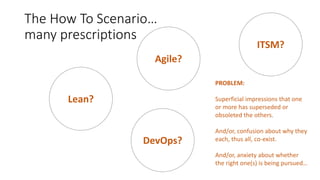
The How To Scenario…
many prescriptions
Lean?
Agile?
DevOps?
ITSM?
PROBLEM:
Superficial impressions that one
or more has superseded or
obsoleted the others.
And/or, confusion about why they
each, thus all, co-exist.
And/or, anxiety about whether
the right one(s) is being pursued…
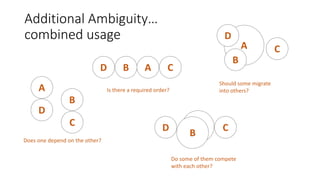
Additional Ambiguity…
combined usage
A
B
C
D
Do some of them compete
with each other?
Does one depend on the other?
AB CD
Is there a required order?
A
B CD
A
B
C
D
Should some migrate
into others?
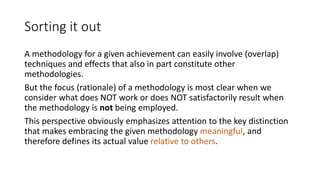
Sorting it out
A methodology for a given achievement can easily involve (overlap)
techniques and effects that also in part constitute other
methodologies.
But the focus (rationale) of a methodology is most clear when we
consider what does NOT work or does NOT satisfactorily result when
the methodology is not being employed.
This perspective obviously emphasizes attention to the key distinction
that makes embracing the given methodology meaningful, and
therefore defines its actual value relative to others.
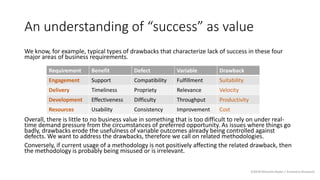
An understanding of “success” as value
We know, for example, typical types of drawbacks that characterize lack of success in these four
major areas of business requirements.
Overall, there is little to no business value in something that is too difficult to rely on under real-
time demand pressure from the circumstances of preferred opportunity. As issues where things go
badly, drawbacks erode the usefulness of variable outcomes already being controlled against
defects. We want to address the drawbacks, therefore we call on related methodologies.
Conversely, if current usage of a methodology is not positively affecting the related drawback, then
the methodology is probably being misused or is irrelevant.
Requirement Benefit Defect Variable Drawback
Engagement Support Compatibility Fulfillment Suitability
Delivery Timeliness Propriety Relevance Velocity
Development Effectiveness Difficulty Throughput Productivity
Resources Usability Consistency Improvement Cost
©2018 Malcolm Ryder / Archestra Research
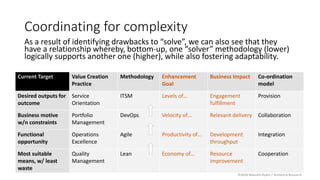
Coordinating for complexity
As a result of identifying drawbacks to “solve”, we can also see that they
have a relationship whereby, bottom-up, one “solver” methodology (lower)
logically supports another one (higher), while also fostering adaptability.
..
.
.
.
.
.
.
Current Target Value Creation
Practice
Methodology Enhancement
Goal
Business Impact Co-ordination
model
Desired outputs for
outcome
Service
Orientation
ITSM Levels of… Engagement
fulfillment
Provision
Business motive
w/n constraints
Portfolio
Management
DevOps Velocity of… Relevant delivery Collaboration
Functional
opportunity
Operations
Excellence
Agile Productivity of… Development
throughput
Integration
Most suitable
means, w/ least
waste
Quality
Management
Lean Economy of… Resource
improvement
Cooperation
©2018 Malcolm Ryder / Archestra Research
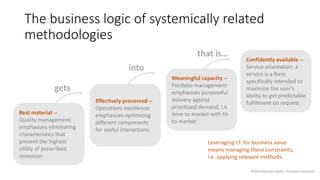
The business logic of systemically related
methodologies
Best material --
Quality management:
emphasizes eliminating
characteristics that
prevent the highest
utility of prescribed
resources
Effectively processed --
Operations excellence:
emphasizes optimizing
different components
for useful interactions.
Meaningful capacity --
Portfolio management:
emphasizes purposeful
delivery against
prioritized demand, i.e.
time-to-market with fit-
to-market
Confidently available --
Service orientation: a
service is a form
specifically intended to
maximize the user’s
ability to get predictable
fulfillment on request
gets
into
that is…
©2018 Malcolm Ryder / Archestra Research
Leveraging I.T. for business value
means managing these constraints,
i.e. applying relevant methods.
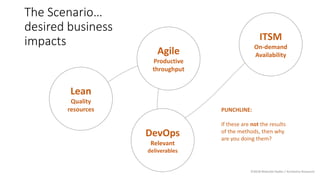
The Scenario…
desired business
impacts
Lean
Quality
resources
Agile
Productive
throughput
DevOps
Relevant
deliverables
ITSM
On-demand
Availability
PUNCHLINE:
If these are not the results
of the methods, then why
are you doing them?
©2018 Malcolm Ryder / Archestra Research
Archestra notebooks compile and organize decades of in-the-field empirical findings. The notes offer explanations of why things
are included, excluded, or can happen in certain ways or to certain effects. The descriptions are determined mainly from the
perspective of strategy and architecture. They comment on, and navigate between, the motives and potentials that predetermine
the decisions and shapes of activity as discussed in the notes. As ongoing research, all notebooks are subject to change.
©2018 Malcolm Ryder / Archestra Research
www.archestra.com
mryder@archestra.com

Systemic I.T. Business Value

  • 1.
    Systemic IT BusinessValue Orchestrating “Success”
  • 2.
    Cutting to thechase Whether you’re doing everything for yourself, or instead also relying on other parties to do things well for you, complexity is the reality that injects uncertainty into business plans for outcomes that are deemed “successful” performance. The space between plans and outcomes is usually thought of in terms of controls causing “valuable” (predefined) effects. But complexity means the best-case-scenarios are about managing to derive value from obtainable results. Therefore, it means recognizing that different kinds of value come from different things; in combining them for their complementary relationships, the goal is to compose an arrangement that leads to an eventual overall system of behaviors that influences desirable ultimate outcomes whether they are required (intended) or optional (discovered). That, in turn, means it is necessary to know how to use obtainable value.
  • 3.
    Cutting to thechase In real time, opportunities change at frequencies, directions and intensities sensitive to factors that may not be controllable even though they may be visible. While such independent factors are apparent forms of risk, the risk is mainly against preconceived forms of outcomes; but instances of those same factors may instead be new or different paths or signals of opportunity. A “science” of predisposing opportunities relevant to valuable outcomes is called for; it mainly calls for co-ordinating means and motives such that adaptation on demand is a core competency. That competency in no way presumes less need for high achievement in the dynamics of execution. Instead, the point is to have certain types of achievement complement each other systemically and sustainably – in effect more architecturally.
  • 4.
    The How ToScenario… many prescriptions Lean? Agile? DevOps? ITSM? PROBLEM: Superficial impressions that one or more has superseded or obsoleted the others. And/or, confusion about why they each, thus all, co-exist. And/or, anxiety about whether the right one(s) is being pursued…
  • 5.
    Additional Ambiguity… combined usage A B C D Dosome of them compete with each other? Does one depend on the other? AB CD Is there a required order? A B CD A B C D Should some migrate into others?
  • 6.
    Sorting it out Amethodology for a given achievement can easily involve (overlap) techniques and effects that also in part constitute other methodologies. But the focus (rationale) of a methodology is most clear when we consider what does NOT work or does NOT satisfactorily result when the methodology is not being employed. This perspective obviously emphasizes attention to the key distinction that makes embracing the given methodology meaningful, and therefore defines its actual value relative to others.
  • 7.
    An understanding of“success” as value We know, for example, typical types of drawbacks that characterize lack of success in these four major areas of business requirements. Overall, there is little to no business value in something that is too difficult to rely on under real- time demand pressure from the circumstances of preferred opportunity. As issues where things go badly, drawbacks erode the usefulness of variable outcomes already being controlled against defects. We want to address the drawbacks, therefore we call on related methodologies. Conversely, if current usage of a methodology is not positively affecting the related drawback, then the methodology is probably being misused or is irrelevant. Requirement Benefit Defect Variable Drawback Engagement Support Compatibility Fulfillment Suitability Delivery Timeliness Propriety Relevance Velocity Development Effectiveness Difficulty Throughput Productivity Resources Usability Consistency Improvement Cost ©2018 Malcolm Ryder / Archestra Research
  • 8.
    Coordinating for complexity Asa result of identifying drawbacks to “solve”, we can also see that they have a relationship whereby, bottom-up, one “solver” methodology (lower) logically supports another one (higher), while also fostering adaptability. .. . . . . . . Current Target Value Creation Practice Methodology Enhancement Goal Business Impact Co-ordination model Desired outputs for outcome Service Orientation ITSM Levels of… Engagement fulfillment Provision Business motive w/n constraints Portfolio Management DevOps Velocity of… Relevant delivery Collaboration Functional opportunity Operations Excellence Agile Productivity of… Development throughput Integration Most suitable means, w/ least waste Quality Management Lean Economy of… Resource improvement Cooperation ©2018 Malcolm Ryder / Archestra Research
  • 9.
    The business logicof systemically related methodologies Best material -- Quality management: emphasizes eliminating characteristics that prevent the highest utility of prescribed resources Effectively processed -- Operations excellence: emphasizes optimizing different components for useful interactions. Meaningful capacity -- Portfolio management: emphasizes purposeful delivery against prioritized demand, i.e. time-to-market with fit- to-market Confidently available -- Service orientation: a service is a form specifically intended to maximize the user’s ability to get predictable fulfillment on request gets into that is… ©2018 Malcolm Ryder / Archestra Research Leveraging I.T. for business value means managing these constraints, i.e. applying relevant methods.
  • 10.
    The Scenario… desired business impacts Lean Quality resources Agile Productive throughput DevOps Relevant deliverables ITSM On-demand Availability PUNCHLINE: Ifthese are not the results of the methods, then why are you doing them? ©2018 Malcolm Ryder / Archestra Research
  • 11.
    Archestra notebooks compileand organize decades of in-the-field empirical findings. The notes offer explanations of why things are included, excluded, or can happen in certain ways or to certain effects. The descriptions are determined mainly from the perspective of strategy and architecture. They comment on, and navigate between, the motives and potentials that predetermine the decisions and shapes of activity as discussed in the notes. As ongoing research, all notebooks are subject to change. ©2018 Malcolm Ryder / Archestra Research ©2018 Malcolm Ryder / Archestra Research www.archestra.com mryder@archestra.com