AT1
Agile Development Concurrent Session
11/13/2014 10:00 AM
"A Holistic View of Complex
Systems and Organizational
Change"
Presented by:
Al Shalloway
Net Objectives
Brought to you by:
340 Corporate Way, Suite 300, Orange Park, FL 32073
888-268-8770 ∙ 904-278-0524 ∙ sqeinfo@sqe.com ∙ www.sqe.com
With more than forty years of experience, the founder and CEO of
Net Objectives Al Shalloway is an industry thought leader in lean,
SAFe, kanban, product portfolio management, Scrum, and agile
design. Al helps companies transition enterprise-wide to lean and
agile methods, and teaches courses in these areas—one of a
handful of SAFe SPC trainers. He is the primary author of Lean-
Agile Software Development: Achieving Enterprise Agility, Design
Patterns Explained, Lean-Agile Pocket Guide for Scrum
Teams, and Essential Skills for the Agile Developer. Cofounder
(although no longer affiliated) with Lean Kanban University, Al is a
popular speaker at prestigious conferences worldwide.
copyright (c) Net Objectives, Inc. All Rights Reserved.
12 November 2014
1
Al Shalloway
CEO, Net Objectives
SPC Trainer
A Holistic View of
Complex Systems and
Organizational Change
© Copyright Net Objectives, Inc. All Rights Reserved 2
Al Shalloway
alshall@NetObjectives.com
@AlShalloway
CEO, Founder
Co-founder of Lean-Systems Society
Co-founder Lean-Kanban University
copyright (c) Net Objectives, Inc. All Rights Reserved.
12 November 2014
2
© Copyright Net Objectives, Inc. All Rights Reserved 3
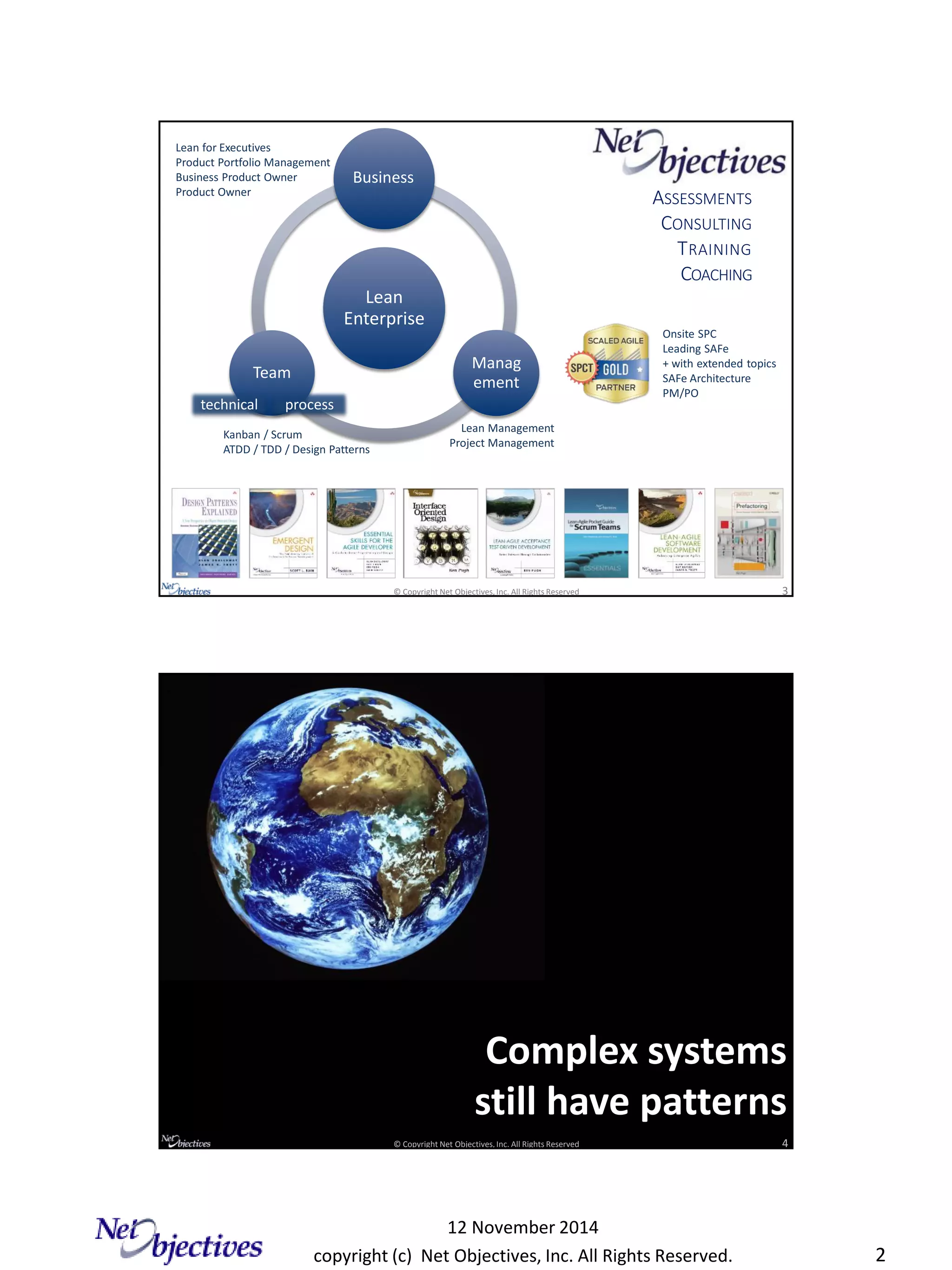
Lean
Enterprise
Business
Manag
ement
Team
ASSESSMENTS
CONSULTING
TRAINING
COACHING
Lean Management
Project Management
Lean for Executives
Product Portfolio Management
Business Product Owner
Product Owner
technical process
Onsite SPC
Leading SAFe
+ with extended topics
SAFe Architecture
PM/PO
Kanban / Scrum
ATDD / TDD / Design Patterns
© Copyright Net Objectives, Inc. All Rights Reserved 4
Complex systems
still have patterns
copyright (c) Net Objectives, Inc. All Rights Reserved.
12 November 2014
3
© Copyright Net Objectives, Inc. All Rights Reserved 5
different kinds
of predictability
© Copyright Net Objectives, Inc. All Rights Reserved 6
If you give people more things than they can handle, it will
lower both their productivity, and their resolve to do better
If you treat people poorly, they will not work as hard for you
as they would otherwise
If you separate people by distance and/or time, their ability
to work together will go down
if you reward people based on particular measures, they will
work more towards those measures than they will towards
what you put those measures in place for
if people ignore principles that effect their work, they will get
inferior results than if they attend to them
if people don't have a common vision, they will not work as
well together as a team that has a common vision
Some Easy Predictions
copyright (c) Net Objectives, Inc. All Rights Reserved.
12 November 2014
4
© Copyright Net Objectives, Inc. All Rights Reserved 7
if you don't define your acceptance tests before writing your
code you will waste a lot of effort
if you don't attend to code quality, your code will degrade
and be harder to maintain and update in the future
if you write for just yourself, your teammates will have
trouble understanding your code
if you use archaic names for your code variables, people
won't understand your code well
The longer you take between integrations, the longer the
integrations will take
if you don't get customer feedback quickly, you will write a
lot of code they really don't want (for any number of reasons)
Some More Easy Predictions
© Copyright Net Objectives, Inc. All Rights Reserved 8
If managers can't see what you are doing,
they won't understand what you are doing
If managers ask you to do one more thing
in your iteration and they don't know your
process (or you don't have an explicit one)
then when you say you can't squeeze it in
they will likely think you just aren't willing
to take the extra effort required
Some Predictions About
Management
copyright (c) Net Objectives, Inc. All Rights Reserved.
12 November 2014
5
© Copyright Net Objectives, Inc. All Rights Reserved 9
Systems & Structures
Poor systems cause most of our problems
Biggest sources of waste are:
• Delays in workflow
• Delays in feedback
Consider:
• Customers don’t know what they want
• What happens when we don’t do test-first
Consider:
• Developers and fixing bugs
• The delays due to system
© Copyright Net Objectives, Inc. All Rights Reserved 10
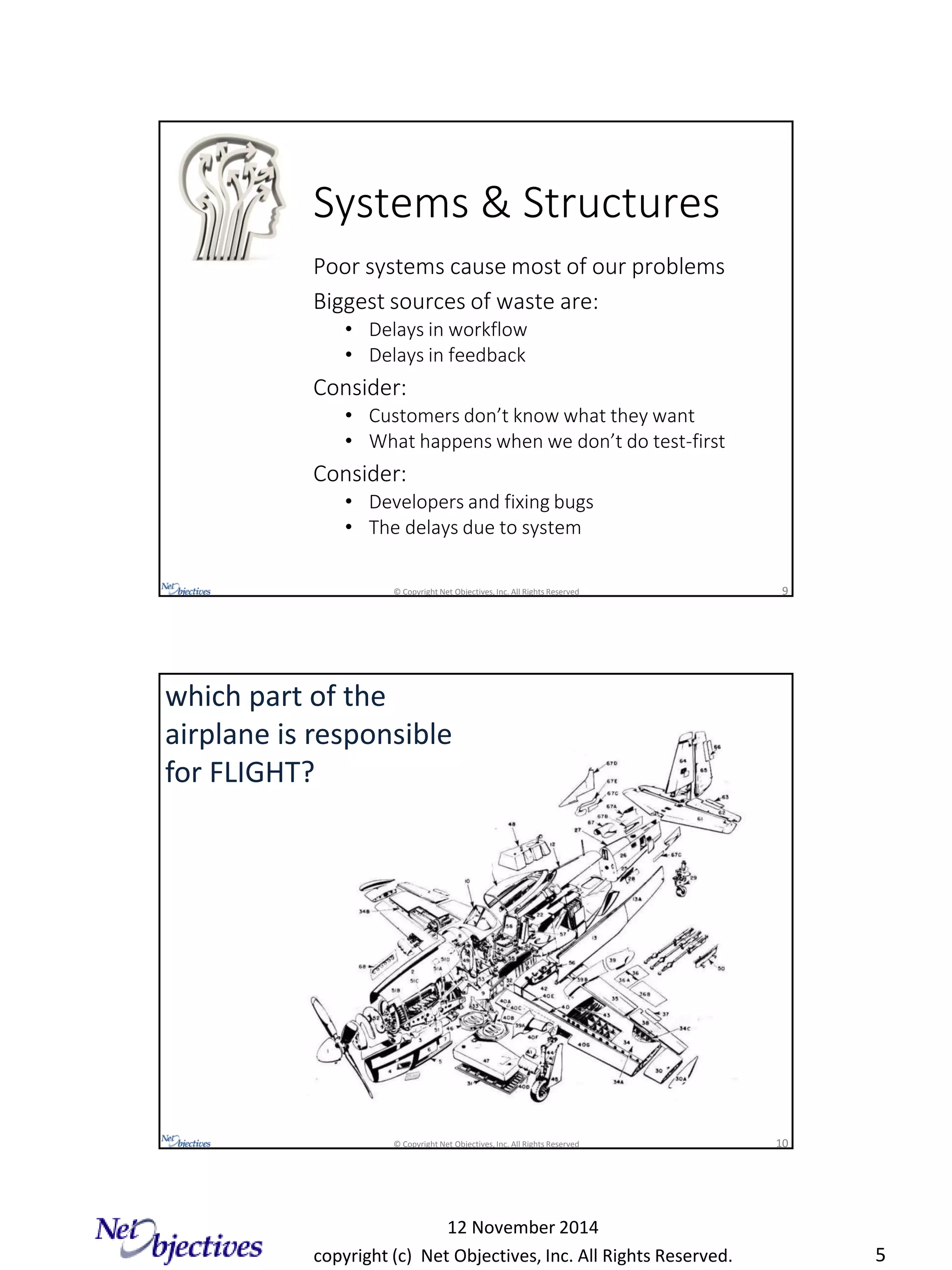
which part of the
airplane is responsible
for FLIGHT?
copyright (c) Net Objectives, Inc. All Rights Reserved.
12 November 2014
6
© Copyright Net Objectives, Inc. All Rights Reserved 11
Value Stream Impedance
Value Stream Impedance (VSI) is a quantitative
measure of the resistance faced by the work in a value
stream.
Impedance often creates delays which create more
work which creates more delays.
Impedance that slows us down is not as bad as the
impedance which creates additional work that we now
have to do, work that could have been avoided
Example. The thrashing that takes place when software
developed by different teams are integrated.
© Copyright Net Objectives, Inc. All Rights Reserved 12
Value Stream Impedance
Number and size of work in process
People in a value stream not working together
How people are both geographically and managerially
located
Sequence work is done in (test-first lowers this)
Too much WIP
Too little automation
Long feedback cycles
The disparity between management structure and the
way the real work takes place
contributors
to VSI
copyright (c) Net Objectives, Inc. All Rights Reserved.
12 November 2014
7
© Copyright Net Objectives, Inc. All Rights Reserved 13
Simple – easy cause and effect
Chaotic – small changes can cause big
impacts
Complicated – many to many
Complex – more about holistic
relationships – not exactly predictable in
advance
Types of Systems
© Copyright Net Objectives, Inc. All Rights Reserved 14
Thinking a System Is
Complex Is More About Us
What is complex now may be simple
tomorrow.
If we don’t take an holistic view we may have
problems.
Few approaches (certainly not Scrum or
Kanban Method) takes an holistic view
copyright (c) Net Objectives, Inc. All Rights Reserved.
12 November 2014
8
© Copyright Net Objectives, Inc. All Rights Reserved 15
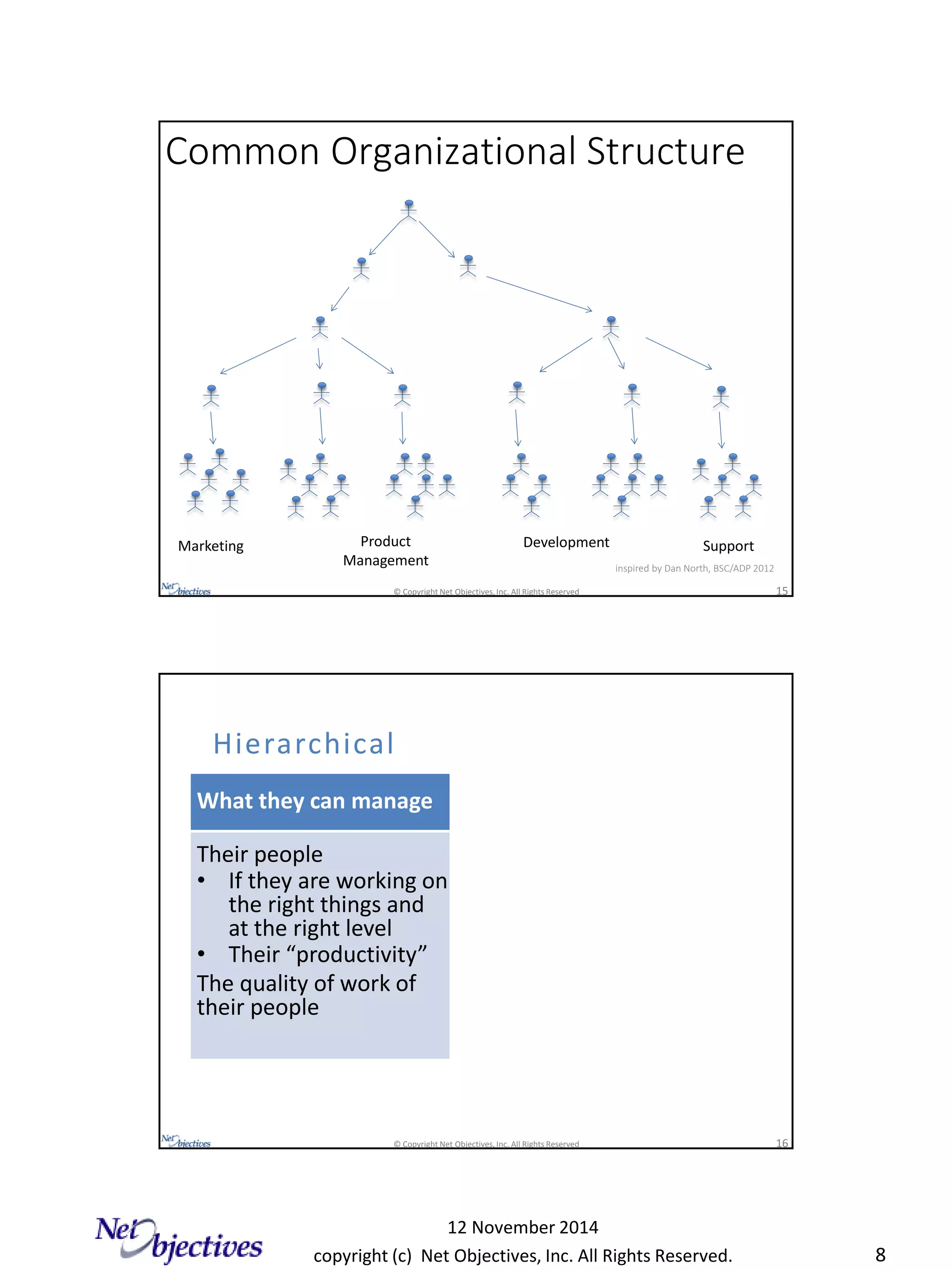
Common Organizational Structure
inspired by Dan North, BSC/ADP 2012
Marketing Product
Management
Development Support
© Copyright Net Objectives, Inc. All Rights Reserved 16
What they can manage What they need to manage
Their people
• If they are working on
the right things and
at the right level
• Their “productivity”
The quality of work of
their people
Hierarchical
copyright (c) Net Objectives, Inc. All Rights Reserved.
12 November 2014
9
© Copyright Net Objectives, Inc. All Rights Reserved 17
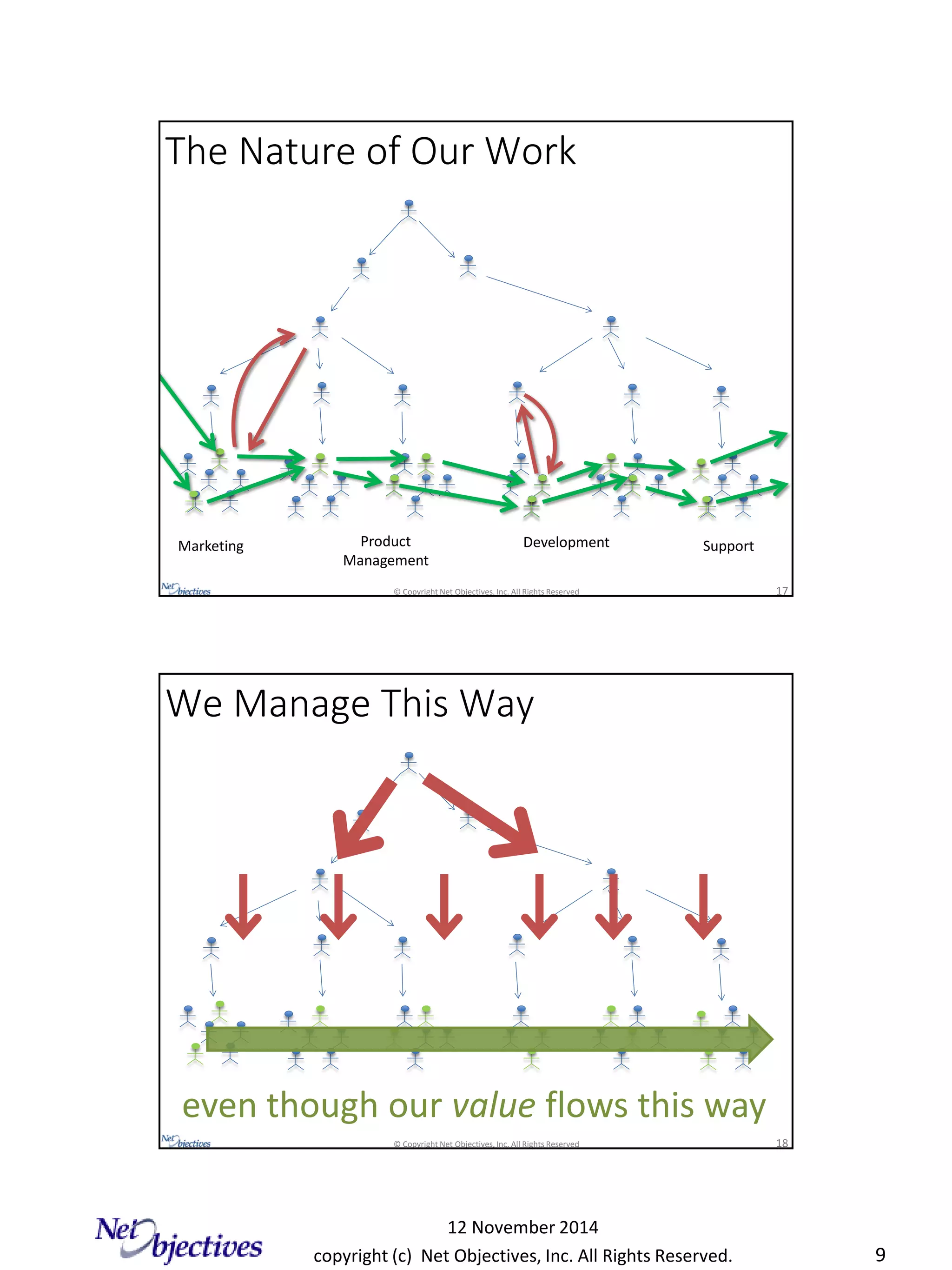
The Nature of Our Work
Marketing Product
Management
Development Support
© Copyright Net Objectives, Inc. All Rights Reserved 18
We Manage This Way
even though our value flows this way
copyright (c) Net Objectives, Inc. All Rights Reserved.
12 November 2014
10
© Copyright Net Objectives, Inc. All Rights Reserved 19
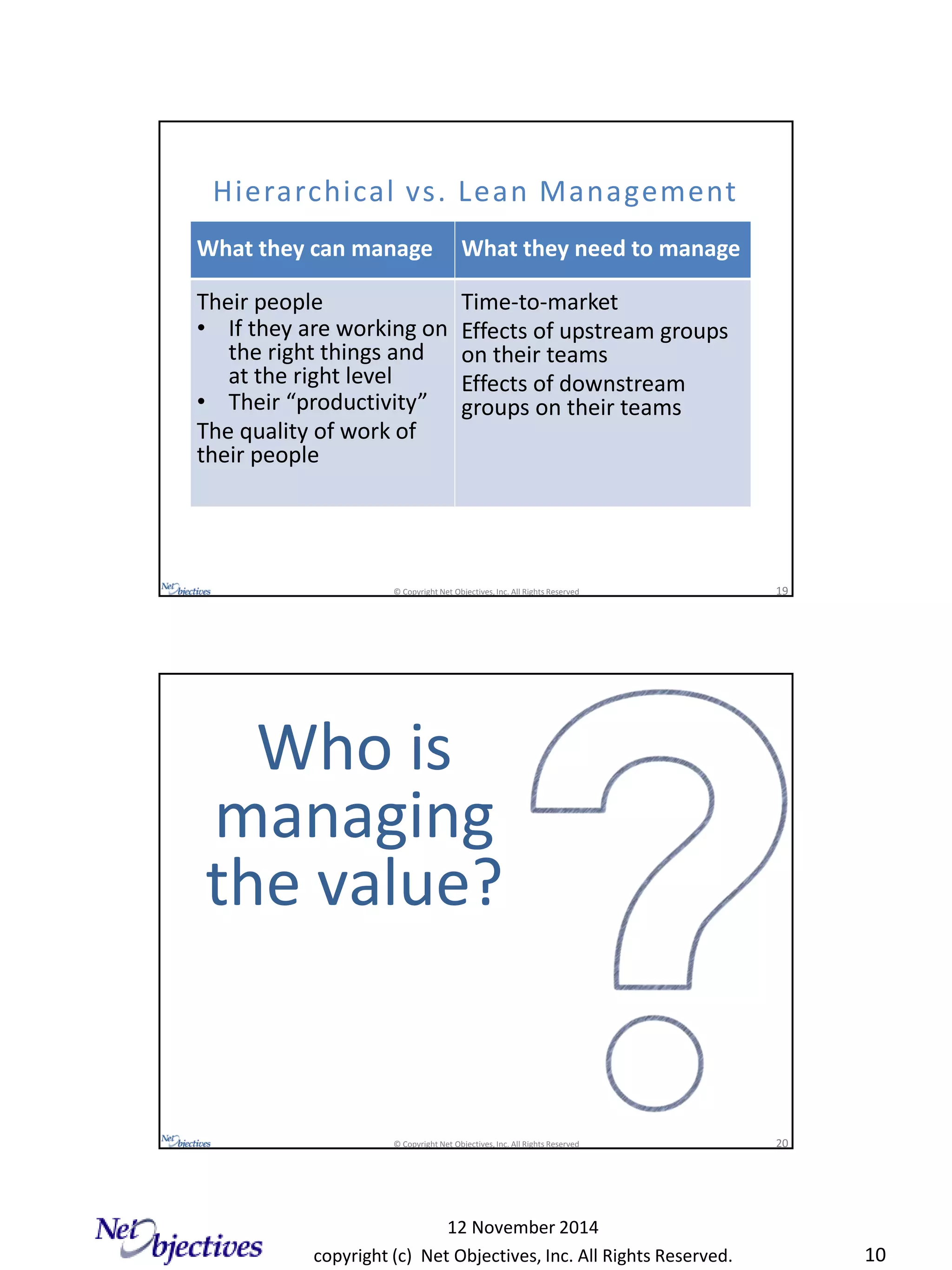
What they can manage What they need to manage
Their people
• If they are working on
the right things and
at the right level
• Their “productivity”
The quality of work of
their people
Time-to-market
Effects of upstream groups
on their teams
Effects of downstream
groups on their teams
Hierarchical vs. Lean Management
© Copyright Net Objectives, Inc. All Rights Reserved 20
Who is
managing
the value?
copyright (c) Net Objectives, Inc. All Rights Reserved.
12 November 2014
11
© Copyright Net Objectives, Inc. All Rights Reserved 21
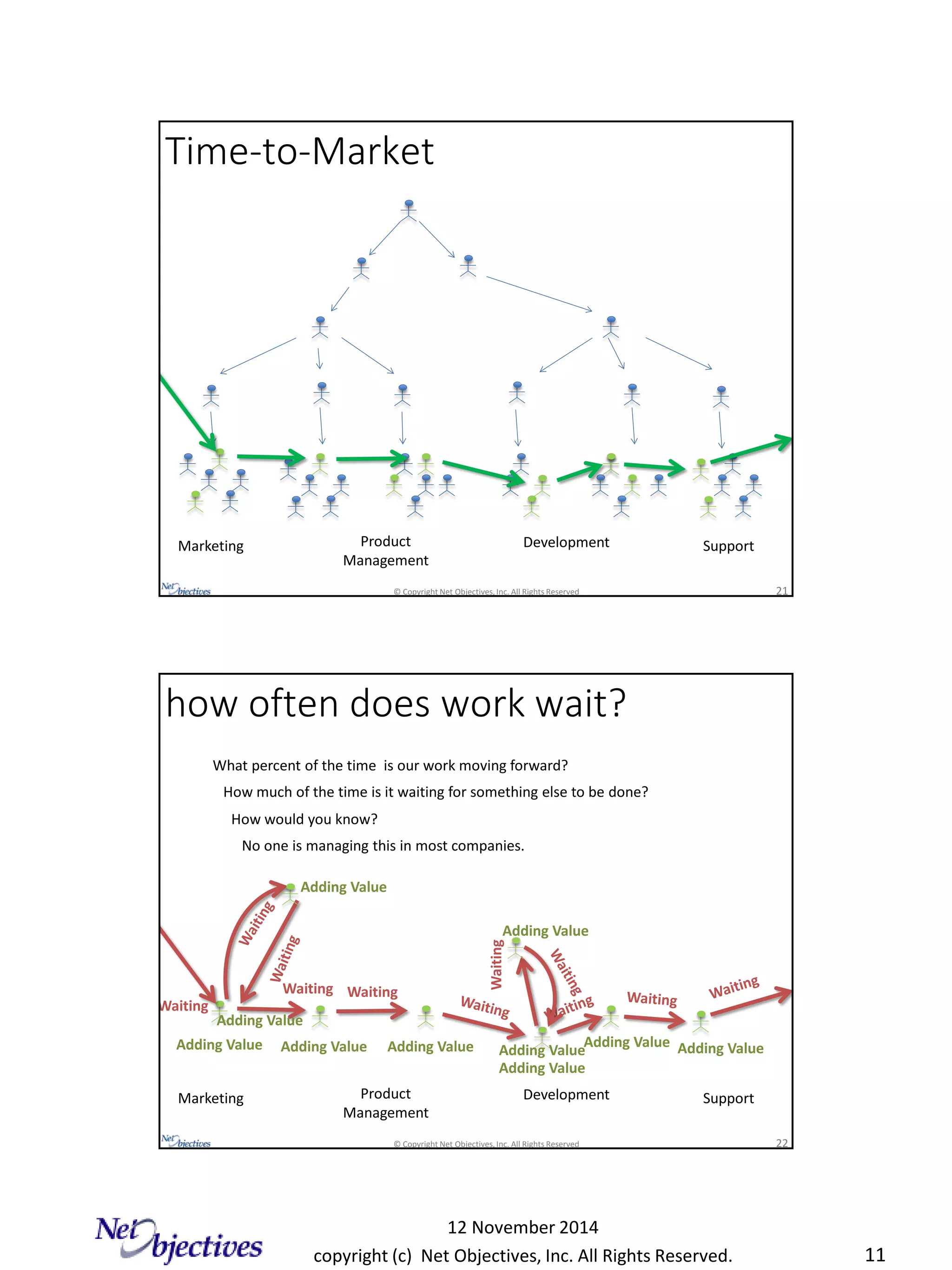
Time-to-Market
Marketing Product
Management
Development Support
© Copyright Net Objectives, Inc. All Rights Reserved 22
how often does work wait?
Adding Value
Waiting
Adding Value Adding Value
Adding Value
Adding Value Adding Value
What percent of the time is our work moving forward?
How would you know?
No one is managing this in most companies.
Waiting
How much of the time is it waiting for something else to be done?
Waiting
Adding Value
Adding Value
Adding Value
Adding Value
Waiting
Marketing Product
Management
Development Support
copyright (c) Net Objectives, Inc. All Rights Reserved.
12 November 2014
12
© Copyright Net Objectives, Inc. All Rights Reserved 23
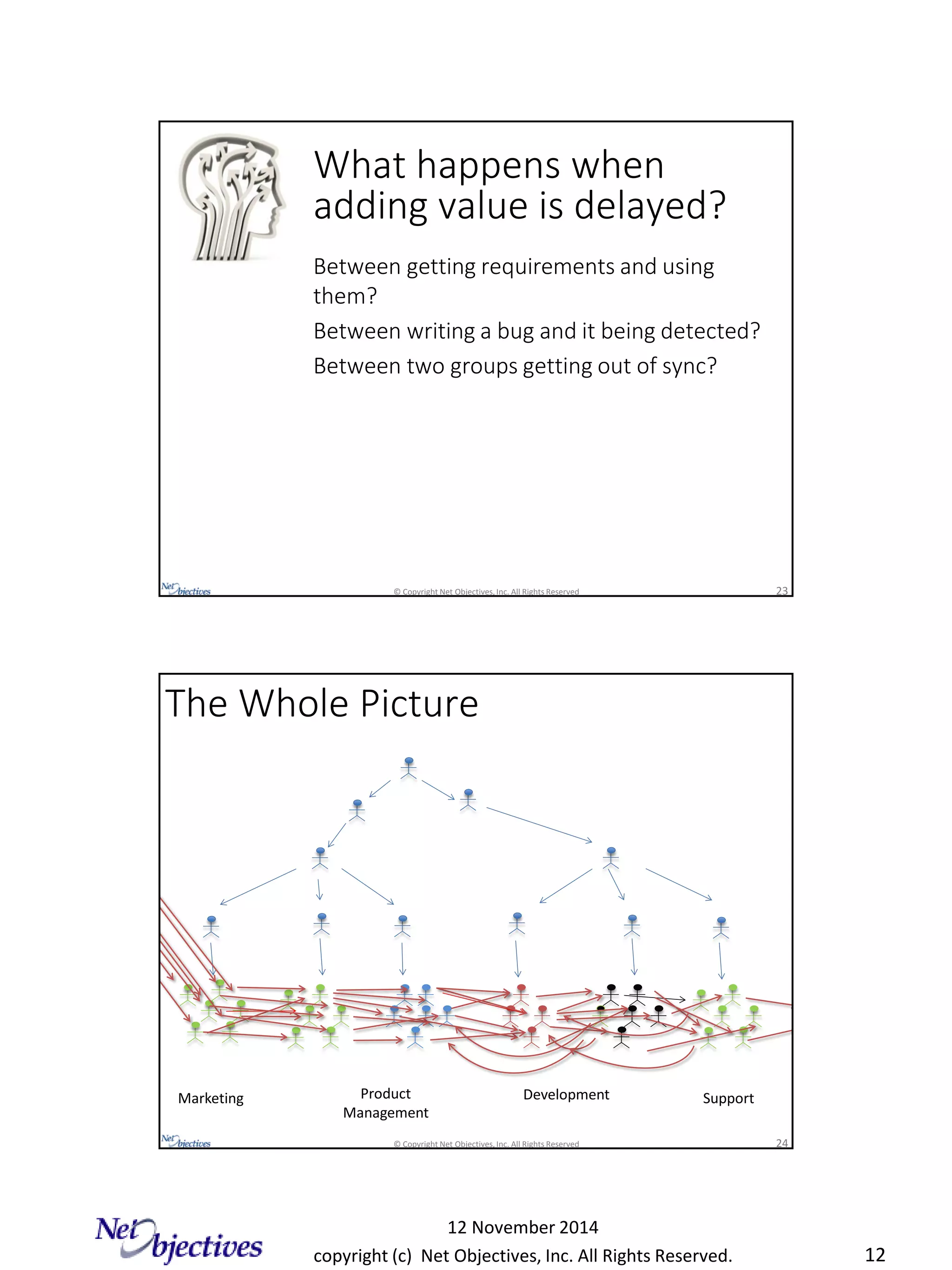
What happens when
adding value is delayed?
Between getting requirements and using
them?
Between writing a bug and it being detected?
Between two groups getting out of sync?
© Copyright Net Objectives, Inc. All Rights Reserved 24
The Whole Picture
Marketing Product
Management
Development Support
copyright (c) Net Objectives, Inc. All Rights Reserved.
12 November 2014
13
© Copyright Net Objectives, Inc. All Rights Reserved 25
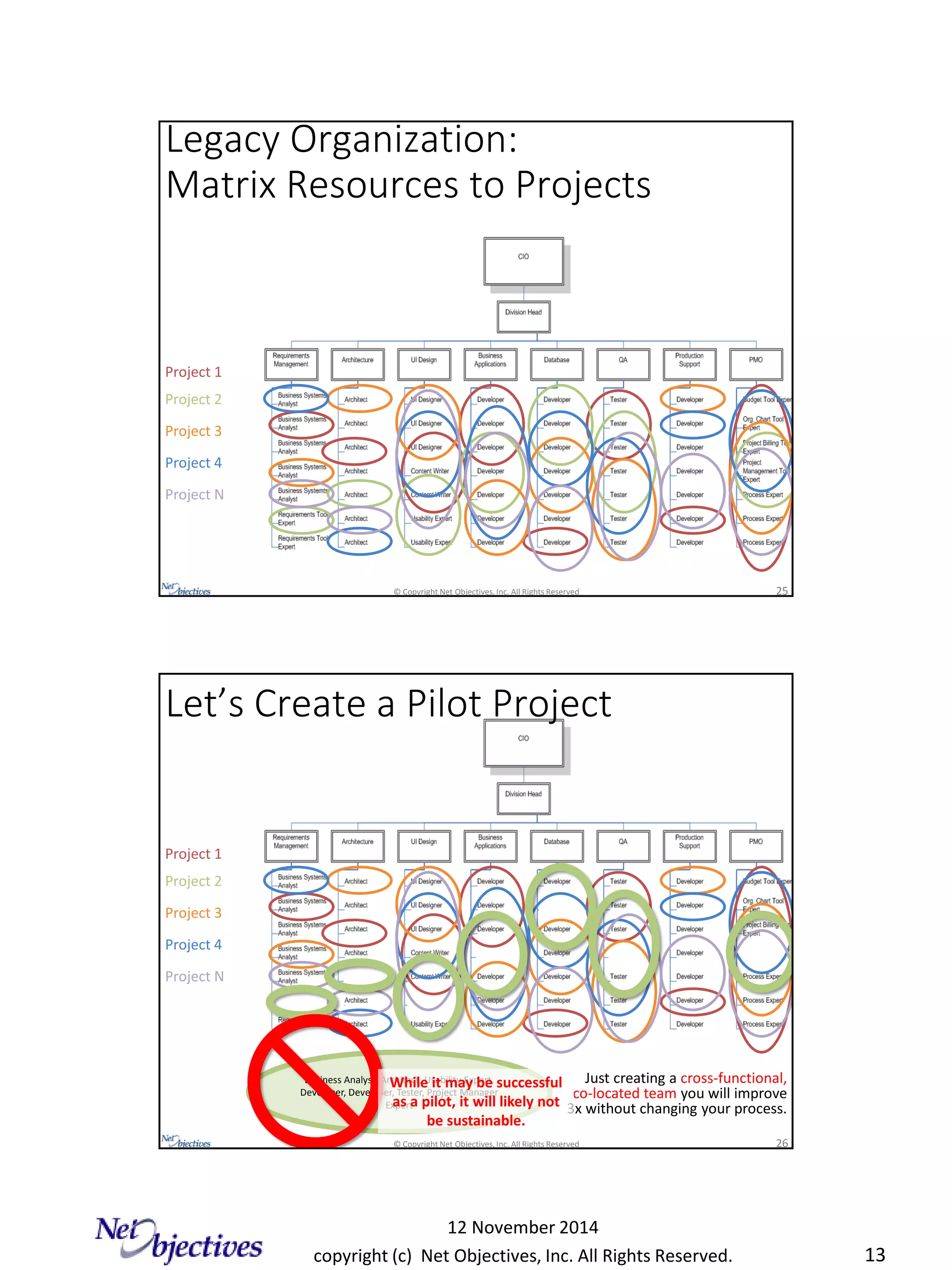
Legacy Organization:
Matrix Resources to Projects
Project 1
Project 2
Project 3
Project 4
Project N
© Copyright Net Objectives, Inc. All Rights Reserved 26
Let’s Create a Pilot Project
Project 1
Project 2
%
Project 3
Project 4
Project N
Business Analyst, Architect, Usability Expert,
Developer, Developer, Tester, Project Manager
Expert
Just creating a cross-functional,
co-located team you will improve
3x without changing your process.
While it may be successful
as a pilot, it will likely not
be sustainable.
copyright (c) Net Objectives, Inc. All Rights Reserved.
12 November 2014
14
© Copyright Net Objectives, Inc. All Rights Reserved 27
Getting
Requirements
Testing
Programming
Design
Integration
Planning
Collaboration
Re-doing
requirements
Working from old
requirements
“Fixing” bugs
“Integration”
errors
Deployment
Building
unneeded
features
Overbuilding
frameworks
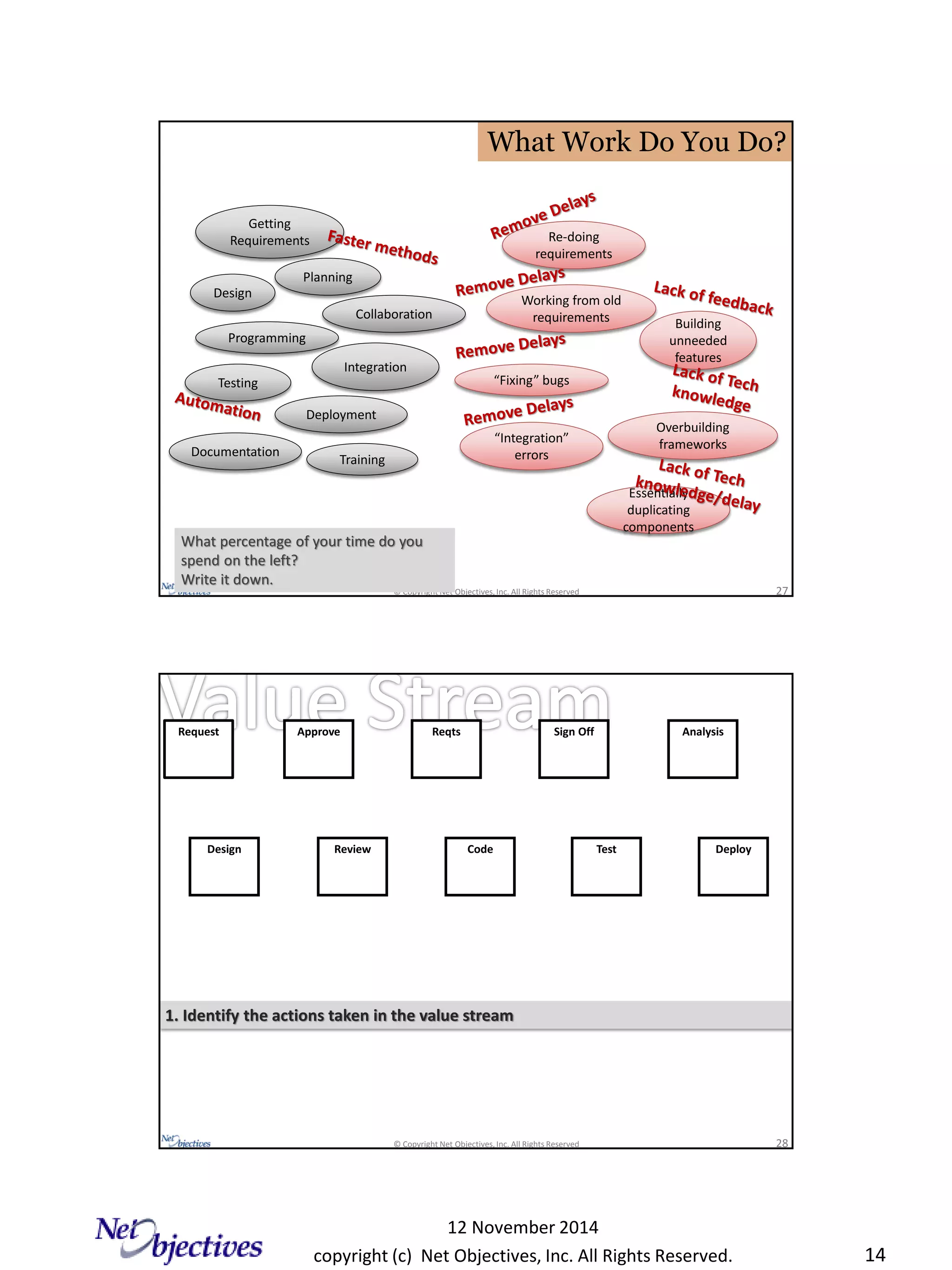
What Work Do You Do?
Training
Documentation
Essentially
duplicating
components
What percentage of your time do you
spend on the left?
Write it down.
© Copyright Net Objectives, Inc. All Rights Reserved 28
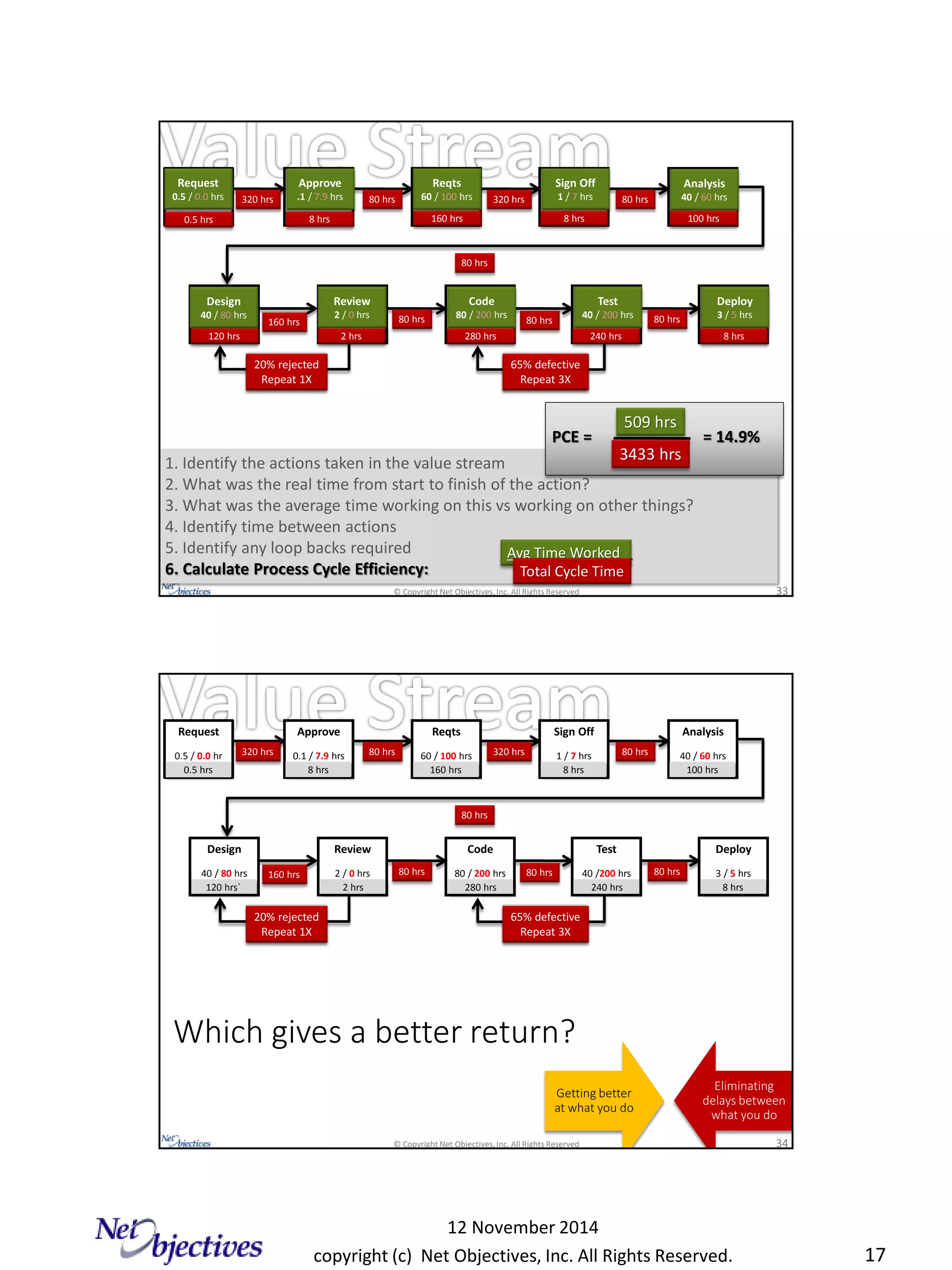
1. Identify the actions taken in the value stream
ApproveRequest Reqts Sign Off
Review Deploy
Analysis
Design Code Test
copyright (c) Net Objectives, Inc. All Rights Reserved.
12 November 2014
15
© Copyright Net Objectives, Inc. All Rights Reserved 29
120 hrs` 280 hrs 240 hrs 8 hrs2 hrs
1. Identify the actions taken in the value stream
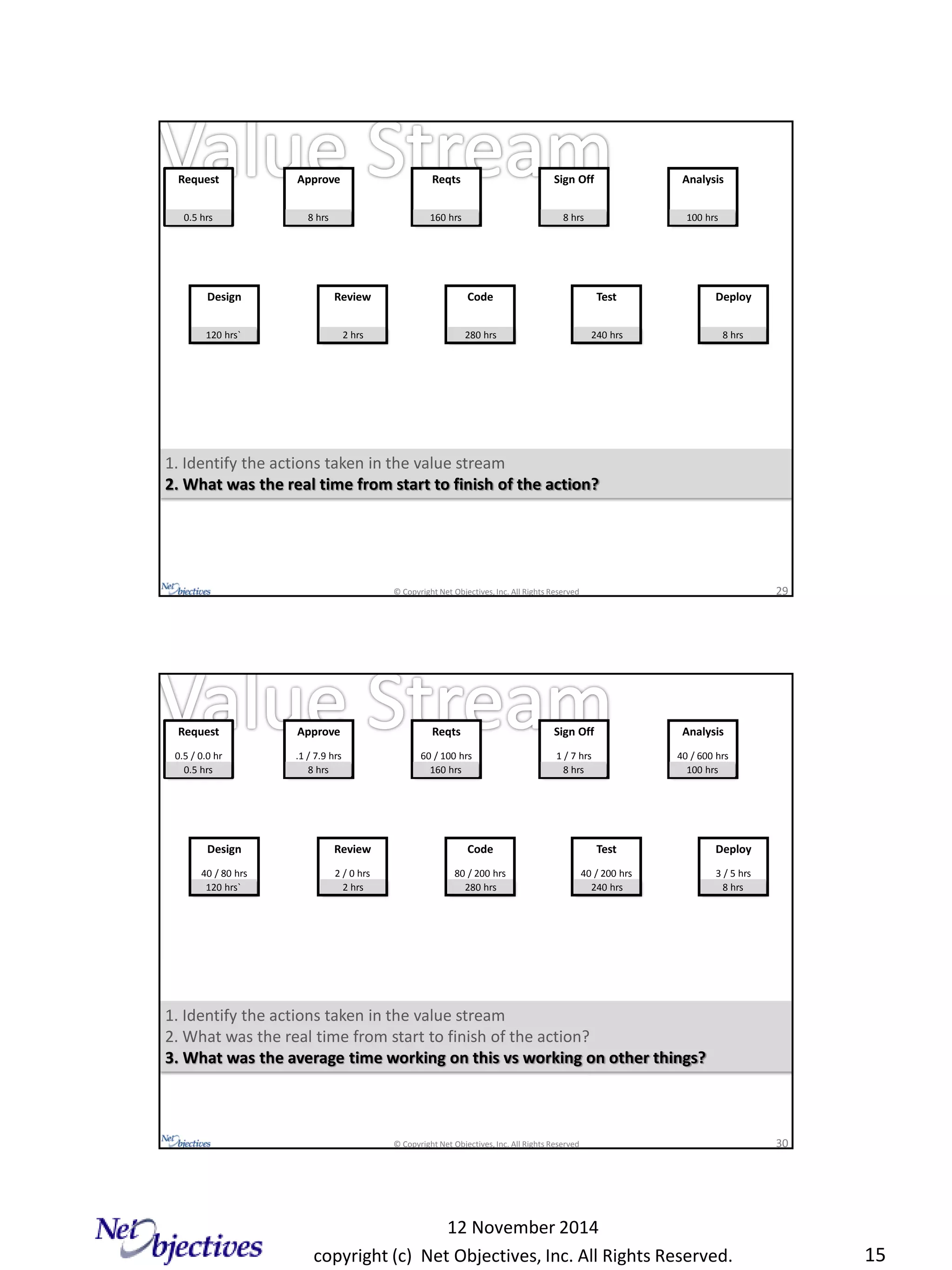
2. What was the real time from start to finish of the action?
ApproveRequest Reqts Sign Off
Review Deploy
Analysis
Design Code Test
0.5 hrs 160 hrs8 hrs 8 hrs 100 hrs
© Copyright Net Objectives, Inc. All Rights Reserved 30
120 hrs` 280 hrs 240 hrs 8 hrs2 hrs
1. Identify the actions taken in the value stream
2. What was the real time from start to finish of the action?
3. What was the average time working on this vs working on other things?
Approve
.1 / 7.9 hrs
Request
0.5 / 0.0 hr
Reqts
60 / 100 hrs
Sign Off
1 / 7 hrs
Review
2 / 0 hrs
Deploy
3 / 5 hrs
Analysis
40 / 600 hrs
Design
40 / 80 hrs
Code
80 / 200 hrs
Test
40 / 200 hrs
0.5 hrs 160 hrs8 hrs 8 hrs 100 hrs
copyright (c) Net Objectives, Inc. All Rights Reserved.
12 November 2014
16
© Copyright Net Objectives, Inc. All Rights Reserved 31
80 hrs320 hrs 80 hrs 320 hrs
80 hrs
160 hrs 80 hrs 80 hrs 80 hrs
1. Identify the actions taken in the value stream
2. What was the real time from start to finish of the action?
3. What was the average time working on this vs working on other things?
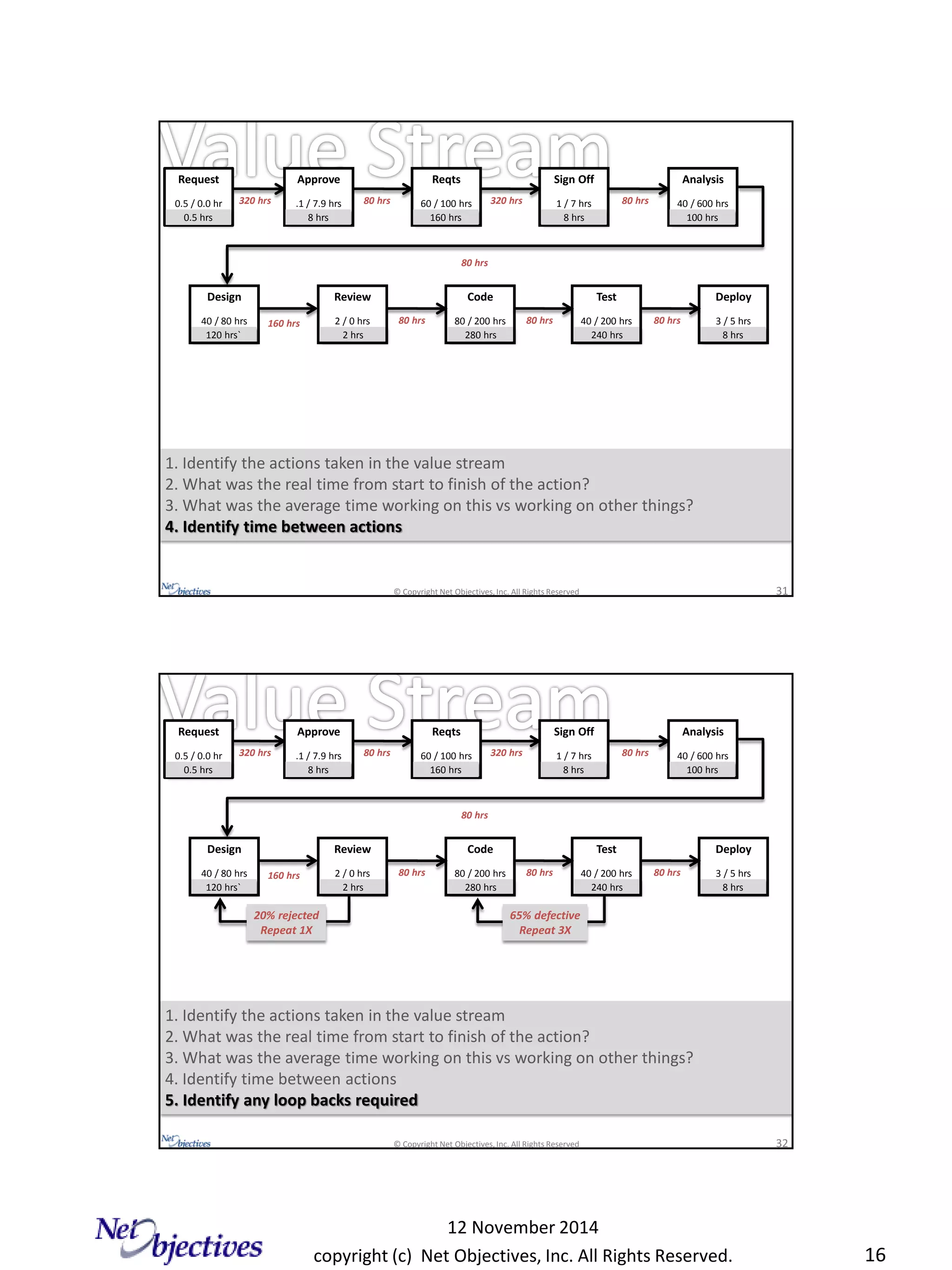
4. Identify time between actions
120 hrs` 280 hrs 240 hrs 8 hrs2 hrs
Approve
.1 / 7.9 hrs
Request
0.5 / 0.0 hr
Reqts
60 / 100 hrs
Sign Off
1 / 7 hrs
Review
2 / 0 hrs
Deploy
3 / 5 hrs
Analysis
40 / 600 hrs
Design
40 / 80 hrs
Code
80 / 200 hrs
Test
40 / 200 hrs
0.5 hrs 160 hrs8 hrs 8 hrs 100 hrs
© Copyright Net Objectives, Inc. All Rights Reserved 32
80 hrs320 hrs 80 hrs 320 hrs
80 hrs
160 hrs 80 hrs 80 hrs 80 hrs
120 hrs` 280 hrs 240 hrs 8 hrs2 hrs
1. Identify the actions taken in the value stream
2. What was the real time from start to finish of the action?
3. What was the average time working on this vs working on other things?
4. Identify time between actions
5. Identify any loop backs required
65% defective
Repeat 3X
20% rejected
Repeat 1X
Approve
.1 / 7.9 hrs
Request
0.5 / 0.0 hr
Reqts
60 / 100 hrs
Sign Off
1 / 7 hrs
Review
2 / 0 hrs
Deploy
3 / 5 hrs
Analysis
40 / 600 hrs
Design
40 / 80 hrs
Code
80 / 200 hrs
Test
40 / 200 hrs
0.5 hrs 160 hrs8 hrs 8 hrs 100 hrs
copyright (c) Net Objectives, Inc. All Rights Reserved.
12 November 2014
17
© Copyright Net Objectives, Inc. All Rights Reserved 33
1. Identify the actions taken in the value stream
2. What was the real time from start to finish of the action?
3. What was the average time working on this vs working on other things?
4. Identify time between actions
5. Identify any loop backs required
6. Calculate Process Cycle Efficiency:
80 hrs320 hrs 80 hrs 320 hrs
80 hrs
160 hrs 80 hrs 80 hrs 80 hrs
0.5 hrs 160 hrs8 hrs 8 hrs
120 hrs` 280 hrs 240 hrs
100 hrs
8 hrs2 hrs
65% defective
Repeat 3X
20% rejected
Repeat 1X
Avg Time Worked
Total Cycle Time
PCE = = 14.9%
509 hrs
3433 hrs
509 hrs
3433 hrs
Avg Time Worked
Total Cycle Time
Approve
.1 / 7.9 hrs
Request
0.5 / 0.0 hr
Reqts
60 / 100 hrs
Sign Off
1 / 7 hrs
Review
2 / 0 hrs
Deploy
3 / 5 hrs
Analysis
40 / 600 hrs
Design
40 / 80 hrs
Code
80 / 200 hrs
Test
40 / 200 hrs
Approve
.1 / 7.9 hrs
Request
0.5 / 0.0 hrs
Reqts
60 / 100 hrs
Sign Off
1 / 7 hrs
Review
2 / 0 hrs
Deploy
3 / 5 hrs
Analysis
40 / 60 hrs
Design
40 / 80 hrs
Code
80 / 200 hrs
Test
40 / 200 hrs
0.5 hrs 160 hrs8 hrs 8 hrs
120 hrs 280 hrs 240 hrs
100 hrs
8 hrs2 hrs
320 hrs 80 hrs 320 hrs 80 hrs
160 hrs 80 hrs 80 hrs
65% defective
Repeat 3X
20% rejected
Repeat 1X
80 hrs
80 hrs
© Copyright Net Objectives, Inc. All Rights Reserved 34
80 hrs320 hrs 80 hrs 320 hrs
80 hrs
160 hrs 80 hrs 80 hrs 80 hrs
120 hrs` 280 hrs 240 hrs 8 hrs2 hrs
Approve
0.1 / 7.9 hrs
Request
0.5 / 0.0 hr
Reqts
60 / 100 hrs
Sign Off
1 / 7 hrs
Review
2 / 0 hrs
Deploy
3 / 5 hrs
Analysis
40 / 60 hrs
Design
40 / 80 hrs
Code
80 / 200 hrs
Test
40 /200 hrs
65% defective
Repeat 3X
20% rejected
Repeat 1X
320 hrs 80 hrs 320 hrs 80 hrs
160 hrs 80 hrs 80 hrs
65% defective
Repeat 3X
20% rejected
Repeat 1X
80 hrs
80 hrs
Eliminating
delays between
what you do
Getting better
at what you do
Which gives a better return?
0.5 hrs 8 hrs 8 hrs 100 hrs160 hrs
copyright (c) Net Objectives, Inc. All Rights Reserved.
12 November 2014
18
© Copyright Net Objectives, Inc. All Rights Reserved 35
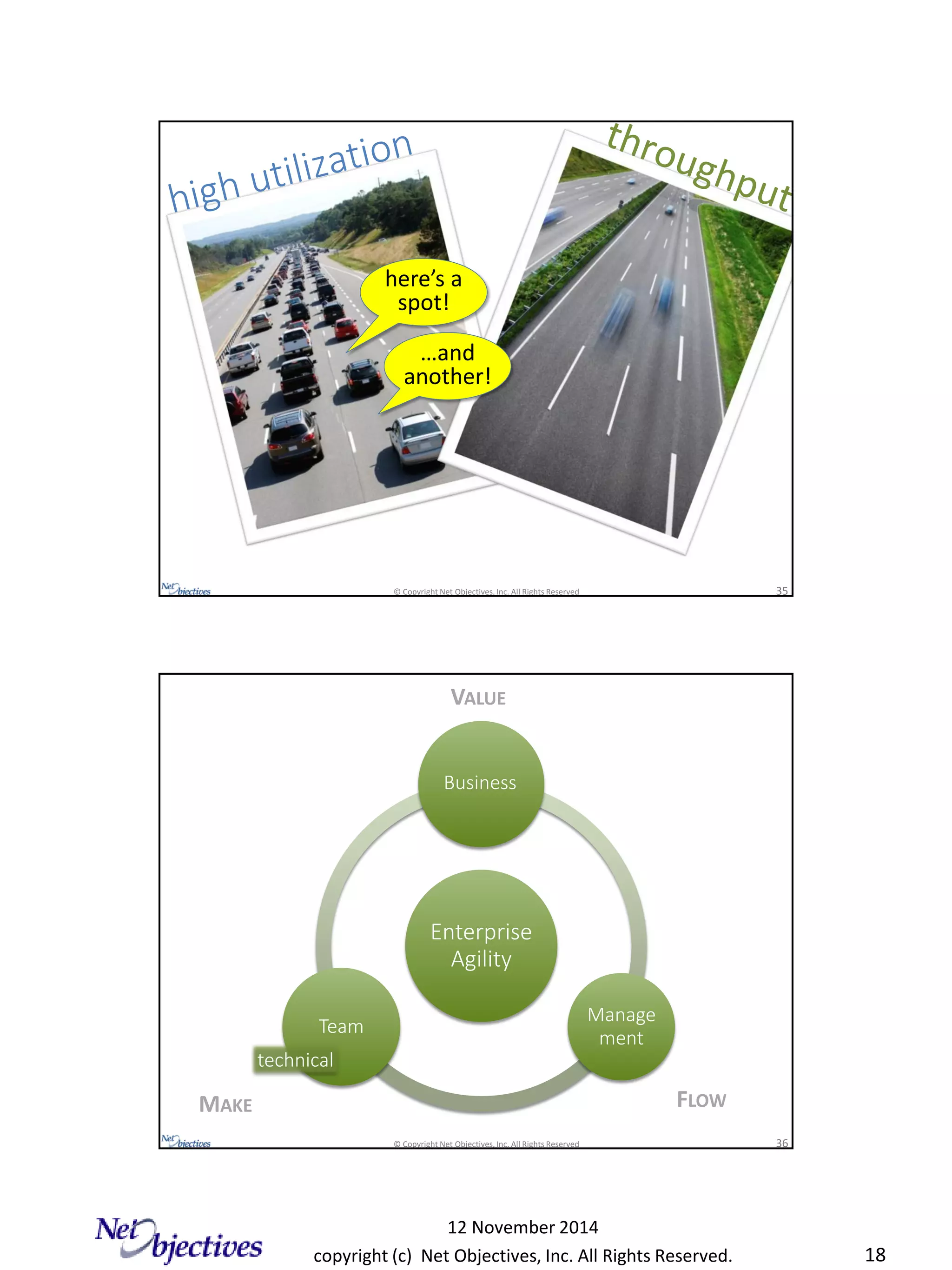
here’s a
spot!
…and
another!
© Copyright Net Objectives, Inc. All Rights Reserved 36
MAKE
VALUE
FLOW
Enterprise
Agility
Business
Manage
ment
Team
technical
copyright (c) Net Objectives, Inc. All Rights Reserved.
12 November 2014
19
© Copyright Net Objectives, Inc. All Rights Reserved 37
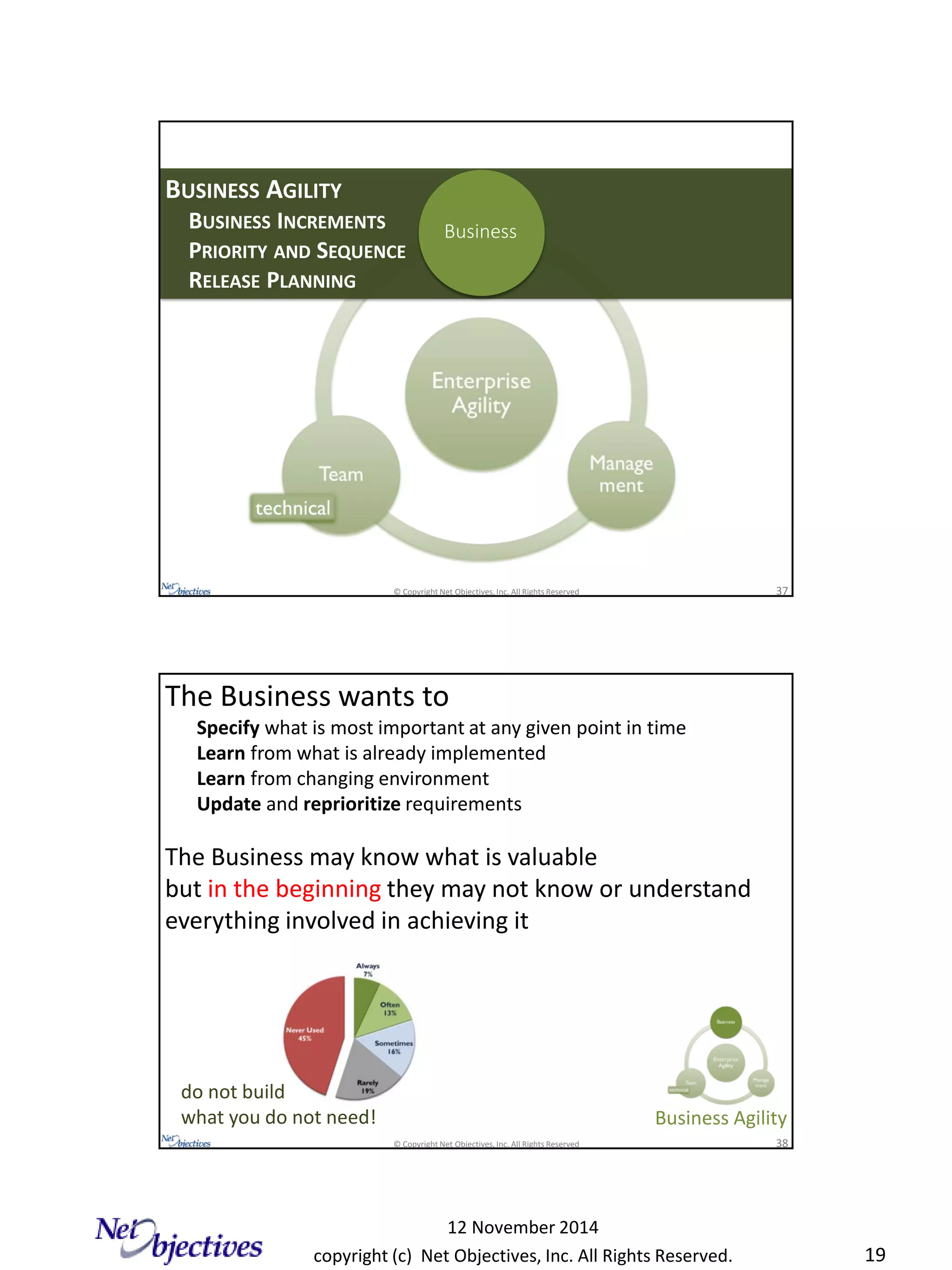
BUSINESS AGILITY
BUSINESS INCREMENTS
PRIORITY AND SEQUENCE
RELEASE PLANNING
Business
© Copyright Net Objectives, Inc. All Rights Reserved 38
The Business wants to
Specify what is most important at any given point in time
Learn from what is already implemented
Learn from changing environment
Update and reprioritize requirements
do not build
what you do not need!
The Business may know what is valuable
but in the beginning they may not know or understand
everything involved in achieving it
Business Agility
copyright (c) Net Objectives, Inc. All Rights Reserved.
12 November 2014
20
© Copyright Net Objectives, Inc. All Rights Reserved 39
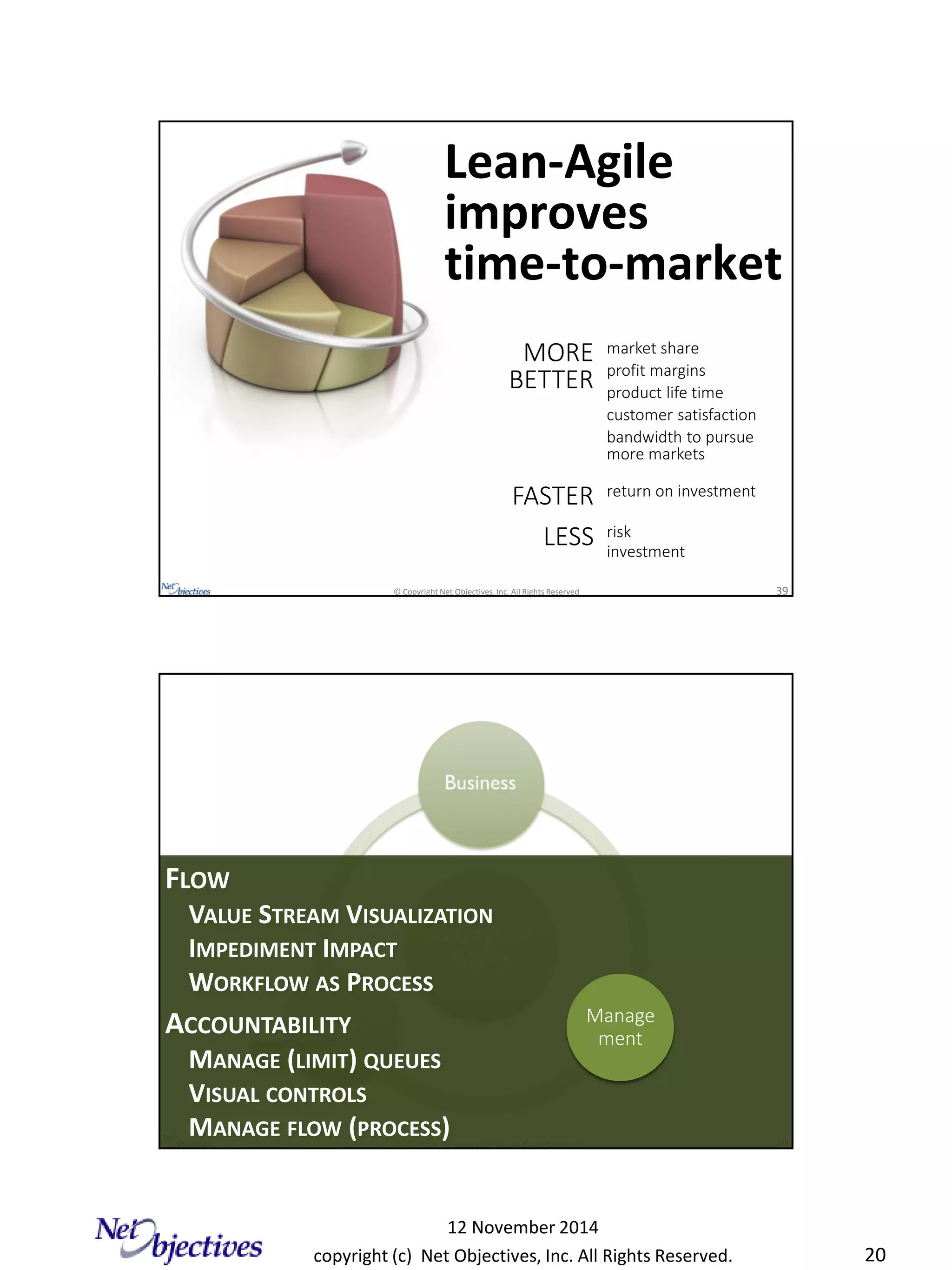
Lean-Agile
improves
time-to-market
MORE
BETTER
market share
profit margins
product life time
customer satisfaction
bandwidth to pursue
more markets
return on investment
risk
investment
LESS
FASTER
© Copyright Net Objectives, Inc. All Rights Reserved 40
FLOW
VALUE STREAM VISUALIZATION
IMPEDIMENT IMPACT
WORKFLOW AS PROCESS
ACCOUNTABILITY
MANAGE (LIMIT) QUEUES
VISUAL CONTROLS
MANAGE FLOW (PROCESS)
Manage
ment
copyright (c) Net Objectives, Inc. All Rights Reserved.
12 November 2014
21
© Copyright Net Objectives, Inc. All Rights Reserved 41
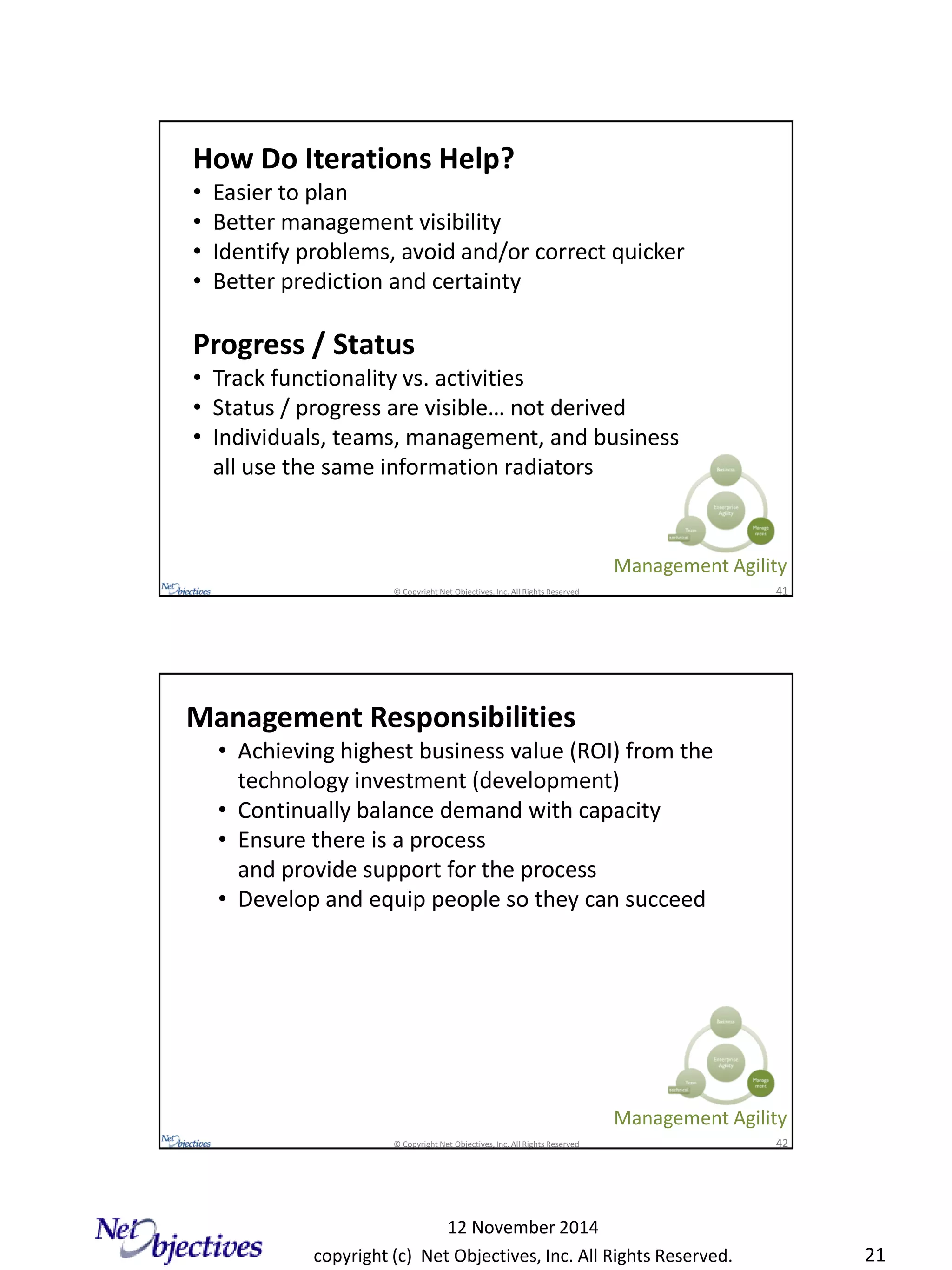
How Do Iterations Help?
• Easier to plan
• Better management visibility
• Identify problems, avoid and/or correct quicker
• Better prediction and certainty
Progress / Status
• Track functionality vs. activities
• Status / progress are visible… not derived
• Individuals, teams, management, and business
all use the same information radiators
Management Agility
© Copyright Net Objectives, Inc. All Rights Reserved 42
Management Responsibilities
• Achieving highest business value (ROI) from the
technology investment (development)
• Continually balance demand with capacity
• Ensure there is a process
and provide support for the process
• Develop and equip people so they can succeed
Management Agility
copyright (c) Net Objectives, Inc. All Rights Reserved.
12 November 2014
22
© Copyright Net Objectives, Inc. All Rights Reserved 43
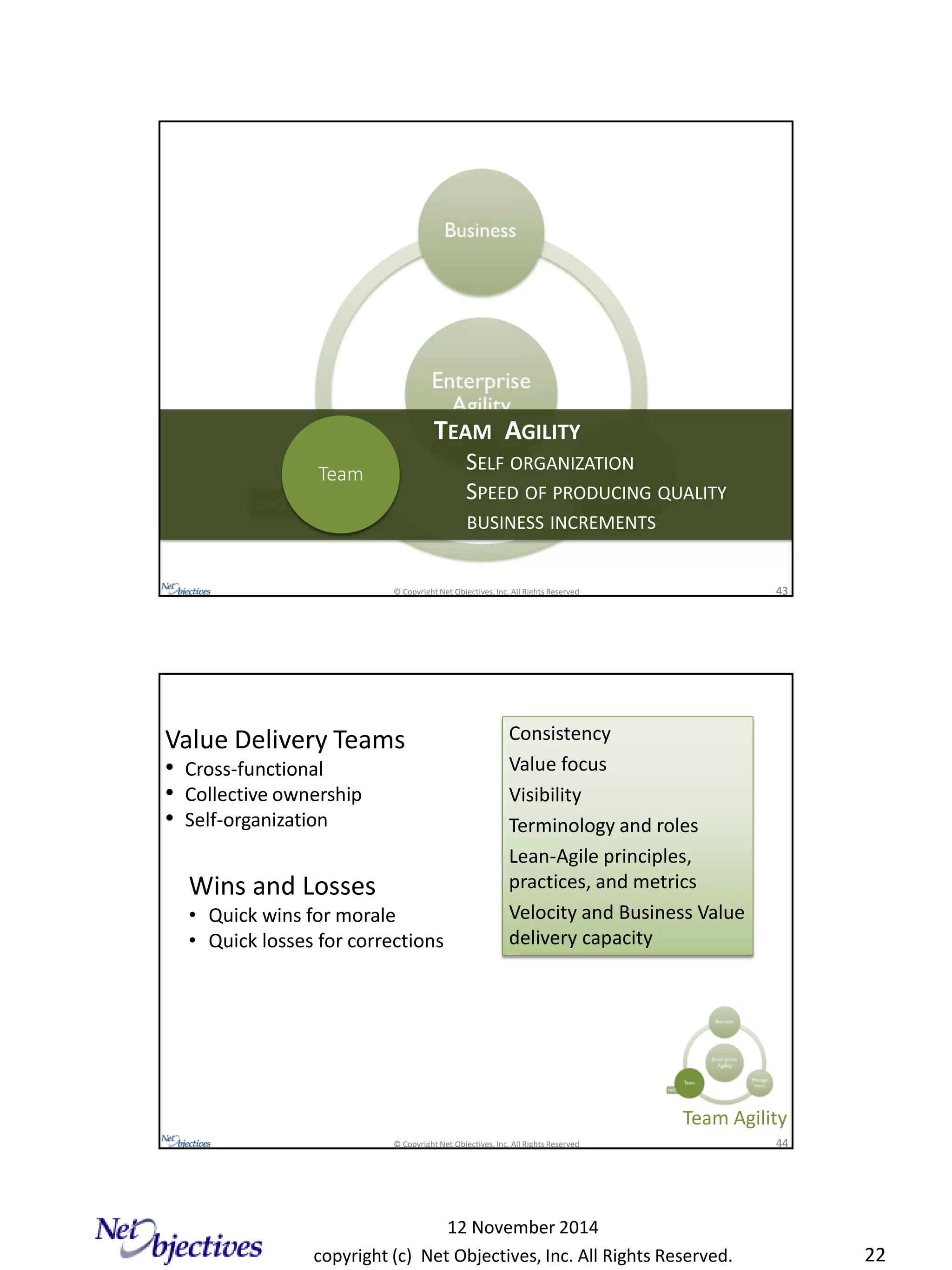
TEAM AGILITY
SELF ORGANIZATION
SPEED OF PRODUCING QUALITY
BUSINESS INCREMENTS
Team
© Copyright Net Objectives, Inc. All Rights Reserved 44
Value Delivery Teams
• Cross-functional
• Collective ownership
• Self-organization
Wins and Losses
• Quick wins for morale
• Quick losses for corrections
Consistency
Value focus
Visibility
Terminology and roles
Lean-Agile principles,
practices, and metrics
Velocity and Business Value
delivery capacity
Team Agility
copyright (c) Net Objectives, Inc. All Rights Reserved.
12 November 2014
23
© Copyright Net Objectives, Inc. All Rights Reserved 45
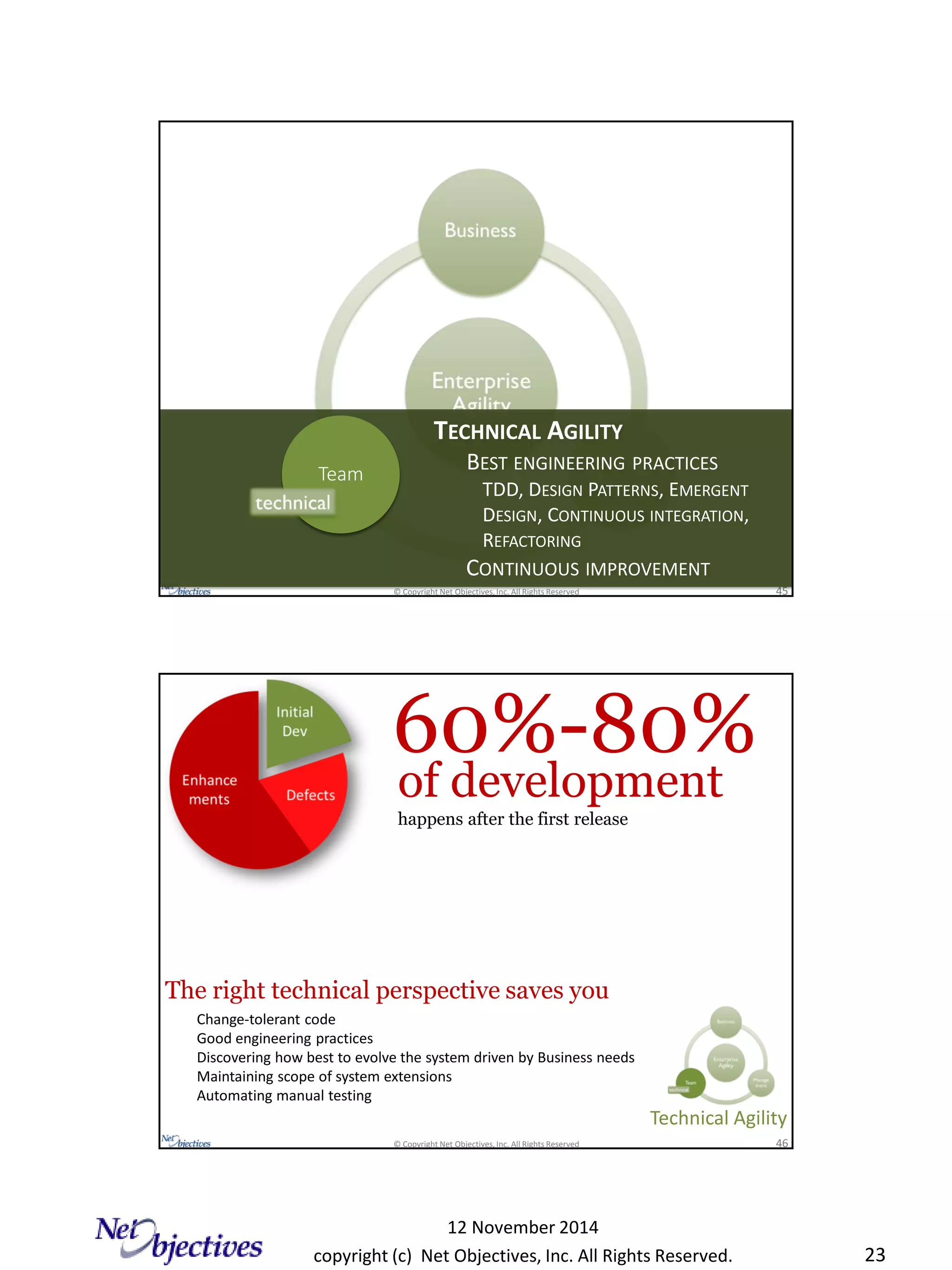
TECHNICAL AGILITY
BEST ENGINEERING PRACTICES
TDD, DESIGN PATTERNS, EMERGENT
DESIGN, CONTINUOUS INTEGRATION,
REFACTORING
CONTINUOUS IMPROVEMENT
Team
© Copyright Net Objectives, Inc. All Rights Reserved 46
60%-80%
The right technical perspective saves you
Change-tolerant code
Good engineering practices
Discovering how best to evolve the system driven by Business needs
Maintaining scope of system extensions
Automating manual testing
of development
happens after the first release
Technical Agility
copyright (c) Net Objectives, Inc. All Rights Reserved.
12 November 2014
24
© Copyright Net Objectives, Inc. All Rights Reserved 47
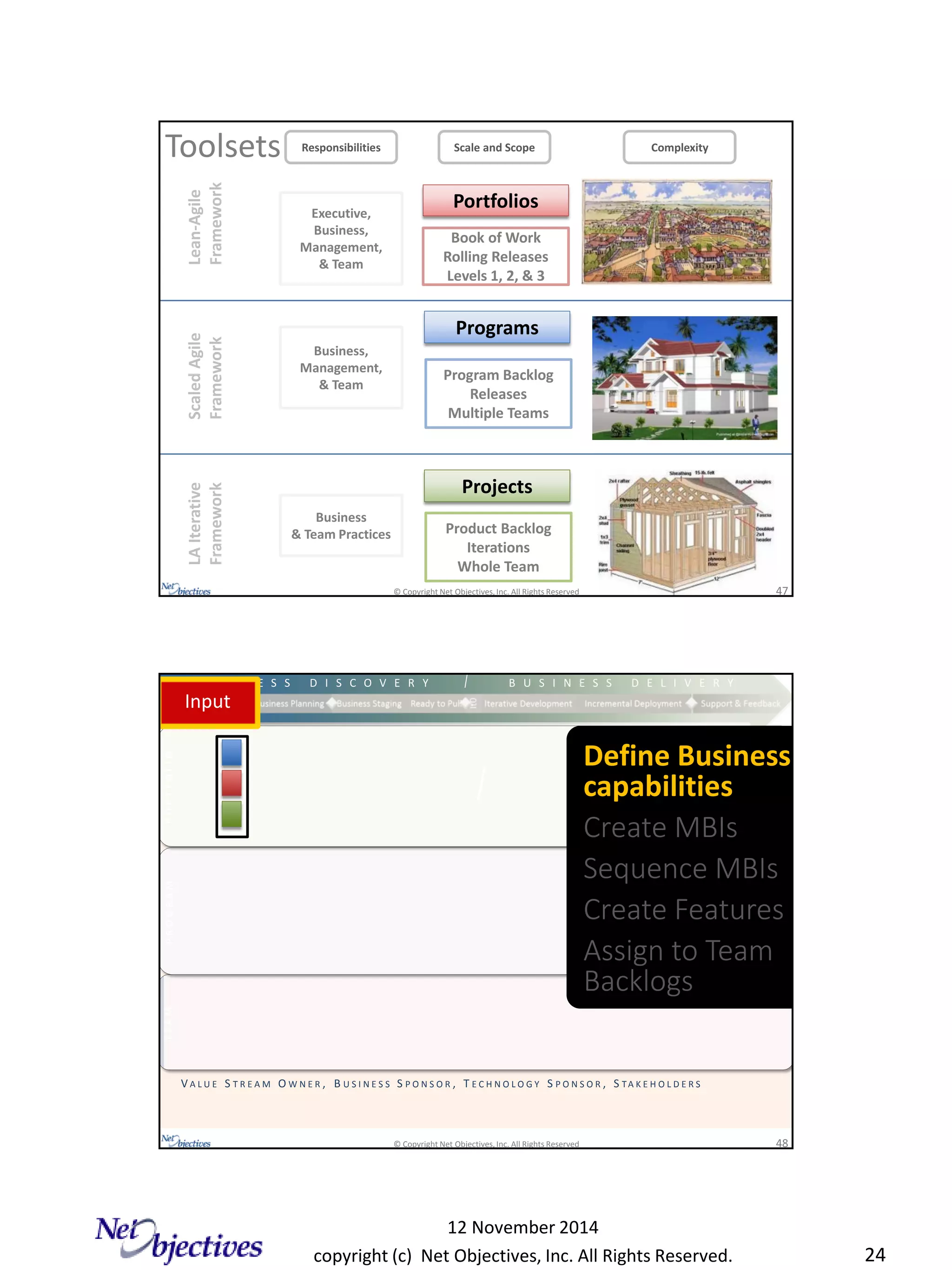
Portfolios
Programs
Projects
Book of Work
Rolling Releases
Levels 1, 2, & 3
Program Backlog
Releases
Multiple Teams
Product Backlog
Iterations
Whole Team
Lean-Agile
Framework
ScaledAgile
Framework
LAIterative
Framework Executive,
Business,
Management,
& Team
Business,
Management,
& Team
Business
& Team Practices
Responsibilities Scale and ScopeToolsets Complexity
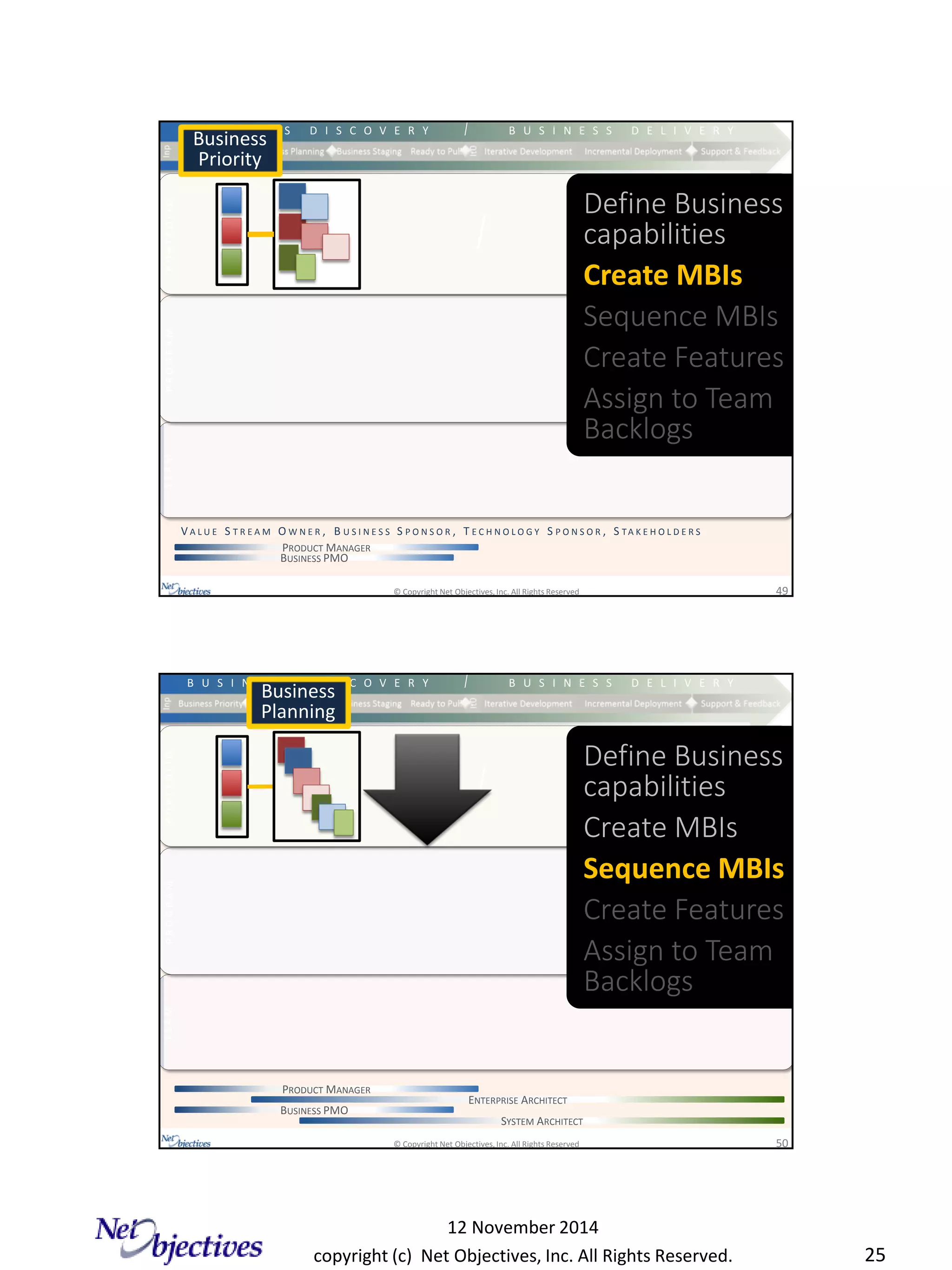
© Copyright Net Objectives, Inc. All Rights Reserved 48
V A L U E S T R E A M O W N E R , B U S I N E S S S P O N S O R , T E C H N O L O G Y S P O N S O R , S TA K E H O L D E R S
TEAMPROGRAMPORTFOLIO
B U S I N E S S D I S C O V E R Y B U S I N E S S D E L I V E R Y
Input
Define Business
capabilities
Create MBIs
Sequence MBIs
Create Features
Assign to Team
Backlogs
copyright (c) Net Objectives, Inc. All Rights Reserved.
12 November 2014
25
© Copyright Net Objectives, Inc. All Rights Reserved 49
BUSINESS PMO
PRODUCT MANAGER
B U S I N E S S D I S C O V E R Y B U S I N E S S D E L I V E R Y
TEAMPROGRAMPORTFOLIO
V A L U E S T R E A M O W N E R , B U S I N E S S S P O N S O R , T E C H N O L O G Y S P O N S O R , S TA K E H O L D E R S
Business
Priority
Define Business
capabilities
Create MBIs
Sequence MBIs
Create Features
Assign to Team
Backlogs
© Copyright Net Objectives, Inc. All Rights Reserved 50
BUSINESS PMO
SYSTEM ARCHITECT
PRODUCT MANAGER
ENTERPRISE ARCHITECT
B U S I N E S S D I S C O V E R Y B U S I N E S S D E L I V E R Y
TEAMPROGRAMPORTFOLIO
Business
Planning
Define Business
capabilities
Create MBIs
Sequence MBIs
Create Features
Assign to Team
Backlogs
copyright (c) Net Objectives, Inc. All Rights Reserved.
12 November 2014
26
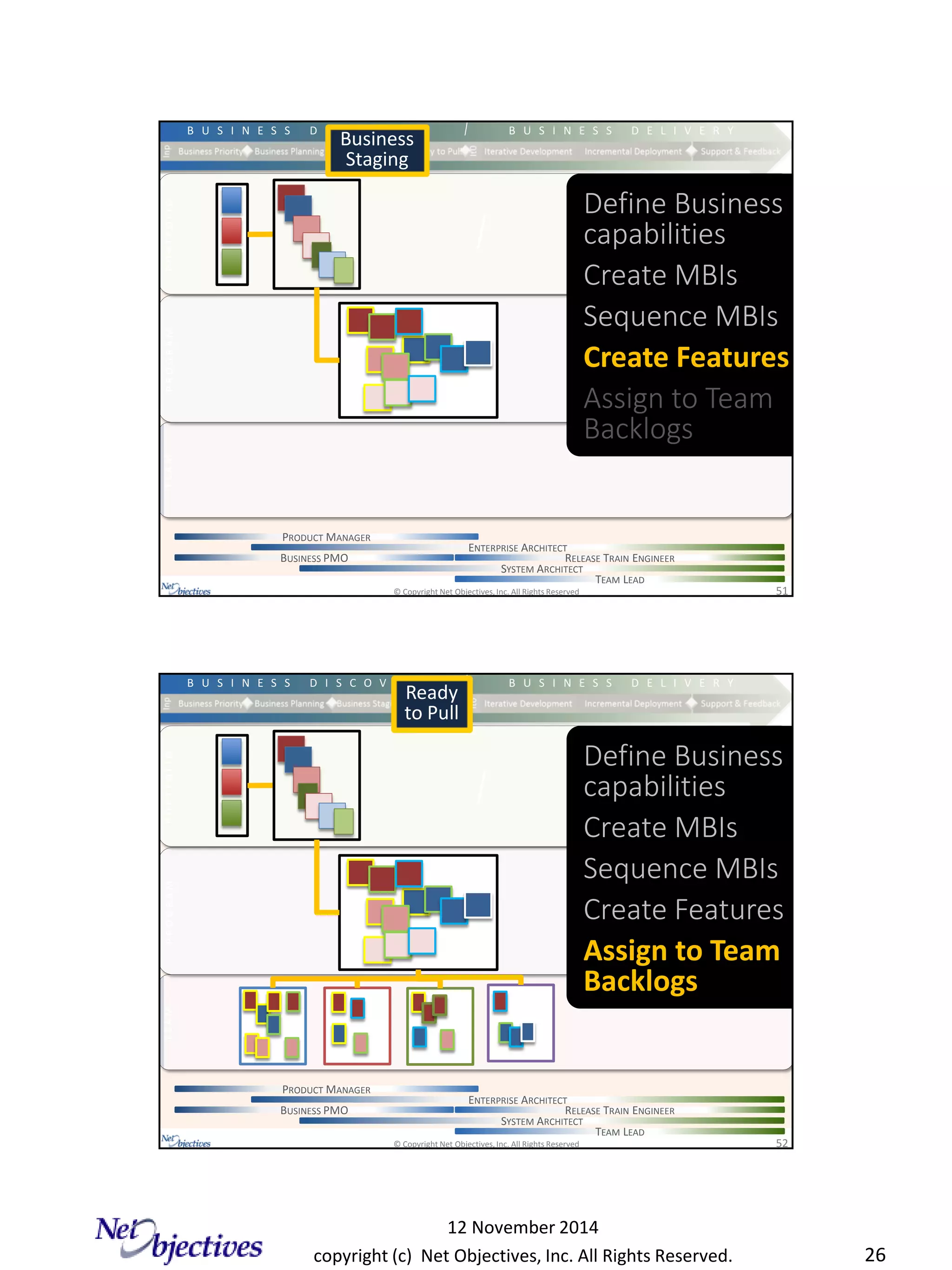
© Copyright Net Objectives, Inc. All Rights Reserved 51
B U S I N E S S D I S C O V E R Y B U S I N E S S D E L I V E R Y
TEAMPROGRAMPORTFOLIO
Business
Staging
BUSINESS PMO
SYSTEM ARCHITECT
PRODUCT MANAGER
ENTERPRISE ARCHITECT
Define Business
capabilities
Create MBIs
Sequence MBIs
Create Features
Assign to Team
Backlogs
RELEASE TRAIN ENGINEER
TEAM LEAD
© Copyright Net Objectives, Inc. All Rights Reserved 52
B U S I N E S S D I S C O V E R Y B U S I N E S S D E L I V E R Y
TEAMPROGRAMPORTFOLIO
Ready
to Pull
BUSINESS PMO
SYSTEM ARCHITECT
PRODUCT MANAGER
ENTERPRISE ARCHITECT
Define Business
capabilities
Create MBIs
Sequence MBIs
Create Features
Assign to Team
Backlogs
RELEASE TRAIN ENGINEER
TEAM LEAD
copyright (c) Net Objectives, Inc. All Rights Reserved.
12 November 2014
27
Al Shalloway
email: alshall@netobjectives.com Twitter tag @alshalloway
Register at www.netobjectives.com/register for webinar info
Lean resources at www.netobjectives.com/lean
Tutorials
An Introduction to SAFe: The Scaled Agile Framework Mon 8:30-4:30
Design Patterns Explained – From Analysis To Implementation Mon 1-4
Eight Steps to Kanban Tue 8:30-12
Principles and Practices of Lean Software Development Tue 8:30-12
Lean Software Development is for Everyone Wed 4:15-5:15
A Holistic View of Complex Systems and Organizational Change Thu 10-11
Avoiding Over and Under Design Thu 11:30-12:30
Thank You
© Copyright Net Objectives, Inc. All Rights Reserved 54
Lean
Enterprise
Business
Manag
ement
Team
ASSESSMENTS
CONSULTING
TRAINING
COACHING
Lean Management
Project Management
Lean for Executives
Product Portfolio Management
Business Product Owner
Product Owner
technical process
Onsite SPC
Leading SAFe
+ with extended topics
SAFe Architecture
PM/PO
Kanban / Scrum
ATDD / TDD / Design Patterns

A Holistic View of Complex Systems and Organizational Change

  • 1.
    AT1 Agile Development ConcurrentSession 11/13/2014 10:00 AM "A Holistic View of Complex Systems and Organizational Change" Presented by: Al Shalloway Net Objectives Brought to you by: 340 Corporate Way, Suite 300, Orange Park, FL 32073 888-268-8770 ∙ 904-278-0524 ∙ sqeinfo@sqe.com ∙ www.sqe.com
  • 2.
    With more thanforty years of experience, the founder and CEO of Net Objectives Al Shalloway is an industry thought leader in lean, SAFe, kanban, product portfolio management, Scrum, and agile design. Al helps companies transition enterprise-wide to lean and agile methods, and teaches courses in these areas—one of a handful of SAFe SPC trainers. He is the primary author of Lean- Agile Software Development: Achieving Enterprise Agility, Design Patterns Explained, Lean-Agile Pocket Guide for Scrum Teams, and Essential Skills for the Agile Developer. Cofounder (although no longer affiliated) with Lean Kanban University, Al is a popular speaker at prestigious conferences worldwide.
  • 3.
    copyright (c) NetObjectives, Inc. All Rights Reserved. 12 November 2014 1 Al Shalloway CEO, Net Objectives SPC Trainer A Holistic View of Complex Systems and Organizational Change © Copyright Net Objectives, Inc. All Rights Reserved 2 Al Shalloway alshall@NetObjectives.com @AlShalloway CEO, Founder Co-founder of Lean-Systems Society Co-founder Lean-Kanban University
  • 4.
    copyright (c) NetObjectives, Inc. All Rights Reserved. 12 November 2014 2 © Copyright Net Objectives, Inc. All Rights Reserved 3 Lean Enterprise Business Manag ement Team ASSESSMENTS CONSULTING TRAINING COACHING Lean Management Project Management Lean for Executives Product Portfolio Management Business Product Owner Product Owner technical process Onsite SPC Leading SAFe + with extended topics SAFe Architecture PM/PO Kanban / Scrum ATDD / TDD / Design Patterns © Copyright Net Objectives, Inc. All Rights Reserved 4 Complex systems still have patterns
  • 5.
    copyright (c) NetObjectives, Inc. All Rights Reserved. 12 November 2014 3 © Copyright Net Objectives, Inc. All Rights Reserved 5 different kinds of predictability © Copyright Net Objectives, Inc. All Rights Reserved 6 If you give people more things than they can handle, it will lower both their productivity, and their resolve to do better If you treat people poorly, they will not work as hard for you as they would otherwise If you separate people by distance and/or time, their ability to work together will go down if you reward people based on particular measures, they will work more towards those measures than they will towards what you put those measures in place for if people ignore principles that effect their work, they will get inferior results than if they attend to them if people don't have a common vision, they will not work as well together as a team that has a common vision Some Easy Predictions
  • 6.
    copyright (c) NetObjectives, Inc. All Rights Reserved. 12 November 2014 4 © Copyright Net Objectives, Inc. All Rights Reserved 7 if you don't define your acceptance tests before writing your code you will waste a lot of effort if you don't attend to code quality, your code will degrade and be harder to maintain and update in the future if you write for just yourself, your teammates will have trouble understanding your code if you use archaic names for your code variables, people won't understand your code well The longer you take between integrations, the longer the integrations will take if you don't get customer feedback quickly, you will write a lot of code they really don't want (for any number of reasons) Some More Easy Predictions © Copyright Net Objectives, Inc. All Rights Reserved 8 If managers can't see what you are doing, they won't understand what you are doing If managers ask you to do one more thing in your iteration and they don't know your process (or you don't have an explicit one) then when you say you can't squeeze it in they will likely think you just aren't willing to take the extra effort required Some Predictions About Management
  • 7.
    copyright (c) NetObjectives, Inc. All Rights Reserved. 12 November 2014 5 © Copyright Net Objectives, Inc. All Rights Reserved 9 Systems & Structures Poor systems cause most of our problems Biggest sources of waste are: • Delays in workflow • Delays in feedback Consider: • Customers don’t know what they want • What happens when we don’t do test-first Consider: • Developers and fixing bugs • The delays due to system © Copyright Net Objectives, Inc. All Rights Reserved 10 which part of the airplane is responsible for FLIGHT?
  • 8.
    copyright (c) NetObjectives, Inc. All Rights Reserved. 12 November 2014 6 © Copyright Net Objectives, Inc. All Rights Reserved 11 Value Stream Impedance Value Stream Impedance (VSI) is a quantitative measure of the resistance faced by the work in a value stream. Impedance often creates delays which create more work which creates more delays. Impedance that slows us down is not as bad as the impedance which creates additional work that we now have to do, work that could have been avoided Example. The thrashing that takes place when software developed by different teams are integrated. © Copyright Net Objectives, Inc. All Rights Reserved 12 Value Stream Impedance Number and size of work in process People in a value stream not working together How people are both geographically and managerially located Sequence work is done in (test-first lowers this) Too much WIP Too little automation Long feedback cycles The disparity between management structure and the way the real work takes place contributors to VSI
  • 9.
    copyright (c) NetObjectives, Inc. All Rights Reserved. 12 November 2014 7 © Copyright Net Objectives, Inc. All Rights Reserved 13 Simple – easy cause and effect Chaotic – small changes can cause big impacts Complicated – many to many Complex – more about holistic relationships – not exactly predictable in advance Types of Systems © Copyright Net Objectives, Inc. All Rights Reserved 14 Thinking a System Is Complex Is More About Us What is complex now may be simple tomorrow. If we don’t take an holistic view we may have problems. Few approaches (certainly not Scrum or Kanban Method) takes an holistic view
  • 10.
    copyright (c) NetObjectives, Inc. All Rights Reserved. 12 November 2014 8 © Copyright Net Objectives, Inc. All Rights Reserved 15 Common Organizational Structure inspired by Dan North, BSC/ADP 2012 Marketing Product Management Development Support © Copyright Net Objectives, Inc. All Rights Reserved 16 What they can manage What they need to manage Their people • If they are working on the right things and at the right level • Their “productivity” The quality of work of their people Hierarchical
  • 11.
    copyright (c) NetObjectives, Inc. All Rights Reserved. 12 November 2014 9 © Copyright Net Objectives, Inc. All Rights Reserved 17 The Nature of Our Work Marketing Product Management Development Support © Copyright Net Objectives, Inc. All Rights Reserved 18 We Manage This Way even though our value flows this way
  • 12.
    copyright (c) NetObjectives, Inc. All Rights Reserved. 12 November 2014 10 © Copyright Net Objectives, Inc. All Rights Reserved 19 What they can manage What they need to manage Their people • If they are working on the right things and at the right level • Their “productivity” The quality of work of their people Time-to-market Effects of upstream groups on their teams Effects of downstream groups on their teams Hierarchical vs. Lean Management © Copyright Net Objectives, Inc. All Rights Reserved 20 Who is managing the value?
  • 13.
    copyright (c) NetObjectives, Inc. All Rights Reserved. 12 November 2014 11 © Copyright Net Objectives, Inc. All Rights Reserved 21 Time-to-Market Marketing Product Management Development Support © Copyright Net Objectives, Inc. All Rights Reserved 22 how often does work wait? Adding Value Waiting Adding Value Adding Value Adding Value Adding Value Adding Value What percent of the time is our work moving forward? How would you know? No one is managing this in most companies. Waiting How much of the time is it waiting for something else to be done? Waiting Adding Value Adding Value Adding Value Adding Value Waiting Marketing Product Management Development Support
  • 14.
    copyright (c) NetObjectives, Inc. All Rights Reserved. 12 November 2014 12 © Copyright Net Objectives, Inc. All Rights Reserved 23 What happens when adding value is delayed? Between getting requirements and using them? Between writing a bug and it being detected? Between two groups getting out of sync? © Copyright Net Objectives, Inc. All Rights Reserved 24 The Whole Picture Marketing Product Management Development Support
  • 15.
    copyright (c) NetObjectives, Inc. All Rights Reserved. 12 November 2014 13 © Copyright Net Objectives, Inc. All Rights Reserved 25 Legacy Organization: Matrix Resources to Projects Project 1 Project 2 Project 3 Project 4 Project N © Copyright Net Objectives, Inc. All Rights Reserved 26 Let’s Create a Pilot Project Project 1 Project 2 % Project 3 Project 4 Project N Business Analyst, Architect, Usability Expert, Developer, Developer, Tester, Project Manager Expert Just creating a cross-functional, co-located team you will improve 3x without changing your process. While it may be successful as a pilot, it will likely not be sustainable.
  • 16.
    copyright (c) NetObjectives, Inc. All Rights Reserved. 12 November 2014 14 © Copyright Net Objectives, Inc. All Rights Reserved 27 Getting Requirements Testing Programming Design Integration Planning Collaboration Re-doing requirements Working from old requirements “Fixing” bugs “Integration” errors Deployment Building unneeded features Overbuilding frameworks What Work Do You Do? Training Documentation Essentially duplicating components What percentage of your time do you spend on the left? Write it down. © Copyright Net Objectives, Inc. All Rights Reserved 28 1. Identify the actions taken in the value stream ApproveRequest Reqts Sign Off Review Deploy Analysis Design Code Test
  • 17.
    copyright (c) NetObjectives, Inc. All Rights Reserved. 12 November 2014 15 © Copyright Net Objectives, Inc. All Rights Reserved 29 120 hrs` 280 hrs 240 hrs 8 hrs2 hrs 1. Identify the actions taken in the value stream 2. What was the real time from start to finish of the action? ApproveRequest Reqts Sign Off Review Deploy Analysis Design Code Test 0.5 hrs 160 hrs8 hrs 8 hrs 100 hrs © Copyright Net Objectives, Inc. All Rights Reserved 30 120 hrs` 280 hrs 240 hrs 8 hrs2 hrs 1. Identify the actions taken in the value stream 2. What was the real time from start to finish of the action? 3. What was the average time working on this vs working on other things? Approve .1 / 7.9 hrs Request 0.5 / 0.0 hr Reqts 60 / 100 hrs Sign Off 1 / 7 hrs Review 2 / 0 hrs Deploy 3 / 5 hrs Analysis 40 / 600 hrs Design 40 / 80 hrs Code 80 / 200 hrs Test 40 / 200 hrs 0.5 hrs 160 hrs8 hrs 8 hrs 100 hrs
  • 18.
    copyright (c) NetObjectives, Inc. All Rights Reserved. 12 November 2014 16 © Copyright Net Objectives, Inc. All Rights Reserved 31 80 hrs320 hrs 80 hrs 320 hrs 80 hrs 160 hrs 80 hrs 80 hrs 80 hrs 1. Identify the actions taken in the value stream 2. What was the real time from start to finish of the action? 3. What was the average time working on this vs working on other things? 4. Identify time between actions 120 hrs` 280 hrs 240 hrs 8 hrs2 hrs Approve .1 / 7.9 hrs Request 0.5 / 0.0 hr Reqts 60 / 100 hrs Sign Off 1 / 7 hrs Review 2 / 0 hrs Deploy 3 / 5 hrs Analysis 40 / 600 hrs Design 40 / 80 hrs Code 80 / 200 hrs Test 40 / 200 hrs 0.5 hrs 160 hrs8 hrs 8 hrs 100 hrs © Copyright Net Objectives, Inc. All Rights Reserved 32 80 hrs320 hrs 80 hrs 320 hrs 80 hrs 160 hrs 80 hrs 80 hrs 80 hrs 120 hrs` 280 hrs 240 hrs 8 hrs2 hrs 1. Identify the actions taken in the value stream 2. What was the real time from start to finish of the action? 3. What was the average time working on this vs working on other things? 4. Identify time between actions 5. Identify any loop backs required 65% defective Repeat 3X 20% rejected Repeat 1X Approve .1 / 7.9 hrs Request 0.5 / 0.0 hr Reqts 60 / 100 hrs Sign Off 1 / 7 hrs Review 2 / 0 hrs Deploy 3 / 5 hrs Analysis 40 / 600 hrs Design 40 / 80 hrs Code 80 / 200 hrs Test 40 / 200 hrs 0.5 hrs 160 hrs8 hrs 8 hrs 100 hrs
  • 19.
    copyright (c) NetObjectives, Inc. All Rights Reserved. 12 November 2014 17 © Copyright Net Objectives, Inc. All Rights Reserved 33 1. Identify the actions taken in the value stream 2. What was the real time from start to finish of the action? 3. What was the average time working on this vs working on other things? 4. Identify time between actions 5. Identify any loop backs required 6. Calculate Process Cycle Efficiency: 80 hrs320 hrs 80 hrs 320 hrs 80 hrs 160 hrs 80 hrs 80 hrs 80 hrs 0.5 hrs 160 hrs8 hrs 8 hrs 120 hrs` 280 hrs 240 hrs 100 hrs 8 hrs2 hrs 65% defective Repeat 3X 20% rejected Repeat 1X Avg Time Worked Total Cycle Time PCE = = 14.9% 509 hrs 3433 hrs 509 hrs 3433 hrs Avg Time Worked Total Cycle Time Approve .1 / 7.9 hrs Request 0.5 / 0.0 hr Reqts 60 / 100 hrs Sign Off 1 / 7 hrs Review 2 / 0 hrs Deploy 3 / 5 hrs Analysis 40 / 600 hrs Design 40 / 80 hrs Code 80 / 200 hrs Test 40 / 200 hrs Approve .1 / 7.9 hrs Request 0.5 / 0.0 hrs Reqts 60 / 100 hrs Sign Off 1 / 7 hrs Review 2 / 0 hrs Deploy 3 / 5 hrs Analysis 40 / 60 hrs Design 40 / 80 hrs Code 80 / 200 hrs Test 40 / 200 hrs 0.5 hrs 160 hrs8 hrs 8 hrs 120 hrs 280 hrs 240 hrs 100 hrs 8 hrs2 hrs 320 hrs 80 hrs 320 hrs 80 hrs 160 hrs 80 hrs 80 hrs 65% defective Repeat 3X 20% rejected Repeat 1X 80 hrs 80 hrs © Copyright Net Objectives, Inc. All Rights Reserved 34 80 hrs320 hrs 80 hrs 320 hrs 80 hrs 160 hrs 80 hrs 80 hrs 80 hrs 120 hrs` 280 hrs 240 hrs 8 hrs2 hrs Approve 0.1 / 7.9 hrs Request 0.5 / 0.0 hr Reqts 60 / 100 hrs Sign Off 1 / 7 hrs Review 2 / 0 hrs Deploy 3 / 5 hrs Analysis 40 / 60 hrs Design 40 / 80 hrs Code 80 / 200 hrs Test 40 /200 hrs 65% defective Repeat 3X 20% rejected Repeat 1X 320 hrs 80 hrs 320 hrs 80 hrs 160 hrs 80 hrs 80 hrs 65% defective Repeat 3X 20% rejected Repeat 1X 80 hrs 80 hrs Eliminating delays between what you do Getting better at what you do Which gives a better return? 0.5 hrs 8 hrs 8 hrs 100 hrs160 hrs
  • 20.
    copyright (c) NetObjectives, Inc. All Rights Reserved. 12 November 2014 18 © Copyright Net Objectives, Inc. All Rights Reserved 35 here’s a spot! …and another! © Copyright Net Objectives, Inc. All Rights Reserved 36 MAKE VALUE FLOW Enterprise Agility Business Manage ment Team technical
  • 21.
    copyright (c) NetObjectives, Inc. All Rights Reserved. 12 November 2014 19 © Copyright Net Objectives, Inc. All Rights Reserved 37 BUSINESS AGILITY BUSINESS INCREMENTS PRIORITY AND SEQUENCE RELEASE PLANNING Business © Copyright Net Objectives, Inc. All Rights Reserved 38 The Business wants to Specify what is most important at any given point in time Learn from what is already implemented Learn from changing environment Update and reprioritize requirements do not build what you do not need! The Business may know what is valuable but in the beginning they may not know or understand everything involved in achieving it Business Agility
  • 22.
    copyright (c) NetObjectives, Inc. All Rights Reserved. 12 November 2014 20 © Copyright Net Objectives, Inc. All Rights Reserved 39 Lean-Agile improves time-to-market MORE BETTER market share profit margins product life time customer satisfaction bandwidth to pursue more markets return on investment risk investment LESS FASTER © Copyright Net Objectives, Inc. All Rights Reserved 40 FLOW VALUE STREAM VISUALIZATION IMPEDIMENT IMPACT WORKFLOW AS PROCESS ACCOUNTABILITY MANAGE (LIMIT) QUEUES VISUAL CONTROLS MANAGE FLOW (PROCESS) Manage ment
  • 23.
    copyright (c) NetObjectives, Inc. All Rights Reserved. 12 November 2014 21 © Copyright Net Objectives, Inc. All Rights Reserved 41 How Do Iterations Help? • Easier to plan • Better management visibility • Identify problems, avoid and/or correct quicker • Better prediction and certainty Progress / Status • Track functionality vs. activities • Status / progress are visible… not derived • Individuals, teams, management, and business all use the same information radiators Management Agility © Copyright Net Objectives, Inc. All Rights Reserved 42 Management Responsibilities • Achieving highest business value (ROI) from the technology investment (development) • Continually balance demand with capacity • Ensure there is a process and provide support for the process • Develop and equip people so they can succeed Management Agility
  • 24.
    copyright (c) NetObjectives, Inc. All Rights Reserved. 12 November 2014 22 © Copyright Net Objectives, Inc. All Rights Reserved 43 TEAM AGILITY SELF ORGANIZATION SPEED OF PRODUCING QUALITY BUSINESS INCREMENTS Team © Copyright Net Objectives, Inc. All Rights Reserved 44 Value Delivery Teams • Cross-functional • Collective ownership • Self-organization Wins and Losses • Quick wins for morale • Quick losses for corrections Consistency Value focus Visibility Terminology and roles Lean-Agile principles, practices, and metrics Velocity and Business Value delivery capacity Team Agility
  • 25.
    copyright (c) NetObjectives, Inc. All Rights Reserved. 12 November 2014 23 © Copyright Net Objectives, Inc. All Rights Reserved 45 TECHNICAL AGILITY BEST ENGINEERING PRACTICES TDD, DESIGN PATTERNS, EMERGENT DESIGN, CONTINUOUS INTEGRATION, REFACTORING CONTINUOUS IMPROVEMENT Team © Copyright Net Objectives, Inc. All Rights Reserved 46 60%-80% The right technical perspective saves you Change-tolerant code Good engineering practices Discovering how best to evolve the system driven by Business needs Maintaining scope of system extensions Automating manual testing of development happens after the first release Technical Agility
  • 26.
    copyright (c) NetObjectives, Inc. All Rights Reserved. 12 November 2014 24 © Copyright Net Objectives, Inc. All Rights Reserved 47 Portfolios Programs Projects Book of Work Rolling Releases Levels 1, 2, & 3 Program Backlog Releases Multiple Teams Product Backlog Iterations Whole Team Lean-Agile Framework ScaledAgile Framework LAIterative Framework Executive, Business, Management, & Team Business, Management, & Team Business & Team Practices Responsibilities Scale and ScopeToolsets Complexity © Copyright Net Objectives, Inc. All Rights Reserved 48 V A L U E S T R E A M O W N E R , B U S I N E S S S P O N S O R , T E C H N O L O G Y S P O N S O R , S TA K E H O L D E R S TEAMPROGRAMPORTFOLIO B U S I N E S S D I S C O V E R Y B U S I N E S S D E L I V E R Y Input Define Business capabilities Create MBIs Sequence MBIs Create Features Assign to Team Backlogs
  • 27.
    copyright (c) NetObjectives, Inc. All Rights Reserved. 12 November 2014 25 © Copyright Net Objectives, Inc. All Rights Reserved 49 BUSINESS PMO PRODUCT MANAGER B U S I N E S S D I S C O V E R Y B U S I N E S S D E L I V E R Y TEAMPROGRAMPORTFOLIO V A L U E S T R E A M O W N E R , B U S I N E S S S P O N S O R , T E C H N O L O G Y S P O N S O R , S TA K E H O L D E R S Business Priority Define Business capabilities Create MBIs Sequence MBIs Create Features Assign to Team Backlogs © Copyright Net Objectives, Inc. All Rights Reserved 50 BUSINESS PMO SYSTEM ARCHITECT PRODUCT MANAGER ENTERPRISE ARCHITECT B U S I N E S S D I S C O V E R Y B U S I N E S S D E L I V E R Y TEAMPROGRAMPORTFOLIO Business Planning Define Business capabilities Create MBIs Sequence MBIs Create Features Assign to Team Backlogs
  • 28.
    copyright (c) NetObjectives, Inc. All Rights Reserved. 12 November 2014 26 © Copyright Net Objectives, Inc. All Rights Reserved 51 B U S I N E S S D I S C O V E R Y B U S I N E S S D E L I V E R Y TEAMPROGRAMPORTFOLIO Business Staging BUSINESS PMO SYSTEM ARCHITECT PRODUCT MANAGER ENTERPRISE ARCHITECT Define Business capabilities Create MBIs Sequence MBIs Create Features Assign to Team Backlogs RELEASE TRAIN ENGINEER TEAM LEAD © Copyright Net Objectives, Inc. All Rights Reserved 52 B U S I N E S S D I S C O V E R Y B U S I N E S S D E L I V E R Y TEAMPROGRAMPORTFOLIO Ready to Pull BUSINESS PMO SYSTEM ARCHITECT PRODUCT MANAGER ENTERPRISE ARCHITECT Define Business capabilities Create MBIs Sequence MBIs Create Features Assign to Team Backlogs RELEASE TRAIN ENGINEER TEAM LEAD
  • 29.
    copyright (c) NetObjectives, Inc. All Rights Reserved. 12 November 2014 27 Al Shalloway email: alshall@netobjectives.com Twitter tag @alshalloway Register at www.netobjectives.com/register for webinar info Lean resources at www.netobjectives.com/lean Tutorials An Introduction to SAFe: The Scaled Agile Framework Mon 8:30-4:30 Design Patterns Explained – From Analysis To Implementation Mon 1-4 Eight Steps to Kanban Tue 8:30-12 Principles and Practices of Lean Software Development Tue 8:30-12 Lean Software Development is for Everyone Wed 4:15-5:15 A Holistic View of Complex Systems and Organizational Change Thu 10-11 Avoiding Over and Under Design Thu 11:30-12:30 Thank You © Copyright Net Objectives, Inc. All Rights Reserved 54 Lean Enterprise Business Manag ement Team ASSESSMENTS CONSULTING TRAINING COACHING Lean Management Project Management Lean for Executives Product Portfolio Management Business Product Owner Product Owner technical process Onsite SPC Leading SAFe + with extended topics SAFe Architecture PM/PO Kanban / Scrum ATDD / TDD / Design Patterns