Three steps to driving
business efficiency
Action Brief
Goodbye, drag.
Hello, competitive advantage.
Do the tools, processes, and systems you’re using today help you drive efficiency, best-in-class operations, and customer experience?
Or are outdated disparate technologies and systems slowing your growth?
You know better than anyone else
that change can happen quickly. A
few new customers mean you’ll be
drinking from a fire hose. Like many
businesss, you may still rely on the
entry-level accounting software,
spreadsheets, and point solutions
that got you started. The problem
is, they’re not sufficient to help
you take on new opportunities
for growth.
To keep ahead of the daily needs
of your customers and go after the
opportunities at hand, you need
your technology to help you drive
efficiency at every turn. You need
a solution that helps you manage
and streamline processes, and gain
insights across your organization.
More efficient operations offer
you the opportunity to reduce
operating costs, improve
profitability, and turn resource
attention to more strategic thinking
and actions.	
This action brief will help you learn how 	
to drive efficiency in three steps:
1 Identify warning signs that the software and systems you’re 	
		 using today aren’t up for the challenges of and opportunities for 	
		 growth.
2 Understand how shifting gears to a more modern, integrated 	
		 business management solution can give your business the 	
		 agility and insights you need to accelerate growth.
3 Take the next steps to get “unstuck” and make decisions that 	
		 will help your business charge forward.	
2
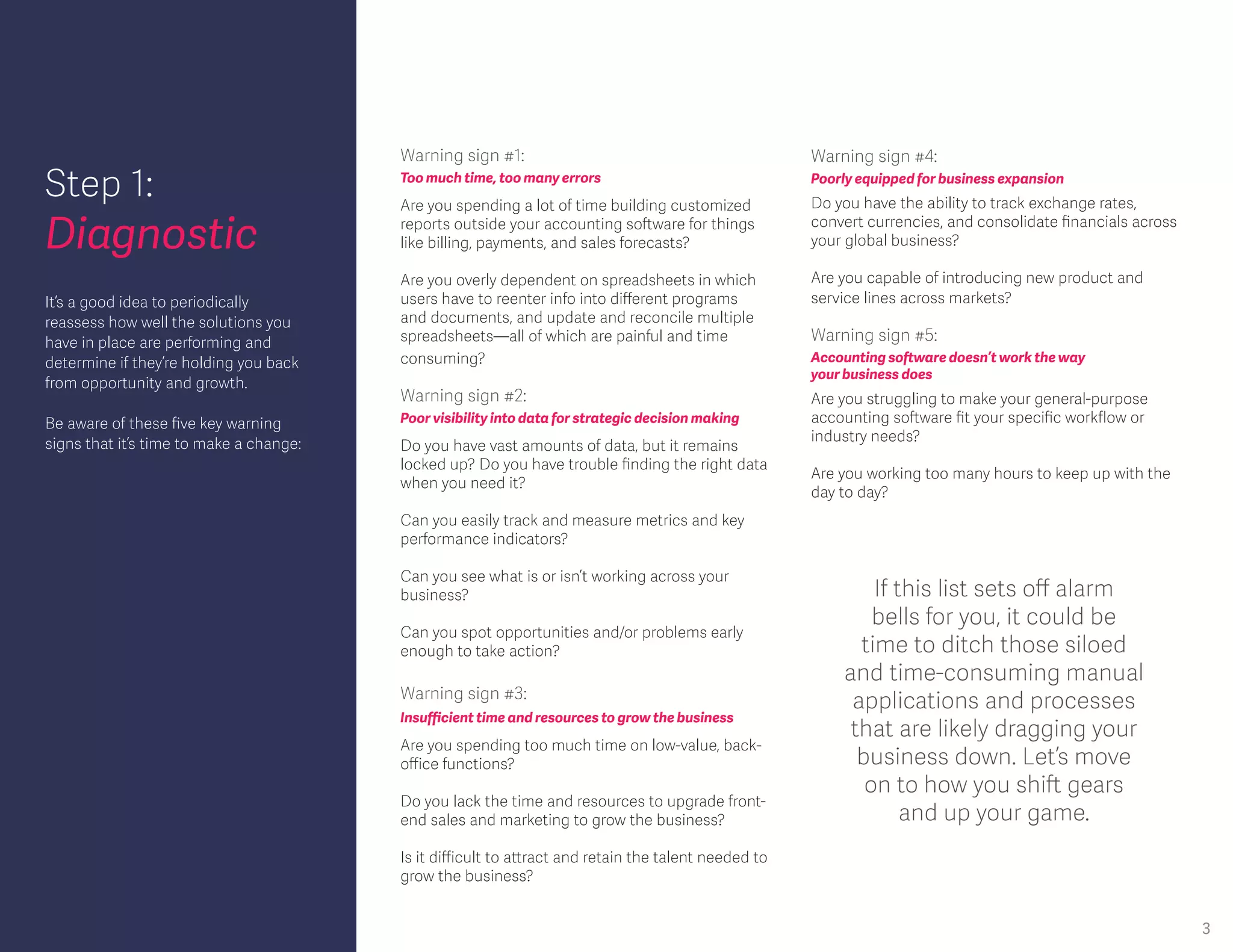
Step 1:
Diagnostic
It’s a good idea to periodically
reassess how well the solutions you
have in place are performing and
determine if they’re holding you back
from opportunity and growth.
Be aware of these five key warning
signs that it’s time to make a change:
If this list sets off alarm
bells for you, it could be
time to ditch those siloed
and time-consuming manual
applications and processes
that are likely dragging your
business down. Let’s move
on to how you shift gears
and up your game.
Warning sign #1:
Too much time, too many errors
Are you spending a lot of time building customized
reports outside your accounting software for things
like billing, payments, and sales forecasts?
Are you overly dependent on spreadsheets in which
users have to reenter info into different programs
and documents, and update and reconcile multiple
spreadsheets—all of which are painful and time
consuming?
Warning sign #2:
Poor visibility into data for strategic decision making
Do you have vast amounts of data, but it remains
locked up? Do you have trouble finding the right data
when you need it?
Can you easily track and measure metrics and key
performance indicators?
Can you see what is or isn’t working across your
business?
Can you spot opportunities and/or problems early
enough to take action?
Warning sign #3:
Insufficient time and resources to grow the business
Are you spending too much time on low-value, back-
office functions?
Do you lack the time and resources to upgrade front-
end sales and marketing to grow the business?
Is it difficult to attract and retain the talent needed to
grow the business?
Warning sign #4:
Poorly equipped for business expansion
Do you have the ability to track exchange rates,
convert currencies, and consolidate financials across
your global business?
Are you capable of introducing new product and
service lines across markets?
Warning sign #5:
Accounting software doesn’t work the way
your business does
Are you struggling to make your general-purpose
accounting software fit your specific workflow or
industry needs?
Are you working too many hours to keep up with the
day to day?
3
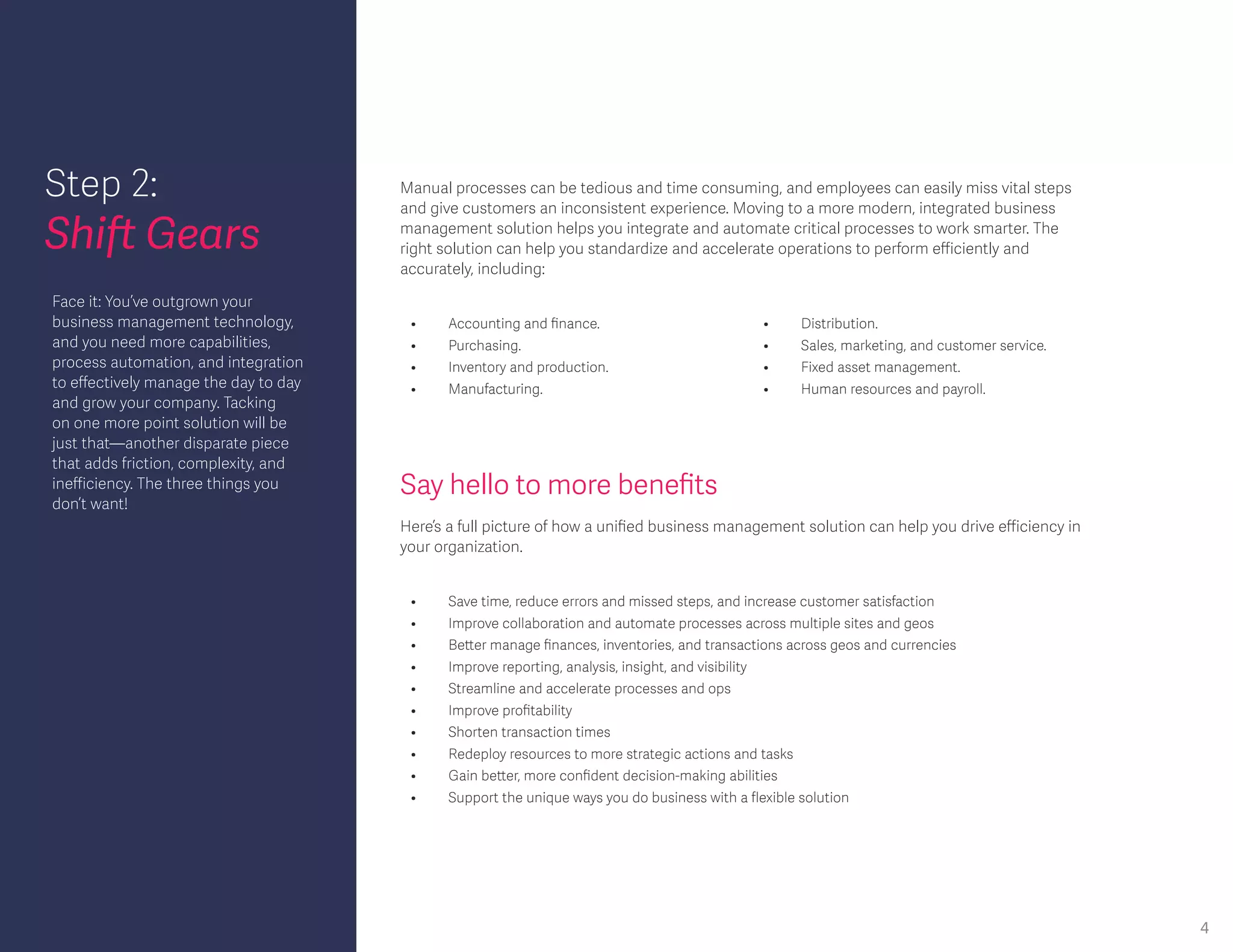
Step 2:
Shift Gears
Say hello to more benefits
Face it: You’ve outgrown your
business management technology,
and you need more capabilities,
process automation, and integration
to effectively manage the day to day
and grow your company. Tacking
on one more point solution will be
just that—another disparate piece
that adds friction, complexity, and
inefficiency. The three things you
don’t want!
Here’s a full picture of how a unified business management solution can help you drive efficiency in
your organization.
•	 Accounting and finance.
•	 Purchasing.
•	 Inventory and production.
•	Manufacturing.
•	 Distribution.
•	 Sales, marketing, and customer service.
•	 Fixed asset management.
•	 Human resources and payroll.
Manual processes can be tedious and time consuming, and employees can easily miss vital steps
and give customers an inconsistent experience. Moving to a more modern, integrated business
management solution helps you integrate and automate critical processes to work smarter. The
right solution can help you standardize and accelerate operations to perform efficiently and
accurately, including:
•	 Save time, reduce errors and missed steps, and increase customer satisfaction
•	 Improve collaboration and automate processes across multiple sites and geos
•	 Better manage finances, inventories, and transactions across geos and currencies
•	 Improve reporting, analysis, insight, and visibility
•	 Streamline and accelerate processes and ops
•	 Improve profitability
•	 Shorten transaction times
•	 Redeploy resources to more strategic actions and tasks
•	 Gain better, more confident decision-making abilities
•	 Support the unique ways you do business with a flexible solution
4
Step 3:
Take Action
Reduce costs by streamlining operations.
From a business perspective, an integrated solution enables organizations to reduce costs by automating
workflows to streamline tasks and remove information-sharing bottlenecks so employees can do their jobs in
less time.
From an IT perspective, a flexible, customizable solution reduces the total cost of ownership by allowing
companies to make changes without the need to modify the system.
A modern architecture makes it easier to swap out databases, hardware, or operating systems without the
need to revamp the solution. A system with modules that are integrated out of the box avoids the time and
cost of tedious point-to-point integrations. Moreover, with a single integrated system, IT eliminates the need to
manage multiple vendors or resellers.
Focus on strategy to drive results.
Using an integrated solution, employees can also do their jobs more effectively. It makes it easy to document
work steps and processes so people know how to perform work on a consistent basis—when employees
have easy access to documented processes, production errors go down and quality goes up. Integrated,
collaborative planning processes enable more accurate plans and reduced budget cycle times. With
more visibility into production processes, management can quickly identify problems in the business and
take immediate corrective action. With more accurate data and better decision-making tools, companies
can improve the quality of their decisions, improving operational results. And finally, by reducing manual
administrative tasks through automated processes and providing faster, smarter access to personalized
information, companies can empower staff to focus on more strategic issues.
We understand. Change is difficult.
But it starts with making decisions
that will help you get unstuck and
move forward. If you take action to
improve and streamline your business
processes today, you’ll reap the
rewards long into the future.
By replacing manual processes and
siloed systems with a single, complete
business management solution that
spans multiple functional areas,
locations, countries, or across your
organization and supply chain, you
can:
5
What’s at stake?
Here are things to keep in mind as you consider your next move:
Agile, best-in-class companies look to business management solutions to
improve operational efficiency and effectiveness, reduce costs, enhance
profitability, and make more resources available for strategic planning. Maybe
it’s time for you to say good-bye to the disparate tools and systems that are
holding you back.
•	 There’s a high cost associated with doing nothing! If you don’t act, 			
	 the drag on the business will only get bigger and stronger.
•	 You can get back more of your most precious resource—time—			
	 so you can focus on things that really matter, such as attracting new 			
	 customers, or recruiting and grooming new employees who will help 			
	 you grow the business.
•	 Don’t try to do tackle everything at once. Look for a solution that 			
	 can provide all the capabilities you need, but start with your biggest 			
	 pain points.
•	 Streamlining the most manual, time-consuming processes first can 			
	 often deliver the biggest most immediate bang for the buck. Do 			
	 those first, then turn on new capabilities as needed.
• 	 The end goal is integrating and streamlining across different 			
	 functions to drive efficiency across the business.
• 	 Look for a provider that understands best practices and can provide 			
	 actionable guidance, takes the time to understand your business, 			
	 and helps you avoid common pitfalls and get the maximum value 			
	 out of whatever solution you select.
Say hello to Sage
For more than 30 years, Sage has been a champion for
businesses like yours: companies on the cusp of greater
opportunity. We’ve evolved right by your side, refining our
offerings, to help you take the next big leap forward. Take
a look and find out how Sage can help you say goodbye to
workarounds and hello to successful growth.
© 2015, Sage Software, Inc. All Rights Reserved. Sage, the Sage logo, and the Sage product and services names mentioned
herein are the registered trademarks or trademarks of Sage Software, Inc. or its affiliated companies. All other trademarks
the property of their respective owners.
6

Sage action brief: Three steps to driving business efficiency

  • 1.
    Three steps todriving business efficiency Action Brief
  • 2.
    Goodbye, drag. Hello, competitiveadvantage. Do the tools, processes, and systems you’re using today help you drive efficiency, best-in-class operations, and customer experience? Or are outdated disparate technologies and systems slowing your growth? You know better than anyone else that change can happen quickly. A few new customers mean you’ll be drinking from a fire hose. Like many businesss, you may still rely on the entry-level accounting software, spreadsheets, and point solutions that got you started. The problem is, they’re not sufficient to help you take on new opportunities for growth. To keep ahead of the daily needs of your customers and go after the opportunities at hand, you need your technology to help you drive efficiency at every turn. You need a solution that helps you manage and streamline processes, and gain insights across your organization. More efficient operations offer you the opportunity to reduce operating costs, improve profitability, and turn resource attention to more strategic thinking and actions. This action brief will help you learn how to drive efficiency in three steps: 1 Identify warning signs that the software and systems you’re using today aren’t up for the challenges of and opportunities for growth. 2 Understand how shifting gears to a more modern, integrated business management solution can give your business the agility and insights you need to accelerate growth. 3 Take the next steps to get “unstuck” and make decisions that will help your business charge forward. 2
  • 3.
    Step 1: Diagnostic It’s agood idea to periodically reassess how well the solutions you have in place are performing and determine if they’re holding you back from opportunity and growth. Be aware of these five key warning signs that it’s time to make a change: If this list sets off alarm bells for you, it could be time to ditch those siloed and time-consuming manual applications and processes that are likely dragging your business down. Let’s move on to how you shift gears and up your game. Warning sign #1: Too much time, too many errors Are you spending a lot of time building customized reports outside your accounting software for things like billing, payments, and sales forecasts? Are you overly dependent on spreadsheets in which users have to reenter info into different programs and documents, and update and reconcile multiple spreadsheets—all of which are painful and time consuming? Warning sign #2: Poor visibility into data for strategic decision making Do you have vast amounts of data, but it remains locked up? Do you have trouble finding the right data when you need it? Can you easily track and measure metrics and key performance indicators? Can you see what is or isn’t working across your business? Can you spot opportunities and/or problems early enough to take action? Warning sign #3: Insufficient time and resources to grow the business Are you spending too much time on low-value, back- office functions? Do you lack the time and resources to upgrade front- end sales and marketing to grow the business? Is it difficult to attract and retain the talent needed to grow the business? Warning sign #4: Poorly equipped for business expansion Do you have the ability to track exchange rates, convert currencies, and consolidate financials across your global business? Are you capable of introducing new product and service lines across markets? Warning sign #5: Accounting software doesn’t work the way your business does Are you struggling to make your general-purpose accounting software fit your specific workflow or industry needs? Are you working too many hours to keep up with the day to day? 3
  • 4.
    Step 2: Shift Gears Sayhello to more benefits Face it: You’ve outgrown your business management technology, and you need more capabilities, process automation, and integration to effectively manage the day to day and grow your company. Tacking on one more point solution will be just that—another disparate piece that adds friction, complexity, and inefficiency. The three things you don’t want! Here’s a full picture of how a unified business management solution can help you drive efficiency in your organization. • Accounting and finance. • Purchasing. • Inventory and production. • Manufacturing. • Distribution. • Sales, marketing, and customer service. • Fixed asset management. • Human resources and payroll. Manual processes can be tedious and time consuming, and employees can easily miss vital steps and give customers an inconsistent experience. Moving to a more modern, integrated business management solution helps you integrate and automate critical processes to work smarter. The right solution can help you standardize and accelerate operations to perform efficiently and accurately, including: • Save time, reduce errors and missed steps, and increase customer satisfaction • Improve collaboration and automate processes across multiple sites and geos • Better manage finances, inventories, and transactions across geos and currencies • Improve reporting, analysis, insight, and visibility • Streamline and accelerate processes and ops • Improve profitability • Shorten transaction times • Redeploy resources to more strategic actions and tasks • Gain better, more confident decision-making abilities • Support the unique ways you do business with a flexible solution 4
  • 5.
    Step 3: Take Action Reducecosts by streamlining operations. From a business perspective, an integrated solution enables organizations to reduce costs by automating workflows to streamline tasks and remove information-sharing bottlenecks so employees can do their jobs in less time. From an IT perspective, a flexible, customizable solution reduces the total cost of ownership by allowing companies to make changes without the need to modify the system. A modern architecture makes it easier to swap out databases, hardware, or operating systems without the need to revamp the solution. A system with modules that are integrated out of the box avoids the time and cost of tedious point-to-point integrations. Moreover, with a single integrated system, IT eliminates the need to manage multiple vendors or resellers. Focus on strategy to drive results. Using an integrated solution, employees can also do their jobs more effectively. It makes it easy to document work steps and processes so people know how to perform work on a consistent basis—when employees have easy access to documented processes, production errors go down and quality goes up. Integrated, collaborative planning processes enable more accurate plans and reduced budget cycle times. With more visibility into production processes, management can quickly identify problems in the business and take immediate corrective action. With more accurate data and better decision-making tools, companies can improve the quality of their decisions, improving operational results. And finally, by reducing manual administrative tasks through automated processes and providing faster, smarter access to personalized information, companies can empower staff to focus on more strategic issues. We understand. Change is difficult. But it starts with making decisions that will help you get unstuck and move forward. If you take action to improve and streamline your business processes today, you’ll reap the rewards long into the future. By replacing manual processes and siloed systems with a single, complete business management solution that spans multiple functional areas, locations, countries, or across your organization and supply chain, you can: 5
  • 6.
    What’s at stake? Hereare things to keep in mind as you consider your next move: Agile, best-in-class companies look to business management solutions to improve operational efficiency and effectiveness, reduce costs, enhance profitability, and make more resources available for strategic planning. Maybe it’s time for you to say good-bye to the disparate tools and systems that are holding you back. • There’s a high cost associated with doing nothing! If you don’t act, the drag on the business will only get bigger and stronger. • You can get back more of your most precious resource—time— so you can focus on things that really matter, such as attracting new customers, or recruiting and grooming new employees who will help you grow the business. • Don’t try to do tackle everything at once. Look for a solution that can provide all the capabilities you need, but start with your biggest pain points. • Streamlining the most manual, time-consuming processes first can often deliver the biggest most immediate bang for the buck. Do those first, then turn on new capabilities as needed. • The end goal is integrating and streamlining across different functions to drive efficiency across the business. • Look for a provider that understands best practices and can provide actionable guidance, takes the time to understand your business, and helps you avoid common pitfalls and get the maximum value out of whatever solution you select. Say hello to Sage For more than 30 years, Sage has been a champion for businesses like yours: companies on the cusp of greater opportunity. We’ve evolved right by your side, refining our offerings, to help you take the next big leap forward. Take a look and find out how Sage can help you say goodbye to workarounds and hello to successful growth. © 2015, Sage Software, Inc. All Rights Reserved. Sage, the Sage logo, and the Sage product and services names mentioned herein are the registered trademarks or trademarks of Sage Software, Inc. or its affiliated companies. All other trademarks the property of their respective owners. 6