Scaling Agility
Development from Software to Enterprise
The manifesto
Processes & Tools: Why not?
Comprehensive documentation: why not?
Contract negotiation: why not?
Following a plan: why not?
In all cases, the answer is in how those conventional means
inhibit an effective responsiveness to a value-seeking need
for change from prior course or expectation.
Put in even more obvious terms, the conventions are about
prediction and control.
Whereas, the new and foreseeable “normal” calls for
influence and navigation.
What is development?
Development, by definition, means to build growth.
We know that “growth” can occur unattended, and that “building” might target
only restoration or assembly.
Growth, by definition, includes both a static difference from a lesser maturity or
extent; and, a dynamic difference from a prior persistent state.
However, at any given time it does not (by definition) require both.
Intentional development is undertaken to produce preferred value.
When either the current preference has changed from the prior, or the prior
derived value is insufficient for its purpose, the practice of intentional development
must adjust to accommodate the newer (previously unintended) difference.
In adjustment, intentional development requires resources and behaviors that
must be used effectively under the currently immediate requirements of preferred
value.
Identifying the culture of agility
From those (above) aspects of intentional development we understand
where inhibitors to preferred value have the greatest impacts:
• Recognition of preference
• Sufficiency of produced value
• Effective variation of practice
• Necessary resources
The key means of preventing inhibition is the influence of proactive
cultivation. For example, agile software development’s cultivation is:
• Recognition of preference: Customer collaboration
• Sufficiency of produced value: Working software
• Effective variation of practice: Individuals and interactions
• Necessary resources: Responding to change
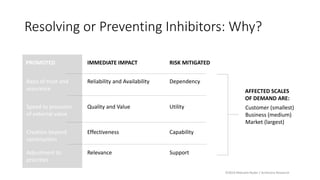
Resolving or Preventing Inhibitors: Why?
Reliability and Availability
Effectiveness
Relevance
Quality and Value
IMMEDIATE IMPACT
Basis of trust and
assurance
Creation beyond
construction
Adjustment to
priorities
Speed to provision
of external value
PROMOTED
Dependency
Capability
Support
Utility
RISK MITIGATED
AFFECTED SCALES
OF DEMAND ARE:
Customer (smallest)
Business (medium)
Market (largest)
©2019 Malcolm Ryder / Archestra Research
Agile beyond software
In the face of frequent substantive change, “Agile” describes
a set of principles for navigation – i.e., how to achieve
persistent goals.
Implementing those principles creates a culture that in turn
generates an “ecosystem” of practice.
The goals of applying the principles remain the same across
the range of scales from small-scale to large-scale.
Despite seeing the enterprise as the largest scale of
application, “scaling up” is not about horizontal breadth
(width) of coverage across the organization; instead it about
bottom to top vertical height (depth) of coverage in the
organization positioned in its environment.
To meet the same given goal, different scales of practice rely
on respectively different means, which together constitute
the overall agility ecosystem.
individual
group
function
operation
environment
Generic hierarchy of relevant scales of practice
small
large
©2019 Malcolm Ryder / Archestra Research
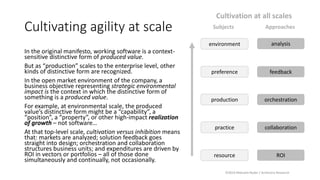
Cultivating agility at scale
In the original manifesto, working software is a context-
sensitive distinctive form of produced value.
But as “production” scales to the enterprise level, other
kinds of distinctive form are recognized.
In the open market environment of the company, a
business objective representing strategic environmental
impact is the context in which the distinctive form of
something is a produced value.
For example, at environmental scale, the produced
value’s distinctive form might be a “capability”, a
“position”, a “property”, or other high-impact realization
of growth – not software…
At that top-level scale, cultivation versus inhibition means
that: markets are analyzed; solution feedback goes
straight into design; orchestration and collaboration
structures business units; and expenditures are driven by
ROI in vectors or portfolios – all of those done
simultaneously and continually, not occasionally.
resource
practice
production
preference
environment
Cultivation at all scales
Subjects Approaches
ROI
collaboration
orchestration
feedback
analysis
©2019 Malcolm Ryder / Archestra Research
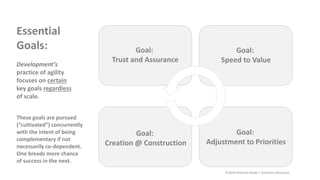
Goal:
Trust and Assurance
Goal:
Speed to Value
Goal:
Creation @ Construction
Goal:
Adjustment to Priorities
These goals are pursued
(“cultivated”) concurrently
with the intent of being
complementary if not
necessarily co-dependent.
One breeds more chance
of success in the next.
Essential
Goals:
Development’s
practice of agility
focuses on certain
key goals regardless
of scale.
©2019 Malcolm Ryder / Archestra Research
Goals and Solution Value
Co-operation
Investment
Fulfillment
Not Contracts
Not Process/Tools
Not Plans
Not Documentation
SOLUTION
CAPABILITY
BRAND
PARTNERS
PURPOSE
SERVICE
Co-production
FOCUS OF IMPACT AT EACH SCALEUNINHIBITED
(e.g. in SW dev)
USER
TECHNIQUE
PROJECT
PRODUCT
Adjustment to
priorities
PROMOTED GOALS
DOMAIN
SEGMENT
COMPETENCY
LOB
Basis of trust and
assurance
Creation beyond
construction
Speed to provision
of external value
CUSTOMER BUSINESS MARKET
©2019 Malcolm Ryder / Archestra Research
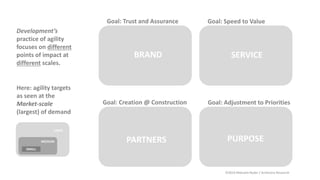
BRAND SERVICE
PARTNERS PURPOSE
Goal: Trust and Assurance
Goal: Creation @ Construction
Goal: Speed to Value
Goal: Adjustment to Priorities
Here: agility targets
as seen at the
Market-scale
(largest) of demand
Development’s
practice of agility
focuses on different
points of impact at
different scales.
©2019 Malcolm Ryder / Archestra Research
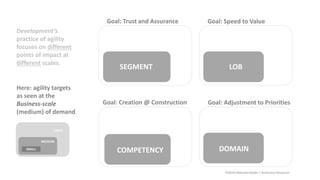
SEGMENT
BRAND
LOB
SERVICE
COMPETENCY
PARTNERS
DOMAIN
PURPOSE
Goal: Trust and Assurance
Goal: Creation @ Construction
Goal: Speed to Value
Goal: Adjustment to Priorities
Here: agility targets
as seen at the
Business-scale
(medium) of demand
©2019 Malcolm Ryder / Archestra Research
Development’s
practice of agility
focuses on different
points of impact at
different scales.
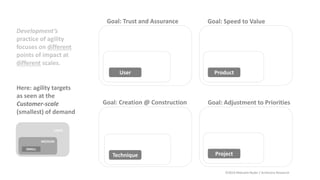
User
SEGMENT
BRAND
Product
LOB
SERVICE
Technique
COMPETENCY
PARTNERS
Project
DOMAIN
PURPOSE
Goal: Trust and Assurance
Goal: Creation @ Construction
Goal: Speed to Value
Goal: Adjustment to Priorities
Here: agility targets
as seen at the
Customer-scale
(smallest) of demand
©2019 Malcolm Ryder / Archestra Research
Development’s
practice of agility
focuses on different
points of impact at
different scales.
User
SEGMENT
BRAND
Product
LOB
SERVICE
Technique
COMPETENCY
PARTNERS
Project
DOMAIN
PURPOSE
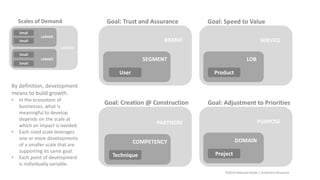
Scales of Demand
By definition, development
means to build growth.
• In the ecosystem of
businesses, what is
meaningful to develop
depends on the scale at
which an impact is needed.
• Each sized scale leverages
one or more developments
of a smaller scale that are
supporting its same goal.
• Each point of development
is individually variable.
Goal: Trust and Assurance
Goal: Creation @ Construction
Goal: Speed to Value
Goal: Adjustment to Priorities
©2019 Malcolm Ryder / Archestra Research
Archestra notebooks compile and organize decades of in-the-field and ongoing empirical findings.
All presented findings are derived exclusively from original research.
Archestra notebooks carry no prescriptive warranty.
As ongoing research, all notebooks are subject to change at any time.
©2019 Malcolm Ryder / Archestra Research
www.archestra.com
mryder@archestra.com
Archestra research is done from the perspective of strategy and architecture.
With all subject matter and topics, the purpose of the notes is analytic, primarily to:
* explore, expose and model why things are
included, excluded, or can happen
in given ways and/or to certain effects.
* comment on, and navigate between,
motives and potentials that predetermine
decisions about, and shapings of, the observed activity.

Scaling Agility - Development from Software to Enterprise

  • 1.
    Scaling Agility Development fromSoftware to Enterprise
  • 2.
    The manifesto Processes &Tools: Why not? Comprehensive documentation: why not? Contract negotiation: why not? Following a plan: why not? In all cases, the answer is in how those conventional means inhibit an effective responsiveness to a value-seeking need for change from prior course or expectation. Put in even more obvious terms, the conventions are about prediction and control. Whereas, the new and foreseeable “normal” calls for influence and navigation.
  • 3.
    What is development? Development,by definition, means to build growth. We know that “growth” can occur unattended, and that “building” might target only restoration or assembly. Growth, by definition, includes both a static difference from a lesser maturity or extent; and, a dynamic difference from a prior persistent state. However, at any given time it does not (by definition) require both. Intentional development is undertaken to produce preferred value. When either the current preference has changed from the prior, or the prior derived value is insufficient for its purpose, the practice of intentional development must adjust to accommodate the newer (previously unintended) difference. In adjustment, intentional development requires resources and behaviors that must be used effectively under the currently immediate requirements of preferred value.
  • 4.
    Identifying the cultureof agility From those (above) aspects of intentional development we understand where inhibitors to preferred value have the greatest impacts: • Recognition of preference • Sufficiency of produced value • Effective variation of practice • Necessary resources The key means of preventing inhibition is the influence of proactive cultivation. For example, agile software development’s cultivation is: • Recognition of preference: Customer collaboration • Sufficiency of produced value: Working software • Effective variation of practice: Individuals and interactions • Necessary resources: Responding to change
  • 5.
    Resolving or PreventingInhibitors: Why? Reliability and Availability Effectiveness Relevance Quality and Value IMMEDIATE IMPACT Basis of trust and assurance Creation beyond construction Adjustment to priorities Speed to provision of external value PROMOTED Dependency Capability Support Utility RISK MITIGATED AFFECTED SCALES OF DEMAND ARE: Customer (smallest) Business (medium) Market (largest) ©2019 Malcolm Ryder / Archestra Research
  • 6.
    Agile beyond software Inthe face of frequent substantive change, “Agile” describes a set of principles for navigation – i.e., how to achieve persistent goals. Implementing those principles creates a culture that in turn generates an “ecosystem” of practice. The goals of applying the principles remain the same across the range of scales from small-scale to large-scale. Despite seeing the enterprise as the largest scale of application, “scaling up” is not about horizontal breadth (width) of coverage across the organization; instead it about bottom to top vertical height (depth) of coverage in the organization positioned in its environment. To meet the same given goal, different scales of practice rely on respectively different means, which together constitute the overall agility ecosystem. individual group function operation environment Generic hierarchy of relevant scales of practice small large ©2019 Malcolm Ryder / Archestra Research
  • 7.
    Cultivating agility atscale In the original manifesto, working software is a context- sensitive distinctive form of produced value. But as “production” scales to the enterprise level, other kinds of distinctive form are recognized. In the open market environment of the company, a business objective representing strategic environmental impact is the context in which the distinctive form of something is a produced value. For example, at environmental scale, the produced value’s distinctive form might be a “capability”, a “position”, a “property”, or other high-impact realization of growth – not software… At that top-level scale, cultivation versus inhibition means that: markets are analyzed; solution feedback goes straight into design; orchestration and collaboration structures business units; and expenditures are driven by ROI in vectors or portfolios – all of those done simultaneously and continually, not occasionally. resource practice production preference environment Cultivation at all scales Subjects Approaches ROI collaboration orchestration feedback analysis ©2019 Malcolm Ryder / Archestra Research
  • 8.
    Goal: Trust and Assurance Goal: Speedto Value Goal: Creation @ Construction Goal: Adjustment to Priorities These goals are pursued (“cultivated”) concurrently with the intent of being complementary if not necessarily co-dependent. One breeds more chance of success in the next. Essential Goals: Development’s practice of agility focuses on certain key goals regardless of scale. ©2019 Malcolm Ryder / Archestra Research
  • 9.
    Goals and SolutionValue Co-operation Investment Fulfillment Not Contracts Not Process/Tools Not Plans Not Documentation SOLUTION CAPABILITY BRAND PARTNERS PURPOSE SERVICE Co-production FOCUS OF IMPACT AT EACH SCALEUNINHIBITED (e.g. in SW dev) USER TECHNIQUE PROJECT PRODUCT Adjustment to priorities PROMOTED GOALS DOMAIN SEGMENT COMPETENCY LOB Basis of trust and assurance Creation beyond construction Speed to provision of external value CUSTOMER BUSINESS MARKET ©2019 Malcolm Ryder / Archestra Research
  • 10.
    BRAND SERVICE PARTNERS PURPOSE Goal:Trust and Assurance Goal: Creation @ Construction Goal: Speed to Value Goal: Adjustment to Priorities Here: agility targets as seen at the Market-scale (largest) of demand Development’s practice of agility focuses on different points of impact at different scales. ©2019 Malcolm Ryder / Archestra Research
  • 11.
    SEGMENT BRAND LOB SERVICE COMPETENCY PARTNERS DOMAIN PURPOSE Goal: Trust andAssurance Goal: Creation @ Construction Goal: Speed to Value Goal: Adjustment to Priorities Here: agility targets as seen at the Business-scale (medium) of demand ©2019 Malcolm Ryder / Archestra Research Development’s practice of agility focuses on different points of impact at different scales.
  • 12.
    User SEGMENT BRAND Product LOB SERVICE Technique COMPETENCY PARTNERS Project DOMAIN PURPOSE Goal: Trust andAssurance Goal: Creation @ Construction Goal: Speed to Value Goal: Adjustment to Priorities Here: agility targets as seen at the Customer-scale (smallest) of demand ©2019 Malcolm Ryder / Archestra Research Development’s practice of agility focuses on different points of impact at different scales.
  • 13.
    User SEGMENT BRAND Product LOB SERVICE Technique COMPETENCY PARTNERS Project DOMAIN PURPOSE Scales of Demand Bydefinition, development means to build growth. • In the ecosystem of businesses, what is meaningful to develop depends on the scale at which an impact is needed. • Each sized scale leverages one or more developments of a smaller scale that are supporting its same goal. • Each point of development is individually variable. Goal: Trust and Assurance Goal: Creation @ Construction Goal: Speed to Value Goal: Adjustment to Priorities ©2019 Malcolm Ryder / Archestra Research
  • 14.
    Archestra notebooks compileand organize decades of in-the-field and ongoing empirical findings. All presented findings are derived exclusively from original research. Archestra notebooks carry no prescriptive warranty. As ongoing research, all notebooks are subject to change at any time. ©2019 Malcolm Ryder / Archestra Research www.archestra.com mryder@archestra.com Archestra research is done from the perspective of strategy and architecture. With all subject matter and topics, the purpose of the notes is analytic, primarily to: * explore, expose and model why things are included, excluded, or can happen in given ways and/or to certain effects. * comment on, and navigate between, motives and potentials that predetermine decisions about, and shapings of, the observed activity.