“Cell Church Models”
What model  should  we choose?
The Jethro Structure (5 x 5)
 
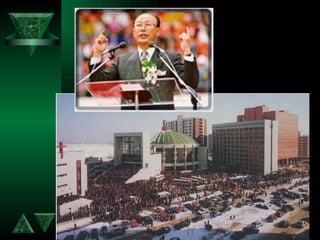
Yoido Full Gospel Church David (Paul) Yonggi Cho Began 1958 Keys: * Prayer * Cell Groups *“Let my people grow and go” First six year without a system of cells Cho collapsed. Initiated the cell model   Exod 18:21 "Moreover you shall select from all the people able men, such as fear God, men of truth, hating covetousness; and place such over them to be rulers of thousands, rulers of hundreds, rulers of fifties, and rulers of tens. Started cells among woman 65 000 cells and 750 000 members
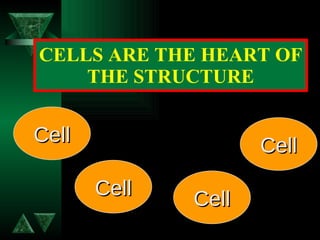
CELLS ARE THE HEART OF THE STRUCTURE Cell Cell Cell Cell
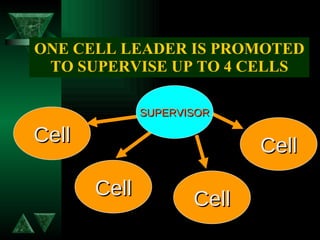
ONE CELL LEADER IS PROMOTED TO SUPERVISE UP TO 4 CELLS Cell Cell Cell Cell SUPERVISOR
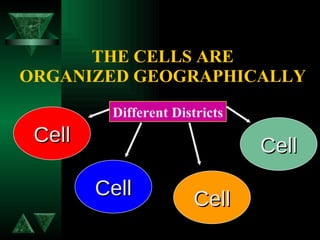
THE CELLS ARE ORGANIZED GEOGRAPHICALLY Cell Cell Cell Cell Different Districts
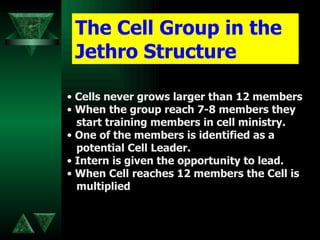
The Cell Group in the Jethro Structure Cells never grows larger than 12 members When the group reach 7-8 members they start training members in cell ministry. One of the members is identified as a  potential Cell Leader. Intern is given the opportunity to lead. When Cell reaches 12 members the Cell is  multiplied
The Sub Zone
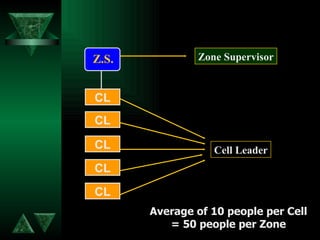
Cell Leader Average of 10 people per Cell = 50 people per Zone Zone Supervisor Z.S. CL CL CL CL CL
The Zone
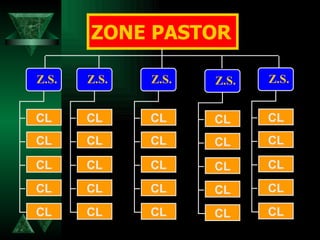
ZONE PASTOR CL CL CL CL Z.S. CL CL CL CL CL Z.S. CL CL CL CL CL Z.S. CL CL CL CL CL Z.S. CL CL CL CL CL Z.S. CL
The District
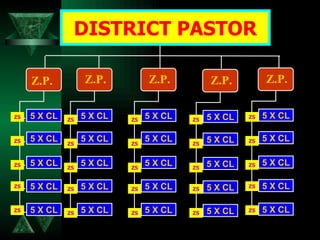
DISTRICT PASTOR 5 X CL 5 X CL 5 X CL 5 X CL Z.P. 5 X CL 5 X CL 5 X CL 5 X CL 5 X CL Z.P. 5 X CL 5 X CL 5 X CL 5 X CL 5 X CL Z.P. 5 X CL 5 X CL 5 X CL 5 X CL 5 X CL Z.P. 5 X CL 5 X CL 5 X CL 5 X CL 5 X CL Z.P. 5 X CL ZS ZS ZS ZS ZS ZS ZS ZS ZS ZS ZS ZS ZS ZS ZS ZS ZS ZS ZS ZS ZS ZS ZS ZS ZS
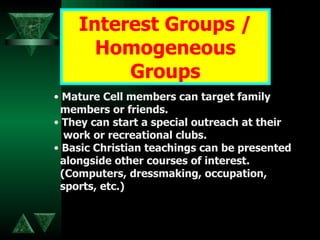
Interest Groups / Homogeneous Groups Mature Cell members can target family  members or friends. They can start a special outreach at their  work or recreational clubs. Basic Christian teachings can be presented  alongside other courses of interest.  (Computers, dressmaking, occupation,  sports, etc.)
The Groups of 12 structure (G12)
 
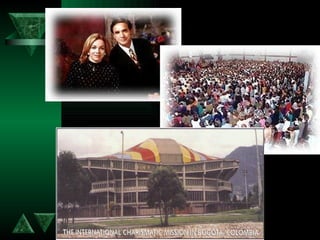
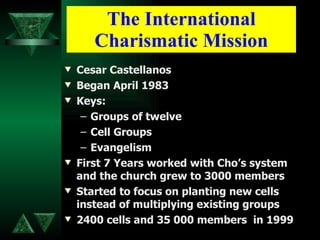
The International Charismatic Mission Cesar Castellanos Began April 1983 Keys: Groups of twelve Cell Groups Evangelism First 7 Years worked with Cho’s system and the church grew to 3000 members Started to focus on planting new cells instead of multiplying existing groups 2400 cells and 35 000 members  in 1999
The Mother  G12  Cell
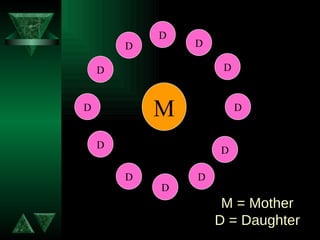
M = Mother D = Daughter D D D D D D D D D D D D M
The Daugter  G12  Cell
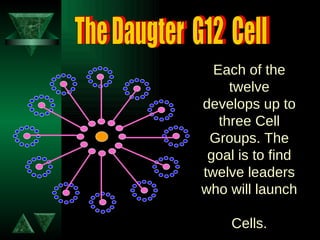
The Daugter  G12  Cell Each of the twelve develops up to three Cell Groups. The goal is to find twelve leaders who will launch  Cells.
The Grand Daugter  G12  Cell
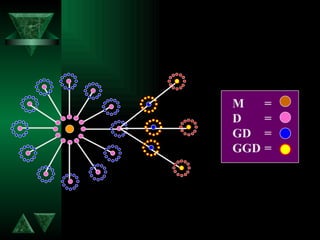
M = D = GD = GGD =
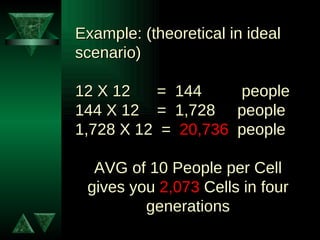
Example: (theoretical in ideal scenario) 12 X 12  =  144  people 144 X 12  =  1,728  people 1,728 X 12  =  20,736   people AVG of 10 People per Cell gives you  2,073  Cells in four generations
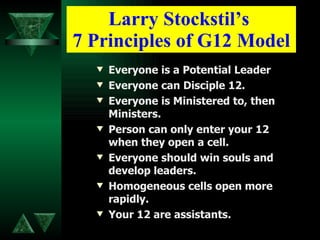
Larry Stockstil’s  7 Principles of G12 Model Everyone is a Potential Leader Everyone can Disciple 12. Everyone is Ministered to, then Ministers. Person can only enter your 12 when they open a cell. Everyone should win souls and develop leaders. Homogeneous cells open more rapidly. Your 12 are assistants.
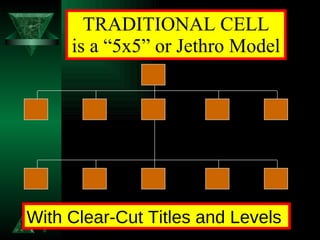
TRADITIONAL CELL is a “5x5” or Jethro Model With Clear-Cut Titles and Levels .
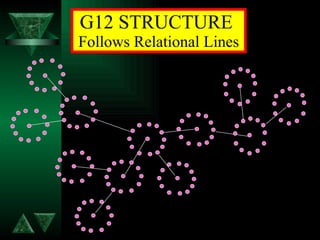
G12 STRUCTURE  Follows Relational Lines
S.W.O.T. Analysis
S  - Strengths W - Weaknesses O  - Oppurtunities T  - Threats
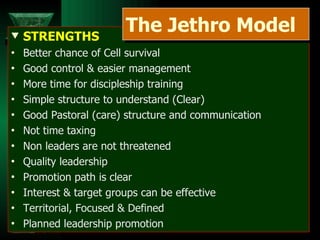
STRENGTHS Better chance of Cell survival Good control & easier management More time for discipleship training Simple structure to understand (Clear) Good Pastoral (care) structure and communication Not time taxing Non leaders are not threatened Quality leadership Promotion path is clear Interest & target groups can be effective Territorial, Focused & Defined Planned leadership promotion The Jethro Model
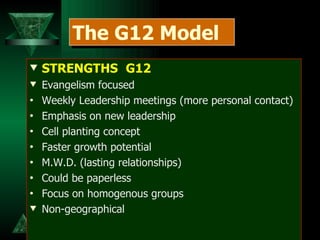
STRENGTHS G12 Evangelism focused Weekly Leadership meetings (more personal contact) Emphasis on new leadership Cell planting concept Faster growth potential M.W.D. (lasting relationships) Could be paperless Focus on homogenous groups Non-geographical The G12 Model
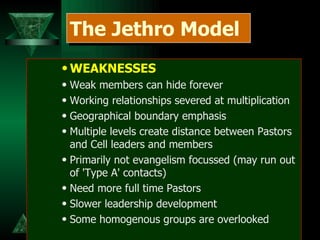
WEAKNESSES Weak members can hide forever Working relationships severed at multiplication Geographical boundary emphasis Multiple levels create distance between Pastors and Cell leaders and members Primarily not evangelism focussed (may run out of 'Type A' contacts) Need more full time Pastors Slower leadership development Some homogenous groups are overlooked The Jethro Model
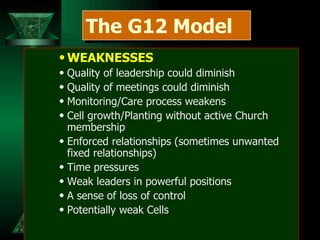
WEAKNESSES Quality of leadership could diminish Quality of meetings could diminish Monitoring/Care process weakens Cell growth/Planting without active Church membership Enforced relationships (sometimes unwanted fixed relationships) Time pressures Weak leaders in powerful positions A sense of loss of control Potentially weak Cells The G12 Model
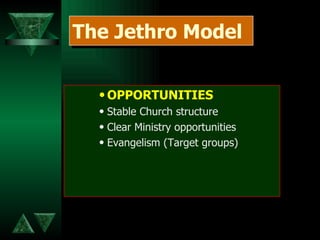
OPPORTUNITIES Stable Church structure Clear Ministry opportunities Evangelism (Target groups) The Jethro Model
OPPORTUNITIES Rapid church growth Cell planting (Homogenous) Leadership development Evangelism (Target groups) Easier to transition from P.B.D. The G12 Model
THREATS People can become stagnant Over reliance on lower levels of leadership Create 'maintenance' culture for top level leadership 'Care' instead of 'Leadership' focused Subjective leadership selection The Jethro Model
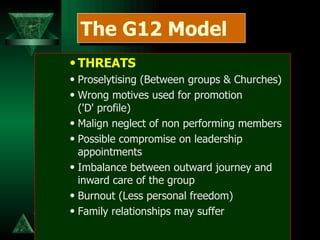
THREATS Proselytising (Between groups & Churches) Wrong motives used for promotion  ('D' profile) Malign neglect of non performing members Possible compromise on leadership appointments Imbalance between outward journey and inward care of the group Burnout (Less personal freedom) Family relationships may suffer The G12 Model
A Combined Structure The J12 Model
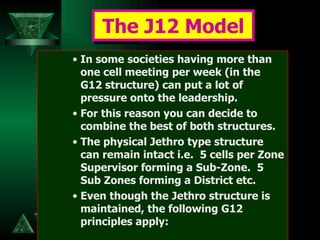
In some societies having more than one cell meeting per week (in the G12 structure) can put a lot of pressure onto the leadership.  For this reason you can decide to combine the best of both structures.  The physical Jethro type structure can remain intact i.e.  5 cells per Zone Supervisor forming a Sub-Zone.  5 Sub Zones forming a District etc.  Even though the Jethro structure is maintained, the following G12 principles apply: The J12 Model
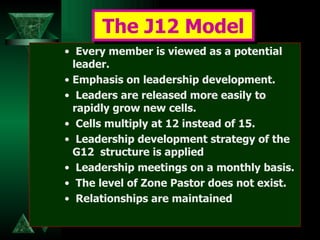
Every member is viewed as a potential leader.  Emphasis on leadership development. Leaders are released more easily to rapidly grow new cells. Cells multiply at 12 instead of 15.  Leadership development strategy of the G12  structure is applied Leadership meetings on a monthly basis.  The level of Zone Pastor does not exist. Relationships are maintained   The J12 Model
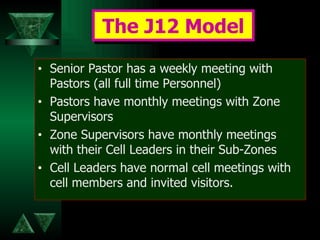
Senior Pastor has a weekly meeting with Pastors (all full time Personnel) Pastors have monthly meetings with Zone Supervisors Zone Supervisors have monthly meetings with their Cell Leaders in their Sub-Zones Cell Leaders have normal cell meetings with cell members and invited visitors. The J12 Model
Reasons for success Goal Setting Team planning Organization Evangelism

Cell Church Models

  • 1.
  • 2.
    What model should we choose?
  • 3.
  • 4.
  • 5.
    Yoido Full GospelChurch David (Paul) Yonggi Cho Began 1958 Keys: * Prayer * Cell Groups *“Let my people grow and go” First six year without a system of cells Cho collapsed. Initiated the cell model Exod 18:21 "Moreover you shall select from all the people able men, such as fear God, men of truth, hating covetousness; and place such over them to be rulers of thousands, rulers of hundreds, rulers of fifties, and rulers of tens. Started cells among woman 65 000 cells and 750 000 members
  • 6.
    CELLS ARE THEHEART OF THE STRUCTURE Cell Cell Cell Cell
  • 7.
    ONE CELL LEADERIS PROMOTED TO SUPERVISE UP TO 4 CELLS Cell Cell Cell Cell SUPERVISOR
  • 8.
    THE CELLS AREORGANIZED GEOGRAPHICALLY Cell Cell Cell Cell Different Districts
  • 9.
    The Cell Groupin the Jethro Structure Cells never grows larger than 12 members When the group reach 7-8 members they start training members in cell ministry. One of the members is identified as a potential Cell Leader. Intern is given the opportunity to lead. When Cell reaches 12 members the Cell is multiplied
  • 10.
  • 11.
    Cell Leader Averageof 10 people per Cell = 50 people per Zone Zone Supervisor Z.S. CL CL CL CL CL
  • 12.
  • 13.
    ZONE PASTOR CLCL CL CL Z.S. CL CL CL CL CL Z.S. CL CL CL CL CL Z.S. CL CL CL CL CL Z.S. CL CL CL CL CL Z.S. CL
  • 14.
  • 15.
    DISTRICT PASTOR 5X CL 5 X CL 5 X CL 5 X CL Z.P. 5 X CL 5 X CL 5 X CL 5 X CL 5 X CL Z.P. 5 X CL 5 X CL 5 X CL 5 X CL 5 X CL Z.P. 5 X CL 5 X CL 5 X CL 5 X CL 5 X CL Z.P. 5 X CL 5 X CL 5 X CL 5 X CL 5 X CL Z.P. 5 X CL ZS ZS ZS ZS ZS ZS ZS ZS ZS ZS ZS ZS ZS ZS ZS ZS ZS ZS ZS ZS ZS ZS ZS ZS ZS
  • 16.
    Interest Groups /Homogeneous Groups Mature Cell members can target family members or friends. They can start a special outreach at their work or recreational clubs. Basic Christian teachings can be presented alongside other courses of interest. (Computers, dressmaking, occupation, sports, etc.)
  • 17.
    The Groups of12 structure (G12)
  • 18.
  • 19.
    The International CharismaticMission Cesar Castellanos Began April 1983 Keys: Groups of twelve Cell Groups Evangelism First 7 Years worked with Cho’s system and the church grew to 3000 members Started to focus on planting new cells instead of multiplying existing groups 2400 cells and 35 000 members in 1999
  • 20.
    The Mother G12 Cell
  • 21.
    M = MotherD = Daughter D D D D D D D D D D D D M
  • 22.
    The Daugter G12 Cell
  • 23.
    The Daugter G12 Cell Each of the twelve develops up to three Cell Groups. The goal is to find twelve leaders who will launch Cells.
  • 24.
  • 25.
    M = D= GD = GGD =
  • 26.
    Example: (theoretical inideal scenario) 12 X 12 = 144 people 144 X 12 = 1,728 people 1,728 X 12 = 20,736 people AVG of 10 People per Cell gives you 2,073 Cells in four generations
  • 27.
    Larry Stockstil’s 7 Principles of G12 Model Everyone is a Potential Leader Everyone can Disciple 12. Everyone is Ministered to, then Ministers. Person can only enter your 12 when they open a cell. Everyone should win souls and develop leaders. Homogeneous cells open more rapidly. Your 12 are assistants.
  • 28.
    TRADITIONAL CELL isa “5x5” or Jethro Model With Clear-Cut Titles and Levels .
  • 29.
    G12 STRUCTURE Follows Relational Lines
  • 30.
  • 31.
    S -Strengths W - Weaknesses O - Oppurtunities T - Threats
  • 32.
    STRENGTHS Better chanceof Cell survival Good control & easier management More time for discipleship training Simple structure to understand (Clear) Good Pastoral (care) structure and communication Not time taxing Non leaders are not threatened Quality leadership Promotion path is clear Interest & target groups can be effective Territorial, Focused & Defined Planned leadership promotion The Jethro Model
  • 33.
    STRENGTHS G12 Evangelismfocused Weekly Leadership meetings (more personal contact) Emphasis on new leadership Cell planting concept Faster growth potential M.W.D. (lasting relationships) Could be paperless Focus on homogenous groups Non-geographical The G12 Model
  • 34.
    WEAKNESSES Weak memberscan hide forever Working relationships severed at multiplication Geographical boundary emphasis Multiple levels create distance between Pastors and Cell leaders and members Primarily not evangelism focussed (may run out of 'Type A' contacts) Need more full time Pastors Slower leadership development Some homogenous groups are overlooked The Jethro Model
  • 35.
    WEAKNESSES Quality ofleadership could diminish Quality of meetings could diminish Monitoring/Care process weakens Cell growth/Planting without active Church membership Enforced relationships (sometimes unwanted fixed relationships) Time pressures Weak leaders in powerful positions A sense of loss of control Potentially weak Cells The G12 Model
  • 36.
    OPPORTUNITIES Stable Churchstructure Clear Ministry opportunities Evangelism (Target groups) The Jethro Model
  • 37.
    OPPORTUNITIES Rapid churchgrowth Cell planting (Homogenous) Leadership development Evangelism (Target groups) Easier to transition from P.B.D. The G12 Model
  • 38.
    THREATS People canbecome stagnant Over reliance on lower levels of leadership Create 'maintenance' culture for top level leadership 'Care' instead of 'Leadership' focused Subjective leadership selection The Jethro Model
  • 39.
    THREATS Proselytising (Betweengroups & Churches) Wrong motives used for promotion ('D' profile) Malign neglect of non performing members Possible compromise on leadership appointments Imbalance between outward journey and inward care of the group Burnout (Less personal freedom) Family relationships may suffer The G12 Model
  • 40.
    A Combined StructureThe J12 Model
  • 41.
    In some societieshaving more than one cell meeting per week (in the G12 structure) can put a lot of pressure onto the leadership. For this reason you can decide to combine the best of both structures. The physical Jethro type structure can remain intact i.e. 5 cells per Zone Supervisor forming a Sub-Zone. 5 Sub Zones forming a District etc. Even though the Jethro structure is maintained, the following G12 principles apply: The J12 Model
  • 42.
    Every member isviewed as a potential leader. Emphasis on leadership development. Leaders are released more easily to rapidly grow new cells. Cells multiply at 12 instead of 15. Leadership development strategy of the G12 structure is applied Leadership meetings on a monthly basis. The level of Zone Pastor does not exist. Relationships are maintained The J12 Model
  • 43.
    Senior Pastor hasa weekly meeting with Pastors (all full time Personnel) Pastors have monthly meetings with Zone Supervisors Zone Supervisors have monthly meetings with their Cell Leaders in their Sub-Zones Cell Leaders have normal cell meetings with cell members and invited visitors. The J12 Model
  • 44.
    Reasons for successGoal Setting Team planning Organization Evangelism