SEATS -- TS 101 -- Basic Theology / Statement of Faith -- Outline page 1
1. INTRODUCTION TO THEOLOGY
A.R.: Christian Theology, pp. 59-80 [21 pp.]
1.1. PRESUPPOSITIONS OF THE COURSE
1.1.1. God Exists
1.1.2. Bible is Inerrant & Inspired
1.1.2.1. Breathed from the mouth of God without any error.
1.1.3. Literal-Grammatical-Canonical Hermeneutic. The Bible was written in
human languages so that humans could have life in the name of Jesus [Jo 20:31].
However, this fact does not mean that the Bible is easily understood. The Ethiopian
Eunuch said as much in response to Philip’s question: “Do you understand what you are
reading?” He replied, “How can I … unless someone explains it to me?” [Ac 8:30-31]. A
literal-grammatical-canonical hermeneutic is useful when interpreting the Bible.
1.1.3.1. Literal. The author’s meaning-intent can be determined by
understanding the normal senses of the words used.
1.1.3.1.1.1. Factual statement.
1.1.3.1.1.1.1. Example: “Her eyes are blue.” Denotes nothing more
than that the subject’s eyes are coloured blue.
1.1.3.1.1.2. Simile—a figure of speech comparing two unlike things
that is often introduced by “like” or “as.”
1.1.3.1.1.2.1. Example: “Her eyes were as blue as the sky.” Does not
mean that they were the sky. It is only a comparison.
1.1.3.1.1.3. Metaphor—a figure of speech in which a word or phrase
literally denoting one kind of object or idea is used in place of another to suggest a likeness
or analogy between them.
1.1.3.1.1.3.1. Example: “He is so rich he is drowning in money.” He is
not actually drowning but has a lot of money.
1.1.3.2. Grammatical. The grammar of any particular passage must be
studied, preferably in its original language so that the author’s meaning-intent can be
determined.
SEATS -- TS 101 -- Basic Theology / Statement of Faith -- Outline page 2
1.1.3.3. Canonical. The author’s meaning-intent must be determined from
what is written, not from extra-biblical sources. This is a principle developed from the fact
that when someone authors a book they include all the information a person needs in
order to understand what the book is saying. Extra-biblical sources are useful as
reference and support materials but the basic meaning of a passage of scripture must be
determined from what is written in the Bible.
1.1.3.3.1.1. Example: Mystery writers write books that encourage
readers to discover for themselves “Who did it?” The author does not require the reader to
look outside of the book for the solution—the answer can be determined from the very
pages of the book itself.
1.2. WHAT IS THEOLOGY?
1.2.1. What is Theology?
1.2.1.1. Theology is derived from two Greek words. Qeov" (Theos) = “Diyos”
and lovgo" (logos) = “salita/verbo.” When combined these words simply mean “ang salita
tungkol sa Diyos.” Of course it is more complex than this. In its broadest sense, theology
refers to all of the subjects normally covered at a Bible School/Seminary. This includes
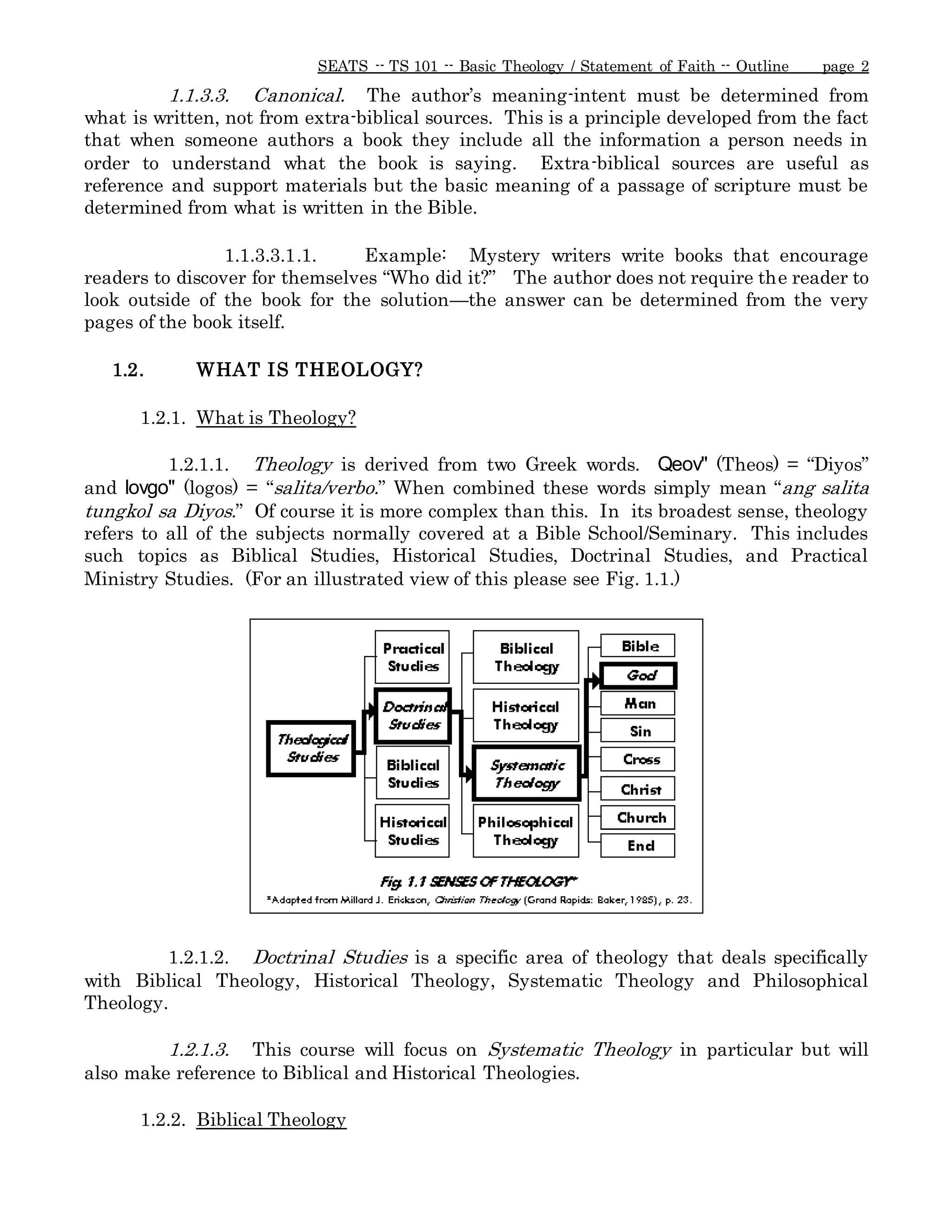
such topics as Biblical Studies, Historical Studies, Doctrinal Studies, and Practical
Ministry Studies. (For an illustrated view of this please see Fig. 1.1.)
1.2.1.2. Doctrinal Studies is a specific area of theology that deals specifically
with Biblical Theology, Historical Theology, Systematic Theology and Philosophical
Theology.
1.2.1.3. This course will focus on Systematic Theology in particular but will
also make reference to Biblical and Historical Theologies.
1.2.2. Biblical Theology
SEATS -- TS 101 -- Basic Theology / Statement of Faith -- Outline page 3
1.2.2.1. DEF — “Biblical Theology is the study of the Bible to determine the
theology of a specific genre or writer.”
1.2.2.2. KAHULUGAN — “Biblical Theology ay isang pag-aaral sa Biblia
upang malaman ang mga katuruan o doktrina ng isang partikular na manunulat o isang
sumulat.”
1.2.2.2.1. Example: The Theology of Paul, or The Theology of the Minor
Prophets.
1.2.2.3. Biblical Theology must include the following four factors:
1.2.2.3.1. Must be presented systematically. The Bible is not laid out in a
systematic fashion. There is no Table of Contents, no Index, no real scheme of
organisation other that books. Chapters and verses do exist but they were only added
later to assist us in finding our way around. We need to organise the results or our Bible
study in a systematic way so we can make sense of what it says about certain topics.
1.2.2.3.2. Must pay attention to the canonical context of the text. This really
relates to 1.1.3.4 Canonical above. Basically, the Bible does have internal cohesiveness—
it sticks together in all matters of faith and conduct. We have to recognise these things in
the text by cross-referencing various passages to determine the complete message of
Kasulatan. The Bible also gives us keys for interpreting itself. These include historical
references, name references, cross-references, and cultural references that work together
to assist us in coming to the true meaning-intent of the author.
1.2.2.3.3. Must consider the development of the doctrine within the section of
Kasulatan being considered.
1.2.2.3.4. Uses the Bible as a primary source document and not as a reference
book. It is very easy for us to think about what we want the Bible to say and then try to
find Kasulatan passages that support our ideas. It is much better to let Kasulatan set the
agenda by deriving our ideas from its contents.
1.2.2.4. Biblical Theology is an essential part of developing your theological
system
1.2.2.4.1. Exegesis —> Biblical Theology —> Systematic Theology
1.2.3. Historical Theology
1.2.3.1. DEF — “Historical Theology is the study of the historical development
and unfolding of theology with attention given to its development, growth, and changes.”
SEATS -- TS 101 -- Basic Theology / Statement of Faith -- Outline page 4
1.2.3.2. KAHULUGAN — “Historical Theology ay ang pag-aaral sa mga
makasaysayang pag-unlad at paglalahad ng mga teknolohiya lalo sa pag-unlad, paglago at
pagbabago nito.”
1.2.3.3. Four Main Divisions of Historical Theology
1.2.3.3.1. Ancient Theology (1st Century-AD 590). Orthodox views of the
Trinity, the deity and eternality of Christ, and salvation were developed during this time.
The canon (Kasulatan) was also affirmed during this time.
1.2.3.3.2. Mediaeval Theology (AD 590-1517). The majority of traditional
Roman Catholic Doctrine was developed during this time.
1.2.3.3.3. Reformation Theology (1517-1750). Reformation Theology saw a
return to the study of the Scriptures, which led to developments of the doctrine of the
atonement, the Lord's Supper, and Baptism.
1.2.3.3.4. Modern Theology (1750-present). Liberalism was developed during
the modern era which has led to an attack on many of the major Christian doctrines such
as the authority of Kasulatan, the resurrection of Christ, and the belief in the
supernatural.
1.2.4. Systematic Theology / Maayos na Teolohiya
1.2.4.1. DEF — “Systematic Theology is the gathering, arranging, comparing,
presenting, and defending of all the facts concerning God, His works, and His Purposes.”
1.2.4.2. KAHULUGAN —
“Systematic Theology ay ang pag-iipon,
pagsasaayos, paghahambing paglalahad at
pagtatanggol ng lahat ng katotohanan
patungkol sa Diyos, ang kanyang mga gawain
at mga layunin .”
1.2.4.3. How the process of developing Systematic Theology works.
1.2.4.3.1. Systematic Theology takes the results of Natural Theology, Biblical
Theology, Historical Theology, and Contemporary Theology and seeks to organise and
present those results in a systematic way. (see Fig. 1.2).
1.2.5. Why study Theology?
1.2.5.1. Need to systematise biblical teaching. The Bible is not organised like a
Theology Textbook. There is no Table of Contents, no Index, no real organising principle
other than books, chapters, and verses—which were added later to make it easier to find
our place.
SEATS -- TS 101 -- Basic Theology / Statement of Faith -- Outline page 5
1.2.5.2. Need to develop systematic statement of faith
1.2.5.2.1. Ordination
1.2.5.2.2. Credo = “I Believe” (Latin)
1.2.5.3. Need to understand that practice flows out of doctrine. The guiding
principles of our lives—our Worldview—determines how we live.
1.2.5.3.1. Morality
1.2.5.3.2. Compassion
1.2.5.3.3. Service
1.2.5.3.4. Integrity
1.2.6. How to study Theology
1.2.6.1. The wrong way to study theology
1.2.6.1.1. Rationalistically. The Bible is not Divine Revelation but is rather
simply a collection of Humanity’s thoughts about God. Other writings about God are also
important as is my own ability to rationally think about what God is like with no other
outside sources. I am as good as the Bible. Moderates of this view would say that the
Bible has value but it is up to humanity to determine what parts have value. Theology
develops evolutionistically—gets better as time progresses.
1.2.6.1.1.1. Problem #1: If Bible has no value then we are simply
studying religion. Without the Bible we do not know anything for certain about God.
1.2.6.1.1.2. Problem #2: If the Bible has some value then a man sits
as the judge of what is acceptable and what is not acceptable.
1.2.6.1.1.3. Problem #3: The human heart is evil. How can an evil
man decide what parts of God’s revelation are acceptable and what parts are not?
1.2.6.1.2. Mystically. God gives additional revelation to that which is
contained in the Bible.
1.2.6.1.2.1. Problem #1: Based largely on “feeling.” However, in
reality, it is what God said in his Word that is important—not what I feel about it.
SEATS -- TS 101 -- Basic Theology / Statement of Faith -- Outline page 6
1.2.6.1.2.2. Problem #2: Emphasises experience
rather than the external authority of the Bible. What makes my experience more valid
that that of the Buddhist.
1.2.6.1.2.3. Problem #3: There is no way of
actually checking out the validity of these new revelations.
1.2.6.1.3. Ecclesiastically. The church has traditionally taught certain things
therefore I will follow those things blindly.
1.2.6.1.3.1. Problem
1.2.6.1.3.1.1. 2Th 2:15
1.2.6.1.3.1.2. 2Th 3:6
1.2.6.1.3.1.3. Galatians 1:14
1.2.6.1.3.1.4. The authority behind these three statements is the Word
of God
1.2.6.2. The right way to study theology
1.2.6.2.1. Unification of Biblical Materials. As we saw above (1.2.2 Biblical
Theology) the Bible is not laid out as an organised, systematic theology book. Rather,
there is a great need to organise the various data gathered from an in-depth study of the
Bible so that the questions of the reader may be answered as fully as possible. An
analysis of the collected data will determine it's worth. For example, if there are
contradictions in the data then the collection method has been flawed and the process
must begin again.
1.2.6.2.2. Analysis of the meaning of the Bible. The Bible had meaning when
it was first spoken and it still has meaning for us today. We need to go through a three-
step process before we can arrive at the meaning-intent of the author.
1.2.6.2.2.1. Interpretation—”What is the meaning of the passage?”
1.2.6.2.2.2. Principalisation—”What principle is being taught in the
passage?”
1.2.6.2.2.3. Application—”What does this mean today?” or “What does
the author want it to mean today?”
1.2.6.2.3. Examination of historical treatments of the doctrines in question.
It is important to look at how Christians down through the centuries have interpreted the
SEATS -- TS 101 -- Basic Theology / Statement of Faith -- Outline page 7
various passages of the Bible. Remember of course that the conclusions drawn by the
great theological thinkers of the past may not always be correct and that we should be like
the Bereans who, after listening to Paul's preaching, “examined the Scriptures every day
to see if what Paul said was true” (Ac 17:11).
1.2.6.2.4. Identification of the essence of the truth. Is the passage being
prescriptive or descriptive. That is, is the passage telling us how to act or is it merely
describing the way some people acted at a certain time. For example, are we supposed to
hang ourselves after, like Judas, we feel remorse or is Mt 27:3-5 merely describing what
Judas did?
1.2.6.2.5. Illumination from other sources. All truth is God’s truth. From
time to time it is possible to look at the answers God gives to us from other sources in
order to see what they say about the Bible. For example, the whole field of science, that is
the examination of the natural world around us, was developed by Christians who wanted
to better understand the world God created for his glory.
SEATS -- TS 101 -- Basic Theology / Statement of Faith -- Outline page 8
1.2.6.2.5.1. Error #1: There is nothing outside of the Bible that we
can use.
1.2.6.2.5.2. Error #2: Putting too much value in non-biblical sources.
The Bible should never have to conform to external ideas. Rather, the Bible is the rule
and all other truth must ultimately conform to it.
1.2.6.2.6. Contemporary expression of the truth. One of the keys to doing
theology is making it understandable to the common tao. This needs to be one of several
levels (see Fig. 1.3):
1.2.6.2.6.1. Length refers to the fact that since the Bible was written
over 2000 years ago the theologian must make the transition from the past to the present.
1.2.6.2.6.2. Width refers to the
fact that, since at any given time there are many
different cultures that need to interact with the
Bible, Christian theology needs to develop different
forms of expression for these various settings—
especially if the theologian is working in more than
one of these cultures. For example, the book,
Christian Theology, was written by an American in
the 20th century, answering questions asked by a
secular, science-based society that is largely
European in origin and places a high value on
individuality. However, we are studying it in the
Philippines and are trying to answer questions asked
by a society that places emphasis on both science and
spirituality as well as on community living.
Moreover a Canadian teaches the course. As a result
we need to realise that the book Christian Theology
will not be able to meet all of the needs of the church
here in the Philippines and that as Filipino theologians it is up to you to fully develop a
Christian Theology geared especially for life here in the Philippines (see Fig. 1.4).
1.2.6.2.6.3. Height refers to the fact that since there are a wide
variety of theological interests and abilities in any given church, the theologian must meet
each person at the right level. Examples of these levels include Great Theological
Thinkers, Professional Theologians, Ministers and Theological Students, and the Common
Tao.
1.2.6.2.7. Stratification of the topics. Some system is needed to categorise
topics so that the most important topics get the most attention and the least important
topics get the least attention.
1.2.6.3. An Overview of Major Theological Systems
SEATS -- TS 101 -- Basic Theology / Statement of Faith -- Outline page 9
1.2.6.3.1. The Life Span of Theologies in History
1.2.6.3.1.1. We have seen that there have been three major periods in
Theological History, Ancient Theology, Mediaeval Theology, and Modern Theology (see
1.2.3.2 above). What is important to realise is that the life span of each school of theology
is diminishing rapidly (See Fig. 1.5).
1.2.6.3.1.1.1. Lesson # 1: Do not “buy-in” too quickly because the new
idea may soon be gone.
1.2.6.3.1.1.2. Lesson #2: Remember the Bereans who “examined the
Scriptures every day to see if what Paul said was true” (Ac 17:11). Always derive your
theology from the Bible and analyse any new ideas against it.
1.2.6.3.1.1.3. Lesson #3: Keep your theological system open for review.
However, do not compromise the essentials. There are some truths that are not open to
debate such as the Doctrine of the Inspiration and Authority of Kasulatan as well as the
Deity of Jesus.
1.2.6.3.2. Major Schools of Theological Thought.
1.2.6.3.2.1.There are basically two major schools of theological thought that
have been developed in the 1967 years since the ascension of Christ—Pelagianism and
Augustinianism. Developed in AD 400, these ideas have formed the basis of theological
thought for centuries. During the time of the Reformation (beginning AD 1517) they were
revised and reformed by Jacob Arminius and John Calvin.
1.2.6.3.3. Pelagianism
1.2.6.3.3.1. Effect of Fall: Only Adam was
affected by the Fall—not the entire
human race.
1.2.6.3.3.2. Original Sin: There is no Original
Sin
1.2.6.3.3.3. Hereditary Sin: There is no
Hereditary Sin
1.2.6.3.3.4. Humans at Birth: Born Neutral
1.2.6.3.3.5. Man’s Will: Free
1.2.6.3.3.6. Fact of Universal Sin: People sin
because of the bad examples they have
around them
1.2.6.3.3.7. Turning to God in Salvation:
Salvation is possible independent of God’s
grace
1.2.6.3.4. Augustinianism
1.2.6.3.4.1. Effect of Fall: All of humanity was
affected by the Fall—not just Adam
1.2.6.3.4.2. Original Sin: There is Original
Sin
1.2.6.3.4.3. Hereditary Sin: There is
Hereditary Sin
1.2.6.3.4.4. Humans at Birth: Born with
fallen nature
1.2.6.3.4.5. Man’s Will: Enslaved to sin
1.2.6.3.4.6. Fact of Universal Sin: Because of
Original Sin, man is “not able not to sin”
1.2.6.3.4.7. Turning to God in Salvation: Only
possible through God’s grace
1.2.6.3.5. Semi-Pelagianism. Developed after Pelagius was condemned by the
Synods of Jerusalem, Carthage, and Mileve in AD 416 and the Council of Ephesus in AD
431, Semi-Pelagianism holds to the same tenets as Pelagianism with one change—
salvation was a result of the cooperation of both the grace of God and the free will of man.
Semi-Pelagianism is the Theological System favoured by the Roman Catholic Church.
1.2.6.3.6. Arminianism is named for Jacob Arminius (d. 1609), a Dutch pastor
and teacher who developed his ideas after disagreeing with John Calvin (see 1.3.6.3.7
Calvinism below) in the areas of predestination and reprobation. He thought that these
doctrines as stated by Calvin needed some change so that “God might not be considered
the author of sin, not man an automaton in the hands of God.” Some of his followers
developed the “Five Points of Arminianism” and presented them to the Synod of Dort in
1618-1619 because they wanted he church to officially accept them. They were
condemned.
1.2.6.3.7. Calvinism is named for John Calvin (1509-1564), a French
Theologian of the Reformation era, and one of the greatest theologians of all time. Please
note the Calvin himself did not write the Five Points of Calvinism. Rather, they were
developed by the Council of Dort in response to the Five Points of Arminianism. The
SEATS -- TS 101 -- Basic Theology / Statement of Faith -- Outline page 11
council rejected Arminianism in favour of the form of Calvinism represented by these five
points.
The Five Points of Arminianism
Free Will & Human Ability. Humans are
able to choose between good and evil.
God’s will is not imposed on people. Faith
is a person’s contribution to salvation.
Conditional Election. Election is based
on God’s foreknowledge of who will repent
& believe. Sinner chooses Christ, God
does not chose Sinner.
Unlimited Atonement. Christ’s death
makes redemption possible for all
humans but the application of that
redemption depends upon a person’s
acceptance of Christ’s work.
Resistible Grace. The Holy Spirit works
on all people but cannot save people who
resist His work.
Falling from Grace. A Christian’s
salvation can be lost through personal
sin.
The Five Points of Calvinism
Total Depravity. Because of Sin, humans
are incapable of responding to the Gospel.
Faith is God’s gift not man’s contribution
to salvation.
Unconditional Election. Election to
salvation is based solely on God’s
sovereign will and is not dependent upon
any action of humanity.
Limited Atonement. Application of
redemption is not dependent upon a
person’s acceptance of Christ’s work.
Christ’s death accomplishes redemption
for the elect.
Irresistible Grace. The Holy Spirit works
on all of humanity and a person can’t
refuse to respond to the internal call of
the Holy Spirit.
Perseverance of the Saints. Those chosen
by God, redeemed by Christ, & called by
the Holy Spirit are eternally saved &
can’t lose their salvation through
personal sin
2.
SEATS -- TS 101 -- Basic Theology / Statement of Faith -- Outline page 12
2. BIBLIOLOGY (THE DOCTRINE OF THE REVELATION OF GOD)
A.R.: Christian Theology, pp. 153-259 [106 pp.]
2.1. BAPTIST CONFERENCE OF THE PHILIPPINES STATEMENT OF FAITH
2.1.1. The statement of faith of the BCP has the following to say about the Word of
God:
2.1.1.1. “We believe that the Bible is the Word of God, fully inspired and
without error in the original manuscripts, written under the inspiration of the Holy Spirit,
and that it has supreme authority in all matters of faith and conduct.”
2.1.1.2. Naniniwala kami na ang Bibliya ay ang Salita ng Diyos, na ganap at
pasalita inspirasyon ng Banal na Espiritu. Naniniwala kami na ang Bibliya sa kanyang
orihinal na manuscripts ay libre mula sa lahat ng kasinungalingan o pagkakamali at sa
gayon ay ganap na totoo at mapagkakatiwalaan sa lahat ng mga assertions sa lahat ng
mga bagay ng natural at teolohiko katotohanan at ito ay may pinakamataas na
kapangyarihan sa lahat ng mga bagay ng pananampalataya at pag-uugali.
2.1.2. The rest of this section will explain in detail each part of this statement,
however, a little bit of explanation is needed at the beginning in order for us to more fully
understand what the it means.
2.1.2.1. “... fully inspired ... written under the inspiration of the Holy Spirit ...”
The Bible is the breath of God and was recorded by humans under the direct supervision
of the Holy Spirit (see 2.4.4 Inspiration, below, for more information).
2.1.2.2. “... without error ... and that it has supreme authority in all matters of
faith and conduct.” (see 2.4.5 Infallibility and Inerrancy, below, for more information).
2.1.2.3. “... in the original manuscripts ...” Today we have thousands of Bible
manuscripts dating from the 1st century AD until well into the Middle Ages. Kaya lang,
there are slight variations in these copies. Please keep in mind, however, that these slight
variations do not affect the teachings of the Bible in any way (see 2.4.6.4 Textual
Criticism, below, for more information).
2.2. INTRODUCTION TO BIBLIOLOGY
2.2.1. What is Bibliology?
2.2.1.1. Bibliology is derived from two Greek words. Bibliov (Biblios) =
“writing” and logov (logos) = “word.” When combined these words simply mean “a word
about the Book” or “ang salita tungkol sa kasulatan.”
SEATS -- TS 101 -- Basic Theology / Statement of Faith -- Outline page 13
2.2.2. What is Revelation?
2.2.2.1. Revelation is the act of God telling humans about Himself (see Fig. 2.1,
below). Ps 19 illustrates for us the nature of this divine revelation:
2.2.2.2. Psalm 19
2.2.2.2.1. Psalm 19 identifies for us the two ways God has shown himself to
us—the Heavens and the Law.
2.2.2.2.2. The Heavens. (Ps 19:1-6) The sky is constantly telling people all
over the world that God is glorious and that he made the world. However, note that the
only things we learn from the sky are that God is glorious and that he created the world.
We learn nothing else.
2.2.2.2.3. The Law. (Ps 19:7-11) The Law is more helpful that the sky in
telling us about God in the because of it our souls are received, we a made wise, our hearts
receive joy, and our eyes receive light. This is because the Law is pure, endures forever, is
sure, and is completely righteous. As a result we receive warning about how to live and
receive a reward from following it.
2.2.2.2.4. So there are two ways that God reveals Himself to us—through
Creation (General) and through His Law (Special) (see Fig. 2.1).
Fig. 2.1 TYPES OF DIVINE REVELATION*
TYPE SHOWN IN SCRIPTURE SIGNIFICANCE
Nature Ps 19:1-6 Reveals God Exists; Reveals God's Glory
Ro 1:18-21 Reveals God is Omnipotent; Reveals God will judge
GENERAL Mt 5:45 Reveals God is benevolent to all people
Providence Ac 14:15-17 Reveals God provides food for all people
Da 2:21 Reveals God raises up and removes rulers
Conscience Ro 2:14-15 Reveals God has placed his law within the hearts of all
Jo 1:18 Reveals what the Father is like
Christ Jo 5:36-37 Reveals the Father's compassion
SPECIAL Jo 6:63; 14:10 Reveals the Father gives life to all who believe in the Son
Scripture 2Ti 3:16-17 Reveals all the doctrine, rebuke, correction, & guidance the
Christian needs for good living
2Pe 1:21 Reveals all that God has chosen to disclose through human
authors directed by the Holy Spirit
*From Paul Enns, The Moody Handbook of Theology (Chicago: Moody Press, 1989), p. 156.
2.3. GENERALREVELATION / ANG KALAKARAANG PAHAYAG NG DIYOS
2.3.1. Definition of General Revelation
SEATS -- TS 101 -- Basic Theology / Statement of Faith -- Outline page 14
2.3.1.1. DEF — “General Revelation is the fact that God has revealed certain
things about himself to everyone by means not limited by geography or language.”
2.3.2. Sources of General Revelation and what they tell us about God. There are
three (3) major sources of General Revelation in the world—Nature, Providence, and
Conscience.
2.3.2.1. Nature, or the world that God created, reveals certain things about its
Creator.
2.3.2.1.1. Ps 19:1-6—Reveals God Exists; Reveals God's Glory
2.3.2.1.2. Ro 1:18-21—Reveals God is Omnipotent (Walang Hanggang
Kapangyarihan); Reveals God will judge
2.3.2.1.3. Mt 5:45—Reveals God is kind to all people.
2.3.2.2. Providence, or the fact that God cares for the world and its
inhabitants, reveals certain things about its Provider.
2.3.2.2.1. Ac 14:15-17—Reveals God provides food for all people
2.3.2.2.2. Da 2:21—Reveals God raises up and removes rulers
2.3.2.3. Conscience, or the mind of man, reveals certain things about God.
2.3.2.3.1. Ro 2:14-15—Reveals God has placed his law within the hearts of all
2.3.3. Purpose of General Revelation
2.3.3.1. General Revelation exists for two reasons—to make man responsible
for his own actions and to show that man is indeed guilty of sin against God.
2.3.3.2. Ro 1:19-20 — “... so that men are without excuse.”
2.3.4. Result of General Revelation
2.3.4.1. Condemnation
2.3.4.1.1. Ro 1:19-20 — “... so that men are without excuse.”
2.3.5. Limitations of General Revelation
SEATS -- TS 101 -- Basic Theology / Statement of Faith -- Outline page 15
2.3.5.1. While General Revelation does give us knowledge of God it does not
give us all the information that we need in order to relate to God in an appropriate
manner. It doesn’t answer all questions we have about God. Halimbawa:
2.3.5.1.1. What can I know about God?
2.3.5.1.2. What don’t I know about God?
2.3.5.2. General Revelation is also seen by humans who are by nature sinful
and incapable of interpreting it correctly.
2.3.5.3. So, where does that leave us as humans? I know that there is a great
and glorious, all powerful God who has made the universe, who is kind to all men, who
gives food, rain, sun, and crops to everyone, and who has placed his law in our consciences.
I know that I am guilty and condemned because I do not do the things God wants. Is there
any hope for me?
2.4. SPECIAL REVELATION / ANG NAIIBANG PAHAYAG NG DIYOS
2.4.1. Definition of Special Revelation
2.4.1.1. DEF — “Special Revelation was that process by which an omnipotent
God made known to man that which otherwise man would never have known.”
2.4.2. Purpose of Special Revelation
2.4.2.1. Adds to General Revelation by answering the questions General
Revelation is unable to answer (see 2.3.5, above).
2.4.2.2. Reveals the plan of Salvation. I wouldn’t know anything about
salvation if God had not revealed it to me. How do I come into a relationship with God
that He is satisfied with? Through Special Revelation.
2.4.2.3. Reveals the full Glory of God. He is the one who has the right to
glorify Himself. We do not have the right to glorify ourselves.
2.4.3. Sources of Special Revelation. There are two ways in which God tells us all
the information we need to know in order to relate properly to Him—through the Living
Word, His Son, Jesus Christ, and through the Written Word, the Scriptures (see Fig. 2.2,
below).
SEATS -- TS 101 -- Basic Theology / Statement of Faith -- Outline page 16
2.4.3.1. The Living Word. Jesus Christ is spoken of as being the Word in John
1:1-14; 1Jo1:1; Re 19:13. “The plainest reason why the Son of God is called the Word,
seems to be, that as our words explain our minds to others, so was the Son of God sent in
order to reveal his Father's mind to the world.”1 As such, the Bible tells us that Jesus
Christ ...
2.4.3.1.1. ... reveals what the Father is like (Jo 1:18)
2.4.3.1.2. ... reveals the Father's compassion (Jo 5:36-37)
2.4.3.1.3. ... reveals that the Father gives life to all who believe in the Son (Jo
6:63; 14:10)
2.4.3.2. The Written Word. Kasulatan is the written Word of God and, as such,
reveals ...
2.4.3.2.1. ... all the doctrine, rebuke, correction, & guidance the Christian
needs for good living (2Ti 3:16-17).
2.4.3.2.2. ... all that God has chosen to disclose through human authors as
directed by the Holy Spirit (2Pe 1:21).
2.4.3.3. The Reliability of Special Revelation. How can we know that Special
Revelation is really reliable? Of course this is easier when we are discussing the
revelation of God through Jesus Christ. But what about the Bible—it is reliable? And , if
1 Mt Henry, Mt Henry’s Commentary, Jo 1:1.
SEATS -- TS 101 -- Basic Theology / Statement of Faith -- Outline page 17
so, how do we know it is reliable? Three concepts—Inspiration, Inerrancy, and
Infallibility—will help us understand why the Bible is so reliable.
2.4.4. Inspiration
2.4.4.1. Definition of Inspiration
2.4.4.1.1. DEF — “Inspiration was that process by which an omnipotent God
guided the human authors in the recording of that which was recalled, and that which was
revealed so that the end product was the exact Word of God, exactly as God wanted it
recorded.”
2.4.4.2. The Fact of Inspiration. The Bible is quite clear that the Bible comes
from God–that it is His very breath ().
2.4.4.2.1. CP — 2Ti 3:16:—-“All scripture is God-breathed (Qeopneusto")
and is profitable for teaching, rebuking, correcting, and training in righteousness, so that
the man of God may be thoroughly equipped for every good service.”
2.4.4.3. The Process of Inspiration. There are several different theories people
have developed to explain their understanding of the process of the Inspiration of the
Bible.
2.4.4.3.1. The Partial Inspiration and Degrees of Inspiration theories say that
either only parts of the Scriptures were inspired by God or that there are different levels of
inspiration in various parts of Kasulatan. Kaya lang who is the judge of what the parts or
degrees are? How do we know if this part is inspired or not?
2.4.4.3.2. The Natural Inspiration theory says that people with special gifts
and insights were chosen to write the Bible much the same way as a gifted painter paints
a masterpiece. Kaya lang, this would mean the Bible is just the same as any other
inspirational or philosophical writings. Not only that, the Bible tells us that Kasulatan
came from God through humans.
2.4.4.3.3. The Endorsement Inspiration theory says that God merely
endorsed what others wrote. The result isn’t the best that he could have done, but it was
good enough. Kaya lang the Bible tells us that the Bible did not originate from humans.
Rather, humans wrote “as they were carried along by the Holy Spirit” (2Pe 1:21).
2.4.4.3.4. The Mechanical-Dictation Inspiration theory says that God dictated
the words to the author. His personality is set aside to preserve the text from fallible
human aspects. Kaya lang different writing styles in scripture seem to indicate that more
than one personality is involved in the writing.
2.4.4.3.5. The Verbal-Plenary Inspiration theory holds that God used writers
who were close to Him so that the words they wrote would be what God wanted but the
SEATS -- TS 101 -- Basic Theology / Statement of Faith -- Outline page 18
style would be that of the human author. Kaya lang if every word is exactly what God
wanted how does this really differ from Mechanical-Dictation Inspiration?
2.4.4.3.6. Central Passage on the Process of Inspiration.
2.4.4.3.6.1. CP — 2Pe 1:20-21—-”Above all, you must understand
that no prophecy of Scripture came about by the prophet's own interpretation. For
prophecy never had its origin in the will of man, but men spoke from God as they were
carried along by the Holy Spirit.”
2.4.4.4. The Proof of Inspiration
2.4.4.4.1. Argument from Reason. It is reasonable to assume that if the Bible
is God’s revelation of Himself to humanity, that the Bible has been inspired by God. If it
didn’t happen that way-how did it happen & how did we get it?
2.4.4.4.2. Argument from Revelation. The Bible itself also attests to the fact
that it is inspired by God.
2.4.4.4.2.1. Testimony of Christ to both the Old and New Testaments
is indicative of the fact that he saw them as being from God and therefore authoritative in
the Christian life.
2.4.4.4.2.1.1. Jesus’ familiarity with and use of the Old Testament
indicates His acceptance of it as the inspired Scriptures from God. Halimbawa: Mt 19:4.
2.4.4.4.2.1.2. Jesus assumed that the Old Testament is from God and
is, therefore, authoritative. Halimbawa: Mt 7:9-13
2.4.4.4.2.1.3. Jesus assumed the Old Testament prophecies must be
fulfilled. Halimbawa: Jo 13:18; Jo 10:34-35; & Mk 14:49.
2.4.4.4.2.1.4. Jesus assumed the historical accuracy of Old Testament
miracles Halimbawa: Mt 12:39-41
2.4.4.4.2.1.5. Jesus trusted the Old Testament during His temptation
Halimbawa: Mt 4:3-10
2.4.4.4.2.1.6. Jesus did not see varied importance of Old Testament
parts but rather saw that all parts of the Old Testament were authoritative. Halimbawa:
Jo 10:35
2.4.4.4.2.1.7. Jesus promised the Revelation would be completed later
through the work of the Holy Spirit. Halimbawa: Jo 16:13
SEATS -- TS 101 -- Basic Theology / Statement of Faith -- Outline page 19
2.4.4.4.2.2. Testimony of Writers of Kasulatan. Not only did Jesus
give His stamp of approval on Kasulatan, but there are countless examples of the writers
of Kasulatan declaring that they were recording the words of God.
2.4.4.4.2.2.1. Old Testament writers claimed their writings were the
Word of God
2.4.4.4.2.2.2. Isaiah 1:10 — “Hear the word of the LORD, you rulers of
Sodom; listen to the law of our God, you people of Gomorrah!”
2.4.4.4.2.2.3. Ezekiel 3:16 — “At the end of seven days the word of the
LORD came to me.”
2.4.4.4.2.2.4. New Testament Writers also claimed their writings were
an authoritative word from God.
2.4.4.4.2.2.5. 2Pe 1:12-21 — “We did not follow cleverly invented stories
when we told you about the power and coming of our Lord Jesus Christ, but we were eye-
witnesses of his majesty. For he received honour and glory from God the Father when the
voice came to him from the Majestic Glory, saying, "This is my Son, whom I love; with him
I am well pleased." We ourselves heard this voice that came from heaven when we were
with him on the sacred mountain.” “And we have the word of the prophets made more
certain, and you will do well to pay attention to it, as to a light shining in a dark place,
until the day dawns and the morning star rises in your hearts. Above all, you must
understand that no prophecy of Scripture came about by the prophet's own interpretation.
For prophecy never had its origin in the will of man, but men spoke from God as they were
carried along by the Holy Spirit” (italics added).
2.4.4.4.2.2.6. Ephesians 3:4-5 — “… the mystery of Christ, which … has
now been revealed by the Spirit to God's holy apostles and prophets.”
2.4.5. Inerrancy & Infallibility
2.4.5.1. DEF — Inerrancy — “The Bible in its original writings is free from
error, in the whole and in all its parts. It is not liable to mistake. It is incapable of error.”
2.4.5.2. DEF — Infallibility — “The Bible possesses a faultless authority. It is
unfailing and incapable of being proven false, erroneous, or of teaching deception.’
2.4.5.3. Proof from the Scriptures. The Scriptures themselves tell us the they
are without error or fault in three ways: God is Truthful, The words will endure, and the
words themselves are trustworthy.
2.4.5.3.1. God is Truthful.
SEATS -- TS 101 -- Basic Theology / Statement of Faith -- Outline page 20
2.4.5.3.1.1. Jo 3:33 — “The man who has accepted it has certified that
God is truthful.”
2.4.5.3.1.2. Ro 3:3,4 — “Let God be true, and every man a liar.”
2.4.5.3.1.3. Titus 1:2 — “... which God, who does not lie, promised ....”
2.4.5.3.2. The written Word of God will endure.
2.4.5.3.2.1. Mt 5:17-19 — “... until heaven and earth disappear, not
the smallest letter, not the least stroke of a pen, will by any means disappear from the
Law ....”
2.4.5.3.2.2. Jo 10:33-36 — “... and the Scripture cannot be broken ....”
2.4.5.3.2.3. Mt 24:35 — “... my words will never pass away.”
2.4.5.3.3. The Words of Kasulatan are trustworthy. We can see this in the
following two passages where Jesus and Paul place great importance on the exact word
used in Kasulatan and the fact that singular instead of plural.
2.4.5.3.3.1. Mt 22:23-33 — “... you do not know the Scriptures or the
power of God .... have you not read what God said to you, ‘I am the God of Abraham, the
God of Isaac, and the God of Jacob’? He is not the God of the dead but of the living” (italics
added).
2.4.5.3.3.2. Galatians 3:15-22 — “The Scripture does not say ‘and to
seeds,’ meaning many people, but ‘and to your seed,’ meaning one person, who is Christ”
(italics added).
2.4.5.4. Proof from the Concept of Communication. If I want to tell you a
message of great importance I will make sure that the medium of communication is
trustworthy and that the message it is communicating is accurate. If I do not have a
trustworthy method of communicating, I can not expect you to get the message correctly.
God wants us to get the message so it makes sense that He would use a trustworthy and
accurate method for getting it to us.
2.4.5.5. Proof from the fact that Faith requires something faithful to trust.
Faith is what you do when you know exactly what you are doing because you have a
trustworthy object on which you can rest your faith. How can we place our faith in God, if
there is no trustworthy record of His revelation?
2.4.5.6. Proof from the Providence of God. The value of my faith is measured
by my God. How big is He? What does He control? How does He control?
SEATS -- TS 101 -- Basic Theology / Statement of Faith -- Outline page 21
2.4.5.7. Sufficiency of the Scriptures [kainaman ang kasulatan]. The Bible
contains all that we need in order to live on this earth. What isn’t there we don’t need.
2.4.5.7.1. 2Ti 3:15-17 — “... you have known the holy Scriptures, which are
able to make you wise for salvation through faith in Christ Jesus. All Scripture is God-
breathed and is useful for teaching, rebuking, correcting and training in righteousness, so
that the man of God may be thoroughly equipped for every good work” (italics added).
2.4.5.7.2. Jo 20:30-31 — “... these are written that you may believe that Jesus
is the Christ, the Son of God, and that by believing you may have life in his name” (italics
added).
2.4.5.8. Clarity of the Scriptures [malinaw ang kasulatan] The Kasulatan is
clear but may be difficult to understand. It is possible to understand what you need to
know in order to live as He wants you to live. It is not intentionally confusing. However,
we do need the help of the Holy Spirit in order to understand it.
2.4.5.9. Living Character of the Scriptures [buhay pa ang kasulatan]. The
Scriptures have the ability to give life to the reader.
2.4.5.9.1. He 4:12 — “For the word of God is living and active. Sharper than
any double-edged sword, it penetrates even to dividing soul and spirit, joints and marrow;
it judges the thoughts and attitudes of the heart” (italics added).
2.4.5.9.2. 1Pe 1:23 — “For you have been born again ... through the living and
enduring word of God” (italics added).
2.4.5.9.3. Jo 6:63 — “The Spirit gives life; the flesh counts for nothing. The
words I have spoken to you are spirit and they are life” (italics added).
2.4.5.9.3.1. Seen in its power toward the Unsaved
2.4.5.9.3.1.1. Ro 10:17 — “Consequently, faith comes from hearing the
message, and the message is heard through the word of Christ.”
2.4.5.9.3.1.2. 2Ti 3:15 — “… able to make you wise for salvation …”
2.4.5.9.3.2. Seen in its power toward the saved
2.4.5.9.3.2.1. 1Th 2:13 — “… which is at work in you who believe.”
2.4.5.9.3.2.2. Ephesians 5:26 — “to make her holy, cleansing her by the
washing with water through the word ….”
SEATS -- TS 101 -- Basic Theology / Statement of Faith -- Outline page 22
2.4.5.10. Authority of the Scriptures. If all the above arguments defending the
Inerrancy and Infallibility of Kasulatan are true we can logically conclude that Kasulatan
has ultimate authority. Authority has two aspects:
2.4.5.10.1. Normative Authority gives us direction for faith and
practice by instructing us to act or behave in a certain way.
2.4.5.10.2. Historical Authority guarantees that certain events are
accurately recorded even in they are not true or binding upon the readers. Halimbawa:
Satan made certain promises to Eve in the Garden of Eden. The Bible records these
statements accurately but they are not authoritative for us today.
2.4.6. How the Bible came to us (see Fig. 2.3, below)
2.4.6.1. Revelation is the “communication of the divine truth from God to
man.”2
2.4.6.2. Inspiration has been discussed at length above (see 2.3.4 above).
Suffice it to say, Inspiration “relates... to the relaying of [the revelation] from the first
recipient(s) of it to other persons.”3
2 Millard J. Erickson, Christian Theology (Grand Rapids: Baker Book House), p.
200.
3 Ibid, p. 200.
SEATS -- TS 101 -- Basic Theology / Statement of Faith -- Outline page 23
2.4.6.3. Canonisation is that process by which an omnipotent God guided in
the process of the recognition and collection of the Books of the Bible as being the true and
authoritative standard for the church. The books were recognised as being Kasulatan
when they were written by the church as a whole, however, some others started to add or
subtract books as they saw fit so in AD 397, a council was held to finalise once and for all
that the books we have now are scripture but others are not.
2.4.6.3.1. There were several criteria that had to be met in order for a book to
be included in the canon such as “Was it written during prophetic period?”, “Was it from a
man directed by God?”, “Did Christ attest to it?”, and “Is it inspired?”, for Old Testament
books, and “Was it written by an Apostle?”, “Was its content spiritual in character?”, “Did
it a agree with the Old Testament?”, “Did it agree with the teachings of the Apostles?”,
“Did the church generally accept it?”, and “Is it inspired?”, for New Testament books.
2.4.6.4. Textual Criticism. Since we do not have the original manuscripts used
by the various biblical writers to record their thoughts, the process of Textual Criticism
has been developed. Textual Criticism involves examining all the available original
language manuscripts and determining which ones are the most reliable. Within these
texts there are also a variety of variations in words used and verses included. Textual
Criticism in the process whereby the best readings are determined. You can notice
evidence of Textual Criticism when you read the notes in your NIV Bible. Some notes may
say, “The earliest and most reliable manuscripts do not have verses ________” (Halimbawa
Jo 8:1-11).
2.4.6.5. Translation is the process whereby the original Hebrew, Aramaic, or
Greek words are translated into the various languages of the world. Without this process,
we would be required to learn Hebrew, Aramaic, and Greek in order to understand the
Bible.
2.4.6.6. Illumination. God is Holy. Humanity is sinful and wicked. How then
are we able to understand or even see what God is showing us through His Revelation?
We need God’s help. Illumination is that process by which the omnipotent God in the
Person of the Holy Spirit works in the believer to make clear, enlighten, and teach the
truth of the written revelation.
2.4.6.6.1. Jo 16:12-14 — “… when he, the Spirit of truth, comes, he will guide
you into all truth. He will not speak on his own; he will speak only what he hears, and he
will tell you what is yet to come. He will bring glory to me by taking from what is mine
and making it known to you.”
2.4.6.6.2. 1Co 2:9-3:2 — “… God has revealed it to us by his Spirit. The Spirit
searches all things, even the deep things of God.… no-one knows the thoughts of God
except the Spirit of God. We have … received … the Spirit who is from God, that we may
understand what God has freely given us …. The man without the Spirit does not accept
the things that come from the Spirit of God, for they are foolishness to him, and he cannot
understand them, because they are spiritually discerned.”
SEATS -- TS 101 -- Basic Theology / Statement of Faith -- Outline page 24
2.4.6.7. Application. Much of this relates to what we talked about earlier with
regards to the right way to study the Bible (see 1.2.6.2 The Right Way To Study Theology,
above, especially 1.2.6.2.6 Contemporary Expression of the Truth). Once we have derived
the meaning/intent of the passage of Kasulatan we are studying, we must develop ways in
which we may apply it to our lives. God revealed Himself to us so that we would change
our lives. Application is that part of the process where the Revelation of God meets us
where we live and compels us the make that change.
2.4.6.8. Communication. One of my seminary professors once said, “The one
question we must ask ourselves when we study the Bible is, ‘How can I preach or teach
this passage?’” The communication of the Gospel is essential to the study of the Bible. If
we are only studying the Bible for our own benefit then we have not gone far enough. We
must share our insights with others so that they also may be blessed by what God is
telling us.
2.5. ISSUES RELATED TO BIBLIOLOGY / REVELATION STUDIES
2.5.1. Does God give us enough information from sources other than the Bible and
His Son whereby we might be saved?
2.5.1.1. As we have seen above, while General Revelation does give us
knowledge of God knowledge of God is not enough for salvation. Calvin Schenk says,
“Nowhere in the Bible is knowledge by itself, whether from general revelation or special
revelation, equivalent to salvation .... Revelation, whether general or special, does not
save; Jesus Christ saves.”4 Jesus Christ IS the revelation of God—Special Revelation that
allows us to be saved.
4 Calvin E. Schenk, Who Do You Say That I Am?: Christians Encounter Other
Religions (Scottdale: Herald Press, 1997), pp. 119-120.
SEATS -- TS 101 -- Basic Theology / Statement of Faith -- Outline page 25
3.
3. THEOLOGY PROPER (THE DOCTRINE OF GOD)
A.R.: Christian Theology, pp. 265-342 [77 pp.]
3.1. BAPTIST CONFERENCE OF THE PHILIPPINES STATEMENT OF FAITH
3.1.1. The Statement of Faith of the BCP has the following to say about God the
Father: “We believe in God the Father, an infinite, personal spirit, perfect in holiness,
wisdom, power, and love. We believe that He concerns Himself mercifully in the affairs of
men, that He hears and answers prayer, and that He saves from sin and death all who
come to Him through Jesus Christ.”
3.1.2. Naniniwala kami sa Diyos, ang Ama, isang walang hanggan, personal na
espiritu, perpekto sa kabanalan, karunungan, kapangyarihan at pag-ibig. Naniniwala
kami na inaalala nya ang mga tao sa kapakanan Niya, ma maririnig Niya at siansagot
ang mga panalangin, at na Siya ang makapagliligtas mula sa kasalanan at kamatayan sa
lahat ng tumanggap sa Kanya sa pamamagitan ni Jesus Cristo.
3.1.3. The Statement of Faith of the BCP has the following to say about the Trinity:
“We believe that there is one living and true God, eternally existing in three persons; that
these are equal in every divine perfection and that they execute distinct but harmonious
offices in the work of creation, providence, and redemption.”
3.1.4. Naniniwala kami na mayroong isang pamumuhay at tunay na Diyos na ang
mga ito ay pantay-pantay sa bawat banal na maging perpekto, at isinasagawa ang ibat
ibang gawain ngunit magkatugma mga tanggapan sa trabaho ng paglikha, diyos at
pagtubos.
3.2. THE KNOWLEDGE OF GOD
3.2.1. Can God be Known?
3.2.1.1. Revelation. Last week we talked about how God makes certain things
about Himself known to all people by means not limited by geography or language and
also makes Himself known more completely through Jesus Christ and the Scriptures. Let
us go back a few steps and look at this question again and see how others have answered
it.
3.2.1.2. Arguments for the existence of God. Through the course of history
people have been asking the question, “Can God be known?” Some with a philosophical
mind have developed rational arguments for God’s existence. Here they are:
3.2.1.2.1. Cosmological Argument—The Argument from Cause (see Fig. 3.1,
below). The existence of this world argues for a first cause. Any observable new thing or
SEATS -- TS 101 -- Basic Theology / Statement of Faith -- Outline page 26
change must have a cause. The universe is full of change, but ordered change. Where do
you find the "uncaused" cause? That must be God.
3.2.1.2.1.1. It is like a chain of dominoes. In order for the sequence to
start, the first domino must be pushed. If it is not pushed, then nothing happens. If it is
pushed, then all the rest of the dominoes fall.
3.2.1.2.1.2. Pero, sino siya? Ang ating Diyos o ang ibang Diyos?
3.2.1.2.2. Teleological Argument—The Argument from Design (see Fig. 3.2,
below). The universe seems to reflect design or purpose. Order and design argue for an
intelligent designer and will. That points in the direction of a God who is a person.
3.2.1.2.2.1. Pero, sino siya? Ang ating Diyos o ang ibang Diyos?
3.2.1.2.3. Anthropological Argument—The Moral Argument (see Fig. 3.3,
above). All people have morality, however, since morality is not always rewarded in this
life there must be some reward for moral behaviour outside of our life here on earth. This
implies the existence of immortality, ultimate judgment, and a God who establishes and
supports morality by rewarding good and punishing evil.
3.2.1.2.3.1. Pero, sino siya? Ang ating Diyos o ang ibang Diyos?
3.2.1.2.4. Ontological Argument (see Fig. 3.4, above). This looks at the
essential quality of humanity
SEATS -- TS 101 -- Basic Theology / Statement of Faith -- Outline page 27
3.2.1.2.4.1. Major Assumption: Man has the idea of an
infinitely perfect being.
3.2.1.2.4.2. Minor assumption: Existence is a necessary part of
perfection.
3.2.1.2.4.3. Conclusion: That perfect being exists.
3.2.1.2.4.4. Pero, sino siya? Ang ating Diyos o ang ibang Diyos?
3.2.1.2.5. Note: We must realise that while these arguments may be valid,
they only result in a finite being greater than we are. Also, these arguments can only say
that God “probably” exists, but also leave the possibility that he doesn’t.
3.2.1.2.6. Assumption of Kasulatan. The Bible does not set out to prove the
existence of God. Rather, starting in Ge 1:1 and continuing on through the rest of the
Bible, Kasulatan assumes the existence of God and proceeds to tell us about Him and His
plans for the world.
3.2.1.2.7. So what is God like?
3.2.2. Theistic Theories. All people have some form of religion or another even
though some are very diligent in their practice of religion while others seem to be very lazy
in their practice of religion. How have people down through history understood God?
There are eight (8) major views of God in the world:
SEATS -- TS 101 -- Basic Theology / Statement of Faith -- Outline page 28
3.2.2.1. Agnosticism is derived from two Greek words—  (a) = “no” and
 (gnosis) = “knowledge.” It is the belief that it is impossible for us to know anything
about God either because we can never verify the evidence or because our minds are too
weak to understand ultimate reality.
3.2.2.2. Atheism is derived from two Greek words.—  (a) = “no” and 
(Theos) = “god.” It is the belief that there is no God. However, it is important to note that
the atheist is either very self-centred or very illogical. For example, how does s/he know if
there is no God? Is s/he omniscient (walang hanggang karunungan) and really knows all
things or omnipresent (nasa lahat ng mga lugar) and has been everywhere in order find
any hiding gods? How else could s/he really know there is no God?
3.2.2.3. Polytheism is derived from two Greek words—  (pollus) =
“many” and  (Theos) = “god.” It is the belief that there are many gods each of whom
is finite (i.e. limited in its interest and/or influence).
3.2.2.4. Monotheism is derived from two Greek words—  (monos) =
“alone” and  (Theos) = “god.” It is the belief that there is only one God.
3.2.2.4.1. Finite Monotheism is the belief that the one God does not have
infinite powers. There are two major schools of thought in this area.
3.2.2.4.1.1. Panentheism is derived from three Greek words— 
(pan) = “all,”  (en) = “in,” and  (Theos) = “god.” It views God as in the process of
becoming. He is always getting bigger, wiser, increasing in His “godness.” “God is a finite
changing director of world affairs who works in cooperation with the world in order to
attain greater perfection in his nature.”5
3.2.2.4.1.2. Finite Godism says that there is a finite god who
transcends the universe but is also active within it.
3.2.2.4.2. Infinite Monotheism is the belief that the one God does have
infinite powers. There are two major schools of thought in this area.
3.2.2.4.2.1. Pantheism is derived from two Greek words—  (pan) =
“all” and  (Theos) = “god.” It sees God as being the same as creation—God is
everything and everything is God. However, God is not transcendent or personal.
3.2.2.4.2.2. Theism is the belief in the existence of some kind of a
God.
5 Ronald H. Nash, Process Theology (n.p., n.d.), p. 14 in Launstein, p. 45.
SEATS -- TS 101 -- Basic Theology / Statement of Faith -- Outline page 29
3.2.2.4.2.2.1. Deism is a view of God whereby God does not get involved
with the world. After creating the world and setting up all the natural laws, God is now
no longer able to become involved.
3.2.2.4.2.2.2. Biblical Theism is the view of God assumed by the Bible.
God is a personal God who is not only involved in the universe but is beyond it.
3.2.3. Definition of God
3.2.3.1. DEF — “God is self existent, self-conscious, personal. He is the creator
of all things. He transcends His creation but is immanent in it.”
3.3. THE NAMES AND TITLES OF GOD
3.3.1. Old Testament Names of God
3.3.1.1. Elohim
3.3.1.1.1. Meaning: Strength and power of God
3.3.1.1.2. Plurality: The im ending on the word Elohim is the plural ending
in Hebrew. This does not mean that it is teaching the Trinity, but it does allow for it. It is
better to see it as the “plural of majesty,” looking at the unlimited greatness of God.
3.3.1.1.3. Used in compound: This name is used in compound with other
words to become other names of God. These compound names thereby give additional
truth concerning His greatness.
3.3.1.1.3.1. El-Shaddai— The power and strength of God manifested
in His care. Possibly the best way to see this truth is to look in the New Testament where
John was the one who “leaned upon the breast of Jesus.” It may mean “the strength of the
breasted one.” As such it looks at His love and consolation. It is of interest to note that 31
of 41 usages of this world in the Bible occur in the book of Job.
3.3.1.1.3.1.1. Ge 17:1 — “When Abram was ninety-nine years old, the
LORD appeared to him and said, ‘I am God Almighty; walk before me and be blameless.’”
3.3.1.1.3.2. El-Elyon— “The Most High God.” Emphasises His
strength and sovereignty. He is the God who can keep His promises. He is supreme over
all.
3.3.1.1.3.2.1. Ge 14:19 — “… and he blessed Abram, saying, "Blessed be
Abram by God Most High, Creator of heaven and earth.”
SEATS -- TS 101 -- Basic Theology / Statement of Faith -- Outline page 30
3.3.1.1.3.3. El-Olam— “The Everlasting God.” The God of Eternity.
It looks at His Unchangeableness. He is the covenant-keeping God. The One His people
can count on.
3.3.1.1.3.3.1. Ge 21:33 — “Abraham planted a tamarisk tree in
Beersheba, and there he called upon the name of the LORD, the Eternal God.”
3.3.1.1.3.4. El-Roi— “The God who Sees.” The God who reveals
Himself.
3.3.1.1.3.4.1. Ge 16:13 — “She gave this name to the LORD who spoke
to her: ‘You are the God who sees me,’ for she said, ‘I have now seen the One who sees
me.’”
3.3.1.2. Yahweh [LORD—NIV; Jehovah—KJV]
3.3.1.2.1. Meaning: Self-existing One
3.3.1.2.1.1. Ex 3:14 — “God said to Moses, ‘I AM WHO I AM. This is
what you are to say to the Israelites: “I AM has sent me to you.”’”
3.3.1.2.2. Sacredness: The Jews would not pronounce this name of God.
They wrote the vowels of the word Adonai with the consonants of Yahweh, so that if they
forgot and pronounced what they read they would not be saying this name for God.
3.3.1.2.3. Used in compound: Once again, this name is used in compound
with other words to become other names of God. These compound names thereby give
additional truth concerning His greatness.
3.3.1.2.3.1. Yahweh Jireh— “The LORD will Provide”
3.3.1.2.3.1.1. Ge 22:14 — “So Abraham called that place The LORD
Will Provide.”
3.3.1.2.3.2. Yahweh Nissi— “The LORD is my Banner”
3.3.1.2.3.2.1. Ex 17:15 — “Moses built an altar and called it The LORD
is my Banner.”
3.3.1.2.3.3. Yahweh Shalom— “The LORD is Peace”
3.3.1.2.3.3.1. Ju 6:24 — “So Gideon built an altar to the LORD there
and called it The LORD is Peace.”
3.3.1.2.3.4. Yahweh Sabbaoth— “The LORD Almighty”
SEATS -- TS 101 -- Basic Theology / Statement of Faith -- Outline page 31
3.3.1.2.3.4.1. 1 Samuel 1:3 — “Year after year this man went up from
his town to worship and sacrifice to the LORD Almighty at Shiloh, where Hophni and
Phinehas, the two sons of Eli, were priests of the LORD.”
3.3.1.3. Adonai
3.3.1.3.1. Meaning: “Lord, Master, Owner”
3.3.1.3.1.1. Ge 19:2 — “’My lords,’ he said, ‘please turn aside to your
servant's house. You can wash your feet and spend the night and then go on your way
early in the morning.’ ‘No,’ they answered, ‘we will spend the night in the square.’”
3.3.1.3.2. Relationships: It looks at relationships. It is use of the relationship
between a master and a slave. When it is used of God and men, it looks at His absolute
authority over men.
3.3.2. New Testament Names of God
3.3.2.1. God []
3.3.2.1.1. Meaning. Like the English word, “God,” “Theos” is the generic
Greek word for deity. Usually refers to the Father, but it is tied to the God of the Old
Testament.
3.3.2.1.1.1. Jo 1:1 — “In the beginning was the Word, and the Word
was with God, and the Word was God.”
3.3.2.1.1.2. Titus 2:13 — “… while we wait for the blessed hope—the
glorious appearing of our great God and Saviour, Jesus Christ ….”
3.3.2.2. Lord []
3.3.2.2.1. Meaning. The authority and supremacy of God. He is the creator,
whose power is revealed in History. He is Lord over the universe.
3.3.2.2.1.1. Jo 20:28 — “Thomas said to him, ‘My Lord and my God!’”
3.3.2.3. Master []
3.3.2.3.1. Meaning. It takes the concept of authority in the Word “Lord,” and
looks at ownership.
3.3.2.3.1.1. 2Pe 2:1 — “But there were also false prophets among the
people, just as there will be false teachers among you. They will secretly introduce
SEATS -- TS 101 -- Basic Theology / Statement of Faith -- Outline page 32
destructive heresies, even denying the sovereign Lord who bought them—bringing swift
destruction on themselves.”
3.3.2.3.1.2. Jude 4 — “For certain men … change the grace of our God
into a licence for immorality and deny Jesus Christ our only Sovereign and Lord.”
3.4. ATTRIBUTES (CHARACTER) OF GOD
3.4.1. Introduction to the Attributes of God. The best way to become acquainted
with someone is to examine their character or attributes. Erickson has divided the
attributes of God into two sections, the Attributes of Greatness and the Attributes of
Goodness. For ease of understanding, we will follow that classification here. The trouble
with identifying and classifying the attributes of God is that fact that we only have so
much time for this part of the discussion. As a result, we are only able to examine one or
two biblical references per attribute even though each attribute is referred to in many
other biblical passages.
3.4.2. Attributes of Greatness
3.4.2.1. Spirituality
3.4.2.1.1. God is a Spirit [Espiritu ang Diyos]. God does not have any
physical presence—He has no body. Rather He is a spiritual being.
3.4.2.1.1.1. Jo 4:24 — “God is spirit, and his worshippers must
worship in spirit and in truth.”
3.4.2.2. Personality [Ang sarili ng Diyos]. When we use the word “personal” to
describe God we are indicating that He has the characteristics of personality—intellect,
emotion, and will.. We are not referring to the fact that He relates to us personally (i.e. as
our own individual Saviour).
3.4.2.2.1. God has a name. [May pangalan ang Diyos] This is very important
because it tells us that God is not simply a “supreme being” or a “higher power.” Rather
He is a being that can be identified with a personal name.
3.4.2.2.1.1. Ex 3:14 — “God said to Moses, ‘I AM WHO I AM. This is
what you are to say to the Israelites: “I AM has sent me to you.”’”
3.4.2.2.2. God relates individually with other persons. God is not some force
that blindly forces all it its path to do its will [Halimbawa: bagyo]. He relates to
individual people in individual ways.
3.4.2.2.2.1. Ge 3 — “Then the man and his wife heard the sound of
the LORD God as he was walking in the garden in the cool of the day, and they hid from
the LORD God among the trees of the garden. But the LORD God called to the man,
SEATS -- TS 101 -- Basic Theology / Statement of Faith -- Outline page 33
‘Where are you?’ He answered, ‘I heard you in the garden, and I was afraid because I was
naked; so I hid.’”
3.4.2.3. Life
3.4.2.3.1. Self-existent [May buhay sa sarili ang Diyos]. God is self-existent
and not dependent upon anything outside of himself for His existence. Any definition of
God must include this truth. This truth is apparent in the name God has chosen to reveal
to us—the “Self-existent One” (see 3.4.1.2.1, above). It is also apparent in other passages.
3.4.2.3.1.1. Jo 5:26 — “… as the Father has life in himself….”
3.4.2.3.1.2. Isaiah 40:18 — “To whom, then, will you compare God?
What image will you compare him to? …. Do you not know? Have you not heard? Has it
not been told you from the beginning? Have you not understood since the earth was
founded? He sits enthroned above the circle of the earth, and its people are like
grasshoppers. He stretches out the heavens like a canopy, and spreads them out like a
tent to live in. He brings princes to naught and reduces the rulers of this world to nothing
…. ‘To whom will you compare me? Or who is my equal?’ says the Holy One.”
3.4.2.3.2. Free [Malaya ang Diyos]. God is independent of His creation and
His creatures. God before creation existed in His perfection and after creation is not
dependent upon His creation of creatures for either His existence or His perfections.
3.4.2.3.2.1. Isaiah 40:13-14 — “Who has understood the mind of the
LORD, or instructed him as his counsellor? Whom did the LORD consult to enlighten him,
and who taught him the right way? Who was it that taught him knowledge or showed him
the path of understanding?”
3.4.2.4. Infinity
3.4.2.4.1. Omnipotent [Walang-hanggang kapangyarihan]. God is all
powerful and almighty. He is able to do anything consistent with His own nature.
3.4.2.4.1.1. De 32:39 — “"See now that I myself am He! There is no
god besides me. I put to death and I bring to life, I have wounded and I will heal, and no-
one can deliver out of my hand.”
3.4.2.4.1.2. Can God make a stone so big that He cannot move it?
Omnipotence does not mean that God can do anything. It does mean that He can do
anything consistent with His nature, and that He chooses to do. But He cannot choose to
do that which is contrary to His nature. So what things can God NOT do?
3.4.2.4.1.2.1. Titus 1:2 — God cannot lie.
3.4.2.4.1.2.2. James 1:13 — God cannot be tempted to sin.
SEATS -- TS 101 -- Basic Theology / Statement of Faith -- Outline page 34
3.4.2.4.1.2.3. 2Ti 2:13 — God cannot deny himself.
3.4.2.4.2. Omnipresent [Nasa lahat ng mga lugar]. God is everywhere
present, both as to His essence and His power, and in all times. This relates God to space;
He fills every part of space with His entire being. One must be careful in handling
omnipresence in relation to Jesus Christ. To deny it is to deny immutability but to try to
understand it is to tempt error.
3.4.2.4.2.1. Ac 17:27-28 — “God did this so that men would seek him
and perhaps reach out for him and find him, though he is not far from each one of us. ‘For
in him we live and move and have our being.’ As some of your own poets have said, ‘We are
his offspring.’”
3.4.2.4.3. Omniscient [Walang-hanggang karunungan]. God knows all
things and all people, both actual and possible and from all eternity. This means that God
has no limitations; His knowledge cannot fail nor can He learn anything new.
3.4.2.4.3.1. Isaiah 40:13-14 — “Whom did the LORD consult to
enlighten him, and who taught him the right way? Who was it that taught him knowledge
or showed him the path of understanding?”
3.4.2.4.3.2. He 4:13 — “Nothing in all creation is hidden from God's
sight. Everything is uncovered and laid bare before the eyes of him to whom we must give
account.”
3.4.2.4.4. Eternal [Walang hanggang ang Diyos]. God exists endlessly. The
point of this attribute as humanity understands it is to see God in relation to time.
Humanity is time-bound; God is beyond time, and not bound by it.
3.4.2.4.4.1. Ge 21:33 — “Abraham planted a tamarisk tree in
Beersheba, and there he called upon the name of the LORD, the Eternal God.”
3.4.2.4.4.2. Ro 1:20 — “… God's invisible qualities—his eternal power
and divine nature—have been clearly seen ….”
3.4.2.5. Constancy
3.4.2.5.1. Immutable [Walang-pagbabago ang Diyos]. God is unchangeable
and unchanging. Unchangeableness does not mean inactivity. It does mean that He does
not grow of become less that He was at any time. He is not developing.
3.4.2.5.1.1. Nu 23:19 — “God is not a man, that he should lie, nor a
son of man, that he should change his mind. Does he speak and then not act? Does he
promise and not fulfil?”
SEATS -- TS 101 -- Basic Theology / Statement of Faith -- Outline page 35
3.4.2.5.1.2. James 1:17 — “Every good and perfect gift is from above,
coming down from the Father of the heavenly lights, who does not change like shifting
shadows.”
3.4.2.5.1.3. How do you tie this into that fact that Kasulatan records
several instances of God apparently changing His mind?
3.4.2.5.1.3.1. God does not change in essence but may change in action.
3.4.2.5.1.3.2. Some may be simply descriptions from a human
perspective.
3.4.2.5.1.3.3. Some may be new stages to an old plan. Eg. Ge 6:6,7
tells us that God “was grieved” that He had created humans and that he had decided to
“wipe them off the face of the earth.” However, note Ge 6:8 which reads, “But Noah found
favour in the eyes of the LORD.” There was a hope that remained—God would continue
His relationship with humanity by keeping the righteous Noah safe through the flood.
3.4.2.5.1.3.4. Some are really changes of orientation in humanity’s
relationship to God. Just as God did not change when Adam sinned (Adam moved into a
position of being in God’s disfavour) so also God did not change when the people of
Nineveh repented (they moved into a position of being in God’s favour)
3.4.3. Attributes of Goodness
3.4.3.1. Moral Purity
3.4.3.1.1. Holy [Ang banal na Diyos]. God is separate from anything that is
contrary to His nature and unto himself. God’s essential holiness refers to His
transcendence above all that is contrary to His nature, while His moral holiness looks at
the active separation from sin in this world.
3.4.3.1.1.1. Ex 15:11 — “"Who among the gods is like you, O LORD?
Who is like you— majestic in holiness, awesome in glory, working wonders?”
3.4.3.1.1.2. 1Pe 1:14-16 —”As obedient children, do not conform to the
evil desires you had when you lived in ignorance. But just as he who called you is holy, so
be holy in all you do; for it is written: ‘Be holy, because I am holy.’”
3.4.3.1.2. Righteous [Ang Banal na Diyos]. God is right, and will always do
right. Righteousness within God declares that there is nothing within God Himself, nor in
His actions, which contradicts anything within His nature.
3.4.3.1.2.1. Ps 11:7 — “For the LORD is righteous, he loves justice;
upright men will see his face.”
SEATS -- TS 101 -- Basic Theology / Statement of Faith -- Outline page 36
3.4.3.1.3. Just [Makatarungang Diyos]. He is right and must always do
right. The justice of God demands that sin be dealt with in keeping with God’s
requirements for disobedience. The justice of God demanded a cross if he was to deal with
His creatures in love. The justice of God could have condemned them. It is true that God
is love, but love could not contradict the justice of God. The Bible speaks much about the
fact that God expects His children to also act justly.
3.4.3.1.3.1. Nehemiah 9:33 — “In all that has happened to us, you
have been just; you have acted faithfully, while we did wrong.”
3.4.3.2. Integrity
3.4.3.2.1. True [Totoo ang Diyos]. He is all that He says he is, and His
actions are consistent therewith. God is everything that He should be; He has revealed
Himself as He really is; and He acts consistently with what He is. It is more than the fact
that He doesn’t lie—He cannot lie.
3.4.3.2.1.1. Jo 17:3 — “… that they may know you, the only true God
….”
3.4.3.2.1.2. Titus 1:2 — “… God, who does not lie ….”
3.4.3.2.1.3. He 6:18 — “… it is impossible for God to lie ….”
3.4.3.2.2. Faithful [Matapat ang Diyos]. God is committed to fulfilling his
promises and to always be and act consistent with His character. This attribute becomes
the basis for our confidence in God, our hope for the future, an our encouragement in the
face of our failure to live as we know He expects us to.
3.4.3.2.2.1. Nu 23:19 — “God is not a man, that he should lie, nor a
son of man, that he should change his mind. Does he speak and then not act? Does he
promise and not fulfil? ( 23.19).”
3.4.3.2.2.2. 2Ti 2:13 — “… if we are faithless, he will remain faithful,
for he cannot disown himself.”
3.4.3.3. Love
3.4.3.3.1. Love [Ang pagmamahal ng Diyos]. That in God which motivates
Him to reach out to his creatures for their good. Love is both an attribute of God (what He
is) as well as an activity (what He does). We must be careful to avoid a definition of love
which contradicts other attributes such as justice, or to think of it only as a manifestation
toward His creatures, for there was and is love between the members of the Godhead
(three persons of the Trinity) before creation, as well as toward His creatures.
SEATS -- TS 101 -- Basic Theology / Statement of Faith -- Outline page 37
3.4.3.3.1.1. Jo 3:16,17 — “"For God so loved the world that he gave
his one and only Son, that whoever believes in him shall not perish but have eternal life.
For God did not send his Son into the world to condemn the world, but to save the world
through him.”
3.4.3.3.1.2. Ro 5::8 — “But God demonstrates his own love for us in
this: While we were still sinners, Christ died for us.”
3.4.3.3.1.3. 1Jo4:8-10 — “Whoever does not love does not know God,
because God is love. This is how God showed his love among us: He sent his one and only
Son into the world that we might live through him. This is love: not that we loved God, but
that he loved us and sent his Son as an atoning sacrifice for our sins.”
3.4.3.3.2. Good [Mabuti ang Diyos]. God is benevolent essentially and this
characterises His actions toward His universe. Goodness is both an attribute of God (what
He is) as well as an activity (what He does).
3.4.3.3.2.1. Ps 145:9 — “The LORD is good to all; he has compassion
on all he has made.”
3.4.3.3.2.2. Mt 5:45 — “… that you may be sons of your Father in
heaven. He causes his sun to rise on the evil and the good, and sends rain on the righteous
and the unrighteous.”
3.4.3.3.3. Gracious [Ang grasya ng Diyos]. God’s love in action toward His
creatures without regard to merit. God acts this way because that is the kind of God that
He is. You often find grace defined as “unmerited favour,” but a better definition would be
“without regard to favour.” His freedom allows Him to act in accord with His nature
(grace). Everything that we think of in regard to our salvation is wrapped up in this
characteristic of God.
3.4.3.3.3.1. Ephesians 2:7-9 — “… in order that in the coming ages he
might show the incomparable riches of his grace, expressed in his kindness to us in Christ
Jesus. For it is by grace you have been saved, through faith—and this not from yourselves,
it is the gift of God— not by works, so that no-one can boast.”
3.4.3.3.4. Mercy [Ang awa ng Diyos]. God’s goodness and love exercised
toward His creatures because of their need.
3.4.3.3.4.1. 2Co 1:3 — “Praise be to the God and Father of our Lord
Jesus Christ, the Father of compassion and the God of all comfort ….”
3.4.3.3.4.2. James 5:11 — “The Lord is full of compassion and mercy.”
3.5. THE TRANSCENDENCE, IMMANENCE AND SOVEREIGNTY OF GOD
SEATS -- TS 101 -- Basic Theology / Statement of Faith -- Outline page 38
3.5.1. Importance of Transcendence and Immanence. A look at church history will
convince us of the importance of a proper understanding of transcendence and immanence.
The modalists emphasised Immanence to the exclusion of transcendence. They said God
was here in this earth in Jesus Christ, and that at that time all of God was here. The
Deists emphasised Transcendence to the exclusion of immanence. They said God created
the universe and the withdrew Himself, leaving it to continue by the laws which He had
established. It is importance not only for theology, but also for your own personal life. A
transcendent God may not be interested in you and your daily problems. An immanent
God my not be able to do anything about your problems!
3.5.2. Transcendence of God: [Higit sa lahat ang Diyos]. God is above and separate
from His created universe, specifically men in this universe. transcendence means that
God is greater than our universe, and ourselves. When viewed correctly, it enhances your
appreciation for His greatness and majesty. When emphasised to the diminishing of
immanence it removes His personal care, and tends to dull your sense of responsibility.
3.5.2.1. Isaiah 55:8-9 — “"For my thoughts are not your thoughts,
neither are your ways my ways," declares the LORD. "As the heavens are higher than the
earth, so are my ways higher than your ways and my thoughts than your thoughts.”
3.5.2.2. Isaiah 57:15 — “For this is what the high and lofty One says—
he who lives for ever, whose name is holy: "I live in a high and holy place, but also with
him who is contrite and lowly in spirit, to revive the spirit of the lowly and to revive the
heart of the contrite.”
3.5.3. Immanence of God: [Ang Diyos lagi sumasama ng buong mundo]. God is
present with and actively involved in His universe, particularly with mankind. This
means that God is a “personal” God. he is here with us and interested in our problems. It
there is a tendency to err today it is on the side of immanence. But remember, immanence
without the balance of transcendence does assure you of a very personal God who certainly
understands your problems, and tat is good. But what can He really do about it if He is
not the infinitely transcendent God who is all powerful, in control, and knows exactly what
is best for you and the circumstances through which you may be going at a particular
time?
3.5.3.1. Jeremiah 23:24 — “Can anyone hide in secret places so that I
cannot see him?” declares the LORD. “Do not I fill heaven and earth?" declares the
LORD.”
3.5.3.2. Ac 17:27-28 — “God did this so that men would seek him and
perhaps reach out for him and find him, though he is not far from each one of us. ‘For in
him we live and move and have our being.’ As some of your own poets have said, ‘We are
his offspring.’”
3.5.4. Sovereignty of God: [Higit sa lahat ang Diyos]. God is supreme in power and
is in control of His universe.
SEATS -- TS 101 -- Basic Theology / Statement of Faith -- Outline page 39
3.5.4.1. God is in complete control of all things, though He may choose to let
certain things happen in keeping with natural laws which He has established.
3.5.4.2. Some people in trying to “protect” God, modify sovereignty and come
close to dualism. Others, trying to preserve “free will” of humans, modify sovereignty and
let humanity’s free choice determine God’s actions.
3.5.4.3. You will struggle with trying to explain the “plan” of God, allow for sin
in His universe, and not make Him either responsible for creating sin or incapable of
preventing it.
3.5.4.4. Sovereignty and God’s will deals with His determination, whereas
Sovereignty and God’s power deals with His omnipotence.
3.5.4.5. 1Co 12:11 — “All these are the work of one and the same Spirit,
and he gives them to each one, just as he determines.”
3.5.4.6. Ps 135:6 — “The LORD does whatever pleases him, in the
heavens and on the earth, in the seas and all their depths.”
3.6. TRIUNITY OF GOD (TRINITY)
3.6.1. Introduction to the Triunity of God
3.6.1.1. The Doctrine of the Triunity of God is not an expression of polytheism,
nor is it a later development of heresy. Rather it is an attempt to understand the nature
of God as He is revealed, particularly in the New Testament, as Father, Son, and Holy
Spirit. That each of these is revealed in the Bible is certainly clear. That each is equally
God is also clear. Where can we find a word to express that? Trinity is man’s attempt.
However, it might be better to use the word Triunity = “one in three.”
3.6.2. Definition of Triunity
3.6.2.1. DEF — “There is one God who exists in three distinct Persons, co-
eternal, co-equal, and of one essence, but distinct in existence.”
3.6.2.1.1. CP (Triunity of God) Mt 28:19—-“therefore go and make disciples
of all nations, baptising them in the name of the Father, and of the Son, and of the Holy
Spirit ….”
3.6.3. Definition of Personhood
SEATS -- TS 101 -- Basic Theology / Statement of Faith -- Outline page 40
3.6.3.1. We define “person” in terms of “personality,” and say that a person is
one who possesses Intellect, Sensibility, and Will.
3.6.3.2. We refer to the various members of the Godhead as three (3) distinct
“persons,” meaning that each member of the Godhead possesses the marks of personality,
or personhood, and then seek to demonstrate this by pointing out how the Scriptures teach
this.
3.6.3.3. When you develop the “personhood” of each member of the Godhead
you are seeking to demonstrate that each one is a distinct and complete “person,” not just
a force or spirit, or different aspects of one person. However, it is important to
immediately move on to demonstrate that there is a unity in the three persons of the
Godhead, or you come up with tri-theism (three gods).
3.6.4. Biblical Proof of Trinity 6
3.6.4.1. God is one. [Isa ang Diyos]
3.6.4.1.1. CP (Oneness of God) De 6:4—-”Hear, O Israel: The LORD our God,
the LORD is one.”
3.6.4.2. The Father is divine and a distinct person. The word "Father" is used
in the Scriptures in a two-fold sense in relation to the Godhead: sometimes as equivalent
to God, sometimes to the first person of the Trinity. The Father is …
3.6.4.2.1. Father over Creation. Note that this Father-children relationship
is different from the relationship we have with God is salvation.
3.6.4.2.1.1. Lk 3:38 — “… the son of Enosh, the son of Seth, the son of
Adam, the son of God.”
3.6.4.2.2. Father of Israel. This does not mean the same kind of relationship
that exists after the death of Christ and the born again experience of the believer. But it
does speak of love and care and relationship.
3.6.4.2.2.1. Ex 4:22 — “This is what the LORD says: Israel is my
firstborn son ….”
3.6.4.2.2.2. Ps 103:13 — “As a father has compassion on his children,
so the LORD has compassion on those who fear him ….”
6 Adapted from H. B. Smith, “Concerning God: The Trinity,” in David Allen Reed,
Outline of the Fundamental Doctrines of the Bible (Springfield, Mass: Bible Normal
College), Chapter 1.
SEATS -- TS 101 -- Basic Theology / Statement of Faith -- Outline page 41
3.6.4.2.3. Father of Christ. He is the “God and Father of our Lord Jesus
Christ.” Note that this in not the same as what the Modalists, Mormons, or Jehovah’s
Witnesses say. Rather it is a relationship between the Father and Jesus Christ. It is not
a relationship that began at some point in time but is a relationship that always existed
between the First and Second persons of the Godhead. Remember, it is important not to
compromise the teaching of Kasulatan in order to establish an explanation which we can
understand. Sometimes the statements of Kasulatan are difficult to understand. But why
should we expect to be able to clearly comprehend all the truth concerning God? If you
understand God as clearly as God understands Himself, then you are as great as God
Himself. I do not think any of us have made that yet!
3.6.4.2.3.1. Ro 15:6 — “so that with one heart and mouth you may
glorify the God and Father of our Lord Jesus Christ.”
3.6.4.2.4. Father of Believers. This is the great truth that is opened to us by
Jesus Christ. It reveals the Truth of the generation of life—>God generates new life in a
person at the point in time where he is saved. It reveals the truth of relationship—>This
is seen in the following expressions: “Abba, Father,” and “Our Father ….”
3.6.4.2.4.1. Mk 11:25-26 — “And when you stand praying, if you hold
anything against anyone, forgive him, so that your Father in heaven may forgive you your
sins.”
3.6.4.2.5. CP (The Father is God) 1Pe 1:2—-“… who have been chosen
according to the foreknowledge of God the Father, through the sanctifying work of the
Spirit, for obedience to Jesus Christ and sprinkling by his blood ….”
3.6.4.3. The Son is divine, but is also a distinct person from the Father. [Ang
Anak ay Diyos pero hindi ang Anak ay ang Ama]
3.6.4.3.1. A more extensive proof for the deity of Jesus Christ will be
considered later under Christology, The Doctrine of the Jesus Christ (see #4, below).
However, for the time being we will use the following passage as our basis for this truth:
3.6.4.3.2. CP (The Son is God) Jo 8:58—-“’I tell you the truth,’ Jesus
answered, ‘before Abraham was born, I am!’”
3.6.4.4. The Holy Spirit is divine and a distinct person from the Father and the
Son. [Ang Espiritu Santo ay Diyos pero hindi ang Espiritu Santo ay ang Tatay o ang
Anak]
3.6.4.4.1. A more extensive proof for the deity of the Holy Spirit will be
considered later under Pneumatology, The Doctrine of the Holy Spirit (see #5, below).
However, for the time being we will use the following passage as our basis for this truth:
SEATS -- TS 101 -- Basic Theology / Statement of Faith -- Outline page 42
3.6.4.4.2. CP (The Holy Spirit is God) Ac 5:3-4—-“Then Peter said, ‘Ananias,
how is it that Satan has so filled your heart that you have lied to the Holy Spirit …. You
have not lied to men but to God’” (italics added).
3.6.4.5. Some passages of Kasulatan indicate that perhaps more than one
person is involved when God is speaking to or about Himself.
3.6.4.5.1. Ge 1:26 — “Then God (singular) said, "Let us (plural) make man in
our (plural) image, in our (plural) likeness ….”
3.6.4.5.2. Isaiah 59:20 — “’The Redeemer will come to Zion, to those in Jacob
who repent of their sins,’ declares the LORD” Note that “Redeemer” and “LORD” are
different.
3.6.4.5.3. Ps 110:1 — “ The LORD says to my Lord: ‘Sit at my right hand
until I make your enemies a footstool for your feet.’” Note this is hard to understand
unless there are two people in the discussion.
3.6.5. Theological Statement (see Fig 3.5, below)
3.6.5.1. Ontological Trinity (the
Trinity as it exists) is an attempt to look at the
three (3) members of the Godhead in relation to
each other, as existing in three (3) different
persons. The Father as the First Person is
neither begotten nor “proceeds.” The Son, or
Second Person, is eternally begotten. The Holy
Spirit, or Third Person, eternally “proceeds” from
the Father and the Son.
3.6.5.2. Economic Trinity (the work of
the Trinity) looks at the trinity in terms of
function or work. There are certain works that
each member of the Trinity carries out.
3.6.6. Historical Survey (see Fig. 3.6, below)
3.6.6.1. The struggle to understand the relationship of the Persons within the
Godhead is seen in the developing of this understanding in the pages of Church history.
3.6.6.2. Monarchianism was an attempt to preserve the unity of God, but it
was at the expense of the Trinity. They emphasised that there was only one God. There
are two types or manifestations of Monarchianism seen church history:
SEATS -- TS 101 -- Basic Theology / Statement of Faith -- Outline page 43
3.6.6.2.1. Dynamic Monarchianism says
Jesus was a only a man upon whom God came,
probably at baptism, and that in a very unique way.
Thus Jesus is not one person with two natures but
one person with one nature who is strongly
influenced by God.
3.6.6.2.2. Modalistic Monarchianism
says God is known by three different names
depending upon His roles or activities in the world.
He reveals Himself in different ways in different
times. When He is manifesting Himself as Father,
then you do not have the Son or the Spirit at the
same time.
3.6.6.3. Arianism holds that Christ was the first creation of God, then He in
turn created all things, including the Holy Spirit. Christ, therefore, in not the eternal Son
of God, but was given that title at the time of His creation. Hence, the Son is not of the
same essence or substance [ (homoousia)] as the Father but is only of similar
substance [ (homoiousia)]. This view was condemned and the Councils of Nicea
and Constantinople where the church decided that Christ was “of the same essence and
substance” as the Father, real God of Real God.
3.6.6.4. Augustine formulated a clear statement of the doctrine of the Trinity,
expressed in his book, De Trinitate. Three persons, each possessing the full essence of
God, interdependent of each other.
3.6.6.5. Synod of Toledo saw the finalisation of the belief that the Holy Spirit
proceeded “from the Father and from the Son.” This is important in that it emphasises
the full deity of the Son.
SEATS -- TS 101 -- Basic Theology / Statement of Faith -- Outline page 44
3.7. PLAN OF GOD (Ang Plano ng Diyos)
3.7.1. Introduction
3.7.1.1. We have seen what a wonderful God our LORD is. But what is His
plan for the world? How did the world come into existence? How does God care for the
world? How does the problem of sin and evil relate to God and who He is? These
questions will be answered in the following section.
3.7.2. Decree of God (Ang pag-utos ng Diyos)
3.7.2.1.1. The question of decree is basically the question of Sovereignty.
Either God is in control or He is not. This does not negate human responsibility, but it
does declare our belief that God is in control. We do not mean that decree merely means
that God can see into the future and know what is going to happen because men choose to
do a given things. Decree is not merely “permission” for something to happen.
3.7.2.1.2. A word of caution is in order when we come to the study of the
decree of God. The principle of the pendulum (overemphasis of one side of the question or
the other) is often practised by those who write about the decree of God. Either they
emphasise the sovereignty of God to the exclusion of moral responsibility, or they
emphasise the freedom of man at the expense of the sovereignty of God. As is so often the
case, man strives to develop a point of theology so that he can understand it, rather than
being satisfied to take the teaching of Kasulatan, even though it may seem to leave the
understanding in a state of tension. Let me encourage you to let God be God even if you
cannot clearly understand Him. That is particularly true in this area of theology.
3.7.2.1.3. The term “decree” is often used to refer to all the decrees of God.
You will find it used both ways, but when a theology book refers to “the Decree” they are
not looking at just one of the many, but rather are looking at all the decrees as being
together in one Decree (see Fig. 3.7., below).
Fig. 3.7 Ang Pag-utos ng Diyos
Nag-utos na piliin ang tao para sa kaligtasan
Nag-utos na likhain ang mundo
Nag-utos na payagan na magkasala ang mga tao
Nagutos na iligtas ang mga tao
Ang Pag-utos ng Diyos
3.7.2.2. Definition
Ang mga
pag-utos
ng Diyos
SEATS -- TS 101 -- Basic Theology / Statement of Faith -- Outline page 45
3.7.2.2.1. DEF — “The decree of God is his plan, made in eternity, rendering
certain all things which occur in time.”
3.7.2.2.2. CP (Decree of God) — Ac 4:28—-“They did what your power and
will had decided beforehand should happen.”
3.7.2.3. Related Words
3.7.2.3.1. Purpose [tangka]. God acts according to a fixed plan, not
arbitrarily. God’s plan includes all things, both those which actually will occur, as well as
those which potentially might occur. It is not based on foreknowledge, but neither does it
make God the direct causative agent in all things that are a part of His plan. Halimbawa,
His plan includes sin, but He is not responsible for causing sin. The inclusion in the Plan
of the possibility of sin does not mean that God is the direct cause of sin in the world. God
cannot sin, nor can He cause His creatures to sin. Then can He tempt people to sin? Of
course not.
3.7.2.3.1.1. Ephesians 1:9 — “And he made known to us the mystery
of his will according to his good pleasure, which he purposed in Christ ….”
3.7.2.3.2. Counsel [konseho]. God acts upon the basis of counsel or
deliberation. His action flows out of infinite wisdom. Be careful that you do not obstruct
the “godness” of God in trying to explain the decree. Neither, deny the sovereignty of God
in emphasising human responsibility at the expense of the Decree.
3.7.2.3.2.1. Ephesians 1:11 — “In him we were also chosen, having
been predestined according to the plan of him who works out everything in conformity
with the purpose of his will ….”
3.7.2.3.3. Foreknowledge [alam na muna]. Foreknowledge is not just the
ability to accurately see the future. It is knowledge based on loving choice. There is
causation in the concept, as follows:
 You know because you see!
 God knows because He causes!
3.7.2.3.3.1. 1Pe 1:2 — “… who have been chosen according to the
foreknowledge of God the Father, through the sanctifying work of the Spirit, for obedience
to Jesus Christ and sprinkling by his blood: Grace and peace be yours in abundance.”
3.7.2.3.4. Election [pili]. Election is Selection or Choice. It deals with those
who will receive the salvation made available in the Lord Jesus Christ. God did not
choose all to salvation.
3.7.2.3.4.1. 1Th 1:4 — “For we know, brothers loved by God, that he
has chosen you ….’
SEATS -- TS 101 -- Basic Theology / Statement of Faith -- Outline page 46
3.7.2.3.5. Predestination [ayusin na muna]. Predestination means to mark
out the boundaries beforehand, based on the will of God. However, we do not believe that
God “predestined people to hell.” In other words, we do not believe in “Double
Predestination.” God predestined some to eternal life but others he passed over leaving
them to eternal death.
3.7.2.3.5.1. Ro 8:29-30 — “For those God foreknew he also
predestined to be conformed to the likeness of his Son … And those he predestined, he also
called; those he called, he also justified; those he justified, he also glorified.”
3.7.2.3.6. Good Pleasure [lugod]. God’s “Good Pleasure” means that God is
free to work according to His purpose. He predetermined that some would be saved, “just
because He wanted to.”
3.7.2.3.6.1. Ephesians 1:5 — “he predestined us to be adopted as his
sons through Jesus Christ, in accordance with his pleasure and will ….”
3.7.2.4. Characteristics of the Decree of God
3.7.2.4.1. Eternal [walang hanggang]. Decree lies in eternity not in time.
Hence, everything–the time before creation, the present age, and the time after the end of
creation–must be seen as included in His decree.
3.7.2.4.1.1. Ephesians 1:4 — “For he chose us in him before the
creation of the world to be holy and blameless in his sight.”
3.7.2.4.2. Wise [marunong]. The Decree is the plan of God that will bring
Him the most glory. Walang hanggang kapangyarihan ng Diyos kaya dapat ang kaniyang
pag-utos pareho ng kaniyang sarili. Dapat marunong ang pag-utos. Be careful that you
do not imply that it is God’s “second best” following the problem of sin being introduced
into God’s world by Satan. The problem of sin is included in the plan, though God is not
the cause of that sin.
3.7.2.4.2.1. Ephesians 3:10-11 — “His intent was that now, through
the church, the manifold wisdom of God should be made known to the rulers and
authorities in the heavenly realms, according to his eternal purpose which he
accomplished in Christ Jesus our Lord.”
3.7.2.4.3. Free [libre]. When we say “free” we mean that there is no influence
outside of God Himself which determines His decrees. God established the Decree apart
from outside influence. He did not succumb to pressure. Circumstances did not determine
the decree.
3.7.2.4.3.1. Ro 11:36 — “For from him and through him and to him
are all things. To him be the glory for ever! Amen.”
SEATS -- TS 101 -- Basic Theology / Statement of Faith -- Outline page 47
3.7.2.4.4. Unconditional [lubos]. There is nothing uncertain about the decree.
God’s decree is not dependent upon anything other than God Himself—including the
choices we as humans make.
3.7.2.4.4.1. Ephesians 1:11 — “In him we were also chosen, having
been predestined according to the plan of him who works out everything in conformity
with the purpose of his will ….”
3.7.2.4.5. All-Inclusive [para sa lahat ng mga gamit]. There is nothing
outside of the decree of God. It includes all things. However, that does not mean that God
causes all things. It means that nothing happens that surprises God. God never says, “Oh
my, I did not expect that! Now what am I going to do?” Some people do not like “decree” to
be part of their theology but they do like to believe that God is in control when the
circumstances of their lives begin to get difficult. Halimbawa, When someone you love is
in an accident, do you want God to be surprised or do you want Him to be in control?
3.7.2.4.5.1. Ephesians 1:11 — “In him we were also chosen, having
been predestined according to the plan of him who works out everything in conformity
with the purpose of his will ….”
3.7.2.4.6. Immutable [Walang-pagbabago]. Immutable means that God is
changeless. Therefore, His plan must also be changeless. There are no mistakes,
ignorance, nor inability in God or His Decree.
3.7.2.4.6.1. Isaiah 46:9-10 — “Remember the former things, those of
long ago; I am God, and there is no other; I am God, and there is none like me. I make
known the end from the beginning, from ancient times, what is still to come. I say: My
purpose will stand, and I will do all that I please.”
3.7.2.4.7. Efficacious [kapangyarihan]. God’s plan will work. It is not
dependent upon the response of Man to make it certain. That doesn’t mean that
humanity’s response is not necessary, but the response of man is part of His plan.
Halimbawa:
 God does some things Himself.
 God does some things through natural laws.
 God does some things through His creatures.
3.7.2.4.7.1. Isaiah 14:27 — “For the LORD Almighty has purposed,
and who can thwart him? His hand is stretched out, and who can turn it back?”
3.7.2.5. Purpose. God’s ultimate purpose in His plan is His glory. God does
not share His glory with others—He reserves it for Himself.
3.7.2.5.1. Ephesians 1:6,12,14 — “… to the praise of his glorious grace, which
he has freely given us in the One he loves .… in order that we, who were the first to hope
SEATS -- TS 101 -- Basic Theology / Statement of Faith -- Outline page 48
in Christ, might be for the praise of his glory .… who is a deposit guaranteeing our
inheritance until the redemption of those who are God's possession—to the praise of his
glory.”
3.7.2.6. Decree and Foreknowledge
3.7.2.6.1. 1 Chronicles 28:9 — “And you, my son Solomon, acknowledge the
God of your father, and serve him with wholehearted devotion and with a willing mind, for
the LORD searches every heart and understands every motive behind the thoughts.”
3.7.2.6.2. The following is an attempt to relate three (3) key words to each
other. Each is a part of this whole concept in this section:
3.7.2.6.2.1. Omniscience is necessary or essential knowledge. It
includes all possibilities and actualities. It includes all possible plans and effect, to
infinity.
3.7.2.6.2.2. Decree is the plan chosen by an act of God’s perfect will,
directed by wise consideration, and according to His divine good pleasure, for the purpose
of accomplishing His own glory.
3.7.2.6.2.3. Foreknowledge is pre-knowledge relating to actualities. It
is His knowledge of things as they are realised in history. It is related to predestination,
not just an expression of good foresight.
Omniscience  Decree  Foreknowledge
3.7.2.7. Decree and Predestination
3.7.2.7.1.1. Ac 4:27-28 — “Indeed Herod and Pontius Pilate met
together with the Gentiles and the people of Israel in this city to conspire against your
holy servant Jesus, whom you anointed. They did what your power and will had decided
beforehand should happen.”
3.7.2.7.1.2. Ro 8:29-30 — “For those God foreknew he also
predestined to be conformed to the likeness of his Son, that he might be the firstborn
among many brothers. And those he predestined, he also called; those he called, he also
justified; those he justified, he also glorified.”
3.7.2.7.1.3. 1Co 2:7 — “No, we speak of God's secret wisdom, a
wisdom that has been hidden and that God destined for our glory before time began.”
3.7.2.7.1.4. Ephesians 1:5,11 — “… he predestined us to be adopted
as his sons through Jesus Christ, in accordance with his pleasure and will …. In him we
SEATS -- TS 101 -- Basic Theology / Statement of Faith -- Outline page 49
were also chosen, having been predestined according to the plan of him who works out
everything in conformity with the purpose of his will ….”
3.7.2.7.2. We need to avoid seeking to establish a sequence that we can
understand. Foreknowledge looks at God’s love in His choice. Predestination looks at a
willing act which determines the destiny, or outcome.
3.7.2.7.2.1. 1Pe 1:1-2 — “Peter, an apostle of Jesus Christ, To God's
elect, strangers in the world, … who have been chosen according to the foreknowledge of
God the Father, through the sanctifying work of the Spirit, for obedience to Jesus Christ
and sprinkling by his blood ….”
3.7.2.7.3. The expression “according to foreknowledge” introduces the
problem. How do you understand God’s “choice” (election) as being “according to
foreknowledge?” Be careful in your interpretation of this passage because theological
error will result if you do not. What do these phrases modify? They further explain the
word “chosen.”
3.7.2.7.4. What does “foreknowledge” mean?  (prognostiko)
comes from two Greek words:  (pro) = “before” and  (gnostiko) = “knowledge
based on personal experience.” So foreknowledge is the knowledge you have of something
before you experience it. So God did not look ahead to the future to see how we would
respond and then elect us then. He knew how we would respond before He experienced it.
3.7.2.7.4.1. “Knowing what has happened before.” This use of
“foreknowledge” relates to the fact that Paul’s accusers (below) know his life and can tell
us about its details.
3.7.2.7.4.1.1. Ac 26:5 — “They have known me for a long time and can
testify, if they are willing, that according to the strictest sect of our religion, I lived as a
Pharisee.”
3.7.2.7.4.2. “Knowing what will happen before it happens because of a
plan.” Notice that the words “purpose” and “foreknowledge” (below) are tied together,
telling us that God’s foreknowledge was predetermined by His purpose.
3.7.2.7.4.2.1. Ac 2:23 — “This man was handed over to you by God's set
purpose and foreknowledge; and you, with the help of wicked men, put him to death by
nailing him to the cross.”
3.7.2.8. Decree and Reprobation.
3.7.2.8.1. God does not predestine people to be lost. His passing over some is
a sovereign act, sometimes called preterition or reprobation.
SEATS -- TS 101 -- Basic Theology / Statement of Faith -- Outline page 50
3.7.2.8.1.1. Ro 9:18,21,22 — “Therefore God has mercy on whom he
wants to have mercy, and he hardens whom he wants to harden …. Does not the potter
have the right to make out of the same lump of clay some pottery for noble purposes and
some for common use? What if God, choosing to show his wrath and make his power
known, bore with great patience the objects of his wrath— prepared for destruction?”
3.7.2.9. Decree and Problem of Sin.
3.7.2.9.1. How can a Holy God include sin in the decree? It is included in His
plan, but nowhere does He take the responsibility for it. He did not efficiently cause sin.
It came through choice as His creatures exercised their will in opposition to His will for
them (see section 3.10, below).
3.7.3. Creation (Nilikha ng Diyos ang sanlibutan)
3.7.3.1. Introduction. We have seen that God has a wonderful plan for His
creation. But where did that creation come from?
3.7.3.2. Act of God. It is important for us today to recognise that creation did
not just happen by chance—it was an act of God and a major part of His plan. Neither is
the creation eternal—co-existent with God for ever. It had a definite beginning and will
have an end.
3.7.3.3. Kasulatan:
3.7.3.3.1. Ge 1:1 —”In the beginning God created the heavens and the earth.”
3.7.3.3.2. He 11:3 — “By faith we understand that the universe was formed at
God's command, so that what is seen was not made out of what was visible.”
3.7.3.3.3. Colossians 1:16-17 — “For by him all things were created: things in
heaven and on earth, visible and invisible, whether thrones or powers or rulers or
authorities; all things were created by him and for him. He is before all things, and in him
all things hold together.”
3.7.3.3.4. 2Pe 3:5 — “But they deliberately forget that long ago by God's word
the heavens existed and the earth was formed out of water and by water.”
3.7.3.4. Theories about how God made the world (Paano nilikha ng Diyos ang
kalupaan?) Prior to the late 19th century, most people believed the earth was created in
4004 BC. After “modern geological methods” dated the earth at about 6,000,000,000
years, theories were developed in an attempt to reconcile the biblical account with science.
Here are some of the ways people have tried to reconcile the Bible and Science:
3.7.3.4.1. Gap and Pre-1:1 Gap Theories. God created the world as described
in Ge 1:1 however, there were big problems with that world because of the fact that Satan
SEATS -- TS 101 -- Basic Theology / Statement of Faith -- Outline page 51
fell and messed it up. As a result, the world was abandoned for many years (millions??)
until the time described in Ge 1:2ff where God refashioned the world in 6, 24-hour days.
The Pre-1:1 Gap Theory says that all of this happened before Ge 1:1.
3.7.3.4.2. Progressive Creation Theory. Ge 1 is an explanation of the way
creation progressed—not an actual account of 24 hour days.
3.7.3.4.3. Day-age Theory. The “days” of Ge 1:1 were in reality long periods
of time during which the geological ages and the various creatures developed. Supported
by the fact that the Hebrew word for “day” can also mean “age.”
3.7.3.4.4. Theistic Evolution Theory. Evolution was the process God used to
bring about the current condition of the universe.
3.7.3.4.5. Revelatory Theory. There is no fact in the creation account. The
account exists merely to point out the fact that it is God who created the world.
3.7.3.4.6. Process/Apparent Age/Flood Theory. The existence of the world and
all of its geological ages can be explained in understanding the process which God used,
the fact that much of creation came into existence with apparent age, and with the chaotic
changes which would happen in a universal flood.
3.7.3.4.6.1. Halimbawa: How old was Adam when he was created?
He had two ages—his apparent age (mid 30s??) and his real age (1 day).
3.7.3.4.6.2. Kasulatan: Jo 2:1-11. The story of Jesus changing the
water into wine. Wine needs to ferment over a period of says, weeks, months, of even
years. How then could Jesus have made wine with no fermentation period? Because He
created it with apparent age.
3.7.3.5. Remember that the correct view of creation will only appear after a
careful examination of what the Bible has to say on the subject. Kasulatan does not have
to fit science; science must fit Kasulatan. Do you really believe in a sovereign God and in
the inspiration and infallibility of Kasulatan?
3.7.4. Providence of God (Nagsusustento ang Diyos ng uniberso)
3.7.4.1. Introduction. We have seen that creation was an act of God whereby
He spoke and all that we see came into being. But God did not just create the world and
then leave it on its own. Rather, He is continuously involved in the day to day affairs of
His creation. This involvement is called Providence.
3.7.4.2. Definition
SEATS -- TS 101 -- Basic Theology / Statement of Faith -- Outline page 52
3.7.4.2.1. DEF — “Providence is the continual working of God by which he
preserves and controls his universe and his creatures, moving them forward according to
their divinely intended purpose”
3.7.4.2.2. CP (Providence of God) — Ephesians 1:11—-“In him we were
chosen, having been predestined according to the plan of him who works out everything in
conformity with the purpose of his will ....”
3.7.4.3. Theories opposed to Providence
3.7.4.3.1. Deism, as we saw above, is the belief that God created the universe
and established the laws of nature by which it operates, then withdrew to let it run by
those natural laws. Therefore God is not directly involved with its operation. He still has
general oversight over the laws but no direct involvement in the working of either the
universe or its creatures.
3.7.4.3.2. Naturalism maintains that nature is the only level of reality.
Humanity’s happiness depends upon his adjustment to the laws of nature. Therefore,
either there is no God, or He is not involved. If there is a god it is not necessary to be
concerned about him in developing one’s philosophy of life.
3.7.4.3.3. Pantheism says that everything is God. Therefore, there is no
difference between God and world. Hence, there is no room for Providence in the system.
What we call Providence is just identical with the laws of nature. Since God is
“everything,” and we are something, or a part of the everything, then we are a part of God.
3.7.4.3.4. Fatalism (bahala na) says all events are fixed beforehand. Nothing
that man can do effect the way things will happen. The originating cause is just blind,
impersonal chance. God is ruled out.
3.7.4.3.5. Partial providence sees God as controlling the larger and more
important things of the universe and life, but He does not become involved with the
smaller things.
3.7.4.4. Categories of Providence. It is easier to understand God’s providence
by dividing His work into four parts, as follows:
3.7.4.4.1. Preservation is the continuing work of God in maintaining His
creation.
3.7.4.4.1.1. Colossians 1:17 — “… in him all things hold together.”
3.7.4.4.1.2. He 1:2-3 — “… his Son [was] … appointed heir of all
things … is the radiance of God's glory and the exact representation of his being,
sustaining all things by his powerful word. ”
SEATS -- TS 101 -- Basic Theology / Statement of Faith -- Outline page 53
3.7.4.4.2. Cooperation is the exercise of God’s power in cooperation with all
subordinate powers which He has created, which cause them to act as they do.
3.7.4.4.2.1. Proverbs 21:1 — “The king's heart is in the hand of the
LORD; he directs it like a watercourse wherever he pleases.”
3.7.4.4.3. Government is the continual activity of God over His universe in
order to secure His originally intended purpose.
3.7.4.4.3.1. Ps 103:19 — “The LORD has established his throne in
heaven, and his kingdom rules over all.”
3.7.4.4.4. Miracles are direct supernatural acts of God, above the natural, by
which He brings about His will for His creatures.
3.7.4.4.4.1. Jo 20:30-31 — “Jesus did many other miraculous signs ….
But these are written that you may believe that Jesus is the Christ, the Son of God, and
that by believing you may have life in his name.”
3.7.4.5. Some areas in which the Providence of God is seen:
3.7.4.5.1. In controlling the universe:
3.7.4.5.1.1. Jos 10:1-14 — “The LORD said to Jos, ‘Do not be afraid of
them; I have given them into your hand. Not one of them will be able to withstand you.’ ….
the LORD hurled large hailstones down on them from the sky, and more of them died from
the hailstones than were killed by the swords …. Jos said to the LORD … ‘O sun, stand
still over Gibeon, O moon, over the Valley of Aijalon.’ So the sun stood still, and the moon
stopped …. The sun stopped in the middle of the sky and delayed going down about a full
day.”
3.7.4.5.2. In controlling the rulers of this world:
3.7.4.5.2.1. Da 4:17-25 — “… this is the decree the Most High has
issued against my lord the king: You will be driven away from people and will live with
the wild animals; you will eat grass like cattle and be drenched with the dew of heaven.
Seven times will pass by for you until you acknowledge that the Most High is sovereign
over the kingdoms of men and gives them to anyone he wishes.”
3.7.4.5.3. In bringing men to Christ:
3.7.4.5.3.1. Ac 8:26-39 — “Now an angel of the Lord said to Philip, ‘Go
….’ So he started out, and on his way he met an Ethiopian … sitting in his chariot reading
the book of Isaiah the prophet …. ‘Do you understand what you are reading?’ Philip asked.
‘How can I,’ he said, ‘unless someone explains it to me?’ So he invited Philip to come up
and sit with him. … Then Philip … told him the good news about Jesus .… and the eunuch
SEATS -- TS 101 -- Basic Theology / Statement of Faith -- Outline page 54
said, "… Why shouldn't I be baptised?" …. When they came up out of the water, the Spirit
of the Lord suddenly took Philip away ….”
3.7.4.5.4. In controlling things in the life of the Christian:
3.7.4.5.4.1. Ro 8:28-29 — “And we know that in all things God works
for the good of those who love him, who have been called according to his purpose. For
those God foreknew he also predestined to be conformed to the likeness of his Son, that he
might be the firstborn among many brothers.”
3.7.4.5.5. In being interested in the smallest details of life:
3.7.4.5.5.1. Mt 10:29-30 — “Are not two sparrows sold for a penny?
Yet not one of them will fall to the ground apart from the will of your Father. And even the
very hairs of your head are all numbered.”
3.7.4.5.6. In controlling the death of man:
3.7.4.5.6.1. He 9:27 — “Just as man is destined to die once, and after
that to face judgment ….”
3.7.4.6. Providence and Prayer.
3.7.4.6.1. One of the difficult areas in understanding Providence is in trying
to see its relationship to prayer. There is a tendency to either one of two extremes. On the
one hand, to assume that God is in control and therefore we do not need to pray. Or, on
the other hand, to at least imply that God is not really in control if He can be coerced into
a given activity solely because of our prayers. Neither one will stand the test of
Kasulatan.
3.7.4.6.2. “Transforming prayer” is not the transforming of God into harmony
with my will, so much as it is the transforming of my will into harmony with God’s will.
We need to see God’s purpose in commanding us to pray as much as we see it in
accomplishing things in areas where He does not command us to pray.
3.7.4.6.2.1. “It is as much decreed that it shall be done in answer to
prayer as it is decreed that it shall be done at all.”7
3.7.5. Are there Problems with the Plan of God? (May mga problema sa Plano ng
Diyos?)
7 Lewis S. Chafer, Systematic Theology, I, p. 256.
SEATS -- TS 101 -- Basic Theology / Statement of Faith -- Outline page 55
3.7.5.1. The Problem of Sin (Kung mabuti ang Diyos, bakit may kasalanan sa
mundo?)
3.7.5.1.1.1. Natural Evil does not involve the choices of humans but is
a force of nature that appears evil to mankind. Mga halimbawa: bagyo, mga sakit, atbp.
3.7.5.1.1.2. Moral Evil is a direct result of the sins of man. The only
person to be blamed for moral evil is man
3.7.5.1.2. The plan of God renders a future sinful act certain, but it does not
hinder the self-determination of the human will, nor does it remove the responsibility form
the one who wills to sin. It is a part of the permissive will of God. However, that does not
mean that the outcome of the wilful sinful acts of the individual is uncertain to God.
Rather, he permits them to come to pass by the free moral agency of His creatures, rather
than determining that they shall come to pass of His own sovereign will. See, for example,
the following passages:
3.7.5.1.2.1. Ps 78:29 — “They ate till they had more than enough, for
he had given them what they craved.”
3.7.5.1.2.2. Ps 106:15 — “So he gave them what they asked for, but
sent a wasting disease upon them.”
3.7.5.1.2.3. Ac 14:16 — “In the past, he let all nations go their own
way.”
3.7.5.1.2.4. Ac 17:30 — “In the past God overlooked such ignorance,
but now he commands all people everywhere to repent.”
3.7.5.1.3. Permission does not mean passivity on the part of God. That would
imply that something is beyond His control. Neither does certainty mean compulsion;
that would negate the free will of man and place the responsibility on God rather than on
man.
3.7.5.1.3.1. God deals with sin in four different ways8 :
3.7.5.1.3.1.1. God can prevent sin. The Kasulatan records that God
sometimes stops people from sinning. An example of this is the story of Abimelech and
Sarah (Ge 20) where God kept Abimelech from entering into a sexual relationship with the
woman he thought to be Abraham’s sister—Sarah.
8 Adapted from Erickson, Christian Theology, pp. 399-401.
SEATS -- TS 101 -- Basic Theology / Statement of Faith -- Outline page 56
3.7.5.1.3.1.2. God can permit sin to happen. God sometimes permits
people to sin because they have not listened to His commands. The purpose of this
turning-over-to-sin is so that the people would see the error of their ways and return to
God (Ps 81:13).
3.7.5.1.3.1.3. God can direct sin. The story of Joseph is a good example
of this as illustrated in Joseph’s statement to his brothers, “You intended to harm me, but
God intended it for good to accomplish what is now being done, the saving of many lives.
(Ge 50:20).” His brothers hated him and didn’t care what happened to him. His life was
one story of hardship after another.. However, in the end, God placed Joseph into a
position of power in the land of Egypt whereby he could see that thousands of people’s
lives were saved, including those of his brothers.
3.7.5.1.3.1.4. God can limit sin. The story of Job is a great example of
this. We read in the first few chapters about Satan’s interest in Job and God’s permitting
Satan to torment Job—in a limited way. Satan could not do whatever he wanted—he
needed God’s permission before he could do anything.
3.7.5.2. The Problem of the Will of Man (Ang kalooban ng tao: Libre o hindi
libre?)
3.7.5.2.1. Does man really have a choice? Does not the decree render all
things certain and therefore there really is no “free will”?
3.7.5.2.2. I am free to do as I choose BUT my choice is limited by God’s
influence on my life. God created me; gave me my ancestors; placed me in a certain place,
at a certain time, and in a certain culture. All of these things act together in influencing
me to choose to live a certain way (see Fig. 3.8).
3.7.5.2.3. Halimbawa, when
confronted by a meal of fish I make sure to avoid
eating the head. I can eat the head if I want but I
do not choose to do so. The reasoning is quite
simple: I am not used to eating fish heads. That is
because I was born in Canada. My place of birth
and the culture I grew up in has influenced the
types of food I eat.
3.7.5.2.4. From this we can see that
the freedom of humanity is part of the decree of
God. It is not separate from it. “Free” means that
man is not conscious of any necessity being
imposed upon him. He acts as his own mind and
will directs him. However, the Bible clearly
teaches that man is responsible for his actions and that he has a moral choice—that
freedom has limits or restrictions:
Ako
Pamilya
Lugar
Panahon
Kabihasnan
Fig. 3.8 Freedom of the
Human Will
SEATS -- TS 101 -- Basic Theology / Statement of Faith -- Outline page 57
3.7.5.2.4.1. It is within the established laws of God;
3.7.5.2.4.2. It is consistent with man’s nature. It is “finite” freedom,
and governed by his “old nature.”
3.7.5.2.4.3. Man is a fallen being and can only exercise his will
toward evil. He is incapable of choosing the good (in the spiritual and redemptive sense).
SEATS -- TS 101 -- Basic Theology / Statement of Faith -- Outline page 58
4. CHRISTOLOGY (THE DOCTRINE OF JESUS CHRIST)
A.R.: Christian Theology, pp. 661-758 [97 pp.]
4.1. BAPTIST CONFERENCE OF THE PHILIPPINES STATEMENT OF FAITH
4.1.1. The Statement of Faith of the BCP has the following to say about Jesus
Christ: We believe in Jesus Christ, God’s only begotten Son, conceived by the Holy Spirit.
We believe in His virgin birth, sinless life, miracles, and teachings. We believe in His
substitutionary atoning death, bodily resurrection, ascension into heaven, perpetual
intercession for His people, and personal visible return to earth.
4.1.2. Naniniwala kami sa Jesu-Cristo, lamang Anak ng Diyos, na conceived ng
Banal na Espiritu. Naniniwala kami sa kanyang kapanganakan mula sa birhen, walang
kasalanan sa buhay, mga himala at aral. Naniniwala kami sa ang Kanyang pag ako sa
kamatayan na sa halip ay tao, muling pagkabuhay ng katawan, pag-akyat sa langit,
panghabang-buhay na pamamagitan para sa Kanyang mga tao at personal na makikita
balik sa lupa.
4.2. DEITY OF CHRIST (as the Second Person of the Trinity)
4.2.1. Pre-Existence of Christ. Technically the preexistence of Christ merely states
that He existed prior to the incarnation and does not state as such that He is eternal.
However, often the term is used to refer to the fact that He was God (hence eternal) before
He became man. This is not unimportant. If He is not preexistent, then there is no
Triunity, He is not God, and He is a liar, for He claimed preexistence.
4.2.2. Proof of Deity of Christ
4.2.2.1. Triunity. A carefully developed doctrine of the Trinity will in the
process of its consideration be a proof of the Deity of Jesus Christ. If the Trinity is eternal
then the Second Person of the Trinity must also be eternal, and Christ is that Second
Person of the Trinity.
4.2.2.2. Creator. If Christ is the Creator then He obviously existed before His
incarnation through Mary.
4.2.2.2.1. Jo 1:3 — “Through him all things were made; without him nothing
was made that has been made.”
4.2.2.2.2. 1Co 8:6 — “… there is but one Lord, Jesus Christ, through whom
all things came and through whom we live.”
4.2.2.2.3. Colossians 1:16-17 — “For by him all things were created: things in
heaven and on earth, visible and invisible, whether thrones or powers or rulers or
SEATS -- TS 101 -- Basic Theology / Statement of Faith -- Outline page 59
authorities; all things were created by him and for him. He is before all things, and in him
all things hold together.”
4.2.2.2.4. He 1:2 — “… he has spoken to us by his Son … through whom he
made the universe.”
4.2.2.3. Came from Heaven. The statements in Scripture concerning the
heavenly origin of Christ indicate His preexistence.
4.2.2.3.1. Jo 3:17 — “For God did not send his Son into the world to condemn
the world, but to save the world through him.”
4.2.2.3.2. Jo 3:31 — “The one who comes from above is above all; the one who
is from the earth belongs to the earth, and speaks as one from the earth. The one who
comes from heaven is above all.”
4.2.2.3.3. Jo 6:38 — “For I have come down from heaven not to do my will but
to do the will of him who sent me.”
4.2.2.4. His Titles. Remember what we said concerning the Names of God.
When you study the Titles that have been given Jesus you conclude that these must refer
to One who exists eternally.
4.2.2.4.1. Logos (lovgo") / Word
4.2.2.4.1.1. Jo 1:1,14 — “In the beginning was the Word, and the
Word was with God, and the Word was God …. The Word became flesh and made his
dwelling among us. We have seen his glory, the glory of the One and Only, who came from
the Father, full of grace and truth.”
4.2.2.4.1.2. There are at least four (4) concepts in the word “logos” as
John uses it:
 Re—making known the truth
 Intelligence—having the power of mind
 Order—speaking of design and purpose
 Incarnation—embodiment in a physical form
4.2.2.4.2. The Son of God
4.2.2.4.2.1. Ro 1:4 — “… and who through the Spirit of holiness was
declared with power to be the Son of God, by his resurrection from the dead: Jesus Christ
our Lord.”
SEATS -- TS 101 -- Basic Theology / Statement of Faith -- Outline page 60
4.2.2.4.2.2. This term as used in the New Testament looks at the
eternal relationship that Christ bears to God, The Father.
4.2.2.4.2.3. False Theories of Sonship. There are at least six (6) false
theories of Sonship that should be avoided.
4.2.2.4.2.3.1. Sonship by Incarnation says that Christ only became a
Son at incarnation. All previous references merely predict that fact that He will be the
Son. However, this implies that Sonship only relates to His humanity, whereas it really
looks at His relationship with the Father. That relationship is eternal.
4.2.2.4.2.3.2. Sonship by Baptism says that Christ became a Son at His
baptism. However, He is called the Son of God many times before this event, and there is
nothing in the Baptism that would make Him a Son. God did not say, “You have become
my Son.” He said, “This is my Son.”
4.2.2.4.2.3.3. Sonship by Resurrection says that He became the Son at
His resurrection, however, Ro 1:4 says that the resurrection “declared Him to be the Son of
God,” not that it made Him the Son of God.
4.2.2.4.2.3.4. Sonship by Exaltation appeals to He 1:3ff in saying that
He became the Son after being exalted. However, He is called the Son many times prior to
His exultation.
4.2.2.4.2.3.5. Sonship by Title says that the term “Son” refers to a Title
that was given to Him, not a designation of what He is by nature. But this denies the
concept of “generation” and that is the point of the Scripture.
4.2.2.4.2.3.6. Sonship by Covenant Relationship claims that when God
made the covenant with humanity, He made Christ the “Son” at that point, and that this
will end at the eternal state. But “Sonship” refers to relationship, not work.
4.2.2.4.2.4. The Biblical View of Sonship is that the Son is eternally
generated by the Father.
4.2.2.4.2.4.1. Ps 2:7 — “I will proclaim the decree of the LORD: He said
to me, “You are my Son; today I have become your Father.” “I will declare the decree: the
LORD hath said unto me, Thou art my Son; this day have I begotten thee.” (2.7).
4.2.2.4.2.4.2. Note that Christ is here declared to be the “Son” in the
day of eternal decree—i.e. Before the foundation of the world (see 3.7.2, above). Further it
is stated that He is begotten at the time of this eternal decree. This passage is quoted
three times in the New Testament:
SEATS -- TS 101 -- Basic Theology / Statement of Faith -- Outline page 61
4.2.2.4.2.4.2.1. Ac 13:33 — “he has fulfilled for us, their children,
by raising up Jesus. As it is written in the second Ps: ‘You are my Son; today I have
become your Father.’”
4.2.2.4.2.4.2.2. He 1:5 — “For to which of the angels did God ever
say, ‘You are my Son; today I have become your Father’? Or again, ‘I will be his Father,
and he will be my Son’”? (He 1.5).
4.2.2.4.2.4.2.3. He 5:5 — “So Christ also did not take upon himself
the glory of becoming a high priest. But God said to him, ‘You are my Son; today I have
become your Father.’”
4.2.2.4.2.4.2.4. Studied in context, they reveal the eternal
generation of the Son. It is a relationship, not a point of beginning.
4.2.2.4.3. The “First Born”
4.2.2.4.3.1. This term is used seven (7) times with reference to Christ,
and these seven usages reveal three (3) different views:
4.2.2.4.3.1.1. Before creation. He exists before all creation; hence He
must be eternally self-existent.
4.2.2.4.3.1.1.1. Colossians 1:15 — “He is … the firstborn over all
creation.”
4.2.2.4.3.1.2. Firstborn of Mary. Obviously this means the first child
born of Mary. Hence, it is here speaking of His incarnate person.
4.2.2.4.3.1.2.1. Mt 1:25 — “And knew her not till she had brought
forth her firstborn son: and he called his name JESUS.”
4.2.2.4.3.1.3. Firstborn by Resurrection. This refers to the fact that He
is the first to be resurrected out from among the dead.
4.2.2.4.3.1.3.1. Colossians 1:18 — “And he is the head of the body,
the church; he is the beginning and the firstborn from among the dead, so that in
everything he might have the supremacy.”
4.2.2.4.4. The “Only Begotten” / “One and Only”
4.2.2.4.4.1. This looks at a relationship with the Father that no one
else has.
SEATS -- TS 101 -- Basic Theology / Statement of Faith -- Outline page 62
4.2.2.4.4.1.1. Jo 1:14 — “The Word became flesh and made his dwelling
among us. We have seen his glory, the glory of the One and Only, who came from the
Father, full of grace and truth.”
4.2.2.4.5. Yahweh
4.2.2.4.5.1. The God who revealed Himself to Moses in the burning
bush (Ex 3) identified Himself as the great I AM (Ex 3:14). Compare that with the
discussion between Christ and the Pharisees in John 8 and particularly His claim to the “I
AM” (Jo 8:58). This supports the claim that Jesus Christ is equal to the Yahweh of the
Old Testament.
4.2.3. Angel of Yahweh. The appearances of the Angel of Yahweh in the Old
Testament must have been pre-incarnate appearances of the second person of the
Godhead. Consider the following:
4.2.3.1. He is God
4.2.3.1.1. Ge 16:7-14 — “The angel of the LORD found Hagar … and he said,
‘Hagar, servant of Sarai, where have you come from, and where are you going?’ …. She
gave this name to the LORD who spoke to her: ‘You are the God who sees me….’”
4.2.3.1.2. Ex 3:2 — “There the angel of the LORD appeared to him in flames
of fire from within a bush. Moses saw that though the bush was on fire it did not burn up.”
4.2.3.1.3. Ju 2:1-4 — “The angel of the LORD went up from Gilgal to Bokim
and said, "I brought you up out of Egypt and led you into the land that I swore to give to
your forefathers.”
4.2.3.2. He is distinct from God
4.2.3.2.1. Ge 24:7 — “The LORD, the God of heaven, who brought me out of
my father's household and my native land and who spoke to me and promised me on oath,
saying, ‘To your offspring I will give this land’ —he will send his angel before you so that
you can get a wife for my son from there.”
4.2.3.2.2. Zechariah 1:12-13 — “Then the angel of the LORD said, "LORD
Almighty, how long will you withhold mercy from Jerusalem and from the towns of Judah,
which you have been angry with these seventy years?" So the LORD spoke kind and
comforting words to the angel who talked with me.”
4.3. DEITY OF JESUS (as the Incarnate God)
4.3.1. Introduction. Above we noticed that the pre-incarnate Christ was God. The
question remains, was His deity diminished in any way by the incarnation? The Bible says
no.
SEATS -- TS 101 -- Basic Theology / Statement of Faith -- Outline page 63
4.3.2. Jesus Possessed the Attributes of God
4.3.2.1. Eternality
4.3.2.1.1. Jo 8:58 — “’I tell you the truth,’ Jesus answered, ‘before Abraham
was born, I am!’”
4.3.2.1.2. Jo 17:5 — “And now, Father, glorify me in your presence with the
glory I had with you before the world began.”
4.3.2.2. Omnipresence
4.3.2.2.1. Mt 18:20 — “For where two or three come together in my name,
there am I with them.”
4.3.2.2.2. Mt 28:20 — “… and teaching them to obey everything I have
commanded you. And surely I am with you always, to the very end of the age.”
4.3.2.3. Omniscience
4.3.2.3.1. Mt 16:21 — “From that time on Jesus began to explain to his
disciples that he must go to Jerusalem and suffer many things at the hands of the elders,
chief priests and teachers of the law, and that he must be killed and on the third day be
raised to life.”
4.3.2.3.2. Lk 6:8 — “But Jesus knew what they were thinking and said to the
man with the shrivelled hand, ‘Get up and stand in front of everyone.’ So he got up and
stood there.”
4.3.2.3.3. Jo 4:29 — “Come, see a man who told me everything I ever did.
Could this be the Christ?”
4.3.2.4. Omnipotence
4.3.2.4.1. Mt 28:20 — “… and teaching them to obey everything I have
commanded you. And surely I am with you always, to the very end of the age.”
4.3.2.4.2. Jo 11:38-44 — [the story of the raising of Lazarus from the dead.]
4.3.3. Jesus Claimed to be God
4.3.3.1. Jo 8:58 — “‘I tell you the truth,’ Jesus answered, ‘before
Abraham was born, I am!’”
4.3.3.2. Jo 10:30 — “I and the Father are one.”
SEATS -- TS 101 -- Basic Theology / Statement of Faith -- Outline page 64
4.3.4. Jesus Had the Name and Titles of Deity
4.3.4.1. Son of God. The expression “son of …” when joined to another noun
was understood to imply the possession of the characteristics which were inherent in the
noun to which they were joined. For instance, when Jesus referred to Judas as a “son of
perdition,” they understood what He meant. Judas was characterised by the same things
that were true of perdition. When Jesus used the term “Son of God,” the Jews clearly
understood that he was claiming to possess the same characteristics as God, hence
claiming to be God. They rejected that claim, and hence rejected His Person and Work.
4.3.4.1.1. Jo 10:36 — “what about the one whom the Father set apart as his
very own and sent into the world? Why then do you accuse me of blasphemy because I
said, ‘I am God's Son’?”
4.3.4.2. Lord
4.3.4.2.1. Lk 1:76 – (about John the Baptist) “And you, my child, will be
called a prophet of the Most High; for you will go on before the Lord to prepare the way for
him ….”
4.3.4.2.2. Mal 3:1 — “‘See, I will send my messenger, who will prepare the
way before me. Then suddenly the Lord you are seeking will come to his temple; the
messenger of the covenant, whom you desire, will come,’ says the LORD Almighty.”
4.3.4.3. God
4.3.4.3.1. Jo 1:1 — “In the beginning was the Word, and the Word was with
God, and the Word was God.”
ejn ajrch/' hn oJ lovgo", kai; oJ lovgo" hn pro;" tovn qeovn, kai; qeo;" hn oJ
lovgo".
4.3.5. Jesus Did the Work of God. Christ claimed to do those things that are
reserved for God alone. Notice the following four (4) things that Christ claimed to do, and
which can only be true of God. Hence, He either did the work of God as He claimed, or He
was an impostor and a blasphemer, as the Jews accused Him of being:
4.3.5.1. Forgave Sins
4.3.5.1.1. Mk 2:1-12 — “A few days later, when Jesus again entered
Capernaum, …. Some men came, bringing to him a paralytic …. they made an opening in
the roof above Jesus and … lowered the mat the paralysed man was lying on …. Jesus …
said to the paralytic, ‘Son, your sins are forgiven.’ Now some teachers of the law were
sitting there, thinking to themselves, ‘…. He's blaspheming! Who can forgive sins but God
alone?’ … Jesus … said to them, ‘…. Which is easier: to say to the paralytic, “Your sins are
forgiven,” or to say, “Get up, take your mat and walk”? But that you may know that the
SEATS -- TS 101 -- Basic Theology / Statement of Faith -- Outline page 65
Son of Man has authority on earth to forgive sins....’ He said to the paralytic, ‘I tell you,
get up, take your mat and go home.’ He got up, took his mat and walked out in full view of
them all …. and they praised God ….”
4.3.5.2. Gave Life
4.3.5.2.1. Jo 5:21 — “For just as the Father raises the dead and gives them
life, even so the Son gives life to whom he is pleased to give it.”
4.3.5.3. Raised the Dead
4.3.5.3.1. Jo 11:43 — “When he had said this, Jesus called in a loud voice,
‘Lazarus, come out!’”
4.3.5.4. Judged
4.3.5.4.1. Jo 5:22,27 — “Moreover, the Father judges no-one, but has
entrusted all judgment to the Son …. And he has given him authority to judge because he
is the Son of Man.”
4.3.6. A Concluding Scripture
4.3.6.1. CP (Deity of Jesus) — Jo 8:58 — “’I tell you the truth,’ Jesus
answered, ‘before Abraham was born, I am!’”
4.4. HUMANITY OF JESUS
4.4.1. While the deity of Christ is the normal aspect of His nature to be attacked, it
is important to note that to make a mistake in understanding the true nature of His
humanity also affects His nature and hence His work. Therefore, consider:
4.4.1.1. Possessed Human Body
4.4.1.1.1. Lk 2:52 — “And Jesus grew in wisdom and stature, and in favour
with God and men.”
4.4.1.1.2. Jo 8:40 — “As it is, you are determined to kill me, a man who has
told you the truth that I heard from God. Abraham did not do such things.”
4.4.1.2. Had Human Soul and Spirit
4.4.1.2.1. Mt 26:38 — “Then he said to them, ‘My soul is overwhelmed with
sorrow to the point of death. Stay here and keep watch with me.’”
SEATS -- TS 101 -- Basic Theology / Statement of Faith -- Outline page 66
4.4.1.2.2. Lk 23:46 — “Jesus called out with a loud voice, ‘Father, into your
hands I commit my spirit.’ When he had said this, he breathed his last.”
4.4.1.3. Had limitations of sinless humanity
4.4.1.3.1. Got Hungry
4.4.1.3.1.1. Mt 4:2 — “After fasting for forty days and forty nights, he
was hungry.”
4.4.1.3.2. Got Thirsty
4.4.1.3.2.1. Jo 19:28 — “Later, knowing that all was now completed,
and so that the Scripture would be fulfilled, Jesus said, ‘I am thirsty.’”
4.4.1.3.3. Got Tired
4.4.1.3.3.1. Jo 4:6 — “Jacob's well was there, and Jesus, tired as he
was from the journey, sat down by the well. It was about the sixth hour.”
4.4.1.3.4. Got Tempted
4.4.1.3.4.1. Mk 1:13 — “… and he was in the desert for forty days,
being tempted by Satan.”
4.4.1.3.5. Had human body, soul, and spirit
4.4.1.3.5.1. Lk 2:52 — “And Jesus grew in wisdom and stature ….”
4.4.1.3.5.2. Mt 26:38 — “Then he said to them, ‘My soul is
overwhelmed with sorrow to the point of death. Stay here and keep watch with me.’”
4.4.1.3.5.3. Lk 23:46 — “Jesus called out with a loud voice, ‘Father,
into your hands I commit my spirit.’ When he had said this, he breathed his last”
4.5. CHRIST’S INCARNATION
4.5.1. Introduction
4.5.1.1. We have seen that Jesus was fully God and Fully man. So what does
this mean? How can we understand this “two natures in one person”?
4.5.2. Definition of Incarnation
SEATS -- TS 101 -- Basic Theology / Statement of Faith -- Outline page 67
4.5.2.1. DEF — “The incarnate Christ possessed full Deity and perfect
humanity united in one Person forever, without mixture, change, division or separation.”
4.5.2.2. KAHULUGAN — “Si Kristo na nagkatawang-tao ay nagtataglay ng
ganap na pagka Diyos at tunay na pagkatao na nagsama sa isang persona o katauhan,
walang hanggan, walang pagkakahalo, walang pagbabago, walang pagkabaha-bahagi o
pagkahiwa-hiwalay.”
4.5.2.3.
4.5.3. History of the Doctrine
4.5.3.1. Erroneous Views (see Fig. 4.1, below, at may mga larawan sa tabi).
There are really six (6) ways in which you can make a mistake in understanding the
incarnation of Jesus Christ:
4.5.3.1.1.1. Deny the Genuineness of His Deity
4.5.3.1.1.2. Deny the Completeness of His Deity
4.5.3.1.1.3. Deny the Genuineness of His Humanity
4.5.3.1.1.4. Deny the Completeness of His Humanity
4.5.3.1.1.5. Divide His Person
4.5.3.1.1.6. Confuse His Natures
Fig. 4.1 Views of the Incarnation of Christ
PANGAL
AN
DOCETISTS EBIONITES GNOSTICISM ARIANS
PETSA: 1st century 2nd century 1st century 4th century
SARILI
NG TAO:
WALA – parang
tao lang
MAYROON MAYROON MAYROON
SARILI
NG
DIYOS:
MAYROON WALA –
ipanganak nina
Jose & Maria
WALA – sumanib si
Cristo kay Jesus
WALA – unag
likha ng Diyos
LABAN: Irenaeus,
Tertullian
Irenaeus, Origen Col, Tim, 1 Jo Nicea 325
PANGAL
AN
APPOLINARIA
NS
NESTORIANS EUTYCHIAN/MONOPHY
SITE
ORTHODOX
PETSA: 4th century 5th century 5th century 5th century
SARILI
NG TAO:
WALA – human
spirit was
replaced
MAYROON –
pero 2 pagkatao
WALA – halo-halo MAYROON – 2
sarili – 1
pagkataoSARILI
NG
DIYOS:
MAYROON MAYROON -
pero 2 pagkatao
WALA – halo-halo MAYROON – 2
sarili – 1
pagkataoLABAN: Constantinople
681
Constantinople
681
Ephesus 431 Chalcedon 451
4.5.3.1.2. Here are some examples from Church History of problems people
have had in understanding the Incarnation:
4.5.3.1.3. Docetist Heresy. Docetists denied the reality of the body of Jesus.
They said it only seemed to be a human body. [Their name is derived from the Greek word
SEATS -- TS 101 -- Basic Theology / Statement of Faith -- Outline page 68
dokejw (dokeo), which means, “to seem.”] This statement stems from their belief that all
matter is evil. If matter is evil and Christ is pure then it would be impossible for Christ to
have a material (i.e. evil) body. Ignatius, Irenaeus, and Tertullian opposed them in the 1st
century.
4.5.3.1.4. Ebionite Heresy. Ebionites denied the true deity of Jesus Christ.
They agreed that he was a real man born of Joseph and Mary, but that he was not God.
This teaching came as a result of their desire to defend monotheism. Irenaeus,
Hippolytus, Origen, and Eusebius opposed this teaching.
4.5.3.1.5. Arian Heresy. Begun by Arius about AD 280, this teaching holds
that Jesus possessed full humanity but was the first creation of God—of similar substance
to God but not of the same
substance as God. The Arians were
opposed by Athanasius and Ossius
and were finally condemned at the
Council of Nicea (AD 325). The
Jehovah’s Witnesses continue this
belief today.
4.5.3.1.6. Appolinarian
Heresy. Begun by Appolinarius,
Bishop of Laodicea, in the 4th
century, the Appolinarians
defended the deity but denied the
true humanity of Jesus. They
claimed that the “Divine Logos”
(word) took the place of Jesus’
human spirit. The struggled with
trying to understand a perfect God
and a perfect man in one person.
The Council of Constantinople
condemned this teaching (AD 681).
4.5.3.1.7. Nestorian
Heresy. Nestorius, Bishop of Constantinople, in 5th
century, objected to the Roman Catholic teaching of Mary
as “The Mother of God.” He ended up developing a theory
of Christ that really was two persons. It was something
like the Holy Spirit dwelling in two persons. The Council
of Constantinople condemned this teaching (AD 681).
4.5.3.1.8. Eutychian & Monophysite Heresy.
5th century. The Council of Ephesus condemned this
teaching (AD 431)
SEATS -- TS 101 -- Basic Theology / Statement of Faith -- Outline page 69
4.5.3.2. Orthodox View (see Fig. 4.2., sa tabi)
4.5.3.2.1. The Orthodox view was outlined at the Council of Chalcedon (AD
451). Remember that this doesn’t mean the doctrine was formed then. Rather that the
Council formally affirmed the Orthodox viewpoint in light of all the other errors being
circulated at the time.
4.5.4. Hypostatic Union (see Fig. 4.2., sa tabi)
4.5.4.1. Hypostasis (uJpostasi") means “substance” or “nature.” Originally
synonymous with the Latin word substantia, meaning “substance,” it became a theological
word referring to substance or essence of a person, particularly one of the Persons in the
Godhead. While the term can be applied to any member of the Godhead, it is generally
used to explain the fact that in Jesus Christ, there is brought together, brought into
“union,” the two “natures,” that of God and man, without diminishing either and without
mixing or confusing either.
4.5.4.2. DEF (Hypostatic Union)— “The existence in Jesus Christ of two
distinct natures in one person.”
4.5.4.3. KAHULUGAN (Hypostatic Union)— “ang pagkakaroon ni Hesu-Kristo
ng dalawang magkaibang kalikasan sa iisang persona o katauhan.”
4.5.5. Theanthropic Person
4.5.5.1. This refers to the same thing as the Hypostatic Union. It takes two
Greek words, qeov" (Theos) = “God,” and a[nqropo" (anthropos) = “man,” and combines
them in the one word Theanthropic = “the God-man”. Then it adds to it the word “person”
to indicate that these two natures exist in one Person.
4.5.5.2. DEF (Theanthropic Person) — “The one person of Jesus Christ being
both God and man.”
4.5.5.3. KAHULUGAN (Theanthropic Person) — “ay isang persona o katauhan
ni Kristo bilang Diyos at tao.”
4.5.5.4. Some Key Scripture Passages. There are many places in the Bible
where the truth of the Hypostatic Union / Theanthropic Person is seen. Please carefully
study the following:
4.5.5.4.1. CP (Theanthropic Person) Jo 1:1,2, 14—-“In the beginning was the
Word and the Word was with God and the Word was God. He was in the beginning with
God …. And the Word became flesh and dwelt among us, full of grace and truth; we have
beheld his glory, glory as of the only Son from the Father.”
SEATS -- TS 101 -- Basic Theology / Statement of Faith -- Outline page 70
4.5.5.4.2. Ro 1:2-5 — “… his Son, who as to his human nature was a
descendant of David, and who through the Spirit of holiness was declared with power to be
the Son of God ….”
4.5.5.4.3. Galatians 4:4-5 — “But when the time had fully come, God sent his
Son, born of a woman ….”
4.5.5.4.4. 1Ti 3:16 — “He appeared in a body, was vindicated by the Spirit,
was seen by angels, was preached among the nations, was believed on in the world, was
taken up in glory.”
4.5.5.4.5. He 2:14 — “Since the children have flesh and blood, he too shared
in their humanity ….”
4.5.5.4.6. 1Jo1:1-3 — “That which was from the beginning, which we have
heard, which we have seen with our eyes, which we have looked at and our hands have
touched—this we proclaim concerning the Word of life. The life appeared; we have seen it
and testify to it, and we proclaim to you the eternal life, which was with the Father and
has appeared to us. We proclaim to you what we have seen and heard, so that you also
may have fellowship with us. And our fellowship is with the Father and with his Son,
Jesus Christ.”
4.5.6. Kenosis
4.5.6.1. Definition. Kenosis comes from the Greek word ejkenovsen
(ekenosen) = “to empty,” which appears in Philippians 2 and describes the process Christ
went through as He prepared for life on earth.
4.5.6.2. CP Philippians 2:5-11—-“… Christ Jesus, who, though he was in
the form of God, did not count equality with God a thing to be grasped, but emptied
himself, taking the form of a servant, being born in the likeness of men. And being found
in human form he humbled himself and became obedient unto death, even death on a
cross. Therefore God has highly exalted him and bestowed on him the name which is
above every name, that at the name of Jesus every knee should bow, in heaven and on the
earth and under the earth, and every tongue confess that Jesus Christ is Lord, to the glory
of God the Father.”
4.5.6.3. The Key Question: Of What Did Christ Empty Himself? “The
‘emptying’ of Christ was taking on an additional nature, a human nature with limitation.
His deity was never surrendered.”9
4.5.6.3.1. Form of Bond-servant
9 Paul Enns, The Moody Handbook of Theology (Chicago: Moody Press, 1989), p.
229.
SEATS -- TS 101 -- Basic Theology / Statement of Faith -- Outline page 71
4.5.6.3.2. made in the likeness of men
4.5.6.3.3. appearance of a man
4.5.6.3.4. humbled Himself to obedience to death on a cross
4.6. THE VIRGIN BIRTH
4.6.1. Introduction
4.6.1.1. How important is the virgin birth of Jesus Christ? Is it an essential
part of evangelical doctrine? Do you have to believe in the virgin birth in order to be
saved?
4.6.2. Prophecies of Old Testament
4.6.2.1. Prophecies of Birth in General
4.6.2.1.1. The Date of His birth is foretold in the following two passages of
Scripture:
4.6.2.1.1.1. Ge 49:10 — “The sceptre will not depart from Judah, nor
the ruler's staff from between his feet, until he comes to whom it belongs and the
obedience of the nations is his.”
4.6.2.1.1.2. Da 9:25 — “Know and understand this: From the issuing
of the decree to restore and rebuild Jerusalem until the Anointed One, the ruler, comes,
there will be seven ‘sevens,’ and sixty-two ‘sevens.’”
4.6.2.1.2. The Place of His birth is clearly stated in the following verse, which
is further supported by the story of King Herod and the Magi.
4.6.2.1.2.1. Micah 5:2 — “But you, Bethlehem Ephrathah, though you
are small among the clans of Judah, out of you will come for me one who will be ruler over
Israel, whose origins are from of old, from ancient times.”
4.6.2.1.3. The Supernatural Character of His birth. Jesus was to be born of a
virgin. See 4.6.2.2.1, below, for a further discussion of this verse.
4.6.2.1.3.1. Isaiah 7:14 — “Therefore the Lord himself will give you a
sign: The virgin will be with child and will give birth to a son, and will call him
Immanuel.”
4.6.2.1.4. His Generation as Eternal Son was discussed previously (see
4.2.2.4.2, above). Suffice it to say, the day in which Christ was begotten was not the same
as the day of His birth in Bethlehem. Rather it was the day in which the decree of God
was made—in eternity before the foundation of the earth.
SEATS -- TS 101 -- Basic Theology / Statement of Faith -- Outline page 72
4.6.2.1.4.1. Ps 2:7 — “I will proclaim the decree of the LORD: He said
to me, "You are my Son; today I have become your Father.”
4.6.2.2. Prophecies of Virgin Birth
4.6.2.2.1. The key verse dealing with the prophecy of the Virgin Birth is
Isaiah 7:14. Here is an explanation of the verse and how it helps us understand the Virgin
Birth of Jesus Christ.
4.6.2.2.2. Isaiah 7:14 — “Therefore the Lord himself will give you a sign: The
virgin will be with child and will give birth to a son, and will call him Immanuel.”
4.6.2.2.3. Setting of the verse. Ahaz is a wicked king. He has repeatedly
done evil in the sight of God (sacrificed his son in the fire, followed the detestable ways of
the nations the LORD had driven out before the Israelites, offered sacrifices and burned
incense at the high places, on the hilltops and under every spreading tree).
4.6.2.2.4. The prophet Isaiah has been sent by God to Ahaz the King of Judah
to deliver a message to the king. The king is seeking some encouragement concerning a
coming battle with a coalition army of Aram and Israel. Isaiah comes from God offering to
Ahaz the opportunity of asking God for a sign. Great latitude is given; for he says the sign
can be “deep as Sheol or high as heaven” (Isaiah 7:11). But Ahaz in really not interested
in obligating himself to any revelation that might come from God and so declines the offer.
It is upon this rejection of Isaiah’s suggestion that the prophecy of 7:14 is given.
4.6.2.2.5. God is saying that Ahaz will not be able to save Israel—only God
can do that. And God will not do it in any normal way. Rather He will use a young,
unmarried, virgin to bring hope to Israel. Ahaz eventually sold some of the Temple
furnishings to buy help from Assyria. In the end he was not even honoured with burial
among the kings of Israel.
4.6.2.2.6. The Point. The point in this context is that Ahaz had great latitude
in asking for a sign, but because of his refusal God Himself will perform a sign that will be
far greater than anything Ahaz could imagine. That fact sets the direction for the
understanding of the word ALMAH.
4.6.2.2.7. Meaning of ALMAH (“virgin”). There has been much debate over
the possible meaning of the Hebrew word ALMAH which is translated “virgin.” While it
must be recognised that the word ALMAH as a Hebrew word by itself does not necessarily
mean virgin I think that the context of its usage in Isaiah, as well as in the Old
Testament, is conclusive.
4.6.2.2.8. The Problem. The primary problem is not just the problem of Ahaz.
It is the same problem that men and women face today. IF this Jesus is really God who
became incarnated into this world by the means of a miraculous conception and a virgin
birth, then He must be God and it is our responsibility to bring our lives into conformity
SEATS -- TS 101 -- Basic Theology / Statement of Faith -- Outline page 73
with his will. But if I do not want to face that question, then I certainly do not want to
accept the truth of the virgin birth.
4.6.3. Statements of New Testament
4.6.3.1. As proclaimed to Mary (see Lk 1:26-38)
4.6.3.1.1. The Time. Divine sovereignty has determined this time as
indicated in Galatians 4:4. However, the “sixth month” of Elisabeth’s pregnancy with the
child who will be known s John the Baptist is also a part of God’s confirmation to Mary of
the fact that he is supernaturally moving to bring Israel her Messiah.
4.6.3.1.2. The Person. This passage reveals many things concerning the
character of this young woman named Mary. But her statement, “be it done to me
according to your word” (v. 38), reveals a tremendous faith in God. It is profitable to think
about everything that might be involved in the “willingness.” Would she be stoned to
death for becoming pregnant out of wedlock? That was the Law of Moses, given by God!
Would she lose Joseph whom, we must assume, she sincerely loved as her husband-to-be?
Undoubtedly. How would she handle the opinions and cutting comments of all her friends
and neighbours? She knew that this was not the way to “win friends and influence
people,” or to become the year’s most popular person. How would we have responded if the
angel had suggested this to us?
4.6.3.1.3. The Means. This precise means by which Mary is to become
pregnant is clearly declared by the angel (vv. 34-35). This statement alone should prove
the reality of the virgin birth. How do you hold to inspiration and literal interpretation
and decide in favour of any other interpretation?
4.6.3.1.4. The Titles given to the Son. The titles promised concerning her Son
in this passage substantiate the fact of the virgin birth. Consider the following:
4.6.3.1.4.1. Jesus / ”The LORD saves” — v. 31
4.6.3.1.4.2. Son of the highest — v. 32
4.6.3.1.4.3. Holy One — v. 35
4.6.3.1.4.4. The Son of God — v. 35
4.6.3.1.5. All of these names are declarations that this One who is about to be
born of the virgin, Mary, is the long-awaited Messiah and he will be born the God-Man,
not just a man born of a woman by natural conception.
4.6.3.2. As Explained to Joseph (see Mt 1:18-25)
4.6.3.2.1. The Discovery. Shortly after the time of the miraculous conception
of Jesus, May leaves to visit her cousin Elisabeth and is there for at least four (4) months.
When she comes back and meets Joseph, he is devastated. His promised bride, whom he
has assumed to be a chaste woman–a virgin–is obviously pregnant, and not with his child.
SEATS -- TS 101 -- Basic Theology / Statement of Faith -- Outline page 74
4.6.3.2.1.1. Mt 1:18 — “This is how the birth of Jesus Christ came
about: His mother Mary was pledged to be married to Joseph, but before they came
together, she was found to be with child through the Holy Spirit.”
4.6.3.2.2. The Dilemma. What will Joseph do? What can he do? He has two
options:
4.6.3.2.2.1.1. He could take here before the leaders, accuse her of
adultery in the betrothal period, and have her stoned to death, OR
4.6.3.2.2.1.2. He could give her a private letter of divorce and send her
away.
4.6.3.2.2.2. These were his only two options according to the Law.
And Joseph was a “righteous man” (v. 19). Joseph must have agonised over the situation
and the decision, but decided to choose the kindest option open to him—divorce her
quietly.
4.6.3.2.2.3. Mt 1:19 — “Because Joseph her husband was a righteous
man and did not want to expose her to public disgrace, he had in mind to divorce her
quietly.”
4.6.3.2.3. The Explanation.
4.6.3.2.3.1. To Joseph. Before Joseph could take action, however, an
angel of the Lord appeared to him.10 He came with an amazing announcement, but this
word from God confirmed the reality of the virgin birth. That which was conceived in
Mary was not of any man, but it was “of the Holy Spirit.” How do you understand that
with anything other than the virgin birth, and all that it signifies?
4.6.3.2.3.1.1. Mt 1:20-21 — “But after he had considered this, an angel
of the Lord appeared to him in a dream and said, ‘Joseph son of David, do not be afraid to
take Mary home as your wife, because what is conceived in her is from the Holy Spirit.
She will give birth to a son, and you are to give him the name Jesus, because he will save
his people from their sins.’”
4.6.3.2.3.2. To All Men. This verse is not only Mt’s explanation for all
men, but it is also the concluding argument to the question: “Immanuel,” or “God with
us,” allows for no other explanation!
10 Given our discussion concerning the “angel of the LORD” statements in the Old
Testament and their relationship to Jesus, in 4.2.3, above, we should make note of that
fact that this passage says, “…an angel of the Lord appeared ….” This is because the
Angel of the Lord is at this time a four-month old fetus in Mary’s womb and therefore
would not be able to talk to Joseph.
SEATS -- TS 101 -- Basic Theology / Statement of Faith -- Outline page 75
4.6.3.2.3.2.1. Mt 1:22-23 — “All this took place to fulfil what the Lord
had said through the prophet: ‘The virgin will be with child and will give birth to a son,
and they will call him Immanuel’— which means, ‘God with us.’”
4.6.3.3. As Declared by Paul
4.6.3.3.1. Galatians 4:4 — “But when the time had fully come, God sent his
Son, born of a woman, born under law ….”
4.6.3.3.2. Of course this does not lead us to the truth of the virgin birth.
However, notice that the verse tells us the Son of God was born of a woman—no mention
is made of a man. While it does not prove the virgin birth it certainly allows for it.
4.6.4. The Theological Meaning of the Virgin Birth
4.6.4.1. Salvation is Supernatural. Salvation is not something that humans
can accomplish on their own. In fact, humanity is helpless to even begin the process. “Not
only is man unable to secure his own salvation, but he could not even introduce a Saviour
into human society.”11
4.6.4.2. Salvation is a Gift of Grace. God chose someone who was, as Erickson
puts it, “incapable of having a child.”12 Mary was just an unmarried child herself who,
even though she possessed remarkable faith, was still in no real position to have a child.
4.6.4.3. Jesus is Unique. The virgin birth, in a way nothing else could, singled
Jesus out as a very special man in the world—someone upon whom God had placed special
attention.
4.6.4.4. God is Sovereign over nature. The virgin birth was a miracle, and as
such, was another opportunity for God to show His power and authority over nature.
4.7. ANG PAGKAMATAY NI JESUCRISTO / DEATH OF CHRIST
4.7.1. Later we will examine the passion of Christ. While both the Death of Christ
and the Passion of Christ refer to the same basic event they are divided to indicate the
following: Under the Person of Christ we look particularly at His nature. What kind of a
person was He? Therefore, here we look at His death to see how that affects our
understanding of His Person. On the other hand we look at the Passion of Christ under
the Work of Christ to see the significance of the death as it relates to humanity. What was
accomplished in that death for us?
11 Erickson, Christian Theology, pp. 757.
12 Ibid.
SEATS -- TS 101 -- Basic Theology / Statement of Faith -- Outline page 76
4.7.2. Reality of the Death
4.7.2.1. Who Died? Some false views concerning the Person of Jesus Christ we
examined above hold that Jesus was either not fully God or not fully human. If it was not
the Theanthropic Person who died on the cross then the work of Christ is diminished.
4.7.2.2. Did He die? One of the views concerning the resurrection is that Jesus
only “swooned” or fainted on the cross, and then when He was put into the tomb, the
coldness of the tomb revived Him. However, not only could Christ not have survived the
beating and crucifixion, if He were to have been revived how could such a beaten and
broken man made such an impression as the risen Lord?
4.7.3. Why did He die?
4.7.3.1. As seen by the Jews. The Jewish leaders believed that if they put Him
to death they would finally prove that error of His claims. He claimed to be the Messiah,
but He did not say the things they thought He should say, nor did He do the things they
expected Him to do. Further, He claimed to be God. This they considered to be
blasphemy. Therefore, they were determined to put Him to death to prove Him wrong.
4.7.3.2. As seen by the Ro. Jesus was executed because He was a criminal.
4.7.3.2.1. In the eyes of Pilate. Pilate concluded Jesus was not guilty of any
crime the merited His death, but found himself caught on the horns of a dilemma. To the
extent he had any ethical principles he knew it was wrong to put Christ to death.
However, he was having enough problems trying to govern the rebellious Jews and he did
not need a report going to Caesar questioning his rule, so he “washed his hands,” and
ordered the crucifixion.
4.7.3.2.2. In the eyes of the soldiers. The Ro soldiers were just carrying out
orders. They had been trained to believe that life was expendable. Please Caesar and you
will probably live. Displease Caesar and you will undoubtedly die. So, it is better to not
let this business of putting someone to death bother you and just carry out your job.
4.7.3.3. As seen by God. The purpose of the death of Christ seen from God’s
viewpoint is the consideration of His work and will be discussed later.
4.7.4. When did He die?
4.7.4.1. Not when the Ro crucified Him. At first it might be argued that of
course He died because the Ro crucified Him. However, Roman crucifixion normally took
about 36 hours before the person finally died. After about 6 hours, the Jews decided they
did not want the bodies on the crosses for the coming Sabbath Day so the soldiers came to
break the legs of those hanging on the crosses, thus hastening their death. However,
when they came to Jesus they discovered that He was already dead. After that, they
SEATS -- TS 101 -- Basic Theology / Statement of Faith -- Outline page 77
pierced His side with a spear, not to cause death, but to prove death. Therefore,
technically, the crucifixion did not cause His death.
4.7.4.2. When He dismissed His spirit. A harmonisation of the death accounts
of Mt, Lk, and John reveals the following sequence:
4.7.4.2.1. “Then Jesus therefore on receiving the wine cried out again in a
loud voice, ‘It is finished.’ And He bowed His head, and said, ‘Father, into Thy hands I
commit my spirit.’ And having said these things, He yielded up His spirit.”
4.7.4.3. But if that is a true account of how Jesus died, then can it be said that
He was “put to death for our sins”? The answer to that question is seen in the answer to
the following:
4.7.5. What is meant by “Death”?
4.7.5.1. Death is separation. But there are three (3) different “deaths” spoken
of in the Bible, as follows:
4.7.5.2. Spiritual Death is the separation of the person from God.
4.7.5.3. Physical Death is the separation of the spirit/soul from the body.
4.7.5.4. Eternal Death is the eternal separation of the person from God.
4.7.5.5. Jesus Christ was put to death—spiritual death—by the Father during
the three (3) hours from 12:00 - 3:00 PM when the sin of the world was placed upon Him.
The separation of this spiritual death is seen in His statement, “My God, My God, why
have you forsaken me?” (Mt 27:46) When “he who knew no sin became sin” for us, God
could not stand to look upon that sin and so Christ was truly separated from God the
Father in spiritual death.
4.7.5.6. Then that work was finished (“It is finished”). After that, He directly
dismissed His spirit, and when His spirit left the body physical death took place.
4.7.5.7. But what about Eternal Death? How does this verse apply?
4.7.5.7.1. He 5:7 — “During the days of Jesus' life on earth, he offered up
prayers and petitions with loud cries and tears to the one who could save him from death,
and he was heard because of his reverent submission.”
4.8. ANG PAGKABUHAY NA MULI NI JESUCRISTO
4.8.1. Ang mga Pakita ng pagkabuhay na muli
4.8.1.1. The Bible records several appearances of Jesus Christ after His death.
If the Bible is true, these “appearances” give strong proof for the reality of the
SEATS -- TS 101 -- Basic Theology / Statement of Faith -- Outline page 78
resurrection. If they are not true and Christ did not rise from the dead, then, as Paul
says, “We are still in our sins.” The following shows the strength of the Biblical proof for
the resurrection:
4.8.1.2. Nakita ng mga guardia na nagpagulong ang Anghel ng bato sa nitso at
natakot sila. This undoubtedly revealed and empty grave.
4.8.1.2.1. Mt 28:2-4 — “There was a violent earthquake, for an angel of the
Lord came down from heaven and, going to the tomb, rolled back the stone and sat on it.
His appearance was like lightning, and his clothes were white as snow. The guards were
so afraid of him that they shook and became like dead men.”
4.8.1.3. Napakita si Cristo sa Mary Magdalene.
4.8.1.3.1. Jo 20:11-17 — “… but Mary stood outside the tomb crying … she
turned round and saw Jesus standing there, but she did not realise that it was Jesus ….
Jesus said to her, ‘Mary.’ She turned towards him and cried out in Aramaic, ‘Rabboni!’
(which means Teacher). Jesus said, ‘… I have not yet returned to the Father. Go instead to
my brothers and tell them, “I am returning to my Father and your Father, to my God and
your God.”’”
4.8.1.4. Napakita si Cristo sa mga ibang babae.
4.8.1.4.1. Mt 29:9-10 — “Suddenly Jesus met them. ‘Greetings,’ he said. They
came to him, clasped his feet and worshipped him. Then Jesus said to them, ‘Do not be
afraid. Go and tell my brothers to go to Galilee; there they will see me.’”
4.8.1.5. Napakita si Cristo kay Pedro.
4.8.1.5.1. Lk 24:34 — “… and saying, ‘It is true! The Lord has risen and has
appeared to Simon.’”
4.8.1.5.2. 1Co 15:5 — “and that he appeared to Peter ….”
4.8.1.6. Napakita si Cristo nasa daan sa Emmaus.
4.8.1.6.1. Mk 16:12-13 — “Afterwards Jesus appeared in a different form to
two of them while they were walking in the country. These returned and reported it to the
rest; but they did not believe them either.”
4.8.1.6.2. Lk 24:13-35 — “Now that same day two of them were going to a
village called Emmaus …. As they talked and discussed these things with each other,
Jesus himself came up and walked along with them; but they were kept from recognising
him. …. As they approached the village to which they were going, Jesus acted as if he were
going further. But they urged him strongly, ‘Stay with us…’ So he went in to stay with
them. When he was at the table with them, he took bread, gave thanks, broke it and began
SEATS -- TS 101 -- Basic Theology / Statement of Faith -- Outline page 79
to give it to them. Then their eyes were opened and they recognised him, and he
disappeared from their sight.”
4.8.1.7. Napakita si Cristo sa labing-isang alagad.
4.8.1.7.1. Mk 16:14 — “Later Jesus appeared to the Eleven as they were
eating ….”
4.8.1.8. Napakita si Cristo sa 500 tao.
4.8.1.8.1. 1Co 15:6 — “After that, he appeared to more than five hundred of
the brothers at the same time ….”
4.8.1.9. Napakita si Cristo sa kaniyang kapatid, Santiago, at sa mga ibang
apostol.
4.8.1.9.1. 1Co 15:7 —“Then he appeared to James ….”
4.8.1.10. Napakita si Cristo kay Stephan.
4.8.1.10.1. Ac 7:55-56 — “But Stephen, full of the Holy Spirit, looked
up to heaven and saw … Jesus standing at the right hand of God.”
4.8.1.11. Napakita si Cristo kay Apostol Paulo sa daan sa Damascus.
4.8.1.11.1. Ac 9:3-6 — “As he neared Damascus on his journey,
suddenly a light from heaven flashed around him. He fell to the ground and heard a voice
say to him, ‘Saul, Saul, why do you persecute me?’ ‘Who are you, Lord?’ Saul asked. ‘I am
Jesus, whom you are persecuting,’ he replied.”
4.8.2. A Question of Cause and Effect
4.8.2.1. There are certain things that are hard to explain apart from the
resurrection of Jesus Christ. Halimbawa:
4.8.2.2. The Empty Tomb. Kung walang pagkabuhay na muli ni Jesucristo,
bakit walang patay sa nitso? Even the unbelieving guards, Pilate, and the Jewish leaders
believed the tomb was empty. The Jewish explanation that the disciples “stole the body”
is more difficult to believe than the possibility of the resurrection. The cause must have
been the resurrection.
4.8.2.3. The Day of Pentecost. There is no other valid argument for the events
that happened on the day of Pentecost other than the reality of the resurrection and
ascension of Jesus Christ.
SEATS -- TS 101 -- Basic Theology / Statement of Faith -- Outline page 80
4.8.2.4. The Changed Disciples. The difference in the disciples before and after
he resurrection demands a resurrection. Eleven out of the twelve disciples were killed for
their faith. People don’t die for something they know is a lie.
4.8.2.5. The Change in the Day of Worship. Nagsimulang pagsamba ang mga
alagad sa linggo, kaysa sa Sabado. Bakit? Wala ibang explanation kung bakit except that
Jesus rose on the first day of the week and the disciples began worshipping then to
celebrate the resurrection.
4.8.3. The Importance of the Resurrection
4.8.3.1. The Proof of His Person. The resurrection proves who Christ is.
4.8.3.1.1. Ro 1:4 — “and who through the Spirit of holiness was declared with
power to be the Son of God, by his resurrection from the dead: Jesus Christ our Lord.”
4.8.3.2. The Proof of His Work. The resurrection is the proof of God’s
acceptance of the work of Jesus Christ. The death of Christ on the cross made
Justification possible. Justification is a work of God. It is a declaration of our
righteousness. But, if God had not accepted the work of Chris as the basis of our
justification, then no resurrection would have very clear proof of that fact.
4.8.3.2.1. Ro 4:25 — “He was delivered over to death for our sins and was
raised to life for our justification.”
4.8.3.3. The Proof of the Gospel
4.8.3.3.1. 1Co 15:1-5,14 — “For what I received I passed on to you as of first
importance: that Christ died for our sins according to the Scriptures, that he was buried,
that he was raised on the third day according to the Scriptures, and that he appeared to
Peter, and then to the Twelve …. And if Christ has not been raised, our preaching is
useless and so is your faith.”
4.8.3.4. The Hope of the Christian
4.8.3.4.1. 1Co 15:13-19 — “… if Christ has not been raised, your faith is
futile; you are still in your sins. Then those also who have fallen asleep in Christ are lost.
If only for this life we have hope in Christ, we are to be pitied more than all men.”
4.9. CHRIST IN PHILIPPINE CONTEXT
4.9.1. The Universal and the Particular Christ. Jesus Christ is Universal. That is,
he is equally accessible to all people regardless of nation, people, tribe, or language.
However, in some ways, Jesus Christ is also particular. That is, every culture has its own
view of who Jesus is—they understand Him based on certain characteristics that are
important to their cultures. Halimbawa, Tingnin ninyo sa mga larawan ni Jesus sa buong
SEATS -- TS 101 -- Basic Theology / Statement of Faith -- Outline page 81
mundo. Nasa Canada, si Jesus ay maputi. Pero, nasa Africa, si Jesus ay maitim. What is
Jesus like in the minds of the Filipinos?
4.9.2. The Spanish Christ
4.9.2.1. A look at the Filipino Christ necessitates a look at the Spanish Christ
that was transported to the Philippines and Latin America during the sixteenth century.
There are three aspects to the Spanish faith that was popular then:
4.9.2.1.1. Sense of Tragedy;
4.9.2.1.2. Fear of Death;
4.9.2.1.3. Tendency to dwell on the wounds and agony of Christ.
4.9.2.2. Christ as Corpse (Ang Patay Cristo) was very popular because it
agreed with people’s sense that life was tragic. Don Miguel de Unamuno had this to say:
“This Christ … does not rise again …. This Corpse Christ … is not the Word which became
incarnate in livable flesh …. This Spanish Christ who has never lived … lies horizontal
and stretched out like a plain, without soul and without hope.”13 In addition, Christ as
Corpse encouraged the Spaniards to preserve their life as it is and not to introduce any
changes into it.
4.9.2.3. The Docetic Christ (Ang Parang Tao Cristo) was another aspect of
Spanish Christianity that affected the Philippines. Here Christ is not seen as being
human and therefore His life really has little influence upon our lives. Thus, there
developed a “split-level Christianity,” one that has a sharp distinction between religious
and secular life.
4.9.2.4. The Latin American Christ is not at all the Christ of the Gospels.
Rather He is represented in many different ways: “the Lord of Miracles,” “the Lord of the
Sepulchre,” and “the Lord of the Earthquakes.” As such He has no real significance or
influence on the lives of the common tao. According to one study, “the Catholicism of the
masses in Latin American countries has had very little effect on society and has been
unrelated to the problems of life.”14
4.9.3. The Filipino Christ
4.9.3.1. The Filipino Christ is very similar to the Spanish and Latin America
Christs in that he commonly appears in two forms: Santo Niño (Holy Child) and Santo
13 Don Miguel de Unamuno, El Cristo Yacente de Santa Clara de Palencia, quoted
in Douglas J. Elwood and Patricia Ling Magdamo, Christ in Philippine Context (Quezon
City: New Day Publishers, 1971), p. 3.
14 Elwood and Magdamo, Christ in Philippine Context, p. 4.
SEATS -- TS 101 -- Basic Theology / Statement of Faith -- Outline page 82
Entierro (Christ Interred). The parts of His life that do not deal with His birth or His
death are ignored.
4.9.3.2. Santo Niño always remains a child. However, the Bible tells us that
Jesus was more than just a child—He was a powerful teacher who lived a sinless life,
struggled with the same temptations we struggle with, and moving purposefully toward
His death on the cross so that He might save humanity from their sins.
4.9.3.3. Santo Entierro always remains dead—He never comes to life again.
Studies have shown that Christian Filipinos attach great significance to the suffering and
death of Christ over that of His life and teaching. However, the Bible tells us that Christ
was more than just a patay——He was a powerful teacher who lived a sinless life,
struggled with the same temptations we struggle with, and moving purposefully toward
His death on the cross so that He might save humanity from their sins.
4.9.3.4. Influence of Traditional Religion. Of course Filipinos are not just
imitators of the Spanish. Some Filipino traditional beliefs have also shaped their view of
Christ. One of these traditional beliefs relates to the Filipino view of death and the
afterlife—a strong dread of death was a central part of their belief system. “Considerable
devotion was extended to the dead in order to avoid any harm they might, if displeased,
inflict upon the living.”15 In addition to that, the idea of the Suffering Christ would
provide hope for the masa as they lived under the oppression of the Spanish during that
time.
4.9.3.5. Humanity of Christ is Slighted in the Filipino view, which means that
His life and teachings have had little influence over His devotees. “Their exclusive
interest in Christ’s meaning for death and immortality has lead them to ignore the One
who by the lake-side told men how to live. Because … Christ has not been associated with
life and living problems, people in general have not come to face to face with the
tremendous Leader who was conscious that He had come into the world to be the Lord of
life. It has thus come about that the most impressive aspects of His teaching have never
been made a rule of life nor the most impressive aspects of His conduct become an
inspiration for living. His words, ‘Follow me,’ have been utterly meaningless.”16
4.9.3.6. Christianity on Two Levels is the problem that results when a person
believes two opposite things at the same time. Halimbawa: Saying you are a Christian
but not following the teachings of Christ in your life. The answer of course is to become a
follower of Christ by removing the areas of your life that are in rebellion against God and
taking on the characteristics of the life that Jesus Christ lived while on the earth.
15 Elwood and Magdamo, Christ in Philippine Context, p. 8.
16 John Mackay, The Other Spanish Christ (New York: Macmillan & Co., 1933), p.
112, quoted in Elwood and Magdamo, Christ in Philippine Context, p. 9.
SEATS -- TS 101 -- Basic Theology / Statement of Faith -- Outline page 83
4.9.3.7. Types of Christianity. According to Elwood and Magdamo, there are
two types of Christianity in the Philippines—that of the masses and that of the
intellectuals. The Christianity of the masses stresses the observance of religious rituals.
The Christianity of the Intellectuals stresses a return to real Christianity. The problem is
this: People see a distinction between being educated and being pious—”the educated
tend to equate piety with Quiapo ritualism, and the pious tend to associate Christian
doctrine with unintelligible pronouncements.”17
4.9.4. The Other Christ
4.9.4.1. Not all Filipinos, of course, see Christ in this way. Many others attest
to a Christ who is closer to what the New Testament tells us about Him.
4.9.4.2. The Christ who is Jesus. Some Filipino writers focussed on the
humanity of Jesus (as opposed to the Docetistic tendencies of the Spanish ideas).
Halimbawa: Dr. Jose Rizal admired Christ as the man—”For me, Christ-man is greater
that Christ-God.”
4.9.4.3. The Face-Saving Christ, as identified by Fr. Ruben Villote, is created
in the likeness of the Filipino—He is does not like controversy and avoids conflict.
However, as Villote points out, this Christ is not the same Christ as represented in the
Gospels. The Christ of the Gospels did not smooth over problems. In fact, as Villote says,
He “is a very disturbing man” because everywhere He went people were confronted with
their need to reject their own sinful lives and embrace the Kingdom of God—priests,
Pharisees, Sadducees, common tao, atbp.
4.9.5. The Result
4.9.5.1. So what do we do? How do we attempt to introduce the Christ of the
Bible to the Filipino? What do we need to emphasise?
4.9.5.1.1. Jesus is not only a baby nor is He just a dead body. He also lived a
life of sinless perfection on earth so that He might save us from our sins. Jesus can relate
to our everyday lives because He was tempted in every way we are but is without sin.
4.9.5.1.2. Jesus is more than a wonderful man who sacrificed Himself for us.
He is also fully God and as such needs to be worshipped as God.
4.9.5.1.3. Jesus is not only the awesome God who is far greater than anything
we can ever dream to be. He is also fully human and as such His life needs to be examined
for ways in which He can relate to us as human beings.
17 Elwood and Magdamo, Christ in Philippine Context, p. 11.
SEATS -- TS 101 -- Basic Theology / Statement of Faith -- Outline page 84
4.9.5.1.4. Jesus commands us to Follow Him. We need to examine His Word-
—the Bible—and do all we can to follow Him. This means that we must give up our hard-
hearted focus on ourselves and seek to do His will. We do this by putting off the old man,
changing our minds, and putting on new man. The result is a changed life that truly
reflects the way God wants us to live (Ephesians 4:17-32).
5. PNEUMATOLOGY (THE DOCTRINE OF THE HOLY SPIRIT)
A.R.: Christian Theology, pp. 845-883 [38 pp.]
5.1. INTRODUCTION
5.1.1. The doctrine of the Holy Spirit is an important one for us today in the church.
In many ways, when we look at the work of the various persons of the Trinity, we see the
Holy Spirit is the one who is primarily at work during the age of the church.
5.1.2. The subject of the Holy Spirit has been very controversial, especially in the
last few hundred years. Sometimes the book of Ac is called “the Ac of the Apostles.”
However, it could also be called the “Ac of the holy Spirit.” Even a surface reading of it
reveals that fact that the Holy Spirit is very active in the action being described therein.
But is it not also obvious that the work of the church is also the work of the Holy Spirit?
Before Christ left this earth He promised two things. First, that He would build His
church. Second, that He would send the Holy Spirit. There is no other adequate
explanation for the miraculous spread of the gospel than the work of the Holy Spirit.
Therefore let us study with care the subject before us.
5.2. BAPTIST CONFERENCE OF THE PHILIPPINES STATEMENT OF FAITH
5.2.1. The Statement of Faith of the BCP has the following to say about the Holy
Spirit: We believe in the Holy Spirit who came forth from the Father and the Son to
convict the world of sin, righteousness, and judgment, and to regenerate, sanctify, and
empower all who believe in Jesus Christ. We believe that the Holy Spirit indwells every
believer in Christ and that He is an abiding helper, teacher, and guide.
5.2.2. Naniniwala kami sa Espiritu Santo mula sa Ama at sa Anak para ng mundo
ng kasalanan, katuwiran, at hahatulan, at para ibigay sa lahat ng nananalig kay
Hesuskristo. Naniniwala kami na ang Espiritu Santo ay namumuhay sa bawat nananalig
kay Kristo at siya’y naging matibay na katulong, guro at patnubay.
5.3. ANG PAGKATAO NG ESPIRITU SANTO (Person of the Holy Spirit)
5.3.1. The Holy Spirit is a Person (Tao ay si Espiritu Santo)
5.3.1.1. The Holy Spirit is not an impersonal force—the Holy Spirit is a person.
SEATS -- TS 101 -- Basic Theology / Statement of Faith -- Outline page 85
5.3.1.2. He has the characteristics of a Person (Mayroon siyang mga katangian
ng tao). When we talked earlier about God we said that He was a person because He had
the marks of personality are intellect (pag-iisip), emotion (damdamin), and will
(kalooban). The Holy Spirit also has these marks.
5.3.1.2.1. Intellect / Pag-iisip.
5.3.1.2.1.1. 1Co 2:10-11 — “… God has revealed it to us by his Spirit.
The Spirit searches all things, even the deep things of God .… no-one knows the thoughts
of God except the Spirit of God.”
5.3.1.2.2. Emotion / Damdamin
5.3.1.2.2.1. Ephesians 4:30 — “And do not grieve the Holy Spirit of
God ….”
5.3.1.2.3. Will / Kalooban
5.3.1.2.3.1. 1Co 12:11 — “All these are the work of one and the same
Spirit, and he gives them to each one, just as he determines.”
5.3.1.3. The Holy Spirit does the work of a Person (Ginagawa ng Espiritu
Santo ang trabaho ng tao)
5.3.1.3.1. Creation — Ge 1:2 — “Now the earth was formless and empty,
darkness was over the surface of the deep, and the Spirit of God was hovering over the
waters.”
5.3.1.3.2. Comforting — Jo 14:26 — “But the Counsellor, the Holy Spirit,
whom the Father will send in my name, will teach you all things and will remind you of
everything I have said to you.”
5.3.1.3.3. Prayer — Ro 8:26 — “In the same way, the Spirit helps us in our
weakness. We do not know what we ought to pray for, but the Spirit himself intercedes for
us with groans that words cannot express.”
5.3.1.3.4. Judgment — Jo 16:7-8 — “Unless I go away, the Counsellor will not
come to you; but if I go, I will send him to you. When he comes, he will convict the world
of guilt in regard to sin and righteousness and judgment.”
5.3.1.4. The Holy Spirit is an object of Faith
5.3.1.4.1. Ephesians 4:30 — “And do not grieve the Holy Spirit of God, with
whom you were sealed for the day of redemption.”
SEATS -- TS 101 -- Basic Theology / Statement of Faith -- Outline page 86
5.3.1.4.2. Mt 28:19 — “Therefore go and make disciples of all nations,
baptising them in the name of the Father and of the Son and of the Holy Spirit ….”
5.3.1.4.3. 2Co 13:14 — “May the grace of the Lord Jesus Christ, and the love
of God, and the fellowship of the Holy Spirit be with you all.”
5.3.2. The Holy Spirit is God
5.3.2.1. The Holy Spirit has the titles of God
5.3.2.1.1. Spirit of God — Ge 1:2 — “Now the earth was formless and empty,
darkness was over the surface of the deep, and the Spirit of God was hovering over the
waters.”
5.3.2.1.2. Spirit of Christ — Philippians 1:19 — “… for I know that through
your prayers and the help given by the Spirit of Jesus Christ, what has happened to me
will turn out for my deliverance.”
5.3.2.1.3. Spirit of Life — Ro 8:2 — “… because through Christ Jesus the law
of the Spirit of life set me free from the law of sin and death.”
5.3.2.1.4. Counsellor — Jo 14:16 — “And I will ask the Father, and he will
give you another Counsellor to be with you for ever ….”
5.3.2.2. The Holy Spirit is declared to be God
5.3.2.2.1. CP (Holy Spirit is God) — Ac 5:3-4—-“Then Peter said, ‘Ananias,
how is it that Satan has so filled your heart that you have lied to the Holy Spirit and have
kept for yourself some of the money you received for the land? Didn’t it belong to you
before it was sold? And after it was sold, wasn’t the money at your disposal? What made
you think of doing such a thing? You have not lied to men but to God.’”
5.3.2.3. The Holy Spirit has the Attributes of God (Mayroon ang Espiritu
Santo ng katangian ng Diyos)
5.3.2.3.1. Omnipotent — Job 33:4 — “The Spirit of God has made me; the
breath of the Almighty gives me life.”
5.3.2.3.2. Omniscient — 1Co 2:12 — “We have not received the spirit of the
world but the Spirit who is from God, that we may understand what God has freely given
us.”
5.3.2.3.3. Omnipresent — Ps 139:7 — “Where can I go from your Spirit?
Where can I flee from your presence?”
SEATS -- TS 101 -- Basic Theology / Statement of Faith -- Outline page 87
5.3.2.3.4. Eternal — He 9:14 — “How much more, then, will the blood of
Christ, who through the eternal Spirit offered himself unblemished to God, cleanse our
consciences from acts that lead to death, so that we may serve the living God!”
5.3.2.3.5. Life — Ro 8:2 — “… because through Christ Jesus the law of the
Spirit of life set me free from the law of sin and death.”
5.3.2.3.6. Holy — Ro 1:4 — “… and who through the Spirit of holiness was
declared with power to be the Son of God, by his resurrection from the dead: Jesus Christ
our Lord.”
5.3.3. The Figures of the Holy Spirit. There are several different figures, or
pictures, of the Holy Spirit used throughout the Bible. These pictures help us better
understand who the Holy Spirit is.
5.3.3.1. Dove / Kalapati — Mt 3:16 — “… heaven was opened, and he
saw the Spirit of God descending like a dove and lighting on him.”
5.3.3.2. Deposit / Paunang Bayad — Ephesians 1:13-14 — “… the
promised Holy Spirit, who is a deposit guaranteeing our inheritance until the redemption
of those who are God's possession ….”
5.3.3.3. Fire / Apoy — Ac 2:3-4 — “They saw what seemed to be tongues
of fire that separated and came to rest on each of them. All of them were filled with the
Holy Spirit ….”
5.3.3.4. Oil / Langis — Ps 45:7 — “You love righteousness and hate
wickedness; therefore God, your God, has set you above your companions by anointing you
with the oil of joy.”
5.3.3.5. Seal / Tatak — Ephesians 4:30 — “And do not grieve the Holy
Spirit of God, with whom you were sealed for the day of redemption.”
5.3.3.6. Water / Tubig — Jo 7:37-39 — “… Jesus stood and said ….
Whoever believes in me, as the Scripture has said, streams of living water will flow from
within him.’ By this he meant the Spirit ….”
5.3.3.7. Wind / Hangin — Jo 3:8 — “The wind blows wherever it pleases.
You hear its sound, but you cannot tell where it comes from or where it is going. So it is
with everyone born of the Spirit.”
5.4. ANG TRABAHO NG ESPIRITU SANTO (The Work of the Holy Spirit)
5.4.1. The Work of the Holy Spirit is classified into three segments: The first deals
with the work of the Holy Spirit in the Old Testament, the second deals with the work of
SEATS -- TS 101 -- Basic Theology / Statement of Faith -- Outline page 88
the Holy Spirit during the time of Christ on earth, and the third deals with the Work of
the Holy Spirit in the church.
5.4.2. The Holy Spirit in the Old Testament
5.4.2.1. The Holy Spirit’s Work in Creation. The Spirit was just as active in
creation as the Father and the Son.
5.4.2.1.1. Ge 1:2 — “Now the earth was formless and empty, darkness was
over the surface of the deep, and the Spirit of God was hovering over the waters.”
5.4.2.1.2. Job 33:4 — “The Spirit of God has made me; the breath of the
Almighty gives me life.”
5.4.2.1.3. Ps 104:30 — “When you send your Spirit, they are created, and you
renew the face of the earth.”
5.4.2.2. The Holy Spirit’s Work in Revelation & Inspiration. The statements
we have about the origin of the revelation of God come from both the Old and the New
Testament. However, we should remember that Scripture for the New Testament writers
was primarily the Old Testament.
5.4.2.2.1. 2Pe 1:20-21 — “… men spoke from God as they were carried along
by the Holy Spirit.”
5.4.2.2.2. 2Ti 3:16 — “All Scripture is God-breathed and is useful for
teaching, rebuking, correcting and training in righteousness ….”
5.4.2.2.3. The Old Testament also refers to the Spirit’s work in Revelation
and Inspiration.
5.4.2.2.4. 2 Samuel 23:2-3 — “The Spirit of the LORD spoke through me ….”
5.4.2.2.5. Micah 3:8 — “But as for me, I am filled with power, with the Spirit
of the LORD … to declare to Jacob his transgression, to Israel his sin.”
5.4.2.2.6. Some New Testament quotations of the Old Testament indicate
that the original was from the Holy Spirit.
5.4.2.2.7. Mt 22:43 / Ps 110 — “He said to them, ‘How is it then that David,
speaking by the Spirit, calls him “Lord”’?”
5.4.2.2.8. Ac 1:16 / Ps 41 — “‘Brothers, the Scripture had to be fulfilled which
the Holy Spirit spoke long ago through the mouth of David ….’”
SEATS -- TS 101 -- Basic Theology / Statement of Faith -- Outline page 89
5.4.2.2.9. Act 28:25 / Isaiah 6:9-10 — “The Holy Spirit spoke the truth to your
forefathers when he said through Isaiah the prophet ….”
5.4.2.2.10. He 3:7-12 / Ps 95:7-10 — “So, as the Holy Spirit says ….”
5.4.2.2.11. He 10:15-17 / Jeremiah 31:33-34 — “The Holy Spirit also
testifies to us about this.”
5.4.2.3. The Holy Spirit’s Work in People
5.4.2.3.1. Holy Spirit was in some people. In the New Testament we will see
indwelling as universal in all believers and permanent, but in the Old Testament, while
He did dwell in some, that was not true of every believer.
5.4.2.3.1.1. Joseph — Ge 41:38 — “So Pharaoh asked them, ‘Can we
find anyone like this man, one in whom is the spirit of God?’”
5.4.2.3.1.2. Jos — Nu 27:18 — “So the LORD said to Moses, "Take Jos
son of Nun, a man in whom is the spirit, and lay your hand on him.”
5.4.2.3.1.3. Daniel — Da 4:8 — “Finally, Daniel came into my
presence and I told him the dream. (He is called Belteshazzar, after the name of my god,
and the spirit of the holy gods is in him.)”
5.4.2.3.1.4. Da 5:11-14 — “There is a man in your kingdom who has
the spirit of the holy gods in him …. I have heard that the spirit of the gods is in you and
that you have insight, intelligence and outstanding wisdom.”
5.4.2.3.1.5. Da 6:3 — “Then this Daniel was preferred above the
presidents and princes, because an excellent spirit was in him ….”
5.4.2.3.2. Holy Spirit came upon some people. There seems to be a difference
between the Holy Spirit dwelling in some people, and His coming upon some people for a
specific reason. That coming upon seems to have been for the purpose of empowering for
some special situation. It was not necessarily a permanent thing (e.g. see under David,
below).
5.4.2.3.2.1. Balaam — Nu 24:2 — “When Balaam looked out and saw
Israel encamped tribe by tribe, the Spirit of God came upon him.”
5.4.2.3.2.2. Othniel — Ju 3:10 — “The Spirit of the LORD came upon
him, so that he became Israel's judge and went to war.”
5.4.2.3.2.3. Gideon — Ju 6:34 — “Then the Spirit of the LORD came
upon Gideon, and he blew a trumpet, summoning the Abiezrites to follow him.”
SEATS -- TS 101 -- Basic Theology / Statement of Faith -- Outline page 90
5.4.2.3.2.4. Jephthah — Ju 11:29 — “Then the Spirit of the LORD
came upon Jephthah.”
5.4.2.3.2.5. Saul — 1 Samuel 10:6,10 — “The Spirit of the LORD will
come upon you in power, and you will prophesy with them; and you will be changed into a
different person …. When they arrived at Gibeah, a procession of prophets met him; the
Spirit of God came upon him in power, and he joined in their prophesying.”
5.4.2.3.2.6. David — 1 Samuel 16:13 — “So Samuel took the horn of
oil and anointed him in the presence of his brothers, and from that day on the Spirit of the
LORD came upon David in power. ”
5.4.2.3.3. Holy Spirit filled some people
5.4.2.3.3.1. Tabernacle Craftsman — Ex 31:3; 35:31 — “and I have
filled him with the Spirit of God, with skill, ability and knowledge in all kinds of crafts ….
and he has filled him with the Spirit of God, with skill, ability and knowledge in all kinds
of crafts.”
5.4.3. The Holy Spirit’s Work During the Incarnation
5.4.3.1. The Holy Spirit was the Agent of Christ’s Conception
5.4.3.1.1. Under our study of the Virgin birth of Christ, we saw that the agent
of conception was the Holy Spirit, as indicated in Lk 1:35.
5.4.3.1.1.1. Lk 1:35 — “The Holy Spirit will come upon you, and the
power of the Most High will overshadow you. So the holy one to be born will be called the
Son of God.”
5.4.3.2. The Holy Spirit was Actively involved with Jesus Christ. Throughout
the life of Christ we see the Holy Spirit at work. Consider the following as examples:
5.4.3.2.1. The Holy Spirit Filled Christ — Lk 4:1 — “Jesus, full of the Holy
Spirit, returned from the Jordan and was led by the Spirit in the desert ….”
5.4.3.2.1.1. Lk 1:15 — “… he will be filled with the Holy Spirit even
from birth.”
5.4.3.2.2. The Holy Spirit Anointed Christ — Lk 4:18 — “‘The Spirit of the
Lord is on me, because he has anointed me to preach good news to the poor, to proclaim
freedom for the prisoners and recovery of sight for the blind, to release the oppressed ….’”
SEATS -- TS 101 -- Basic Theology / Statement of Faith -- Outline page 91
5.4.3.2.3. The Holy Spirit was the Source of Christ’s rejoicing — Lk 10:21 —
“At that time Jesus, full of joy through the Holy Spirit, said, "I praise you, Father, Lord of
heaven and earth, because you have hidden these things from the wise and learned, and
revealed them to little children. Yes, Father, for this was your good pleasure.”
5.4.3.2.4. The Holy Spirit Powered some of the miracles of Christ — Mt 12:28
— “But if I drive out demons by the Spirit of God, then the kingdom of God has come upon
you.”
5.4.3.3. Blasphemy of the Holy Spirit
5.4.3.3.1. Mt 12:30-32 — “He who is not with me is against me, and he who
does not gather with me scatters. And so I tell you, every sin and blasphemy will be
forgiven men, but the blasphemy against the Spirit will not be forgiven. Anyone who
speaks a word against the Son of Man will be forgiven, but anyone who speaks against the
Holy Spirit will not be forgiven, either in this age or in the age to come.”
5.4.4. The Holy Spirit’s Work in the Church
5.4.4.1. The Holy Spirit’s Work in Illumination
5.4.4.1.1. Under our study of Revelation above, we examined the need for the
Holy Spirit to help us understand what was written in the Bible. This is because or our
sinful condition. For more on this, please reread at section 2.4.6.6, above.
5.4.4.2. The Holy Spirit’s Work in Salvation
5.4.4.2.1. Conviction of Sin. When Christ said concerning the Holy Spirit
that He would “convict the world,” it is doubtful that He was limiting the work to just
those who would believe in Him and receive His salvation. There seems to be a work the
Holy Spirit does in relationship to the people in the world, whether or not they come to
Christ as saviour.
5.4.4.2.1.1. Jo 16:7-11 — “Unless I go away, the Counsellor will not
come to you; but if I go, I will send him to you. When he comes, he will convict the world of
guilt in regard to sin and righteousness and judgment: in regard to sin, because men do
not believe in me; in regard to righteousness, because I am going to the Father, where you
can see me no longer; and in regard to judgment, because the prince of this world now
stands condemned.”
5.4.4.2.2. Regeneration. Humans cannot be born again without the work of
the Spirit.
SEATS -- TS 101 -- Basic Theology / Statement of Faith -- Outline page 92
5.4.4.2.2.1. Jo 3:5-8 — “Jesus answered, ‘I tell you the truth, no-one
can enter the kingdom of God unless he is born of water and the Spirit. Flesh gives birth
to flesh, but the Spirit gives birth to spirit. You should not be surprised at my saying, “You
must be born again.” The wind blows wherever it pleases. You hear its sound, but you
cannot tell where it comes from or where it is going. So it is with everyone born of the
Spirit.’”
5.4.4.3. The Holy Spirit’s Work in forming and empowering the Church
5.4.4.3.1. Forming the body of Christ. The Holy Spirit seems to have some
work that he does in relation to “forming” the body, that is to say, the Church. We will
consider that more when we come to the baptising work of the Holy Spirit.
5.4.4.3.2. Empowering Believers. Without question the Holy Spirit does some
things that result in giving the believer the power s/he needs to live for Christ and
minister in and through the church today. However, because there are different things He
does, they will be considered individually below.
5.4.4.4. The Holy Spirit’s Work in the Life of the Christian
5.4.4.4.1. The Holy Spirit does many things for the believer, but it seems
possible to divide those “works” into at least two different categories—Sovereign and
Responsive. What we mean is this: The Holy Spirit does some things of His own
sovereign choice without asking or being dependent upon the cooperation of the believer.
However, on the other hand, He does some things only as the believer “responds” or
“cooperates” with the work. For instance, I do not think that He “fills” me if I do not want
to be “filled.” This should become more clear as we see each work listed below:
5.4.4.4.2. Sovereign Work of the Holy Spirit (Does not require human
cooperation)
5.4.4.4.2.1. The Indwelling of the Holy Spirit
5.4.4.4.2.1.1. Promised — Jo 14:17 — “… the Spirit of truth. The world
cannot accept him, because it neither sees him nor knows him. But you know him, for he
lives with you and will be in you.”
5.4.4.4.2.1.2. Realised — Ro 8:9 — “You, however, are controlled not by
the sinful nature but by the Spirit, if the Spirit of God lives in you. And if anyone does not
have the Spirit of Christ, he does not belong to Christ.”
SEATS -- TS 101 -- Basic Theology / Statement of Faith -- Outline page 93
5.4.4.4.2.1.3. Permanent — Jo 14:16 — “And I will ask the Father, and
he will give you another Counsellor to be with you for ever ….”
5.4.4.4.2.1.4. DEF — “The Indwelling of the Spirit is that fact that the
Holy Spirit at the time of the new birth permanently and universally lives in every
believer.”
5.4.4.4.2.1.5. KAHULUGAN (Theanthropic Person) — “ay isang
persona o katauhan ni Kristo bilang Diyos at tao.”
5.4.4.4.2.1.6. CP — (Indwelling of the Spirit) — Ro 8:9 — “You,
however, are controlled not by the sinful nature but by the Spirit, if the Spirit of God lives
in you. And if anyone does not have the Spirit of Christ, he does not belong to Christ.”
5.4.4.4.2.2. The Sealing of the Holy Spirit
5.4.4.4.2.2.1. DEF — “The sealing of the Spirit is the fact that the Holy
Spirit by His personal presence permanently identifies and secures every believer in the
body of Christ.”
5.4.4.4.2.2.2. KAHULUGAN — “The sealing of the Spirit ay ang
katotohanan ng Banal na Espiritu sa pamamagitan ng kanyang pasensiya ay permanente
niyang kinikilala at iniingatan ang bawat mananampalataya sa katawan ni Kristo.”
5.4.4.4.2.2.3. CP — (Sealing of the Spirit) — Ephesians 1:13 — “Having
believed, you were marked in him with a seal, the promised Holy Spirit ….”
5.4.4.4.2.3. The Deposit of the Holy Spirit
5.4.4.4.2.3.1. DEF — “The deposit of the Spirit is the fact that the Holy
Spirit, by His personal presence in every believer, is the assurance of the completion of
God’s work, and is an indication of the present and ultimate relationship of all believers to
God.”
5.4.4.4.2.3.2. KAHULUGAN — “The deposit of the Spirit ay isang
katotohanang ang Banal na Espiritu sa pamagitan ng kanyang pasensiya sa bawat
mananampalataya, ay isang kasiguruhan ng pagtatapos ng gawain ng Diyos at ito ay
isang palatandaan ng kanyang kasalukuyan at kabuuang relasyon sa lahat na
mananampalataya .”
5.4.4.4.2.3.3. CP — (Deposit of the Spirit) — Ephesians 1:13-14 — “the
promised Holy Spirit, who is a deposit guaranteeing our inheritance until the redemption
of those who are God's possession—to the praise of his glory.”
5.4.4.4.2.4. Immersion (Baptism) of the Holy Spirit
SEATS -- TS 101 -- Basic Theology / Statement of Faith -- Outline page 94
5.4.4.4.2.4.1. Meaning of the word “Baptism.”
5.4.4.4.2.4.1.1. Baptism comes from the Greek word baptivzw
(baptizo), which means “immerse.” The problem arises when this word is transliterated
(each Greek letter was replaced by an English letter) rather than being translated (each
Greek word is replaced by a word with the same meaning in English). This is done so that
the word can be applied to sprinkling and pouring as legitimate modes of baptism (along
with immersion). In Greek, however, the word means to be “completely dipped” into
water. It is this usage that gives us the best understanding of the Immersion of the Holy
Spirit.
5.4.4.4.2.4.2. The Immersion of the Spirit is referred to five (5) times in
the New Testament. These five can be categorised under three (3) headings: Promised,
Happens, Explained. We are all aware that “the Immersion of the Holy Spirit” is the
cause of much misunderstanding and division in the church. It is also obvious that Christ
knew what He meant when He promised it, and the Holy Spirit knows what He means
when He does it. It is our responsibility to seek to understand. That understanding must
be based upon a careful investigation of the Scriptures, not on our experience. We can
arrive at a proper understanding of the meaning only as we carefully study each
occurrence in its context and the meaning we finally conclude must be consistent in each
context in which it is used. It should also be understood that there is only one right
meaning. Let us examine the following passages:
5.4.4.4.2.4.2.1. Mt 3:11 — “I baptise [immerse] you with water for
repentance. But after me will come one who is more powerful than I, whose sandals I am
not fit to carry. He will baptise [immerse] you with the Holy Spirit and with fire.”
5.4.4.4.2.4.2.2. Jo 1:33 — “I would not have known him, except
that the one who sent me to baptise [immerse] with water told me, ‘The man on whom you
see the Spirit come down and remain is he who will baptise [immerse] with the Holy
Spirit.’”
5.4.4.4.2.4.2.3. Ac 1:5 — “For John baptised [immersed] with
water, but in a few days you will be baptised [immersed] with the Holy Spirit.”
5.4.4.4.2.4.2.4. Ac 11:15-16 — “As I began to speak, the Holy Spirit
came on them as he had come on us at the beginning. Then I remembered what the Lord
had said: ‘John baptised [immersed] with water, but you will be baptised [immersed] with
the Holy Spirit.’”
5.4.4.4.2.4.2.5. 1Co 12:13 — “For we were all baptised [immersed]
by one Spirit into one body—whether Jews or Greeks, slave or free—and we were all given
the one Spirit to drink.”
SEATS -- TS 101 -- Basic Theology / Statement of Faith -- Outline page 95
5.4.4.4.2.4.3. DEF — “The immersion of the Spirit is that act of the
Holy Spirit by which the believer upon the moment of his salvation is put into the body of
Christ.”
5.4.4.4.2.4.4. KAHULUGAN — “… ay ang gawain ng Banal na
Espiritu na naglalagay sa isang manampalataya at maging bahagi na sa katawan ni
Kristo kahit noon pang pagkatanggap niya sa kaligtasan.
5.4.4.4.2.4.5. CP — (Immersion of the Spirit) — 1Co 12:13 — “For we
were all baptised [immersed] by one Spirit into one body—whether Jews or Greeks, slave
or free—and we were all given the one Spirit to drink.”
5.4.4.4.2.5. The Gifts of the Holy Spirit
5.4.4.4.2.5.1. Purpose of the Gifts of the Holy Spirit. The purpose of the
gifts of the Spirit is clearly stated in the Scriptures below. In Ephesians 4:7-13 there are 4
purposes stated. These are not parallel but consecutive—that is, each one produces the
next:
 to prepare God's people for works of service
 so that the body of Christ may be built up
 until we all reach unity
 in the faith and
 in the knowledge of the Son of God
 [until we all] become mature, attaining to the whole measure of the fullness of
Christ.
5.4.4.4.2.5.1.1. 1Co 12:7 — “Now to each one the manifestation of
the Spirit is given for the common good.
5.4.4.4.2.5.2. Scriptures. There are four (4) major passages of Scripture
that discuss Spiritual Gifts.
5.4.4.4.2.5.2.1. Ro 12:4-8 — “Just as each of us has one body with
many members, and these members do not all have the same function, so in Christ we who
are many form one body, and each member belongs to all the others. We have different
gifts, according to the grace given us. If a man's gift is prophesying, let him use it in
proportion to his faith. If it is serving, let him serve; if it is teaching, let him teach; if it is
encouraging, let him encourage; if it is contributing to the needs of others, let him give
generously; if it is leadership, let him govern diligently; if it is showing mercy, let him do it
cheerfully.”
5.4.4.4.2.5.2.2. 1Co 12:7-13 — “Now to each one the manifestation
of the Spirit is given for the common good. To one there is given through the Spirit the
message of wisdom, to another the message of knowledge by means of the same Spirit, to
another faith by the same Spirit, to another gifts of healing by that one Spirit, to another
SEATS -- TS 101 -- Basic Theology / Statement of Faith -- Outline page 96
miraculous powers, to another prophecy, to another distinguishing between spirits, to
another speaking in different kinds of tongues, and to still another the interpretation of
tongues. All these are the work of one and the same Spirit, and he gives them to each one,
just as he determines.” “The body is a unit, though it is made up of many parts; and
though all its parts are many, they form one body. So it is with Christ. For we were all
baptised by one Spirit into one body—whether Jews or Greeks, slave or free—and we were
all given the one Spirit to drink.”
5.4.4.4.2.5.2.3. Ephesians 4:7-13 — “But to each one of us grace
has been given as Christ apportioned it …. It was he who gave some to be apostles, some
to be prophets, some to be evangelists, and some to be pastors and teachers, to prepare
God's people for works of service, so that the body of Christ may be built up until we all
reach unity in the faith and in the knowledge of the Son of God and become mature,
attaining to the whole measure of the fullness of Christ.”
5.4.4.4.2.5.2.4. 1Pe 4:10-11 — “Each one should use whatever gift
he has received to serve others, faithfully administering God's grace in its various forms. If
anyone speaks, he should do it as one speaking the very words of God. If anyone serves, he
should do it with the strength God provides, so that in all things God may be praised
through Jesus Christ.”
5.4.4.4.2.5.3. Key Questions:
5.4.4.4.2.5.3.1. What criteria are involved for receiving a gift?
5.4.4.4.2.5.3.2. Why are there different kinds of gifts?
5.4.4.4.2.5.3.3. Are some gifts better than others? Why or Why
not?
5.4.4.4.2.5.3.4. Are these the only Spiritual Gifts we can have or
are there others?
5.4.4.4.2.5.3.5. What is the proper way to use your gift?
5.4.4.4.3. Responsive Work of the Holy Spirit (Does require human
cooperation)
5.4.4.4.3.1. We have looked at what we called the “sovereign” works
of the Spirit, those that the Spirit does apart from dependency or our cooperation. Now we
turn our attention to those works of the Spirit that require our conscious cooperation.
Remember, these things deal with our relationship with the Spirit. Therefore, it is very
important that we understand what it is that the Spirit wants to do for us that we might
be the Christians God intended us to be in the church today.
5.4.4.4.3.2. The Filling of the Holy Spirit
SEATS -- TS 101 -- Basic Theology / Statement of Faith -- Outline page 97
5.4.4.4.3.2.1. DEF — “The Filling of the Spirit is the control of the
believer by the Holy Spirit in thought, work, and action, which is realised by His using the
Word of God to bring about that control. It is the responsibility of every believer to
continually study the Word of God and to surrender to that control.”
5.4.4.4.3.2.2. CP (Filling of the Spirit) — Ephesians 5:18 — “Do not get
drunk on wine, which leads to debauchery. Instead, be filled with the Spirit.”
5.4.4.4.3.2.3. CP (Filling of the Spirit) — Colossians 3:16 — “Let the
word of Christ dwell in you richly as you teach and admonish one another with all wisdom,
and as you sing psalms, hymns and spiritual songs with gratitude in your hearts to God.”
5.4.4.4.3.3. Walking in the Holy Spirit
5.4.4.4.3.3.1.DEF — “Walking in the Holy Spirit is that continual,
conscious act of dependence upon the Holy Spirit by each believer in order that Christ may
be seen in every word and action.”
5.4.4.4.3.3.2. CP (Walking in the Holy Spirit) — Galatians 5:16,25 —
“So I say, live by the Spirit, and you will not gratify the desires of the sinful nature ….
Since we live by the Spirit, let us keep in step with the Spirit.”
5.4.4.4.3.4. Grieve not the Holy Spirit
5.4.4.4.3.4.1.DEF — “The Grieving of the Holy Spirit is the continual
permission of known sin to continue unconfessed in the life of the believer.”
5.4.4.4.3.4.2. CP (Grieve not the Holy Spirit) — Ephesians 4:30 — “And
do not grieve the Holy Spirit of God, with whom you were sealed for the day of
redemption.”
5.4.4.4.3.5. Quench not the Holy Spirit
5.4.4.4.3.5.1.DEF — “The Quenching of the Holy Spirit is that
conscious act of a believer in resisting the Work of the Spirit by which He seeks to bring
about the will of God in that believer’s life.”
5.4.4.4.3.5.2. CP (Quench not the Holy Spirit) — 1Th 5:19 — “Do not
put out the Spirit's fire ….”
5.4.4.4.3.6. The Teaching of the Holy Spirit. [Jo 16:12-15]
SEATS -- TS 101 -- Basic Theology / Statement of Faith -- Outline page 98
5.4.4.4.3.6.1. There is a truth in this passage that the church today
needs to keep in focus. It is the work of the Holy Spirit to glorify Christ. In other words, it
is His work to cause Christ to be seen and understood. If you see an experience that exalts
the Holy Spirit at the expense of Jesus Christ, then that experience was not one that was
produced by the Holy Spirit. We need to learn that lesson today.
5.4.4.4.3.6.2. Notice in verses 14 and 15 that Christ says the Holy
Spirit will “disclose” the truth to the believer. The Greek word ajnangelei` means “He is
announcing.” This is teaching that the Holy Spirit is the teacher, teaching the things
concerning Jesus Christ.
5.4.4.4.3.6.3. That truth of the teaching ministry of the Holy Spirit
should become a conscious fact every time we study the Bible. The Spirit will not teach us
by special revelation in dreams, visions, or writing it on the walls of our homes, but He
will take the Word of God and use it to bring the truth to our understanding. This being
true, our relationship to Him is obviously vital to that teaching ministry. That truth
should also become a part of our prayer when we come to study the Bible.
5.4.4.4.3.6.3.1. Jo 16:12-15 — “I have much more to say to you,
more than you can now bear. But when he, the Spirit of truth, comes, he will guide you
into all truth. He will not speak on his own; he will speak only what he hears, and he will
tell you what is yet to come. He will bring glory to me by taking from what is mine and
making it known to you. All that belongs to the Father is mine. That is why I said the
Spirit will take from what is mine and make it known to you.”
5.4.4.4.3.7. The Leading of the Holy Spirit.
5.4.4.4.3.7.1. This is another way of looking at the basic truth noted
above. However, I think there may be another facet of meaning. The Holy Spirit uses the
Word of God to teach us, but He may use the Word plus other things—other people,
sermons, circumstances, education, dreams, visions, or many other things—to guide us, or
lead us into an understanding of the will of God in our lives.
5.4.4.4.3.7.2. Ro 8:14 — “… because those who are led by the Spirit of
God are sons of God.”
6. ANGELOLOGY (THE DOCTRINE OF ANGELS)
A.R.:
Christian Theology, pp. 433-451 [18 pp.]
Filipino Spirit World, pp. 43-75 [32 pp.]
6.1. INTRODUCTION TO ANGELOLOGY
SEATS -- TS 101 -- Basic Theology / Statement of Faith -- Outline page 99
6.1.1. The study of angels is very appealing humans, both Christian and not-yet-
Christian alike. We all like to hear stories about angels or because it gives us a sense that
this is how God works in the world—through angels.
6.1.2. We need to be cautious, however, and be sure that our beliefs about angels
are based on the truth of God’s word and not upon some experience. As Billy Graham
says, “I do not believe in angels because someone has told me about a dramatic visitation
from an angel, impressive as such rare testimonies might be. I do not believe in angels
because UFOs are astonishingly angel-like in some of their reported appearances. I do not
believe in angels because ESP experts are making the realm of the spirit world seem more
and more plausible. I do not believe in angels because of the sudden worldwide emphasis
on the reality of Satan and demons. I do not believe in angels because I have never seen
one—because I haven’t. I believe in angels because the Bible says there are angels; and I
believe the Bible to be the true Word of God.”18
6.2. BAPTIST CONFERENCE OF THE PHILIPPINES STATEMENT OF FAITH
6.2.1. The Statement of Faith of the BCP has nothing to say about angels.
However, the Affirmation of Faith of the Baptist General Conference of Canada says the
following:
6.2.1.1. “We believe that angels are a distinct order of created spiritual beings;
that they can appear in human form; that good angels minister to human beings and serve
God as special messengers; that Satan, a fallen angel, and his evil angels whom he leads,
exercise great but limited evil power in the world, and will suffer final defeat at the hands
of the Lord Jesus Christ.”
6.3. WESTERN & NON-WESTERN VIEWS OF ANGELS
Introduction. A woman was teaching
microbiology to a group of nurses in an
African Village. After the final exam, one of
the workers put up her hand and said, “Miss,
I know that you taught us about polio, but do
you want to know how people really get it?
It’s the witches! They are invisible. They fly
around at night and bite people’s backs!” The
teacher later said, “At that moment I realised
that as far as these student were concerned, I
didn’t know what I was talking about. Their
grandmothers had taught them that witches
were real and microorganisms were what
18 Billy Graham, Angels: God’s Secret Agents (Waco: Word Books, 1986), pp. 23-24.
Fig. 6.1 Western Worldview
SEATS -- TS 101 -- Basic Theology / Statement of Faith -- Outline page 100
white people believed in.”19
6.3.1. This story shows us the vast difference between Western ways of thinking
and non-Western ways of thinking in one very important area—Western thinking has
rejected spiritual involvement in the day-to-day affairs of life while non-Western thinking
has not. This is even true for Christians. Most Western Christians grow up believing in
angels and demons but don’t really think that they affect their day-to-day lives.
6.3.2. Western Thinking (Fig. 6.1). Western thinking has rejected the idea of angels
being involved in the world we see around us. Angels and demons are only involved in the
world of God and Satan—they are
not involved in the day-to-day
affairs of humanity. All of the
affairs of the natural, physical
world can be explained through
science. Even those who believe in
the authority and inspiration of the
Bible have had a tendency to ignore
the work of created spiritual beings
in the everyday world.
6.3.3. Philippine Context
(Fig. 6.2). These two worldviews
come into conflict in the life of the
Filipino—“do I accept the Western-
based education I have received
regarding the Spirit World, or do I
accept the folk-beliefs and traditions of my ancestors?”
6.4. DEFINITION OF ANGELS
6.4.1. Definition of Angels
6.4.1.1. DEF — “Angels are spirit beings created by God for the purpose of His
service and glory.”
6.5. ORIGIN OF ANGELS
6.5.1. Where do angels come from? Are they independent spiritual beings or
dependent and created spiritual beings?
19 Darrow Miller, Discipling Nations: The Power of Truth to Transform Cultures
(Seattle: YWAM Publishing, n.d.), p. 31.
Fig. 6.2 Filipino Worldview
SEATS -- TS 101 -- Basic Theology / Statement of Faith -- Outline page 101
6.5.2. Angels were created by God. We have talked in the past about how God is
the creator of the universe and everything in it. This includes the angels.
6.5.2.1. Ps 148:2-5 — “Praise him, all his angels, praise him, all his
heavenly hosts. Praise him, sun and moon, praise him, all you shining stars. Praise him,
you highest heavens and you waters above the skies. Let them praise the name of the
LORD, for he commanded and they were created.”
6.5.2.2. Colossians 1:16 — “For by him all things were created: things in
heaven and on earth, visible and invisible, whether thrones or powers or rulers or
authorities; all things were created by him and for him.”
6.6. NATURE OF ANGELS
6.6.1. We commonly think of angels
in a certain way. Angels are female and
have white clothes, wings, halos, and play
harps in heaven. What is the real nature
of angels? Do they have wings and halos?
Are they human in appearance? Do they
get married? Do they die or are they
immortal?
6.6.2. Angels are Spiritual Beings.
As we saw above under definition, angels are spirits.
6.6.2.1. He 1:14 — “Are not all angels ministering spirits sent to serve
those who will inherit salvation?”
6.6.2.2. Angels can appear in human form. While angels are spirit
beings, the Bible is quite clear in telling us that they can appear as humans. Since many
of the stories tell us that the people who met angels were afraid, perhaps they appear as
humans to help limit this fear.
6.6.2.2.1. Ge 19:16 — “When [Lot] hesitated, the [angels] grasped his hand
and the hands of his wife and of his two daughters and led them safely out of the city, for
the LORD was merciful to them.”
6.6.2.2.2. Nu 22:31 — “Then the LORD opened Balaam's eyes, and he saw the
angel of the LORD standing in the road with his sword drawn. So he bowed low and fell
face down.”
6.6.2.2.3. Ju 6:11 — “The angel of the LORD came and sat down under the
oak in Ophrah that belonged to Joash the Abiezrite, where his son Gideon was threshing
wheat in a winepress to keep it from the Midianites.”
SEATS -- TS 101 -- Basic Theology / Statement of Faith -- Outline page 102
6.6.3. Angels have limited knowledge of salvation. Angels do not know everything
about the plan of God. Instead they must wait to see it unfold as we live it here on earth.
(For more on this see Section 6.7.5, below.)
6.6.4. Angels do not marry. Jesus used the fact that angels don’t marry as an
illustration of what heaven will be like for humans.
6.6.4.1. Mt 22:30 — “At the resurrection people will neither marry nor
be given in marriage; they will be like the angels in heaven.”
6.6.5. Angels do not die. Jesus also used the fact that angels don’t die as an
illustration of what heaven will be like for humans.
6.6.5.1. Lk 20:36 — “… and they can no longer die; for they are like the
angels.”
6.6.6. Angels can Fly. The Bible tells us that some of the angels can fly and that
some of them do, in fact, have wings. However, these angels have six sings and not just
the two we are used to thinking about.
6.6.6.1. Isaiah 6:2 — “Above him were seraphs, each with six wings:”
6.6.6.2. Da 9:21 — “Gabriel … came to me in swift flight about the time
of the evening sacrifice.”
6.6.7. Angels are Holy. Holy means separated unto God. Angels exist to serve God
and only God.
6.6.7.1. Lk 9:26 — “If anyone is ashamed of me and my words, the Son of
Man will be ashamed of him when he comes in his glory and in the glory of the Father and
of the holy angels.”
6.6.8. Angels live in Heaven. The Bible tells us that angels live in heaven but
spend their time working throughout the World. The description of Jacob’s Ladder seems
to indicate that there is a constant stream of angels ascending and descending the stairs
to heaven.
6.6.8.1. Mt 22:30 — “But you have come to Mount Zion, to the heavenly
Jerusalem, the city of the living God. You have come to thousands upon thousands of
angels in joyful assembly, (he 12.22). ….”
6.6.8.2. Ge 28:12 — “He had a dream in which he saw a stairway resting
on the earth, with its top reaching to heaven, and the angels of God were ascending and
descending on it.”
SEATS -- TS 101 -- Basic Theology / Statement of Faith -- Outline page 103
6.7. MINISTRY OF ANGELS
6.7.1. Messengers from God. Angels are messengers from God. In fact the Greek
word for angel () is the same as the word for messenger. The Bible has many
examples of angels being messengers from God to humans. One angel in particular,
Gabriel, seems to have this special task (see section 6.9.4).
6.7.1.1. Lk 2:1-14 — “But the angel said to them, ‘Do not be afraid. I
bring you good news of great joy that will be for all the people.’ Suddenly a great company
of the heavenly host appeared with the angel, praising God and saying, ‘Glory to God in
the highest, and on earth peace to men on whom his favour rests.’”
6.7.1.2. Lk 16:22 — “"The time came when the beggar died and the
angels carried him to Abraham's side. The rich man also died and was buried.”
6.7.1.3. Mt 24:31 — “And he will send his angels with a loud trumpet
call, and they will gather his elect from the four winds, from one end of the heavens to the
other.”
6.7.2. Helpers and Protectors. The angels exist to help and protect Christians.
6.7.2.1. 1Ki 19:5-7 — “Then [Elijah] lay down under the tree and fell
asleep. All at once an angel touched him and said, ‘Get up and eat.’ …. The angel of the
LORD came back a second time and touched him and said, ‘Get up and eat, for the journey
is too much for you.’”
6.7.3. Hands of God. Angels exist to do the will of God in many various areas. Here
however we are looking specifically at angels as the “hands” of God.
6.7.3.1. Mt 26:53 — “Do you think I cannot call on my Father, and he
will at once put at my disposal more than twelve legions of angels?”
6.7.3.2. Ac 12:7 — “Suddenly an angel of the Lord appeared and a light
shone in the cell. He struck Peter on the side and woke him up. "Quick, get up!" he said,
and the chains fell off Peter's wrists.”
6.7.4. Agents in Judgment. The Bible speaks many times of angels being involved
in carrying out the judgment of God. Examples of this include the burning of Sodom and
Gomorrah, judgment against Israel after David counted the people, and when King Herod
refused to praise God.
6.7.4.1. Ge 19:13 — “… because we are going to destroy this place. The
outcry to the LORD against its people is so great that he has sent us to destroy it.”
SEATS -- TS 101 -- Basic Theology / Statement of Faith -- Outline page 104
6.7.4.2. 2 Samuel 24:16 — “When the angel stretched out his hand to
destroy Jerusalem, the LORD was grieved because of the calamity and said to the angel
who was afflicting the people, ‘Enough! Withdraw your hand.’”
6.7.4.3. Ac 12:23 — “Immediately, because Herod did not give praise to
God, an angel of the Lord struck him down, and he was eaten by worms and died.”
6.7.5. Watchers. Angels are spectators watching to see what happens in the world
God has created. This is the only way they will know what happens because even they do
not know the plan of God.
6.7.5.1.1. Mk 13:32 — “"No-one knows about that day or hour, not even the
angels in heaven, nor the Son, but only the Father.”
6.7.5.1.2. 1Co 4:9 — “We have been made a spectacle to the whole universe,
to angels as well as to men.”
6.7.5.1.3. 1Pe 1:12 — “It was revealed to them that they were not serving
themselves but you, when they spoke of the things that have now been told you by those
who have preached the gospel to you by the Holy Spirit sent from heaven. Even angels
long to look into these things.”
6.7.6. To the elect before Salvation. Angels exist to serve not-yet-Christians.
6.7.6.1. He 1:14 — “Are not all angels ministering spirits sent to serve those
who will inherit salvation?”
6.7.7. Care for Children. Angels watch over children and presumably over adults
as well.
6.7.7.1. Mt 18:10 — “"See that you do not look down on one of these little
ones. For I tell you that their angels in heaven always see the face of my Father in
heaven.”
6.7.8. To Christ on Earth. Angels came at several different times to minister to
Jesus Christ while He was on the earth. Angels announced the birth of Jesus, helped Him
after His 40 days in the wilderness with Satan, and when He was praying in the Garden of
Gethsemane.
6.7.8.1. Lk 2:13 — “Suddenly a great company of the heavenly host
appeared with the angel, praising God ….”
6.7.8.2. Mt 4:11 — “Then the devil left him, and angels came and
attended him.”
SEATS -- TS 101 -- Basic Theology / Statement of Faith -- Outline page 105
6.7.8.3. Lk 22:43 — “An angel from heaven appeared to him and
strengthened him.”
6.7.9. To the Church Today. Angels even minister to the church today
6.8. NUMBER OF ANGELS
6.8.1. How many angels are there? (How many angels can dance on the head of a
pin?)
6.8.2. Cannot be counted
6.8.2.1. He 12:22 — “But you have come to Mount Zion, to the heavenly
Jerusalem, the city of the living God. You have come to thousands upon thousands of
angels in joyful assembly ….”
6.9. CLASSIFICATION OF ANGELS
6.9.1. Are there different types of angels and, if so, what are they and what are
their roles?
6.9.2. Angels can be classified into several groups—Archangel, Angels, Seraphim,
Cherubim, and Fallen Angels. It appears that all angels, at the time of Lucifer’s rebellion
and fall, were confirmed in their state at that time. If they chose not to join Lucifer, they
were confirmed in their decision for God, and if they chose to join in the rebellion against
God they were confirmed at that time in their separation from God. Further, it should be
noted that there is no possibility of salvation for the angels.
6.9.3. Archangel. The archangel is the chief angel and as such is in charge of the
armies of God. There is only one archangel named in scripture, Michael. The name is a
question and means “Who is like God?” The implied answer to this question is, “There is
no one who is like God!” This idea is in marked contrast to Lucifer’s “I will make myself
like the Most High” in Isaiah 14:14. The archangel has some special tasks that he must
carry out.
6.9.3.1. Shout when the LORD returns — 1Th 4:16 — “For the Lord
himself will come down from heaven, with a loud command, with the voice of the
archangel and with the trumpet call of God ….”
6.9.3.2. Protects the people of God — Da 10:13; 21:1 — “Then Michael,
one of the chief princes, came to help me, because I was detained there with the king of
Persia.… At that time Michael, the great prince who protects your people, will arise.”
6.9.3.3. Cares for the dead saints of God — Jude 1:9 — “But even the
archangel Michael, when he was disputing with the devil about the body of Moses, did not
dare to bring a slanderous accusation against him, but said, ‘The Lord rebuke you!’”
SEATS -- TS 101 -- Basic Theology / Statement of Faith -- Outline page 106
6.9.3.4. Leads the fight against the devil and his angels — Re 12:7 —
“And there was war in heaven. Michael and his angels fought against the dragon, and the
dragon and his angels fought back.”
6.9.4. Angels
6.9.4.1. Gabriel. Contrary to popular belief, the angel Gabriel is not referred to
as an archangel in the Bible. His name means “mighty one” and he stands in the presence
of God. He had the responsibility of delivering important messages concerning the arrival
of Jesus Christ to three people in the Bible—Daniel, Zechariah, and Mary.
6.9.4.1.1. Daniel asked God to “look with favour on your desolate sanctuary”
in Daniel 9:17. Gabriel brought the answer and spoke of the coming Anointed One who
would save His people from their sins.
6.9.4.1.1.1. Da 8:16; 9:21 — “And I heard a man's voice from the Ulai
calling, ‘Gabriel, tell this man the meaning of the vision.’ …. while I was still in prayer,
Gabriel, the man I had seen in the earlier vision, came to me in swift flight about the time
of the evening sacrifice.”
6.9.4.1.2. Zechariah was in the temple one day performing his duties as a
priest when Gabriel appeared to him to tell him of the arrival of a son—John [the Baptist]-
— who would be the one who would make the people ready to receive the Lord.
6.9.4.1.2.1. Lk 1:19 — “The angel answered, "I am Gabriel. I stand in
the presence of God, and I have been sent to speak to you and to tell you this good news.”
6.9.4.1.3. Mary received the news that she was pregnant from Gabriel and
that her son would save His people from their sins.
6.9.4.1.3.1. Lk 1:26 — “In the sixth month, God sent the angel
Gabriel to Nazareth, a town in Galilee ….”
6.9.5. Seraphim are mentioned in Isaiah 6 as those six-winged creatures that
constantly fly around the throne room of God and praise Him. Seraphim were also
instrumental in the cleansing of Isaiah through a coal plucked from the fire.
6.9.5.1. Isaiah 6:2-7 — “Then one of the seraphs flew to me with a live
coal in his hand, which he had taken with tongs from the altar. With it he touched my
mouth and said, ‘See, this has touched your lips; your guilt is taken away and your sin
atoned for.’”
6.9.6. Cherubim are identified with the holiness of God. It is also interesting to
note that God commanded that two cherubim be made and placed on the top of the Ark of
the Covenant. It was between these two cherubim that God met with and dealt with His
people’s sin—on the mercy seat of God.
SEATS -- TS 101 -- Basic Theology / Statement of Faith -- Outline page 107
6.9.6.1. Lucifer, or “star of the morning,” was “an anointed Cherub” before his
fall and subsequent deportation from Heaven. The Bible describes his as being full of
wisdom and perfect in beauty. He was covered in every kind of precious stone and spent
his time in the presence of God.
6.9.7. Fallen Angels (Demons). Another category of angels exists. This group is
made up of fallen angels and is headed up by Satan himself. Satan is the new name for
Lucifer and means “the accuser.”
6.9.7.1. Existence of Satan. To deny the existence of Satan is to deny the
testimony of Christ seen on many occasions in the Gospels and to deny the many names
applied to him in the Bible.
6.9.7.2. Nature of Satan. We have already seen above some of the
characteristics of the nature of Lucifer. What is Satan like after the fall?
6.9.7.2.1. Creation of Satan. Satan is a created being. This tells us
something about his relationship to God. God and Satan are not equals in the struggle for
the world. While he may be powerful, and while we may not be able to conquer him in our
own strength, he is still a created being and therefore subject to the God who created him.
6.9.7.2.1.1. Ezekiel 28:13,15 — “You were in Eden, the garden of God
…. Your settings and mountings were made of gold; on the day you were created they were
prepared …. You were blameless in your ways from the day you were created till
wickedness was found in you.”
6.9.7.2.2. Spirit. Satan is a spirit being because he is an angel. We saw
above that angels are spirit beings.
6.9.7.2.2.1. Ezekiel 28:14 — “You were anointed as a guardian
cherub, for so I ordained you. ”
6.9.7.2.3. Creature. Satan is also a creature. He is not just an influence, a
power, or some mystical cosmic force.
6.9.7.2.4. Identity of Satan. One of the best ways to understand his identity
is to study the different names that are applied to him in the Bible.
6.9.7.2.5. The Fall of Satan. When did Satan fall? Why did Satan fall? What
did he do that would cause God to cast him out of heaven?
6.9.7.2.5.1. What happened? Clearly Satan and some of the angels
sinned. The rebellion of Satan was not only centred around His pride in his own beauty
and splendour, it was also centred around his desire to surpass God in greatness as he
says in Isaiah 14:12-15:
SEATS -- TS 101 -- Basic Theology / Statement of Faith -- Outline page 108
6.9.7.2.5.1.1. I will ascend to heaven
6.9.7.2.5.1.2. I will raise my throne above the stars of God
6.9.7.2.5.1.3. I will sit enthroned on the mount of assembly, on the
utmost heights of the sacred mountain
6.9.7.2.5.1.4. I will ascend above the tops of the clouds
6.9.7.2.5.1.5. I will make myself like the Most High
6.9.7.2.5.1.6. 2Pe 2:4 — “For if God did not spare angels when they
sinned, but sent them to hell, putting them into gloomy dungeons to be held for judgment
….”
6.9.7.2.5.2. Who was involved? Satan and about one-third of the
angels apparently rebelled against God. When Satan was cast out he took with him about
one-third of the angels. They may have willing followed Satan out of heaven since Jude 6
tells us that some angels “abandoned” their home.
6.9.7.2.5.2.1. Lk 10:18 — “I saw Satan fall like lightning from heaven.”
6.9.7.2.5.2.2. Re 12:4 — “[The dragon’s] tail swept a third of the stars
out of the sky and flung them to the earth.”
6.9.7.2.5.2.3. Jude 6 — “And the angels who did not keep their
positions of authority but abandoned their own home—these he has kept in darkness,
bound with everlasting chains for judgment on the great Day.”
6.9.7.2.5.3. When did all this happen? Although we are not told of
the exact time Satan and some other angels fell into sin, we can deduce that it must have
happened sometime after God finished creation because the Bible tells us that God saw
that everything was good at the end of the sixth day of creation. Remember that angels
are created beings and that God did not create twice.
6.9.7.2.5.3.1. Ge 1:31 — “God saw all that he had made, and it was very
good.”
6.9.7.2.5.4. Work of Satan and Fallen Angels. Satan is involved in
the day-to-day affairs of this world as he seeks to destroy God’s kingdom. Here as a few of
the things he does:
6.9.7.2.5.4.1. Tempting Christ. Satan was involved in the temptation
of Christ because he knew that if he could get Christ to do things his (Satan’s) way, rather
than God’s way, then he would win the warfare that started in heaven and was then
transferred to the earth when he fell. Christ resisted and in the end, won the victory on
the cross. However, the warfare continues to the final end. Notice that the key to Christ’s
victory over Satan is His knowledge of the Word of God.
SEATS -- TS 101 -- Basic Theology / Statement of Faith -- Outline page 109
6.9.7.2.5.4.2. In the Unsaved. Satan is also at work in the lives of those
people who are not-yet-Christians.
6.9.7.2.5.4.2.1. He blinds men to the Gospel — 2Co 4:3-4 — “And
even if our gospel is veiled, it is veiled to those who are perishing. The god of this age has
blinded the minds of unbelievers, so that they cannot see the light of the gospel of the
glory of Christ, who is the image of God.”
6.9.7.2.5.4.2.2. He tries to keep the truth from Humanity — Mt
13:4,19 — “As he was scattering the seed, some fell along the path, and the birds came and
ate it up …. When anyone hears the message about the kingdom and does not understand
it, the evil one comes and snatches away what was sown in his heart. This is the seed
sown along the path.”
6.9.7.2.5.4.2.3. He seeks to further false religion — 2Co 11:13-15 -
— “For such men are false apostles, deceitful workmen, masquerading as apostles of
Christ. And no wonder, for Satan himself masquerades as an angel of light. It is not
surprising, then, if his servants masquerade as servants of righteousness.”
6.9.7.2.5.4.2.3.1. 2Th 2:9 — “The coming of the lawless
one will be in accordance with the work of Satan displayed in all kinds of counterfeit
miracles, signs and wonders ….”
6.9.7.2.5.4.2.4. He puts evil into men’s hearts — Jo 13:2 — “The
evening meal was being served, and the devil had already prompted Judas Iscariot, son of
Simon, to betray Jesus.”
6.9.7.2.5.4.3. In the Saved. Satan is also at work in the lives of
Christians as he seeks to disrupt the Kingdom of God.
6.9.7.2.5.4.3.1. He attacks Christians — Ephesians 6:10-18 — “Put
on the full armour of God so that you can take your stand against the devil's schemes. For
our struggle is not against flesh and blood, but against the rulers, against the authorities,
against the powers of this dark world and against the spiritual forces of evil in the
heavenly realms.”
6.9.7.2.5.4.3.2. He seeks to bring about an unforgiving spirit —
2Co 2:10-11 — “If you forgive anyone, I also forgive him. And what I have forgiven—if
there was anything to forgive—I have forgiven in the sight of Christ for your sake, in order
that Satan might not outwit us. For we are not unaware of his schemes.”
6.9.7.2.5.4.3.3. He desires to corrupt the minds of humans — 2Co
11:3 — “But I am afraid that just as Eve was deceived by the serpent's cunning, your
minds may somehow be led astray from your sincere and pure devotion to Christ.”
SEATS -- TS 101 -- Basic Theology / Statement of Faith -- Outline page 110
6.9.7.2.5.4.3.4. He leads into sin — Ac 5:3 — “Then Peter said,
"Ananias, how is it that Satan has so filled your heart that you have lied to the Holy Spirit
and have kept for yourself some of the money you received for the land?”
6.9.7.2.5.4.3.5. He accuses believers before God — Re 12:10 —
“Now have come the salvation and the power and the kingdom of our God, and the
authority of his Christ. For the accuser of our brothers, who accuses them before our God
day and night, has been hurled down.”
6.9.7.3. Where are Satan & the Fallen Angels?
6.9.7.3.1. Possessing People. The Bible has many examples of unfallen
angels possessing people. They appeared to control many aspects of the person including
strength, speech, and character. One example is:
6.9.7.3.1.1. Mk 5:2-13 — “… a man with an evil spirit came from the
tombs to meet him. This man lived in the tombs, and no one could bind him any more, not
even with a chain. For he had often been chained hand and foot, but he tore the chains
apart and broke the irons on his feet. No one was strong enough to subdue him. Night and
day among the tombs and in the hills he would cry out and cut himself with stones. When
he saw Jesus from a distance, he ran and fell on his knees in front of him. He shouted at
the top of his voice, ‘What do you want with me, Jesus, Son of the Most High God? Swear
to God that you won't torture me!’ For Jesus had said to him, ‘Come out of this man, you
evil spirit!’ Then Jesus asked him, ‘What is your name?’ ‘My name is Legion … for we are
many.’ And he begged Jesus … not to send them out of the area …. The demons begged
Jesus, ‘Send us among the pigs; allow us to go into them.’ He gave them permission, and
the evil spirits came out and went into the pigs. The herd … rushed down the steep bank
into the lake and were drowned.”
6.9.7.3.2. In Hell. Scripture indicates that the angels who sinned with Satan
have been sent to hell to await the final judgment.
6.9.7.3.2.1. 2Pe 2:4 — “For if God did not spare angels when they
sinned, but sent them to hell, putting them into gloomy dungeons to be held for judgment.”
6.9.7.3.3. Bound for 1000 Years. Some people would suggest that Satan was
bound at the crucifixion and will be released for a short time near the end. They
determine this from the fact that in the context of demon possession, Jesus told a parable
about a man wanting to rob a house. If a strong man owns the house they must first bind
him so that they can rob the house. The devil is the strong man and Jesus bound him at
the cross. they would tie this in with the binding of Satan described in Revelation.
6.9.7.3.3.1. Mt 12:29 — “"Or again, how can anyone enter a strong
man's house and carry off his possessions unless he first ties up the strong man? Then he
can rob his house.
SEATS -- TS 101 -- Basic Theology / Statement of Faith -- Outline page 111
6.9.7.3.3.2. Revelation 20:2-3 — “He seized the dragon, that ancient
serpent, who is the devil, or Satan, and bound him for a thousand years .… After that, he
must be set free for a short time.”
6.9.7.3.3.2.1. Question: If Satan and the Fallen angels are imprisoned
at this time, how do we explain the presence of evil spiritual activity in the world?
6.9.7.3.4. Wandering Around the Earth. The Bible tells us that Satan
wanders throughout the earth and looks for people to accuse before God.
6.9.7.3.4.1. Job 1.7 — “The LORD said to Satan, ‘Where have you
come from?’ Satan answered the LORD, ‘From roaming through the earth and going to
and fro in it.’”
6.9.7.3.5. In the Presence of God. Satan retains access to heaven for the
purpose of accusing God’s people. It is important to note, however, that he still remains
under the authority of God – he can only do what God permits!
6.9.7.3.5.1. Job 1:6 — “One day the angels came to present
themselves before the LORD, and Satan also came with them.”
6.9.7.3.5.2. Re 12:10 — “… the accuser of our brothers, who accuses
them before our God day and night ….”
6.9.7.4. Their Doom. The defeat of Satan and his forces is certain. All
throughout the Bible he is spoken of as being a creature under subjection – his defeat is
certain! Thus, the Christian need have no lasting fear of Satan’s power over him. James
simply instructs us to resist him and he will leave us [Ja 4:7].
6.9.7.4.1. Can no longer live in Heaven. Satan was cast out of heaven to
dwell in the earth. Of course, he still has access to heaven as we saw above.
6.9.7.4.1.1. Isaiah 14:12 — “How you have fallen from heaven, O
morning star, son of the dawn! You have been cast down to the earth, you who once laid
low the nations!”
6.9.7.4.1.2. Ezekiel 28:16 — “So I drove you in disgrace from the
mount of God, and I expelled you, O guardian cherub, from among the fiery stones.”
6.9.7.4.2. Judged at the cross. The cross was the thing that did Satan in.
Once Jesus died and rose again, Satan no longer had control over the world through death.
Death has been defeated!
6.9.7.4.2.1. Jo 12:31 — “Now is the time for judgment on this world;
now the prince of this world will be driven out.”
SEATS -- TS 101 -- Basic Theology / Statement of Faith -- Outline page 112
6.9.7.4.2.2. Jo 16:11 — “… [Jesus] will convict the world of guilt in
regard to … judgment: …. in regard to judgment, because the prince of this world now
stands condemned.”
6.9.7.4.3. Doomed to Lake of Fire. The Bible also tells us that the Lake of
Fire was prepared for the devil and his angels as their place of eternal punishment.
6.9.7.4.3.1.1. Mt 25:41 — “"Then he will say … ‘Depart from me, you
who are cursed, into the eternal fire prepared for the devil and his angels.’”
6.9.7.4.3.1.2. Re 20:10 — “And the devil … was thrown into the lake of
burning sulphur …. They will be tormented day and night for ever and ever.”
7. ANTHROPOLOGY (THE DOCTRINE OF HUMANITY)
A.R.: Christian Theology, pp. 495-558 [63 pp.]
7.1. INTRODUCTION TO ANTHROPOLOGY
7.1.1. In some ways this entire course concerns anthropology simply for the reason
that we are humans who are studying systematic theology. However, it is important to
look specifically at who we are as people. What makes us human? What is our purpose in
life? Where do we come from? Where are we going? This section will help us answer
these questions with the hope that a better understanding of humanity will better enable
us to present the Good News of Jesus Christ to a lost and dying world.
7.1.2. Who is Man? People throughout all of history have struggled to answer the
question, “Who is Man?” Erickson identifies seven of these attempts in Christian
Theology.20
7.1.2.1. Humans as Machines. This view places the value of humans upon the
work that they can do. There is no emphasis upon what can be done for humans. The
ultimate end of this view of man is euthanasia, the “right-to-die” movement, and abortion.
7.1.2.2. Humans as Animals. Developed from evolutionary theory, this views
holds that humans are just another part of the animal kingdom. They may be more
advanced in some areas such as physical structure, cranial capacity, and in their nervous
systems but they are simply no more than animals. As such, humans are degraded into
creatures to be experimented on in order to better understand the universe.
7.1.2.3. Humans as Sexual Beings. Made famous by Sigmund Freud, this
theory sees humans as divided into three parts (see below). The driving force behind
20 Erickson, pp. 462-470.
SEATS -- TS 101 -- Basic Theology / Statement of Faith -- Outline page 113
everything is sexual force, or libido, which always seeks gratification. This sexual force
can be directed towards other goals but still remains a sexual force. Society, however,
could not survive if everyone was to seek satisfaction of all of his sexual energy and so
laws are put upon individuals to control their desires. It is these controls that cause
society’s problems because the energy builds up inside a person and is not released. The
result is a society that focusses, to the extreme, on sex in everything from movies, to
advertisements, to fashion.
7.1.2.3.1. Id — Consists of our desires and is constantly seeking satisfaction.
7.1.2.3.2. Ego — Our public personality that allows the desires of the id to be
satisfied.
7.1.2.3.3. Superego — The parental restraint that controls the id.
7.1.2.4. Humans as Economic Beings. Proponents of this view hold that once a
person’s basic needs are met, he will be satisfied. It is money, and nothing else, that
controls and motivates humans. Communism is a good example of this view. It teaches
that the problems of the world are caused by the economic gap that exists between
employers/landowners and workers. Once this gap is removed, all problems will be over.
The trouble is, while people like the idea of a classless society, they like the idea of being
rich more!
7.1.2.5. Humans as Pawns of the Universe. Many people see humans as being
helpless pawns of the universe, and are faced with a lifetime of control by a system that
doesn’t care one way or the other how their lives turn out. Everything that we achieve, all
of our failures, all of our greatest moments, all of our worst nightmares, are really
meaningless in the face of the vast expanse of the universe, and will not amount to
anything once time comes to and end. It leads to an attitude that says, “My life will not
accomplish anything so why should I do anything?”
7.1.2.6. Humans as Free Beings. This view teaches that the essential nature of
humans is the ability and responsibility to choose. All that is needed is the right
environment within which to make that choice, the right information for determining the
correct choice, and the determination to carry the choice out. The key to the right
environment is a freedom from restriction. Thus, if people want to achieve their fullest
potential, they should live in countries where regulation is at a minimum and information
is at a maximum.
7.1.2.7. Humans as Social Beings. Proponents of this view hold that the human
identity consists in her relationships with other humans. One who does not interact with
others is not fully human.
7.1.3. What is the Filipino view of man? How do Filipinos commonly see themselves
when they think of their purpose in life?21
21 The following ideas were presented by students during previous class discussions at SEATS.
SEATS -- TS 101 -- Basic Theology / Statement of Faith -- Outline page 114
7.1.3.1. Bahala na. You stay in the position you are born into for life. For
example, if you are born poor you will remain poor—it is only luck if you get rich.
7.1.3.2. Ningas kogon. It is easy to start projects but difficult to bring them to
completion.
7.1.3.3. Barkada. Relationships and community are essential to a good life.
Being alone that means you have a problem.
7.1.3.4. Family. Bringing honour to one’s family is essential. Those who do not
bring honour are considered to be a family jinx and are outcasted.
7.1.3.5. Good Luck/Bad Luck. For Christians, good luck = blessings and bad
luck = sin in your life.
7.1.3.6. Provincial identity. People are identified by their province more than
by their accomplishments.
7.1.3.7. Afterlife. Since 85% of Filipinos are Roman Catholic, there is a strong
belief in the afterlife. Admittance to heaven is based upon what you do in life. Having a
devout religious person in your family is good since that one person can save the rest of
the family by intercession.
7.1.3.8. Others?? Juan Tamad, Aim High, etc.?
7.1.4. The Christian View of Man. After looking at traditional views of humanity
and also how the traditional Filipino views humanity, let us look at what the Bible says
about humans. Before we do that, however, let us define humanity.
7.1.4.1. DEF — “Humans are creatures of God, made in the image of God, and
have a special relationship with God. They consist of two parts—physical and spiritual—
that together form a human. Humans begin their existence at a specific point in time but
their lives continue on into eternity.”
7.2. BAPTIST CONFERENCE OF THE PHILIPPINES STATEMENT OF FAITH
7.2.1. The Statement of Faith of the BCP has the following to say about Humanity:
7.2.1.1. “We believe that a Christian should live for the glory of God and the
well-being of the fellow men; that his conduct should be blameless before the world; that
SEATS -- TS 101 -- Basic Theology / Statement of Faith -- Outline page 115
he should be a faithful steward of his possessions, and that he should seek to realise for
himself and others the full stature of maturity in Christ.”
7.2.1.2. “We believe that all men are sinners by nature and by choice and are
therefore under condemnation.”
7.3. CREATION OF HUMANITY
7.3.1. As we begin our discussion of humanity we need to ask ourselves a few
questions about humanity’s origin. How did humanity come into existence? Where did
humans come from? What are the suggested possibilities?
7.3.2. Theories
7.3.2.1. Naturalistic Evolution. This position, which is basically atheistic,
maintains that all aspects of man’s being, both material and immaterial, came into
existence through the process of evolution, evolving from the simplest form of matter to
the present state of humanity.
7.3.2.2. Theistic Evolution. This position puts God (or a god) into the process
at the beginning. This God created the first particle of matter and established the laws by
which the process of evolution completed the process, or is continuing the process.
7.3.2.3. Threshold Evolution. This view recognises the “gaps” in the proposed
evolutionistic process and puts God into the process at those points with a special act of
creation.
7.3.2.4. Problems with Evolutionary Theories. There are many problems with
evolutionistic theories and there is an extensive literature on the subject today. A few
things to be considered include:
7.3.2.4.1. When the Scriptures are literally interpreted there is no allowance
for any process of evolution in the creation of humanity.
7.3.2.4.2. How do you explain male and female in light of the teachings of
Scripture?
7.3.2.4.3. How do you handle the “image of God” as described in Ge 1:26-27?
7.3.2.4.4. How do you explain the Fall of humanity into sin? The Bible
teaches that man fell from a higher position to a lower one but evolution teaches that man
evolved from a lower position into a higher one.
SEATS -- TS 101 -- Basic Theology / Statement of Faith -- Outline page 116
7.3.3. The Biblical View
7.3.3.1. The Point of Scripture. If a person were to come to Scripture without
bringing their prejudices to it, and were to read it as the revelation of God, which it claims
to be, then s/he would conclude that man is the product of a special creative act of God.
Further, he holds a unique relationship to God because she is created in “the image of
God.”
7.3.4. What this means for humans 22
7.3.4.1. Humans do not exist independent of God but are a part of creation.
Thus, our value as persons is not dependent upon what we do, how comfortable we are, or
how useful we are to humanity. Instead, our value comes from the fact that we are a
creation of God, the ruler of the universe. It also means that we are not God and never
will be God. We are separate from Him and in fact are closer to the animals than we are
to God. As such, we must be sure to care for creation by being environmentally sound and
by being humane toward the animals.
7.3.4.2. However, even though humans are a part of creation, they have a
special place within God’s creation. Humans are closer to the animals than they are to
God; however, they are also made in the image of God. This means that they do not
function simply by instinct but have a special capacity above that of the animals to not
only live in the world but also relate to the God who made them.
7.3.4.3. Humans are all a part of the same family. Those who do not follow a
biblical worldview see others as the enemy. “If I want to succeed in business,” they say, “I
must fight my way to the top regardless of who may be hurt in the process.” However,
Christians see the world in a different light. We seen the common roots we have in our
parents, Adam and Eve. These roots include all people, by the way, and are not just
limited to Christians. This should cause us to have compassion on one another. When one
of us hurts we should all hurt. When one of us rejoices, we should all rejoice.
7.3.4.4. Humans are not the highest objects in the universe—they are limited.
That limitation, however, is not evil. In fact, not only is God a higher being than humans,
but angels are also higher. Some have a tendency to put man at the top of everything,
with an innate, natural goodness that will make the entire world’s wrongs seem right.
7.3.4.5. Humans are wonderful. We as people commonly think of ourselves as
being bad—whether it is the non-Christian who sees humans as the lowest form of life on
the planet and the cause of all of its ills, to the Christian who sees himself as a worm and
not worthy of God’s attention. However, the ruler of the Universe created us as His
special creatures. That is great news.
22 Erickson, pp. 487-493.
SEATS -- TS 101 -- Basic Theology / Statement of Faith -- Outline page 117
7.4. NATURE OF HUMANITY
7.4.1. Now that we have examined the origin of humanity, we need to look at the
nature of this creature called man. How does the Bible describe humanity?
7.4.2. Humanity is made up of two basic parts-material and immaterial, as
described below:
7.4.3. The Material (Physical) part of humanity is the body. While there are times
when the term “body” is connected to other descriptive words to refer to some aspect of the
immaterial part of man we basically use the term to refer to the material part of man as
distinct from the immaterial part of man.
7.4.3.1. Origin. We believe that humanity was brought into existence by a
direct creative act of God. That act of creation was during the same basic time that the
material universe was brought into existence. All humans owe their existence to the first
man and woman, named Adam and Eve.
7.4.3.2. Character. What is the body like? It is anything more than the
observable flesh and blood?
7.4.3.2.1. For the Christian, the body is a Temple of the Holy Spirit.
7.4.3.2.1.1. 1Co 6:19 – “Do you not know that your body is a temple of
the Holy Spirit, who is in you, whom you have received from God?”
7.4.3.2.2. The human body is as yet unredeemed.
7.4.3.2.2.1. Ro 8:23 – “… we ourselves … groan inwardly as we wait
eagerly for … the redemption of our bodies.”
7.4.3.2.3. The body is to be used as Instrument for God’s service. God
originally intended it for this use and that intention still remains to this day.
7.4.3.2.3.1. Ge 1:26-27 — “Then God said, ‘Let us make man in our
image, in our likeness, and let them rule over the fish of the sea and the birds of the air,
over the livestock, over all the earth, and over all the creatures that move along the
ground.’ So God created man in his own image, in the image of God he created him; male
and female he created them.”
7.4.3.2.3.2. Ro 6:11-13 — “Do not offer the parts of your body to sin,
as instruments of wickedness, but rather offer yourselves to God, as those who have been
brought from death to life; and offer the parts of your body to him as instruments of
righteousness.”
SEATS -- TS 101 -- Basic Theology / Statement of Faith -- Outline page 118
7.4.3.2.4. The Human body needs discipline. Discipline means to bring it into
subjection, to beat it down into submission. The subjection means I lead it about as a
slave. That is very descriptive language, and yet it teaches a truth that is needed today.
The body becomes the instrument for all kinds of immorality and sin while it is all being
excused with the trite statement, “Everyone is doing it. We live in an enlightened age.”
The Bible does not call it “light,” but rather calls it “darkness.”
7.4.3.2.4.1. 1Co 9:27 — “No, I beat my body and make it my slave so
that after I have preached to others, I myself will not be disqualified for the prize.”
7.4.3.2.4.2. See also Ro 6
7.4.3.3. Ultimate Destiny. Because of sin in the body is determined for death.
But God has also determined that it will participate in the resurrection. How do these two
ideas relate to each other?
7.4.3.3.1. Unbeliever. The unbeliever will be raised, stand at the judgment
seat of God, and then be cast into the Lake of Fire and eternal damnation.
7.4.3.3.1.1. Re 20:11-15 — “The dead were judged according to what
they had done as recorded in the books …. If anyone's name was not found written in the
book of life, he was thrown into the lake of fire.”
7.4.3.3.2. Believer. The believer will get a new body at the return of Christ.
God will also judge the deeds of Christians.
7.4.3.3.2.1. 1Co 15:35-44 — “But someone may ask, ‘How are the dead
raised? With what kind of body will they come?’ …. There are also heavenly bodies and
there are earthly bodies; but the splendour of the heavenly bodies is one kind, and the
splendour of the earthly bodies is another …. it is sown a natural body, it is raised a
spiritual body. If there is a natural body, there is also a spiritual body.”
7.4.3.3.2.2. 2Co 5:10 — “For we must all appear before the judgment
seat of Christ, that each one may receive what is due to him for the things done while in
the body, whether good or bad.”
7.4.4. The Immaterial (Spiritual) part of humanity is the non-physical part of man,
or the soul/spirit of humanity.
7.4.4.1. Origin. The body of man came as a direct creative act of God, but in the
phrase “God breathed into his nostrils the breath of life and man became a living soul”
there seems to be the indication that the immaterial part of man was a transmission or
impartation from God.
SEATS -- TS 101 -- Basic Theology / Statement of Faith -- Outline page 119
7.4.4.2. Continuation. One of the major theological problems is how the
immaterial part of man is perpetuated, or continued. From where does man get his soul?
There are three basic theories, or possibilities. Carefully consider the following:
7.4.4.2.1. Preexistence Theory. God (or some god) created a set number of
souls for all men for all time. Then these souls are continually reincarnated. Obviously
this cannot stand the test of the Bible.
7.4.4.2.2. Creationist Theory. God directly creates the soul of each man at
some point—either at conception, at birth, or at some point in between. There are,
however, some problems with this view:
7.4.4.2.2.1. Ge tells us that on the seventh day God rested from all He
had done—His creation of the world was finished. Why then would He keep creating as
each one of us is born?
7.4.4.2.2.2. Does God create a sinful soul? Bodies don’t sin by
themselves therefore the immaterial part of man must also be involved in the sinning. If
the immaterial part comes from God, then God must have created a sinful soul. Since we
know that God cannot sin, then we know that the Creationist Theory does not work.
7.4.4.2.2.3. If not, then where does sin come from?
7.4.4.2.2.4. Does man propagate only bodies?
7.4.4.2.2.5. When do you get your soul?
7.4.4.2.3. Traducianist Theory. “Traducian” means “to transmit.” This theory
maintains that both the immaterial and material parts of man come from the parents.
Consider the following in support of this possibility:
7.4.4.2.3.1. The Ge account states that God’s creatures reproduce
”after their kind.” Humans are not just a body. A body alone cannot reproduce. Body and
soul/spirit constitute man.
7.4.4.2.3.2. This best explains the origination of the “sin nature” in
man and seems to be the teaching of the Scripture concerning that nature.
7.4.5. The Division of the Human
7.4.5.1. We have just seen that humans consist of two basic parts—physical
and non-physical. But is there a further distinction? Are these two parts subdivided
further so that man is more complex? Several theories have been developed over the
years and basically deal with the possible division of the non-physical aspect of man into
soul and spirit.
SEATS -- TS 101 -- Basic Theology / Statement of Faith -- Outline page 120
7.4.5.2. Scripture. Scripture tells us that man is not simple—he is made up of
physical and non-physical parts. However, these parts also seem to be identified and
divided in several different ways.
7.4.5.2.1.1. Mt 10:28 — “… be afraid of the One who can destroy both
soul and body in hell.”
7.4.5.2.1.2. 1Th 5:23 — “May your whole spirit, soul and body be kept
blameless at the coming of our Lord Jesus Christ.”
7.4.5.2.1.3. Lk 1:46-47 — “And Mary said: "My soul glorifies the Lord
and my spirit rejoices in God my Saviour.”
7.4.5.2.1.4. Lk 10:27 — “Love the Lord your God with all your heart
and with all your soul and with all your strength and with all your mind ….”
7.4.5.3. How do these various parts fit together? Several theories explaining
this phenomenon have developed down through the centuries. Let us now examine them.
7.4.5.4. Trichotomy
7.4.5.4.1. DEF — “Trichotomy is that view of the nature of man which
maintains that man consists of three basic aspects—body, soul, and spirit.”
7.4.5.4.1.1. Body. This is what humans have in common with the rest
of creation; the only difference being that man’s body is much more complex than that of
plants and animals.
7.4.5.4.1.2. Soul. The soul is the psychological element of humans
and it is the distinguishing factor between humans/animals and plants. The soul contains
the personality of the human—ability to reason, emotions, and social skills.
7.4.5.4.1.3. Spirit. The spirit is the religious element of humans and
it is the distinguishing factor between humans and animals.
7.4.5.4.2. Scripture. Scripture records many instances where three parts of
humans are described. In addition to that, there are also many instances where not only
three parts of man are described, but sometimes even four!
7.4.5.4.3. Problem. The danger of this view is that it leads to the
development of a type of dualism within humans with one part commonly identified as not
worth saving due to an inherent evil (the physical part) and the other part being identified
as being worth saving (the spiritual parts).
7.4.5.5. Dichotomy
SEATS -- TS 101 -- Basic Theology / Statement of Faith -- Outline page 121
7.4.5.5.1. DEF — “Dichotomy is that view of the nature of man which
maintains that man consists of two basic aspects—body and soul (or spirit).”
7.4.5.5.1.1. Body. The body is the physical part of humans and is the
part that dies, decays in the ground, and is resurrected upon the return of Christ.
7.4.5.5.1.2. Soul / Spirit. The soul/spirit is the non-physical part of
humans and is immortal. It is the immortal soul that makes humans different from the
rest of creation.
7.4.5.5.2. Scripture. Scripture records many instances where soul and spirit
are deemed to be equal. In addition to that, there are also many instances where not only
three parts of man are described, but sometimes even four!
7.4.5.5.3. Problem. The danger of this view is that it leads to the
development of a type of dualism within humans with one part commonly identified as not
worth saving due to an inherent evil (the physical part) and the other part being identified
as being worth saving (the spiritual part).
7.4.5.6. Monism
7.4.5.6.1. DEF — “Monism is that view of the nature of man which maintains
that man consists of only one basic aspect—self.”
7.4.5.6.1.1. Self. Self is the term used to describe the human in the
Bible. Terms like body, soul, and spirit are simply different ways of saying self and are
not to be interpreted as distinguishing the human’s various parts. The basic key to this
idea is that to be human is to have a body—without a body person is not human.
Therefore, any idea that a soul/spirit can exist apart from the body is wrong.
7.4.5.6.1.1.1. Scripture. This idea is based on the mistaken belief that
Hebrew thought does not distinguish differences within the nature of humans. In fact
there is really no Scriptural evidence supporting this view.
7.4.5.7. Conditional Unity
7.4.5.7.1. The problem arises when we try to identify the “normal state” of
humans. Are they primarily physical or non-physical? Erickson answers this with the
idea of “conditional unity.”23
7.4.5.7.2. DEF — “Conditional unity is that view of the nature of man which
maintains that man consists of unified physical and non-physical parts that are
23 Erickson, pp. 536-538.
SEATS -- TS 101 -- Basic Theology / Statement of Faith -- Outline page 122
temporarily separated at the time of physical death until their reunification in the
resurrection.”
7.4.5.7.3. Body, Soul, and Spirit. Their view of body, soul, and spirit would be
similar to that of the dichotomists. However, there would be no problems of the dualism
that arises from that belief. The unity is conditional based on the season of life. While on
earth and in heaven, the two parts are inseparable. However, there is a personal,
conscious existence between death and resurrection. Even though we do not have our
bodies in the time between our deaths and our resurrection, we do not stop existing.
Rather, our souls constantly cry out to God for justice and reunion with our bodies.
7.4.5.7.3.1. Re 6:9-11 — “I saw under the altar the souls of those who
had been slain …. They called out in a loud voice, ‘How long, Sovereign Lord, holy and
true, until you judge the inhabitants of the earth and avenge our blood?’ Then each of
them was given a white robe, and they were told to wait a little longer ….”
7.4.6. How does our view of the constitution of humanity affect how we present the
gospel?
7.4.6.1. Our presentation of the Gospel to the world around us has often
focussed on one aspect of human nature. We have just discussed, however, the fact that
humans are made up of at least two parts—physical and non-physical. How does a correct
understanding of who we are as humans help us present the gospel in a way that will
meet people both in this life and in the life to come?
7.4.6.2. Focus on Spiritual Aspects of Humanity. Traditionally, evangelical
groups have focused on the spiritual side of man by emphasising salvation from death and
hell. However, very little emphasis has been placed upon the person’s physical needs.
This leads to a Christianity that is of no relevance to the life we live on earth. In fact,
groups that do focus on people’s physical needs are viewed as being liberals who are not
interested in saving a person’s soul.
7.4.6.3. Focus on Physical Aspects of Humanity. Traditionally, non-evangelical
groups have focused on the physical aspects of humanity in their ministries by focussing
on hunger and compassion issues. Very little emphasis is placed upon a person’s spiritual
needs. This leads to a Christianity that pays little attention to salvation issues such as
sin and grace. In fact, groups that do focus on people’s spiritual needs are viewed as being
“so heavenly minded that they are no earthly good.”
7.4.6.4. Man is a complex unity. He contains both spiritual and physical parts
and, as such, must be approached on both of these levels. It is not enough to deal only
with man’s spiritual needs, nor only with man’s physical needs. One’s presentation of the
gospel must include both aspects.
7.4.6.5. Holistic Approach to the Gospel. A new approach is emerging in the
world of missions and evangelism—that of holistic ministry. It has developed from the
SEATS -- TS 101 -- Basic Theology / Statement of Faith -- Outline page 123
observation that man is a complex unity of physical and non-physical parts and, as such,
must be approached on both of these levels. It is not enough to deal only with man’s
spiritual needs, nor only with man’s physical needs. One’s presentation of the gospel must
include both aspects. Holistic ministry looks at the person as a complete whole—spiritual
and physical—and seeks to help that person at every level of life.
7.4.6.6. All aspects of the Human nature need attention. Jesus came to earth
fully human—having both the physical and non-physical parts of humanity. This tells us
that God is concerned with all of us, and not just our souls.
7.4.6.7. All aspects of human nature are equal. Sin inhabits both the physical
and the non-physical parts of humans. Thus, we cannot simply state that the body is evil
and must be controlled. We must also understand that our souls/spirits are sinful and are
in need of redemption.
7.5. IMAGE OF GOD IN HUMANITY
7.5.1. Ge 1:26-27 says that God made man “in His image.” What does this mean?
How is this image affected by sin?
7.5.2. Scripture. The Scriptures tells two important things about the image of God:
7.5.2.1. Humans are created in the image of God.
7.5.2.1.1. CP — Ge 1:26-27—-“Then God said, ‘Let us make man in our
image, in our likeness, and let them rule over the fish of the sea and the birds of the air,
over the livestock, over all the earth, and over all the creatures that move along the
ground.’ “So God created man in his own image, in the image of God he created him; male
and female he created them.”
7.5.2.2. Humans are described as being the image of God even after the Fall.
There is no indication that any part of the image was affected by the fall.
7.5.2.2.1. Ge 9:6 — “Whoever sheds the blood of man, by man shall his blood
be shed; for in the image of God has God made man.”
7.5.2.2.2. 1Co 11:7 — “A man ought not to cover his head, since he is the
image and glory of God.”
7.5.2.2.3. James 3:9 — “With the tongue we praise our Lord and Father, and
with it we curse men, who have been made in God's likeness.”
7.5.2.3. The Image of God is one of the essential parts of humanity—without it
we wouldn’t be human. We can see this by the prominent role the image of God plays in
the creation narrative—if it was not intended for all humans, then it would have come
later to specific people at specific times (like the Immersion of the Holy Spirit).
SEATS -- TS 101 -- Basic Theology / Statement of Faith -- Outline page 124
7.5.2.4. It seems best to conclude that “image” is explained in the aspects of
personality— intellect, emotion, and will. God is a person, and as such possesses the
marks of personality. God made man in His “image.” That is to say that He made him
with the same basic nature of personhood that He, god, possesses. Note the following
implication:
 With the Intellect — Humans can know God
 With the Emotion — Humans can love God
 With the Will — Humans can choose to serve God
7.6. THE UNIVERSALITY OF HUMANITY
7.6.1. The world is made up of many different kinds of people. One of the things we
as humans have done down through history is to treat certain members of society
differently from others. The racial genocide in Rwanda and former Yugoslavia, slavery in
Sudan, gender inequality in Canada, and the “Muslim-Christian” conflict in Mindanao are
all examples of how people have regarded certain members of the human race as inferior
to themselves.
7.6.2. All Tribes, Languages, Peoples, and Nations. The Bible is very clear on the
fact that all people on the earth are equally important to God. He does not care if you
speak a different language, if you wear different kinds of clothes, if your skin is a different
colour, if you live in a different part of the world—all are equal in His sight. In fact, God
eagerly desires everyone to come to Him in worship.
7.6.2.1. Re 7:9 — “After this I looked and there before me was a great
multitude that no-one could count, from every nation, tribe, people and language, standing
before the throne and in front of the Lamb.”
7.6.3. Both Genders. The Bible is very clear on the fact that women are as much a
part of God’s family as men. This is most clearly expressed in Galatians 3:28. In addition
to this, women appear in many of the stories of the Bible. This of course does not mean
that there are no differences in the roles of men and women both in the home and in the
church. Rather, it simply means that as far as salvation is concerned, women are just as
welcome to be saved as men.
7.6.3.1. Galatians 3:28 — “There is neither Jew nor Greek, slave nor
free, male nor female, for you are all one in Christ Jesus.”
7.6.4. People of all Economic Statuses. Both rich and poor are included in the plan
of God. We have a tendency to like rich people more than poor people but the Bible seems
to tell us that rich people have a larger spiritual problem than poor people. Nonetheless
there are many examples of rich and poor who were faithful servants of God during their
time on earth.
SEATS -- TS 101 -- Basic Theology / Statement of Faith -- Outline page 125
7.6.4.1. Jeremiah 9:23-24 — “This is what the LORD says: "Let not the
wise man boast of his wisdom or the strong man boast of his strength or the rich man
boast of his riches, but let him who boasts boast about this: that he understands and
knows me ….’”
7.6.4.2. Mt 19:23 — “Then Jesus said to his disciples, “I tell you the
truth, it is hard for a rich man to enter the kingdom of heaven.’”
7.6.4.3. Mt 27:57 — “As evening approached, there came a rich man
from Arimathea, named Joseph, who had himself become a disciple of Jesus.”
7.6.4.4. Ps 34:6 — “This poor man called, and the LORD heard him; he
saved him out of all his troubles.”
7.6.5. All Generations. One of the biggest problems churches are facing today is the
generational struggle that is exemplified in music. Old people like old music and young
people like young music and each feels the other has no place in the church. The Bible tells
us, however, that each age group—children, young people, and old people—has the right to
be involved in the ministry of the church.
7.6.5.1. Mt 18:5 — “And whoever welcomes a little child like this in my
name welcomes me.”
7.6.5.2. 1Ti 4:12 — “Don't let anyone look down on you because you are
young, but set an example for the believers in speech, in life, in love, in faith and in
purity.”
7.6.5.3. 1Pe 5:5 — “Young men, in the same way be submissive to those
who are older.”
7.7. ORIGINAL STATE OF HUMANITY
Let’s examine Adam and Eve as they came from the hand of their creator. What
condition were Adam and Eve in before the Fall?
7.7.1. Erroneous Views. Down through the years of church history various aspects
of man’s original state have been suggested that are probably not really true.
7.7.1.1. He was in a state of perfect innocency. If innocency implies neutrality,
then that is not true. Adam and Eva were not just neutral, neither good nor bad, waiting
around to see what would happen. In fact, Adam and Eve were not devoid of holiness,
though it may not have been fully demonstrated. They could demonstrate that holiness by
obedience to God, or they could, in disobedience, rebel against their creator. As moral
creatures they had this option. We must avoid the error of seeing them innocent, if by that
term we mean neutral.
SEATS -- TS 101 -- Basic Theology / Statement of Faith -- Outline page 126
7.7.1.2. He possessed an inclination toward sin. Since Adam and Eve came
from the hands of their creator you cannot say anything that might imply a tendency to
sin, or else you are in danger of saying God is sinful. They were not created with a
tendency toward sin. They were created in a position of positive righteousness, enjoying
fellowship with their creator.
7.7.1.3. He was created mortal. The word “mortal” means that man is a
creature who ultimately will die. However, throughout the Bible there is the teaching that
death was an intrusion into the original condition of man and woman, not something that
was true when he was created. That seems to be the point of the “tree of life,” and their
exclusion from it after the fall. They were not created to die. They were created to live
forever in fellowship with God. They were not excluded from the tree of life until after the
fall.
7.7.2. Their Original Situation
7.7.2.1. They were placed in a situation that was perfectly suited to meet their
needs and in which they could fulfil the purpose that God intended for them.
7.7.2.2. They were capable of enjoying communion with God. God was not a
distant, uninvolved creator whom Adam and Eve knew nothing about. Rather He was a
God who was involved with His creation right from the beginning. Not only that, Adam
and Eve were able to communicate directly with God.
7.7.2.2.1. Ge 3:8 — “Then the man and his wife heard the sound of the LORD
God as he was walking in the garden in the cool of the day, and they hid from the LORD
God among the trees of the garden.”
7.7.2.3. Adam was given a “suitable helper” equal to him, and fitting his needs.
Be careful at this point that, in insisting on equality, you do not imply that either Adam or
Eve could have been complete and fulfilled by himself or herself. That is not what the
Bible teaches. It says that Adam was not everything that God wanted him to be until Eve
had been created to be his companion and completer. Neither does that imply that she was
in any sense less that he was. However, their ultimate fulfilment was not in each other
apart from their relationship with God. That is still true today.
7.7.2.3.1. Ge 2:20-24 — “But for Adam no suitable helper was found …. Then
the LORD God made a woman from the rib he had taken out of the man, and he brought
her to the man. The man said, ‘This is now bone of my bones and flesh of my flesh; she
shall be called “woman,” for she was taken out of man.’”
7.7.2.4. They possessed reflective, creative, and intuitive knowledge. They had
knowledge about many things that normally takes years to develop. For example, Adam
had knowledge of farming, of how to name the animals, and of how to have dominion over
the whole earth.
SEATS -- TS 101 -- Basic Theology / Statement of Faith -- Outline page 127
7.7.2.4.1. Ge 2:20 — “So the man gave names to all the livestock, the birds of
the air and all the beasts of the field. But for Adam no suitable helper was found.”
7.7.2.4.2. Ge 2:17 — “… but you must not eat from the tree of the knowledge
of good and evil, for when you eat of it you will surely die.”
7.7.2.4.3. Ge 2:23-24 — “The man said, ‘This is now bone of my bones and
flesh of my flesh; she shall be called “woman,” for she was taken out of man.’”
7.7.3. Their Original Moral Nature
7.7.3.1. Original Righteousness. Adam and Eve were created originally
righteous.
7.7.3.1.1. Ecclesiastes 7:29 — “This only have I found: God made mankind
upright, but men have gone in search of many schemes.”
7.7.3.2. This righteousness meant, among other things, that he had the
freedom to choose between good and evil.
7.7.3.2.1. Ge 2:16,17 — “And the LORD God commanded the man, ‘You are
free to eat from any tree in the garden; but you must not eat from the tree of the
knowledge of good and evil, for when you eat of it you will surely die.’”
7.7.3.2.2. Ge 3:12,13 — “The man said, ‘The woman you put here with me—
she gave me some fruit from the tree, and I ate it.’ Then the LORD God said to the woman,
‘What is this you have done?’ The woman said, ‘The serpent deceived me, and I ate.’”
7.7.3.3. Because of sin, Adam and Eve are the only humans who shared in this
original righteousness.
7.7.3.3.1. See Ge 2,3
7.7.3.4. Untried Holiness. The nature that both Adam and Eve possessed was
not one of positive, proven holiness, but rather of untried holiness. They possessed the
tendency to do right, but with the possibility of doing wrong.
7.7.3.4.1. It is important to remember that “untried holiness” can be “tried” in
either of two ways. Either by obedience, or by disobedience. God was not saying that the
“knowledge of good and evil” was wrong, but that there was a right and a wrong way of
obtaining it.
7.7.3.4.2. Apply to that the temptation of Christ. He was faced with the
possibility, and hence the temptation, to do right or wrong, good or evil. That should teach
us something. You do not have to sin in order to understand sin. The perfectly righteous
SEATS -- TS 101 -- Basic Theology / Statement of Faith -- Outline page 128
can understand sin better than the corruptible sinner. He who does not have the sin and is
not a part of the problem, can better see the sinfulness of any sin, than the one who is so
completely involved in the sin that s/he really is not in a position to see the sinfulness of
sin, because s/he cannot seen the “light” against which it must be measured. The
sinfulness of sin is seen in the brightness of the light.
7.7.3.5. Potential Positive Holiness. If Adam and Eve had made the right
choice they would have progressed to the knowledge of “good and evil” by the exercise of
those right choices. Their “untried” holiness would then have been positive holiness, being
demonstrated by right choices.
7.7.3.5.1. Note: You do not have to experience evil in order to understand evil.
Otherwise the temptations of Christ would not have been real temptations. You can face a
temptation, understand the error involved, and think your way through to the conclusion
that such a choice would be detrimental. Granted that inherent ability, you then have to
add to it the fact that Adam possessed clear revelation from God concerning that which
was expected of him. Hence, obedience was a part of the desired response.
7.7.4. Their Original Responsibilities
7.7.4.1. Obedience to Positive Instruction. We have a tendency to think about
the negative commandment, “keep yourself away from that tree,” without considering all
the positive things that are there. Consider the following:
7.7.4.1.1. Ge 1:26-30 — “Then God said, ‘… Be fruitful and increase in
number; fill the earth and subdue it. Rule over [all the creatures of creation].’ Then God
said, ‘I give you every seed-bearing plant … and every tree that has fruit with seed in it.
They will be yours for food.’ And it was so.”
7.7.4.1.2. Ps 8:4-8 — “You made him a little lower than the heavenly beings
and crowned him with glory and honour. You made him ruler over the works of your
hands; you put everything under his feet ….”
7.7.4.2. Obedience to clear prohibition. They were put into the Garden of Eden
in a perfect situation and given an opportunity to demonstrate their willingness to obey
God, with everything favourable. This was not a temptation, but a test. The question was
not of the “what” they would do, so much as it was a question of “whom” they would obey.
The primary point is a question of obedience.
7.7.5. Conclusion
7.7.5.1. God created Adam and Eve in a state of perfect, untried holiness, and
placed them in the Garden with positive instruction and with one prohibition. It was God’s
desire that in obedience they would enjoy increasing fellowship with Him.
SEATS -- TS 101 -- Basic Theology / Statement of Faith -- Outline page 129
7.7.5.2. They could have obeyed and gone on eternally being what God
intended for them to be. However, their disobedience allowed God to introduce the
program by which He would ultimately realise in man that which He intended. But in that
plan there was included a tremendous cost by which man was to be restored to fellowship
with God, that is, the death of His Son. Do not dismiss the cross from the story in the
Garden of Eden.
7.8. THE FALL OF HUMANITY
7.8.1. Introduction. The Bible tells us that even though God created humans in this
wonderful condition of righteousness and holiness, man decided to reject God and pursue
his own interests. This is called the Fall of Man. Let’s examine the Fall to see what caused
it and what the result was for humanity.
7.8.1.1. CP — Ge 3—-The story of the temptation in the Garden of Eden
and the subsequent fall of man.
7.8.2. The Test
7.8.2.1. The Source of the Test
7.8.2.1.1. For humans today. There are three sources from which temptation
can come to man today:
 The World
 The Flesh
 The Devil
7.8.2.1.1.1. 1Jo2:16 — “For everything in the world—the cravings of
sinful man, the lust of his eyes and the boasting of what he has and does— comes not from
the Father but from the world.”
7.8.2.1.2. For Adam. For Adam temptation could not come from the “flesh.”
He was not created with a sinful nature. Temptation, as such, could not come from the
world. For at that point the creation had just come from the hand of the creator and was
perfect. However, it was possible for something in the world to be a point of the test of
their holiness. Therefore, the only source from which temptation could come to Adam and
Eve was from Satan.
7.8.2.2. The Point of the Test.
7.8.2.2.1. The point of the test is to be found in the word: “Obedience.”
7.8.2.2.2. The point of the temptation is found in the word: “Disobedience.”
SEATS -- TS 101 -- Basic Theology / Statement of Faith -- Outline page 130
7.8.2.2.3. The question of “obedience” is a question of action. You act either
consistently with the revealed with of God, or you act independently of His revealed will,
and therefore, in opposition to the will of God.
7.8.2.2.4. For Adam and Eve the eating was merely the outward act that gave
expression to the inward attitude of disobedience. The sin was in the attitude, before it
was expressed in the act of taking the fruit.
7.8.2.2.5. As man faced the test, there were three things that should be seen:
7.8.2.2.5.1. Adam understood the issues. He knew that the question
was that of obedience, or disobedience to the revealed will of God.
7.8.2.2.5.1.1. 1Ti 2:14 — ”And Adam was not the one deceived; it was
the woman who was deceived and became a sinner.”
7.8.2.2.5.2. Adam had freedom to act. This also should be seen in the
light of what Good was doing with Adam. “Knowledge of good and evil” does not require
evil. Certainly God had knowledge of good and evil. Yet, He did not come into that
knowledge by practising evil.
7.8.2.2.5.3. Neither was it necessary for Adam to practice “evil” in
order to come into that knowledge. He could have been obedient. He would have learned
about good and evil through that obedience.
7.8.2.2.5.4. John tells us “sin is lawlessness.” That is another way of
saying the same basic thing. It is acting contrary to the revealed will of God.
7.8.2.2.5.5. Adam had knowledge of the consequences. God had told
him what they would be—death.
7.8.2.2.5.5.1. Ge 2:17 — “… you must not eat from the tree of the
knowledge of good and evil, for when you eat of it you will surely die.”
7.8.3. The Process of the Temptation. Man fell because he responded to the
temptation of Satan. However, he did not have to respond to that solicitation to evil. He
was tempted by Satan to disobey God, His will, and His way. The temptation came in
three specific areas:
7.8.3.1. Doubt the Word of God. Eve knew the facts of God’s command. It was
the raising of the doubt that led her into the problem.
7.8.3.2. That is still a very basic issue today. Humans still question, “Did God
really say that?” When men question the Word of God they are opening themselves to the
same problem that confronted Eve. It is our responsibility to seek to clearly understand
what God said, but not to doubt the truth or benefit of what He has revealed.
SEATS -- TS 101 -- Basic Theology / Statement of Faith -- Outline page 131
7.8.3.2.1. Ge 3:1-3 — “Now the serpent was more crafty than any of the wild
animals the LORD God had made. He said to the woman, ‘Did God really say, “You must
not eat from any tree in the garden”?’ The woman said to the serpent, ‘We may eat fruit
from the trees in the garden, but God did say, “You must not eat fruit from the tree that is
in the middle of the garden, and you must not touch it, or you will die.”’”
7.8.3.3. Deny the Word of God. This not only reveals the basic strategy of
Satan, it also reveals the basic problem in sin today. Any point of disobedience has to have
at the heart of it a denial of the truth that God has revealed.
7.8.3.3.1. Ge 3:4 — “‘You will not surely die,’ the serpent said to the woman.”
7.8.3.4. Doubt the Goodness of God. This could be seen as another area of the
question of doubt. However, to entertain doubt is to question God. Is God really good? Is
He loving and gracious? Why would He refuse to give to His creatures that which might be
“good?” After all, would it not be good to have the “knowledge of good and evil”? Is God
afraid that we will gain too much knowledge and therefore be like Him? Is God insecure or
envious?
7.8.3.4.1. Ge 3:5 — “For God knows that when you eat of it your eyes will be
opened, and you will be like God, knowing good and evil.”
7.8.3.5. Remember, this satanic lie, “be like Him,” is where it all started with
Satan. It was at the heart of his temptation of Eve. And it is still one of the basic problems
in most theological error today. Many of the cults work on this level.
7.8.3.6. Note: In considering the process of temptation, the following Scripture
is helpful:
7.8.3.6.1. James 1:14-15 — “but each one is tempted when, by his own evil
desire, he is dragged away and enticed. Then, after desire has conceived, it gives birth to
sin; and sin, when it is full-grown, gives birth to death.”
7.8.4. Result of the Fall. The results of the fall we be discussed under 8.5. Result of
Sin, below.
8. HAMARTIOLOGY (THE DOCTRINE OF SIN)
A.R.: Christian Theology, pp. 561-581 [20 pp.]
SEATS -- TS 101 -- Basic Theology / Statement of Faith -- Outline page 132
8.1. INTRODUCTION TO THE DOCTRINE OF SIN
8.1.1. Two basic questions have plagued humans for all of their history. First, “Is
man a sinner?” and Second, “What is sin?” It is to this second question that this section
addresses itself. While the basic answer is to be found in the Bible, it is also helpful to see
some of the erroneous views that have been suggested. Man does not like to face the
Biblical answer to this question because it leaves him hopeless in himself and thrust upon
God for any meaningful answer. History reveals that we do not like to be entirely
dependent upon God for any hope of salvation. Religion is a never-ceasing testimony of
man’s attempt to reach God. At least, to have some part in being pleasing to Him.
8.2. BAPTIST CONFERENCE OF THE PHILIPPINES STATEMENT OF FAITH
8.2.1. The Statement of Faith of the BCP has the following to say about Sin: “We
believe that all men are sinners by nature and by choice an are therefore under
condemnation.”
8.2.2. Naniniwala kami na ang lahat ng tao ay makasalanan sa pamamagitan ng
kalikasan at sa pamamagitan ng pagpili at, samakatuwid, sa ilalim ng paghatol.
8.3. ORIGIN OF SIN
8.3.1. Erroneous Views.
8.3.1.1. Unknown. Some say that sin just appeared. However, if it just
appeared, what does that say about the sovereignty and omniscience of God if something
could come into existence without His having created it?
8.3.1.2. Unavoidable. Some say that sin was unavoidable. However, this
would deny the omnipotence of God.
8.3.1.3. Eternal. People who want to avoid any question of God being
responsible for sin have often suggested this. However, instead of defending God, it really
attacks the self-existence and sovereignty of God. It leads you to dualism and introduces
into the theological spectrum something that God could not do anything about. It
significantly reduces the majesty of God.
8.3.2. The Biblical Possibility. It must have been a part of God’s plan.
8.3.2.1. Why was sin possible? It did not take God by surprise. We know this
because the Bile speaks of Christ as having been chosen as our Saviour before the creation
of the world. As soon as God created a creature with a will, He introduced the possibility
of sin, for that creature could then “will” to act contrary to God’s will for the creature.
Therefore, God’s plan included the possibility of sin, and we conclude that His plan must
be the best plan by which He can be most glorified.
SEATS -- TS 101 -- Basic Theology / Statement of Faith -- Outline page 133
8.3.2.1.1. 1Pe 1:18-20 — “For you know that … you were redeemed … with
the precious blood of Christ, chosen before the creation of the world ….”
8.3.2.2. Is God responsible for Sin? Job 34:10 says, “No!” God is holy and
cannot be the author of sin. He is not “temptable” and He cannot “tempt” man to sin. Sin
arises not by the exercise of God’s will, but by the activity of the creature’s will.
8.3.2.2.1. Job 34:10 — “Far be it from God to do evil, from the Almighty to do
wrong.”
8.3.2.2.2. James 1:13-15 — “God cannot be tempted by evil, nor does he tempt
anyone; but each one is tempted when, by his own evil desire, he is dragged away and
enticed. Then, after desire has conceived, it gives birth to sin ….”
8.3.2.3. Why was sin permitted? Sin was permitted so that God might be
glorified.
8.3.2.3.1. Ro 1:24,26,28 — “Therefore God gave them over in the sinful
desires of their hearts to sexual impurity for the degrading of their bodies with one
another … Because of this, God gave them over to shameful lusts. Even their women
exchanged natural relations for unnatural ones … Furthermore, since they did not think it
worth while to retain the knowledge of God, he gave them over to a depraved mind, to do
what ought not to be done.”
8.4. CHARACTER OF SIN
8.4.1. So is sin really all that bad? As humans, we do not want to think that we are
sinful. So we have developed many different excuses to explain sin and try to escape from
its consequences. The trouble is, each of these views contains an element of truth that
makes it difficult to distinguish from the truth. Let’s examine them and see how belief in
these ideas will lead people away from the truth and away from relationship with God.
8.4.2. Erroneous Views About Sin
8.4.2.1. Sin is merely man’s imperfection. Because man is a creature in the
process of developing he is imperfect. It is this imperfection that is seen by some as “sin.”
They say that as such it is a necessary part of man’s development. It is not related to the
“fall” or “rebellion” of the first man. Ultimately it will be eliminated as man learns to
improve his own nature and environment.
8.4.2.2. Sin is part of a dualistic world. Dualism is the view that good and evil
are equal in power in the universe. Dualism was an attempt to absolve God of
responsibility for sin. God did not cause sin, nor was it a part of His plan. It has always
existed. Many people today still have a form of dualism. They say that is just the kind of
world we live in. Therefore, it is our responsibility to recognise this fact and do the best
we can to live above the sin that is in the world.
SEATS -- TS 101 -- Basic Theology / Statement of Faith -- Outline page 134
8.4.2.3. Sin is an expression of man’s sensuous nature. Man has both a body
with its hungers as well as a spirit with its desires. Sin is the expression of the “sensuous”
drives of the body. He should suppress and seek to live above them. We overcome sin to
the extent that we succeed in suppressing these “sensuous drives.”
8.4.2.4. Sin is merely an explanation of man’s consciousness. Man is conscious
of not measuring up to what he believes about God and His desires for man. It is a feeling
of inadequacy when compared to what he believes about God. Sin is that feeling of
inadequacy.
8.4.2.5. Sin is man’s refusal to admit his finiteness. Man is a creature and yet
he believes in God. His failure to measure up to the ideals his God-consciousness imposes
on him causes a state of tension or anxiety. Sin is his dissatisfaction with this tension. It
may be expresses in lust or in pride.
8.4.2.6. Sin is doing wrong. While the statement as such may be true, it is also
an expression of the view that many hold concerning sin and misses the fact and
importance of inherited sin and imputed sin. It says that the only sense in which man is
corrupt is because he makes wrong choices. Sin’s universality is merely a reflection of the
fact that all men have the same problem of making wrong choices.
8.4.3. Common Christian Excuses for Sin. Christians also sometimes have a view
of sin that is in error. Let’s examine some Christian views of sin and see where they are
in error.
8.4.3.1. Sin as Humanness. This view of sin says, “I’m not perfect, just
forgiven!” Sin is seen as one of the identifying features of being human—“we are human
so we must sin.” This belief comes from the idea that the only requirement that we as
Christians have is to believe the right things about Jesus. The Christian life is to a large
extent ignored, especially when it comes to evangelism (“All you have to do is pray this
prayer ….”). Thus a system is developed whereby Christians are able to profess Jesus as
their Saviour but are unable to overcome the sin in their lives. As a result
8.4.3.2. Sin as Disease. This view of sin sees sin as being a disease that must
be treated in order to be cured. However, sin is not the disease. Rather, it causes many
diseases or dysfunctions within us as humans. Jan Hettinga lists the following as
examples:
8.4.3.2.1. “The sins of greed and covetousness produce a driven, workaholic,
stress-filled life. The bank account may be full but the marriage is empty.
8.4.3.2.2. The sin of lust produces a dangerous “every male/female is a target”
mentality. Compulsive sexual obsessions take over. Sexually transmitted diseases may
lurk in the aftermath of every sexual encounter.
SEATS -- TS 101 -- Basic Theology / Statement of Faith -- Outline page 135
8.4.3.2.3. The sin of self-indulgence produces laziness, gluttony, and a
sedentary lifestyle. Cancer to the heart and the arteries is predictable.
8.4.3.2.4. The sins of hatred and bitterness produce internal stress and
hardness of heart that make healthy relationships impossible to sustain. Eventually,
inner conflict adversely affects emotional and physical health.”24
8.4.3.3. Sin as Ignorance. This view of sin says, “He can‘t be held responsible
for his actions because it’s part of the uneducated community he grew up on. He doesn’t
know any better.” Their solution to the problem of sin is for people to become better
educated. However, education doesn’t change sinful choices. Halimbawa, a look at our
history will show us that the more educated people have become the more efficient they
have become at killing others. Whereas 100 years ago bolos and kris were common
weapons of warfare, today machine-guns and bombs are common. Which is more efficient
at killing? Of course the new methods. So rather than education leading people to stop
killing, it has merely improved the methods of killing so that more people can be killed
each day!
8.4.3.4. Sin as Victimisation. This view of sin says, “I can’t be held responsible
for my behaviour because of the way I was treated by others.” This effectively removes all
responsibility for sin from my shoulders and puts it on the shoulders of others around me.
“If my sin is someone else’s fault, then I have no compelling need to change. I can’t help
my behaviour. I’ve been damaged and programmed by the family system in which I was
raised. In this view of sin the current treatment of choice is to go back into the past and
affix blame. The assumption behind it? If I can understand how I was damaged, I can
then make new choices to break the hold of the past.”25
8.4.3.5. Sin as Inability. This view of sin says, “I am unable to do anything
about my sin so why bother?” This belief stems from a misunderstanding of the belief in
total depravity of humans. Humans are dead in their sins and are, as such, unable to
approach God. It is only through the powerful work of God that people can be saved.
However, this belief can be taken too far. I knew a group of Christians whose lives were
no different from the lives of their unsaved friends. They drank beer, smoked cigarettes,
and had sex with whomever they pleased; all the while insisting they were Christians.
Their excuse was, “I am unable to do anything about my sin so why bother?” However,
while the Bible does tell us that we are dead in our transgressions and sins, it also
commands us to repent—to change our ways from the ways of the Devil to the ways of
God.
24 Jan David Hettinga, Follow Me: Experience the Loving Leadership of Jesus
(Colorado Springs: NavPress, 1996), pp. 68-69.
25 Hettinga, p. 71.
SEATS -- TS 101 -- Basic Theology / Statement of Faith -- Outline page 136
8.4.3.6. Sin as Misunderstanding. In this view of sin, the harmful effects of sin
have been removed and replaced by a basic belief that all humans are basically good. The
cure for sin is positive thinking and human potential which, when properly harnessed,
will be able to help humans overcome all of society’s ills and help them develop a
wonderful utopia where everyone can live at peace with God.
8.4.4. Words for Sin in Scripture. We have just examined common views of sin,
both from the world’s perspective and from the Christian’s perspective. But we haven’t
yet asked the question, “What does the Bible have to say about sin?” One of the best ways
to understand sin is to thoroughly study the words used in the Bible that identify sin.
Here are some of the ways the Bible describes sin:
8.4.4.1. Miss the Mk — Le 4:2 — “Say to the Israelites: ‘When anyone
sins unintentionally and does what is forbidden in any of the LORD's commands….’”
8.4.4.2. Violation — Jos 7:11 — “Israel has sinned; they have violated
my covenant, which I commanded them to keep.”
8.4.4.3. Iniquity — Ps 51:9 — “Hide your face from my sins and blot out
all my iniquity.”
8.4.4.4. Unfaithfulness to God — Nu 5:6-7 — “Say to the Israelites:
’When a man or woman wrongs another in any way and so is unfaithful to the LORD, that
person is guilty and must confess the sin he has committed.’”
8.4.4.5. Rebellion — Isaiah 1:2 — “Hear, O heavens! Listen, O earth!
For the LORD has spoken: ‘I reared children and brought them up, but they have rebelled
against me.’”
8.4.4.6. Injustice — Isaiah 58:6 — “Is not this the kind of fasting I have
chosen: to loose the chains of injustice and untie the cords of the yoke, to set the oppressed
free and break every yoke?”
8.4.4.7. Ignorance — He 9:7 — “But only the high priest entered the
inner room, and that only once a year, and never without blood, which he offered for
himself and for the sins the people had committed in ignorance.”
8.4.4.8. Unrighteousness — 1Jo5:17 — “All unrighteousness is sin ….”
8.4.4.9. Lawlessness — 1Jo3:4 — “Everyone who sins breaks the law; in
fact, sin is lawlessness.”
8.4.4.10. Not subject to the rule of God — 1Ti 1:9 — “We also know that
law is made not for the righteous but for lawbreakers and rebels, the ungodly and sinful,
the unholy and irreligious; for those who kill their fathers or mothers, for murderers ….”
SEATS -- TS 101 -- Basic Theology / Statement of Faith -- Outline page 137
8.4.4.11. Disobedience — Ro 5:19 — “For just as through the disobedience
of the one man the many were made sinners, so also through the obedience of the one man
the many will be made righteous.”
8.4.4.12. Godlessness — Ro 1:18 — “The wrath of God is being revealed
from heaven against all the godlessness and wickedness of men who suppress the truth by
their wickedness ….”
8.4.4.13. Fault — Galatians 6:1 — “Brothers, if someone is caught in a
sin [overtaken in a fault], you who are spiritual should restore him gently. But watch
yourself, or you also may be tempted.”
8.4.4.14. Evil — Ro 1:29 — “They have become filled with every kind of
wickedness, evil, greed and depravity. They are full of envy, murder, strife, deceit and
malice.”
8.4.4.15. Crossing the line — Ro 5:15 — “But the gift is not like the
trespass. For if the many died by the trespass of the one man …?”
8.4.4.16. Wrongdoing — 2Pe 2:16 — “But [Balaam] was rebuked for his
wrongdoing by a donkey—a beast without speech—who spoke with a man's voice and
restrained the prophet's madness.”
8.4.4.17. Going Astray — Ro 1:27 — “In the same way the men also
abandoned natural relations with women and were inflamed with lust for one another.
Men committed indecent acts with other men, and received in themselves the due penalty
for their perversion.”
8.4.5. Summary
8.4.5.1. Hettinga26 lists the following 10 items as good expressions of the
Biblical view of sin:
 Going our Own Way
 Doing our Own Thing
 Defiantly Resisting Authority
 Stubborn Disobedience
 Wilful Rebellion
 Defensive and Antagonistic Attitudes
 Self-centred Focus
26 Hettinga, p. 77.
SEATS -- TS 101 -- Basic Theology / Statement of Faith -- Outline page 138
 Obsession with Empowerment
 Compulsively Competitive Nature
 Addiction to Control
8.4.5.2. Sin comes from the inner nature of humanity. It is not just in acts of
his physical nature that it is seen. This does not mean that acts of the body are not sinful,
but that sin starts in the inner being of humans. It is a problem of his nature and will.
8.4.5.3. It is failure to meet the standard of God. The character of sin is both
negative and positive. Negatively, it denies, at least by action, that which is true of God.
Positively, it expresses itself in active opposition to God.
8.4.5.4. Sin is absolute. There are no levels within sin. By this we mean that
on a line from 1 to 10, with “1” being bad and “10” being good, that a given sin could not be
a “3” or “4.” Sin is sin. And there are no neutrals. Most people generally miss this truth
today.
8.4.5.4.1. James 2:10 — “For whoever keeps the whole law and yet stumbles
at just one point is guilty of breaking all of it.”
8.4.5.5. Sin is act, guilt, and corruption. Some people think that sin is just an
act. You commit the act and it is done. That is the end of it. Then confession brings
forgiveness and gets it “off the record.” But that is not true. The act of sin brings guilt,
the recognition that the sinner is liable to and deserves punishment. Furthermore, it
corrupts the sinner. There is a consequence within the life of the sinner that damages his
personality, his soul.
8.4.5.5.1. Ro 3:19 — “Now we know that whatever the law says, it says to
those who are under the law, so that every mouth may be silenced and the whole world
held accountable to God.”
8.4.5.5.2. Ephesians 4:17-19 — “So I tell you this, and insist on it in the Lord,
that you must no longer live as the Gentiles do, in the futility of their thinking. They are
darkened in their understanding and separated from the life of God because of the
ignorance that is in them due to the hardening of their hearts. Having lost all sensitivity,
they have given themselves over to sensuality so as to indulge in every kind of impurity,
with a continual lust for more.”
8.4.6. Definition of Sin
8.4.6.1. DEF — “Sin is the lack of conformity to the revealed will of God. It is
the sinner’s refusal to put God at the centre of his life, in thought, word, and action. It is
an attempt to put himself at the centre of life as an independent, self-sufficient being.”
8.4.6.2. CP — 1Jo3:4—-“Everyone who sins breaks the law; in fact, sin is
lawlessness.”
SEATS -- TS 101 -- Basic Theology / Statement of Faith -- Outline page 139
8.5. CONTINUATION OF SIN.
8.5.1. By the continuation of sin, we seek to understand how a person becomes a
sinner. Is s/he a sinner because s/he sins? Or, is being a sinner what causes him/her to
sin? And if it is the latter, what caused him/her to be a sinner? What makes humans
sinners? This is sometimes called the transmission of sin. Three things need to be seen
and understood if we are to begin to grasp this section on the transmission of sin. These
are basic to understanding sin:
8.5.1.1. Imputed Sin (Original Sin)
8.5.1.1.1. DEF — “Adam’s sin was charged to the rest of humanity. All men
are sinners because they were in Adam when he sinned. All men sinned in Adam.”
8.5.1.1.2. CP — Ro 5:12—-“Therefore, just as sin entered the world through
one man, and death through sin, and in this way death came to all men, because all
sinned ….”
8.5.1.1.3. Ro 5:12-21 is a key passage in understanding imputed sin. The
“therefore” with which this section begins looks back on the preceding. It refers either to
5:1-11, or to 1:17-5:11. In 1:18-3:20 Paul demonstrated the universal sinfulness of
mankind and therefore the “need” which man has for salvation. In 3:21-5:11 he has been
declaring the fact that God provided for this need in the Person and Work of the Lord
Jesus Christ.
8.5.1.1.4. Paul now moves to demonstrate that there is an underlying
common principle in both the need and the provision. Both are based on the “unity of the
many in the one.” As to salvation, “the many” (the church) find their unity in the
obedience of the One, Jesus Christ. His obedience to God seen in His death on the cross
made this salvation available.
8.5.1.1.5. On the other hand, the need is seen n that all men are viewed as
being united together in the disobedience of the one, Adam. His disobedience included all
men and women, inasmuch as they are viewed as being “in him.”
8.5.1.1.5.1. Verse 12. In this verse Paul sets up the comparison:
8.5.1.1.5.1.1. But why is this true? Paul answers that in the last
phrase in the verse: “because all sinned.”
8.5.1.1.5.1.2. Who is the “one man”? Verse 14 says “Adam.”
“so also”
“unto all men”
“the death”
“spread”
“just as”
“through one man”
“the sin and the death”
“entered”
COMPARE
SEATS -- TS 101 -- Basic Theology / Statement of Faith -- Outline page 140
8.5.1.1.5.1.3. NOTE: We will look at the rest of the chapter and then
return to the issue of “all sinned.”
8.5.1.1.5.2. Verses 13-14. Here Paul explains the last statement in
verse 12.
8.5.1.1.5.2.1. “Transgression” is dependent upon the Law.
8.5.1.1.5.2.2. “Sin” is not dependent upon the Law.
8.5.1.1.5.2.3. Point: In order for sin to be viewed as a “transgression,” a
stepping across the line, there has to be the “law” which establishes the line.
8.5.1.1.5.2.4. Then Paul says that Adam was a “type” of Christ. How?
The word “type” can mean the mark left on something. In Jo 20:25, Thomas says he will
not believe unless he sees the “imprint” of the nails, and puts his finger in the “place” of
the nails. They are both the same word, the word “type.” It is the mark left on an object.
8.5.1.1.5.2.5. That is the point Paul is making. He is saying that Adam
is a “mark” of the Christ who was to come. How? Adam left his:”mark” on all men who
follow him. Just so, Christ left His mark on all who follow Him; He provided salvation for
them. The point is that the “act” of the “one,” affects the “many.” They each become
“representative men.”
8.5.1.1.5.3. Verses 15-21. Here Paul moves form the “comparison”
figure of verse 12, to a “contrast” figure, contrasting the result of the “one,” Adam or
Christ.
8.5.1.1.6. The point of verse 12. What is the point of the statement “all
sinned”? Observe several different proposed answers:
8.5.1.1.6.1. Pelagianism.
8.5.1.1.6.1.1. All men are guilty of personally sinning. This refers to
the first personal sin that a person commits. Therefore, the point is that all are sinners
because all men personally sin.
8.5.1.1.6.1.2. Answer. But what about babies who die? Are they not
sinners? If they are not sinners, then what causes them to die? If death is because of sin,
CONTRAST
CHRIST
“one death”
“brought life”
“life established its
kingdom”
ADAM
“one sin”
“brought death”
“death established its
kingdom”
SEATS -- TS 101 -- Basic Theology / Statement of Faith -- Outline page 141
but babies are not sinners until they commit the first personal sin, then there is no
explanation for their death. Further, if they have no sin before they choose personal sin,
then there is no need of salvation prior to the point of that sin. Then, if you believe, tat
even one baby goes to heaven, do you not have that person entering heaven apart from the
work of Christ? Where can you find that in the Bible?
8.5.1.1.6.1.3. Further, that is the point of verses 15-19 where Paul says
repeatedly that death and condemnation reign over the “many” because of the sin of the
“one” man, Adam.
8.5.1.1.6.2. Semi-Pelagianism.
8.5.1.1.6.2.1. All men are depraved because all men inherited a sinful
nature from Adam. Death is not the result of Adam’s sin, but because we inherit that
nature. NOTE: It is true that we inherit a sinful nature. But that is different than that
truth of imputed sin. Both are true, but both are not the same.
8.5.1.1.6.2.2. Answer. “All sinned” does not mean that all are corrupt.
It means that all were active in that “sin.” The point of verses 15-19 is that we are
righteous or justified, not because we “inherit” that from Christ, but because we are “in
Christ” by faith. The point of the passage is that we have the problem because of the “one”
sin of Adam, and not because of something we “inherited,” or practice.
8.5.1.1.6.3. Federal Headship.
8.5.1.1.6.3.1. Adam is both the natural and federal head of the human
race. The federal or representative headship is the specific ground of the imputation of
Adam’s sin. When Adam sinned, he acted as a representative of the human race. God
imputed the guilt of the first sin to all those whom Adam represented, the entire human
race. As sin was imputed to us because of Adam’s disobedience, so righteousness can be
imputed to us because of Christ’s obedience. Adam was appointed by God as the head of
the human race to represent all men in the Covenant of Works.
8.5.1.1.6.3.2. Answer. The problem with this position comes in the
comparison in the passage “as in Adam … so in Christ.” It does not say, “as represented
by Adam … so also represented by Christ.” In addition to that, can one be considered
guilty of another man’s sin?
8.5.1.1.6.4. Seminal Headship.
8.5.1.1.6.4.1. Because all men are viewed as in Adam, the first or head
of the human race, then all participated in his sin. We were all in Adam as the Seminal
seed of the human race. Notice that this is just a narrower view of Federal Headship.
SEATS -- TS 101 -- Basic Theology / Statement of Faith -- Outline page 142
8.5.1.1.6.4.2. Supported. He 7:9-10 uses this point to demonstrate that
all the Jewish nation as in Abraham, who is viewed as their “seminal father.” Therefore,
his act of paying tithes to Melchizedek was the act of all who were in him.
8.5.1.1.6.4.3. Answer. The problem with the position comes in the
comparison in the passage, “as in Adam … so in Christ.” There is no way that we were
“seminally” in Christ, as the basis for our righteousness in Him.
8.5.1.1.6.5. Natural Headship.
8.5.1.1.6.5.1. The human race was naturally and substantially in Adam
when he sinned. In his first sin, man became corrupt and guilty, and his state was
transmitted to Adam’s descendants. There was an impersonal and unconscious
participation by all of Adam’s progeny in his first sinful act. This, because man was
numerically one, the common, unindividualised nature committed the first sin. All men
are co-sinners with Adam. In this way sin can by justly imputed and man can be justly
condemned because he participated in the sin.
8.5.1.1.6.5.2. Support. This seems to be the best fit for Ro 5:12-21 and
is also consistent with Traducianism, previously discussed. Further it answers the
following questions:
8.5.1.1.6.5.2.1. What is the origin of man’s soul? It is transmitted
from parent to child.
8.5.1.1.6.5.2.2. What is man’s condition at birth? The child is born
with the problem of its parents; it is a sinner. It is totally depraved, unable to please God,
and is under condemnation.
8.5.1.1.6.5.2.3. What are the effects of Adam’s sin? Guilt,
corruption, and death.
8.5.1.1.6.5.2.4. How did all sin? The entire race is viewed as being
in Adam and therefore, participating in the action which Adam took in disobeying God.
That is the truth the author of He develops in He 7:4-10.
8.5.1.1.6.5.2.5. What is corruption? It is a condition and tendency
that is contrary to God and therefore to be condemned.
8.5.1.1.6.5.2.6. What is imputed? There are two levels of
imputation:
8.5.1.1.6.5.2.6.1. Immediate imputation is where the
guilt and penalty of physical death is placed upon each man at his conception because of
his being a part of the Adamic race.
SEATS -- TS 101 -- Basic Theology / Statement of Faith -- Outline page 143
8.5.1.1.6.5.2.6.2. Mediate imputation is closely related
to inherited sin. It sees every man receiving a corrupt nature and spiritual death by his
relationship to his father. As such it is basically the same thing as inherited sin and will
be considered below under that heading.
8.5.1.1.6.5.2.7. What death is incurred? Physical death.
8.5.1.1.6.5.2.8. How are men saved? Men are saved by the
imputation of the righteousness of Jesus Christ based upon His completed work, at the
moment of our union with Him at the time of our salvation.
8.5.1.1.6.5.2.9. Answer. Can a man sin before he exists?
V iews Ro 5:12 Adam Humanity Modern Adherents
Pelagian V iew People incur death when
they sin after Adam's
example
Sin affected Adam alone No one affected by
Adam's sin
Unitarians
Arminian View All people consent to
Adam's sin—then sin is
imputed
Adam sinned and
partially affected
humanity
Depravity is not total;
people received corrupt
nature from Adam but
not guilt or culpability
Methodists,
Wesleyans,
Pentecostals,
Holiness Groups
Federal V iew Sin is imputed to
humanity because of
Adam's sin
Adam alone sinned but
human race affected
Depravity is total; sin and
guilt are imputed
Presbyterians;
Covenant Theology
Augustinian View Sin is imputed to
humanity because of
Adam's sin
Humanity sinned in
Adam
Depravity is total; sin and
guilt are imputed
Reformers; Later
Calvinists
Fig 8.1 – Views on the Imputation of Sin
8.5.1.2. Inherited Sin
8.5.1.2.1. DEF — “Inherited sin is the fact that we receive a sinful, corrupt
nature directly from our human father at the moment of conception.”
NOTE: In the definition we use the two terms “sinful” and “corrupt” in order to
avoid the possible conclusion that the “sinful nature” is merely a tendency, and not an
actual fact. The point is, man does not merely have a tendency to sin, man is born a
corrupt sinner. Further, inherited sin must be seen along with the truth of Traducianism
and mediate impuation.
8.5.1.2.2. Scripture.
8.5.1.2.2.1. C.P. – Ps 51:5---“Surely I was sinful at birth, sinful from
the time my mother conceived me.”
8.5.1.2.2.2. Ephesians 2:1-5 — “As for you, you were dead in your
transgressions and sins, in which you used to live when you followed the ways of this
world …. All of us also lived among them at one time, gratifying the cravings of our sinful
nature and following its desires and thoughts. Like the rest, we were by nature objects of
SEATS -- TS 101 -- Basic Theology / Statement of Faith -- Outline page 144
wrath. But because of his great love for us, God … made us alive with Christ even when
we were dead in transgressions….”
8.5.1.2.2.3. 2Co 4:4 — “The god of this age has blinded the minds of
unbelievers, so that they cannot see the light of the gospel of the glory of Christ, who is
the image of God.”
8.5.1.2.2.4. 1Ti 4:2 — “Such teachings come through hypocritical
liars, whose consciences have been seared as with a hot iron.”
8.5.1.2.3. The Result of Inherited Sin.
8.5.1.2.3.1. Total Depravity. To say that man is totally depraved does
not mean that all men equally demonstrate their corrupt nature. It does not mean that he
is incapable of making moral decisions, or that he cannot have worthy thoughts. It means
that he is incapable of doing that which is acceptable to God for his own benefit. He may
think, speak, or act in a manner that is consistent with God’s demands, but it comes from
a corrupt nature and therefore is not meritorious. It means that the condition is all-
pervasive in character, and that the pollution of sin touches every major area of human
experience.
8.5.1.2.3.1.1. Intellect — Ro 1:18, 21 — “The wrath of God is being
revealed from heaven against all the godlessness and wickedness of men who suppress the
truth by their wickedness …. For although they knew God, they neither glorified him as
God nor gave thanks to him, but their thinking became futile and their foolish hearts were
darkened.”
8.5.1.2.3.1.2. Sensibility — Galatians 5:24 — “Those who belong to
Christ Jesus have crucified the sinful nature with its passions and desires.”
8.5.1.2.3.1.3. Will — Ro 1:32 — “Although they know God's righteous
decree that those who do such things deserve death, they not only continue to do these
very things but also approve of those who practise them.”
8.5.1.2.3.2. Total Inability. There is no capacity for exercising any of
the above areas in a manner that is pleasing to God.
8.5.1.2.3.2.1. 1Co 2:14 — “The man without the Spirit does not accept
the things that come from the Spirit of God, for they are foolishness to him, and he cannot
understand them, because they are spiritually discerned.”
8.5.1.2.3.3. Penalty. The penalty for inherited sin is spiritual death.
While this can be reversed by spiritual life, if it is not is will result in eternal death.
8.5.1.2.3.3.1. Re 20:11-15 — “Then I saw a great white throne and him
who was seated on it …. And I saw the dead, great and small, standing before the throne
SEATS -- TS 101 -- Basic Theology / Statement of Faith -- Outline page 145
…. The dead were judged according to what they had done as recorded in the books ….
and each person was judged according to what he had done …. The lake of fire is the
second death. If anyone's name was not found written in the book of life, he was thrown
into the lake of fire.”
8.5.1.2.3.4. Transmission. The transmission of the sin nature is
mediacy, from father to child.
8.5.1.2.3.4.1. Jo 3:6 — “Flesh gives birth to flesh, but the Spirit gives
birth to spirit.”
8.5.1.2.3.5. Remedy for Inherited Sin.
8.5.1.2.3.5.1. The remedy for the sin nature is the regenerating work of
the Holy Spirit by which man receives a new nature, the impartation of eternal life.
8.5.1.2.3.5.2. As to Penalty: The penalty for the sin nature was dealt
with on the cross.
8.5.1.2.3.5.2.1. Ro 8:1 — “Therefore, there is now no condemnation
for those who are in Christ Jesus ….”
8.5.1.2.3.5.3. As to Power: The power of the sin nature can be
overcome in the life of the believer by daily living by the power and victory of the
indwelling Holy Spirit.
8.5.1.2.3.5.3.1. Ro 6:1-23 — “For we know that our old self was
crucified with him so that the body of sin might be done away with, that we should no
longer be slaves to sin— because anyone who has died has been freed from sin …. count
yourselves dead to sin but alive to God in Christ Jesus. Therefore do not let sin reign in
your mortal body so that you obey its evil desires. Do not offer the parts of your body to
sin, as instruments of wickedness, but rather offer yourselves to God, as those who have
been brought from death to life; and offer the parts of your body to him as instruments of
righteousness .… But now that you have been set free from sin and have become slaves to
God, the benefit you reap leads to holiness, and the result is eternal life. For the wages of
sin is death, but the gift of God is eternal life in Christ Jesus our Lord.”
8.5.1.2.3.5.4. As to the Presence: The believer will be delivered from
the sin nature at the point of death. Some say that this is the “future day of the
redemption of the body.” The problem with that statement is the possibility that you
imply it will not take place until the resurrection. Then you have the old nature with the
person after death until the time of the resurrection. This is hardly biblical.
8.5.1.3. Personal Sins
SEATS -- TS 101 -- Basic Theology / Statement of Faith -- Outline page 146
8.5.1.3.1. DEF — “All men, both unbelievers and believers, commit personal
acts of sin, in thought, word, and action.”
8.5.1.3.2. Scripture.
8.5.1.3.2.1. CP — 1Jo 1:5-2:2—- “…. If we claim to be without sin, we
deceive ourselves and the truth is not in us …. If we claim we have not sinned, we make
him out to be a liar and his word has no place in our lives .… not only for ours but also for
the sins of the world.”
8.5.1.3.3. Some Problems in Understanding Personal Sin.
8.5.1.3.3.1. Antinomianism. Antinomianism is a misunderstanding
of the truth that we are no longer under the law. The antinomian says that because we
are not longer under the law, but rather under grace, it does not matter what we do for it
is taken care of by grace. Obviously this is not what the Bible teaches. God is holy and
expects the holiness of His people.
8.5.1.3.3.1.1. 1Pe 1:15-16 — “But just as he who called you is holy, so
be holy in all you do; for it is written: ‘Be holy, because I am holy.’”
8.5.1.3.3.2. Perfectionism. Perfectionism maintains that it is possible
in this life to reach that place where the believer becomes perfect and does not sin at all.
8.5.1.3.3.2.1. 1Jo1:10 — “If we claim we have not sinned, we make him
out to be a liar and his word has no place in our lives.”
8.5.1.3.4. The Source of Personal Sin.
8.5.1.3.4.1. Personal sin can arise from any one of three sources (it
can also involve more than one of these sources in any given incident).
8.5.1.3.4.2. The Flesh. The sin nature within man may produce the
impetus that finds expression of sin.
8.5.1.3.4.2.1. James 1:13-16 — “… each one is tempted when, by his
own evil desire, he is dragged away and enticed. Then, after desire has conceived, it gives
birth to sin; and sin, when it is full-grown, gives birth to death.”
8.5.1.3.4.3. The World. Something seen or heard in the world-system
may be the initiating cause of sin.
SEATS -- TS 101 -- Basic Theology / Statement of Faith -- Outline page 147
8.5.1.3.4.3.1. 1Jo2:15-16 — “Do not love the world or anything in the
world. If anyone loves the world, the love of the Father is not in him. For everything in the
world—the cravings of sinful man, the lust of his eyes and the boasting of what he has and
does— comes not from the Father but from the world.”
8.5.1.3.4.4. The Devil. While it may be true that the devil is the
ultimate source of all sin, he may also be directly involved in tempting man to sin.
8.5.1.3.4.4.1. Ephesians 6:10-15 — “Put on the full armour of God so
that you can take your stand against the devil's schemes. For our struggle is not against
flesh and blood, but against the rulers, against the authorities, against the powers of this
dark world and against the spiritual forces of evil in the heavenly realms.”
8.5.1.3.5. The Effects of Personal Sin
8.5.1.3.5.1. Loss of Fellowship. It is impossible for man to be in
fellowship wit God while at the same time practising known sin. He ay think that he is in
fellowship, but that is the delusion ad lie of his old nature and at times of succumbing to
the devil.
8.5.1.3.5.1.1. 1Jo 1:5-6 — “God is light; in him there is no darkness at
all. If we claim to have fellowship with him yet walk in the darkness, we lie and do not
live by the truth.”
8.5.1.3.5.2. Possible Chastisement. God chastens His children. If the
believer persists in practising sin, then God may bring chastisement upon him.
8.5.1.3.5.2.1. He 12:1-13 — “My son, do not make light of the Lord's
discipline, and do not lose heart when he rebukes you, because the Lord disciplines those
he loves, and he punishes everyone he accepts as a son.”
8.5.1.3.5.3. Unproductivity. The believer cannot be producing “fruit”
for the Lord while at the same time he is practising known sin.
8.5.1.3.5.3.1. Jo 15:1-16 — “No branch can bear fruit by itself; it must
remain in the vine. Neither can you bear fruit unless you remain in me. I am the vine; you
are the branches. If a man remains in me and I in him, he will bear much fruit; apart from
me you can do nothing .… This is to my Father's glory, that you bear much fruit, showing
yourselves to be my disciples .… If you obey my commands, you will remain in my love,
just as I have obeyed my Father's commands and remain in his love.”
8.5.1.3.5.4. Loss of Reward. While a believer is practising sin he is
not gaining reward, but is rather losing reward.
8.5.1.3.5.4.1. 1Co 3:11-15 — “For no-one can lay any foundation other
than the one already laid, which is Jesus Christ. If any man builds on this foundation
SEATS -- TS 101 -- Basic Theology / Statement of Faith -- Outline page 148
using gold, silver, costly stones, wood, hay or straw, his work will be shown for what it is,
because the Day will bring it to light. It will be revealed with fire, and the fire will test the
quality of each man's work. If what he has built survives, he will receive his reward. If it
is burned up, he will suffer loss; he himself will be saved, but only as one escaping through
the flames.”
8.5.1.3.5.4.2. 2Co 5:10 — “For we must all appear before the judgment
seat of Christ, that each one may receive what is due to him for the things done while in
the body, whether good or bad.”
8.5.1.3.5.5. Possible Death. People who persist in personal sin may
end up physically dead.
8.5.1.3.5.5.1. Ac 5:1-11 — “Peter said, ‘Ananias, how is it that Satan
has so filled your heart that you have lied to the Holy Spirit and have kept for yourself
some of the money you received for the land? Didn't it belong to you before it was sold?
And after it was sold, wasn't the money at your disposal? What made you think of doing
such a thing? You have not lied to men but to God.’ When Ananias heard this, he fell down
and died.”
8.5.1.3.5.5.2. 1Jo5:16-17 — “If anyone sees his brother commit a sin
that does not lead to death, he should pray and God will give him life. I refer to those
whose sin does not lead to death. There is a sin that leads to death. I am not saying that
he should pray about that. All wrongdoing is sin, and there is sin that does not lead to
death.”
8.5.1.3.5.5.3. James 5:19-20 — “My brothers, if one of you should
wander from the truth and someone should bring him back, remember this: Whoever
turns a sinner from the error of his way will save him from death and cover over a
multitude of sins.”
8.5.1.3.6. The Remedy for Personal Sin
8.5.1.3.6.1. For the Not-Yet-Christian
8.5.1.3.6.1.1. Forgiveness. Personal sin is a part o the sin that is dealt
with by Christ on the cross. It is an actual removal of those sins by His death for them
upon the cross. Forgiveness means that they are no longer a matter that stands between
the person and God. When the individual confesses the sin, that is to say when s/he
agrees with God in what God says about sin. Then the fellowship with God is restored.
The basis for the removal of the sin is always the finished work of Christ on the cross.
8.5.1.3.6.1.1.1. Ephesians 1:7 —“In him we have redemption
through his blood, the forgiveness of sins, in accordance with the riches of God's grace ….”
SEATS -- TS 101 -- Basic Theology / Statement of Faith -- Outline page 149
8.5.1.3.6.1.2. Justification. This is the positive side of the question.
After the sin has been dealt with, then it is possible for God, on the basis of the imputed
righteousness of Christ, to make a positive declaration of righteousness.
8.5.1.3.6.1.2.1. Ro 3:24,26,28 — “… and are justified freely by his
grace through the redemption that came by Christ Jesus.… he did it to demonstrate his
justice at the present time, so as to be just and the one who justifies those who have faith
in Jesus.… For we maintain that a man is justified by faith apart from observing the law.”
8.5.1.3.6.2. For the Christian
8.5.1.3.6.2.1. Positionally. If a believer sins, God must deal with that
sin in some way, or the sinner would be immediately separated from God. While this is a
part of the work of Christ, the first thing that needs to be seen is the advocacy work of
Christ.
8.5.1.3.6.2.1.1. 1Jo2:1-2 — “But if anybody does sin, we have one
who speaks to the Father in our defence—Jesus Christ, the Righteous One. He is the
atoning sacrifice for our sins, and not only for ours but also for the sins of the whole
world.”
8.5.1.3.6.2.2. Practically.
8.5.1.3.6.2.2.1. Prevention. God is at work and expects the
believer to also be doing his part so that personal sin does not happen. This includes the
following:
8.5.1.3.6.2.2.1.1. The use of the Written Word
8.5.1.3.6.2.2.1.2. Jo 17:17 — “Sanctify them by the
truth; your word is truth.”
8.5.1.3.6.2.2.1.3. Ps 119:11 — “I have hidden your word
in my heart that I might not sin against you.”
8.5.1.3.6.2.2.1.4. The intercession of Christ
8.5.1.3.6.2.2.1.5. He 7:25 — “Therefore he is able to
save completely those who come to God through him, because he always lives to intercede
for them.”
8.5.1.3.6.2.2.1.6. The sanctifying work of the Holy
Spirit
SEATS -- TS 101 -- Basic Theology / Statement of Faith -- Outline page 150
8.5.1.3.6.2.2.1.7. Jo 16:13-15 — “But when he, the
Spirit of truth, comes, he will guide you into all truth. He will not speak on his own; he
will speak only what he hears, and he will tell you what is yet to come. He will bring glory
to me by taking from what is mine and making it known to you. All that belongs to the
Father is mine. That is why I said the Spirit will take from what is mine and make it
known to you.”
TYPE BIBLE PASSED ON RESULT REMEDY
IMPUTED SIN Ro 5:12 Direct from
Adam
Physical Death Imputed
Righteousness
INHERITED
SIN
Ephesians 2:3 Generation to
generation
Spiritual Death Redemption &
Gift of Holy
Spirit
PERSONAL
SINS
Ro 3:23
1Jo 1:9-10
None Loss of
Fellowship
Forgiveness
Fig. 8.2 – Types of Sin
8.6. RESULT OF SIN
8.6.1. So what was the result of sin? When sin entered into the world, what
happened? The Bible tells us that several areas of creation were affected by the fall—the
serpent, Satan, Eve, Adam, on nature, and on humanity as a whole.
8.6.2. On the Snake [Ge 3:14]. God degraded the snake as a result of its
involvement in the fall. I am not sure we know exactly what that was because we do not
know the condition of the snake before the fall. However, it must have been a definite
change in its condition brought about by God. Whether the snake knew what the change
was is debatable. It certainly must have been observable by humans and served to be a
continual reminder of how the temptation had come to them, and hence a reminder of
their own sinfulness.
8.6.3. On Satan [Ge 3:15]
8.6.3.1. Hostility. God put warfare between the snake and the “seed of the
woman.” One of the basic problems faced by the church today is that they do not recognise
that we are still in a state of warfare with Satan. We live like we have settled down for a
long pleasant stay, rather than like soldier. Not that we do not fight, but we fight among
ourselves. rather than with the one who is in reality our enemy.
8.6.3.2. Promised Destruction. The “seed” will “crush the head” of Satan. The
“seed” refers to the promised Messiah.
8.6.4. On Woman [Ge 3:16].
8.6.4.1. Multiplied pain
SEATS -- TS 101 -- Basic Theology / Statement of Faith -- Outline page 151
8.6.4.2. Painful Childbirth
8.6.4.3. Attraction to Man.
8.6.4.4. Subjection to Man.
8.6.5. On Man [Ge 3:17-19]
8.6.5.1. A Cursed Ground
8.6.5.2. Struggling toil
8.6.6. On Nature [Ge 3:17-18]. Because of the fall the curse was put upon creation.
You could not have a fallen man living in a perfect earth.
8.6.6.1. Ro 8:18-20 — “The creation waits in eager expectation for the
sons of God to be revealed. For the creation was subjected to frustration, not by its own
choice, but by the will of the one who subjected it, in hope ….”
8.6.7. On All of Humanity. While it is true that the things that came upon nature,
Adam, Eve and Satan do affect all of humanity, observe also the following:
8.6.7.1. Broken Fellowship
8.6.7.1.1. Ge 3:7,10 — “Then the eyes of both of them were opened, and they
realised that they were naked; so they sewed fig leaves together and made coverings for
themselves …. He answered, ‘I heard you in the garden, and I was afraid because I was
naked; so I hid.’”
8.6.7.2. Spiritual Death
8.6.7.2.1. Ge 2:17 — “but you must not eat from the tree of the knowledge of
good and evil, for when you eat of it you will surely die.”
8.6.7.3. Physical Death
8.6.7.3.1. Ge 3:19 — “By the sweat of your brow you will eat your food until
you return to the ground, since from it you were taken; for dust you are and to dust you
will return.”
8.6.7.4. Sinful Tendency. This can be seen in the fact that they tried to pass
the blame for their sin to the next person.
SEATS -- TS 101 -- Basic Theology / Statement of Faith -- Outline page 152
8.6.7.4.1. Ge 3:12-13 — “The man said, ‘The woman you put here with me—
she gave me some fruit from the tree, and I ate it.’ Then the LORD God said to the woman,
‘What is this you have done?’ The woman said, ‘The serpent deceived me, and I ate.’”
8.6.7.5. Temporary domination by Satan.
8.6.7.5.1. Ge 3:15 — “And I will put enmity between you and the woman, and
between your offspring and hers; he will crush your head, and you will strike his heel.”
8.6.7.5.2. 2Co 4:3-4 — “The god of this age has blinded the minds of
unbelievers, so that they cannot see the light of the gospel of the glory of Christ, who is the
image of God.”
8.6.7.5.3. He 2:14-15 — “Since the children have flesh and blood, he too
shared in their humanity so that by his death he might destroy him who holds the power
of death—that is, the devil— and free those who all their lives were held in slavery by
their fear of death.”
8.7. THE SOCIAL DIMENSION OF SIN
8.7.1. We often focus on the individual’s response to sin. Altar calls tell us to repent
and believe and our sins will be forgiven. However, sin is more than an individual thing.
The Bible also talks about sin as relating not only to individuals but also to groups.
Moreover, it appears that these sins can only be dealt with on a corporate level—not an
individual level. What is the nature of this corporate sin and how can we as a church
overcome it?
8.7.2. The Biblical Teaching
8.7.2.1. The World. The Bible talks many times of the existence of “the world,”
which is that evil part of human society that it opposed to God. It is under the control of
Satan but is ultimately doomed to destruction.
8.7.2.2. The Powers. The Bible also talks about spiritual powers that have
influence over humanity. Originally created to glorify God, they fell along with the rest of
creation and are now used by Satan to drive a wedge between God and humanity. Christ,
however, has gained victory over these powers by removing their strength, by exposing
their deception and sin, and by defeating them through His death and resurrection. Kaya
lang, until the final realisation of Christ’s kingdom, these powers continue to lead people
into sin.
8.7.2.3. Corporate Personality. The Bible also talks about how from time to
time, the sins of the individual affect the group. Examples of this would be the sin of
Achan when he took the clothes and money from Jericho rather than destroying
SEATS -- TS 101 -- Basic Theology / Statement of Faith -- Outline page 153
everything as God had commanded. Israel was not able to continue in its conquest of the
land of Canaan until this sin had been dealt with [Jos 7].
8.7.2.4. In many ways, the discussion above concerning the imputation of sin is
also a good example of corporate sin.
8.7.3. Strategies for Overcoming Social Sin. So what is the best way to overcome
social sin. Several options have been suggested:
8.7.3.1. Regeneration. Regeneration focusses on the individual members of
society by seeking to change society as individuals rather than as a group. If each
individual where to change for the better, then society as a whole would automatically
change for the better.
8.7.3.1.1. Halimbawa: The church has this attitude in that it desires the
salvation of all humans, realising that only then will society be the way God wants it to be.
8.7.3.2. Reform. Reform focusses on society as a whole by seeking to change
society as a group rather than as individuals. Examples of this are political and economic
reform.
8.7.3.2.1. Halimbawa. In an attempt to reform the PNP, Ping Lacson
implemented a policy whereby all members must be physically fit.
8.7.3.2.2. Halimbawa. Examples of economic reform include boycotting
products produced by a particular company or country so that they will be forced to change
their ways. The latest version of this in the United States allows the US to examine how
any potential trading partners treat Christians. If Christians are mistreated, then the US
will not trade with them until their human rights record is cleaned up.
8.7.3.3. Revolution. By far the most radical of the options, revolution involves
the destruction or removal of the bad parts of society and their replacement by good parts.
Many of the word’s countries came to be because of revolution—founded by people who
desired a change and saw the only way of enacting that change as being war. This is also
becoming popular today as we witness the fragmentation of the world’s societies into
special interest groups who each seeks to have their own control.
8.7.3.3.1. Halimbawa: The NPA and MILF seek to bring about changes to
society through warfare.
8.7.3.3.2. Halimbawa: The US was founded by people who fought a war with
England in order to change society into they way they wanted it.
8.7.3.3.3. Halimbawa: The Philippines was founded by people who fought a
war with Spain in order to change society into they way they wanted it.
SEATS -- TS 101 -- Basic Theology / Statement of Faith -- Outline page 154
8.7.3.3.4. Question: If we see Revolution as being a legitimate form of
overcoming social sin and we have a revolution in order to accomplish that goal, does that
mean that we will allow people to rebel against us if they perceive sin in our society? [Eg.
Moros, NPA, etc.]
9. SOTERIOLOGY (THE DOCTRINE OF SALVATION)
A.R.: Christian Theology, pp. 825-841 [16 pp.]
9.1. BAPTIST CONFERENCE OF THE PHILIPPINES STATEMENT OF FAITH
9.1.1. The Statement of Faith of the BCP has the following to say about
Regeneration:
9.1.1.1. “We believe that those who repent of their sins and trust in Jesus
Christ as Saviour are regenerated by the Holy Spirit.”
9.1.1.2. Naniniwala kami na ang mga na magsisi ng kanilang mga kasalanan
at tiwala sa Jesu-Cristo bilang Tagapagligtas ay magbabago sa pamamagitan ng Banal na
Espiritu.
9.2. THE PASSION OF CHRIST
9.2.1. The Reason for His Passion
9.2.1.1. While it is true that there can be no explanation for the Death of
Christ for man apart from the Love of God, His work on the cross will never be understood
apart from a correct doctrine of sin. The entire teaching under Hamartiology must be
clearly seen if one is to properly understand the passion of Christ.
9.2.2. The Person of His Passion
9.2.2.1. Just as is it true that you cannot properly understand the Death of
Christ apart from a correct view of Sin, so the significance of His death is tied to the
identity of His Person. Think back over the section on the Person of Christ and then
relate those truths back to this section.
9.2.3. His Active and Passive Sufferings
9.2.3.1. You will find in some theologies the sufferings of Christ listed in terms
of active a passive. The active sufferings refer to sufferings that He endured during His
lifetime, and were the results of His incarnation and obedience. These were non-atoning.
Compare He 5:8 and 10:5-10. On the other hand, the sufferings on the cross, particularly
the last 3 hours in the time of darkness, are viewed as the Passive Sufferings of Christ,
which were atoning.
SEATS -- TS 101 -- Basic Theology / Statement of Faith -- Outline page 155
9.2.3.2. A part of that suffering can be better understood if one does a careful
study of crucifixion as a means of death. There are good sources available and I suggest
you pursue this as a part of the development of your Biblical knowledge.
9.2.3.2.1. Suggested Resource: The Zondervan Pictorial Encyclopaedia of the
Bible, pp. 1040-41.
9.2.3.3. However, I think the physical sufferings, as great as they were, are not
to be compared to the soul sufferings of a perfect God-man bearing the sin of mankind
upon Himself. The Passion of Christ will never be understood apart from Isaiah 52:13-
53:12.
9.2.3.4. The Work of Christ on the cross is that which accomplished Salvation.
No matter how intensely any of us study the subject, we will never exhaust its riches in
this lifetime. However, there are certain basic things that must be included at the very
beginning of our attempt to comprehend the riches of His work for us.
9.3. THE SALVATION OF CHRIST
Some Results of Salvation. Please read Ro 3:21-5:21. Understanding the following
eight (8) ideas is one the basic things you need to do as you develop your theology.
9.3.1. Some Results of Salvation
9.3.1.1. Justification
9.3.1.1.1. Justification looks at the pronouncement of God, the righteous
Judge, declaring the fact that He finds the condemned, accused sinner to be absolutely
righteous. The basic meaning of the word justification is “the positive declaration of
righteousness.” It is a legal word, looking at a courtroom scene and the official
pronouncement of the Judge.
9.3.1.1.2. This declaration cannot be because God overlooks sin, or decides
not to consider it, but because Jesus Christ has completely dealt with it. Our sin is
imputed to Jesus Christ, He dies for it, and then His righteousness is imputed to us. On
the basis of this “imputation” of righteousness through the death of Christ, God makes the
declaration that He finds us to be absolutely righteous.
9.3.1.1.3. DEF — “Justification is God’s declaration that He finds the
believing sinner to be positively righteous on the basis of the imputation of the
righteousness of Jesus Christ.”
9.3.1.1.4. CP Ro 5:1—-“Therefore, since we have been justified through faith,
we have peace with God through our Lord Jesus Christ ….”
9.3.1.2. Propitiation
SEATS -- TS 101 -- Basic Theology / Statement of Faith -- Outline page 156
9.3.1.2.1. The simplest definition for “propitiation” is “a satisfactory mercy
seat.” The Greek word that is translated “propitiation” is found in He 9:5 where it is used
of that piece of furniture in the tabernacle or temple which was found in the Holy of Holies
and was known as “the mercy seat.” You find a related form in Lk 18:13 where the tax
collector says, “God be merciful to me, a sinner.” The Tax Collector was a Jew who had
been excommunicated from the synagogue because of his business. As such, he had no
access to the Temple and the mercy seat that was there. So, realising his sinfulness, and
being excluded from the only means of access that he knew of in his day, he pleaded with
God to be for him what he could not find for himself. That’s what Jesus Christ has become
for humanity. He is the mercy seat at which God is willing—is pleased—to meet men
today. And there is no other (Ac 4:12).
9.3.1.2.2. DEF — “Propitiation is the fact that Jesus Christ is the satisfactory
mercy seat at which God is willing to meet the repentant sinner.”
9.3.1.2.3. CP 1Jo 2:2—-“He is the atoning sacrifice for our sins, and not only
for ours but also for the sins of the whole world.”
9.3.1.3. Reconciliatio
n
9.3.1.3.1. Reconcilia
tion means to bring into
conformity with God, to bring
the sinner back into proper
relationship with Him. Because
of sin, man has been alienated
from God and needs to be
brought back into proper
relationship (see Ro 5:10; 11:28).
Because humans moved away
from God through sin, it is
humans who must be reconciled
to God. Certainly God initiated
the action of the death of Christ on the cross, and it was Christ who did the work to being
man back, but it was the many who needed the change in his position.
9.3.1.3.2. DEF — “Reconciliation is that act of Jesus Christ in bringing the
sinner back into proper relationship with God.”
9.3.1.3.3. CP Ro 5:10—-“For if, when we were God’s enemies, we were
reconciled to him through the death of his Son, how much more, having been reconciled,
shall we be saved through his life!”
9.3.1.4. Redemption
IN CHRIST
Only Christians
Enter only through
new birth
Enter only
through
physical birth
IN ADAM
All humans
The
Fall
Eternal
Separation
GOD
SIN &
DEATH
Death & Resurrection
of Christ
Defeat of
Sin & Death
Fig 9.1 Reconciliation
Reconcile
d
SEATS -- TS 101 -- Basic Theology / Statement of Faith -- Outline page 157
9.3.1.4.1. Out of the slave-market context of the first century comes the
background against which the New Testament doctrine of redemption shines forth in
outstanding brilliance. The three basic words that teach the truth of redemption are all
connected with the slave market, each one reflecting a different facet of the truth, but all
blending into one of the most beautiful gems of the work of Christ on behalf of the sinner.
9.3.1.4.1.1. To Buy. This word looks at a person in the slave market
as he bids on a slave that is for sale and succeeds in making the highest bid. He then goes
to the person in charge and “lays down” the purchase price that has just been agreed
upon.
9.3.1.4.1.2. In a similar way, the New Testament speak of Christ as
the One who came and “paid the price,” agreed upon in advance among the Godhead.
That price was His death on the cross. The blood was the price paid.
9.3.1.4.1.2.1. CP 2Pe 2:1—-“But there were also false prophets among
the people, just as there will be false teachers among you. They will secretly introduce
destructive heresies, even denying the sovereign Lord who bought them—bringing swift
destruction on themselves.”
9.3.1.4.1.3. To Buy Out. The fact of the price paid is still in this
word, but the emphasis shifts to the fact that once the price is paid the slave is led out of
the slave market to a new life with the one who paid the price. He is “bought out” from
the captivity of sin.
9.3.1.4.1.3.1. CP Galatians 3:13—-“Christ redeemed us from the curse
of the law by becoming a curse for us, for it is written: ‘Cursed is everyone who is hung on
a tree.’”
9.3.1.4.1.4. To Buy in Order to Set Free. The slave market was not
only the place to which men and women went to buy slaves, but it was also the meeting
place for the men of the community. It was where they went to meet people, to find out
what was going on in the world, to just pass the time of day. Sometimes there would be a
person there at the slave market having come with no intention at all to purchase a slave,
but to just meet other people.
9.3.1.4.1.5. To further understand this word you need to see how a
person might become a slave:
 He might be born into slavery, the child of a slave mother or slave
parents;
 He might have been captured in a war and brought back by the
conquering army to be sold into slavery; or
 He might have been sold by his parents into slavery to pay a debt.
SEATS -- TS 101 -- Basic Theology / Statement of Faith -- Outline page 158
9.3.1.4.1.6. Now bring those two things together: The person who
does not need any more slaves, comes to the slave market and notices some promising
young person about to be sold into slavery, and who knows what kind of a life they will
have for the rest of their days. Moved by compassion, this person begins to bid and,
though it probably would cost him a high price, be buys the slave.
9.3.1.4.1.7. He still pays the price. He also takes his newly acquired
slave out of the slave market. But then, he turns to the slave and says something like this;
“I did not buy you for the purpose of making you my slave for the rest of your life. I
bought you in order to set you free.” Then the ropes are removed. The one who moments
before faced the certainty of a life of slavery, is now free to go his way, as free as the freest
person in that community. Free because someone, moved by love, paid the price to
“redeem” that one from slavery.
9.3.1.4.1.7.1. CP Ro 3:24—-“… and are justified freely by his grace
through the redemption that came by Jesus Christ.”
9.3.1.4.1.8. As great as this truth is, there is one further facet of truth
about redemption that needs to be seen. At times the person who was just set free by his
benefactor would decide that such magnificent love and self-sacrifice in order to procure
the benefit of the one loved should not go without response. The slave who had been set
free would return to the one who paid the price and inform him that he chose not to leave
as a result of his freedom, but rather chose to exercise that freedom in voluntarily
becoming the slave of the one who paid the price, a slave for life. That truth, taught in the
Old Testament, is picked up in the New Testament as the only worthy response to Jesus
Christ in light of what He has done as our Redeemer.
9.3.1.4.1.8.1. De 15:12-17 — “… if your servant says to you, ‘I do not
want to leave you,’ because he loves you and your family and is well off with you, then
take an awl and push it through his ear lobe into the door, and he will become your
servant for life. Do the same for your maidservant.”
9.3.1.4.1.8.2. 1Co 6:19-20 — ”Do you not know that your body is a
temple of the Holy Spirit, who is in you, whom you have received from God? You are not
your own; you were bought at a price. Therefore honour God with your body.”
9.3.1.4.1.9. The truth of redemption is not only taught in the Old
Testament, it is beautifully pictured in the truth of the Kinsman-Redeemer as illustrated
in the story of Ruth. The one who was to be a Kinsman-Redeemer had to have four
qualification:
9.3.1.4.1.9.1. He had to be related. Jesus Christ became a human, in
order to redeem humans.
9.3.1.4.1.9.2. He had to be able. If he did no have the money to pay the
redemption price, his good intentions could accomplish nothing. Jesus Christ was able.
SEATS -- TS 101 -- Basic Theology / Statement of Faith -- Outline page 159
9.3.1.4.1.9.3. He had to be free from the problem. If he was bound by
the problem he could not release from the problem. “God made him who had no sin to be
sin for us, so that in him we might become the righteousness of God.” (2Co 5:21). The
question of the sinlessness of Jesus Christ is far more than just some interesting
theological question. Our very salvation hangs on the fact. If He was not sinless, then He
could not redeem the sinner.
9.3.1.4.1.9.4. He had to be willing. The Kinsman-Redeemer might have
the three qualifications noted above, but if he did not choose to act as the redeemer, then
redemption was not accomplished. Jesus said, “No man takes my life from me, I lay it
down.”
9.3.1.4.2. DEF — “Redemption is that truth that Jesus Christ paid the price
to remove the sinner from the bondage of sin and to set him/her free in Himself.”
9.3.1.5. Regeneration
9.3.1.5.1. Regeneration is the generation of new life. It is the bringing of life
to that which was dead. This is the truth that lies at the heart of the truth about being
“born again.” It should be seen n light of the truth of the spiritual deadness of the sinner
before he comes to Christ (Ephesians 2:1,5).
9.3.1.5.2. DEF — “Regeneration is the act of God in bringing new life to the
believing sinner while he/she is dead in sins.”
9.3.1.5.3. CP Jo 3:3— “In reply Jesus declared, ‘I tell you the truth, no one
can see the kingdom of God unless he is born again.’”
9.3.1.6. Remission
9.3.1.6.1. The truth of remission is found in the teaching concerning
“forgiveness.” Forgiveness is not forgetting. Forgetfulness just dismisses or loses the
object in view. Forgiveness deals with the problem. It deals with it by sending it away.
But God’s forgiveness cannot be based just on His love. He cannot send sin away just
because He decided to do that. He must do something about that sin. Sin must be dealt
with. Forgiveness must be consistent with His justice, righteousness, and wrath.
9.3.1.6.2. The truth of remission is beautifully pictured in the Scapegoat of
the Old Testament (Le 16:5-10).
9.3.1.6.3. DEF — “Remission is the act of God in placing our sins upon Jesus
Christ who in His death removed those sins that he might deal with us in grace.”
9.3.1.6.4. CP Ro 3:25—-“God presented him as a sacrifice of atonement,
through faith in his blood. He did this to demonstrate his justice, because in his
forbearance he had left the sins committed beforehand unpunished ….”
SEATS -- TS 101 -- Basic Theology / Statement of Faith -- Outline page 160
9.3.1.6.5. The church today has failed to see the application of this truth in
the area of forgiveness that is required for a brother. If my brother does something
against me, and I “forgive” him, then that thing is no longer there. It just isn’t there! The
extent to which I keep bringing it back and it becomes a block between us is the extent to
which I have failed to forgive him.
9.3.1.7. Judgment of sin nature
9.3.1.7.1. Under the doctrine of sin we looked at the reality of the inherited
sin nature. If we are to be new creatures in Christ then that nature must be dealt with.
That is the truth of Ro 6.
9.3.1.7.1.1. Ro 6:1-13 — “… count yourselves dead to sin but alive to
God in Christ Jesus. Therefore do not let sin reign in your mortal body so that you obey its
evil desires. Do not offer the parts of your body to sin, as instruments of wickedness, but
rather offer yourselves to God, as those who have been brought from death to life; and
offer the parts of your body to him as instruments of righteousness.”
9.3.1.8. End of the law
9.3.1.8.1. One of the basic problems the church faces today is in the failure to
see the reality of this truth. Man has a tendency to mix law with salvation, and then mix
law with living the Christian life after salvation. Both are a denial of Scripture.
9.3.1.8.2. Many Christians will really argue with you if you claim that the 10
Commandments are no longer binding upon us today. But read 2Co 3:4-17, making
special note of the last part— “when Moses is read, a veil covers their hearts. But
whenever anyone turns to the Lord, the veil is taken away. Now the Lord is the Spirit, and
where the Spirit of the Lord is, there is freedom.” That freedom is freedom from the Law.
The law no longer has a hold over us because of the New Covenant in the blood of Christ
Jesus. The Law was something that condemned every person because no one could keep
all of it. Now, however, there is freedom for us because Jesus Christ is the one who was
able to fulfil the Law and set us free from it. Our living of life is not based upon keeping
the Law but upon the Grace of God.
9.3.1.8.3. That does not mean, however, that it is now acceptable for
Christians to murder, commit adultery, lie, etc. Rather, we do these things based upon
our desire to honour God because of what He has done for us. Obedience is as a result of
our desire to serve Him rather than our desire to save ourselves!
9.3.1.8.4. CP — 2Co 3:4-17 — “Therefore, since we have such a hope, we are
very bold. We are not like Moses, who would put a veil over his face to keep the Israelites
from gazing at it while the radiance was fading away. But their minds were made dull, for
to this day the same veil remains when the old covenant is read. It has not been removed,
because only in Christ is it taken away. Even to this day when Moses is read, a veil covers
SEATS -- TS 101 -- Basic Theology / Statement of Faith -- Outline page 161
their hearts. But whenever anyone turns to the Lord, the veil is taken away. Now the Lord
is the Spirit, and where the Spirit of the Lord is, there is freedom.”
9.3.1.8.5. CP — Galatians 3 —“…. (v. 11) Clearly no one is justified before
God by the law, because, ‘The righteous will live by faith’ …. (v. 13) Christ redeemed us
from the curse of the law by becoming a curse for us, for it is written: ‘Cursed is everyone
who is hung on a tree’ …. (vv. 19-20) [the law was given so that people would keep from
doing too much bad stuff] …. (v. 25) Now that faith has come, we are no longer under the
supervision of the law.”
9.3.2. The Atonement
9.3.2.1. Introduction to Atonement. The word “atonement” is a theological
word. It is used throughout the Old Testament, but not in the New Testament. In the Old
Testament it is used to refer to the work of “covering” the sins of Israel or the individual
by means of a sacrifice, awaiting the coming of Christ who would finally deal with the sin
and remove it from the sinner. The word “atonement” in KJV Ro 5:11 should be
translated “reconciliation” [cf. Ro 11:15; 2Co 5:18,19]. When it is used as a theological
word it refers to the work of Christ on the cross and includes the results of salvation as
seen above. When it is used as a Biblical word it is in the Old Testament and refers to the
work of the annual sacrifice on the “day of atonement” which provided a covering for the
sin of Israel for one more year. It was in essence a one-year stay of execution.
9.3.2.2. Down through he centuries since His death, men have struggled with
the correct view of the Person of Christ. Therefore, they have developed erroneous views
of the work of the atonement. It is important to understand some of those errors, for the
truth is sometimes more clearly seen when contrasted with the false.
9.3.2.3. Erroneous Views of the Atonement
9.3.2.3.1. Ransom to Satan. This view sees the death of Christ as a ransom
paid to Satan to satisfy his claims against humanity. However, the Bible does not say that
Christ paid anything to Satan. It was God who was the One primarily against who Adam
sinned and with whom we must deal regarding our sins.
9.3.2.3.2. Recapitulation. Christ “recapitulated,” or summarised in Himself
all the stages in the life of man, including that which is ours as sinners. His obedience
satisfied God in the place of Adam’s disobedience. Recognising this fact would bring us to
a change in our lives.
9.3.2.3.3. Satisfaction. Sin robbed God of the honour that should have been
His through man. God was pleased with the death of Christ and viewed it as a work of
supererogation (paid out more than was necessary) making it possible for God to apply the
merit of the death of Christ to us upon the basis of our faith (asking for it).
SEATS -- TS 101 -- Basic Theology / Statement of Faith -- Outline page 162
Fig. 9.2. Theories of the Atonement
Theory Main Idea Weakness
Ransom to Satan Ransom paid to Satan because people held
captive by him.
God’s holiness offended through sin;cross
was judgmenton Satan,not ransom to
Satan
Recapitulation Christexperienced all Adam did, including
sin.
Contradicts Christ’s sinlessness (1 Jn 3:5)
Satisfaction
(Commercial)
Sin robbed God of honour;Christ’s death
honoured God enabling Him to forgive
sinners.
Elevates God’s honour above other
attributes;ignores vicarious atonement.
Moral Influence Christ’s death unnecessaryto atone for sin;
His death softens sinners hearts to cause
them to repent.
Basis ofChrist’s death is Gods love,not
holiness.Atonementviewed as
unnecessary.
Governmental Christupheld governmentin Gods law;His
death was a token payment;enables God to
setlaw aside & forgive people
God is subjectto change;His law is set
aside;God forgives withoutpayment for sin.
9.3.2.3.4. Moral Influence. The death of Christ demonstrated the love of God.
This should bring about a change in man when he sees that extent of that love. This
“response” on the part of man to the demonstrated love of God should set us free from the
bondage of sin to live for God.
9.3.2.3.5. Governmental. The death of Christ revealed God’s hatred of sin
and satisfied God’s “governmental” requirement for sin’s penalty. God accepted His death
as a substitute for the penalty for that sin (this does not see Christ as the substitute which
bore our penalty for sin; but God accepted the death of Christ, rather than demanding
sin’s just penalty).
9.3.2.3.6. Neo-orthodox. The death of Christ is seen as a “revelation” of God’s
love for man and His hatred of sin.
9.3.2.4. Substitutionary Atonement.
9.3.2.4.1. DEF — “Christ took our sins and bore them on the cross, suffering
as our substitute in His death for our sins.”
9.3.2.4.2. Christ took our sins and bore them to the cross, suffering as our
substitute in His death for our sins. The truth is seen in anticipation throughout the Old
Testament in the animal as the substitute for man on the altar. It is seen in the New
Testament in two prepositions:  (anti) = “in the place of” and  (huper) = “in
behalf of.”
9.3.2.4.2.1. Mk 10:45 — “For even the Son of Man did not come to be
served, but to serve, and to give his life as a ransom for (= in the place of) many.”
9.3.2.4.2.2. Ro 5:6-8 — “You see, at just the right time, when we were
still powerless, Christ died for ( = in behalf of) the ungodly. Very rarely will anyone
die for ( = in behalf of) a righteous man, though for ( = in behalf of) a good man
SEATS -- TS 101 -- Basic Theology / Statement of Faith -- Outline page 163
someone might possibly dare to die. But God demonstrates his own love for us in this:
While we were still sinners, Christ died for ( = in behalf of) us.”
9.3.2.4.2.3. 2Co 5:21 — “God made him who had no sin to be sin for
( = in behalf of) us, so that in him we might become the righteousness of God.”
9.3.2.5. The Doctrine of Election
9.3.2.5.1. In the section “The Plan of God” we saw Election as a part of that
plan, a part of the total work of Decree. Here, in connection with the Atonement, it should
be seen that Election relates to that question. Did Christ die only for the Elect, or did He
die for all men, and only those who are elect will come to Him?
9.3.2.5.2. If you look up “election” in the index of Christian Theology and
study all of the references listed, you will have a much better understanding of the
complexity and importance of the subject.
9.3.2.6. The Extent of the Atonement
9.3.2.6.1. When we contrasted Arminianism and Calvinism we noted that one
of the differences was in the area of the extent of the Atonement. The “Calvinists”
believed in Limited Atonement, whereas the Arminians believed in Unlimited Atonement.
It should be remembered, however, that the “L” in TULIP is a statement prepared by the
Synod of Dort in 1619 to refute the “5 Points” of Arminianism. Sometimes “Unlimited
Atonement” people are referred to as “4-Point” Calvinists, whereas “5-Point” Calvinists are
known as “Particular Redemptionists” (His redemption applied only to the particular ones
who He elected).
9.3.2.6.2. Therefore, do not think that you are a Calvinist if you believe in “5-
Point” and an Arminian if you believe in “4-Point.” Rather, wait to write your book until
you have had more time to carefully study the Bible and seek to determine what it teaches
about the atonement of Jesus Christ. You are a good theologian, not because you
subscribe to the theology of a particular individual or school, but because you have
carefully worked through the Scriptures and feel you have correctly interpreted them,
understood them, and systematically organised their teachings.
9.3.2.6.3. It is important to understand that you can believer in Unlimited
Atonement and still hold to Total Depravity, the lost-ness of the unsaved, and the
necessity of belief to obtain salvation. The point in question is “for whom did Christ die?
All men, or just the elect?”
9.3.2.6.4. Scripture
9.3.2.6.4.1. 1Jo 2:2 — “He is the atoning sacrifice for our sins, and not
only for ours but also for the sins of the whole world.”
SEATS -- TS 101 -- Basic Theology / Statement of Faith -- Outline page 164
9.3.2.6.4.2. 1Ti 2:3-6 — “… God … wants all men to be saved and to
come to a knowledge of the truth. For there is one God and one mediator between God and
men, the man Christ Jesus, who gave himself as a ransom for all men—the testimony
given in its proper time.”
9.3.2.6.4.3. 1Ti 4:10 — “… we have put our hope in the living God,
who is the Saviour of all men, and especially of those who believe.”
9.3.2.6.4.4. He 2:9 — “But we see Jesus, who was made a little lower
than the angels, now crowned with glory and honour because he suffered death, so that by
the grace of God he might taste death for everyone.”
9.3.2.6.4.5. 2Pe 2:1 — “[F]alse prophets …. will secretly introduce
destructive heresies, even denying the sovereign Lord who bought them.…”
9.3.2.6.4.6. Jo 3:16 — “"For God so loved the world that he gave his
one and only Son, that whoever believes in him shall not perish but have eternal life.”
9.3.2.6.4.7. Ac 17:30 — “In the past God overlooked such ignorance,
but now he commands all people everywhere to repent.”
9.4. THE CONDITIONS OF SALVATION
9.4.1. The Statement of the Gospel
9.4.1.1. It is imperative that the “minister” of the gospel must know how to
explain it with clarity. The tendency down through church history is to confuse that
gospel. Particularly to add to the conditions by which one responds. That is what
produces the cults today.
9.4.1.2. I think it is essential that you develop your own clear statement of the
gospel based upon the Scriptures. I would suggest you consider 1Co 15:1-5 as a good place
to start. You might organise your thinking around the following outline:
 A Person — God
 A Problem — Sin
 A Plan — Christ Died
 A Procedure — Receive and Believe
9.4.2. The Reception of the Gospel
9.4.2.1. This asks and seeks to answer the question, “What is necessary in
order to be saved?” The answer to that question is not only a significant part of church
SEATS -- TS 101 -- Basic Theology / Statement of Faith -- Outline page 165
history, but it is also a current debate today. This is where you need to consider the
“Lordship” question—”Who is Lord of your life?”
9.4.3. The Continuation of The Gospel
9.4.3.1. Is salvation eternal? Do you believe that God will complete the
salvation that He accomplished in you in Jesus Christ, or do you believe that it is possible
for you to lose that salvation if you do not remain faithful? May I suggest that before you
are too quick to jump to a conclusion on that question that you carefully study what
happened when God saved you. Lewis Chafer, in Systematic Theology, lists 33 different
things that God did for us when He saved us. If you can lose you salvation you have to
explain how you are going to “undo” each of those things.
9.4.3.2. If Salvation is GRACE + ANYTHING, then it is possible for you to lose
it. If my acceptance of Christ contributes to my salvation, that is if there is any divinely
recognised “benefit” in my response, and then if I withdraw my part, the result would be
that I would lose my salvation.
9.4.3.3. But if my salvation is GRACE + NOTHING, then I cannot cancel it by
something I do after it is given to me. That issue is far more basic than some of us have
considered.
9.4.3.3.1. Ephesians 2:8-9 — “For it is by grace you have been saved, through
faith—and this not from yourselves, it is the gift of God— not by works, so that no-one can
boast.”
10. ECCLESIOLOGY (THE DOCTRINE OF THE CHURCH)
A.R.: Christian Theology, pp. 1025-1049 [24 pp.]
10.1. INTRODUCTION
10.1.1. No matter how briefly or extensively we were to give our attention to the matter of the
church, it would be incomplete. For that matter, you will spend the rest of your life working on
developing your understanding of “The Church” and all that it means in your life and ministry. Just as it
is true that you could profitably spend an entire lifetime studying about Jesus Christ, so you could spend
a lifetime studying about the Church. But then, why not? The Bridegroom and the Bride ought to
capture our attention.
10.2. BAPTIST CONFERENCE OF THE PHILIPPINES STATEMENT OF FAITH
10.2.1. The Statement of Faith of the BCP has the following to say about the Church:
10.2.1.1. “We believe in the universal church, a living spiritual body of which Christ is the
head and all regenerated persons are members. We believe in the local church, consisting of a company
of believers in Jesus Christ, baptised on a credible profession of faith and associated for worship, work,
SEATS -- TS 101 -- Basic Theology / Statement of Faith -- Outline page 166
and fellowship. We believe that God has laid upon the members of the local church the primary task of
giving the gospel of Jesus Christ to the lost world.”
10.2.1.2. Naniniwala kami na ang unibersal na simbahan, isang buhay espirituwal na
katawan na kung saan si Kristo ay ang ulo at lahat ng mganagbagong buhay na tao ay mga miyembro.
Naniniwala kami sa lokal na iglesya, na binubuo ng isang kumpanya ng mga mananampalataya sa
Jesu-Cristo, baptized sa isang kapani-paniwala propesyon ng pananampalataya, at nauugnay para sa
pagsamba, trabaho at pagsasama. Naniniwala kami na ang Diyos ay inilatag sa mga miyembro ng lokal
na simbahan ang mga pangunahing gawain ng pagbibigay ng ebanghelyo ni Jesu-Cristo sa isang
nawala mundo.
10.2.2. The Statement of Faith of the BCP has the following to say about the Ordinances:
10.2.2.1. “We believe that the Lord Jesus Christ has committed two ordinances to the local
church, baptism and the Lord’s Supper. We believe that Christian baptism is the immersion of a
believer in water into the name of the triune God. We believe that Christ instituted the Lord’s Supper
for commemoration of His death. We believe that these two ordinances should be observed and
administered until the return of the Lord Jesus Christ.”
10.2.2.2. Naniniwala kami na si Hesukristo ay nakapagbigay ng dalawang kautusan sa
lokal na simbahan: ang bautismo at ang Komunyon. Naniniwala kami na ang bautismo ay ang
pagkubog ng nananampalataya sa ilalim ng tubig sa pangalan ng Ama at ng Anak at ng Espiritu Santo.
Naniniwala kami na ang Komunyon ay itinatag ni Hesukristo bilang pag-alala ng kanyang kamatayan.
Naniniwala kami na nangangailangan tuparin at isagawa ito hanggang sa pagbabalik ni Hesukristo.
10.2.3. The Statement of Faith of the BCP has the following to say about Religious Liberty:
10.2.3.1. “We believe that every human being has direct relations with God and is
responsible to God alone in all matters of faith; that each church is independent and must be free from
interference by any ecclesiastical or political authority; that, therefore, church and state must be kept
separate as having separate functions -- each fulfilling its duties, free from dictation or patronage of the
other.”
10.2.3.2. Naniniwala kami na ang bawat tao ay may direktang relasyon sa Diyos, at ang
mananagot sa Diyos nag-iisa sa lahat ng mga bagay ng pananampalataya, na ang bawat iglesia ay
malaya at dapat na libre mula sa panghihimasok sa pamamagitan ng anumang pansimbahan o
pampulitikang kapangyarihan; na samakatuwid Simbahan at Estado ay dapat pinananatiling hiwalay
bilang pagkakaroon ng mga iba't-ibang mga function, bawat pagtupad ng kanyang mga tungkulin ng
libre mula sa pagdidikta o pagtataguyod ng iba.
10.2.4. The Statement of Faith of the BCP has the following to say about Church Cooperation:
10.2.4.1. “We believe that local churches can best promote the cause of Christ by
cooperating with one another in a denominational organisation. Such an organisation, whether a
regional or district conference, exists and functions by the will of the churches. Cooperation in a
conference is voluntary and may be terminated at any time. Churches may likewise cooperate with
interdenominational fellowships on a voluntary independent basis.”
SEATS -- TS 101 -- Basic Theology / Statement of Faith -- Outline page 167
10.2.4.2. Naniniwala kami na ang mga lokal na simbahan ay maaaring pinakamahusay na
isulong ang dahilan ni Jesu-Cristo sa pamamagitan ng pagkakaisa ng isang pananampalataya sa
organisasyon. Tulad ng isang organisasyon, kung ang isang rehiyon o distrito conference, umiiral at
mga tungkulin sa pamamagitan ng kalooban ng simbahan. Ang pakikipagtulungan sa isang
pagpupulong ay kusang-loob at maaaring tinapos sa anumang oras. Ang Simbahan ay maaari ding
makikipagtulungan sa interdenominational fellowships sa isang kusang-loob, independiyenteng
batayan.
10.3. DEFINITION OF THE CHURCH
10.3.1. Words
10.3.1.1. Church. The English word “church” comes from a Scottish and German words
(kirk, kirche), which are in turn derived from the Greek word kuriakon (kuriakon), which means
“belonging to the Lord.”
10.3.1.2. Simbahan. The Tagalog word simbahan is usually used to describe an individual,
local church as opposed to the church as society.
10.3.1.3. Iglesya. The Tagalog word Iglesia is derived from the Spanish and is usually
used to describe the church as a society as opposed to an individual, local church.
10.3.1.4. The Greek word in Bible that the English word “church” translates is ekklesia
(ekklesia), which is a combination of two words ek (ek = “out of”) and kalew (kaleo = “to call”).
Ekklesia means, “called out.” However, the nature of the word ekklesia is that it can be used for both
religious gatherings and regular community gatherings. As such, we need to examine its usage within
the Bible in order to see what exact meaning it is given by the biblical writers.
10.3.1.5. Scripture. Ekklesia is used 114 times in the New Testament.
10.3.1.1. A Political Assembly
10.3.1.1.1. Ac 19:39,41 -- “If there is anything further you want to bring up, it must be
settled in a legal assembly (ekklesia) .… After he had said this, he dismissed the assembly (ekklesia).”
10.3.1.2. The Nation of Israel
10.3.1.2.1. Ac 7:38 -- “[Moses] was in the assembly (ekklesia) in the desert, with the
angel who spoke to him on Mount Sinai, and with our fathers; and he received living words to pass on to
us.”
10.3.1.3. The Universal Church (Iglesya)
10.3.1.3.1. Ephesians 1:22-23 -- “And God placed all things under his feet and appointed
him to be head over everything for the church, which is his body, the fullness of him who fills
everything in every way.”
SEATS -- TS 101 -- Basic Theology / Statement of Faith -- Outline page 168
10.3.1.4. The Local Church (Simbahan)
10.3.1.4.1. Ro 16:5 -- “Greet also the church that meets at their house.”
10.3.1.4.2. Philemon 2 -- “… to Apphia our sister, to Archippus our fellow-soldier and to
the church that meets in your home.”
10.3.2. Definitions. Having seen the above, we can now come to point of defining the church.
Notice, however, that the issue is complicated by the fact that there are several different levels of the
church, depending upon your emphasis.
10.3.2.1. Universal Church (Iglesya)
10.3.2.1.1. DEF -- “The universal church
is that total group of born-again believers from the
beginning of the church to its consummation.”
10.3.2.1.2. CP -- (Universal Church) --
Colossians 1:24 -- “Now I rejoice in what was suffered for
you, and I fill up in my flesh what is still lacking in regard
to Christ’s afflictions, for the sake of his body, which is
the church.”
10.3.2.2. Local Church (Simbahan)
10.3.2.2.1. DEF -- “A local church is a
group of baptised professing believers who have organised
themselves for the purpose of remembering the ordinances
and carrying out the Great Commission.”
10.3.2.2.2. CP -- (Local Church) -- Ro 16:3, 5 -- “Greet Priscilla and Aquila, my fellow-
workers in Christ Jesus .… Greet also the church that meets at their house.”
10.3.2.3. Indigenous
Church. Because the BCP is
interested in Churchplanting and
missions, it is important for us to
understand that for a church to be
truly effective in a community, it
must be run by people from that
community. To this end, we
present the following definition of
the Indigenous Church:
Fig. 10.2 Indigenous & Mission Churches
Culture 2
Indigenous
Church
Mission
Church
Indigenous
Church
Culture 1
Iglesya
Simbahan
Simbahan
Simbahan
Simbahan
Simbahan
Simbahan
Fig. 10.1 Universal & Local Churches
SEATS -- TS 101 -- Basic Theology / Statement of Faith -- Outline page 169
10.3.2.3.1. DEF -- “An indigenous church is a group of believers who live out their
Christian lives in the patterns of the local society, and for whom any transformation of that society
comes out of their felt needs under the guidance of the Holy Spirit and the Scriptures.”27
10.4. PICTURES OF THE CHURCH
10.4.1. Introduction. There are several different pictures or figures found in the Bible that help
us understand the identity of functioning of the church. Since God has given us so many different ways
of looking at the church, it should be obvious that He things it is very important for us to understand
what the church is and what we should be doing as a part of that church. When we consider that fact
that the church is God’s program for this present age it is obvious that we must understand it if we are to
be pleasing to the One who died to for it.
10.4.2. Therefore as you work your way through the following notes I think it is important not
only to see the basic things that God is teaching concerning the church, but also that you continually ask
yourself that question, “How does that help me understand what God wants me to be and to do as I live
my life here on this earth?”
10.4.3. The Vine and the Branches
10.4.3.1. CP -- (The Vine and the Branches) -- Jo 15
10.4.3.2. The extensive nature of John 15 reveals the importance of this figure. The point
of the chapter is “abiding is necessary to bearing fruit,” and bearing fruit is what Christ expects of His
followers. That reminds one of the “fruit of the Spirit” and several other sections of scripture. If you
know anything about raising fruit, particularly growing grapes, this figure immediately springs to life
with many clear, and often convicting, principles.
10.4.3.3. The following are a few points that will help us understand what the church as the
branches of the vine means for us:
10.4.3.3.1. Union. Did you ever see a branch what was not in vital connection with the
vine bear any fruit?
10.4.3.3.2. Communion. You cannot bear fruit in isolation from the vine. We need to
pray. The Bible says that God will grant us whatever we ask because God wants us to bear fruit.
10.4.3.3.3. Cleansing. Branches do not bear fruit if they are lying down in the dirt. This
is a truth that is often missed in the churches today. Too many Christians think that their service for
Christ is not directly affected by the cleanness of their lifestyle. The Word of God cleans our lives by
showing us where we are at fault.
27 William A. Smalley, “Cultural Implications of an Indigenous Church,” in World Mission: An
Analysis of the World Christian Movement, vol. 3, ed. Jonathan Lewis (Pasadena: William Carey
Library, 1987), p. 132.
SEATS -- TS 101 -- Basic Theology / Statement of Faith -- Outline page 170
10.4.3.3.4. Dependency. This is not just the concepts of “union” and “communion”
(above), but also the fact that we cannot ear fruit in our own strength alone. We must be in fellowship
with Him, but we must also be continually conscious that we depend on God as the strength in which we
are to serve Him.
10.4.3.3.4.1. Zechariah 4:6 -- “’Not by might nor by power, but by my Spirit,’
says the LORD Almighty.”
10.4.3.3.5. Bearing fruit. This is not just the purpose of this figure but also the point of
the entire Christian life. Too many Christians act like they believe that their purpose on earth is to either
enjoy life, or to wait for death and heaven. However, God has left us here for a definite purpose, and
this figure speaks to that purpose. This is not just “winning people to Christ” but is also using our lives
as He wishes to further His Kingdom.
10.4.4. The Shepherd and the Sheep
10.4.4.1. CP -- (The Shepherd and the Sheep) -- Jo 10
10.4.4.2. Ps 23 should have taught us that you cannot understand the relationship between
God and His people without understanding the shepherd and His sheep. That is also true of John 10 and
this picture of the church.
10.4.4.3. The following are a few points that will help us understand what the church as the
sheep means for us:
 The Shepherd owns the Sheep;
 The Shepherd trusts the care of the sheep to Under-shepherds;
 This requires leadership ability;
 Shepherding involves the provision of food for the sheep;
 Obedience to the Shepherd is required of the sheep.
10.4.5. The Stones in the Building
10.4.5.1. CP -- (The Stones in the Building) -- Ephesians 2:19-22 -- “Consequently, you
are no longer foreigners and aliens, but fellow-citizens with God’s people and members of God’s
household, built on the foundation of the apostles and prophets, with Christ Jesus himself as the chief
cornerstone. In him the whole building is joined together and rises to become a holy temple in the Lord.
And in him you too are being built together to become a dwelling in which God lives by his Spirit.”
10.4.5.2. The concept of the church as a building is seen throughout the New Testament.
One of the common factors seen in the various explanations of this concept emphasises the foundation
that is in Christ Jesus. On that foundation is being built a building known as the church. The figure
helps us understand the church, but it is also very convicting. As poor material is reflected in a building,
so poorly lived Christianity cannot be hidden from the sight of those who are watching, and wondering
what this thing called “the church” is all about. What are these people called Christians?
SEATS -- TS 101 -- Basic Theology / Statement of Faith -- Outline page 171
10.4.5.3. The following are a few points that will help us understand what the church as a
building means for us:
 Christ is the uniting/determining factor of the building;
 Christ is the foundation of the building;
 The interdependency of the stones within the building.
 The material from which it is built determines the beauty of the building.
10.4.6. Other Analogies of the Church. There are several other analogies of Christ and the
church that can be seen and compared in Fig. 10.1. Analogies of Christ and the Church, below.
10.5. THE CHURCH AND THE KINGDOM OF GOD
10.5.1. Various Aspects of the Kingdom of God
10.5.1.1. The Universal Kingdom. One aspect of “kingdom” is seen in a theme that runs
through the Bible that maintains that God will establish His kingdom and that it will be a universal
kingdom. But what is that kingdom and how does the church relate to it? Are the terms synonymous?
10.5.1.1.1. Ge 1:26-27 -- “Then God said, ‘Let us make man in our image, in our
likeness, and let them rule over the fish of the sea and the birds of the air, over the livestock, over all the
Fig. 10.1. Analogies of Christ and the Church *
CHRIST CHURCH REFERENCE TERMINOLOGY
Head Body Col 1:18 “And He is the head of the body, the church”
Cornerstone Temple Eph 2:20-21 “… ChristJesus Himselfas the chief cornerstone”
Beloved Virgin 2 Cor 11:2 “I promised you to one husband,to Christ,so that I mightpresentyou
as a pure virgin to him.”
Bridegroom Bride Rev 21:9 “Come,I will show you the bride, the wife of the Lamb.”
Ruler (Implied) City Rev 21:9-10 “he … showed me the Holy City, Jerusalem,coming down outof
heaven from God.”
Owner People Titus 2:14 “… to purify for himselfa people that are his very own.”
Shepherd Flock 1Pe 5:2-4 “Be shepherds ofGod's flock …. And when the ChiefShepherd
appears,you will receive the crown.”
Firstborn Household Eph 2:19;
Col 1:18
“… members ofGod's household …”;“… He is the beginning and the
firstborn ….”
Creator New Man Eph 2:15 “His purpose was to create in himselfone new man outof the two ….”
Founder (Implied)Chosen People 1Pe 2:9 “you are a chosen people … a holy nation,a people belonging to God”
High Priest Royal PriesthoodHeb 4:14;
1Pe 2:9
“… we have a great high priest… Jesus the Son of God …”; “… a royal
priesthood …”
Heir Inheritance Eph 1:18 “… His glorious inheritance in the saints.”
* From H. Wayne House, Charts of Christian Theology and Doctrine (Grand Rapids:Zondervan Publishing House,1992),
p. 117.
SEATS -- TS 101 -- Basic Theology / Statement of Faith -- Outline page 172
earth, and over all the creatures that move along the ground.’ So God created man in his own image, in
the image of God he created him; male and female he created them.”
10.5.1.1.2. 1 Chronicles 29:11 -- “Yours, O LORD, is the greatness and the power and
the glory and the majesty and the splendour, for everything in heaven and earth is yours. Yours, O
LORD, is the kingdom; you are exalted as head over all.”
10.5.1.1.3. Da 2:37 -- “You, O king, are the king of kings. The God of heaven has given
you dominion and power and might and glory ….”
10.5.1.1.4. Da 4:25,34-37 -- “[T]he Most High is sovereign over the kingdoms of men
and gives them to anyone he wishes .… His dominion is an eternal dominion; his kingdom endures from
generation to generation.”
10.5.1.2. The Davidic/Messianic Kingdom. One of the things you must consider in the
developing of your theology is whether or not God will at some time in the future restore the Davidic
Kingdom. If so, what is the relation of the church to it?
10.5.1.2.1. 2 Samuel 7:12-16 -- “When your days are over and you rest with your fathers,
I will raise up your offspring to succeed you, who will come from your own body, and I will establish
his kingdom …. Your house and your kingdom shall endure for ever before me; your throne shall be
established for ever.”
10.5.1.3. The Mystery form of the Kingdom. Christ did refer to the work He was doing as a
mystery. Paul talked about the “mystery.” How do you take these concepts and relate them to the
kingdom of God?
10.5.1.3.1. Mt 13:10-11 -- “The disciples came to him and asked, ‘Why do you speak to
the people in parables?’ He replied, ‘The knowledge of the secrets of the kingdom of heaven has been
given to you, but not to them.’”
10.5.1.3.2. Colossians 1:25-27 -- “I have become its servant by the commission God gave
me to present to you the word of God in its fullness-- the mystery that has been kept hidden for ages and
generations, but is now disclosed to the saints. To them God has chosen to make known among the
Gentiles the glorious riches of this mystery, which is Christ in you, the hope of glory.”
10.5.1.3.3. Ephesians 3:3-7 -- “… that is, the mystery made known to me by revelation,
as I have already written briefly. In reading this, then, you will be able to understand my insight into the
mystery of Christ, which was not made known to men in other generations as it has now been revealed
by the Spirit to God’s holy apostles and prophets. This mystery is that through the gospel the Gentiles
are heirs together with Israel, members together of one body, and sharers together in the promise in
Christ Jesus. I became a servant of this gospel by the gift of God’s grace given me through the working
of his power.”
10.5.1.4. The Spiritual Kingdom. That there is a spiritual kingdom of God seems certain.
But is hat the only aspect of the kingdom? Any time you find “kingdom” in the Bible can you equate it
SEATS -- TS 101 -- Basic Theology / Statement of Faith -- Outline page 173
with a spiritual relationship with God and thus fulfil all that is intended in a particular passage? How
does it relate to the church?
10.5.1.4.1. Colossians 1:13 -- “For he has rescued us from the dominion of darkness and
brought us into the kingdom of the Son he loves ….”
10.5.2. The Church and the Kingdom
10.5.2.1. George Ladd contends that the kingdom of God is the reign of God and the
church is part of the people under His rule. He lists five basic points concerning the relationship
between the kingdom of God and the church:
 The church is not the kingdom;
 The kingdom creates the church;
 The church witnesses to the kingdom;
 The church is the instrument of the kingdom;
 The church is the custodian of the kingdom.28
10.6. THE BEGINNING OF THE CHURCH
10.6.1. The church started at Pentecost. Consider the following:
10.6.1.1. The Lord said it was future.
10.6.1.1.1. Mt 16:18 -- “And I tell you that you are Peter, and on this rock I will build my
church, and the gates of Hades will not overcome it.”
10.6.1.2. The church could not start as a body without a head and that required the death
and resurrection of Jesus Christ.
28 George E. Ladd, Jesus and the Kingdom (New York: Harper & Row, 1964), pp. 259-260 in Millard J.
Erickson, Christian Theology (Grand Rapids: Baker, 1985), p. 1042.
“… wherever His will is done.”
Universe
In Heaven
Angels
On Earth
Israel  Church
Fig. 10.2 The Kingdom of God
SEATS -- TS 101 -- Basic Theology / Statement of Faith -- Outline page 174
10.6.1.2.1. Ephesians 1:20 -- “which he exerted in Christ when he raised him from the
dead and seated him at his right hand in the heavenly realms ….”
10.6.1.3. The church could not be a functioning organism without possessing the gifts,
which were not given until after the ascension.
10.6.1.3.1. Ephesians 4:7-12 -- “But to each one of us grace has been given as Christ
apportioned it. This is why it says: ‘When he ascended on high, he led captives in his train and gave gifts
to men.’ (What does ‘he ascended’ mean except that he also descended to the lower, earthly regions? He
who descended is the very one who ascended higher than all the heavens, in order to fill the whole
universe.) It was he who gave some to be apostles, some to be prophets, some to be evangelists, and
some to be pastors and teachers, to prepare God’s people for works of service, so that the body of Christ
may be built up.”
10.6.1.4. The point of the mystery. Paul calls the church “the mystery.” That means that
which was not completely revealed beforehand. It is the fact that God is taking some out from among
the Jews and some out from among the Gentiles and putting them together in a new thing--”the church.”
10.6.1.4.1. Ephesians 3:4-6 -- “… the mystery of Christ, which was not made known to
men in other generations as it has now been revealed by the Spirit to God’s holy apostles and prophets.
This mystery is that through the gospel the Gentiles are heirs together with Israel, members together of
one body, and sharers together in the promise in Christ Jesus.”
10.6.1.4.2. Colossians 1:26 -- “… the mystery that has been kept hidden for ages and
generations, but is now disclosed to the saints.”
10.6.2. The Church and Israel. So what of the fact that in the Old Testament the people of God
were represented by the children of Israel (and those aliens who chose to join them)? Does that mean
there is forever a difference between “New Testament Christians” and “Old Testament Saints”? The
Bible doesn’t teach that. In fact, the Bible speaks of a new people being formed, made up of those saved
in both the Old Testament and in the New Testament. The Children of Israel have been united with the
nations to form the church--the body of Christ.
10.7. THE ORGANISATION OF THE CHURCH
Fig. 10.3. Forms of Church Government
Form Adherents Authority Basis
Episcopal Roman Catholic Bishops Ac 6:6
SEATS -- TS 101 -- Basic Theology / Statement of Faith -- Outline page 175
10.7.1. Church Government.
There have been basically three different
types of church government that have
been developed over the past 2000 years
since the ascension of Christ.
Interestingly enough, each of these views
has support in Scripture.
10.7.1.1. Episcopal. This
emphasises some form of superior clergy
[Bishop, etc] and entrusts to them the
guarding of the truth and the final
authority.
10.7.1.2. Presbyterian. This is a position between the episcopal and the congregational. It
sees the authority placed in a group of selected individuals who make up a governing body, normally
both laymen and clergy, sometimes called the “synod.“
10.7.1.3. Congregational. This believes that the final authority rests in the local
congregation of a given church. The organisational structure of the early New Testament church is not a
clear as we might like it to be, nor even as we may have a tendency to maintain that it teaches. This
probably is a message from God that organisation is not the most important thing. Not that it is
unimportant, but that there are other things God also wants us to be concerned about.
10.7.1.4. Here are some examples of how the church functioned in the New Testament:
10.7.1.4.1. Ac 6. The congregation in Jerusalem chose leaders who were responsible to
meet the specific needs of each ethnic group in the church. However, notice that it was the apostles who
prayed for them.
10.7.1.4.2. Ac 13. The story of how the congregation of the local church at Antioch
chose from their own midst those who were sent out the preach the gospel to those who were lost.
10.7.1.4.3. 1Co 5. The story of how the local church at Corinth was called upon by Paul
to exercise discipline upon one of its members who was failing to live a Biblical lifestyle.
10.7.1.4.3.1. Four Aspects of Congregational Church Government
10.7.1.4.3.1.1. Authority. Where does authority lie? Some say, “with the Lord.”
True, but how do you know that? How does that get implemented in the local assembly? Somebody has
to say, “This is the way the Lord is leading.”
10.7.1.4.3.1.1.1. Do we emphasise prayer and Bible study in preparation for
the decisions that come before the congregation? How do you determine the will of the Lord? Is there
Orthodox Ac 14:23
Episcopal Galatians 1:19
Lutheran Galatians 2:9
Methodist
Presbyterian
Presbyterian
Elders
Ac 20:17
Reformed 1 Tim 5:17
Titus 1:5
Congregational
Baptist
Congregation
Ac 15:12, 22-25
Mennonite Colossians 1:18
Evangelical Free 1Pe 2:9
Congregational
SEATS -- TS 101 -- Basic Theology / Statement of Faith -- Outline page 176
not a responsibility to members within the local body to be concerned wit, give encouragement to, and
confirm the will of the Lord to another member o of the body?
10.7.1.4.3.1.2. Autonomy. Each local church is “autonomous.” This does not
deny the importance of a fellowship affiliation with other churches like the Baptist Conference of the
Philippines, but it does say that the “denomination” cannot dictate to the local church what it must do.
10.7.1.4.3.1.3. Delegation. Unless you are going to call a business meeting every
time you need to buy a ballpen how do you handle the question of autonomy? The local congregation
can delegate to elected and called leadership certain responsibilities. However, the big question is “How
many responsibilities will be delegated?”
10.7.1.4.3.1.4. Fellowship. The importance of fellowship within the local church
is readily recognised, but there is a tendency to discount the importance of fellowship between churches
that are in agreement. This is why it is right and important for there to be denominations. While some
may say that there should only be one big, broad fellowship of all existing churches that claim to be
Christian, that fails to recognise differences in belief. It is important, however, to be joined together
with other churches who believe the same things that you do, for there is strength in such relationships
that cannot be achieved otherwise.
10.7.1.4.3.1.4.1. 1Co 11:16 -- “If anyone wants to be contentious about this,
we have no other practice--nor do the churches of God.”
10.7.2. Church Officers
10.7.2.1. Evangelical churches commonly identify only two offices of the church, namely
deacon and elder. They derive these offices from an examination of 1Ti 3:1-13 and Titus 1:5-9.
However, I think there is scriptural warrant for proposing a third office, namely that of widow. The
passage for this office is 1Ti 5:9-15. We will examine these offices, and their respective scriptures and
qualifications.
10.7.2.2. Elder/Pastor/Bishop (see Fig. 10.4, below)
10.7.2.2.1. Words. The New Testament uses two different words to signify the office of
elder, namely presbuteron (presbuteron) and ejpivskopov (episkopos). The term
presbuteron is used seventeen times to identify those who have leadership in the church.
ejpivskopov is used seven times. These words have been translated several ways, the most
common being “bishop,” “overseer,” and “elder.” The terms “bishop/overseer” and “elder” are often
equated. It is also important to notice that while there are two separate forms for presbuteron
(masculine and feminine) there is only on form for ejpivskopov (masculine). As a result there is
some possible gender distinction in this office.
Fig. 10.4. Qualifications for Elder (Pastor, Bishop)
Scripture: 1Ti 3:1-7; Titus 1:5-9
Self-controlled Upright.Holy Not Overbearing
Hospitable Disciplined Not Quick Tempered
Able to teach Above Reproach Loves what is Good
SEATS -- TS 101 -- Basic Theology / Statement of Faith -- Outline page 177
10.7.2.2.2. Their
Qualifications. Study the following
Scripture passages and develop a clear
understanding of the qualifications that are
declared to be identifying characteristics
of those who are put into this office in the
local church. Remember, the Bible determines doctrine and the Bible should be the guidebook for
establishing the officers in the local church. They should not be chosen on the basis of popularity or the
result of “Those who are not willing to say, ‘No.’”
10.7.2.2.3. The qualifications for elder are laid out in 1Ti 3:1-7 and Titus 1:5-9. An elder
is to “be above reproach, the husband of but one wife, temperate, self-controlled, respectable, hospitable,
able to teach, not given to drunkenness, not violent but gentle, not quarrelsome, not a lover of money . . .
[able to] manage his own family well and see that his children obey him with proper respect . . . not be a
recent convert . . . have a good reputation with outsiders ….” He must also be “not overbearing, not
quick-tempered . . . not pursuing dishonest gain . . . hospitable, one who loves what is good . . . upright,
holy and disciplined. He must hold firmly to the trustworthy message . . . encourage others by sound
doctrine and refute those who oppose it.”
10.7.2.2.4. As we saw above, elders are also required to be the “husband of one wife.”
There is some debate as to the interpretation of this phrase; does it mean that he can only be married
once (i.e. not widowed or divorced), that he must be married while he is serving as elder, or that he must
simply be a one-woman man? The phrase in the Greek is mia'" gunaiko;" a[ndra. This relates to
our discussion in this way: If this office were not gender restrictive, would Paul have used this phrase to
describe monogamy? In 1Ti 5: 9, where he is describing widows, Paul says those women who hold the
office of widow are also to have only one husband. Since Paul uses the masculine form in 1Ti 3:2 and
the feminine form in 1Ti 5:9, one can argue these offices are gender restrictive, but require the office
holder to either be married or to have been married at one time.
10.7.2.2.4.1. CP -- 1Ti 3:1-7 -- “[T]he overseer must be above reproach, the
husband of but one wife, temperate, self-controlled, respectable, hospitable, able to teach, not given to
drunkenness, not violent but gentle, not quarrelsome, not a lover of money. He must manage his own
family well and see that his children obey him with proper respect …. He must not be a recent convert,
or he may become conceited and fall under the same judgment as the devil. He must also have a good
reputation with outsiders ….”
10.7.2.2.4.2. CP -- Titus 1:5-9 -- “An elder must be blameless, the husband of
but one wife, a man whose children believe and are not open to the charge of being wild and disobedient
…. he must be blameless--not overbearing, not quick-tempered, not given to drunkenness, not violent,
not pursuing dishonest gain. Rather he must be hospitable, one who loves what is good, who is self-
controlled, upright, holy and disciplined. He must hold firmly to the trustworthy message as it has been
taught ….”
10.7.2.2.5. Their Selection. I am not sure that the final word has been said about the
Biblical process of the selection of those who claim this office. I would suggest that the following must
be a part of what is involved in the life of the person who claims to be a “pastor.”
Not Violent but Gentle Temperate Children Obey Him
Not Quarrelsome Respectable Not into DishonestGain
Husband ofOne Wife Not a Drunk Holds the Great Truths
Not Lover of Money Good Outside ReputationNot RecentConvert
Good FamilyManager
SEATS -- TS 101 -- Basic Theology / Statement of Faith -- Outline page 178
10.7.2.2.5.1. Called of God. The two passages noted above obviously teach that
God is involved in the selection of the person for this office. But they should also be seen in comparison
with Ephesians 4:7-16, with special attention given to verse 11. I also think it is essential to try to
discover the Biblical balance between the responsibility of human commitment, and the place that
sovereign divine “call” fits into this picture. There is still truth in the statement of Spurgeon, “If God
has called you to preach the gospel, don’t stoop to be a king.”
10.7.2.2.5.2. Personally Responsive. This is reflected in the statements made
above. You cannot escape the responsibility of response to God’s call. Read Ezekiel 33 in connection
with this concern.
10.7.2.2.5.2.1. Ezekiel 33 -- “Son of man, I have made you a watchman for the
house of Israel; so hear the word I speak and give them warning from me. When I say to the wicked, ‘O
wicked man, you will surely die,’ and you do not speak out to dissuade him from his ways, that wicked
man will die for his sin, and I will hold you accountable for his blood. But if you do warn the wicked
man to turn from his ways and he does not do so, he will die for his sin, but you will be saved yourself.”
10.7.2.2.5.3. By human choice. Here I am not looking at the human response of
the “officer” so much as the recognition by others in the church that God has called and that person is
qualified. As Baptists we do not believe in the Episcopalian form of church government in which a
Bishop makes the choice and sends the pastor to the local church. What do people who know you think
about your consideration of this office? What does a local congregation feel about the possibility of
your becoming their pastor?
10.7.2.2.5.4. Their Ordination. With the emphasis that is increasingly made
today for the equality of the “clergy and the laity,” there comes the possibility of missing something the
God seems to emphasise in the Scripture. Ordination is not the imposition of power by human means,
nor it is just a politically wise thing to do, but it is not unbiblical for there to be human recognition of
what God has done. If it is biblical and right, then work on understanding how the total ordination
experience can be most meaningful to all who are involved.
10.7.2.2.5.4.1. Titus 1:5 -- “The reason I left you in Crete was that you might
straighten out what was left unfinished and appoint [ordain] elders in every town, as I directed you.”
10.7.2.3. Deacons (see Fig. 10.5, below)
10.7.2.3.1. Having looked at the office of elder, we now move on to the next office,
namely that of deacon.
10.7.2.3.2. Words. The word “deacon” comes from the Greek word diavkono" and
means simply “a servant, waiting man.” It is important to realise that “deacon” is a gender-neutral
word--that is, there is no warrant for translating it “deacon” and “deaconess.” It is similar to the English
word “teacher.” Thus, the very word itself does not provide the grounds for any gender differentiation.
Of the thirty-two times this word is used in the New Testament, twenty-four of them refer to people.
Only eight of these references can be specifically tied to men. All the rest either refer specifically to
women (eight times) or to people of both genders (seven times). Two times it refers to the office of
‘deacon.’
SEATS -- TS 101 -- Basic Theology / Statement of Faith -- Outline page 179
10.7.2.3.3. The qualifications for deacons are laid out in 1Ti 3:8-13. Deacons are to be
“men worthy of respect, sincere, not indulging in much wine, and not pursuing dishonest gain. They
must keep hold of the deep truths of the faith with a clear conscience. They must first be tested; and
then if there is nothing against them, let them serve as deacons . . . [They must also be] the husband of
but one wife and must manage [their] children and [their] household[s] well.”
10.7.2.3.4. A quick reading of this passage in English seems to imply that this office is
restricted to men only. Not only does the passage refer to deacons being the husband of one wife
(something which a woman cannot be), it also seems to refer to the wives that deacons must have.
However, examination of the Greek in verses 8 and 11 tells us differently.
10.7.2.3.5. The NIV translates verse 8 in this way: “Deacons, likewise, are to be men
worthy of respect .…” This translation is wrong. The word ‘man’ is not in the original Greek. Rather,
the verse should read “Deacons in the same way <be> worthy of respect .…” As can be plainly seen,
this verse does not relate gender with office.
10.7.2.3.6. The NIV translates verse 11 as follows: “In the same way, their [i.e. deacons’]
wives are to be women worthy of respect, not malicious talkers but temperate and trustworthy in
everything.” The KJV translates it thus: “Even so must their [i.e. deacons’] wives be grave, not
slanderers, sober, faithful in all things.” Both of these translations are wrong. This verse could be
translated as follows: “Women in the same way <be> worthy of respect, not slanderous, not intoxicated,
<but be> faithful in all things.” Thus, this verse also does not relate gender with office.
10.7.2.3.7. Now that we have corrected these translational errors, it is plain to see that
women were clearly permitted within the office of deacons. While one qualification for deacon is being
the “husband of one wife,” the verse that follows also identifies the fact that there were women who
were worthy of the office. However, even if the inclusion of women in this office is disallowed, the fact
remains that deacons, if they are male, are to be the “husband[s] of one wife.” Therefore, a woman does
enter the picture by being a part of the team.
10.7.2.3.8. Their Qualifications. Study the
following Scripture passages and develop and clear
understanding of the qualifications that are declared to be
identifying characteristics of those who are put into this office in
the local church. Remember, the Bible determines doctrine and
the Bible should be the guidebook for establishing the officers
in the local church. They should not be chosen on the basis of
popularity or the result of “Those who are not willing to say,
‘No.’”
10.7.2.3.8.1. CP -- 1Ti 3:8-13 -- “Deacons, likewise, are to be men worthy of
respect, sincere, not indulging in much wine, and not pursuing dishonest gain. They must keep hold of
the deep truths of the faith with a clear conscience. They must first be tested; and then if there is nothing
against them, let them serve as deacons. In the same way, women are to be women worthy of respect,
not malicious talkers but temperate and trustworthy in everything. A deacon must be the husband of but
one wife and must manage his children and his household well. Those who have served well gain an
excellent standing and great assurance in their faith in Christ Jesus.”
Fig. 10.5. Qualifications for Deacons
Scripture: 1Ti 3:8-13; Ac 6:3,5
Above Reproach Good FamilyManager
Husband ofOne WifeChildren Obey Him
Temperate Not into DishonestGain
Respectable Holds the Great Truths
Not a Drunk Sincere
Tested
SEATS -- TS 101 -- Basic Theology / Statement of Faith -- Outline page 180
10.7.2.3.9. Their Selection. Having identified those who are qualified for the office, how
do you “get them into that office?” The Bible seems to indicate a two-fold process, seen in two words,
selection and appointment. Carefully study Ac 6:1-7 and you will see that the choice or selection was
the responsibility of the local congregation, though under the direction of the leaders. It involved
prayer, careful consideration of qualifications, and then choice.
10.7.2.3.10. Their Appointment. There seems to be more than just a change of job
responsibilities in the “turn this responsibility over to” of Ac 6:3 (NIV). It is the same word used in
Titus 1:5, “ordain elders in every city” and He 5:1; 8:3 of the appointment of the priests to their office.
Therefore it seems that there was some kind of official placement into the office for which they had been
chosen. I think this is one of the things we have a tendency to miss in the local church today. We have
e business meeting, elect deacons, and then expect them to get to work, without further recognition, or
involvement of the congregation. I encourage you to give some thought to how you can implement this
“appointment” or “ordaining” to office. It might make the office more significant both in the minds of
the deacons as well as the congregation.
10.7.2.3.11. Their Responsibility. One thing is very clear in the Ac 6 passage; that is
the appointment of the “deacons” to meet a specific situation. I would translate verse 3 as “whom we
will appoint over this specific need.” There was a particular part of the ministry of the local church that
was not functioning as efficiently as it should. Therefore, the apostles took steps to try to see to it that
this ministry was also being met. These first deacons were chosen to minister specifically in that area.
It is therefore important as we chose deacons for our churches that they also be chosen to meet specific
needs within the church.
10.7.2.4. Widows (see Fig. 10.6, below)
10.7.2.4.1. We have examined the offices of elder and deacon. However, we have one
more office to examine, namely the office of widow.
10.7.2.4.2. Scripture. There are three passages that describe the role widows played in
the early church.
10.7.2.4.2.1. Lk 2:36-37. Lk 2:36-37 tells the story of Anna, the woman who
blessed Jesus when he was brought to the temple in Jerusalem. Anna is portrayed as the epitome of the
widow--“She never left the temple but worshipped night and day, fasting and praying” (italics added).
10.7.2.4.2.2. Ac 6:1. Ac 6:1 tells us that there were a lot of widows in the early
church--so many that the Apostles had to inaugurate the office of deacon to take care of the distribution
of food to them.
10.7.2.4.2.3. 1Ti 5:3-16. By far the most important passage dealing with the
ministry of widows is found in 1Ti 5:3-16. Here we read that there are two kinds of widows: The one
who puts her “hope in God and continue[s] night and day to pray and to ask God for help” and the
“widow who lives for pleasure.”
10.7.2.4.2.3.1. In verse nine Paul begins describing a third office of the church,
namely the office of widows. Paul is saying that there are certain widows whom the church should help,
SEATS -- TS 101 -- Basic Theology / Statement of Faith -- Outline page 181
namely those who are serving God in some tangible way. Note that the immediate context supports the
fact that ministry roles are being discussed: the support of
elders is described in the following verses.
10.7.2.4.3. Qualifications. The qualifications
for widows are given in 1Ti 5:9-15. A widow must be over
sixty years of age, she must have been faithful to her
husband, and she must be well known for good deeds such
as “bringing up children, showing hospitality, washing the
feet of the saints, helping those in trouble and devoting
herself to all kinds of good deeds.” She also must not be
young and she must pledge her dedication to God by vowing
not to remarry.
10.7.2.4.4. There is some evidence that the early church interpreted these passages as
pointing to the ministry women should have in the church.
10.7.2.5. Members
10.7.2.5.1. Membership is a very important issue in the church today. People want to
know, “Do I have to be a member of a local church?” “Are there any qualifications for membership in a
local church?” and more. While the New Testament does not directly command membership in a local
church, it implies membership that we should be members in the local church. Look carefully at the
following two verses:
10.7.2.5.1.1. Ac 2:41,47 -- “Those who accepted his message were baptised, and
about three thousand were added to their number that day .… praising God and enjoying the favour of
all the people. And the Lord added to their number daily those who were being saved.”
10.7.2.5.2. In verse 41 it says: “three thousand were added to their number”
10.7.2.5.3. In verse 47 it says: “the Lord added to their number”
10.7.2.5.4. You cannot tell numbers if you do not count. There was an identified group
of people in the early church. First, 500, then another 3000, and then 5000. The implication is that this
was not just a number of converts, but that they were recognised as a part of the church, and it seems to
me that was the local church in Jerusalem, not just the universal church.
10.7.2.5.5. Here are a few implications of church membership:
10.7.2.5.5.1. There are No Indications of Non-members. In fact, the Bible even
tells us that we must meet together for encouragement. It is important that you build your doctrine on
the teaching of Scripture, not on observation or experience today. We live in a day when it is popular
and acceptable to be a Christian, participate in the services and ministry of the local church, without
membership in that local church. I do not think that you can substantiate that biblically. I find no
indication in the Bible that this condition existed anywhere in the local churches.
Fig. 10.6. Qualifications for Widows
Scripture: 1Ti 5:3-16
Over 60 years old Known for Good Deeds:
Was faithful to husband •Raising children
CannotRemarry •Showing Hospitality
Not Idle •Washing feet of saints
Not a Gossip •Helping those in trouble
Not a Busybody Devoted to Good Deeds
Relies on God for help
SEATS -- TS 101 -- Basic Theology / Statement of Faith -- Outline page 182
10.7.2.5.5.1.1. He 10:25 -- “Let us not give up meeting together, as some are in
the habit of doing, but let us encourage one another--and all the more as you see the Day approaching.”
10.7.2.5.5.2. Regenerate Church Membership. If Christ died to redeem lost
sinners and those who receive His work on their behalf are a part of His body, “the Church,” then
certainly those who are a part of His church in a local area should also be regenerate, or saved. I used
the word “should be” because it must be recognised that man cannot finally judge whether or not a
person as truly had the spiritual experience of the new birth.
10.7.2.5.5.3. Immersion Precedes Membership. We will discuss immersion
further below, however, it is important for us to say here that the New Testament teaches that the new
birth is to precede immersion and that immersion is to precede membership.
10.7.2.5.5.3.1. Ac 2:41 -- “Those who accepted his message were baptised, and
about three thousand were added to their number that day.”
10.7.2.5.5.3.2. Ac 8:36-38 -- “As they travelled along the road, they came to some
water and the eunuch said, "Look, here is water. Why shouldn’t I be baptised?" And he gave orders to
stop the chariot. Then both Philip and the eunuch went down into the water and Philip baptised him.”
10.7.2.5.5.4. Spiritual Gifts are for the Local Church. Do not let the
“charismatic controversy” keep you from seeing the importance, identification, and ministry of the gifts
that God sovereignly gives to members of His body. But at this point consider the fact that the existence
of those gifts and the fact that they are to recognised and exercised in a local church context strongly
implies that the Christian so gifted must be a member of that local congregation.
10.7.2.5.5.4.1. 1Co 12 -- “Now about spiritual gifts …. to each one the
manifestation of the Spirit is given for the common good …. The body is a unit, though it is made up of
many parts; and though all its parts are many, they form one body …. For we were all baptised by one
Spirit into one body--whether Jews or Greeks, slave or free--and we were all given the one Spirit to
drink. Now the body is not made up of one part but of many …. The eye cannot say to the hand, ‘I don't
need you!’ And the head cannot say to the feet, ‘I don't need you!’ …. Now you are the body of Christ,
and each one of you is a part of it.”
10.7.2.5.5.5. Unity of the Church Requires Membership. That God desires unity
among the members of His body cannot be denied. Certainly, He establishes a unity in the universal
church. Whether or not that can be seen may be debatable, but it cannot be legislated. That there should
be unity in the local church is also obvious, but you cannot discipline to unity those who are not
members of that local church.
10.7.2.5.5.5.1. Ephesians 1:1; 4:1-3,13 -- “Paul, an apostle of Christ Jesus by the
will of God, To the saints in Ephesus, the faithful in Christ Jesus .… As a prisoner for the Lord, then, I
urge you to live a life worthy of the calling you have received. Be completely humble and gentle; be
patient, bearing with one another in love. Make every effort to keep the unity of the Spirit through the
bond of peace …. until we all reach unity in the faith and in the knowledge of the Son of God and
become mature, attaining to the whole measure of the fullness of Christ”
SEATS -- TS 101 -- Basic Theology / Statement of Faith -- Outline page 183
10.7.2.5.5.6. Church Discipline Demands Local Membership. The Bible clearly
teaches the fact and importance of discipline in the local church. However, you cannot discipline those
who are not members of the local church. They are technically not answerable to anyone except God.
The command to discipline demands an organisational relationship that makes this possible.
10.7.2.5.5.6.1. He 12:5-11 -- “And you have forgotten that word of
encouragement that addresses you as sons: ‘My son, do not make light of the Lord's discipline, and do
not lose heart when he rebukes you, because the Lord disciplines those he loves, and he punishes
everyone he accepts as a son.’ Endure hardship as discipline; God is treating you as sons. For what son
is not disciplined by his father? If you are not disciplined (and everyone undergoes discipline), then you
are illegitimate children and not true sons. Moreover, we have all had human fathers who disciplined us
and we respected them for it. How much more should we submit to the Father of our spirits and live!
Our fathers disciplined us for a little while as they thought best; but God disciplines us for our good, that
we may share in his holiness. No discipline seems pleasant at the time, but painful. Later on, however, it
produces a harvest of righteousness and peace for those who have been trained by it.”
10.7.2.5.5.6.1.1. See also 1Co 5:1-13; Mt 18:15-20; Ro 16:17-18; Titus
3:10; Galatians 1:8-9; 1Ti 1:20; 6:3-5; 2Jo9-11; Re 2:14-16.
10.8. CHURCH PRACTICES
10.8.1. Pictures of Salvation. The church gathers together to observe two pictures of salvation –
Immersion and the Lord’s Table.
10.8.1.1. Lord’s Table (see Fig. 10.7, below). Christ instituted the Lord’s Table for
commemoration of His death. It is a memorial only – Christ is not present in the elements either literally
or spiritually. It is to be observed and administered until the return of the Lord Jesus Christ.
10.8.1.1.1. 1Co 11:24,25 -- “[W]hen [Jesus] had given thanks, he broke it and said, ‘This
is my body, which is for you; do this in remembrance of me.’ In the same way, after supper he took the
cup, saying, ‘This cup is the new covenant in my blood; do this, whenever you drink it, in remembrance
of me.’”
10.8.1.2. Immersion. The total immersion of a believer in water in the name of the triune
God pictures the death, burial, and resurrection of the believer with Christ. Even though immersion in
water has no salvific effect upon the believer, it was the primary means by which people in the New
Testament declared their repentance.
10.8.1.2.1. Ro 6:1-4 -- “What shall we say, then? Shall we go on sinning, so that grace
may increase? By no means! We died to sin; how can we live in it any longer? Or don’t you know that
all of us who were baptised into Christ Jesus were baptised into his death? We were therefore buried
with him through baptism into death in order that, just as Christ was raised from the dead through the
glory of the Father, we too may live a new life.”
10.8.1.2.2. See also Ac 2:38; Ac 8:12,13,16,36-38; 10:47-48.
SEATS -- TS 101 -- Basic Theology / Statement of Faith -- Outline page 184
10.8.2. Ordination. We looked at ordination above (see 10.8.3.1.4 above). Suffice it to say, it is
the local church’s responsibility to select and recognise the spirit’s calling upon pastors and other church
leaders. The ultimate form of this recognition is the ordination service, whereby the church sets apart
certain people for the ministry of God.
10.8.3. Cooperation with others. Since each local church is independent, they also have the
ability to cooperate with other churches in various associations such as conferences and crusades. This
biblically-based practice is one of the best ways of promoting the cause of Christ because it exhibits the
unity of the family of God. The basis of cooperation should be the same test as that for spirits in 1 John
4:1-3 – “Every spirit that acknowledges that Jesus Christ has come in the flesh is from God, but every
spirit that does not acknowledge Jesus is not from God.”
10.8.3.1. Mk 9:38-41 -- “’No-one who does a miracle in my name can in the next moment
say anything bad about me, for whoever is not against us is for us. I tell you the truth, anyone who gives
you a cup of water in my name because you belong to Christ will certainly not lose his reward.”
10.8.3.2. 2Co 8:19 -- “What is more, he was chosen by the churches to accompany us as
we carry the offering, which we administer in order to honour the Lord himself and to show our
eagerness to help.”
10.8.4. Religious Liberty. Every human being has direct relations with God and is responsible to
God alone in all matters of faith – no mediator other than Jesus is needed. Since humans are responsible
to God alone, they cannot be forced into Christianity. The call to repentance implies that humans must
be free to change their lives in accordance with God’s law. The importance of this responsibility is
illustrated in an instruction to those with the gift of prophecy. Not only are prophets to use self-control
when exercising their gift, they are also to realise that the prophecy does not control them, they control
the prophecy! They are free to prophesy or not, as they alone decide!
10.8.4.1. 1Ti 2:5 -- “For there is one God and one mediator between God and men, the man
Christ Jesus ….”
10.8.4.2. 1Co 14:32 -- “The spirits of prophets are subject to the control of prophets.”
10.8.5. Each church must also be independent and must be free from interference by any
ecclesiastical or political authority. This means that there must be a clear distinction between Church
and State.
10.8.5.1. Ac 4:13-20 -- “Judge for yourselves whether it is right in God’s sight to obey you
rather than God. For we cannot help speaking about what we have seen and heard.”
10.8.5.2. Mt 22:21 -- “Give to Caesar what is Caesar’s, and to God what is God’s.”
10.8.6. Raising Funds. The Scriptural method of raising funds for the church is by means of the
tithe and freewill offerings.
10.8.6.1. Ex 35:5 -- “From what you have, take an offering for the LORD. Everyone who
is willing is to bring to the LORD an offering of gold, silver and bronze ….”
SEATS -- TS 101 -- Basic Theology / Statement of Faith -- Outline page 185
10.8.6.2. 1Co 16:2 -- “On the first day of every week, each one of you should set aside a
sum of money in keeping with his income, saving it up, so that when I come no collections will have to
be made.”
10.8.6.3. See also Mt 23:23; 2Co 9:6-15; Ac 4:32-37
11. ESCHATOLOGY (THE DOCTRINE OF LAST THINGS)
A.R.: Christian Theology, pp. 1167-1204, 1225-1241 [53 pp.]
11.1. INTRODUCTION TO ESCHATOLOGY
11.1.1. The whole area of Eschatology has excited both Christians and not-yet-Christians for the
past 2000 years. It seems like everyone wants to know something about the end times. Elaborate,
sometimes complicated time lines of the events of the end of the world. Eschatology, however, is more
than just the study of the events surrounding the end of the world; it is also the study of the events
surrounding the end of our lives on earth and the transition from earth to heaven.
11.1.2. The study of the events surrounding our personal transition from earth to heaven is
called, Personal, or Individual Eschatology, and the study of the events surrounding the end of the world
is called Eschatology.
11.2. BAPTIST CONFERENCE OF THE PHILIPPINES STATEMENT OF FAITH
11.2.1.1. The Statement of Faith of the BCP has the following to say about the Last Things:
11.2.1.1.1. “We believe in the personal and visible return of the Lord Jesus Christ to earth
and the establishment of His kingdom. We believe in the resurrection of the body, the final judgment,
the eternal felicity of the righteous, and the endless sufferings of the wicked.”
11.2.1.1.2. Naniniwala kami sa personal at nakikita pagbabalik ng Panginoon Jesu-
Cristo sa lupa at ang pagtatatag ng Kanyang kaharian. Naniniwala kami sa muling pagkabuhay ng
katawan, ang huling paghuhukom, walang hanggan ligaya ang matuwid, at ang walang katapusang
paghihirap ng masama.
11.3. INDIVIDUAL ESCHATOLOGY
11.3.1. Death. It is obvious that most believers in the Lord Jesus Christ have died, along with
those who believed before the Lord Jesus came to the earth. Where do they go? What is their
condition? What about those who do not believe--what happens to them?
11.3.1.1. Death is the result of sin in the world. People only live one life and die one
physical death. Death is the separation of the material parts of humans from the immaterial parts of
humans. The perishable material parts (i.e. the body) return to dust but the immaterial parts are joined to
a new, imperishable body (see 11.2.1, below) and go to their eternal state – those of the righteous to the
presence of the Lord, and those of the wicked to hell.
SEATS -- TS 101 -- Basic Theology / Statement of Faith -- Outline page 186
11.3.1.1.1. Ro 6:23 -- “For the wages of sin is death, but the gift of God is eternal life in
Christ Jesus our Lord.”
11.3.1.1.2. 2Co 5:8 -- “We are confident, I say, and would prefer to be away from the
body and at home with the Lord.”
11.3.1.1.3. See also Philippians 1:23; Lk 16:19-31
11.3.1.2. Before the Death and Resurrection of Christ. There seems to be a difference
between what happened to those believers who died before Christ and those who died (and die) after that
time. There is not a lot of revelation concerning the is subject, but what there is seems to indicate that
those who died prior to the time of Christ did not go directly to heaven, but did go to a place of
conscious, enjoyable existence, often designated “paradise” or “Abraham’s side.”
11.3.1.2.1. Lk 16:19-31 -- “The time came when the beggar died and the angels carried
him to Abraham's side.”
11.3.1.3. Since the death and resurrection of Christ.
11.3.1.3.1. The New Testament gives and answer to the age-old question, “What happens
when we die?” For the believer in Christ his/her future is transformed from a big question, to that of
quiet confidence. It is hard to improve on the words of the Apostle Paul, “Absent from the body, present
with the Lord” (2Co 5:8). But what will be our condition when death takes place? Consider four
options:
11.3.1.3.2. Soul Sleep. There are a number of professing Christian groups that believe
there will be a time of “soul sleep” between the death of the believer and the resurrection. They believe
that we will cease to consciously exist during hat time.
11.3.1.3.3. Intermediate body. Some very sound theologians believer that there will be
some form of body that we will possess in between the time of the death of this present earthy body and
the resurrection. This is based on some of the things said in 2Co 5:1-8, particularly the statement found
several times in the passage, “to be clothed.”
11.3.1.3.4. Conscious Soul/Spirit existence. The New Testament teaches that we will
continue to exist following death in a conscious, disembodied condition in heaven. The Bible seems
clear on the fact that this is possible, is in effect the reality of our condition. Compare Christ between
death and the resurrection, and the teaching of 2Co 5.
11.3.2. Resurrection of the Dead. When Jesus returns, the dead will be physically resurrected.
The resurrected bodies will be new and immortal. There are
11.3.2.1. Philippians 3:20-21 -- “But our citizenship is in heaven. And we eagerly await a
Saviour from there, the Lord Jesus Christ, who, by the power that enables him to bring everything under
his control, will transform our lowly bodies so that they will be like his glorious body.”
11.3.2.2. See also 1Th 4:13-18; 1Co 15:35-58
SEATS -- TS 101 -- Basic Theology / Statement of Faith -- Outline page 187
11.3.3. Judgment. After people die, regardless of their spiritual condition, they face judgment
by God. This includes both believers and unbelievers. People will be judged by what they have done
with their lives, as well as whether their name appears in the Book of Life or not. Those whose names
do not appear are thrown into hell.
11.3.3.1. Re 20:11-15 -- “Then I saw a great white throne … And I saw the dead, great and
small, standing before the throne, and books were opened. Another book was opened, which is the book
of life. The dead were judged according to what they had done as recorded in the books .… If anyone’s
name was not found written in the book of life, he was thrown into the lake of fire.”
11.3.4. The Eternal State. The Bible clearly teaches that humans will no cease to exist at some
time in the future but will live forever. As such, there are three abodes for humans after death--earth,
heaven, or hell.
11.3.4.1. Earth. Revelation 21:1 says, “Then I saw a new heaven and a new earth ….” But
why a new earth? Isn’t God just going to be through with it, destroy it and live happily in heaven for
evermore? Or is there something about the earth that is important to God. Maybe this time will be a
return to the paradise-like conditions of the Garden of Eden. Perhaps this will be the time when the
prophecies concerning the establishment of the land for the people of God to live in will be fulfilled.
11.3.4.1.1. 2Pe 3:10 -- “But the day of the Lord will come like a thief. The heavens will
disappear with a roar; the elements will be destroyed by fire, and the earth and everything in it will be
laid bare.”
11.3.4.2. Heaven. The dwelling place of God is in heaven along with the seat of his rule.
Jesus talks of preparing places in his Father’s house for His people to dwell in. In the end, people from
all nations will dwell eternally with God, drinking from the river of life and eating from the tree of life.
11.3.4.2.1. Jo 14:1-3 -- “In my Father’s house are many rooms; if it were not so, I would
have told you. I am going there to prepare a place for you. And if I go and prepare a place for you, I will
come back and take you to be with me that you also may be where I am.”
11.3.4.2.1.1. See also Mt 6:9; Re 21:1-7; 22:1-5
11.3.4.3. Hell. The wicked will spend eternity in the torment of hell, where there will be
“weeping, wailing, and gnashing of teeth.” This torment will be a conscious, endless suffering. Hell is
also referred to as the second death. Satan and his angels will also join the wicked.
11.3.4.3.1. Mt 25:41,46 -- “Then he will say to those on his left, ‘Depart from me, you
who are cursed, into the eternal fire prepared for the devil and his angels.’ … Then they will go away to
eternal punishment, but the righteous to eternal life.”
11.3.4.3.2. Re 21:8 -- “But the cowardly, the unbelieving, the vile, the murderers, the
sexually immoral, those who practice magic arts, the idolaters and all liars–their place will be in the
fiery lake of burning sulphur. This is the second death.”
SEATS -- TS 101 -- Basic Theology / Statement of Faith -- Outline page 188
11.3.4.3.3. Re 20:10 -- “And the devil, who deceived them, was thrown into the lake of
burning sulphur, where the beast and the false prophet had been thrown. They will be tormented day and
night for ever and ever.”
11.4. INTERPRETATION OF PROPHECY
11.4.1. Introduction. Your eschatology will be a reflection of a decision you make concerning
how you are going to interpret the many sections of the Bible which deal with eschatological truth. It
will probably be a reflection of modification of the following:
11.4.2. Futurist View. Most of the events of prophetic truth are yet to be fulfilled in the future.
11.4.3. Preterist View. The events described were taking place at the time written, and therefore
are past from our perspective.
11.4.4. Historical View. The events prophesied were future at the time they were given, but
were to be fulfilled sometime in history. They may be fulfilled already, may be being fulfilled, or may
yet be fulfilled in the future.
11.4.5. Symbolic View. The events mentioned are timeless in their teaching, and do not refer to
some historical fulfillment, either past, present, or future.
11.5. DEFINITION OF TERMS
11.5.1. In order to understand the terminology it might be well to have some brief definitions in
mind:
11.5.2. Second Coming. Christ will return to earth again visibly and bodily. The purpose of that
return will be consistent with your view of the rapture and millennium.
11.5.3. Tribulation. There will be a period of persecution on the earth before the second coming
of Christ. It may last for seven (7) years or for a period of time represented by the number seven (7).
11.5.4. Rapture. Christ will receive His church to Himself in the clouds and they will return with
Him to heaven.
11.5.5. Pre-Tribulational Rapture. Christ will return for the church and take it to be with Him
before the tribulation period begins.
11.5.6. Mid-Tribulational Rapture. The Rapture will take place in the middle of the Tribulation.
11.5.7. Post-Tribulational Rapture. The Rapture will take place and the end of the tribulation.
11.6. RETURN OF CHRIST
SEATS -- TS 101 -- Basic Theology / Statement of Faith -- Outline page 189
11.6.1. It is important to recognise that no matter what decision you make concerning the
millennium, the reality of the second coming of Jesus Christ has been a part of Orthodox theology since
the time of Christ.
11.6.2. The Certainty of His Coming.
11.6.2.1. The Prophecies of Christ.
11.6.2.1.1. Mt 24:30 -- “At that time the sign of the Son of Man will appear in the sky,
and all the nations of the earth will mourn. They will see the Son of Man coming on the clouds of the
sky, with power and great glory.”
11.6.2.1.2. Mt 26:64 -- “’Yes, it is as you say,’ Jesus replied. ‘But I say to all of you: In
the future you will see the Son of Man sitting at the right hand of the Mighty One and coming on the
clouds of heaven.’”
11.6.2.2. The Testimony of the angels.
11.6.2.2.1. Ac 1:11 -- “’Men of Galilee,’ they said, ‘why do you stand here looking into
the sky? This same Jesus, who has been taken from you into heaven, will come back in the same way
you have seen him go into heaven.’”
11.6.2.3. The teaching of the apostles.
11.6.2.3.1. Peter -- Ac 3:19-21 -- “… turn to God … that he may send the Christ, who
has been appointed for you--even Jesus. He must remain in heaven until the time comes for God to
restore everything, as he promised long ago through his holy prophets.”
11.6.2.3.2. 2Pe 3:3-9 -- “… in the last days scoffers will come …. They will say, ‘Where
is this “coming” he promised?’ …. But do not forget this one thing, dear friends: With the Lord a day is
like a thousand years, and a thousand years are like a day .… He is patient with you, not wanting anyone
to perish, but everyone to come to repentance.”
11.6.2.3.3. Paul -- 1Th 4:15-16 -- “For the Lord himself will come down from heaven,
with a loud command, with the voice of the archangel and with the trumpet call of God, and the dead in
Christ will rise first.”
11.6.2.3.4. Titus 2:13 -- “… while we wait for the blessed hope--the glorious appearing
of our great God and Saviour, Jesus Christ …”
11.6.2.3.5. John -- 1Jo 2:28 -- “And now, dear children, continue in him, so that when he
appears we may be confident and unashamed before him at his coming.”
11.6.2.4. The Final Promise of Christ.
11.6.2.4.1. Re 22:7 -- “Behold, I am coming soon! Blessed is he who keeps the words of
the prophecy in this book.”
SEATS -- TS 101 -- Basic Theology / Statement of Faith -- Outline page 190
11.6.3. The Time of His Coming. History from the time of Christ to the present is full of
testimony to the seemingly irresistible temptation to deny the very words of Christ and set the date for
His return. In response to the disciples’ question, “When?” Christ responded, “It is not for you to know”
(Ac 1:6-7). However, the Bible does give us some indications of the things that must happen before
Christ returns. For example, Mk 13:10 says, “And the gospel must first be preached to all nations.”
11.6.3.1. Mt 24:36 -- “No-one knows about that day or hour, not even the angels in heaven,
nor the Son, but only the Father.”
11.6.3.2. Ac 1:6-7 -- “So when they met together, they asked him, ‘Lord, are you at this
time going to restore the kingdom to Israel?’ He said to them: ‘It is not for you to know the times or
dates the Father has set by his own authority.’”
11.6.3.3. 1Th 5:1-3 -- “Now, brothers, about times and dates we do not need to write to
you, for you know very well that the day of the Lord will come like a thief in the night. While people are
saying, ‘Peace and safety’, destruction will come on them suddenly, as labour pains on a pregnant
woman, and they will not escape.”
11.6.3.4. Mt 24:14 -- “And this gospel of the kingdom will be preached in the whole world
as a testimony to all nations, and then the end will come.”
11.6.4. The Purpose of His Coming. Down through the ages people have been encouraged by
the promise of His coming, partly because they believe it will be wonderful to see Him face to face, and
that is certainly true, but also because the coming of Jesus Christ will vindicate them in their faith before
all who have ridiculed, mocked and even persecuted them.
11.6.5. If that is true, and it certainly is, how much more, infinitely more, will this be true when
God is finally vindicated. It started with the angels when Lucifer decided that he could challenge God
and win. It started with the very first man and woman when they decided that they knew better than
God what was “good” for them. Since that first sin men and women have continued to say and/or live as
if God were not really God, at least not the God the Bible claims Him to be. That challenge to
everything that God is will be put down when Jesus Christ comes back. “And then that lawless one will
be revealed who the Lord will slay with the breath of His mouth and bring to an end by the appearance
of His coming” (2Th 2:8).
11.6.6. The Millennium
11.6.6.1. Introduction to the Millennium. The word millennium is a Latin word that is
made up of two separate words mille = “thousand,” and anus = “year.” Hence it means 1000 years. The
concept is found in Revelation 20:1-6 and the Greek word used there is cilia eth (chilia ete),
which basically means the same thing. What has the church throughout history done with these verses?
Books have been written trying to defend, explain, and or modify the concept. What are the basic
positions held?
11.6.6.1.1. Re 20:1-6 -- “[A]n angel … seized … Satan, and bound him for a thousand
years. He threw him into the Abyss, and locked and sealed it over him, to keep him from deceiving the
nations any more until the thousand years were ended. After that, he must be set free for a short time. I
SEATS -- TS 101 -- Basic Theology / Statement of Faith -- Outline page 191
saw thrones … And I saw the souls of those who had been beheaded because of their testimony for Jesus
…. They came to life and reigned with Christ for a thousand years. (The rest of the dead did not come to
life until the thousand years were ended.) This is the first resurrection. Blessed and holy are those who
have part in the first resurrection. The second death has no power over them, but they will be priests of
God and of Christ and will reign with him for a thousand years.”
11.6.6.2. Amillennialism (see Fig. 11.1., below). Also called Realised Millennialism, the
amillennialist believes that there will be no future reign of Christ on earth. Rather the kingdom of God
is now present in the world through His Word, His Spirit, and His church.
11.6.6.2.1.1.1. Church. The church fulfils the promises of God given to Israel
because Israel and the church are one and the same--the body of Christ.
11.6.6.2.1.1.2. Covenants. The covenants given by God in the Old Testament
were either conditional, and therefore they are broken and are no longer applicable, or they are viewed
as fulfilled through the church today.
11.6.6.3. Postmillennialism (see Fig. 11.2., below). Believes that the world will
increasingly respond to the preaching of the gospel by the church over an extended period of time, after
which Christ will return.
11.6.6.3.1. How?
God will use His church to establish
the Kingdom on this earth.
11.6.6.3.2. How
Long? An extended, indefinite
period of time, but not limited to
1000 years.
11.6.6.3.3. When
does it Start? The present age
blends into the millennial age. Most
Postmillennialists believe this
kingdom has already begun on
earth.
11.6.6.3.4. Current
Status of the belief. Because the
basic tenet of Postmillennialism is
the belief that the church will grow
and increasingly influence the world
toward the kingdom, and because he
current conditions of the church and
the world do not indicate this kind
of growing goodness, the position
has basically lost its popularity.
SEATS -- TS 101 -- Basic Theology / Statement of Faith -- Outline page 192
11.6.6.4. Premillennialism. Believes that the Lord Jesus Christ will return to this earth
sometime in the future and will at that time establish His Kingdom upon the earth for a 1000 year
period, after which will come the eternal state. There are two major types of Premillennialism in
Christian Theology today, Historic Premillennialism and Dispensational Premillennialism.
11.6.6.4.1. Historic Premillennialism (see Fig. 11.3., above) believes in the millennial
reign of Christ on the earth but does not believe in a pretribulational rapture. Nor is there a difference
between Israel and the church.
11.6.6.4.2. Dispensational Premillennialism (see Fig. 11.4., above) is characterised by a
belief in the difference between Israel and the church and (usually) by the belief in a pretribulational
rapture.
11.6.6.5. Panmillennialism. The panmillennialist looks at all of the above views (and the
arguments that are produced among people holding opposing views) and rejects them all as far more
involved and complex than what Scripture teaches. The panmillennialist says, “Everything will just pan
out in the end!” 
11.6.7. The Tribulation
11.6.7.1. The Bible speaks of the persecution and tribulation of the people of God.
11.6.7.2. De 4:30 -- “When you are in distress and all these things have happened to you,
then in later days you will return to the LORD your God and obey him.”
11.6.7.3. Mt 24:21 -- “For then there will be great distress, unequalled from the beginning
of the world until now--and never to be equaled again.”
Fig. 11.5 Views Concerning Last Things
Categories Amillennialism Postmillennialism Historic Premillennialism Dispensational
Premillennialism
Christ’s
Second
Coming
1 event; no distinct.
betw/ rapture & 2nd
coming;Intro Eternal
state
1 event; no distinct.
betw/ rapture & 2nd
coming;Christreturns
aft. 1000 yrs
Rapture & 2nd coming @
same time;Christ returns
to reign on earth
Second coming in 2 phases:
Rapture for church; 2nd coming
to earth 7 years later
Resurrection
General Resurrection
of all people at2nd
coming
General Resurrection of
all people at 2nd coming
Resurrection ofbelievers
at beginning of1000 yrs;
Resurrection of
unbelievers atend of 1000
yrs.
Distinc.in Resurrections:1-
Church at rapture; 2-OT/Trib
saints at2nd coming;3-
Unbelievers atend of 1000 yrs.
Judgments
One judgmentfor all
people
One judgmentfor all
people
1stjudgmentat2nd
coming. 2nd judgmentat
end of Trib.
Distinction in Judgments: 1-
Believers'works at rapture; 2-
Jews/Gentiles atend of Trib.; 3-
Unbelievers atend of 1000 yrs.
Tribulation
Experienced in present
age
Experienced in present
age
PostTrib:Church goes
through Trib
PreTrib: church raptured prior to
Trib.
Millennium
No literal 1000 yrs on
earth after 2nd coming.
Kingdom presentin
church age.
Presentage blends into
1000 yrs because of
progress ofgospel.
1000 yrs is present&
future. Christ is reigning in
heaven. 1000 yrs not
necessarily1000 yrs.
At 2nd coming Christ
inaugurates literal 1000 yr, reign
on earth.
Israel &
Church
Church is New Israel—
no distinctions
Church is New Israel—
no distinctions
Some distinctions;future
for Israel but church is
spiritual Israel
Complete distinct.betw/Israel &
church. Distinctprogram for
each
SEATS -- TS 101 -- Basic Theology / Statement of Faith -- Outline page 193
11.6.7.4. Jo 16:33 -- “I have told you these things, so that in me you may have peace. In
this world you will have trouble. But take heart! I have overcome the world.”
11.6.7.5. Ac 14:22 -- “…strengthening the disciples and encouraging them to remain true to
the faith. ‘We must go through many hardships to enter the kingdom of God,’ they said.”
11.6.7.6. Ro 5:3-4 -- “Not only so, but we also rejoice in our sufferings, because we know
that suffering produces perseverance; perseverance, character; and character, hope.”
11.6.7.7. 1Th 3:4 -- “In fact, when we were with you, we kept telling you that we would be
persecuted. And it turned out that way, as you well know.”
11.6.7.8. Re 7:14 -- “I answered, ‘Sir, you know.’ And he said, ‘These are they who have
come out of the great tribulation; they have washed their robes and made them white in the blood of the
Lamb.’”
11.6.7.9. The Rapture
11.6.7.9.1. Pre-Tribulation Rapture (see Fig. 11.6., below). This view maintains that the
church will be taken out of the world prior to the beginning of the time of the tribulation on this earth.
All believers who are a part of the church, both dead and alive, will be resurrected, or transformed, and
go to be will Jesus Christ for that period of trouble that will sweep this earth in unbelievable fury during
that time. Most pretribulationists would believe that the tribulation period will last for about seven
years.
11.6.7.9.2. Mid-Tribulation Rapture (see Fig.
11.7., below). This view believes that the church will go
through the first half of the tribulation period and will then be
removed at the middle, before the worst part takes place.
11.6.7.9.3. A modification of this view is the
Partial Rapture position. Some hold that only those who are
practicing righteousness and who are expecting the return of
Christ will be taken in the Rapture, and the rest will be left on
this earth to either by martyred, or to go through the
tribulation.
11.6.7.9.4. Post-Tribulation Rapture (see Fig.
11.8., below). Posttribulationists believe that the church will
go through the tribulation period. They often make a
distinction between “tribulation” and “wrath.” The Bible
does teach that we will be delivered from “wrath.” Therefore
it is claimed that believers will go through the tribulation, but
will be miraculously kept from the wrath, which is a part of
that time.
SEATS -- TS 101 -- Basic Theology / Statement of Faith -- Outline page 194
THE END

Introduction to theology may tagalog

  • 1.
    SEATS -- TS101 -- Basic Theology / Statement of Faith -- Outline page 1 1. INTRODUCTION TO THEOLOGY A.R.: Christian Theology, pp. 59-80 [21 pp.] 1.1. PRESUPPOSITIONS OF THE COURSE 1.1.1. God Exists 1.1.2. Bible is Inerrant & Inspired 1.1.2.1. Breathed from the mouth of God without any error. 1.1.3. Literal-Grammatical-Canonical Hermeneutic. The Bible was written in human languages so that humans could have life in the name of Jesus [Jo 20:31]. However, this fact does not mean that the Bible is easily understood. The Ethiopian Eunuch said as much in response to Philip’s question: “Do you understand what you are reading?” He replied, “How can I … unless someone explains it to me?” [Ac 8:30-31]. A literal-grammatical-canonical hermeneutic is useful when interpreting the Bible. 1.1.3.1. Literal. The author’s meaning-intent can be determined by understanding the normal senses of the words used. 1.1.3.1.1.1. Factual statement. 1.1.3.1.1.1.1. Example: “Her eyes are blue.” Denotes nothing more than that the subject’s eyes are coloured blue. 1.1.3.1.1.2. Simile—a figure of speech comparing two unlike things that is often introduced by “like” or “as.” 1.1.3.1.1.2.1. Example: “Her eyes were as blue as the sky.” Does not mean that they were the sky. It is only a comparison. 1.1.3.1.1.3. Metaphor—a figure of speech in which a word or phrase literally denoting one kind of object or idea is used in place of another to suggest a likeness or analogy between them. 1.1.3.1.1.3.1. Example: “He is so rich he is drowning in money.” He is not actually drowning but has a lot of money. 1.1.3.2. Grammatical. The grammar of any particular passage must be studied, preferably in its original language so that the author’s meaning-intent can be determined.
  • 2.
    SEATS -- TS101 -- Basic Theology / Statement of Faith -- Outline page 2 1.1.3.3. Canonical. The author’s meaning-intent must be determined from what is written, not from extra-biblical sources. This is a principle developed from the fact that when someone authors a book they include all the information a person needs in order to understand what the book is saying. Extra-biblical sources are useful as reference and support materials but the basic meaning of a passage of scripture must be determined from what is written in the Bible. 1.1.3.3.1.1. Example: Mystery writers write books that encourage readers to discover for themselves “Who did it?” The author does not require the reader to look outside of the book for the solution—the answer can be determined from the very pages of the book itself. 1.2. WHAT IS THEOLOGY? 1.2.1. What is Theology? 1.2.1.1. Theology is derived from two Greek words. Qeov" (Theos) = “Diyos” and lovgo" (logos) = “salita/verbo.” When combined these words simply mean “ang salita tungkol sa Diyos.” Of course it is more complex than this. In its broadest sense, theology refers to all of the subjects normally covered at a Bible School/Seminary. This includes such topics as Biblical Studies, Historical Studies, Doctrinal Studies, and Practical Ministry Studies. (For an illustrated view of this please see Fig. 1.1.) 1.2.1.2. Doctrinal Studies is a specific area of theology that deals specifically with Biblical Theology, Historical Theology, Systematic Theology and Philosophical Theology. 1.2.1.3. This course will focus on Systematic Theology in particular but will also make reference to Biblical and Historical Theologies. 1.2.2. Biblical Theology
  • 3.
    SEATS -- TS101 -- Basic Theology / Statement of Faith -- Outline page 3 1.2.2.1. DEF — “Biblical Theology is the study of the Bible to determine the theology of a specific genre or writer.” 1.2.2.2. KAHULUGAN — “Biblical Theology ay isang pag-aaral sa Biblia upang malaman ang mga katuruan o doktrina ng isang partikular na manunulat o isang sumulat.” 1.2.2.2.1. Example: The Theology of Paul, or The Theology of the Minor Prophets. 1.2.2.3. Biblical Theology must include the following four factors: 1.2.2.3.1. Must be presented systematically. The Bible is not laid out in a systematic fashion. There is no Table of Contents, no Index, no real scheme of organisation other that books. Chapters and verses do exist but they were only added later to assist us in finding our way around. We need to organise the results or our Bible study in a systematic way so we can make sense of what it says about certain topics. 1.2.2.3.2. Must pay attention to the canonical context of the text. This really relates to 1.1.3.4 Canonical above. Basically, the Bible does have internal cohesiveness— it sticks together in all matters of faith and conduct. We have to recognise these things in the text by cross-referencing various passages to determine the complete message of Kasulatan. The Bible also gives us keys for interpreting itself. These include historical references, name references, cross-references, and cultural references that work together to assist us in coming to the true meaning-intent of the author. 1.2.2.3.3. Must consider the development of the doctrine within the section of Kasulatan being considered. 1.2.2.3.4. Uses the Bible as a primary source document and not as a reference book. It is very easy for us to think about what we want the Bible to say and then try to find Kasulatan passages that support our ideas. It is much better to let Kasulatan set the agenda by deriving our ideas from its contents. 1.2.2.4. Biblical Theology is an essential part of developing your theological system 1.2.2.4.1. Exegesis —> Biblical Theology —> Systematic Theology 1.2.3. Historical Theology 1.2.3.1. DEF — “Historical Theology is the study of the historical development and unfolding of theology with attention given to its development, growth, and changes.”
  • 4.
    SEATS -- TS101 -- Basic Theology / Statement of Faith -- Outline page 4 1.2.3.2. KAHULUGAN — “Historical Theology ay ang pag-aaral sa mga makasaysayang pag-unlad at paglalahad ng mga teknolohiya lalo sa pag-unlad, paglago at pagbabago nito.” 1.2.3.3. Four Main Divisions of Historical Theology 1.2.3.3.1. Ancient Theology (1st Century-AD 590). Orthodox views of the Trinity, the deity and eternality of Christ, and salvation were developed during this time. The canon (Kasulatan) was also affirmed during this time. 1.2.3.3.2. Mediaeval Theology (AD 590-1517). The majority of traditional Roman Catholic Doctrine was developed during this time. 1.2.3.3.3. Reformation Theology (1517-1750). Reformation Theology saw a return to the study of the Scriptures, which led to developments of the doctrine of the atonement, the Lord's Supper, and Baptism. 1.2.3.3.4. Modern Theology (1750-present). Liberalism was developed during the modern era which has led to an attack on many of the major Christian doctrines such as the authority of Kasulatan, the resurrection of Christ, and the belief in the supernatural. 1.2.4. Systematic Theology / Maayos na Teolohiya 1.2.4.1. DEF — “Systematic Theology is the gathering, arranging, comparing, presenting, and defending of all the facts concerning God, His works, and His Purposes.” 1.2.4.2. KAHULUGAN — “Systematic Theology ay ang pag-iipon, pagsasaayos, paghahambing paglalahad at pagtatanggol ng lahat ng katotohanan patungkol sa Diyos, ang kanyang mga gawain at mga layunin .” 1.2.4.3. How the process of developing Systematic Theology works. 1.2.4.3.1. Systematic Theology takes the results of Natural Theology, Biblical Theology, Historical Theology, and Contemporary Theology and seeks to organise and present those results in a systematic way. (see Fig. 1.2). 1.2.5. Why study Theology? 1.2.5.1. Need to systematise biblical teaching. The Bible is not organised like a Theology Textbook. There is no Table of Contents, no Index, no real organising principle other than books, chapters, and verses—which were added later to make it easier to find our place.
  • 5.
    SEATS -- TS101 -- Basic Theology / Statement of Faith -- Outline page 5 1.2.5.2. Need to develop systematic statement of faith 1.2.5.2.1. Ordination 1.2.5.2.2. Credo = “I Believe” (Latin) 1.2.5.3. Need to understand that practice flows out of doctrine. The guiding principles of our lives—our Worldview—determines how we live. 1.2.5.3.1. Morality 1.2.5.3.2. Compassion 1.2.5.3.3. Service 1.2.5.3.4. Integrity 1.2.6. How to study Theology 1.2.6.1. The wrong way to study theology 1.2.6.1.1. Rationalistically. The Bible is not Divine Revelation but is rather simply a collection of Humanity’s thoughts about God. Other writings about God are also important as is my own ability to rationally think about what God is like with no other outside sources. I am as good as the Bible. Moderates of this view would say that the Bible has value but it is up to humanity to determine what parts have value. Theology develops evolutionistically—gets better as time progresses. 1.2.6.1.1.1. Problem #1: If Bible has no value then we are simply studying religion. Without the Bible we do not know anything for certain about God. 1.2.6.1.1.2. Problem #2: If the Bible has some value then a man sits as the judge of what is acceptable and what is not acceptable. 1.2.6.1.1.3. Problem #3: The human heart is evil. How can an evil man decide what parts of God’s revelation are acceptable and what parts are not? 1.2.6.1.2. Mystically. God gives additional revelation to that which is contained in the Bible. 1.2.6.1.2.1. Problem #1: Based largely on “feeling.” However, in reality, it is what God said in his Word that is important—not what I feel about it.
  • 6.
    SEATS -- TS101 -- Basic Theology / Statement of Faith -- Outline page 6 1.2.6.1.2.2. Problem #2: Emphasises experience rather than the external authority of the Bible. What makes my experience more valid that that of the Buddhist. 1.2.6.1.2.3. Problem #3: There is no way of actually checking out the validity of these new revelations. 1.2.6.1.3. Ecclesiastically. The church has traditionally taught certain things therefore I will follow those things blindly. 1.2.6.1.3.1. Problem 1.2.6.1.3.1.1. 2Th 2:15 1.2.6.1.3.1.2. 2Th 3:6 1.2.6.1.3.1.3. Galatians 1:14 1.2.6.1.3.1.4. The authority behind these three statements is the Word of God 1.2.6.2. The right way to study theology 1.2.6.2.1. Unification of Biblical Materials. As we saw above (1.2.2 Biblical Theology) the Bible is not laid out as an organised, systematic theology book. Rather, there is a great need to organise the various data gathered from an in-depth study of the Bible so that the questions of the reader may be answered as fully as possible. An analysis of the collected data will determine it's worth. For example, if there are contradictions in the data then the collection method has been flawed and the process must begin again. 1.2.6.2.2. Analysis of the meaning of the Bible. The Bible had meaning when it was first spoken and it still has meaning for us today. We need to go through a three- step process before we can arrive at the meaning-intent of the author. 1.2.6.2.2.1. Interpretation—”What is the meaning of the passage?” 1.2.6.2.2.2. Principalisation—”What principle is being taught in the passage?” 1.2.6.2.2.3. Application—”What does this mean today?” or “What does the author want it to mean today?” 1.2.6.2.3. Examination of historical treatments of the doctrines in question. It is important to look at how Christians down through the centuries have interpreted the
  • 7.
    SEATS -- TS101 -- Basic Theology / Statement of Faith -- Outline page 7 various passages of the Bible. Remember of course that the conclusions drawn by the great theological thinkers of the past may not always be correct and that we should be like the Bereans who, after listening to Paul's preaching, “examined the Scriptures every day to see if what Paul said was true” (Ac 17:11). 1.2.6.2.4. Identification of the essence of the truth. Is the passage being prescriptive or descriptive. That is, is the passage telling us how to act or is it merely describing the way some people acted at a certain time. For example, are we supposed to hang ourselves after, like Judas, we feel remorse or is Mt 27:3-5 merely describing what Judas did? 1.2.6.2.5. Illumination from other sources. All truth is God’s truth. From time to time it is possible to look at the answers God gives to us from other sources in order to see what they say about the Bible. For example, the whole field of science, that is the examination of the natural world around us, was developed by Christians who wanted to better understand the world God created for his glory.
  • 8.
    SEATS -- TS101 -- Basic Theology / Statement of Faith -- Outline page 8 1.2.6.2.5.1. Error #1: There is nothing outside of the Bible that we can use. 1.2.6.2.5.2. Error #2: Putting too much value in non-biblical sources. The Bible should never have to conform to external ideas. Rather, the Bible is the rule and all other truth must ultimately conform to it. 1.2.6.2.6. Contemporary expression of the truth. One of the keys to doing theology is making it understandable to the common tao. This needs to be one of several levels (see Fig. 1.3): 1.2.6.2.6.1. Length refers to the fact that since the Bible was written over 2000 years ago the theologian must make the transition from the past to the present. 1.2.6.2.6.2. Width refers to the fact that, since at any given time there are many different cultures that need to interact with the Bible, Christian theology needs to develop different forms of expression for these various settings— especially if the theologian is working in more than one of these cultures. For example, the book, Christian Theology, was written by an American in the 20th century, answering questions asked by a secular, science-based society that is largely European in origin and places a high value on individuality. However, we are studying it in the Philippines and are trying to answer questions asked by a society that places emphasis on both science and spirituality as well as on community living. Moreover a Canadian teaches the course. As a result we need to realise that the book Christian Theology will not be able to meet all of the needs of the church here in the Philippines and that as Filipino theologians it is up to you to fully develop a Christian Theology geared especially for life here in the Philippines (see Fig. 1.4). 1.2.6.2.6.3. Height refers to the fact that since there are a wide variety of theological interests and abilities in any given church, the theologian must meet each person at the right level. Examples of these levels include Great Theological Thinkers, Professional Theologians, Ministers and Theological Students, and the Common Tao. 1.2.6.2.7. Stratification of the topics. Some system is needed to categorise topics so that the most important topics get the most attention and the least important topics get the least attention. 1.2.6.3. An Overview of Major Theological Systems
  • 9.
    SEATS -- TS101 -- Basic Theology / Statement of Faith -- Outline page 9 1.2.6.3.1. The Life Span of Theologies in History 1.2.6.3.1.1. We have seen that there have been three major periods in Theological History, Ancient Theology, Mediaeval Theology, and Modern Theology (see 1.2.3.2 above). What is important to realise is that the life span of each school of theology is diminishing rapidly (See Fig. 1.5). 1.2.6.3.1.1.1. Lesson # 1: Do not “buy-in” too quickly because the new idea may soon be gone. 1.2.6.3.1.1.2. Lesson #2: Remember the Bereans who “examined the Scriptures every day to see if what Paul said was true” (Ac 17:11). Always derive your theology from the Bible and analyse any new ideas against it. 1.2.6.3.1.1.3. Lesson #3: Keep your theological system open for review. However, do not compromise the essentials. There are some truths that are not open to debate such as the Doctrine of the Inspiration and Authority of Kasulatan as well as the Deity of Jesus. 1.2.6.3.2. Major Schools of Theological Thought. 1.2.6.3.2.1.There are basically two major schools of theological thought that have been developed in the 1967 years since the ascension of Christ—Pelagianism and Augustinianism. Developed in AD 400, these ideas have formed the basis of theological thought for centuries. During the time of the Reformation (beginning AD 1517) they were revised and reformed by Jacob Arminius and John Calvin.
  • 10.
    1.2.6.3.3. Pelagianism 1.2.6.3.3.1. Effectof Fall: Only Adam was affected by the Fall—not the entire human race. 1.2.6.3.3.2. Original Sin: There is no Original Sin 1.2.6.3.3.3. Hereditary Sin: There is no Hereditary Sin 1.2.6.3.3.4. Humans at Birth: Born Neutral 1.2.6.3.3.5. Man’s Will: Free 1.2.6.3.3.6. Fact of Universal Sin: People sin because of the bad examples they have around them 1.2.6.3.3.7. Turning to God in Salvation: Salvation is possible independent of God’s grace 1.2.6.3.4. Augustinianism 1.2.6.3.4.1. Effect of Fall: All of humanity was affected by the Fall—not just Adam 1.2.6.3.4.2. Original Sin: There is Original Sin 1.2.6.3.4.3. Hereditary Sin: There is Hereditary Sin 1.2.6.3.4.4. Humans at Birth: Born with fallen nature 1.2.6.3.4.5. Man’s Will: Enslaved to sin 1.2.6.3.4.6. Fact of Universal Sin: Because of Original Sin, man is “not able not to sin” 1.2.6.3.4.7. Turning to God in Salvation: Only possible through God’s grace 1.2.6.3.5. Semi-Pelagianism. Developed after Pelagius was condemned by the Synods of Jerusalem, Carthage, and Mileve in AD 416 and the Council of Ephesus in AD 431, Semi-Pelagianism holds to the same tenets as Pelagianism with one change— salvation was a result of the cooperation of both the grace of God and the free will of man. Semi-Pelagianism is the Theological System favoured by the Roman Catholic Church. 1.2.6.3.6. Arminianism is named for Jacob Arminius (d. 1609), a Dutch pastor and teacher who developed his ideas after disagreeing with John Calvin (see 1.3.6.3.7 Calvinism below) in the areas of predestination and reprobation. He thought that these doctrines as stated by Calvin needed some change so that “God might not be considered the author of sin, not man an automaton in the hands of God.” Some of his followers developed the “Five Points of Arminianism” and presented them to the Synod of Dort in 1618-1619 because they wanted he church to officially accept them. They were condemned. 1.2.6.3.7. Calvinism is named for John Calvin (1509-1564), a French Theologian of the Reformation era, and one of the greatest theologians of all time. Please note the Calvin himself did not write the Five Points of Calvinism. Rather, they were developed by the Council of Dort in response to the Five Points of Arminianism. The
  • 11.
    SEATS -- TS101 -- Basic Theology / Statement of Faith -- Outline page 11 council rejected Arminianism in favour of the form of Calvinism represented by these five points. The Five Points of Arminianism Free Will & Human Ability. Humans are able to choose between good and evil. God’s will is not imposed on people. Faith is a person’s contribution to salvation. Conditional Election. Election is based on God’s foreknowledge of who will repent & believe. Sinner chooses Christ, God does not chose Sinner. Unlimited Atonement. Christ’s death makes redemption possible for all humans but the application of that redemption depends upon a person’s acceptance of Christ’s work. Resistible Grace. The Holy Spirit works on all people but cannot save people who resist His work. Falling from Grace. A Christian’s salvation can be lost through personal sin. The Five Points of Calvinism Total Depravity. Because of Sin, humans are incapable of responding to the Gospel. Faith is God’s gift not man’s contribution to salvation. Unconditional Election. Election to salvation is based solely on God’s sovereign will and is not dependent upon any action of humanity. Limited Atonement. Application of redemption is not dependent upon a person’s acceptance of Christ’s work. Christ’s death accomplishes redemption for the elect. Irresistible Grace. The Holy Spirit works on all of humanity and a person can’t refuse to respond to the internal call of the Holy Spirit. Perseverance of the Saints. Those chosen by God, redeemed by Christ, & called by the Holy Spirit are eternally saved & can’t lose their salvation through personal sin 2.
  • 12.
    SEATS -- TS101 -- Basic Theology / Statement of Faith -- Outline page 12 2. BIBLIOLOGY (THE DOCTRINE OF THE REVELATION OF GOD) A.R.: Christian Theology, pp. 153-259 [106 pp.] 2.1. BAPTIST CONFERENCE OF THE PHILIPPINES STATEMENT OF FAITH 2.1.1. The statement of faith of the BCP has the following to say about the Word of God: 2.1.1.1. “We believe that the Bible is the Word of God, fully inspired and without error in the original manuscripts, written under the inspiration of the Holy Spirit, and that it has supreme authority in all matters of faith and conduct.” 2.1.1.2. Naniniwala kami na ang Bibliya ay ang Salita ng Diyos, na ganap at pasalita inspirasyon ng Banal na Espiritu. Naniniwala kami na ang Bibliya sa kanyang orihinal na manuscripts ay libre mula sa lahat ng kasinungalingan o pagkakamali at sa gayon ay ganap na totoo at mapagkakatiwalaan sa lahat ng mga assertions sa lahat ng mga bagay ng natural at teolohiko katotohanan at ito ay may pinakamataas na kapangyarihan sa lahat ng mga bagay ng pananampalataya at pag-uugali. 2.1.2. The rest of this section will explain in detail each part of this statement, however, a little bit of explanation is needed at the beginning in order for us to more fully understand what the it means. 2.1.2.1. “... fully inspired ... written under the inspiration of the Holy Spirit ...” The Bible is the breath of God and was recorded by humans under the direct supervision of the Holy Spirit (see 2.4.4 Inspiration, below, for more information). 2.1.2.2. “... without error ... and that it has supreme authority in all matters of faith and conduct.” (see 2.4.5 Infallibility and Inerrancy, below, for more information). 2.1.2.3. “... in the original manuscripts ...” Today we have thousands of Bible manuscripts dating from the 1st century AD until well into the Middle Ages. Kaya lang, there are slight variations in these copies. Please keep in mind, however, that these slight variations do not affect the teachings of the Bible in any way (see 2.4.6.4 Textual Criticism, below, for more information). 2.2. INTRODUCTION TO BIBLIOLOGY 2.2.1. What is Bibliology? 2.2.1.1. Bibliology is derived from two Greek words. Bibliov (Biblios) = “writing” and logov (logos) = “word.” When combined these words simply mean “a word about the Book” or “ang salita tungkol sa kasulatan.”
  • 13.
    SEATS -- TS101 -- Basic Theology / Statement of Faith -- Outline page 13 2.2.2. What is Revelation? 2.2.2.1. Revelation is the act of God telling humans about Himself (see Fig. 2.1, below). Ps 19 illustrates for us the nature of this divine revelation: 2.2.2.2. Psalm 19 2.2.2.2.1. Psalm 19 identifies for us the two ways God has shown himself to us—the Heavens and the Law. 2.2.2.2.2. The Heavens. (Ps 19:1-6) The sky is constantly telling people all over the world that God is glorious and that he made the world. However, note that the only things we learn from the sky are that God is glorious and that he created the world. We learn nothing else. 2.2.2.2.3. The Law. (Ps 19:7-11) The Law is more helpful that the sky in telling us about God in the because of it our souls are received, we a made wise, our hearts receive joy, and our eyes receive light. This is because the Law is pure, endures forever, is sure, and is completely righteous. As a result we receive warning about how to live and receive a reward from following it. 2.2.2.2.4. So there are two ways that God reveals Himself to us—through Creation (General) and through His Law (Special) (see Fig. 2.1). Fig. 2.1 TYPES OF DIVINE REVELATION* TYPE SHOWN IN SCRIPTURE SIGNIFICANCE Nature Ps 19:1-6 Reveals God Exists; Reveals God's Glory Ro 1:18-21 Reveals God is Omnipotent; Reveals God will judge GENERAL Mt 5:45 Reveals God is benevolent to all people Providence Ac 14:15-17 Reveals God provides food for all people Da 2:21 Reveals God raises up and removes rulers Conscience Ro 2:14-15 Reveals God has placed his law within the hearts of all Jo 1:18 Reveals what the Father is like Christ Jo 5:36-37 Reveals the Father's compassion SPECIAL Jo 6:63; 14:10 Reveals the Father gives life to all who believe in the Son Scripture 2Ti 3:16-17 Reveals all the doctrine, rebuke, correction, & guidance the Christian needs for good living 2Pe 1:21 Reveals all that God has chosen to disclose through human authors directed by the Holy Spirit *From Paul Enns, The Moody Handbook of Theology (Chicago: Moody Press, 1989), p. 156. 2.3. GENERALREVELATION / ANG KALAKARAANG PAHAYAG NG DIYOS 2.3.1. Definition of General Revelation
  • 14.
    SEATS -- TS101 -- Basic Theology / Statement of Faith -- Outline page 14 2.3.1.1. DEF — “General Revelation is the fact that God has revealed certain things about himself to everyone by means not limited by geography or language.” 2.3.2. Sources of General Revelation and what they tell us about God. There are three (3) major sources of General Revelation in the world—Nature, Providence, and Conscience. 2.3.2.1. Nature, or the world that God created, reveals certain things about its Creator. 2.3.2.1.1. Ps 19:1-6—Reveals God Exists; Reveals God's Glory 2.3.2.1.2. Ro 1:18-21—Reveals God is Omnipotent (Walang Hanggang Kapangyarihan); Reveals God will judge 2.3.2.1.3. Mt 5:45—Reveals God is kind to all people. 2.3.2.2. Providence, or the fact that God cares for the world and its inhabitants, reveals certain things about its Provider. 2.3.2.2.1. Ac 14:15-17—Reveals God provides food for all people 2.3.2.2.2. Da 2:21—Reveals God raises up and removes rulers 2.3.2.3. Conscience, or the mind of man, reveals certain things about God. 2.3.2.3.1. Ro 2:14-15—Reveals God has placed his law within the hearts of all 2.3.3. Purpose of General Revelation 2.3.3.1. General Revelation exists for two reasons—to make man responsible for his own actions and to show that man is indeed guilty of sin against God. 2.3.3.2. Ro 1:19-20 — “... so that men are without excuse.” 2.3.4. Result of General Revelation 2.3.4.1. Condemnation 2.3.4.1.1. Ro 1:19-20 — “... so that men are without excuse.” 2.3.5. Limitations of General Revelation
  • 15.
    SEATS -- TS101 -- Basic Theology / Statement of Faith -- Outline page 15 2.3.5.1. While General Revelation does give us knowledge of God it does not give us all the information that we need in order to relate to God in an appropriate manner. It doesn’t answer all questions we have about God. Halimbawa: 2.3.5.1.1. What can I know about God? 2.3.5.1.2. What don’t I know about God? 2.3.5.2. General Revelation is also seen by humans who are by nature sinful and incapable of interpreting it correctly. 2.3.5.3. So, where does that leave us as humans? I know that there is a great and glorious, all powerful God who has made the universe, who is kind to all men, who gives food, rain, sun, and crops to everyone, and who has placed his law in our consciences. I know that I am guilty and condemned because I do not do the things God wants. Is there any hope for me? 2.4. SPECIAL REVELATION / ANG NAIIBANG PAHAYAG NG DIYOS 2.4.1. Definition of Special Revelation 2.4.1.1. DEF — “Special Revelation was that process by which an omnipotent God made known to man that which otherwise man would never have known.” 2.4.2. Purpose of Special Revelation 2.4.2.1. Adds to General Revelation by answering the questions General Revelation is unable to answer (see 2.3.5, above). 2.4.2.2. Reveals the plan of Salvation. I wouldn’t know anything about salvation if God had not revealed it to me. How do I come into a relationship with God that He is satisfied with? Through Special Revelation. 2.4.2.3. Reveals the full Glory of God. He is the one who has the right to glorify Himself. We do not have the right to glorify ourselves. 2.4.3. Sources of Special Revelation. There are two ways in which God tells us all the information we need to know in order to relate properly to Him—through the Living Word, His Son, Jesus Christ, and through the Written Word, the Scriptures (see Fig. 2.2, below).
  • 16.
    SEATS -- TS101 -- Basic Theology / Statement of Faith -- Outline page 16 2.4.3.1. The Living Word. Jesus Christ is spoken of as being the Word in John 1:1-14; 1Jo1:1; Re 19:13. “The plainest reason why the Son of God is called the Word, seems to be, that as our words explain our minds to others, so was the Son of God sent in order to reveal his Father's mind to the world.”1 As such, the Bible tells us that Jesus Christ ... 2.4.3.1.1. ... reveals what the Father is like (Jo 1:18) 2.4.3.1.2. ... reveals the Father's compassion (Jo 5:36-37) 2.4.3.1.3. ... reveals that the Father gives life to all who believe in the Son (Jo 6:63; 14:10) 2.4.3.2. The Written Word. Kasulatan is the written Word of God and, as such, reveals ... 2.4.3.2.1. ... all the doctrine, rebuke, correction, & guidance the Christian needs for good living (2Ti 3:16-17). 2.4.3.2.2. ... all that God has chosen to disclose through human authors as directed by the Holy Spirit (2Pe 1:21). 2.4.3.3. The Reliability of Special Revelation. How can we know that Special Revelation is really reliable? Of course this is easier when we are discussing the revelation of God through Jesus Christ. But what about the Bible—it is reliable? And , if 1 Mt Henry, Mt Henry’s Commentary, Jo 1:1.
  • 17.
    SEATS -- TS101 -- Basic Theology / Statement of Faith -- Outline page 17 so, how do we know it is reliable? Three concepts—Inspiration, Inerrancy, and Infallibility—will help us understand why the Bible is so reliable. 2.4.4. Inspiration 2.4.4.1. Definition of Inspiration 2.4.4.1.1. DEF — “Inspiration was that process by which an omnipotent God guided the human authors in the recording of that which was recalled, and that which was revealed so that the end product was the exact Word of God, exactly as God wanted it recorded.” 2.4.4.2. The Fact of Inspiration. The Bible is quite clear that the Bible comes from God–that it is His very breath (). 2.4.4.2.1. CP — 2Ti 3:16:—-“All scripture is God-breathed (Qeopneusto") and is profitable for teaching, rebuking, correcting, and training in righteousness, so that the man of God may be thoroughly equipped for every good service.” 2.4.4.3. The Process of Inspiration. There are several different theories people have developed to explain their understanding of the process of the Inspiration of the Bible. 2.4.4.3.1. The Partial Inspiration and Degrees of Inspiration theories say that either only parts of the Scriptures were inspired by God or that there are different levels of inspiration in various parts of Kasulatan. Kaya lang who is the judge of what the parts or degrees are? How do we know if this part is inspired or not? 2.4.4.3.2. The Natural Inspiration theory says that people with special gifts and insights were chosen to write the Bible much the same way as a gifted painter paints a masterpiece. Kaya lang, this would mean the Bible is just the same as any other inspirational or philosophical writings. Not only that, the Bible tells us that Kasulatan came from God through humans. 2.4.4.3.3. The Endorsement Inspiration theory says that God merely endorsed what others wrote. The result isn’t the best that he could have done, but it was good enough. Kaya lang the Bible tells us that the Bible did not originate from humans. Rather, humans wrote “as they were carried along by the Holy Spirit” (2Pe 1:21). 2.4.4.3.4. The Mechanical-Dictation Inspiration theory says that God dictated the words to the author. His personality is set aside to preserve the text from fallible human aspects. Kaya lang different writing styles in scripture seem to indicate that more than one personality is involved in the writing. 2.4.4.3.5. The Verbal-Plenary Inspiration theory holds that God used writers who were close to Him so that the words they wrote would be what God wanted but the
  • 18.
    SEATS -- TS101 -- Basic Theology / Statement of Faith -- Outline page 18 style would be that of the human author. Kaya lang if every word is exactly what God wanted how does this really differ from Mechanical-Dictation Inspiration? 2.4.4.3.6. Central Passage on the Process of Inspiration. 2.4.4.3.6.1. CP — 2Pe 1:20-21—-”Above all, you must understand that no prophecy of Scripture came about by the prophet's own interpretation. For prophecy never had its origin in the will of man, but men spoke from God as they were carried along by the Holy Spirit.” 2.4.4.4. The Proof of Inspiration 2.4.4.4.1. Argument from Reason. It is reasonable to assume that if the Bible is God’s revelation of Himself to humanity, that the Bible has been inspired by God. If it didn’t happen that way-how did it happen & how did we get it? 2.4.4.4.2. Argument from Revelation. The Bible itself also attests to the fact that it is inspired by God. 2.4.4.4.2.1. Testimony of Christ to both the Old and New Testaments is indicative of the fact that he saw them as being from God and therefore authoritative in the Christian life. 2.4.4.4.2.1.1. Jesus’ familiarity with and use of the Old Testament indicates His acceptance of it as the inspired Scriptures from God. Halimbawa: Mt 19:4. 2.4.4.4.2.1.2. Jesus assumed that the Old Testament is from God and is, therefore, authoritative. Halimbawa: Mt 7:9-13 2.4.4.4.2.1.3. Jesus assumed the Old Testament prophecies must be fulfilled. Halimbawa: Jo 13:18; Jo 10:34-35; & Mk 14:49. 2.4.4.4.2.1.4. Jesus assumed the historical accuracy of Old Testament miracles Halimbawa: Mt 12:39-41 2.4.4.4.2.1.5. Jesus trusted the Old Testament during His temptation Halimbawa: Mt 4:3-10 2.4.4.4.2.1.6. Jesus did not see varied importance of Old Testament parts but rather saw that all parts of the Old Testament were authoritative. Halimbawa: Jo 10:35 2.4.4.4.2.1.7. Jesus promised the Revelation would be completed later through the work of the Holy Spirit. Halimbawa: Jo 16:13
  • 19.
    SEATS -- TS101 -- Basic Theology / Statement of Faith -- Outline page 19 2.4.4.4.2.2. Testimony of Writers of Kasulatan. Not only did Jesus give His stamp of approval on Kasulatan, but there are countless examples of the writers of Kasulatan declaring that they were recording the words of God. 2.4.4.4.2.2.1. Old Testament writers claimed their writings were the Word of God 2.4.4.4.2.2.2. Isaiah 1:10 — “Hear the word of the LORD, you rulers of Sodom; listen to the law of our God, you people of Gomorrah!” 2.4.4.4.2.2.3. Ezekiel 3:16 — “At the end of seven days the word of the LORD came to me.” 2.4.4.4.2.2.4. New Testament Writers also claimed their writings were an authoritative word from God. 2.4.4.4.2.2.5. 2Pe 1:12-21 — “We did not follow cleverly invented stories when we told you about the power and coming of our Lord Jesus Christ, but we were eye- witnesses of his majesty. For he received honour and glory from God the Father when the voice came to him from the Majestic Glory, saying, "This is my Son, whom I love; with him I am well pleased." We ourselves heard this voice that came from heaven when we were with him on the sacred mountain.” “And we have the word of the prophets made more certain, and you will do well to pay attention to it, as to a light shining in a dark place, until the day dawns and the morning star rises in your hearts. Above all, you must understand that no prophecy of Scripture came about by the prophet's own interpretation. For prophecy never had its origin in the will of man, but men spoke from God as they were carried along by the Holy Spirit” (italics added). 2.4.4.4.2.2.6. Ephesians 3:4-5 — “… the mystery of Christ, which … has now been revealed by the Spirit to God's holy apostles and prophets.” 2.4.5. Inerrancy & Infallibility 2.4.5.1. DEF — Inerrancy — “The Bible in its original writings is free from error, in the whole and in all its parts. It is not liable to mistake. It is incapable of error.” 2.4.5.2. DEF — Infallibility — “The Bible possesses a faultless authority. It is unfailing and incapable of being proven false, erroneous, or of teaching deception.’ 2.4.5.3. Proof from the Scriptures. The Scriptures themselves tell us the they are without error or fault in three ways: God is Truthful, The words will endure, and the words themselves are trustworthy. 2.4.5.3.1. God is Truthful.
  • 20.
    SEATS -- TS101 -- Basic Theology / Statement of Faith -- Outline page 20 2.4.5.3.1.1. Jo 3:33 — “The man who has accepted it has certified that God is truthful.” 2.4.5.3.1.2. Ro 3:3,4 — “Let God be true, and every man a liar.” 2.4.5.3.1.3. Titus 1:2 — “... which God, who does not lie, promised ....” 2.4.5.3.2. The written Word of God will endure. 2.4.5.3.2.1. Mt 5:17-19 — “... until heaven and earth disappear, not the smallest letter, not the least stroke of a pen, will by any means disappear from the Law ....” 2.4.5.3.2.2. Jo 10:33-36 — “... and the Scripture cannot be broken ....” 2.4.5.3.2.3. Mt 24:35 — “... my words will never pass away.” 2.4.5.3.3. The Words of Kasulatan are trustworthy. We can see this in the following two passages where Jesus and Paul place great importance on the exact word used in Kasulatan and the fact that singular instead of plural. 2.4.5.3.3.1. Mt 22:23-33 — “... you do not know the Scriptures or the power of God .... have you not read what God said to you, ‘I am the God of Abraham, the God of Isaac, and the God of Jacob’? He is not the God of the dead but of the living” (italics added). 2.4.5.3.3.2. Galatians 3:15-22 — “The Scripture does not say ‘and to seeds,’ meaning many people, but ‘and to your seed,’ meaning one person, who is Christ” (italics added). 2.4.5.4. Proof from the Concept of Communication. If I want to tell you a message of great importance I will make sure that the medium of communication is trustworthy and that the message it is communicating is accurate. If I do not have a trustworthy method of communicating, I can not expect you to get the message correctly. God wants us to get the message so it makes sense that He would use a trustworthy and accurate method for getting it to us. 2.4.5.5. Proof from the fact that Faith requires something faithful to trust. Faith is what you do when you know exactly what you are doing because you have a trustworthy object on which you can rest your faith. How can we place our faith in God, if there is no trustworthy record of His revelation? 2.4.5.6. Proof from the Providence of God. The value of my faith is measured by my God. How big is He? What does He control? How does He control?
  • 21.
    SEATS -- TS101 -- Basic Theology / Statement of Faith -- Outline page 21 2.4.5.7. Sufficiency of the Scriptures [kainaman ang kasulatan]. The Bible contains all that we need in order to live on this earth. What isn’t there we don’t need. 2.4.5.7.1. 2Ti 3:15-17 — “... you have known the holy Scriptures, which are able to make you wise for salvation through faith in Christ Jesus. All Scripture is God- breathed and is useful for teaching, rebuking, correcting and training in righteousness, so that the man of God may be thoroughly equipped for every good work” (italics added). 2.4.5.7.2. Jo 20:30-31 — “... these are written that you may believe that Jesus is the Christ, the Son of God, and that by believing you may have life in his name” (italics added). 2.4.5.8. Clarity of the Scriptures [malinaw ang kasulatan] The Kasulatan is clear but may be difficult to understand. It is possible to understand what you need to know in order to live as He wants you to live. It is not intentionally confusing. However, we do need the help of the Holy Spirit in order to understand it. 2.4.5.9. Living Character of the Scriptures [buhay pa ang kasulatan]. The Scriptures have the ability to give life to the reader. 2.4.5.9.1. He 4:12 — “For the word of God is living and active. Sharper than any double-edged sword, it penetrates even to dividing soul and spirit, joints and marrow; it judges the thoughts and attitudes of the heart” (italics added). 2.4.5.9.2. 1Pe 1:23 — “For you have been born again ... through the living and enduring word of God” (italics added). 2.4.5.9.3. Jo 6:63 — “The Spirit gives life; the flesh counts for nothing. The words I have spoken to you are spirit and they are life” (italics added). 2.4.5.9.3.1. Seen in its power toward the Unsaved 2.4.5.9.3.1.1. Ro 10:17 — “Consequently, faith comes from hearing the message, and the message is heard through the word of Christ.” 2.4.5.9.3.1.2. 2Ti 3:15 — “… able to make you wise for salvation …” 2.4.5.9.3.2. Seen in its power toward the saved 2.4.5.9.3.2.1. 1Th 2:13 — “… which is at work in you who believe.” 2.4.5.9.3.2.2. Ephesians 5:26 — “to make her holy, cleansing her by the washing with water through the word ….”
  • 22.
    SEATS -- TS101 -- Basic Theology / Statement of Faith -- Outline page 22 2.4.5.10. Authority of the Scriptures. If all the above arguments defending the Inerrancy and Infallibility of Kasulatan are true we can logically conclude that Kasulatan has ultimate authority. Authority has two aspects: 2.4.5.10.1. Normative Authority gives us direction for faith and practice by instructing us to act or behave in a certain way. 2.4.5.10.2. Historical Authority guarantees that certain events are accurately recorded even in they are not true or binding upon the readers. Halimbawa: Satan made certain promises to Eve in the Garden of Eden. The Bible records these statements accurately but they are not authoritative for us today. 2.4.6. How the Bible came to us (see Fig. 2.3, below) 2.4.6.1. Revelation is the “communication of the divine truth from God to man.”2 2.4.6.2. Inspiration has been discussed at length above (see 2.3.4 above). Suffice it to say, Inspiration “relates... to the relaying of [the revelation] from the first recipient(s) of it to other persons.”3 2 Millard J. Erickson, Christian Theology (Grand Rapids: Baker Book House), p. 200. 3 Ibid, p. 200.
  • 23.
    SEATS -- TS101 -- Basic Theology / Statement of Faith -- Outline page 23 2.4.6.3. Canonisation is that process by which an omnipotent God guided in the process of the recognition and collection of the Books of the Bible as being the true and authoritative standard for the church. The books were recognised as being Kasulatan when they were written by the church as a whole, however, some others started to add or subtract books as they saw fit so in AD 397, a council was held to finalise once and for all that the books we have now are scripture but others are not. 2.4.6.3.1. There were several criteria that had to be met in order for a book to be included in the canon such as “Was it written during prophetic period?”, “Was it from a man directed by God?”, “Did Christ attest to it?”, and “Is it inspired?”, for Old Testament books, and “Was it written by an Apostle?”, “Was its content spiritual in character?”, “Did it a agree with the Old Testament?”, “Did it agree with the teachings of the Apostles?”, “Did the church generally accept it?”, and “Is it inspired?”, for New Testament books. 2.4.6.4. Textual Criticism. Since we do not have the original manuscripts used by the various biblical writers to record their thoughts, the process of Textual Criticism has been developed. Textual Criticism involves examining all the available original language manuscripts and determining which ones are the most reliable. Within these texts there are also a variety of variations in words used and verses included. Textual Criticism in the process whereby the best readings are determined. You can notice evidence of Textual Criticism when you read the notes in your NIV Bible. Some notes may say, “The earliest and most reliable manuscripts do not have verses ________” (Halimbawa Jo 8:1-11). 2.4.6.5. Translation is the process whereby the original Hebrew, Aramaic, or Greek words are translated into the various languages of the world. Without this process, we would be required to learn Hebrew, Aramaic, and Greek in order to understand the Bible. 2.4.6.6. Illumination. God is Holy. Humanity is sinful and wicked. How then are we able to understand or even see what God is showing us through His Revelation? We need God’s help. Illumination is that process by which the omnipotent God in the Person of the Holy Spirit works in the believer to make clear, enlighten, and teach the truth of the written revelation. 2.4.6.6.1. Jo 16:12-14 — “… when he, the Spirit of truth, comes, he will guide you into all truth. He will not speak on his own; he will speak only what he hears, and he will tell you what is yet to come. He will bring glory to me by taking from what is mine and making it known to you.” 2.4.6.6.2. 1Co 2:9-3:2 — “… God has revealed it to us by his Spirit. The Spirit searches all things, even the deep things of God.… no-one knows the thoughts of God except the Spirit of God. We have … received … the Spirit who is from God, that we may understand what God has freely given us …. The man without the Spirit does not accept the things that come from the Spirit of God, for they are foolishness to him, and he cannot understand them, because they are spiritually discerned.”
  • 24.
    SEATS -- TS101 -- Basic Theology / Statement of Faith -- Outline page 24 2.4.6.7. Application. Much of this relates to what we talked about earlier with regards to the right way to study the Bible (see 1.2.6.2 The Right Way To Study Theology, above, especially 1.2.6.2.6 Contemporary Expression of the Truth). Once we have derived the meaning/intent of the passage of Kasulatan we are studying, we must develop ways in which we may apply it to our lives. God revealed Himself to us so that we would change our lives. Application is that part of the process where the Revelation of God meets us where we live and compels us the make that change. 2.4.6.8. Communication. One of my seminary professors once said, “The one question we must ask ourselves when we study the Bible is, ‘How can I preach or teach this passage?’” The communication of the Gospel is essential to the study of the Bible. If we are only studying the Bible for our own benefit then we have not gone far enough. We must share our insights with others so that they also may be blessed by what God is telling us. 2.5. ISSUES RELATED TO BIBLIOLOGY / REVELATION STUDIES 2.5.1. Does God give us enough information from sources other than the Bible and His Son whereby we might be saved? 2.5.1.1. As we have seen above, while General Revelation does give us knowledge of God knowledge of God is not enough for salvation. Calvin Schenk says, “Nowhere in the Bible is knowledge by itself, whether from general revelation or special revelation, equivalent to salvation .... Revelation, whether general or special, does not save; Jesus Christ saves.”4 Jesus Christ IS the revelation of God—Special Revelation that allows us to be saved. 4 Calvin E. Schenk, Who Do You Say That I Am?: Christians Encounter Other Religions (Scottdale: Herald Press, 1997), pp. 119-120.
  • 25.
    SEATS -- TS101 -- Basic Theology / Statement of Faith -- Outline page 25 3. 3. THEOLOGY PROPER (THE DOCTRINE OF GOD) A.R.: Christian Theology, pp. 265-342 [77 pp.] 3.1. BAPTIST CONFERENCE OF THE PHILIPPINES STATEMENT OF FAITH 3.1.1. The Statement of Faith of the BCP has the following to say about God the Father: “We believe in God the Father, an infinite, personal spirit, perfect in holiness, wisdom, power, and love. We believe that He concerns Himself mercifully in the affairs of men, that He hears and answers prayer, and that He saves from sin and death all who come to Him through Jesus Christ.” 3.1.2. Naniniwala kami sa Diyos, ang Ama, isang walang hanggan, personal na espiritu, perpekto sa kabanalan, karunungan, kapangyarihan at pag-ibig. Naniniwala kami na inaalala nya ang mga tao sa kapakanan Niya, ma maririnig Niya at siansagot ang mga panalangin, at na Siya ang makapagliligtas mula sa kasalanan at kamatayan sa lahat ng tumanggap sa Kanya sa pamamagitan ni Jesus Cristo. 3.1.3. The Statement of Faith of the BCP has the following to say about the Trinity: “We believe that there is one living and true God, eternally existing in three persons; that these are equal in every divine perfection and that they execute distinct but harmonious offices in the work of creation, providence, and redemption.” 3.1.4. Naniniwala kami na mayroong isang pamumuhay at tunay na Diyos na ang mga ito ay pantay-pantay sa bawat banal na maging perpekto, at isinasagawa ang ibat ibang gawain ngunit magkatugma mga tanggapan sa trabaho ng paglikha, diyos at pagtubos. 3.2. THE KNOWLEDGE OF GOD 3.2.1. Can God be Known? 3.2.1.1. Revelation. Last week we talked about how God makes certain things about Himself known to all people by means not limited by geography or language and also makes Himself known more completely through Jesus Christ and the Scriptures. Let us go back a few steps and look at this question again and see how others have answered it. 3.2.1.2. Arguments for the existence of God. Through the course of history people have been asking the question, “Can God be known?” Some with a philosophical mind have developed rational arguments for God’s existence. Here they are: 3.2.1.2.1. Cosmological Argument—The Argument from Cause (see Fig. 3.1, below). The existence of this world argues for a first cause. Any observable new thing or
  • 26.
    SEATS -- TS101 -- Basic Theology / Statement of Faith -- Outline page 26 change must have a cause. The universe is full of change, but ordered change. Where do you find the "uncaused" cause? That must be God. 3.2.1.2.1.1. It is like a chain of dominoes. In order for the sequence to start, the first domino must be pushed. If it is not pushed, then nothing happens. If it is pushed, then all the rest of the dominoes fall. 3.2.1.2.1.2. Pero, sino siya? Ang ating Diyos o ang ibang Diyos? 3.2.1.2.2. Teleological Argument—The Argument from Design (see Fig. 3.2, below). The universe seems to reflect design or purpose. Order and design argue for an intelligent designer and will. That points in the direction of a God who is a person. 3.2.1.2.2.1. Pero, sino siya? Ang ating Diyos o ang ibang Diyos? 3.2.1.2.3. Anthropological Argument—The Moral Argument (see Fig. 3.3, above). All people have morality, however, since morality is not always rewarded in this life there must be some reward for moral behaviour outside of our life here on earth. This implies the existence of immortality, ultimate judgment, and a God who establishes and supports morality by rewarding good and punishing evil. 3.2.1.2.3.1. Pero, sino siya? Ang ating Diyos o ang ibang Diyos? 3.2.1.2.4. Ontological Argument (see Fig. 3.4, above). This looks at the essential quality of humanity
  • 27.
    SEATS -- TS101 -- Basic Theology / Statement of Faith -- Outline page 27 3.2.1.2.4.1. Major Assumption: Man has the idea of an infinitely perfect being. 3.2.1.2.4.2. Minor assumption: Existence is a necessary part of perfection. 3.2.1.2.4.3. Conclusion: That perfect being exists. 3.2.1.2.4.4. Pero, sino siya? Ang ating Diyos o ang ibang Diyos? 3.2.1.2.5. Note: We must realise that while these arguments may be valid, they only result in a finite being greater than we are. Also, these arguments can only say that God “probably” exists, but also leave the possibility that he doesn’t. 3.2.1.2.6. Assumption of Kasulatan. The Bible does not set out to prove the existence of God. Rather, starting in Ge 1:1 and continuing on through the rest of the Bible, Kasulatan assumes the existence of God and proceeds to tell us about Him and His plans for the world. 3.2.1.2.7. So what is God like? 3.2.2. Theistic Theories. All people have some form of religion or another even though some are very diligent in their practice of religion while others seem to be very lazy in their practice of religion. How have people down through history understood God? There are eight (8) major views of God in the world:
  • 28.
    SEATS -- TS101 -- Basic Theology / Statement of Faith -- Outline page 28 3.2.2.1. Agnosticism is derived from two Greek words—  (a) = “no” and  (gnosis) = “knowledge.” It is the belief that it is impossible for us to know anything about God either because we can never verify the evidence or because our minds are too weak to understand ultimate reality. 3.2.2.2. Atheism is derived from two Greek words.—  (a) = “no” and  (Theos) = “god.” It is the belief that there is no God. However, it is important to note that the atheist is either very self-centred or very illogical. For example, how does s/he know if there is no God? Is s/he omniscient (walang hanggang karunungan) and really knows all things or omnipresent (nasa lahat ng mga lugar) and has been everywhere in order find any hiding gods? How else could s/he really know there is no God? 3.2.2.3. Polytheism is derived from two Greek words—  (pollus) = “many” and  (Theos) = “god.” It is the belief that there are many gods each of whom is finite (i.e. limited in its interest and/or influence). 3.2.2.4. Monotheism is derived from two Greek words—  (monos) = “alone” and  (Theos) = “god.” It is the belief that there is only one God. 3.2.2.4.1. Finite Monotheism is the belief that the one God does not have infinite powers. There are two major schools of thought in this area. 3.2.2.4.1.1. Panentheism is derived from three Greek words—  (pan) = “all,”  (en) = “in,” and  (Theos) = “god.” It views God as in the process of becoming. He is always getting bigger, wiser, increasing in His “godness.” “God is a finite changing director of world affairs who works in cooperation with the world in order to attain greater perfection in his nature.”5 3.2.2.4.1.2. Finite Godism says that there is a finite god who transcends the universe but is also active within it. 3.2.2.4.2. Infinite Monotheism is the belief that the one God does have infinite powers. There are two major schools of thought in this area. 3.2.2.4.2.1. Pantheism is derived from two Greek words—  (pan) = “all” and  (Theos) = “god.” It sees God as being the same as creation—God is everything and everything is God. However, God is not transcendent or personal. 3.2.2.4.2.2. Theism is the belief in the existence of some kind of a God. 5 Ronald H. Nash, Process Theology (n.p., n.d.), p. 14 in Launstein, p. 45.
  • 29.
    SEATS -- TS101 -- Basic Theology / Statement of Faith -- Outline page 29 3.2.2.4.2.2.1. Deism is a view of God whereby God does not get involved with the world. After creating the world and setting up all the natural laws, God is now no longer able to become involved. 3.2.2.4.2.2.2. Biblical Theism is the view of God assumed by the Bible. God is a personal God who is not only involved in the universe but is beyond it. 3.2.3. Definition of God 3.2.3.1. DEF — “God is self existent, self-conscious, personal. He is the creator of all things. He transcends His creation but is immanent in it.” 3.3. THE NAMES AND TITLES OF GOD 3.3.1. Old Testament Names of God 3.3.1.1. Elohim 3.3.1.1.1. Meaning: Strength and power of God 3.3.1.1.2. Plurality: The im ending on the word Elohim is the plural ending in Hebrew. This does not mean that it is teaching the Trinity, but it does allow for it. It is better to see it as the “plural of majesty,” looking at the unlimited greatness of God. 3.3.1.1.3. Used in compound: This name is used in compound with other words to become other names of God. These compound names thereby give additional truth concerning His greatness. 3.3.1.1.3.1. El-Shaddai— The power and strength of God manifested in His care. Possibly the best way to see this truth is to look in the New Testament where John was the one who “leaned upon the breast of Jesus.” It may mean “the strength of the breasted one.” As such it looks at His love and consolation. It is of interest to note that 31 of 41 usages of this world in the Bible occur in the book of Job. 3.3.1.1.3.1.1. Ge 17:1 — “When Abram was ninety-nine years old, the LORD appeared to him and said, ‘I am God Almighty; walk before me and be blameless.’” 3.3.1.1.3.2. El-Elyon— “The Most High God.” Emphasises His strength and sovereignty. He is the God who can keep His promises. He is supreme over all. 3.3.1.1.3.2.1. Ge 14:19 — “… and he blessed Abram, saying, "Blessed be Abram by God Most High, Creator of heaven and earth.”
  • 30.
    SEATS -- TS101 -- Basic Theology / Statement of Faith -- Outline page 30 3.3.1.1.3.3. El-Olam— “The Everlasting God.” The God of Eternity. It looks at His Unchangeableness. He is the covenant-keeping God. The One His people can count on. 3.3.1.1.3.3.1. Ge 21:33 — “Abraham planted a tamarisk tree in Beersheba, and there he called upon the name of the LORD, the Eternal God.” 3.3.1.1.3.4. El-Roi— “The God who Sees.” The God who reveals Himself. 3.3.1.1.3.4.1. Ge 16:13 — “She gave this name to the LORD who spoke to her: ‘You are the God who sees me,’ for she said, ‘I have now seen the One who sees me.’” 3.3.1.2. Yahweh [LORD—NIV; Jehovah—KJV] 3.3.1.2.1. Meaning: Self-existing One 3.3.1.2.1.1. Ex 3:14 — “God said to Moses, ‘I AM WHO I AM. This is what you are to say to the Israelites: “I AM has sent me to you.”’” 3.3.1.2.2. Sacredness: The Jews would not pronounce this name of God. They wrote the vowels of the word Adonai with the consonants of Yahweh, so that if they forgot and pronounced what they read they would not be saying this name for God. 3.3.1.2.3. Used in compound: Once again, this name is used in compound with other words to become other names of God. These compound names thereby give additional truth concerning His greatness. 3.3.1.2.3.1. Yahweh Jireh— “The LORD will Provide” 3.3.1.2.3.1.1. Ge 22:14 — “So Abraham called that place The LORD Will Provide.” 3.3.1.2.3.2. Yahweh Nissi— “The LORD is my Banner” 3.3.1.2.3.2.1. Ex 17:15 — “Moses built an altar and called it The LORD is my Banner.” 3.3.1.2.3.3. Yahweh Shalom— “The LORD is Peace” 3.3.1.2.3.3.1. Ju 6:24 — “So Gideon built an altar to the LORD there and called it The LORD is Peace.” 3.3.1.2.3.4. Yahweh Sabbaoth— “The LORD Almighty”
  • 31.
    SEATS -- TS101 -- Basic Theology / Statement of Faith -- Outline page 31 3.3.1.2.3.4.1. 1 Samuel 1:3 — “Year after year this man went up from his town to worship and sacrifice to the LORD Almighty at Shiloh, where Hophni and Phinehas, the two sons of Eli, were priests of the LORD.” 3.3.1.3. Adonai 3.3.1.3.1. Meaning: “Lord, Master, Owner” 3.3.1.3.1.1. Ge 19:2 — “’My lords,’ he said, ‘please turn aside to your servant's house. You can wash your feet and spend the night and then go on your way early in the morning.’ ‘No,’ they answered, ‘we will spend the night in the square.’” 3.3.1.3.2. Relationships: It looks at relationships. It is use of the relationship between a master and a slave. When it is used of God and men, it looks at His absolute authority over men. 3.3.2. New Testament Names of God 3.3.2.1. God [] 3.3.2.1.1. Meaning. Like the English word, “God,” “Theos” is the generic Greek word for deity. Usually refers to the Father, but it is tied to the God of the Old Testament. 3.3.2.1.1.1. Jo 1:1 — “In the beginning was the Word, and the Word was with God, and the Word was God.” 3.3.2.1.1.2. Titus 2:13 — “… while we wait for the blessed hope—the glorious appearing of our great God and Saviour, Jesus Christ ….” 3.3.2.2. Lord [] 3.3.2.2.1. Meaning. The authority and supremacy of God. He is the creator, whose power is revealed in History. He is Lord over the universe. 3.3.2.2.1.1. Jo 20:28 — “Thomas said to him, ‘My Lord and my God!’” 3.3.2.3. Master [] 3.3.2.3.1. Meaning. It takes the concept of authority in the Word “Lord,” and looks at ownership. 3.3.2.3.1.1. 2Pe 2:1 — “But there were also false prophets among the people, just as there will be false teachers among you. They will secretly introduce
  • 32.
    SEATS -- TS101 -- Basic Theology / Statement of Faith -- Outline page 32 destructive heresies, even denying the sovereign Lord who bought them—bringing swift destruction on themselves.” 3.3.2.3.1.2. Jude 4 — “For certain men … change the grace of our God into a licence for immorality and deny Jesus Christ our only Sovereign and Lord.” 3.4. ATTRIBUTES (CHARACTER) OF GOD 3.4.1. Introduction to the Attributes of God. The best way to become acquainted with someone is to examine their character or attributes. Erickson has divided the attributes of God into two sections, the Attributes of Greatness and the Attributes of Goodness. For ease of understanding, we will follow that classification here. The trouble with identifying and classifying the attributes of God is that fact that we only have so much time for this part of the discussion. As a result, we are only able to examine one or two biblical references per attribute even though each attribute is referred to in many other biblical passages. 3.4.2. Attributes of Greatness 3.4.2.1. Spirituality 3.4.2.1.1. God is a Spirit [Espiritu ang Diyos]. God does not have any physical presence—He has no body. Rather He is a spiritual being. 3.4.2.1.1.1. Jo 4:24 — “God is spirit, and his worshippers must worship in spirit and in truth.” 3.4.2.2. Personality [Ang sarili ng Diyos]. When we use the word “personal” to describe God we are indicating that He has the characteristics of personality—intellect, emotion, and will.. We are not referring to the fact that He relates to us personally (i.e. as our own individual Saviour). 3.4.2.2.1. God has a name. [May pangalan ang Diyos] This is very important because it tells us that God is not simply a “supreme being” or a “higher power.” Rather He is a being that can be identified with a personal name. 3.4.2.2.1.1. Ex 3:14 — “God said to Moses, ‘I AM WHO I AM. This is what you are to say to the Israelites: “I AM has sent me to you.”’” 3.4.2.2.2. God relates individually with other persons. God is not some force that blindly forces all it its path to do its will [Halimbawa: bagyo]. He relates to individual people in individual ways. 3.4.2.2.2.1. Ge 3 — “Then the man and his wife heard the sound of the LORD God as he was walking in the garden in the cool of the day, and they hid from the LORD God among the trees of the garden. But the LORD God called to the man,
  • 33.
    SEATS -- TS101 -- Basic Theology / Statement of Faith -- Outline page 33 ‘Where are you?’ He answered, ‘I heard you in the garden, and I was afraid because I was naked; so I hid.’” 3.4.2.3. Life 3.4.2.3.1. Self-existent [May buhay sa sarili ang Diyos]. God is self-existent and not dependent upon anything outside of himself for His existence. Any definition of God must include this truth. This truth is apparent in the name God has chosen to reveal to us—the “Self-existent One” (see 3.4.1.2.1, above). It is also apparent in other passages. 3.4.2.3.1.1. Jo 5:26 — “… as the Father has life in himself….” 3.4.2.3.1.2. Isaiah 40:18 — “To whom, then, will you compare God? What image will you compare him to? …. Do you not know? Have you not heard? Has it not been told you from the beginning? Have you not understood since the earth was founded? He sits enthroned above the circle of the earth, and its people are like grasshoppers. He stretches out the heavens like a canopy, and spreads them out like a tent to live in. He brings princes to naught and reduces the rulers of this world to nothing …. ‘To whom will you compare me? Or who is my equal?’ says the Holy One.” 3.4.2.3.2. Free [Malaya ang Diyos]. God is independent of His creation and His creatures. God before creation existed in His perfection and after creation is not dependent upon His creation of creatures for either His existence or His perfections. 3.4.2.3.2.1. Isaiah 40:13-14 — “Who has understood the mind of the LORD, or instructed him as his counsellor? Whom did the LORD consult to enlighten him, and who taught him the right way? Who was it that taught him knowledge or showed him the path of understanding?” 3.4.2.4. Infinity 3.4.2.4.1. Omnipotent [Walang-hanggang kapangyarihan]. God is all powerful and almighty. He is able to do anything consistent with His own nature. 3.4.2.4.1.1. De 32:39 — “"See now that I myself am He! There is no god besides me. I put to death and I bring to life, I have wounded and I will heal, and no- one can deliver out of my hand.” 3.4.2.4.1.2. Can God make a stone so big that He cannot move it? Omnipotence does not mean that God can do anything. It does mean that He can do anything consistent with His nature, and that He chooses to do. But He cannot choose to do that which is contrary to His nature. So what things can God NOT do? 3.4.2.4.1.2.1. Titus 1:2 — God cannot lie. 3.4.2.4.1.2.2. James 1:13 — God cannot be tempted to sin.
  • 34.
    SEATS -- TS101 -- Basic Theology / Statement of Faith -- Outline page 34 3.4.2.4.1.2.3. 2Ti 2:13 — God cannot deny himself. 3.4.2.4.2. Omnipresent [Nasa lahat ng mga lugar]. God is everywhere present, both as to His essence and His power, and in all times. This relates God to space; He fills every part of space with His entire being. One must be careful in handling omnipresence in relation to Jesus Christ. To deny it is to deny immutability but to try to understand it is to tempt error. 3.4.2.4.2.1. Ac 17:27-28 — “God did this so that men would seek him and perhaps reach out for him and find him, though he is not far from each one of us. ‘For in him we live and move and have our being.’ As some of your own poets have said, ‘We are his offspring.’” 3.4.2.4.3. Omniscient [Walang-hanggang karunungan]. God knows all things and all people, both actual and possible and from all eternity. This means that God has no limitations; His knowledge cannot fail nor can He learn anything new. 3.4.2.4.3.1. Isaiah 40:13-14 — “Whom did the LORD consult to enlighten him, and who taught him the right way? Who was it that taught him knowledge or showed him the path of understanding?” 3.4.2.4.3.2. He 4:13 — “Nothing in all creation is hidden from God's sight. Everything is uncovered and laid bare before the eyes of him to whom we must give account.” 3.4.2.4.4. Eternal [Walang hanggang ang Diyos]. God exists endlessly. The point of this attribute as humanity understands it is to see God in relation to time. Humanity is time-bound; God is beyond time, and not bound by it. 3.4.2.4.4.1. Ge 21:33 — “Abraham planted a tamarisk tree in Beersheba, and there he called upon the name of the LORD, the Eternal God.” 3.4.2.4.4.2. Ro 1:20 — “… God's invisible qualities—his eternal power and divine nature—have been clearly seen ….” 3.4.2.5. Constancy 3.4.2.5.1. Immutable [Walang-pagbabago ang Diyos]. God is unchangeable and unchanging. Unchangeableness does not mean inactivity. It does mean that He does not grow of become less that He was at any time. He is not developing. 3.4.2.5.1.1. Nu 23:19 — “God is not a man, that he should lie, nor a son of man, that he should change his mind. Does he speak and then not act? Does he promise and not fulfil?”
  • 35.
    SEATS -- TS101 -- Basic Theology / Statement of Faith -- Outline page 35 3.4.2.5.1.2. James 1:17 — “Every good and perfect gift is from above, coming down from the Father of the heavenly lights, who does not change like shifting shadows.” 3.4.2.5.1.3. How do you tie this into that fact that Kasulatan records several instances of God apparently changing His mind? 3.4.2.5.1.3.1. God does not change in essence but may change in action. 3.4.2.5.1.3.2. Some may be simply descriptions from a human perspective. 3.4.2.5.1.3.3. Some may be new stages to an old plan. Eg. Ge 6:6,7 tells us that God “was grieved” that He had created humans and that he had decided to “wipe them off the face of the earth.” However, note Ge 6:8 which reads, “But Noah found favour in the eyes of the LORD.” There was a hope that remained—God would continue His relationship with humanity by keeping the righteous Noah safe through the flood. 3.4.2.5.1.3.4. Some are really changes of orientation in humanity’s relationship to God. Just as God did not change when Adam sinned (Adam moved into a position of being in God’s disfavour) so also God did not change when the people of Nineveh repented (they moved into a position of being in God’s favour) 3.4.3. Attributes of Goodness 3.4.3.1. Moral Purity 3.4.3.1.1. Holy [Ang banal na Diyos]. God is separate from anything that is contrary to His nature and unto himself. God’s essential holiness refers to His transcendence above all that is contrary to His nature, while His moral holiness looks at the active separation from sin in this world. 3.4.3.1.1.1. Ex 15:11 — “"Who among the gods is like you, O LORD? Who is like you— majestic in holiness, awesome in glory, working wonders?” 3.4.3.1.1.2. 1Pe 1:14-16 —”As obedient children, do not conform to the evil desires you had when you lived in ignorance. But just as he who called you is holy, so be holy in all you do; for it is written: ‘Be holy, because I am holy.’” 3.4.3.1.2. Righteous [Ang Banal na Diyos]. God is right, and will always do right. Righteousness within God declares that there is nothing within God Himself, nor in His actions, which contradicts anything within His nature. 3.4.3.1.2.1. Ps 11:7 — “For the LORD is righteous, he loves justice; upright men will see his face.”
  • 36.
    SEATS -- TS101 -- Basic Theology / Statement of Faith -- Outline page 36 3.4.3.1.3. Just [Makatarungang Diyos]. He is right and must always do right. The justice of God demands that sin be dealt with in keeping with God’s requirements for disobedience. The justice of God demanded a cross if he was to deal with His creatures in love. The justice of God could have condemned them. It is true that God is love, but love could not contradict the justice of God. The Bible speaks much about the fact that God expects His children to also act justly. 3.4.3.1.3.1. Nehemiah 9:33 — “In all that has happened to us, you have been just; you have acted faithfully, while we did wrong.” 3.4.3.2. Integrity 3.4.3.2.1. True [Totoo ang Diyos]. He is all that He says he is, and His actions are consistent therewith. God is everything that He should be; He has revealed Himself as He really is; and He acts consistently with what He is. It is more than the fact that He doesn’t lie—He cannot lie. 3.4.3.2.1.1. Jo 17:3 — “… that they may know you, the only true God ….” 3.4.3.2.1.2. Titus 1:2 — “… God, who does not lie ….” 3.4.3.2.1.3. He 6:18 — “… it is impossible for God to lie ….” 3.4.3.2.2. Faithful [Matapat ang Diyos]. God is committed to fulfilling his promises and to always be and act consistent with His character. This attribute becomes the basis for our confidence in God, our hope for the future, an our encouragement in the face of our failure to live as we know He expects us to. 3.4.3.2.2.1. Nu 23:19 — “God is not a man, that he should lie, nor a son of man, that he should change his mind. Does he speak and then not act? Does he promise and not fulfil? ( 23.19).” 3.4.3.2.2.2. 2Ti 2:13 — “… if we are faithless, he will remain faithful, for he cannot disown himself.” 3.4.3.3. Love 3.4.3.3.1. Love [Ang pagmamahal ng Diyos]. That in God which motivates Him to reach out to his creatures for their good. Love is both an attribute of God (what He is) as well as an activity (what He does). We must be careful to avoid a definition of love which contradicts other attributes such as justice, or to think of it only as a manifestation toward His creatures, for there was and is love between the members of the Godhead (three persons of the Trinity) before creation, as well as toward His creatures.
  • 37.
    SEATS -- TS101 -- Basic Theology / Statement of Faith -- Outline page 37 3.4.3.3.1.1. Jo 3:16,17 — “"For God so loved the world that he gave his one and only Son, that whoever believes in him shall not perish but have eternal life. For God did not send his Son into the world to condemn the world, but to save the world through him.” 3.4.3.3.1.2. Ro 5::8 — “But God demonstrates his own love for us in this: While we were still sinners, Christ died for us.” 3.4.3.3.1.3. 1Jo4:8-10 — “Whoever does not love does not know God, because God is love. This is how God showed his love among us: He sent his one and only Son into the world that we might live through him. This is love: not that we loved God, but that he loved us and sent his Son as an atoning sacrifice for our sins.” 3.4.3.3.2. Good [Mabuti ang Diyos]. God is benevolent essentially and this characterises His actions toward His universe. Goodness is both an attribute of God (what He is) as well as an activity (what He does). 3.4.3.3.2.1. Ps 145:9 — “The LORD is good to all; he has compassion on all he has made.” 3.4.3.3.2.2. Mt 5:45 — “… that you may be sons of your Father in heaven. He causes his sun to rise on the evil and the good, and sends rain on the righteous and the unrighteous.” 3.4.3.3.3. Gracious [Ang grasya ng Diyos]. God’s love in action toward His creatures without regard to merit. God acts this way because that is the kind of God that He is. You often find grace defined as “unmerited favour,” but a better definition would be “without regard to favour.” His freedom allows Him to act in accord with His nature (grace). Everything that we think of in regard to our salvation is wrapped up in this characteristic of God. 3.4.3.3.3.1. Ephesians 2:7-9 — “… in order that in the coming ages he might show the incomparable riches of his grace, expressed in his kindness to us in Christ Jesus. For it is by grace you have been saved, through faith—and this not from yourselves, it is the gift of God— not by works, so that no-one can boast.” 3.4.3.3.4. Mercy [Ang awa ng Diyos]. God’s goodness and love exercised toward His creatures because of their need. 3.4.3.3.4.1. 2Co 1:3 — “Praise be to the God and Father of our Lord Jesus Christ, the Father of compassion and the God of all comfort ….” 3.4.3.3.4.2. James 5:11 — “The Lord is full of compassion and mercy.” 3.5. THE TRANSCENDENCE, IMMANENCE AND SOVEREIGNTY OF GOD
  • 38.
    SEATS -- TS101 -- Basic Theology / Statement of Faith -- Outline page 38 3.5.1. Importance of Transcendence and Immanence. A look at church history will convince us of the importance of a proper understanding of transcendence and immanence. The modalists emphasised Immanence to the exclusion of transcendence. They said God was here in this earth in Jesus Christ, and that at that time all of God was here. The Deists emphasised Transcendence to the exclusion of immanence. They said God created the universe and the withdrew Himself, leaving it to continue by the laws which He had established. It is importance not only for theology, but also for your own personal life. A transcendent God may not be interested in you and your daily problems. An immanent God my not be able to do anything about your problems! 3.5.2. Transcendence of God: [Higit sa lahat ang Diyos]. God is above and separate from His created universe, specifically men in this universe. transcendence means that God is greater than our universe, and ourselves. When viewed correctly, it enhances your appreciation for His greatness and majesty. When emphasised to the diminishing of immanence it removes His personal care, and tends to dull your sense of responsibility. 3.5.2.1. Isaiah 55:8-9 — “"For my thoughts are not your thoughts, neither are your ways my ways," declares the LORD. "As the heavens are higher than the earth, so are my ways higher than your ways and my thoughts than your thoughts.” 3.5.2.2. Isaiah 57:15 — “For this is what the high and lofty One says— he who lives for ever, whose name is holy: "I live in a high and holy place, but also with him who is contrite and lowly in spirit, to revive the spirit of the lowly and to revive the heart of the contrite.” 3.5.3. Immanence of God: [Ang Diyos lagi sumasama ng buong mundo]. God is present with and actively involved in His universe, particularly with mankind. This means that God is a “personal” God. he is here with us and interested in our problems. It there is a tendency to err today it is on the side of immanence. But remember, immanence without the balance of transcendence does assure you of a very personal God who certainly understands your problems, and tat is good. But what can He really do about it if He is not the infinitely transcendent God who is all powerful, in control, and knows exactly what is best for you and the circumstances through which you may be going at a particular time? 3.5.3.1. Jeremiah 23:24 — “Can anyone hide in secret places so that I cannot see him?” declares the LORD. “Do not I fill heaven and earth?" declares the LORD.” 3.5.3.2. Ac 17:27-28 — “God did this so that men would seek him and perhaps reach out for him and find him, though he is not far from each one of us. ‘For in him we live and move and have our being.’ As some of your own poets have said, ‘We are his offspring.’” 3.5.4. Sovereignty of God: [Higit sa lahat ang Diyos]. God is supreme in power and is in control of His universe.
  • 39.
    SEATS -- TS101 -- Basic Theology / Statement of Faith -- Outline page 39 3.5.4.1. God is in complete control of all things, though He may choose to let certain things happen in keeping with natural laws which He has established. 3.5.4.2. Some people in trying to “protect” God, modify sovereignty and come close to dualism. Others, trying to preserve “free will” of humans, modify sovereignty and let humanity’s free choice determine God’s actions. 3.5.4.3. You will struggle with trying to explain the “plan” of God, allow for sin in His universe, and not make Him either responsible for creating sin or incapable of preventing it. 3.5.4.4. Sovereignty and God’s will deals with His determination, whereas Sovereignty and God’s power deals with His omnipotence. 3.5.4.5. 1Co 12:11 — “All these are the work of one and the same Spirit, and he gives them to each one, just as he determines.” 3.5.4.6. Ps 135:6 — “The LORD does whatever pleases him, in the heavens and on the earth, in the seas and all their depths.” 3.6. TRIUNITY OF GOD (TRINITY) 3.6.1. Introduction to the Triunity of God 3.6.1.1. The Doctrine of the Triunity of God is not an expression of polytheism, nor is it a later development of heresy. Rather it is an attempt to understand the nature of God as He is revealed, particularly in the New Testament, as Father, Son, and Holy Spirit. That each of these is revealed in the Bible is certainly clear. That each is equally God is also clear. Where can we find a word to express that? Trinity is man’s attempt. However, it might be better to use the word Triunity = “one in three.” 3.6.2. Definition of Triunity 3.6.2.1. DEF — “There is one God who exists in three distinct Persons, co- eternal, co-equal, and of one essence, but distinct in existence.” 3.6.2.1.1. CP (Triunity of God) Mt 28:19—-“therefore go and make disciples of all nations, baptising them in the name of the Father, and of the Son, and of the Holy Spirit ….” 3.6.3. Definition of Personhood
  • 40.
    SEATS -- TS101 -- Basic Theology / Statement of Faith -- Outline page 40 3.6.3.1. We define “person” in terms of “personality,” and say that a person is one who possesses Intellect, Sensibility, and Will. 3.6.3.2. We refer to the various members of the Godhead as three (3) distinct “persons,” meaning that each member of the Godhead possesses the marks of personality, or personhood, and then seek to demonstrate this by pointing out how the Scriptures teach this. 3.6.3.3. When you develop the “personhood” of each member of the Godhead you are seeking to demonstrate that each one is a distinct and complete “person,” not just a force or spirit, or different aspects of one person. However, it is important to immediately move on to demonstrate that there is a unity in the three persons of the Godhead, or you come up with tri-theism (three gods). 3.6.4. Biblical Proof of Trinity 6 3.6.4.1. God is one. [Isa ang Diyos] 3.6.4.1.1. CP (Oneness of God) De 6:4—-”Hear, O Israel: The LORD our God, the LORD is one.” 3.6.4.2. The Father is divine and a distinct person. The word "Father" is used in the Scriptures in a two-fold sense in relation to the Godhead: sometimes as equivalent to God, sometimes to the first person of the Trinity. The Father is … 3.6.4.2.1. Father over Creation. Note that this Father-children relationship is different from the relationship we have with God is salvation. 3.6.4.2.1.1. Lk 3:38 — “… the son of Enosh, the son of Seth, the son of Adam, the son of God.” 3.6.4.2.2. Father of Israel. This does not mean the same kind of relationship that exists after the death of Christ and the born again experience of the believer. But it does speak of love and care and relationship. 3.6.4.2.2.1. Ex 4:22 — “This is what the LORD says: Israel is my firstborn son ….” 3.6.4.2.2.2. Ps 103:13 — “As a father has compassion on his children, so the LORD has compassion on those who fear him ….” 6 Adapted from H. B. Smith, “Concerning God: The Trinity,” in David Allen Reed, Outline of the Fundamental Doctrines of the Bible (Springfield, Mass: Bible Normal College), Chapter 1.
  • 41.
    SEATS -- TS101 -- Basic Theology / Statement of Faith -- Outline page 41 3.6.4.2.3. Father of Christ. He is the “God and Father of our Lord Jesus Christ.” Note that this in not the same as what the Modalists, Mormons, or Jehovah’s Witnesses say. Rather it is a relationship between the Father and Jesus Christ. It is not a relationship that began at some point in time but is a relationship that always existed between the First and Second persons of the Godhead. Remember, it is important not to compromise the teaching of Kasulatan in order to establish an explanation which we can understand. Sometimes the statements of Kasulatan are difficult to understand. But why should we expect to be able to clearly comprehend all the truth concerning God? If you understand God as clearly as God understands Himself, then you are as great as God Himself. I do not think any of us have made that yet! 3.6.4.2.3.1. Ro 15:6 — “so that with one heart and mouth you may glorify the God and Father of our Lord Jesus Christ.” 3.6.4.2.4. Father of Believers. This is the great truth that is opened to us by Jesus Christ. It reveals the Truth of the generation of life—>God generates new life in a person at the point in time where he is saved. It reveals the truth of relationship—>This is seen in the following expressions: “Abba, Father,” and “Our Father ….” 3.6.4.2.4.1. Mk 11:25-26 — “And when you stand praying, if you hold anything against anyone, forgive him, so that your Father in heaven may forgive you your sins.” 3.6.4.2.5. CP (The Father is God) 1Pe 1:2—-“… who have been chosen according to the foreknowledge of God the Father, through the sanctifying work of the Spirit, for obedience to Jesus Christ and sprinkling by his blood ….” 3.6.4.3. The Son is divine, but is also a distinct person from the Father. [Ang Anak ay Diyos pero hindi ang Anak ay ang Ama] 3.6.4.3.1. A more extensive proof for the deity of Jesus Christ will be considered later under Christology, The Doctrine of the Jesus Christ (see #4, below). However, for the time being we will use the following passage as our basis for this truth: 3.6.4.3.2. CP (The Son is God) Jo 8:58—-“’I tell you the truth,’ Jesus answered, ‘before Abraham was born, I am!’” 3.6.4.4. The Holy Spirit is divine and a distinct person from the Father and the Son. [Ang Espiritu Santo ay Diyos pero hindi ang Espiritu Santo ay ang Tatay o ang Anak] 3.6.4.4.1. A more extensive proof for the deity of the Holy Spirit will be considered later under Pneumatology, The Doctrine of the Holy Spirit (see #5, below). However, for the time being we will use the following passage as our basis for this truth:
  • 42.
    SEATS -- TS101 -- Basic Theology / Statement of Faith -- Outline page 42 3.6.4.4.2. CP (The Holy Spirit is God) Ac 5:3-4—-“Then Peter said, ‘Ananias, how is it that Satan has so filled your heart that you have lied to the Holy Spirit …. You have not lied to men but to God’” (italics added). 3.6.4.5. Some passages of Kasulatan indicate that perhaps more than one person is involved when God is speaking to or about Himself. 3.6.4.5.1. Ge 1:26 — “Then God (singular) said, "Let us (plural) make man in our (plural) image, in our (plural) likeness ….” 3.6.4.5.2. Isaiah 59:20 — “’The Redeemer will come to Zion, to those in Jacob who repent of their sins,’ declares the LORD” Note that “Redeemer” and “LORD” are different. 3.6.4.5.3. Ps 110:1 — “ The LORD says to my Lord: ‘Sit at my right hand until I make your enemies a footstool for your feet.’” Note this is hard to understand unless there are two people in the discussion. 3.6.5. Theological Statement (see Fig 3.5, below) 3.6.5.1. Ontological Trinity (the Trinity as it exists) is an attempt to look at the three (3) members of the Godhead in relation to each other, as existing in three (3) different persons. The Father as the First Person is neither begotten nor “proceeds.” The Son, or Second Person, is eternally begotten. The Holy Spirit, or Third Person, eternally “proceeds” from the Father and the Son. 3.6.5.2. Economic Trinity (the work of the Trinity) looks at the trinity in terms of function or work. There are certain works that each member of the Trinity carries out. 3.6.6. Historical Survey (see Fig. 3.6, below) 3.6.6.1. The struggle to understand the relationship of the Persons within the Godhead is seen in the developing of this understanding in the pages of Church history. 3.6.6.2. Monarchianism was an attempt to preserve the unity of God, but it was at the expense of the Trinity. They emphasised that there was only one God. There are two types or manifestations of Monarchianism seen church history:
  • 43.
    SEATS -- TS101 -- Basic Theology / Statement of Faith -- Outline page 43 3.6.6.2.1. Dynamic Monarchianism says Jesus was a only a man upon whom God came, probably at baptism, and that in a very unique way. Thus Jesus is not one person with two natures but one person with one nature who is strongly influenced by God. 3.6.6.2.2. Modalistic Monarchianism says God is known by three different names depending upon His roles or activities in the world. He reveals Himself in different ways in different times. When He is manifesting Himself as Father, then you do not have the Son or the Spirit at the same time. 3.6.6.3. Arianism holds that Christ was the first creation of God, then He in turn created all things, including the Holy Spirit. Christ, therefore, in not the eternal Son of God, but was given that title at the time of His creation. Hence, the Son is not of the same essence or substance [ (homoousia)] as the Father but is only of similar substance [ (homoiousia)]. This view was condemned and the Councils of Nicea and Constantinople where the church decided that Christ was “of the same essence and substance” as the Father, real God of Real God. 3.6.6.4. Augustine formulated a clear statement of the doctrine of the Trinity, expressed in his book, De Trinitate. Three persons, each possessing the full essence of God, interdependent of each other. 3.6.6.5. Synod of Toledo saw the finalisation of the belief that the Holy Spirit proceeded “from the Father and from the Son.” This is important in that it emphasises the full deity of the Son.
  • 44.
    SEATS -- TS101 -- Basic Theology / Statement of Faith -- Outline page 44 3.7. PLAN OF GOD (Ang Plano ng Diyos) 3.7.1. Introduction 3.7.1.1. We have seen what a wonderful God our LORD is. But what is His plan for the world? How did the world come into existence? How does God care for the world? How does the problem of sin and evil relate to God and who He is? These questions will be answered in the following section. 3.7.2. Decree of God (Ang pag-utos ng Diyos) 3.7.2.1.1. The question of decree is basically the question of Sovereignty. Either God is in control or He is not. This does not negate human responsibility, but it does declare our belief that God is in control. We do not mean that decree merely means that God can see into the future and know what is going to happen because men choose to do a given things. Decree is not merely “permission” for something to happen. 3.7.2.1.2. A word of caution is in order when we come to the study of the decree of God. The principle of the pendulum (overemphasis of one side of the question or the other) is often practised by those who write about the decree of God. Either they emphasise the sovereignty of God to the exclusion of moral responsibility, or they emphasise the freedom of man at the expense of the sovereignty of God. As is so often the case, man strives to develop a point of theology so that he can understand it, rather than being satisfied to take the teaching of Kasulatan, even though it may seem to leave the understanding in a state of tension. Let me encourage you to let God be God even if you cannot clearly understand Him. That is particularly true in this area of theology. 3.7.2.1.3. The term “decree” is often used to refer to all the decrees of God. You will find it used both ways, but when a theology book refers to “the Decree” they are not looking at just one of the many, but rather are looking at all the decrees as being together in one Decree (see Fig. 3.7., below). Fig. 3.7 Ang Pag-utos ng Diyos Nag-utos na piliin ang tao para sa kaligtasan Nag-utos na likhain ang mundo Nag-utos na payagan na magkasala ang mga tao Nagutos na iligtas ang mga tao Ang Pag-utos ng Diyos 3.7.2.2. Definition Ang mga pag-utos ng Diyos
  • 45.
    SEATS -- TS101 -- Basic Theology / Statement of Faith -- Outline page 45 3.7.2.2.1. DEF — “The decree of God is his plan, made in eternity, rendering certain all things which occur in time.” 3.7.2.2.2. CP (Decree of God) — Ac 4:28—-“They did what your power and will had decided beforehand should happen.” 3.7.2.3. Related Words 3.7.2.3.1. Purpose [tangka]. God acts according to a fixed plan, not arbitrarily. God’s plan includes all things, both those which actually will occur, as well as those which potentially might occur. It is not based on foreknowledge, but neither does it make God the direct causative agent in all things that are a part of His plan. Halimbawa, His plan includes sin, but He is not responsible for causing sin. The inclusion in the Plan of the possibility of sin does not mean that God is the direct cause of sin in the world. God cannot sin, nor can He cause His creatures to sin. Then can He tempt people to sin? Of course not. 3.7.2.3.1.1. Ephesians 1:9 — “And he made known to us the mystery of his will according to his good pleasure, which he purposed in Christ ….” 3.7.2.3.2. Counsel [konseho]. God acts upon the basis of counsel or deliberation. His action flows out of infinite wisdom. Be careful that you do not obstruct the “godness” of God in trying to explain the decree. Neither, deny the sovereignty of God in emphasising human responsibility at the expense of the Decree. 3.7.2.3.2.1. Ephesians 1:11 — “In him we were also chosen, having been predestined according to the plan of him who works out everything in conformity with the purpose of his will ….” 3.7.2.3.3. Foreknowledge [alam na muna]. Foreknowledge is not just the ability to accurately see the future. It is knowledge based on loving choice. There is causation in the concept, as follows:  You know because you see!  God knows because He causes! 3.7.2.3.3.1. 1Pe 1:2 — “… who have been chosen according to the foreknowledge of God the Father, through the sanctifying work of the Spirit, for obedience to Jesus Christ and sprinkling by his blood: Grace and peace be yours in abundance.” 3.7.2.3.4. Election [pili]. Election is Selection or Choice. It deals with those who will receive the salvation made available in the Lord Jesus Christ. God did not choose all to salvation. 3.7.2.3.4.1. 1Th 1:4 — “For we know, brothers loved by God, that he has chosen you ….’
  • 46.
    SEATS -- TS101 -- Basic Theology / Statement of Faith -- Outline page 46 3.7.2.3.5. Predestination [ayusin na muna]. Predestination means to mark out the boundaries beforehand, based on the will of God. However, we do not believe that God “predestined people to hell.” In other words, we do not believe in “Double Predestination.” God predestined some to eternal life but others he passed over leaving them to eternal death. 3.7.2.3.5.1. Ro 8:29-30 — “For those God foreknew he also predestined to be conformed to the likeness of his Son … And those he predestined, he also called; those he called, he also justified; those he justified, he also glorified.” 3.7.2.3.6. Good Pleasure [lugod]. God’s “Good Pleasure” means that God is free to work according to His purpose. He predetermined that some would be saved, “just because He wanted to.” 3.7.2.3.6.1. Ephesians 1:5 — “he predestined us to be adopted as his sons through Jesus Christ, in accordance with his pleasure and will ….” 3.7.2.4. Characteristics of the Decree of God 3.7.2.4.1. Eternal [walang hanggang]. Decree lies in eternity not in time. Hence, everything–the time before creation, the present age, and the time after the end of creation–must be seen as included in His decree. 3.7.2.4.1.1. Ephesians 1:4 — “For he chose us in him before the creation of the world to be holy and blameless in his sight.” 3.7.2.4.2. Wise [marunong]. The Decree is the plan of God that will bring Him the most glory. Walang hanggang kapangyarihan ng Diyos kaya dapat ang kaniyang pag-utos pareho ng kaniyang sarili. Dapat marunong ang pag-utos. Be careful that you do not imply that it is God’s “second best” following the problem of sin being introduced into God’s world by Satan. The problem of sin is included in the plan, though God is not the cause of that sin. 3.7.2.4.2.1. Ephesians 3:10-11 — “His intent was that now, through the church, the manifold wisdom of God should be made known to the rulers and authorities in the heavenly realms, according to his eternal purpose which he accomplished in Christ Jesus our Lord.” 3.7.2.4.3. Free [libre]. When we say “free” we mean that there is no influence outside of God Himself which determines His decrees. God established the Decree apart from outside influence. He did not succumb to pressure. Circumstances did not determine the decree. 3.7.2.4.3.1. Ro 11:36 — “For from him and through him and to him are all things. To him be the glory for ever! Amen.”
  • 47.
    SEATS -- TS101 -- Basic Theology / Statement of Faith -- Outline page 47 3.7.2.4.4. Unconditional [lubos]. There is nothing uncertain about the decree. God’s decree is not dependent upon anything other than God Himself—including the choices we as humans make. 3.7.2.4.4.1. Ephesians 1:11 — “In him we were also chosen, having been predestined according to the plan of him who works out everything in conformity with the purpose of his will ….” 3.7.2.4.5. All-Inclusive [para sa lahat ng mga gamit]. There is nothing outside of the decree of God. It includes all things. However, that does not mean that God causes all things. It means that nothing happens that surprises God. God never says, “Oh my, I did not expect that! Now what am I going to do?” Some people do not like “decree” to be part of their theology but they do like to believe that God is in control when the circumstances of their lives begin to get difficult. Halimbawa, When someone you love is in an accident, do you want God to be surprised or do you want Him to be in control? 3.7.2.4.5.1. Ephesians 1:11 — “In him we were also chosen, having been predestined according to the plan of him who works out everything in conformity with the purpose of his will ….” 3.7.2.4.6. Immutable [Walang-pagbabago]. Immutable means that God is changeless. Therefore, His plan must also be changeless. There are no mistakes, ignorance, nor inability in God or His Decree. 3.7.2.4.6.1. Isaiah 46:9-10 — “Remember the former things, those of long ago; I am God, and there is no other; I am God, and there is none like me. I make known the end from the beginning, from ancient times, what is still to come. I say: My purpose will stand, and I will do all that I please.” 3.7.2.4.7. Efficacious [kapangyarihan]. God’s plan will work. It is not dependent upon the response of Man to make it certain. That doesn’t mean that humanity’s response is not necessary, but the response of man is part of His plan. Halimbawa:  God does some things Himself.  God does some things through natural laws.  God does some things through His creatures. 3.7.2.4.7.1. Isaiah 14:27 — “For the LORD Almighty has purposed, and who can thwart him? His hand is stretched out, and who can turn it back?” 3.7.2.5. Purpose. God’s ultimate purpose in His plan is His glory. God does not share His glory with others—He reserves it for Himself. 3.7.2.5.1. Ephesians 1:6,12,14 — “… to the praise of his glorious grace, which he has freely given us in the One he loves .… in order that we, who were the first to hope
  • 48.
    SEATS -- TS101 -- Basic Theology / Statement of Faith -- Outline page 48 in Christ, might be for the praise of his glory .… who is a deposit guaranteeing our inheritance until the redemption of those who are God's possession—to the praise of his glory.” 3.7.2.6. Decree and Foreknowledge 3.7.2.6.1. 1 Chronicles 28:9 — “And you, my son Solomon, acknowledge the God of your father, and serve him with wholehearted devotion and with a willing mind, for the LORD searches every heart and understands every motive behind the thoughts.” 3.7.2.6.2. The following is an attempt to relate three (3) key words to each other. Each is a part of this whole concept in this section: 3.7.2.6.2.1. Omniscience is necessary or essential knowledge. It includes all possibilities and actualities. It includes all possible plans and effect, to infinity. 3.7.2.6.2.2. Decree is the plan chosen by an act of God’s perfect will, directed by wise consideration, and according to His divine good pleasure, for the purpose of accomplishing His own glory. 3.7.2.6.2.3. Foreknowledge is pre-knowledge relating to actualities. It is His knowledge of things as they are realised in history. It is related to predestination, not just an expression of good foresight. Omniscience  Decree  Foreknowledge 3.7.2.7. Decree and Predestination 3.7.2.7.1.1. Ac 4:27-28 — “Indeed Herod and Pontius Pilate met together with the Gentiles and the people of Israel in this city to conspire against your holy servant Jesus, whom you anointed. They did what your power and will had decided beforehand should happen.” 3.7.2.7.1.2. Ro 8:29-30 — “For those God foreknew he also predestined to be conformed to the likeness of his Son, that he might be the firstborn among many brothers. And those he predestined, he also called; those he called, he also justified; those he justified, he also glorified.” 3.7.2.7.1.3. 1Co 2:7 — “No, we speak of God's secret wisdom, a wisdom that has been hidden and that God destined for our glory before time began.” 3.7.2.7.1.4. Ephesians 1:5,11 — “… he predestined us to be adopted as his sons through Jesus Christ, in accordance with his pleasure and will …. In him we
  • 49.
    SEATS -- TS101 -- Basic Theology / Statement of Faith -- Outline page 49 were also chosen, having been predestined according to the plan of him who works out everything in conformity with the purpose of his will ….” 3.7.2.7.2. We need to avoid seeking to establish a sequence that we can understand. Foreknowledge looks at God’s love in His choice. Predestination looks at a willing act which determines the destiny, or outcome. 3.7.2.7.2.1. 1Pe 1:1-2 — “Peter, an apostle of Jesus Christ, To God's elect, strangers in the world, … who have been chosen according to the foreknowledge of God the Father, through the sanctifying work of the Spirit, for obedience to Jesus Christ and sprinkling by his blood ….” 3.7.2.7.3. The expression “according to foreknowledge” introduces the problem. How do you understand God’s “choice” (election) as being “according to foreknowledge?” Be careful in your interpretation of this passage because theological error will result if you do not. What do these phrases modify? They further explain the word “chosen.” 3.7.2.7.4. What does “foreknowledge” mean?  (prognostiko) comes from two Greek words:  (pro) = “before” and  (gnostiko) = “knowledge based on personal experience.” So foreknowledge is the knowledge you have of something before you experience it. So God did not look ahead to the future to see how we would respond and then elect us then. He knew how we would respond before He experienced it. 3.7.2.7.4.1. “Knowing what has happened before.” This use of “foreknowledge” relates to the fact that Paul’s accusers (below) know his life and can tell us about its details. 3.7.2.7.4.1.1. Ac 26:5 — “They have known me for a long time and can testify, if they are willing, that according to the strictest sect of our religion, I lived as a Pharisee.” 3.7.2.7.4.2. “Knowing what will happen before it happens because of a plan.” Notice that the words “purpose” and “foreknowledge” (below) are tied together, telling us that God’s foreknowledge was predetermined by His purpose. 3.7.2.7.4.2.1. Ac 2:23 — “This man was handed over to you by God's set purpose and foreknowledge; and you, with the help of wicked men, put him to death by nailing him to the cross.” 3.7.2.8. Decree and Reprobation. 3.7.2.8.1. God does not predestine people to be lost. His passing over some is a sovereign act, sometimes called preterition or reprobation.
  • 50.
    SEATS -- TS101 -- Basic Theology / Statement of Faith -- Outline page 50 3.7.2.8.1.1. Ro 9:18,21,22 — “Therefore God has mercy on whom he wants to have mercy, and he hardens whom he wants to harden …. Does not the potter have the right to make out of the same lump of clay some pottery for noble purposes and some for common use? What if God, choosing to show his wrath and make his power known, bore with great patience the objects of his wrath— prepared for destruction?” 3.7.2.9. Decree and Problem of Sin. 3.7.2.9.1. How can a Holy God include sin in the decree? It is included in His plan, but nowhere does He take the responsibility for it. He did not efficiently cause sin. It came through choice as His creatures exercised their will in opposition to His will for them (see section 3.10, below). 3.7.3. Creation (Nilikha ng Diyos ang sanlibutan) 3.7.3.1. Introduction. We have seen that God has a wonderful plan for His creation. But where did that creation come from? 3.7.3.2. Act of God. It is important for us today to recognise that creation did not just happen by chance—it was an act of God and a major part of His plan. Neither is the creation eternal—co-existent with God for ever. It had a definite beginning and will have an end. 3.7.3.3. Kasulatan: 3.7.3.3.1. Ge 1:1 —”In the beginning God created the heavens and the earth.” 3.7.3.3.2. He 11:3 — “By faith we understand that the universe was formed at God's command, so that what is seen was not made out of what was visible.” 3.7.3.3.3. Colossians 1:16-17 — “For by him all things were created: things in heaven and on earth, visible and invisible, whether thrones or powers or rulers or authorities; all things were created by him and for him. He is before all things, and in him all things hold together.” 3.7.3.3.4. 2Pe 3:5 — “But they deliberately forget that long ago by God's word the heavens existed and the earth was formed out of water and by water.” 3.7.3.4. Theories about how God made the world (Paano nilikha ng Diyos ang kalupaan?) Prior to the late 19th century, most people believed the earth was created in 4004 BC. After “modern geological methods” dated the earth at about 6,000,000,000 years, theories were developed in an attempt to reconcile the biblical account with science. Here are some of the ways people have tried to reconcile the Bible and Science: 3.7.3.4.1. Gap and Pre-1:1 Gap Theories. God created the world as described in Ge 1:1 however, there were big problems with that world because of the fact that Satan
  • 51.
    SEATS -- TS101 -- Basic Theology / Statement of Faith -- Outline page 51 fell and messed it up. As a result, the world was abandoned for many years (millions??) until the time described in Ge 1:2ff where God refashioned the world in 6, 24-hour days. The Pre-1:1 Gap Theory says that all of this happened before Ge 1:1. 3.7.3.4.2. Progressive Creation Theory. Ge 1 is an explanation of the way creation progressed—not an actual account of 24 hour days. 3.7.3.4.3. Day-age Theory. The “days” of Ge 1:1 were in reality long periods of time during which the geological ages and the various creatures developed. Supported by the fact that the Hebrew word for “day” can also mean “age.” 3.7.3.4.4. Theistic Evolution Theory. Evolution was the process God used to bring about the current condition of the universe. 3.7.3.4.5. Revelatory Theory. There is no fact in the creation account. The account exists merely to point out the fact that it is God who created the world. 3.7.3.4.6. Process/Apparent Age/Flood Theory. The existence of the world and all of its geological ages can be explained in understanding the process which God used, the fact that much of creation came into existence with apparent age, and with the chaotic changes which would happen in a universal flood. 3.7.3.4.6.1. Halimbawa: How old was Adam when he was created? He had two ages—his apparent age (mid 30s??) and his real age (1 day). 3.7.3.4.6.2. Kasulatan: Jo 2:1-11. The story of Jesus changing the water into wine. Wine needs to ferment over a period of says, weeks, months, of even years. How then could Jesus have made wine with no fermentation period? Because He created it with apparent age. 3.7.3.5. Remember that the correct view of creation will only appear after a careful examination of what the Bible has to say on the subject. Kasulatan does not have to fit science; science must fit Kasulatan. Do you really believe in a sovereign God and in the inspiration and infallibility of Kasulatan? 3.7.4. Providence of God (Nagsusustento ang Diyos ng uniberso) 3.7.4.1. Introduction. We have seen that creation was an act of God whereby He spoke and all that we see came into being. But God did not just create the world and then leave it on its own. Rather, He is continuously involved in the day to day affairs of His creation. This involvement is called Providence. 3.7.4.2. Definition
  • 52.
    SEATS -- TS101 -- Basic Theology / Statement of Faith -- Outline page 52 3.7.4.2.1. DEF — “Providence is the continual working of God by which he preserves and controls his universe and his creatures, moving them forward according to their divinely intended purpose” 3.7.4.2.2. CP (Providence of God) — Ephesians 1:11—-“In him we were chosen, having been predestined according to the plan of him who works out everything in conformity with the purpose of his will ....” 3.7.4.3. Theories opposed to Providence 3.7.4.3.1. Deism, as we saw above, is the belief that God created the universe and established the laws of nature by which it operates, then withdrew to let it run by those natural laws. Therefore God is not directly involved with its operation. He still has general oversight over the laws but no direct involvement in the working of either the universe or its creatures. 3.7.4.3.2. Naturalism maintains that nature is the only level of reality. Humanity’s happiness depends upon his adjustment to the laws of nature. Therefore, either there is no God, or He is not involved. If there is a god it is not necessary to be concerned about him in developing one’s philosophy of life. 3.7.4.3.3. Pantheism says that everything is God. Therefore, there is no difference between God and world. Hence, there is no room for Providence in the system. What we call Providence is just identical with the laws of nature. Since God is “everything,” and we are something, or a part of the everything, then we are a part of God. 3.7.4.3.4. Fatalism (bahala na) says all events are fixed beforehand. Nothing that man can do effect the way things will happen. The originating cause is just blind, impersonal chance. God is ruled out. 3.7.4.3.5. Partial providence sees God as controlling the larger and more important things of the universe and life, but He does not become involved with the smaller things. 3.7.4.4. Categories of Providence. It is easier to understand God’s providence by dividing His work into four parts, as follows: 3.7.4.4.1. Preservation is the continuing work of God in maintaining His creation. 3.7.4.4.1.1. Colossians 1:17 — “… in him all things hold together.” 3.7.4.4.1.2. He 1:2-3 — “… his Son [was] … appointed heir of all things … is the radiance of God's glory and the exact representation of his being, sustaining all things by his powerful word. ”
  • 53.
    SEATS -- TS101 -- Basic Theology / Statement of Faith -- Outline page 53 3.7.4.4.2. Cooperation is the exercise of God’s power in cooperation with all subordinate powers which He has created, which cause them to act as they do. 3.7.4.4.2.1. Proverbs 21:1 — “The king's heart is in the hand of the LORD; he directs it like a watercourse wherever he pleases.” 3.7.4.4.3. Government is the continual activity of God over His universe in order to secure His originally intended purpose. 3.7.4.4.3.1. Ps 103:19 — “The LORD has established his throne in heaven, and his kingdom rules over all.” 3.7.4.4.4. Miracles are direct supernatural acts of God, above the natural, by which He brings about His will for His creatures. 3.7.4.4.4.1. Jo 20:30-31 — “Jesus did many other miraculous signs …. But these are written that you may believe that Jesus is the Christ, the Son of God, and that by believing you may have life in his name.” 3.7.4.5. Some areas in which the Providence of God is seen: 3.7.4.5.1. In controlling the universe: 3.7.4.5.1.1. Jos 10:1-14 — “The LORD said to Jos, ‘Do not be afraid of them; I have given them into your hand. Not one of them will be able to withstand you.’ …. the LORD hurled large hailstones down on them from the sky, and more of them died from the hailstones than were killed by the swords …. Jos said to the LORD … ‘O sun, stand still over Gibeon, O moon, over the Valley of Aijalon.’ So the sun stood still, and the moon stopped …. The sun stopped in the middle of the sky and delayed going down about a full day.” 3.7.4.5.2. In controlling the rulers of this world: 3.7.4.5.2.1. Da 4:17-25 — “… this is the decree the Most High has issued against my lord the king: You will be driven away from people and will live with the wild animals; you will eat grass like cattle and be drenched with the dew of heaven. Seven times will pass by for you until you acknowledge that the Most High is sovereign over the kingdoms of men and gives them to anyone he wishes.” 3.7.4.5.3. In bringing men to Christ: 3.7.4.5.3.1. Ac 8:26-39 — “Now an angel of the Lord said to Philip, ‘Go ….’ So he started out, and on his way he met an Ethiopian … sitting in his chariot reading the book of Isaiah the prophet …. ‘Do you understand what you are reading?’ Philip asked. ‘How can I,’ he said, ‘unless someone explains it to me?’ So he invited Philip to come up and sit with him. … Then Philip … told him the good news about Jesus .… and the eunuch
  • 54.
    SEATS -- TS101 -- Basic Theology / Statement of Faith -- Outline page 54 said, "… Why shouldn't I be baptised?" …. When they came up out of the water, the Spirit of the Lord suddenly took Philip away ….” 3.7.4.5.4. In controlling things in the life of the Christian: 3.7.4.5.4.1. Ro 8:28-29 — “And we know that in all things God works for the good of those who love him, who have been called according to his purpose. For those God foreknew he also predestined to be conformed to the likeness of his Son, that he might be the firstborn among many brothers.” 3.7.4.5.5. In being interested in the smallest details of life: 3.7.4.5.5.1. Mt 10:29-30 — “Are not two sparrows sold for a penny? Yet not one of them will fall to the ground apart from the will of your Father. And even the very hairs of your head are all numbered.” 3.7.4.5.6. In controlling the death of man: 3.7.4.5.6.1. He 9:27 — “Just as man is destined to die once, and after that to face judgment ….” 3.7.4.6. Providence and Prayer. 3.7.4.6.1. One of the difficult areas in understanding Providence is in trying to see its relationship to prayer. There is a tendency to either one of two extremes. On the one hand, to assume that God is in control and therefore we do not need to pray. Or, on the other hand, to at least imply that God is not really in control if He can be coerced into a given activity solely because of our prayers. Neither one will stand the test of Kasulatan. 3.7.4.6.2. “Transforming prayer” is not the transforming of God into harmony with my will, so much as it is the transforming of my will into harmony with God’s will. We need to see God’s purpose in commanding us to pray as much as we see it in accomplishing things in areas where He does not command us to pray. 3.7.4.6.2.1. “It is as much decreed that it shall be done in answer to prayer as it is decreed that it shall be done at all.”7 3.7.5. Are there Problems with the Plan of God? (May mga problema sa Plano ng Diyos?) 7 Lewis S. Chafer, Systematic Theology, I, p. 256.
  • 55.
    SEATS -- TS101 -- Basic Theology / Statement of Faith -- Outline page 55 3.7.5.1. The Problem of Sin (Kung mabuti ang Diyos, bakit may kasalanan sa mundo?) 3.7.5.1.1.1. Natural Evil does not involve the choices of humans but is a force of nature that appears evil to mankind. Mga halimbawa: bagyo, mga sakit, atbp. 3.7.5.1.1.2. Moral Evil is a direct result of the sins of man. The only person to be blamed for moral evil is man 3.7.5.1.2. The plan of God renders a future sinful act certain, but it does not hinder the self-determination of the human will, nor does it remove the responsibility form the one who wills to sin. It is a part of the permissive will of God. However, that does not mean that the outcome of the wilful sinful acts of the individual is uncertain to God. Rather, he permits them to come to pass by the free moral agency of His creatures, rather than determining that they shall come to pass of His own sovereign will. See, for example, the following passages: 3.7.5.1.2.1. Ps 78:29 — “They ate till they had more than enough, for he had given them what they craved.” 3.7.5.1.2.2. Ps 106:15 — “So he gave them what they asked for, but sent a wasting disease upon them.” 3.7.5.1.2.3. Ac 14:16 — “In the past, he let all nations go their own way.” 3.7.5.1.2.4. Ac 17:30 — “In the past God overlooked such ignorance, but now he commands all people everywhere to repent.” 3.7.5.1.3. Permission does not mean passivity on the part of God. That would imply that something is beyond His control. Neither does certainty mean compulsion; that would negate the free will of man and place the responsibility on God rather than on man. 3.7.5.1.3.1. God deals with sin in four different ways8 : 3.7.5.1.3.1.1. God can prevent sin. The Kasulatan records that God sometimes stops people from sinning. An example of this is the story of Abimelech and Sarah (Ge 20) where God kept Abimelech from entering into a sexual relationship with the woman he thought to be Abraham’s sister—Sarah. 8 Adapted from Erickson, Christian Theology, pp. 399-401.
  • 56.
    SEATS -- TS101 -- Basic Theology / Statement of Faith -- Outline page 56 3.7.5.1.3.1.2. God can permit sin to happen. God sometimes permits people to sin because they have not listened to His commands. The purpose of this turning-over-to-sin is so that the people would see the error of their ways and return to God (Ps 81:13). 3.7.5.1.3.1.3. God can direct sin. The story of Joseph is a good example of this as illustrated in Joseph’s statement to his brothers, “You intended to harm me, but God intended it for good to accomplish what is now being done, the saving of many lives. (Ge 50:20).” His brothers hated him and didn’t care what happened to him. His life was one story of hardship after another.. However, in the end, God placed Joseph into a position of power in the land of Egypt whereby he could see that thousands of people’s lives were saved, including those of his brothers. 3.7.5.1.3.1.4. God can limit sin. The story of Job is a great example of this. We read in the first few chapters about Satan’s interest in Job and God’s permitting Satan to torment Job—in a limited way. Satan could not do whatever he wanted—he needed God’s permission before he could do anything. 3.7.5.2. The Problem of the Will of Man (Ang kalooban ng tao: Libre o hindi libre?) 3.7.5.2.1. Does man really have a choice? Does not the decree render all things certain and therefore there really is no “free will”? 3.7.5.2.2. I am free to do as I choose BUT my choice is limited by God’s influence on my life. God created me; gave me my ancestors; placed me in a certain place, at a certain time, and in a certain culture. All of these things act together in influencing me to choose to live a certain way (see Fig. 3.8). 3.7.5.2.3. Halimbawa, when confronted by a meal of fish I make sure to avoid eating the head. I can eat the head if I want but I do not choose to do so. The reasoning is quite simple: I am not used to eating fish heads. That is because I was born in Canada. My place of birth and the culture I grew up in has influenced the types of food I eat. 3.7.5.2.4. From this we can see that the freedom of humanity is part of the decree of God. It is not separate from it. “Free” means that man is not conscious of any necessity being imposed upon him. He acts as his own mind and will directs him. However, the Bible clearly teaches that man is responsible for his actions and that he has a moral choice—that freedom has limits or restrictions: Ako Pamilya Lugar Panahon Kabihasnan Fig. 3.8 Freedom of the Human Will
  • 57.
    SEATS -- TS101 -- Basic Theology / Statement of Faith -- Outline page 57 3.7.5.2.4.1. It is within the established laws of God; 3.7.5.2.4.2. It is consistent with man’s nature. It is “finite” freedom, and governed by his “old nature.” 3.7.5.2.4.3. Man is a fallen being and can only exercise his will toward evil. He is incapable of choosing the good (in the spiritual and redemptive sense).
  • 58.
    SEATS -- TS101 -- Basic Theology / Statement of Faith -- Outline page 58 4. CHRISTOLOGY (THE DOCTRINE OF JESUS CHRIST) A.R.: Christian Theology, pp. 661-758 [97 pp.] 4.1. BAPTIST CONFERENCE OF THE PHILIPPINES STATEMENT OF FAITH 4.1.1. The Statement of Faith of the BCP has the following to say about Jesus Christ: We believe in Jesus Christ, God’s only begotten Son, conceived by the Holy Spirit. We believe in His virgin birth, sinless life, miracles, and teachings. We believe in His substitutionary atoning death, bodily resurrection, ascension into heaven, perpetual intercession for His people, and personal visible return to earth. 4.1.2. Naniniwala kami sa Jesu-Cristo, lamang Anak ng Diyos, na conceived ng Banal na Espiritu. Naniniwala kami sa kanyang kapanganakan mula sa birhen, walang kasalanan sa buhay, mga himala at aral. Naniniwala kami sa ang Kanyang pag ako sa kamatayan na sa halip ay tao, muling pagkabuhay ng katawan, pag-akyat sa langit, panghabang-buhay na pamamagitan para sa Kanyang mga tao at personal na makikita balik sa lupa. 4.2. DEITY OF CHRIST (as the Second Person of the Trinity) 4.2.1. Pre-Existence of Christ. Technically the preexistence of Christ merely states that He existed prior to the incarnation and does not state as such that He is eternal. However, often the term is used to refer to the fact that He was God (hence eternal) before He became man. This is not unimportant. If He is not preexistent, then there is no Triunity, He is not God, and He is a liar, for He claimed preexistence. 4.2.2. Proof of Deity of Christ 4.2.2.1. Triunity. A carefully developed doctrine of the Trinity will in the process of its consideration be a proof of the Deity of Jesus Christ. If the Trinity is eternal then the Second Person of the Trinity must also be eternal, and Christ is that Second Person of the Trinity. 4.2.2.2. Creator. If Christ is the Creator then He obviously existed before His incarnation through Mary. 4.2.2.2.1. Jo 1:3 — “Through him all things were made; without him nothing was made that has been made.” 4.2.2.2.2. 1Co 8:6 — “… there is but one Lord, Jesus Christ, through whom all things came and through whom we live.” 4.2.2.2.3. Colossians 1:16-17 — “For by him all things were created: things in heaven and on earth, visible and invisible, whether thrones or powers or rulers or
  • 59.
    SEATS -- TS101 -- Basic Theology / Statement of Faith -- Outline page 59 authorities; all things were created by him and for him. He is before all things, and in him all things hold together.” 4.2.2.2.4. He 1:2 — “… he has spoken to us by his Son … through whom he made the universe.” 4.2.2.3. Came from Heaven. The statements in Scripture concerning the heavenly origin of Christ indicate His preexistence. 4.2.2.3.1. Jo 3:17 — “For God did not send his Son into the world to condemn the world, but to save the world through him.” 4.2.2.3.2. Jo 3:31 — “The one who comes from above is above all; the one who is from the earth belongs to the earth, and speaks as one from the earth. The one who comes from heaven is above all.” 4.2.2.3.3. Jo 6:38 — “For I have come down from heaven not to do my will but to do the will of him who sent me.” 4.2.2.4. His Titles. Remember what we said concerning the Names of God. When you study the Titles that have been given Jesus you conclude that these must refer to One who exists eternally. 4.2.2.4.1. Logos (lovgo") / Word 4.2.2.4.1.1. Jo 1:1,14 — “In the beginning was the Word, and the Word was with God, and the Word was God …. The Word became flesh and made his dwelling among us. We have seen his glory, the glory of the One and Only, who came from the Father, full of grace and truth.” 4.2.2.4.1.2. There are at least four (4) concepts in the word “logos” as John uses it:  Re—making known the truth  Intelligence—having the power of mind  Order—speaking of design and purpose  Incarnation—embodiment in a physical form 4.2.2.4.2. The Son of God 4.2.2.4.2.1. Ro 1:4 — “… and who through the Spirit of holiness was declared with power to be the Son of God, by his resurrection from the dead: Jesus Christ our Lord.”
  • 60.
    SEATS -- TS101 -- Basic Theology / Statement of Faith -- Outline page 60 4.2.2.4.2.2. This term as used in the New Testament looks at the eternal relationship that Christ bears to God, The Father. 4.2.2.4.2.3. False Theories of Sonship. There are at least six (6) false theories of Sonship that should be avoided. 4.2.2.4.2.3.1. Sonship by Incarnation says that Christ only became a Son at incarnation. All previous references merely predict that fact that He will be the Son. However, this implies that Sonship only relates to His humanity, whereas it really looks at His relationship with the Father. That relationship is eternal. 4.2.2.4.2.3.2. Sonship by Baptism says that Christ became a Son at His baptism. However, He is called the Son of God many times before this event, and there is nothing in the Baptism that would make Him a Son. God did not say, “You have become my Son.” He said, “This is my Son.” 4.2.2.4.2.3.3. Sonship by Resurrection says that He became the Son at His resurrection, however, Ro 1:4 says that the resurrection “declared Him to be the Son of God,” not that it made Him the Son of God. 4.2.2.4.2.3.4. Sonship by Exaltation appeals to He 1:3ff in saying that He became the Son after being exalted. However, He is called the Son many times prior to His exultation. 4.2.2.4.2.3.5. Sonship by Title says that the term “Son” refers to a Title that was given to Him, not a designation of what He is by nature. But this denies the concept of “generation” and that is the point of the Scripture. 4.2.2.4.2.3.6. Sonship by Covenant Relationship claims that when God made the covenant with humanity, He made Christ the “Son” at that point, and that this will end at the eternal state. But “Sonship” refers to relationship, not work. 4.2.2.4.2.4. The Biblical View of Sonship is that the Son is eternally generated by the Father. 4.2.2.4.2.4.1. Ps 2:7 — “I will proclaim the decree of the LORD: He said to me, “You are my Son; today I have become your Father.” “I will declare the decree: the LORD hath said unto me, Thou art my Son; this day have I begotten thee.” (2.7). 4.2.2.4.2.4.2. Note that Christ is here declared to be the “Son” in the day of eternal decree—i.e. Before the foundation of the world (see 3.7.2, above). Further it is stated that He is begotten at the time of this eternal decree. This passage is quoted three times in the New Testament:
  • 61.
    SEATS -- TS101 -- Basic Theology / Statement of Faith -- Outline page 61 4.2.2.4.2.4.2.1. Ac 13:33 — “he has fulfilled for us, their children, by raising up Jesus. As it is written in the second Ps: ‘You are my Son; today I have become your Father.’” 4.2.2.4.2.4.2.2. He 1:5 — “For to which of the angels did God ever say, ‘You are my Son; today I have become your Father’? Or again, ‘I will be his Father, and he will be my Son’”? (He 1.5). 4.2.2.4.2.4.2.3. He 5:5 — “So Christ also did not take upon himself the glory of becoming a high priest. But God said to him, ‘You are my Son; today I have become your Father.’” 4.2.2.4.2.4.2.4. Studied in context, they reveal the eternal generation of the Son. It is a relationship, not a point of beginning. 4.2.2.4.3. The “First Born” 4.2.2.4.3.1. This term is used seven (7) times with reference to Christ, and these seven usages reveal three (3) different views: 4.2.2.4.3.1.1. Before creation. He exists before all creation; hence He must be eternally self-existent. 4.2.2.4.3.1.1.1. Colossians 1:15 — “He is … the firstborn over all creation.” 4.2.2.4.3.1.2. Firstborn of Mary. Obviously this means the first child born of Mary. Hence, it is here speaking of His incarnate person. 4.2.2.4.3.1.2.1. Mt 1:25 — “And knew her not till she had brought forth her firstborn son: and he called his name JESUS.” 4.2.2.4.3.1.3. Firstborn by Resurrection. This refers to the fact that He is the first to be resurrected out from among the dead. 4.2.2.4.3.1.3.1. Colossians 1:18 — “And he is the head of the body, the church; he is the beginning and the firstborn from among the dead, so that in everything he might have the supremacy.” 4.2.2.4.4. The “Only Begotten” / “One and Only” 4.2.2.4.4.1. This looks at a relationship with the Father that no one else has.
  • 62.
    SEATS -- TS101 -- Basic Theology / Statement of Faith -- Outline page 62 4.2.2.4.4.1.1. Jo 1:14 — “The Word became flesh and made his dwelling among us. We have seen his glory, the glory of the One and Only, who came from the Father, full of grace and truth.” 4.2.2.4.5. Yahweh 4.2.2.4.5.1. The God who revealed Himself to Moses in the burning bush (Ex 3) identified Himself as the great I AM (Ex 3:14). Compare that with the discussion between Christ and the Pharisees in John 8 and particularly His claim to the “I AM” (Jo 8:58). This supports the claim that Jesus Christ is equal to the Yahweh of the Old Testament. 4.2.3. Angel of Yahweh. The appearances of the Angel of Yahweh in the Old Testament must have been pre-incarnate appearances of the second person of the Godhead. Consider the following: 4.2.3.1. He is God 4.2.3.1.1. Ge 16:7-14 — “The angel of the LORD found Hagar … and he said, ‘Hagar, servant of Sarai, where have you come from, and where are you going?’ …. She gave this name to the LORD who spoke to her: ‘You are the God who sees me….’” 4.2.3.1.2. Ex 3:2 — “There the angel of the LORD appeared to him in flames of fire from within a bush. Moses saw that though the bush was on fire it did not burn up.” 4.2.3.1.3. Ju 2:1-4 — “The angel of the LORD went up from Gilgal to Bokim and said, "I brought you up out of Egypt and led you into the land that I swore to give to your forefathers.” 4.2.3.2. He is distinct from God 4.2.3.2.1. Ge 24:7 — “The LORD, the God of heaven, who brought me out of my father's household and my native land and who spoke to me and promised me on oath, saying, ‘To your offspring I will give this land’ —he will send his angel before you so that you can get a wife for my son from there.” 4.2.3.2.2. Zechariah 1:12-13 — “Then the angel of the LORD said, "LORD Almighty, how long will you withhold mercy from Jerusalem and from the towns of Judah, which you have been angry with these seventy years?" So the LORD spoke kind and comforting words to the angel who talked with me.” 4.3. DEITY OF JESUS (as the Incarnate God) 4.3.1. Introduction. Above we noticed that the pre-incarnate Christ was God. The question remains, was His deity diminished in any way by the incarnation? The Bible says no.
  • 63.
    SEATS -- TS101 -- Basic Theology / Statement of Faith -- Outline page 63 4.3.2. Jesus Possessed the Attributes of God 4.3.2.1. Eternality 4.3.2.1.1. Jo 8:58 — “’I tell you the truth,’ Jesus answered, ‘before Abraham was born, I am!’” 4.3.2.1.2. Jo 17:5 — “And now, Father, glorify me in your presence with the glory I had with you before the world began.” 4.3.2.2. Omnipresence 4.3.2.2.1. Mt 18:20 — “For where two or three come together in my name, there am I with them.” 4.3.2.2.2. Mt 28:20 — “… and teaching them to obey everything I have commanded you. And surely I am with you always, to the very end of the age.” 4.3.2.3. Omniscience 4.3.2.3.1. Mt 16:21 — “From that time on Jesus began to explain to his disciples that he must go to Jerusalem and suffer many things at the hands of the elders, chief priests and teachers of the law, and that he must be killed and on the third day be raised to life.” 4.3.2.3.2. Lk 6:8 — “But Jesus knew what they were thinking and said to the man with the shrivelled hand, ‘Get up and stand in front of everyone.’ So he got up and stood there.” 4.3.2.3.3. Jo 4:29 — “Come, see a man who told me everything I ever did. Could this be the Christ?” 4.3.2.4. Omnipotence 4.3.2.4.1. Mt 28:20 — “… and teaching them to obey everything I have commanded you. And surely I am with you always, to the very end of the age.” 4.3.2.4.2. Jo 11:38-44 — [the story of the raising of Lazarus from the dead.] 4.3.3. Jesus Claimed to be God 4.3.3.1. Jo 8:58 — “‘I tell you the truth,’ Jesus answered, ‘before Abraham was born, I am!’” 4.3.3.2. Jo 10:30 — “I and the Father are one.”
  • 64.
    SEATS -- TS101 -- Basic Theology / Statement of Faith -- Outline page 64 4.3.4. Jesus Had the Name and Titles of Deity 4.3.4.1. Son of God. The expression “son of …” when joined to another noun was understood to imply the possession of the characteristics which were inherent in the noun to which they were joined. For instance, when Jesus referred to Judas as a “son of perdition,” they understood what He meant. Judas was characterised by the same things that were true of perdition. When Jesus used the term “Son of God,” the Jews clearly understood that he was claiming to possess the same characteristics as God, hence claiming to be God. They rejected that claim, and hence rejected His Person and Work. 4.3.4.1.1. Jo 10:36 — “what about the one whom the Father set apart as his very own and sent into the world? Why then do you accuse me of blasphemy because I said, ‘I am God's Son’?” 4.3.4.2. Lord 4.3.4.2.1. Lk 1:76 – (about John the Baptist) “And you, my child, will be called a prophet of the Most High; for you will go on before the Lord to prepare the way for him ….” 4.3.4.2.2. Mal 3:1 — “‘See, I will send my messenger, who will prepare the way before me. Then suddenly the Lord you are seeking will come to his temple; the messenger of the covenant, whom you desire, will come,’ says the LORD Almighty.” 4.3.4.3. God 4.3.4.3.1. Jo 1:1 — “In the beginning was the Word, and the Word was with God, and the Word was God.” ejn ajrch/' hn oJ lovgo", kai; oJ lovgo" hn pro;" tovn qeovn, kai; qeo;" hn oJ lovgo". 4.3.5. Jesus Did the Work of God. Christ claimed to do those things that are reserved for God alone. Notice the following four (4) things that Christ claimed to do, and which can only be true of God. Hence, He either did the work of God as He claimed, or He was an impostor and a blasphemer, as the Jews accused Him of being: 4.3.5.1. Forgave Sins 4.3.5.1.1. Mk 2:1-12 — “A few days later, when Jesus again entered Capernaum, …. Some men came, bringing to him a paralytic …. they made an opening in the roof above Jesus and … lowered the mat the paralysed man was lying on …. Jesus … said to the paralytic, ‘Son, your sins are forgiven.’ Now some teachers of the law were sitting there, thinking to themselves, ‘…. He's blaspheming! Who can forgive sins but God alone?’ … Jesus … said to them, ‘…. Which is easier: to say to the paralytic, “Your sins are forgiven,” or to say, “Get up, take your mat and walk”? But that you may know that the
  • 65.
    SEATS -- TS101 -- Basic Theology / Statement of Faith -- Outline page 65 Son of Man has authority on earth to forgive sins....’ He said to the paralytic, ‘I tell you, get up, take your mat and go home.’ He got up, took his mat and walked out in full view of them all …. and they praised God ….” 4.3.5.2. Gave Life 4.3.5.2.1. Jo 5:21 — “For just as the Father raises the dead and gives them life, even so the Son gives life to whom he is pleased to give it.” 4.3.5.3. Raised the Dead 4.3.5.3.1. Jo 11:43 — “When he had said this, Jesus called in a loud voice, ‘Lazarus, come out!’” 4.3.5.4. Judged 4.3.5.4.1. Jo 5:22,27 — “Moreover, the Father judges no-one, but has entrusted all judgment to the Son …. And he has given him authority to judge because he is the Son of Man.” 4.3.6. A Concluding Scripture 4.3.6.1. CP (Deity of Jesus) — Jo 8:58 — “’I tell you the truth,’ Jesus answered, ‘before Abraham was born, I am!’” 4.4. HUMANITY OF JESUS 4.4.1. While the deity of Christ is the normal aspect of His nature to be attacked, it is important to note that to make a mistake in understanding the true nature of His humanity also affects His nature and hence His work. Therefore, consider: 4.4.1.1. Possessed Human Body 4.4.1.1.1. Lk 2:52 — “And Jesus grew in wisdom and stature, and in favour with God and men.” 4.4.1.1.2. Jo 8:40 — “As it is, you are determined to kill me, a man who has told you the truth that I heard from God. Abraham did not do such things.” 4.4.1.2. Had Human Soul and Spirit 4.4.1.2.1. Mt 26:38 — “Then he said to them, ‘My soul is overwhelmed with sorrow to the point of death. Stay here and keep watch with me.’”
  • 66.
    SEATS -- TS101 -- Basic Theology / Statement of Faith -- Outline page 66 4.4.1.2.2. Lk 23:46 — “Jesus called out with a loud voice, ‘Father, into your hands I commit my spirit.’ When he had said this, he breathed his last.” 4.4.1.3. Had limitations of sinless humanity 4.4.1.3.1. Got Hungry 4.4.1.3.1.1. Mt 4:2 — “After fasting for forty days and forty nights, he was hungry.” 4.4.1.3.2. Got Thirsty 4.4.1.3.2.1. Jo 19:28 — “Later, knowing that all was now completed, and so that the Scripture would be fulfilled, Jesus said, ‘I am thirsty.’” 4.4.1.3.3. Got Tired 4.4.1.3.3.1. Jo 4:6 — “Jacob's well was there, and Jesus, tired as he was from the journey, sat down by the well. It was about the sixth hour.” 4.4.1.3.4. Got Tempted 4.4.1.3.4.1. Mk 1:13 — “… and he was in the desert for forty days, being tempted by Satan.” 4.4.1.3.5. Had human body, soul, and spirit 4.4.1.3.5.1. Lk 2:52 — “And Jesus grew in wisdom and stature ….” 4.4.1.3.5.2. Mt 26:38 — “Then he said to them, ‘My soul is overwhelmed with sorrow to the point of death. Stay here and keep watch with me.’” 4.4.1.3.5.3. Lk 23:46 — “Jesus called out with a loud voice, ‘Father, into your hands I commit my spirit.’ When he had said this, he breathed his last” 4.5. CHRIST’S INCARNATION 4.5.1. Introduction 4.5.1.1. We have seen that Jesus was fully God and Fully man. So what does this mean? How can we understand this “two natures in one person”? 4.5.2. Definition of Incarnation
  • 67.
    SEATS -- TS101 -- Basic Theology / Statement of Faith -- Outline page 67 4.5.2.1. DEF — “The incarnate Christ possessed full Deity and perfect humanity united in one Person forever, without mixture, change, division or separation.” 4.5.2.2. KAHULUGAN — “Si Kristo na nagkatawang-tao ay nagtataglay ng ganap na pagka Diyos at tunay na pagkatao na nagsama sa isang persona o katauhan, walang hanggan, walang pagkakahalo, walang pagbabago, walang pagkabaha-bahagi o pagkahiwa-hiwalay.” 4.5.2.3. 4.5.3. History of the Doctrine 4.5.3.1. Erroneous Views (see Fig. 4.1, below, at may mga larawan sa tabi). There are really six (6) ways in which you can make a mistake in understanding the incarnation of Jesus Christ: 4.5.3.1.1.1. Deny the Genuineness of His Deity 4.5.3.1.1.2. Deny the Completeness of His Deity 4.5.3.1.1.3. Deny the Genuineness of His Humanity 4.5.3.1.1.4. Deny the Completeness of His Humanity 4.5.3.1.1.5. Divide His Person 4.5.3.1.1.6. Confuse His Natures Fig. 4.1 Views of the Incarnation of Christ PANGAL AN DOCETISTS EBIONITES GNOSTICISM ARIANS PETSA: 1st century 2nd century 1st century 4th century SARILI NG TAO: WALA – parang tao lang MAYROON MAYROON MAYROON SARILI NG DIYOS: MAYROON WALA – ipanganak nina Jose & Maria WALA – sumanib si Cristo kay Jesus WALA – unag likha ng Diyos LABAN: Irenaeus, Tertullian Irenaeus, Origen Col, Tim, 1 Jo Nicea 325 PANGAL AN APPOLINARIA NS NESTORIANS EUTYCHIAN/MONOPHY SITE ORTHODOX PETSA: 4th century 5th century 5th century 5th century SARILI NG TAO: WALA – human spirit was replaced MAYROON – pero 2 pagkatao WALA – halo-halo MAYROON – 2 sarili – 1 pagkataoSARILI NG DIYOS: MAYROON MAYROON - pero 2 pagkatao WALA – halo-halo MAYROON – 2 sarili – 1 pagkataoLABAN: Constantinople 681 Constantinople 681 Ephesus 431 Chalcedon 451 4.5.3.1.2. Here are some examples from Church History of problems people have had in understanding the Incarnation: 4.5.3.1.3. Docetist Heresy. Docetists denied the reality of the body of Jesus. They said it only seemed to be a human body. [Their name is derived from the Greek word
  • 68.
    SEATS -- TS101 -- Basic Theology / Statement of Faith -- Outline page 68 dokejw (dokeo), which means, “to seem.”] This statement stems from their belief that all matter is evil. If matter is evil and Christ is pure then it would be impossible for Christ to have a material (i.e. evil) body. Ignatius, Irenaeus, and Tertullian opposed them in the 1st century. 4.5.3.1.4. Ebionite Heresy. Ebionites denied the true deity of Jesus Christ. They agreed that he was a real man born of Joseph and Mary, but that he was not God. This teaching came as a result of their desire to defend monotheism. Irenaeus, Hippolytus, Origen, and Eusebius opposed this teaching. 4.5.3.1.5. Arian Heresy. Begun by Arius about AD 280, this teaching holds that Jesus possessed full humanity but was the first creation of God—of similar substance to God but not of the same substance as God. The Arians were opposed by Athanasius and Ossius and were finally condemned at the Council of Nicea (AD 325). The Jehovah’s Witnesses continue this belief today. 4.5.3.1.6. Appolinarian Heresy. Begun by Appolinarius, Bishop of Laodicea, in the 4th century, the Appolinarians defended the deity but denied the true humanity of Jesus. They claimed that the “Divine Logos” (word) took the place of Jesus’ human spirit. The struggled with trying to understand a perfect God and a perfect man in one person. The Council of Constantinople condemned this teaching (AD 681). 4.5.3.1.7. Nestorian Heresy. Nestorius, Bishop of Constantinople, in 5th century, objected to the Roman Catholic teaching of Mary as “The Mother of God.” He ended up developing a theory of Christ that really was two persons. It was something like the Holy Spirit dwelling in two persons. The Council of Constantinople condemned this teaching (AD 681). 4.5.3.1.8. Eutychian & Monophysite Heresy. 5th century. The Council of Ephesus condemned this teaching (AD 431)
  • 69.
    SEATS -- TS101 -- Basic Theology / Statement of Faith -- Outline page 69 4.5.3.2. Orthodox View (see Fig. 4.2., sa tabi) 4.5.3.2.1. The Orthodox view was outlined at the Council of Chalcedon (AD 451). Remember that this doesn’t mean the doctrine was formed then. Rather that the Council formally affirmed the Orthodox viewpoint in light of all the other errors being circulated at the time. 4.5.4. Hypostatic Union (see Fig. 4.2., sa tabi) 4.5.4.1. Hypostasis (uJpostasi") means “substance” or “nature.” Originally synonymous with the Latin word substantia, meaning “substance,” it became a theological word referring to substance or essence of a person, particularly one of the Persons in the Godhead. While the term can be applied to any member of the Godhead, it is generally used to explain the fact that in Jesus Christ, there is brought together, brought into “union,” the two “natures,” that of God and man, without diminishing either and without mixing or confusing either. 4.5.4.2. DEF (Hypostatic Union)— “The existence in Jesus Christ of two distinct natures in one person.” 4.5.4.3. KAHULUGAN (Hypostatic Union)— “ang pagkakaroon ni Hesu-Kristo ng dalawang magkaibang kalikasan sa iisang persona o katauhan.” 4.5.5. Theanthropic Person 4.5.5.1. This refers to the same thing as the Hypostatic Union. It takes two Greek words, qeov" (Theos) = “God,” and a[nqropo" (anthropos) = “man,” and combines them in the one word Theanthropic = “the God-man”. Then it adds to it the word “person” to indicate that these two natures exist in one Person. 4.5.5.2. DEF (Theanthropic Person) — “The one person of Jesus Christ being both God and man.” 4.5.5.3. KAHULUGAN (Theanthropic Person) — “ay isang persona o katauhan ni Kristo bilang Diyos at tao.” 4.5.5.4. Some Key Scripture Passages. There are many places in the Bible where the truth of the Hypostatic Union / Theanthropic Person is seen. Please carefully study the following: 4.5.5.4.1. CP (Theanthropic Person) Jo 1:1,2, 14—-“In the beginning was the Word and the Word was with God and the Word was God. He was in the beginning with God …. And the Word became flesh and dwelt among us, full of grace and truth; we have beheld his glory, glory as of the only Son from the Father.”
  • 70.
    SEATS -- TS101 -- Basic Theology / Statement of Faith -- Outline page 70 4.5.5.4.2. Ro 1:2-5 — “… his Son, who as to his human nature was a descendant of David, and who through the Spirit of holiness was declared with power to be the Son of God ….” 4.5.5.4.3. Galatians 4:4-5 — “But when the time had fully come, God sent his Son, born of a woman ….” 4.5.5.4.4. 1Ti 3:16 — “He appeared in a body, was vindicated by the Spirit, was seen by angels, was preached among the nations, was believed on in the world, was taken up in glory.” 4.5.5.4.5. He 2:14 — “Since the children have flesh and blood, he too shared in their humanity ….” 4.5.5.4.6. 1Jo1:1-3 — “That which was from the beginning, which we have heard, which we have seen with our eyes, which we have looked at and our hands have touched—this we proclaim concerning the Word of life. The life appeared; we have seen it and testify to it, and we proclaim to you the eternal life, which was with the Father and has appeared to us. We proclaim to you what we have seen and heard, so that you also may have fellowship with us. And our fellowship is with the Father and with his Son, Jesus Christ.” 4.5.6. Kenosis 4.5.6.1. Definition. Kenosis comes from the Greek word ejkenovsen (ekenosen) = “to empty,” which appears in Philippians 2 and describes the process Christ went through as He prepared for life on earth. 4.5.6.2. CP Philippians 2:5-11—-“… Christ Jesus, who, though he was in the form of God, did not count equality with God a thing to be grasped, but emptied himself, taking the form of a servant, being born in the likeness of men. And being found in human form he humbled himself and became obedient unto death, even death on a cross. Therefore God has highly exalted him and bestowed on him the name which is above every name, that at the name of Jesus every knee should bow, in heaven and on the earth and under the earth, and every tongue confess that Jesus Christ is Lord, to the glory of God the Father.” 4.5.6.3. The Key Question: Of What Did Christ Empty Himself? “The ‘emptying’ of Christ was taking on an additional nature, a human nature with limitation. His deity was never surrendered.”9 4.5.6.3.1. Form of Bond-servant 9 Paul Enns, The Moody Handbook of Theology (Chicago: Moody Press, 1989), p. 229.
  • 71.
    SEATS -- TS101 -- Basic Theology / Statement of Faith -- Outline page 71 4.5.6.3.2. made in the likeness of men 4.5.6.3.3. appearance of a man 4.5.6.3.4. humbled Himself to obedience to death on a cross 4.6. THE VIRGIN BIRTH 4.6.1. Introduction 4.6.1.1. How important is the virgin birth of Jesus Christ? Is it an essential part of evangelical doctrine? Do you have to believe in the virgin birth in order to be saved? 4.6.2. Prophecies of Old Testament 4.6.2.1. Prophecies of Birth in General 4.6.2.1.1. The Date of His birth is foretold in the following two passages of Scripture: 4.6.2.1.1.1. Ge 49:10 — “The sceptre will not depart from Judah, nor the ruler's staff from between his feet, until he comes to whom it belongs and the obedience of the nations is his.” 4.6.2.1.1.2. Da 9:25 — “Know and understand this: From the issuing of the decree to restore and rebuild Jerusalem until the Anointed One, the ruler, comes, there will be seven ‘sevens,’ and sixty-two ‘sevens.’” 4.6.2.1.2. The Place of His birth is clearly stated in the following verse, which is further supported by the story of King Herod and the Magi. 4.6.2.1.2.1. Micah 5:2 — “But you, Bethlehem Ephrathah, though you are small among the clans of Judah, out of you will come for me one who will be ruler over Israel, whose origins are from of old, from ancient times.” 4.6.2.1.3. The Supernatural Character of His birth. Jesus was to be born of a virgin. See 4.6.2.2.1, below, for a further discussion of this verse. 4.6.2.1.3.1. Isaiah 7:14 — “Therefore the Lord himself will give you a sign: The virgin will be with child and will give birth to a son, and will call him Immanuel.” 4.6.2.1.4. His Generation as Eternal Son was discussed previously (see 4.2.2.4.2, above). Suffice it to say, the day in which Christ was begotten was not the same as the day of His birth in Bethlehem. Rather it was the day in which the decree of God was made—in eternity before the foundation of the earth.
  • 72.
    SEATS -- TS101 -- Basic Theology / Statement of Faith -- Outline page 72 4.6.2.1.4.1. Ps 2:7 — “I will proclaim the decree of the LORD: He said to me, "You are my Son; today I have become your Father.” 4.6.2.2. Prophecies of Virgin Birth 4.6.2.2.1. The key verse dealing with the prophecy of the Virgin Birth is Isaiah 7:14. Here is an explanation of the verse and how it helps us understand the Virgin Birth of Jesus Christ. 4.6.2.2.2. Isaiah 7:14 — “Therefore the Lord himself will give you a sign: The virgin will be with child and will give birth to a son, and will call him Immanuel.” 4.6.2.2.3. Setting of the verse. Ahaz is a wicked king. He has repeatedly done evil in the sight of God (sacrificed his son in the fire, followed the detestable ways of the nations the LORD had driven out before the Israelites, offered sacrifices and burned incense at the high places, on the hilltops and under every spreading tree). 4.6.2.2.4. The prophet Isaiah has been sent by God to Ahaz the King of Judah to deliver a message to the king. The king is seeking some encouragement concerning a coming battle with a coalition army of Aram and Israel. Isaiah comes from God offering to Ahaz the opportunity of asking God for a sign. Great latitude is given; for he says the sign can be “deep as Sheol or high as heaven” (Isaiah 7:11). But Ahaz in really not interested in obligating himself to any revelation that might come from God and so declines the offer. It is upon this rejection of Isaiah’s suggestion that the prophecy of 7:14 is given. 4.6.2.2.5. God is saying that Ahaz will not be able to save Israel—only God can do that. And God will not do it in any normal way. Rather He will use a young, unmarried, virgin to bring hope to Israel. Ahaz eventually sold some of the Temple furnishings to buy help from Assyria. In the end he was not even honoured with burial among the kings of Israel. 4.6.2.2.6. The Point. The point in this context is that Ahaz had great latitude in asking for a sign, but because of his refusal God Himself will perform a sign that will be far greater than anything Ahaz could imagine. That fact sets the direction for the understanding of the word ALMAH. 4.6.2.2.7. Meaning of ALMAH (“virgin”). There has been much debate over the possible meaning of the Hebrew word ALMAH which is translated “virgin.” While it must be recognised that the word ALMAH as a Hebrew word by itself does not necessarily mean virgin I think that the context of its usage in Isaiah, as well as in the Old Testament, is conclusive. 4.6.2.2.8. The Problem. The primary problem is not just the problem of Ahaz. It is the same problem that men and women face today. IF this Jesus is really God who became incarnated into this world by the means of a miraculous conception and a virgin birth, then He must be God and it is our responsibility to bring our lives into conformity
  • 73.
    SEATS -- TS101 -- Basic Theology / Statement of Faith -- Outline page 73 with his will. But if I do not want to face that question, then I certainly do not want to accept the truth of the virgin birth. 4.6.3. Statements of New Testament 4.6.3.1. As proclaimed to Mary (see Lk 1:26-38) 4.6.3.1.1. The Time. Divine sovereignty has determined this time as indicated in Galatians 4:4. However, the “sixth month” of Elisabeth’s pregnancy with the child who will be known s John the Baptist is also a part of God’s confirmation to Mary of the fact that he is supernaturally moving to bring Israel her Messiah. 4.6.3.1.2. The Person. This passage reveals many things concerning the character of this young woman named Mary. But her statement, “be it done to me according to your word” (v. 38), reveals a tremendous faith in God. It is profitable to think about everything that might be involved in the “willingness.” Would she be stoned to death for becoming pregnant out of wedlock? That was the Law of Moses, given by God! Would she lose Joseph whom, we must assume, she sincerely loved as her husband-to-be? Undoubtedly. How would she handle the opinions and cutting comments of all her friends and neighbours? She knew that this was not the way to “win friends and influence people,” or to become the year’s most popular person. How would we have responded if the angel had suggested this to us? 4.6.3.1.3. The Means. This precise means by which Mary is to become pregnant is clearly declared by the angel (vv. 34-35). This statement alone should prove the reality of the virgin birth. How do you hold to inspiration and literal interpretation and decide in favour of any other interpretation? 4.6.3.1.4. The Titles given to the Son. The titles promised concerning her Son in this passage substantiate the fact of the virgin birth. Consider the following: 4.6.3.1.4.1. Jesus / ”The LORD saves” — v. 31 4.6.3.1.4.2. Son of the highest — v. 32 4.6.3.1.4.3. Holy One — v. 35 4.6.3.1.4.4. The Son of God — v. 35 4.6.3.1.5. All of these names are declarations that this One who is about to be born of the virgin, Mary, is the long-awaited Messiah and he will be born the God-Man, not just a man born of a woman by natural conception. 4.6.3.2. As Explained to Joseph (see Mt 1:18-25) 4.6.3.2.1. The Discovery. Shortly after the time of the miraculous conception of Jesus, May leaves to visit her cousin Elisabeth and is there for at least four (4) months. When she comes back and meets Joseph, he is devastated. His promised bride, whom he has assumed to be a chaste woman–a virgin–is obviously pregnant, and not with his child.
  • 74.
    SEATS -- TS101 -- Basic Theology / Statement of Faith -- Outline page 74 4.6.3.2.1.1. Mt 1:18 — “This is how the birth of Jesus Christ came about: His mother Mary was pledged to be married to Joseph, but before they came together, she was found to be with child through the Holy Spirit.” 4.6.3.2.2. The Dilemma. What will Joseph do? What can he do? He has two options: 4.6.3.2.2.1.1. He could take here before the leaders, accuse her of adultery in the betrothal period, and have her stoned to death, OR 4.6.3.2.2.1.2. He could give her a private letter of divorce and send her away. 4.6.3.2.2.2. These were his only two options according to the Law. And Joseph was a “righteous man” (v. 19). Joseph must have agonised over the situation and the decision, but decided to choose the kindest option open to him—divorce her quietly. 4.6.3.2.2.3. Mt 1:19 — “Because Joseph her husband was a righteous man and did not want to expose her to public disgrace, he had in mind to divorce her quietly.” 4.6.3.2.3. The Explanation. 4.6.3.2.3.1. To Joseph. Before Joseph could take action, however, an angel of the Lord appeared to him.10 He came with an amazing announcement, but this word from God confirmed the reality of the virgin birth. That which was conceived in Mary was not of any man, but it was “of the Holy Spirit.” How do you understand that with anything other than the virgin birth, and all that it signifies? 4.6.3.2.3.1.1. Mt 1:20-21 — “But after he had considered this, an angel of the Lord appeared to him in a dream and said, ‘Joseph son of David, do not be afraid to take Mary home as your wife, because what is conceived in her is from the Holy Spirit. She will give birth to a son, and you are to give him the name Jesus, because he will save his people from their sins.’” 4.6.3.2.3.2. To All Men. This verse is not only Mt’s explanation for all men, but it is also the concluding argument to the question: “Immanuel,” or “God with us,” allows for no other explanation! 10 Given our discussion concerning the “angel of the LORD” statements in the Old Testament and their relationship to Jesus, in 4.2.3, above, we should make note of that fact that this passage says, “…an angel of the Lord appeared ….” This is because the Angel of the Lord is at this time a four-month old fetus in Mary’s womb and therefore would not be able to talk to Joseph.
  • 75.
    SEATS -- TS101 -- Basic Theology / Statement of Faith -- Outline page 75 4.6.3.2.3.2.1. Mt 1:22-23 — “All this took place to fulfil what the Lord had said through the prophet: ‘The virgin will be with child and will give birth to a son, and they will call him Immanuel’— which means, ‘God with us.’” 4.6.3.3. As Declared by Paul 4.6.3.3.1. Galatians 4:4 — “But when the time had fully come, God sent his Son, born of a woman, born under law ….” 4.6.3.3.2. Of course this does not lead us to the truth of the virgin birth. However, notice that the verse tells us the Son of God was born of a woman—no mention is made of a man. While it does not prove the virgin birth it certainly allows for it. 4.6.4. The Theological Meaning of the Virgin Birth 4.6.4.1. Salvation is Supernatural. Salvation is not something that humans can accomplish on their own. In fact, humanity is helpless to even begin the process. “Not only is man unable to secure his own salvation, but he could not even introduce a Saviour into human society.”11 4.6.4.2. Salvation is a Gift of Grace. God chose someone who was, as Erickson puts it, “incapable of having a child.”12 Mary was just an unmarried child herself who, even though she possessed remarkable faith, was still in no real position to have a child. 4.6.4.3. Jesus is Unique. The virgin birth, in a way nothing else could, singled Jesus out as a very special man in the world—someone upon whom God had placed special attention. 4.6.4.4. God is Sovereign over nature. The virgin birth was a miracle, and as such, was another opportunity for God to show His power and authority over nature. 4.7. ANG PAGKAMATAY NI JESUCRISTO / DEATH OF CHRIST 4.7.1. Later we will examine the passion of Christ. While both the Death of Christ and the Passion of Christ refer to the same basic event they are divided to indicate the following: Under the Person of Christ we look particularly at His nature. What kind of a person was He? Therefore, here we look at His death to see how that affects our understanding of His Person. On the other hand we look at the Passion of Christ under the Work of Christ to see the significance of the death as it relates to humanity. What was accomplished in that death for us? 11 Erickson, Christian Theology, pp. 757. 12 Ibid.
  • 76.
    SEATS -- TS101 -- Basic Theology / Statement of Faith -- Outline page 76 4.7.2. Reality of the Death 4.7.2.1. Who Died? Some false views concerning the Person of Jesus Christ we examined above hold that Jesus was either not fully God or not fully human. If it was not the Theanthropic Person who died on the cross then the work of Christ is diminished. 4.7.2.2. Did He die? One of the views concerning the resurrection is that Jesus only “swooned” or fainted on the cross, and then when He was put into the tomb, the coldness of the tomb revived Him. However, not only could Christ not have survived the beating and crucifixion, if He were to have been revived how could such a beaten and broken man made such an impression as the risen Lord? 4.7.3. Why did He die? 4.7.3.1. As seen by the Jews. The Jewish leaders believed that if they put Him to death they would finally prove that error of His claims. He claimed to be the Messiah, but He did not say the things they thought He should say, nor did He do the things they expected Him to do. Further, He claimed to be God. This they considered to be blasphemy. Therefore, they were determined to put Him to death to prove Him wrong. 4.7.3.2. As seen by the Ro. Jesus was executed because He was a criminal. 4.7.3.2.1. In the eyes of Pilate. Pilate concluded Jesus was not guilty of any crime the merited His death, but found himself caught on the horns of a dilemma. To the extent he had any ethical principles he knew it was wrong to put Christ to death. However, he was having enough problems trying to govern the rebellious Jews and he did not need a report going to Caesar questioning his rule, so he “washed his hands,” and ordered the crucifixion. 4.7.3.2.2. In the eyes of the soldiers. The Ro soldiers were just carrying out orders. They had been trained to believe that life was expendable. Please Caesar and you will probably live. Displease Caesar and you will undoubtedly die. So, it is better to not let this business of putting someone to death bother you and just carry out your job. 4.7.3.3. As seen by God. The purpose of the death of Christ seen from God’s viewpoint is the consideration of His work and will be discussed later. 4.7.4. When did He die? 4.7.4.1. Not when the Ro crucified Him. At first it might be argued that of course He died because the Ro crucified Him. However, Roman crucifixion normally took about 36 hours before the person finally died. After about 6 hours, the Jews decided they did not want the bodies on the crosses for the coming Sabbath Day so the soldiers came to break the legs of those hanging on the crosses, thus hastening their death. However, when they came to Jesus they discovered that He was already dead. After that, they
  • 77.
    SEATS -- TS101 -- Basic Theology / Statement of Faith -- Outline page 77 pierced His side with a spear, not to cause death, but to prove death. Therefore, technically, the crucifixion did not cause His death. 4.7.4.2. When He dismissed His spirit. A harmonisation of the death accounts of Mt, Lk, and John reveals the following sequence: 4.7.4.2.1. “Then Jesus therefore on receiving the wine cried out again in a loud voice, ‘It is finished.’ And He bowed His head, and said, ‘Father, into Thy hands I commit my spirit.’ And having said these things, He yielded up His spirit.” 4.7.4.3. But if that is a true account of how Jesus died, then can it be said that He was “put to death for our sins”? The answer to that question is seen in the answer to the following: 4.7.5. What is meant by “Death”? 4.7.5.1. Death is separation. But there are three (3) different “deaths” spoken of in the Bible, as follows: 4.7.5.2. Spiritual Death is the separation of the person from God. 4.7.5.3. Physical Death is the separation of the spirit/soul from the body. 4.7.5.4. Eternal Death is the eternal separation of the person from God. 4.7.5.5. Jesus Christ was put to death—spiritual death—by the Father during the three (3) hours from 12:00 - 3:00 PM when the sin of the world was placed upon Him. The separation of this spiritual death is seen in His statement, “My God, My God, why have you forsaken me?” (Mt 27:46) When “he who knew no sin became sin” for us, God could not stand to look upon that sin and so Christ was truly separated from God the Father in spiritual death. 4.7.5.6. Then that work was finished (“It is finished”). After that, He directly dismissed His spirit, and when His spirit left the body physical death took place. 4.7.5.7. But what about Eternal Death? How does this verse apply? 4.7.5.7.1. He 5:7 — “During the days of Jesus' life on earth, he offered up prayers and petitions with loud cries and tears to the one who could save him from death, and he was heard because of his reverent submission.” 4.8. ANG PAGKABUHAY NA MULI NI JESUCRISTO 4.8.1. Ang mga Pakita ng pagkabuhay na muli 4.8.1.1. The Bible records several appearances of Jesus Christ after His death. If the Bible is true, these “appearances” give strong proof for the reality of the
  • 78.
    SEATS -- TS101 -- Basic Theology / Statement of Faith -- Outline page 78 resurrection. If they are not true and Christ did not rise from the dead, then, as Paul says, “We are still in our sins.” The following shows the strength of the Biblical proof for the resurrection: 4.8.1.2. Nakita ng mga guardia na nagpagulong ang Anghel ng bato sa nitso at natakot sila. This undoubtedly revealed and empty grave. 4.8.1.2.1. Mt 28:2-4 — “There was a violent earthquake, for an angel of the Lord came down from heaven and, going to the tomb, rolled back the stone and sat on it. His appearance was like lightning, and his clothes were white as snow. The guards were so afraid of him that they shook and became like dead men.” 4.8.1.3. Napakita si Cristo sa Mary Magdalene. 4.8.1.3.1. Jo 20:11-17 — “… but Mary stood outside the tomb crying … she turned round and saw Jesus standing there, but she did not realise that it was Jesus …. Jesus said to her, ‘Mary.’ She turned towards him and cried out in Aramaic, ‘Rabboni!’ (which means Teacher). Jesus said, ‘… I have not yet returned to the Father. Go instead to my brothers and tell them, “I am returning to my Father and your Father, to my God and your God.”’” 4.8.1.4. Napakita si Cristo sa mga ibang babae. 4.8.1.4.1. Mt 29:9-10 — “Suddenly Jesus met them. ‘Greetings,’ he said. They came to him, clasped his feet and worshipped him. Then Jesus said to them, ‘Do not be afraid. Go and tell my brothers to go to Galilee; there they will see me.’” 4.8.1.5. Napakita si Cristo kay Pedro. 4.8.1.5.1. Lk 24:34 — “… and saying, ‘It is true! The Lord has risen and has appeared to Simon.’” 4.8.1.5.2. 1Co 15:5 — “and that he appeared to Peter ….” 4.8.1.6. Napakita si Cristo nasa daan sa Emmaus. 4.8.1.6.1. Mk 16:12-13 — “Afterwards Jesus appeared in a different form to two of them while they were walking in the country. These returned and reported it to the rest; but they did not believe them either.” 4.8.1.6.2. Lk 24:13-35 — “Now that same day two of them were going to a village called Emmaus …. As they talked and discussed these things with each other, Jesus himself came up and walked along with them; but they were kept from recognising him. …. As they approached the village to which they were going, Jesus acted as if he were going further. But they urged him strongly, ‘Stay with us…’ So he went in to stay with them. When he was at the table with them, he took bread, gave thanks, broke it and began
  • 79.
    SEATS -- TS101 -- Basic Theology / Statement of Faith -- Outline page 79 to give it to them. Then their eyes were opened and they recognised him, and he disappeared from their sight.” 4.8.1.7. Napakita si Cristo sa labing-isang alagad. 4.8.1.7.1. Mk 16:14 — “Later Jesus appeared to the Eleven as they were eating ….” 4.8.1.8. Napakita si Cristo sa 500 tao. 4.8.1.8.1. 1Co 15:6 — “After that, he appeared to more than five hundred of the brothers at the same time ….” 4.8.1.9. Napakita si Cristo sa kaniyang kapatid, Santiago, at sa mga ibang apostol. 4.8.1.9.1. 1Co 15:7 —“Then he appeared to James ….” 4.8.1.10. Napakita si Cristo kay Stephan. 4.8.1.10.1. Ac 7:55-56 — “But Stephen, full of the Holy Spirit, looked up to heaven and saw … Jesus standing at the right hand of God.” 4.8.1.11. Napakita si Cristo kay Apostol Paulo sa daan sa Damascus. 4.8.1.11.1. Ac 9:3-6 — “As he neared Damascus on his journey, suddenly a light from heaven flashed around him. He fell to the ground and heard a voice say to him, ‘Saul, Saul, why do you persecute me?’ ‘Who are you, Lord?’ Saul asked. ‘I am Jesus, whom you are persecuting,’ he replied.” 4.8.2. A Question of Cause and Effect 4.8.2.1. There are certain things that are hard to explain apart from the resurrection of Jesus Christ. Halimbawa: 4.8.2.2. The Empty Tomb. Kung walang pagkabuhay na muli ni Jesucristo, bakit walang patay sa nitso? Even the unbelieving guards, Pilate, and the Jewish leaders believed the tomb was empty. The Jewish explanation that the disciples “stole the body” is more difficult to believe than the possibility of the resurrection. The cause must have been the resurrection. 4.8.2.3. The Day of Pentecost. There is no other valid argument for the events that happened on the day of Pentecost other than the reality of the resurrection and ascension of Jesus Christ.
  • 80.
    SEATS -- TS101 -- Basic Theology / Statement of Faith -- Outline page 80 4.8.2.4. The Changed Disciples. The difference in the disciples before and after he resurrection demands a resurrection. Eleven out of the twelve disciples were killed for their faith. People don’t die for something they know is a lie. 4.8.2.5. The Change in the Day of Worship. Nagsimulang pagsamba ang mga alagad sa linggo, kaysa sa Sabado. Bakit? Wala ibang explanation kung bakit except that Jesus rose on the first day of the week and the disciples began worshipping then to celebrate the resurrection. 4.8.3. The Importance of the Resurrection 4.8.3.1. The Proof of His Person. The resurrection proves who Christ is. 4.8.3.1.1. Ro 1:4 — “and who through the Spirit of holiness was declared with power to be the Son of God, by his resurrection from the dead: Jesus Christ our Lord.” 4.8.3.2. The Proof of His Work. The resurrection is the proof of God’s acceptance of the work of Jesus Christ. The death of Christ on the cross made Justification possible. Justification is a work of God. It is a declaration of our righteousness. But, if God had not accepted the work of Chris as the basis of our justification, then no resurrection would have very clear proof of that fact. 4.8.3.2.1. Ro 4:25 — “He was delivered over to death for our sins and was raised to life for our justification.” 4.8.3.3. The Proof of the Gospel 4.8.3.3.1. 1Co 15:1-5,14 — “For what I received I passed on to you as of first importance: that Christ died for our sins according to the Scriptures, that he was buried, that he was raised on the third day according to the Scriptures, and that he appeared to Peter, and then to the Twelve …. And if Christ has not been raised, our preaching is useless and so is your faith.” 4.8.3.4. The Hope of the Christian 4.8.3.4.1. 1Co 15:13-19 — “… if Christ has not been raised, your faith is futile; you are still in your sins. Then those also who have fallen asleep in Christ are lost. If only for this life we have hope in Christ, we are to be pitied more than all men.” 4.9. CHRIST IN PHILIPPINE CONTEXT 4.9.1. The Universal and the Particular Christ. Jesus Christ is Universal. That is, he is equally accessible to all people regardless of nation, people, tribe, or language. However, in some ways, Jesus Christ is also particular. That is, every culture has its own view of who Jesus is—they understand Him based on certain characteristics that are important to their cultures. Halimbawa, Tingnin ninyo sa mga larawan ni Jesus sa buong
  • 81.
    SEATS -- TS101 -- Basic Theology / Statement of Faith -- Outline page 81 mundo. Nasa Canada, si Jesus ay maputi. Pero, nasa Africa, si Jesus ay maitim. What is Jesus like in the minds of the Filipinos? 4.9.2. The Spanish Christ 4.9.2.1. A look at the Filipino Christ necessitates a look at the Spanish Christ that was transported to the Philippines and Latin America during the sixteenth century. There are three aspects to the Spanish faith that was popular then: 4.9.2.1.1. Sense of Tragedy; 4.9.2.1.2. Fear of Death; 4.9.2.1.3. Tendency to dwell on the wounds and agony of Christ. 4.9.2.2. Christ as Corpse (Ang Patay Cristo) was very popular because it agreed with people’s sense that life was tragic. Don Miguel de Unamuno had this to say: “This Christ … does not rise again …. This Corpse Christ … is not the Word which became incarnate in livable flesh …. This Spanish Christ who has never lived … lies horizontal and stretched out like a plain, without soul and without hope.”13 In addition, Christ as Corpse encouraged the Spaniards to preserve their life as it is and not to introduce any changes into it. 4.9.2.3. The Docetic Christ (Ang Parang Tao Cristo) was another aspect of Spanish Christianity that affected the Philippines. Here Christ is not seen as being human and therefore His life really has little influence upon our lives. Thus, there developed a “split-level Christianity,” one that has a sharp distinction between religious and secular life. 4.9.2.4. The Latin American Christ is not at all the Christ of the Gospels. Rather He is represented in many different ways: “the Lord of Miracles,” “the Lord of the Sepulchre,” and “the Lord of the Earthquakes.” As such He has no real significance or influence on the lives of the common tao. According to one study, “the Catholicism of the masses in Latin American countries has had very little effect on society and has been unrelated to the problems of life.”14 4.9.3. The Filipino Christ 4.9.3.1. The Filipino Christ is very similar to the Spanish and Latin America Christs in that he commonly appears in two forms: Santo Niño (Holy Child) and Santo 13 Don Miguel de Unamuno, El Cristo Yacente de Santa Clara de Palencia, quoted in Douglas J. Elwood and Patricia Ling Magdamo, Christ in Philippine Context (Quezon City: New Day Publishers, 1971), p. 3. 14 Elwood and Magdamo, Christ in Philippine Context, p. 4.
  • 82.
    SEATS -- TS101 -- Basic Theology / Statement of Faith -- Outline page 82 Entierro (Christ Interred). The parts of His life that do not deal with His birth or His death are ignored. 4.9.3.2. Santo Niño always remains a child. However, the Bible tells us that Jesus was more than just a child—He was a powerful teacher who lived a sinless life, struggled with the same temptations we struggle with, and moving purposefully toward His death on the cross so that He might save humanity from their sins. 4.9.3.3. Santo Entierro always remains dead—He never comes to life again. Studies have shown that Christian Filipinos attach great significance to the suffering and death of Christ over that of His life and teaching. However, the Bible tells us that Christ was more than just a patay——He was a powerful teacher who lived a sinless life, struggled with the same temptations we struggle with, and moving purposefully toward His death on the cross so that He might save humanity from their sins. 4.9.3.4. Influence of Traditional Religion. Of course Filipinos are not just imitators of the Spanish. Some Filipino traditional beliefs have also shaped their view of Christ. One of these traditional beliefs relates to the Filipino view of death and the afterlife—a strong dread of death was a central part of their belief system. “Considerable devotion was extended to the dead in order to avoid any harm they might, if displeased, inflict upon the living.”15 In addition to that, the idea of the Suffering Christ would provide hope for the masa as they lived under the oppression of the Spanish during that time. 4.9.3.5. Humanity of Christ is Slighted in the Filipino view, which means that His life and teachings have had little influence over His devotees. “Their exclusive interest in Christ’s meaning for death and immortality has lead them to ignore the One who by the lake-side told men how to live. Because … Christ has not been associated with life and living problems, people in general have not come to face to face with the tremendous Leader who was conscious that He had come into the world to be the Lord of life. It has thus come about that the most impressive aspects of His teaching have never been made a rule of life nor the most impressive aspects of His conduct become an inspiration for living. His words, ‘Follow me,’ have been utterly meaningless.”16 4.9.3.6. Christianity on Two Levels is the problem that results when a person believes two opposite things at the same time. Halimbawa: Saying you are a Christian but not following the teachings of Christ in your life. The answer of course is to become a follower of Christ by removing the areas of your life that are in rebellion against God and taking on the characteristics of the life that Jesus Christ lived while on the earth. 15 Elwood and Magdamo, Christ in Philippine Context, p. 8. 16 John Mackay, The Other Spanish Christ (New York: Macmillan & Co., 1933), p. 112, quoted in Elwood and Magdamo, Christ in Philippine Context, p. 9.
  • 83.
    SEATS -- TS101 -- Basic Theology / Statement of Faith -- Outline page 83 4.9.3.7. Types of Christianity. According to Elwood and Magdamo, there are two types of Christianity in the Philippines—that of the masses and that of the intellectuals. The Christianity of the masses stresses the observance of religious rituals. The Christianity of the Intellectuals stresses a return to real Christianity. The problem is this: People see a distinction between being educated and being pious—”the educated tend to equate piety with Quiapo ritualism, and the pious tend to associate Christian doctrine with unintelligible pronouncements.”17 4.9.4. The Other Christ 4.9.4.1. Not all Filipinos, of course, see Christ in this way. Many others attest to a Christ who is closer to what the New Testament tells us about Him. 4.9.4.2. The Christ who is Jesus. Some Filipino writers focussed on the humanity of Jesus (as opposed to the Docetistic tendencies of the Spanish ideas). Halimbawa: Dr. Jose Rizal admired Christ as the man—”For me, Christ-man is greater that Christ-God.” 4.9.4.3. The Face-Saving Christ, as identified by Fr. Ruben Villote, is created in the likeness of the Filipino—He is does not like controversy and avoids conflict. However, as Villote points out, this Christ is not the same Christ as represented in the Gospels. The Christ of the Gospels did not smooth over problems. In fact, as Villote says, He “is a very disturbing man” because everywhere He went people were confronted with their need to reject their own sinful lives and embrace the Kingdom of God—priests, Pharisees, Sadducees, common tao, atbp. 4.9.5. The Result 4.9.5.1. So what do we do? How do we attempt to introduce the Christ of the Bible to the Filipino? What do we need to emphasise? 4.9.5.1.1. Jesus is not only a baby nor is He just a dead body. He also lived a life of sinless perfection on earth so that He might save us from our sins. Jesus can relate to our everyday lives because He was tempted in every way we are but is without sin. 4.9.5.1.2. Jesus is more than a wonderful man who sacrificed Himself for us. He is also fully God and as such needs to be worshipped as God. 4.9.5.1.3. Jesus is not only the awesome God who is far greater than anything we can ever dream to be. He is also fully human and as such His life needs to be examined for ways in which He can relate to us as human beings. 17 Elwood and Magdamo, Christ in Philippine Context, p. 11.
  • 84.
    SEATS -- TS101 -- Basic Theology / Statement of Faith -- Outline page 84 4.9.5.1.4. Jesus commands us to Follow Him. We need to examine His Word- —the Bible—and do all we can to follow Him. This means that we must give up our hard- hearted focus on ourselves and seek to do His will. We do this by putting off the old man, changing our minds, and putting on new man. The result is a changed life that truly reflects the way God wants us to live (Ephesians 4:17-32). 5. PNEUMATOLOGY (THE DOCTRINE OF THE HOLY SPIRIT) A.R.: Christian Theology, pp. 845-883 [38 pp.] 5.1. INTRODUCTION 5.1.1. The doctrine of the Holy Spirit is an important one for us today in the church. In many ways, when we look at the work of the various persons of the Trinity, we see the Holy Spirit is the one who is primarily at work during the age of the church. 5.1.2. The subject of the Holy Spirit has been very controversial, especially in the last few hundred years. Sometimes the book of Ac is called “the Ac of the Apostles.” However, it could also be called the “Ac of the holy Spirit.” Even a surface reading of it reveals that fact that the Holy Spirit is very active in the action being described therein. But is it not also obvious that the work of the church is also the work of the Holy Spirit? Before Christ left this earth He promised two things. First, that He would build His church. Second, that He would send the Holy Spirit. There is no other adequate explanation for the miraculous spread of the gospel than the work of the Holy Spirit. Therefore let us study with care the subject before us. 5.2. BAPTIST CONFERENCE OF THE PHILIPPINES STATEMENT OF FAITH 5.2.1. The Statement of Faith of the BCP has the following to say about the Holy Spirit: We believe in the Holy Spirit who came forth from the Father and the Son to convict the world of sin, righteousness, and judgment, and to regenerate, sanctify, and empower all who believe in Jesus Christ. We believe that the Holy Spirit indwells every believer in Christ and that He is an abiding helper, teacher, and guide. 5.2.2. Naniniwala kami sa Espiritu Santo mula sa Ama at sa Anak para ng mundo ng kasalanan, katuwiran, at hahatulan, at para ibigay sa lahat ng nananalig kay Hesuskristo. Naniniwala kami na ang Espiritu Santo ay namumuhay sa bawat nananalig kay Kristo at siya’y naging matibay na katulong, guro at patnubay. 5.3. ANG PAGKATAO NG ESPIRITU SANTO (Person of the Holy Spirit) 5.3.1. The Holy Spirit is a Person (Tao ay si Espiritu Santo) 5.3.1.1. The Holy Spirit is not an impersonal force—the Holy Spirit is a person.
  • 85.
    SEATS -- TS101 -- Basic Theology / Statement of Faith -- Outline page 85 5.3.1.2. He has the characteristics of a Person (Mayroon siyang mga katangian ng tao). When we talked earlier about God we said that He was a person because He had the marks of personality are intellect (pag-iisip), emotion (damdamin), and will (kalooban). The Holy Spirit also has these marks. 5.3.1.2.1. Intellect / Pag-iisip. 5.3.1.2.1.1. 1Co 2:10-11 — “… God has revealed it to us by his Spirit. The Spirit searches all things, even the deep things of God .… no-one knows the thoughts of God except the Spirit of God.” 5.3.1.2.2. Emotion / Damdamin 5.3.1.2.2.1. Ephesians 4:30 — “And do not grieve the Holy Spirit of God ….” 5.3.1.2.3. Will / Kalooban 5.3.1.2.3.1. 1Co 12:11 — “All these are the work of one and the same Spirit, and he gives them to each one, just as he determines.” 5.3.1.3. The Holy Spirit does the work of a Person (Ginagawa ng Espiritu Santo ang trabaho ng tao) 5.3.1.3.1. Creation — Ge 1:2 — “Now the earth was formless and empty, darkness was over the surface of the deep, and the Spirit of God was hovering over the waters.” 5.3.1.3.2. Comforting — Jo 14:26 — “But the Counsellor, the Holy Spirit, whom the Father will send in my name, will teach you all things and will remind you of everything I have said to you.” 5.3.1.3.3. Prayer — Ro 8:26 — “In the same way, the Spirit helps us in our weakness. We do not know what we ought to pray for, but the Spirit himself intercedes for us with groans that words cannot express.” 5.3.1.3.4. Judgment — Jo 16:7-8 — “Unless I go away, the Counsellor will not come to you; but if I go, I will send him to you. When he comes, he will convict the world of guilt in regard to sin and righteousness and judgment.” 5.3.1.4. The Holy Spirit is an object of Faith 5.3.1.4.1. Ephesians 4:30 — “And do not grieve the Holy Spirit of God, with whom you were sealed for the day of redemption.”
  • 86.
    SEATS -- TS101 -- Basic Theology / Statement of Faith -- Outline page 86 5.3.1.4.2. Mt 28:19 — “Therefore go and make disciples of all nations, baptising them in the name of the Father and of the Son and of the Holy Spirit ….” 5.3.1.4.3. 2Co 13:14 — “May the grace of the Lord Jesus Christ, and the love of God, and the fellowship of the Holy Spirit be with you all.” 5.3.2. The Holy Spirit is God 5.3.2.1. The Holy Spirit has the titles of God 5.3.2.1.1. Spirit of God — Ge 1:2 — “Now the earth was formless and empty, darkness was over the surface of the deep, and the Spirit of God was hovering over the waters.” 5.3.2.1.2. Spirit of Christ — Philippians 1:19 — “… for I know that through your prayers and the help given by the Spirit of Jesus Christ, what has happened to me will turn out for my deliverance.” 5.3.2.1.3. Spirit of Life — Ro 8:2 — “… because through Christ Jesus the law of the Spirit of life set me free from the law of sin and death.” 5.3.2.1.4. Counsellor — Jo 14:16 — “And I will ask the Father, and he will give you another Counsellor to be with you for ever ….” 5.3.2.2. The Holy Spirit is declared to be God 5.3.2.2.1. CP (Holy Spirit is God) — Ac 5:3-4—-“Then Peter said, ‘Ananias, how is it that Satan has so filled your heart that you have lied to the Holy Spirit and have kept for yourself some of the money you received for the land? Didn’t it belong to you before it was sold? And after it was sold, wasn’t the money at your disposal? What made you think of doing such a thing? You have not lied to men but to God.’” 5.3.2.3. The Holy Spirit has the Attributes of God (Mayroon ang Espiritu Santo ng katangian ng Diyos) 5.3.2.3.1. Omnipotent — Job 33:4 — “The Spirit of God has made me; the breath of the Almighty gives me life.” 5.3.2.3.2. Omniscient — 1Co 2:12 — “We have not received the spirit of the world but the Spirit who is from God, that we may understand what God has freely given us.” 5.3.2.3.3. Omnipresent — Ps 139:7 — “Where can I go from your Spirit? Where can I flee from your presence?”
  • 87.
    SEATS -- TS101 -- Basic Theology / Statement of Faith -- Outline page 87 5.3.2.3.4. Eternal — He 9:14 — “How much more, then, will the blood of Christ, who through the eternal Spirit offered himself unblemished to God, cleanse our consciences from acts that lead to death, so that we may serve the living God!” 5.3.2.3.5. Life — Ro 8:2 — “… because through Christ Jesus the law of the Spirit of life set me free from the law of sin and death.” 5.3.2.3.6. Holy — Ro 1:4 — “… and who through the Spirit of holiness was declared with power to be the Son of God, by his resurrection from the dead: Jesus Christ our Lord.” 5.3.3. The Figures of the Holy Spirit. There are several different figures, or pictures, of the Holy Spirit used throughout the Bible. These pictures help us better understand who the Holy Spirit is. 5.3.3.1. Dove / Kalapati — Mt 3:16 — “… heaven was opened, and he saw the Spirit of God descending like a dove and lighting on him.” 5.3.3.2. Deposit / Paunang Bayad — Ephesians 1:13-14 — “… the promised Holy Spirit, who is a deposit guaranteeing our inheritance until the redemption of those who are God's possession ….” 5.3.3.3. Fire / Apoy — Ac 2:3-4 — “They saw what seemed to be tongues of fire that separated and came to rest on each of them. All of them were filled with the Holy Spirit ….” 5.3.3.4. Oil / Langis — Ps 45:7 — “You love righteousness and hate wickedness; therefore God, your God, has set you above your companions by anointing you with the oil of joy.” 5.3.3.5. Seal / Tatak — Ephesians 4:30 — “And do not grieve the Holy Spirit of God, with whom you were sealed for the day of redemption.” 5.3.3.6. Water / Tubig — Jo 7:37-39 — “… Jesus stood and said …. Whoever believes in me, as the Scripture has said, streams of living water will flow from within him.’ By this he meant the Spirit ….” 5.3.3.7. Wind / Hangin — Jo 3:8 — “The wind blows wherever it pleases. You hear its sound, but you cannot tell where it comes from or where it is going. So it is with everyone born of the Spirit.” 5.4. ANG TRABAHO NG ESPIRITU SANTO (The Work of the Holy Spirit) 5.4.1. The Work of the Holy Spirit is classified into three segments: The first deals with the work of the Holy Spirit in the Old Testament, the second deals with the work of
  • 88.
    SEATS -- TS101 -- Basic Theology / Statement of Faith -- Outline page 88 the Holy Spirit during the time of Christ on earth, and the third deals with the Work of the Holy Spirit in the church. 5.4.2. The Holy Spirit in the Old Testament 5.4.2.1. The Holy Spirit’s Work in Creation. The Spirit was just as active in creation as the Father and the Son. 5.4.2.1.1. Ge 1:2 — “Now the earth was formless and empty, darkness was over the surface of the deep, and the Spirit of God was hovering over the waters.” 5.4.2.1.2. Job 33:4 — “The Spirit of God has made me; the breath of the Almighty gives me life.” 5.4.2.1.3. Ps 104:30 — “When you send your Spirit, they are created, and you renew the face of the earth.” 5.4.2.2. The Holy Spirit’s Work in Revelation & Inspiration. The statements we have about the origin of the revelation of God come from both the Old and the New Testament. However, we should remember that Scripture for the New Testament writers was primarily the Old Testament. 5.4.2.2.1. 2Pe 1:20-21 — “… men spoke from God as they were carried along by the Holy Spirit.” 5.4.2.2.2. 2Ti 3:16 — “All Scripture is God-breathed and is useful for teaching, rebuking, correcting and training in righteousness ….” 5.4.2.2.3. The Old Testament also refers to the Spirit’s work in Revelation and Inspiration. 5.4.2.2.4. 2 Samuel 23:2-3 — “The Spirit of the LORD spoke through me ….” 5.4.2.2.5. Micah 3:8 — “But as for me, I am filled with power, with the Spirit of the LORD … to declare to Jacob his transgression, to Israel his sin.” 5.4.2.2.6. Some New Testament quotations of the Old Testament indicate that the original was from the Holy Spirit. 5.4.2.2.7. Mt 22:43 / Ps 110 — “He said to them, ‘How is it then that David, speaking by the Spirit, calls him “Lord”’?” 5.4.2.2.8. Ac 1:16 / Ps 41 — “‘Brothers, the Scripture had to be fulfilled which the Holy Spirit spoke long ago through the mouth of David ….’”
  • 89.
    SEATS -- TS101 -- Basic Theology / Statement of Faith -- Outline page 89 5.4.2.2.9. Act 28:25 / Isaiah 6:9-10 — “The Holy Spirit spoke the truth to your forefathers when he said through Isaiah the prophet ….” 5.4.2.2.10. He 3:7-12 / Ps 95:7-10 — “So, as the Holy Spirit says ….” 5.4.2.2.11. He 10:15-17 / Jeremiah 31:33-34 — “The Holy Spirit also testifies to us about this.” 5.4.2.3. The Holy Spirit’s Work in People 5.4.2.3.1. Holy Spirit was in some people. In the New Testament we will see indwelling as universal in all believers and permanent, but in the Old Testament, while He did dwell in some, that was not true of every believer. 5.4.2.3.1.1. Joseph — Ge 41:38 — “So Pharaoh asked them, ‘Can we find anyone like this man, one in whom is the spirit of God?’” 5.4.2.3.1.2. Jos — Nu 27:18 — “So the LORD said to Moses, "Take Jos son of Nun, a man in whom is the spirit, and lay your hand on him.” 5.4.2.3.1.3. Daniel — Da 4:8 — “Finally, Daniel came into my presence and I told him the dream. (He is called Belteshazzar, after the name of my god, and the spirit of the holy gods is in him.)” 5.4.2.3.1.4. Da 5:11-14 — “There is a man in your kingdom who has the spirit of the holy gods in him …. I have heard that the spirit of the gods is in you and that you have insight, intelligence and outstanding wisdom.” 5.4.2.3.1.5. Da 6:3 — “Then this Daniel was preferred above the presidents and princes, because an excellent spirit was in him ….” 5.4.2.3.2. Holy Spirit came upon some people. There seems to be a difference between the Holy Spirit dwelling in some people, and His coming upon some people for a specific reason. That coming upon seems to have been for the purpose of empowering for some special situation. It was not necessarily a permanent thing (e.g. see under David, below). 5.4.2.3.2.1. Balaam — Nu 24:2 — “When Balaam looked out and saw Israel encamped tribe by tribe, the Spirit of God came upon him.” 5.4.2.3.2.2. Othniel — Ju 3:10 — “The Spirit of the LORD came upon him, so that he became Israel's judge and went to war.” 5.4.2.3.2.3. Gideon — Ju 6:34 — “Then the Spirit of the LORD came upon Gideon, and he blew a trumpet, summoning the Abiezrites to follow him.”
  • 90.
    SEATS -- TS101 -- Basic Theology / Statement of Faith -- Outline page 90 5.4.2.3.2.4. Jephthah — Ju 11:29 — “Then the Spirit of the LORD came upon Jephthah.” 5.4.2.3.2.5. Saul — 1 Samuel 10:6,10 — “The Spirit of the LORD will come upon you in power, and you will prophesy with them; and you will be changed into a different person …. When they arrived at Gibeah, a procession of prophets met him; the Spirit of God came upon him in power, and he joined in their prophesying.” 5.4.2.3.2.6. David — 1 Samuel 16:13 — “So Samuel took the horn of oil and anointed him in the presence of his brothers, and from that day on the Spirit of the LORD came upon David in power. ” 5.4.2.3.3. Holy Spirit filled some people 5.4.2.3.3.1. Tabernacle Craftsman — Ex 31:3; 35:31 — “and I have filled him with the Spirit of God, with skill, ability and knowledge in all kinds of crafts …. and he has filled him with the Spirit of God, with skill, ability and knowledge in all kinds of crafts.” 5.4.3. The Holy Spirit’s Work During the Incarnation 5.4.3.1. The Holy Spirit was the Agent of Christ’s Conception 5.4.3.1.1. Under our study of the Virgin birth of Christ, we saw that the agent of conception was the Holy Spirit, as indicated in Lk 1:35. 5.4.3.1.1.1. Lk 1:35 — “The Holy Spirit will come upon you, and the power of the Most High will overshadow you. So the holy one to be born will be called the Son of God.” 5.4.3.2. The Holy Spirit was Actively involved with Jesus Christ. Throughout the life of Christ we see the Holy Spirit at work. Consider the following as examples: 5.4.3.2.1. The Holy Spirit Filled Christ — Lk 4:1 — “Jesus, full of the Holy Spirit, returned from the Jordan and was led by the Spirit in the desert ….” 5.4.3.2.1.1. Lk 1:15 — “… he will be filled with the Holy Spirit even from birth.” 5.4.3.2.2. The Holy Spirit Anointed Christ — Lk 4:18 — “‘The Spirit of the Lord is on me, because he has anointed me to preach good news to the poor, to proclaim freedom for the prisoners and recovery of sight for the blind, to release the oppressed ….’”
  • 91.
    SEATS -- TS101 -- Basic Theology / Statement of Faith -- Outline page 91 5.4.3.2.3. The Holy Spirit was the Source of Christ’s rejoicing — Lk 10:21 — “At that time Jesus, full of joy through the Holy Spirit, said, "I praise you, Father, Lord of heaven and earth, because you have hidden these things from the wise and learned, and revealed them to little children. Yes, Father, for this was your good pleasure.” 5.4.3.2.4. The Holy Spirit Powered some of the miracles of Christ — Mt 12:28 — “But if I drive out demons by the Spirit of God, then the kingdom of God has come upon you.” 5.4.3.3. Blasphemy of the Holy Spirit 5.4.3.3.1. Mt 12:30-32 — “He who is not with me is against me, and he who does not gather with me scatters. And so I tell you, every sin and blasphemy will be forgiven men, but the blasphemy against the Spirit will not be forgiven. Anyone who speaks a word against the Son of Man will be forgiven, but anyone who speaks against the Holy Spirit will not be forgiven, either in this age or in the age to come.” 5.4.4. The Holy Spirit’s Work in the Church 5.4.4.1. The Holy Spirit’s Work in Illumination 5.4.4.1.1. Under our study of Revelation above, we examined the need for the Holy Spirit to help us understand what was written in the Bible. This is because or our sinful condition. For more on this, please reread at section 2.4.6.6, above. 5.4.4.2. The Holy Spirit’s Work in Salvation 5.4.4.2.1. Conviction of Sin. When Christ said concerning the Holy Spirit that He would “convict the world,” it is doubtful that He was limiting the work to just those who would believe in Him and receive His salvation. There seems to be a work the Holy Spirit does in relationship to the people in the world, whether or not they come to Christ as saviour. 5.4.4.2.1.1. Jo 16:7-11 — “Unless I go away, the Counsellor will not come to you; but if I go, I will send him to you. When he comes, he will convict the world of guilt in regard to sin and righteousness and judgment: in regard to sin, because men do not believe in me; in regard to righteousness, because I am going to the Father, where you can see me no longer; and in regard to judgment, because the prince of this world now stands condemned.” 5.4.4.2.2. Regeneration. Humans cannot be born again without the work of the Spirit.
  • 92.
    SEATS -- TS101 -- Basic Theology / Statement of Faith -- Outline page 92 5.4.4.2.2.1. Jo 3:5-8 — “Jesus answered, ‘I tell you the truth, no-one can enter the kingdom of God unless he is born of water and the Spirit. Flesh gives birth to flesh, but the Spirit gives birth to spirit. You should not be surprised at my saying, “You must be born again.” The wind blows wherever it pleases. You hear its sound, but you cannot tell where it comes from or where it is going. So it is with everyone born of the Spirit.’” 5.4.4.3. The Holy Spirit’s Work in forming and empowering the Church 5.4.4.3.1. Forming the body of Christ. The Holy Spirit seems to have some work that he does in relation to “forming” the body, that is to say, the Church. We will consider that more when we come to the baptising work of the Holy Spirit. 5.4.4.3.2. Empowering Believers. Without question the Holy Spirit does some things that result in giving the believer the power s/he needs to live for Christ and minister in and through the church today. However, because there are different things He does, they will be considered individually below. 5.4.4.4. The Holy Spirit’s Work in the Life of the Christian 5.4.4.4.1. The Holy Spirit does many things for the believer, but it seems possible to divide those “works” into at least two different categories—Sovereign and Responsive. What we mean is this: The Holy Spirit does some things of His own sovereign choice without asking or being dependent upon the cooperation of the believer. However, on the other hand, He does some things only as the believer “responds” or “cooperates” with the work. For instance, I do not think that He “fills” me if I do not want to be “filled.” This should become more clear as we see each work listed below: 5.4.4.4.2. Sovereign Work of the Holy Spirit (Does not require human cooperation) 5.4.4.4.2.1. The Indwelling of the Holy Spirit 5.4.4.4.2.1.1. Promised — Jo 14:17 — “… the Spirit of truth. The world cannot accept him, because it neither sees him nor knows him. But you know him, for he lives with you and will be in you.” 5.4.4.4.2.1.2. Realised — Ro 8:9 — “You, however, are controlled not by the sinful nature but by the Spirit, if the Spirit of God lives in you. And if anyone does not have the Spirit of Christ, he does not belong to Christ.”
  • 93.
    SEATS -- TS101 -- Basic Theology / Statement of Faith -- Outline page 93 5.4.4.4.2.1.3. Permanent — Jo 14:16 — “And I will ask the Father, and he will give you another Counsellor to be with you for ever ….” 5.4.4.4.2.1.4. DEF — “The Indwelling of the Spirit is that fact that the Holy Spirit at the time of the new birth permanently and universally lives in every believer.” 5.4.4.4.2.1.5. KAHULUGAN (Theanthropic Person) — “ay isang persona o katauhan ni Kristo bilang Diyos at tao.” 5.4.4.4.2.1.6. CP — (Indwelling of the Spirit) — Ro 8:9 — “You, however, are controlled not by the sinful nature but by the Spirit, if the Spirit of God lives in you. And if anyone does not have the Spirit of Christ, he does not belong to Christ.” 5.4.4.4.2.2. The Sealing of the Holy Spirit 5.4.4.4.2.2.1. DEF — “The sealing of the Spirit is the fact that the Holy Spirit by His personal presence permanently identifies and secures every believer in the body of Christ.” 5.4.4.4.2.2.2. KAHULUGAN — “The sealing of the Spirit ay ang katotohanan ng Banal na Espiritu sa pamamagitan ng kanyang pasensiya ay permanente niyang kinikilala at iniingatan ang bawat mananampalataya sa katawan ni Kristo.” 5.4.4.4.2.2.3. CP — (Sealing of the Spirit) — Ephesians 1:13 — “Having believed, you were marked in him with a seal, the promised Holy Spirit ….” 5.4.4.4.2.3. The Deposit of the Holy Spirit 5.4.4.4.2.3.1. DEF — “The deposit of the Spirit is the fact that the Holy Spirit, by His personal presence in every believer, is the assurance of the completion of God’s work, and is an indication of the present and ultimate relationship of all believers to God.” 5.4.4.4.2.3.2. KAHULUGAN — “The deposit of the Spirit ay isang katotohanang ang Banal na Espiritu sa pamagitan ng kanyang pasensiya sa bawat mananampalataya, ay isang kasiguruhan ng pagtatapos ng gawain ng Diyos at ito ay isang palatandaan ng kanyang kasalukuyan at kabuuang relasyon sa lahat na mananampalataya .” 5.4.4.4.2.3.3. CP — (Deposit of the Spirit) — Ephesians 1:13-14 — “the promised Holy Spirit, who is a deposit guaranteeing our inheritance until the redemption of those who are God's possession—to the praise of his glory.” 5.4.4.4.2.4. Immersion (Baptism) of the Holy Spirit
  • 94.
    SEATS -- TS101 -- Basic Theology / Statement of Faith -- Outline page 94 5.4.4.4.2.4.1. Meaning of the word “Baptism.” 5.4.4.4.2.4.1.1. Baptism comes from the Greek word baptivzw (baptizo), which means “immerse.” The problem arises when this word is transliterated (each Greek letter was replaced by an English letter) rather than being translated (each Greek word is replaced by a word with the same meaning in English). This is done so that the word can be applied to sprinkling and pouring as legitimate modes of baptism (along with immersion). In Greek, however, the word means to be “completely dipped” into water. It is this usage that gives us the best understanding of the Immersion of the Holy Spirit. 5.4.4.4.2.4.2. The Immersion of the Spirit is referred to five (5) times in the New Testament. These five can be categorised under three (3) headings: Promised, Happens, Explained. We are all aware that “the Immersion of the Holy Spirit” is the cause of much misunderstanding and division in the church. It is also obvious that Christ knew what He meant when He promised it, and the Holy Spirit knows what He means when He does it. It is our responsibility to seek to understand. That understanding must be based upon a careful investigation of the Scriptures, not on our experience. We can arrive at a proper understanding of the meaning only as we carefully study each occurrence in its context and the meaning we finally conclude must be consistent in each context in which it is used. It should also be understood that there is only one right meaning. Let us examine the following passages: 5.4.4.4.2.4.2.1. Mt 3:11 — “I baptise [immerse] you with water for repentance. But after me will come one who is more powerful than I, whose sandals I am not fit to carry. He will baptise [immerse] you with the Holy Spirit and with fire.” 5.4.4.4.2.4.2.2. Jo 1:33 — “I would not have known him, except that the one who sent me to baptise [immerse] with water told me, ‘The man on whom you see the Spirit come down and remain is he who will baptise [immerse] with the Holy Spirit.’” 5.4.4.4.2.4.2.3. Ac 1:5 — “For John baptised [immersed] with water, but in a few days you will be baptised [immersed] with the Holy Spirit.” 5.4.4.4.2.4.2.4. Ac 11:15-16 — “As I began to speak, the Holy Spirit came on them as he had come on us at the beginning. Then I remembered what the Lord had said: ‘John baptised [immersed] with water, but you will be baptised [immersed] with the Holy Spirit.’” 5.4.4.4.2.4.2.5. 1Co 12:13 — “For we were all baptised [immersed] by one Spirit into one body—whether Jews or Greeks, slave or free—and we were all given the one Spirit to drink.”
  • 95.
    SEATS -- TS101 -- Basic Theology / Statement of Faith -- Outline page 95 5.4.4.4.2.4.3. DEF — “The immersion of the Spirit is that act of the Holy Spirit by which the believer upon the moment of his salvation is put into the body of Christ.” 5.4.4.4.2.4.4. KAHULUGAN — “… ay ang gawain ng Banal na Espiritu na naglalagay sa isang manampalataya at maging bahagi na sa katawan ni Kristo kahit noon pang pagkatanggap niya sa kaligtasan. 5.4.4.4.2.4.5. CP — (Immersion of the Spirit) — 1Co 12:13 — “For we were all baptised [immersed] by one Spirit into one body—whether Jews or Greeks, slave or free—and we were all given the one Spirit to drink.” 5.4.4.4.2.5. The Gifts of the Holy Spirit 5.4.4.4.2.5.1. Purpose of the Gifts of the Holy Spirit. The purpose of the gifts of the Spirit is clearly stated in the Scriptures below. In Ephesians 4:7-13 there are 4 purposes stated. These are not parallel but consecutive—that is, each one produces the next:  to prepare God's people for works of service  so that the body of Christ may be built up  until we all reach unity  in the faith and  in the knowledge of the Son of God  [until we all] become mature, attaining to the whole measure of the fullness of Christ. 5.4.4.4.2.5.1.1. 1Co 12:7 — “Now to each one the manifestation of the Spirit is given for the common good. 5.4.4.4.2.5.2. Scriptures. There are four (4) major passages of Scripture that discuss Spiritual Gifts. 5.4.4.4.2.5.2.1. Ro 12:4-8 — “Just as each of us has one body with many members, and these members do not all have the same function, so in Christ we who are many form one body, and each member belongs to all the others. We have different gifts, according to the grace given us. If a man's gift is prophesying, let him use it in proportion to his faith. If it is serving, let him serve; if it is teaching, let him teach; if it is encouraging, let him encourage; if it is contributing to the needs of others, let him give generously; if it is leadership, let him govern diligently; if it is showing mercy, let him do it cheerfully.” 5.4.4.4.2.5.2.2. 1Co 12:7-13 — “Now to each one the manifestation of the Spirit is given for the common good. To one there is given through the Spirit the message of wisdom, to another the message of knowledge by means of the same Spirit, to another faith by the same Spirit, to another gifts of healing by that one Spirit, to another
  • 96.
    SEATS -- TS101 -- Basic Theology / Statement of Faith -- Outline page 96 miraculous powers, to another prophecy, to another distinguishing between spirits, to another speaking in different kinds of tongues, and to still another the interpretation of tongues. All these are the work of one and the same Spirit, and he gives them to each one, just as he determines.” “The body is a unit, though it is made up of many parts; and though all its parts are many, they form one body. So it is with Christ. For we were all baptised by one Spirit into one body—whether Jews or Greeks, slave or free—and we were all given the one Spirit to drink.” 5.4.4.4.2.5.2.3. Ephesians 4:7-13 — “But to each one of us grace has been given as Christ apportioned it …. It was he who gave some to be apostles, some to be prophets, some to be evangelists, and some to be pastors and teachers, to prepare God's people for works of service, so that the body of Christ may be built up until we all reach unity in the faith and in the knowledge of the Son of God and become mature, attaining to the whole measure of the fullness of Christ.” 5.4.4.4.2.5.2.4. 1Pe 4:10-11 — “Each one should use whatever gift he has received to serve others, faithfully administering God's grace in its various forms. If anyone speaks, he should do it as one speaking the very words of God. If anyone serves, he should do it with the strength God provides, so that in all things God may be praised through Jesus Christ.” 5.4.4.4.2.5.3. Key Questions: 5.4.4.4.2.5.3.1. What criteria are involved for receiving a gift? 5.4.4.4.2.5.3.2. Why are there different kinds of gifts? 5.4.4.4.2.5.3.3. Are some gifts better than others? Why or Why not? 5.4.4.4.2.5.3.4. Are these the only Spiritual Gifts we can have or are there others? 5.4.4.4.2.5.3.5. What is the proper way to use your gift? 5.4.4.4.3. Responsive Work of the Holy Spirit (Does require human cooperation) 5.4.4.4.3.1. We have looked at what we called the “sovereign” works of the Spirit, those that the Spirit does apart from dependency or our cooperation. Now we turn our attention to those works of the Spirit that require our conscious cooperation. Remember, these things deal with our relationship with the Spirit. Therefore, it is very important that we understand what it is that the Spirit wants to do for us that we might be the Christians God intended us to be in the church today. 5.4.4.4.3.2. The Filling of the Holy Spirit
  • 97.
    SEATS -- TS101 -- Basic Theology / Statement of Faith -- Outline page 97 5.4.4.4.3.2.1. DEF — “The Filling of the Spirit is the control of the believer by the Holy Spirit in thought, work, and action, which is realised by His using the Word of God to bring about that control. It is the responsibility of every believer to continually study the Word of God and to surrender to that control.” 5.4.4.4.3.2.2. CP (Filling of the Spirit) — Ephesians 5:18 — “Do not get drunk on wine, which leads to debauchery. Instead, be filled with the Spirit.” 5.4.4.4.3.2.3. CP (Filling of the Spirit) — Colossians 3:16 — “Let the word of Christ dwell in you richly as you teach and admonish one another with all wisdom, and as you sing psalms, hymns and spiritual songs with gratitude in your hearts to God.” 5.4.4.4.3.3. Walking in the Holy Spirit 5.4.4.4.3.3.1.DEF — “Walking in the Holy Spirit is that continual, conscious act of dependence upon the Holy Spirit by each believer in order that Christ may be seen in every word and action.” 5.4.4.4.3.3.2. CP (Walking in the Holy Spirit) — Galatians 5:16,25 — “So I say, live by the Spirit, and you will not gratify the desires of the sinful nature …. Since we live by the Spirit, let us keep in step with the Spirit.” 5.4.4.4.3.4. Grieve not the Holy Spirit 5.4.4.4.3.4.1.DEF — “The Grieving of the Holy Spirit is the continual permission of known sin to continue unconfessed in the life of the believer.” 5.4.4.4.3.4.2. CP (Grieve not the Holy Spirit) — Ephesians 4:30 — “And do not grieve the Holy Spirit of God, with whom you were sealed for the day of redemption.” 5.4.4.4.3.5. Quench not the Holy Spirit 5.4.4.4.3.5.1.DEF — “The Quenching of the Holy Spirit is that conscious act of a believer in resisting the Work of the Spirit by which He seeks to bring about the will of God in that believer’s life.” 5.4.4.4.3.5.2. CP (Quench not the Holy Spirit) — 1Th 5:19 — “Do not put out the Spirit's fire ….” 5.4.4.4.3.6. The Teaching of the Holy Spirit. [Jo 16:12-15]
  • 98.
    SEATS -- TS101 -- Basic Theology / Statement of Faith -- Outline page 98 5.4.4.4.3.6.1. There is a truth in this passage that the church today needs to keep in focus. It is the work of the Holy Spirit to glorify Christ. In other words, it is His work to cause Christ to be seen and understood. If you see an experience that exalts the Holy Spirit at the expense of Jesus Christ, then that experience was not one that was produced by the Holy Spirit. We need to learn that lesson today. 5.4.4.4.3.6.2. Notice in verses 14 and 15 that Christ says the Holy Spirit will “disclose” the truth to the believer. The Greek word ajnangelei` means “He is announcing.” This is teaching that the Holy Spirit is the teacher, teaching the things concerning Jesus Christ. 5.4.4.4.3.6.3. That truth of the teaching ministry of the Holy Spirit should become a conscious fact every time we study the Bible. The Spirit will not teach us by special revelation in dreams, visions, or writing it on the walls of our homes, but He will take the Word of God and use it to bring the truth to our understanding. This being true, our relationship to Him is obviously vital to that teaching ministry. That truth should also become a part of our prayer when we come to study the Bible. 5.4.4.4.3.6.3.1. Jo 16:12-15 — “I have much more to say to you, more than you can now bear. But when he, the Spirit of truth, comes, he will guide you into all truth. He will not speak on his own; he will speak only what he hears, and he will tell you what is yet to come. He will bring glory to me by taking from what is mine and making it known to you. All that belongs to the Father is mine. That is why I said the Spirit will take from what is mine and make it known to you.” 5.4.4.4.3.7. The Leading of the Holy Spirit. 5.4.4.4.3.7.1. This is another way of looking at the basic truth noted above. However, I think there may be another facet of meaning. The Holy Spirit uses the Word of God to teach us, but He may use the Word plus other things—other people, sermons, circumstances, education, dreams, visions, or many other things—to guide us, or lead us into an understanding of the will of God in our lives. 5.4.4.4.3.7.2. Ro 8:14 — “… because those who are led by the Spirit of God are sons of God.” 6. ANGELOLOGY (THE DOCTRINE OF ANGELS) A.R.: Christian Theology, pp. 433-451 [18 pp.] Filipino Spirit World, pp. 43-75 [32 pp.] 6.1. INTRODUCTION TO ANGELOLOGY
  • 99.
    SEATS -- TS101 -- Basic Theology / Statement of Faith -- Outline page 99 6.1.1. The study of angels is very appealing humans, both Christian and not-yet- Christian alike. We all like to hear stories about angels or because it gives us a sense that this is how God works in the world—through angels. 6.1.2. We need to be cautious, however, and be sure that our beliefs about angels are based on the truth of God’s word and not upon some experience. As Billy Graham says, “I do not believe in angels because someone has told me about a dramatic visitation from an angel, impressive as such rare testimonies might be. I do not believe in angels because UFOs are astonishingly angel-like in some of their reported appearances. I do not believe in angels because ESP experts are making the realm of the spirit world seem more and more plausible. I do not believe in angels because of the sudden worldwide emphasis on the reality of Satan and demons. I do not believe in angels because I have never seen one—because I haven’t. I believe in angels because the Bible says there are angels; and I believe the Bible to be the true Word of God.”18 6.2. BAPTIST CONFERENCE OF THE PHILIPPINES STATEMENT OF FAITH 6.2.1. The Statement of Faith of the BCP has nothing to say about angels. However, the Affirmation of Faith of the Baptist General Conference of Canada says the following: 6.2.1.1. “We believe that angels are a distinct order of created spiritual beings; that they can appear in human form; that good angels minister to human beings and serve God as special messengers; that Satan, a fallen angel, and his evil angels whom he leads, exercise great but limited evil power in the world, and will suffer final defeat at the hands of the Lord Jesus Christ.” 6.3. WESTERN & NON-WESTERN VIEWS OF ANGELS Introduction. A woman was teaching microbiology to a group of nurses in an African Village. After the final exam, one of the workers put up her hand and said, “Miss, I know that you taught us about polio, but do you want to know how people really get it? It’s the witches! They are invisible. They fly around at night and bite people’s backs!” The teacher later said, “At that moment I realised that as far as these student were concerned, I didn’t know what I was talking about. Their grandmothers had taught them that witches were real and microorganisms were what 18 Billy Graham, Angels: God’s Secret Agents (Waco: Word Books, 1986), pp. 23-24. Fig. 6.1 Western Worldview
  • 100.
    SEATS -- TS101 -- Basic Theology / Statement of Faith -- Outline page 100 white people believed in.”19 6.3.1. This story shows us the vast difference between Western ways of thinking and non-Western ways of thinking in one very important area—Western thinking has rejected spiritual involvement in the day-to-day affairs of life while non-Western thinking has not. This is even true for Christians. Most Western Christians grow up believing in angels and demons but don’t really think that they affect their day-to-day lives. 6.3.2. Western Thinking (Fig. 6.1). Western thinking has rejected the idea of angels being involved in the world we see around us. Angels and demons are only involved in the world of God and Satan—they are not involved in the day-to-day affairs of humanity. All of the affairs of the natural, physical world can be explained through science. Even those who believe in the authority and inspiration of the Bible have had a tendency to ignore the work of created spiritual beings in the everyday world. 6.3.3. Philippine Context (Fig. 6.2). These two worldviews come into conflict in the life of the Filipino—“do I accept the Western- based education I have received regarding the Spirit World, or do I accept the folk-beliefs and traditions of my ancestors?” 6.4. DEFINITION OF ANGELS 6.4.1. Definition of Angels 6.4.1.1. DEF — “Angels are spirit beings created by God for the purpose of His service and glory.” 6.5. ORIGIN OF ANGELS 6.5.1. Where do angels come from? Are they independent spiritual beings or dependent and created spiritual beings? 19 Darrow Miller, Discipling Nations: The Power of Truth to Transform Cultures (Seattle: YWAM Publishing, n.d.), p. 31. Fig. 6.2 Filipino Worldview
  • 101.
    SEATS -- TS101 -- Basic Theology / Statement of Faith -- Outline page 101 6.5.2. Angels were created by God. We have talked in the past about how God is the creator of the universe and everything in it. This includes the angels. 6.5.2.1. Ps 148:2-5 — “Praise him, all his angels, praise him, all his heavenly hosts. Praise him, sun and moon, praise him, all you shining stars. Praise him, you highest heavens and you waters above the skies. Let them praise the name of the LORD, for he commanded and they were created.” 6.5.2.2. Colossians 1:16 — “For by him all things were created: things in heaven and on earth, visible and invisible, whether thrones or powers or rulers or authorities; all things were created by him and for him.” 6.6. NATURE OF ANGELS 6.6.1. We commonly think of angels in a certain way. Angels are female and have white clothes, wings, halos, and play harps in heaven. What is the real nature of angels? Do they have wings and halos? Are they human in appearance? Do they get married? Do they die or are they immortal? 6.6.2. Angels are Spiritual Beings. As we saw above under definition, angels are spirits. 6.6.2.1. He 1:14 — “Are not all angels ministering spirits sent to serve those who will inherit salvation?” 6.6.2.2. Angels can appear in human form. While angels are spirit beings, the Bible is quite clear in telling us that they can appear as humans. Since many of the stories tell us that the people who met angels were afraid, perhaps they appear as humans to help limit this fear. 6.6.2.2.1. Ge 19:16 — “When [Lot] hesitated, the [angels] grasped his hand and the hands of his wife and of his two daughters and led them safely out of the city, for the LORD was merciful to them.” 6.6.2.2.2. Nu 22:31 — “Then the LORD opened Balaam's eyes, and he saw the angel of the LORD standing in the road with his sword drawn. So he bowed low and fell face down.” 6.6.2.2.3. Ju 6:11 — “The angel of the LORD came and sat down under the oak in Ophrah that belonged to Joash the Abiezrite, where his son Gideon was threshing wheat in a winepress to keep it from the Midianites.”
  • 102.
    SEATS -- TS101 -- Basic Theology / Statement of Faith -- Outline page 102 6.6.3. Angels have limited knowledge of salvation. Angels do not know everything about the plan of God. Instead they must wait to see it unfold as we live it here on earth. (For more on this see Section 6.7.5, below.) 6.6.4. Angels do not marry. Jesus used the fact that angels don’t marry as an illustration of what heaven will be like for humans. 6.6.4.1. Mt 22:30 — “At the resurrection people will neither marry nor be given in marriage; they will be like the angels in heaven.” 6.6.5. Angels do not die. Jesus also used the fact that angels don’t die as an illustration of what heaven will be like for humans. 6.6.5.1. Lk 20:36 — “… and they can no longer die; for they are like the angels.” 6.6.6. Angels can Fly. The Bible tells us that some of the angels can fly and that some of them do, in fact, have wings. However, these angels have six sings and not just the two we are used to thinking about. 6.6.6.1. Isaiah 6:2 — “Above him were seraphs, each with six wings:” 6.6.6.2. Da 9:21 — “Gabriel … came to me in swift flight about the time of the evening sacrifice.” 6.6.7. Angels are Holy. Holy means separated unto God. Angels exist to serve God and only God. 6.6.7.1. Lk 9:26 — “If anyone is ashamed of me and my words, the Son of Man will be ashamed of him when he comes in his glory and in the glory of the Father and of the holy angels.” 6.6.8. Angels live in Heaven. The Bible tells us that angels live in heaven but spend their time working throughout the World. The description of Jacob’s Ladder seems to indicate that there is a constant stream of angels ascending and descending the stairs to heaven. 6.6.8.1. Mt 22:30 — “But you have come to Mount Zion, to the heavenly Jerusalem, the city of the living God. You have come to thousands upon thousands of angels in joyful assembly, (he 12.22). ….” 6.6.8.2. Ge 28:12 — “He had a dream in which he saw a stairway resting on the earth, with its top reaching to heaven, and the angels of God were ascending and descending on it.”
  • 103.
    SEATS -- TS101 -- Basic Theology / Statement of Faith -- Outline page 103 6.7. MINISTRY OF ANGELS 6.7.1. Messengers from God. Angels are messengers from God. In fact the Greek word for angel () is the same as the word for messenger. The Bible has many examples of angels being messengers from God to humans. One angel in particular, Gabriel, seems to have this special task (see section 6.9.4). 6.7.1.1. Lk 2:1-14 — “But the angel said to them, ‘Do not be afraid. I bring you good news of great joy that will be for all the people.’ Suddenly a great company of the heavenly host appeared with the angel, praising God and saying, ‘Glory to God in the highest, and on earth peace to men on whom his favour rests.’” 6.7.1.2. Lk 16:22 — “"The time came when the beggar died and the angels carried him to Abraham's side. The rich man also died and was buried.” 6.7.1.3. Mt 24:31 — “And he will send his angels with a loud trumpet call, and they will gather his elect from the four winds, from one end of the heavens to the other.” 6.7.2. Helpers and Protectors. The angels exist to help and protect Christians. 6.7.2.1. 1Ki 19:5-7 — “Then [Elijah] lay down under the tree and fell asleep. All at once an angel touched him and said, ‘Get up and eat.’ …. The angel of the LORD came back a second time and touched him and said, ‘Get up and eat, for the journey is too much for you.’” 6.7.3. Hands of God. Angels exist to do the will of God in many various areas. Here however we are looking specifically at angels as the “hands” of God. 6.7.3.1. Mt 26:53 — “Do you think I cannot call on my Father, and he will at once put at my disposal more than twelve legions of angels?” 6.7.3.2. Ac 12:7 — “Suddenly an angel of the Lord appeared and a light shone in the cell. He struck Peter on the side and woke him up. "Quick, get up!" he said, and the chains fell off Peter's wrists.” 6.7.4. Agents in Judgment. The Bible speaks many times of angels being involved in carrying out the judgment of God. Examples of this include the burning of Sodom and Gomorrah, judgment against Israel after David counted the people, and when King Herod refused to praise God. 6.7.4.1. Ge 19:13 — “… because we are going to destroy this place. The outcry to the LORD against its people is so great that he has sent us to destroy it.”
  • 104.
    SEATS -- TS101 -- Basic Theology / Statement of Faith -- Outline page 104 6.7.4.2. 2 Samuel 24:16 — “When the angel stretched out his hand to destroy Jerusalem, the LORD was grieved because of the calamity and said to the angel who was afflicting the people, ‘Enough! Withdraw your hand.’” 6.7.4.3. Ac 12:23 — “Immediately, because Herod did not give praise to God, an angel of the Lord struck him down, and he was eaten by worms and died.” 6.7.5. Watchers. Angels are spectators watching to see what happens in the world God has created. This is the only way they will know what happens because even they do not know the plan of God. 6.7.5.1.1. Mk 13:32 — “"No-one knows about that day or hour, not even the angels in heaven, nor the Son, but only the Father.” 6.7.5.1.2. 1Co 4:9 — “We have been made a spectacle to the whole universe, to angels as well as to men.” 6.7.5.1.3. 1Pe 1:12 — “It was revealed to them that they were not serving themselves but you, when they spoke of the things that have now been told you by those who have preached the gospel to you by the Holy Spirit sent from heaven. Even angels long to look into these things.” 6.7.6. To the elect before Salvation. Angels exist to serve not-yet-Christians. 6.7.6.1. He 1:14 — “Are not all angels ministering spirits sent to serve those who will inherit salvation?” 6.7.7. Care for Children. Angels watch over children and presumably over adults as well. 6.7.7.1. Mt 18:10 — “"See that you do not look down on one of these little ones. For I tell you that their angels in heaven always see the face of my Father in heaven.” 6.7.8. To Christ on Earth. Angels came at several different times to minister to Jesus Christ while He was on the earth. Angels announced the birth of Jesus, helped Him after His 40 days in the wilderness with Satan, and when He was praying in the Garden of Gethsemane. 6.7.8.1. Lk 2:13 — “Suddenly a great company of the heavenly host appeared with the angel, praising God ….” 6.7.8.2. Mt 4:11 — “Then the devil left him, and angels came and attended him.”
  • 105.
    SEATS -- TS101 -- Basic Theology / Statement of Faith -- Outline page 105 6.7.8.3. Lk 22:43 — “An angel from heaven appeared to him and strengthened him.” 6.7.9. To the Church Today. Angels even minister to the church today 6.8. NUMBER OF ANGELS 6.8.1. How many angels are there? (How many angels can dance on the head of a pin?) 6.8.2. Cannot be counted 6.8.2.1. He 12:22 — “But you have come to Mount Zion, to the heavenly Jerusalem, the city of the living God. You have come to thousands upon thousands of angels in joyful assembly ….” 6.9. CLASSIFICATION OF ANGELS 6.9.1. Are there different types of angels and, if so, what are they and what are their roles? 6.9.2. Angels can be classified into several groups—Archangel, Angels, Seraphim, Cherubim, and Fallen Angels. It appears that all angels, at the time of Lucifer’s rebellion and fall, were confirmed in their state at that time. If they chose not to join Lucifer, they were confirmed in their decision for God, and if they chose to join in the rebellion against God they were confirmed at that time in their separation from God. Further, it should be noted that there is no possibility of salvation for the angels. 6.9.3. Archangel. The archangel is the chief angel and as such is in charge of the armies of God. There is only one archangel named in scripture, Michael. The name is a question and means “Who is like God?” The implied answer to this question is, “There is no one who is like God!” This idea is in marked contrast to Lucifer’s “I will make myself like the Most High” in Isaiah 14:14. The archangel has some special tasks that he must carry out. 6.9.3.1. Shout when the LORD returns — 1Th 4:16 — “For the Lord himself will come down from heaven, with a loud command, with the voice of the archangel and with the trumpet call of God ….” 6.9.3.2. Protects the people of God — Da 10:13; 21:1 — “Then Michael, one of the chief princes, came to help me, because I was detained there with the king of Persia.… At that time Michael, the great prince who protects your people, will arise.” 6.9.3.3. Cares for the dead saints of God — Jude 1:9 — “But even the archangel Michael, when he was disputing with the devil about the body of Moses, did not dare to bring a slanderous accusation against him, but said, ‘The Lord rebuke you!’”
  • 106.
    SEATS -- TS101 -- Basic Theology / Statement of Faith -- Outline page 106 6.9.3.4. Leads the fight against the devil and his angels — Re 12:7 — “And there was war in heaven. Michael and his angels fought against the dragon, and the dragon and his angels fought back.” 6.9.4. Angels 6.9.4.1. Gabriel. Contrary to popular belief, the angel Gabriel is not referred to as an archangel in the Bible. His name means “mighty one” and he stands in the presence of God. He had the responsibility of delivering important messages concerning the arrival of Jesus Christ to three people in the Bible—Daniel, Zechariah, and Mary. 6.9.4.1.1. Daniel asked God to “look with favour on your desolate sanctuary” in Daniel 9:17. Gabriel brought the answer and spoke of the coming Anointed One who would save His people from their sins. 6.9.4.1.1.1. Da 8:16; 9:21 — “And I heard a man's voice from the Ulai calling, ‘Gabriel, tell this man the meaning of the vision.’ …. while I was still in prayer, Gabriel, the man I had seen in the earlier vision, came to me in swift flight about the time of the evening sacrifice.” 6.9.4.1.2. Zechariah was in the temple one day performing his duties as a priest when Gabriel appeared to him to tell him of the arrival of a son—John [the Baptist]- — who would be the one who would make the people ready to receive the Lord. 6.9.4.1.2.1. Lk 1:19 — “The angel answered, "I am Gabriel. I stand in the presence of God, and I have been sent to speak to you and to tell you this good news.” 6.9.4.1.3. Mary received the news that she was pregnant from Gabriel and that her son would save His people from their sins. 6.9.4.1.3.1. Lk 1:26 — “In the sixth month, God sent the angel Gabriel to Nazareth, a town in Galilee ….” 6.9.5. Seraphim are mentioned in Isaiah 6 as those six-winged creatures that constantly fly around the throne room of God and praise Him. Seraphim were also instrumental in the cleansing of Isaiah through a coal plucked from the fire. 6.9.5.1. Isaiah 6:2-7 — “Then one of the seraphs flew to me with a live coal in his hand, which he had taken with tongs from the altar. With it he touched my mouth and said, ‘See, this has touched your lips; your guilt is taken away and your sin atoned for.’” 6.9.6. Cherubim are identified with the holiness of God. It is also interesting to note that God commanded that two cherubim be made and placed on the top of the Ark of the Covenant. It was between these two cherubim that God met with and dealt with His people’s sin—on the mercy seat of God.
  • 107.
    SEATS -- TS101 -- Basic Theology / Statement of Faith -- Outline page 107 6.9.6.1. Lucifer, or “star of the morning,” was “an anointed Cherub” before his fall and subsequent deportation from Heaven. The Bible describes his as being full of wisdom and perfect in beauty. He was covered in every kind of precious stone and spent his time in the presence of God. 6.9.7. Fallen Angels (Demons). Another category of angels exists. This group is made up of fallen angels and is headed up by Satan himself. Satan is the new name for Lucifer and means “the accuser.” 6.9.7.1. Existence of Satan. To deny the existence of Satan is to deny the testimony of Christ seen on many occasions in the Gospels and to deny the many names applied to him in the Bible. 6.9.7.2. Nature of Satan. We have already seen above some of the characteristics of the nature of Lucifer. What is Satan like after the fall? 6.9.7.2.1. Creation of Satan. Satan is a created being. This tells us something about his relationship to God. God and Satan are not equals in the struggle for the world. While he may be powerful, and while we may not be able to conquer him in our own strength, he is still a created being and therefore subject to the God who created him. 6.9.7.2.1.1. Ezekiel 28:13,15 — “You were in Eden, the garden of God …. Your settings and mountings were made of gold; on the day you were created they were prepared …. You were blameless in your ways from the day you were created till wickedness was found in you.” 6.9.7.2.2. Spirit. Satan is a spirit being because he is an angel. We saw above that angels are spirit beings. 6.9.7.2.2.1. Ezekiel 28:14 — “You were anointed as a guardian cherub, for so I ordained you. ” 6.9.7.2.3. Creature. Satan is also a creature. He is not just an influence, a power, or some mystical cosmic force. 6.9.7.2.4. Identity of Satan. One of the best ways to understand his identity is to study the different names that are applied to him in the Bible. 6.9.7.2.5. The Fall of Satan. When did Satan fall? Why did Satan fall? What did he do that would cause God to cast him out of heaven? 6.9.7.2.5.1. What happened? Clearly Satan and some of the angels sinned. The rebellion of Satan was not only centred around His pride in his own beauty and splendour, it was also centred around his desire to surpass God in greatness as he says in Isaiah 14:12-15:
  • 108.
    SEATS -- TS101 -- Basic Theology / Statement of Faith -- Outline page 108 6.9.7.2.5.1.1. I will ascend to heaven 6.9.7.2.5.1.2. I will raise my throne above the stars of God 6.9.7.2.5.1.3. I will sit enthroned on the mount of assembly, on the utmost heights of the sacred mountain 6.9.7.2.5.1.4. I will ascend above the tops of the clouds 6.9.7.2.5.1.5. I will make myself like the Most High 6.9.7.2.5.1.6. 2Pe 2:4 — “For if God did not spare angels when they sinned, but sent them to hell, putting them into gloomy dungeons to be held for judgment ….” 6.9.7.2.5.2. Who was involved? Satan and about one-third of the angels apparently rebelled against God. When Satan was cast out he took with him about one-third of the angels. They may have willing followed Satan out of heaven since Jude 6 tells us that some angels “abandoned” their home. 6.9.7.2.5.2.1. Lk 10:18 — “I saw Satan fall like lightning from heaven.” 6.9.7.2.5.2.2. Re 12:4 — “[The dragon’s] tail swept a third of the stars out of the sky and flung them to the earth.” 6.9.7.2.5.2.3. Jude 6 — “And the angels who did not keep their positions of authority but abandoned their own home—these he has kept in darkness, bound with everlasting chains for judgment on the great Day.” 6.9.7.2.5.3. When did all this happen? Although we are not told of the exact time Satan and some other angels fell into sin, we can deduce that it must have happened sometime after God finished creation because the Bible tells us that God saw that everything was good at the end of the sixth day of creation. Remember that angels are created beings and that God did not create twice. 6.9.7.2.5.3.1. Ge 1:31 — “God saw all that he had made, and it was very good.” 6.9.7.2.5.4. Work of Satan and Fallen Angels. Satan is involved in the day-to-day affairs of this world as he seeks to destroy God’s kingdom. Here as a few of the things he does: 6.9.7.2.5.4.1. Tempting Christ. Satan was involved in the temptation of Christ because he knew that if he could get Christ to do things his (Satan’s) way, rather than God’s way, then he would win the warfare that started in heaven and was then transferred to the earth when he fell. Christ resisted and in the end, won the victory on the cross. However, the warfare continues to the final end. Notice that the key to Christ’s victory over Satan is His knowledge of the Word of God.
  • 109.
    SEATS -- TS101 -- Basic Theology / Statement of Faith -- Outline page 109 6.9.7.2.5.4.2. In the Unsaved. Satan is also at work in the lives of those people who are not-yet-Christians. 6.9.7.2.5.4.2.1. He blinds men to the Gospel — 2Co 4:3-4 — “And even if our gospel is veiled, it is veiled to those who are perishing. The god of this age has blinded the minds of unbelievers, so that they cannot see the light of the gospel of the glory of Christ, who is the image of God.” 6.9.7.2.5.4.2.2. He tries to keep the truth from Humanity — Mt 13:4,19 — “As he was scattering the seed, some fell along the path, and the birds came and ate it up …. When anyone hears the message about the kingdom and does not understand it, the evil one comes and snatches away what was sown in his heart. This is the seed sown along the path.” 6.9.7.2.5.4.2.3. He seeks to further false religion — 2Co 11:13-15 - — “For such men are false apostles, deceitful workmen, masquerading as apostles of Christ. And no wonder, for Satan himself masquerades as an angel of light. It is not surprising, then, if his servants masquerade as servants of righteousness.” 6.9.7.2.5.4.2.3.1. 2Th 2:9 — “The coming of the lawless one will be in accordance with the work of Satan displayed in all kinds of counterfeit miracles, signs and wonders ….” 6.9.7.2.5.4.2.4. He puts evil into men’s hearts — Jo 13:2 — “The evening meal was being served, and the devil had already prompted Judas Iscariot, son of Simon, to betray Jesus.” 6.9.7.2.5.4.3. In the Saved. Satan is also at work in the lives of Christians as he seeks to disrupt the Kingdom of God. 6.9.7.2.5.4.3.1. He attacks Christians — Ephesians 6:10-18 — “Put on the full armour of God so that you can take your stand against the devil's schemes. For our struggle is not against flesh and blood, but against the rulers, against the authorities, against the powers of this dark world and against the spiritual forces of evil in the heavenly realms.” 6.9.7.2.5.4.3.2. He seeks to bring about an unforgiving spirit — 2Co 2:10-11 — “If you forgive anyone, I also forgive him. And what I have forgiven—if there was anything to forgive—I have forgiven in the sight of Christ for your sake, in order that Satan might not outwit us. For we are not unaware of his schemes.” 6.9.7.2.5.4.3.3. He desires to corrupt the minds of humans — 2Co 11:3 — “But I am afraid that just as Eve was deceived by the serpent's cunning, your minds may somehow be led astray from your sincere and pure devotion to Christ.”
  • 110.
    SEATS -- TS101 -- Basic Theology / Statement of Faith -- Outline page 110 6.9.7.2.5.4.3.4. He leads into sin — Ac 5:3 — “Then Peter said, "Ananias, how is it that Satan has so filled your heart that you have lied to the Holy Spirit and have kept for yourself some of the money you received for the land?” 6.9.7.2.5.4.3.5. He accuses believers before God — Re 12:10 — “Now have come the salvation and the power and the kingdom of our God, and the authority of his Christ. For the accuser of our brothers, who accuses them before our God day and night, has been hurled down.” 6.9.7.3. Where are Satan & the Fallen Angels? 6.9.7.3.1. Possessing People. The Bible has many examples of unfallen angels possessing people. They appeared to control many aspects of the person including strength, speech, and character. One example is: 6.9.7.3.1.1. Mk 5:2-13 — “… a man with an evil spirit came from the tombs to meet him. This man lived in the tombs, and no one could bind him any more, not even with a chain. For he had often been chained hand and foot, but he tore the chains apart and broke the irons on his feet. No one was strong enough to subdue him. Night and day among the tombs and in the hills he would cry out and cut himself with stones. When he saw Jesus from a distance, he ran and fell on his knees in front of him. He shouted at the top of his voice, ‘What do you want with me, Jesus, Son of the Most High God? Swear to God that you won't torture me!’ For Jesus had said to him, ‘Come out of this man, you evil spirit!’ Then Jesus asked him, ‘What is your name?’ ‘My name is Legion … for we are many.’ And he begged Jesus … not to send them out of the area …. The demons begged Jesus, ‘Send us among the pigs; allow us to go into them.’ He gave them permission, and the evil spirits came out and went into the pigs. The herd … rushed down the steep bank into the lake and were drowned.” 6.9.7.3.2. In Hell. Scripture indicates that the angels who sinned with Satan have been sent to hell to await the final judgment. 6.9.7.3.2.1. 2Pe 2:4 — “For if God did not spare angels when they sinned, but sent them to hell, putting them into gloomy dungeons to be held for judgment.” 6.9.7.3.3. Bound for 1000 Years. Some people would suggest that Satan was bound at the crucifixion and will be released for a short time near the end. They determine this from the fact that in the context of demon possession, Jesus told a parable about a man wanting to rob a house. If a strong man owns the house they must first bind him so that they can rob the house. The devil is the strong man and Jesus bound him at the cross. they would tie this in with the binding of Satan described in Revelation. 6.9.7.3.3.1. Mt 12:29 — “"Or again, how can anyone enter a strong man's house and carry off his possessions unless he first ties up the strong man? Then he can rob his house.
  • 111.
    SEATS -- TS101 -- Basic Theology / Statement of Faith -- Outline page 111 6.9.7.3.3.2. Revelation 20:2-3 — “He seized the dragon, that ancient serpent, who is the devil, or Satan, and bound him for a thousand years .… After that, he must be set free for a short time.” 6.9.7.3.3.2.1. Question: If Satan and the Fallen angels are imprisoned at this time, how do we explain the presence of evil spiritual activity in the world? 6.9.7.3.4. Wandering Around the Earth. The Bible tells us that Satan wanders throughout the earth and looks for people to accuse before God. 6.9.7.3.4.1. Job 1.7 — “The LORD said to Satan, ‘Where have you come from?’ Satan answered the LORD, ‘From roaming through the earth and going to and fro in it.’” 6.9.7.3.5. In the Presence of God. Satan retains access to heaven for the purpose of accusing God’s people. It is important to note, however, that he still remains under the authority of God – he can only do what God permits! 6.9.7.3.5.1. Job 1:6 — “One day the angels came to present themselves before the LORD, and Satan also came with them.” 6.9.7.3.5.2. Re 12:10 — “… the accuser of our brothers, who accuses them before our God day and night ….” 6.9.7.4. Their Doom. The defeat of Satan and his forces is certain. All throughout the Bible he is spoken of as being a creature under subjection – his defeat is certain! Thus, the Christian need have no lasting fear of Satan’s power over him. James simply instructs us to resist him and he will leave us [Ja 4:7]. 6.9.7.4.1. Can no longer live in Heaven. Satan was cast out of heaven to dwell in the earth. Of course, he still has access to heaven as we saw above. 6.9.7.4.1.1. Isaiah 14:12 — “How you have fallen from heaven, O morning star, son of the dawn! You have been cast down to the earth, you who once laid low the nations!” 6.9.7.4.1.2. Ezekiel 28:16 — “So I drove you in disgrace from the mount of God, and I expelled you, O guardian cherub, from among the fiery stones.” 6.9.7.4.2. Judged at the cross. The cross was the thing that did Satan in. Once Jesus died and rose again, Satan no longer had control over the world through death. Death has been defeated! 6.9.7.4.2.1. Jo 12:31 — “Now is the time for judgment on this world; now the prince of this world will be driven out.”
  • 112.
    SEATS -- TS101 -- Basic Theology / Statement of Faith -- Outline page 112 6.9.7.4.2.2. Jo 16:11 — “… [Jesus] will convict the world of guilt in regard to … judgment: …. in regard to judgment, because the prince of this world now stands condemned.” 6.9.7.4.3. Doomed to Lake of Fire. The Bible also tells us that the Lake of Fire was prepared for the devil and his angels as their place of eternal punishment. 6.9.7.4.3.1.1. Mt 25:41 — “"Then he will say … ‘Depart from me, you who are cursed, into the eternal fire prepared for the devil and his angels.’” 6.9.7.4.3.1.2. Re 20:10 — “And the devil … was thrown into the lake of burning sulphur …. They will be tormented day and night for ever and ever.” 7. ANTHROPOLOGY (THE DOCTRINE OF HUMANITY) A.R.: Christian Theology, pp. 495-558 [63 pp.] 7.1. INTRODUCTION TO ANTHROPOLOGY 7.1.1. In some ways this entire course concerns anthropology simply for the reason that we are humans who are studying systematic theology. However, it is important to look specifically at who we are as people. What makes us human? What is our purpose in life? Where do we come from? Where are we going? This section will help us answer these questions with the hope that a better understanding of humanity will better enable us to present the Good News of Jesus Christ to a lost and dying world. 7.1.2. Who is Man? People throughout all of history have struggled to answer the question, “Who is Man?” Erickson identifies seven of these attempts in Christian Theology.20 7.1.2.1. Humans as Machines. This view places the value of humans upon the work that they can do. There is no emphasis upon what can be done for humans. The ultimate end of this view of man is euthanasia, the “right-to-die” movement, and abortion. 7.1.2.2. Humans as Animals. Developed from evolutionary theory, this views holds that humans are just another part of the animal kingdom. They may be more advanced in some areas such as physical structure, cranial capacity, and in their nervous systems but they are simply no more than animals. As such, humans are degraded into creatures to be experimented on in order to better understand the universe. 7.1.2.3. Humans as Sexual Beings. Made famous by Sigmund Freud, this theory sees humans as divided into three parts (see below). The driving force behind 20 Erickson, pp. 462-470.
  • 113.
    SEATS -- TS101 -- Basic Theology / Statement of Faith -- Outline page 113 everything is sexual force, or libido, which always seeks gratification. This sexual force can be directed towards other goals but still remains a sexual force. Society, however, could not survive if everyone was to seek satisfaction of all of his sexual energy and so laws are put upon individuals to control their desires. It is these controls that cause society’s problems because the energy builds up inside a person and is not released. The result is a society that focusses, to the extreme, on sex in everything from movies, to advertisements, to fashion. 7.1.2.3.1. Id — Consists of our desires and is constantly seeking satisfaction. 7.1.2.3.2. Ego — Our public personality that allows the desires of the id to be satisfied. 7.1.2.3.3. Superego — The parental restraint that controls the id. 7.1.2.4. Humans as Economic Beings. Proponents of this view hold that once a person’s basic needs are met, he will be satisfied. It is money, and nothing else, that controls and motivates humans. Communism is a good example of this view. It teaches that the problems of the world are caused by the economic gap that exists between employers/landowners and workers. Once this gap is removed, all problems will be over. The trouble is, while people like the idea of a classless society, they like the idea of being rich more! 7.1.2.5. Humans as Pawns of the Universe. Many people see humans as being helpless pawns of the universe, and are faced with a lifetime of control by a system that doesn’t care one way or the other how their lives turn out. Everything that we achieve, all of our failures, all of our greatest moments, all of our worst nightmares, are really meaningless in the face of the vast expanse of the universe, and will not amount to anything once time comes to and end. It leads to an attitude that says, “My life will not accomplish anything so why should I do anything?” 7.1.2.6. Humans as Free Beings. This view teaches that the essential nature of humans is the ability and responsibility to choose. All that is needed is the right environment within which to make that choice, the right information for determining the correct choice, and the determination to carry the choice out. The key to the right environment is a freedom from restriction. Thus, if people want to achieve their fullest potential, they should live in countries where regulation is at a minimum and information is at a maximum. 7.1.2.7. Humans as Social Beings. Proponents of this view hold that the human identity consists in her relationships with other humans. One who does not interact with others is not fully human. 7.1.3. What is the Filipino view of man? How do Filipinos commonly see themselves when they think of their purpose in life?21 21 The following ideas were presented by students during previous class discussions at SEATS.
  • 114.
    SEATS -- TS101 -- Basic Theology / Statement of Faith -- Outline page 114 7.1.3.1. Bahala na. You stay in the position you are born into for life. For example, if you are born poor you will remain poor—it is only luck if you get rich. 7.1.3.2. Ningas kogon. It is easy to start projects but difficult to bring them to completion. 7.1.3.3. Barkada. Relationships and community are essential to a good life. Being alone that means you have a problem. 7.1.3.4. Family. Bringing honour to one’s family is essential. Those who do not bring honour are considered to be a family jinx and are outcasted. 7.1.3.5. Good Luck/Bad Luck. For Christians, good luck = blessings and bad luck = sin in your life. 7.1.3.6. Provincial identity. People are identified by their province more than by their accomplishments. 7.1.3.7. Afterlife. Since 85% of Filipinos are Roman Catholic, there is a strong belief in the afterlife. Admittance to heaven is based upon what you do in life. Having a devout religious person in your family is good since that one person can save the rest of the family by intercession. 7.1.3.8. Others?? Juan Tamad, Aim High, etc.? 7.1.4. The Christian View of Man. After looking at traditional views of humanity and also how the traditional Filipino views humanity, let us look at what the Bible says about humans. Before we do that, however, let us define humanity. 7.1.4.1. DEF — “Humans are creatures of God, made in the image of God, and have a special relationship with God. They consist of two parts—physical and spiritual— that together form a human. Humans begin their existence at a specific point in time but their lives continue on into eternity.” 7.2. BAPTIST CONFERENCE OF THE PHILIPPINES STATEMENT OF FAITH 7.2.1. The Statement of Faith of the BCP has the following to say about Humanity: 7.2.1.1. “We believe that a Christian should live for the glory of God and the well-being of the fellow men; that his conduct should be blameless before the world; that
  • 115.
    SEATS -- TS101 -- Basic Theology / Statement of Faith -- Outline page 115 he should be a faithful steward of his possessions, and that he should seek to realise for himself and others the full stature of maturity in Christ.” 7.2.1.2. “We believe that all men are sinners by nature and by choice and are therefore under condemnation.” 7.3. CREATION OF HUMANITY 7.3.1. As we begin our discussion of humanity we need to ask ourselves a few questions about humanity’s origin. How did humanity come into existence? Where did humans come from? What are the suggested possibilities? 7.3.2. Theories 7.3.2.1. Naturalistic Evolution. This position, which is basically atheistic, maintains that all aspects of man’s being, both material and immaterial, came into existence through the process of evolution, evolving from the simplest form of matter to the present state of humanity. 7.3.2.2. Theistic Evolution. This position puts God (or a god) into the process at the beginning. This God created the first particle of matter and established the laws by which the process of evolution completed the process, or is continuing the process. 7.3.2.3. Threshold Evolution. This view recognises the “gaps” in the proposed evolutionistic process and puts God into the process at those points with a special act of creation. 7.3.2.4. Problems with Evolutionary Theories. There are many problems with evolutionistic theories and there is an extensive literature on the subject today. A few things to be considered include: 7.3.2.4.1. When the Scriptures are literally interpreted there is no allowance for any process of evolution in the creation of humanity. 7.3.2.4.2. How do you explain male and female in light of the teachings of Scripture? 7.3.2.4.3. How do you handle the “image of God” as described in Ge 1:26-27? 7.3.2.4.4. How do you explain the Fall of humanity into sin? The Bible teaches that man fell from a higher position to a lower one but evolution teaches that man evolved from a lower position into a higher one.
  • 116.
    SEATS -- TS101 -- Basic Theology / Statement of Faith -- Outline page 116 7.3.3. The Biblical View 7.3.3.1. The Point of Scripture. If a person were to come to Scripture without bringing their prejudices to it, and were to read it as the revelation of God, which it claims to be, then s/he would conclude that man is the product of a special creative act of God. Further, he holds a unique relationship to God because she is created in “the image of God.” 7.3.4. What this means for humans 22 7.3.4.1. Humans do not exist independent of God but are a part of creation. Thus, our value as persons is not dependent upon what we do, how comfortable we are, or how useful we are to humanity. Instead, our value comes from the fact that we are a creation of God, the ruler of the universe. It also means that we are not God and never will be God. We are separate from Him and in fact are closer to the animals than we are to God. As such, we must be sure to care for creation by being environmentally sound and by being humane toward the animals. 7.3.4.2. However, even though humans are a part of creation, they have a special place within God’s creation. Humans are closer to the animals than they are to God; however, they are also made in the image of God. This means that they do not function simply by instinct but have a special capacity above that of the animals to not only live in the world but also relate to the God who made them. 7.3.4.3. Humans are all a part of the same family. Those who do not follow a biblical worldview see others as the enemy. “If I want to succeed in business,” they say, “I must fight my way to the top regardless of who may be hurt in the process.” However, Christians see the world in a different light. We seen the common roots we have in our parents, Adam and Eve. These roots include all people, by the way, and are not just limited to Christians. This should cause us to have compassion on one another. When one of us hurts we should all hurt. When one of us rejoices, we should all rejoice. 7.3.4.4. Humans are not the highest objects in the universe—they are limited. That limitation, however, is not evil. In fact, not only is God a higher being than humans, but angels are also higher. Some have a tendency to put man at the top of everything, with an innate, natural goodness that will make the entire world’s wrongs seem right. 7.3.4.5. Humans are wonderful. We as people commonly think of ourselves as being bad—whether it is the non-Christian who sees humans as the lowest form of life on the planet and the cause of all of its ills, to the Christian who sees himself as a worm and not worthy of God’s attention. However, the ruler of the Universe created us as His special creatures. That is great news. 22 Erickson, pp. 487-493.
  • 117.
    SEATS -- TS101 -- Basic Theology / Statement of Faith -- Outline page 117 7.4. NATURE OF HUMANITY 7.4.1. Now that we have examined the origin of humanity, we need to look at the nature of this creature called man. How does the Bible describe humanity? 7.4.2. Humanity is made up of two basic parts-material and immaterial, as described below: 7.4.3. The Material (Physical) part of humanity is the body. While there are times when the term “body” is connected to other descriptive words to refer to some aspect of the immaterial part of man we basically use the term to refer to the material part of man as distinct from the immaterial part of man. 7.4.3.1. Origin. We believe that humanity was brought into existence by a direct creative act of God. That act of creation was during the same basic time that the material universe was brought into existence. All humans owe their existence to the first man and woman, named Adam and Eve. 7.4.3.2. Character. What is the body like? It is anything more than the observable flesh and blood? 7.4.3.2.1. For the Christian, the body is a Temple of the Holy Spirit. 7.4.3.2.1.1. 1Co 6:19 – “Do you not know that your body is a temple of the Holy Spirit, who is in you, whom you have received from God?” 7.4.3.2.2. The human body is as yet unredeemed. 7.4.3.2.2.1. Ro 8:23 – “… we ourselves … groan inwardly as we wait eagerly for … the redemption of our bodies.” 7.4.3.2.3. The body is to be used as Instrument for God’s service. God originally intended it for this use and that intention still remains to this day. 7.4.3.2.3.1. Ge 1:26-27 — “Then God said, ‘Let us make man in our image, in our likeness, and let them rule over the fish of the sea and the birds of the air, over the livestock, over all the earth, and over all the creatures that move along the ground.’ So God created man in his own image, in the image of God he created him; male and female he created them.” 7.4.3.2.3.2. Ro 6:11-13 — “Do not offer the parts of your body to sin, as instruments of wickedness, but rather offer yourselves to God, as those who have been brought from death to life; and offer the parts of your body to him as instruments of righteousness.”
  • 118.
    SEATS -- TS101 -- Basic Theology / Statement of Faith -- Outline page 118 7.4.3.2.4. The Human body needs discipline. Discipline means to bring it into subjection, to beat it down into submission. The subjection means I lead it about as a slave. That is very descriptive language, and yet it teaches a truth that is needed today. The body becomes the instrument for all kinds of immorality and sin while it is all being excused with the trite statement, “Everyone is doing it. We live in an enlightened age.” The Bible does not call it “light,” but rather calls it “darkness.” 7.4.3.2.4.1. 1Co 9:27 — “No, I beat my body and make it my slave so that after I have preached to others, I myself will not be disqualified for the prize.” 7.4.3.2.4.2. See also Ro 6 7.4.3.3. Ultimate Destiny. Because of sin in the body is determined for death. But God has also determined that it will participate in the resurrection. How do these two ideas relate to each other? 7.4.3.3.1. Unbeliever. The unbeliever will be raised, stand at the judgment seat of God, and then be cast into the Lake of Fire and eternal damnation. 7.4.3.3.1.1. Re 20:11-15 — “The dead were judged according to what they had done as recorded in the books …. If anyone's name was not found written in the book of life, he was thrown into the lake of fire.” 7.4.3.3.2. Believer. The believer will get a new body at the return of Christ. God will also judge the deeds of Christians. 7.4.3.3.2.1. 1Co 15:35-44 — “But someone may ask, ‘How are the dead raised? With what kind of body will they come?’ …. There are also heavenly bodies and there are earthly bodies; but the splendour of the heavenly bodies is one kind, and the splendour of the earthly bodies is another …. it is sown a natural body, it is raised a spiritual body. If there is a natural body, there is also a spiritual body.” 7.4.3.3.2.2. 2Co 5:10 — “For we must all appear before the judgment seat of Christ, that each one may receive what is due to him for the things done while in the body, whether good or bad.” 7.4.4. The Immaterial (Spiritual) part of humanity is the non-physical part of man, or the soul/spirit of humanity. 7.4.4.1. Origin. The body of man came as a direct creative act of God, but in the phrase “God breathed into his nostrils the breath of life and man became a living soul” there seems to be the indication that the immaterial part of man was a transmission or impartation from God.
  • 119.
    SEATS -- TS101 -- Basic Theology / Statement of Faith -- Outline page 119 7.4.4.2. Continuation. One of the major theological problems is how the immaterial part of man is perpetuated, or continued. From where does man get his soul? There are three basic theories, or possibilities. Carefully consider the following: 7.4.4.2.1. Preexistence Theory. God (or some god) created a set number of souls for all men for all time. Then these souls are continually reincarnated. Obviously this cannot stand the test of the Bible. 7.4.4.2.2. Creationist Theory. God directly creates the soul of each man at some point—either at conception, at birth, or at some point in between. There are, however, some problems with this view: 7.4.4.2.2.1. Ge tells us that on the seventh day God rested from all He had done—His creation of the world was finished. Why then would He keep creating as each one of us is born? 7.4.4.2.2.2. Does God create a sinful soul? Bodies don’t sin by themselves therefore the immaterial part of man must also be involved in the sinning. If the immaterial part comes from God, then God must have created a sinful soul. Since we know that God cannot sin, then we know that the Creationist Theory does not work. 7.4.4.2.2.3. If not, then where does sin come from? 7.4.4.2.2.4. Does man propagate only bodies? 7.4.4.2.2.5. When do you get your soul? 7.4.4.2.3. Traducianist Theory. “Traducian” means “to transmit.” This theory maintains that both the immaterial and material parts of man come from the parents. Consider the following in support of this possibility: 7.4.4.2.3.1. The Ge account states that God’s creatures reproduce ”after their kind.” Humans are not just a body. A body alone cannot reproduce. Body and soul/spirit constitute man. 7.4.4.2.3.2. This best explains the origination of the “sin nature” in man and seems to be the teaching of the Scripture concerning that nature. 7.4.5. The Division of the Human 7.4.5.1. We have just seen that humans consist of two basic parts—physical and non-physical. But is there a further distinction? Are these two parts subdivided further so that man is more complex? Several theories have been developed over the years and basically deal with the possible division of the non-physical aspect of man into soul and spirit.
  • 120.
    SEATS -- TS101 -- Basic Theology / Statement of Faith -- Outline page 120 7.4.5.2. Scripture. Scripture tells us that man is not simple—he is made up of physical and non-physical parts. However, these parts also seem to be identified and divided in several different ways. 7.4.5.2.1.1. Mt 10:28 — “… be afraid of the One who can destroy both soul and body in hell.” 7.4.5.2.1.2. 1Th 5:23 — “May your whole spirit, soul and body be kept blameless at the coming of our Lord Jesus Christ.” 7.4.5.2.1.3. Lk 1:46-47 — “And Mary said: "My soul glorifies the Lord and my spirit rejoices in God my Saviour.” 7.4.5.2.1.4. Lk 10:27 — “Love the Lord your God with all your heart and with all your soul and with all your strength and with all your mind ….” 7.4.5.3. How do these various parts fit together? Several theories explaining this phenomenon have developed down through the centuries. Let us now examine them. 7.4.5.4. Trichotomy 7.4.5.4.1. DEF — “Trichotomy is that view of the nature of man which maintains that man consists of three basic aspects—body, soul, and spirit.” 7.4.5.4.1.1. Body. This is what humans have in common with the rest of creation; the only difference being that man’s body is much more complex than that of plants and animals. 7.4.5.4.1.2. Soul. The soul is the psychological element of humans and it is the distinguishing factor between humans/animals and plants. The soul contains the personality of the human—ability to reason, emotions, and social skills. 7.4.5.4.1.3. Spirit. The spirit is the religious element of humans and it is the distinguishing factor between humans and animals. 7.4.5.4.2. Scripture. Scripture records many instances where three parts of humans are described. In addition to that, there are also many instances where not only three parts of man are described, but sometimes even four! 7.4.5.4.3. Problem. The danger of this view is that it leads to the development of a type of dualism within humans with one part commonly identified as not worth saving due to an inherent evil (the physical part) and the other part being identified as being worth saving (the spiritual parts). 7.4.5.5. Dichotomy
  • 121.
    SEATS -- TS101 -- Basic Theology / Statement of Faith -- Outline page 121 7.4.5.5.1. DEF — “Dichotomy is that view of the nature of man which maintains that man consists of two basic aspects—body and soul (or spirit).” 7.4.5.5.1.1. Body. The body is the physical part of humans and is the part that dies, decays in the ground, and is resurrected upon the return of Christ. 7.4.5.5.1.2. Soul / Spirit. The soul/spirit is the non-physical part of humans and is immortal. It is the immortal soul that makes humans different from the rest of creation. 7.4.5.5.2. Scripture. Scripture records many instances where soul and spirit are deemed to be equal. In addition to that, there are also many instances where not only three parts of man are described, but sometimes even four! 7.4.5.5.3. Problem. The danger of this view is that it leads to the development of a type of dualism within humans with one part commonly identified as not worth saving due to an inherent evil (the physical part) and the other part being identified as being worth saving (the spiritual part). 7.4.5.6. Monism 7.4.5.6.1. DEF — “Monism is that view of the nature of man which maintains that man consists of only one basic aspect—self.” 7.4.5.6.1.1. Self. Self is the term used to describe the human in the Bible. Terms like body, soul, and spirit are simply different ways of saying self and are not to be interpreted as distinguishing the human’s various parts. The basic key to this idea is that to be human is to have a body—without a body person is not human. Therefore, any idea that a soul/spirit can exist apart from the body is wrong. 7.4.5.6.1.1.1. Scripture. This idea is based on the mistaken belief that Hebrew thought does not distinguish differences within the nature of humans. In fact there is really no Scriptural evidence supporting this view. 7.4.5.7. Conditional Unity 7.4.5.7.1. The problem arises when we try to identify the “normal state” of humans. Are they primarily physical or non-physical? Erickson answers this with the idea of “conditional unity.”23 7.4.5.7.2. DEF — “Conditional unity is that view of the nature of man which maintains that man consists of unified physical and non-physical parts that are 23 Erickson, pp. 536-538.
  • 122.
    SEATS -- TS101 -- Basic Theology / Statement of Faith -- Outline page 122 temporarily separated at the time of physical death until their reunification in the resurrection.” 7.4.5.7.3. Body, Soul, and Spirit. Their view of body, soul, and spirit would be similar to that of the dichotomists. However, there would be no problems of the dualism that arises from that belief. The unity is conditional based on the season of life. While on earth and in heaven, the two parts are inseparable. However, there is a personal, conscious existence between death and resurrection. Even though we do not have our bodies in the time between our deaths and our resurrection, we do not stop existing. Rather, our souls constantly cry out to God for justice and reunion with our bodies. 7.4.5.7.3.1. Re 6:9-11 — “I saw under the altar the souls of those who had been slain …. They called out in a loud voice, ‘How long, Sovereign Lord, holy and true, until you judge the inhabitants of the earth and avenge our blood?’ Then each of them was given a white robe, and they were told to wait a little longer ….” 7.4.6. How does our view of the constitution of humanity affect how we present the gospel? 7.4.6.1. Our presentation of the Gospel to the world around us has often focussed on one aspect of human nature. We have just discussed, however, the fact that humans are made up of at least two parts—physical and non-physical. How does a correct understanding of who we are as humans help us present the gospel in a way that will meet people both in this life and in the life to come? 7.4.6.2. Focus on Spiritual Aspects of Humanity. Traditionally, evangelical groups have focused on the spiritual side of man by emphasising salvation from death and hell. However, very little emphasis has been placed upon the person’s physical needs. This leads to a Christianity that is of no relevance to the life we live on earth. In fact, groups that do focus on people’s physical needs are viewed as being liberals who are not interested in saving a person’s soul. 7.4.6.3. Focus on Physical Aspects of Humanity. Traditionally, non-evangelical groups have focused on the physical aspects of humanity in their ministries by focussing on hunger and compassion issues. Very little emphasis is placed upon a person’s spiritual needs. This leads to a Christianity that pays little attention to salvation issues such as sin and grace. In fact, groups that do focus on people’s spiritual needs are viewed as being “so heavenly minded that they are no earthly good.” 7.4.6.4. Man is a complex unity. He contains both spiritual and physical parts and, as such, must be approached on both of these levels. It is not enough to deal only with man’s spiritual needs, nor only with man’s physical needs. One’s presentation of the gospel must include both aspects. 7.4.6.5. Holistic Approach to the Gospel. A new approach is emerging in the world of missions and evangelism—that of holistic ministry. It has developed from the
  • 123.
    SEATS -- TS101 -- Basic Theology / Statement of Faith -- Outline page 123 observation that man is a complex unity of physical and non-physical parts and, as such, must be approached on both of these levels. It is not enough to deal only with man’s spiritual needs, nor only with man’s physical needs. One’s presentation of the gospel must include both aspects. Holistic ministry looks at the person as a complete whole—spiritual and physical—and seeks to help that person at every level of life. 7.4.6.6. All aspects of the Human nature need attention. Jesus came to earth fully human—having both the physical and non-physical parts of humanity. This tells us that God is concerned with all of us, and not just our souls. 7.4.6.7. All aspects of human nature are equal. Sin inhabits both the physical and the non-physical parts of humans. Thus, we cannot simply state that the body is evil and must be controlled. We must also understand that our souls/spirits are sinful and are in need of redemption. 7.5. IMAGE OF GOD IN HUMANITY 7.5.1. Ge 1:26-27 says that God made man “in His image.” What does this mean? How is this image affected by sin? 7.5.2. Scripture. The Scriptures tells two important things about the image of God: 7.5.2.1. Humans are created in the image of God. 7.5.2.1.1. CP — Ge 1:26-27—-“Then God said, ‘Let us make man in our image, in our likeness, and let them rule over the fish of the sea and the birds of the air, over the livestock, over all the earth, and over all the creatures that move along the ground.’ “So God created man in his own image, in the image of God he created him; male and female he created them.” 7.5.2.2. Humans are described as being the image of God even after the Fall. There is no indication that any part of the image was affected by the fall. 7.5.2.2.1. Ge 9:6 — “Whoever sheds the blood of man, by man shall his blood be shed; for in the image of God has God made man.” 7.5.2.2.2. 1Co 11:7 — “A man ought not to cover his head, since he is the image and glory of God.” 7.5.2.2.3. James 3:9 — “With the tongue we praise our Lord and Father, and with it we curse men, who have been made in God's likeness.” 7.5.2.3. The Image of God is one of the essential parts of humanity—without it we wouldn’t be human. We can see this by the prominent role the image of God plays in the creation narrative—if it was not intended for all humans, then it would have come later to specific people at specific times (like the Immersion of the Holy Spirit).
  • 124.
    SEATS -- TS101 -- Basic Theology / Statement of Faith -- Outline page 124 7.5.2.4. It seems best to conclude that “image” is explained in the aspects of personality— intellect, emotion, and will. God is a person, and as such possesses the marks of personality. God made man in His “image.” That is to say that He made him with the same basic nature of personhood that He, god, possesses. Note the following implication:  With the Intellect — Humans can know God  With the Emotion — Humans can love God  With the Will — Humans can choose to serve God 7.6. THE UNIVERSALITY OF HUMANITY 7.6.1. The world is made up of many different kinds of people. One of the things we as humans have done down through history is to treat certain members of society differently from others. The racial genocide in Rwanda and former Yugoslavia, slavery in Sudan, gender inequality in Canada, and the “Muslim-Christian” conflict in Mindanao are all examples of how people have regarded certain members of the human race as inferior to themselves. 7.6.2. All Tribes, Languages, Peoples, and Nations. The Bible is very clear on the fact that all people on the earth are equally important to God. He does not care if you speak a different language, if you wear different kinds of clothes, if your skin is a different colour, if you live in a different part of the world—all are equal in His sight. In fact, God eagerly desires everyone to come to Him in worship. 7.6.2.1. Re 7:9 — “After this I looked and there before me was a great multitude that no-one could count, from every nation, tribe, people and language, standing before the throne and in front of the Lamb.” 7.6.3. Both Genders. The Bible is very clear on the fact that women are as much a part of God’s family as men. This is most clearly expressed in Galatians 3:28. In addition to this, women appear in many of the stories of the Bible. This of course does not mean that there are no differences in the roles of men and women both in the home and in the church. Rather, it simply means that as far as salvation is concerned, women are just as welcome to be saved as men. 7.6.3.1. Galatians 3:28 — “There is neither Jew nor Greek, slave nor free, male nor female, for you are all one in Christ Jesus.” 7.6.4. People of all Economic Statuses. Both rich and poor are included in the plan of God. We have a tendency to like rich people more than poor people but the Bible seems to tell us that rich people have a larger spiritual problem than poor people. Nonetheless there are many examples of rich and poor who were faithful servants of God during their time on earth.
  • 125.
    SEATS -- TS101 -- Basic Theology / Statement of Faith -- Outline page 125 7.6.4.1. Jeremiah 9:23-24 — “This is what the LORD says: "Let not the wise man boast of his wisdom or the strong man boast of his strength or the rich man boast of his riches, but let him who boasts boast about this: that he understands and knows me ….’” 7.6.4.2. Mt 19:23 — “Then Jesus said to his disciples, “I tell you the truth, it is hard for a rich man to enter the kingdom of heaven.’” 7.6.4.3. Mt 27:57 — “As evening approached, there came a rich man from Arimathea, named Joseph, who had himself become a disciple of Jesus.” 7.6.4.4. Ps 34:6 — “This poor man called, and the LORD heard him; he saved him out of all his troubles.” 7.6.5. All Generations. One of the biggest problems churches are facing today is the generational struggle that is exemplified in music. Old people like old music and young people like young music and each feels the other has no place in the church. The Bible tells us, however, that each age group—children, young people, and old people—has the right to be involved in the ministry of the church. 7.6.5.1. Mt 18:5 — “And whoever welcomes a little child like this in my name welcomes me.” 7.6.5.2. 1Ti 4:12 — “Don't let anyone look down on you because you are young, but set an example for the believers in speech, in life, in love, in faith and in purity.” 7.6.5.3. 1Pe 5:5 — “Young men, in the same way be submissive to those who are older.” 7.7. ORIGINAL STATE OF HUMANITY Let’s examine Adam and Eve as they came from the hand of their creator. What condition were Adam and Eve in before the Fall? 7.7.1. Erroneous Views. Down through the years of church history various aspects of man’s original state have been suggested that are probably not really true. 7.7.1.1. He was in a state of perfect innocency. If innocency implies neutrality, then that is not true. Adam and Eva were not just neutral, neither good nor bad, waiting around to see what would happen. In fact, Adam and Eve were not devoid of holiness, though it may not have been fully demonstrated. They could demonstrate that holiness by obedience to God, or they could, in disobedience, rebel against their creator. As moral creatures they had this option. We must avoid the error of seeing them innocent, if by that term we mean neutral.
  • 126.
    SEATS -- TS101 -- Basic Theology / Statement of Faith -- Outline page 126 7.7.1.2. He possessed an inclination toward sin. Since Adam and Eve came from the hands of their creator you cannot say anything that might imply a tendency to sin, or else you are in danger of saying God is sinful. They were not created with a tendency toward sin. They were created in a position of positive righteousness, enjoying fellowship with their creator. 7.7.1.3. He was created mortal. The word “mortal” means that man is a creature who ultimately will die. However, throughout the Bible there is the teaching that death was an intrusion into the original condition of man and woman, not something that was true when he was created. That seems to be the point of the “tree of life,” and their exclusion from it after the fall. They were not created to die. They were created to live forever in fellowship with God. They were not excluded from the tree of life until after the fall. 7.7.2. Their Original Situation 7.7.2.1. They were placed in a situation that was perfectly suited to meet their needs and in which they could fulfil the purpose that God intended for them. 7.7.2.2. They were capable of enjoying communion with God. God was not a distant, uninvolved creator whom Adam and Eve knew nothing about. Rather He was a God who was involved with His creation right from the beginning. Not only that, Adam and Eve were able to communicate directly with God. 7.7.2.2.1. Ge 3:8 — “Then the man and his wife heard the sound of the LORD God as he was walking in the garden in the cool of the day, and they hid from the LORD God among the trees of the garden.” 7.7.2.3. Adam was given a “suitable helper” equal to him, and fitting his needs. Be careful at this point that, in insisting on equality, you do not imply that either Adam or Eve could have been complete and fulfilled by himself or herself. That is not what the Bible teaches. It says that Adam was not everything that God wanted him to be until Eve had been created to be his companion and completer. Neither does that imply that she was in any sense less that he was. However, their ultimate fulfilment was not in each other apart from their relationship with God. That is still true today. 7.7.2.3.1. Ge 2:20-24 — “But for Adam no suitable helper was found …. Then the LORD God made a woman from the rib he had taken out of the man, and he brought her to the man. The man said, ‘This is now bone of my bones and flesh of my flesh; she shall be called “woman,” for she was taken out of man.’” 7.7.2.4. They possessed reflective, creative, and intuitive knowledge. They had knowledge about many things that normally takes years to develop. For example, Adam had knowledge of farming, of how to name the animals, and of how to have dominion over the whole earth.
  • 127.
    SEATS -- TS101 -- Basic Theology / Statement of Faith -- Outline page 127 7.7.2.4.1. Ge 2:20 — “So the man gave names to all the livestock, the birds of the air and all the beasts of the field. But for Adam no suitable helper was found.” 7.7.2.4.2. Ge 2:17 — “… but you must not eat from the tree of the knowledge of good and evil, for when you eat of it you will surely die.” 7.7.2.4.3. Ge 2:23-24 — “The man said, ‘This is now bone of my bones and flesh of my flesh; she shall be called “woman,” for she was taken out of man.’” 7.7.3. Their Original Moral Nature 7.7.3.1. Original Righteousness. Adam and Eve were created originally righteous. 7.7.3.1.1. Ecclesiastes 7:29 — “This only have I found: God made mankind upright, but men have gone in search of many schemes.” 7.7.3.2. This righteousness meant, among other things, that he had the freedom to choose between good and evil. 7.7.3.2.1. Ge 2:16,17 — “And the LORD God commanded the man, ‘You are free to eat from any tree in the garden; but you must not eat from the tree of the knowledge of good and evil, for when you eat of it you will surely die.’” 7.7.3.2.2. Ge 3:12,13 — “The man said, ‘The woman you put here with me— she gave me some fruit from the tree, and I ate it.’ Then the LORD God said to the woman, ‘What is this you have done?’ The woman said, ‘The serpent deceived me, and I ate.’” 7.7.3.3. Because of sin, Adam and Eve are the only humans who shared in this original righteousness. 7.7.3.3.1. See Ge 2,3 7.7.3.4. Untried Holiness. The nature that both Adam and Eve possessed was not one of positive, proven holiness, but rather of untried holiness. They possessed the tendency to do right, but with the possibility of doing wrong. 7.7.3.4.1. It is important to remember that “untried holiness” can be “tried” in either of two ways. Either by obedience, or by disobedience. God was not saying that the “knowledge of good and evil” was wrong, but that there was a right and a wrong way of obtaining it. 7.7.3.4.2. Apply to that the temptation of Christ. He was faced with the possibility, and hence the temptation, to do right or wrong, good or evil. That should teach us something. You do not have to sin in order to understand sin. The perfectly righteous
  • 128.
    SEATS -- TS101 -- Basic Theology / Statement of Faith -- Outline page 128 can understand sin better than the corruptible sinner. He who does not have the sin and is not a part of the problem, can better see the sinfulness of any sin, than the one who is so completely involved in the sin that s/he really is not in a position to see the sinfulness of sin, because s/he cannot seen the “light” against which it must be measured. The sinfulness of sin is seen in the brightness of the light. 7.7.3.5. Potential Positive Holiness. If Adam and Eve had made the right choice they would have progressed to the knowledge of “good and evil” by the exercise of those right choices. Their “untried” holiness would then have been positive holiness, being demonstrated by right choices. 7.7.3.5.1. Note: You do not have to experience evil in order to understand evil. Otherwise the temptations of Christ would not have been real temptations. You can face a temptation, understand the error involved, and think your way through to the conclusion that such a choice would be detrimental. Granted that inherent ability, you then have to add to it the fact that Adam possessed clear revelation from God concerning that which was expected of him. Hence, obedience was a part of the desired response. 7.7.4. Their Original Responsibilities 7.7.4.1. Obedience to Positive Instruction. We have a tendency to think about the negative commandment, “keep yourself away from that tree,” without considering all the positive things that are there. Consider the following: 7.7.4.1.1. Ge 1:26-30 — “Then God said, ‘… Be fruitful and increase in number; fill the earth and subdue it. Rule over [all the creatures of creation].’ Then God said, ‘I give you every seed-bearing plant … and every tree that has fruit with seed in it. They will be yours for food.’ And it was so.” 7.7.4.1.2. Ps 8:4-8 — “You made him a little lower than the heavenly beings and crowned him with glory and honour. You made him ruler over the works of your hands; you put everything under his feet ….” 7.7.4.2. Obedience to clear prohibition. They were put into the Garden of Eden in a perfect situation and given an opportunity to demonstrate their willingness to obey God, with everything favourable. This was not a temptation, but a test. The question was not of the “what” they would do, so much as it was a question of “whom” they would obey. The primary point is a question of obedience. 7.7.5. Conclusion 7.7.5.1. God created Adam and Eve in a state of perfect, untried holiness, and placed them in the Garden with positive instruction and with one prohibition. It was God’s desire that in obedience they would enjoy increasing fellowship with Him.
  • 129.
    SEATS -- TS101 -- Basic Theology / Statement of Faith -- Outline page 129 7.7.5.2. They could have obeyed and gone on eternally being what God intended for them to be. However, their disobedience allowed God to introduce the program by which He would ultimately realise in man that which He intended. But in that plan there was included a tremendous cost by which man was to be restored to fellowship with God, that is, the death of His Son. Do not dismiss the cross from the story in the Garden of Eden. 7.8. THE FALL OF HUMANITY 7.8.1. Introduction. The Bible tells us that even though God created humans in this wonderful condition of righteousness and holiness, man decided to reject God and pursue his own interests. This is called the Fall of Man. Let’s examine the Fall to see what caused it and what the result was for humanity. 7.8.1.1. CP — Ge 3—-The story of the temptation in the Garden of Eden and the subsequent fall of man. 7.8.2. The Test 7.8.2.1. The Source of the Test 7.8.2.1.1. For humans today. There are three sources from which temptation can come to man today:  The World  The Flesh  The Devil 7.8.2.1.1.1. 1Jo2:16 — “For everything in the world—the cravings of sinful man, the lust of his eyes and the boasting of what he has and does— comes not from the Father but from the world.” 7.8.2.1.2. For Adam. For Adam temptation could not come from the “flesh.” He was not created with a sinful nature. Temptation, as such, could not come from the world. For at that point the creation had just come from the hand of the creator and was perfect. However, it was possible for something in the world to be a point of the test of their holiness. Therefore, the only source from which temptation could come to Adam and Eve was from Satan. 7.8.2.2. The Point of the Test. 7.8.2.2.1. The point of the test is to be found in the word: “Obedience.” 7.8.2.2.2. The point of the temptation is found in the word: “Disobedience.”
  • 130.
    SEATS -- TS101 -- Basic Theology / Statement of Faith -- Outline page 130 7.8.2.2.3. The question of “obedience” is a question of action. You act either consistently with the revealed with of God, or you act independently of His revealed will, and therefore, in opposition to the will of God. 7.8.2.2.4. For Adam and Eve the eating was merely the outward act that gave expression to the inward attitude of disobedience. The sin was in the attitude, before it was expressed in the act of taking the fruit. 7.8.2.2.5. As man faced the test, there were three things that should be seen: 7.8.2.2.5.1. Adam understood the issues. He knew that the question was that of obedience, or disobedience to the revealed will of God. 7.8.2.2.5.1.1. 1Ti 2:14 — ”And Adam was not the one deceived; it was the woman who was deceived and became a sinner.” 7.8.2.2.5.2. Adam had freedom to act. This also should be seen in the light of what Good was doing with Adam. “Knowledge of good and evil” does not require evil. Certainly God had knowledge of good and evil. Yet, He did not come into that knowledge by practising evil. 7.8.2.2.5.3. Neither was it necessary for Adam to practice “evil” in order to come into that knowledge. He could have been obedient. He would have learned about good and evil through that obedience. 7.8.2.2.5.4. John tells us “sin is lawlessness.” That is another way of saying the same basic thing. It is acting contrary to the revealed will of God. 7.8.2.2.5.5. Adam had knowledge of the consequences. God had told him what they would be—death. 7.8.2.2.5.5.1. Ge 2:17 — “… you must not eat from the tree of the knowledge of good and evil, for when you eat of it you will surely die.” 7.8.3. The Process of the Temptation. Man fell because he responded to the temptation of Satan. However, he did not have to respond to that solicitation to evil. He was tempted by Satan to disobey God, His will, and His way. The temptation came in three specific areas: 7.8.3.1. Doubt the Word of God. Eve knew the facts of God’s command. It was the raising of the doubt that led her into the problem. 7.8.3.2. That is still a very basic issue today. Humans still question, “Did God really say that?” When men question the Word of God they are opening themselves to the same problem that confronted Eve. It is our responsibility to seek to clearly understand what God said, but not to doubt the truth or benefit of what He has revealed.
  • 131.
    SEATS -- TS101 -- Basic Theology / Statement of Faith -- Outline page 131 7.8.3.2.1. Ge 3:1-3 — “Now the serpent was more crafty than any of the wild animals the LORD God had made. He said to the woman, ‘Did God really say, “You must not eat from any tree in the garden”?’ The woman said to the serpent, ‘We may eat fruit from the trees in the garden, but God did say, “You must not eat fruit from the tree that is in the middle of the garden, and you must not touch it, or you will die.”’” 7.8.3.3. Deny the Word of God. This not only reveals the basic strategy of Satan, it also reveals the basic problem in sin today. Any point of disobedience has to have at the heart of it a denial of the truth that God has revealed. 7.8.3.3.1. Ge 3:4 — “‘You will not surely die,’ the serpent said to the woman.” 7.8.3.4. Doubt the Goodness of God. This could be seen as another area of the question of doubt. However, to entertain doubt is to question God. Is God really good? Is He loving and gracious? Why would He refuse to give to His creatures that which might be “good?” After all, would it not be good to have the “knowledge of good and evil”? Is God afraid that we will gain too much knowledge and therefore be like Him? Is God insecure or envious? 7.8.3.4.1. Ge 3:5 — “For God knows that when you eat of it your eyes will be opened, and you will be like God, knowing good and evil.” 7.8.3.5. Remember, this satanic lie, “be like Him,” is where it all started with Satan. It was at the heart of his temptation of Eve. And it is still one of the basic problems in most theological error today. Many of the cults work on this level. 7.8.3.6. Note: In considering the process of temptation, the following Scripture is helpful: 7.8.3.6.1. James 1:14-15 — “but each one is tempted when, by his own evil desire, he is dragged away and enticed. Then, after desire has conceived, it gives birth to sin; and sin, when it is full-grown, gives birth to death.” 7.8.4. Result of the Fall. The results of the fall we be discussed under 8.5. Result of Sin, below. 8. HAMARTIOLOGY (THE DOCTRINE OF SIN) A.R.: Christian Theology, pp. 561-581 [20 pp.]
  • 132.
    SEATS -- TS101 -- Basic Theology / Statement of Faith -- Outline page 132 8.1. INTRODUCTION TO THE DOCTRINE OF SIN 8.1.1. Two basic questions have plagued humans for all of their history. First, “Is man a sinner?” and Second, “What is sin?” It is to this second question that this section addresses itself. While the basic answer is to be found in the Bible, it is also helpful to see some of the erroneous views that have been suggested. Man does not like to face the Biblical answer to this question because it leaves him hopeless in himself and thrust upon God for any meaningful answer. History reveals that we do not like to be entirely dependent upon God for any hope of salvation. Religion is a never-ceasing testimony of man’s attempt to reach God. At least, to have some part in being pleasing to Him. 8.2. BAPTIST CONFERENCE OF THE PHILIPPINES STATEMENT OF FAITH 8.2.1. The Statement of Faith of the BCP has the following to say about Sin: “We believe that all men are sinners by nature and by choice an are therefore under condemnation.” 8.2.2. Naniniwala kami na ang lahat ng tao ay makasalanan sa pamamagitan ng kalikasan at sa pamamagitan ng pagpili at, samakatuwid, sa ilalim ng paghatol. 8.3. ORIGIN OF SIN 8.3.1. Erroneous Views. 8.3.1.1. Unknown. Some say that sin just appeared. However, if it just appeared, what does that say about the sovereignty and omniscience of God if something could come into existence without His having created it? 8.3.1.2. Unavoidable. Some say that sin was unavoidable. However, this would deny the omnipotence of God. 8.3.1.3. Eternal. People who want to avoid any question of God being responsible for sin have often suggested this. However, instead of defending God, it really attacks the self-existence and sovereignty of God. It leads you to dualism and introduces into the theological spectrum something that God could not do anything about. It significantly reduces the majesty of God. 8.3.2. The Biblical Possibility. It must have been a part of God’s plan. 8.3.2.1. Why was sin possible? It did not take God by surprise. We know this because the Bile speaks of Christ as having been chosen as our Saviour before the creation of the world. As soon as God created a creature with a will, He introduced the possibility of sin, for that creature could then “will” to act contrary to God’s will for the creature. Therefore, God’s plan included the possibility of sin, and we conclude that His plan must be the best plan by which He can be most glorified.
  • 133.
    SEATS -- TS101 -- Basic Theology / Statement of Faith -- Outline page 133 8.3.2.1.1. 1Pe 1:18-20 — “For you know that … you were redeemed … with the precious blood of Christ, chosen before the creation of the world ….” 8.3.2.2. Is God responsible for Sin? Job 34:10 says, “No!” God is holy and cannot be the author of sin. He is not “temptable” and He cannot “tempt” man to sin. Sin arises not by the exercise of God’s will, but by the activity of the creature’s will. 8.3.2.2.1. Job 34:10 — “Far be it from God to do evil, from the Almighty to do wrong.” 8.3.2.2.2. James 1:13-15 — “God cannot be tempted by evil, nor does he tempt anyone; but each one is tempted when, by his own evil desire, he is dragged away and enticed. Then, after desire has conceived, it gives birth to sin ….” 8.3.2.3. Why was sin permitted? Sin was permitted so that God might be glorified. 8.3.2.3.1. Ro 1:24,26,28 — “Therefore God gave them over in the sinful desires of their hearts to sexual impurity for the degrading of their bodies with one another … Because of this, God gave them over to shameful lusts. Even their women exchanged natural relations for unnatural ones … Furthermore, since they did not think it worth while to retain the knowledge of God, he gave them over to a depraved mind, to do what ought not to be done.” 8.4. CHARACTER OF SIN 8.4.1. So is sin really all that bad? As humans, we do not want to think that we are sinful. So we have developed many different excuses to explain sin and try to escape from its consequences. The trouble is, each of these views contains an element of truth that makes it difficult to distinguish from the truth. Let’s examine them and see how belief in these ideas will lead people away from the truth and away from relationship with God. 8.4.2. Erroneous Views About Sin 8.4.2.1. Sin is merely man’s imperfection. Because man is a creature in the process of developing he is imperfect. It is this imperfection that is seen by some as “sin.” They say that as such it is a necessary part of man’s development. It is not related to the “fall” or “rebellion” of the first man. Ultimately it will be eliminated as man learns to improve his own nature and environment. 8.4.2.2. Sin is part of a dualistic world. Dualism is the view that good and evil are equal in power in the universe. Dualism was an attempt to absolve God of responsibility for sin. God did not cause sin, nor was it a part of His plan. It has always existed. Many people today still have a form of dualism. They say that is just the kind of world we live in. Therefore, it is our responsibility to recognise this fact and do the best we can to live above the sin that is in the world.
  • 134.
    SEATS -- TS101 -- Basic Theology / Statement of Faith -- Outline page 134 8.4.2.3. Sin is an expression of man’s sensuous nature. Man has both a body with its hungers as well as a spirit with its desires. Sin is the expression of the “sensuous” drives of the body. He should suppress and seek to live above them. We overcome sin to the extent that we succeed in suppressing these “sensuous drives.” 8.4.2.4. Sin is merely an explanation of man’s consciousness. Man is conscious of not measuring up to what he believes about God and His desires for man. It is a feeling of inadequacy when compared to what he believes about God. Sin is that feeling of inadequacy. 8.4.2.5. Sin is man’s refusal to admit his finiteness. Man is a creature and yet he believes in God. His failure to measure up to the ideals his God-consciousness imposes on him causes a state of tension or anxiety. Sin is his dissatisfaction with this tension. It may be expresses in lust or in pride. 8.4.2.6. Sin is doing wrong. While the statement as such may be true, it is also an expression of the view that many hold concerning sin and misses the fact and importance of inherited sin and imputed sin. It says that the only sense in which man is corrupt is because he makes wrong choices. Sin’s universality is merely a reflection of the fact that all men have the same problem of making wrong choices. 8.4.3. Common Christian Excuses for Sin. Christians also sometimes have a view of sin that is in error. Let’s examine some Christian views of sin and see where they are in error. 8.4.3.1. Sin as Humanness. This view of sin says, “I’m not perfect, just forgiven!” Sin is seen as one of the identifying features of being human—“we are human so we must sin.” This belief comes from the idea that the only requirement that we as Christians have is to believe the right things about Jesus. The Christian life is to a large extent ignored, especially when it comes to evangelism (“All you have to do is pray this prayer ….”). Thus a system is developed whereby Christians are able to profess Jesus as their Saviour but are unable to overcome the sin in their lives. As a result 8.4.3.2. Sin as Disease. This view of sin sees sin as being a disease that must be treated in order to be cured. However, sin is not the disease. Rather, it causes many diseases or dysfunctions within us as humans. Jan Hettinga lists the following as examples: 8.4.3.2.1. “The sins of greed and covetousness produce a driven, workaholic, stress-filled life. The bank account may be full but the marriage is empty. 8.4.3.2.2. The sin of lust produces a dangerous “every male/female is a target” mentality. Compulsive sexual obsessions take over. Sexually transmitted diseases may lurk in the aftermath of every sexual encounter.
  • 135.
    SEATS -- TS101 -- Basic Theology / Statement of Faith -- Outline page 135 8.4.3.2.3. The sin of self-indulgence produces laziness, gluttony, and a sedentary lifestyle. Cancer to the heart and the arteries is predictable. 8.4.3.2.4. The sins of hatred and bitterness produce internal stress and hardness of heart that make healthy relationships impossible to sustain. Eventually, inner conflict adversely affects emotional and physical health.”24 8.4.3.3. Sin as Ignorance. This view of sin says, “He can‘t be held responsible for his actions because it’s part of the uneducated community he grew up on. He doesn’t know any better.” Their solution to the problem of sin is for people to become better educated. However, education doesn’t change sinful choices. Halimbawa, a look at our history will show us that the more educated people have become the more efficient they have become at killing others. Whereas 100 years ago bolos and kris were common weapons of warfare, today machine-guns and bombs are common. Which is more efficient at killing? Of course the new methods. So rather than education leading people to stop killing, it has merely improved the methods of killing so that more people can be killed each day! 8.4.3.4. Sin as Victimisation. This view of sin says, “I can’t be held responsible for my behaviour because of the way I was treated by others.” This effectively removes all responsibility for sin from my shoulders and puts it on the shoulders of others around me. “If my sin is someone else’s fault, then I have no compelling need to change. I can’t help my behaviour. I’ve been damaged and programmed by the family system in which I was raised. In this view of sin the current treatment of choice is to go back into the past and affix blame. The assumption behind it? If I can understand how I was damaged, I can then make new choices to break the hold of the past.”25 8.4.3.5. Sin as Inability. This view of sin says, “I am unable to do anything about my sin so why bother?” This belief stems from a misunderstanding of the belief in total depravity of humans. Humans are dead in their sins and are, as such, unable to approach God. It is only through the powerful work of God that people can be saved. However, this belief can be taken too far. I knew a group of Christians whose lives were no different from the lives of their unsaved friends. They drank beer, smoked cigarettes, and had sex with whomever they pleased; all the while insisting they were Christians. Their excuse was, “I am unable to do anything about my sin so why bother?” However, while the Bible does tell us that we are dead in our transgressions and sins, it also commands us to repent—to change our ways from the ways of the Devil to the ways of God. 24 Jan David Hettinga, Follow Me: Experience the Loving Leadership of Jesus (Colorado Springs: NavPress, 1996), pp. 68-69. 25 Hettinga, p. 71.
  • 136.
    SEATS -- TS101 -- Basic Theology / Statement of Faith -- Outline page 136 8.4.3.6. Sin as Misunderstanding. In this view of sin, the harmful effects of sin have been removed and replaced by a basic belief that all humans are basically good. The cure for sin is positive thinking and human potential which, when properly harnessed, will be able to help humans overcome all of society’s ills and help them develop a wonderful utopia where everyone can live at peace with God. 8.4.4. Words for Sin in Scripture. We have just examined common views of sin, both from the world’s perspective and from the Christian’s perspective. But we haven’t yet asked the question, “What does the Bible have to say about sin?” One of the best ways to understand sin is to thoroughly study the words used in the Bible that identify sin. Here are some of the ways the Bible describes sin: 8.4.4.1. Miss the Mk — Le 4:2 — “Say to the Israelites: ‘When anyone sins unintentionally and does what is forbidden in any of the LORD's commands….’” 8.4.4.2. Violation — Jos 7:11 — “Israel has sinned; they have violated my covenant, which I commanded them to keep.” 8.4.4.3. Iniquity — Ps 51:9 — “Hide your face from my sins and blot out all my iniquity.” 8.4.4.4. Unfaithfulness to God — Nu 5:6-7 — “Say to the Israelites: ’When a man or woman wrongs another in any way and so is unfaithful to the LORD, that person is guilty and must confess the sin he has committed.’” 8.4.4.5. Rebellion — Isaiah 1:2 — “Hear, O heavens! Listen, O earth! For the LORD has spoken: ‘I reared children and brought them up, but they have rebelled against me.’” 8.4.4.6. Injustice — Isaiah 58:6 — “Is not this the kind of fasting I have chosen: to loose the chains of injustice and untie the cords of the yoke, to set the oppressed free and break every yoke?” 8.4.4.7. Ignorance — He 9:7 — “But only the high priest entered the inner room, and that only once a year, and never without blood, which he offered for himself and for the sins the people had committed in ignorance.” 8.4.4.8. Unrighteousness — 1Jo5:17 — “All unrighteousness is sin ….” 8.4.4.9. Lawlessness — 1Jo3:4 — “Everyone who sins breaks the law; in fact, sin is lawlessness.” 8.4.4.10. Not subject to the rule of God — 1Ti 1:9 — “We also know that law is made not for the righteous but for lawbreakers and rebels, the ungodly and sinful, the unholy and irreligious; for those who kill their fathers or mothers, for murderers ….”
  • 137.
    SEATS -- TS101 -- Basic Theology / Statement of Faith -- Outline page 137 8.4.4.11. Disobedience — Ro 5:19 — “For just as through the disobedience of the one man the many were made sinners, so also through the obedience of the one man the many will be made righteous.” 8.4.4.12. Godlessness — Ro 1:18 — “The wrath of God is being revealed from heaven against all the godlessness and wickedness of men who suppress the truth by their wickedness ….” 8.4.4.13. Fault — Galatians 6:1 — “Brothers, if someone is caught in a sin [overtaken in a fault], you who are spiritual should restore him gently. But watch yourself, or you also may be tempted.” 8.4.4.14. Evil — Ro 1:29 — “They have become filled with every kind of wickedness, evil, greed and depravity. They are full of envy, murder, strife, deceit and malice.” 8.4.4.15. Crossing the line — Ro 5:15 — “But the gift is not like the trespass. For if the many died by the trespass of the one man …?” 8.4.4.16. Wrongdoing — 2Pe 2:16 — “But [Balaam] was rebuked for his wrongdoing by a donkey—a beast without speech—who spoke with a man's voice and restrained the prophet's madness.” 8.4.4.17. Going Astray — Ro 1:27 — “In the same way the men also abandoned natural relations with women and were inflamed with lust for one another. Men committed indecent acts with other men, and received in themselves the due penalty for their perversion.” 8.4.5. Summary 8.4.5.1. Hettinga26 lists the following 10 items as good expressions of the Biblical view of sin:  Going our Own Way  Doing our Own Thing  Defiantly Resisting Authority  Stubborn Disobedience  Wilful Rebellion  Defensive and Antagonistic Attitudes  Self-centred Focus 26 Hettinga, p. 77.
  • 138.
    SEATS -- TS101 -- Basic Theology / Statement of Faith -- Outline page 138  Obsession with Empowerment  Compulsively Competitive Nature  Addiction to Control 8.4.5.2. Sin comes from the inner nature of humanity. It is not just in acts of his physical nature that it is seen. This does not mean that acts of the body are not sinful, but that sin starts in the inner being of humans. It is a problem of his nature and will. 8.4.5.3. It is failure to meet the standard of God. The character of sin is both negative and positive. Negatively, it denies, at least by action, that which is true of God. Positively, it expresses itself in active opposition to God. 8.4.5.4. Sin is absolute. There are no levels within sin. By this we mean that on a line from 1 to 10, with “1” being bad and “10” being good, that a given sin could not be a “3” or “4.” Sin is sin. And there are no neutrals. Most people generally miss this truth today. 8.4.5.4.1. James 2:10 — “For whoever keeps the whole law and yet stumbles at just one point is guilty of breaking all of it.” 8.4.5.5. Sin is act, guilt, and corruption. Some people think that sin is just an act. You commit the act and it is done. That is the end of it. Then confession brings forgiveness and gets it “off the record.” But that is not true. The act of sin brings guilt, the recognition that the sinner is liable to and deserves punishment. Furthermore, it corrupts the sinner. There is a consequence within the life of the sinner that damages his personality, his soul. 8.4.5.5.1. Ro 3:19 — “Now we know that whatever the law says, it says to those who are under the law, so that every mouth may be silenced and the whole world held accountable to God.” 8.4.5.5.2. Ephesians 4:17-19 — “So I tell you this, and insist on it in the Lord, that you must no longer live as the Gentiles do, in the futility of their thinking. They are darkened in their understanding and separated from the life of God because of the ignorance that is in them due to the hardening of their hearts. Having lost all sensitivity, they have given themselves over to sensuality so as to indulge in every kind of impurity, with a continual lust for more.” 8.4.6. Definition of Sin 8.4.6.1. DEF — “Sin is the lack of conformity to the revealed will of God. It is the sinner’s refusal to put God at the centre of his life, in thought, word, and action. It is an attempt to put himself at the centre of life as an independent, self-sufficient being.” 8.4.6.2. CP — 1Jo3:4—-“Everyone who sins breaks the law; in fact, sin is lawlessness.”
  • 139.
    SEATS -- TS101 -- Basic Theology / Statement of Faith -- Outline page 139 8.5. CONTINUATION OF SIN. 8.5.1. By the continuation of sin, we seek to understand how a person becomes a sinner. Is s/he a sinner because s/he sins? Or, is being a sinner what causes him/her to sin? And if it is the latter, what caused him/her to be a sinner? What makes humans sinners? This is sometimes called the transmission of sin. Three things need to be seen and understood if we are to begin to grasp this section on the transmission of sin. These are basic to understanding sin: 8.5.1.1. Imputed Sin (Original Sin) 8.5.1.1.1. DEF — “Adam’s sin was charged to the rest of humanity. All men are sinners because they were in Adam when he sinned. All men sinned in Adam.” 8.5.1.1.2. CP — Ro 5:12—-“Therefore, just as sin entered the world through one man, and death through sin, and in this way death came to all men, because all sinned ….” 8.5.1.1.3. Ro 5:12-21 is a key passage in understanding imputed sin. The “therefore” with which this section begins looks back on the preceding. It refers either to 5:1-11, or to 1:17-5:11. In 1:18-3:20 Paul demonstrated the universal sinfulness of mankind and therefore the “need” which man has for salvation. In 3:21-5:11 he has been declaring the fact that God provided for this need in the Person and Work of the Lord Jesus Christ. 8.5.1.1.4. Paul now moves to demonstrate that there is an underlying common principle in both the need and the provision. Both are based on the “unity of the many in the one.” As to salvation, “the many” (the church) find their unity in the obedience of the One, Jesus Christ. His obedience to God seen in His death on the cross made this salvation available. 8.5.1.1.5. On the other hand, the need is seen n that all men are viewed as being united together in the disobedience of the one, Adam. His disobedience included all men and women, inasmuch as they are viewed as being “in him.” 8.5.1.1.5.1. Verse 12. In this verse Paul sets up the comparison: 8.5.1.1.5.1.1. But why is this true? Paul answers that in the last phrase in the verse: “because all sinned.” 8.5.1.1.5.1.2. Who is the “one man”? Verse 14 says “Adam.” “so also” “unto all men” “the death” “spread” “just as” “through one man” “the sin and the death” “entered” COMPARE
  • 140.
    SEATS -- TS101 -- Basic Theology / Statement of Faith -- Outline page 140 8.5.1.1.5.1.3. NOTE: We will look at the rest of the chapter and then return to the issue of “all sinned.” 8.5.1.1.5.2. Verses 13-14. Here Paul explains the last statement in verse 12. 8.5.1.1.5.2.1. “Transgression” is dependent upon the Law. 8.5.1.1.5.2.2. “Sin” is not dependent upon the Law. 8.5.1.1.5.2.3. Point: In order for sin to be viewed as a “transgression,” a stepping across the line, there has to be the “law” which establishes the line. 8.5.1.1.5.2.4. Then Paul says that Adam was a “type” of Christ. How? The word “type” can mean the mark left on something. In Jo 20:25, Thomas says he will not believe unless he sees the “imprint” of the nails, and puts his finger in the “place” of the nails. They are both the same word, the word “type.” It is the mark left on an object. 8.5.1.1.5.2.5. That is the point Paul is making. He is saying that Adam is a “mark” of the Christ who was to come. How? Adam left his:”mark” on all men who follow him. Just so, Christ left His mark on all who follow Him; He provided salvation for them. The point is that the “act” of the “one,” affects the “many.” They each become “representative men.” 8.5.1.1.5.3. Verses 15-21. Here Paul moves form the “comparison” figure of verse 12, to a “contrast” figure, contrasting the result of the “one,” Adam or Christ. 8.5.1.1.6. The point of verse 12. What is the point of the statement “all sinned”? Observe several different proposed answers: 8.5.1.1.6.1. Pelagianism. 8.5.1.1.6.1.1. All men are guilty of personally sinning. This refers to the first personal sin that a person commits. Therefore, the point is that all are sinners because all men personally sin. 8.5.1.1.6.1.2. Answer. But what about babies who die? Are they not sinners? If they are not sinners, then what causes them to die? If death is because of sin, CONTRAST CHRIST “one death” “brought life” “life established its kingdom” ADAM “one sin” “brought death” “death established its kingdom”
  • 141.
    SEATS -- TS101 -- Basic Theology / Statement of Faith -- Outline page 141 but babies are not sinners until they commit the first personal sin, then there is no explanation for their death. Further, if they have no sin before they choose personal sin, then there is no need of salvation prior to the point of that sin. Then, if you believe, tat even one baby goes to heaven, do you not have that person entering heaven apart from the work of Christ? Where can you find that in the Bible? 8.5.1.1.6.1.3. Further, that is the point of verses 15-19 where Paul says repeatedly that death and condemnation reign over the “many” because of the sin of the “one” man, Adam. 8.5.1.1.6.2. Semi-Pelagianism. 8.5.1.1.6.2.1. All men are depraved because all men inherited a sinful nature from Adam. Death is not the result of Adam’s sin, but because we inherit that nature. NOTE: It is true that we inherit a sinful nature. But that is different than that truth of imputed sin. Both are true, but both are not the same. 8.5.1.1.6.2.2. Answer. “All sinned” does not mean that all are corrupt. It means that all were active in that “sin.” The point of verses 15-19 is that we are righteous or justified, not because we “inherit” that from Christ, but because we are “in Christ” by faith. The point of the passage is that we have the problem because of the “one” sin of Adam, and not because of something we “inherited,” or practice. 8.5.1.1.6.3. Federal Headship. 8.5.1.1.6.3.1. Adam is both the natural and federal head of the human race. The federal or representative headship is the specific ground of the imputation of Adam’s sin. When Adam sinned, he acted as a representative of the human race. God imputed the guilt of the first sin to all those whom Adam represented, the entire human race. As sin was imputed to us because of Adam’s disobedience, so righteousness can be imputed to us because of Christ’s obedience. Adam was appointed by God as the head of the human race to represent all men in the Covenant of Works. 8.5.1.1.6.3.2. Answer. The problem with this position comes in the comparison in the passage “as in Adam … so in Christ.” It does not say, “as represented by Adam … so also represented by Christ.” In addition to that, can one be considered guilty of another man’s sin? 8.5.1.1.6.4. Seminal Headship. 8.5.1.1.6.4.1. Because all men are viewed as in Adam, the first or head of the human race, then all participated in his sin. We were all in Adam as the Seminal seed of the human race. Notice that this is just a narrower view of Federal Headship.
  • 142.
    SEATS -- TS101 -- Basic Theology / Statement of Faith -- Outline page 142 8.5.1.1.6.4.2. Supported. He 7:9-10 uses this point to demonstrate that all the Jewish nation as in Abraham, who is viewed as their “seminal father.” Therefore, his act of paying tithes to Melchizedek was the act of all who were in him. 8.5.1.1.6.4.3. Answer. The problem with the position comes in the comparison in the passage, “as in Adam … so in Christ.” There is no way that we were “seminally” in Christ, as the basis for our righteousness in Him. 8.5.1.1.6.5. Natural Headship. 8.5.1.1.6.5.1. The human race was naturally and substantially in Adam when he sinned. In his first sin, man became corrupt and guilty, and his state was transmitted to Adam’s descendants. There was an impersonal and unconscious participation by all of Adam’s progeny in his first sinful act. This, because man was numerically one, the common, unindividualised nature committed the first sin. All men are co-sinners with Adam. In this way sin can by justly imputed and man can be justly condemned because he participated in the sin. 8.5.1.1.6.5.2. Support. This seems to be the best fit for Ro 5:12-21 and is also consistent with Traducianism, previously discussed. Further it answers the following questions: 8.5.1.1.6.5.2.1. What is the origin of man’s soul? It is transmitted from parent to child. 8.5.1.1.6.5.2.2. What is man’s condition at birth? The child is born with the problem of its parents; it is a sinner. It is totally depraved, unable to please God, and is under condemnation. 8.5.1.1.6.5.2.3. What are the effects of Adam’s sin? Guilt, corruption, and death. 8.5.1.1.6.5.2.4. How did all sin? The entire race is viewed as being in Adam and therefore, participating in the action which Adam took in disobeying God. That is the truth the author of He develops in He 7:4-10. 8.5.1.1.6.5.2.5. What is corruption? It is a condition and tendency that is contrary to God and therefore to be condemned. 8.5.1.1.6.5.2.6. What is imputed? There are two levels of imputation: 8.5.1.1.6.5.2.6.1. Immediate imputation is where the guilt and penalty of physical death is placed upon each man at his conception because of his being a part of the Adamic race.
  • 143.
    SEATS -- TS101 -- Basic Theology / Statement of Faith -- Outline page 143 8.5.1.1.6.5.2.6.2. Mediate imputation is closely related to inherited sin. It sees every man receiving a corrupt nature and spiritual death by his relationship to his father. As such it is basically the same thing as inherited sin and will be considered below under that heading. 8.5.1.1.6.5.2.7. What death is incurred? Physical death. 8.5.1.1.6.5.2.8. How are men saved? Men are saved by the imputation of the righteousness of Jesus Christ based upon His completed work, at the moment of our union with Him at the time of our salvation. 8.5.1.1.6.5.2.9. Answer. Can a man sin before he exists? V iews Ro 5:12 Adam Humanity Modern Adherents Pelagian V iew People incur death when they sin after Adam's example Sin affected Adam alone No one affected by Adam's sin Unitarians Arminian View All people consent to Adam's sin—then sin is imputed Adam sinned and partially affected humanity Depravity is not total; people received corrupt nature from Adam but not guilt or culpability Methodists, Wesleyans, Pentecostals, Holiness Groups Federal V iew Sin is imputed to humanity because of Adam's sin Adam alone sinned but human race affected Depravity is total; sin and guilt are imputed Presbyterians; Covenant Theology Augustinian View Sin is imputed to humanity because of Adam's sin Humanity sinned in Adam Depravity is total; sin and guilt are imputed Reformers; Later Calvinists Fig 8.1 – Views on the Imputation of Sin 8.5.1.2. Inherited Sin 8.5.1.2.1. DEF — “Inherited sin is the fact that we receive a sinful, corrupt nature directly from our human father at the moment of conception.” NOTE: In the definition we use the two terms “sinful” and “corrupt” in order to avoid the possible conclusion that the “sinful nature” is merely a tendency, and not an actual fact. The point is, man does not merely have a tendency to sin, man is born a corrupt sinner. Further, inherited sin must be seen along with the truth of Traducianism and mediate impuation. 8.5.1.2.2. Scripture. 8.5.1.2.2.1. C.P. – Ps 51:5---“Surely I was sinful at birth, sinful from the time my mother conceived me.” 8.5.1.2.2.2. Ephesians 2:1-5 — “As for you, you were dead in your transgressions and sins, in which you used to live when you followed the ways of this world …. All of us also lived among them at one time, gratifying the cravings of our sinful nature and following its desires and thoughts. Like the rest, we were by nature objects of
  • 144.
    SEATS -- TS101 -- Basic Theology / Statement of Faith -- Outline page 144 wrath. But because of his great love for us, God … made us alive with Christ even when we were dead in transgressions….” 8.5.1.2.2.3. 2Co 4:4 — “The god of this age has blinded the minds of unbelievers, so that they cannot see the light of the gospel of the glory of Christ, who is the image of God.” 8.5.1.2.2.4. 1Ti 4:2 — “Such teachings come through hypocritical liars, whose consciences have been seared as with a hot iron.” 8.5.1.2.3. The Result of Inherited Sin. 8.5.1.2.3.1. Total Depravity. To say that man is totally depraved does not mean that all men equally demonstrate their corrupt nature. It does not mean that he is incapable of making moral decisions, or that he cannot have worthy thoughts. It means that he is incapable of doing that which is acceptable to God for his own benefit. He may think, speak, or act in a manner that is consistent with God’s demands, but it comes from a corrupt nature and therefore is not meritorious. It means that the condition is all- pervasive in character, and that the pollution of sin touches every major area of human experience. 8.5.1.2.3.1.1. Intellect — Ro 1:18, 21 — “The wrath of God is being revealed from heaven against all the godlessness and wickedness of men who suppress the truth by their wickedness …. For although they knew God, they neither glorified him as God nor gave thanks to him, but their thinking became futile and their foolish hearts were darkened.” 8.5.1.2.3.1.2. Sensibility — Galatians 5:24 — “Those who belong to Christ Jesus have crucified the sinful nature with its passions and desires.” 8.5.1.2.3.1.3. Will — Ro 1:32 — “Although they know God's righteous decree that those who do such things deserve death, they not only continue to do these very things but also approve of those who practise them.” 8.5.1.2.3.2. Total Inability. There is no capacity for exercising any of the above areas in a manner that is pleasing to God. 8.5.1.2.3.2.1. 1Co 2:14 — “The man without the Spirit does not accept the things that come from the Spirit of God, for they are foolishness to him, and he cannot understand them, because they are spiritually discerned.” 8.5.1.2.3.3. Penalty. The penalty for inherited sin is spiritual death. While this can be reversed by spiritual life, if it is not is will result in eternal death. 8.5.1.2.3.3.1. Re 20:11-15 — “Then I saw a great white throne and him who was seated on it …. And I saw the dead, great and small, standing before the throne
  • 145.
    SEATS -- TS101 -- Basic Theology / Statement of Faith -- Outline page 145 …. The dead were judged according to what they had done as recorded in the books …. and each person was judged according to what he had done …. The lake of fire is the second death. If anyone's name was not found written in the book of life, he was thrown into the lake of fire.” 8.5.1.2.3.4. Transmission. The transmission of the sin nature is mediacy, from father to child. 8.5.1.2.3.4.1. Jo 3:6 — “Flesh gives birth to flesh, but the Spirit gives birth to spirit.” 8.5.1.2.3.5. Remedy for Inherited Sin. 8.5.1.2.3.5.1. The remedy for the sin nature is the regenerating work of the Holy Spirit by which man receives a new nature, the impartation of eternal life. 8.5.1.2.3.5.2. As to Penalty: The penalty for the sin nature was dealt with on the cross. 8.5.1.2.3.5.2.1. Ro 8:1 — “Therefore, there is now no condemnation for those who are in Christ Jesus ….” 8.5.1.2.3.5.3. As to Power: The power of the sin nature can be overcome in the life of the believer by daily living by the power and victory of the indwelling Holy Spirit. 8.5.1.2.3.5.3.1. Ro 6:1-23 — “For we know that our old self was crucified with him so that the body of sin might be done away with, that we should no longer be slaves to sin— because anyone who has died has been freed from sin …. count yourselves dead to sin but alive to God in Christ Jesus. Therefore do not let sin reign in your mortal body so that you obey its evil desires. Do not offer the parts of your body to sin, as instruments of wickedness, but rather offer yourselves to God, as those who have been brought from death to life; and offer the parts of your body to him as instruments of righteousness .… But now that you have been set free from sin and have become slaves to God, the benefit you reap leads to holiness, and the result is eternal life. For the wages of sin is death, but the gift of God is eternal life in Christ Jesus our Lord.” 8.5.1.2.3.5.4. As to the Presence: The believer will be delivered from the sin nature at the point of death. Some say that this is the “future day of the redemption of the body.” The problem with that statement is the possibility that you imply it will not take place until the resurrection. Then you have the old nature with the person after death until the time of the resurrection. This is hardly biblical. 8.5.1.3. Personal Sins
  • 146.
    SEATS -- TS101 -- Basic Theology / Statement of Faith -- Outline page 146 8.5.1.3.1. DEF — “All men, both unbelievers and believers, commit personal acts of sin, in thought, word, and action.” 8.5.1.3.2. Scripture. 8.5.1.3.2.1. CP — 1Jo 1:5-2:2—- “…. If we claim to be without sin, we deceive ourselves and the truth is not in us …. If we claim we have not sinned, we make him out to be a liar and his word has no place in our lives .… not only for ours but also for the sins of the world.” 8.5.1.3.3. Some Problems in Understanding Personal Sin. 8.5.1.3.3.1. Antinomianism. Antinomianism is a misunderstanding of the truth that we are no longer under the law. The antinomian says that because we are not longer under the law, but rather under grace, it does not matter what we do for it is taken care of by grace. Obviously this is not what the Bible teaches. God is holy and expects the holiness of His people. 8.5.1.3.3.1.1. 1Pe 1:15-16 — “But just as he who called you is holy, so be holy in all you do; for it is written: ‘Be holy, because I am holy.’” 8.5.1.3.3.2. Perfectionism. Perfectionism maintains that it is possible in this life to reach that place where the believer becomes perfect and does not sin at all. 8.5.1.3.3.2.1. 1Jo1:10 — “If we claim we have not sinned, we make him out to be a liar and his word has no place in our lives.” 8.5.1.3.4. The Source of Personal Sin. 8.5.1.3.4.1. Personal sin can arise from any one of three sources (it can also involve more than one of these sources in any given incident). 8.5.1.3.4.2. The Flesh. The sin nature within man may produce the impetus that finds expression of sin. 8.5.1.3.4.2.1. James 1:13-16 — “… each one is tempted when, by his own evil desire, he is dragged away and enticed. Then, after desire has conceived, it gives birth to sin; and sin, when it is full-grown, gives birth to death.” 8.5.1.3.4.3. The World. Something seen or heard in the world-system may be the initiating cause of sin.
  • 147.
    SEATS -- TS101 -- Basic Theology / Statement of Faith -- Outline page 147 8.5.1.3.4.3.1. 1Jo2:15-16 — “Do not love the world or anything in the world. If anyone loves the world, the love of the Father is not in him. For everything in the world—the cravings of sinful man, the lust of his eyes and the boasting of what he has and does— comes not from the Father but from the world.” 8.5.1.3.4.4. The Devil. While it may be true that the devil is the ultimate source of all sin, he may also be directly involved in tempting man to sin. 8.5.1.3.4.4.1. Ephesians 6:10-15 — “Put on the full armour of God so that you can take your stand against the devil's schemes. For our struggle is not against flesh and blood, but against the rulers, against the authorities, against the powers of this dark world and against the spiritual forces of evil in the heavenly realms.” 8.5.1.3.5. The Effects of Personal Sin 8.5.1.3.5.1. Loss of Fellowship. It is impossible for man to be in fellowship wit God while at the same time practising known sin. He ay think that he is in fellowship, but that is the delusion ad lie of his old nature and at times of succumbing to the devil. 8.5.1.3.5.1.1. 1Jo 1:5-6 — “God is light; in him there is no darkness at all. If we claim to have fellowship with him yet walk in the darkness, we lie and do not live by the truth.” 8.5.1.3.5.2. Possible Chastisement. God chastens His children. If the believer persists in practising sin, then God may bring chastisement upon him. 8.5.1.3.5.2.1. He 12:1-13 — “My son, do not make light of the Lord's discipline, and do not lose heart when he rebukes you, because the Lord disciplines those he loves, and he punishes everyone he accepts as a son.” 8.5.1.3.5.3. Unproductivity. The believer cannot be producing “fruit” for the Lord while at the same time he is practising known sin. 8.5.1.3.5.3.1. Jo 15:1-16 — “No branch can bear fruit by itself; it must remain in the vine. Neither can you bear fruit unless you remain in me. I am the vine; you are the branches. If a man remains in me and I in him, he will bear much fruit; apart from me you can do nothing .… This is to my Father's glory, that you bear much fruit, showing yourselves to be my disciples .… If you obey my commands, you will remain in my love, just as I have obeyed my Father's commands and remain in his love.” 8.5.1.3.5.4. Loss of Reward. While a believer is practising sin he is not gaining reward, but is rather losing reward. 8.5.1.3.5.4.1. 1Co 3:11-15 — “For no-one can lay any foundation other than the one already laid, which is Jesus Christ. If any man builds on this foundation
  • 148.
    SEATS -- TS101 -- Basic Theology / Statement of Faith -- Outline page 148 using gold, silver, costly stones, wood, hay or straw, his work will be shown for what it is, because the Day will bring it to light. It will be revealed with fire, and the fire will test the quality of each man's work. If what he has built survives, he will receive his reward. If it is burned up, he will suffer loss; he himself will be saved, but only as one escaping through the flames.” 8.5.1.3.5.4.2. 2Co 5:10 — “For we must all appear before the judgment seat of Christ, that each one may receive what is due to him for the things done while in the body, whether good or bad.” 8.5.1.3.5.5. Possible Death. People who persist in personal sin may end up physically dead. 8.5.1.3.5.5.1. Ac 5:1-11 — “Peter said, ‘Ananias, how is it that Satan has so filled your heart that you have lied to the Holy Spirit and have kept for yourself some of the money you received for the land? Didn't it belong to you before it was sold? And after it was sold, wasn't the money at your disposal? What made you think of doing such a thing? You have not lied to men but to God.’ When Ananias heard this, he fell down and died.” 8.5.1.3.5.5.2. 1Jo5:16-17 — “If anyone sees his brother commit a sin that does not lead to death, he should pray and God will give him life. I refer to those whose sin does not lead to death. There is a sin that leads to death. I am not saying that he should pray about that. All wrongdoing is sin, and there is sin that does not lead to death.” 8.5.1.3.5.5.3. James 5:19-20 — “My brothers, if one of you should wander from the truth and someone should bring him back, remember this: Whoever turns a sinner from the error of his way will save him from death and cover over a multitude of sins.” 8.5.1.3.6. The Remedy for Personal Sin 8.5.1.3.6.1. For the Not-Yet-Christian 8.5.1.3.6.1.1. Forgiveness. Personal sin is a part o the sin that is dealt with by Christ on the cross. It is an actual removal of those sins by His death for them upon the cross. Forgiveness means that they are no longer a matter that stands between the person and God. When the individual confesses the sin, that is to say when s/he agrees with God in what God says about sin. Then the fellowship with God is restored. The basis for the removal of the sin is always the finished work of Christ on the cross. 8.5.1.3.6.1.1.1. Ephesians 1:7 —“In him we have redemption through his blood, the forgiveness of sins, in accordance with the riches of God's grace ….”
  • 149.
    SEATS -- TS101 -- Basic Theology / Statement of Faith -- Outline page 149 8.5.1.3.6.1.2. Justification. This is the positive side of the question. After the sin has been dealt with, then it is possible for God, on the basis of the imputed righteousness of Christ, to make a positive declaration of righteousness. 8.5.1.3.6.1.2.1. Ro 3:24,26,28 — “… and are justified freely by his grace through the redemption that came by Christ Jesus.… he did it to demonstrate his justice at the present time, so as to be just and the one who justifies those who have faith in Jesus.… For we maintain that a man is justified by faith apart from observing the law.” 8.5.1.3.6.2. For the Christian 8.5.1.3.6.2.1. Positionally. If a believer sins, God must deal with that sin in some way, or the sinner would be immediately separated from God. While this is a part of the work of Christ, the first thing that needs to be seen is the advocacy work of Christ. 8.5.1.3.6.2.1.1. 1Jo2:1-2 — “But if anybody does sin, we have one who speaks to the Father in our defence—Jesus Christ, the Righteous One. He is the atoning sacrifice for our sins, and not only for ours but also for the sins of the whole world.” 8.5.1.3.6.2.2. Practically. 8.5.1.3.6.2.2.1. Prevention. God is at work and expects the believer to also be doing his part so that personal sin does not happen. This includes the following: 8.5.1.3.6.2.2.1.1. The use of the Written Word 8.5.1.3.6.2.2.1.2. Jo 17:17 — “Sanctify them by the truth; your word is truth.” 8.5.1.3.6.2.2.1.3. Ps 119:11 — “I have hidden your word in my heart that I might not sin against you.” 8.5.1.3.6.2.2.1.4. The intercession of Christ 8.5.1.3.6.2.2.1.5. He 7:25 — “Therefore he is able to save completely those who come to God through him, because he always lives to intercede for them.” 8.5.1.3.6.2.2.1.6. The sanctifying work of the Holy Spirit
  • 150.
    SEATS -- TS101 -- Basic Theology / Statement of Faith -- Outline page 150 8.5.1.3.6.2.2.1.7. Jo 16:13-15 — “But when he, the Spirit of truth, comes, he will guide you into all truth. He will not speak on his own; he will speak only what he hears, and he will tell you what is yet to come. He will bring glory to me by taking from what is mine and making it known to you. All that belongs to the Father is mine. That is why I said the Spirit will take from what is mine and make it known to you.” TYPE BIBLE PASSED ON RESULT REMEDY IMPUTED SIN Ro 5:12 Direct from Adam Physical Death Imputed Righteousness INHERITED SIN Ephesians 2:3 Generation to generation Spiritual Death Redemption & Gift of Holy Spirit PERSONAL SINS Ro 3:23 1Jo 1:9-10 None Loss of Fellowship Forgiveness Fig. 8.2 – Types of Sin 8.6. RESULT OF SIN 8.6.1. So what was the result of sin? When sin entered into the world, what happened? The Bible tells us that several areas of creation were affected by the fall—the serpent, Satan, Eve, Adam, on nature, and on humanity as a whole. 8.6.2. On the Snake [Ge 3:14]. God degraded the snake as a result of its involvement in the fall. I am not sure we know exactly what that was because we do not know the condition of the snake before the fall. However, it must have been a definite change in its condition brought about by God. Whether the snake knew what the change was is debatable. It certainly must have been observable by humans and served to be a continual reminder of how the temptation had come to them, and hence a reminder of their own sinfulness. 8.6.3. On Satan [Ge 3:15] 8.6.3.1. Hostility. God put warfare between the snake and the “seed of the woman.” One of the basic problems faced by the church today is that they do not recognise that we are still in a state of warfare with Satan. We live like we have settled down for a long pleasant stay, rather than like soldier. Not that we do not fight, but we fight among ourselves. rather than with the one who is in reality our enemy. 8.6.3.2. Promised Destruction. The “seed” will “crush the head” of Satan. The “seed” refers to the promised Messiah. 8.6.4. On Woman [Ge 3:16]. 8.6.4.1. Multiplied pain
  • 151.
    SEATS -- TS101 -- Basic Theology / Statement of Faith -- Outline page 151 8.6.4.2. Painful Childbirth 8.6.4.3. Attraction to Man. 8.6.4.4. Subjection to Man. 8.6.5. On Man [Ge 3:17-19] 8.6.5.1. A Cursed Ground 8.6.5.2. Struggling toil 8.6.6. On Nature [Ge 3:17-18]. Because of the fall the curse was put upon creation. You could not have a fallen man living in a perfect earth. 8.6.6.1. Ro 8:18-20 — “The creation waits in eager expectation for the sons of God to be revealed. For the creation was subjected to frustration, not by its own choice, but by the will of the one who subjected it, in hope ….” 8.6.7. On All of Humanity. While it is true that the things that came upon nature, Adam, Eve and Satan do affect all of humanity, observe also the following: 8.6.7.1. Broken Fellowship 8.6.7.1.1. Ge 3:7,10 — “Then the eyes of both of them were opened, and they realised that they were naked; so they sewed fig leaves together and made coverings for themselves …. He answered, ‘I heard you in the garden, and I was afraid because I was naked; so I hid.’” 8.6.7.2. Spiritual Death 8.6.7.2.1. Ge 2:17 — “but you must not eat from the tree of the knowledge of good and evil, for when you eat of it you will surely die.” 8.6.7.3. Physical Death 8.6.7.3.1. Ge 3:19 — “By the sweat of your brow you will eat your food until you return to the ground, since from it you were taken; for dust you are and to dust you will return.” 8.6.7.4. Sinful Tendency. This can be seen in the fact that they tried to pass the blame for their sin to the next person.
  • 152.
    SEATS -- TS101 -- Basic Theology / Statement of Faith -- Outline page 152 8.6.7.4.1. Ge 3:12-13 — “The man said, ‘The woman you put here with me— she gave me some fruit from the tree, and I ate it.’ Then the LORD God said to the woman, ‘What is this you have done?’ The woman said, ‘The serpent deceived me, and I ate.’” 8.6.7.5. Temporary domination by Satan. 8.6.7.5.1. Ge 3:15 — “And I will put enmity between you and the woman, and between your offspring and hers; he will crush your head, and you will strike his heel.” 8.6.7.5.2. 2Co 4:3-4 — “The god of this age has blinded the minds of unbelievers, so that they cannot see the light of the gospel of the glory of Christ, who is the image of God.” 8.6.7.5.3. He 2:14-15 — “Since the children have flesh and blood, he too shared in their humanity so that by his death he might destroy him who holds the power of death—that is, the devil— and free those who all their lives were held in slavery by their fear of death.” 8.7. THE SOCIAL DIMENSION OF SIN 8.7.1. We often focus on the individual’s response to sin. Altar calls tell us to repent and believe and our sins will be forgiven. However, sin is more than an individual thing. The Bible also talks about sin as relating not only to individuals but also to groups. Moreover, it appears that these sins can only be dealt with on a corporate level—not an individual level. What is the nature of this corporate sin and how can we as a church overcome it? 8.7.2. The Biblical Teaching 8.7.2.1. The World. The Bible talks many times of the existence of “the world,” which is that evil part of human society that it opposed to God. It is under the control of Satan but is ultimately doomed to destruction. 8.7.2.2. The Powers. The Bible also talks about spiritual powers that have influence over humanity. Originally created to glorify God, they fell along with the rest of creation and are now used by Satan to drive a wedge between God and humanity. Christ, however, has gained victory over these powers by removing their strength, by exposing their deception and sin, and by defeating them through His death and resurrection. Kaya lang, until the final realisation of Christ’s kingdom, these powers continue to lead people into sin. 8.7.2.3. Corporate Personality. The Bible also talks about how from time to time, the sins of the individual affect the group. Examples of this would be the sin of Achan when he took the clothes and money from Jericho rather than destroying
  • 153.
    SEATS -- TS101 -- Basic Theology / Statement of Faith -- Outline page 153 everything as God had commanded. Israel was not able to continue in its conquest of the land of Canaan until this sin had been dealt with [Jos 7]. 8.7.2.4. In many ways, the discussion above concerning the imputation of sin is also a good example of corporate sin. 8.7.3. Strategies for Overcoming Social Sin. So what is the best way to overcome social sin. Several options have been suggested: 8.7.3.1. Regeneration. Regeneration focusses on the individual members of society by seeking to change society as individuals rather than as a group. If each individual where to change for the better, then society as a whole would automatically change for the better. 8.7.3.1.1. Halimbawa: The church has this attitude in that it desires the salvation of all humans, realising that only then will society be the way God wants it to be. 8.7.3.2. Reform. Reform focusses on society as a whole by seeking to change society as a group rather than as individuals. Examples of this are political and economic reform. 8.7.3.2.1. Halimbawa. In an attempt to reform the PNP, Ping Lacson implemented a policy whereby all members must be physically fit. 8.7.3.2.2. Halimbawa. Examples of economic reform include boycotting products produced by a particular company or country so that they will be forced to change their ways. The latest version of this in the United States allows the US to examine how any potential trading partners treat Christians. If Christians are mistreated, then the US will not trade with them until their human rights record is cleaned up. 8.7.3.3. Revolution. By far the most radical of the options, revolution involves the destruction or removal of the bad parts of society and their replacement by good parts. Many of the word’s countries came to be because of revolution—founded by people who desired a change and saw the only way of enacting that change as being war. This is also becoming popular today as we witness the fragmentation of the world’s societies into special interest groups who each seeks to have their own control. 8.7.3.3.1. Halimbawa: The NPA and MILF seek to bring about changes to society through warfare. 8.7.3.3.2. Halimbawa: The US was founded by people who fought a war with England in order to change society into they way they wanted it. 8.7.3.3.3. Halimbawa: The Philippines was founded by people who fought a war with Spain in order to change society into they way they wanted it.
  • 154.
    SEATS -- TS101 -- Basic Theology / Statement of Faith -- Outline page 154 8.7.3.3.4. Question: If we see Revolution as being a legitimate form of overcoming social sin and we have a revolution in order to accomplish that goal, does that mean that we will allow people to rebel against us if they perceive sin in our society? [Eg. Moros, NPA, etc.] 9. SOTERIOLOGY (THE DOCTRINE OF SALVATION) A.R.: Christian Theology, pp. 825-841 [16 pp.] 9.1. BAPTIST CONFERENCE OF THE PHILIPPINES STATEMENT OF FAITH 9.1.1. The Statement of Faith of the BCP has the following to say about Regeneration: 9.1.1.1. “We believe that those who repent of their sins and trust in Jesus Christ as Saviour are regenerated by the Holy Spirit.” 9.1.1.2. Naniniwala kami na ang mga na magsisi ng kanilang mga kasalanan at tiwala sa Jesu-Cristo bilang Tagapagligtas ay magbabago sa pamamagitan ng Banal na Espiritu. 9.2. THE PASSION OF CHRIST 9.2.1. The Reason for His Passion 9.2.1.1. While it is true that there can be no explanation for the Death of Christ for man apart from the Love of God, His work on the cross will never be understood apart from a correct doctrine of sin. The entire teaching under Hamartiology must be clearly seen if one is to properly understand the passion of Christ. 9.2.2. The Person of His Passion 9.2.2.1. Just as is it true that you cannot properly understand the Death of Christ apart from a correct view of Sin, so the significance of His death is tied to the identity of His Person. Think back over the section on the Person of Christ and then relate those truths back to this section. 9.2.3. His Active and Passive Sufferings 9.2.3.1. You will find in some theologies the sufferings of Christ listed in terms of active a passive. The active sufferings refer to sufferings that He endured during His lifetime, and were the results of His incarnation and obedience. These were non-atoning. Compare He 5:8 and 10:5-10. On the other hand, the sufferings on the cross, particularly the last 3 hours in the time of darkness, are viewed as the Passive Sufferings of Christ, which were atoning.
  • 155.
    SEATS -- TS101 -- Basic Theology / Statement of Faith -- Outline page 155 9.2.3.2. A part of that suffering can be better understood if one does a careful study of crucifixion as a means of death. There are good sources available and I suggest you pursue this as a part of the development of your Biblical knowledge. 9.2.3.2.1. Suggested Resource: The Zondervan Pictorial Encyclopaedia of the Bible, pp. 1040-41. 9.2.3.3. However, I think the physical sufferings, as great as they were, are not to be compared to the soul sufferings of a perfect God-man bearing the sin of mankind upon Himself. The Passion of Christ will never be understood apart from Isaiah 52:13- 53:12. 9.2.3.4. The Work of Christ on the cross is that which accomplished Salvation. No matter how intensely any of us study the subject, we will never exhaust its riches in this lifetime. However, there are certain basic things that must be included at the very beginning of our attempt to comprehend the riches of His work for us. 9.3. THE SALVATION OF CHRIST Some Results of Salvation. Please read Ro 3:21-5:21. Understanding the following eight (8) ideas is one the basic things you need to do as you develop your theology. 9.3.1. Some Results of Salvation 9.3.1.1. Justification 9.3.1.1.1. Justification looks at the pronouncement of God, the righteous Judge, declaring the fact that He finds the condemned, accused sinner to be absolutely righteous. The basic meaning of the word justification is “the positive declaration of righteousness.” It is a legal word, looking at a courtroom scene and the official pronouncement of the Judge. 9.3.1.1.2. This declaration cannot be because God overlooks sin, or decides not to consider it, but because Jesus Christ has completely dealt with it. Our sin is imputed to Jesus Christ, He dies for it, and then His righteousness is imputed to us. On the basis of this “imputation” of righteousness through the death of Christ, God makes the declaration that He finds us to be absolutely righteous. 9.3.1.1.3. DEF — “Justification is God’s declaration that He finds the believing sinner to be positively righteous on the basis of the imputation of the righteousness of Jesus Christ.” 9.3.1.1.4. CP Ro 5:1—-“Therefore, since we have been justified through faith, we have peace with God through our Lord Jesus Christ ….” 9.3.1.2. Propitiation
  • 156.
    SEATS -- TS101 -- Basic Theology / Statement of Faith -- Outline page 156 9.3.1.2.1. The simplest definition for “propitiation” is “a satisfactory mercy seat.” The Greek word that is translated “propitiation” is found in He 9:5 where it is used of that piece of furniture in the tabernacle or temple which was found in the Holy of Holies and was known as “the mercy seat.” You find a related form in Lk 18:13 where the tax collector says, “God be merciful to me, a sinner.” The Tax Collector was a Jew who had been excommunicated from the synagogue because of his business. As such, he had no access to the Temple and the mercy seat that was there. So, realising his sinfulness, and being excluded from the only means of access that he knew of in his day, he pleaded with God to be for him what he could not find for himself. That’s what Jesus Christ has become for humanity. He is the mercy seat at which God is willing—is pleased—to meet men today. And there is no other (Ac 4:12). 9.3.1.2.2. DEF — “Propitiation is the fact that Jesus Christ is the satisfactory mercy seat at which God is willing to meet the repentant sinner.” 9.3.1.2.3. CP 1Jo 2:2—-“He is the atoning sacrifice for our sins, and not only for ours but also for the sins of the whole world.” 9.3.1.3. Reconciliatio n 9.3.1.3.1. Reconcilia tion means to bring into conformity with God, to bring the sinner back into proper relationship with Him. Because of sin, man has been alienated from God and needs to be brought back into proper relationship (see Ro 5:10; 11:28). Because humans moved away from God through sin, it is humans who must be reconciled to God. Certainly God initiated the action of the death of Christ on the cross, and it was Christ who did the work to being man back, but it was the many who needed the change in his position. 9.3.1.3.2. DEF — “Reconciliation is that act of Jesus Christ in bringing the sinner back into proper relationship with God.” 9.3.1.3.3. CP Ro 5:10—-“For if, when we were God’s enemies, we were reconciled to him through the death of his Son, how much more, having been reconciled, shall we be saved through his life!” 9.3.1.4. Redemption IN CHRIST Only Christians Enter only through new birth Enter only through physical birth IN ADAM All humans The Fall Eternal Separation GOD SIN & DEATH Death & Resurrection of Christ Defeat of Sin & Death Fig 9.1 Reconciliation Reconcile d
  • 157.
    SEATS -- TS101 -- Basic Theology / Statement of Faith -- Outline page 157 9.3.1.4.1. Out of the slave-market context of the first century comes the background against which the New Testament doctrine of redemption shines forth in outstanding brilliance. The three basic words that teach the truth of redemption are all connected with the slave market, each one reflecting a different facet of the truth, but all blending into one of the most beautiful gems of the work of Christ on behalf of the sinner. 9.3.1.4.1.1. To Buy. This word looks at a person in the slave market as he bids on a slave that is for sale and succeeds in making the highest bid. He then goes to the person in charge and “lays down” the purchase price that has just been agreed upon. 9.3.1.4.1.2. In a similar way, the New Testament speak of Christ as the One who came and “paid the price,” agreed upon in advance among the Godhead. That price was His death on the cross. The blood was the price paid. 9.3.1.4.1.2.1. CP 2Pe 2:1—-“But there were also false prophets among the people, just as there will be false teachers among you. They will secretly introduce destructive heresies, even denying the sovereign Lord who bought them—bringing swift destruction on themselves.” 9.3.1.4.1.3. To Buy Out. The fact of the price paid is still in this word, but the emphasis shifts to the fact that once the price is paid the slave is led out of the slave market to a new life with the one who paid the price. He is “bought out” from the captivity of sin. 9.3.1.4.1.3.1. CP Galatians 3:13—-“Christ redeemed us from the curse of the law by becoming a curse for us, for it is written: ‘Cursed is everyone who is hung on a tree.’” 9.3.1.4.1.4. To Buy in Order to Set Free. The slave market was not only the place to which men and women went to buy slaves, but it was also the meeting place for the men of the community. It was where they went to meet people, to find out what was going on in the world, to just pass the time of day. Sometimes there would be a person there at the slave market having come with no intention at all to purchase a slave, but to just meet other people. 9.3.1.4.1.5. To further understand this word you need to see how a person might become a slave:  He might be born into slavery, the child of a slave mother or slave parents;  He might have been captured in a war and brought back by the conquering army to be sold into slavery; or  He might have been sold by his parents into slavery to pay a debt.
  • 158.
    SEATS -- TS101 -- Basic Theology / Statement of Faith -- Outline page 158 9.3.1.4.1.6. Now bring those two things together: The person who does not need any more slaves, comes to the slave market and notices some promising young person about to be sold into slavery, and who knows what kind of a life they will have for the rest of their days. Moved by compassion, this person begins to bid and, though it probably would cost him a high price, be buys the slave. 9.3.1.4.1.7. He still pays the price. He also takes his newly acquired slave out of the slave market. But then, he turns to the slave and says something like this; “I did not buy you for the purpose of making you my slave for the rest of your life. I bought you in order to set you free.” Then the ropes are removed. The one who moments before faced the certainty of a life of slavery, is now free to go his way, as free as the freest person in that community. Free because someone, moved by love, paid the price to “redeem” that one from slavery. 9.3.1.4.1.7.1. CP Ro 3:24—-“… and are justified freely by his grace through the redemption that came by Jesus Christ.” 9.3.1.4.1.8. As great as this truth is, there is one further facet of truth about redemption that needs to be seen. At times the person who was just set free by his benefactor would decide that such magnificent love and self-sacrifice in order to procure the benefit of the one loved should not go without response. The slave who had been set free would return to the one who paid the price and inform him that he chose not to leave as a result of his freedom, but rather chose to exercise that freedom in voluntarily becoming the slave of the one who paid the price, a slave for life. That truth, taught in the Old Testament, is picked up in the New Testament as the only worthy response to Jesus Christ in light of what He has done as our Redeemer. 9.3.1.4.1.8.1. De 15:12-17 — “… if your servant says to you, ‘I do not want to leave you,’ because he loves you and your family and is well off with you, then take an awl and push it through his ear lobe into the door, and he will become your servant for life. Do the same for your maidservant.” 9.3.1.4.1.8.2. 1Co 6:19-20 — ”Do you not know that your body is a temple of the Holy Spirit, who is in you, whom you have received from God? You are not your own; you were bought at a price. Therefore honour God with your body.” 9.3.1.4.1.9. The truth of redemption is not only taught in the Old Testament, it is beautifully pictured in the truth of the Kinsman-Redeemer as illustrated in the story of Ruth. The one who was to be a Kinsman-Redeemer had to have four qualification: 9.3.1.4.1.9.1. He had to be related. Jesus Christ became a human, in order to redeem humans. 9.3.1.4.1.9.2. He had to be able. If he did no have the money to pay the redemption price, his good intentions could accomplish nothing. Jesus Christ was able.
  • 159.
    SEATS -- TS101 -- Basic Theology / Statement of Faith -- Outline page 159 9.3.1.4.1.9.3. He had to be free from the problem. If he was bound by the problem he could not release from the problem. “God made him who had no sin to be sin for us, so that in him we might become the righteousness of God.” (2Co 5:21). The question of the sinlessness of Jesus Christ is far more than just some interesting theological question. Our very salvation hangs on the fact. If He was not sinless, then He could not redeem the sinner. 9.3.1.4.1.9.4. He had to be willing. The Kinsman-Redeemer might have the three qualifications noted above, but if he did not choose to act as the redeemer, then redemption was not accomplished. Jesus said, “No man takes my life from me, I lay it down.” 9.3.1.4.2. DEF — “Redemption is that truth that Jesus Christ paid the price to remove the sinner from the bondage of sin and to set him/her free in Himself.” 9.3.1.5. Regeneration 9.3.1.5.1. Regeneration is the generation of new life. It is the bringing of life to that which was dead. This is the truth that lies at the heart of the truth about being “born again.” It should be seen n light of the truth of the spiritual deadness of the sinner before he comes to Christ (Ephesians 2:1,5). 9.3.1.5.2. DEF — “Regeneration is the act of God in bringing new life to the believing sinner while he/she is dead in sins.” 9.3.1.5.3. CP Jo 3:3— “In reply Jesus declared, ‘I tell you the truth, no one can see the kingdom of God unless he is born again.’” 9.3.1.6. Remission 9.3.1.6.1. The truth of remission is found in the teaching concerning “forgiveness.” Forgiveness is not forgetting. Forgetfulness just dismisses or loses the object in view. Forgiveness deals with the problem. It deals with it by sending it away. But God’s forgiveness cannot be based just on His love. He cannot send sin away just because He decided to do that. He must do something about that sin. Sin must be dealt with. Forgiveness must be consistent with His justice, righteousness, and wrath. 9.3.1.6.2. The truth of remission is beautifully pictured in the Scapegoat of the Old Testament (Le 16:5-10). 9.3.1.6.3. DEF — “Remission is the act of God in placing our sins upon Jesus Christ who in His death removed those sins that he might deal with us in grace.” 9.3.1.6.4. CP Ro 3:25—-“God presented him as a sacrifice of atonement, through faith in his blood. He did this to demonstrate his justice, because in his forbearance he had left the sins committed beforehand unpunished ….”
  • 160.
    SEATS -- TS101 -- Basic Theology / Statement of Faith -- Outline page 160 9.3.1.6.5. The church today has failed to see the application of this truth in the area of forgiveness that is required for a brother. If my brother does something against me, and I “forgive” him, then that thing is no longer there. It just isn’t there! The extent to which I keep bringing it back and it becomes a block between us is the extent to which I have failed to forgive him. 9.3.1.7. Judgment of sin nature 9.3.1.7.1. Under the doctrine of sin we looked at the reality of the inherited sin nature. If we are to be new creatures in Christ then that nature must be dealt with. That is the truth of Ro 6. 9.3.1.7.1.1. Ro 6:1-13 — “… count yourselves dead to sin but alive to God in Christ Jesus. Therefore do not let sin reign in your mortal body so that you obey its evil desires. Do not offer the parts of your body to sin, as instruments of wickedness, but rather offer yourselves to God, as those who have been brought from death to life; and offer the parts of your body to him as instruments of righteousness.” 9.3.1.8. End of the law 9.3.1.8.1. One of the basic problems the church faces today is in the failure to see the reality of this truth. Man has a tendency to mix law with salvation, and then mix law with living the Christian life after salvation. Both are a denial of Scripture. 9.3.1.8.2. Many Christians will really argue with you if you claim that the 10 Commandments are no longer binding upon us today. But read 2Co 3:4-17, making special note of the last part— “when Moses is read, a veil covers their hearts. But whenever anyone turns to the Lord, the veil is taken away. Now the Lord is the Spirit, and where the Spirit of the Lord is, there is freedom.” That freedom is freedom from the Law. The law no longer has a hold over us because of the New Covenant in the blood of Christ Jesus. The Law was something that condemned every person because no one could keep all of it. Now, however, there is freedom for us because Jesus Christ is the one who was able to fulfil the Law and set us free from it. Our living of life is not based upon keeping the Law but upon the Grace of God. 9.3.1.8.3. That does not mean, however, that it is now acceptable for Christians to murder, commit adultery, lie, etc. Rather, we do these things based upon our desire to honour God because of what He has done for us. Obedience is as a result of our desire to serve Him rather than our desire to save ourselves! 9.3.1.8.4. CP — 2Co 3:4-17 — “Therefore, since we have such a hope, we are very bold. We are not like Moses, who would put a veil over his face to keep the Israelites from gazing at it while the radiance was fading away. But their minds were made dull, for to this day the same veil remains when the old covenant is read. It has not been removed, because only in Christ is it taken away. Even to this day when Moses is read, a veil covers
  • 161.
    SEATS -- TS101 -- Basic Theology / Statement of Faith -- Outline page 161 their hearts. But whenever anyone turns to the Lord, the veil is taken away. Now the Lord is the Spirit, and where the Spirit of the Lord is, there is freedom.” 9.3.1.8.5. CP — Galatians 3 —“…. (v. 11) Clearly no one is justified before God by the law, because, ‘The righteous will live by faith’ …. (v. 13) Christ redeemed us from the curse of the law by becoming a curse for us, for it is written: ‘Cursed is everyone who is hung on a tree’ …. (vv. 19-20) [the law was given so that people would keep from doing too much bad stuff] …. (v. 25) Now that faith has come, we are no longer under the supervision of the law.” 9.3.2. The Atonement 9.3.2.1. Introduction to Atonement. The word “atonement” is a theological word. It is used throughout the Old Testament, but not in the New Testament. In the Old Testament it is used to refer to the work of “covering” the sins of Israel or the individual by means of a sacrifice, awaiting the coming of Christ who would finally deal with the sin and remove it from the sinner. The word “atonement” in KJV Ro 5:11 should be translated “reconciliation” [cf. Ro 11:15; 2Co 5:18,19]. When it is used as a theological word it refers to the work of Christ on the cross and includes the results of salvation as seen above. When it is used as a Biblical word it is in the Old Testament and refers to the work of the annual sacrifice on the “day of atonement” which provided a covering for the sin of Israel for one more year. It was in essence a one-year stay of execution. 9.3.2.2. Down through he centuries since His death, men have struggled with the correct view of the Person of Christ. Therefore, they have developed erroneous views of the work of the atonement. It is important to understand some of those errors, for the truth is sometimes more clearly seen when contrasted with the false. 9.3.2.3. Erroneous Views of the Atonement 9.3.2.3.1. Ransom to Satan. This view sees the death of Christ as a ransom paid to Satan to satisfy his claims against humanity. However, the Bible does not say that Christ paid anything to Satan. It was God who was the One primarily against who Adam sinned and with whom we must deal regarding our sins. 9.3.2.3.2. Recapitulation. Christ “recapitulated,” or summarised in Himself all the stages in the life of man, including that which is ours as sinners. His obedience satisfied God in the place of Adam’s disobedience. Recognising this fact would bring us to a change in our lives. 9.3.2.3.3. Satisfaction. Sin robbed God of the honour that should have been His through man. God was pleased with the death of Christ and viewed it as a work of supererogation (paid out more than was necessary) making it possible for God to apply the merit of the death of Christ to us upon the basis of our faith (asking for it).
  • 162.
    SEATS -- TS101 -- Basic Theology / Statement of Faith -- Outline page 162 Fig. 9.2. Theories of the Atonement Theory Main Idea Weakness Ransom to Satan Ransom paid to Satan because people held captive by him. God’s holiness offended through sin;cross was judgmenton Satan,not ransom to Satan Recapitulation Christexperienced all Adam did, including sin. Contradicts Christ’s sinlessness (1 Jn 3:5) Satisfaction (Commercial) Sin robbed God of honour;Christ’s death honoured God enabling Him to forgive sinners. Elevates God’s honour above other attributes;ignores vicarious atonement. Moral Influence Christ’s death unnecessaryto atone for sin; His death softens sinners hearts to cause them to repent. Basis ofChrist’s death is Gods love,not holiness.Atonementviewed as unnecessary. Governmental Christupheld governmentin Gods law;His death was a token payment;enables God to setlaw aside & forgive people God is subjectto change;His law is set aside;God forgives withoutpayment for sin. 9.3.2.3.4. Moral Influence. The death of Christ demonstrated the love of God. This should bring about a change in man when he sees that extent of that love. This “response” on the part of man to the demonstrated love of God should set us free from the bondage of sin to live for God. 9.3.2.3.5. Governmental. The death of Christ revealed God’s hatred of sin and satisfied God’s “governmental” requirement for sin’s penalty. God accepted His death as a substitute for the penalty for that sin (this does not see Christ as the substitute which bore our penalty for sin; but God accepted the death of Christ, rather than demanding sin’s just penalty). 9.3.2.3.6. Neo-orthodox. The death of Christ is seen as a “revelation” of God’s love for man and His hatred of sin. 9.3.2.4. Substitutionary Atonement. 9.3.2.4.1. DEF — “Christ took our sins and bore them on the cross, suffering as our substitute in His death for our sins.” 9.3.2.4.2. Christ took our sins and bore them to the cross, suffering as our substitute in His death for our sins. The truth is seen in anticipation throughout the Old Testament in the animal as the substitute for man on the altar. It is seen in the New Testament in two prepositions:  (anti) = “in the place of” and  (huper) = “in behalf of.” 9.3.2.4.2.1. Mk 10:45 — “For even the Son of Man did not come to be served, but to serve, and to give his life as a ransom for (= in the place of) many.” 9.3.2.4.2.2. Ro 5:6-8 — “You see, at just the right time, when we were still powerless, Christ died for ( = in behalf of) the ungodly. Very rarely will anyone die for ( = in behalf of) a righteous man, though for ( = in behalf of) a good man
  • 163.
    SEATS -- TS101 -- Basic Theology / Statement of Faith -- Outline page 163 someone might possibly dare to die. But God demonstrates his own love for us in this: While we were still sinners, Christ died for ( = in behalf of) us.” 9.3.2.4.2.3. 2Co 5:21 — “God made him who had no sin to be sin for ( = in behalf of) us, so that in him we might become the righteousness of God.” 9.3.2.5. The Doctrine of Election 9.3.2.5.1. In the section “The Plan of God” we saw Election as a part of that plan, a part of the total work of Decree. Here, in connection with the Atonement, it should be seen that Election relates to that question. Did Christ die only for the Elect, or did He die for all men, and only those who are elect will come to Him? 9.3.2.5.2. If you look up “election” in the index of Christian Theology and study all of the references listed, you will have a much better understanding of the complexity and importance of the subject. 9.3.2.6. The Extent of the Atonement 9.3.2.6.1. When we contrasted Arminianism and Calvinism we noted that one of the differences was in the area of the extent of the Atonement. The “Calvinists” believed in Limited Atonement, whereas the Arminians believed in Unlimited Atonement. It should be remembered, however, that the “L” in TULIP is a statement prepared by the Synod of Dort in 1619 to refute the “5 Points” of Arminianism. Sometimes “Unlimited Atonement” people are referred to as “4-Point” Calvinists, whereas “5-Point” Calvinists are known as “Particular Redemptionists” (His redemption applied only to the particular ones who He elected). 9.3.2.6.2. Therefore, do not think that you are a Calvinist if you believe in “5- Point” and an Arminian if you believe in “4-Point.” Rather, wait to write your book until you have had more time to carefully study the Bible and seek to determine what it teaches about the atonement of Jesus Christ. You are a good theologian, not because you subscribe to the theology of a particular individual or school, but because you have carefully worked through the Scriptures and feel you have correctly interpreted them, understood them, and systematically organised their teachings. 9.3.2.6.3. It is important to understand that you can believer in Unlimited Atonement and still hold to Total Depravity, the lost-ness of the unsaved, and the necessity of belief to obtain salvation. The point in question is “for whom did Christ die? All men, or just the elect?” 9.3.2.6.4. Scripture 9.3.2.6.4.1. 1Jo 2:2 — “He is the atoning sacrifice for our sins, and not only for ours but also for the sins of the whole world.”
  • 164.
    SEATS -- TS101 -- Basic Theology / Statement of Faith -- Outline page 164 9.3.2.6.4.2. 1Ti 2:3-6 — “… God … wants all men to be saved and to come to a knowledge of the truth. For there is one God and one mediator between God and men, the man Christ Jesus, who gave himself as a ransom for all men—the testimony given in its proper time.” 9.3.2.6.4.3. 1Ti 4:10 — “… we have put our hope in the living God, who is the Saviour of all men, and especially of those who believe.” 9.3.2.6.4.4. He 2:9 — “But we see Jesus, who was made a little lower than the angels, now crowned with glory and honour because he suffered death, so that by the grace of God he might taste death for everyone.” 9.3.2.6.4.5. 2Pe 2:1 — “[F]alse prophets …. will secretly introduce destructive heresies, even denying the sovereign Lord who bought them.…” 9.3.2.6.4.6. Jo 3:16 — “"For God so loved the world that he gave his one and only Son, that whoever believes in him shall not perish but have eternal life.” 9.3.2.6.4.7. Ac 17:30 — “In the past God overlooked such ignorance, but now he commands all people everywhere to repent.” 9.4. THE CONDITIONS OF SALVATION 9.4.1. The Statement of the Gospel 9.4.1.1. It is imperative that the “minister” of the gospel must know how to explain it with clarity. The tendency down through church history is to confuse that gospel. Particularly to add to the conditions by which one responds. That is what produces the cults today. 9.4.1.2. I think it is essential that you develop your own clear statement of the gospel based upon the Scriptures. I would suggest you consider 1Co 15:1-5 as a good place to start. You might organise your thinking around the following outline:  A Person — God  A Problem — Sin  A Plan — Christ Died  A Procedure — Receive and Believe 9.4.2. The Reception of the Gospel 9.4.2.1. This asks and seeks to answer the question, “What is necessary in order to be saved?” The answer to that question is not only a significant part of church
  • 165.
    SEATS -- TS101 -- Basic Theology / Statement of Faith -- Outline page 165 history, but it is also a current debate today. This is where you need to consider the “Lordship” question—”Who is Lord of your life?” 9.4.3. The Continuation of The Gospel 9.4.3.1. Is salvation eternal? Do you believe that God will complete the salvation that He accomplished in you in Jesus Christ, or do you believe that it is possible for you to lose that salvation if you do not remain faithful? May I suggest that before you are too quick to jump to a conclusion on that question that you carefully study what happened when God saved you. Lewis Chafer, in Systematic Theology, lists 33 different things that God did for us when He saved us. If you can lose you salvation you have to explain how you are going to “undo” each of those things. 9.4.3.2. If Salvation is GRACE + ANYTHING, then it is possible for you to lose it. If my acceptance of Christ contributes to my salvation, that is if there is any divinely recognised “benefit” in my response, and then if I withdraw my part, the result would be that I would lose my salvation. 9.4.3.3. But if my salvation is GRACE + NOTHING, then I cannot cancel it by something I do after it is given to me. That issue is far more basic than some of us have considered. 9.4.3.3.1. Ephesians 2:8-9 — “For it is by grace you have been saved, through faith—and this not from yourselves, it is the gift of God— not by works, so that no-one can boast.” 10. ECCLESIOLOGY (THE DOCTRINE OF THE CHURCH) A.R.: Christian Theology, pp. 1025-1049 [24 pp.] 10.1. INTRODUCTION 10.1.1. No matter how briefly or extensively we were to give our attention to the matter of the church, it would be incomplete. For that matter, you will spend the rest of your life working on developing your understanding of “The Church” and all that it means in your life and ministry. Just as it is true that you could profitably spend an entire lifetime studying about Jesus Christ, so you could spend a lifetime studying about the Church. But then, why not? The Bridegroom and the Bride ought to capture our attention. 10.2. BAPTIST CONFERENCE OF THE PHILIPPINES STATEMENT OF FAITH 10.2.1. The Statement of Faith of the BCP has the following to say about the Church: 10.2.1.1. “We believe in the universal church, a living spiritual body of which Christ is the head and all regenerated persons are members. We believe in the local church, consisting of a company of believers in Jesus Christ, baptised on a credible profession of faith and associated for worship, work,
  • 166.
    SEATS -- TS101 -- Basic Theology / Statement of Faith -- Outline page 166 and fellowship. We believe that God has laid upon the members of the local church the primary task of giving the gospel of Jesus Christ to the lost world.” 10.2.1.2. Naniniwala kami na ang unibersal na simbahan, isang buhay espirituwal na katawan na kung saan si Kristo ay ang ulo at lahat ng mganagbagong buhay na tao ay mga miyembro. Naniniwala kami sa lokal na iglesya, na binubuo ng isang kumpanya ng mga mananampalataya sa Jesu-Cristo, baptized sa isang kapani-paniwala propesyon ng pananampalataya, at nauugnay para sa pagsamba, trabaho at pagsasama. Naniniwala kami na ang Diyos ay inilatag sa mga miyembro ng lokal na simbahan ang mga pangunahing gawain ng pagbibigay ng ebanghelyo ni Jesu-Cristo sa isang nawala mundo. 10.2.2. The Statement of Faith of the BCP has the following to say about the Ordinances: 10.2.2.1. “We believe that the Lord Jesus Christ has committed two ordinances to the local church, baptism and the Lord’s Supper. We believe that Christian baptism is the immersion of a believer in water into the name of the triune God. We believe that Christ instituted the Lord’s Supper for commemoration of His death. We believe that these two ordinances should be observed and administered until the return of the Lord Jesus Christ.” 10.2.2.2. Naniniwala kami na si Hesukristo ay nakapagbigay ng dalawang kautusan sa lokal na simbahan: ang bautismo at ang Komunyon. Naniniwala kami na ang bautismo ay ang pagkubog ng nananampalataya sa ilalim ng tubig sa pangalan ng Ama at ng Anak at ng Espiritu Santo. Naniniwala kami na ang Komunyon ay itinatag ni Hesukristo bilang pag-alala ng kanyang kamatayan. Naniniwala kami na nangangailangan tuparin at isagawa ito hanggang sa pagbabalik ni Hesukristo. 10.2.3. The Statement of Faith of the BCP has the following to say about Religious Liberty: 10.2.3.1. “We believe that every human being has direct relations with God and is responsible to God alone in all matters of faith; that each church is independent and must be free from interference by any ecclesiastical or political authority; that, therefore, church and state must be kept separate as having separate functions -- each fulfilling its duties, free from dictation or patronage of the other.” 10.2.3.2. Naniniwala kami na ang bawat tao ay may direktang relasyon sa Diyos, at ang mananagot sa Diyos nag-iisa sa lahat ng mga bagay ng pananampalataya, na ang bawat iglesia ay malaya at dapat na libre mula sa panghihimasok sa pamamagitan ng anumang pansimbahan o pampulitikang kapangyarihan; na samakatuwid Simbahan at Estado ay dapat pinananatiling hiwalay bilang pagkakaroon ng mga iba't-ibang mga function, bawat pagtupad ng kanyang mga tungkulin ng libre mula sa pagdidikta o pagtataguyod ng iba. 10.2.4. The Statement of Faith of the BCP has the following to say about Church Cooperation: 10.2.4.1. “We believe that local churches can best promote the cause of Christ by cooperating with one another in a denominational organisation. Such an organisation, whether a regional or district conference, exists and functions by the will of the churches. Cooperation in a conference is voluntary and may be terminated at any time. Churches may likewise cooperate with interdenominational fellowships on a voluntary independent basis.”
  • 167.
    SEATS -- TS101 -- Basic Theology / Statement of Faith -- Outline page 167 10.2.4.2. Naniniwala kami na ang mga lokal na simbahan ay maaaring pinakamahusay na isulong ang dahilan ni Jesu-Cristo sa pamamagitan ng pagkakaisa ng isang pananampalataya sa organisasyon. Tulad ng isang organisasyon, kung ang isang rehiyon o distrito conference, umiiral at mga tungkulin sa pamamagitan ng kalooban ng simbahan. Ang pakikipagtulungan sa isang pagpupulong ay kusang-loob at maaaring tinapos sa anumang oras. Ang Simbahan ay maaari ding makikipagtulungan sa interdenominational fellowships sa isang kusang-loob, independiyenteng batayan. 10.3. DEFINITION OF THE CHURCH 10.3.1. Words 10.3.1.1. Church. The English word “church” comes from a Scottish and German words (kirk, kirche), which are in turn derived from the Greek word kuriakon (kuriakon), which means “belonging to the Lord.” 10.3.1.2. Simbahan. The Tagalog word simbahan is usually used to describe an individual, local church as opposed to the church as society. 10.3.1.3. Iglesya. The Tagalog word Iglesia is derived from the Spanish and is usually used to describe the church as a society as opposed to an individual, local church. 10.3.1.4. The Greek word in Bible that the English word “church” translates is ekklesia (ekklesia), which is a combination of two words ek (ek = “out of”) and kalew (kaleo = “to call”). Ekklesia means, “called out.” However, the nature of the word ekklesia is that it can be used for both religious gatherings and regular community gatherings. As such, we need to examine its usage within the Bible in order to see what exact meaning it is given by the biblical writers. 10.3.1.5. Scripture. Ekklesia is used 114 times in the New Testament. 10.3.1.1. A Political Assembly 10.3.1.1.1. Ac 19:39,41 -- “If there is anything further you want to bring up, it must be settled in a legal assembly (ekklesia) .… After he had said this, he dismissed the assembly (ekklesia).” 10.3.1.2. The Nation of Israel 10.3.1.2.1. Ac 7:38 -- “[Moses] was in the assembly (ekklesia) in the desert, with the angel who spoke to him on Mount Sinai, and with our fathers; and he received living words to pass on to us.” 10.3.1.3. The Universal Church (Iglesya) 10.3.1.3.1. Ephesians 1:22-23 -- “And God placed all things under his feet and appointed him to be head over everything for the church, which is his body, the fullness of him who fills everything in every way.”
  • 168.
    SEATS -- TS101 -- Basic Theology / Statement of Faith -- Outline page 168 10.3.1.4. The Local Church (Simbahan) 10.3.1.4.1. Ro 16:5 -- “Greet also the church that meets at their house.” 10.3.1.4.2. Philemon 2 -- “… to Apphia our sister, to Archippus our fellow-soldier and to the church that meets in your home.” 10.3.2. Definitions. Having seen the above, we can now come to point of defining the church. Notice, however, that the issue is complicated by the fact that there are several different levels of the church, depending upon your emphasis. 10.3.2.1. Universal Church (Iglesya) 10.3.2.1.1. DEF -- “The universal church is that total group of born-again believers from the beginning of the church to its consummation.” 10.3.2.1.2. CP -- (Universal Church) -- Colossians 1:24 -- “Now I rejoice in what was suffered for you, and I fill up in my flesh what is still lacking in regard to Christ’s afflictions, for the sake of his body, which is the church.” 10.3.2.2. Local Church (Simbahan) 10.3.2.2.1. DEF -- “A local church is a group of baptised professing believers who have organised themselves for the purpose of remembering the ordinances and carrying out the Great Commission.” 10.3.2.2.2. CP -- (Local Church) -- Ro 16:3, 5 -- “Greet Priscilla and Aquila, my fellow- workers in Christ Jesus .… Greet also the church that meets at their house.” 10.3.2.3. Indigenous Church. Because the BCP is interested in Churchplanting and missions, it is important for us to understand that for a church to be truly effective in a community, it must be run by people from that community. To this end, we present the following definition of the Indigenous Church: Fig. 10.2 Indigenous & Mission Churches Culture 2 Indigenous Church Mission Church Indigenous Church Culture 1 Iglesya Simbahan Simbahan Simbahan Simbahan Simbahan Simbahan Fig. 10.1 Universal & Local Churches
  • 169.
    SEATS -- TS101 -- Basic Theology / Statement of Faith -- Outline page 169 10.3.2.3.1. DEF -- “An indigenous church is a group of believers who live out their Christian lives in the patterns of the local society, and for whom any transformation of that society comes out of their felt needs under the guidance of the Holy Spirit and the Scriptures.”27 10.4. PICTURES OF THE CHURCH 10.4.1. Introduction. There are several different pictures or figures found in the Bible that help us understand the identity of functioning of the church. Since God has given us so many different ways of looking at the church, it should be obvious that He things it is very important for us to understand what the church is and what we should be doing as a part of that church. When we consider that fact that the church is God’s program for this present age it is obvious that we must understand it if we are to be pleasing to the One who died to for it. 10.4.2. Therefore as you work your way through the following notes I think it is important not only to see the basic things that God is teaching concerning the church, but also that you continually ask yourself that question, “How does that help me understand what God wants me to be and to do as I live my life here on this earth?” 10.4.3. The Vine and the Branches 10.4.3.1. CP -- (The Vine and the Branches) -- Jo 15 10.4.3.2. The extensive nature of John 15 reveals the importance of this figure. The point of the chapter is “abiding is necessary to bearing fruit,” and bearing fruit is what Christ expects of His followers. That reminds one of the “fruit of the Spirit” and several other sections of scripture. If you know anything about raising fruit, particularly growing grapes, this figure immediately springs to life with many clear, and often convicting, principles. 10.4.3.3. The following are a few points that will help us understand what the church as the branches of the vine means for us: 10.4.3.3.1. Union. Did you ever see a branch what was not in vital connection with the vine bear any fruit? 10.4.3.3.2. Communion. You cannot bear fruit in isolation from the vine. We need to pray. The Bible says that God will grant us whatever we ask because God wants us to bear fruit. 10.4.3.3.3. Cleansing. Branches do not bear fruit if they are lying down in the dirt. This is a truth that is often missed in the churches today. Too many Christians think that their service for Christ is not directly affected by the cleanness of their lifestyle. The Word of God cleans our lives by showing us where we are at fault. 27 William A. Smalley, “Cultural Implications of an Indigenous Church,” in World Mission: An Analysis of the World Christian Movement, vol. 3, ed. Jonathan Lewis (Pasadena: William Carey Library, 1987), p. 132.
  • 170.
    SEATS -- TS101 -- Basic Theology / Statement of Faith -- Outline page 170 10.4.3.3.4. Dependency. This is not just the concepts of “union” and “communion” (above), but also the fact that we cannot ear fruit in our own strength alone. We must be in fellowship with Him, but we must also be continually conscious that we depend on God as the strength in which we are to serve Him. 10.4.3.3.4.1. Zechariah 4:6 -- “’Not by might nor by power, but by my Spirit,’ says the LORD Almighty.” 10.4.3.3.5. Bearing fruit. This is not just the purpose of this figure but also the point of the entire Christian life. Too many Christians act like they believe that their purpose on earth is to either enjoy life, or to wait for death and heaven. However, God has left us here for a definite purpose, and this figure speaks to that purpose. This is not just “winning people to Christ” but is also using our lives as He wishes to further His Kingdom. 10.4.4. The Shepherd and the Sheep 10.4.4.1. CP -- (The Shepherd and the Sheep) -- Jo 10 10.4.4.2. Ps 23 should have taught us that you cannot understand the relationship between God and His people without understanding the shepherd and His sheep. That is also true of John 10 and this picture of the church. 10.4.4.3. The following are a few points that will help us understand what the church as the sheep means for us:  The Shepherd owns the Sheep;  The Shepherd trusts the care of the sheep to Under-shepherds;  This requires leadership ability;  Shepherding involves the provision of food for the sheep;  Obedience to the Shepherd is required of the sheep. 10.4.5. The Stones in the Building 10.4.5.1. CP -- (The Stones in the Building) -- Ephesians 2:19-22 -- “Consequently, you are no longer foreigners and aliens, but fellow-citizens with God’s people and members of God’s household, built on the foundation of the apostles and prophets, with Christ Jesus himself as the chief cornerstone. In him the whole building is joined together and rises to become a holy temple in the Lord. And in him you too are being built together to become a dwelling in which God lives by his Spirit.” 10.4.5.2. The concept of the church as a building is seen throughout the New Testament. One of the common factors seen in the various explanations of this concept emphasises the foundation that is in Christ Jesus. On that foundation is being built a building known as the church. The figure helps us understand the church, but it is also very convicting. As poor material is reflected in a building, so poorly lived Christianity cannot be hidden from the sight of those who are watching, and wondering what this thing called “the church” is all about. What are these people called Christians?
  • 171.
    SEATS -- TS101 -- Basic Theology / Statement of Faith -- Outline page 171 10.4.5.3. The following are a few points that will help us understand what the church as a building means for us:  Christ is the uniting/determining factor of the building;  Christ is the foundation of the building;  The interdependency of the stones within the building.  The material from which it is built determines the beauty of the building. 10.4.6. Other Analogies of the Church. There are several other analogies of Christ and the church that can be seen and compared in Fig. 10.1. Analogies of Christ and the Church, below. 10.5. THE CHURCH AND THE KINGDOM OF GOD 10.5.1. Various Aspects of the Kingdom of God 10.5.1.1. The Universal Kingdom. One aspect of “kingdom” is seen in a theme that runs through the Bible that maintains that God will establish His kingdom and that it will be a universal kingdom. But what is that kingdom and how does the church relate to it? Are the terms synonymous? 10.5.1.1.1. Ge 1:26-27 -- “Then God said, ‘Let us make man in our image, in our likeness, and let them rule over the fish of the sea and the birds of the air, over the livestock, over all the Fig. 10.1. Analogies of Christ and the Church * CHRIST CHURCH REFERENCE TERMINOLOGY Head Body Col 1:18 “And He is the head of the body, the church” Cornerstone Temple Eph 2:20-21 “… ChristJesus Himselfas the chief cornerstone” Beloved Virgin 2 Cor 11:2 “I promised you to one husband,to Christ,so that I mightpresentyou as a pure virgin to him.” Bridegroom Bride Rev 21:9 “Come,I will show you the bride, the wife of the Lamb.” Ruler (Implied) City Rev 21:9-10 “he … showed me the Holy City, Jerusalem,coming down outof heaven from God.” Owner People Titus 2:14 “… to purify for himselfa people that are his very own.” Shepherd Flock 1Pe 5:2-4 “Be shepherds ofGod's flock …. And when the ChiefShepherd appears,you will receive the crown.” Firstborn Household Eph 2:19; Col 1:18 “… members ofGod's household …”;“… He is the beginning and the firstborn ….” Creator New Man Eph 2:15 “His purpose was to create in himselfone new man outof the two ….” Founder (Implied)Chosen People 1Pe 2:9 “you are a chosen people … a holy nation,a people belonging to God” High Priest Royal PriesthoodHeb 4:14; 1Pe 2:9 “… we have a great high priest… Jesus the Son of God …”; “… a royal priesthood …” Heir Inheritance Eph 1:18 “… His glorious inheritance in the saints.” * From H. Wayne House, Charts of Christian Theology and Doctrine (Grand Rapids:Zondervan Publishing House,1992), p. 117.
  • 172.
    SEATS -- TS101 -- Basic Theology / Statement of Faith -- Outline page 172 earth, and over all the creatures that move along the ground.’ So God created man in his own image, in the image of God he created him; male and female he created them.” 10.5.1.1.2. 1 Chronicles 29:11 -- “Yours, O LORD, is the greatness and the power and the glory and the majesty and the splendour, for everything in heaven and earth is yours. Yours, O LORD, is the kingdom; you are exalted as head over all.” 10.5.1.1.3. Da 2:37 -- “You, O king, are the king of kings. The God of heaven has given you dominion and power and might and glory ….” 10.5.1.1.4. Da 4:25,34-37 -- “[T]he Most High is sovereign over the kingdoms of men and gives them to anyone he wishes .… His dominion is an eternal dominion; his kingdom endures from generation to generation.” 10.5.1.2. The Davidic/Messianic Kingdom. One of the things you must consider in the developing of your theology is whether or not God will at some time in the future restore the Davidic Kingdom. If so, what is the relation of the church to it? 10.5.1.2.1. 2 Samuel 7:12-16 -- “When your days are over and you rest with your fathers, I will raise up your offspring to succeed you, who will come from your own body, and I will establish his kingdom …. Your house and your kingdom shall endure for ever before me; your throne shall be established for ever.” 10.5.1.3. The Mystery form of the Kingdom. Christ did refer to the work He was doing as a mystery. Paul talked about the “mystery.” How do you take these concepts and relate them to the kingdom of God? 10.5.1.3.1. Mt 13:10-11 -- “The disciples came to him and asked, ‘Why do you speak to the people in parables?’ He replied, ‘The knowledge of the secrets of the kingdom of heaven has been given to you, but not to them.’” 10.5.1.3.2. Colossians 1:25-27 -- “I have become its servant by the commission God gave me to present to you the word of God in its fullness-- the mystery that has been kept hidden for ages and generations, but is now disclosed to the saints. To them God has chosen to make known among the Gentiles the glorious riches of this mystery, which is Christ in you, the hope of glory.” 10.5.1.3.3. Ephesians 3:3-7 -- “… that is, the mystery made known to me by revelation, as I have already written briefly. In reading this, then, you will be able to understand my insight into the mystery of Christ, which was not made known to men in other generations as it has now been revealed by the Spirit to God’s holy apostles and prophets. This mystery is that through the gospel the Gentiles are heirs together with Israel, members together of one body, and sharers together in the promise in Christ Jesus. I became a servant of this gospel by the gift of God’s grace given me through the working of his power.” 10.5.1.4. The Spiritual Kingdom. That there is a spiritual kingdom of God seems certain. But is hat the only aspect of the kingdom? Any time you find “kingdom” in the Bible can you equate it
  • 173.
    SEATS -- TS101 -- Basic Theology / Statement of Faith -- Outline page 173 with a spiritual relationship with God and thus fulfil all that is intended in a particular passage? How does it relate to the church? 10.5.1.4.1. Colossians 1:13 -- “For he has rescued us from the dominion of darkness and brought us into the kingdom of the Son he loves ….” 10.5.2. The Church and the Kingdom 10.5.2.1. George Ladd contends that the kingdom of God is the reign of God and the church is part of the people under His rule. He lists five basic points concerning the relationship between the kingdom of God and the church:  The church is not the kingdom;  The kingdom creates the church;  The church witnesses to the kingdom;  The church is the instrument of the kingdom;  The church is the custodian of the kingdom.28 10.6. THE BEGINNING OF THE CHURCH 10.6.1. The church started at Pentecost. Consider the following: 10.6.1.1. The Lord said it was future. 10.6.1.1.1. Mt 16:18 -- “And I tell you that you are Peter, and on this rock I will build my church, and the gates of Hades will not overcome it.” 10.6.1.2. The church could not start as a body without a head and that required the death and resurrection of Jesus Christ. 28 George E. Ladd, Jesus and the Kingdom (New York: Harper & Row, 1964), pp. 259-260 in Millard J. Erickson, Christian Theology (Grand Rapids: Baker, 1985), p. 1042. “… wherever His will is done.” Universe In Heaven Angels On Earth Israel  Church Fig. 10.2 The Kingdom of God
  • 174.
    SEATS -- TS101 -- Basic Theology / Statement of Faith -- Outline page 174 10.6.1.2.1. Ephesians 1:20 -- “which he exerted in Christ when he raised him from the dead and seated him at his right hand in the heavenly realms ….” 10.6.1.3. The church could not be a functioning organism without possessing the gifts, which were not given until after the ascension. 10.6.1.3.1. Ephesians 4:7-12 -- “But to each one of us grace has been given as Christ apportioned it. This is why it says: ‘When he ascended on high, he led captives in his train and gave gifts to men.’ (What does ‘he ascended’ mean except that he also descended to the lower, earthly regions? He who descended is the very one who ascended higher than all the heavens, in order to fill the whole universe.) It was he who gave some to be apostles, some to be prophets, some to be evangelists, and some to be pastors and teachers, to prepare God’s people for works of service, so that the body of Christ may be built up.” 10.6.1.4. The point of the mystery. Paul calls the church “the mystery.” That means that which was not completely revealed beforehand. It is the fact that God is taking some out from among the Jews and some out from among the Gentiles and putting them together in a new thing--”the church.” 10.6.1.4.1. Ephesians 3:4-6 -- “… the mystery of Christ, which was not made known to men in other generations as it has now been revealed by the Spirit to God’s holy apostles and prophets. This mystery is that through the gospel the Gentiles are heirs together with Israel, members together of one body, and sharers together in the promise in Christ Jesus.” 10.6.1.4.2. Colossians 1:26 -- “… the mystery that has been kept hidden for ages and generations, but is now disclosed to the saints.” 10.6.2. The Church and Israel. So what of the fact that in the Old Testament the people of God were represented by the children of Israel (and those aliens who chose to join them)? Does that mean there is forever a difference between “New Testament Christians” and “Old Testament Saints”? The Bible doesn’t teach that. In fact, the Bible speaks of a new people being formed, made up of those saved in both the Old Testament and in the New Testament. The Children of Israel have been united with the nations to form the church--the body of Christ. 10.7. THE ORGANISATION OF THE CHURCH Fig. 10.3. Forms of Church Government Form Adherents Authority Basis Episcopal Roman Catholic Bishops Ac 6:6
  • 175.
    SEATS -- TS101 -- Basic Theology / Statement of Faith -- Outline page 175 10.7.1. Church Government. There have been basically three different types of church government that have been developed over the past 2000 years since the ascension of Christ. Interestingly enough, each of these views has support in Scripture. 10.7.1.1. Episcopal. This emphasises some form of superior clergy [Bishop, etc] and entrusts to them the guarding of the truth and the final authority. 10.7.1.2. Presbyterian. This is a position between the episcopal and the congregational. It sees the authority placed in a group of selected individuals who make up a governing body, normally both laymen and clergy, sometimes called the “synod.“ 10.7.1.3. Congregational. This believes that the final authority rests in the local congregation of a given church. The organisational structure of the early New Testament church is not a clear as we might like it to be, nor even as we may have a tendency to maintain that it teaches. This probably is a message from God that organisation is not the most important thing. Not that it is unimportant, but that there are other things God also wants us to be concerned about. 10.7.1.4. Here are some examples of how the church functioned in the New Testament: 10.7.1.4.1. Ac 6. The congregation in Jerusalem chose leaders who were responsible to meet the specific needs of each ethnic group in the church. However, notice that it was the apostles who prayed for them. 10.7.1.4.2. Ac 13. The story of how the congregation of the local church at Antioch chose from their own midst those who were sent out the preach the gospel to those who were lost. 10.7.1.4.3. 1Co 5. The story of how the local church at Corinth was called upon by Paul to exercise discipline upon one of its members who was failing to live a Biblical lifestyle. 10.7.1.4.3.1. Four Aspects of Congregational Church Government 10.7.1.4.3.1.1. Authority. Where does authority lie? Some say, “with the Lord.” True, but how do you know that? How does that get implemented in the local assembly? Somebody has to say, “This is the way the Lord is leading.” 10.7.1.4.3.1.1.1. Do we emphasise prayer and Bible study in preparation for the decisions that come before the congregation? How do you determine the will of the Lord? Is there Orthodox Ac 14:23 Episcopal Galatians 1:19 Lutheran Galatians 2:9 Methodist Presbyterian Presbyterian Elders Ac 20:17 Reformed 1 Tim 5:17 Titus 1:5 Congregational Baptist Congregation Ac 15:12, 22-25 Mennonite Colossians 1:18 Evangelical Free 1Pe 2:9 Congregational
  • 176.
    SEATS -- TS101 -- Basic Theology / Statement of Faith -- Outline page 176 not a responsibility to members within the local body to be concerned wit, give encouragement to, and confirm the will of the Lord to another member o of the body? 10.7.1.4.3.1.2. Autonomy. Each local church is “autonomous.” This does not deny the importance of a fellowship affiliation with other churches like the Baptist Conference of the Philippines, but it does say that the “denomination” cannot dictate to the local church what it must do. 10.7.1.4.3.1.3. Delegation. Unless you are going to call a business meeting every time you need to buy a ballpen how do you handle the question of autonomy? The local congregation can delegate to elected and called leadership certain responsibilities. However, the big question is “How many responsibilities will be delegated?” 10.7.1.4.3.1.4. Fellowship. The importance of fellowship within the local church is readily recognised, but there is a tendency to discount the importance of fellowship between churches that are in agreement. This is why it is right and important for there to be denominations. While some may say that there should only be one big, broad fellowship of all existing churches that claim to be Christian, that fails to recognise differences in belief. It is important, however, to be joined together with other churches who believe the same things that you do, for there is strength in such relationships that cannot be achieved otherwise. 10.7.1.4.3.1.4.1. 1Co 11:16 -- “If anyone wants to be contentious about this, we have no other practice--nor do the churches of God.” 10.7.2. Church Officers 10.7.2.1. Evangelical churches commonly identify only two offices of the church, namely deacon and elder. They derive these offices from an examination of 1Ti 3:1-13 and Titus 1:5-9. However, I think there is scriptural warrant for proposing a third office, namely that of widow. The passage for this office is 1Ti 5:9-15. We will examine these offices, and their respective scriptures and qualifications. 10.7.2.2. Elder/Pastor/Bishop (see Fig. 10.4, below) 10.7.2.2.1. Words. The New Testament uses two different words to signify the office of elder, namely presbuteron (presbuteron) and ejpivskopov (episkopos). The term presbuteron is used seventeen times to identify those who have leadership in the church. ejpivskopov is used seven times. These words have been translated several ways, the most common being “bishop,” “overseer,” and “elder.” The terms “bishop/overseer” and “elder” are often equated. It is also important to notice that while there are two separate forms for presbuteron (masculine and feminine) there is only on form for ejpivskopov (masculine). As a result there is some possible gender distinction in this office. Fig. 10.4. Qualifications for Elder (Pastor, Bishop) Scripture: 1Ti 3:1-7; Titus 1:5-9 Self-controlled Upright.Holy Not Overbearing Hospitable Disciplined Not Quick Tempered Able to teach Above Reproach Loves what is Good
  • 177.
    SEATS -- TS101 -- Basic Theology / Statement of Faith -- Outline page 177 10.7.2.2.2. Their Qualifications. Study the following Scripture passages and develop a clear understanding of the qualifications that are declared to be identifying characteristics of those who are put into this office in the local church. Remember, the Bible determines doctrine and the Bible should be the guidebook for establishing the officers in the local church. They should not be chosen on the basis of popularity or the result of “Those who are not willing to say, ‘No.’” 10.7.2.2.3. The qualifications for elder are laid out in 1Ti 3:1-7 and Titus 1:5-9. An elder is to “be above reproach, the husband of but one wife, temperate, self-controlled, respectable, hospitable, able to teach, not given to drunkenness, not violent but gentle, not quarrelsome, not a lover of money . . . [able to] manage his own family well and see that his children obey him with proper respect . . . not be a recent convert . . . have a good reputation with outsiders ….” He must also be “not overbearing, not quick-tempered . . . not pursuing dishonest gain . . . hospitable, one who loves what is good . . . upright, holy and disciplined. He must hold firmly to the trustworthy message . . . encourage others by sound doctrine and refute those who oppose it.” 10.7.2.2.4. As we saw above, elders are also required to be the “husband of one wife.” There is some debate as to the interpretation of this phrase; does it mean that he can only be married once (i.e. not widowed or divorced), that he must be married while he is serving as elder, or that he must simply be a one-woman man? The phrase in the Greek is mia'" gunaiko;" a[ndra. This relates to our discussion in this way: If this office were not gender restrictive, would Paul have used this phrase to describe monogamy? In 1Ti 5: 9, where he is describing widows, Paul says those women who hold the office of widow are also to have only one husband. Since Paul uses the masculine form in 1Ti 3:2 and the feminine form in 1Ti 5:9, one can argue these offices are gender restrictive, but require the office holder to either be married or to have been married at one time. 10.7.2.2.4.1. CP -- 1Ti 3:1-7 -- “[T]he overseer must be above reproach, the husband of but one wife, temperate, self-controlled, respectable, hospitable, able to teach, not given to drunkenness, not violent but gentle, not quarrelsome, not a lover of money. He must manage his own family well and see that his children obey him with proper respect …. He must not be a recent convert, or he may become conceited and fall under the same judgment as the devil. He must also have a good reputation with outsiders ….” 10.7.2.2.4.2. CP -- Titus 1:5-9 -- “An elder must be blameless, the husband of but one wife, a man whose children believe and are not open to the charge of being wild and disobedient …. he must be blameless--not overbearing, not quick-tempered, not given to drunkenness, not violent, not pursuing dishonest gain. Rather he must be hospitable, one who loves what is good, who is self- controlled, upright, holy and disciplined. He must hold firmly to the trustworthy message as it has been taught ….” 10.7.2.2.5. Their Selection. I am not sure that the final word has been said about the Biblical process of the selection of those who claim this office. I would suggest that the following must be a part of what is involved in the life of the person who claims to be a “pastor.” Not Violent but Gentle Temperate Children Obey Him Not Quarrelsome Respectable Not into DishonestGain Husband ofOne Wife Not a Drunk Holds the Great Truths Not Lover of Money Good Outside ReputationNot RecentConvert Good FamilyManager
  • 178.
    SEATS -- TS101 -- Basic Theology / Statement of Faith -- Outline page 178 10.7.2.2.5.1. Called of God. The two passages noted above obviously teach that God is involved in the selection of the person for this office. But they should also be seen in comparison with Ephesians 4:7-16, with special attention given to verse 11. I also think it is essential to try to discover the Biblical balance between the responsibility of human commitment, and the place that sovereign divine “call” fits into this picture. There is still truth in the statement of Spurgeon, “If God has called you to preach the gospel, don’t stoop to be a king.” 10.7.2.2.5.2. Personally Responsive. This is reflected in the statements made above. You cannot escape the responsibility of response to God’s call. Read Ezekiel 33 in connection with this concern. 10.7.2.2.5.2.1. Ezekiel 33 -- “Son of man, I have made you a watchman for the house of Israel; so hear the word I speak and give them warning from me. When I say to the wicked, ‘O wicked man, you will surely die,’ and you do not speak out to dissuade him from his ways, that wicked man will die for his sin, and I will hold you accountable for his blood. But if you do warn the wicked man to turn from his ways and he does not do so, he will die for his sin, but you will be saved yourself.” 10.7.2.2.5.3. By human choice. Here I am not looking at the human response of the “officer” so much as the recognition by others in the church that God has called and that person is qualified. As Baptists we do not believe in the Episcopalian form of church government in which a Bishop makes the choice and sends the pastor to the local church. What do people who know you think about your consideration of this office? What does a local congregation feel about the possibility of your becoming their pastor? 10.7.2.2.5.4. Their Ordination. With the emphasis that is increasingly made today for the equality of the “clergy and the laity,” there comes the possibility of missing something the God seems to emphasise in the Scripture. Ordination is not the imposition of power by human means, nor it is just a politically wise thing to do, but it is not unbiblical for there to be human recognition of what God has done. If it is biblical and right, then work on understanding how the total ordination experience can be most meaningful to all who are involved. 10.7.2.2.5.4.1. Titus 1:5 -- “The reason I left you in Crete was that you might straighten out what was left unfinished and appoint [ordain] elders in every town, as I directed you.” 10.7.2.3. Deacons (see Fig. 10.5, below) 10.7.2.3.1. Having looked at the office of elder, we now move on to the next office, namely that of deacon. 10.7.2.3.2. Words. The word “deacon” comes from the Greek word diavkono" and means simply “a servant, waiting man.” It is important to realise that “deacon” is a gender-neutral word--that is, there is no warrant for translating it “deacon” and “deaconess.” It is similar to the English word “teacher.” Thus, the very word itself does not provide the grounds for any gender differentiation. Of the thirty-two times this word is used in the New Testament, twenty-four of them refer to people. Only eight of these references can be specifically tied to men. All the rest either refer specifically to women (eight times) or to people of both genders (seven times). Two times it refers to the office of ‘deacon.’
  • 179.
    SEATS -- TS101 -- Basic Theology / Statement of Faith -- Outline page 179 10.7.2.3.3. The qualifications for deacons are laid out in 1Ti 3:8-13. Deacons are to be “men worthy of respect, sincere, not indulging in much wine, and not pursuing dishonest gain. They must keep hold of the deep truths of the faith with a clear conscience. They must first be tested; and then if there is nothing against them, let them serve as deacons . . . [They must also be] the husband of but one wife and must manage [their] children and [their] household[s] well.” 10.7.2.3.4. A quick reading of this passage in English seems to imply that this office is restricted to men only. Not only does the passage refer to deacons being the husband of one wife (something which a woman cannot be), it also seems to refer to the wives that deacons must have. However, examination of the Greek in verses 8 and 11 tells us differently. 10.7.2.3.5. The NIV translates verse 8 in this way: “Deacons, likewise, are to be men worthy of respect .…” This translation is wrong. The word ‘man’ is not in the original Greek. Rather, the verse should read “Deacons in the same way <be> worthy of respect .…” As can be plainly seen, this verse does not relate gender with office. 10.7.2.3.6. The NIV translates verse 11 as follows: “In the same way, their [i.e. deacons’] wives are to be women worthy of respect, not malicious talkers but temperate and trustworthy in everything.” The KJV translates it thus: “Even so must their [i.e. deacons’] wives be grave, not slanderers, sober, faithful in all things.” Both of these translations are wrong. This verse could be translated as follows: “Women in the same way <be> worthy of respect, not slanderous, not intoxicated, <but be> faithful in all things.” Thus, this verse also does not relate gender with office. 10.7.2.3.7. Now that we have corrected these translational errors, it is plain to see that women were clearly permitted within the office of deacons. While one qualification for deacon is being the “husband of one wife,” the verse that follows also identifies the fact that there were women who were worthy of the office. However, even if the inclusion of women in this office is disallowed, the fact remains that deacons, if they are male, are to be the “husband[s] of one wife.” Therefore, a woman does enter the picture by being a part of the team. 10.7.2.3.8. Their Qualifications. Study the following Scripture passages and develop and clear understanding of the qualifications that are declared to be identifying characteristics of those who are put into this office in the local church. Remember, the Bible determines doctrine and the Bible should be the guidebook for establishing the officers in the local church. They should not be chosen on the basis of popularity or the result of “Those who are not willing to say, ‘No.’” 10.7.2.3.8.1. CP -- 1Ti 3:8-13 -- “Deacons, likewise, are to be men worthy of respect, sincere, not indulging in much wine, and not pursuing dishonest gain. They must keep hold of the deep truths of the faith with a clear conscience. They must first be tested; and then if there is nothing against them, let them serve as deacons. In the same way, women are to be women worthy of respect, not malicious talkers but temperate and trustworthy in everything. A deacon must be the husband of but one wife and must manage his children and his household well. Those who have served well gain an excellent standing and great assurance in their faith in Christ Jesus.” Fig. 10.5. Qualifications for Deacons Scripture: 1Ti 3:8-13; Ac 6:3,5 Above Reproach Good FamilyManager Husband ofOne WifeChildren Obey Him Temperate Not into DishonestGain Respectable Holds the Great Truths Not a Drunk Sincere Tested
  • 180.
    SEATS -- TS101 -- Basic Theology / Statement of Faith -- Outline page 180 10.7.2.3.9. Their Selection. Having identified those who are qualified for the office, how do you “get them into that office?” The Bible seems to indicate a two-fold process, seen in two words, selection and appointment. Carefully study Ac 6:1-7 and you will see that the choice or selection was the responsibility of the local congregation, though under the direction of the leaders. It involved prayer, careful consideration of qualifications, and then choice. 10.7.2.3.10. Their Appointment. There seems to be more than just a change of job responsibilities in the “turn this responsibility over to” of Ac 6:3 (NIV). It is the same word used in Titus 1:5, “ordain elders in every city” and He 5:1; 8:3 of the appointment of the priests to their office. Therefore it seems that there was some kind of official placement into the office for which they had been chosen. I think this is one of the things we have a tendency to miss in the local church today. We have e business meeting, elect deacons, and then expect them to get to work, without further recognition, or involvement of the congregation. I encourage you to give some thought to how you can implement this “appointment” or “ordaining” to office. It might make the office more significant both in the minds of the deacons as well as the congregation. 10.7.2.3.11. Their Responsibility. One thing is very clear in the Ac 6 passage; that is the appointment of the “deacons” to meet a specific situation. I would translate verse 3 as “whom we will appoint over this specific need.” There was a particular part of the ministry of the local church that was not functioning as efficiently as it should. Therefore, the apostles took steps to try to see to it that this ministry was also being met. These first deacons were chosen to minister specifically in that area. It is therefore important as we chose deacons for our churches that they also be chosen to meet specific needs within the church. 10.7.2.4. Widows (see Fig. 10.6, below) 10.7.2.4.1. We have examined the offices of elder and deacon. However, we have one more office to examine, namely the office of widow. 10.7.2.4.2. Scripture. There are three passages that describe the role widows played in the early church. 10.7.2.4.2.1. Lk 2:36-37. Lk 2:36-37 tells the story of Anna, the woman who blessed Jesus when he was brought to the temple in Jerusalem. Anna is portrayed as the epitome of the widow--“She never left the temple but worshipped night and day, fasting and praying” (italics added). 10.7.2.4.2.2. Ac 6:1. Ac 6:1 tells us that there were a lot of widows in the early church--so many that the Apostles had to inaugurate the office of deacon to take care of the distribution of food to them. 10.7.2.4.2.3. 1Ti 5:3-16. By far the most important passage dealing with the ministry of widows is found in 1Ti 5:3-16. Here we read that there are two kinds of widows: The one who puts her “hope in God and continue[s] night and day to pray and to ask God for help” and the “widow who lives for pleasure.” 10.7.2.4.2.3.1. In verse nine Paul begins describing a third office of the church, namely the office of widows. Paul is saying that there are certain widows whom the church should help,
  • 181.
    SEATS -- TS101 -- Basic Theology / Statement of Faith -- Outline page 181 namely those who are serving God in some tangible way. Note that the immediate context supports the fact that ministry roles are being discussed: the support of elders is described in the following verses. 10.7.2.4.3. Qualifications. The qualifications for widows are given in 1Ti 5:9-15. A widow must be over sixty years of age, she must have been faithful to her husband, and she must be well known for good deeds such as “bringing up children, showing hospitality, washing the feet of the saints, helping those in trouble and devoting herself to all kinds of good deeds.” She also must not be young and she must pledge her dedication to God by vowing not to remarry. 10.7.2.4.4. There is some evidence that the early church interpreted these passages as pointing to the ministry women should have in the church. 10.7.2.5. Members 10.7.2.5.1. Membership is a very important issue in the church today. People want to know, “Do I have to be a member of a local church?” “Are there any qualifications for membership in a local church?” and more. While the New Testament does not directly command membership in a local church, it implies membership that we should be members in the local church. Look carefully at the following two verses: 10.7.2.5.1.1. Ac 2:41,47 -- “Those who accepted his message were baptised, and about three thousand were added to their number that day .… praising God and enjoying the favour of all the people. And the Lord added to their number daily those who were being saved.” 10.7.2.5.2. In verse 41 it says: “three thousand were added to their number” 10.7.2.5.3. In verse 47 it says: “the Lord added to their number” 10.7.2.5.4. You cannot tell numbers if you do not count. There was an identified group of people in the early church. First, 500, then another 3000, and then 5000. The implication is that this was not just a number of converts, but that they were recognised as a part of the church, and it seems to me that was the local church in Jerusalem, not just the universal church. 10.7.2.5.5. Here are a few implications of church membership: 10.7.2.5.5.1. There are No Indications of Non-members. In fact, the Bible even tells us that we must meet together for encouragement. It is important that you build your doctrine on the teaching of Scripture, not on observation or experience today. We live in a day when it is popular and acceptable to be a Christian, participate in the services and ministry of the local church, without membership in that local church. I do not think that you can substantiate that biblically. I find no indication in the Bible that this condition existed anywhere in the local churches. Fig. 10.6. Qualifications for Widows Scripture: 1Ti 5:3-16 Over 60 years old Known for Good Deeds: Was faithful to husband •Raising children CannotRemarry •Showing Hospitality Not Idle •Washing feet of saints Not a Gossip •Helping those in trouble Not a Busybody Devoted to Good Deeds Relies on God for help
  • 182.
    SEATS -- TS101 -- Basic Theology / Statement of Faith -- Outline page 182 10.7.2.5.5.1.1. He 10:25 -- “Let us not give up meeting together, as some are in the habit of doing, but let us encourage one another--and all the more as you see the Day approaching.” 10.7.2.5.5.2. Regenerate Church Membership. If Christ died to redeem lost sinners and those who receive His work on their behalf are a part of His body, “the Church,” then certainly those who are a part of His church in a local area should also be regenerate, or saved. I used the word “should be” because it must be recognised that man cannot finally judge whether or not a person as truly had the spiritual experience of the new birth. 10.7.2.5.5.3. Immersion Precedes Membership. We will discuss immersion further below, however, it is important for us to say here that the New Testament teaches that the new birth is to precede immersion and that immersion is to precede membership. 10.7.2.5.5.3.1. Ac 2:41 -- “Those who accepted his message were baptised, and about three thousand were added to their number that day.” 10.7.2.5.5.3.2. Ac 8:36-38 -- “As they travelled along the road, they came to some water and the eunuch said, "Look, here is water. Why shouldn’t I be baptised?" And he gave orders to stop the chariot. Then both Philip and the eunuch went down into the water and Philip baptised him.” 10.7.2.5.5.4. Spiritual Gifts are for the Local Church. Do not let the “charismatic controversy” keep you from seeing the importance, identification, and ministry of the gifts that God sovereignly gives to members of His body. But at this point consider the fact that the existence of those gifts and the fact that they are to recognised and exercised in a local church context strongly implies that the Christian so gifted must be a member of that local congregation. 10.7.2.5.5.4.1. 1Co 12 -- “Now about spiritual gifts …. to each one the manifestation of the Spirit is given for the common good …. The body is a unit, though it is made up of many parts; and though all its parts are many, they form one body …. For we were all baptised by one Spirit into one body--whether Jews or Greeks, slave or free--and we were all given the one Spirit to drink. Now the body is not made up of one part but of many …. The eye cannot say to the hand, ‘I don't need you!’ And the head cannot say to the feet, ‘I don't need you!’ …. Now you are the body of Christ, and each one of you is a part of it.” 10.7.2.5.5.5. Unity of the Church Requires Membership. That God desires unity among the members of His body cannot be denied. Certainly, He establishes a unity in the universal church. Whether or not that can be seen may be debatable, but it cannot be legislated. That there should be unity in the local church is also obvious, but you cannot discipline to unity those who are not members of that local church. 10.7.2.5.5.5.1. Ephesians 1:1; 4:1-3,13 -- “Paul, an apostle of Christ Jesus by the will of God, To the saints in Ephesus, the faithful in Christ Jesus .… As a prisoner for the Lord, then, I urge you to live a life worthy of the calling you have received. Be completely humble and gentle; be patient, bearing with one another in love. Make every effort to keep the unity of the Spirit through the bond of peace …. until we all reach unity in the faith and in the knowledge of the Son of God and become mature, attaining to the whole measure of the fullness of Christ”
  • 183.
    SEATS -- TS101 -- Basic Theology / Statement of Faith -- Outline page 183 10.7.2.5.5.6. Church Discipline Demands Local Membership. The Bible clearly teaches the fact and importance of discipline in the local church. However, you cannot discipline those who are not members of the local church. They are technically not answerable to anyone except God. The command to discipline demands an organisational relationship that makes this possible. 10.7.2.5.5.6.1. He 12:5-11 -- “And you have forgotten that word of encouragement that addresses you as sons: ‘My son, do not make light of the Lord's discipline, and do not lose heart when he rebukes you, because the Lord disciplines those he loves, and he punishes everyone he accepts as a son.’ Endure hardship as discipline; God is treating you as sons. For what son is not disciplined by his father? If you are not disciplined (and everyone undergoes discipline), then you are illegitimate children and not true sons. Moreover, we have all had human fathers who disciplined us and we respected them for it. How much more should we submit to the Father of our spirits and live! Our fathers disciplined us for a little while as they thought best; but God disciplines us for our good, that we may share in his holiness. No discipline seems pleasant at the time, but painful. Later on, however, it produces a harvest of righteousness and peace for those who have been trained by it.” 10.7.2.5.5.6.1.1. See also 1Co 5:1-13; Mt 18:15-20; Ro 16:17-18; Titus 3:10; Galatians 1:8-9; 1Ti 1:20; 6:3-5; 2Jo9-11; Re 2:14-16. 10.8. CHURCH PRACTICES 10.8.1. Pictures of Salvation. The church gathers together to observe two pictures of salvation – Immersion and the Lord’s Table. 10.8.1.1. Lord’s Table (see Fig. 10.7, below). Christ instituted the Lord’s Table for commemoration of His death. It is a memorial only – Christ is not present in the elements either literally or spiritually. It is to be observed and administered until the return of the Lord Jesus Christ. 10.8.1.1.1. 1Co 11:24,25 -- “[W]hen [Jesus] had given thanks, he broke it and said, ‘This is my body, which is for you; do this in remembrance of me.’ In the same way, after supper he took the cup, saying, ‘This cup is the new covenant in my blood; do this, whenever you drink it, in remembrance of me.’” 10.8.1.2. Immersion. The total immersion of a believer in water in the name of the triune God pictures the death, burial, and resurrection of the believer with Christ. Even though immersion in water has no salvific effect upon the believer, it was the primary means by which people in the New Testament declared their repentance. 10.8.1.2.1. Ro 6:1-4 -- “What shall we say, then? Shall we go on sinning, so that grace may increase? By no means! We died to sin; how can we live in it any longer? Or don’t you know that all of us who were baptised into Christ Jesus were baptised into his death? We were therefore buried with him through baptism into death in order that, just as Christ was raised from the dead through the glory of the Father, we too may live a new life.” 10.8.1.2.2. See also Ac 2:38; Ac 8:12,13,16,36-38; 10:47-48.
  • 184.
    SEATS -- TS101 -- Basic Theology / Statement of Faith -- Outline page 184 10.8.2. Ordination. We looked at ordination above (see 10.8.3.1.4 above). Suffice it to say, it is the local church’s responsibility to select and recognise the spirit’s calling upon pastors and other church leaders. The ultimate form of this recognition is the ordination service, whereby the church sets apart certain people for the ministry of God. 10.8.3. Cooperation with others. Since each local church is independent, they also have the ability to cooperate with other churches in various associations such as conferences and crusades. This biblically-based practice is one of the best ways of promoting the cause of Christ because it exhibits the unity of the family of God. The basis of cooperation should be the same test as that for spirits in 1 John 4:1-3 – “Every spirit that acknowledges that Jesus Christ has come in the flesh is from God, but every spirit that does not acknowledge Jesus is not from God.” 10.8.3.1. Mk 9:38-41 -- “’No-one who does a miracle in my name can in the next moment say anything bad about me, for whoever is not against us is for us. I tell you the truth, anyone who gives you a cup of water in my name because you belong to Christ will certainly not lose his reward.” 10.8.3.2. 2Co 8:19 -- “What is more, he was chosen by the churches to accompany us as we carry the offering, which we administer in order to honour the Lord himself and to show our eagerness to help.” 10.8.4. Religious Liberty. Every human being has direct relations with God and is responsible to God alone in all matters of faith – no mediator other than Jesus is needed. Since humans are responsible to God alone, they cannot be forced into Christianity. The call to repentance implies that humans must be free to change their lives in accordance with God’s law. The importance of this responsibility is illustrated in an instruction to those with the gift of prophecy. Not only are prophets to use self-control when exercising their gift, they are also to realise that the prophecy does not control them, they control the prophecy! They are free to prophesy or not, as they alone decide! 10.8.4.1. 1Ti 2:5 -- “For there is one God and one mediator between God and men, the man Christ Jesus ….” 10.8.4.2. 1Co 14:32 -- “The spirits of prophets are subject to the control of prophets.” 10.8.5. Each church must also be independent and must be free from interference by any ecclesiastical or political authority. This means that there must be a clear distinction between Church and State. 10.8.5.1. Ac 4:13-20 -- “Judge for yourselves whether it is right in God’s sight to obey you rather than God. For we cannot help speaking about what we have seen and heard.” 10.8.5.2. Mt 22:21 -- “Give to Caesar what is Caesar’s, and to God what is God’s.” 10.8.6. Raising Funds. The Scriptural method of raising funds for the church is by means of the tithe and freewill offerings. 10.8.6.1. Ex 35:5 -- “From what you have, take an offering for the LORD. Everyone who is willing is to bring to the LORD an offering of gold, silver and bronze ….”
  • 185.
    SEATS -- TS101 -- Basic Theology / Statement of Faith -- Outline page 185 10.8.6.2. 1Co 16:2 -- “On the first day of every week, each one of you should set aside a sum of money in keeping with his income, saving it up, so that when I come no collections will have to be made.” 10.8.6.3. See also Mt 23:23; 2Co 9:6-15; Ac 4:32-37 11. ESCHATOLOGY (THE DOCTRINE OF LAST THINGS) A.R.: Christian Theology, pp. 1167-1204, 1225-1241 [53 pp.] 11.1. INTRODUCTION TO ESCHATOLOGY 11.1.1. The whole area of Eschatology has excited both Christians and not-yet-Christians for the past 2000 years. It seems like everyone wants to know something about the end times. Elaborate, sometimes complicated time lines of the events of the end of the world. Eschatology, however, is more than just the study of the events surrounding the end of the world; it is also the study of the events surrounding the end of our lives on earth and the transition from earth to heaven. 11.1.2. The study of the events surrounding our personal transition from earth to heaven is called, Personal, or Individual Eschatology, and the study of the events surrounding the end of the world is called Eschatology. 11.2. BAPTIST CONFERENCE OF THE PHILIPPINES STATEMENT OF FAITH 11.2.1.1. The Statement of Faith of the BCP has the following to say about the Last Things: 11.2.1.1.1. “We believe in the personal and visible return of the Lord Jesus Christ to earth and the establishment of His kingdom. We believe in the resurrection of the body, the final judgment, the eternal felicity of the righteous, and the endless sufferings of the wicked.” 11.2.1.1.2. Naniniwala kami sa personal at nakikita pagbabalik ng Panginoon Jesu- Cristo sa lupa at ang pagtatatag ng Kanyang kaharian. Naniniwala kami sa muling pagkabuhay ng katawan, ang huling paghuhukom, walang hanggan ligaya ang matuwid, at ang walang katapusang paghihirap ng masama. 11.3. INDIVIDUAL ESCHATOLOGY 11.3.1. Death. It is obvious that most believers in the Lord Jesus Christ have died, along with those who believed before the Lord Jesus came to the earth. Where do they go? What is their condition? What about those who do not believe--what happens to them? 11.3.1.1. Death is the result of sin in the world. People only live one life and die one physical death. Death is the separation of the material parts of humans from the immaterial parts of humans. The perishable material parts (i.e. the body) return to dust but the immaterial parts are joined to a new, imperishable body (see 11.2.1, below) and go to their eternal state – those of the righteous to the presence of the Lord, and those of the wicked to hell.
  • 186.
    SEATS -- TS101 -- Basic Theology / Statement of Faith -- Outline page 186 11.3.1.1.1. Ro 6:23 -- “For the wages of sin is death, but the gift of God is eternal life in Christ Jesus our Lord.” 11.3.1.1.2. 2Co 5:8 -- “We are confident, I say, and would prefer to be away from the body and at home with the Lord.” 11.3.1.1.3. See also Philippians 1:23; Lk 16:19-31 11.3.1.2. Before the Death and Resurrection of Christ. There seems to be a difference between what happened to those believers who died before Christ and those who died (and die) after that time. There is not a lot of revelation concerning the is subject, but what there is seems to indicate that those who died prior to the time of Christ did not go directly to heaven, but did go to a place of conscious, enjoyable existence, often designated “paradise” or “Abraham’s side.” 11.3.1.2.1. Lk 16:19-31 -- “The time came when the beggar died and the angels carried him to Abraham's side.” 11.3.1.3. Since the death and resurrection of Christ. 11.3.1.3.1. The New Testament gives and answer to the age-old question, “What happens when we die?” For the believer in Christ his/her future is transformed from a big question, to that of quiet confidence. It is hard to improve on the words of the Apostle Paul, “Absent from the body, present with the Lord” (2Co 5:8). But what will be our condition when death takes place? Consider four options: 11.3.1.3.2. Soul Sleep. There are a number of professing Christian groups that believe there will be a time of “soul sleep” between the death of the believer and the resurrection. They believe that we will cease to consciously exist during hat time. 11.3.1.3.3. Intermediate body. Some very sound theologians believer that there will be some form of body that we will possess in between the time of the death of this present earthy body and the resurrection. This is based on some of the things said in 2Co 5:1-8, particularly the statement found several times in the passage, “to be clothed.” 11.3.1.3.4. Conscious Soul/Spirit existence. The New Testament teaches that we will continue to exist following death in a conscious, disembodied condition in heaven. The Bible seems clear on the fact that this is possible, is in effect the reality of our condition. Compare Christ between death and the resurrection, and the teaching of 2Co 5. 11.3.2. Resurrection of the Dead. When Jesus returns, the dead will be physically resurrected. The resurrected bodies will be new and immortal. There are 11.3.2.1. Philippians 3:20-21 -- “But our citizenship is in heaven. And we eagerly await a Saviour from there, the Lord Jesus Christ, who, by the power that enables him to bring everything under his control, will transform our lowly bodies so that they will be like his glorious body.” 11.3.2.2. See also 1Th 4:13-18; 1Co 15:35-58
  • 187.
    SEATS -- TS101 -- Basic Theology / Statement of Faith -- Outline page 187 11.3.3. Judgment. After people die, regardless of their spiritual condition, they face judgment by God. This includes both believers and unbelievers. People will be judged by what they have done with their lives, as well as whether their name appears in the Book of Life or not. Those whose names do not appear are thrown into hell. 11.3.3.1. Re 20:11-15 -- “Then I saw a great white throne … And I saw the dead, great and small, standing before the throne, and books were opened. Another book was opened, which is the book of life. The dead were judged according to what they had done as recorded in the books .… If anyone’s name was not found written in the book of life, he was thrown into the lake of fire.” 11.3.4. The Eternal State. The Bible clearly teaches that humans will no cease to exist at some time in the future but will live forever. As such, there are three abodes for humans after death--earth, heaven, or hell. 11.3.4.1. Earth. Revelation 21:1 says, “Then I saw a new heaven and a new earth ….” But why a new earth? Isn’t God just going to be through with it, destroy it and live happily in heaven for evermore? Or is there something about the earth that is important to God. Maybe this time will be a return to the paradise-like conditions of the Garden of Eden. Perhaps this will be the time when the prophecies concerning the establishment of the land for the people of God to live in will be fulfilled. 11.3.4.1.1. 2Pe 3:10 -- “But the day of the Lord will come like a thief. The heavens will disappear with a roar; the elements will be destroyed by fire, and the earth and everything in it will be laid bare.” 11.3.4.2. Heaven. The dwelling place of God is in heaven along with the seat of his rule. Jesus talks of preparing places in his Father’s house for His people to dwell in. In the end, people from all nations will dwell eternally with God, drinking from the river of life and eating from the tree of life. 11.3.4.2.1. Jo 14:1-3 -- “In my Father’s house are many rooms; if it were not so, I would have told you. I am going there to prepare a place for you. And if I go and prepare a place for you, I will come back and take you to be with me that you also may be where I am.” 11.3.4.2.1.1. See also Mt 6:9; Re 21:1-7; 22:1-5 11.3.4.3. Hell. The wicked will spend eternity in the torment of hell, where there will be “weeping, wailing, and gnashing of teeth.” This torment will be a conscious, endless suffering. Hell is also referred to as the second death. Satan and his angels will also join the wicked. 11.3.4.3.1. Mt 25:41,46 -- “Then he will say to those on his left, ‘Depart from me, you who are cursed, into the eternal fire prepared for the devil and his angels.’ … Then they will go away to eternal punishment, but the righteous to eternal life.” 11.3.4.3.2. Re 21:8 -- “But the cowardly, the unbelieving, the vile, the murderers, the sexually immoral, those who practice magic arts, the idolaters and all liars–their place will be in the fiery lake of burning sulphur. This is the second death.”
  • 188.
    SEATS -- TS101 -- Basic Theology / Statement of Faith -- Outline page 188 11.3.4.3.3. Re 20:10 -- “And the devil, who deceived them, was thrown into the lake of burning sulphur, where the beast and the false prophet had been thrown. They will be tormented day and night for ever and ever.” 11.4. INTERPRETATION OF PROPHECY 11.4.1. Introduction. Your eschatology will be a reflection of a decision you make concerning how you are going to interpret the many sections of the Bible which deal with eschatological truth. It will probably be a reflection of modification of the following: 11.4.2. Futurist View. Most of the events of prophetic truth are yet to be fulfilled in the future. 11.4.3. Preterist View. The events described were taking place at the time written, and therefore are past from our perspective. 11.4.4. Historical View. The events prophesied were future at the time they were given, but were to be fulfilled sometime in history. They may be fulfilled already, may be being fulfilled, or may yet be fulfilled in the future. 11.4.5. Symbolic View. The events mentioned are timeless in their teaching, and do not refer to some historical fulfillment, either past, present, or future. 11.5. DEFINITION OF TERMS 11.5.1. In order to understand the terminology it might be well to have some brief definitions in mind: 11.5.2. Second Coming. Christ will return to earth again visibly and bodily. The purpose of that return will be consistent with your view of the rapture and millennium. 11.5.3. Tribulation. There will be a period of persecution on the earth before the second coming of Christ. It may last for seven (7) years or for a period of time represented by the number seven (7). 11.5.4. Rapture. Christ will receive His church to Himself in the clouds and they will return with Him to heaven. 11.5.5. Pre-Tribulational Rapture. Christ will return for the church and take it to be with Him before the tribulation period begins. 11.5.6. Mid-Tribulational Rapture. The Rapture will take place in the middle of the Tribulation. 11.5.7. Post-Tribulational Rapture. The Rapture will take place and the end of the tribulation. 11.6. RETURN OF CHRIST
  • 189.
    SEATS -- TS101 -- Basic Theology / Statement of Faith -- Outline page 189 11.6.1. It is important to recognise that no matter what decision you make concerning the millennium, the reality of the second coming of Jesus Christ has been a part of Orthodox theology since the time of Christ. 11.6.2. The Certainty of His Coming. 11.6.2.1. The Prophecies of Christ. 11.6.2.1.1. Mt 24:30 -- “At that time the sign of the Son of Man will appear in the sky, and all the nations of the earth will mourn. They will see the Son of Man coming on the clouds of the sky, with power and great glory.” 11.6.2.1.2. Mt 26:64 -- “’Yes, it is as you say,’ Jesus replied. ‘But I say to all of you: In the future you will see the Son of Man sitting at the right hand of the Mighty One and coming on the clouds of heaven.’” 11.6.2.2. The Testimony of the angels. 11.6.2.2.1. Ac 1:11 -- “’Men of Galilee,’ they said, ‘why do you stand here looking into the sky? This same Jesus, who has been taken from you into heaven, will come back in the same way you have seen him go into heaven.’” 11.6.2.3. The teaching of the apostles. 11.6.2.3.1. Peter -- Ac 3:19-21 -- “… turn to God … that he may send the Christ, who has been appointed for you--even Jesus. He must remain in heaven until the time comes for God to restore everything, as he promised long ago through his holy prophets.” 11.6.2.3.2. 2Pe 3:3-9 -- “… in the last days scoffers will come …. They will say, ‘Where is this “coming” he promised?’ …. But do not forget this one thing, dear friends: With the Lord a day is like a thousand years, and a thousand years are like a day .… He is patient with you, not wanting anyone to perish, but everyone to come to repentance.” 11.6.2.3.3. Paul -- 1Th 4:15-16 -- “For the Lord himself will come down from heaven, with a loud command, with the voice of the archangel and with the trumpet call of God, and the dead in Christ will rise first.” 11.6.2.3.4. Titus 2:13 -- “… while we wait for the blessed hope--the glorious appearing of our great God and Saviour, Jesus Christ …” 11.6.2.3.5. John -- 1Jo 2:28 -- “And now, dear children, continue in him, so that when he appears we may be confident and unashamed before him at his coming.” 11.6.2.4. The Final Promise of Christ. 11.6.2.4.1. Re 22:7 -- “Behold, I am coming soon! Blessed is he who keeps the words of the prophecy in this book.”
  • 190.
    SEATS -- TS101 -- Basic Theology / Statement of Faith -- Outline page 190 11.6.3. The Time of His Coming. History from the time of Christ to the present is full of testimony to the seemingly irresistible temptation to deny the very words of Christ and set the date for His return. In response to the disciples’ question, “When?” Christ responded, “It is not for you to know” (Ac 1:6-7). However, the Bible does give us some indications of the things that must happen before Christ returns. For example, Mk 13:10 says, “And the gospel must first be preached to all nations.” 11.6.3.1. Mt 24:36 -- “No-one knows about that day or hour, not even the angels in heaven, nor the Son, but only the Father.” 11.6.3.2. Ac 1:6-7 -- “So when they met together, they asked him, ‘Lord, are you at this time going to restore the kingdom to Israel?’ He said to them: ‘It is not for you to know the times or dates the Father has set by his own authority.’” 11.6.3.3. 1Th 5:1-3 -- “Now, brothers, about times and dates we do not need to write to you, for you know very well that the day of the Lord will come like a thief in the night. While people are saying, ‘Peace and safety’, destruction will come on them suddenly, as labour pains on a pregnant woman, and they will not escape.” 11.6.3.4. Mt 24:14 -- “And this gospel of the kingdom will be preached in the whole world as a testimony to all nations, and then the end will come.” 11.6.4. The Purpose of His Coming. Down through the ages people have been encouraged by the promise of His coming, partly because they believe it will be wonderful to see Him face to face, and that is certainly true, but also because the coming of Jesus Christ will vindicate them in their faith before all who have ridiculed, mocked and even persecuted them. 11.6.5. If that is true, and it certainly is, how much more, infinitely more, will this be true when God is finally vindicated. It started with the angels when Lucifer decided that he could challenge God and win. It started with the very first man and woman when they decided that they knew better than God what was “good” for them. Since that first sin men and women have continued to say and/or live as if God were not really God, at least not the God the Bible claims Him to be. That challenge to everything that God is will be put down when Jesus Christ comes back. “And then that lawless one will be revealed who the Lord will slay with the breath of His mouth and bring to an end by the appearance of His coming” (2Th 2:8). 11.6.6. The Millennium 11.6.6.1. Introduction to the Millennium. The word millennium is a Latin word that is made up of two separate words mille = “thousand,” and anus = “year.” Hence it means 1000 years. The concept is found in Revelation 20:1-6 and the Greek word used there is cilia eth (chilia ete), which basically means the same thing. What has the church throughout history done with these verses? Books have been written trying to defend, explain, and or modify the concept. What are the basic positions held? 11.6.6.1.1. Re 20:1-6 -- “[A]n angel … seized … Satan, and bound him for a thousand years. He threw him into the Abyss, and locked and sealed it over him, to keep him from deceiving the nations any more until the thousand years were ended. After that, he must be set free for a short time. I
  • 191.
    SEATS -- TS101 -- Basic Theology / Statement of Faith -- Outline page 191 saw thrones … And I saw the souls of those who had been beheaded because of their testimony for Jesus …. They came to life and reigned with Christ for a thousand years. (The rest of the dead did not come to life until the thousand years were ended.) This is the first resurrection. Blessed and holy are those who have part in the first resurrection. The second death has no power over them, but they will be priests of God and of Christ and will reign with him for a thousand years.” 11.6.6.2. Amillennialism (see Fig. 11.1., below). Also called Realised Millennialism, the amillennialist believes that there will be no future reign of Christ on earth. Rather the kingdom of God is now present in the world through His Word, His Spirit, and His church. 11.6.6.2.1.1.1. Church. The church fulfils the promises of God given to Israel because Israel and the church are one and the same--the body of Christ. 11.6.6.2.1.1.2. Covenants. The covenants given by God in the Old Testament were either conditional, and therefore they are broken and are no longer applicable, or they are viewed as fulfilled through the church today. 11.6.6.3. Postmillennialism (see Fig. 11.2., below). Believes that the world will increasingly respond to the preaching of the gospel by the church over an extended period of time, after which Christ will return. 11.6.6.3.1. How? God will use His church to establish the Kingdom on this earth. 11.6.6.3.2. How Long? An extended, indefinite period of time, but not limited to 1000 years. 11.6.6.3.3. When does it Start? The present age blends into the millennial age. Most Postmillennialists believe this kingdom has already begun on earth. 11.6.6.3.4. Current Status of the belief. Because the basic tenet of Postmillennialism is the belief that the church will grow and increasingly influence the world toward the kingdom, and because he current conditions of the church and the world do not indicate this kind of growing goodness, the position has basically lost its popularity.
  • 192.
    SEATS -- TS101 -- Basic Theology / Statement of Faith -- Outline page 192 11.6.6.4. Premillennialism. Believes that the Lord Jesus Christ will return to this earth sometime in the future and will at that time establish His Kingdom upon the earth for a 1000 year period, after which will come the eternal state. There are two major types of Premillennialism in Christian Theology today, Historic Premillennialism and Dispensational Premillennialism. 11.6.6.4.1. Historic Premillennialism (see Fig. 11.3., above) believes in the millennial reign of Christ on the earth but does not believe in a pretribulational rapture. Nor is there a difference between Israel and the church. 11.6.6.4.2. Dispensational Premillennialism (see Fig. 11.4., above) is characterised by a belief in the difference between Israel and the church and (usually) by the belief in a pretribulational rapture. 11.6.6.5. Panmillennialism. The panmillennialist looks at all of the above views (and the arguments that are produced among people holding opposing views) and rejects them all as far more involved and complex than what Scripture teaches. The panmillennialist says, “Everything will just pan out in the end!”  11.6.7. The Tribulation 11.6.7.1. The Bible speaks of the persecution and tribulation of the people of God. 11.6.7.2. De 4:30 -- “When you are in distress and all these things have happened to you, then in later days you will return to the LORD your God and obey him.” 11.6.7.3. Mt 24:21 -- “For then there will be great distress, unequalled from the beginning of the world until now--and never to be equaled again.” Fig. 11.5 Views Concerning Last Things Categories Amillennialism Postmillennialism Historic Premillennialism Dispensational Premillennialism Christ’s Second Coming 1 event; no distinct. betw/ rapture & 2nd coming;Intro Eternal state 1 event; no distinct. betw/ rapture & 2nd coming;Christreturns aft. 1000 yrs Rapture & 2nd coming @ same time;Christ returns to reign on earth Second coming in 2 phases: Rapture for church; 2nd coming to earth 7 years later Resurrection General Resurrection of all people at2nd coming General Resurrection of all people at 2nd coming Resurrection ofbelievers at beginning of1000 yrs; Resurrection of unbelievers atend of 1000 yrs. Distinc.in Resurrections:1- Church at rapture; 2-OT/Trib saints at2nd coming;3- Unbelievers atend of 1000 yrs. Judgments One judgmentfor all people One judgmentfor all people 1stjudgmentat2nd coming. 2nd judgmentat end of Trib. Distinction in Judgments: 1- Believers'works at rapture; 2- Jews/Gentiles atend of Trib.; 3- Unbelievers atend of 1000 yrs. Tribulation Experienced in present age Experienced in present age PostTrib:Church goes through Trib PreTrib: church raptured prior to Trib. Millennium No literal 1000 yrs on earth after 2nd coming. Kingdom presentin church age. Presentage blends into 1000 yrs because of progress ofgospel. 1000 yrs is present& future. Christ is reigning in heaven. 1000 yrs not necessarily1000 yrs. At 2nd coming Christ inaugurates literal 1000 yr, reign on earth. Israel & Church Church is New Israel— no distinctions Church is New Israel— no distinctions Some distinctions;future for Israel but church is spiritual Israel Complete distinct.betw/Israel & church. Distinctprogram for each
  • 193.
    SEATS -- TS101 -- Basic Theology / Statement of Faith -- Outline page 193 11.6.7.4. Jo 16:33 -- “I have told you these things, so that in me you may have peace. In this world you will have trouble. But take heart! I have overcome the world.” 11.6.7.5. Ac 14:22 -- “…strengthening the disciples and encouraging them to remain true to the faith. ‘We must go through many hardships to enter the kingdom of God,’ they said.” 11.6.7.6. Ro 5:3-4 -- “Not only so, but we also rejoice in our sufferings, because we know that suffering produces perseverance; perseverance, character; and character, hope.” 11.6.7.7. 1Th 3:4 -- “In fact, when we were with you, we kept telling you that we would be persecuted. And it turned out that way, as you well know.” 11.6.7.8. Re 7:14 -- “I answered, ‘Sir, you know.’ And he said, ‘These are they who have come out of the great tribulation; they have washed their robes and made them white in the blood of the Lamb.’” 11.6.7.9. The Rapture 11.6.7.9.1. Pre-Tribulation Rapture (see Fig. 11.6., below). This view maintains that the church will be taken out of the world prior to the beginning of the time of the tribulation on this earth. All believers who are a part of the church, both dead and alive, will be resurrected, or transformed, and go to be will Jesus Christ for that period of trouble that will sweep this earth in unbelievable fury during that time. Most pretribulationists would believe that the tribulation period will last for about seven years. 11.6.7.9.2. Mid-Tribulation Rapture (see Fig. 11.7., below). This view believes that the church will go through the first half of the tribulation period and will then be removed at the middle, before the worst part takes place. 11.6.7.9.3. A modification of this view is the Partial Rapture position. Some hold that only those who are practicing righteousness and who are expecting the return of Christ will be taken in the Rapture, and the rest will be left on this earth to either by martyred, or to go through the tribulation. 11.6.7.9.4. Post-Tribulation Rapture (see Fig. 11.8., below). Posttribulationists believe that the church will go through the tribulation period. They often make a distinction between “tribulation” and “wrath.” The Bible does teach that we will be delivered from “wrath.” Therefore it is claimed that believers will go through the tribulation, but will be miraculously kept from the wrath, which is a part of that time.
  • 194.
    SEATS -- TS101 -- Basic Theology / Statement of Faith -- Outline page 194 THE END