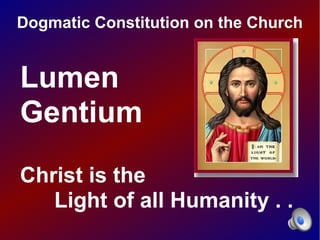
Dogmatic Constitution on the Church


Lumen
Gentium
Christ is the
   Light of all Humanity . .
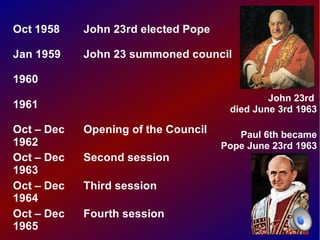
Oct 1958    John 23rd elected Pope

Jan 1959    John 23 summoned council

1960
                                              John 23rd
1961                                  died June 3rd 1963

Oct – Dec   Opening of the Council      Paul 6th became
1962                                 Pope June 23rd 1963
Oct – Dec   Second session
1963
Oct – Dec   Third session
1964
Oct – Dec   Fourth session
1965
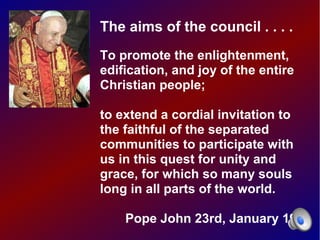
The aims of the council . . . .
To promote the enlightenment,
edification, and joy of the entire
Christian people;

to extend a cordial invitation to
the faithful of the separated
communities to participate with
us in this quest for unity and
grace, for which so many souls
long in all parts of the world.

    Pope John 23rd, January 1959
Three key themes running through the council . . .


 Aggiornamento
      – Italian word meaning bringing up-to-date.
Three key themes running through the council . . .


Aggiornamento
     – Italian word meaning bringing up-to-date.

Ressourcement: a returning to the sources to
    ensure they are conformed to a more
    authentic view of the past.
Three key themes running through the council . . .


Aggiornamento
     – Italian word meaning bringing up-to-date.

Ressourcement – a returning to the sources to
    ensure they are conformed to a more
    authentic view of the past.

Development of Doctrine – how to develop
     doctrine and show that in some way it was
     in scripture or the church's tradition.
The mystery of the church

     The Father created the world
     to raise us all to divine life.

     The Son by his obedience
     brought about redemption.

     The Holy Spirit was sent to
     sanctify the church.
The mystery of the church

  The Lord Jesus set it on its course
  by preaching the good news

  The kingdom – a sheepfold, a flock,
  a cultivated field, the building of God,
  the new Jerusalem, the mother,
  Christ made us all, from all nations,
  the components of his own body
                           and now we . . . .
We are called to follow Christ in the
same route, in poverty and
persecution. We encompass with love
 all who are afflicted with human
suffering and in the poor and
afflicted . . . we do all we can to
relieve their need and in them we
strive to serve Christ.
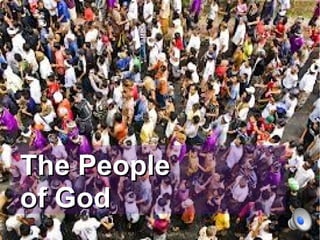
The People
of God
The people of God . . .

At all times and in every race God
has given welcome to whoever
hears him and does what is right

everyone is called to belong to the
new people of God
The people of God
The people of God
 The Catholic faithful
The people of God
 The Catholic faithful
 Those who are baptised
The people of God
 The Catholic faithful
 Those who are baptised
 Those who have not yet received the
 gospel, including the Jews and the
 Muslims
The people of God
 The Catholic faithful
 Those who are baptised
 Those who have not yet received the
 gospel, including the Jews and the
 Muslims
 Those who seek the unknown God
The people of God
 The Catholic faithful
 Those who are baptised
 Those who have not yet received the
 gospel, including the Jews and the
 Muslims
 Those who seek the unknown God
 Those who do not know the gospel
The people of God
 The Catholic faithful
 Those who are baptised
 Those who have not yet received the
 gospel, including the Jews and the
 Muslims
 Those who seek the unknown God
 Those who do not know the gospel
 Those with no explicit knowledge of God
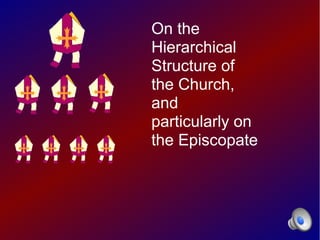
On the
Hierarchical
Structure of
the Church,
and
particularly on
the Episcopate
The Lord Jesus appointed twelve to be
with him;

they took care to appoint successors;


in the bishops, the Lord Jesus is present
in the midst of those who believe.
Collegiality
In the gospel, St Peter and the other
apostles constitute one apostolic
college, so the Roman Pontiff and the
bishops are joined together . . .
the task of proclaiming the gospel
everywhere belongs to the body of
pastors, to all of whom in common
Christ gave his command, thereby
imposing on them a common duty.
The Laity
The People of God includes laity,
religious and clergy alike.
Upon the laity rests the noble duty of
working to extend the divine plan of
salvation to everyone, in every epoch
and in every land.
Let the laity remedy the customs and
conditions of the world, if they are an
inducement to sin, so that all may be
conformed to the norms of justice.
They should try to reconcile rights and
duties


    as members of the church


    as members of human society.

In every temporal affair they must be
guided by a Christian conscience.
Holiness
The Lord Jesus
preached holiness to all.
Holiness is for all who

    are moved by the Spirit of God

    obey the voice of the Father

    worship God in spirit and in truth

    follow the poor, humble Christ

    walk according to their personal gifts
and duties
God is love,
and whoever who abides in
love abides in God,
and God abides in them.
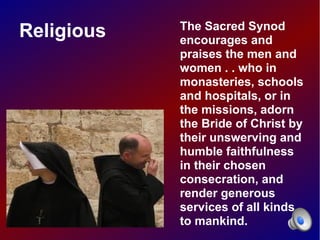
The Sacred Synod
Religious   encourages and
            praises the men and
            women . . who in
            monasteries, schools
            and hospitals, or in
            the missions, adorn
            the Bride of Christ by
            their unswerving and
            humble faithfulness
            in their chosen
            consecration, and
            render generous
            services of all kinds
            to mankind.
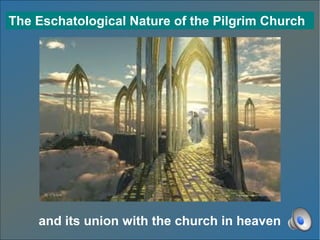
The Eschatological Nature of the Pilgrim Church


    and its union with the church in heaven
The church attains its full glory only
in heaven

until then, some of the Lord's
disciples are exiles on earth,

some having died are purified

others are in glory.
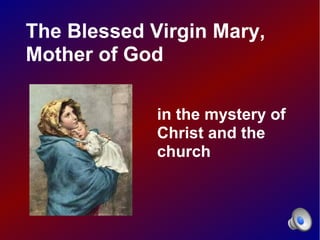
The Blessed Virgin Mary,
Mother of God

             in the mystery of
             Christ and the
             church
Mary,

consenting to the divine word
became the mother of Jesus
the one and only mediator.

She freely co-operated in the work of
human salvation through faith and
obedience.
Mary . . became the mother of Jesus . .
embracing God's salvific will with a full heart,
and impeded by no sin,
she devoted herself totally as a handmaid of the
Lord to the person and work of her son, under
him, and with him, by the grace of almighty God,
serving the mystery of redemption . .
freely co-operating in the work of human
salvation through faith and obedience.
                                Lumen Gentium, paragraph 56
The Fathers have resolved on each and every
utterance in this dogmatic constitution.
In virtue of the apostolic power handed to us
from Christ, we join the venerable Fathers in
giving these utterances approval, decreeing and
enacting them.
We order that the synod's enactments be
promulgated to the glory of God.
St Peter's, Rome, November 21st 1964
Paul, bishop of the Catholic Church.
The signatures of all the Fathers follow.
At the very end of the third session of
the council, when the pope was
solemnly promulgating Lumen
Gentium, he added:

“For the glory of the Blessed Virgin,
and for our consolation, we declare her
Mother of the Church.”
Lumen Gentium

Lumen Gentium

  • 1.
    Dogmatic Constitution onthe Church Lumen Gentium Christ is the Light of all Humanity . .
  • 2.
    Oct 1958 John 23rd elected Pope Jan 1959 John 23 summoned council 1960 John 23rd 1961 died June 3rd 1963 Oct – Dec Opening of the Council Paul 6th became 1962 Pope June 23rd 1963 Oct – Dec Second session 1963 Oct – Dec Third session 1964 Oct – Dec Fourth session 1965
  • 3.
    The aims ofthe council . . . . To promote the enlightenment, edification, and joy of the entire Christian people; to extend a cordial invitation to the faithful of the separated communities to participate with us in this quest for unity and grace, for which so many souls long in all parts of the world. Pope John 23rd, January 1959
  • 4.
    Three key themesrunning through the council . . .
  • 5.
    Three key themesrunning through the council . . . Aggiornamento – Italian word meaning bringing up-to-date.
  • 6.
    Three key themesrunning through the council . . . Aggiornamento – Italian word meaning bringing up-to-date. Ressourcement: a returning to the sources to ensure they are conformed to a more authentic view of the past.
  • 7.
    Three key themesrunning through the council . . . Aggiornamento – Italian word meaning bringing up-to-date. Ressourcement – a returning to the sources to ensure they are conformed to a more authentic view of the past. Development of Doctrine – how to develop doctrine and show that in some way it was in scripture or the church's tradition.
  • 8.
    The mystery ofthe church The Father created the world to raise us all to divine life. The Son by his obedience brought about redemption. The Holy Spirit was sent to sanctify the church.
  • 9.
    The mystery ofthe church The Lord Jesus set it on its course by preaching the good news The kingdom – a sheepfold, a flock, a cultivated field, the building of God, the new Jerusalem, the mother, Christ made us all, from all nations, the components of his own body and now we . . . .
  • 10.
    We are calledto follow Christ in the same route, in poverty and persecution. We encompass with love all who are afflicted with human suffering and in the poor and afflicted . . . we do all we can to relieve their need and in them we strive to serve Christ.
  • 11.
  • 12.
    The people ofGod . . . At all times and in every race God has given welcome to whoever hears him and does what is right everyone is called to belong to the new people of God
  • 13.
  • 14.
    The people ofGod The Catholic faithful
  • 15.
    The people ofGod The Catholic faithful Those who are baptised
  • 16.
    The people ofGod The Catholic faithful Those who are baptised Those who have not yet received the gospel, including the Jews and the Muslims
  • 17.
    The people ofGod The Catholic faithful Those who are baptised Those who have not yet received the gospel, including the Jews and the Muslims Those who seek the unknown God
  • 18.
    The people ofGod The Catholic faithful Those who are baptised Those who have not yet received the gospel, including the Jews and the Muslims Those who seek the unknown God Those who do not know the gospel
  • 19.
    The people ofGod The Catholic faithful Those who are baptised Those who have not yet received the gospel, including the Jews and the Muslims Those who seek the unknown God Those who do not know the gospel Those with no explicit knowledge of God
  • 20.
    On the Hierarchical Structure of theChurch, and particularly on the Episcopate
  • 21.
    The Lord Jesusappointed twelve to be with him; they took care to appoint successors; in the bishops, the Lord Jesus is present in the midst of those who believe.
  • 22.
    Collegiality In the gospel,St Peter and the other apostles constitute one apostolic college, so the Roman Pontiff and the bishops are joined together . . . the task of proclaiming the gospel everywhere belongs to the body of pastors, to all of whom in common Christ gave his command, thereby imposing on them a common duty.
  • 23.
  • 24.
    The People ofGod includes laity, religious and clergy alike. Upon the laity rests the noble duty of working to extend the divine plan of salvation to everyone, in every epoch and in every land. Let the laity remedy the customs and conditions of the world, if they are an inducement to sin, so that all may be conformed to the norms of justice.
  • 25.
    They should tryto reconcile rights and duties  as members of the church  as members of human society. In every temporal affair they must be guided by a Christian conscience.
  • 26.
  • 27.
    The Lord Jesus preachedholiness to all.
  • 28.
    Holiness is forall who  are moved by the Spirit of God  obey the voice of the Father  worship God in spirit and in truth  follow the poor, humble Christ  walk according to their personal gifts and duties
  • 29.
    God is love, andwhoever who abides in love abides in God, and God abides in them.
  • 30.
    The Sacred Synod Religious encourages and praises the men and women . . who in monasteries, schools and hospitals, or in the missions, adorn the Bride of Christ by their unswerving and humble faithfulness in their chosen consecration, and render generous services of all kinds to mankind.
  • 31.
    The Eschatological Natureof the Pilgrim Church and its union with the church in heaven
  • 32.
    The church attainsits full glory only in heaven until then, some of the Lord's disciples are exiles on earth, some having died are purified others are in glory.
  • 33.
    The Blessed VirginMary, Mother of God in the mystery of Christ and the church
  • 34.
    Mary, consenting to thedivine word became the mother of Jesus the one and only mediator. She freely co-operated in the work of human salvation through faith and obedience.
  • 35.
    Mary . .became the mother of Jesus . . embracing God's salvific will with a full heart, and impeded by no sin, she devoted herself totally as a handmaid of the Lord to the person and work of her son, under him, and with him, by the grace of almighty God, serving the mystery of redemption . . freely co-operating in the work of human salvation through faith and obedience. Lumen Gentium, paragraph 56
  • 36.
    The Fathers haveresolved on each and every utterance in this dogmatic constitution. In virtue of the apostolic power handed to us from Christ, we join the venerable Fathers in giving these utterances approval, decreeing and enacting them. We order that the synod's enactments be promulgated to the glory of God. St Peter's, Rome, November 21st 1964 Paul, bishop of the Catholic Church. The signatures of all the Fathers follow.
  • 37.
    At the veryend of the third session of the council, when the pope was solemnly promulgating Lumen Gentium, he added: “For the glory of the Blessed Virgin, and for our consolation, we declare her Mother of the Church.”