System of Least Support:
Prompting, Fading, and Data Collection
Presented for the:
National Conference for Paraprofessionals by:
Sheri White, Ms. Ed
Oak Brook, IL
April, 2016
1.5 hours
1
Presented by:
Sheri White, Ms Ed
Northwestern Illinois Association
4920 East State St. Unit 6
Rockford, IL 61108
(815)964-0937
Fax: (815)316-0640
swhite@thenia.org
www.thenia.org
2
Learner Outcomes
• To know and appreciate which individual educational goals have been
prioritized by the educational team for the student(s) you support.
• To understand how prompting, fading, and data collection affect
student growth and independence. (prompts: least to most)
• To discuss the types of data to record and report.
3
Prioritizing Educational Needs
As a part of a team discussion, it is helpful for each member to identify
what outcomes they hope to see in the student by the end of the
school year. Prioritize 1-5, 1 being the most important.
1.___________ 2.______________
3.___________ 4.______________
5.___________
4
Ask yourself :
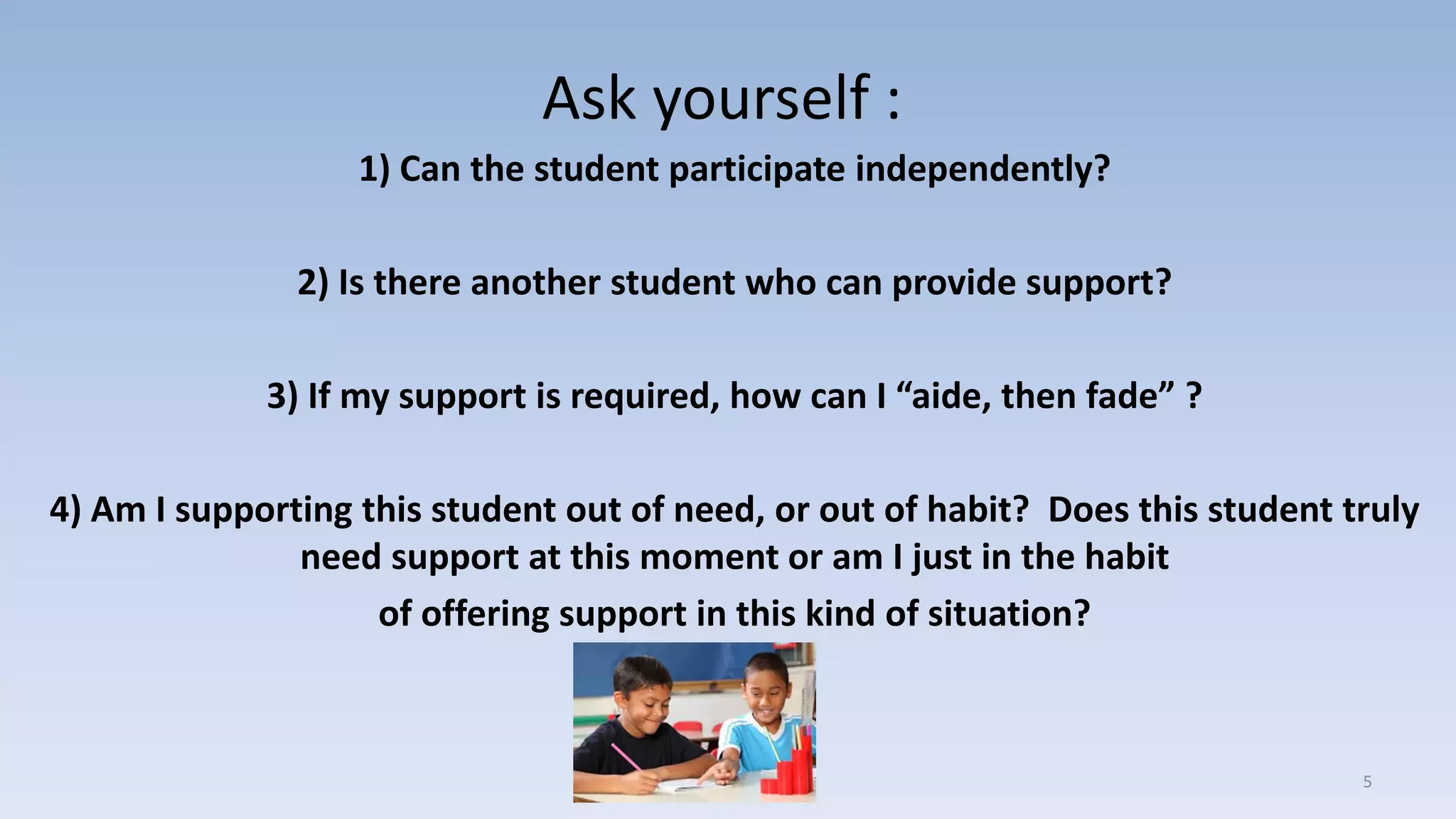
1) Can the student participate independently?
2) Is there another student who can provide support?
3) If my support is required, how can I “aide, then fade” ?
4) Am I supporting this student out of need, or out of habit? Does this student truly
need support at this moment or am I just in the habit
of offering support in this kind of situation?
5
PROMPTING
Objective:
To understand how
prompting, fading, and
data collection affect
student growth and
independence.
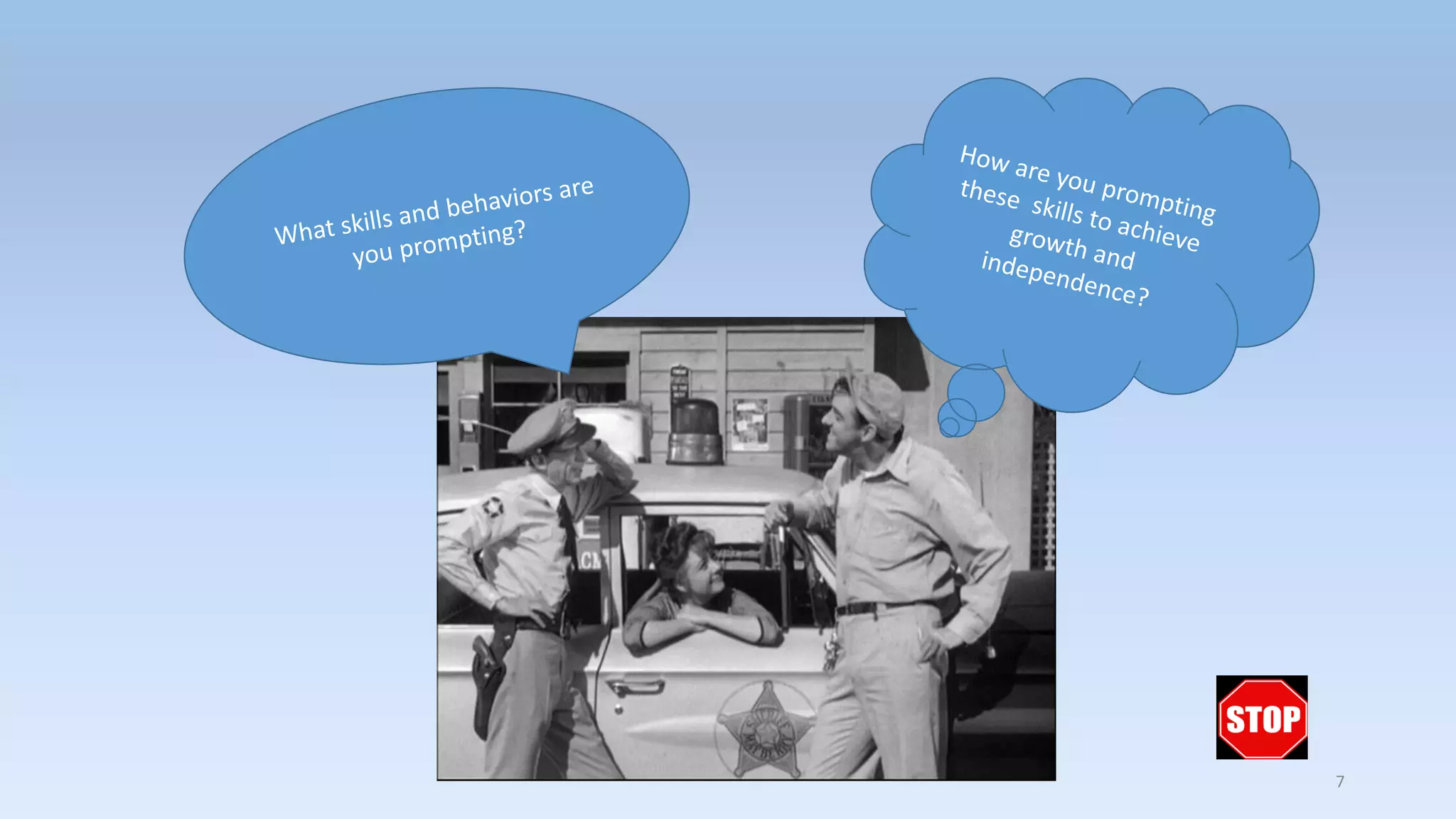
When do you feel more like a
mother than a para?
6
7
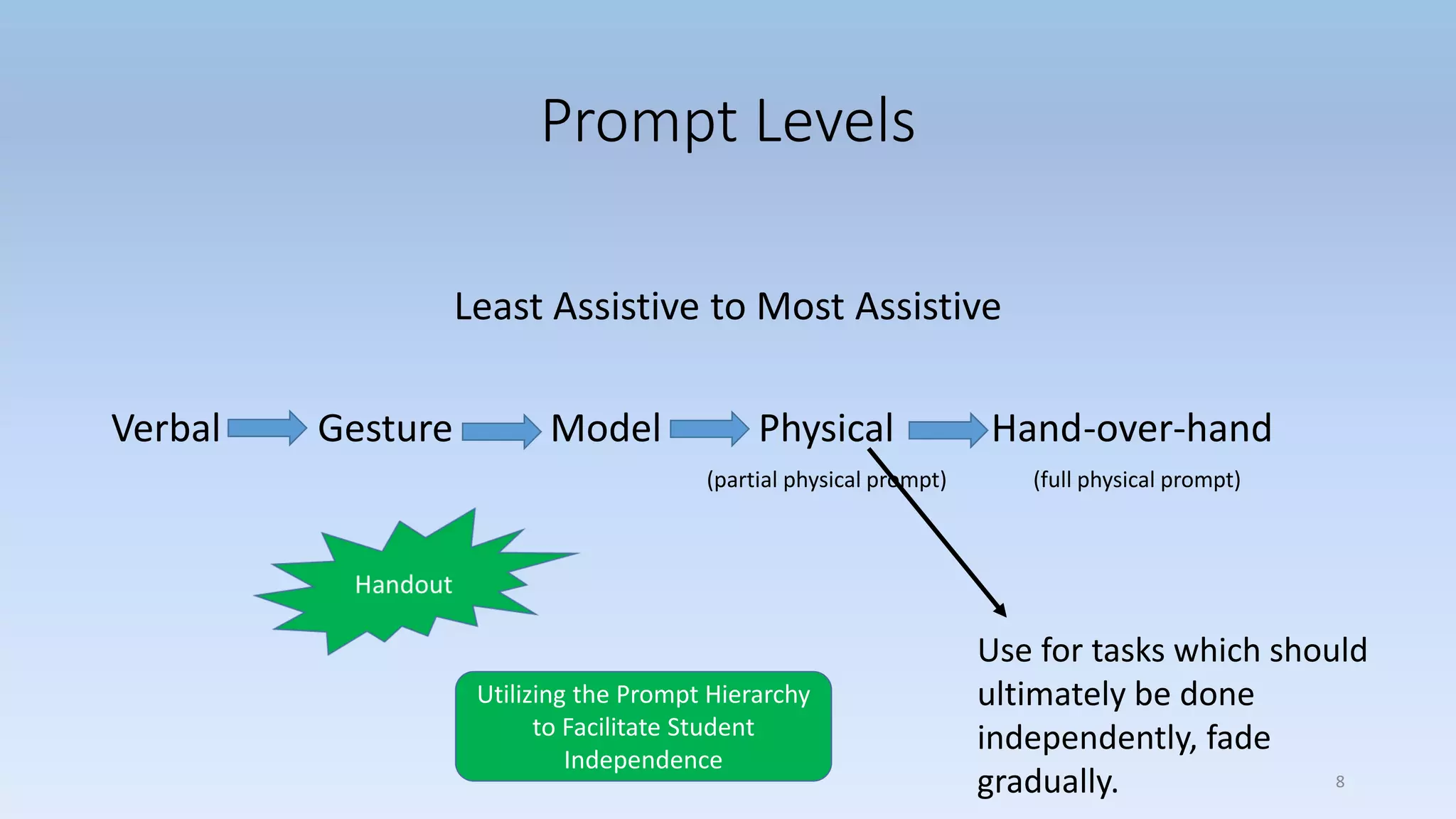
Prompt Levels
Least Assistive to Most Assistive
Verbal Gesture Model Physical Hand-over-hand
(partial physical prompt) (full physical prompt)
8
Utilizing the Prompt Hierarchy
to Facilitate Student
Independence
Use for tasks which should
ultimately be done
independently, fade
gradually.
Prompt Levels
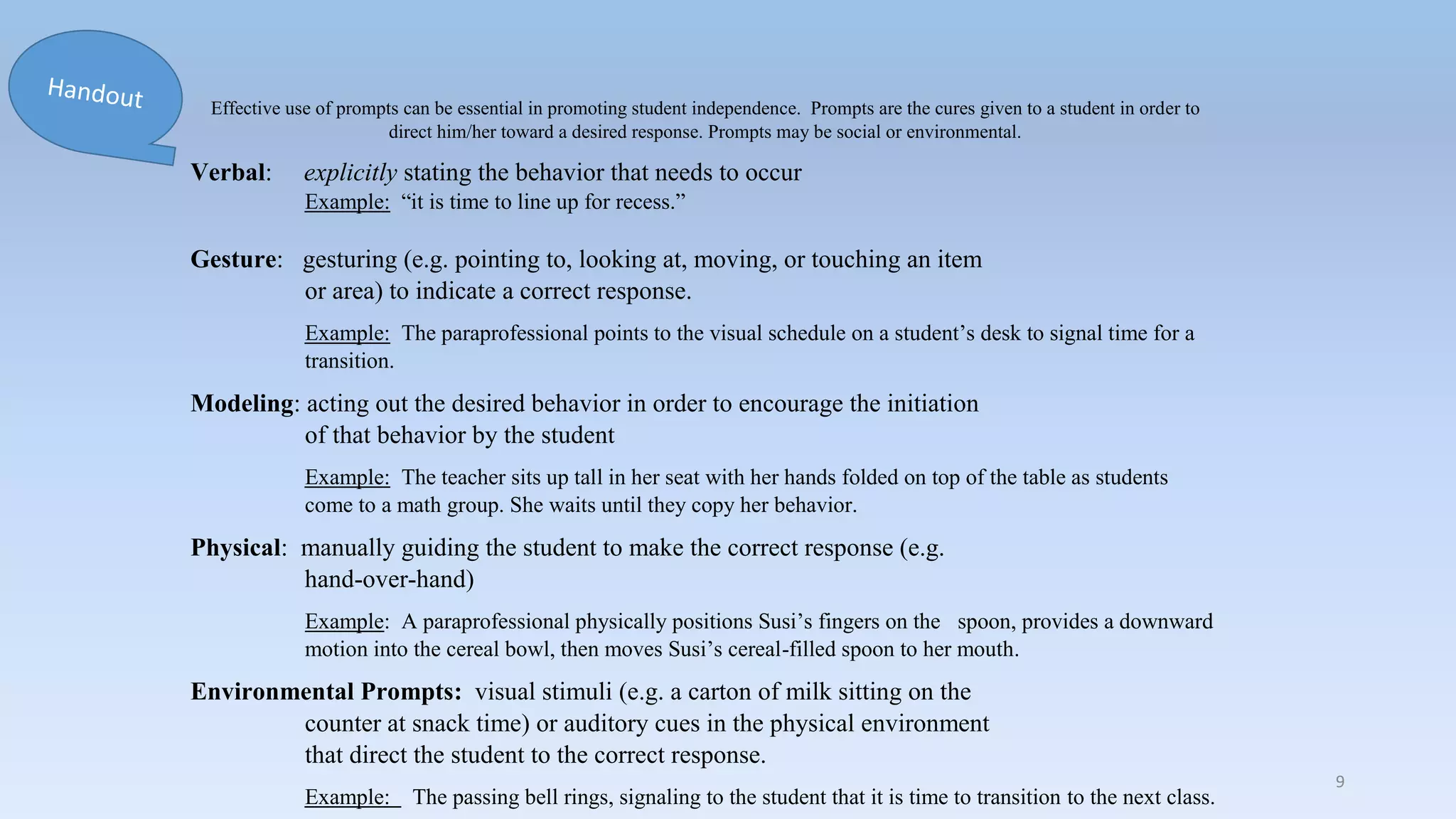
Effective use of prompts can be essential in promoting student independence. Prompts are the cures given to a student in order to
direct him/her toward a desired response. Prompts may be social or environmental.
Verbal: explicitly stating the behavior that needs to occur
Example: “it is time to line up for recess.”
Gesture: gesturing (e.g. pointing to, looking at, moving, or touching an item
or area) to indicate a correct response.
Example: The paraprofessional points to the visual schedule on a student’s desk to signal time for a
transition.
Modeling: acting out the desired behavior in order to encourage the initiation
of that behavior by the student
Example: The teacher sits up tall in her seat with her hands folded on top of the table as students
come to a math group. She waits until they copy her behavior.
Physical: manually guiding the student to make the correct response (e.g.
hand-over-hand)
Example: A paraprofessional physically positions Susi’s fingers on the spoon, provides a downward
motion into the cereal bowl, then moves Susi’s cereal-filled spoon to her mouth.
Environmental Prompts: visual stimuli (e.g. a carton of milk sitting on the
counter at snack time) or auditory cues in the physical environment
that direct the student to the correct response.
Example: The passing bell rings, signaling to the student that it is time to transition to the next class.
9
Your Turn - Prompts
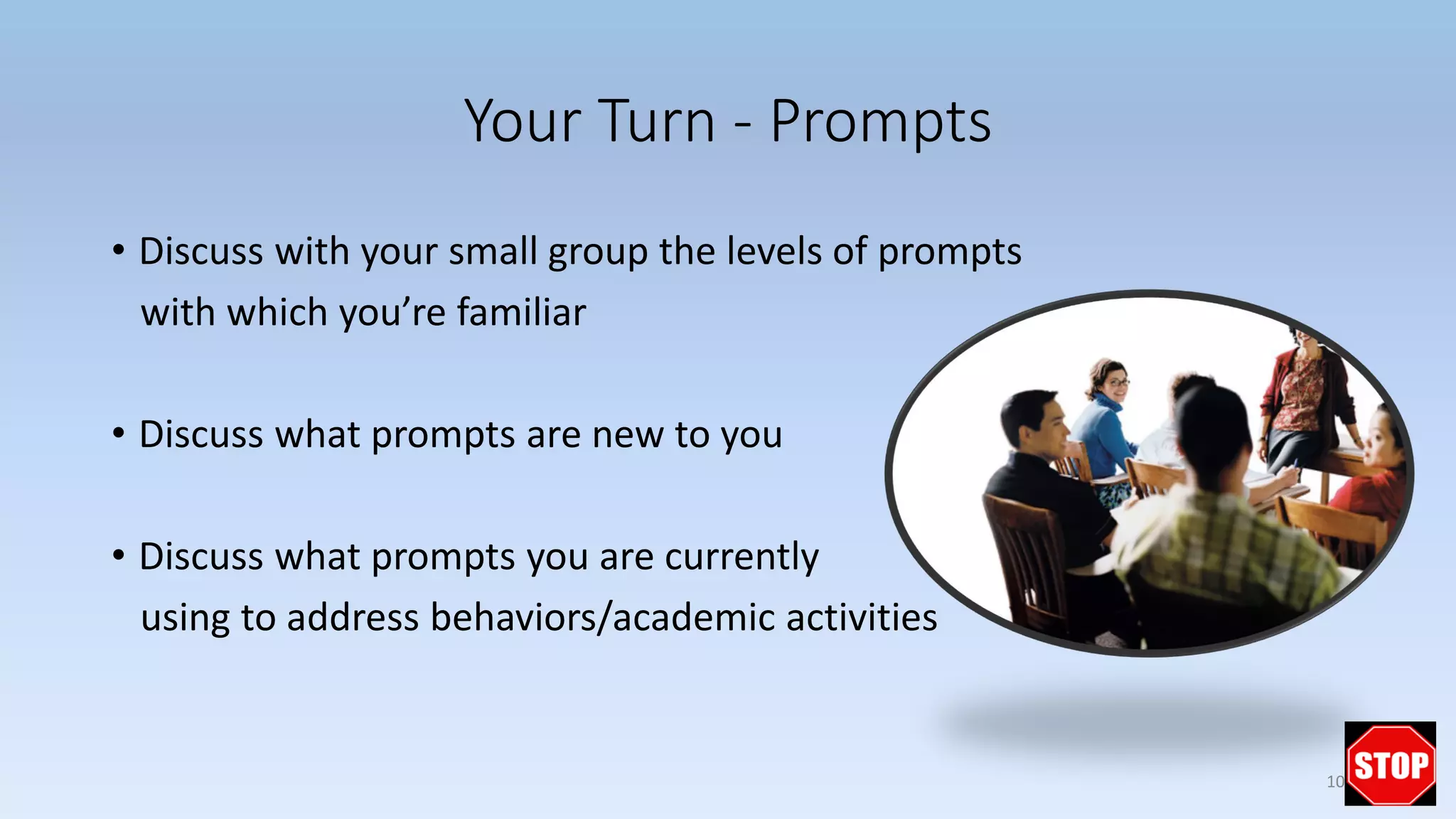
• Discuss with your small group the levels of prompts
with which you’re familiar
• Discuss what prompts are new to you
• Discuss what prompts you are currently
using to address behaviors/academic activities
10
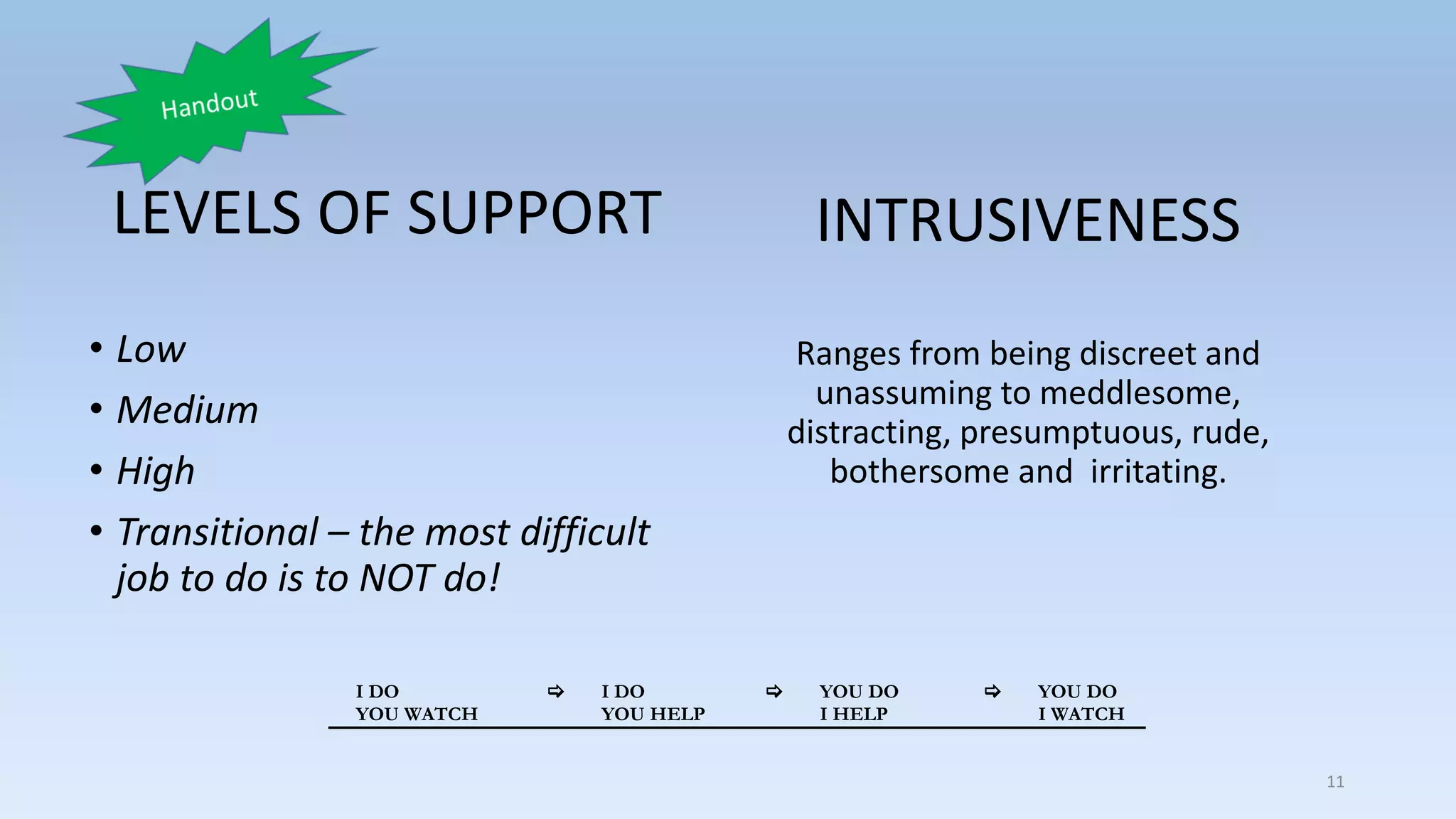
LEVELS OF SUPPORT
• Low
• Medium
• High
• Transitional – the most difficult
job to do is to NOT do!
INTRUSIVENESS
Ranges from being discreet and
unassuming to meddlesome,
distracting, presumptuous, rude,
bothersome and irritating.
11
I DO  I DO  YOU DO  YOU DO
YOU WATCH YOU HELP I HELP I WATCH
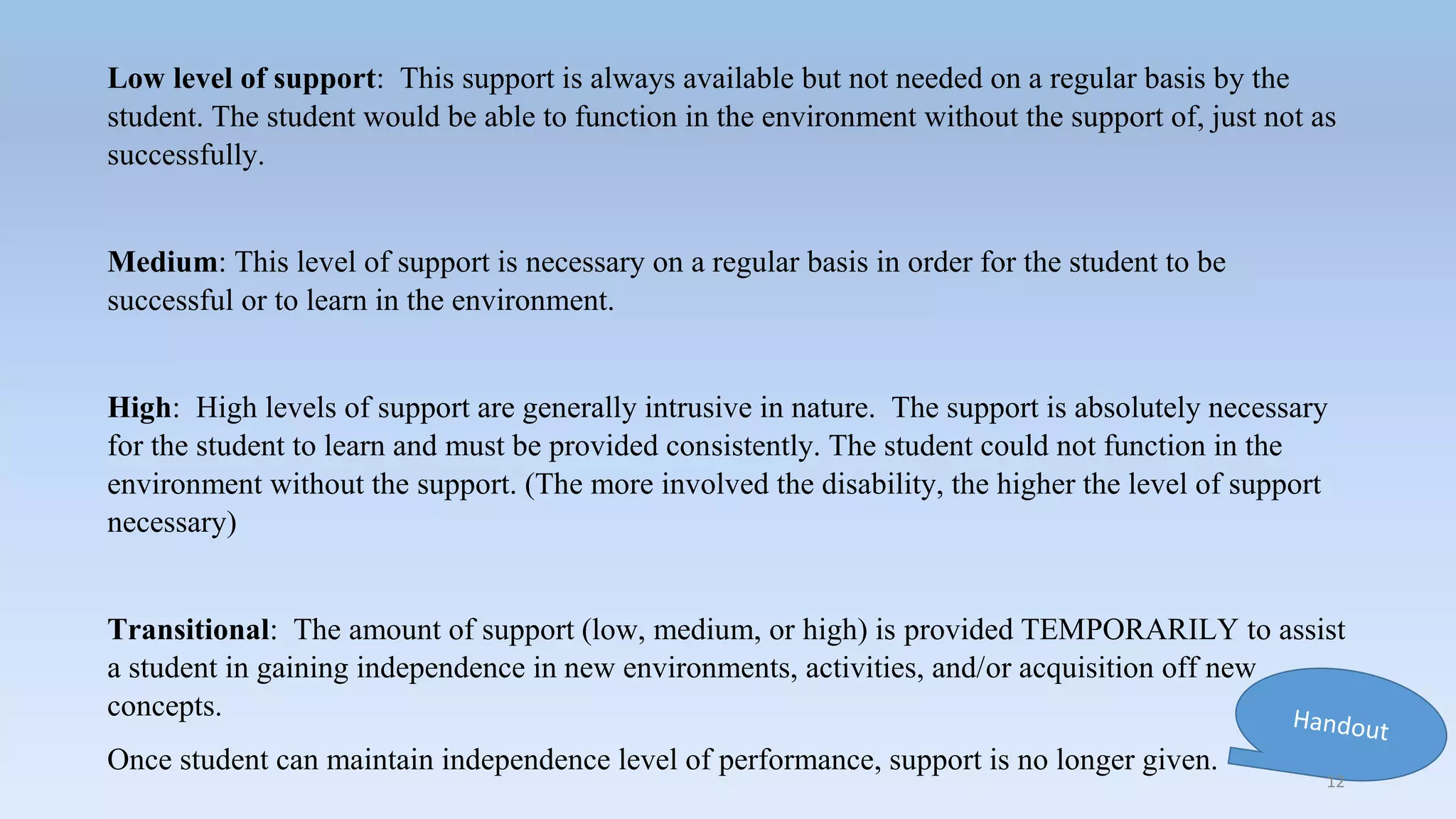
Low level of support: This support is always available but not needed on a regular basis by the
student. The student would be able to function in the environment without the support of, just not as
successfully.
Medium: This level of support is necessary on a regular basis in order for the student to be
successful or to learn in the environment.
High: High levels of support are generally intrusive in nature. The support is absolutely necessary
for the student to learn and must be provided consistently. The student could not function in the
environment without the support. (The more involved the disability, the higher the level of support
necessary)
Transitional: The amount of support (low, medium, or high) is provided TEMPORARILY to assist
a student in gaining independence in new environments, activities, and/or acquisition off new
concepts.
Once student can maintain independence level of performance, support is no longer given.
12
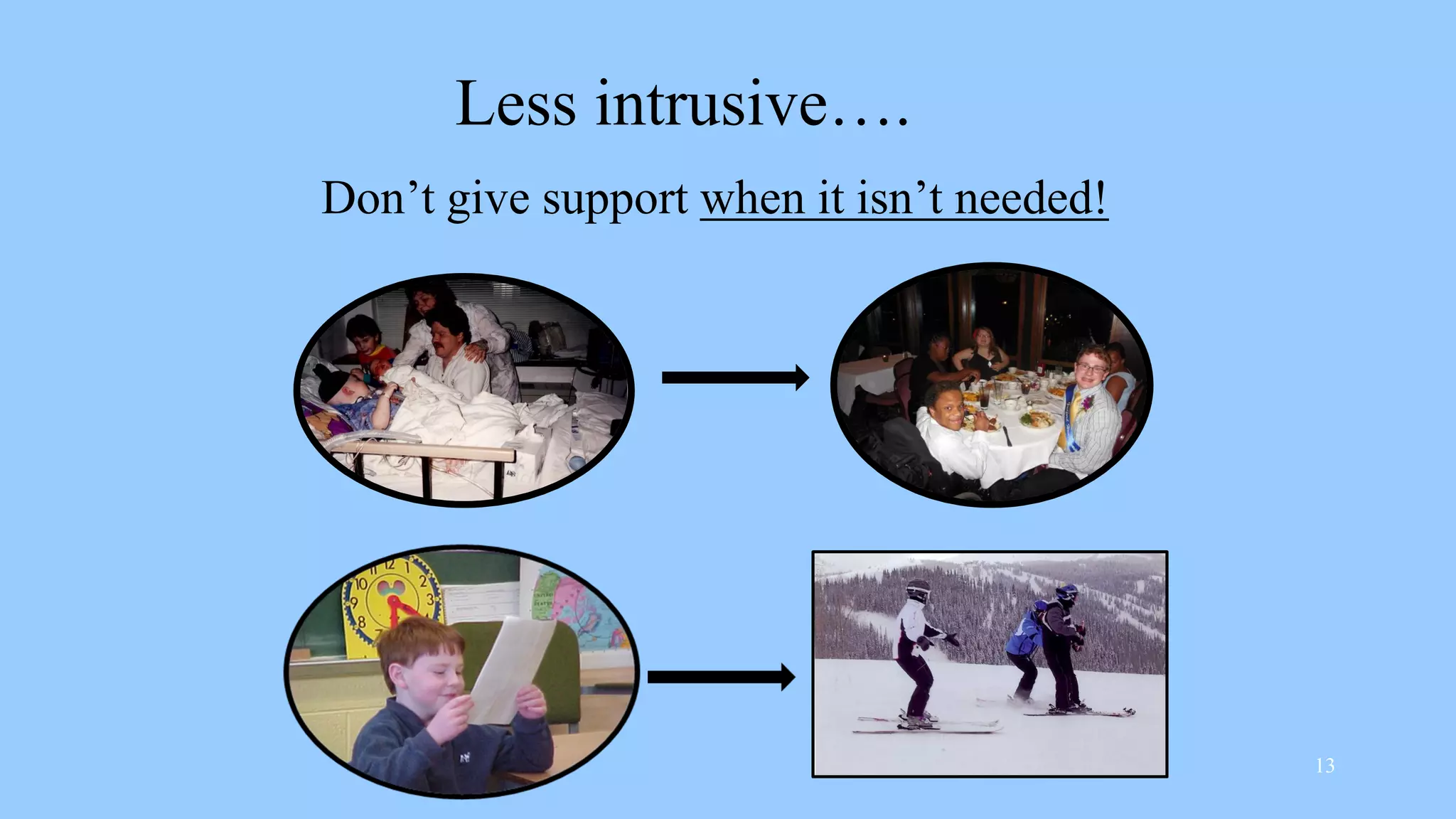
Less intrusive….
Don’t give support when it isn’t needed!
13
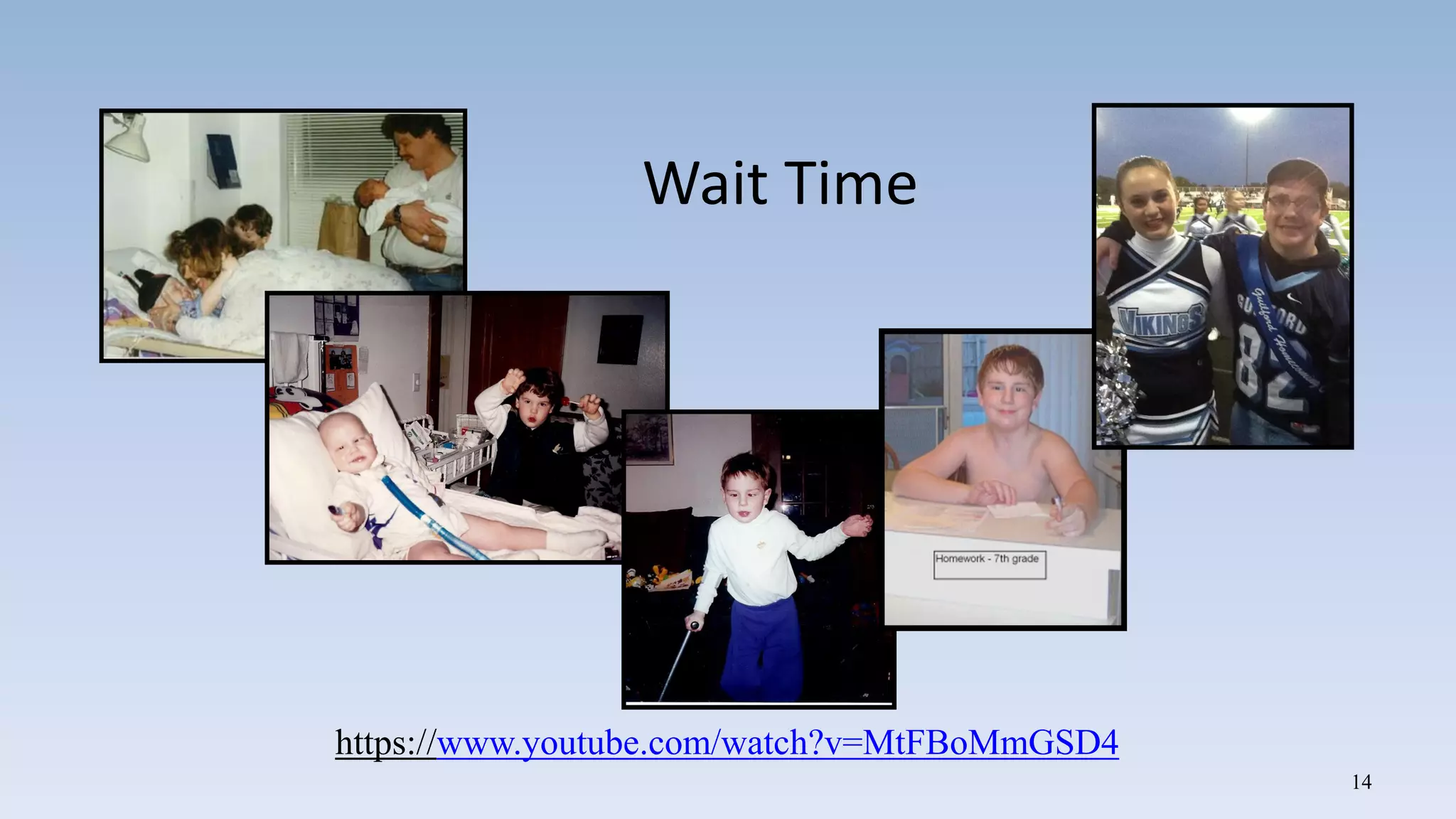
Wait Time
14
https://www.youtube.com/watch?v=MtFBoMmGSD4
The most important thing for a paraeducator to
remember is that helping a student when he or she
could learn to do a task independently
is what leads a student to become
overly dependent on the paraeduatcator and
not develop skills of dependence.
15
Have you heard this before?
“Hover cover, Velcro effect”
16
How do you know when to fade the prompt or go to
a less intrusive/indirect prompt?
17
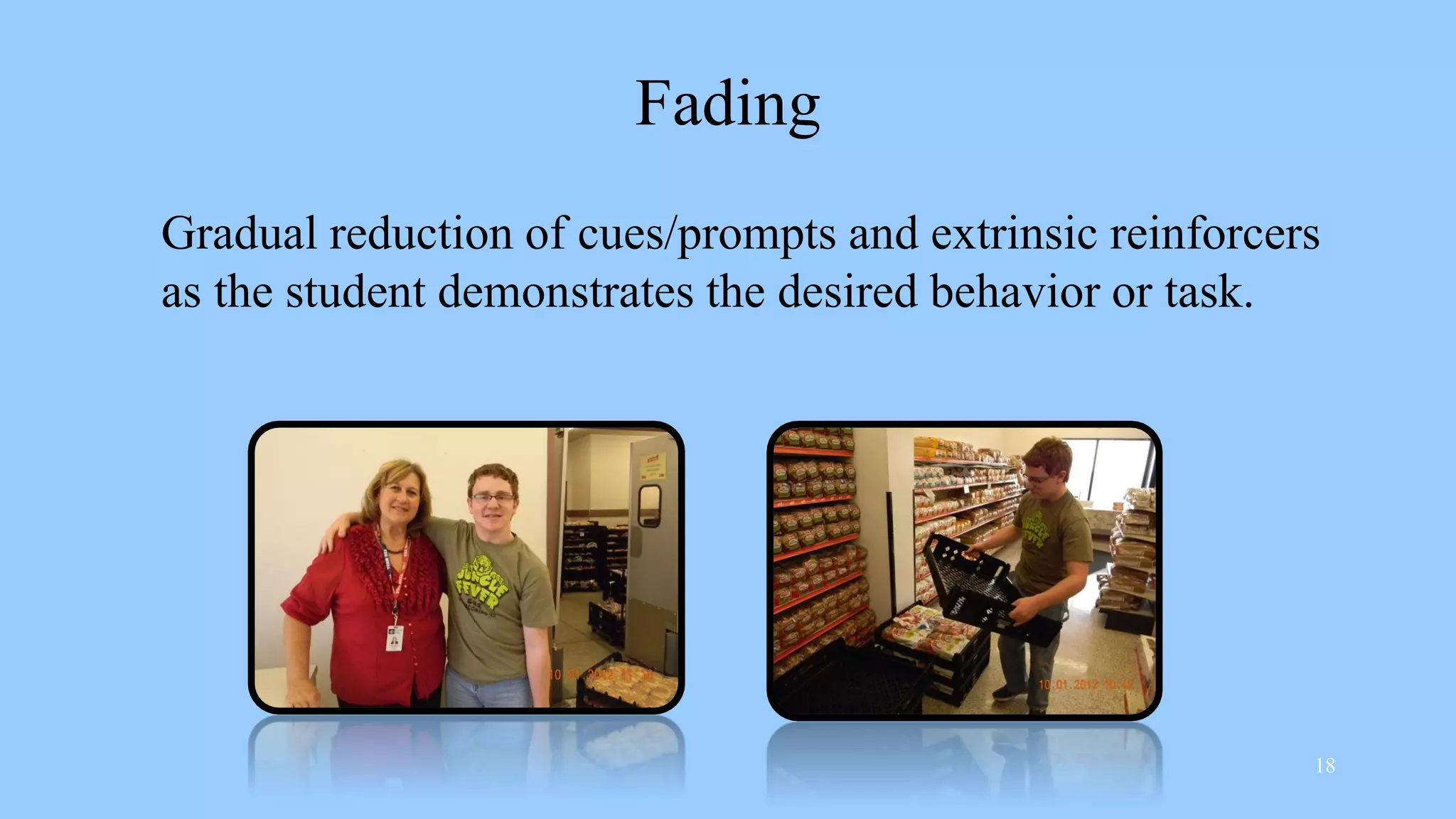
Fading
Gradual reduction of cues/prompts and extrinsic reinforcers
as the student demonstrates the desired behavior or task.
18
Intentionally plan to FADE prompts/support
• Facilitate independence by VARYING the amount of support,
monitoring, and prompting based on need and independent level of
student.
• Plan, systematically with the teacher, on when and how to fade.
• Replace your support with visuals. Teach natural, environmental cues.
• Aide then fade.
19
Increasing Student Learning
and Independence
Promote self-sufficiency by:
• Resisting urge to step in and do things for them
• Asking leading questions:
• What’s next?
• What should we do first?
• What else?
http://www.youtube.com/watch?v=jMwaruBi3M4 (1:18)
20
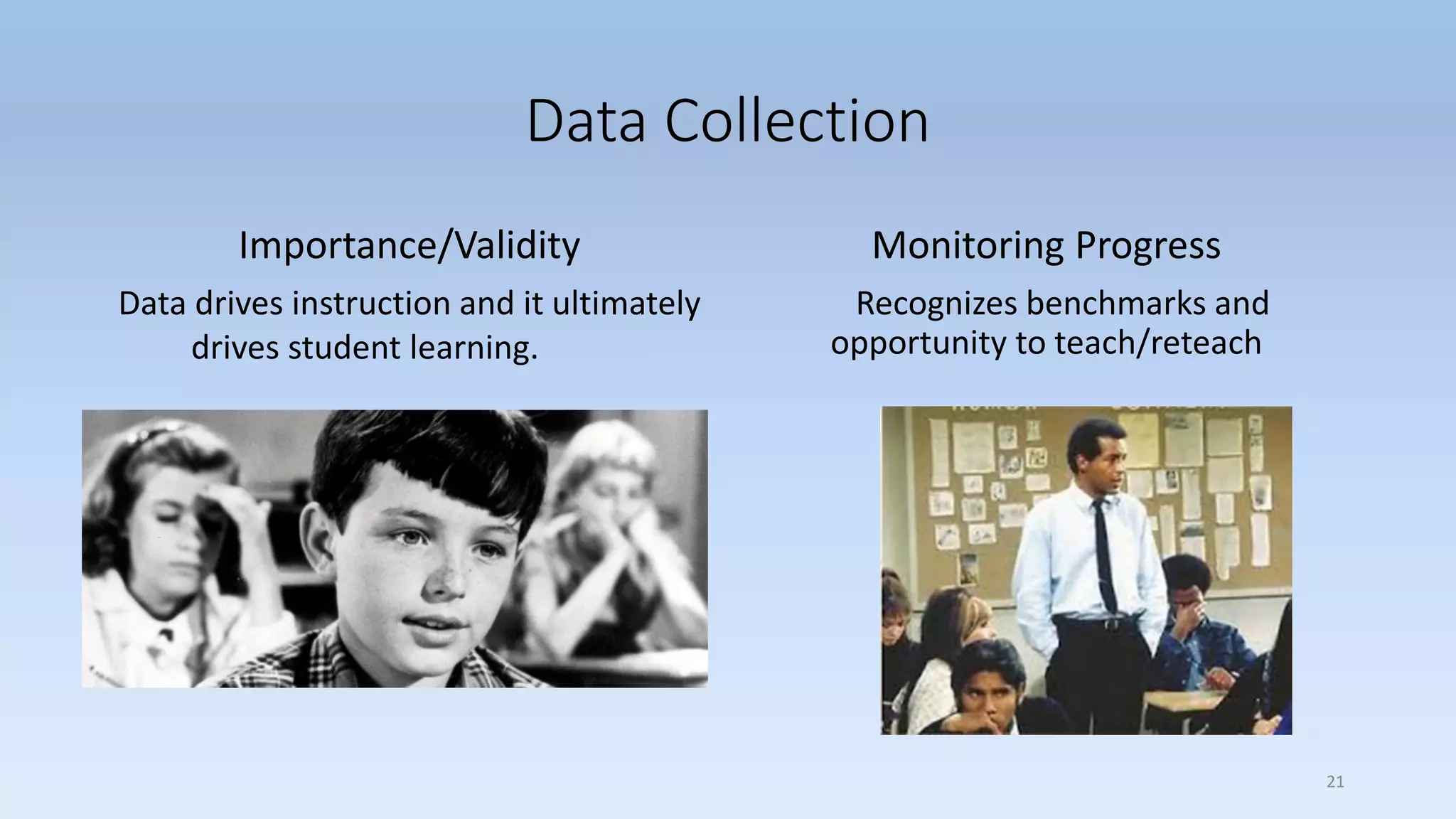
Data Collection
Importance/Validity
Data drives instruction and it ultimately
drives student learning.
Monitoring Progress
Recognizes benchmarks and
opportunity to teach/reteach
21
We Use DATA to……
Establish Baseline
Determine Patterns????
Provide Information
Compare Behavior
Communication
22
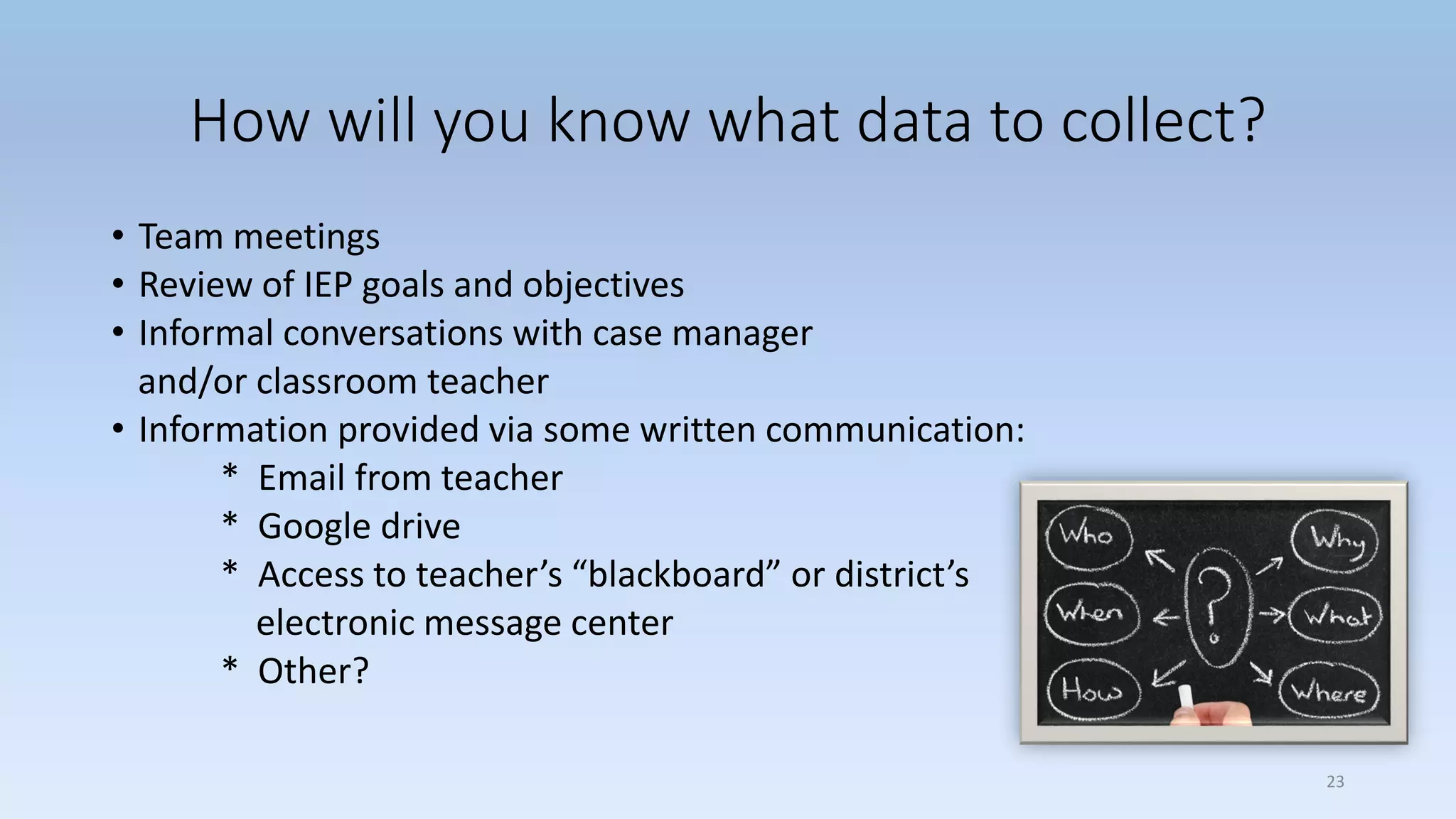
How will you know what data to collect?
• Team meetings
• Review of IEP goals and objectives
• Informal conversations with case manager
and/or classroom teacher
• Information provided via some written communication:
* Email from teacher
* Google drive
* Access to teacher’s “blackboard” or district’s
electronic message center
* Other?
23
24
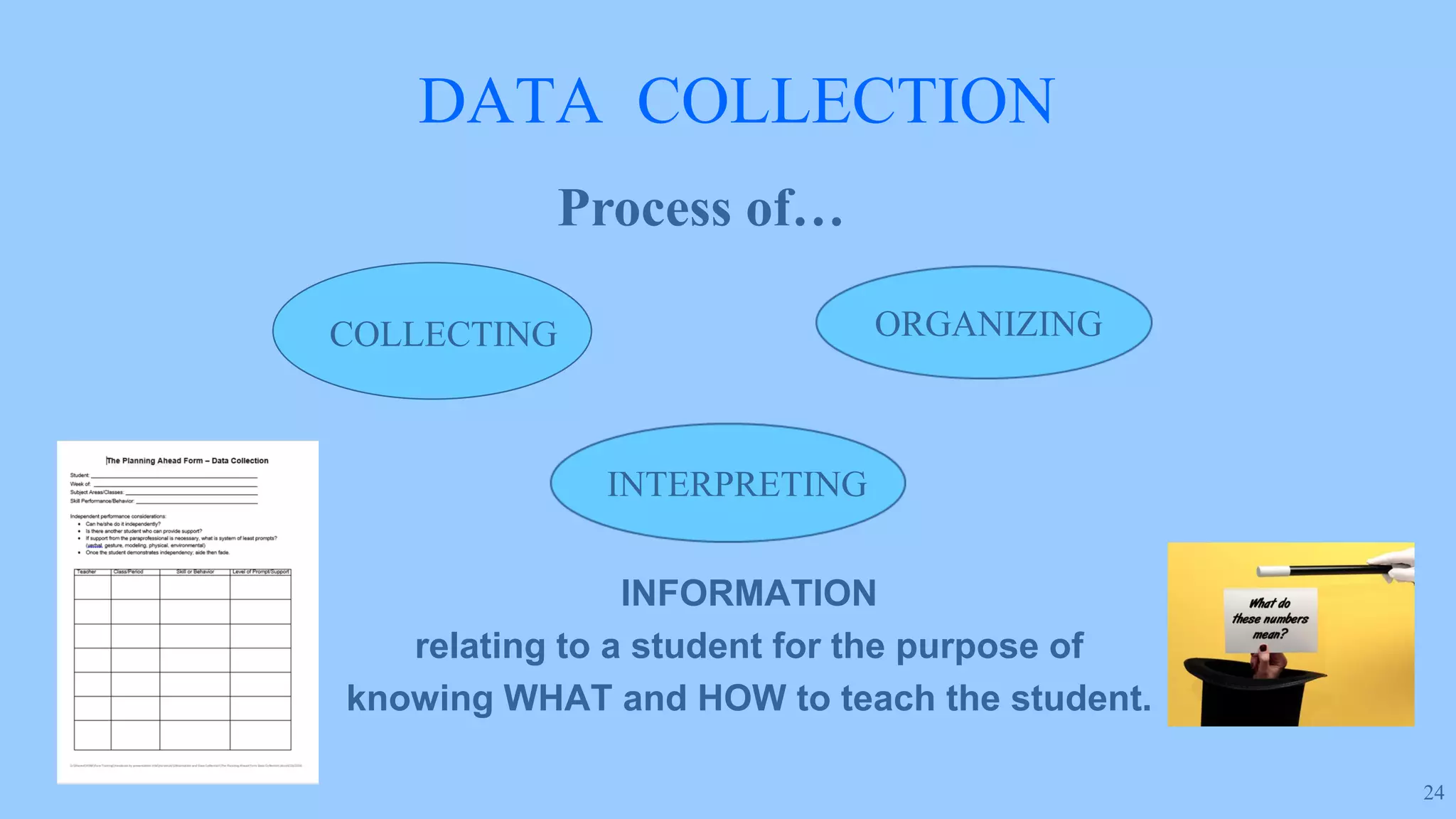
DATA COLLECTION
INFORMATION
relating to a student for the purpose of
knowing WHAT and HOW to teach the student.
COLLECTING ORGANIZING
INTERPRETING
Process of…
Formative Assessment
If the teacher doesn’t expect
you to help gather formative
data, be sure to ask how the
teacher would like you to let
him or her know when the
student you are working
with is struggling, as it may
still be part of your
responsibility to provide
feedback regarding specific
students.
25
26
Types of Recording Systems
 Frequency
(is the behavior discrete? A start and a stop point)
 Interval
(is the behavior expected to occur at a high frequency?)
 Duration
(want to measure time before requested response begins?)
 Latency
(want to measure the time before requested response begins?)
27
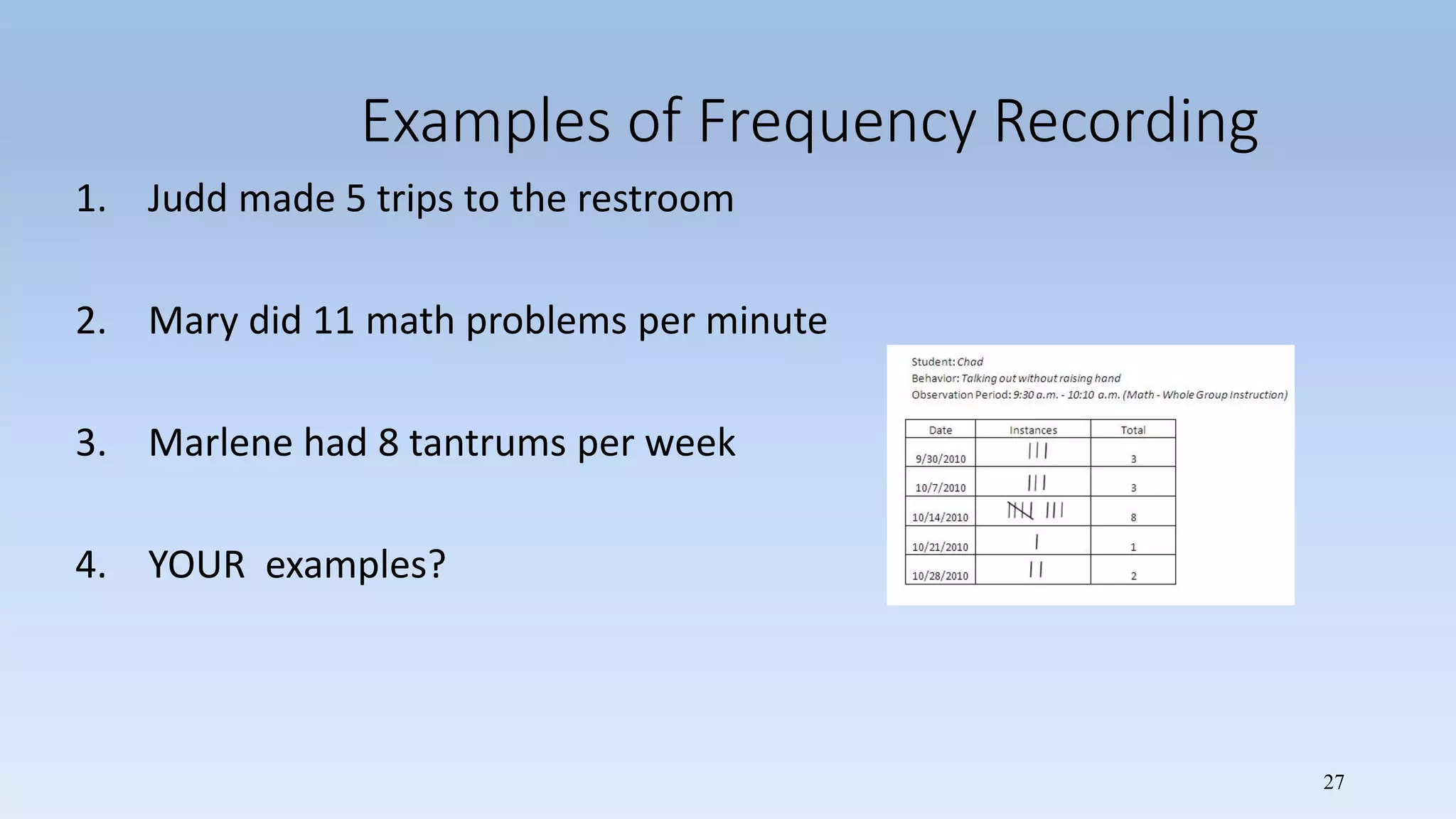
Examples of Frequency Recording
1. Judd made 5 trips to the restroom
2. Mary did 11 math problems per minute
3. Marlene had 8 tantrums per week
4. YOUR examples?
28
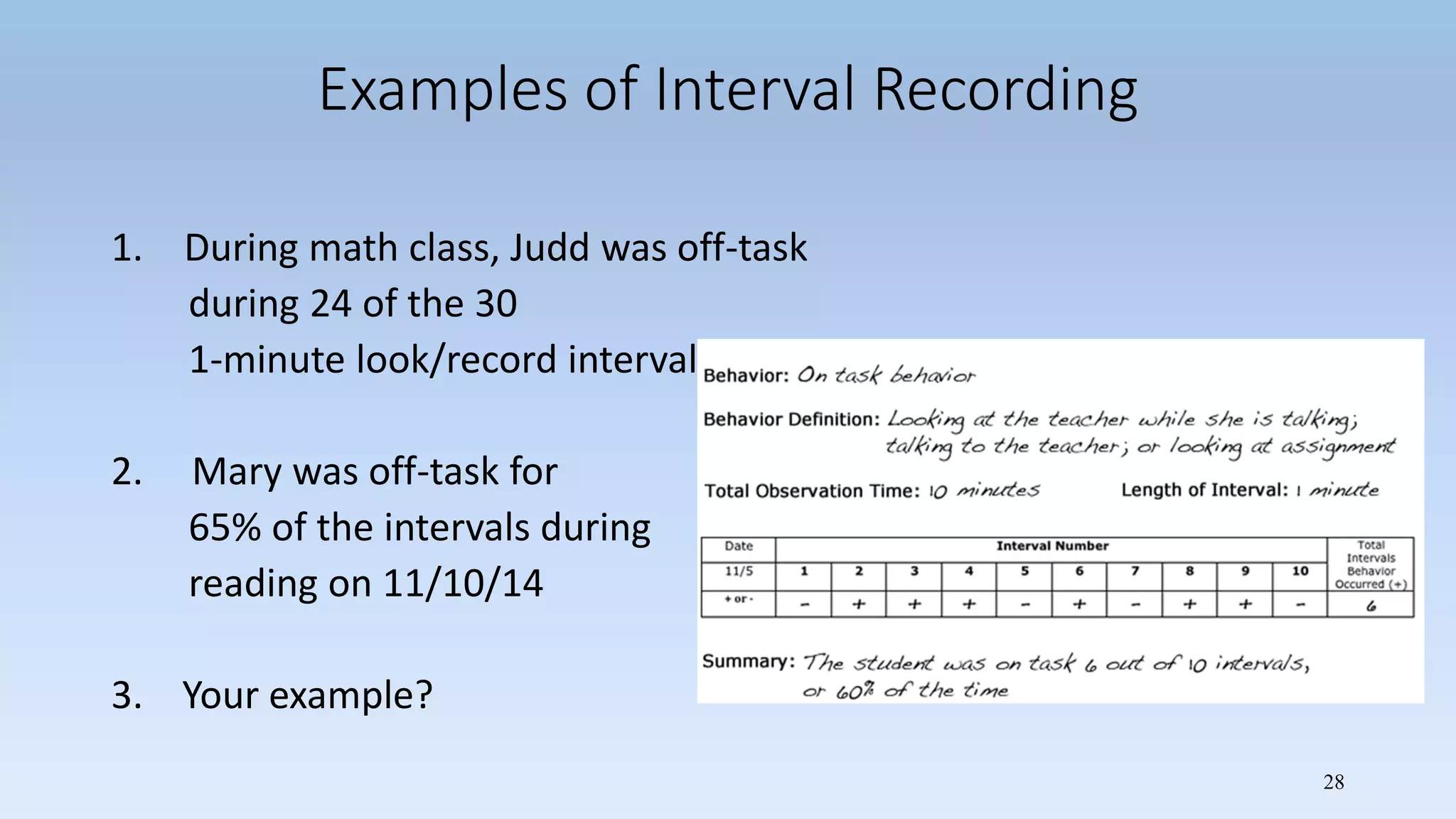
Examples of Interval Recording
1. During math class, Judd was off-task
during 24 of the 30
1-minute look/record intervals
2. Mary was off-task for
65% of the intervals during
reading on 11/10/14
3. Your example?
29
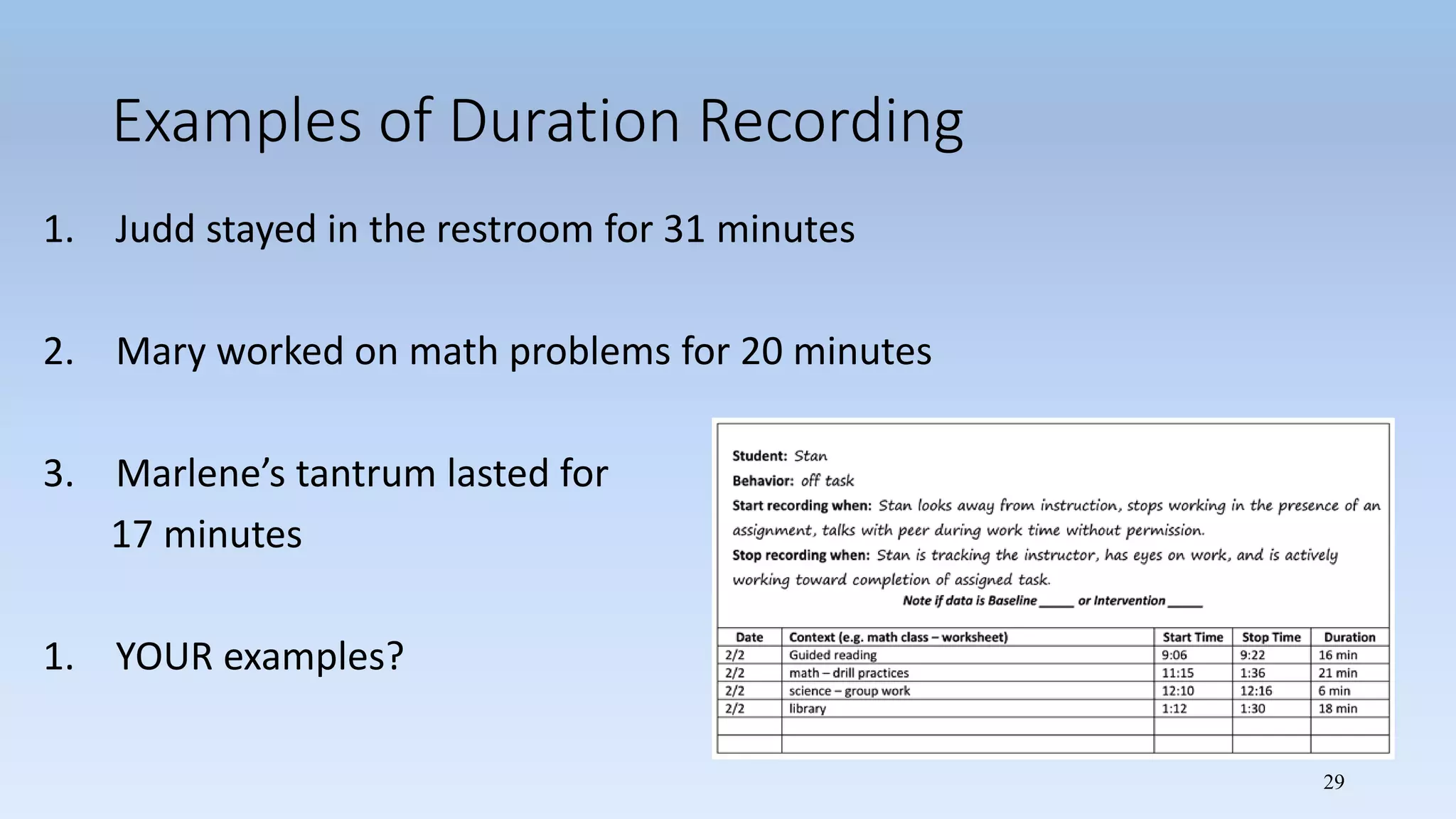
Examples of Duration Recording
1. Judd stayed in the restroom for 31 minutes
2. Mary worked on math problems for 20 minutes
3. Marlene’s tantrum lasted for
17 minutes
1. YOUR examples?
30
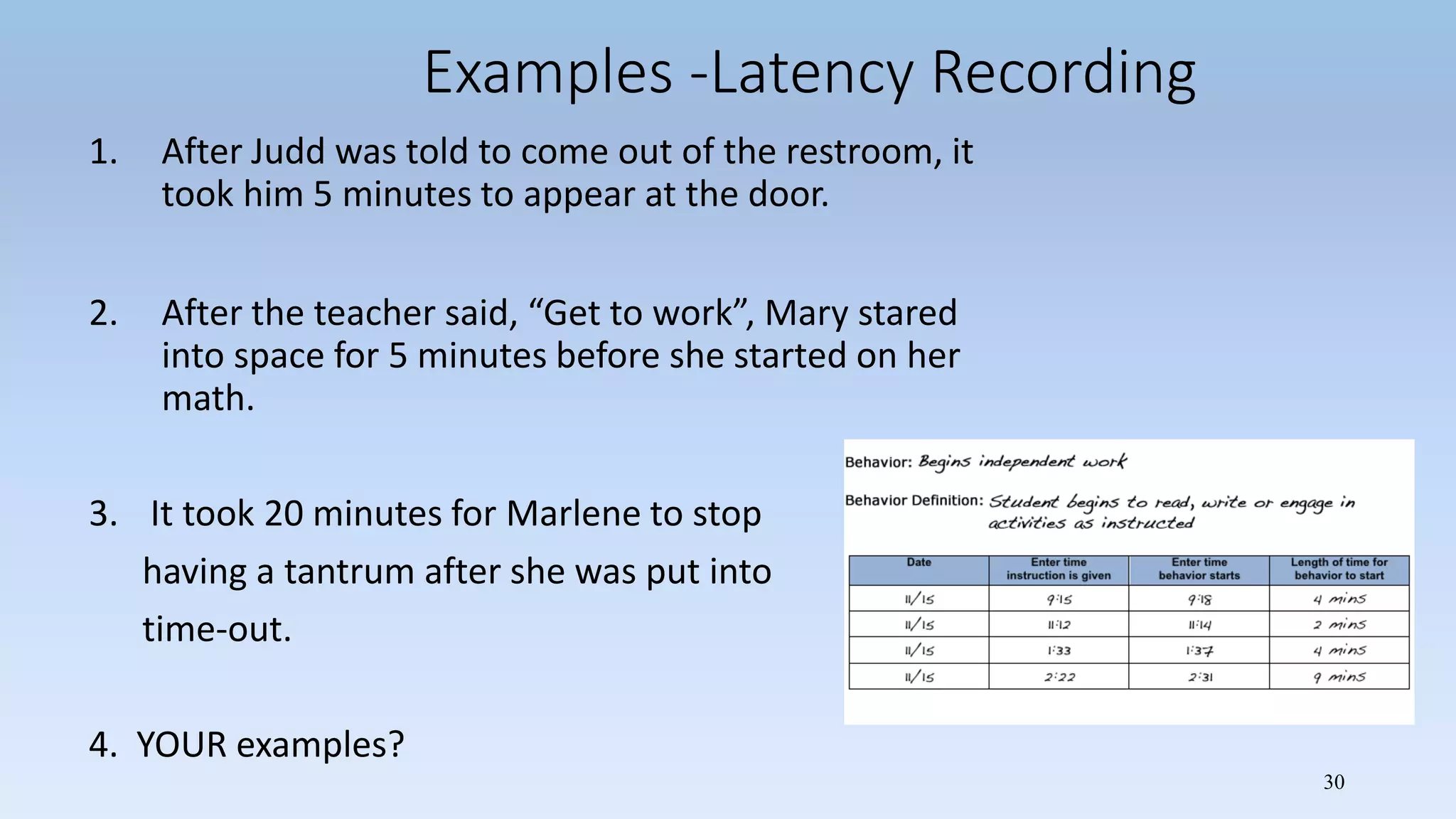
Examples -Latency Recording
1. After Judd was told to come out of the restroom, it
took him 5 minutes to appear at the door.
2. After the teacher said, “Get to work”, Mary stared
into space for 5 minutes before she started on her
math.
3. It took 20 minutes for Marlene to stop
having a tantrum after she was put into
time-out.
4. YOUR examples?
Using Technology to Obtain Data
31
Behavior Lens- app $30
https://www.youtube.com/watch?v=jfeEZ-t7FQw
Class Dojo- app FREE
https://www.youtube.com/watch?v=cpgENHYPfDs
https://www.youtube.com/watch?v=aJ0yNBcYYYI
Behavior Data Overview / Review
Finally…. A few Recording Tips
• Be sure you have clearly defined the behavior
• Be sure the recording method suits the behavior
• Be sure to record for a set time
• Calculate averages & plot the results over time in order to track the
behavior and the effect of the interventions
32
33
Thank you for
all you do…
Anything else
you can
think of ?

System of least prompts natl conf 1.5 hr 4 16

  • 1.
    System of LeastSupport: Prompting, Fading, and Data Collection Presented for the: National Conference for Paraprofessionals by: Sheri White, Ms. Ed Oak Brook, IL April, 2016 1.5 hours 1
  • 2.
    Presented by: Sheri White,Ms Ed Northwestern Illinois Association 4920 East State St. Unit 6 Rockford, IL 61108 (815)964-0937 Fax: (815)316-0640 swhite@thenia.org www.thenia.org 2
  • 3.
    Learner Outcomes • Toknow and appreciate which individual educational goals have been prioritized by the educational team for the student(s) you support. • To understand how prompting, fading, and data collection affect student growth and independence. (prompts: least to most) • To discuss the types of data to record and report. 3
  • 4.
    Prioritizing Educational Needs Asa part of a team discussion, it is helpful for each member to identify what outcomes they hope to see in the student by the end of the school year. Prioritize 1-5, 1 being the most important. 1.___________ 2.______________ 3.___________ 4.______________ 5.___________ 4
  • 5.
    Ask yourself : 1)Can the student participate independently? 2) Is there another student who can provide support? 3) If my support is required, how can I “aide, then fade” ? 4) Am I supporting this student out of need, or out of habit? Does this student truly need support at this moment or am I just in the habit of offering support in this kind of situation? 5
  • 6.
    PROMPTING Objective: To understand how prompting,fading, and data collection affect student growth and independence. When do you feel more like a mother than a para? 6
  • 7.
  • 8.
    Prompt Levels Least Assistiveto Most Assistive Verbal Gesture Model Physical Hand-over-hand (partial physical prompt) (full physical prompt) 8 Utilizing the Prompt Hierarchy to Facilitate Student Independence Use for tasks which should ultimately be done independently, fade gradually.
  • 9.
    Prompt Levels Effective useof prompts can be essential in promoting student independence. Prompts are the cures given to a student in order to direct him/her toward a desired response. Prompts may be social or environmental. Verbal: explicitly stating the behavior that needs to occur Example: “it is time to line up for recess.” Gesture: gesturing (e.g. pointing to, looking at, moving, or touching an item or area) to indicate a correct response. Example: The paraprofessional points to the visual schedule on a student’s desk to signal time for a transition. Modeling: acting out the desired behavior in order to encourage the initiation of that behavior by the student Example: The teacher sits up tall in her seat with her hands folded on top of the table as students come to a math group. She waits until they copy her behavior. Physical: manually guiding the student to make the correct response (e.g. hand-over-hand) Example: A paraprofessional physically positions Susi’s fingers on the spoon, provides a downward motion into the cereal bowl, then moves Susi’s cereal-filled spoon to her mouth. Environmental Prompts: visual stimuli (e.g. a carton of milk sitting on the counter at snack time) or auditory cues in the physical environment that direct the student to the correct response. Example: The passing bell rings, signaling to the student that it is time to transition to the next class. 9
  • 10.
    Your Turn -Prompts • Discuss with your small group the levels of prompts with which you’re familiar • Discuss what prompts are new to you • Discuss what prompts you are currently using to address behaviors/academic activities 10
  • 11.
    LEVELS OF SUPPORT •Low • Medium • High • Transitional – the most difficult job to do is to NOT do! INTRUSIVENESS Ranges from being discreet and unassuming to meddlesome, distracting, presumptuous, rude, bothersome and irritating. 11 I DO  I DO  YOU DO  YOU DO YOU WATCH YOU HELP I HELP I WATCH
  • 12.
    Low level ofsupport: This support is always available but not needed on a regular basis by the student. The student would be able to function in the environment without the support of, just not as successfully. Medium: This level of support is necessary on a regular basis in order for the student to be successful or to learn in the environment. High: High levels of support are generally intrusive in nature. The support is absolutely necessary for the student to learn and must be provided consistently. The student could not function in the environment without the support. (The more involved the disability, the higher the level of support necessary) Transitional: The amount of support (low, medium, or high) is provided TEMPORARILY to assist a student in gaining independence in new environments, activities, and/or acquisition off new concepts. Once student can maintain independence level of performance, support is no longer given. 12
  • 13.
    Less intrusive…. Don’t givesupport when it isn’t needed! 13
  • 14.
  • 15.
    The most importantthing for a paraeducator to remember is that helping a student when he or she could learn to do a task independently is what leads a student to become overly dependent on the paraeduatcator and not develop skills of dependence. 15
  • 16.
    Have you heardthis before? “Hover cover, Velcro effect” 16
  • 17.
    How do youknow when to fade the prompt or go to a less intrusive/indirect prompt? 17
  • 18.
    Fading Gradual reduction ofcues/prompts and extrinsic reinforcers as the student demonstrates the desired behavior or task. 18
  • 19.
    Intentionally plan toFADE prompts/support • Facilitate independence by VARYING the amount of support, monitoring, and prompting based on need and independent level of student. • Plan, systematically with the teacher, on when and how to fade. • Replace your support with visuals. Teach natural, environmental cues. • Aide then fade. 19
  • 20.
    Increasing Student Learning andIndependence Promote self-sufficiency by: • Resisting urge to step in and do things for them • Asking leading questions: • What’s next? • What should we do first? • What else? http://www.youtube.com/watch?v=jMwaruBi3M4 (1:18) 20
  • 21.
    Data Collection Importance/Validity Data drivesinstruction and it ultimately drives student learning. Monitoring Progress Recognizes benchmarks and opportunity to teach/reteach 21
  • 22.
    We Use DATAto…… Establish Baseline Determine Patterns???? Provide Information Compare Behavior Communication 22
  • 23.
    How will youknow what data to collect? • Team meetings • Review of IEP goals and objectives • Informal conversations with case manager and/or classroom teacher • Information provided via some written communication: * Email from teacher * Google drive * Access to teacher’s “blackboard” or district’s electronic message center * Other? 23
  • 24.
    24 DATA COLLECTION INFORMATION relating toa student for the purpose of knowing WHAT and HOW to teach the student. COLLECTING ORGANIZING INTERPRETING Process of…
  • 25.
    Formative Assessment If theteacher doesn’t expect you to help gather formative data, be sure to ask how the teacher would like you to let him or her know when the student you are working with is struggling, as it may still be part of your responsibility to provide feedback regarding specific students. 25
  • 26.
    26 Types of RecordingSystems  Frequency (is the behavior discrete? A start and a stop point)  Interval (is the behavior expected to occur at a high frequency?)  Duration (want to measure time before requested response begins?)  Latency (want to measure the time before requested response begins?)
  • 27.
    27 Examples of FrequencyRecording 1. Judd made 5 trips to the restroom 2. Mary did 11 math problems per minute 3. Marlene had 8 tantrums per week 4. YOUR examples?
  • 28.
    28 Examples of IntervalRecording 1. During math class, Judd was off-task during 24 of the 30 1-minute look/record intervals 2. Mary was off-task for 65% of the intervals during reading on 11/10/14 3. Your example?
  • 29.
    29 Examples of DurationRecording 1. Judd stayed in the restroom for 31 minutes 2. Mary worked on math problems for 20 minutes 3. Marlene’s tantrum lasted for 17 minutes 1. YOUR examples?
  • 30.
    30 Examples -Latency Recording 1.After Judd was told to come out of the restroom, it took him 5 minutes to appear at the door. 2. After the teacher said, “Get to work”, Mary stared into space for 5 minutes before she started on her math. 3. It took 20 minutes for Marlene to stop having a tantrum after she was put into time-out. 4. YOUR examples?
  • 31.
    Using Technology toObtain Data 31 Behavior Lens- app $30 https://www.youtube.com/watch?v=jfeEZ-t7FQw Class Dojo- app FREE https://www.youtube.com/watch?v=cpgENHYPfDs https://www.youtube.com/watch?v=aJ0yNBcYYYI Behavior Data Overview / Review
  • 32.
    Finally…. A fewRecording Tips • Be sure you have clearly defined the behavior • Be sure the recording method suits the behavior • Be sure to record for a set time • Calculate averages & plot the results over time in order to track the behavior and the effect of the interventions 32
  • 33.
    33 Thank you for allyou do… Anything else you can think of ?