System Development Life
Cycle (SDLC)
Day-1
Team Emertxe
Course span-out
Some fundamentals
Get the basics right
 SDLC and related areas are very critical for engineers
 Technical success v/s business success
• Building technically great product is nice
• Making them commercially successful is the key
 Standard frameworks like SDLC helps to do that
 Evolved over three decades
 Let us get our basics right!
What customer wants?
 A small game
 Need 6 volunteers
Customer need
 I want an Embedded device with 40$ price with device
performance as the key priority.
 I would like to have a NOR flash with 20 MB space with
1 MB RAM.
 User experience should be really excellent.
 I can compromise on price for performance and user
experience. Quality is a non-negotiable item
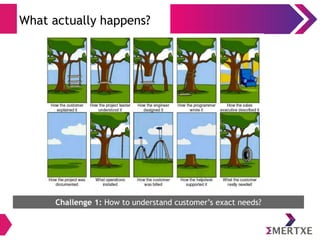
What actually happens?
Challenge 1: How to understand customer’s exact needs?
How do I deliver?
 Assuming customer challenges are understood, how to
deliver the product?
 How do I ensure:
• Quality of end product is very good
• Customer perceives quality
• Control quality in my product development
• Make it repeatable and scalable
 Often perceived as trust, brand, goodwill etc…
Challenge 2: How do I deliver a quality product?
Case studies
Outsourcing blues
 Ajay is an owner of small business, which has partnered with Arun’s
organization for re-branding
 This includes our logo, caption, digital identity, website, branding
artifacts, social media etc
 During vendor evaluation, Ajay was very happy with Arun’s
capability and awarded the project
 As time progressed Ajay observed the following:
• Consistently not keeping up with time commitments
• Delays in responding to emails, phone-calls, no-response
• Quality issues (Broken defect fixes, implementation flaws etc…)
• Behavioral problems (“you didn’t tell this before!”, “It’s your
problem”, “Why should I fix this?”, “you check this first!”)
 Ponder upon:
• What are the possibilities of problems with Arun?
• What experience Ajay is getting out of this activity?
• Would Ajay recommend Arun to his other business associates?
Key observations: Planning, Estimation, Team capability and skills
eCommerce project
 One of the newly formed company came up with idea of selling niche
products online
 They came up with an online portal which has excellent UI, e-commerce
and product listings
 During product development and testing everything worked fine
 Product was successfully launched on-time, initial customer reviews were
very positive
 Traffic to the website suddenly stared picking up for which the site
couldn’t handle. This resulted in multiple transaction failures, delays and
incorrect shipments
 This created a crisis in the organization
 Ponder upon:
• What did the company do right?
• Where did they go wrong?
• What element did they miss during product requirement gathering?
Key observations: Non-functional requirement handling (scalability, security,
regulation compliance, high-availability etc..)
Bad news
 Subbu was project manager, heading a complex system integration
project by combining many modules
 He understood the importance of making all modules working
together and created a system integration plan
 During initial days none of the modules worked well with each
other created a lot of issues
 In senior management meetings he raised it as a ‘RISK’ item and
consistently raised alarm, which initially created some confusion
 To address these issues an expert team was formed who figured
out all issues and solved the integration problem
 Product was released on time, customer was happy
 Ponder upon:
• What did Subbu do right?
• Confusion caused by Subbu initially was correct or wrong?
• What would be the side effects if Subbu didn’t raise issues on time?
Key observations: Risk raising and mitigation, Early handling, Being paranoid
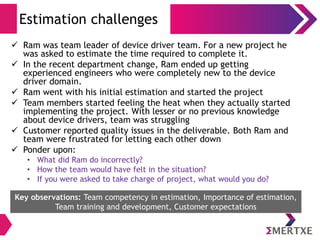
Estimation challenges
 Ram was team leader of device driver team. For a new project he
was asked to estimate the time required to complete it.
 In the recent department change, Ram ended up getting
experienced engineers who were completely new to the device
driver domain.
 Ram went with his initial estimation and started the project
 Team members started feeling the heat when they actually started
implementing the project. With lesser or no previous knowledge
about device drivers, team was struggling
 Customer reported quality issues in the deliverable. Both Ram and
team were frustrated for letting each other down
 Ponder upon:
• What did Ram do incorrectly?
• How the team would have felt in the situation?
• If you were asked to take charge of project, what would you do?
Key observations: Team competency in estimation, Importance of estimation,
Team training and development, Customer expectations
Process for Process
 Chaithra was a highly quality conscious project manager who strongly
believes in establishing strong processes. Starting from the scratch she
built quality system of her team, which delivered quality products
consistently to customers. Chaithra and her team was highly regarded as
‘champions-of-quality’.
 However over a period of time, team started introducing too many new
processes and created a “checklist-and-approval” culture. For anything
and everything it became a world of excel sheets, check-lists, and
introducing new templates.
 Senior technical and management members started enjoying this
“approval” based culture as they started enjoying the “pseudo power”
that came along with
 Over a period of time customers started observing that Chaithra’s team is
slow in delivering products
 Ponder upon:
• What was the problem with Chaithra?
• Process based approach followed by the team is correct or incorrect?
• Why the customer is feeling delay in product releases?
Key observations: Process should help team and customer, Keeping it simple,
Impact of process in team culture
Challenges in Product development
Two challenges
 How to understand customer
requirements?
 How to deliver on-time with
high quality?
Requirements
Quality & Time
Processes
Parameter Aravind Benchmark
Number of operation 400 / month 25 / month
Post infection cases 4 / 10000 patients 6 / 10000 patients
Time taken for operation 10 minutes 30 minutes
Key point: Make it as a standard, Make it repeatable and scalable
SDLC - Introduction
What is SDLC?
 System Development Life Cycle
 A conceptual model used in project management
 Describes the stages involved, from an initial
feasibility study through maintenance
Why SDLC?
 To have a successful system
 To execute large projects
 To understand customer requirements
 To deliver on-time with high quality
 Process framework
Failures
 Schedule slippage
• No planning of development work (e.g. no milestones
defined)
• No control or review
 Cost over-runs
• Poor understanding of cost and effort by both developer
and user
 Does not solve user’s problem
• Deliverables to user not identified
• Poor understanding of user requirements
 Poor quality of software
• Technical incompetence of developers
 Poor maintainability
Success
 Taking an “engineering” approach - To design,
develop (build, fabricate) an artefact that meets
specifications efficiently, cost-effectively and
ensuring quality
 That comes from:
• Attempt to estimate cost/effort
• Plan and schedule work
• Involve user in defining requirements
• Identify stages in development
• Define clear milestones so that progress can be measured
• Schedule reviews both for control and quality
• Define deliverables
• Plan extensive testing
Process
 Process consists of activities/steps to be carried out in
a particular order
 Software process deals with both technical and
management issues
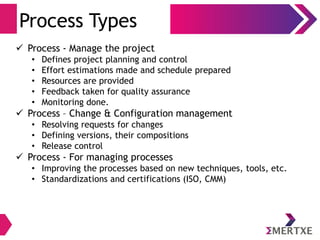
Process Types
 Process - Manage the project
• Defines project planning and control
• Effort estimations made and schedule prepared
• Resources are provided
• Feedback taken for quality assurance
• Monitoring done.
 Process – Change & Configuration management
• Resolving requests for changes
• Defining versions, their compositions
• Release control
 Process - For managing processes
• Improving the processes based on new techniques, tools, etc.
• Standardizations and certifications (ISO, CMM)
Steps in process
 Each step has a well-defined objective
 Requires people with specific skills
 Takes specific inputs and produces well-defined outputs
 Step defines when it may begin (entry criteria) and
when it ends (exit criteria)
 Uses specific techniques, tools, guidelines,
conventions.
Characteristics
 Precisely defined
 Predictable
 Quality
 Statistically controlled
 Supports testing and maintainability
 Facilitates early detection of and removal of defects
 Facilitate monitoring and improvement
SDLC - Phases
Initiation
 Is this project worth doing?
 Defining the project scope
 Key deliverable is a
feasibility report
Concept Development
 Feasibility Study (will it
work?)
 Identify system interfaces.
 Identify basic functional and
data requirements to satisfy
the business need.
 Cost/Benefit Analysis (is the
cost really worth it?)
 System Boundary (how far
should the project go?)
 Risk Management (what will
happen if we don't do it?)
Planning
 During this phase, a plan is
developed that documents
the approach to be used
 It includes a discussion of
methods, tools, tasks,
resources, project
schedules, and user input.
 Personnel assignments,
costs, project schedule,
and target dates are
established.
 A Project Management
Plan is created
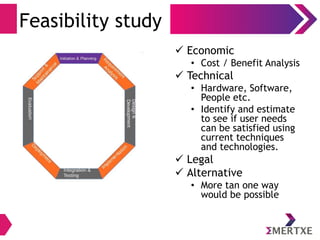
Feasibility study
 Economic
• Cost / Benefit Analysis
 Technical
• Hardware, Software,
People etc.
• Identify and estimate
to see if user needs
can be satisfied using
current techniques
and technologies.
 Legal
 Alternative
• More tan one way
would be possible
Requirement Analysis
 Define the client’s
requirements
 Further define and refine the
functional and data
requirements and document
them in the Requirements
Document.
 Develop detailed data and
process models including
system inputs and outputs.
 Develop the test and
evaluation requirements that
will be used to determine
acceptable system
performance.
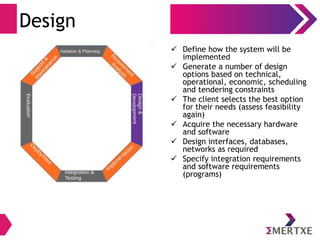
Design
 Define how the system will be
implemented
 Generate a number of design
options based on technical,
operational, economic, scheduling
and tendering constraints
 The client selects the best option
for their needs (assess feasibility
again)
 Acquire the necessary hardware
and software
 Design interfaces, databases,
networks as required
 Specify integration requirements
and software requirements
(programs)
Implementation
 Build and deliver the system
 Build/modify databases and
networks as required
 Build and test programs
• Acceptance testing, user
documentation, user
training, maintenance
procedures
 Prepare users for new system
 Finalize system and technical
documentation
 Install the system
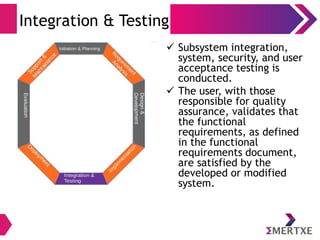
Integration & Testing
 Subsystem integration,
system, security, and user
acceptance testing is
conducted.
 The user, with those
responsible for quality
assurance, validates that
the functional
requirements, as defined
in the functional
requirements document,
are satisfied by the
developed or modified
system.
Deployment
 This phase is initiated after the
system has been tested and
accepted by the user.
 The system is installed to
support the intended business
functions.
 System performance is
compared to performance
objectives established during
the planning phase.
 Implementation includes user
notification, user training,
installation of hardware,
installation of software onto
production computers, and
integration of the system into
daily work processes.
Evaluation
 Evaluation measures how
well the original ambitions
of the new system (i.e. the
logical design laid down
during the analysis phase)
have been achieved.
 Evaluation doesn't really
serve to improve the
system that is being
evaluated; it serves to
improve the next system
you will work on
Evaluation
 Typical evaluation criteria include:
• Speed
• Accuracy
• Quality of output
• Reliability
• Cost of operation
• Attractiveness
• Ease of use
• Robustness
• Capacity
• Compatibility with other systems
• Functionality (does it have the features it needs?)
• Security
• Flexibility (can it be upgraded, modified, adapted, tweaked,
configured?)
• Size, portability
Support & Maintenance
 Corrective - fix errors
 Adaptive - satisfy
changing needs
 Perfective - enhance
performance
 Preventative - fix
potential problems
Templates overview
Stay connected
About us: Emertxe is India’s one of the top IT finishing schools & self learning kits
provider. Our primary focus is on Embedded with diversification focus on Java,
Oracle and Android areas
Emertxe Information Technologies,
No-1, 9th Cross, 5th Main,
Jayamahal Extension,
Bangalore, Karnataka 560046
T: +91 80 6562 9666
E: training@emertxe.com
https://www.facebook.com/Emertxe https://twitter.com/EmertxeTweet https://www.slideshare.net/EmertxeSlides
THANK YOU

System Development Life Cycle (SDLC) - Part I

  • 1.
    System Development Life Cycle(SDLC) Day-1 Team Emertxe
  • 2.
  • 3.
  • 4.
    Get the basicsright  SDLC and related areas are very critical for engineers  Technical success v/s business success • Building technically great product is nice • Making them commercially successful is the key  Standard frameworks like SDLC helps to do that  Evolved over three decades  Let us get our basics right!
  • 5.
    What customer wants? A small game  Need 6 volunteers
  • 6.
    Customer need  Iwant an Embedded device with 40$ price with device performance as the key priority.  I would like to have a NOR flash with 20 MB space with 1 MB RAM.  User experience should be really excellent.  I can compromise on price for performance and user experience. Quality is a non-negotiable item
  • 7.
    What actually happens? Challenge1: How to understand customer’s exact needs?
  • 8.
    How do Ideliver?  Assuming customer challenges are understood, how to deliver the product?  How do I ensure: • Quality of end product is very good • Customer perceives quality • Control quality in my product development • Make it repeatable and scalable  Often perceived as trust, brand, goodwill etc… Challenge 2: How do I deliver a quality product?
  • 9.
  • 10.
    Outsourcing blues  Ajayis an owner of small business, which has partnered with Arun’s organization for re-branding  This includes our logo, caption, digital identity, website, branding artifacts, social media etc  During vendor evaluation, Ajay was very happy with Arun’s capability and awarded the project  As time progressed Ajay observed the following: • Consistently not keeping up with time commitments • Delays in responding to emails, phone-calls, no-response • Quality issues (Broken defect fixes, implementation flaws etc…) • Behavioral problems (“you didn’t tell this before!”, “It’s your problem”, “Why should I fix this?”, “you check this first!”)  Ponder upon: • What are the possibilities of problems with Arun? • What experience Ajay is getting out of this activity? • Would Ajay recommend Arun to his other business associates? Key observations: Planning, Estimation, Team capability and skills
  • 11.
    eCommerce project  Oneof the newly formed company came up with idea of selling niche products online  They came up with an online portal which has excellent UI, e-commerce and product listings  During product development and testing everything worked fine  Product was successfully launched on-time, initial customer reviews were very positive  Traffic to the website suddenly stared picking up for which the site couldn’t handle. This resulted in multiple transaction failures, delays and incorrect shipments  This created a crisis in the organization  Ponder upon: • What did the company do right? • Where did they go wrong? • What element did they miss during product requirement gathering? Key observations: Non-functional requirement handling (scalability, security, regulation compliance, high-availability etc..)
  • 12.
    Bad news  Subbuwas project manager, heading a complex system integration project by combining many modules  He understood the importance of making all modules working together and created a system integration plan  During initial days none of the modules worked well with each other created a lot of issues  In senior management meetings he raised it as a ‘RISK’ item and consistently raised alarm, which initially created some confusion  To address these issues an expert team was formed who figured out all issues and solved the integration problem  Product was released on time, customer was happy  Ponder upon: • What did Subbu do right? • Confusion caused by Subbu initially was correct or wrong? • What would be the side effects if Subbu didn’t raise issues on time? Key observations: Risk raising and mitigation, Early handling, Being paranoid
  • 13.
    Estimation challenges  Ramwas team leader of device driver team. For a new project he was asked to estimate the time required to complete it.  In the recent department change, Ram ended up getting experienced engineers who were completely new to the device driver domain.  Ram went with his initial estimation and started the project  Team members started feeling the heat when they actually started implementing the project. With lesser or no previous knowledge about device drivers, team was struggling  Customer reported quality issues in the deliverable. Both Ram and team were frustrated for letting each other down  Ponder upon: • What did Ram do incorrectly? • How the team would have felt in the situation? • If you were asked to take charge of project, what would you do? Key observations: Team competency in estimation, Importance of estimation, Team training and development, Customer expectations
  • 14.
    Process for Process Chaithra was a highly quality conscious project manager who strongly believes in establishing strong processes. Starting from the scratch she built quality system of her team, which delivered quality products consistently to customers. Chaithra and her team was highly regarded as ‘champions-of-quality’.  However over a period of time, team started introducing too many new processes and created a “checklist-and-approval” culture. For anything and everything it became a world of excel sheets, check-lists, and introducing new templates.  Senior technical and management members started enjoying this “approval” based culture as they started enjoying the “pseudo power” that came along with  Over a period of time customers started observing that Chaithra’s team is slow in delivering products  Ponder upon: • What was the problem with Chaithra? • Process based approach followed by the team is correct or incorrect? • Why the customer is feeling delay in product releases? Key observations: Process should help team and customer, Keeping it simple, Impact of process in team culture
  • 15.
  • 16.
    Two challenges  Howto understand customer requirements?  How to deliver on-time with high quality?
  • 17.
  • 18.
  • 19.
    Processes Parameter Aravind Benchmark Numberof operation 400 / month 25 / month Post infection cases 4 / 10000 patients 6 / 10000 patients Time taken for operation 10 minutes 30 minutes Key point: Make it as a standard, Make it repeatable and scalable
  • 20.
  • 21.
    What is SDLC? System Development Life Cycle  A conceptual model used in project management  Describes the stages involved, from an initial feasibility study through maintenance
  • 22.
    Why SDLC?  Tohave a successful system  To execute large projects  To understand customer requirements  To deliver on-time with high quality  Process framework
  • 23.
    Failures  Schedule slippage •No planning of development work (e.g. no milestones defined) • No control or review  Cost over-runs • Poor understanding of cost and effort by both developer and user  Does not solve user’s problem • Deliverables to user not identified • Poor understanding of user requirements  Poor quality of software • Technical incompetence of developers  Poor maintainability
  • 24.
    Success  Taking an“engineering” approach - To design, develop (build, fabricate) an artefact that meets specifications efficiently, cost-effectively and ensuring quality  That comes from: • Attempt to estimate cost/effort • Plan and schedule work • Involve user in defining requirements • Identify stages in development • Define clear milestones so that progress can be measured • Schedule reviews both for control and quality • Define deliverables • Plan extensive testing
  • 25.
    Process  Process consistsof activities/steps to be carried out in a particular order  Software process deals with both technical and management issues
  • 26.
    Process Types  Process- Manage the project • Defines project planning and control • Effort estimations made and schedule prepared • Resources are provided • Feedback taken for quality assurance • Monitoring done.  Process – Change & Configuration management • Resolving requests for changes • Defining versions, their compositions • Release control  Process - For managing processes • Improving the processes based on new techniques, tools, etc. • Standardizations and certifications (ISO, CMM)
  • 27.
    Steps in process Each step has a well-defined objective  Requires people with specific skills  Takes specific inputs and produces well-defined outputs  Step defines when it may begin (entry criteria) and when it ends (exit criteria)  Uses specific techniques, tools, guidelines, conventions.
  • 28.
    Characteristics  Precisely defined Predictable  Quality  Statistically controlled  Supports testing and maintainability  Facilitates early detection of and removal of defects  Facilitate monitoring and improvement
  • 29.
  • 30.
    Initiation  Is thisproject worth doing?  Defining the project scope  Key deliverable is a feasibility report
  • 31.
    Concept Development  FeasibilityStudy (will it work?)  Identify system interfaces.  Identify basic functional and data requirements to satisfy the business need.  Cost/Benefit Analysis (is the cost really worth it?)  System Boundary (how far should the project go?)  Risk Management (what will happen if we don't do it?)
  • 32.
    Planning  During thisphase, a plan is developed that documents the approach to be used  It includes a discussion of methods, tools, tasks, resources, project schedules, and user input.  Personnel assignments, costs, project schedule, and target dates are established.  A Project Management Plan is created
  • 33.
    Feasibility study  Economic •Cost / Benefit Analysis  Technical • Hardware, Software, People etc. • Identify and estimate to see if user needs can be satisfied using current techniques and technologies.  Legal  Alternative • More tan one way would be possible
  • 34.
    Requirement Analysis  Definethe client’s requirements  Further define and refine the functional and data requirements and document them in the Requirements Document.  Develop detailed data and process models including system inputs and outputs.  Develop the test and evaluation requirements that will be used to determine acceptable system performance.
  • 35.
    Design  Define howthe system will be implemented  Generate a number of design options based on technical, operational, economic, scheduling and tendering constraints  The client selects the best option for their needs (assess feasibility again)  Acquire the necessary hardware and software  Design interfaces, databases, networks as required  Specify integration requirements and software requirements (programs)
  • 36.
    Implementation  Build anddeliver the system  Build/modify databases and networks as required  Build and test programs • Acceptance testing, user documentation, user training, maintenance procedures  Prepare users for new system  Finalize system and technical documentation  Install the system
  • 37.
    Integration & Testing Subsystem integration, system, security, and user acceptance testing is conducted.  The user, with those responsible for quality assurance, validates that the functional requirements, as defined in the functional requirements document, are satisfied by the developed or modified system.
  • 38.
    Deployment  This phaseis initiated after the system has been tested and accepted by the user.  The system is installed to support the intended business functions.  System performance is compared to performance objectives established during the planning phase.  Implementation includes user notification, user training, installation of hardware, installation of software onto production computers, and integration of the system into daily work processes.
  • 39.
    Evaluation  Evaluation measureshow well the original ambitions of the new system (i.e. the logical design laid down during the analysis phase) have been achieved.  Evaluation doesn't really serve to improve the system that is being evaluated; it serves to improve the next system you will work on
  • 40.
    Evaluation  Typical evaluationcriteria include: • Speed • Accuracy • Quality of output • Reliability • Cost of operation • Attractiveness • Ease of use • Robustness • Capacity • Compatibility with other systems • Functionality (does it have the features it needs?) • Security • Flexibility (can it be upgraded, modified, adapted, tweaked, configured?) • Size, portability
  • 41.
    Support & Maintenance Corrective - fix errors  Adaptive - satisfy changing needs  Perfective - enhance performance  Preventative - fix potential problems
  • 42.
  • 43.
    Stay connected About us:Emertxe is India’s one of the top IT finishing schools & self learning kits provider. Our primary focus is on Embedded with diversification focus on Java, Oracle and Android areas Emertxe Information Technologies, No-1, 9th Cross, 5th Main, Jayamahal Extension, Bangalore, Karnataka 560046 T: +91 80 6562 9666 E: training@emertxe.com https://www.facebook.com/Emertxe https://twitter.com/EmertxeTweet https://www.slideshare.net/EmertxeSlides
  • 44.