

Applying Quality to the Project and Product
Management Process
Jim Grundner – Vice President Software Development– Fidelity Investments
NC Project Management Institute
October 10, 2013
Why Quality?
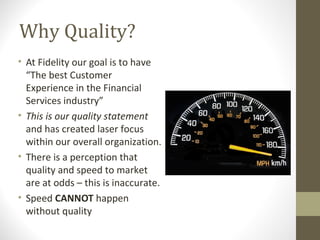
• At Fidelity our goal is to have
“The best Customer
Experience in the Financial
Services industry”
• This is our quality statement
and has created laser focus
within our overall organization.
• There is a perception that
quality and speed to market
are at odds – this is inaccurate.
• Speed CANNOT happen
without quality
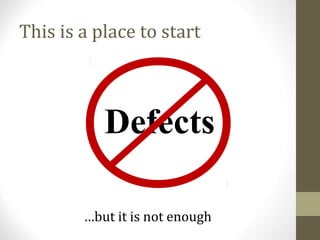
This is a place to start
Defects
…but it is not enough
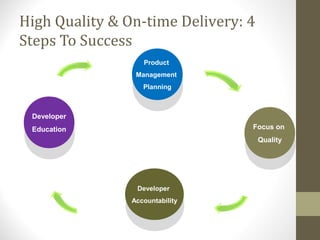
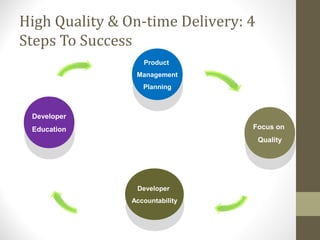
High Quality & On-time Delivery: 4
Steps To Success
Developer
Accountability
Developer
Accountability
Focus on
Quality
Focus on
Quality
Product
Management
Planning
Product
Management
Planning
Developer
Education
Developer
Education
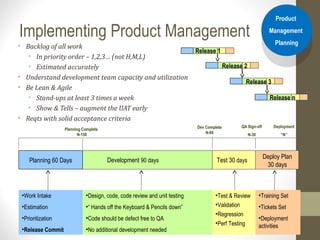
Implementing Product Management
• Backlog of all work
• In priority order – 1,2,3… (not H,M,L)
• Estimated accurately
• Understand development team capacity and utilization
• Be Lean & Agile
• Stand-ups at least 3 times a week
• Show & Tells – augment the UAT early
• Reqts with solid acceptance criteria
QA Sign-off
N-30
Dev Complete
N-60
Deployment
“N”
•Design, code, code review and unit testing
•“ Hands off the Keyboard & Pencils down”
•Code should be defect free to QA
•No additional development needed
Planning 60 Days Development 90 days Test 30 days
Deploy Plan
30 days
•Work Intake
•Estimation
•Prioritization
•Release Commit
•Test & Review
•Validation
•Regression
•Perf Testing
•Training Set
•Tickets Set
•Deployment
activities
Planning Complete
N-150
Product
Management
Planning
Product
Management
Planning
Release 1
Release 2
Release 3
Release n
Quality
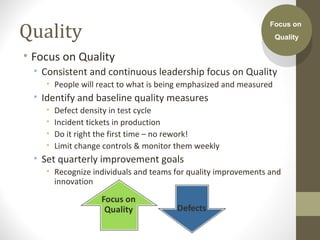
• Focus on Quality
• Consistent and continuous leadership focus on Quality
• People will react to what is being emphasized and measured
• Identify and baseline quality measures
• Defect density in test cycle
• Incident tickets in production
• Do it right the first time – no rework!
• Limit change controls & monitor them weekly
• Set quarterly improvement goals
• Recognize individuals and teams for quality improvements and
innovation
Focus on
Quality
Focus on
Quality
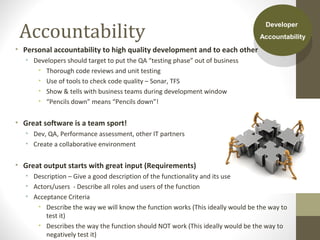
Accountability
• Personal accountability to high quality development and to each other
• Developers should target to put the QA “testing phase” out of business
• Thorough code reviews and unit testing
• Use of tools to check code quality – Sonar, TFS
• Show & tells with business teams during development window
• “Pencils down” means “Pencils down”!
• Great software is a team sport!
• Dev, QA, Performance assessment, other IT partners
• Create a collaborative environment
• Great output starts with great input (Requirements)
• Description – Give a good description of the functionality and its use
• Actors/users - Describe all roles and users of the function
• Acceptance Criteria
• Describe the way we will know the function works (This ideally would be the way to
test it)
• Describes the way the function should NOT work (This ideally would be the way to
negatively test it)
Developer
Accountability
Developer
Accountability
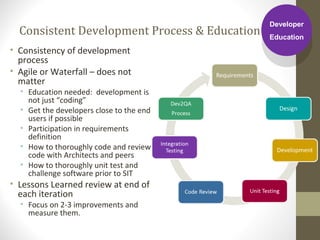
Consistent Development Process & Education
• Consistency of development
process
• Agile or Waterfall – does not
matter
• Education needed: development is
not just “coding”
• Get the developers close to the end
users if possible
• Participation in requirements
definition
• How to thoroughly code and review
code with Architects and peers
• How to thoroughly unit test and
challenge software prior to SIT
• Lessons Learned review at end of
each iteration
• Focus on 2-3 improvements and
measure them.
Developer
Education
Developer
Education
High Quality & On-time Delivery: 4
Steps To Success
Developer
Accountability
Developer
Accountability
Focus on
Quality
Focus on
Quality
Product
Management
Planning
Product
Management
Planning
Developer
Education
Developer
Education
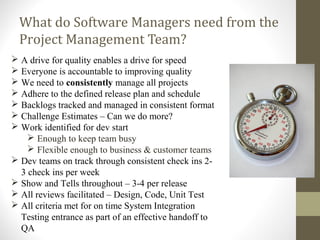
What do Software Managers need from the
Project Management Team?
FidelityInternal
 A drive for quality enables a drive for speed
 Everyone is accountable to improving quality
 We need to consistently manage all projects
 Adhere to the defined release plan and schedule
 Backlogs tracked and managed in consistent format
 Challenge Estimates – Can we do more?
 Work identified for dev start
 Enough to keep team busy
 Flexible enough to business & customer teams
 Dev teams on track through consistent check ins 2-
3 check ins per week
 Show and Tells throughout – 3-4 per release
 All reviews facilitated – Design, Code, Unit Test
 All criteria met for on time System Integration
Testing entrance as part of an effective handoff to
QA
Here is what we should
expect
• Quality improvement
• Process consistency leads to “muscle memory”
• Teams execute better when repeating the same approach
over and over
• Creativity is focused on the product, not the process
• Faster delivery
• Productivity gains based on elimination of rework
• Defined delivery dates take the guess work out of planning
• Consistent on time delivery
• Repeatable, reliable delivery
Questions, comments or
thoughts?

Applying Quality to the Project and Product Management Process

  • 1.
    Applying Quality tothe Project and Product Management Process Jim Grundner – Vice President Software Development– Fidelity Investments NC Project Management Institute October 10, 2013
  • 2.
    Why Quality? • AtFidelity our goal is to have “The best Customer Experience in the Financial Services industry” • This is our quality statement and has created laser focus within our overall organization. • There is a perception that quality and speed to market are at odds – this is inaccurate. • Speed CANNOT happen without quality
  • 3.
    This is aplace to start Defects …but it is not enough
  • 4.
    High Quality &On-time Delivery: 4 Steps To Success Developer Accountability Developer Accountability Focus on Quality Focus on Quality Product Management Planning Product Management Planning Developer Education Developer Education
  • 5.
    Implementing Product Management •Backlog of all work • In priority order – 1,2,3… (not H,M,L) • Estimated accurately • Understand development team capacity and utilization • Be Lean & Agile • Stand-ups at least 3 times a week • Show & Tells – augment the UAT early • Reqts with solid acceptance criteria QA Sign-off N-30 Dev Complete N-60 Deployment “N” •Design, code, code review and unit testing •“ Hands off the Keyboard & Pencils down” •Code should be defect free to QA •No additional development needed Planning 60 Days Development 90 days Test 30 days Deploy Plan 30 days •Work Intake •Estimation •Prioritization •Release Commit •Test & Review •Validation •Regression •Perf Testing •Training Set •Tickets Set •Deployment activities Planning Complete N-150 Product Management Planning Product Management Planning Release 1 Release 2 Release 3 Release n
  • 6.
    Quality • Focus onQuality • Consistent and continuous leadership focus on Quality • People will react to what is being emphasized and measured • Identify and baseline quality measures • Defect density in test cycle • Incident tickets in production • Do it right the first time – no rework! • Limit change controls & monitor them weekly • Set quarterly improvement goals • Recognize individuals and teams for quality improvements and innovation Focus on Quality Focus on Quality
  • 7.
    Accountability • Personal accountabilityto high quality development and to each other • Developers should target to put the QA “testing phase” out of business • Thorough code reviews and unit testing • Use of tools to check code quality – Sonar, TFS • Show & tells with business teams during development window • “Pencils down” means “Pencils down”! • Great software is a team sport! • Dev, QA, Performance assessment, other IT partners • Create a collaborative environment • Great output starts with great input (Requirements) • Description – Give a good description of the functionality and its use • Actors/users - Describe all roles and users of the function • Acceptance Criteria • Describe the way we will know the function works (This ideally would be the way to test it) • Describes the way the function should NOT work (This ideally would be the way to negatively test it) Developer Accountability Developer Accountability
  • 8.
    Consistent Development Process& Education • Consistency of development process • Agile or Waterfall – does not matter • Education needed: development is not just “coding” • Get the developers close to the end users if possible • Participation in requirements definition • How to thoroughly code and review code with Architects and peers • How to thoroughly unit test and challenge software prior to SIT • Lessons Learned review at end of each iteration • Focus on 2-3 improvements and measure them. Developer Education Developer Education
  • 9.
    High Quality &On-time Delivery: 4 Steps To Success Developer Accountability Developer Accountability Focus on Quality Focus on Quality Product Management Planning Product Management Planning Developer Education Developer Education
  • 10.
    What do SoftwareManagers need from the Project Management Team? FidelityInternal  A drive for quality enables a drive for speed  Everyone is accountable to improving quality  We need to consistently manage all projects  Adhere to the defined release plan and schedule  Backlogs tracked and managed in consistent format  Challenge Estimates – Can we do more?  Work identified for dev start  Enough to keep team busy  Flexible enough to business & customer teams  Dev teams on track through consistent check ins 2- 3 check ins per week  Show and Tells throughout – 3-4 per release  All reviews facilitated – Design, Code, Unit Test  All criteria met for on time System Integration Testing entrance as part of an effective handoff to QA
  • 11.
    Here is whatwe should expect • Quality improvement • Process consistency leads to “muscle memory” • Teams execute better when repeating the same approach over and over • Creativity is focused on the product, not the process • Faster delivery • Productivity gains based on elimination of rework • Defined delivery dates take the guess work out of planning • Consistent on time delivery • Repeatable, reliable delivery
  • 12.