



Muhammad Hamza
Roll No : 1227
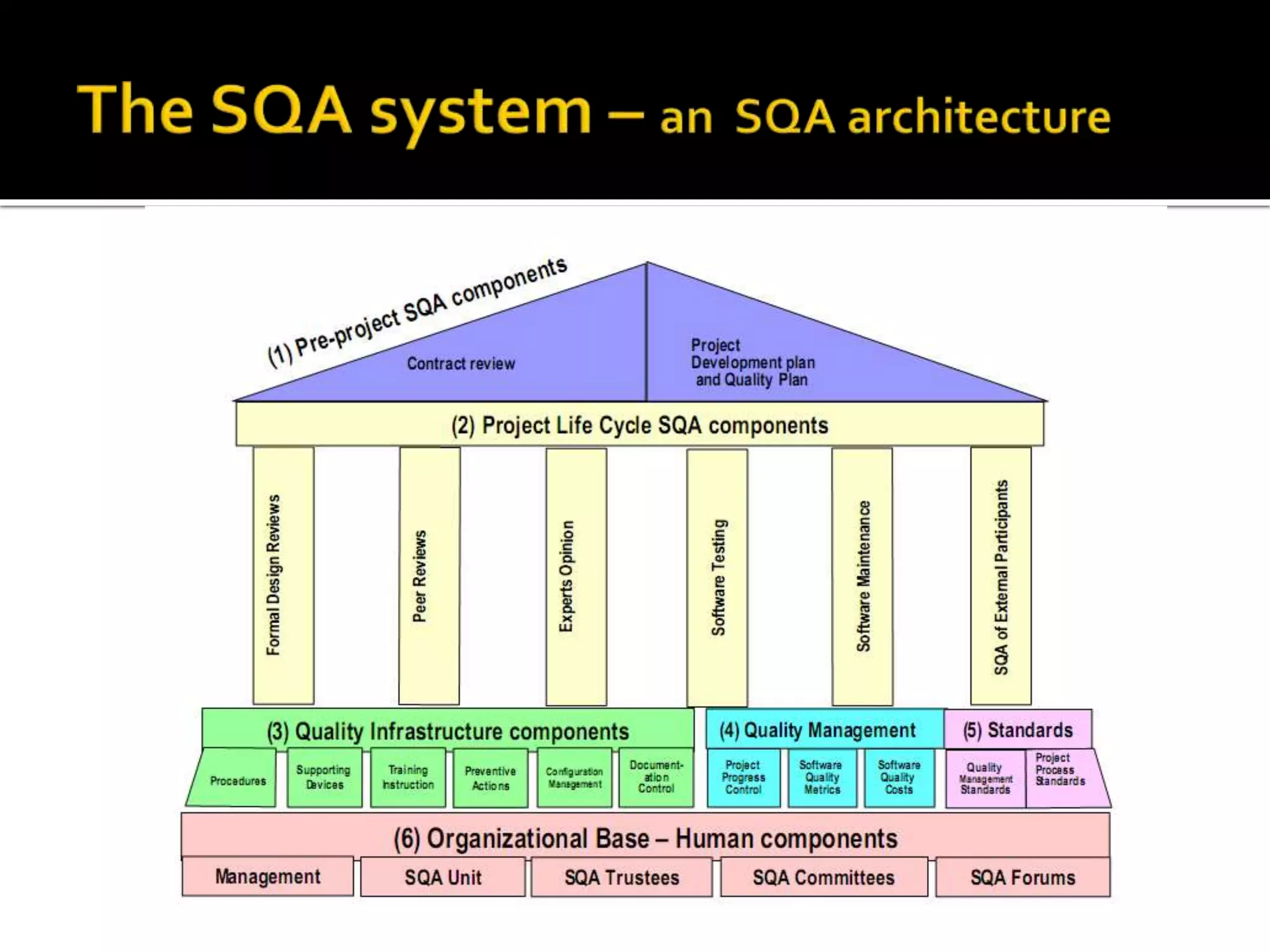
 SQA system components can be classified
into six classes:
 Pre-project quality components
 Project life cycle components
 Infrastructure error preventive and improvement
components
 Software quality management components
 Standardization, certification and SQA assessment
components
 Organizing for SQA – the human components
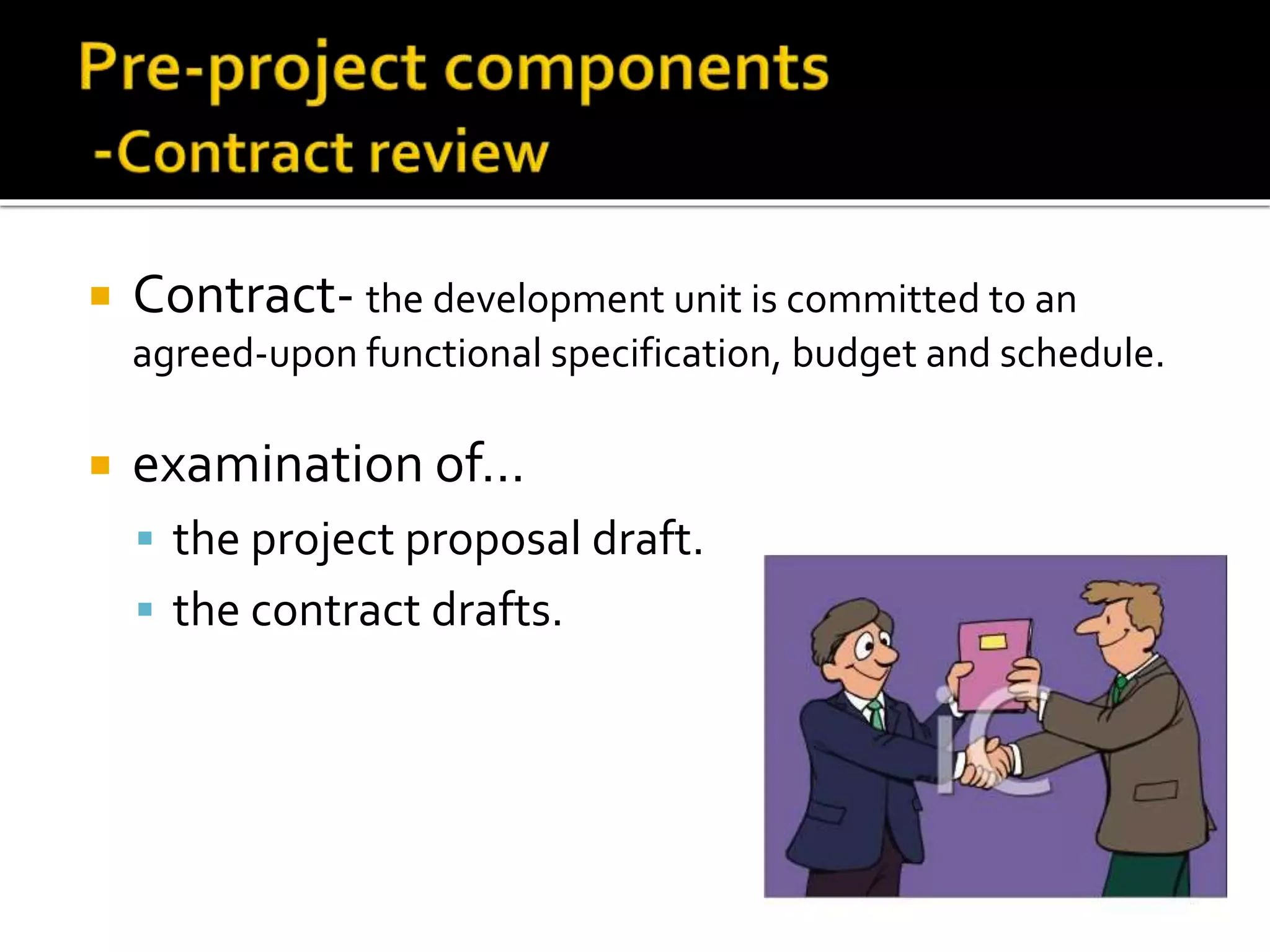
 Contract- the development unit is committed to an
agreed-upon functional specification, budget and schedule.
 examination of…
 the project proposal draft.
 the contract drafts.
 Clarification of the customer’s requirements
 Review of the project’s schedule and resource
requirement estimates
 Evaluation of the professional staff’s capacity
to carry out the proposed project
 Evaluation of the customer’s capacity to fulfill
his obligations
 Evaluation of development risks.
 a plan is prepared of the project (“development
plan”) and its integrated quality assurance
activities (“quality plan”).These plans include
additional details and needed revisions based on
prior plans that provided the basis for the
current proposal and contract.
 It is quite common for several months to pass
between the tender submission and the signing
of the contract.
 Schedules
 Required manpower and hardware resources
 Risk evaluations
 Organizational issues: team members,
subcontractors and partnerships
 Project methodology, development tools,
etc.
 Software reuse plans.
 Quality goals, expressed in the appropriate
measurable terms
 Criteria for starting and ending each project
stage
 Lists of reviews, tests, and other scheduled
verification and validation activities.
Hafiz Muhaamad Junaid
Roll No: 1197
 Reviews
 Expert opinions
 Software testing
 Software maintenance
 Assurance of the quality of the subcontractors’
work and the customer supplied parts.
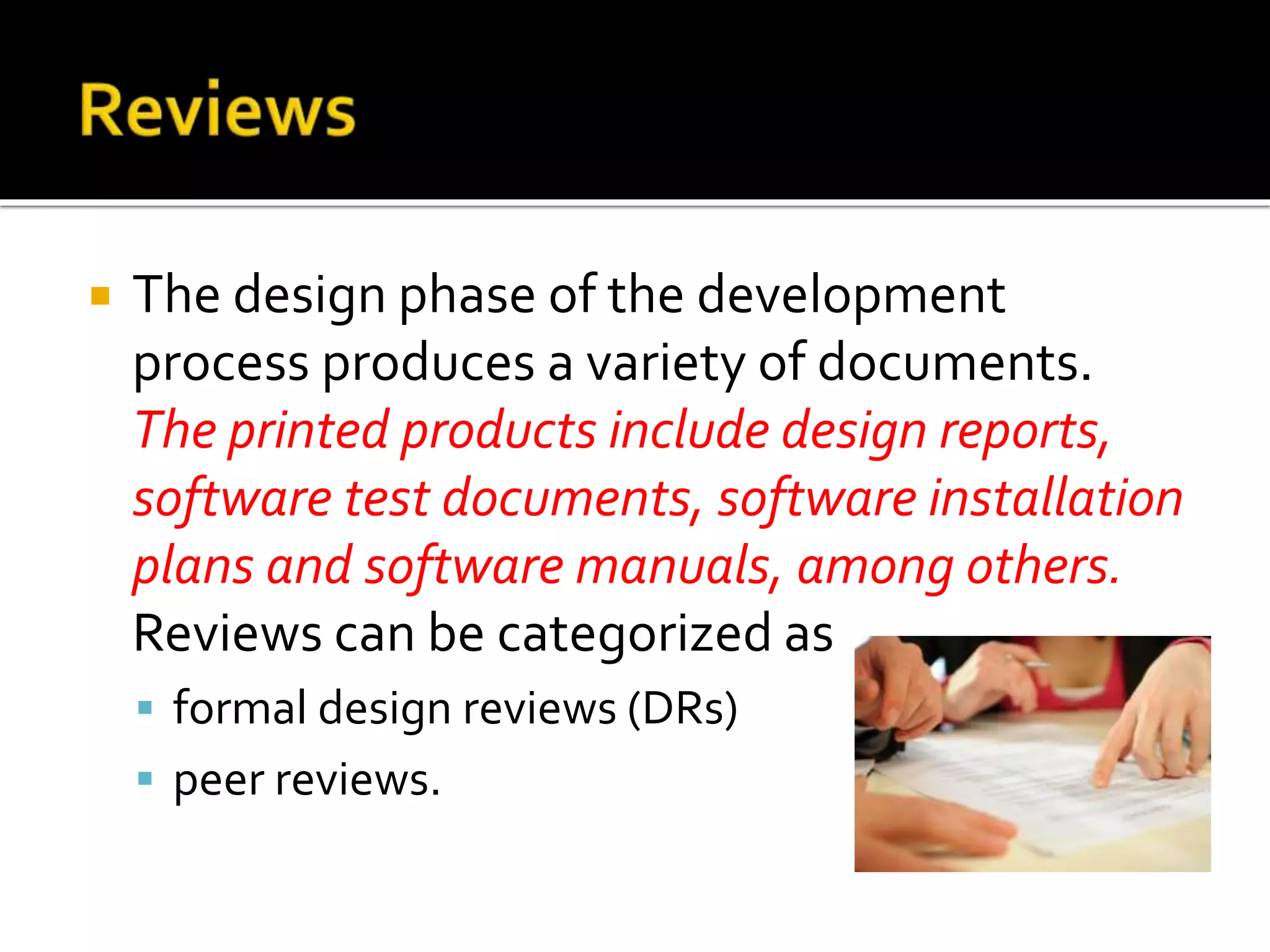
 The design phase of the development
process produces a variety of documents.
The printed products include design reports,
software test documents, software installation
plans and software manuals, among others.
Reviews can be categorized as
 formal design reviews (DRs)
 peer reviews.
 The committees are composed of senior
professionals, including the project leader
and, usually, the department manager, the
chief software engineer, and heads of other
related departments.
 The DR report itself includes a list of required
corrections (termed “action items”).
 When a design review committee sits in order to decide
upon the continuation of the work completed so far, one
of the following options is usually open for
consideration:
 Immediate approval of the DR document and continuation to
the next development phase.
 Approval to proceed to the next development phase after all
the action items have been completed and inspected by the
committee’s representative.
 An additional DR is required and scheduled to take place after
all the action items have been completed and inspected by the
committee’s representative.
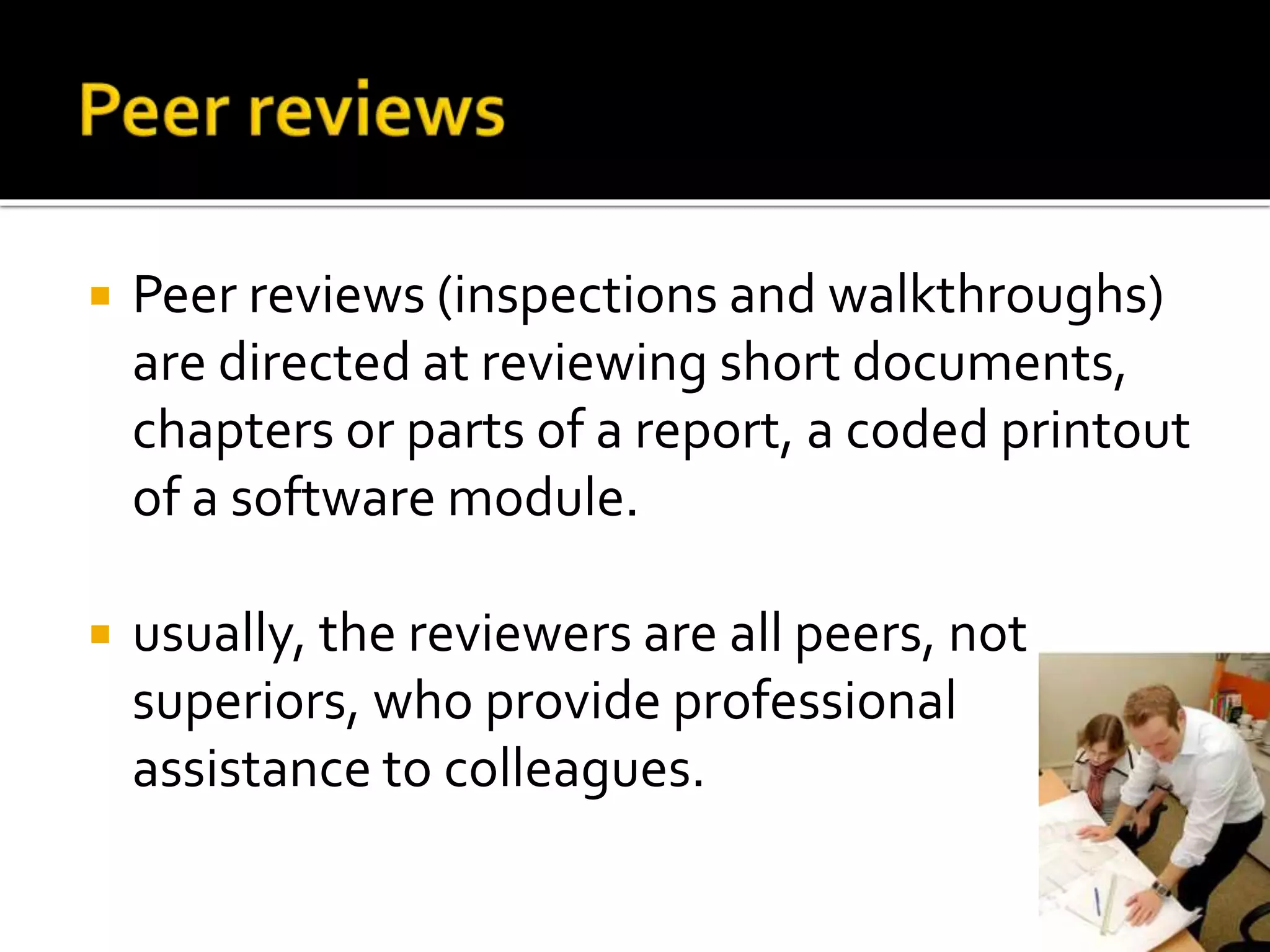
 Peer reviews (inspections and walkthroughs)
are directed at reviewing short documents,
chapters or parts of a report, a coded printout
of a software module.
 usually, the reviewers are all peers, not
superiors, who provide professional
assistance to colleagues.
 The main objective of inspections and
walkthroughs is to detect as many design and
programming faults as possible.
 The output is a list of detected faults and, for
inspections, also a defect summary and
statistics to be used as a database for
reviewing and improving development
methods.
 Expert opinions support quality assessment
efforts by introducing additional external
capabilities into the organization’s in-house
development process.Turning to outside
experts may be particularly useful in the
following situations:
 Insufficient in-house professional capabilities
in a given area.
 In small organizations in many cases it is
difficult to find enough suitable candidates to
participate in the design review teams.
 In cases of major disagreement among the
organization’s
 Software tests are formal SQA components
that are targeted toward review of the actual
running of the software.The tests are based
on a prepared list of test cases that represent
a variety of expected scenarios.
 The test report will include a detailed list of
the faults detected and recommendations.
 Software maintenance services vary in range
and are provided for extensive periods, often
several years.These services fall into the
following categories:
 Corrective maintenance – User’s support
services and correction of soft-ware code and
documentation failures
 Adaptive maintenance – Adaptation of
current software to new circumstances and
customers without changing the basic
software product.
 Functionality improvement maintenance –
The functional and performance related
improvement of existing software, carried
out with respect to limited issues.
 Subcontractors and customers frequently
join the directly contracted developers (the
“supplier”) in carrying out software
development projects.The larger and more
complex the project, the greater the
likelihood that external participants will be
required, and the larger the proportion of
work trans-mitted to them
Adeel Sultan
Roll No : 1195
 The goal are the prevention of software fault or
lowering of software fault rates.
 Now days there are growing use of computerized
automatic tools for application of these components
 The class of SQA component:-
 Procedure and work instructions
 Templates and checklist
 Staff training, retraining and certification
 Preventive and corrective actions
 Configuration management
 Documentation control
 Procedure and work instructions
 Provide detailed definitions for the performance
of specific type of development activities.
 Procedure and work instruction are planned and
are based on the organization experience and
knowledge.
• Staff training, retraining and certification
 Keeping organization human resource knowledge
update
 Achieve mainly by:-
1. Training new employees
2. Continuously updating staff
3. Certifying employees after their knowledge have
been demonstrated.
• Preventive and corrective actions
1. Implementation of change that prevent similar
failures in future
2. Correction similar fault found in other projects
3. Implement proven successful methodologies.
• Configuration management
Introducing procedures to control the change
process.These procedure relate to:-
1. Approval of change
2. Recording of those change performed
3. Issuing of new software versions and release.
4. Recording of the version and release specification
 Documentation control refer mainly to
customer requirement documents, contract
documents, design report, project plans,
development standards. And the activities in
document control are:-
1. Definition of the type of controlled document
2. Specification of the format, method
3. Definition of review and approval process
Muhammad Shahid
Roll No : 1101
 Managerial SQA components support the
managerial control of software development
projects. Control components are:-
1. Project progress control
2. Software quality metrics
3. Software quality costs
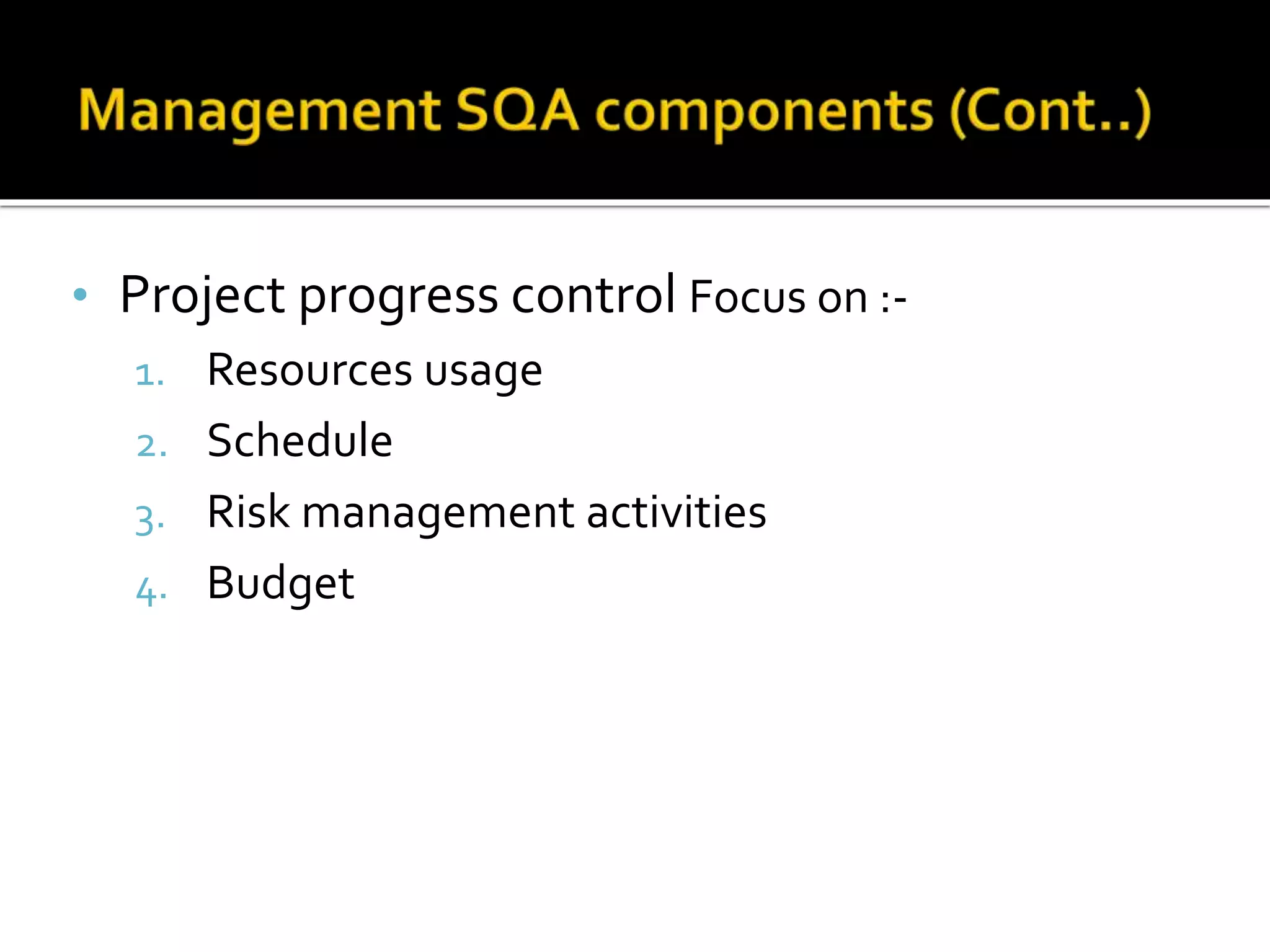
• Project progress control Focus on :-
1. Resources usage
2. Schedule
3. Risk management activities
4. Budget
 Software quality metrics measurement of the
various aspects of software quality is
considered to be effective tool for the
support of control activities.
 Software quality costs
 Analysis of software quality costs can direct SQA
efforts to improvement of activities.
 Quality cost analysis can help identify those
teams whose ineffective
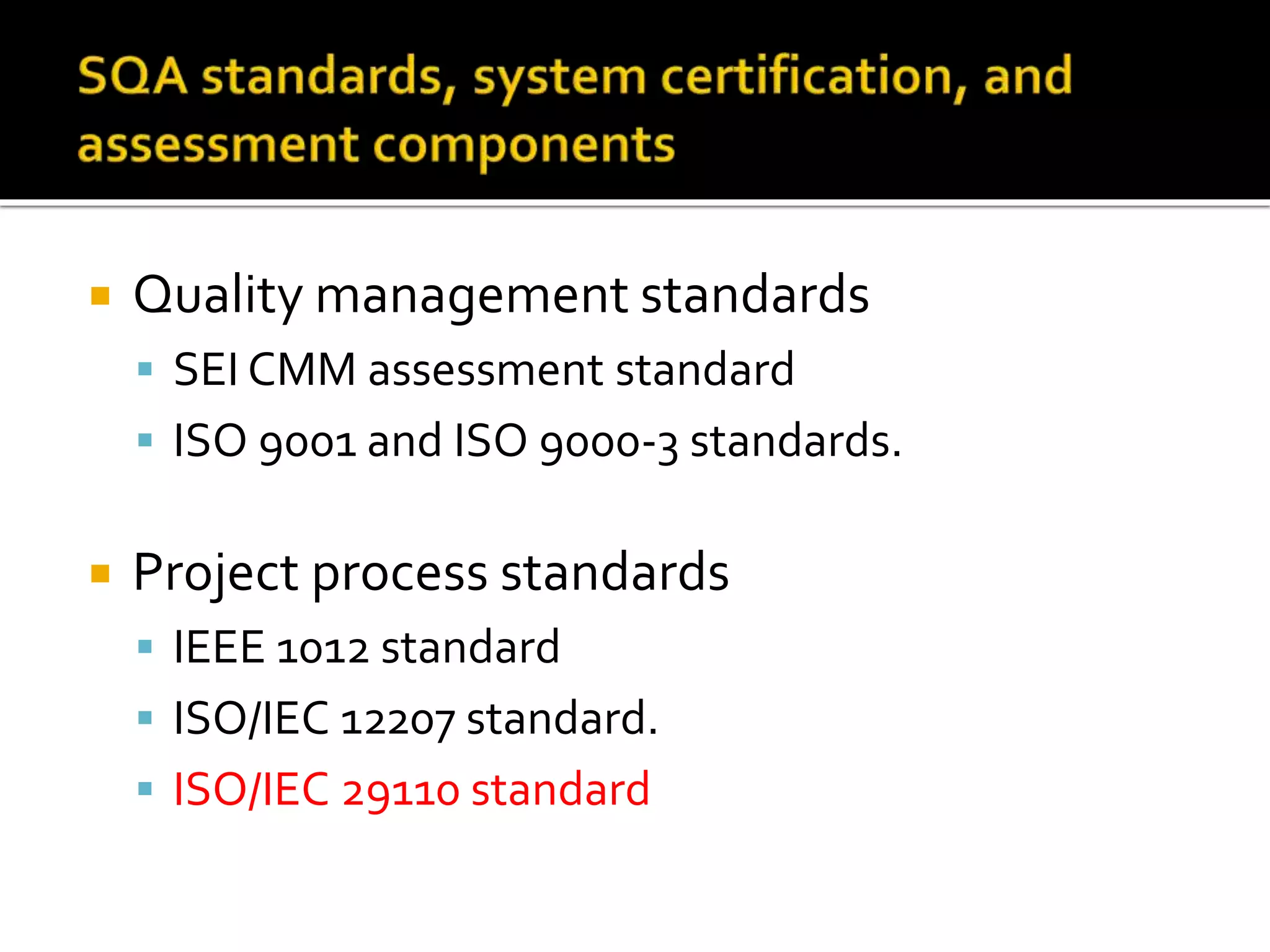
 Quality management standards
 SEI CMM assessment standard
 ISO 9001 and ISO 9000-3 standards.
 Project process standards
 IEEE 1012 standard
 ISO/IEC 12207 standard.
 ISO/IEC 29110 standard
Any Question?

Components of the sqa system

  • 2.
  • 3.
     SQA systemcomponents can be classified into six classes:  Pre-project quality components  Project life cycle components  Infrastructure error preventive and improvement components  Software quality management components  Standardization, certification and SQA assessment components  Organizing for SQA – the human components
  • 5.
     Contract- thedevelopment unit is committed to an agreed-upon functional specification, budget and schedule.  examination of…  the project proposal draft.  the contract drafts.
  • 6.
     Clarification ofthe customer’s requirements  Review of the project’s schedule and resource requirement estimates  Evaluation of the professional staff’s capacity to carry out the proposed project
  • 7.
     Evaluation ofthe customer’s capacity to fulfill his obligations  Evaluation of development risks.
  • 8.
     a planis prepared of the project (“development plan”) and its integrated quality assurance activities (“quality plan”).These plans include additional details and needed revisions based on prior plans that provided the basis for the current proposal and contract.  It is quite common for several months to pass between the tender submission and the signing of the contract.
  • 9.
     Schedules  Requiredmanpower and hardware resources  Risk evaluations  Organizational issues: team members, subcontractors and partnerships  Project methodology, development tools, etc.  Software reuse plans.
  • 10.
     Quality goals,expressed in the appropriate measurable terms  Criteria for starting and ending each project stage  Lists of reviews, tests, and other scheduled verification and validation activities.
  • 11.
  • 12.
     Reviews  Expertopinions  Software testing  Software maintenance  Assurance of the quality of the subcontractors’ work and the customer supplied parts.
  • 13.
     The designphase of the development process produces a variety of documents. The printed products include design reports, software test documents, software installation plans and software manuals, among others. Reviews can be categorized as  formal design reviews (DRs)  peer reviews.
  • 14.
     The committeesare composed of senior professionals, including the project leader and, usually, the department manager, the chief software engineer, and heads of other related departments.  The DR report itself includes a list of required corrections (termed “action items”).
  • 15.
     When adesign review committee sits in order to decide upon the continuation of the work completed so far, one of the following options is usually open for consideration:  Immediate approval of the DR document and continuation to the next development phase.  Approval to proceed to the next development phase after all the action items have been completed and inspected by the committee’s representative.  An additional DR is required and scheduled to take place after all the action items have been completed and inspected by the committee’s representative.
  • 16.
     Peer reviews(inspections and walkthroughs) are directed at reviewing short documents, chapters or parts of a report, a coded printout of a software module.  usually, the reviewers are all peers, not superiors, who provide professional assistance to colleagues.
  • 17.
     The mainobjective of inspections and walkthroughs is to detect as many design and programming faults as possible.  The output is a list of detected faults and, for inspections, also a defect summary and statistics to be used as a database for reviewing and improving development methods.
  • 18.
     Expert opinionssupport quality assessment efforts by introducing additional external capabilities into the organization’s in-house development process.Turning to outside experts may be particularly useful in the following situations:
  • 19.
     Insufficient in-houseprofessional capabilities in a given area.  In small organizations in many cases it is difficult to find enough suitable candidates to participate in the design review teams.  In cases of major disagreement among the organization’s
  • 20.
     Software testsare formal SQA components that are targeted toward review of the actual running of the software.The tests are based on a prepared list of test cases that represent a variety of expected scenarios.  The test report will include a detailed list of the faults detected and recommendations.
  • 21.
     Software maintenanceservices vary in range and are provided for extensive periods, often several years.These services fall into the following categories:  Corrective maintenance – User’s support services and correction of soft-ware code and documentation failures
  • 22.
     Adaptive maintenance– Adaptation of current software to new circumstances and customers without changing the basic software product.  Functionality improvement maintenance – The functional and performance related improvement of existing software, carried out with respect to limited issues.
  • 23.
     Subcontractors andcustomers frequently join the directly contracted developers (the “supplier”) in carrying out software development projects.The larger and more complex the project, the greater the likelihood that external participants will be required, and the larger the proportion of work trans-mitted to them
  • 24.
  • 25.
     The goalare the prevention of software fault or lowering of software fault rates.  Now days there are growing use of computerized automatic tools for application of these components  The class of SQA component:-  Procedure and work instructions  Templates and checklist  Staff training, retraining and certification  Preventive and corrective actions  Configuration management  Documentation control
  • 26.
     Procedure andwork instructions  Provide detailed definitions for the performance of specific type of development activities.  Procedure and work instruction are planned and are based on the organization experience and knowledge.
  • 27.
    • Staff training,retraining and certification  Keeping organization human resource knowledge update  Achieve mainly by:- 1. Training new employees 2. Continuously updating staff 3. Certifying employees after their knowledge have been demonstrated.
  • 28.
    • Preventive andcorrective actions 1. Implementation of change that prevent similar failures in future 2. Correction similar fault found in other projects 3. Implement proven successful methodologies.
  • 29.
    • Configuration management Introducingprocedures to control the change process.These procedure relate to:- 1. Approval of change 2. Recording of those change performed 3. Issuing of new software versions and release. 4. Recording of the version and release specification
  • 30.
     Documentation controlrefer mainly to customer requirement documents, contract documents, design report, project plans, development standards. And the activities in document control are:- 1. Definition of the type of controlled document 2. Specification of the format, method 3. Definition of review and approval process
  • 31.
  • 32.
     Managerial SQAcomponents support the managerial control of software development projects. Control components are:- 1. Project progress control 2. Software quality metrics 3. Software quality costs
  • 33.
    • Project progresscontrol Focus on :- 1. Resources usage 2. Schedule 3. Risk management activities 4. Budget
  • 34.
     Software qualitymetrics measurement of the various aspects of software quality is considered to be effective tool for the support of control activities.
  • 35.
     Software qualitycosts  Analysis of software quality costs can direct SQA efforts to improvement of activities.  Quality cost analysis can help identify those teams whose ineffective
  • 36.
     Quality managementstandards  SEI CMM assessment standard  ISO 9001 and ISO 9000-3 standards.  Project process standards  IEEE 1012 standard  ISO/IEC 12207 standard.  ISO/IEC 29110 standard
  • 37.