Nin Prapongsena, MPh.
Faculty of pharmacy
Huachiew chalermprakiet University
Outline
• Introduction of thiopurines
• Thiopurine metabolism and their mechanism of actions
• ADR of thiopurines
• How thiopurine treatment failure ???
• Polymorphisms of thiopurine methyltransferase
(TPMT) gene and their clinical effects of TPMT activity
• Correlation of TPMT genotype and phenotype
• Limitation of TPMT genotype and phenotype
assessment
• Conclusion
• Pharmacist’s role
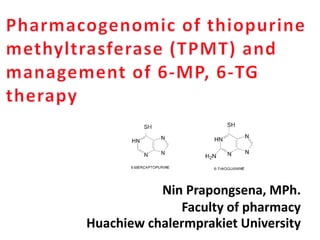
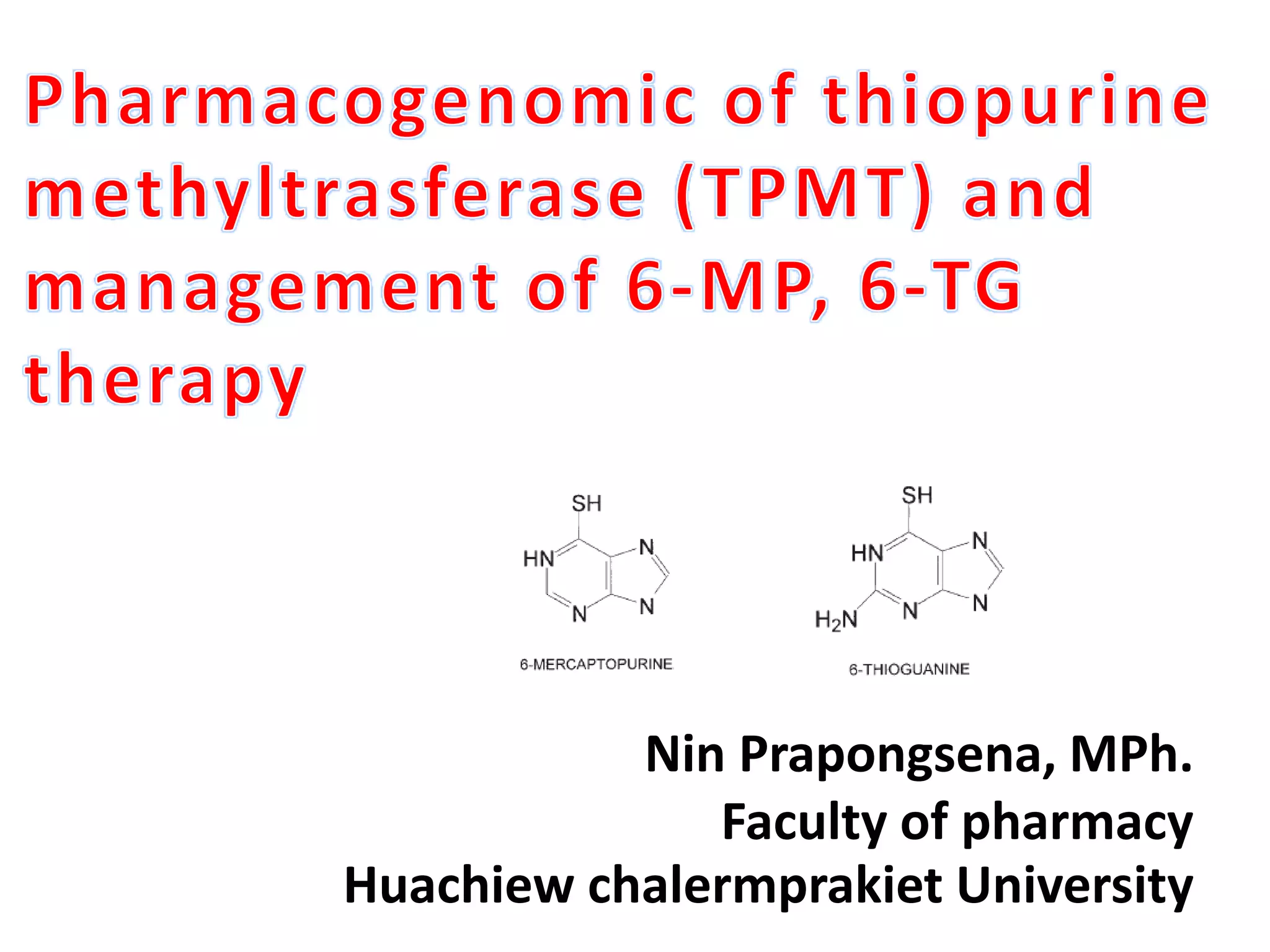
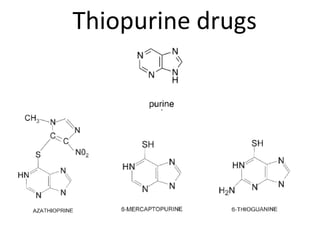
Thiopurine drugs
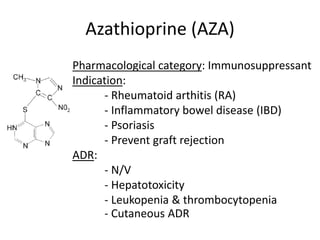
Azathioprine (AZA)
Pharmacological category: Immunosuppressant
Indication:
- Rheumatoid arthitis (RA)
- Inflammatory bowel disease (IBD)
- Psoriasis
- Prevent graft rejection
ADR:
- N/V
- Hepatotoxicity
- Leukopenia & thrombocytopenia
- Cutaneous ADR
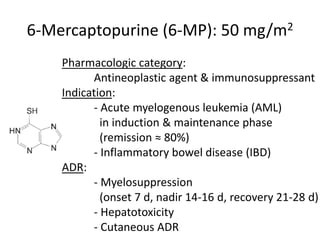
6-Mercaptopurine (6-MP): 50 mg/m2
Pharmacologic category:
Antineoplastic agent & immunosuppressant
Indication:
- Acute myelogenous leukemia (AML)
in induction & maintenance phase
(remission ≈ 80%)
- Inflammatory bowel disease (IBD)
ADR:
- Myelosuppression
(onset 7 d, nadir 14-16 d, recovery 21-28 d)
- Hepatotoxicity
- Cutaneous ADR
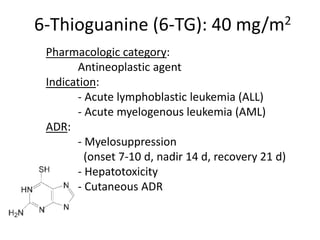
6-Thioguanine (6-TG): 40 mg/m2
Pharmacologic category:
Antineoplastic agent
Indication:
- Acute lymphoblastic leukemia (ALL)
- Acute myelogenous leukemia (AML)
ADR:
- Myelosuppression
(onset 7-10 d, nadir 14 d, recovery 21 d)
- Hepatotoxicity
- Cutaneous ADR
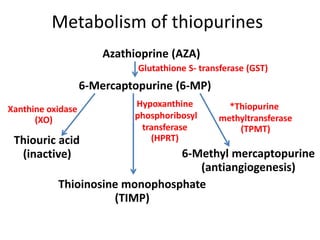
Metabolism of thiopurines
Azathioprine (AZA)
6-Mercaptopurine (6-MP)
Glutathione S- transferase (GST)
Xanthine oxidase
(XO)
Thiouric acid
(inactive)
*Thiopurine
methyltransferase
(TPMT)
6-Methyl mercaptopurine
(antiangiogenesis)
Hypoxanthine
phosphoribosyl
transferase
(HPRT)
Thioinosine monophosphate
(TIMP)
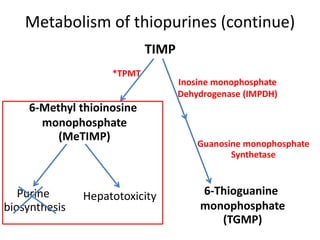
Metabolism of thiopurines (continue)
TIMP
*TPMT
6-Methyl thioinosine
monophosphate
(MeTIMP)
Hepatotoxicity
Inosine monophosphate
Dehydrogenase (IMPDH)
6-Thioguanine
monophosphate
(TGMP)
Guanosine monophosphate
Synthetase
Purine
biosynthesis
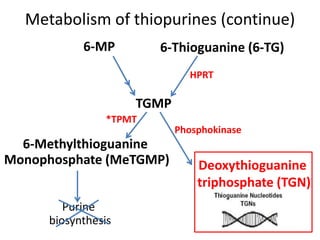
Metabolism of thiopurines (continue)
TGMP
6-MP 6-Thioguanine (6-TG)
HPRT
*TPMT
6-Methylthioguanine
Monophosphate (MeTGMP)
Phosphokinase
Deoxythioguanine
triphosphate (TGN)
Purine
biosynthesis
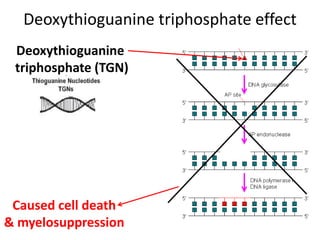
Deoxythioguanine triphosphate effect
Deoxythioguanine
triphosphate (TGN)
Caused cell death
& myelosuppression
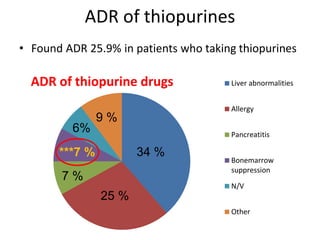
ADR of thiopurines
• Found ADR 25.9% in patients who taking thiopurines
ADR of thiopurine drugs Liver abnormalities
Allergy
Pancreatitis
Bonemarrow
suppression
N/V
Other
34 %
6%
9 %
***7 %
25 %
7 %
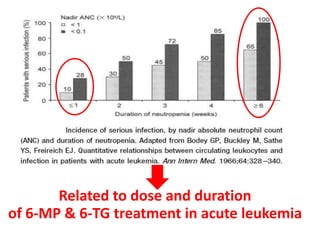
Related to dose and duration
of 6-MP & 6-TG treatment in acute leukemia
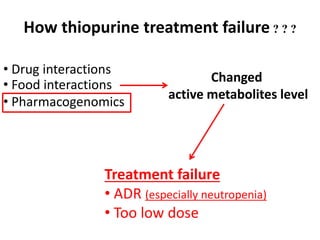
How thiopurine treatment failure ? ? ?
• Drug interactions
• Food interactions
• Pharmacogenomics
Changed
active metabolites level
Treatment failure
• ADR (especially neutropenia)
• Too low dose
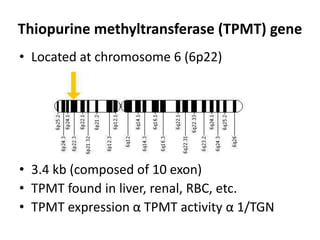
Thiopurine methyltransferase (TPMT) gene
• Located at chromosome 6 (6p22)
• 3.4 kb (composed of 10 exon)
• TPMT found in liver, renal, RBC, etc.
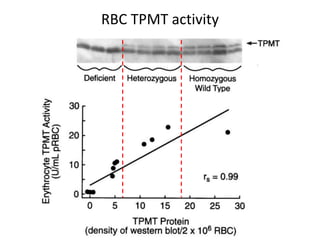
• TPMT expression α TPMT activity α 1/TGN
Weinshilboum RM., and Sladek SL
Am J Hum Genet. 1980; 32: 651-652.
Mercaptopurine pharmacogenetics:
monogenic inheritance of erythrocyte
thiopurine methyltransferase activity
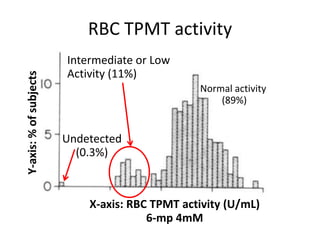
Undetected
(0.3%)
Intermediate or Low
Activity (11%)
Normal activity
(89%)
X-axis: RBC TPMT activity (U/mL)
6-mp 4mM
Y-axis:%ofsubjects RBC TPMT activity
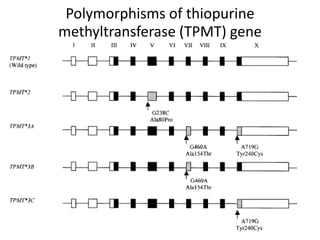
Polymorphisms of thiopurine
methyltransferase (TPMT) gene
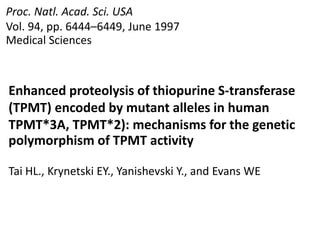
Proc. Natl. Acad. Sci. USA
Vol. 94, pp. 6444–6449, June 1997
Medical Sciences
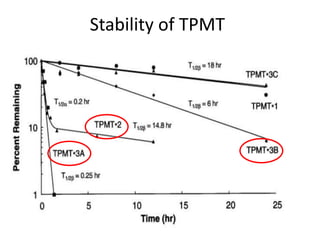
Enhanced proteolysis of thiopurine S-transferase
(TPMT) encoded by mutant alleles in human
TPMT*3A, TPMT*2): mechanisms for the genetic
polymorphism of TPMT activity
Tai HL., Krynetski EY., Yanishevski Y., and Evans WE
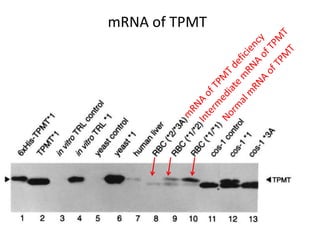
mRNA of TPMT
RBC TPMT activity
Stability of TPMT
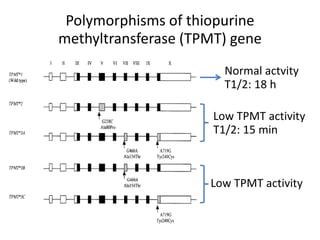
Polymorphisms of thiopurine
methyltransferase (TPMT) gene
Normal actvity
T1/2: 18 h
Low TPMT activity
T1/2: 15 min
Low TPMT activity
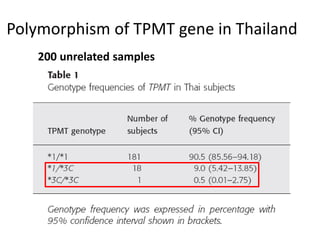
Polymorphism of TPMT gene in Thailand
200 unrelated samples
Clinical effects of TPMT activity
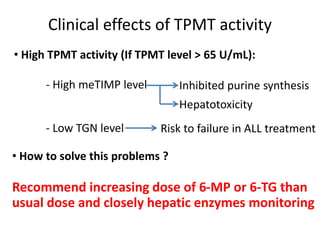
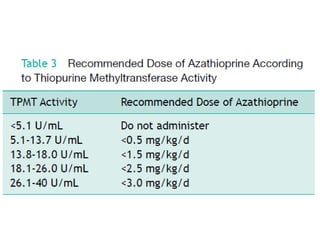
• High TPMT activity (If TPMT level > 65 U/mL):
- High meTIMP level
- Low TGN level
Inhibited purine synthesis
Hepatotoxicity
Risk to failure in ALL treatment
• How to solve this problems ?
Recommend increasing dose of 6-MP or 6-TG than
usual dose and closely hepatic enzymes monitoring
Clinical effects of TPMT activity
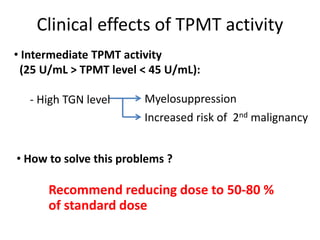
• Intermediate TPMT activity
(25 U/mL > TPMT level < 45 U/mL):
- High TGN level Myelosuppression
Increased risk of 2nd malignancy
• How to solve this problems ?
Recommend reducing dose to 50-80 %
of standard dose
Clinical effects of TPMT activity
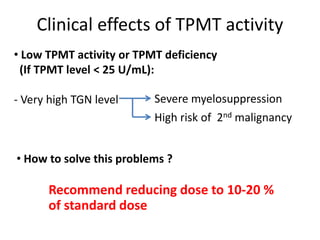
• Low TPMT activity or TPMT deficiency
(If TPMT level < 25 U/mL):
- Very high TGN level Severe myelosuppression
High risk of 2nd malignancy
• How to solve this problems ?
Recommend reducing dose to 10-20 %
of standard dose
Correlation of TPMT genotype and phenotype
Assessment of Thiopurine S-Methyltransferase
Activity in Patients Prescribed Thiopurines: A
Systematic Review
Ann Intern Med. 2011;154:814-823.
Ronald A. Booth, PhD; Mohammed T. Ansari, MBBS, MMedSc, MPhil; Evelin Loit,
PhD; Andrea C. Tricco, PhD; Laura Weeks, PhD; Steve Doucette, MSc; Becky
Skidmore, MLS; Margaret Sears, PhD; Richmond Sy, MD; and Jacob Karsh, MDCM
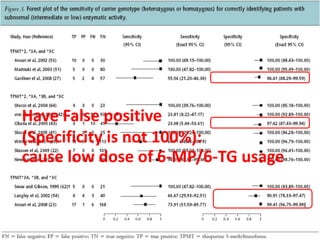
Have False positive
(Specificity is not 100%):
cause low dose of 6-MP/6-TG usage
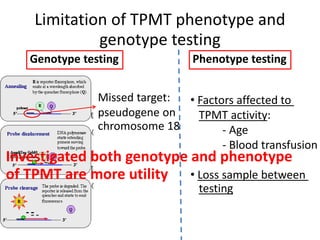
Limitation of TPMT phenotype and
genotype testing
Genotype testing
Missed target:
pseudogene on
chromosome 18
Phenotype testing
• Factors affected to
TPMT activity:
- Age
- Blood transfusion
• Loss sample between
testing
Investigated both genotype and phenotype
of TPMT are more utility
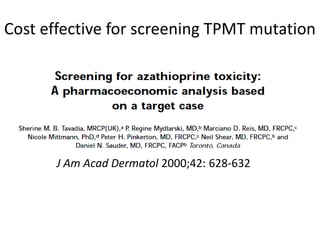
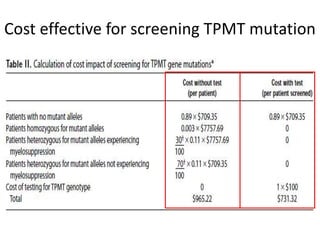
Cost effective for screening TPMT mutation
J Am Acad Dermatol 2000;42: 628-632
Cost effective for screening TPMT mutation
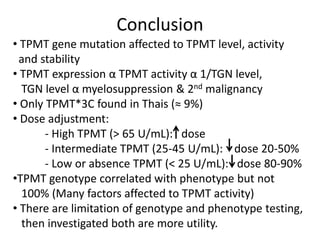
Conclusion
• TPMT gene mutation affected to TPMT level, activity
and stability
• TPMT expression α TPMT activity α 1/TGN level,
TGN level α myelosuppression & 2nd malignancy
• Only TPMT*3C found in Thais (≈ 9%)
• Dose adjustment:
- High TPMT (> 65 U/mL): dose
- Intermediate TPMT (25-45 U/mL): dose 20-50%
- Low or absence TPMT (< 25 U/mL): dose 80-90%
•TPMT genotype correlated with phenotype but not
100% (Many factors affected to TPMT activity)
• There are limitation of genotype and phenotype testing,
then investigated both are more utility.
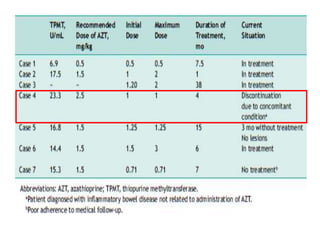
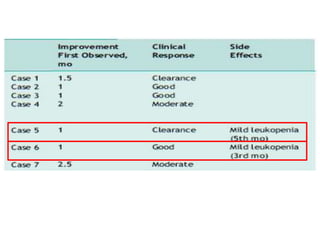
Case report
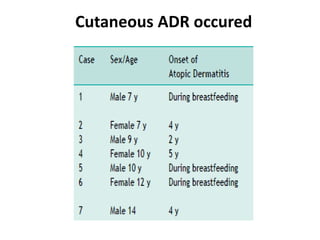
Cutaneous ADR occured
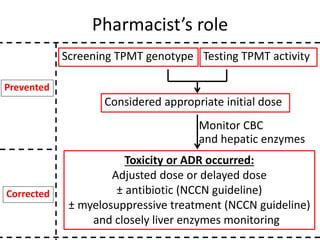
Pharmacist’s role
Prevented
Screening TPMT genotype Testing TPMT activity
Considered appropriate initial dose
Monitor CBC
and hepatic enzymes
Toxicity or ADR occurred:
Adjusted dose or delayed dose
± antibiotic (NCCN guideline)
± myelosuppressive treatment (NCCN guideline)
and closely liver enzymes monitoring
Corrected
References
• Katzung BG. Basic and clinical pharmacology 9th ed. McGraw-Hill, Inc. 2004: 827, 1292-1293.
• Nielsen OH., Vainer B., and Rask-Madsen J. Review article: the treatment of inflammatory bowel
disease with 6-mercaptopurine or azathioprine. Aliment Pharmacol Thera. 2001; 15: 1699-1708.
• Bokkerink JPM., Stet EH., dAbreu RA., et al. 6-mercaptopurine: cytotoxicity and biochemical
pharmacology in human malignant T-lymphoblasts. Biochemical Pharmacology; 45: 1455-1463.
• Swann PF., Waters TR., Moulton DC., Xu Y-Z., Edward M., and Mace R. Role of postreplication DNA
mismatch repair in the cytotoxic action of thioguanine. Science. 1996; 273: 1109-1111.
• Elion GB. The purine path to chemotherapy. Science. 1989; 244: 41-47.
• Chan GLC., Erdman GR., Gruber SA., et al. Pharmacokinetic of 6-thiouric acid and 6-mercaptopurine
in renal allograft recipients after oral administration of azathioprine. European Journal of Clinical
Pharmacology. 1989; 36(3): 265-271.
• Presta M., Rusnati M., Belleri M., et al. Purine analogue 6-methylmercaptopurine riboside inhibits
early and late phases of the angiogenesis process. Cancer Research. 1999; 59: 2417-2424.
• Stet EH., Abreu RAD., Bokkerink JPM., et al. Reversal of 6-mercaptopurine and 6-mercaptopurine
ribonucleoside cytotoxicity by amidoimidazole carboxamide ribonucleoside in Molt4 human
malignant T-lymphoblasts. Biochemistry Pharmacology. 1993; 45:1455-1463.
• Coulthard SA., Hograth LA., Little M., et al. The effect of thiopurine methyltransferase expression on
sensivity to thiopurine drugs. Molecular Pharmacology. 2002; 62: 102-109.
• Gearry R., Barclay M., Gardiner S., and Zhang M. 6-Thioguanine nucleotides and thiopurine
methyltransferase activity: important factors determining response to treatment and incidence of
adverse effects from azathioprine and 6-mercaptopurine. Journal of the New Zealand Medical
Association. 2003;116(1178).
• Tiede I., Fritz G., Strand S., et al. CD28-dependent Rac1 activation is the molecular target of
azathioprine in primary human CD4+ T-lymphocyte. J Clin Invest. 2003; 111: 1135-1145.
References
• Ford LT., and Berg JD. Thiopurine S-methyltransferase (TPMT) assessment prior to starting
thiopurine drug treatment; a pharmacogenomic test whose time has come. J Clin Pathol. 2010; 63:
288-295.
• Pacifici GM., Romiti P., Giuliani L., and Rane A. Thiopurine methyltransferase in humans:
development and tissue distribution. Dev Pharmacol Ther. 1991; 17: 16-23.
• Szumlanski C., Otterness D., Her C., et al. Thiopurine methyltransferase pharmacogenetics: human
gene cloning and characterization of a common polymorphism. DNA Cell Biology. 1996; 15: 17-30.
• Weinshilboum RM., and Sladek SL.Mercaptopurine pharmacogenetics: monogenic inheritance of
erythrocyte thiopurine methyltransferase activity. Am J Hum Genet. 1980; 32: 651-652.
• Krysnetski EY., Schuetz JD., Galpin AJ., Pui CH., Relling MV., and Evans WE. A single point mutation
leading to loss of catalytic activity in human thiopurine S-methyltransferase. Proc Natl Acad Sci U S
A. 1995; 92: 949-953.
• Tai HL., Krynetski EY., Yates CR., et al. Thiopurine S-methyltransferase deficiency: two nucleotide
transitions define the most prevalent mutant allele associated with loss of catalytic activity in
Caucasians. Am J Hum Genet. 1996; 58: 694-702.
• Tai HL., Krynetski EY., Yanishevski Y., and Evans WE. Enhanced proteolysis of thiopurine S-transferase
(TPMT) encoded by mutant alleles in human TPMT*3A, TPMT*2): mechanisms for the genetic
polymorphism of TPMT activity. Proc Natl Acad Sci U S A. 1997; 58: 6444-6449.
• Loennechen T., Yates CR., Fessing MY., Relling MV., Krynetski EY., and Evans WE. Isolation of a
human thiopurine S-methyltransferase (TPMT) complementary DNA with a single nucleotide
transition A719G (TPMT*3C) and its association with loss of TPMT protein and catalytic activity in
humans. Cli Pharmacol Ther. 1998; 64: 46-51.
• Chang JG., Lee LS., Chen CM., et al. Molecular analysis of thiopurine S-methyltransferase alleles in
South-East Asia populations. Pharmacogenetics. 2002; 12: 191-195.
• Ishioka S., Hiyama K., Sato H., et al. Thiopurine methyltransferase genotype and the toxicity of
azathioprine in Japanese. Intern Med. 1999; 38: 944-947.
• Srimartpirom S., Tassaneeyakul W., Kukongviriyapan V., and Tassaneeyakul W. Thiopurine S-
methyltransferase genetic polymorphism in the Thai population. British Journal of Clinical
Pharmacology. 2004; 58(1): 66-70.
References
• Clunie G., and Lennard L. Relevance of thiopurine methyltransferase status in
rheumatology patients receiveing azathioprine. Rheumatology. 2004; 43: 13-18.
• Booth RA., Ansari MT., Loit E., et al. Assessment of thiopurine S-methyltransferase
activity in patients prescribed thiopurines: a systemic review. Annals of Internal
Medicine. 2011; 154: 814-823.
• McLeod HL., Krynetski EY., Relling MV., and Evans WE. Genetic polymorphism of
thiopurine methyltransferase and its clinical relevance for childhood acute
lymphoblastic leukemia. Leukemia. 2000; 14(4):567–572
• Kamisha JD., and Gwendolyn M. Thiopurine methyltransferase activity-TPMT: The
Physician's Guide to Laboratory Test Selection and Interpretation. ARUP
laboratories. 522-2787.
• Coulthard SA., and Hall AG. Recent advances in the pharmacogenomics of
thiopurine methyltransferase. The pharmacogenomics Journal. 2001; 1: 254-261.
• Lennard L., Lilleyman JS., Van Loon J., et al. Genetic variation in response to 6-
mercaptopurine for childhood acute lymphoblastic leukemia. Lancet. 1990; 336:
225-229.
• Sanderson J., Ansari A., Marinaki T., et al. Thiopurine methyl transferase: should it
be measured before commencing thiopurine drug therapy? Ann Clin Biochem.
2004; 41: 303-308.
• Gearry RB, Barclay ML, Burt MJ, Collett JA, and Chapman BA. Thiopurine drug
adverse effects in a population of New Zealand patients with inflammatory bowel
disease. Pharmacoepidemiol Drug Saf. 2004 ;13(8):563-7.

Pharmacogenomic of TPMT which affected to plasma level of thiopurine drugs

  • 1.
    Nin Prapongsena, MPh. Facultyof pharmacy Huachiew chalermprakiet University
  • 2.
    Outline • Introduction ofthiopurines • Thiopurine metabolism and their mechanism of actions • ADR of thiopurines • How thiopurine treatment failure ??? • Polymorphisms of thiopurine methyltransferase (TPMT) gene and their clinical effects of TPMT activity • Correlation of TPMT genotype and phenotype • Limitation of TPMT genotype and phenotype assessment • Conclusion • Pharmacist’s role
  • 3.
  • 4.
    Azathioprine (AZA) Pharmacological category:Immunosuppressant Indication: - Rheumatoid arthitis (RA) - Inflammatory bowel disease (IBD) - Psoriasis - Prevent graft rejection ADR: - N/V - Hepatotoxicity - Leukopenia & thrombocytopenia - Cutaneous ADR
  • 5.
    6-Mercaptopurine (6-MP): 50mg/m2 Pharmacologic category: Antineoplastic agent & immunosuppressant Indication: - Acute myelogenous leukemia (AML) in induction & maintenance phase (remission ≈ 80%) - Inflammatory bowel disease (IBD) ADR: - Myelosuppression (onset 7 d, nadir 14-16 d, recovery 21-28 d) - Hepatotoxicity - Cutaneous ADR
  • 6.
    6-Thioguanine (6-TG): 40mg/m2 Pharmacologic category: Antineoplastic agent Indication: - Acute lymphoblastic leukemia (ALL) - Acute myelogenous leukemia (AML) ADR: - Myelosuppression (onset 7-10 d, nadir 14 d, recovery 21 d) - Hepatotoxicity - Cutaneous ADR
  • 7.
    Metabolism of thiopurines Azathioprine(AZA) 6-Mercaptopurine (6-MP) Glutathione S- transferase (GST) Xanthine oxidase (XO) Thiouric acid (inactive) *Thiopurine methyltransferase (TPMT) 6-Methyl mercaptopurine (antiangiogenesis) Hypoxanthine phosphoribosyl transferase (HPRT) Thioinosine monophosphate (TIMP)
  • 8.
    Metabolism of thiopurines(continue) TIMP *TPMT 6-Methyl thioinosine monophosphate (MeTIMP) Hepatotoxicity Inosine monophosphate Dehydrogenase (IMPDH) 6-Thioguanine monophosphate (TGMP) Guanosine monophosphate Synthetase Purine biosynthesis
  • 9.
    Metabolism of thiopurines(continue) TGMP 6-MP 6-Thioguanine (6-TG) HPRT *TPMT 6-Methylthioguanine Monophosphate (MeTGMP) Phosphokinase Deoxythioguanine triphosphate (TGN) Purine biosynthesis
  • 10.
  • 11.
    ADR of thiopurines •Found ADR 25.9% in patients who taking thiopurines ADR of thiopurine drugs Liver abnormalities Allergy Pancreatitis Bonemarrow suppression N/V Other 34 % 6% 9 % ***7 % 25 % 7 %
  • 12.
    Related to doseand duration of 6-MP & 6-TG treatment in acute leukemia
  • 13.
    How thiopurine treatmentfailure ? ? ? • Drug interactions • Food interactions • Pharmacogenomics Changed active metabolites level Treatment failure • ADR (especially neutropenia) • Too low dose
  • 14.
    Thiopurine methyltransferase (TPMT)gene • Located at chromosome 6 (6p22) • 3.4 kb (composed of 10 exon) • TPMT found in liver, renal, RBC, etc. • TPMT expression α TPMT activity α 1/TGN
  • 15.
    Weinshilboum RM., andSladek SL Am J Hum Genet. 1980; 32: 651-652. Mercaptopurine pharmacogenetics: monogenic inheritance of erythrocyte thiopurine methyltransferase activity
  • 16.
    Undetected (0.3%) Intermediate or Low Activity(11%) Normal activity (89%) X-axis: RBC TPMT activity (U/mL) 6-mp 4mM Y-axis:%ofsubjects RBC TPMT activity
  • 17.
  • 18.
    Proc. Natl. Acad.Sci. USA Vol. 94, pp. 6444–6449, June 1997 Medical Sciences Enhanced proteolysis of thiopurine S-transferase (TPMT) encoded by mutant alleles in human TPMT*3A, TPMT*2): mechanisms for the genetic polymorphism of TPMT activity Tai HL., Krynetski EY., Yanishevski Y., and Evans WE
  • 19.
  • 20.
  • 21.
  • 22.
    Polymorphisms of thiopurine methyltransferase(TPMT) gene Normal actvity T1/2: 18 h Low TPMT activity T1/2: 15 min Low TPMT activity
  • 23.
    Polymorphism of TPMTgene in Thailand 200 unrelated samples
  • 24.
    Clinical effects ofTPMT activity • High TPMT activity (If TPMT level > 65 U/mL): - High meTIMP level - Low TGN level Inhibited purine synthesis Hepatotoxicity Risk to failure in ALL treatment • How to solve this problems ? Recommend increasing dose of 6-MP or 6-TG than usual dose and closely hepatic enzymes monitoring
  • 25.
    Clinical effects ofTPMT activity • Intermediate TPMT activity (25 U/mL > TPMT level < 45 U/mL): - High TGN level Myelosuppression Increased risk of 2nd malignancy • How to solve this problems ? Recommend reducing dose to 50-80 % of standard dose
  • 26.
    Clinical effects ofTPMT activity • Low TPMT activity or TPMT deficiency (If TPMT level < 25 U/mL): - Very high TGN level Severe myelosuppression High risk of 2nd malignancy • How to solve this problems ? Recommend reducing dose to 10-20 % of standard dose
  • 27.
    Correlation of TPMTgenotype and phenotype
  • 28.
    Assessment of ThiopurineS-Methyltransferase Activity in Patients Prescribed Thiopurines: A Systematic Review Ann Intern Med. 2011;154:814-823. Ronald A. Booth, PhD; Mohammed T. Ansari, MBBS, MMedSc, MPhil; Evelin Loit, PhD; Andrea C. Tricco, PhD; Laura Weeks, PhD; Steve Doucette, MSc; Becky Skidmore, MLS; Margaret Sears, PhD; Richmond Sy, MD; and Jacob Karsh, MDCM
  • 29.
    Have False positive (Specificityis not 100%): cause low dose of 6-MP/6-TG usage
  • 30.
    Limitation of TPMTphenotype and genotype testing Genotype testing Missed target: pseudogene on chromosome 18 Phenotype testing • Factors affected to TPMT activity: - Age - Blood transfusion • Loss sample between testing Investigated both genotype and phenotype of TPMT are more utility
  • 31.
    Cost effective forscreening TPMT mutation J Am Acad Dermatol 2000;42: 628-632
  • 32.
    Cost effective forscreening TPMT mutation
  • 33.
    Conclusion • TPMT genemutation affected to TPMT level, activity and stability • TPMT expression α TPMT activity α 1/TGN level, TGN level α myelosuppression & 2nd malignancy • Only TPMT*3C found in Thais (≈ 9%) • Dose adjustment: - High TPMT (> 65 U/mL): dose - Intermediate TPMT (25-45 U/mL): dose 20-50% - Low or absence TPMT (< 25 U/mL): dose 80-90% •TPMT genotype correlated with phenotype but not 100% (Many factors affected to TPMT activity) • There are limitation of genotype and phenotype testing, then investigated both are more utility.
  • 34.
  • 38.
  • 40.
    Pharmacist’s role Prevented Screening TPMTgenotype Testing TPMT activity Considered appropriate initial dose Monitor CBC and hepatic enzymes Toxicity or ADR occurred: Adjusted dose or delayed dose ± antibiotic (NCCN guideline) ± myelosuppressive treatment (NCCN guideline) and closely liver enzymes monitoring Corrected
  • 41.
    References • Katzung BG.Basic and clinical pharmacology 9th ed. McGraw-Hill, Inc. 2004: 827, 1292-1293. • Nielsen OH., Vainer B., and Rask-Madsen J. Review article: the treatment of inflammatory bowel disease with 6-mercaptopurine or azathioprine. Aliment Pharmacol Thera. 2001; 15: 1699-1708. • Bokkerink JPM., Stet EH., dAbreu RA., et al. 6-mercaptopurine: cytotoxicity and biochemical pharmacology in human malignant T-lymphoblasts. Biochemical Pharmacology; 45: 1455-1463. • Swann PF., Waters TR., Moulton DC., Xu Y-Z., Edward M., and Mace R. Role of postreplication DNA mismatch repair in the cytotoxic action of thioguanine. Science. 1996; 273: 1109-1111. • Elion GB. The purine path to chemotherapy. Science. 1989; 244: 41-47. • Chan GLC., Erdman GR., Gruber SA., et al. Pharmacokinetic of 6-thiouric acid and 6-mercaptopurine in renal allograft recipients after oral administration of azathioprine. European Journal of Clinical Pharmacology. 1989; 36(3): 265-271. • Presta M., Rusnati M., Belleri M., et al. Purine analogue 6-methylmercaptopurine riboside inhibits early and late phases of the angiogenesis process. Cancer Research. 1999; 59: 2417-2424. • Stet EH., Abreu RAD., Bokkerink JPM., et al. Reversal of 6-mercaptopurine and 6-mercaptopurine ribonucleoside cytotoxicity by amidoimidazole carboxamide ribonucleoside in Molt4 human malignant T-lymphoblasts. Biochemistry Pharmacology. 1993; 45:1455-1463. • Coulthard SA., Hograth LA., Little M., et al. The effect of thiopurine methyltransferase expression on sensivity to thiopurine drugs. Molecular Pharmacology. 2002; 62: 102-109. • Gearry R., Barclay M., Gardiner S., and Zhang M. 6-Thioguanine nucleotides and thiopurine methyltransferase activity: important factors determining response to treatment and incidence of adverse effects from azathioprine and 6-mercaptopurine. Journal of the New Zealand Medical Association. 2003;116(1178). • Tiede I., Fritz G., Strand S., et al. CD28-dependent Rac1 activation is the molecular target of azathioprine in primary human CD4+ T-lymphocyte. J Clin Invest. 2003; 111: 1135-1145.
  • 42.
    References • Ford LT.,and Berg JD. Thiopurine S-methyltransferase (TPMT) assessment prior to starting thiopurine drug treatment; a pharmacogenomic test whose time has come. J Clin Pathol. 2010; 63: 288-295. • Pacifici GM., Romiti P., Giuliani L., and Rane A. Thiopurine methyltransferase in humans: development and tissue distribution. Dev Pharmacol Ther. 1991; 17: 16-23. • Szumlanski C., Otterness D., Her C., et al. Thiopurine methyltransferase pharmacogenetics: human gene cloning and characterization of a common polymorphism. DNA Cell Biology. 1996; 15: 17-30. • Weinshilboum RM., and Sladek SL.Mercaptopurine pharmacogenetics: monogenic inheritance of erythrocyte thiopurine methyltransferase activity. Am J Hum Genet. 1980; 32: 651-652. • Krysnetski EY., Schuetz JD., Galpin AJ., Pui CH., Relling MV., and Evans WE. A single point mutation leading to loss of catalytic activity in human thiopurine S-methyltransferase. Proc Natl Acad Sci U S A. 1995; 92: 949-953. • Tai HL., Krynetski EY., Yates CR., et al. Thiopurine S-methyltransferase deficiency: two nucleotide transitions define the most prevalent mutant allele associated with loss of catalytic activity in Caucasians. Am J Hum Genet. 1996; 58: 694-702. • Tai HL., Krynetski EY., Yanishevski Y., and Evans WE. Enhanced proteolysis of thiopurine S-transferase (TPMT) encoded by mutant alleles in human TPMT*3A, TPMT*2): mechanisms for the genetic polymorphism of TPMT activity. Proc Natl Acad Sci U S A. 1997; 58: 6444-6449. • Loennechen T., Yates CR., Fessing MY., Relling MV., Krynetski EY., and Evans WE. Isolation of a human thiopurine S-methyltransferase (TPMT) complementary DNA with a single nucleotide transition A719G (TPMT*3C) and its association with loss of TPMT protein and catalytic activity in humans. Cli Pharmacol Ther. 1998; 64: 46-51. • Chang JG., Lee LS., Chen CM., et al. Molecular analysis of thiopurine S-methyltransferase alleles in South-East Asia populations. Pharmacogenetics. 2002; 12: 191-195. • Ishioka S., Hiyama K., Sato H., et al. Thiopurine methyltransferase genotype and the toxicity of azathioprine in Japanese. Intern Med. 1999; 38: 944-947. • Srimartpirom S., Tassaneeyakul W., Kukongviriyapan V., and Tassaneeyakul W. Thiopurine S- methyltransferase genetic polymorphism in the Thai population. British Journal of Clinical Pharmacology. 2004; 58(1): 66-70.
  • 43.
    References • Clunie G.,and Lennard L. Relevance of thiopurine methyltransferase status in rheumatology patients receiveing azathioprine. Rheumatology. 2004; 43: 13-18. • Booth RA., Ansari MT., Loit E., et al. Assessment of thiopurine S-methyltransferase activity in patients prescribed thiopurines: a systemic review. Annals of Internal Medicine. 2011; 154: 814-823. • McLeod HL., Krynetski EY., Relling MV., and Evans WE. Genetic polymorphism of thiopurine methyltransferase and its clinical relevance for childhood acute lymphoblastic leukemia. Leukemia. 2000; 14(4):567–572 • Kamisha JD., and Gwendolyn M. Thiopurine methyltransferase activity-TPMT: The Physician's Guide to Laboratory Test Selection and Interpretation. ARUP laboratories. 522-2787. • Coulthard SA., and Hall AG. Recent advances in the pharmacogenomics of thiopurine methyltransferase. The pharmacogenomics Journal. 2001; 1: 254-261. • Lennard L., Lilleyman JS., Van Loon J., et al. Genetic variation in response to 6- mercaptopurine for childhood acute lymphoblastic leukemia. Lancet. 1990; 336: 225-229. • Sanderson J., Ansari A., Marinaki T., et al. Thiopurine methyl transferase: should it be measured before commencing thiopurine drug therapy? Ann Clin Biochem. 2004; 41: 303-308. • Gearry RB, Barclay ML, Burt MJ, Collett JA, and Chapman BA. Thiopurine drug adverse effects in a population of New Zealand patients with inflammatory bowel disease. Pharmacoepidemiol Drug Saf. 2004 ;13(8):563-7.