HEALTH SERVICE
MANAGEMENT
By
EBRAHIM MOHAMMED
( DMGT, MPH, PhD Fellow)
zebrahim720@gmail.com
ACSHMC, Ethiopia
3/24/2024 1
INTRODUCTION:
Health Service
Management
2
3/24/2024
Learning Objectives
• By the end of this session, students will be able
understand
– Define management
– Health System
– The WHO Health System Frame Work
– Concepts of management
– Principles of management
– Role of managers
– Levels of Managers
3
3/24/2024
Management ???
3/24/2024 4
Definitions of Management
Management
– The process of designing and maintaining an environment
in which individuals, working together in groups, efficiently
accomplish selected aims (koontz and weihrich , 1990)
– The efficient use of resources and getting people working
harmoniously(በስምምነት) together in order to achieve
organizational objectives
– Getting things done through other people
– The process of planning, organizing, leading/directing and
controlling the efforts of organizational members and
using all available organizational resources to reach
predetermined objectives
3/24/2024 5
Definition of …
Management …
• Acquisition (ማግኘት )of managerial
competence(ብቃት), and effectiveness in
the following key areas
–Problem solving
–Administration
–Resource management
–Organizational leadership
3/24/2024 6
Definition of …
The definitions suggests:
– Management is a continuous process
– Several interrelated activities have to be performed by
managers irrespective of their levels to achieve the
desired goals
– Managers use the resources of the organization, both
physical as well as human, to achieve the goals
– Management aims at achieving the organization's
goals by ensuring effective use of resources in the
best interests of the society
3/24/2024 7
3/24/2024 8
Is management
science or art ?
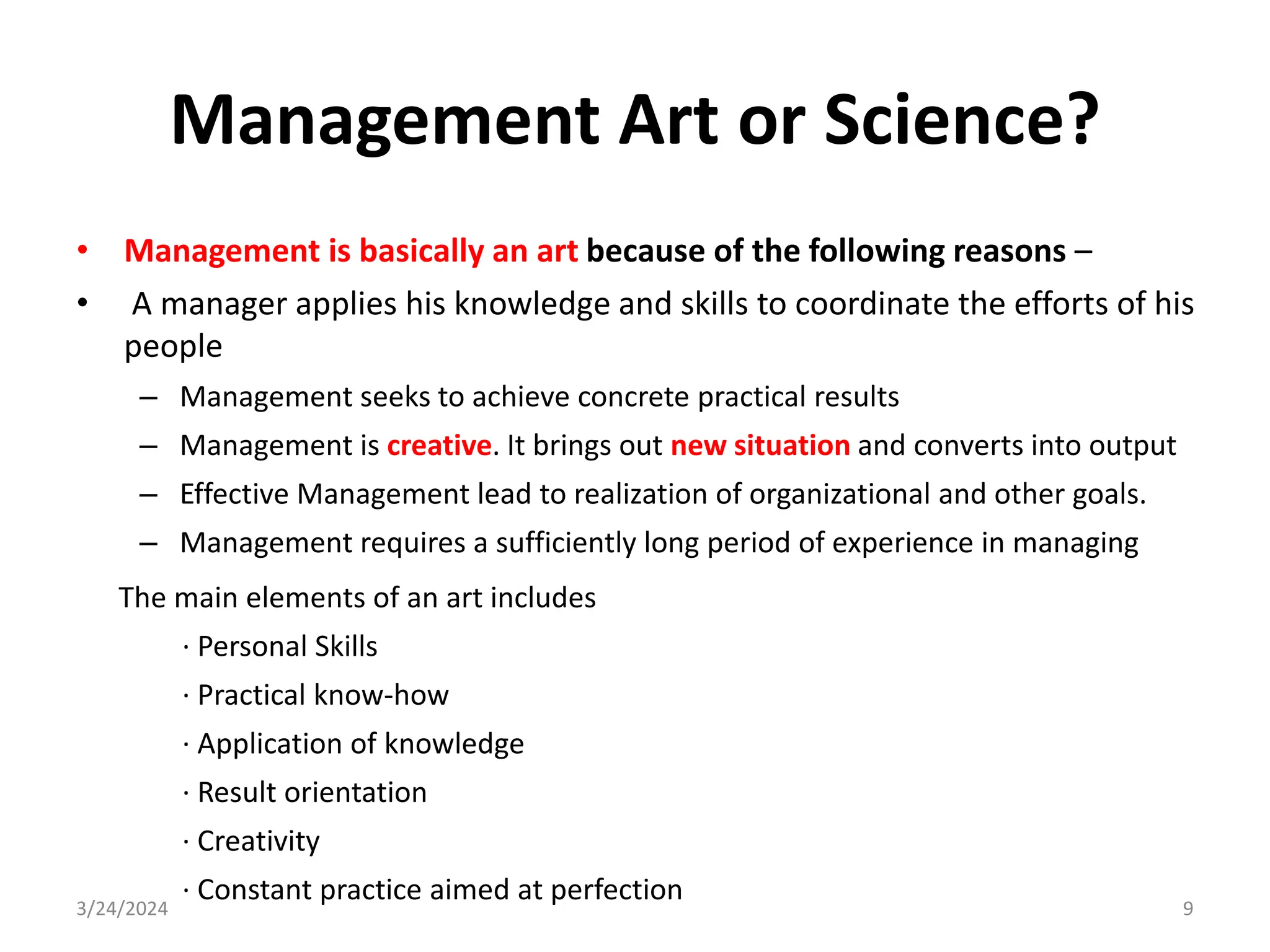
Management Art or Science?
• Management is basically an art because of the following reasons –
• A manager applies his knowledge and skills to coordinate the efforts of his
people
– Management seeks to achieve concrete practical results
– Management is creative. It brings out new situation and converts into output
– Effective Management lead to realization of organizational and other goals.
– Management requires a sufficiently long period of experience in managing
3/24/2024 9
The main elements of an art includes
· Personal Skills
· Practical know-how
· Application of knowledge
· Result orientation
· Creativity
· Constant practice aimed at perfection
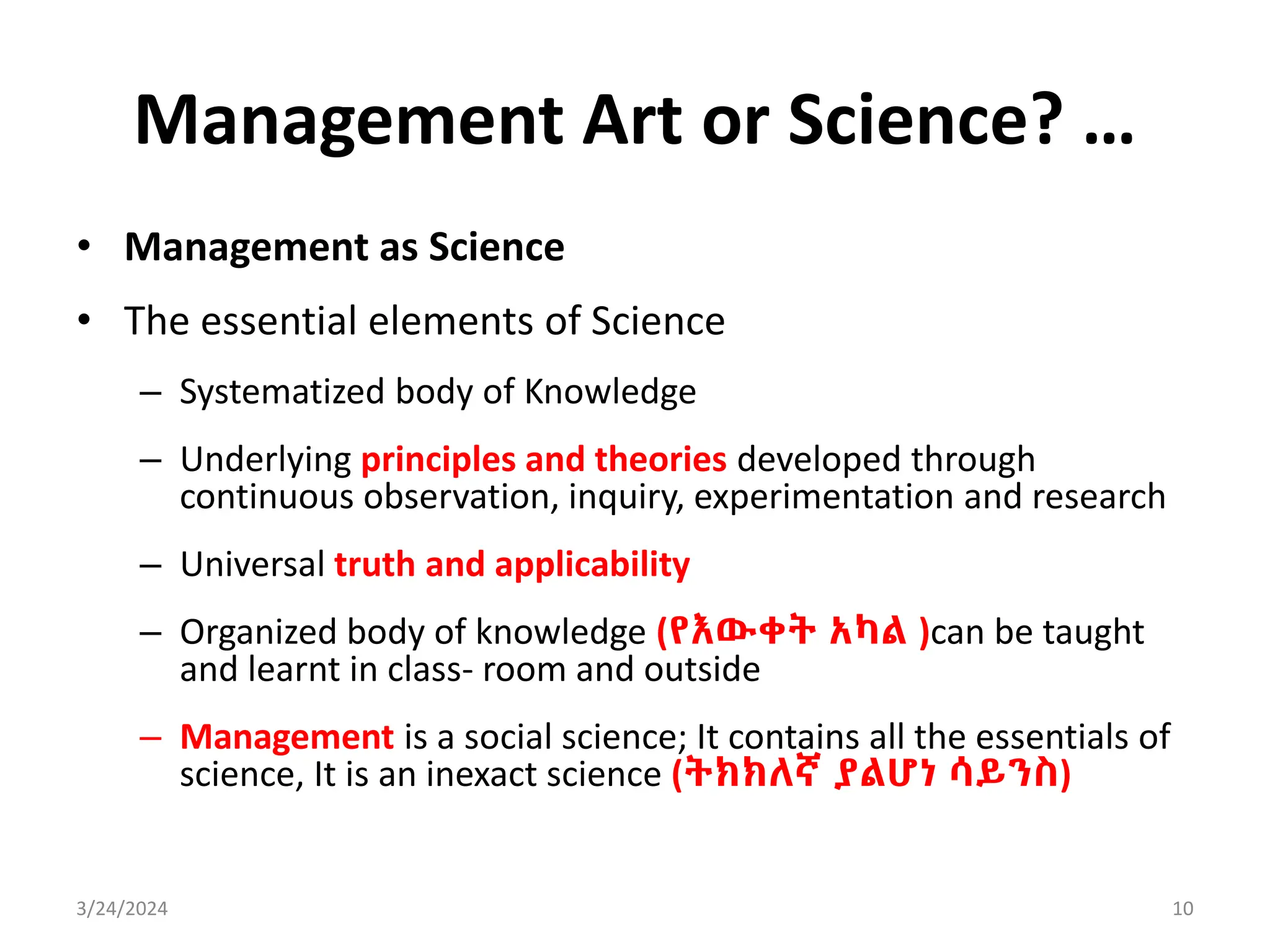
Management Art or Science? …
• Management as Science
• The essential elements of Science
– Systematized body of Knowledge
– Underlying principles and theories developed through
continuous observation, inquiry, experimentation and research
– Universal truth and applicability
– Organized body of knowledge (የእውቀት አካል )can be taught
and learnt in class- room and outside
– Management is a social science; It contains all the essentials of
science, It is an inexact science (ትክክለኛ ያልሆነ ሳይንስ)
3/24/2024 10
Management
vs
Administration ?
3/24/2024 11
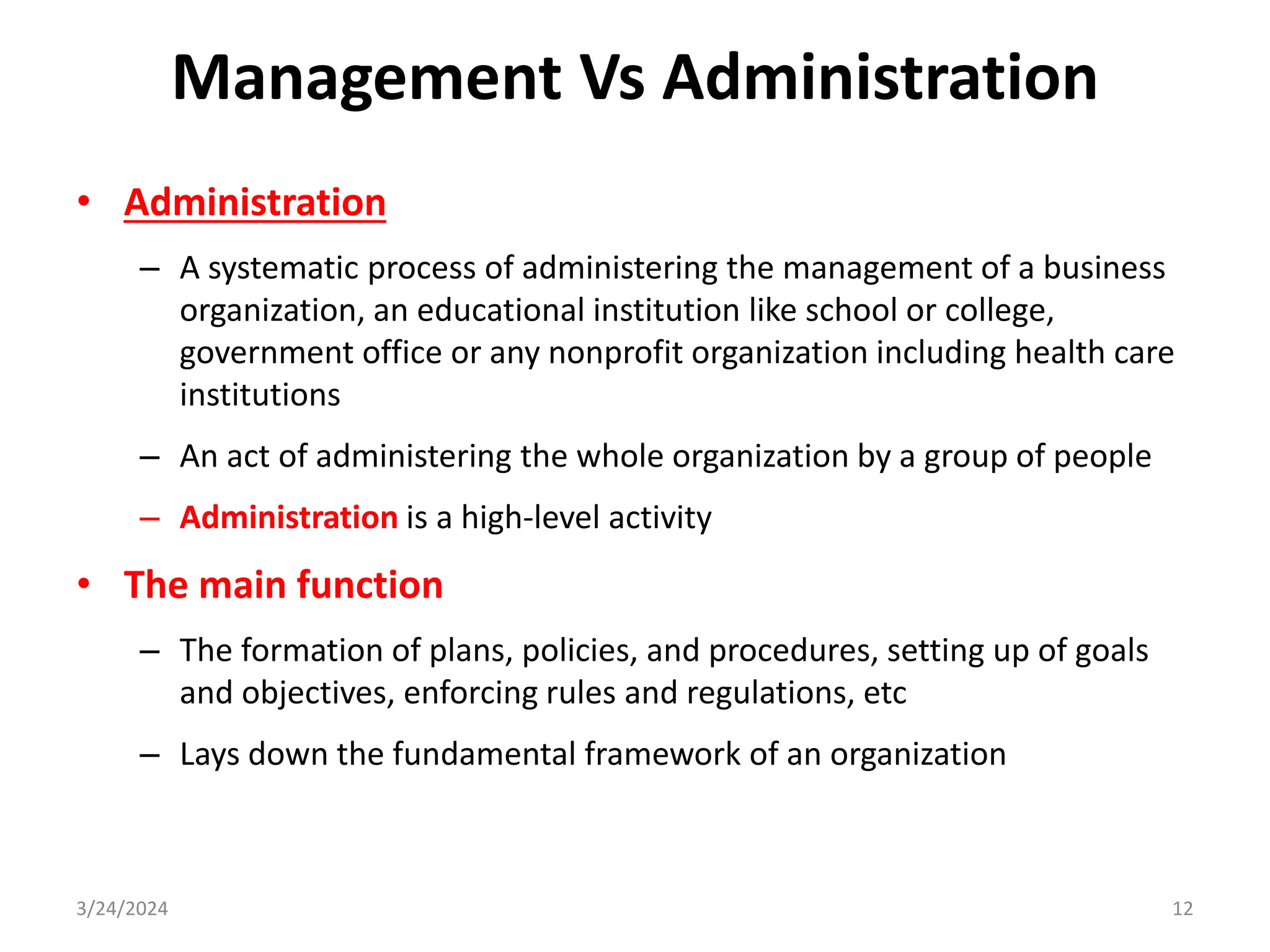
Management Vs Administration
• Administration
– A systematic process of administering the management of a business
organization, an educational institution like school or college,
government office or any nonprofit organization including health care
institutions
– An act of administering the whole organization by a group of people
– Administration is a high-level activity
• The main function
– The formation of plans, policies, and procedures, setting up of goals
and objectives, enforcing rules and regulations, etc
– Lays down the fundamental framework of an organization
3/24/2024 12
Management Vs Administration …
• Management
– An act of managing people and their work, for
achieving a common goal by using the
organization’s resources
• Main function
– Planning, organizing, leading, motivating,
controlling, coordination and decision making are
the major activities performed by the
management
3/24/2024 13
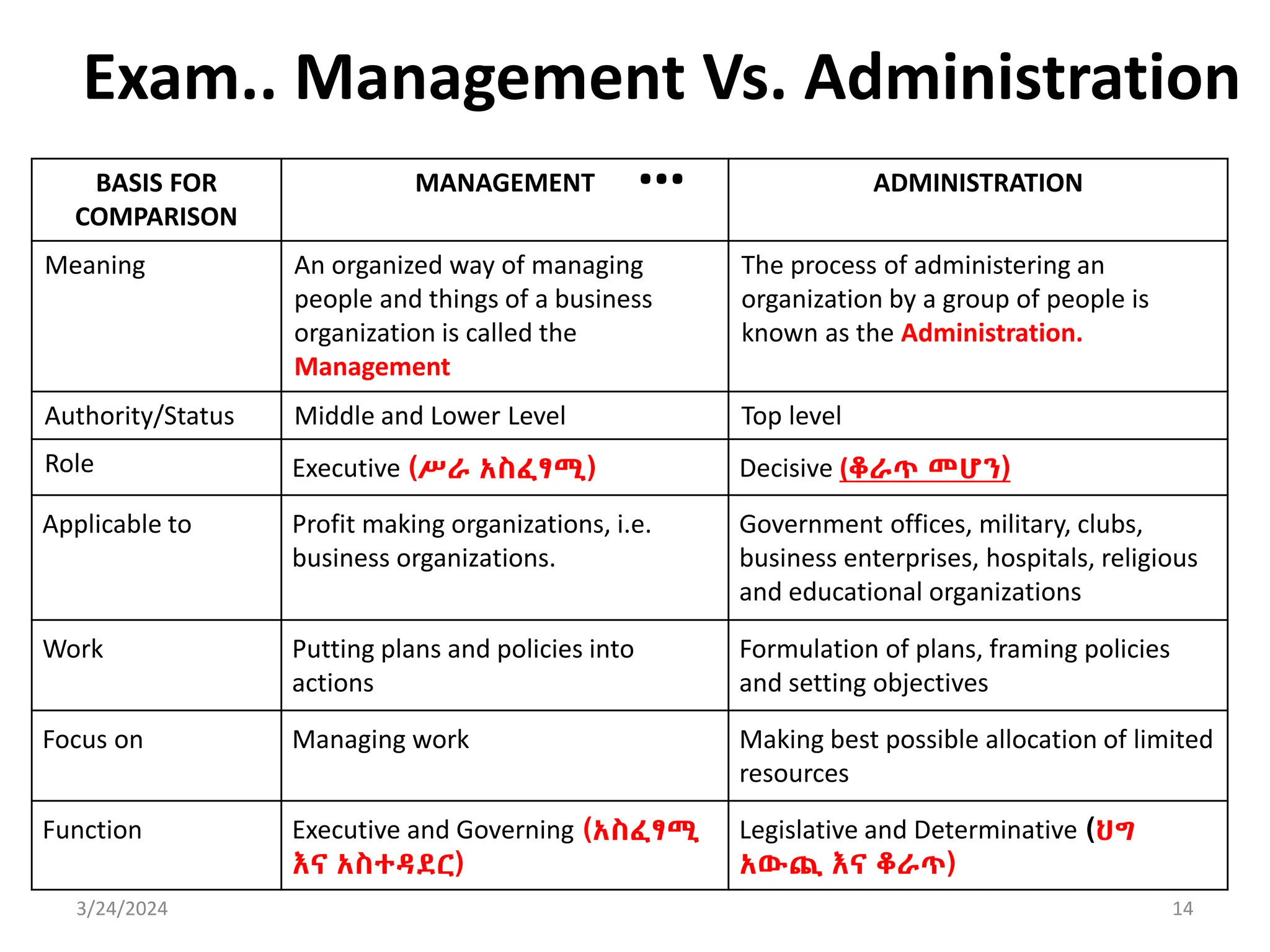
Exam.. Management Vs. Administration
…
BASIS FOR
COMPARISON
MANAGEMENT ADMINISTRATION
Meaning An organized way of managing
people and things of a business
organization is called the
Management
The process of administering an
organization by a group of people is
known as the Administration.
Authority/Status Middle and Lower Level Top level
Role Executive (ሥራ አስፈፃሚ) Decisive (ቆራጥ መሆን)
Applicable to Profit making organizations, i.e.
business organizations.
Government offices, military, clubs,
business enterprises, hospitals, religious
and educational organizations
Work Putting plans and policies into
actions
Formulation of plans, framing policies
and setting objectives
Focus on Managing work Making best possible allocation of limited
resources
Function Executive and Governing (አስፈፃሚ
እና አስተዳደር)
Legislative and Determinative (ህግ
አውጪ እና ቆራጥ)
3/24/2024 14
Characteristics of Management
1. Is a Process /a function
2. Is a Social Process
3. Involves Group Effort
4. Aims at achieving predetermined objectives
5. Required at all levels of management
6. Is a Profession
7. Is comprised of following functions:
• Planning , Organizing, Directing, Controlling , Co-ordination
8. Is an art and science
9. it is a group of organized activities
10. it is dynamic in nature
3/24/2024 17
Exam..Approaches to Management
• There are many approaches in management
thought
• Each approach tries to explain the nature and
content of management separately with
different beliefs and views
• Approaches are organized as
– Systems approach
– Contingency or situational approach
3/24/2024 18
Exam ..Approaches to Management …
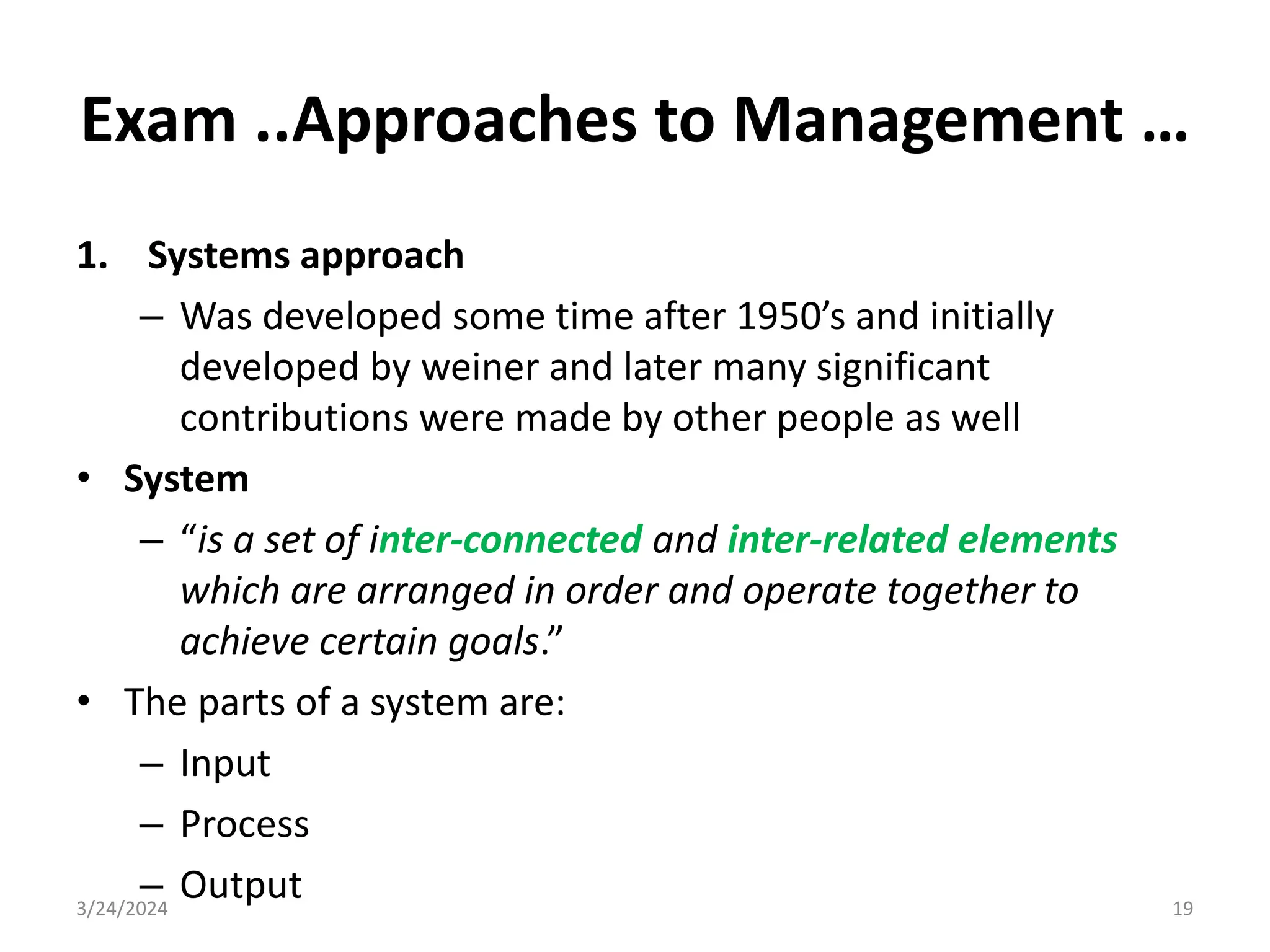
1. Systems approach
– Was developed some time after 1950’s and initially
developed by weiner and later many significant
contributions were made by other people as well
• System
– “is a set of inter-connected and inter-related elements
which are arranged in order and operate together to
achieve certain goals.”
• The parts of a system are:
– Input
– Process
– Output
3/24/2024 19
Approaches to Management …
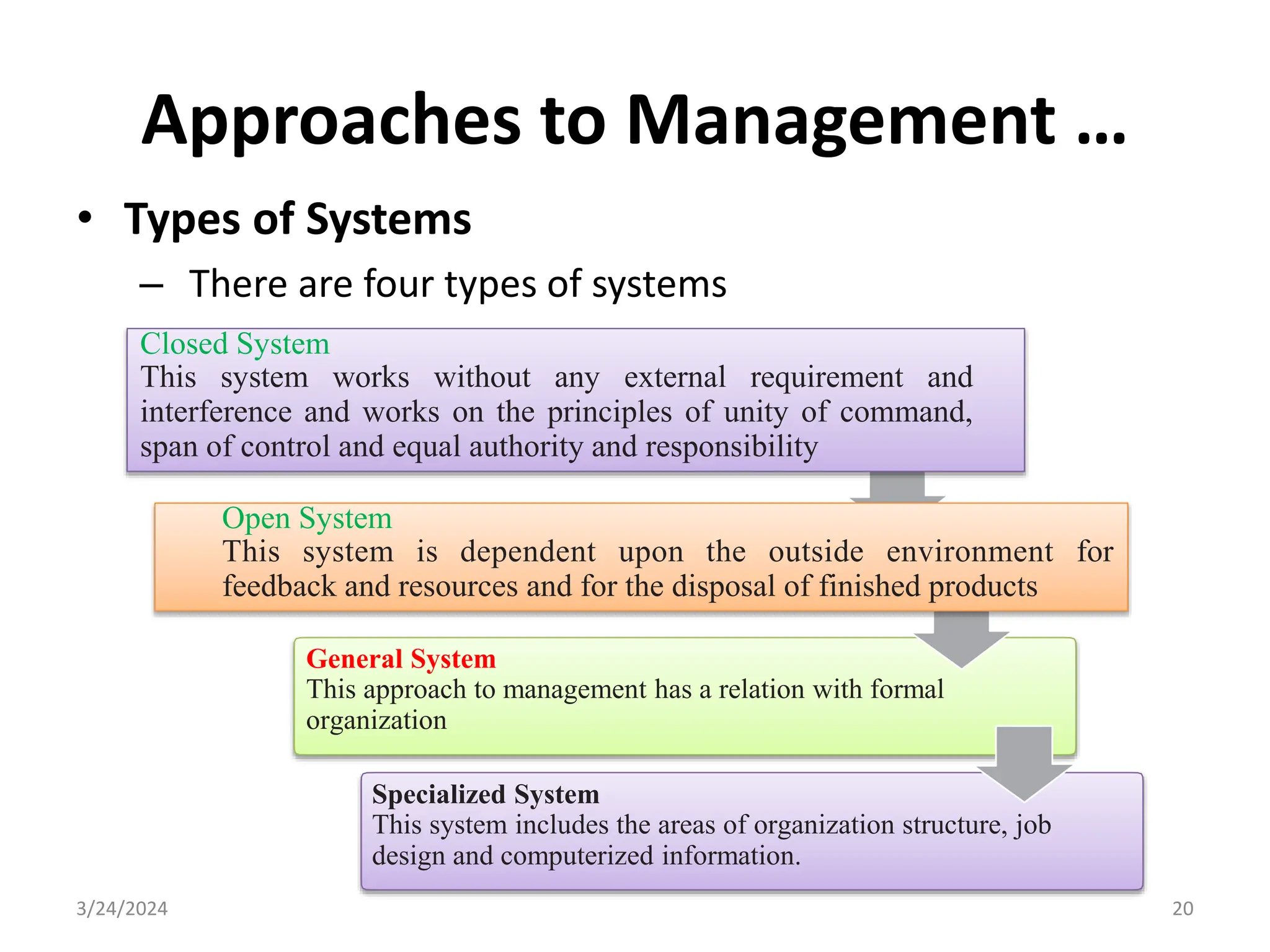
• Types of Systems
– There are four types of systems
3/24/2024 20
General System
This approach to management has a relation with formal
organization
Specialized System
This system includes the areas of organization structure, job
design and computerized information.
Closed System
This system works without any external requirement and
interference and works on the principles of unity of command,
span of control and equal authority and responsibility
Open System
This system is dependent upon the outside environment for
feedback and resources and for the disposal of finished products
Approaches to Management …
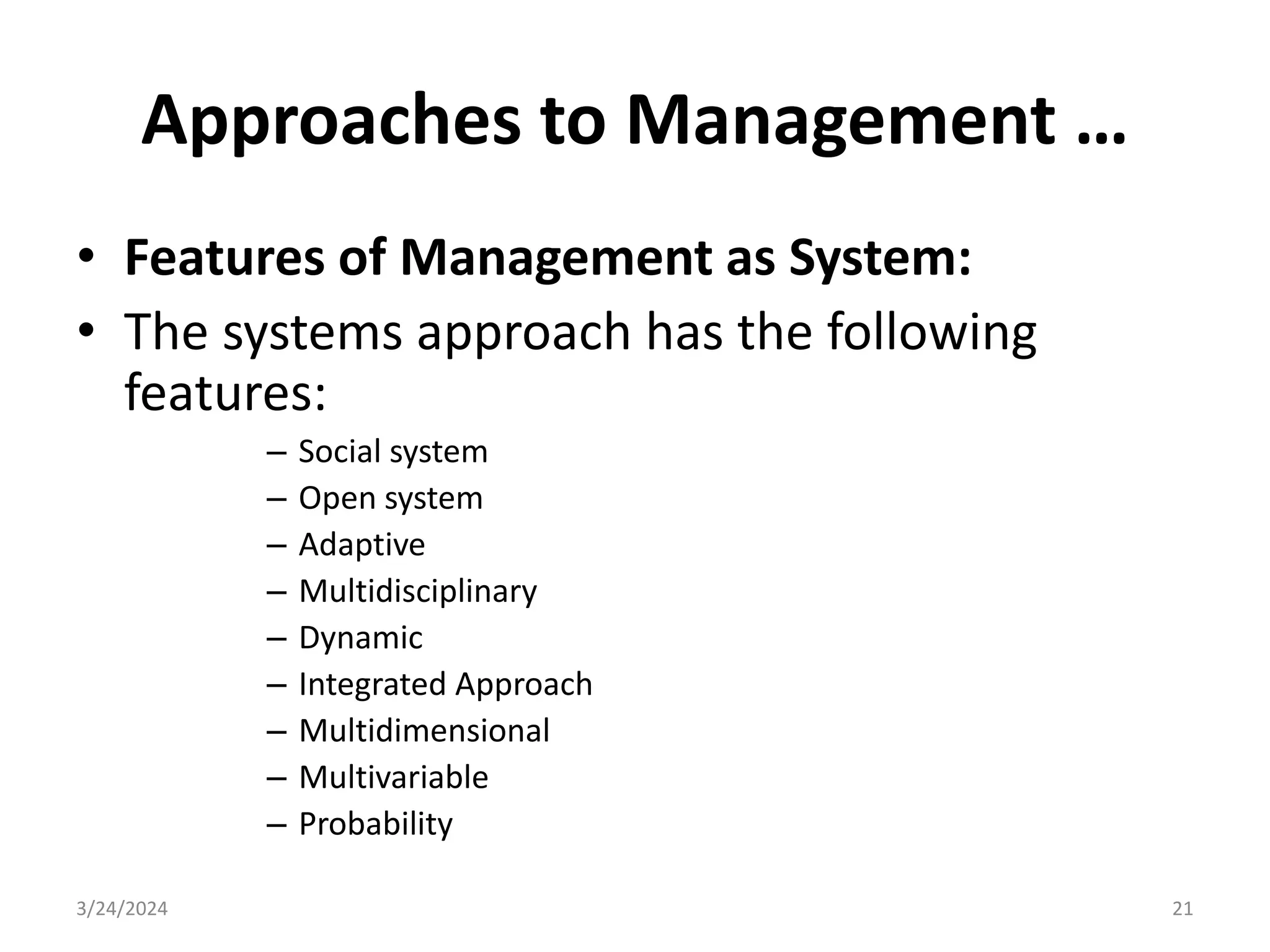
• Features of Management as System:
• The systems approach has the following
features:
– Social system
– Open system
– Adaptive
– Multidisciplinary
– Dynamic
– Integrated Approach
– Multidimensional
– Multivariable
– Probability
3/24/2024 21
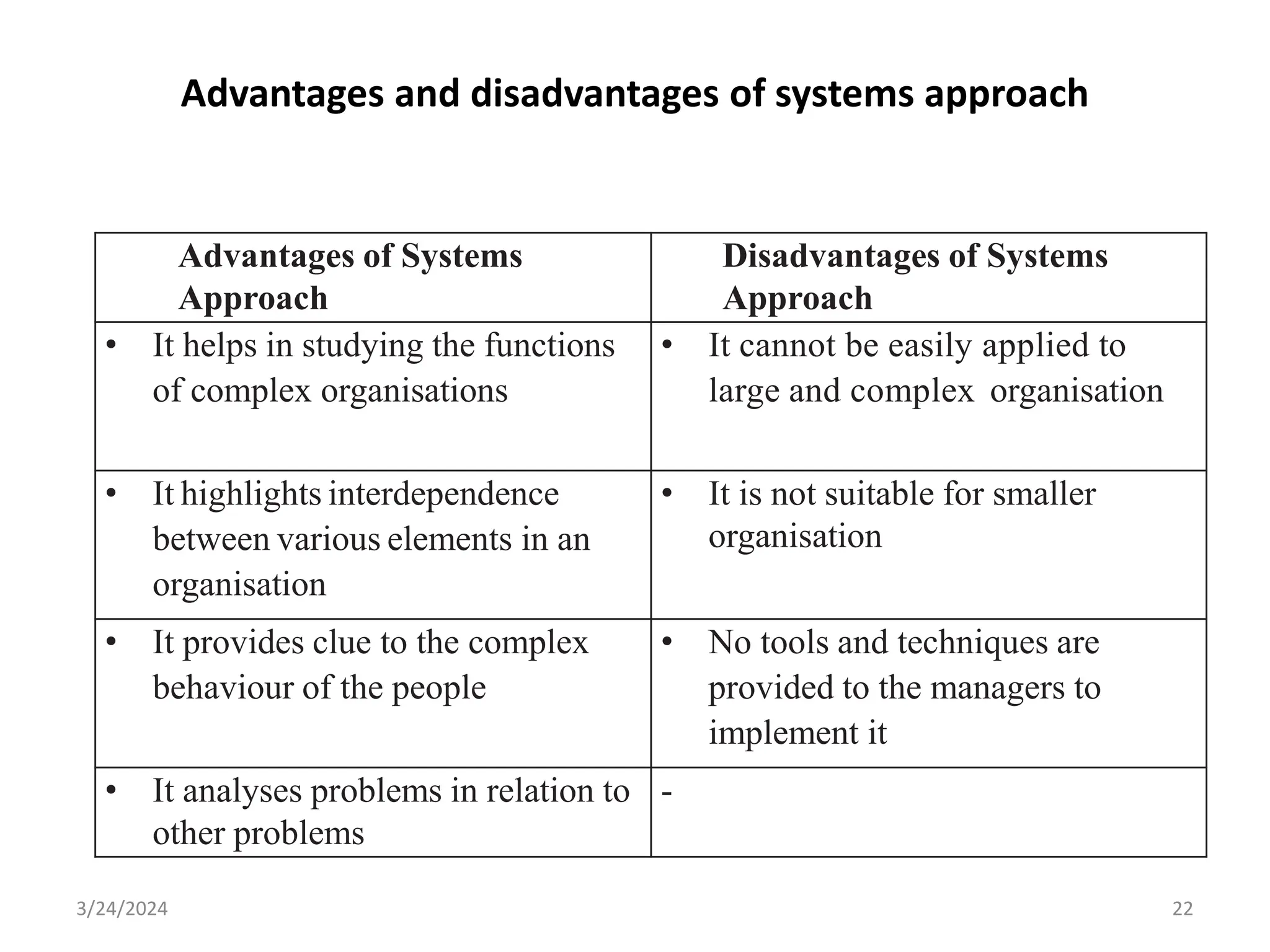
Advantages and disadvantages of systems approach
Advantages of Systems
Approach
Disadvantages of Systems
Approach
• It helps in studying the functions
of complex organisations
• It cannot be easily applied to
large and complex organisation
• It highlights interdependence
between various elements in an
organisation
• It is not suitable for smaller
organisation
• It provides clue to the complex
behaviour of the people
• No tools and techniques are
provided to the managers to
implement it
• It analyses problems in relation to
other problems
-
3/24/2024 22
Approaches to Management …
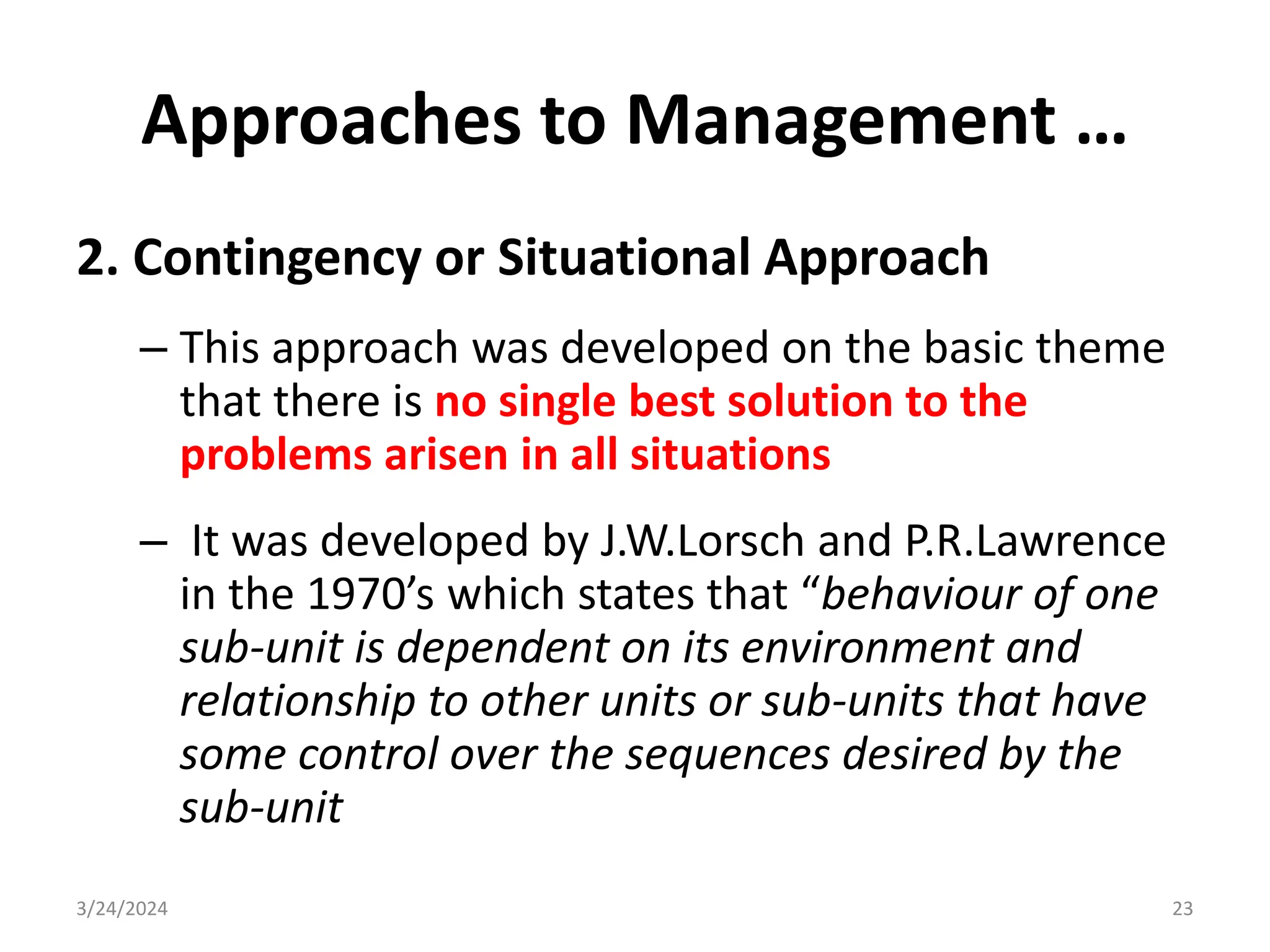
2. Contingency or Situational Approach
– This approach was developed on the basic theme
that there is no single best solution to the
problems arisen in all situations
– It was developed by J.W.Lorsch and P.R.Lawrence
in the 1970’s which states that “behaviour of one
sub-unit is dependent on its environment and
relationship to other units or sub-units that have
some control over the sequences desired by the
sub-unit
3/24/2024 23
3/24/2024 24
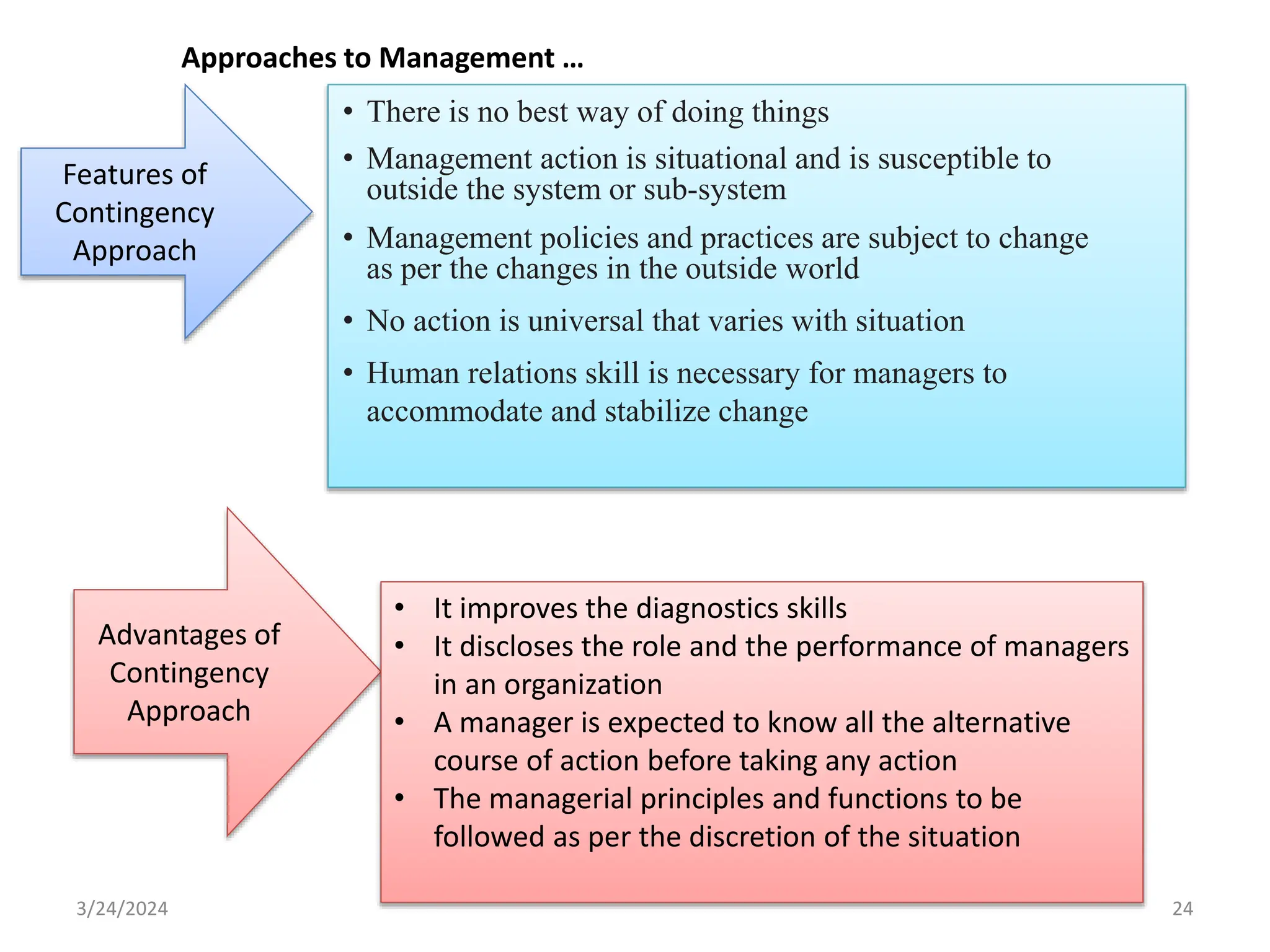
• There is no best way of doing things
• Management action is situational and is susceptible to
outside the system or sub-system
• Management policies and practices are subject to change
as per the changes in the outside world
• No action is universal that varies with situation
• Human relations skill is necessary for managers to
accommodate and stabilize change
Features of
Contingency
Approach
Advantages of
Contingency
Approach
• It improves the diagnostics skills
• It discloses the role and the performance of managers
in an organization
• A manager is expected to know all the alternative
course of action before taking any action
• The managerial principles and functions to be
followed as per the discretion of the situation
Approaches to Management …
3/24/2024 25
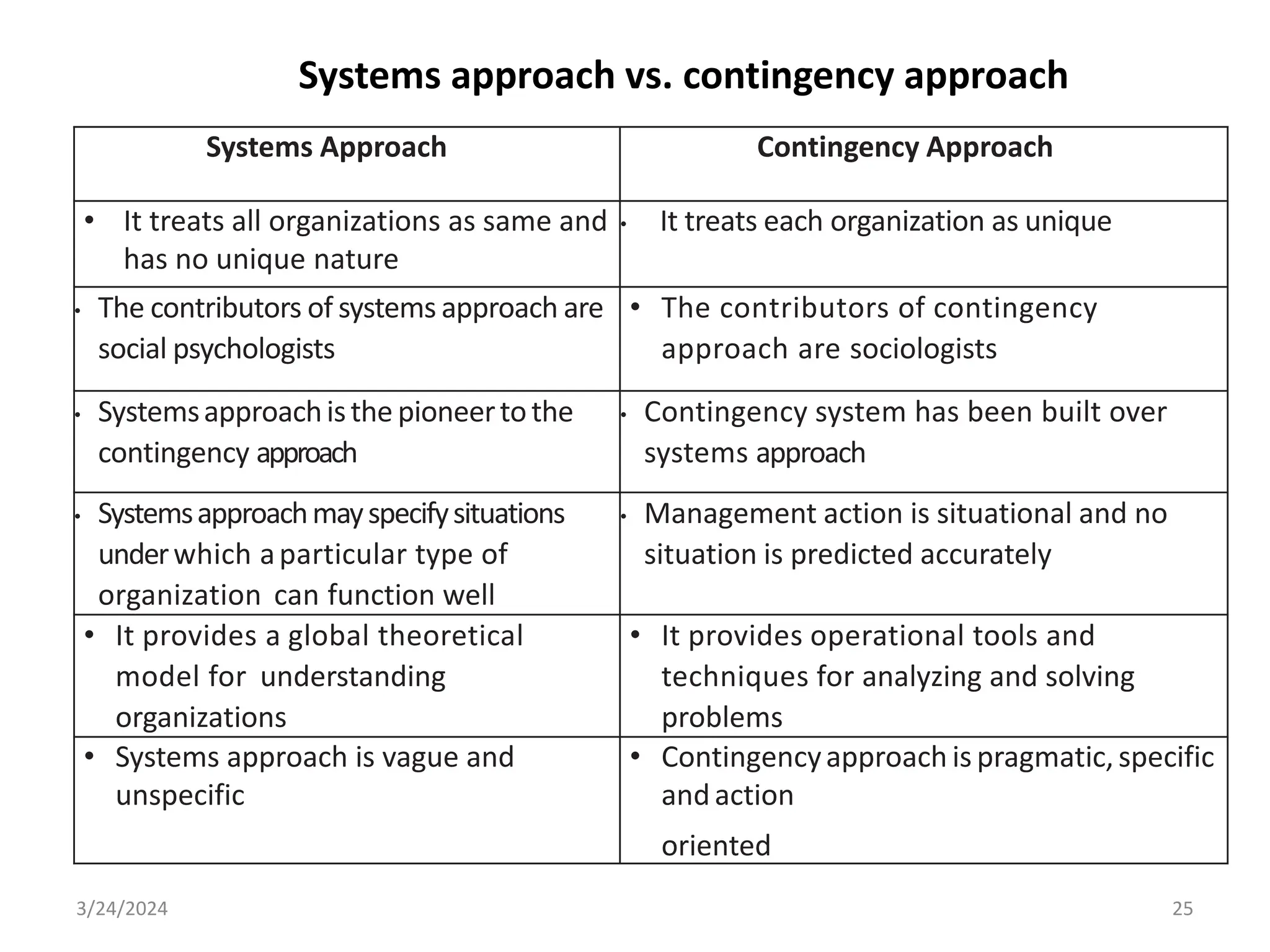
Systems Approach Contingency Approach
• It treats all organizations as same and
has no unique nature
• It treats each organization as unique
• The contributors of systems approach are
social psychologists
• The contributors of contingency
approach are sociologists
• Systemsapproachisthe pioneertothe
contingency approach
• Contingency system has been built over
systems approach
• Systemsapproachmayspecifysituations
underwhich aparticular type of
organization can function well
• Management action is situational and no
situation is predicted accurately
• It provides a global theoretical
model for understanding
organizations
• It provides operational tools and
techniques for analyzing and solving
problems
• Systems approach is vague and
unspecific
• Contingencyapproach is pragmatic, specific
andaction
oriented
Systems approach vs. contingency approach
3/24/2024 26
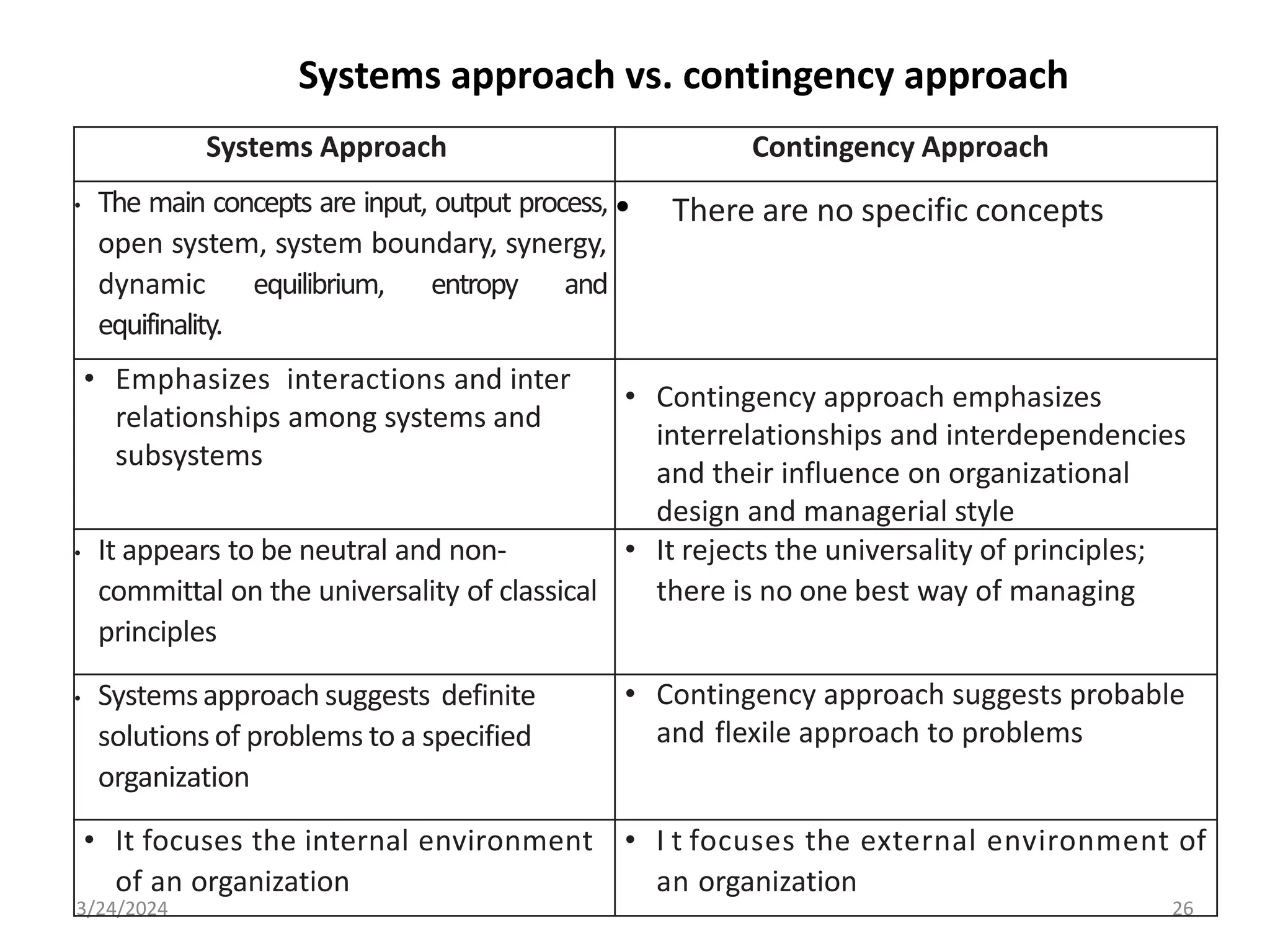
Systems Approach Contingency Approach
• The main concepts are input, output process,
open system, system boundary, synergy,
dynamic equilibrium, entropy and
equifinality.
• There are no specific concepts
• Emphasizes interactions and inter
relationships among systems and
subsystems
• Contingency approach emphasizes
interrelationships and interdependencies
and their influence on organizational
design and managerial style
• It appears to be neutral and non-
committal on the universality of classical
principles
• It rejects the universality of principles;
there is no one best way of managing
• Systemsapproach suggests definite
solutions of problems to a specified
organization
• Contingency approach suggests probable
and flexile approach to problems
• It focuses the internal environment
of an organization
• I t focuses the external environment of
an organization
Systems approach vs. contingency approach
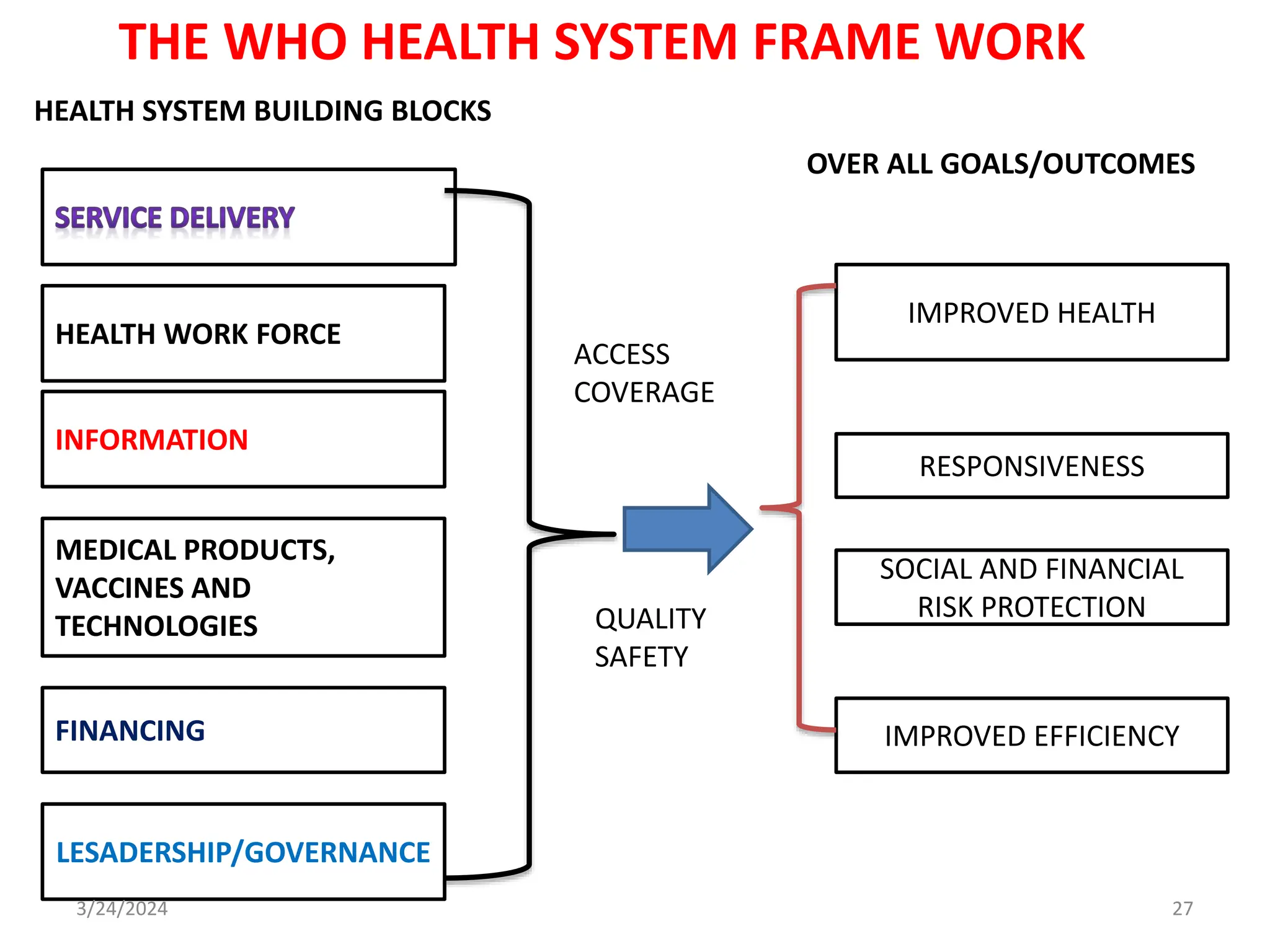
HEALTH WORK FORCE
INFORMATION
MEDICAL PRODUCTS,
VACCINES AND
TECHNOLOGIES
FINANCING
LESADERSHIP/GOVERNANCE
IMPROVED HEALTH
RESPONSIVENESS
SOCIAL AND FINANCIAL
RISK PROTECTION
IMPROVED EFFICIENCY
ACCESS
COVERAGE
QUALITY
SAFETY
HEALTH SYSTEM BUILDING BLOCKS
OVER ALL GOALS/OUTCOMES
THE WHO HEALTH SYSTEM FRAME WORK
27
3/24/2024
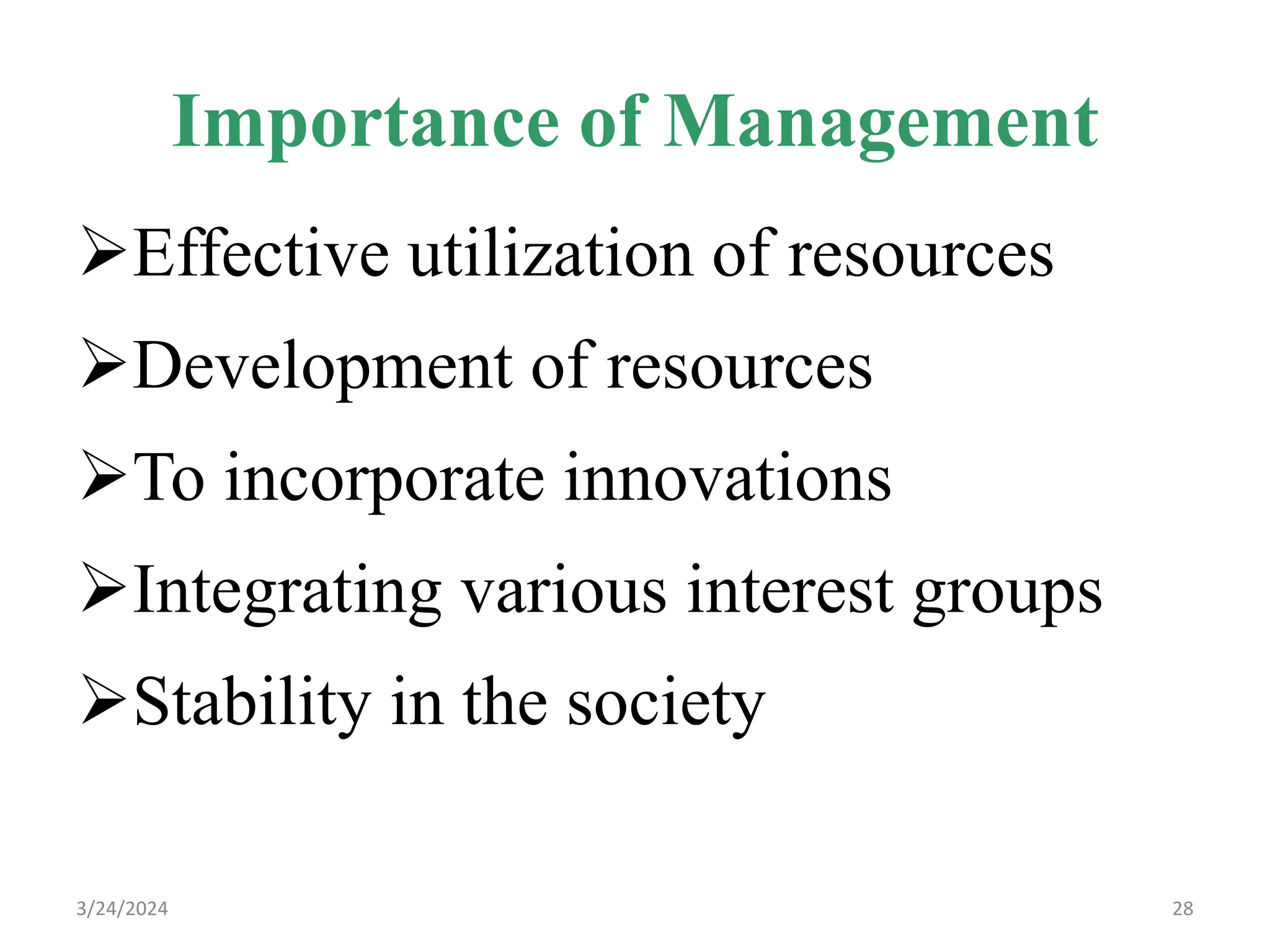
Importance of Management
Effective utilization of resources
Development of resources
To incorporate innovations
Integrating various interest groups
Stability in the society
3/24/2024 28
MGT Concepts, Principles,
Levels, Roles
and
Managerial Skills
3/24/2024 29
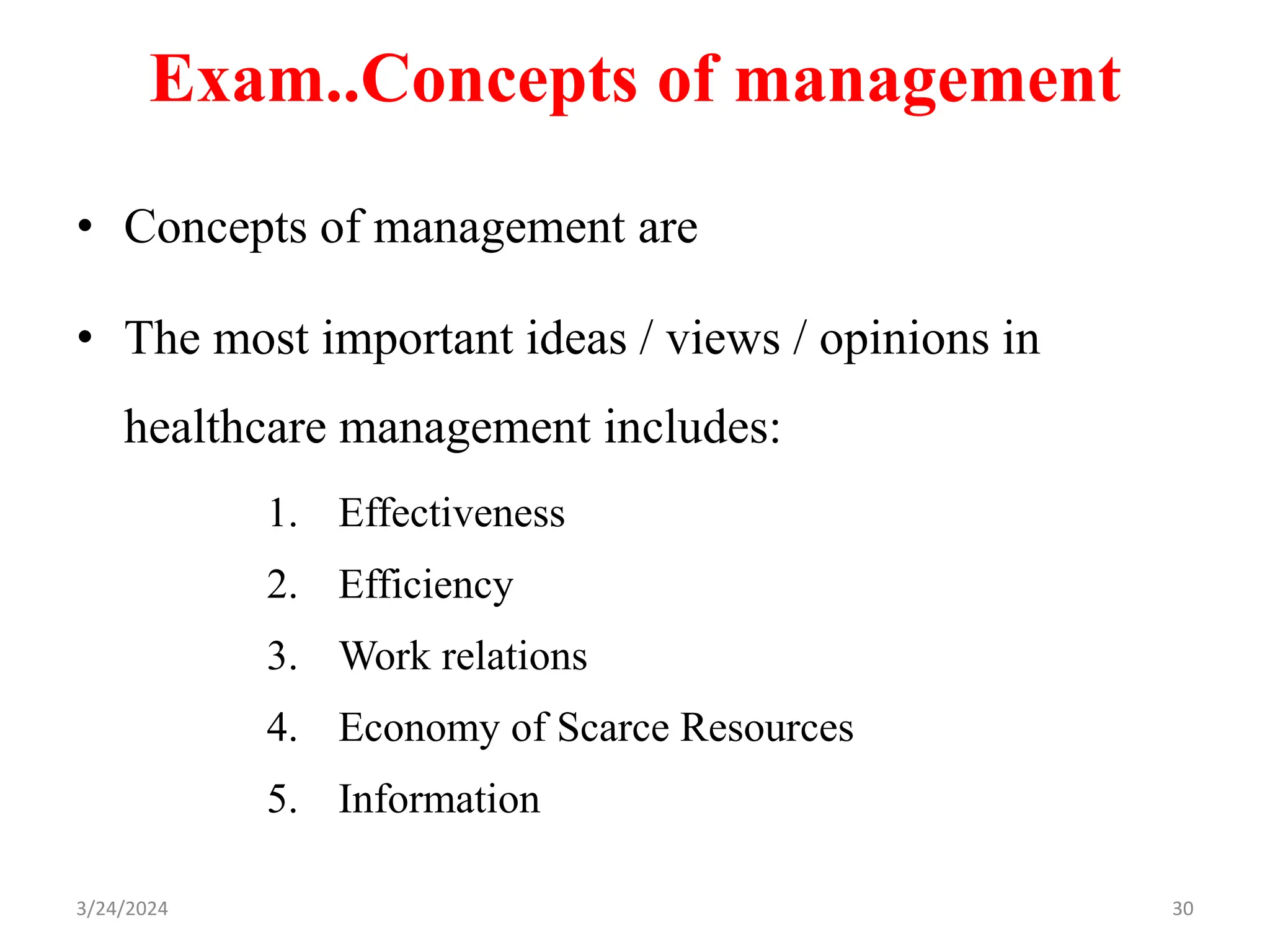
Exam..Concepts of management
• Concepts of management are
• The most important ideas / views / opinions in
healthcare management includes:
1. Effectiveness
2. Efficiency
3. Work relations
4. Economy of Scarce Resources
5. Information
30
3/24/2024
Concepts of…
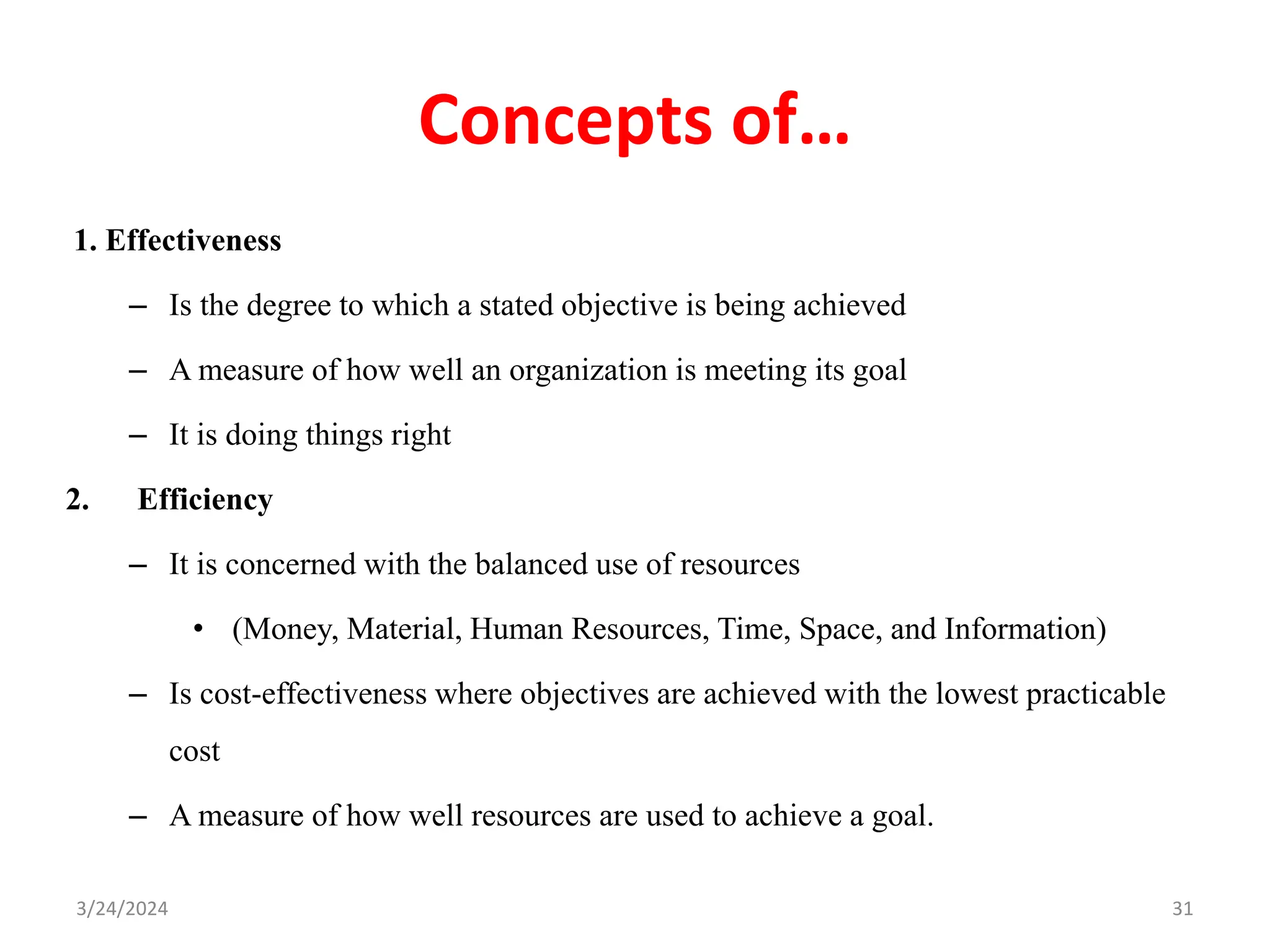
1. Effectiveness
– Is the degree to which a stated objective is being achieved
– A measure of how well an organization is meeting its goal
– It is doing things right
2. Efficiency
– It is concerned with the balanced use of resources
• (Money, Material, Human Resources, Time, Space, and Information)
– Is cost-effectiveness where objectives are achieved with the lowest practicable
cost
– A measure of how well resources are used to achieve a goal.
31
3/24/2024
Concepts of…
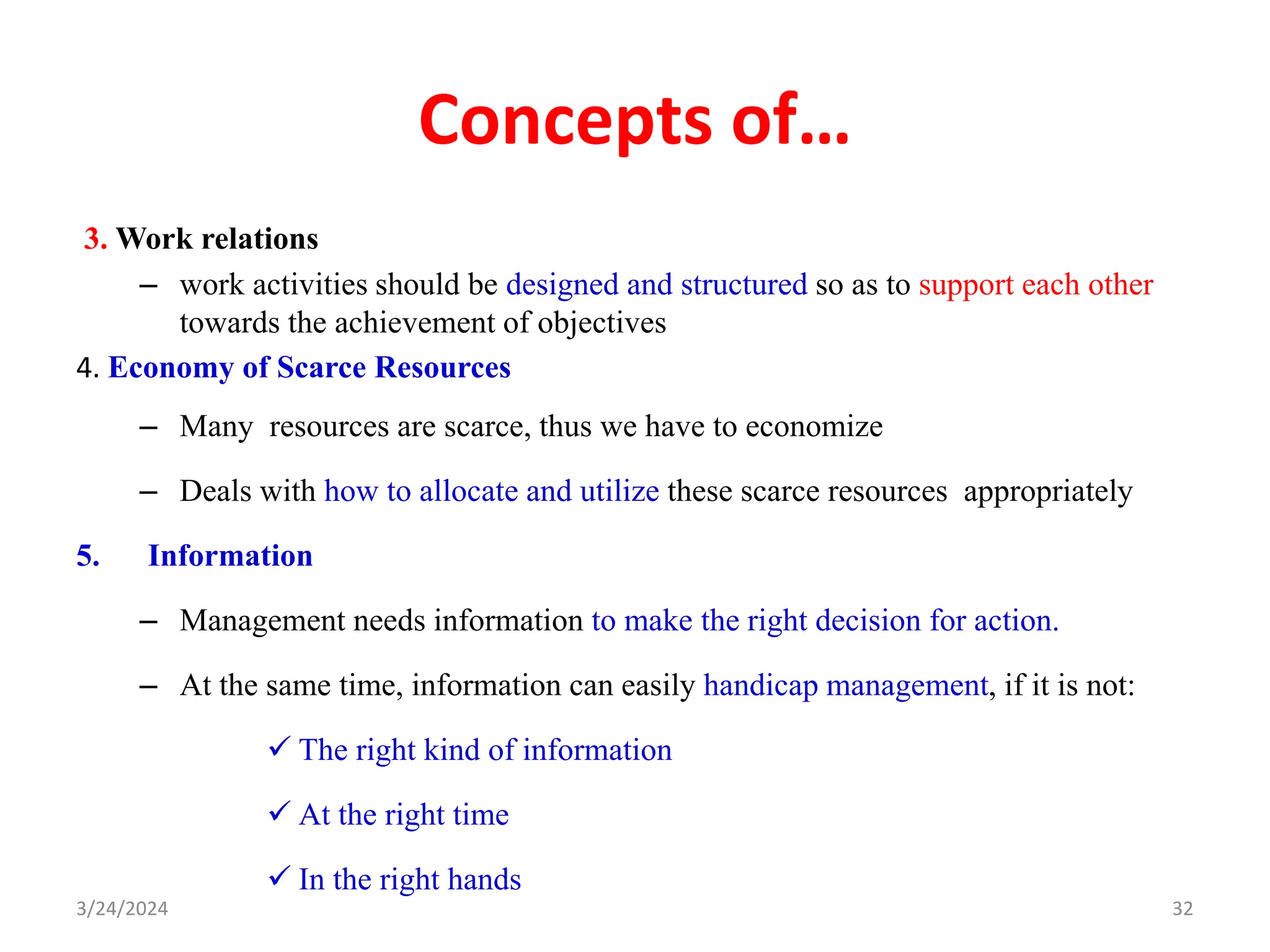
3. Work relations
– work activities should be designed and structured so as to support each other
towards the achievement of objectives
4. Economy of Scarce Resources
– Many resources are scarce, thus we have to economize
– Deals with how to allocate and utilize these scarce resources appropriately
5. Information
– Management needs information to make the right decision for action.
– At the same time, information can easily handicap management, if it is not:
 The right kind of information
 At the right time
 In the right hands
32
3/24/2024
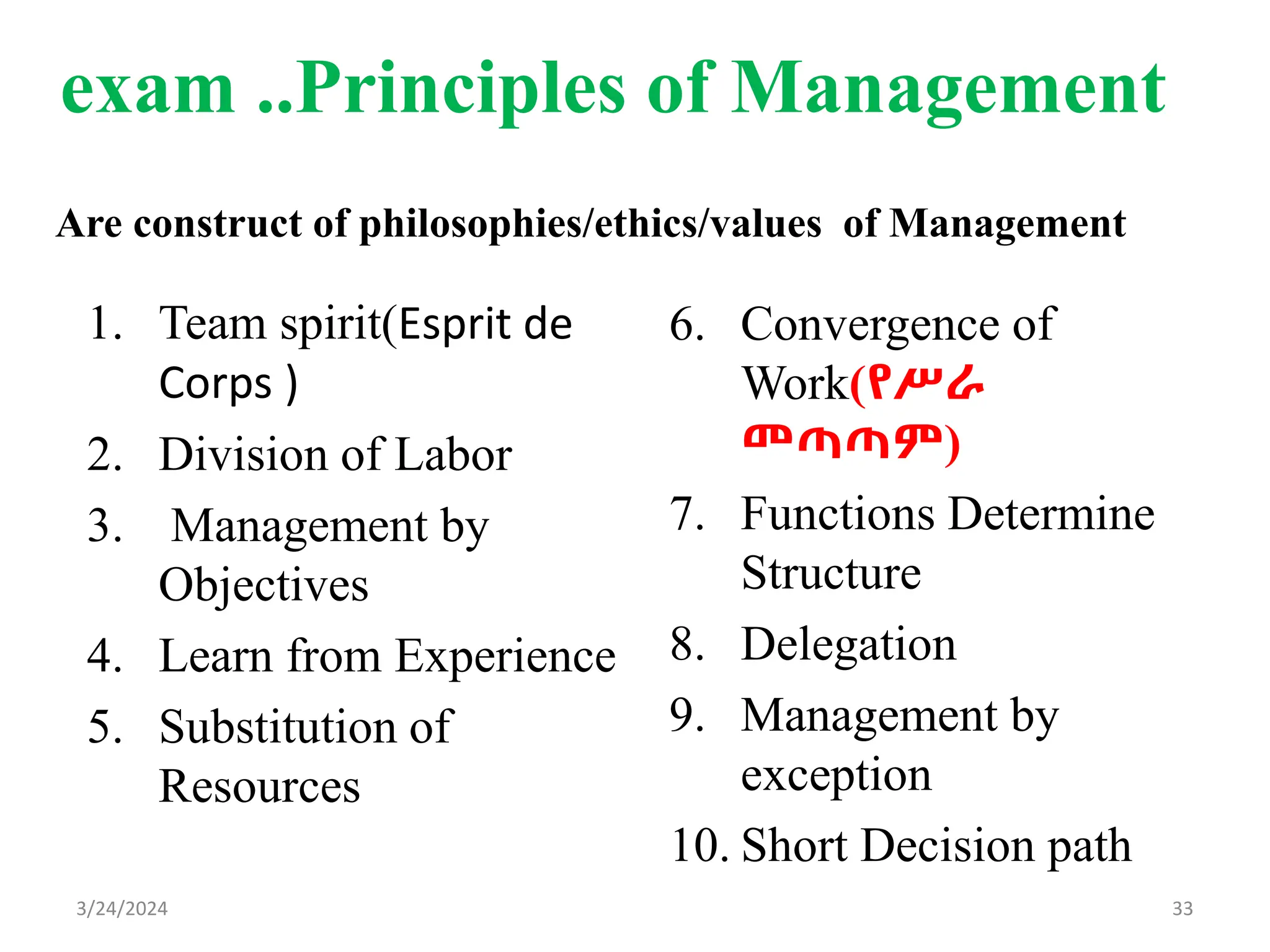
exam ..Principles of Management
1. Team spirit(Esprit de
Corps )
2. Division of Labor
3. Management by
Objectives
4. Learn from Experience
5. Substitution of
Resources
6. Convergence of
Work(የሥራ
መጣጣም)
7. Functions Determine
Structure
8. Delegation
9. Management by
exception
10. Short Decision path
33
3/24/2024
Are construct of philosophies/ethics/values of Management
Principles of …
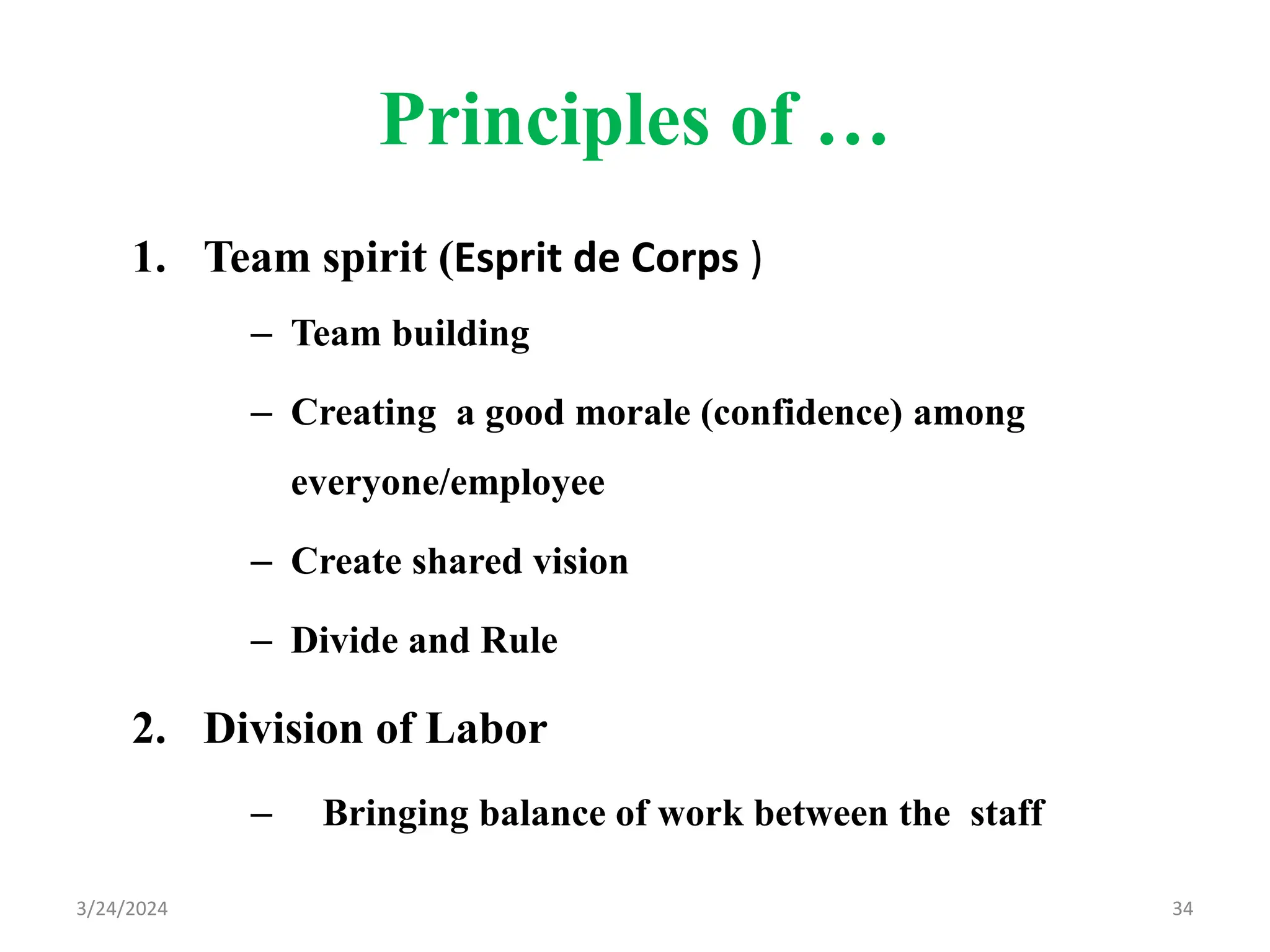
1. Team spirit (Esprit de Corps )
– Team building
– Creating a good morale (confidence) among
everyone/employee
– Create shared vision
– Divide and Rule
2. Division of Labor
– Bringing balance of work between the staff
34
3/24/2024
Principles of …
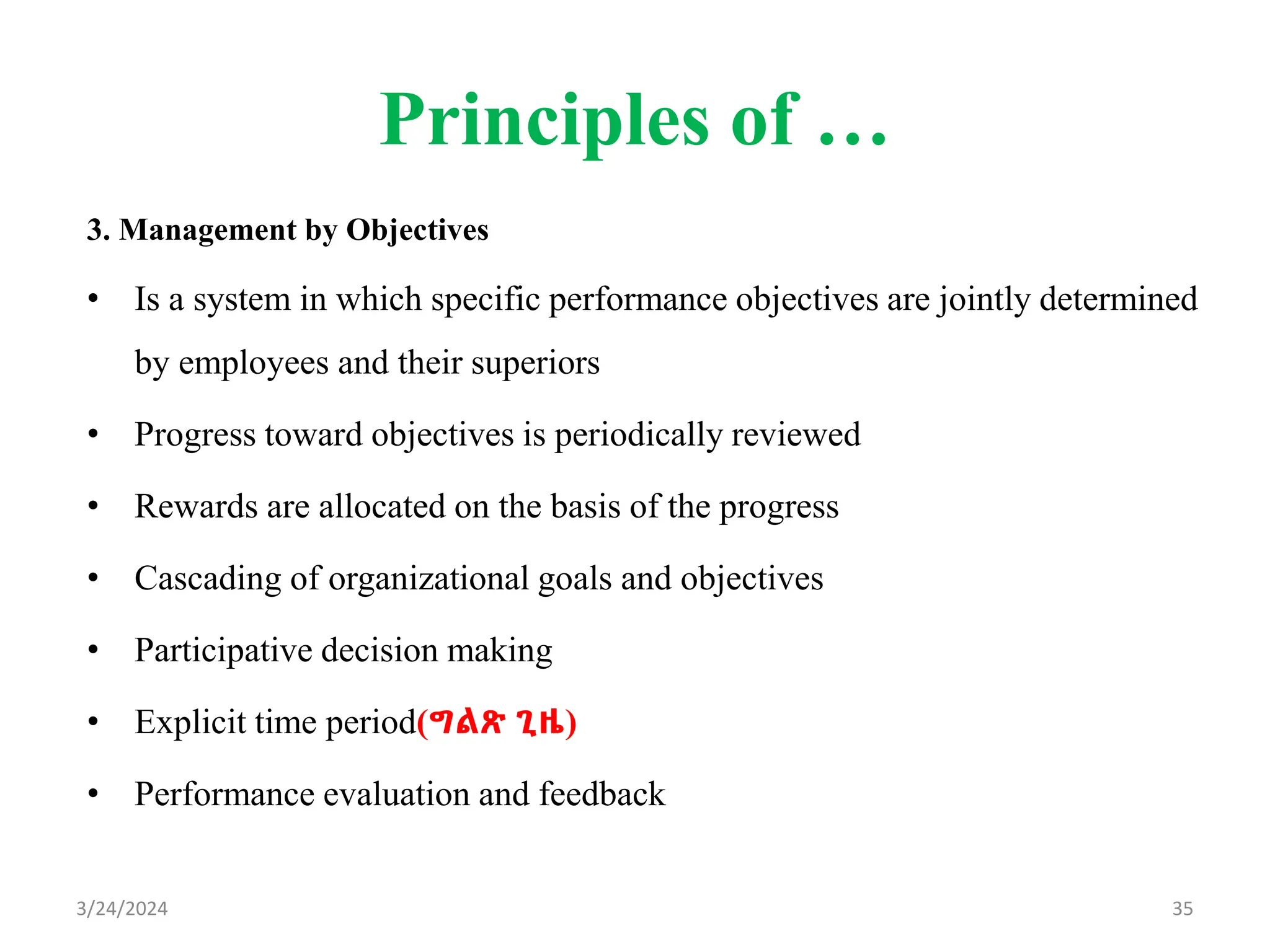
3. Management by Objectives
• Is a system in which specific performance objectives are jointly determined
by employees and their superiors
• Progress toward objectives is periodically reviewed
• Rewards are allocated on the basis of the progress
• Cascading of organizational goals and objectives
• Participative decision making
• Explicit time period(ግልጽ ጊዜ)
• Performance evaluation and feedback
35
3/24/2024
Principles of …
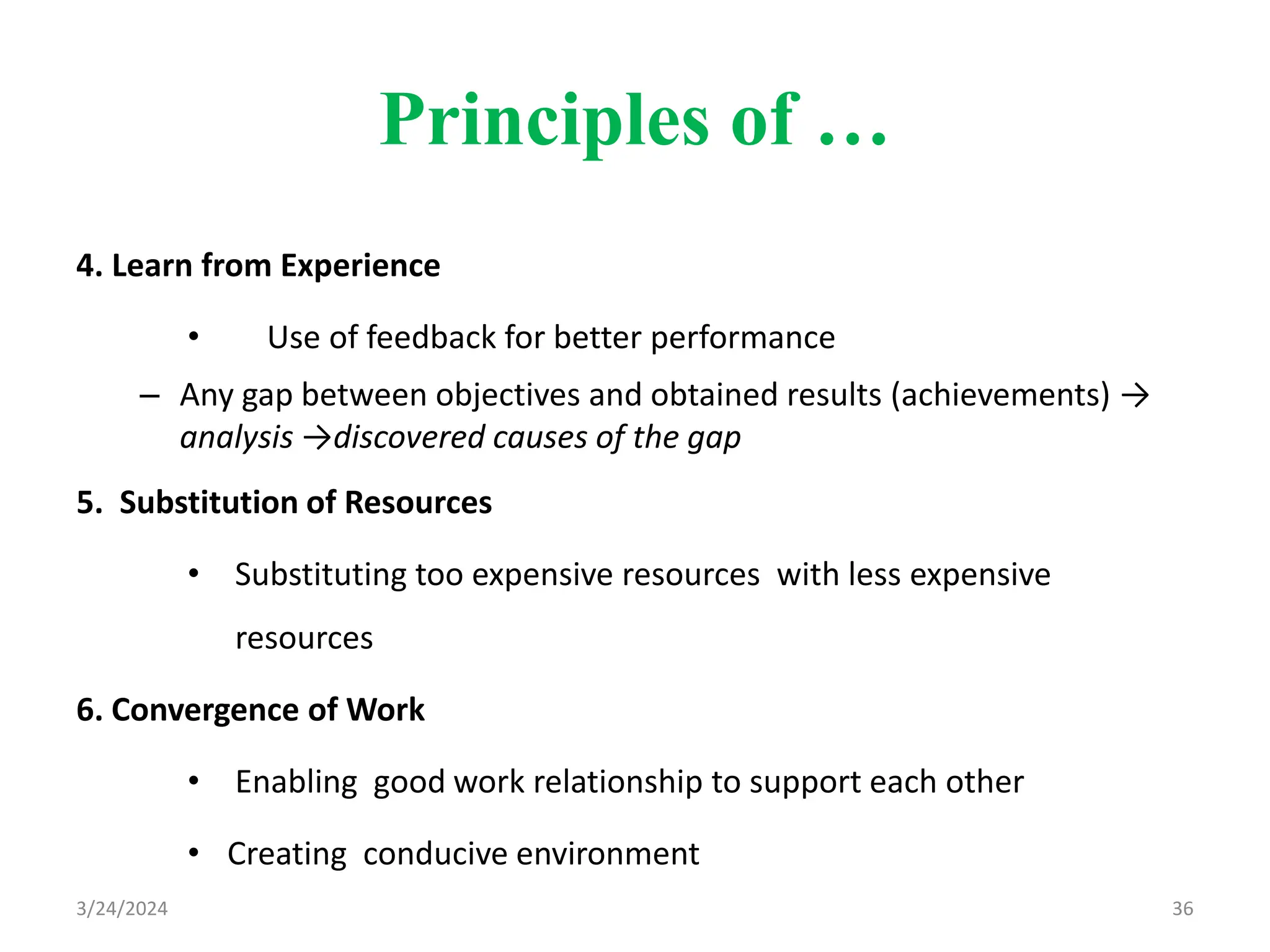
4. Learn from Experience
• Use of feedback for better performance
– Any gap between objectives and obtained results (achievements) →
analysis →discovered causes of the gap
5. Substitution of Resources
• Substituting too expensive resources with less expensive
resources
6. Convergence of Work
• Enabling good work relationship to support each other
• Creating conducive environment
36
3/24/2024
Principles of…
8. Functions Determine Structure
– Defining the duties and responsibilities of the individual members
– Determining the function & duties of individual member is followed by working relations
9. Delegation
– Assigning job activities and corresponding authority to specific individuals within the
organization
9. Management by exception
– Selectivity in information
• Don’t be overloaded with unnecessary information
• Be selective!
– Priority in decision
• Make BIG decision first!
10. Short Decision path
– Decision must be made as closely as possible in time and place to the object of decision
and to those affected by it
3/24/2024 37
Levels of Managers
• How do you define “manager”?
• What are the Levels of Managers?
38
3/24/2024
Levels of Managers
Managers
• Are people formally appointed to positions of
authority in organization or systems who:
– Enable others to do their work: direct or support
work effectively
– Have responsibility for resource utilization
– Are accountable for work results
39
3/24/2024
Exam..Levels of Managers …
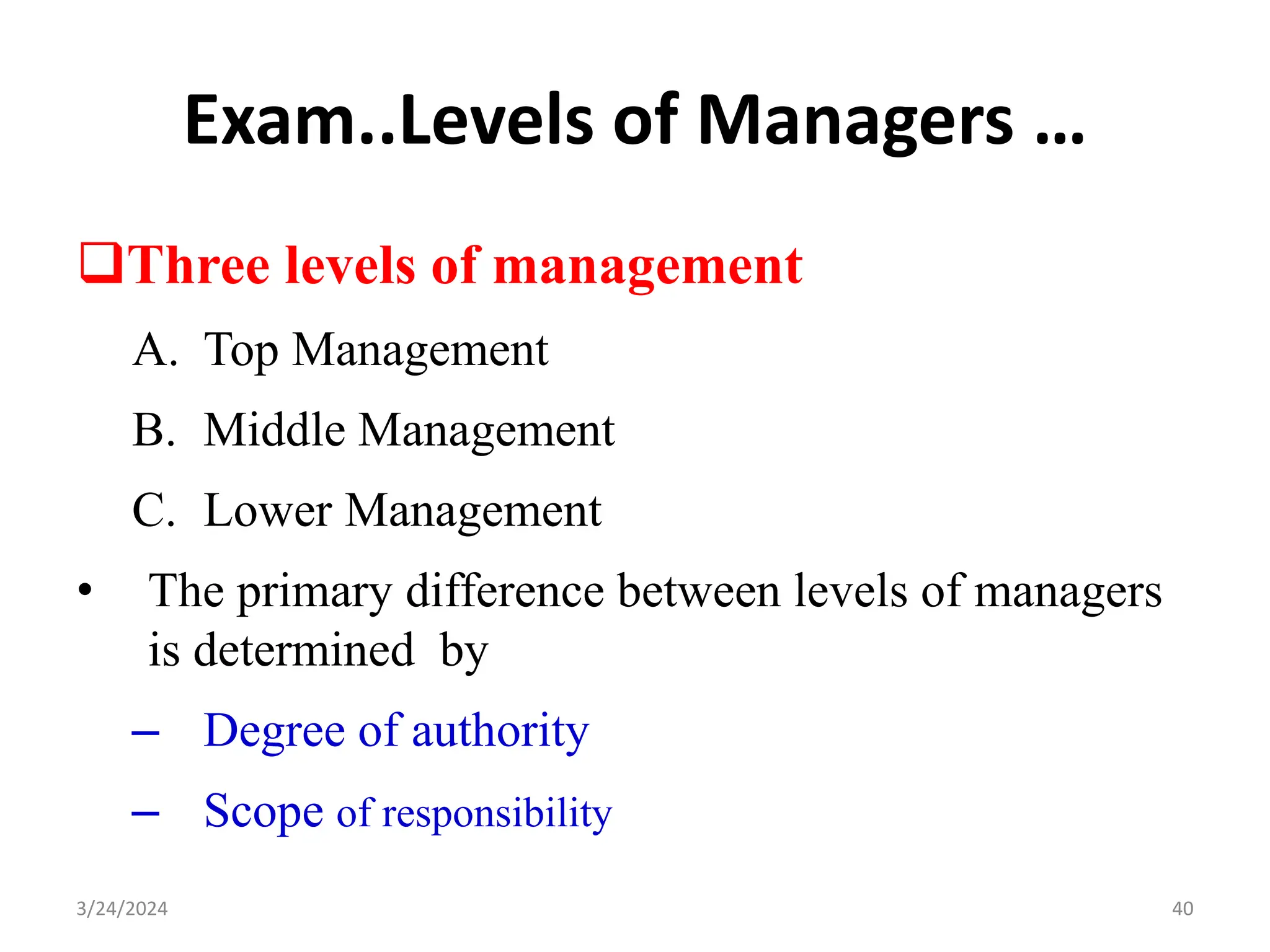
Three levels of management
A. Top Management
B. Middle Management
C. Lower Management
• The primary difference between levels of managers
is determined by
– Degree of authority
– Scope of responsibility
40
3/24/2024
Levels of Managers …
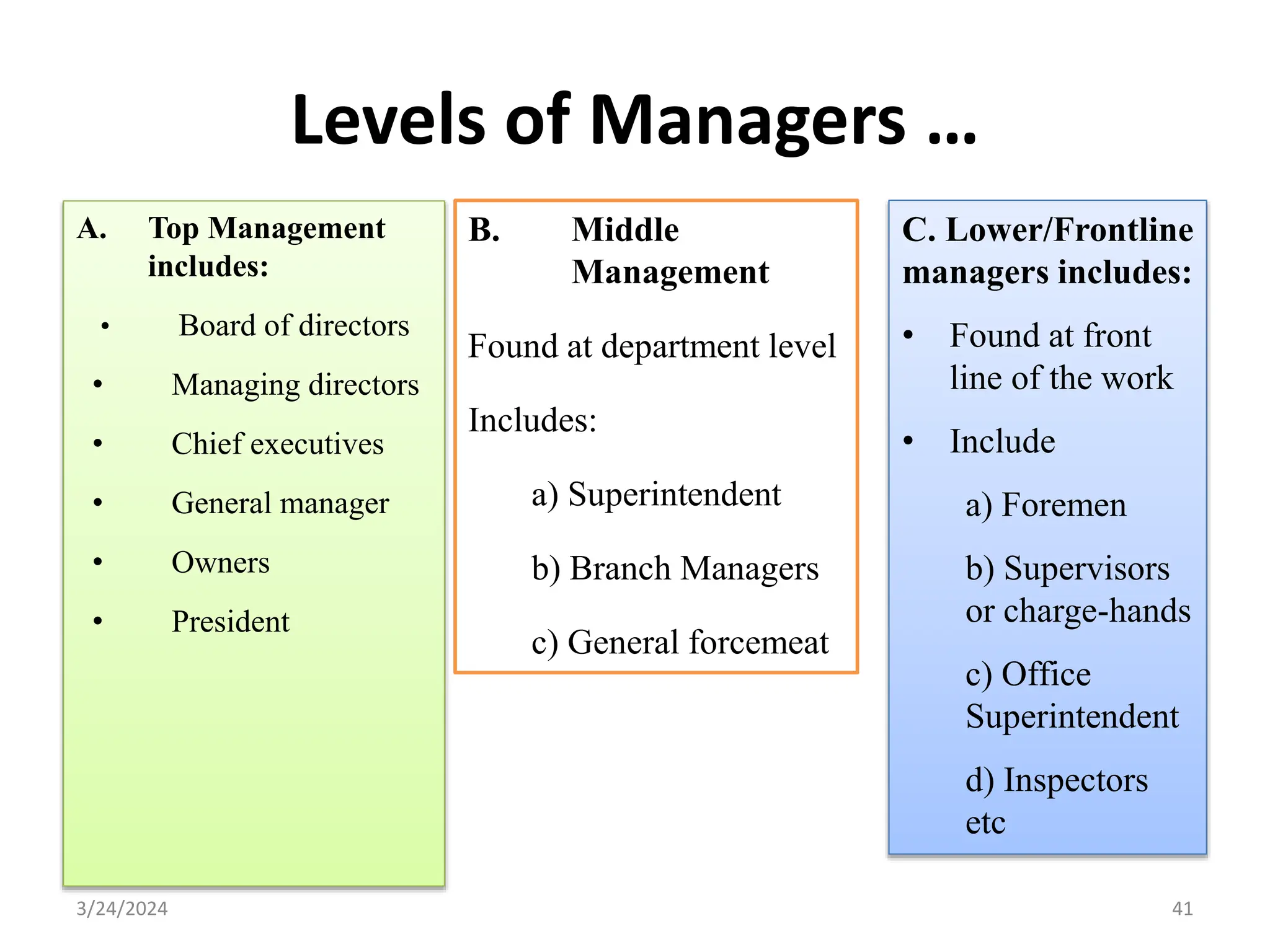
A. Top Management
includes:
• Board of directors
• Managing directors
• Chief executives
• General manager
• Owners
• President
41
3/24/2024
B. Middle
Management
Found at department level
Includes:
a) Superintendent
b) Branch Managers
c) General forcemeat
C. Lower/Frontline
managers includes:
• Found at front
line of the work
• Include
a) Foremen
b) Supervisors
or charge-hands
c) Office
Superintendent
d) Inspectors
etc
Levels of Managers …
 Functions of top managers :
A. Responsible for managing the entire organization
B. Responsible for establishing the objectives or goals of the enterprise
C. Developing strategic plan
D. Exercising effective control of the operations
E. Establishing policies
F. Setting up an organizational frame work to conduct the operations as per
plans
G. Providing overall leadership to the enterprise
G. Designing/Redesigning organization system
H. Carry out organizing and controlling activities as determined by strategic
planning
I. Are accountable to the governing body
3/24/2024 42
Levels of Managers …
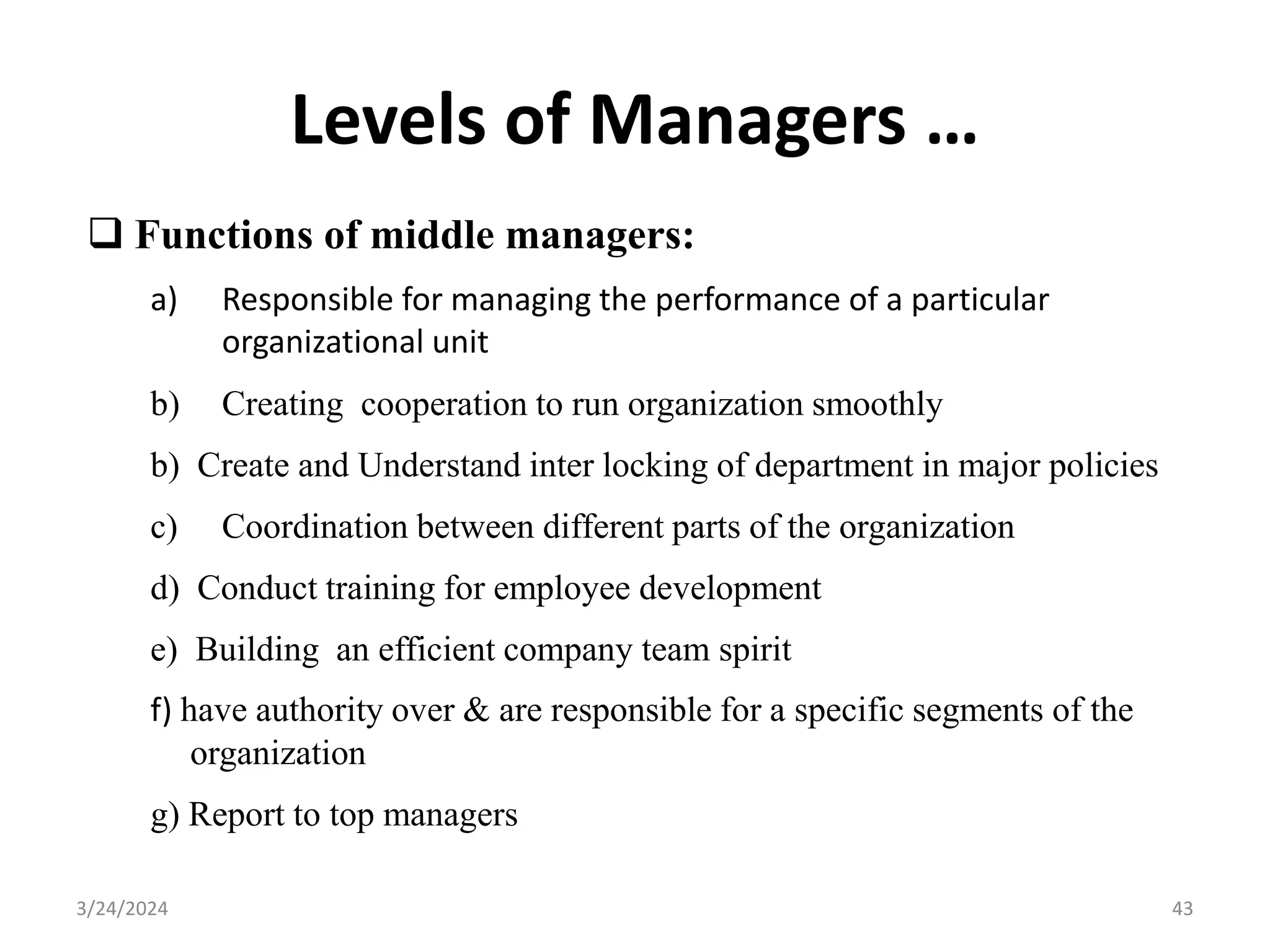
 Functions of middle managers:
a) Responsible for managing the performance of a particular
organizational unit
b) Creating cooperation to run organization smoothly
b) Create and Understand inter locking of department in major policies
c) Coordination between different parts of the organization
d) Conduct training for employee development
e) Building an efficient company team spirit
f) have authority over & are responsible for a specific segments of the
organization
g) Report to top managers
43
3/24/2024
Levels of Managers …
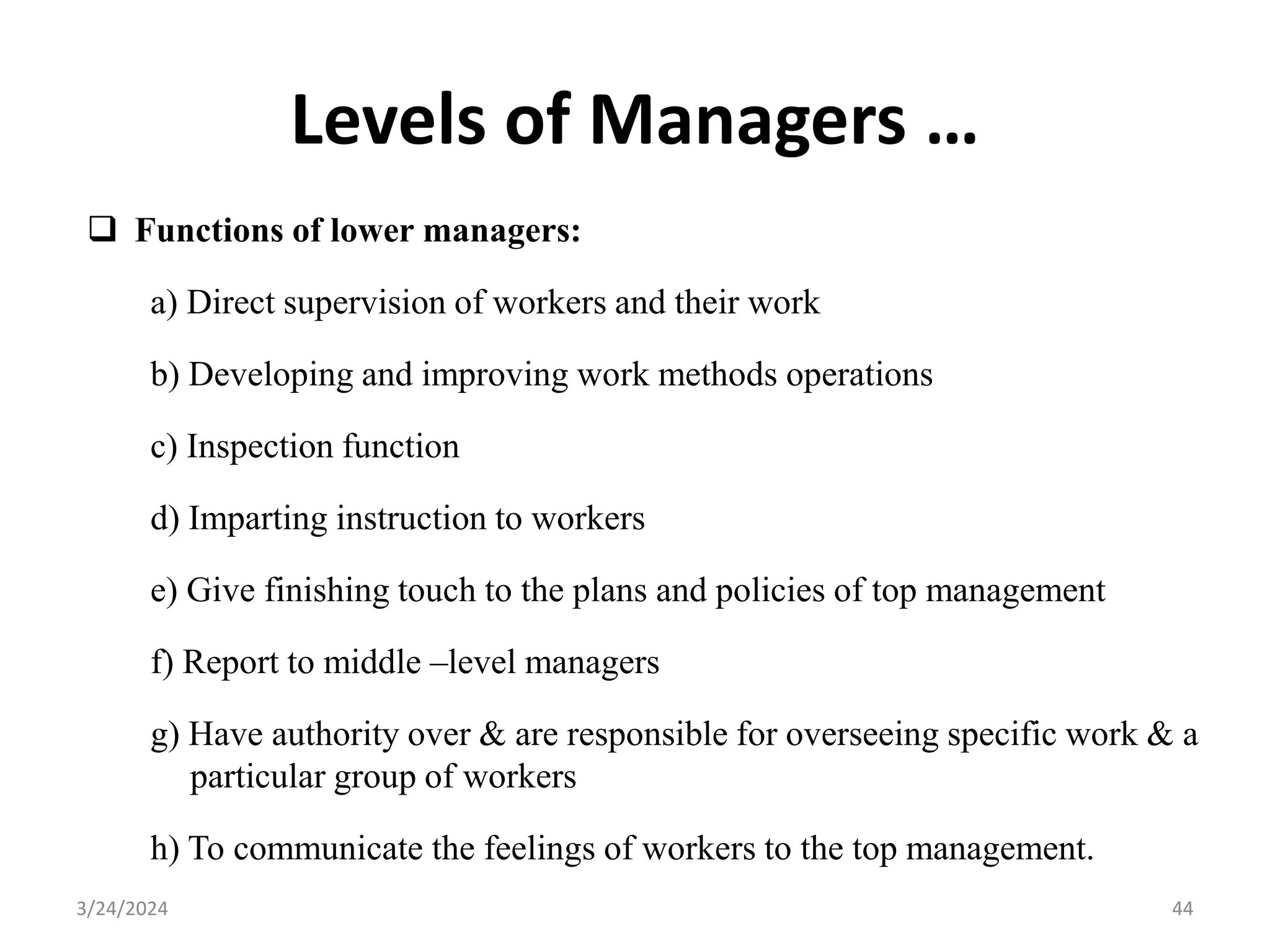
 Functions of lower managers:
a) Direct supervision of workers and their work
b) Developing and improving work methods operations
c) Inspection function
d) Imparting instruction to workers
e) Give finishing touch to the plans and policies of top management
f) Report to middle –level managers
g) Have authority over & are responsible for overseeing specific work & a
particular group of workers
h) To communicate the feelings of workers to the top management.
44
3/24/2024
Break
3/24/2024 45
MANAGERIAL ROLES
• What is mean by “ role “ ?
• What is your role know?
• What roles do you think manager should have
to manage the organization to its best?
46
3/24/2024
Exam..MANAGERIAL ROLES
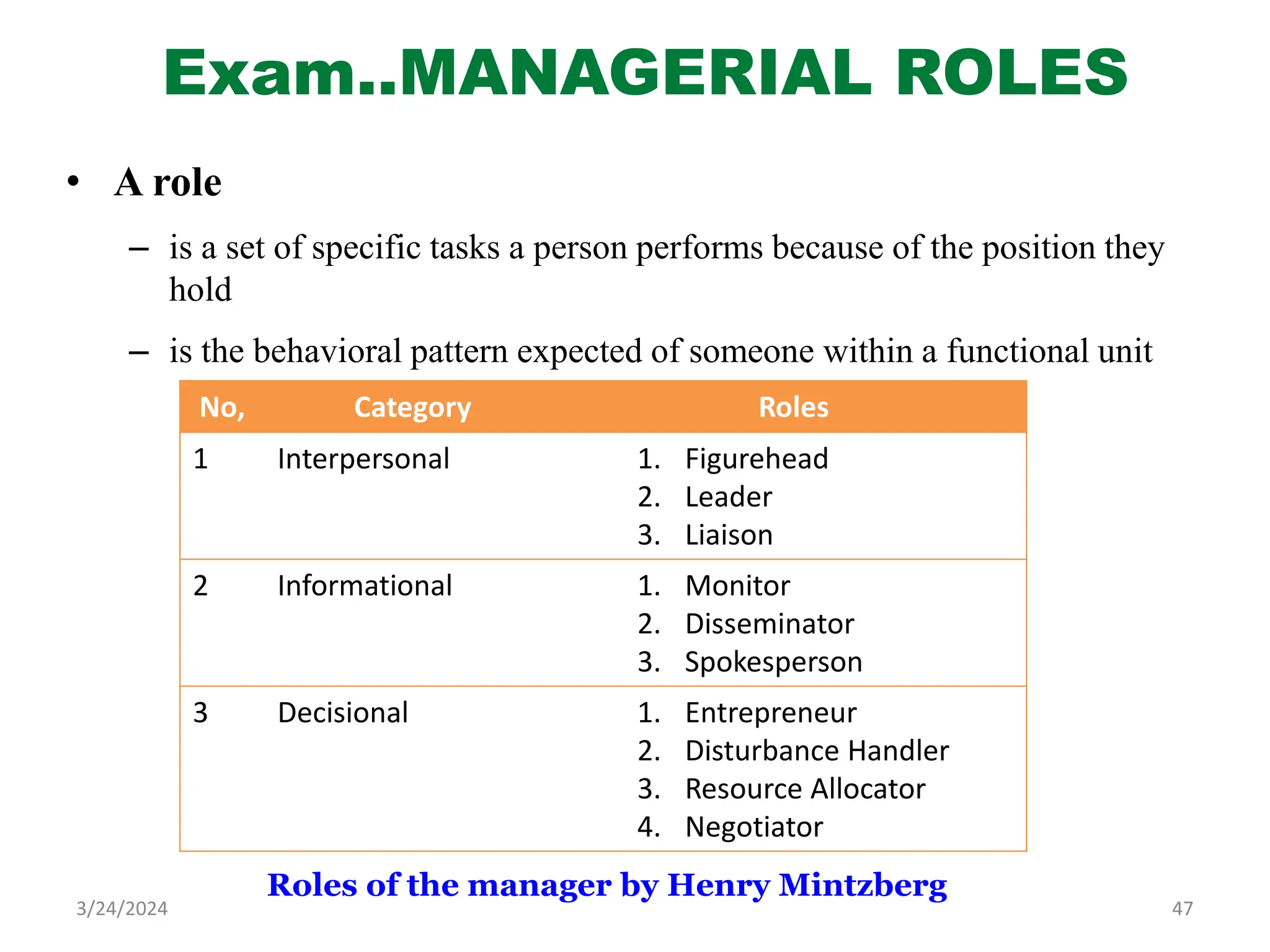
• A role
– is a set of specific tasks a person performs because of the position they
hold
– is the behavioral pattern expected of someone within a functional unit
47
3/24/2024
No, Category Roles
1 Interpersonal 1. Figurehead
2. Leader
3. Liaison
2 Informational 1. Monitor
2. Disseminator
3. Spokesperson
3 Decisional 1. Entrepreneur
2. Disturbance Handler
3. Resource Allocator
4. Negotiator
Roles of the manager by Henry Mintzberg
MANAGERIAL ROLES…
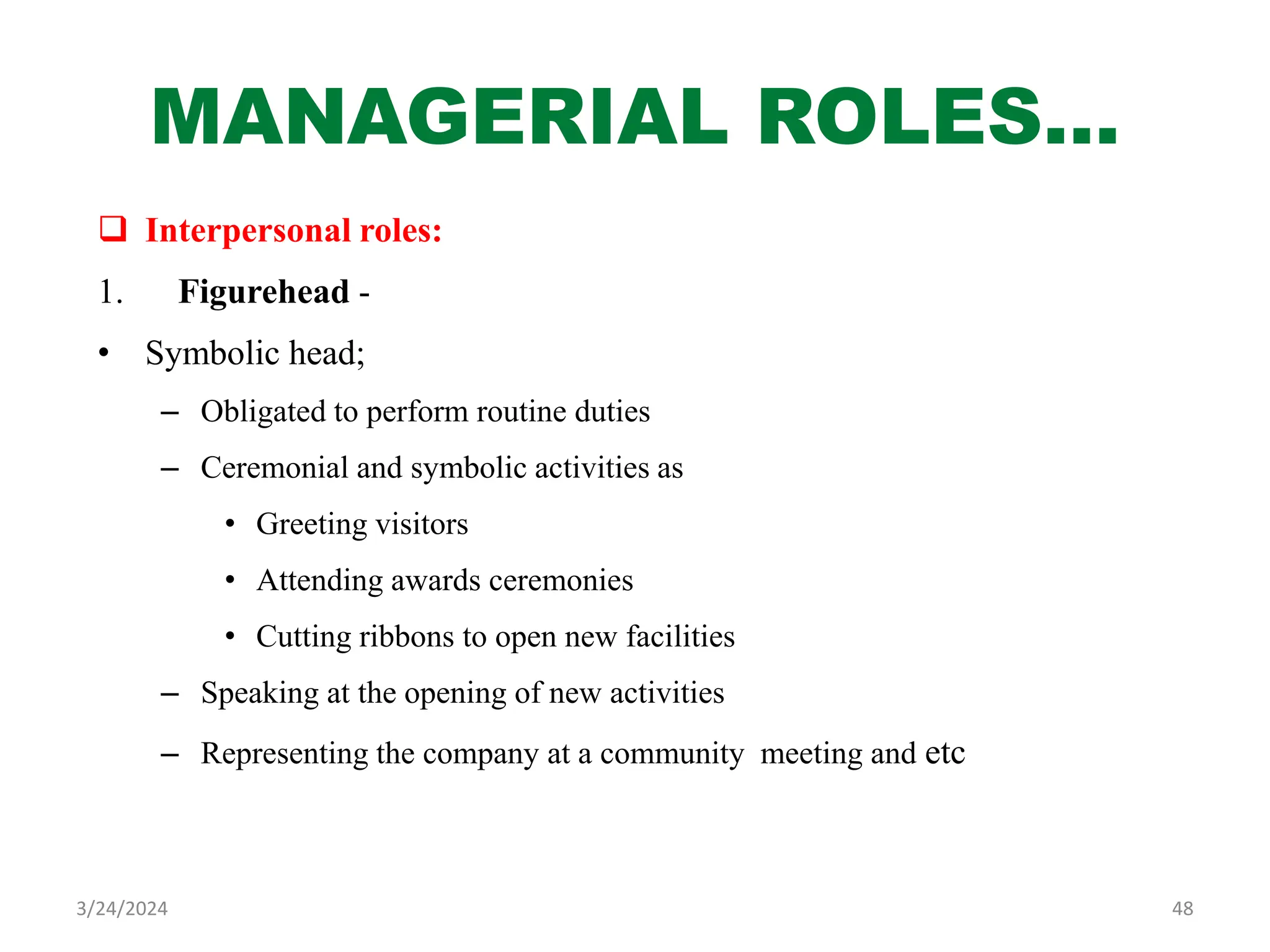
 Interpersonal roles:
1. Figurehead -
• Symbolic head;
– Obligated to perform routine duties
– Ceremonial and symbolic activities as
• Greeting visitors
• Attending awards ceremonies
• Cutting ribbons to open new facilities
– Speaking at the opening of new activities
– Representing the company at a community meeting and etc
48
3/24/2024
MANAGERIAL ROLES…
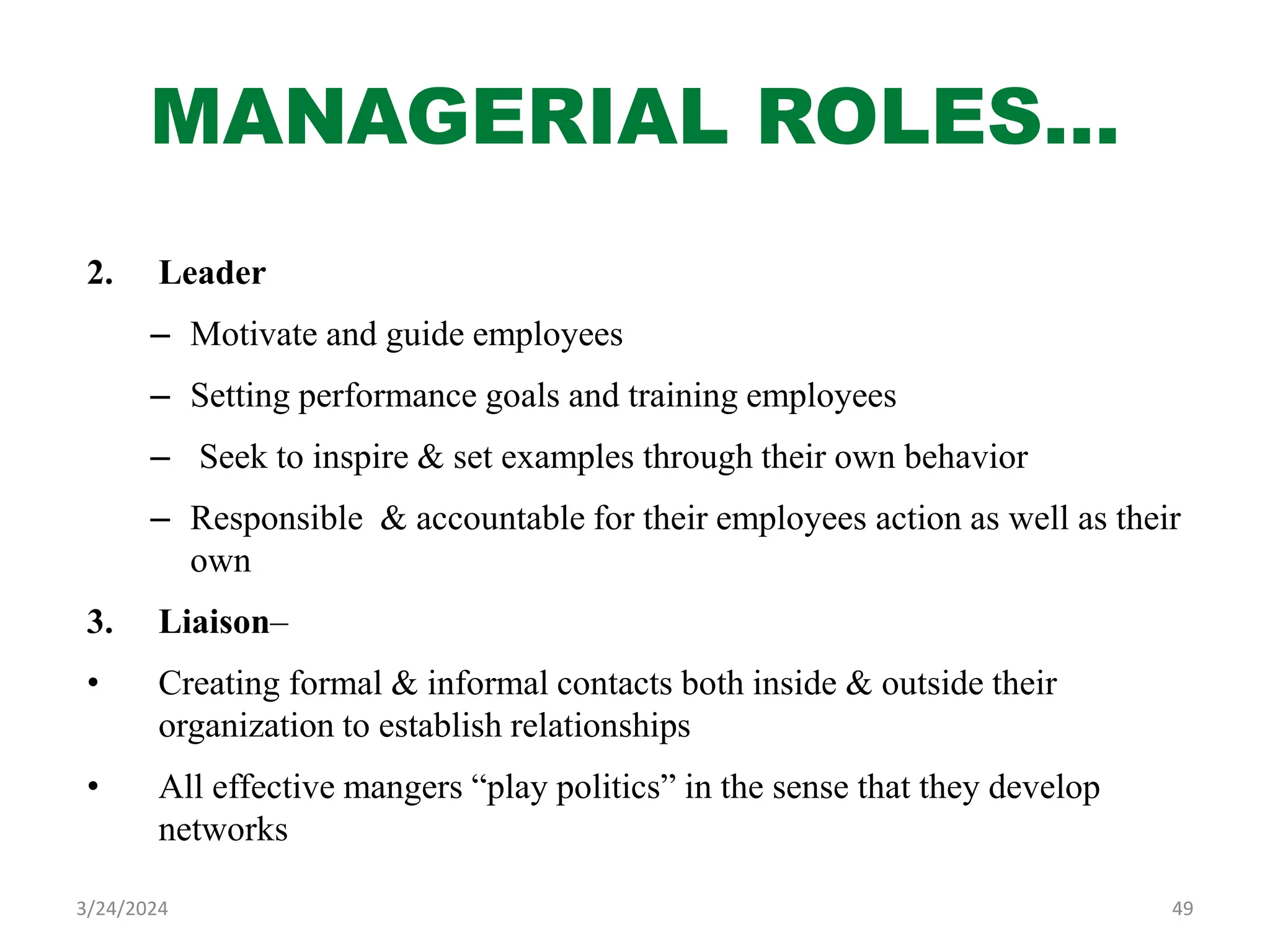
2. Leader
– Motivate and guide employees
– Setting performance goals and training employees
– Seek to inspire & set examples through their own behavior
– Responsible & accountable for their employees action as well as their
own
3. Liaison–
• Creating formal & informal contacts both inside & outside their
organization to establish relationships
• All effective mangers “play politics” in the sense that they develop
networks
49
3/24/2024
MANAGERIAL ROLES…
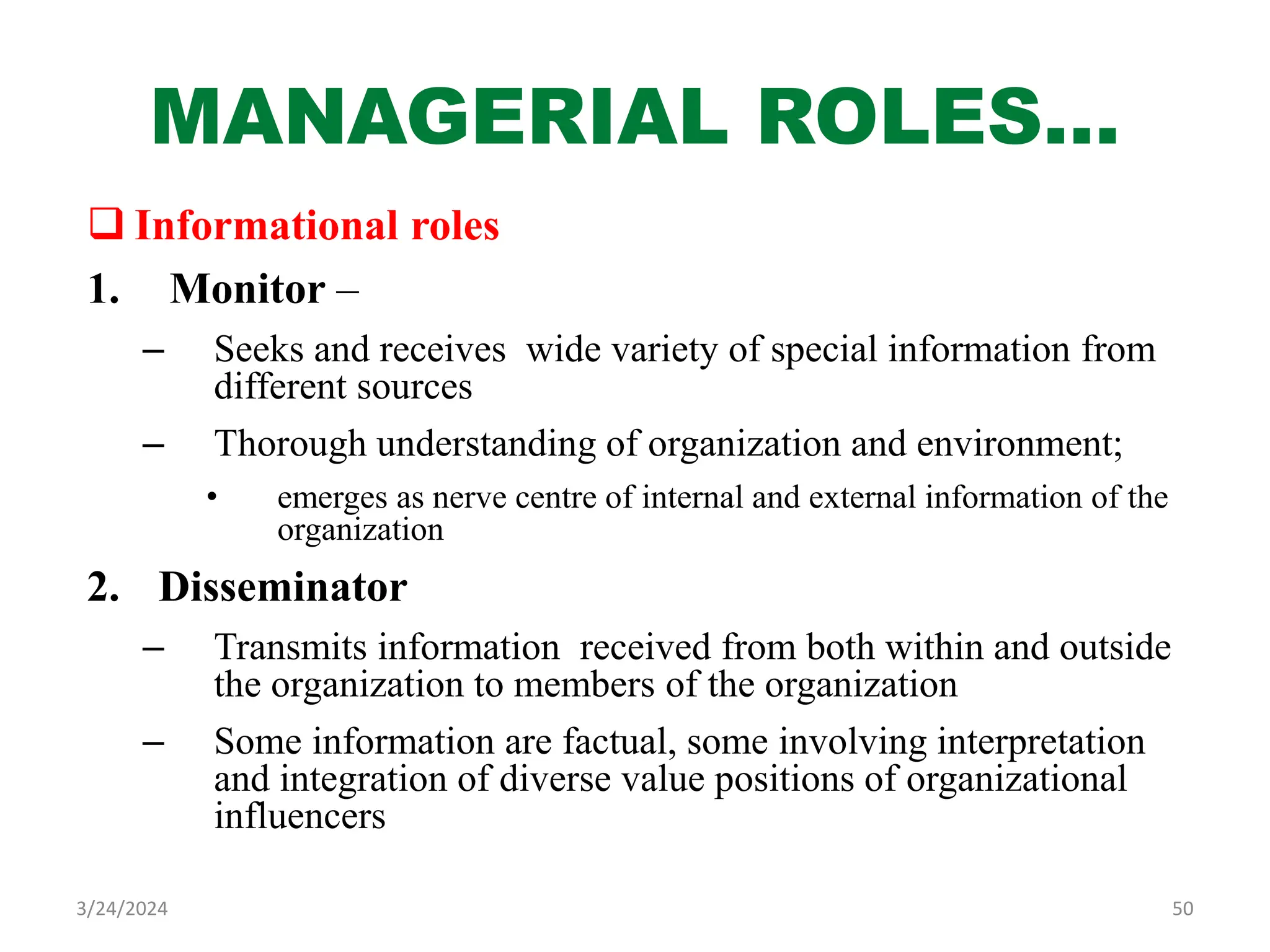
 Informational roles
1. Monitor –
– Seeks and receives wide variety of special information from
different sources
– Thorough understanding of organization and environment;
• emerges as nerve centre of internal and external information of the
organization
2. Disseminator
– Transmits information received from both within and outside
the organization to members of the organization
– Some information are factual, some involving interpretation
and integration of diverse value positions of organizational
influencers
50
3/24/2024
MANAGERIAL ROLES…
3. Spokesman
– Transmits information to stake holders about
external environment and organization’s plans,
policies, actions, results of its activities
– Distribute information to people outside their
organizations or units through annual stockholder
reports, speeches, memos, and various other means
– This role is related to the figurehead role
51
3/24/2024
MANAGERIAL ROLES…
 Decisional roles:
1. Entrepreneur
– Are initiators and designers of changes intended to improve
performances
– Act as change agents → initiate improvement projects, identify new
ideas, delegate idea responsibilities to others
2. Disturbance handler
– Detect wide variety of problems & decides on and implements
solutions
– Takes corrective action during disputes or crises and resolves
conflicts among subordinates
– The ability to make good decisions about handling disturbances is and
important determinant of managerial success
52
3/24/2024
MANAGERIAL ROLES…
3. Resource allocator
 Prioritize tasks and make decisions regarding the use of limited resources
 Responsible for the allocation of 0rganizational resources of all kinds
 Making or approval of all significant organizational decisions
 Deciding what resources will be allocated to perform the planned task
4. Negotiator
 Responsible for representing the organizations at major negotiations
 Involving negotiation on behalf of the organization both internally and
externally
 Interact and bargain with employees, suppliers, regulators, customers, clients
and others
• Negotiating includes deciding what objectives to seek through negotiations and
how to be top to conduct the negotiations
53
3/24/2024
MANAGERIAL ROLES…
Characteristics of Professional Managers
1. Managers are responsible and accountable
– Responsible for seeing that specific tasks are done
successfully
– They are usually evaluated on how well they
arrange for tasks to be accomplished
– Responsible for the actions of their employees
– The success or failure of subordinates is a direct
reflection of managers' success or failure
54
3/24/2024
MANAGERIAL ROLES…
2. Managers balances competing goals and set priorities
– At any given time, the manager faces a number of
organizational goals, problems and needs all of which
compete for the manager's time and resources (both
human and material)
– A manager must also decide who is to perform a particular
task and must assign work to an appropriate person
3. Managers think analytically and conceptually
– A manager must be able to break a problem down into its
components, analyze those components and then come up
with a feasible solution
55
3/24/2024
MANAGERIAL ROLES…
4. Managers are mediators
– Managers must at times take on the role of mediator and
iron out disputes before they get out of hand
– Setting conflicts requires skill and tact
5. Managers make difficult decisions
– No organization runs smoothly all the time
– Managers are expected to come up with solutions to
difficult problems and to follow through on their decisions
even when doing so may be unpopular
56
3/24/2024
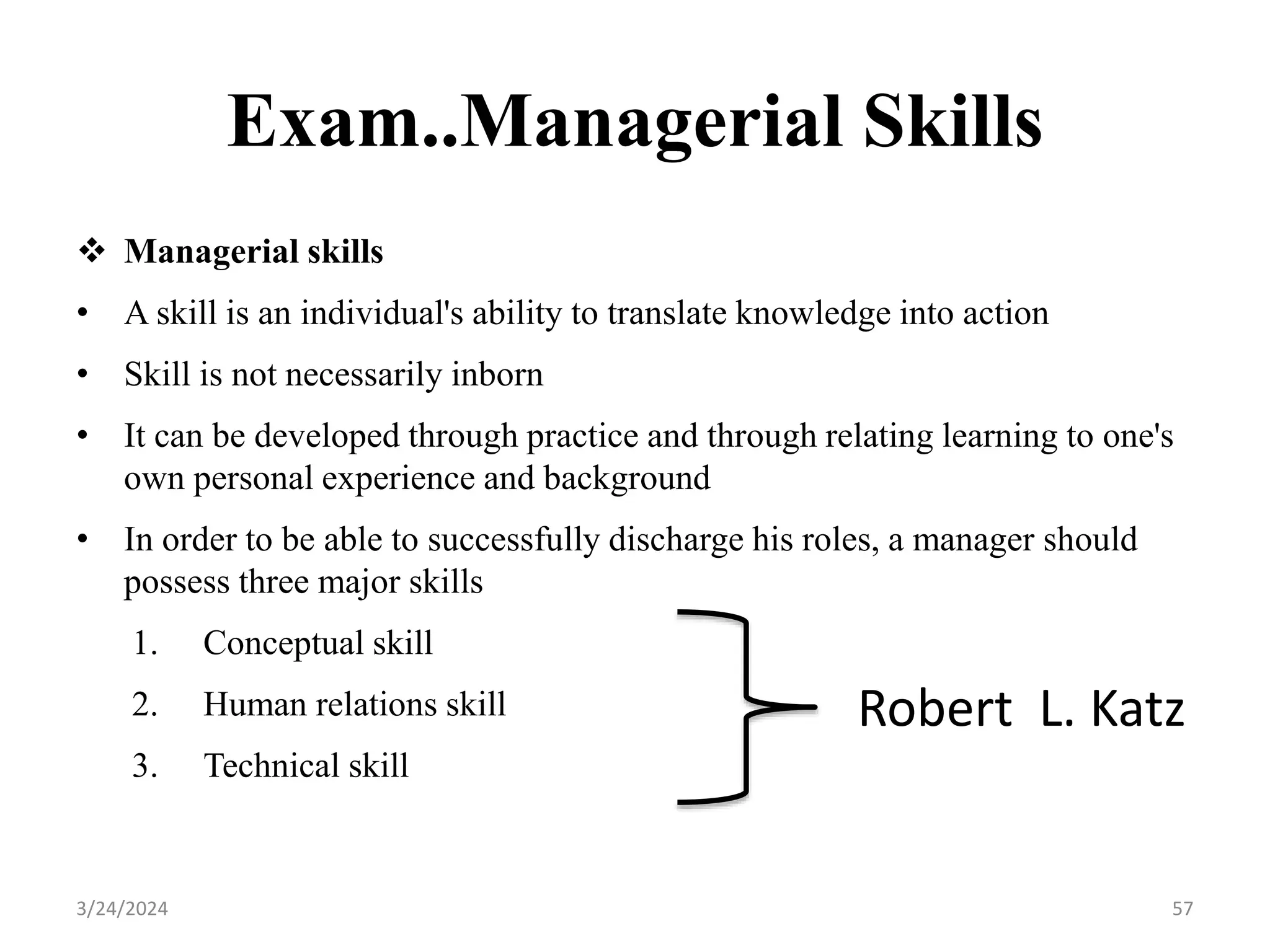
Exam..Managerial Skills
 Managerial skills
• A skill is an individual's ability to translate knowledge into action
• Skill is not necessarily inborn
• It can be developed through practice and through relating learning to one's
own personal experience and background
• In order to be able to successfully discharge his roles, a manager should
possess three major skills
1. Conceptual skill
2. Human relations skill
3. Technical skill
57
3/24/2024
Robert L. Katz
Managerial Skills…
1. Technical skill
– Is the manager's understanding of the nature of job that people
under him have to perform
– Is knowledge and proficiency in performing activities
– It involves working with tools and specific techniques
– Skills can be acquired through training, education and work
experience
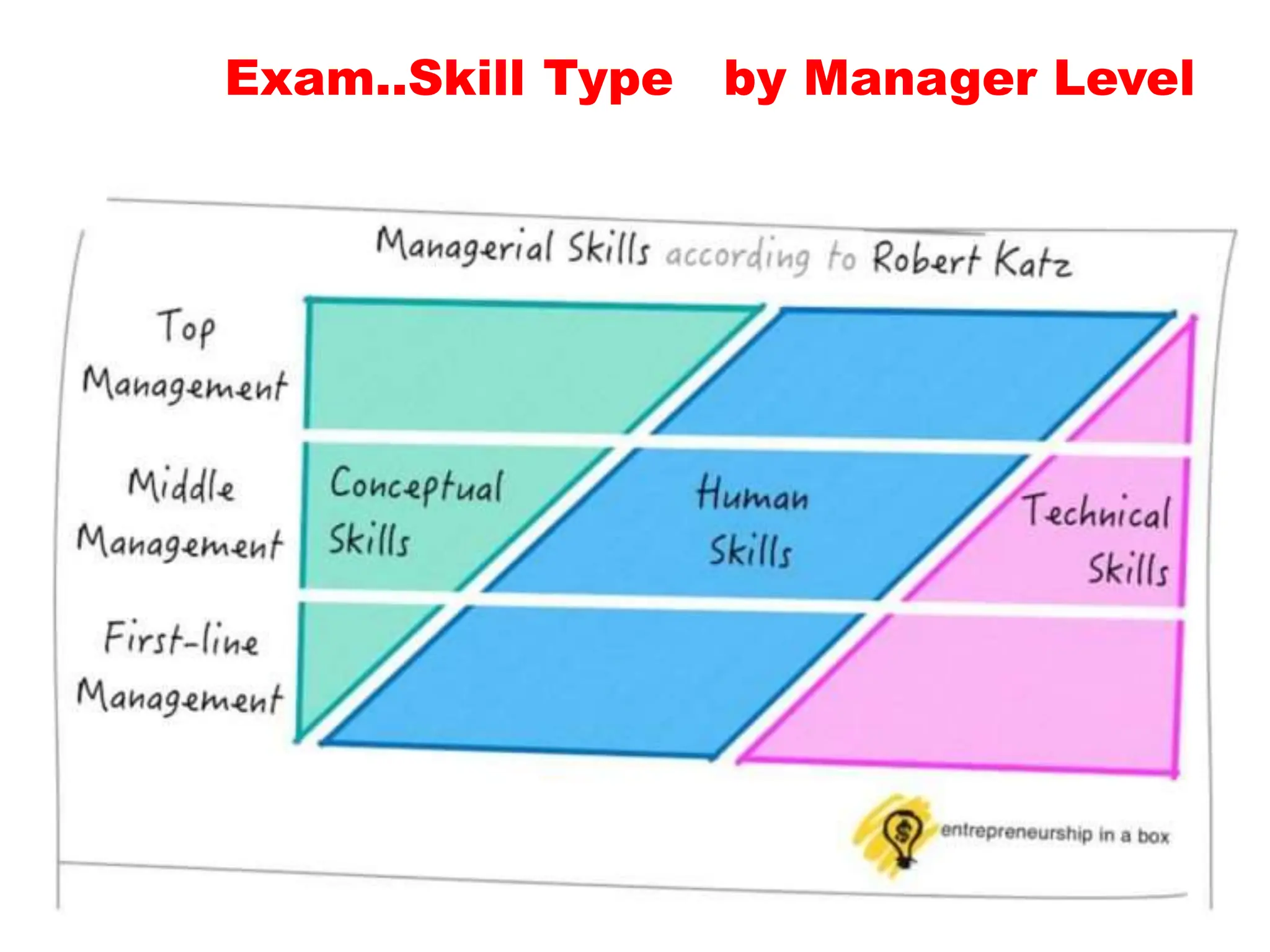
– Tend to be more important for lower-level managers
– Deal with the design of production system, and acquisition,
allocation and conversion of physical resources to achieve
certain goals
58
3/24/2024
Managerial Skills…
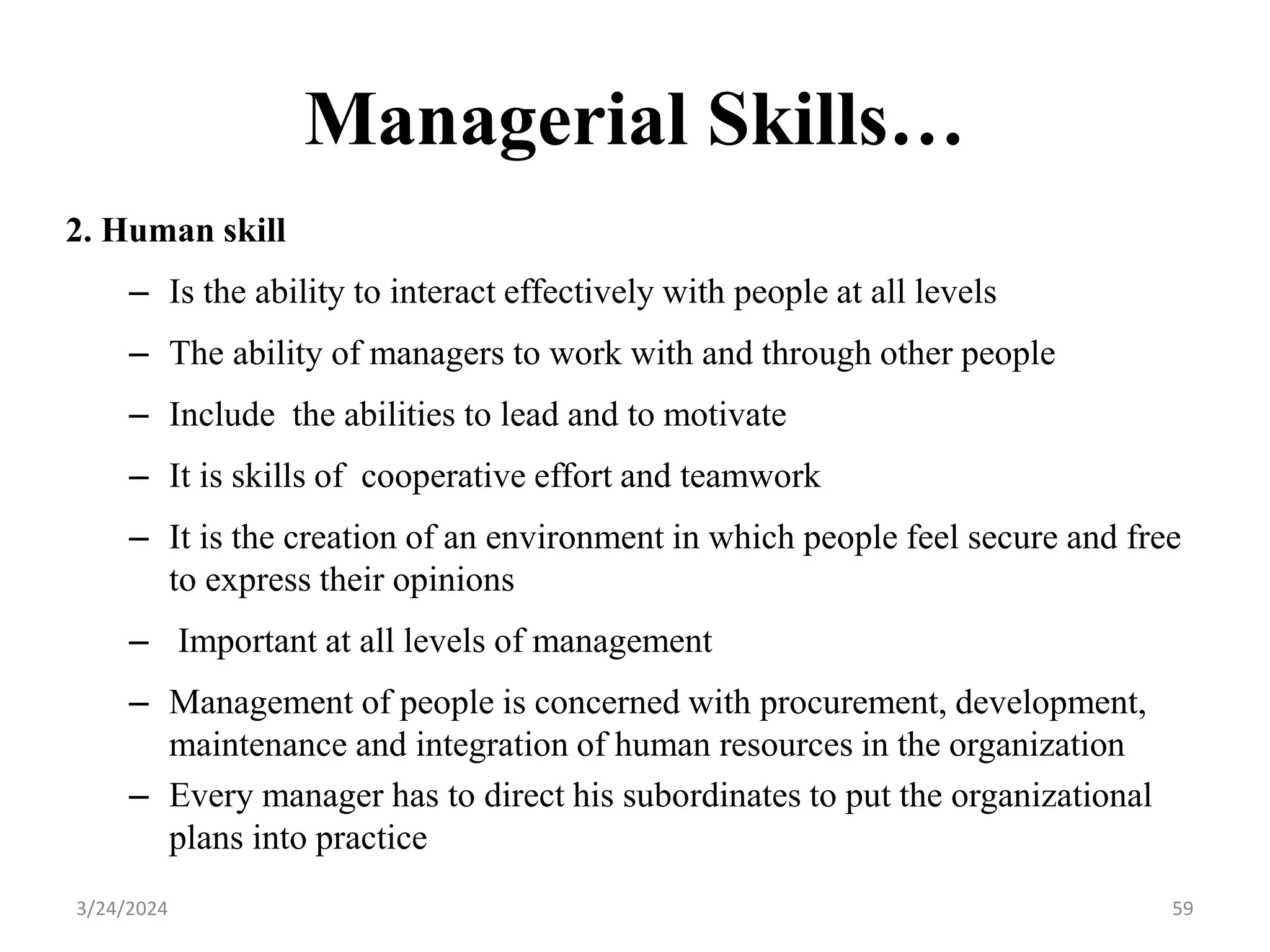
2. Human skill
– Is the ability to interact effectively with people at all levels
– The ability of managers to work with and through other people
– Include the abilities to lead and to motivate
– It is skills of cooperative effort and teamwork
– It is the creation of an environment in which people feel secure and free
to express their opinions
– Important at all levels of management
– Management of people is concerned with procurement, development,
maintenance and integration of human resources in the organization
– Every manager has to direct his subordinates to put the organizational
plans into practice
59
3/24/2024
Managerial Skills…
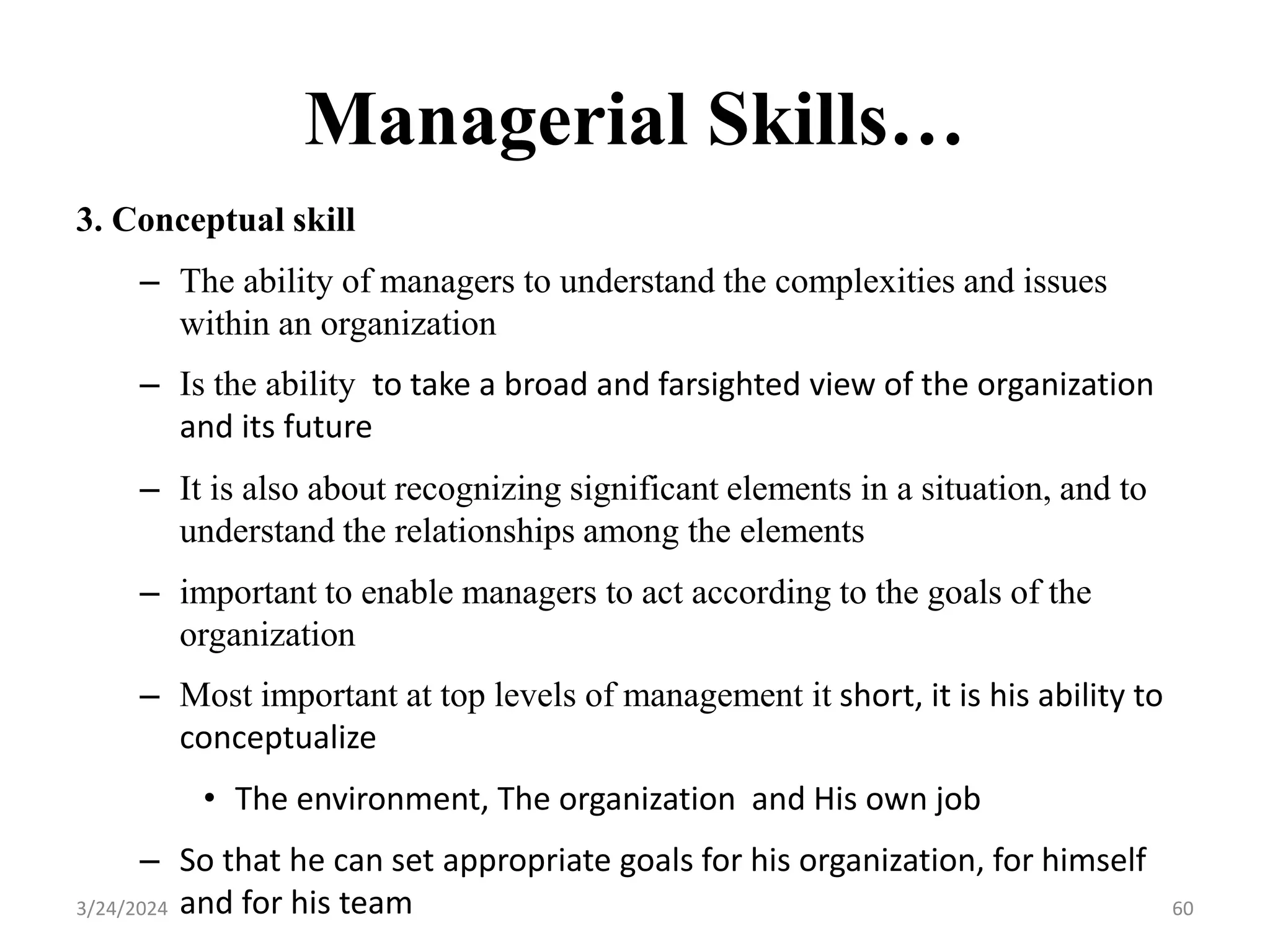
3. Conceptual skill
– The ability of managers to understand the complexities and issues
within an organization
– Is the ability to take a broad and farsighted view of the organization
and its future
– It is also about recognizing significant elements in a situation, and to
understand the relationships among the elements
– important to enable managers to act according to the goals of the
organization
– Most important at top levels of management it short, it is his ability to
conceptualize
• The environment, The organization and His own job
– So that he can set appropriate goals for his organization, for himself
and for his team 60
3/24/2024
3/24/2024 61
Exam..Skill Type by Manager Level
References
• Systems of management Rensis likert (1903-
1981)
• Mary parker follett (1868–1933) the scientific-
cum-technical approach to management
• Principles of management , Lyndall Urwick
(1943)
• General principles of managerial effectiveness
Henri Fayol (1917)
3/24/2024 62
3/24/2024 63

Unit 1. Introduction to mgt for MPH.pptx

  • 1.
    HEALTH SERVICE MANAGEMENT By EBRAHIM MOHAMMED (DMGT, MPH, PhD Fellow) zebrahim720@gmail.com ACSHMC, Ethiopia 3/24/2024 1
  • 2.
  • 3.
    Learning Objectives • Bythe end of this session, students will be able understand – Define management – Health System – The WHO Health System Frame Work – Concepts of management – Principles of management – Role of managers – Levels of Managers 3 3/24/2024
  • 4.
  • 5.
    Definitions of Management Management –The process of designing and maintaining an environment in which individuals, working together in groups, efficiently accomplish selected aims (koontz and weihrich , 1990) – The efficient use of resources and getting people working harmoniously(በስምምነት) together in order to achieve organizational objectives – Getting things done through other people – The process of planning, organizing, leading/directing and controlling the efforts of organizational members and using all available organizational resources to reach predetermined objectives 3/24/2024 5
  • 6.
    Definition of … Management… • Acquisition (ማግኘት )of managerial competence(ብቃት), and effectiveness in the following key areas –Problem solving –Administration –Resource management –Organizational leadership 3/24/2024 6
  • 7.
    Definition of … Thedefinitions suggests: – Management is a continuous process – Several interrelated activities have to be performed by managers irrespective of their levels to achieve the desired goals – Managers use the resources of the organization, both physical as well as human, to achieve the goals – Management aims at achieving the organization's goals by ensuring effective use of resources in the best interests of the society 3/24/2024 7
  • 8.
  • 9.
    Management Art orScience? • Management is basically an art because of the following reasons – • A manager applies his knowledge and skills to coordinate the efforts of his people – Management seeks to achieve concrete practical results – Management is creative. It brings out new situation and converts into output – Effective Management lead to realization of organizational and other goals. – Management requires a sufficiently long period of experience in managing 3/24/2024 9 The main elements of an art includes · Personal Skills · Practical know-how · Application of knowledge · Result orientation · Creativity · Constant practice aimed at perfection
  • 10.
    Management Art orScience? … • Management as Science • The essential elements of Science – Systematized body of Knowledge – Underlying principles and theories developed through continuous observation, inquiry, experimentation and research – Universal truth and applicability – Organized body of knowledge (የእውቀት አካል )can be taught and learnt in class- room and outside – Management is a social science; It contains all the essentials of science, It is an inexact science (ትክክለኛ ያልሆነ ሳይንስ) 3/24/2024 10
  • 11.
  • 12.
    Management Vs Administration •Administration – A systematic process of administering the management of a business organization, an educational institution like school or college, government office or any nonprofit organization including health care institutions – An act of administering the whole organization by a group of people – Administration is a high-level activity • The main function – The formation of plans, policies, and procedures, setting up of goals and objectives, enforcing rules and regulations, etc – Lays down the fundamental framework of an organization 3/24/2024 12
  • 13.
    Management Vs Administration… • Management – An act of managing people and their work, for achieving a common goal by using the organization’s resources • Main function – Planning, organizing, leading, motivating, controlling, coordination and decision making are the major activities performed by the management 3/24/2024 13
  • 14.
    Exam.. Management Vs.Administration … BASIS FOR COMPARISON MANAGEMENT ADMINISTRATION Meaning An organized way of managing people and things of a business organization is called the Management The process of administering an organization by a group of people is known as the Administration. Authority/Status Middle and Lower Level Top level Role Executive (ሥራ አስፈፃሚ) Decisive (ቆራጥ መሆን) Applicable to Profit making organizations, i.e. business organizations. Government offices, military, clubs, business enterprises, hospitals, religious and educational organizations Work Putting plans and policies into actions Formulation of plans, framing policies and setting objectives Focus on Managing work Making best possible allocation of limited resources Function Executive and Governing (አስፈፃሚ እና አስተዳደር) Legislative and Determinative (ህግ አውጪ እና ቆራጥ) 3/24/2024 14
  • 15.
    Characteristics of Management 1.Is a Process /a function 2. Is a Social Process 3. Involves Group Effort 4. Aims at achieving predetermined objectives 5. Required at all levels of management 6. Is a Profession 7. Is comprised of following functions: • Planning , Organizing, Directing, Controlling , Co-ordination 8. Is an art and science 9. it is a group of organized activities 10. it is dynamic in nature 3/24/2024 17
  • 16.
    Exam..Approaches to Management •There are many approaches in management thought • Each approach tries to explain the nature and content of management separately with different beliefs and views • Approaches are organized as – Systems approach – Contingency or situational approach 3/24/2024 18
  • 17.
    Exam ..Approaches toManagement … 1. Systems approach – Was developed some time after 1950’s and initially developed by weiner and later many significant contributions were made by other people as well • System – “is a set of inter-connected and inter-related elements which are arranged in order and operate together to achieve certain goals.” • The parts of a system are: – Input – Process – Output 3/24/2024 19
  • 18.
    Approaches to Management… • Types of Systems – There are four types of systems 3/24/2024 20 General System This approach to management has a relation with formal organization Specialized System This system includes the areas of organization structure, job design and computerized information. Closed System This system works without any external requirement and interference and works on the principles of unity of command, span of control and equal authority and responsibility Open System This system is dependent upon the outside environment for feedback and resources and for the disposal of finished products
  • 19.
    Approaches to Management… • Features of Management as System: • The systems approach has the following features: – Social system – Open system – Adaptive – Multidisciplinary – Dynamic – Integrated Approach – Multidimensional – Multivariable – Probability 3/24/2024 21
  • 20.
    Advantages and disadvantagesof systems approach Advantages of Systems Approach Disadvantages of Systems Approach • It helps in studying the functions of complex organisations • It cannot be easily applied to large and complex organisation • It highlights interdependence between various elements in an organisation • It is not suitable for smaller organisation • It provides clue to the complex behaviour of the people • No tools and techniques are provided to the managers to implement it • It analyses problems in relation to other problems - 3/24/2024 22
  • 21.
    Approaches to Management… 2. Contingency or Situational Approach – This approach was developed on the basic theme that there is no single best solution to the problems arisen in all situations – It was developed by J.W.Lorsch and P.R.Lawrence in the 1970’s which states that “behaviour of one sub-unit is dependent on its environment and relationship to other units or sub-units that have some control over the sequences desired by the sub-unit 3/24/2024 23
  • 22.
    3/24/2024 24 • Thereis no best way of doing things • Management action is situational and is susceptible to outside the system or sub-system • Management policies and practices are subject to change as per the changes in the outside world • No action is universal that varies with situation • Human relations skill is necessary for managers to accommodate and stabilize change Features of Contingency Approach Advantages of Contingency Approach • It improves the diagnostics skills • It discloses the role and the performance of managers in an organization • A manager is expected to know all the alternative course of action before taking any action • The managerial principles and functions to be followed as per the discretion of the situation Approaches to Management …
  • 23.
    3/24/2024 25 Systems ApproachContingency Approach • It treats all organizations as same and has no unique nature • It treats each organization as unique • The contributors of systems approach are social psychologists • The contributors of contingency approach are sociologists • Systemsapproachisthe pioneertothe contingency approach • Contingency system has been built over systems approach • Systemsapproachmayspecifysituations underwhich aparticular type of organization can function well • Management action is situational and no situation is predicted accurately • It provides a global theoretical model for understanding organizations • It provides operational tools and techniques for analyzing and solving problems • Systems approach is vague and unspecific • Contingencyapproach is pragmatic, specific andaction oriented Systems approach vs. contingency approach
  • 24.
    3/24/2024 26 Systems ApproachContingency Approach • The main concepts are input, output process, open system, system boundary, synergy, dynamic equilibrium, entropy and equifinality. • There are no specific concepts • Emphasizes interactions and inter relationships among systems and subsystems • Contingency approach emphasizes interrelationships and interdependencies and their influence on organizational design and managerial style • It appears to be neutral and non- committal on the universality of classical principles • It rejects the universality of principles; there is no one best way of managing • Systemsapproach suggests definite solutions of problems to a specified organization • Contingency approach suggests probable and flexile approach to problems • It focuses the internal environment of an organization • I t focuses the external environment of an organization Systems approach vs. contingency approach
  • 25.
    HEALTH WORK FORCE INFORMATION MEDICALPRODUCTS, VACCINES AND TECHNOLOGIES FINANCING LESADERSHIP/GOVERNANCE IMPROVED HEALTH RESPONSIVENESS SOCIAL AND FINANCIAL RISK PROTECTION IMPROVED EFFICIENCY ACCESS COVERAGE QUALITY SAFETY HEALTH SYSTEM BUILDING BLOCKS OVER ALL GOALS/OUTCOMES THE WHO HEALTH SYSTEM FRAME WORK 27 3/24/2024
  • 26.
    Importance of Management Effectiveutilization of resources Development of resources To incorporate innovations Integrating various interest groups Stability in the society 3/24/2024 28
  • 27.
    MGT Concepts, Principles, Levels,Roles and Managerial Skills 3/24/2024 29
  • 28.
    Exam..Concepts of management •Concepts of management are • The most important ideas / views / opinions in healthcare management includes: 1. Effectiveness 2. Efficiency 3. Work relations 4. Economy of Scarce Resources 5. Information 30 3/24/2024
  • 29.
    Concepts of… 1. Effectiveness –Is the degree to which a stated objective is being achieved – A measure of how well an organization is meeting its goal – It is doing things right 2. Efficiency – It is concerned with the balanced use of resources • (Money, Material, Human Resources, Time, Space, and Information) – Is cost-effectiveness where objectives are achieved with the lowest practicable cost – A measure of how well resources are used to achieve a goal. 31 3/24/2024
  • 30.
    Concepts of… 3. Workrelations – work activities should be designed and structured so as to support each other towards the achievement of objectives 4. Economy of Scarce Resources – Many resources are scarce, thus we have to economize – Deals with how to allocate and utilize these scarce resources appropriately 5. Information – Management needs information to make the right decision for action. – At the same time, information can easily handicap management, if it is not:  The right kind of information  At the right time  In the right hands 32 3/24/2024
  • 31.
    exam ..Principles ofManagement 1. Team spirit(Esprit de Corps ) 2. Division of Labor 3. Management by Objectives 4. Learn from Experience 5. Substitution of Resources 6. Convergence of Work(የሥራ መጣጣም) 7. Functions Determine Structure 8. Delegation 9. Management by exception 10. Short Decision path 33 3/24/2024 Are construct of philosophies/ethics/values of Management
  • 32.
    Principles of … 1.Team spirit (Esprit de Corps ) – Team building – Creating a good morale (confidence) among everyone/employee – Create shared vision – Divide and Rule 2. Division of Labor – Bringing balance of work between the staff 34 3/24/2024
  • 33.
    Principles of … 3.Management by Objectives • Is a system in which specific performance objectives are jointly determined by employees and their superiors • Progress toward objectives is periodically reviewed • Rewards are allocated on the basis of the progress • Cascading of organizational goals and objectives • Participative decision making • Explicit time period(ግልጽ ጊዜ) • Performance evaluation and feedback 35 3/24/2024
  • 34.
    Principles of … 4.Learn from Experience • Use of feedback for better performance – Any gap between objectives and obtained results (achievements) → analysis →discovered causes of the gap 5. Substitution of Resources • Substituting too expensive resources with less expensive resources 6. Convergence of Work • Enabling good work relationship to support each other • Creating conducive environment 36 3/24/2024
  • 35.
    Principles of… 8. FunctionsDetermine Structure – Defining the duties and responsibilities of the individual members – Determining the function & duties of individual member is followed by working relations 9. Delegation – Assigning job activities and corresponding authority to specific individuals within the organization 9. Management by exception – Selectivity in information • Don’t be overloaded with unnecessary information • Be selective! – Priority in decision • Make BIG decision first! 10. Short Decision path – Decision must be made as closely as possible in time and place to the object of decision and to those affected by it 3/24/2024 37
  • 36.
    Levels of Managers •How do you define “manager”? • What are the Levels of Managers? 38 3/24/2024
  • 37.
    Levels of Managers Managers •Are people formally appointed to positions of authority in organization or systems who: – Enable others to do their work: direct or support work effectively – Have responsibility for resource utilization – Are accountable for work results 39 3/24/2024
  • 38.
    Exam..Levels of Managers… Three levels of management A. Top Management B. Middle Management C. Lower Management • The primary difference between levels of managers is determined by – Degree of authority – Scope of responsibility 40 3/24/2024
  • 39.
    Levels of Managers… A. Top Management includes: • Board of directors • Managing directors • Chief executives • General manager • Owners • President 41 3/24/2024 B. Middle Management Found at department level Includes: a) Superintendent b) Branch Managers c) General forcemeat C. Lower/Frontline managers includes: • Found at front line of the work • Include a) Foremen b) Supervisors or charge-hands c) Office Superintendent d) Inspectors etc
  • 40.
    Levels of Managers…  Functions of top managers : A. Responsible for managing the entire organization B. Responsible for establishing the objectives or goals of the enterprise C. Developing strategic plan D. Exercising effective control of the operations E. Establishing policies F. Setting up an organizational frame work to conduct the operations as per plans G. Providing overall leadership to the enterprise G. Designing/Redesigning organization system H. Carry out organizing and controlling activities as determined by strategic planning I. Are accountable to the governing body 3/24/2024 42
  • 41.
    Levels of Managers…  Functions of middle managers: a) Responsible for managing the performance of a particular organizational unit b) Creating cooperation to run organization smoothly b) Create and Understand inter locking of department in major policies c) Coordination between different parts of the organization d) Conduct training for employee development e) Building an efficient company team spirit f) have authority over & are responsible for a specific segments of the organization g) Report to top managers 43 3/24/2024
  • 42.
    Levels of Managers…  Functions of lower managers: a) Direct supervision of workers and their work b) Developing and improving work methods operations c) Inspection function d) Imparting instruction to workers e) Give finishing touch to the plans and policies of top management f) Report to middle –level managers g) Have authority over & are responsible for overseeing specific work & a particular group of workers h) To communicate the feelings of workers to the top management. 44 3/24/2024
  • 43.
  • 44.
    MANAGERIAL ROLES • Whatis mean by “ role “ ? • What is your role know? • What roles do you think manager should have to manage the organization to its best? 46 3/24/2024
  • 45.
    Exam..MANAGERIAL ROLES • Arole – is a set of specific tasks a person performs because of the position they hold – is the behavioral pattern expected of someone within a functional unit 47 3/24/2024 No, Category Roles 1 Interpersonal 1. Figurehead 2. Leader 3. Liaison 2 Informational 1. Monitor 2. Disseminator 3. Spokesperson 3 Decisional 1. Entrepreneur 2. Disturbance Handler 3. Resource Allocator 4. Negotiator Roles of the manager by Henry Mintzberg
  • 46.
    MANAGERIAL ROLES…  Interpersonalroles: 1. Figurehead - • Symbolic head; – Obligated to perform routine duties – Ceremonial and symbolic activities as • Greeting visitors • Attending awards ceremonies • Cutting ribbons to open new facilities – Speaking at the opening of new activities – Representing the company at a community meeting and etc 48 3/24/2024
  • 47.
    MANAGERIAL ROLES… 2. Leader –Motivate and guide employees – Setting performance goals and training employees – Seek to inspire & set examples through their own behavior – Responsible & accountable for their employees action as well as their own 3. Liaison– • Creating formal & informal contacts both inside & outside their organization to establish relationships • All effective mangers “play politics” in the sense that they develop networks 49 3/24/2024
  • 48.
    MANAGERIAL ROLES…  Informationalroles 1. Monitor – – Seeks and receives wide variety of special information from different sources – Thorough understanding of organization and environment; • emerges as nerve centre of internal and external information of the organization 2. Disseminator – Transmits information received from both within and outside the organization to members of the organization – Some information are factual, some involving interpretation and integration of diverse value positions of organizational influencers 50 3/24/2024
  • 49.
    MANAGERIAL ROLES… 3. Spokesman –Transmits information to stake holders about external environment and organization’s plans, policies, actions, results of its activities – Distribute information to people outside their organizations or units through annual stockholder reports, speeches, memos, and various other means – This role is related to the figurehead role 51 3/24/2024
  • 50.
    MANAGERIAL ROLES…  Decisionalroles: 1. Entrepreneur – Are initiators and designers of changes intended to improve performances – Act as change agents → initiate improvement projects, identify new ideas, delegate idea responsibilities to others 2. Disturbance handler – Detect wide variety of problems & decides on and implements solutions – Takes corrective action during disputes or crises and resolves conflicts among subordinates – The ability to make good decisions about handling disturbances is and important determinant of managerial success 52 3/24/2024
  • 51.
    MANAGERIAL ROLES… 3. Resourceallocator  Prioritize tasks and make decisions regarding the use of limited resources  Responsible for the allocation of 0rganizational resources of all kinds  Making or approval of all significant organizational decisions  Deciding what resources will be allocated to perform the planned task 4. Negotiator  Responsible for representing the organizations at major negotiations  Involving negotiation on behalf of the organization both internally and externally  Interact and bargain with employees, suppliers, regulators, customers, clients and others • Negotiating includes deciding what objectives to seek through negotiations and how to be top to conduct the negotiations 53 3/24/2024
  • 52.
    MANAGERIAL ROLES… Characteristics ofProfessional Managers 1. Managers are responsible and accountable – Responsible for seeing that specific tasks are done successfully – They are usually evaluated on how well they arrange for tasks to be accomplished – Responsible for the actions of their employees – The success or failure of subordinates is a direct reflection of managers' success or failure 54 3/24/2024
  • 53.
    MANAGERIAL ROLES… 2. Managersbalances competing goals and set priorities – At any given time, the manager faces a number of organizational goals, problems and needs all of which compete for the manager's time and resources (both human and material) – A manager must also decide who is to perform a particular task and must assign work to an appropriate person 3. Managers think analytically and conceptually – A manager must be able to break a problem down into its components, analyze those components and then come up with a feasible solution 55 3/24/2024
  • 54.
    MANAGERIAL ROLES… 4. Managersare mediators – Managers must at times take on the role of mediator and iron out disputes before they get out of hand – Setting conflicts requires skill and tact 5. Managers make difficult decisions – No organization runs smoothly all the time – Managers are expected to come up with solutions to difficult problems and to follow through on their decisions even when doing so may be unpopular 56 3/24/2024
  • 55.
    Exam..Managerial Skills  Managerialskills • A skill is an individual's ability to translate knowledge into action • Skill is not necessarily inborn • It can be developed through practice and through relating learning to one's own personal experience and background • In order to be able to successfully discharge his roles, a manager should possess three major skills 1. Conceptual skill 2. Human relations skill 3. Technical skill 57 3/24/2024 Robert L. Katz
  • 56.
    Managerial Skills… 1. Technicalskill – Is the manager's understanding of the nature of job that people under him have to perform – Is knowledge and proficiency in performing activities – It involves working with tools and specific techniques – Skills can be acquired through training, education and work experience – Tend to be more important for lower-level managers – Deal with the design of production system, and acquisition, allocation and conversion of physical resources to achieve certain goals 58 3/24/2024
  • 57.
    Managerial Skills… 2. Humanskill – Is the ability to interact effectively with people at all levels – The ability of managers to work with and through other people – Include the abilities to lead and to motivate – It is skills of cooperative effort and teamwork – It is the creation of an environment in which people feel secure and free to express their opinions – Important at all levels of management – Management of people is concerned with procurement, development, maintenance and integration of human resources in the organization – Every manager has to direct his subordinates to put the organizational plans into practice 59 3/24/2024
  • 58.
    Managerial Skills… 3. Conceptualskill – The ability of managers to understand the complexities and issues within an organization – Is the ability to take a broad and farsighted view of the organization and its future – It is also about recognizing significant elements in a situation, and to understand the relationships among the elements – important to enable managers to act according to the goals of the organization – Most important at top levels of management it short, it is his ability to conceptualize • The environment, The organization and His own job – So that he can set appropriate goals for his organization, for himself and for his team 60 3/24/2024
  • 59.
  • 60.
    References • Systems ofmanagement Rensis likert (1903- 1981) • Mary parker follett (1868–1933) the scientific- cum-technical approach to management • Principles of management , Lyndall Urwick (1943) • General principles of managerial effectiveness Henri Fayol (1917) 3/24/2024 62
  • 61.

Editor's Notes

  • #32 The concept of effectiveness is a measure of how well an organization, or a person in an organization, is meeting their goals.