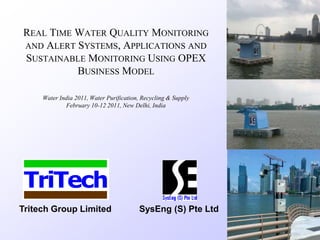
REAL TIME WATER QUALITY MONITORING
AND ALERT SYSTEMS, APPLICATIONS AND
SUSTAINABLE MONITORING USING OPEX
BUSINESS MODEL
Water India 2011, Water Purification, Recycling & Supply
February 10-12 2011, New Delhi, India
TriTech
Tritech Group Limited SysEng (S) Pte Ltd
Abstract
The paper covers the following:
o Methodology and setup in Water Quality Monitoring
System, a Real Time Monitoring and Alert System
(RTMAS).
o Considerations for sustainable operation in water
monitoring applications, using the OPEX (Operational
Expense) Model
System Setup and Methodology
of
Real Time Water Quality Monitoring
Real Time Water Quality Monitoring and Alert System
System Setup and Methods
Illustrates the System Setup based on 2 applications
we have deployed in Singapore:
o Remote Monitoring of Reservoirs Water Quality
profile.
o Remote monitoring of Total Suspended Solid
(TSS) in drainage and catchment.
System Setup and Methods
Remote Monitoring of Reservoirs Water Quality Profile
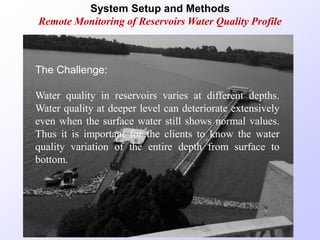
The Challenge:
Water quality in reservoirs varies at different depths.
Water quality at deeper level can deteriorate extensively
even when the surface water still shows normal values.
Thus it is important for the clients to know the water
quality variation of the entire depth from surface to
bottom.
System Setup and Methods
Remote Monitoring of Reservoirs Water Quality Profile
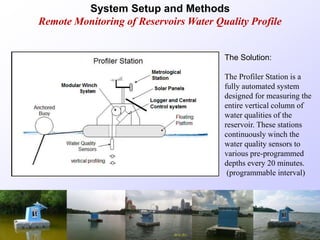
The Solution:
The Profiler Station is a
fully automated system
designed for measuring the
entire vertical column of
water qualities of the
reservoir. These stations
continuously winch the
water quality sensors to
various pre-programmed
depths every 20 minutes.
(programmable interval)
System Setup and Methods
Remote Monitoring of Reservoirs Water Quality Profile
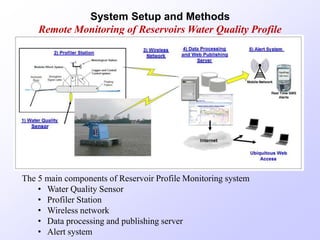
The 5 main components of Reservoir Profile Monitoring system
• Water Quality Sensor
• Profiler Station
• Wireless network
• Data processing and publishing server
• Alert system
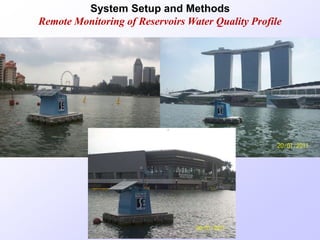
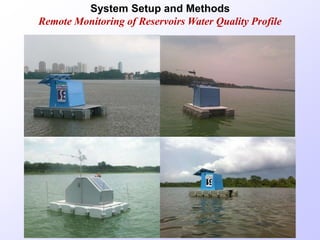
System Setup and Methods
Remote Monitoring of Reservoirs Water Quality Profile
System Setup and Methods
Remote Monitoring of Reservoirs Water Quality Profile
System Setup and Methods
Remote Monitoring of Reservoirs Water Quality Profile
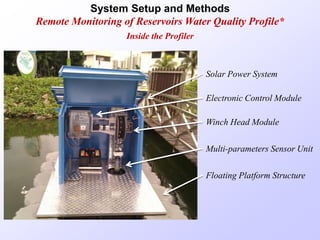
System Setup and Methods
Remote Monitoring of Reservoirs Water Quality Profile*
Electronic Control Module
Solar Power System
Winch Head Module
Multi-parameters Sensor Unit
Floating Platform Structure
Inside the Profiler
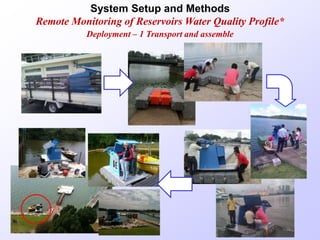
System Setup and Methods
Remote Monitoring of Reservoirs Water Quality Profile*
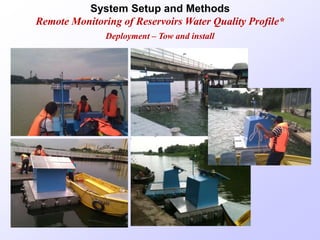
Deployment – 1 Transport and assemble
System Setup and Methods
Remote Monitoring of Reservoirs Water Quality Profile*
Deployment – Tow and install
System Setup and Methods
Remote Monitoring of Reservoirs Water Quality Profile
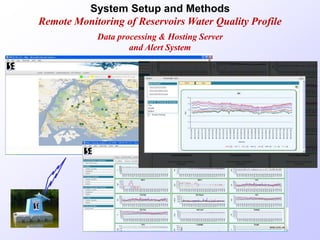
Data processing & Hosting Server
and Alert System
System Setup and Methods
Remote Monitoring of Reservoirs Water Quality Profile
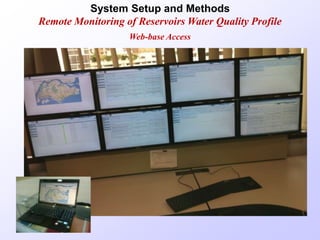
Web-base Access
System Setup and Methods
Remote Monitoring of Total Suspended Solid discharge
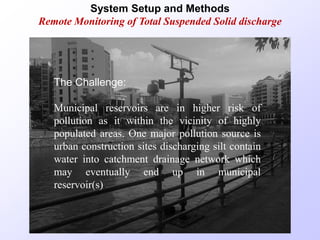
The Challenge:
Municipal reservoirs are in higher risk of
pollution as it within the vicinity of highly
populated areas. One major pollution source is
urban construction sites discharging silt contain
water into catchment drainage network which
may eventually end up in municipal
reservoir(s).
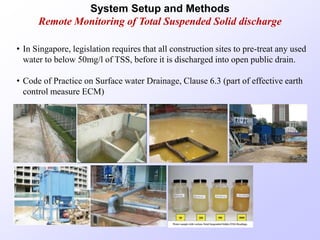
• In Singapore, legislation requires that all construction sites to pre-treat any used
water to below 50mg/l of TSS, before it is discharged into open public drain.
• Code of Practice on Surface water Drainage, Clause 6.3 (part of effective earth
control measure ECM)
System Setup and Methods
Remote Monitoring of Total Suspended Solid discharge
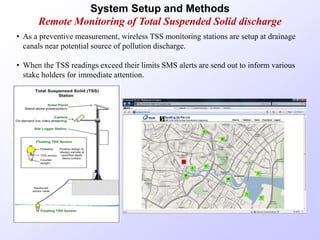
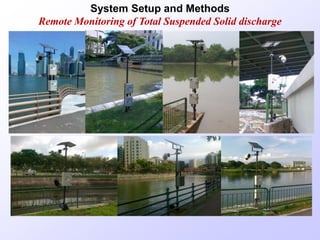
• As a preventive measurement, wireless TSS monitoring stations are setup at drainage
canals near potential source of pollution discharge.
• When the TSS readings exceed their limits SMS alerts are send out to inform various
stake holders for immediate attention.
System Setup and Methods
Remote Monitoring of Total Suspended Solid discharge
System Setup and Methods
Remote Monitoring of Total Suspended Solid discharge
System Setup and Methods
Remote Monitoring of Total Suspended Solid discharge
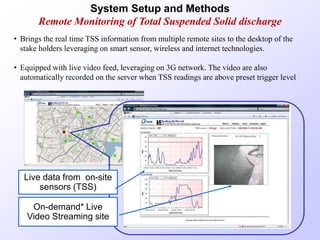
Live data from on-site
sensors (TSS)
On-demand* Live
Video Streaming site
• Brings the real time TSS information from multiple remote sites to the desktop of the
stake holders leveraging on smart sensor, wireless and internet technologies.
• Equipped with live video feed, leveraging on 3G network. The video are also
automatically recorded on the server when TSS readings are above preset trigger level
Consideration for a Sustainable
Water Quality Monitoring Operation
Real Time Water Quality Monitoring and Alert System
Considerations in Sustainable Water Quality Monitoring
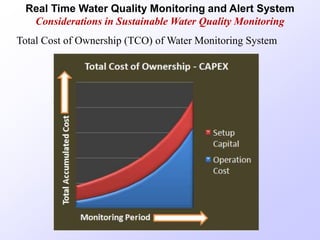
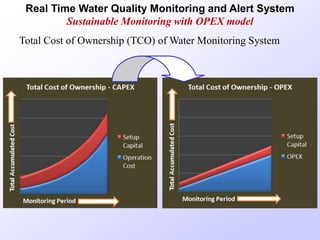
Total Cost of Ownership (TCO) of Water Monitoring System
Real Time Water Quality Monitoring and Alert System
Considerations in Sustainable Water Quality Monitoring
Ownership Risks - Increasing Operation Cost / Hidden Cost:
• Repair cost are not accurately forecasted (especially after
warranty period)
• Increasing maintenance cost due to wear and tear, bio-fouling,
weathering. etc. (dependent on skill level in maintenance)
• Equipment obsolescence
• Maintaining and training of manpower in diversified areas of
skills required in water quality monitoring
• Others…
This Hidden Cost in Ownership Risks are often under estimated or
left out. If it is un-planned for, the system will not sustainable due to
the increasing operation cost.
Real Time Water Quality Monitoring and Alert System
Considerations in Sustainable Water Quality Monitoring
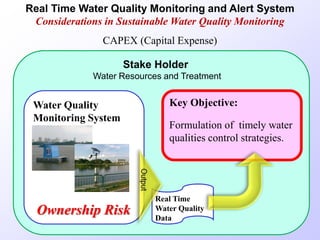
Stake Holder
Water Resources and Treatment
Key Objective:
Formulation of timely water
qualities control strategies.
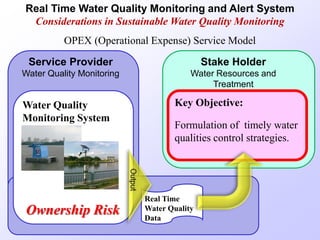
Water Quality
Monitoring System
Ownership Risk
Real Time
Water Quality
Data
CAPEX (Capital Expense)
Real Time Water Quality Monitoring and Alert System
Considerations in Sustainable Water Quality Monitoring
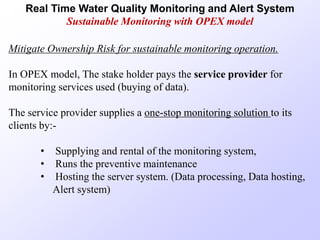
Stake Holder
Water Resources and
Treatment
Key Objective:
Formulation of timely water
qualities control strategies.
Water Quality
Monitoring System
Ownership Risk
Real Time
Water Quality
Data
Service Provider
Water Quality Monitoring
OPEX (Operational Expense) Service Model
Real Time Water Quality Monitoring and Alert System
Sustainable Monitoring with OPEX model
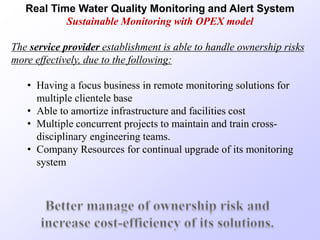
Mitigate Ownership Risk for sustainable monitoring operation.
In OPEX model, The stake holder pays the service provider for
monitoring services used (buying of data).
The service provider supplies a one-stop monitoring solution to its
clients by:-
• Supplying and rental of the monitoring system,
• Runs the preventive maintenance
• Hosting the server system. (Data processing, Data hosting,
Alert system)
Real Time Water Quality Monitoring and Alert System
Sustainable Monitoring with OPEX model
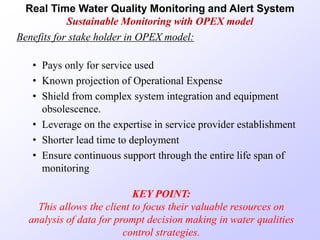
The service provider establishment is able to handle ownership risks
more effectively, due to the following:
• Having a focus business in remote monitoring solutions for
multiple clientele base
• Able to amortize infrastructure and facilities cost
• Multiple concurrent projects to maintain and train cross-
disciplinary engineering teams.
• Company Resources for continual upgrade of its monitoring
system
Benefits for stake holder in OPEX model:
• Pays only for service used
• Known projection of Operational Expense
• Shield from complex system integration and equipment
obsolescence.
• Leverage on the expertise in service provider establishment
• Shorter lead time to deployment
• Ensure continuous support through the entire life span of
monitoring
KEY POINT:
This allows the client to focus their valuable resources on
analysis of data for prompt decision making in water qualities
control strategies.
Real Time Water Quality Monitoring and Alert System
Sustainable Monitoring with OPEX model
Total Cost of Ownership (TCO) of Water Monitoring System
Real Time Water Quality Monitoring and Alert System
Sustainable Monitoring with OPEX model
Real Time Water Quality Monitoring and Alert System
Conclusion
• Water quality monitoring system requires detail planning in both
system setup and operation considerations.
• To ensure sustainability of monitoring, the Critical operation
resources need to be plan before execution:
• specialized manpower
• facilities
• equipment and redundancies/spares
• A service-support organization structure
• An option for sustainable monitoring operation is OPEX service
model, which stake holder can leverage on the service provider’s
establishment and focus their limited resources on result
analysis and formulation of water qualities control strategies.
Choo Chun Keong
Tel: +65 62875710
Mobile: +65 96673684
keong@syseng.com.sg
Thank You
TriTech
Tritech Group Limited
Santosh Palan
Mobile: +91 9945666181
santosh.palan@techspaneng.com
Hall 14 booth W20

SysEng Water India 2011 conference presentation

  • 1.
    REAL TIME WATERQUALITY MONITORING AND ALERT SYSTEMS, APPLICATIONS AND SUSTAINABLE MONITORING USING OPEX BUSINESS MODEL Water India 2011, Water Purification, Recycling & Supply February 10-12 2011, New Delhi, India TriTech Tritech Group Limited SysEng (S) Pte Ltd
  • 2.
    Abstract The paper coversthe following: o Methodology and setup in Water Quality Monitoring System, a Real Time Monitoring and Alert System (RTMAS). o Considerations for sustainable operation in water monitoring applications, using the OPEX (Operational Expense) Model
  • 3.
    System Setup andMethodology of Real Time Water Quality Monitoring
  • 4.
    Real Time WaterQuality Monitoring and Alert System System Setup and Methods Illustrates the System Setup based on 2 applications we have deployed in Singapore: o Remote Monitoring of Reservoirs Water Quality profile. o Remote monitoring of Total Suspended Solid (TSS) in drainage and catchment.
  • 5.
    System Setup andMethods Remote Monitoring of Reservoirs Water Quality Profile The Challenge: Water quality in reservoirs varies at different depths. Water quality at deeper level can deteriorate extensively even when the surface water still shows normal values. Thus it is important for the clients to know the water quality variation of the entire depth from surface to bottom.
  • 6.
    System Setup andMethods Remote Monitoring of Reservoirs Water Quality Profile The Solution: The Profiler Station is a fully automated system designed for measuring the entire vertical column of water qualities of the reservoir. These stations continuously winch the water quality sensors to various pre-programmed depths every 20 minutes. (programmable interval)
  • 7.
    System Setup andMethods Remote Monitoring of Reservoirs Water Quality Profile The 5 main components of Reservoir Profile Monitoring system • Water Quality Sensor • Profiler Station • Wireless network • Data processing and publishing server • Alert system
  • 8.
    System Setup andMethods Remote Monitoring of Reservoirs Water Quality Profile
  • 9.
    System Setup andMethods Remote Monitoring of Reservoirs Water Quality Profile
  • 10.
    System Setup andMethods Remote Monitoring of Reservoirs Water Quality Profile
  • 11.
    System Setup andMethods Remote Monitoring of Reservoirs Water Quality Profile* Electronic Control Module Solar Power System Winch Head Module Multi-parameters Sensor Unit Floating Platform Structure Inside the Profiler
  • 12.
    System Setup andMethods Remote Monitoring of Reservoirs Water Quality Profile* Deployment – 1 Transport and assemble
  • 13.
    System Setup andMethods Remote Monitoring of Reservoirs Water Quality Profile* Deployment – Tow and install
  • 14.
    System Setup andMethods Remote Monitoring of Reservoirs Water Quality Profile Data processing & Hosting Server and Alert System
  • 15.
    System Setup andMethods Remote Monitoring of Reservoirs Water Quality Profile Web-base Access
  • 16.
    System Setup andMethods Remote Monitoring of Total Suspended Solid discharge The Challenge: Municipal reservoirs are in higher risk of pollution as it within the vicinity of highly populated areas. One major pollution source is urban construction sites discharging silt contain water into catchment drainage network which may eventually end up in municipal reservoir(s).
  • 17.
    • In Singapore,legislation requires that all construction sites to pre-treat any used water to below 50mg/l of TSS, before it is discharged into open public drain. • Code of Practice on Surface water Drainage, Clause 6.3 (part of effective earth control measure ECM) System Setup and Methods Remote Monitoring of Total Suspended Solid discharge
  • 18.
    • As apreventive measurement, wireless TSS monitoring stations are setup at drainage canals near potential source of pollution discharge. • When the TSS readings exceed their limits SMS alerts are send out to inform various stake holders for immediate attention. System Setup and Methods Remote Monitoring of Total Suspended Solid discharge
  • 19.
    System Setup andMethods Remote Monitoring of Total Suspended Solid discharge
  • 20.
    System Setup andMethods Remote Monitoring of Total Suspended Solid discharge Live data from on-site sensors (TSS) On-demand* Live Video Streaming site • Brings the real time TSS information from multiple remote sites to the desktop of the stake holders leveraging on smart sensor, wireless and internet technologies. • Equipped with live video feed, leveraging on 3G network. The video are also automatically recorded on the server when TSS readings are above preset trigger level
  • 21.
    Consideration for aSustainable Water Quality Monitoring Operation
  • 22.
    Real Time WaterQuality Monitoring and Alert System Considerations in Sustainable Water Quality Monitoring Total Cost of Ownership (TCO) of Water Monitoring System
  • 23.
    Real Time WaterQuality Monitoring and Alert System Considerations in Sustainable Water Quality Monitoring Ownership Risks - Increasing Operation Cost / Hidden Cost: • Repair cost are not accurately forecasted (especially after warranty period) • Increasing maintenance cost due to wear and tear, bio-fouling, weathering. etc. (dependent on skill level in maintenance) • Equipment obsolescence • Maintaining and training of manpower in diversified areas of skills required in water quality monitoring • Others… This Hidden Cost in Ownership Risks are often under estimated or left out. If it is un-planned for, the system will not sustainable due to the increasing operation cost.
  • 24.
    Real Time WaterQuality Monitoring and Alert System Considerations in Sustainable Water Quality Monitoring Stake Holder Water Resources and Treatment Key Objective: Formulation of timely water qualities control strategies. Water Quality Monitoring System Ownership Risk Real Time Water Quality Data CAPEX (Capital Expense)
  • 25.
    Real Time WaterQuality Monitoring and Alert System Considerations in Sustainable Water Quality Monitoring Stake Holder Water Resources and Treatment Key Objective: Formulation of timely water qualities control strategies. Water Quality Monitoring System Ownership Risk Real Time Water Quality Data Service Provider Water Quality Monitoring OPEX (Operational Expense) Service Model
  • 26.
    Real Time WaterQuality Monitoring and Alert System Sustainable Monitoring with OPEX model Mitigate Ownership Risk for sustainable monitoring operation. In OPEX model, The stake holder pays the service provider for monitoring services used (buying of data). The service provider supplies a one-stop monitoring solution to its clients by:- • Supplying and rental of the monitoring system, • Runs the preventive maintenance • Hosting the server system. (Data processing, Data hosting, Alert system)
  • 27.
    Real Time WaterQuality Monitoring and Alert System Sustainable Monitoring with OPEX model The service provider establishment is able to handle ownership risks more effectively, due to the following: • Having a focus business in remote monitoring solutions for multiple clientele base • Able to amortize infrastructure and facilities cost • Multiple concurrent projects to maintain and train cross- disciplinary engineering teams. • Company Resources for continual upgrade of its monitoring system
  • 28.
    Benefits for stakeholder in OPEX model: • Pays only for service used • Known projection of Operational Expense • Shield from complex system integration and equipment obsolescence. • Leverage on the expertise in service provider establishment • Shorter lead time to deployment • Ensure continuous support through the entire life span of monitoring KEY POINT: This allows the client to focus their valuable resources on analysis of data for prompt decision making in water qualities control strategies. Real Time Water Quality Monitoring and Alert System Sustainable Monitoring with OPEX model
  • 29.
    Total Cost ofOwnership (TCO) of Water Monitoring System Real Time Water Quality Monitoring and Alert System Sustainable Monitoring with OPEX model
  • 30.
    Real Time WaterQuality Monitoring and Alert System Conclusion • Water quality monitoring system requires detail planning in both system setup and operation considerations. • To ensure sustainability of monitoring, the Critical operation resources need to be plan before execution: • specialized manpower • facilities • equipment and redundancies/spares • A service-support organization structure • An option for sustainable monitoring operation is OPEX service model, which stake holder can leverage on the service provider’s establishment and focus their limited resources on result analysis and formulation of water qualities control strategies.
  • 31.
    Choo Chun Keong Tel:+65 62875710 Mobile: +65 96673684 keong@syseng.com.sg Thank You TriTech Tritech Group Limited Santosh Palan Mobile: +91 9945666181 santosh.palan@techspaneng.com Hall 14 booth W20