See	discussions,	stats,	and	author	profiles	for	this	publication	at:	https://www.researchgate.net/publication/232734552
Phd	Presentation
Dataset	·	November	2012
READS
19
Available	from:	hussein	karaman
Retrieved	on:	12	May	2016
RISK AND UNCERTAINTY ASSESSMENT APPLIED TO WATER
QUALITY MANAGEMENT:
A PROBALISTIC DECISION SUPPORT SYSTEM
By
Hussein Gamal El Dien Karaman
Researcher Assistant
Drainage Research Institute
Under the supervision
Of
Prof. Dr. Alla El Zawahry- Faculty of Engineering-Cairo University
Prof. Dr. Hussam Fahmy- Director of Drainage Research Inst.
Dr. Ahmed Emam- Faculty of Engineering-Cairo University
OUTLINE
• Introduction
• Problem Definition
• Study Objectives
• Literature Review
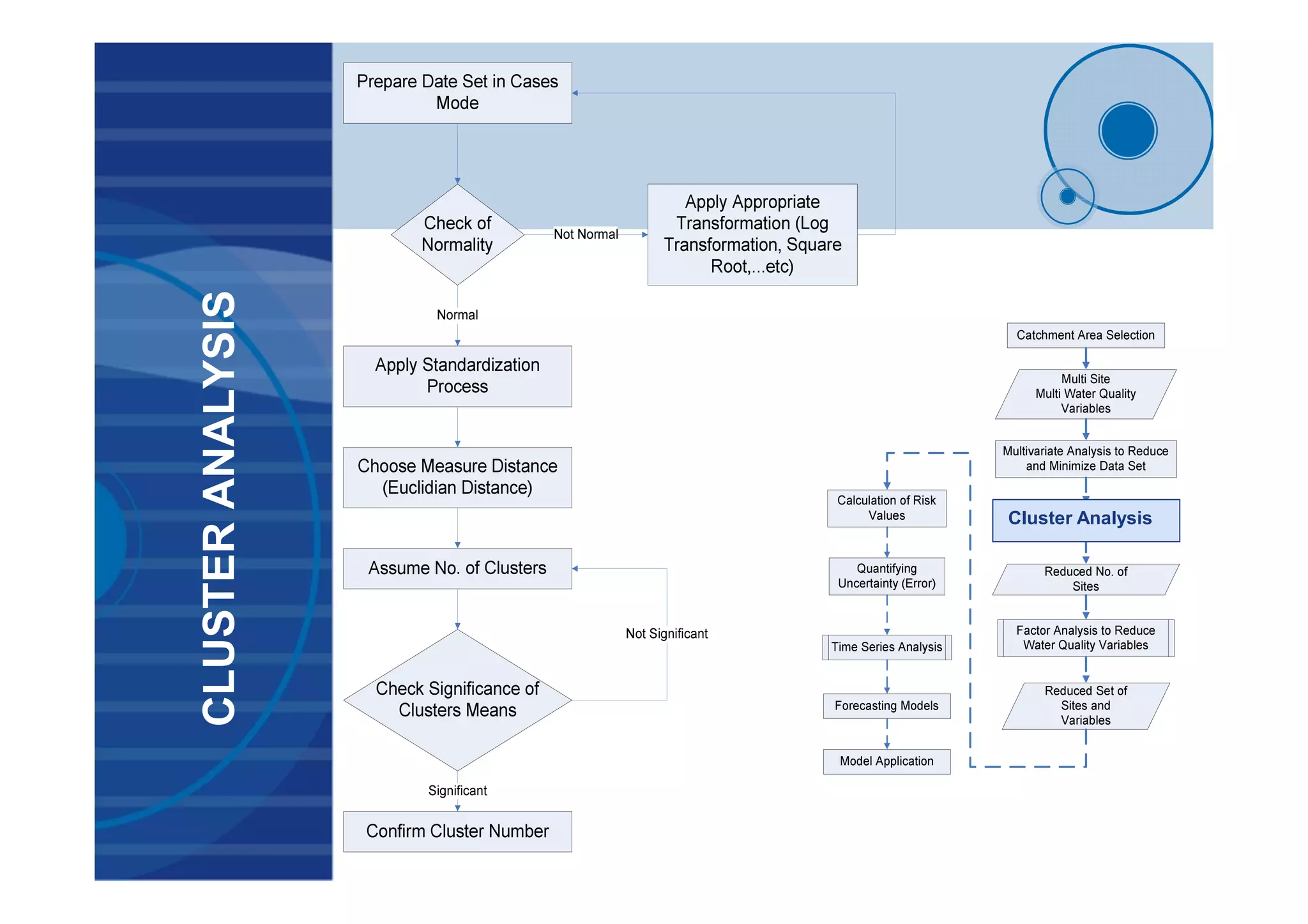
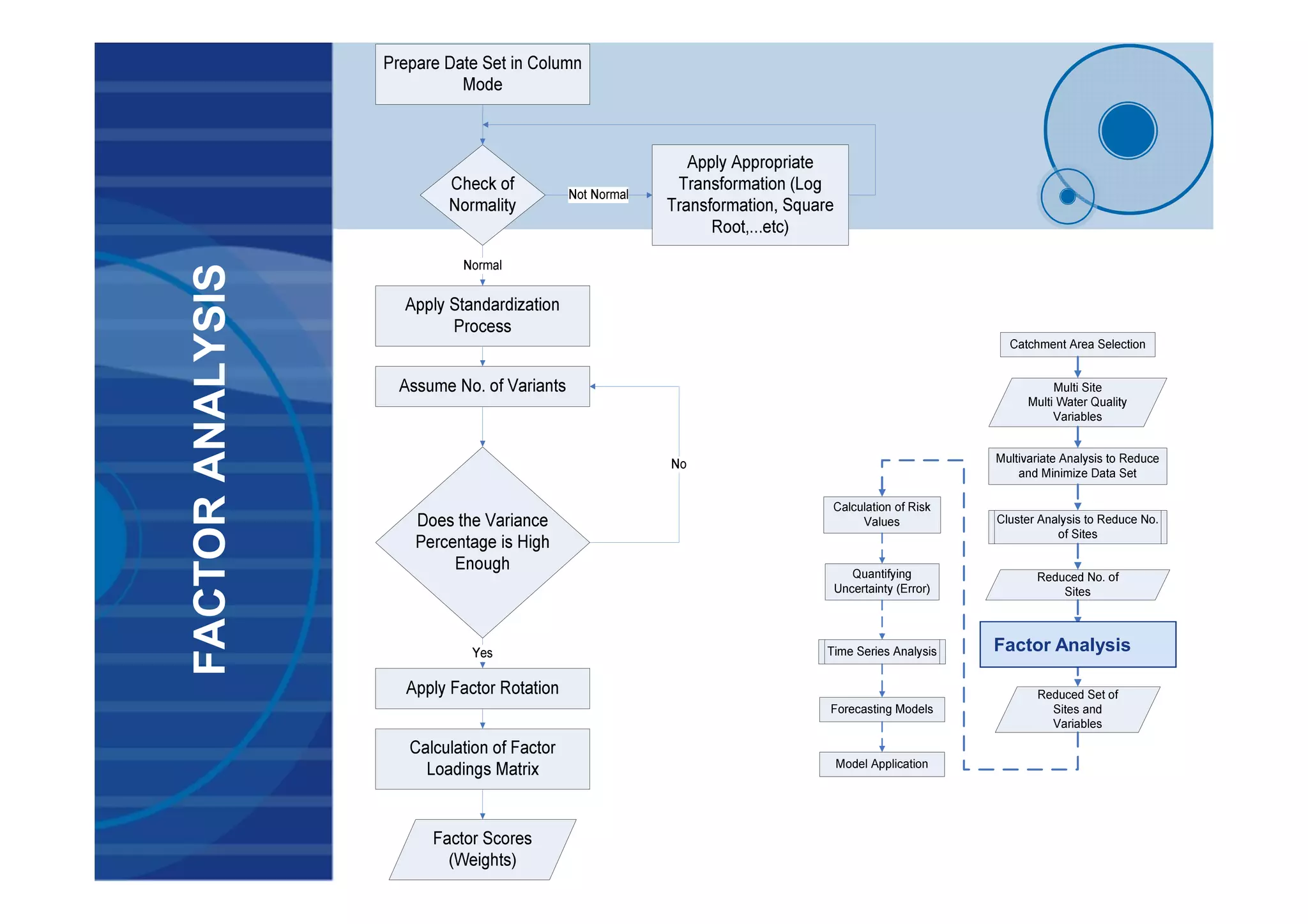
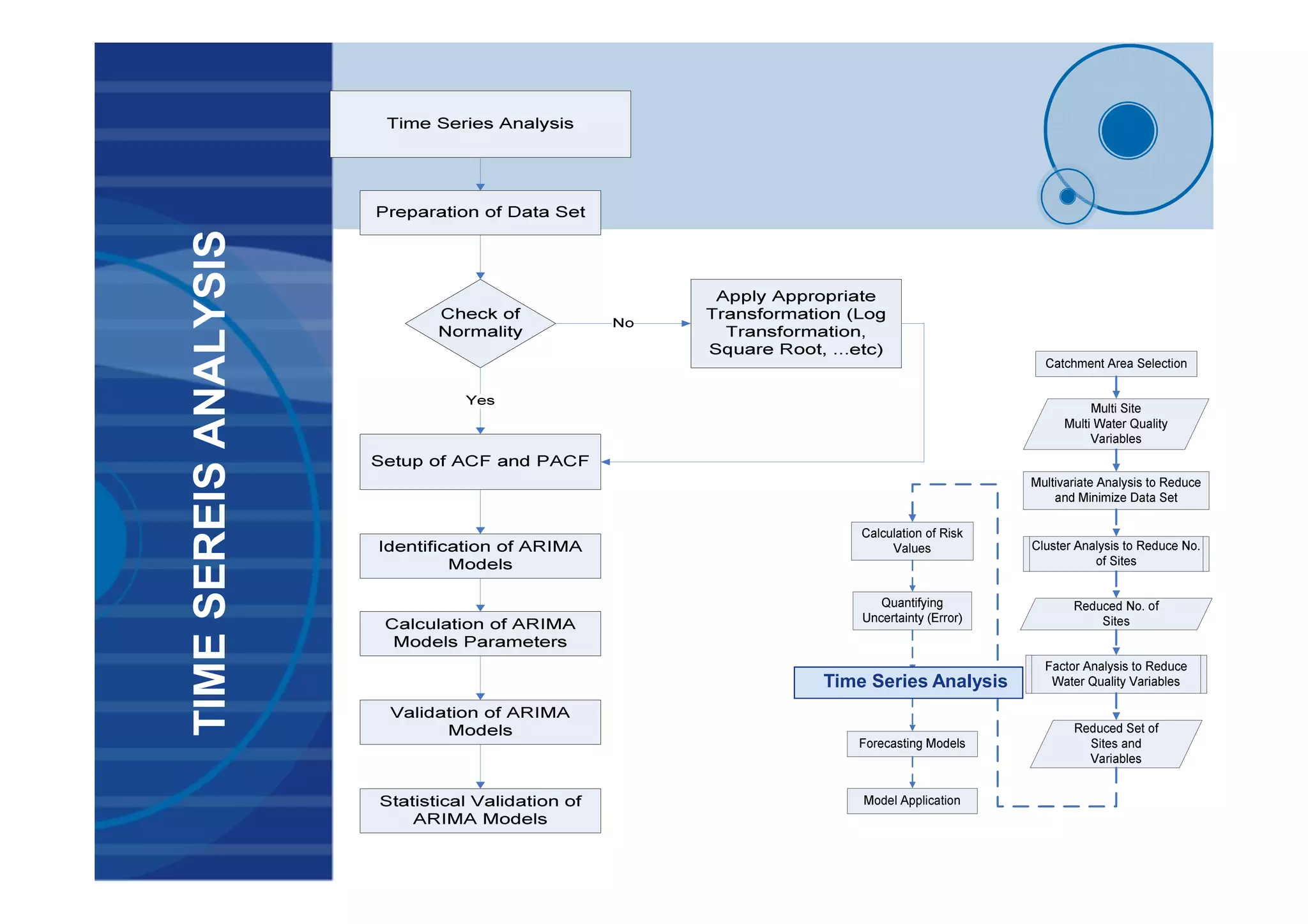
• Proposed Framework
• Theoretical Base of the Proposed Framework
– Methodology Rationale
– Techniques Used
• Application
• Conclusions and Recommendations
INTRODUCTION
• Decision making is the objective of the water resources
management plans;
• Water quality needs to be managed to provide decision
makers with information about the present and future
status of water quality;
• The National Water Quality Monitoring Network
(NWAQMN) was established in the eighteens of the last
century;
• The main objective of this network was to monitor the
salinity of the drainage water to fulfill the objectives of the
drainage water reuse project;
• In 1995, the objective of the monitoring network was
changed from monitoring the salinity to monitor the whole
water pollution.
PROBLEM DEFINITION
• The uncertainty in the measured data pose problems to
the decision maker;
• In the case of water quality the uncertainty can be found
on several stages:
– Sampling process;
– Chemical analysis in the lab;
– Reporting process.
• The total number of locations along the Nile Delta is
about 163 locations distributed between the Eastern,
Middle and Western Delta;
• Now, the main objective of the monitoring network start to
change from measuring only one variable to measure
more than 46 water quality variables;
STUDY OBJECTIVES
• The main goal of this research is to:-
– Construct a logical framework in the water quality
management process to reflect the stochastic nature of
water quality to efficiently produce the needed information.
STUDY OBJECTIVES (Cont.)
• The secondary objectives of this research is to:-
– Reduce the number of monitoring points on a drain
catchment selected for the study;
– Construct water quality variants representing several water
quality categories such as (salinity category, Biological
category, Nutrients category…etc) to reduce the efforts in
analyzing each water quality variable solely;
– Dealing with the uncertainty in the historical and predicted
data for each water quality variants.
LETREATURE REVIEW
WATER QUALITY MODELS
WITH UNCERTAINTY
• Tung (1996) reviews the application of uncertainty
analysis in water quality modeling
• Tung identifies two types of uncertainties:
– Uncertainty due to inherent randomness of an event;
– Uncertainties associated with a lack of complete knowledge
about model processes, parameters, and data uncertainties.
SOURCES OF NOISE
• Timmerman et al., (1996) describe the following data
limitations as sources of noise:
– Missing values:
– Sampling frequencies that change over the period of record
– Multiple observations within one sampling period
– Uncertainty in the measurement procedures
– Censored data
– Small sample sizes
– Outliers
– Problems related to quality of data
– Problems related to data presentation
WATER QUALITY
MONITORING
• The systematic (or coordinated) operation of the network
is realized by the selection of three basic factors:
– Sampling sites
– Sampling frequencies
– Variables to be sampled
(Harmancioglu et al., 1998b and c).
COMPLEXITY OF WATER
QUALITY DATA
• (Sanders et al., 1983) stated that the water quality has
to be recognized as a random process by nature then
monitoring activities are required to reflect the stochastic
nature of water quality to efficiently produce the
expected information.
• Sanders et al. (1983), Cotter (1985) and Karpuzeu et
al. (1987) specify the term “monitoring” further to mean
“statistical sampling”.
STOCHASTIC MODELING
APPLICATION
• (Shamshad et al,2002) compared different stochastic
models to forecast some water quality variables (DO,
BOD and pH) along River Gangs in India;
• He stated that “ The performance of the Multiplicative
ARIMA models and deseasonalised model with a Fourier
Series technique provided satisfactory forecasting results
for the selected water quality variables”
APPLICATION OF (MAT) IN
WATER QUALITY DATA
• (Zou and Yu, 1996) have used a general dynamic factor
model to reduce the high dimensionality of the original
matrix of variables in order to detect trends in time series;
• (S.T. Abdel Gawad et al, 2005) used the principle
component analysis (PCA) to condensate and interpret
the variability of numerous water quality variables at Bahr
El Baqer drainage catchment (Egypt)
WATER QUALITY INDEX
• (Chapman, 1992) stated that, water quality index is an
indicator of the quality of water obtained by aggregating
several water quality measurements into one number;
• Canter (1996) stated that, the common criteria for
selecting the parameters to be used in the index are:-
– Should be routinely monitored,
– Represents a potential public health,
– Has effect on aquatic ecology, irrigation, recreation and
industrial water uses,
– Selected by the water quality experts in the country and
finally selected by other water quality experts all over the
world.
THEORETICAL BASE OF THE PROPOSED
FRAMEWORK
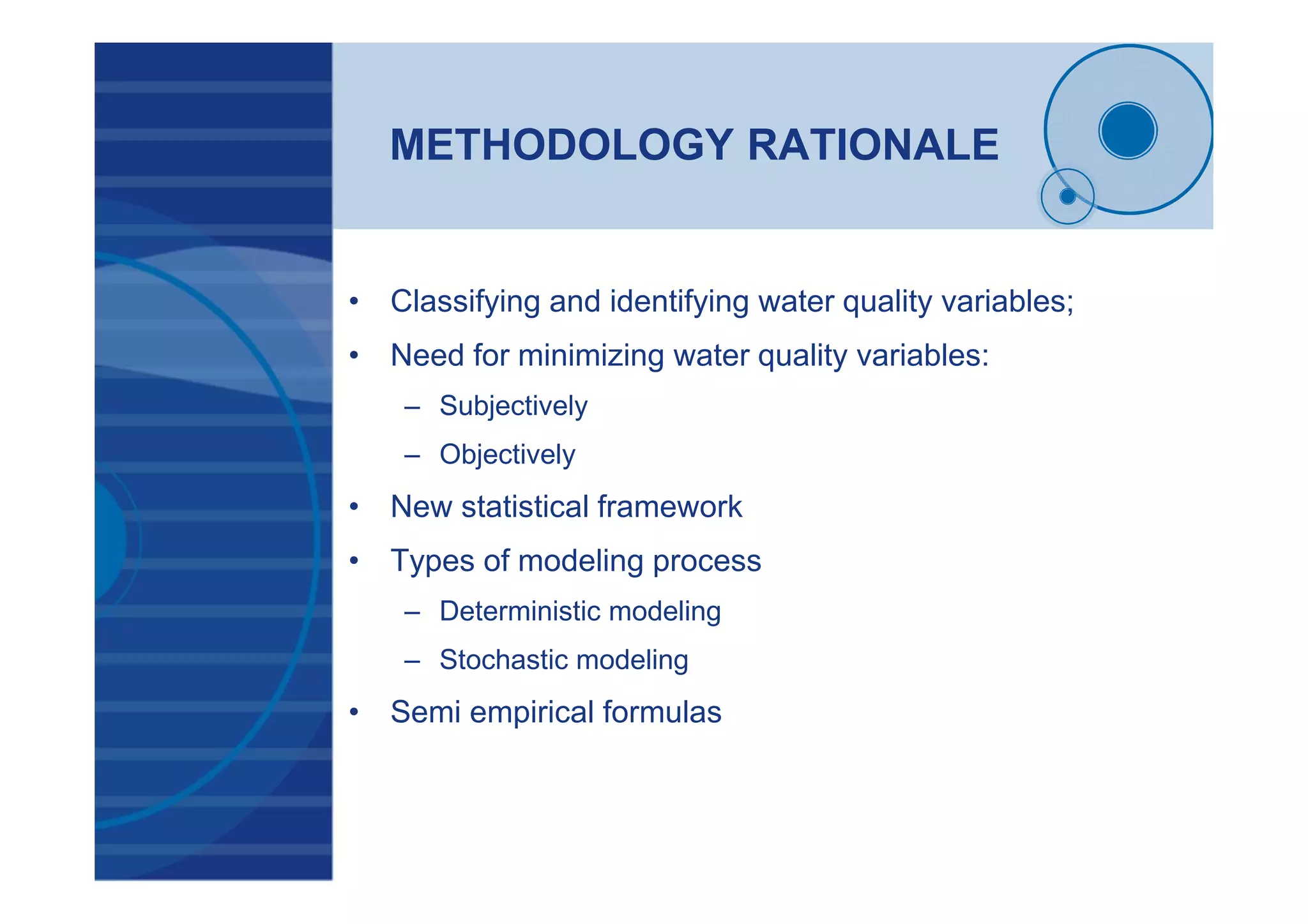
METHODOLOGY RATIONALE
• Classifying and identifying water quality variables;
• Need for minimizing water quality variables:
– Subjectively
– Objectively
• New statistical framework
• Types of modeling process
– Deterministic modeling
– Stochastic modeling
• Semi empirical formulas
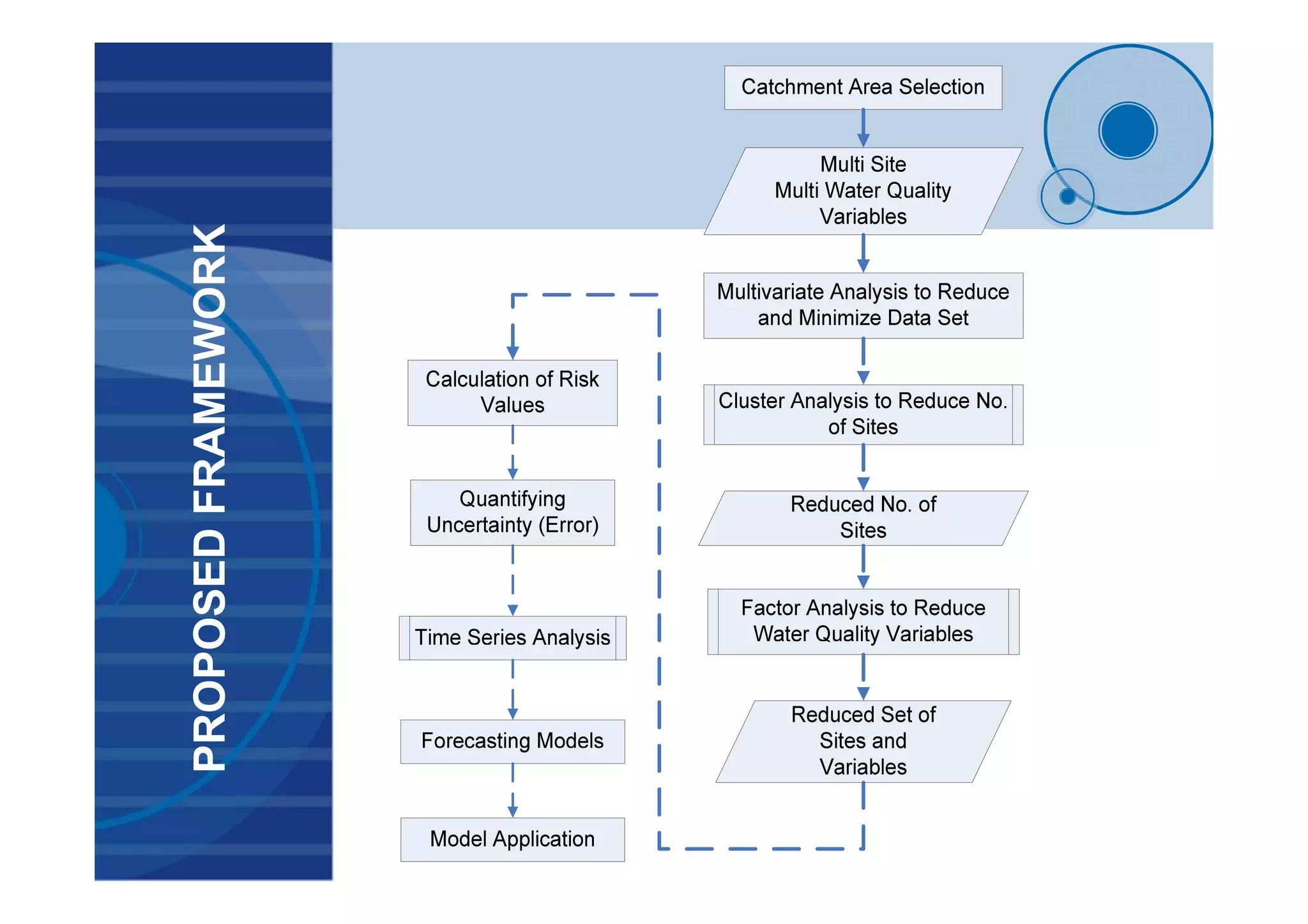
PROPOSEDFRAMEWORK
CLUSTERANALYSIS
Cluster Analysis
FACTORANALYSIS
Factor Analysis
TIMESEREISANALYSIS
Time Series Analysis
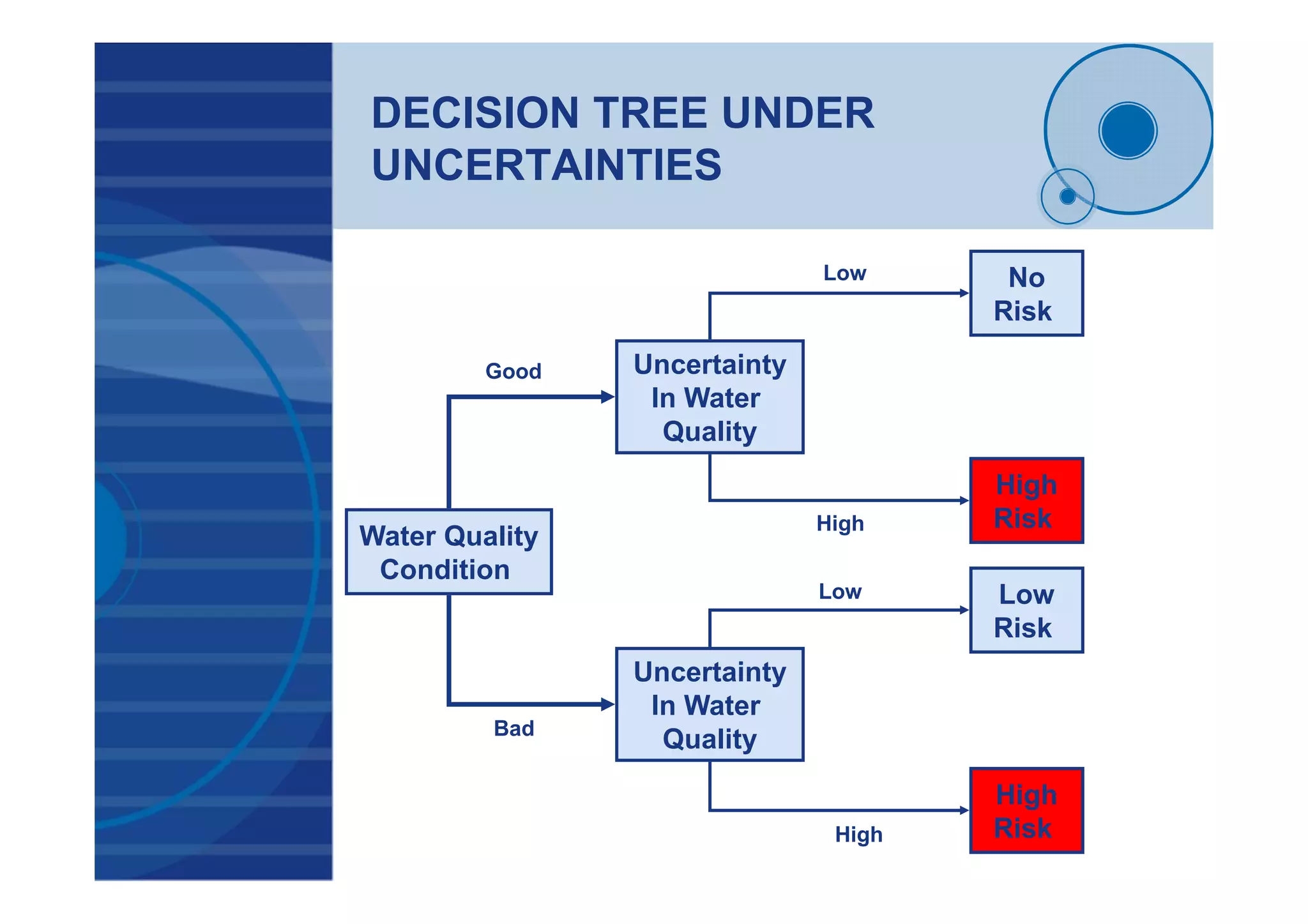
DECISION TREE UNDER
UNCERTAINTIES
Water Quality
Condition
Uncertainty
In Water
Quality
Uncertainty
In Water
Quality
No
Risk
High
Risk
Low
Risk
High
Risk
Good
Bad
Low
High
Low
High
APPLICATION OF THE PROPOSED FRAMEWORK
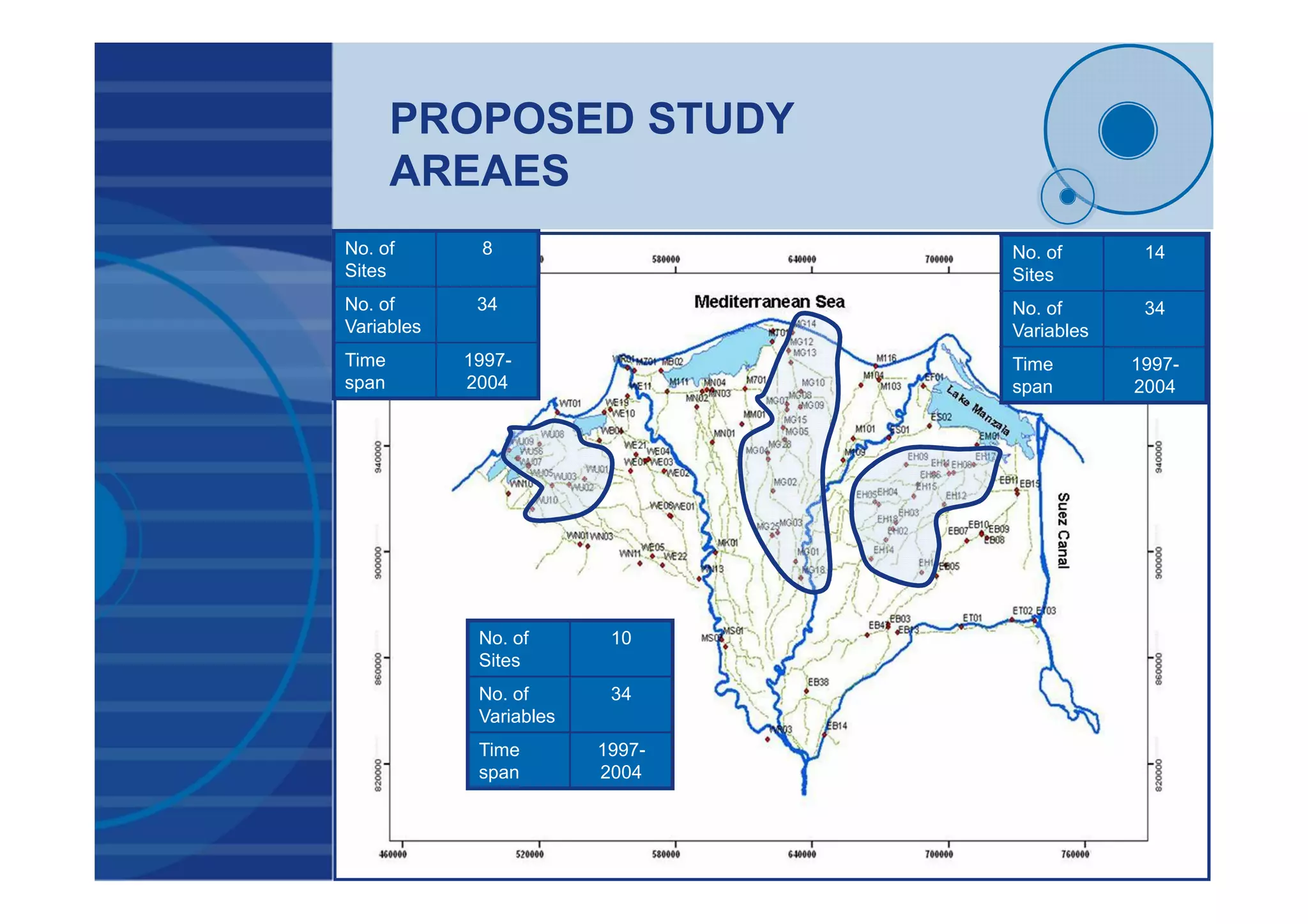
PROPOSED STUDY
AREAES
No. of
Sites
8
No. of
Variables
34
Time
span
1997-
2004
No. of
Sites
14
No. of
Variables
34
Time
span
1997-
2004
No. of
Sites
10
No. of
Variables
34
Time
span
1997-
2004
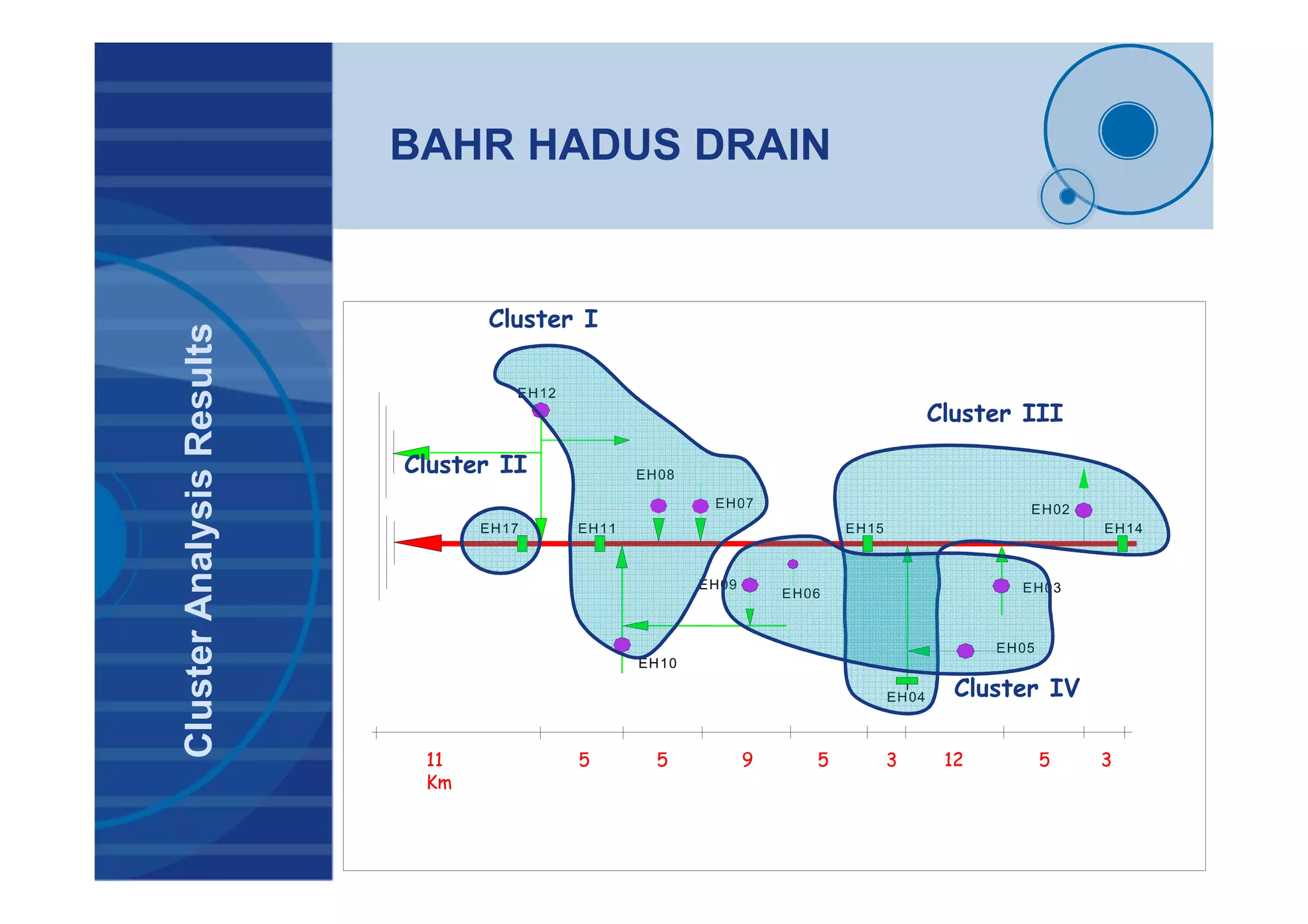
BAHR HADUS DRAIN
ClusterAnalysisResults
EH07
EH17
EH10
EH11
EH09
EH06
EH12
EH08
EH02
EH14
EH04
EH15
EH03
EH05
11
Km
5 5 9 35 512 3
Cluster I
Cluster II
Cluster III
Cluster IV
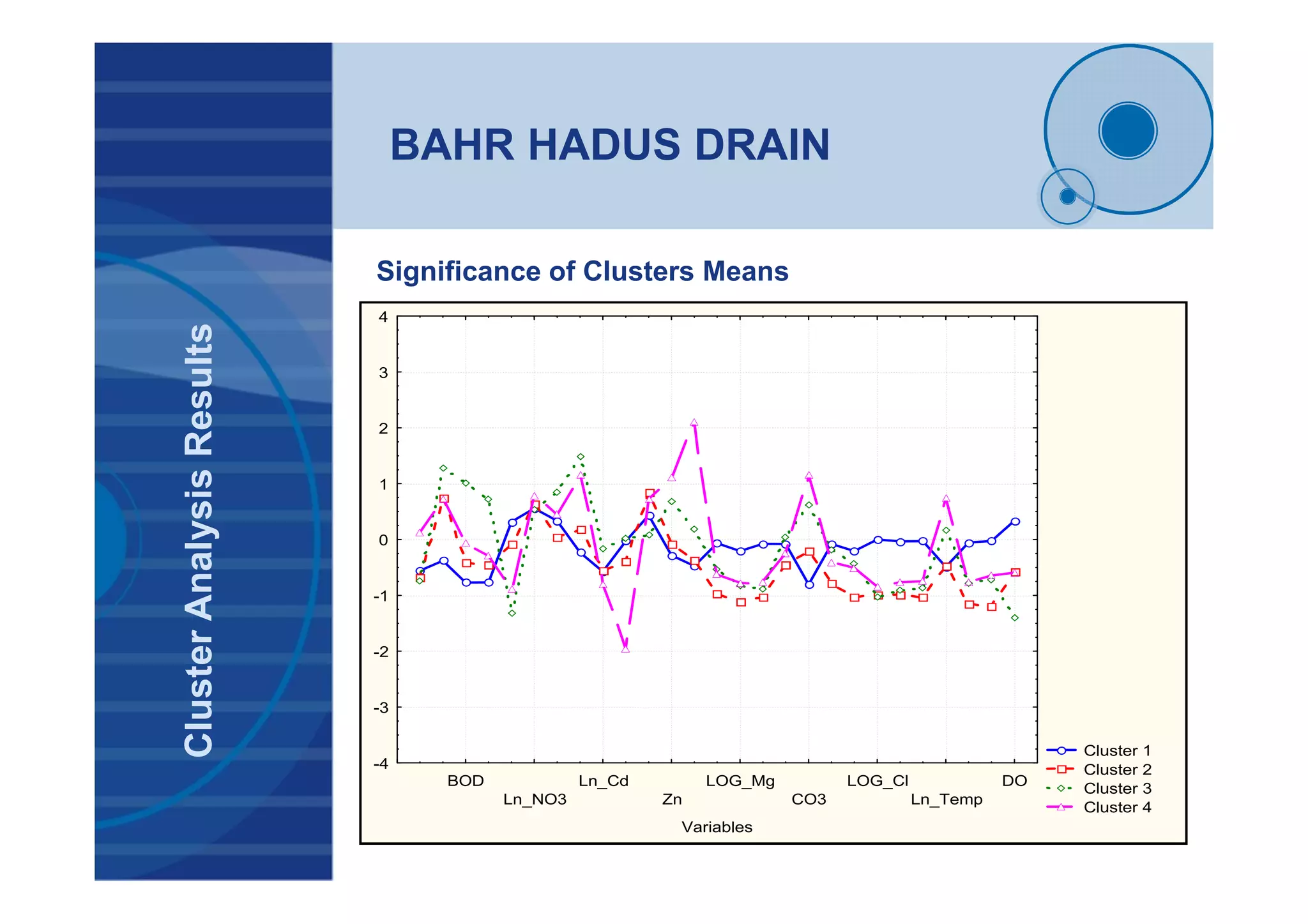
BAHR HADUS DRAIN
Cluster 1
Cluster 2
Cluster 3
Cluster 4
BOD
Ln_NO3
Ln_Cd
Zn
LOG_Mg
CO3
LOG_Cl
Ln_Temp
DO
Variables
-4
-3
-2
-1
0
1
2
3
4
ClusterAnalysisResults
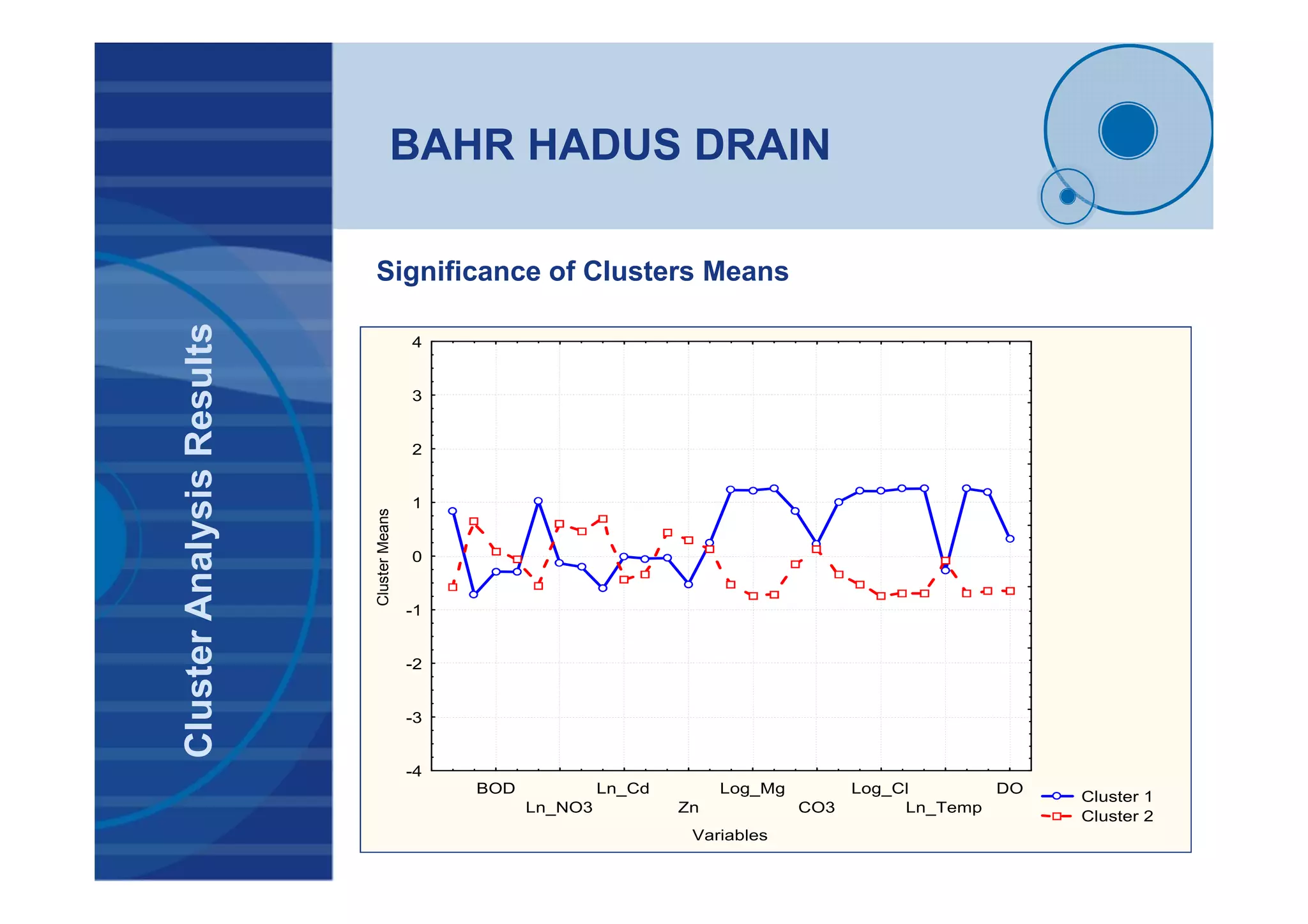
Significance of Clusters Means
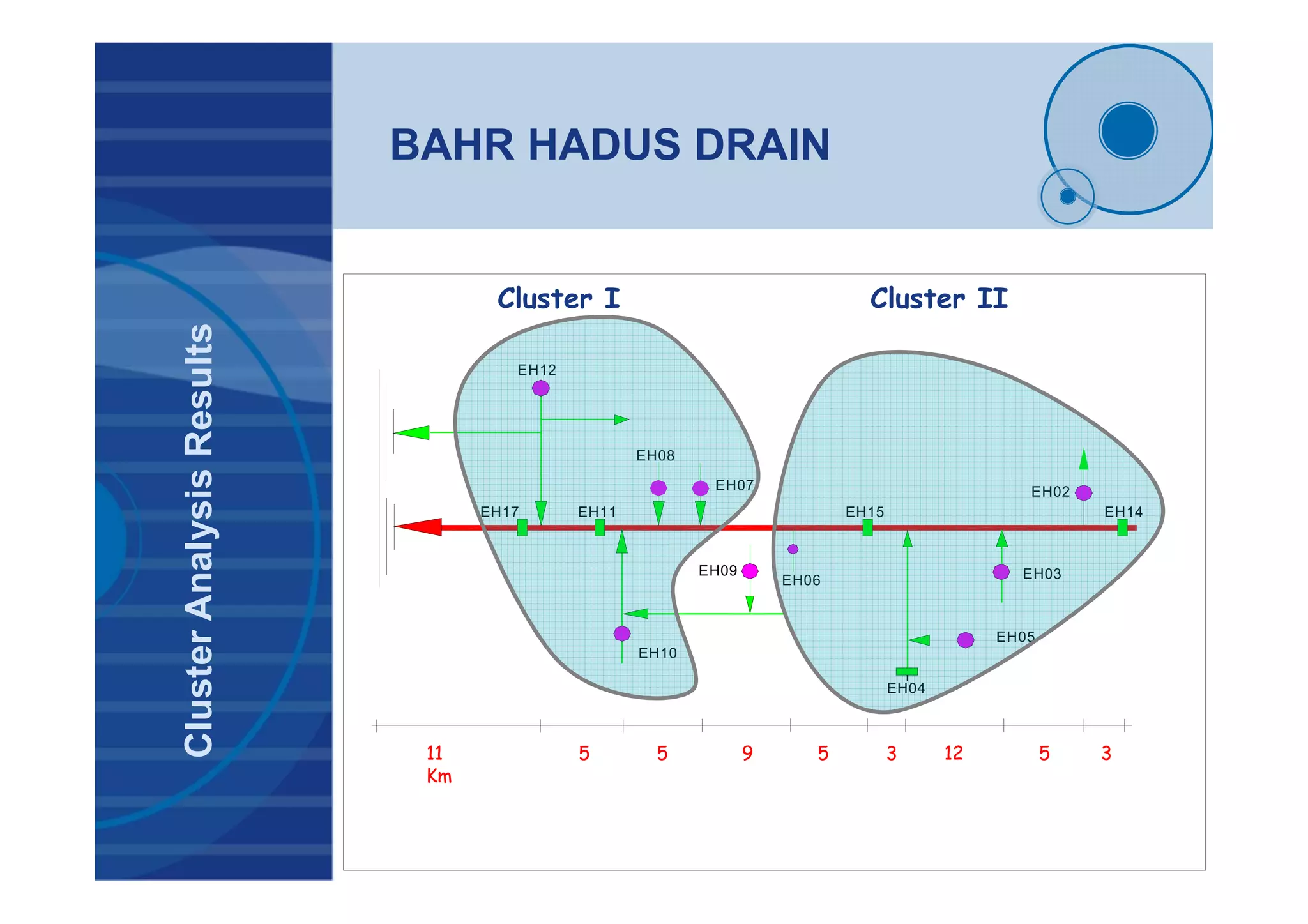
BAHR HADUS DRAIN
EH07
EH17
EH10
EH11
EH09
EH06
EH12
EH08
EH02
EH14
EH04
EH15
EH03
EH05
11
Km
5 5 9 35 512 3
Cluster I Cluster II
ClusterAnalysisResults
BAHR HADUS DRAIN
ClusterAnalysisResults
Significance of Clusters Means
Cluster 1
Cluster 2
BOD
Ln_NO3
Ln_Cd
Zn
Log_Mg
CO3
Log_Cl
Ln_Temp
DO
Variables
-4
-3
-2
-1
0
1
2
3
4
ClusterMeans
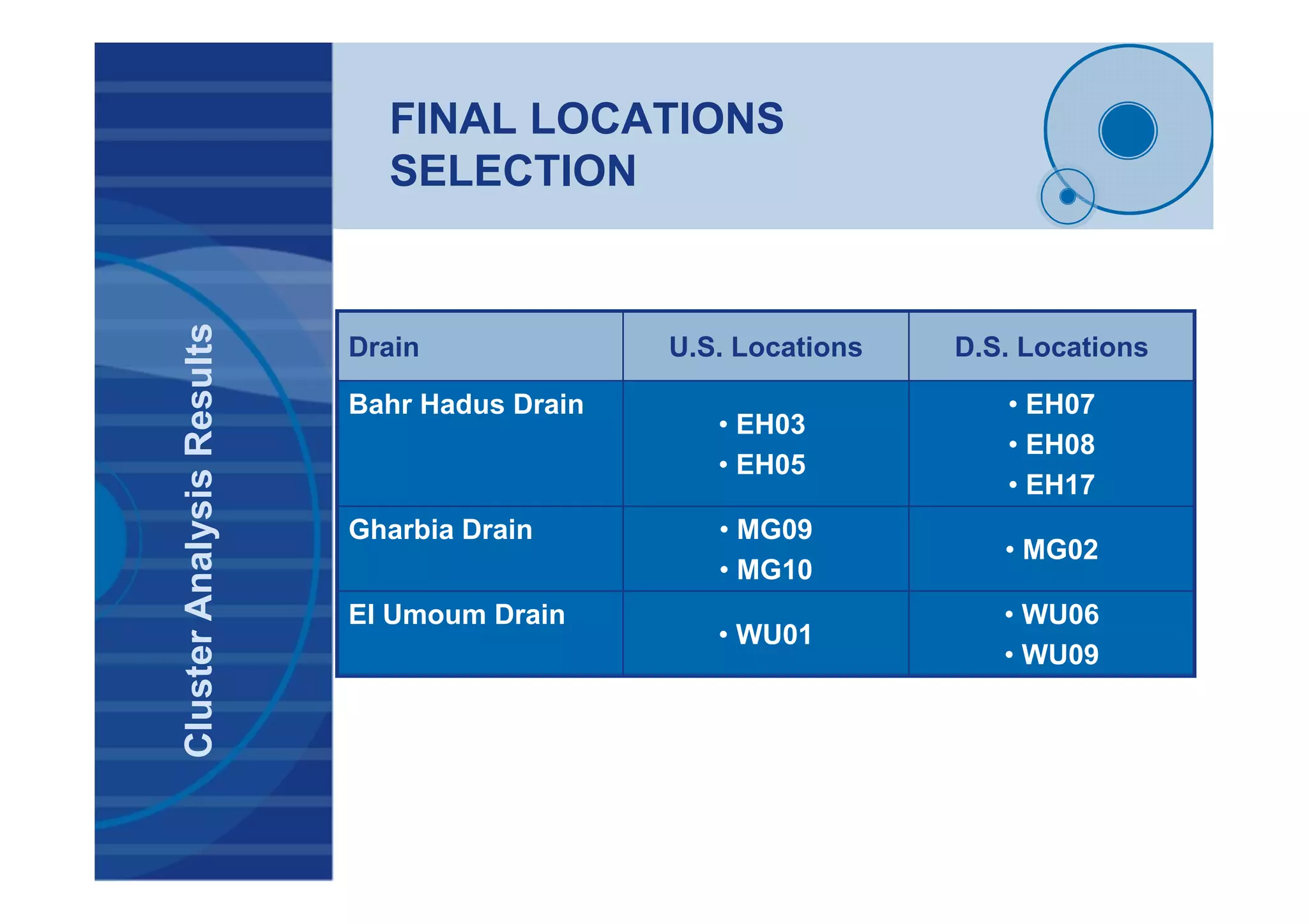
FINAL LOCATIONS
SELECTION
Drain U.S. Locations D.S. Locations
Bahr Hadus Drain
• EH03
• EH05
• EH07
• EH08
• EH17
Gharbia Drain • MG09
• MG10
• MG02
El Umoum Drain
• WU01
• WU06
• WU09
ClusterAnalysisResults
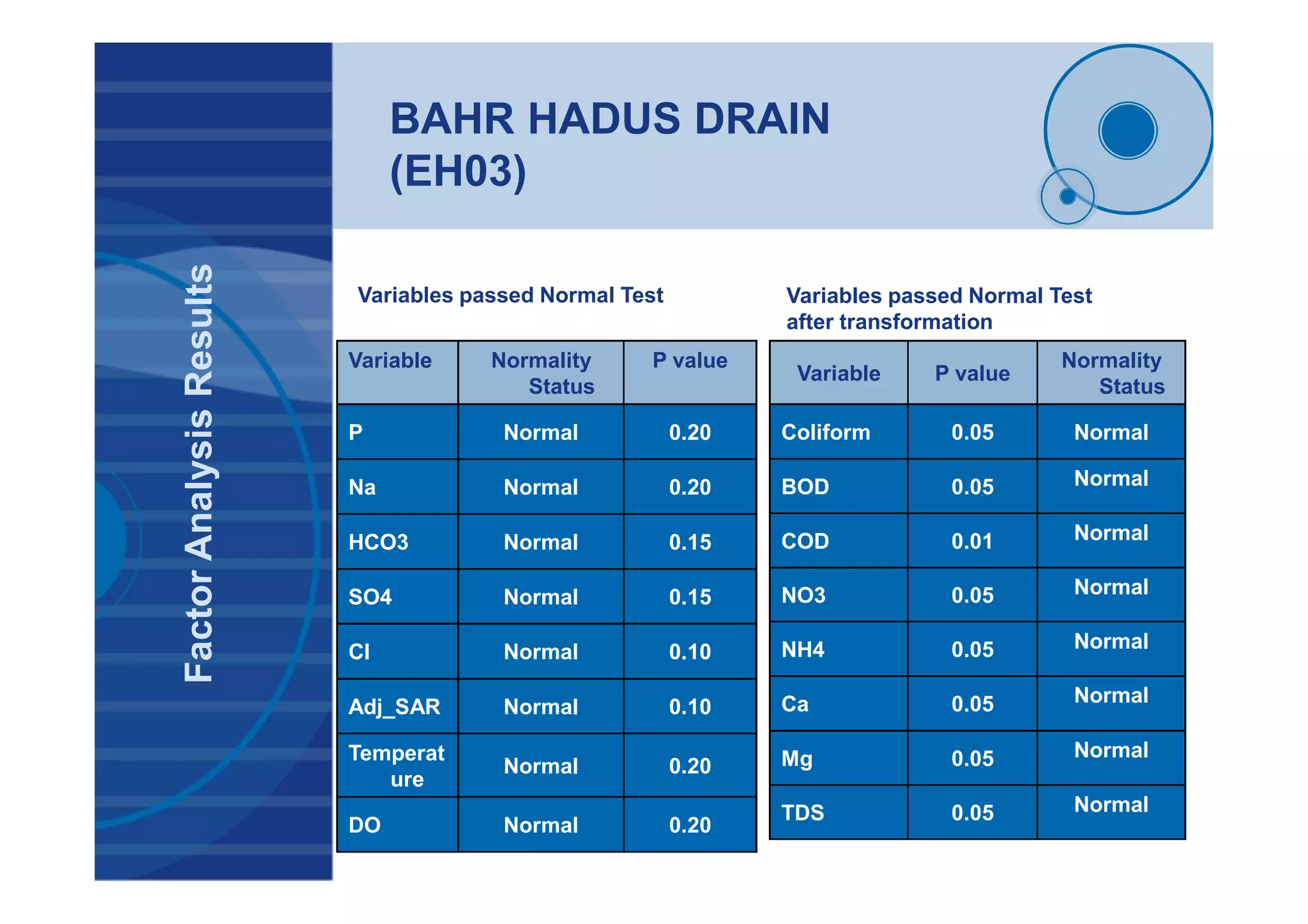
BAHR HADUS DRAIN
(EH03)
Variable Normality
Status
P value
P Normal 0.20
Na Normal 0.20
HCO3 Normal 0.15
SO4 Normal 0.15
Cl Normal 0.10
Adj_SAR Normal 0.10
Temperat
ure
Normal 0.20
DO Normal 0.20
FactorAnalysisResults
Variable P value
Normality
Status
Coliform 0.05 Normal
BOD 0.05 Normal
COD 0.01 Normal
NO3 0.05 Normal
NH4 0.05 Normal
Ca 0.05 Normal
Mg 0.05 Normal
TDS 0.05 Normal
Variables passed Normal Test Variables passed Normal Test
after transformation
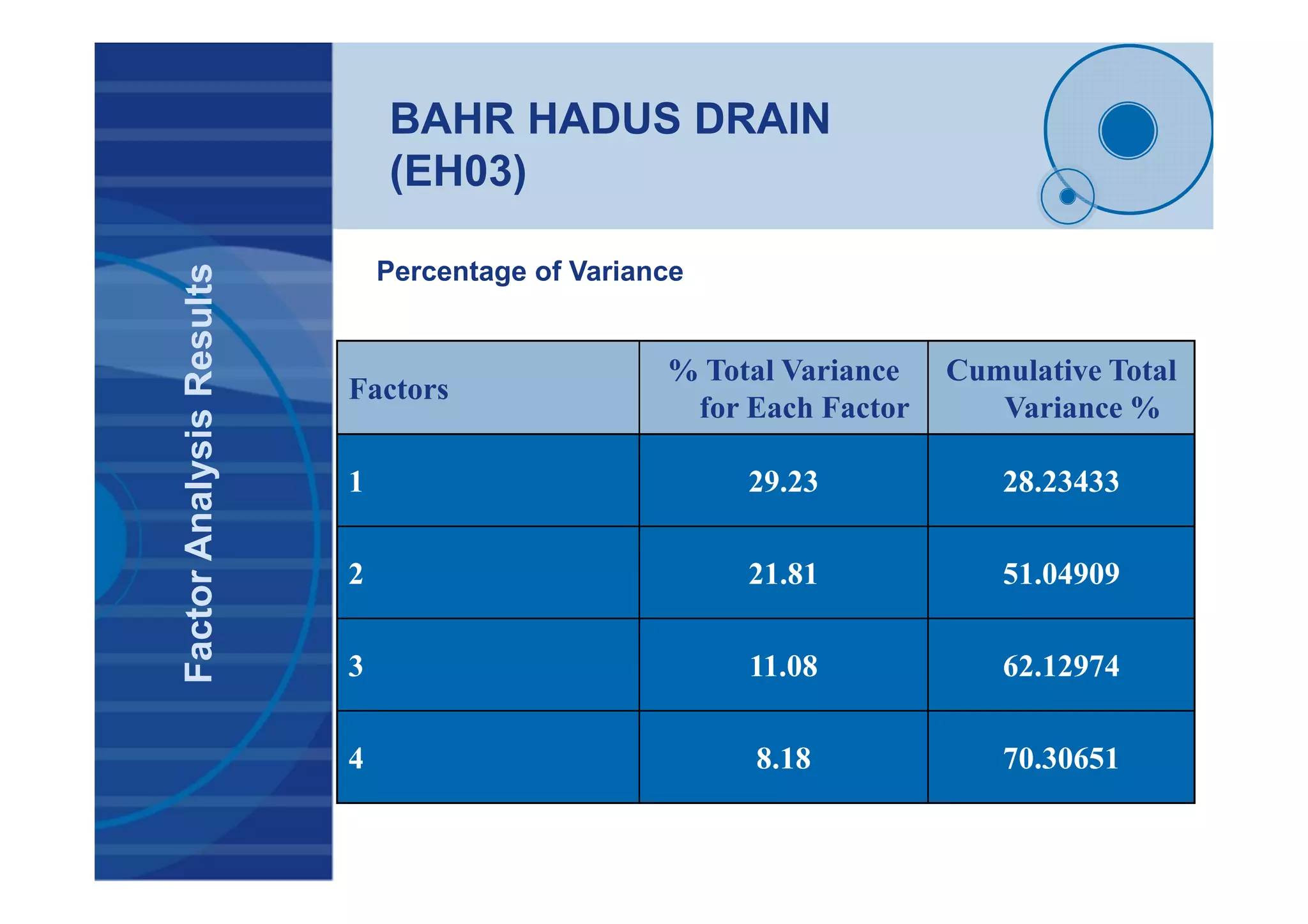
BAHR HADUS DRAIN
(EH03)
Factors
% Total Variance
for Each Factor
Cumulative Total
Variance %
1 29.23 28.23433
2 21.81 51.04909
3 11.08 62.12974
4 8.18 70.30651
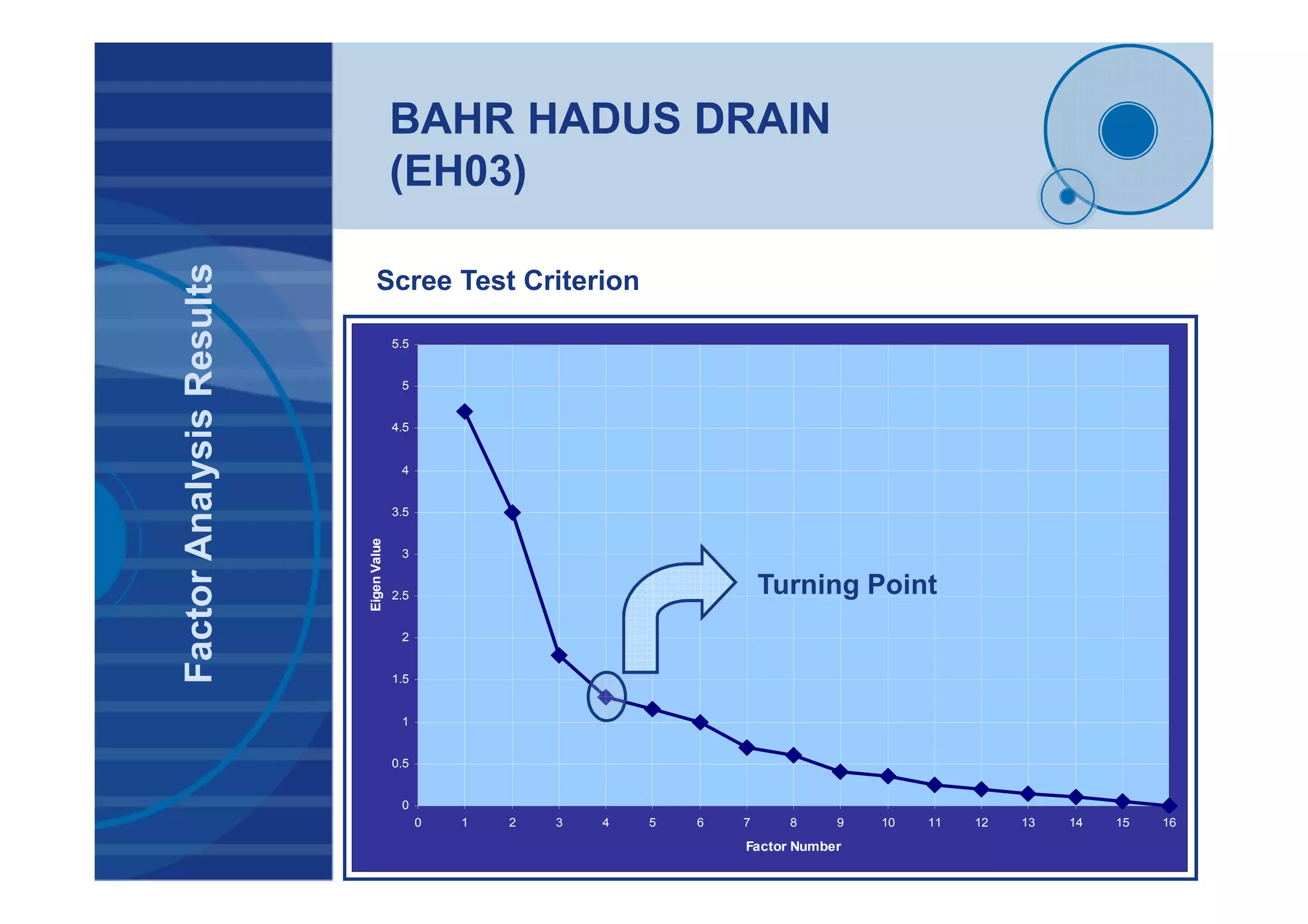
FactorAnalysisResults
Percentage of Variance
0
0.5
1
1.5
2
2.5
3
3.5
4
4.5
5
5.5
0 1 2 3 4 5 6 7 8 9 10 11 12 13 14 15 16
Factor Number
EigenValue
BAHR HADUS DRAIN
(EH03)
FactorAnalysisResults
Turning Point
Scree Test Criterion
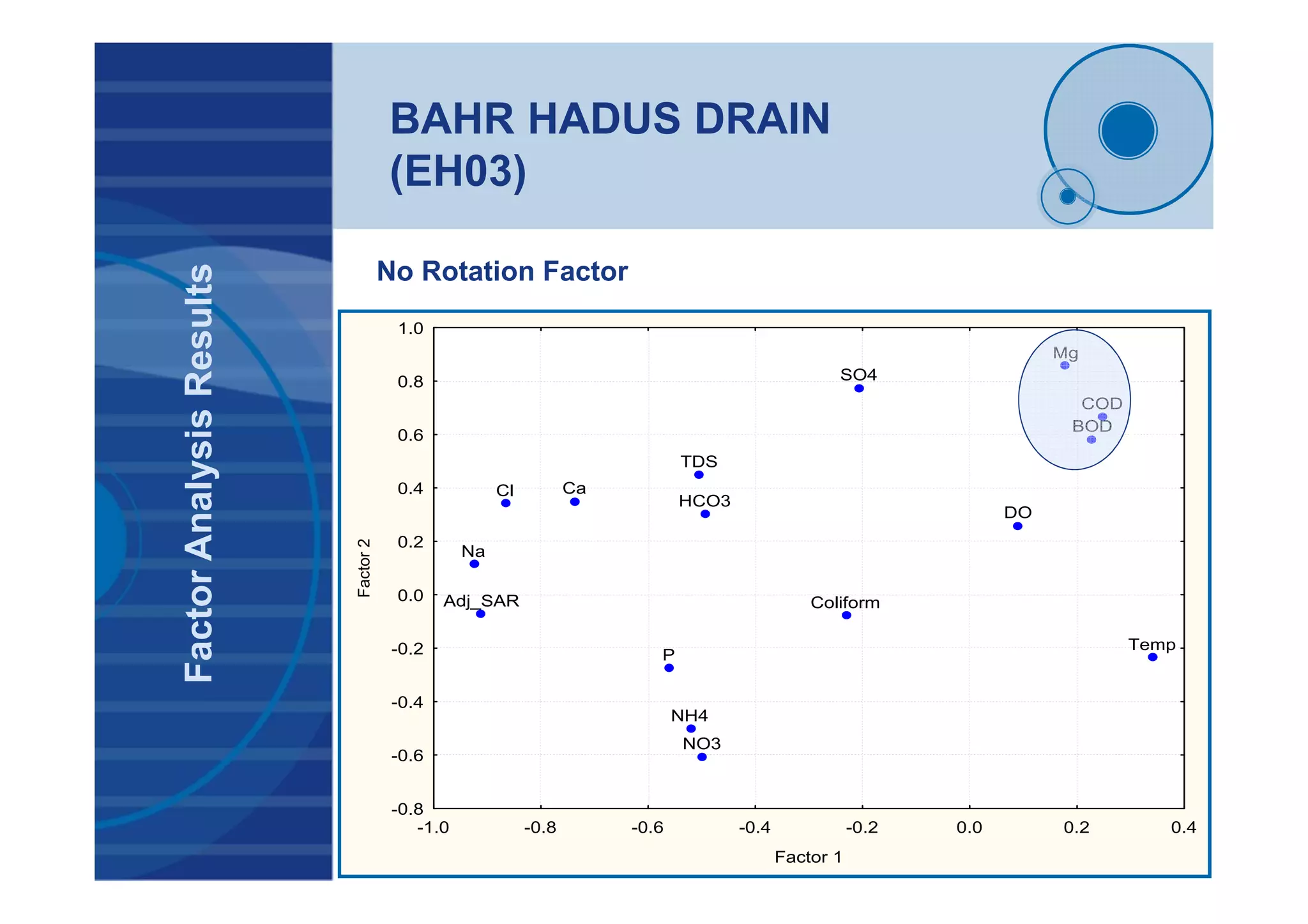
BAHR HADUS DRAIN
(EH03)
Coliform
BOD
COD
NO3
NH4
P
Ca
Mg
Na
HCO3
SO4
Cl
Adj_SAR
Temp
TDS
DO
-1.0 -0.8 -0.6 -0.4 -0.2 0.0 0.2 0.4
Factor 1
-0.8
-0.6
-0.4
-0.2
0.0
0.2
0.4
0.6
0.8
1.0
Factor2
No Rotation Factor
FactorAnalysisResults
BAHR HADUS DRAIN
(EH03)
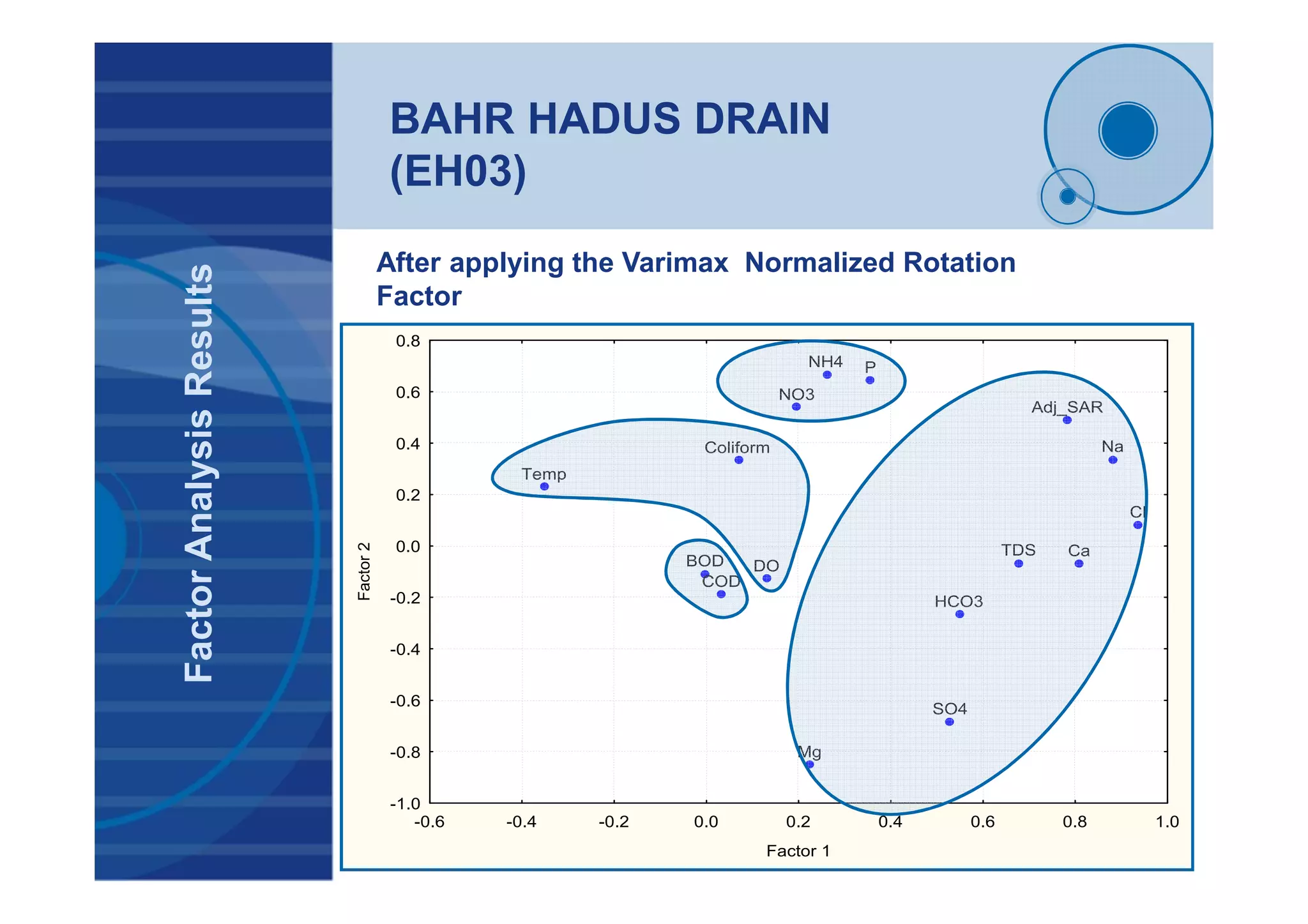
FactorAnalysisResults
Coliform
BOD
COD
NO3
NH4 P
Ca
Mg
Na
HCO3
SO4
Cl
Adj_SAR
Temp
TDS
DO
-0.6 -0.4 -0.2 0.0 0.2 0.4 0.6 0.8 1.0
Factor 1
-1.0
-0.8
-0.6
-0.4
-0.2
0.0
0.2
0.4
0.6
0.8
Factor2
After applying the Varimax Normalized Rotation
Factor
BAHR HADUS DRAIN
(EH03)
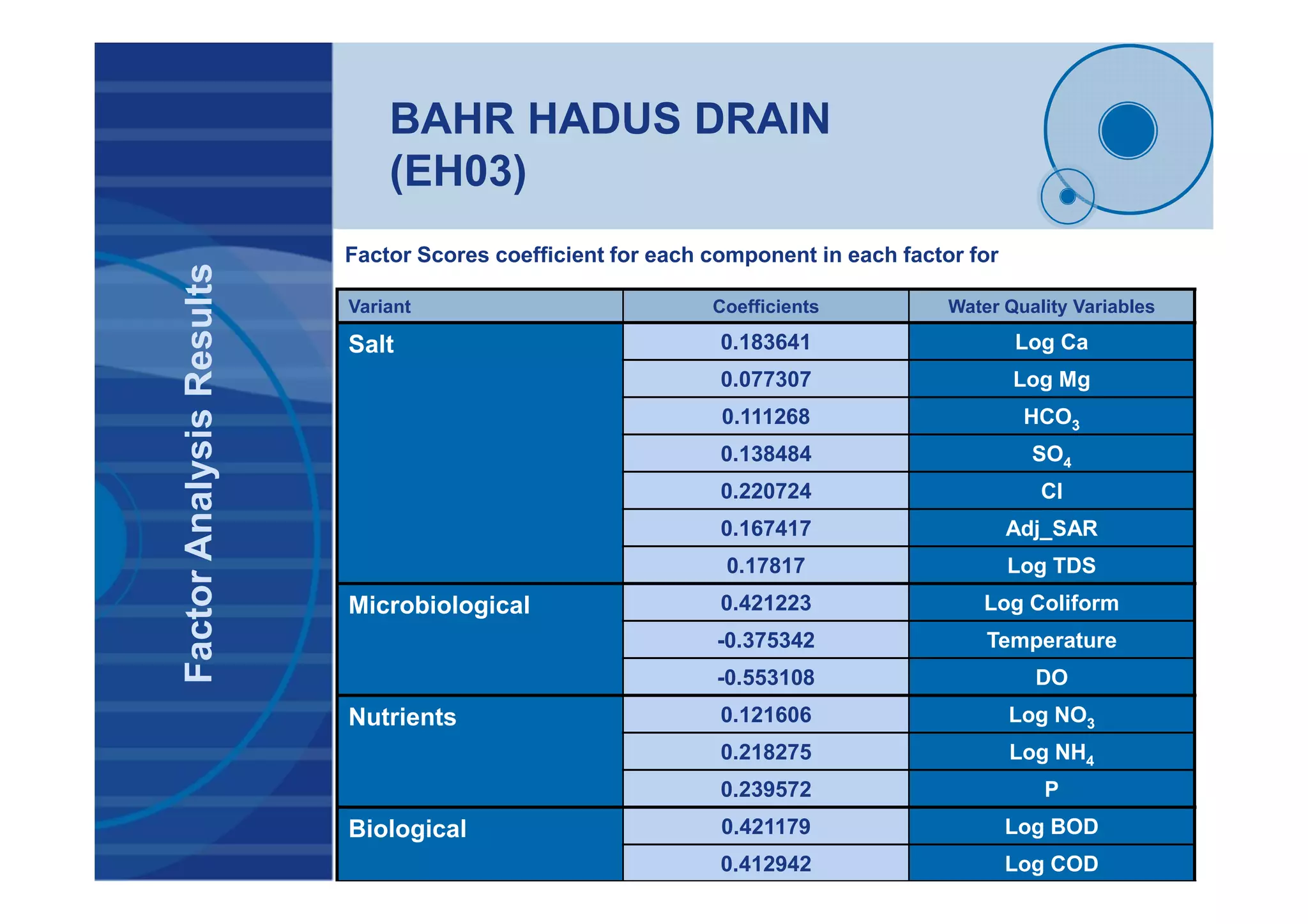
FactorAnalysisResults
Variant Coefficients Water Quality Variables
Salt 0.183641 Log Ca
0.077307 Log Mg
0.111268 HCO3
0.138484 SO4
0.220724 Cl
0.167417 Adj_SAR
0.17817 Log TDS
Microbiological 0.421223 Log Coliform
-0.375342 Temperature
-0.553108 DO
Nutrients 0.121606 Log NO3
0.218275 Log NH4
0.239572 P
Biological 0.421179 Log BOD
0.412942 Log COD
Factor Scores coefficient for each component in each factor for
BAHR HADUS DRAIN
(EH03)
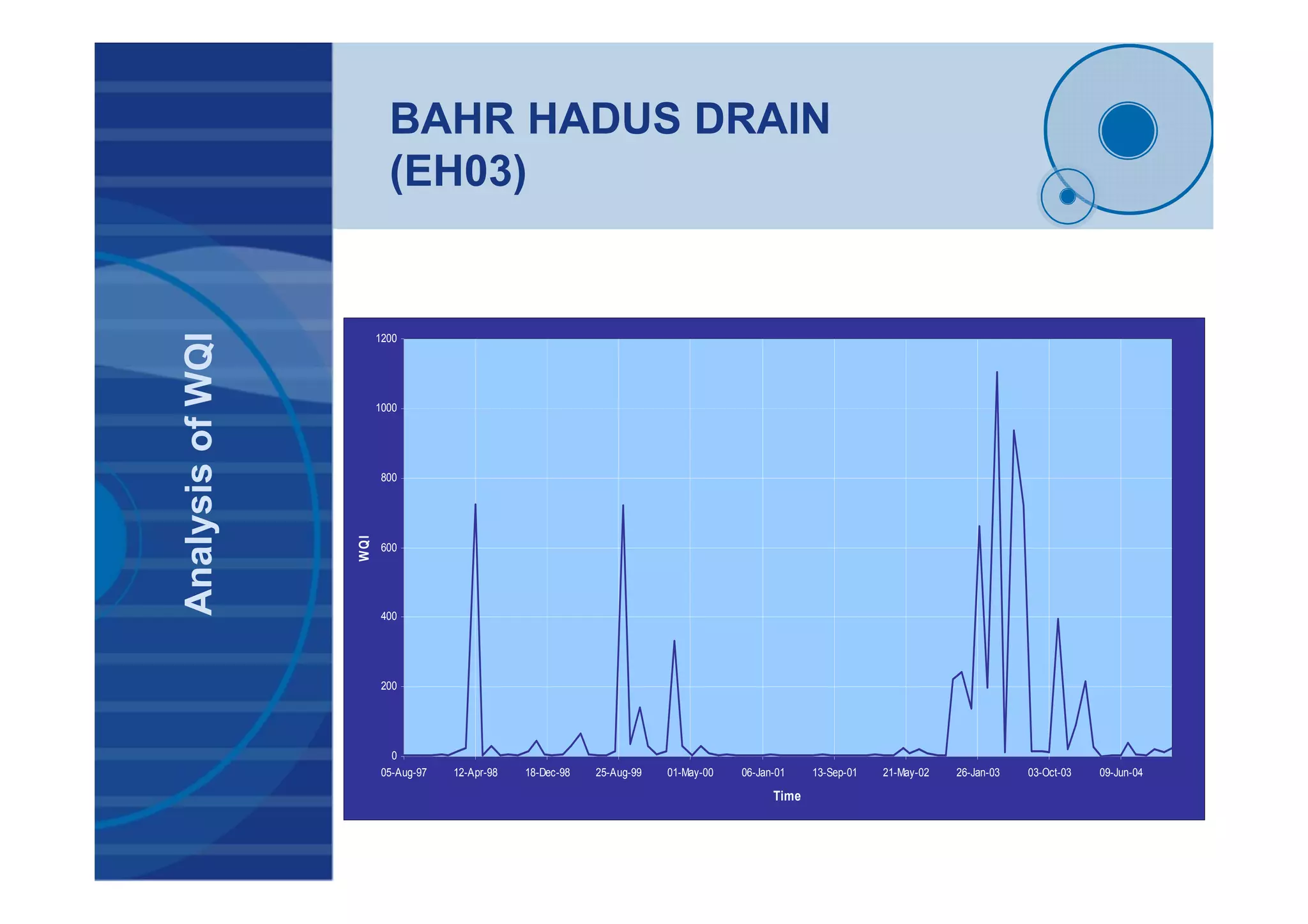
AnalysisofWQI
0
200
400
600
800
1000
1200
05-Aug-97 12-Apr-98 18-Dec-98 25-Aug-99 01-May-00 06-Jan-01 13-Sep-01 21-May-02 26-Jan-03 03-Oct-03 09-Jun-04
Time
WQI
BAHR HADUS DRAIN
(EH03)QuantifyingUncertaintyand
RiskintheVariantsHistorical
Data
0
1.5
3
4.5
6
7.5
9
10.5
12
13.5
15
5-Aug-97 12-Apr-98 18-Dec-98 25-Aug-99 1-May-00 6-Jan-01 13-Sep-01 21-May-02 26-Jan-03 3-Oct-03 9-Jun-04
Time
SaltVariant
Salt Variant U.C.L L.C.L
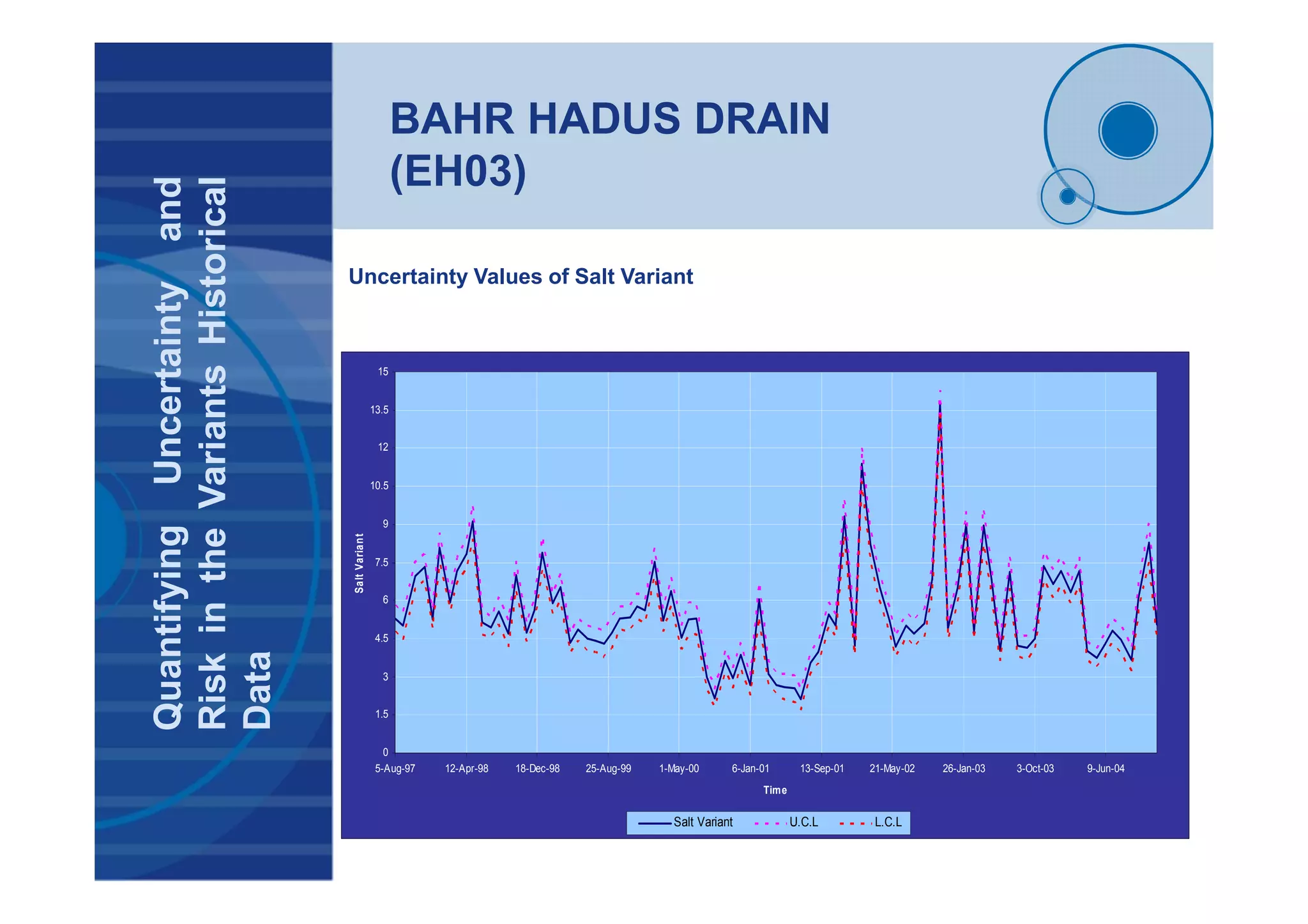
Uncertainty Values of Salt Variant
BAHR HADUS DRAIN
(EH03)QuantifyingUncertaintyand
RiskintheVariantsHistorical
Data
PearsonVI(64.38,8.51,0.66)
0
0.1
0.2
0.3
0.4
0.5
0.6
0.7
0.8
0.9
1
0 2 4 6 8 10 12 14
Salt Variant
Probability(P)
PearsonVI(64.38,8.51,0.66)
Equivalent Standards= 203 ppm
Risk Values of Salt Variant= 0%
BAHR HADUS DRAIN
(EH03)DecisionTreeUnderRiskand
UncertaintyConditions
0
1.5
3
4.5
6
7.5
9
10.5
12
13.5
15
5-Aug-97 12-Apr-98 18-Dec-98 25-Aug-99 1-May-00 6-Jan-01 13-Sep-01 21-May-02 26-Jan-03 3-Oct-03 9-Jun-04
Time
SaltVariant
Salt Variant U.C.L L.C.L
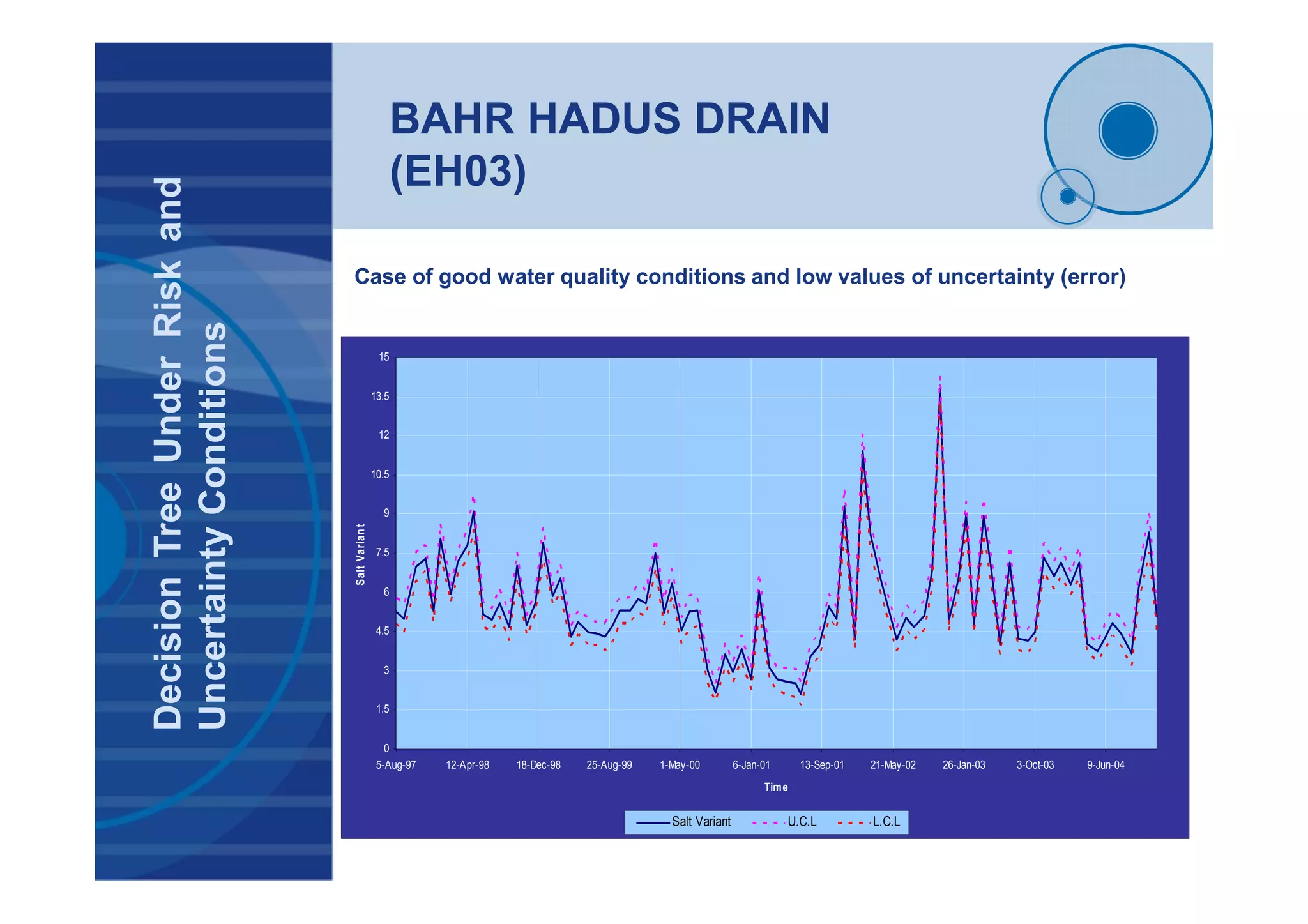
Case of good water quality conditions and low values of uncertainty (error)
BAHR HADUS DRAIN
(EH03)DecisionTreeUnderRiskand
UncertaintyConditions
0
5
10
15
20
25
5-Aug-97 12-Apr-98 18-Dec-98 25-Aug-99 1-May-00 6-Jan-01 13-Sep-01 21-May-02 26-Jan-03 3-Oct-03 9-Jun-04
Time
MicrobiologicalVariant
Microbiological U.C.L L.C.L Standards
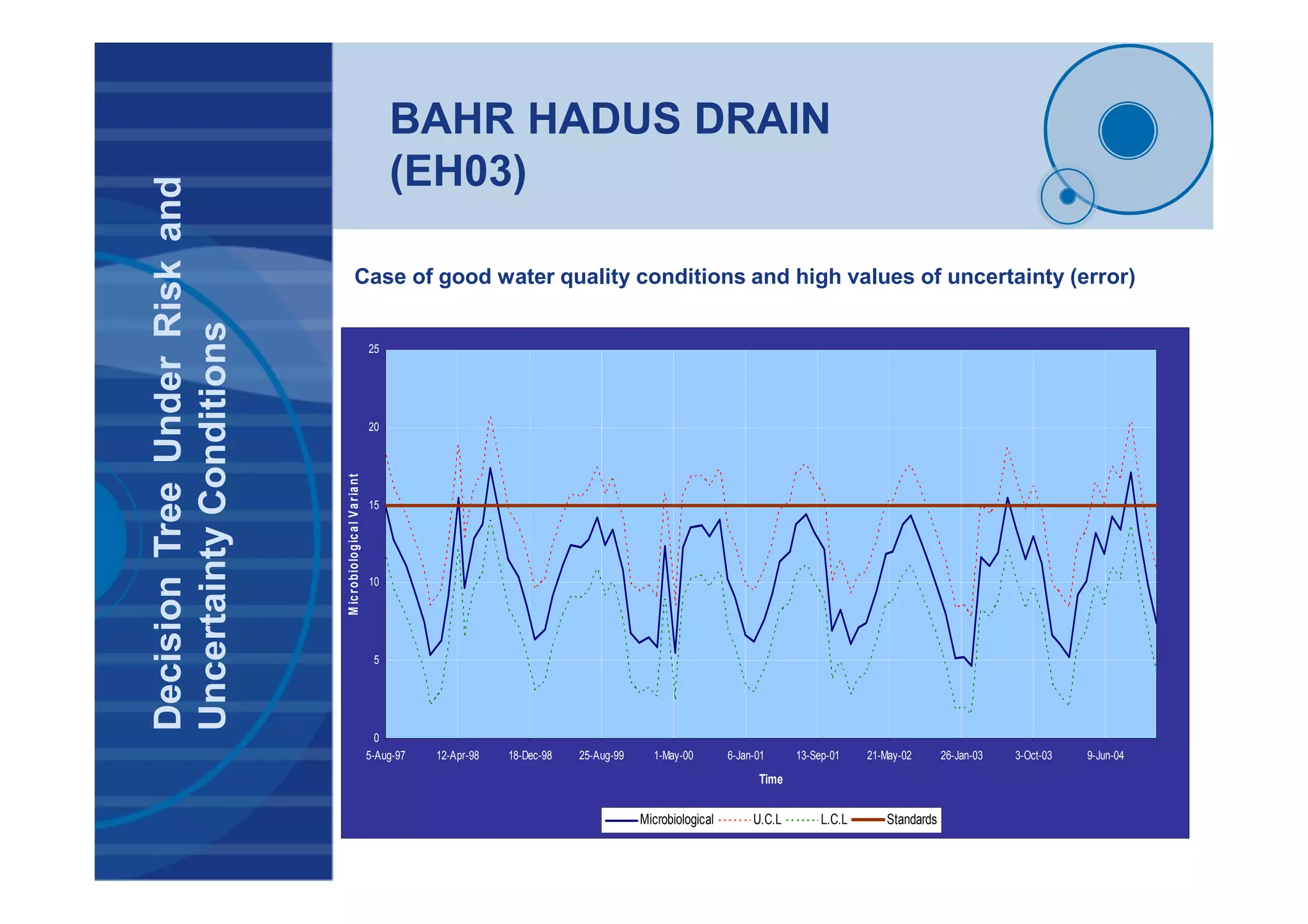
Case of good water quality conditions and high values of uncertainty (error)
BAHR HADUS DRAIN
(EH03)DecisionTreeUnderRiskand
UncertaintyConditions
0
0.4
0.8
1.2
1.6
2
2.4
2.8
3.2
5-Aug-97 12-Apr-98 18-Dec-98 25-Aug-99 1-May-00 6-Jan-01 13-Sep-01 21-May-02 26-Jan-03 3-Oct-03 9-Jun-04
Time
MicrobiologicalVariant
Microbiological Variant U.C.L L.C.L Standard
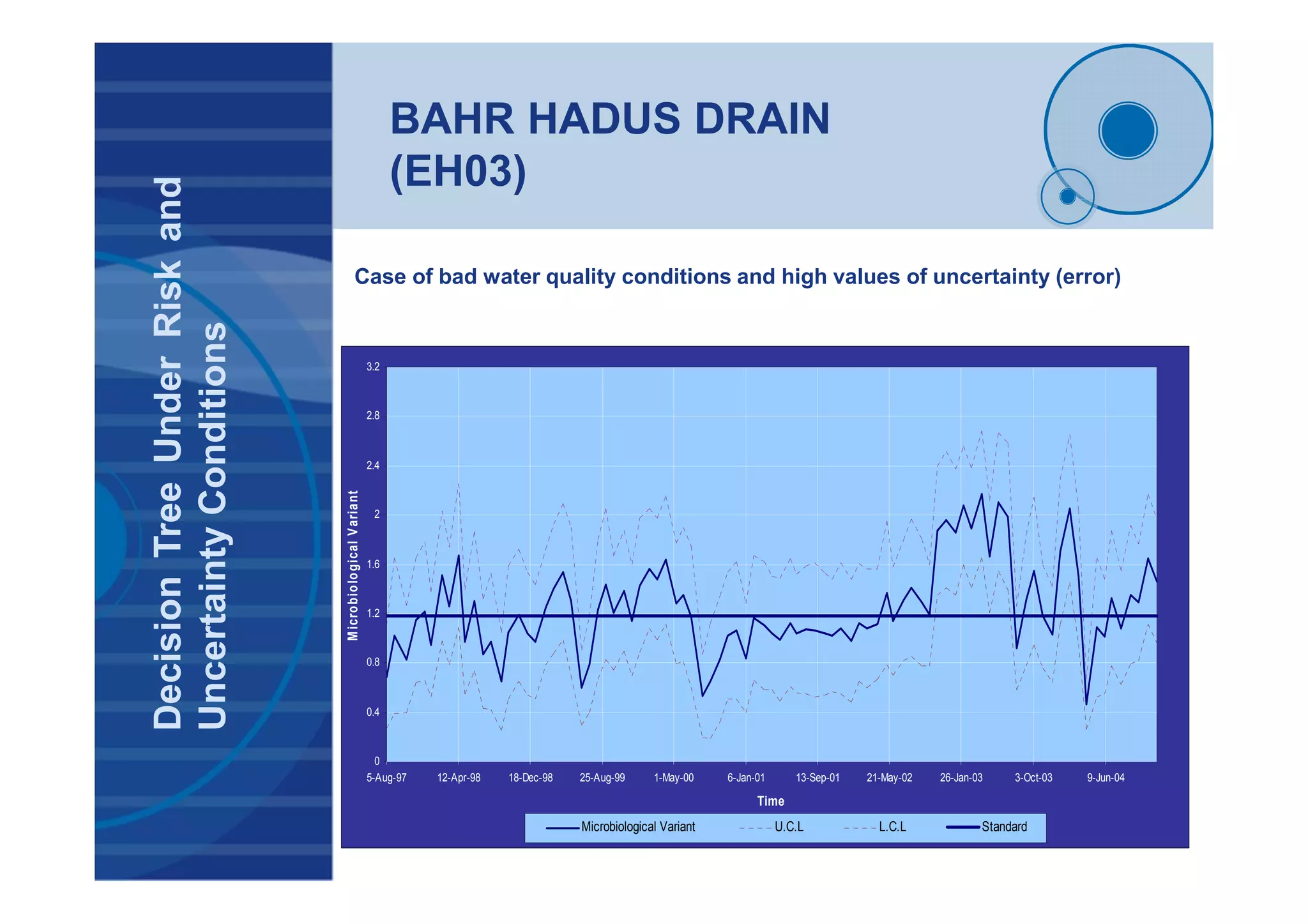
Case of bad water quality conditions and high values of uncertainty (error)
BAHR HADUS DRAIN
(EH03)DecisionTreeUnderRiskand
UncertaintyConditions
0
20
40
60
80
100
120
140
5-Aug-97 12-Apr-98 18-Dec-98 25-Aug-99 1-May-00 6-Jan-01 13-Sep-01 21-May-02 26-Jan-03 3-Oct-03 9-Jun-04
Time
BiologicalVariant
Biological U.C.L L.C.L Standards
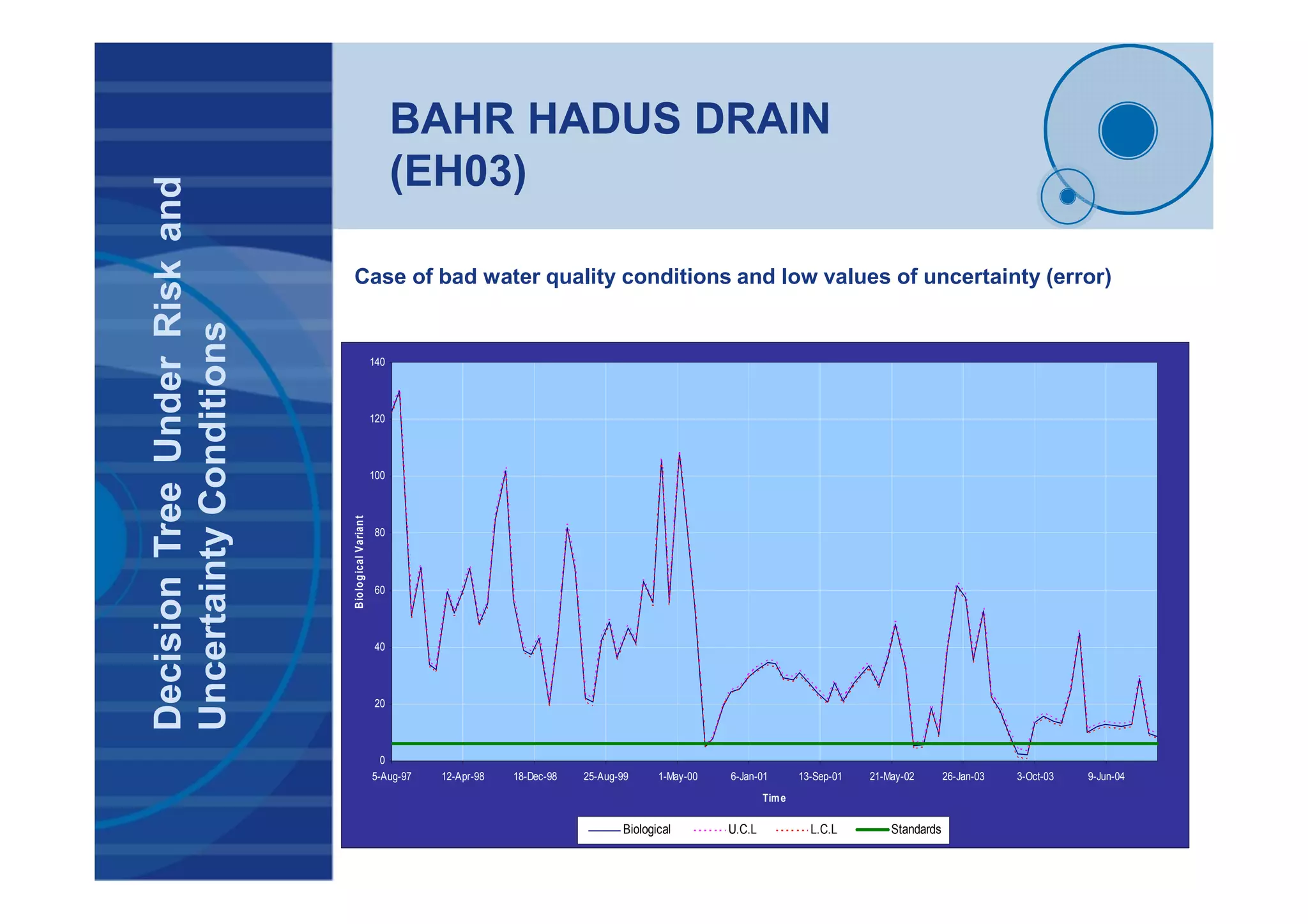
Case of bad water quality conditions and low values of uncertainty (error)
BAHR HADUS DRAIN
(EH03- Salt Variant)
TimeSeriesAnalysisResults
Autocorrelation Function
EH03 Salt
Conf. Limit
-1.0 -0.5 0.0 0.5 1.0
0
15 -.144 .0956
14 +.067 .0962
13 +.021 .0969
12 +.179 .0975
11 +.133 .0981
10 +.030 .0988
9 +.137 .0994
8 +.110 .1000
7 -.039 .1006
6 -.014 .1012
5 +.044 .1018
4 +.060 .1024
3 +.272 .1030
2 +.340 .1036
1 +.304 .1042
Lag Corr. S.E.
0
38.17 .0009
35.90 .0011
35.42 .0007
35.38 .0004
32.01 .0008
30.17 .0008
30.08 .0004
28.19 .0004
26.97 .0003
26.82 .0002
26.80 .0001
26.61 .0000
26.27 .0000
19.31 .0001
8.52 .0035
Q p
Partial Autocorrelation Function
EH03 Salt
Conf. Limit
-1.0 -0.5 0.0 0.5 1.0
0
15 -.215 .1060
14 -.025 .1060
13 -.062 .1060
12 +.144 .1060
11 -.011 .1060
10 -.113 .1060
9 +.151 .1060
8 +.184 .1060
7 +.004 .1060
6 -.032 .1060
5 -.069 .1060
4 -.139 .1060
3 +.135 .1060
2 +.273 .1060
1 +.304 .1060
Lag Corr. S.E.
Partial Auto Correlation Function Auto Correlation Function
BAHR HADUS DRAIN
(EH03- Salt Variant)
TimeSeriesAnalysisResults
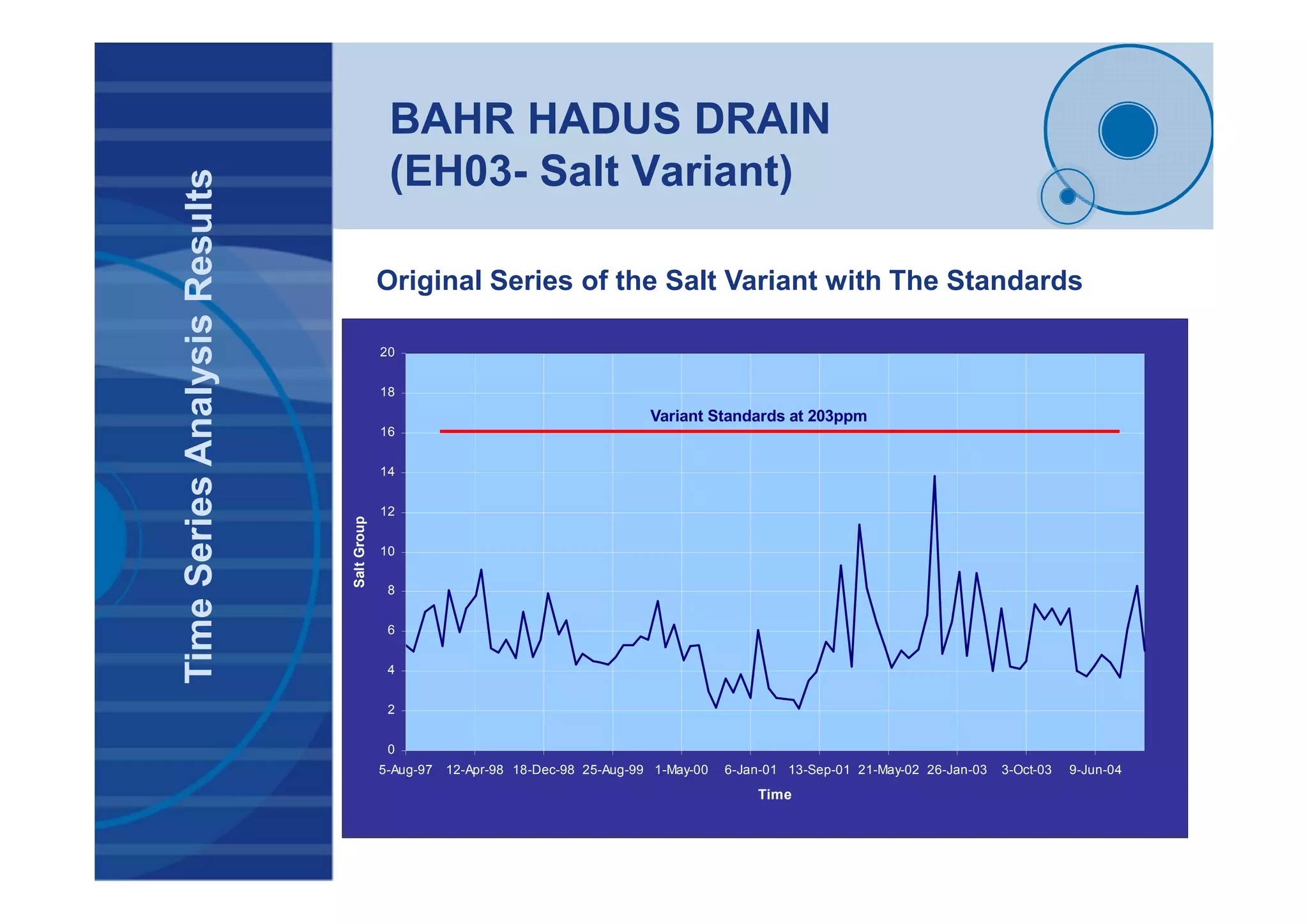
Original Series of the Salt Variant with The Standards
0
2
4
6
8
10
12
14
16
18
20
5-Aug-97 12-Apr-98 18-Dec-98 25-Aug-99 1-May-00 6-Jan-01 13-Sep-01 21-May-02 26-Jan-03 3-Oct-03 9-Jun-04
Time
SaltGroup
Variant Standards at 203ppm
BAHR HADUS DRAIN
(EH03- Salt Variant)
Location Variant Non Seasonal Model Seasonal Model
θ d Φ θ d Φ
EH03 Salt 0.765 1 -0.988 1
TimeSeriesAnalysisResults
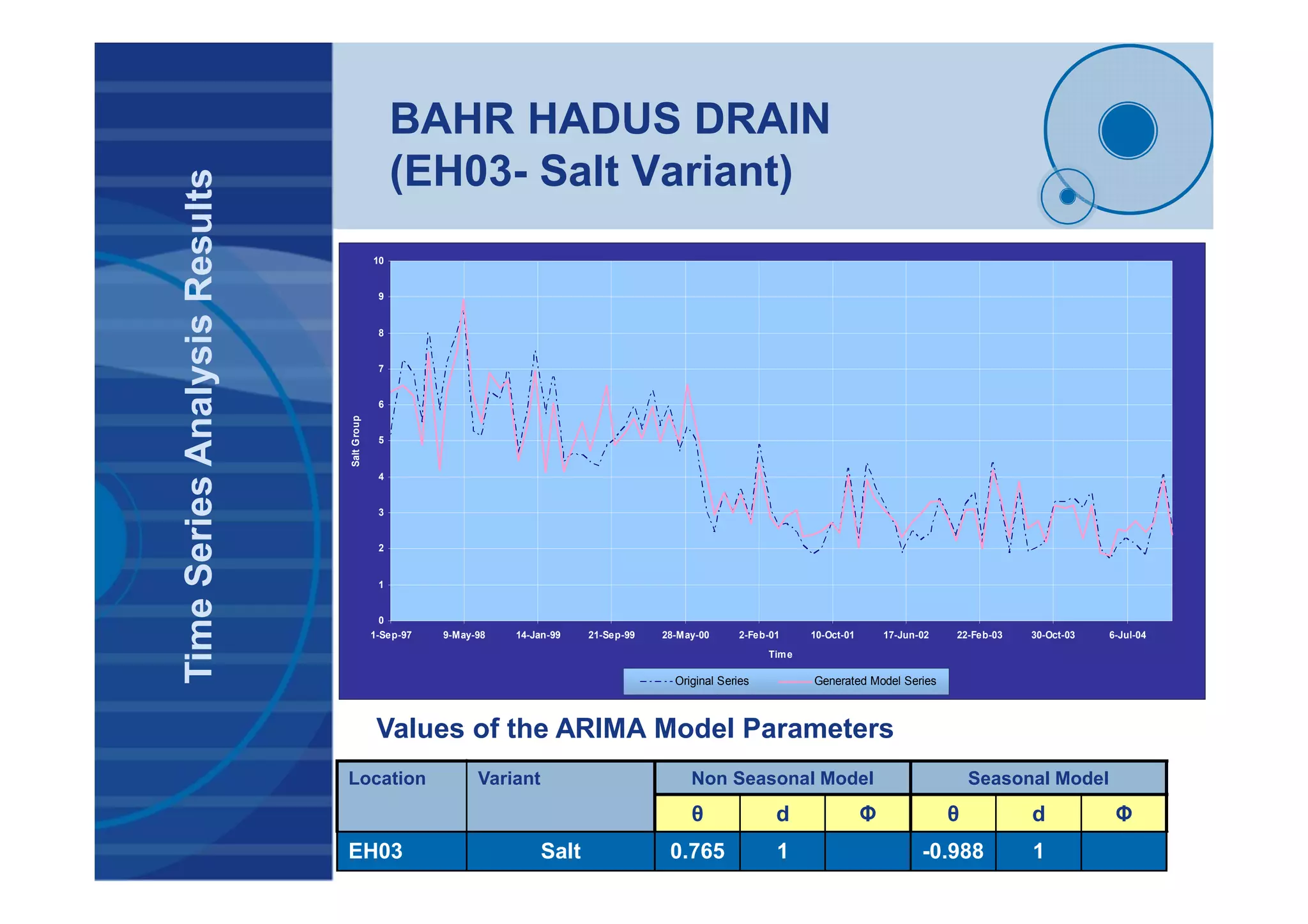
Values of the ARIMA Model Parameters
0
1
2
3
4
5
6
7
8
9
10
1-Sep-97 9-May-98 14-Jan-99 21-Sep-99 28-May-00 2-Feb-01 10-Oct-01 17-Jun-02 22-Feb-03 30-Oct-03 6-Jul-04
Time
SaltGroup
Original Series Generated Model Series
BAHR HADUS DRAIN
(EH03- Salt Variant)
TimeSeriesAnalysisResults
0
0.5
1
1.5
2
2.5
3
3.5
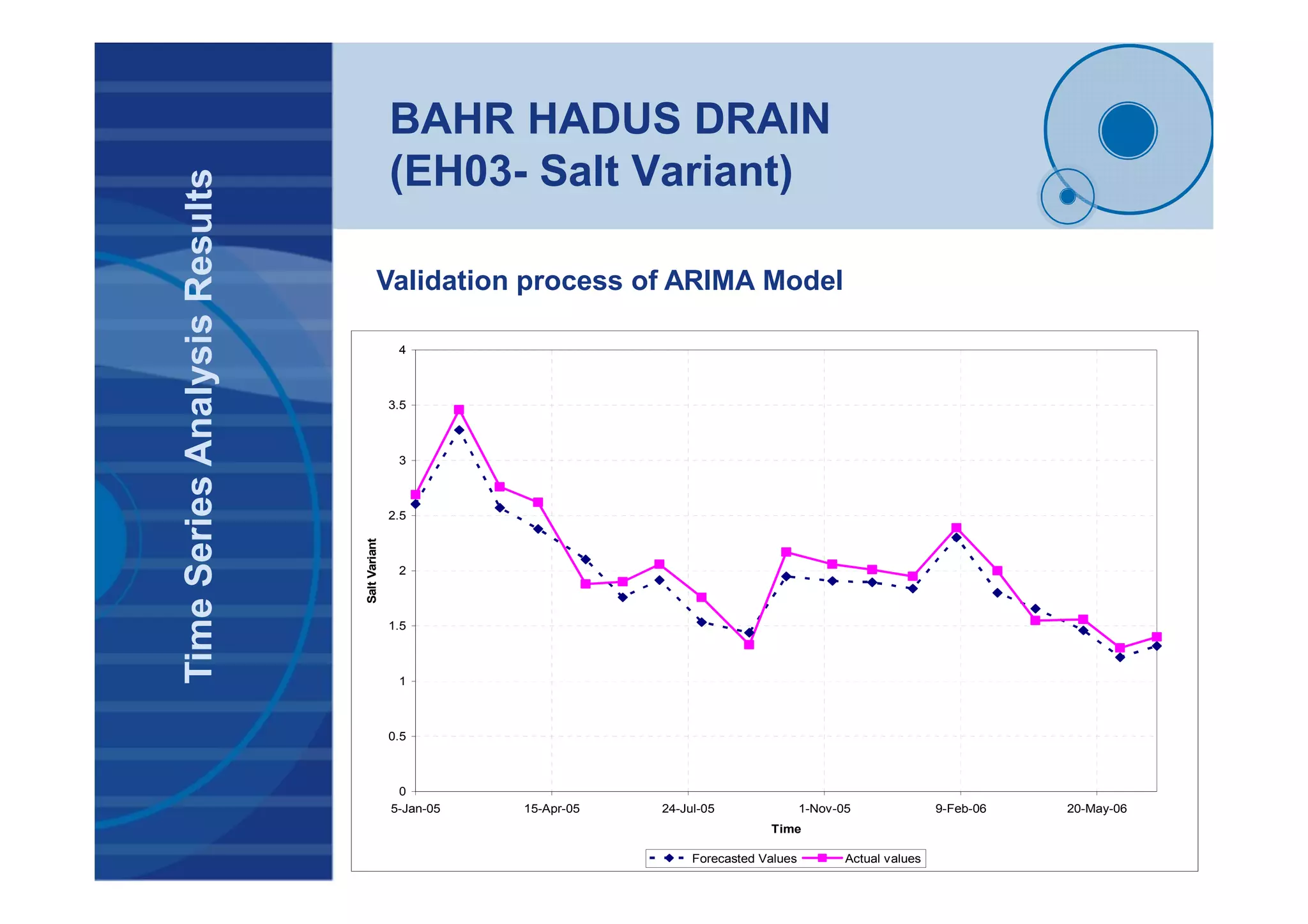
4
5-Jan-05 15-Apr-05 24-Jul-05 1-Nov-05 9-Feb-06 20-May-06
Time
SaltVariant
Forecasted Values Actual values
Validation process of ARIMA Model
BAHR HADUS DRAIN
(EH03- Salt Variant)
TimeSeriesAnalysisResults
INFORMATION ON DIAGNOSTICS SELECTIVE ARIMA MODEL
SA quality index (stand to 10) 2.239 [0, 10] ad-hoc
STATISTICS ON RESIDUALS
Ljung-Box on residuals 15.87 [0, 33.90] 5%
Box-Pierce on residuals 00.44 [0, 5.990] 5%
Ljung-Box on squared residuals 24.89 [0, 33.90] 5%
Box-Pierce on squared residuals 00.09 [0, 5.990] 5%
Durbin-Watson statistic on residuals 2.16 [min:0, max:4]
DESCRIPTION OF RESIDUALS
Normality 1.30 [0, 5.99] 5%
Skewness 0.00 [-0.57, 0.57] 5%
Kurtosis 2.34 [1.87, 4.13] 5%
OUTLIERS
Percentage of outliers 2.33 % [0%, 5.0 %] ad-hoc
Results of the Statistical Tests Applied on the Residuals of
the Selected Model
BAHR HADUS DRAIN
(EH03- Salt Variant)
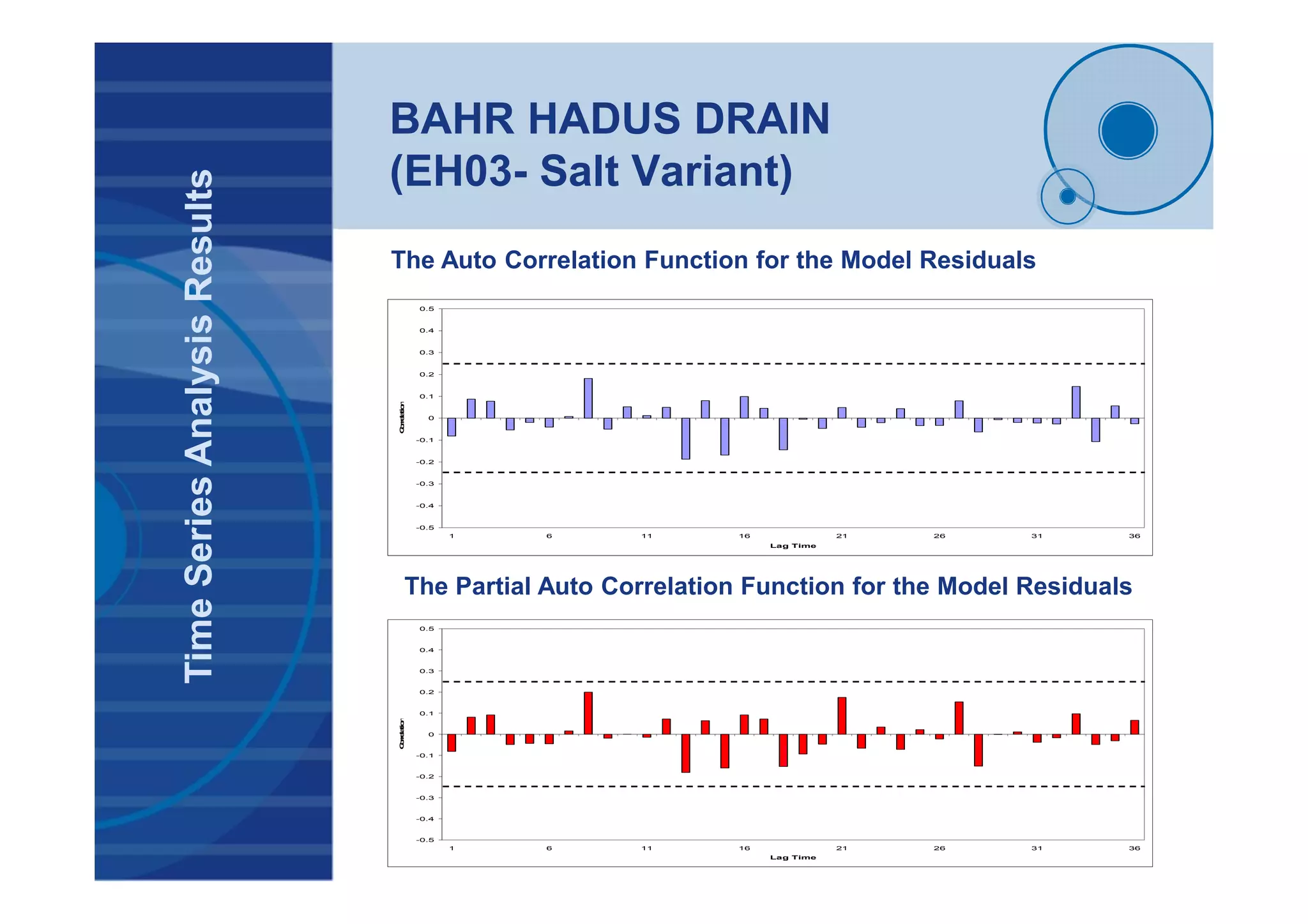
-0.5
-0.4
-0.3
-0.2
-0.1
0
0.1
0.2
0.3
0.4
0.5
1 6 11 16 21 26 31 36
Lag Time
Correlation
TimeSeriesAnalysisResults
-0.5
-0.4
-0.3
-0.2
-0.1
0
0.1
0.2
0.3
0.4
0.5
1 6 11 16 21 26 31 36
Lag Time
Correlation
The Auto Correlation Function for the Model Residuals
The Partial Auto Correlation Function for the Model Residuals
BAHR HADUS DRAIN
(EH03- Salt Variant)
TimeSeriesAnalysisResults
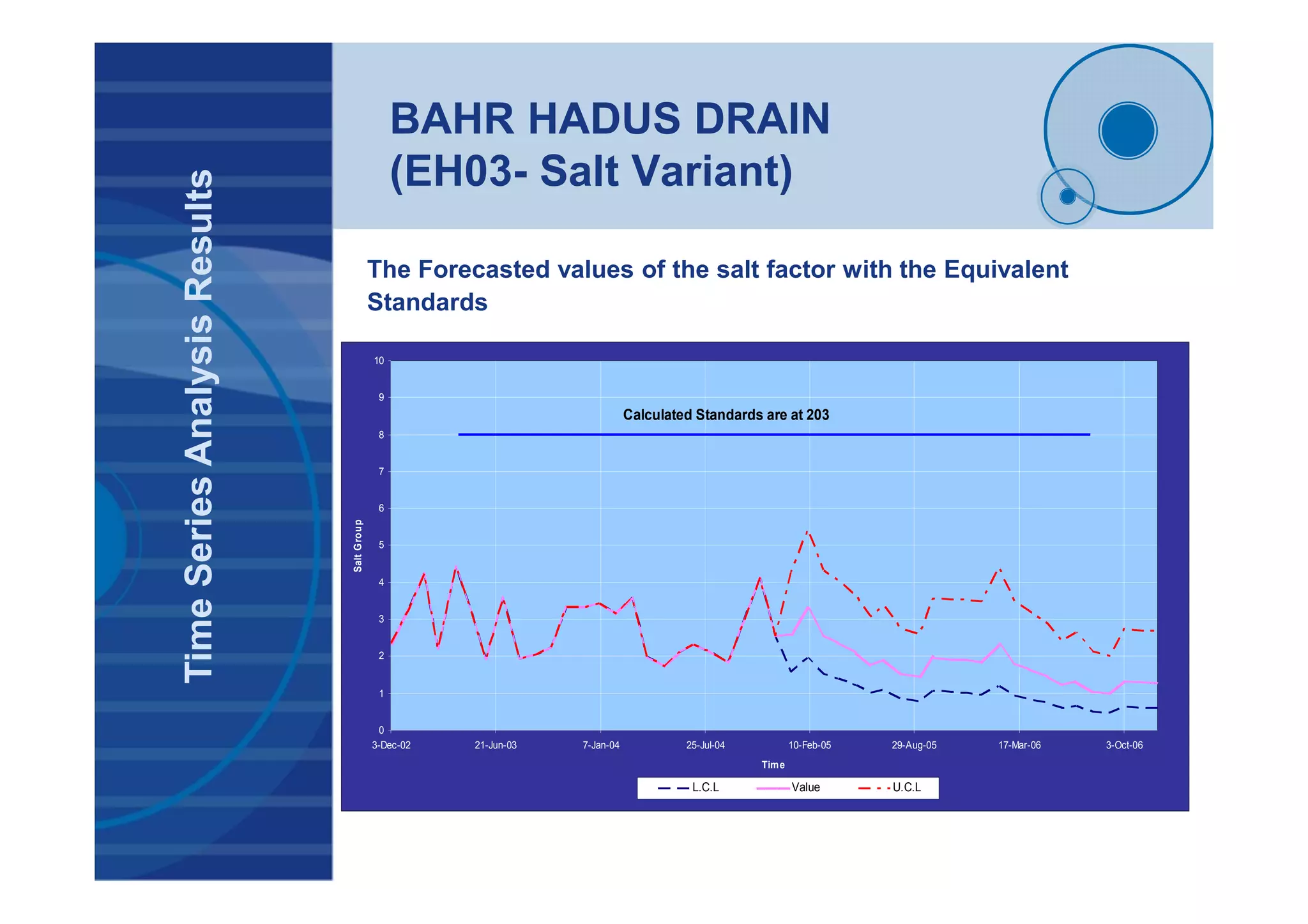
The Forecasted values of the salt factor with the Equivalent
Standards
0
1
2
3
4
5
6
7
8
9
10
3-Dec-02 21-Jun-03 7-Jan-04 25-Jul-04 10-Feb-05 29-Aug-05 17-Mar-06 3-Oct-06
Time
SaltGroup
L.C.L Value U.C.L
Calculated Standards are at 203
BAHR HADUS DRAIN
TimeSeriesAnalysisResults
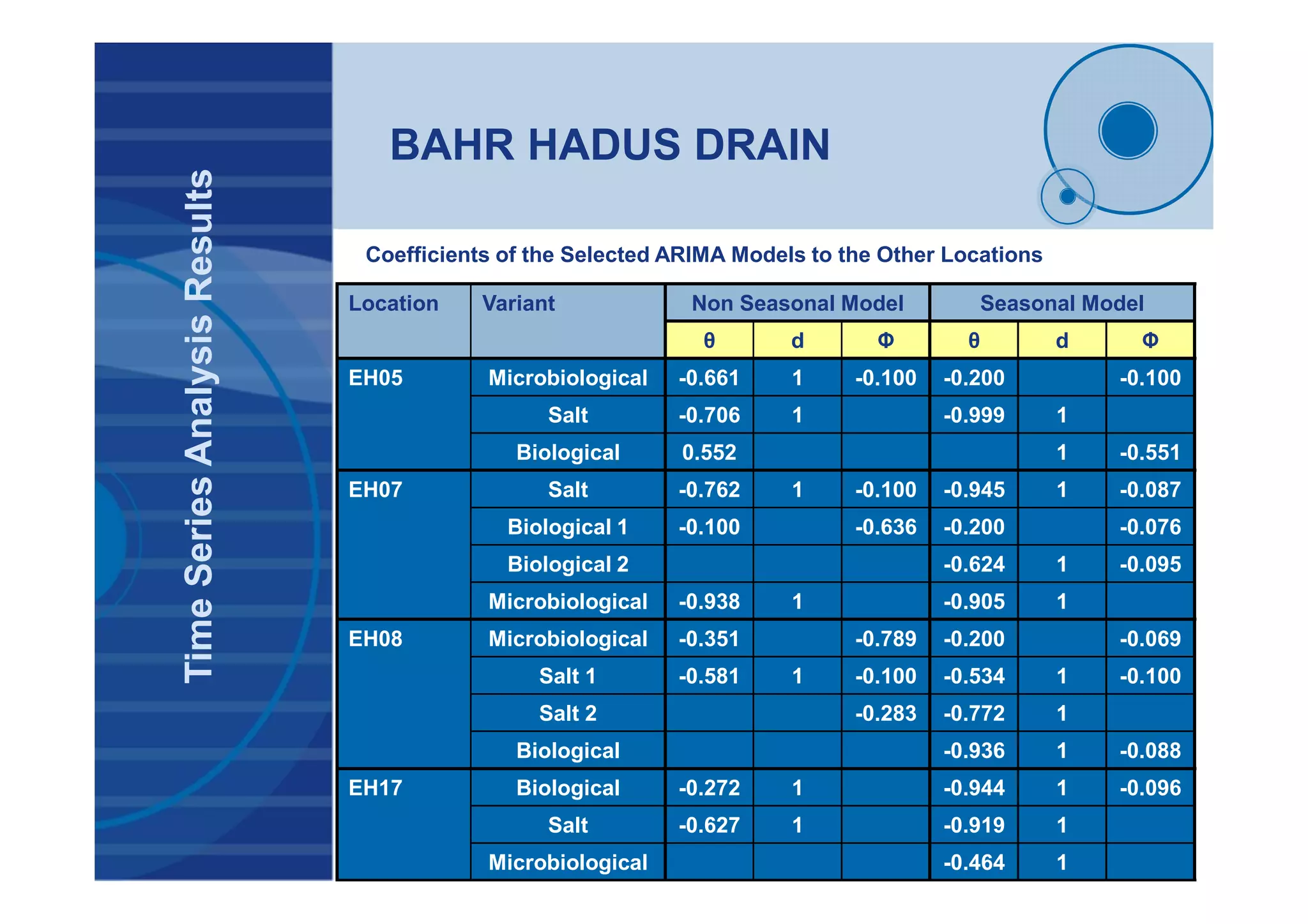
Location Variant Non Seasonal Model Seasonal Model
θ d Φ θ d Φ
EH05 Microbiological -0.661 1 -0.100 -0.200 -0.100
Salt -0.706 1 -0.999 1
Biological 0.552 1 -0.551
EH07 Salt -0.762 1 -0.100 -0.945 1 -0.087
Biological 1 -0.100 -0.636 -0.200 -0.076
Biological 2 -0.624 1 -0.095
Microbiological -0.938 1 -0.905 1
EH08 Microbiological -0.351 -0.789 -0.200 -0.069
Salt 1 -0.581 1 -0.100 -0.534 1 -0.100
Salt 2 -0.283 -0.772 1
Biological -0.936 1 -0.088
EH17 Biological -0.272 1 -0.944 1 -0.096
Salt -0.627 1 -0.919 1
Microbiological -0.464 1
Coefficients of the Selected ARIMA Models to the Other Locations
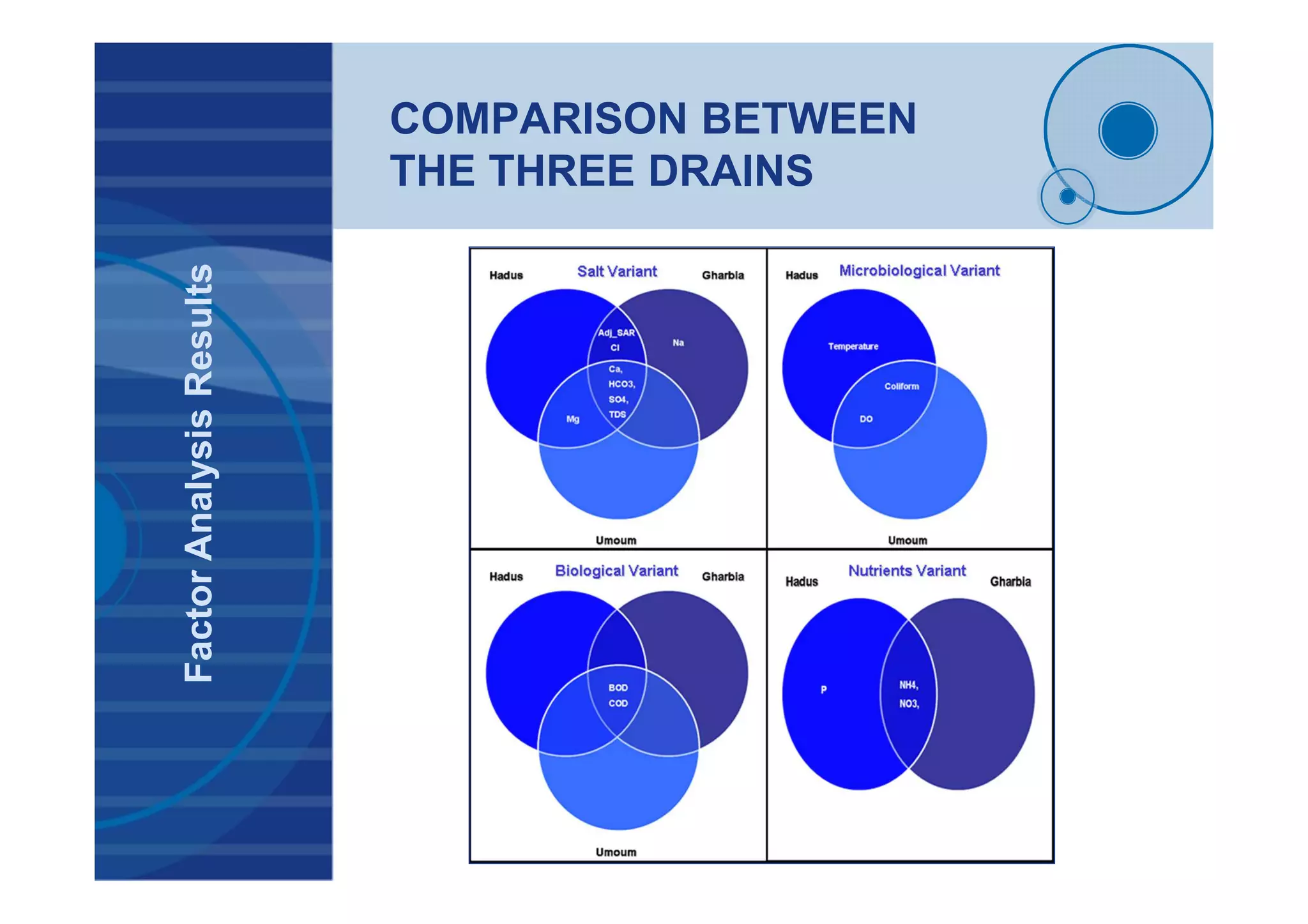
COMPARISON BETWEEN
THE THREE DRAINS
FactorAnalysisResults
COMPARISON BETWEEN
THE THREE DRAINS
TimeSeriesAnalysisResults
EH03 MG02 WU01
Salt Variant
[0,1,1][0,1,1] [1,1,1][1,1,1] [0,1,1][0,1,1]
Nutrients Variant
[0,1,1][0,1,1] [0,1,2][1,0,1]
Biological Variant
[1,1,1][1,0,1] [0,1,3][0,1,2] [0,1,1],[0,1,1]
Microbiological
Variant [1,0,0][0,1,1] [0,0,0][1,0,0]
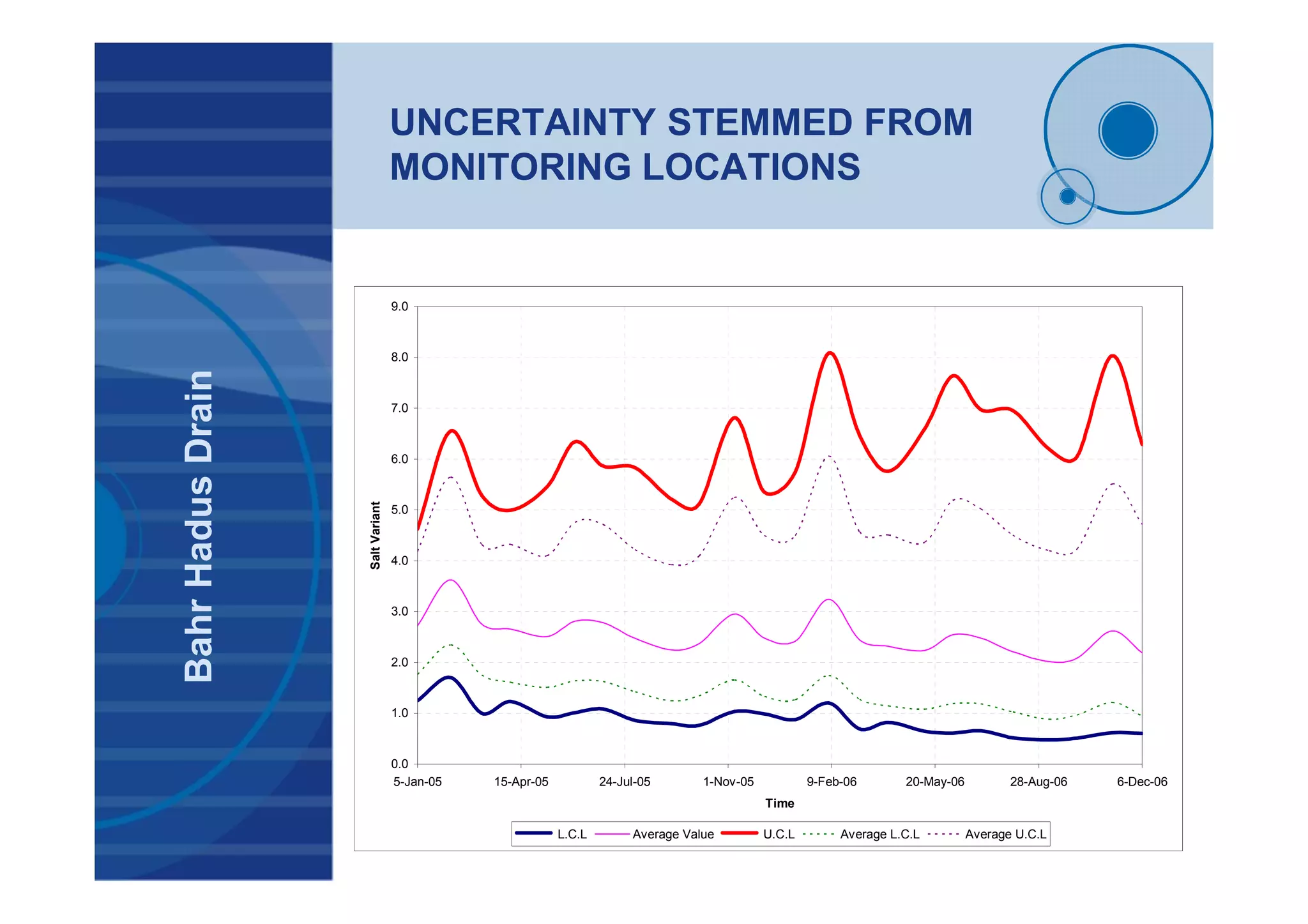
UNCERTAINTY STEMMED FROM
MONITORING LOCATIONS
0.0
1.0
2.0
3.0
4.0
5.0
6.0
7.0
8.0
9.0
5-Jan-05 15-Apr-05 24-Jul-05 1-Nov-05 9-Feb-06 20-May-06 28-Aug-06 6-Dec-06
Time
SaltVariant
L.C.L Average Value U.C.L Average L.C.L Average U.C.L
BahrHadusDrain
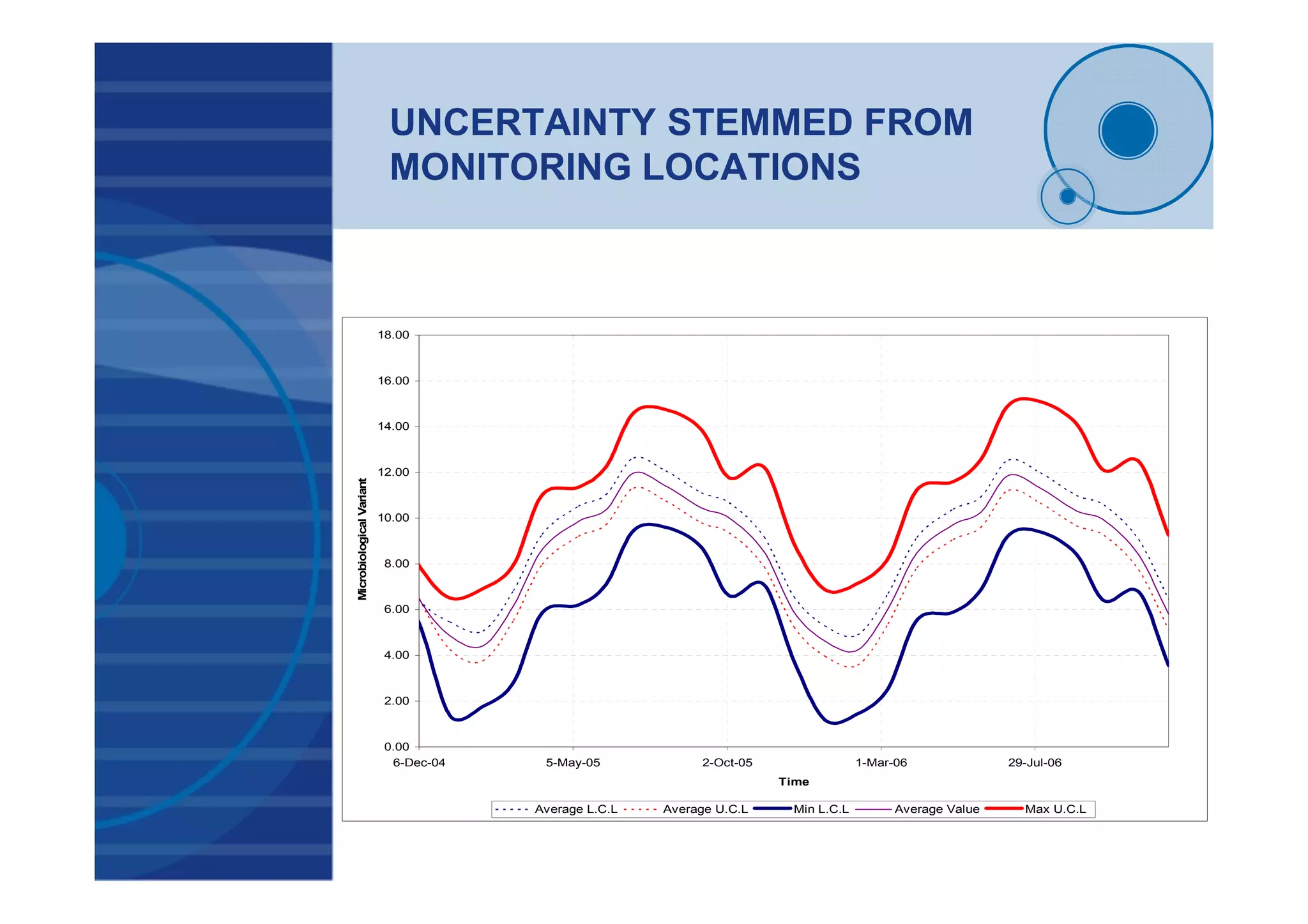
UNCERTAINTY STEMMED FROM
MONITORING LOCATIONS
0.00
2.00
4.00
6.00
8.00
10.00
12.00
14.00
16.00
18.00
6-Dec-04 5-May-05 2-Oct-05 1-Mar-06 29-Jul-06
Time
MicrobiologicalVariant
Average L.C.L Average U.C.L Min L.C.L Average Value Max U.C.L
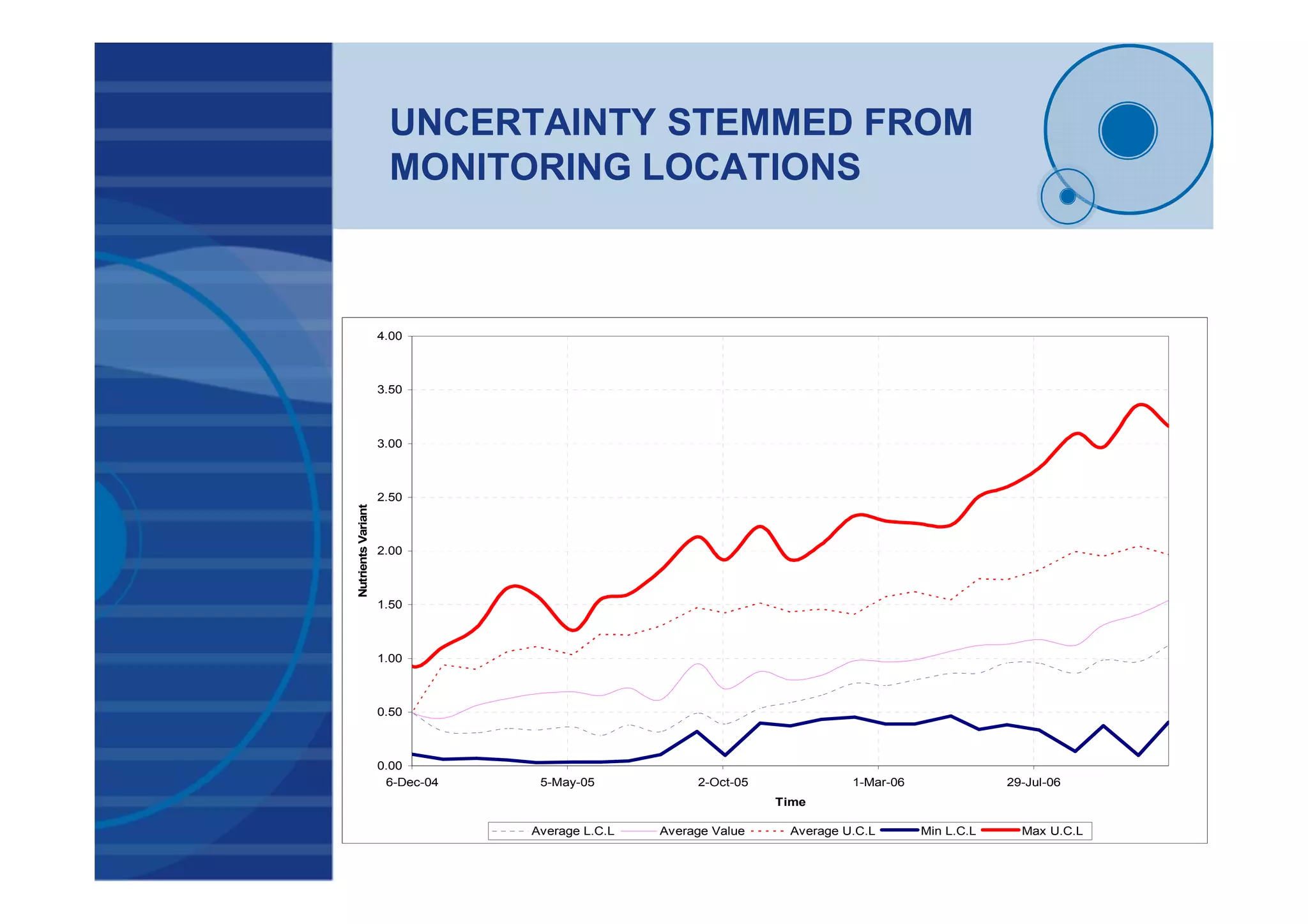
UNCERTAINTY STEMMED FROM
MONITORING LOCATIONS
0.00
0.50
1.00
1.50
2.00
2.50
3.00
3.50
4.00
6-Dec-04 5-May-05 2-Oct-05 1-Mar-06 29-Jul-06
Time
NutrientsVariant
Average L.C.L Average Value Average U.C.L Min L.C.L Max U.C.L
CONCLUSIONS
• The K-Means algorithm is a suitable technique to apply in the
analysis of water quality data.
• The drainage system at the three drains could be classified into
two main clusters. The first cluster represents the upstream part
of the drain while the second cluster represents the downstream
part of the drain
• Due to the high number of sites in each cluster, another step is
applied to reduce the number of sites along the drain. This
achieved by applying the multi correlation matrix between the
members of each cluster; this step is an arbitrary step as this
situation may not occur in other drainage catchments.
• The factor analysis technique (Principle component) is also a
powerful tool in reducing the number of water quality variables
to meaningful variants from the decision maker point of view.
CONCLUSIONS (Cont.)
• The principle component method succeeded in combining the
most relevant variables with each other in separate variants.
• Most of the variants formed in the selected locations at the
three drains have the same combination from basic water
quality variables. This could lead to using these factors as
permanent variants or water quality indices to determine the
status of water quality.
• Most of the deduced variants in the five selected monitoring
sites exceed the standards set by the Egyptian government
except the salt variants in all location, which are below the
Egyptian standards.
• The seasonal pattern is found in all the water quality factors as
the seasonal ARIMA models are always conjugate to the non
seasonal ARIMA models.
• Most of the ARIMA models used in this study have the same
order except one factor that has a high ARIMA model order.
RECOMMENDATIONS
• The proposed framework should be applied to other several
drainage catchments to check if the deduced variants will
repeat again with the same basic water quality variables or will
change from drain to drain.
• A software interface for the proposed framework is needed to
be easy to use in the future.
• The economic dimension should be taken into consideration in
the uncertainty analysis as the spatial distribution of the
monitoring sites changes and the water quality variables
decrease through the analysis.
• Finally, the uncertainty should be taken into consideration in
any future water quality studies rather than assuming that all the
conditions involving the process of modeling are deterministic.

Phd Presentation

  • 1.
  • 2.
    RISK AND UNCERTAINTYASSESSMENT APPLIED TO WATER QUALITY MANAGEMENT: A PROBALISTIC DECISION SUPPORT SYSTEM By Hussein Gamal El Dien Karaman Researcher Assistant Drainage Research Institute Under the supervision Of Prof. Dr. Alla El Zawahry- Faculty of Engineering-Cairo University Prof. Dr. Hussam Fahmy- Director of Drainage Research Inst. Dr. Ahmed Emam- Faculty of Engineering-Cairo University
  • 3.
    OUTLINE • Introduction • ProblemDefinition • Study Objectives • Literature Review • Proposed Framework • Theoretical Base of the Proposed Framework – Methodology Rationale – Techniques Used • Application • Conclusions and Recommendations
  • 4.
    INTRODUCTION • Decision makingis the objective of the water resources management plans; • Water quality needs to be managed to provide decision makers with information about the present and future status of water quality; • The National Water Quality Monitoring Network (NWAQMN) was established in the eighteens of the last century; • The main objective of this network was to monitor the salinity of the drainage water to fulfill the objectives of the drainage water reuse project; • In 1995, the objective of the monitoring network was changed from monitoring the salinity to monitor the whole water pollution.
  • 5.
    PROBLEM DEFINITION • Theuncertainty in the measured data pose problems to the decision maker; • In the case of water quality the uncertainty can be found on several stages: – Sampling process; – Chemical analysis in the lab; – Reporting process. • The total number of locations along the Nile Delta is about 163 locations distributed between the Eastern, Middle and Western Delta; • Now, the main objective of the monitoring network start to change from measuring only one variable to measure more than 46 water quality variables;
  • 6.
    STUDY OBJECTIVES • Themain goal of this research is to:- – Construct a logical framework in the water quality management process to reflect the stochastic nature of water quality to efficiently produce the needed information.
  • 7.
    STUDY OBJECTIVES (Cont.) •The secondary objectives of this research is to:- – Reduce the number of monitoring points on a drain catchment selected for the study; – Construct water quality variants representing several water quality categories such as (salinity category, Biological category, Nutrients category…etc) to reduce the efforts in analyzing each water quality variable solely; – Dealing with the uncertainty in the historical and predicted data for each water quality variants.
  • 8.
  • 9.
    WATER QUALITY MODELS WITHUNCERTAINTY • Tung (1996) reviews the application of uncertainty analysis in water quality modeling • Tung identifies two types of uncertainties: – Uncertainty due to inherent randomness of an event; – Uncertainties associated with a lack of complete knowledge about model processes, parameters, and data uncertainties.
  • 10.
    SOURCES OF NOISE •Timmerman et al., (1996) describe the following data limitations as sources of noise: – Missing values: – Sampling frequencies that change over the period of record – Multiple observations within one sampling period – Uncertainty in the measurement procedures – Censored data – Small sample sizes – Outliers – Problems related to quality of data – Problems related to data presentation
  • 11.
    WATER QUALITY MONITORING • Thesystematic (or coordinated) operation of the network is realized by the selection of three basic factors: – Sampling sites – Sampling frequencies – Variables to be sampled (Harmancioglu et al., 1998b and c).
  • 12.
    COMPLEXITY OF WATER QUALITYDATA • (Sanders et al., 1983) stated that the water quality has to be recognized as a random process by nature then monitoring activities are required to reflect the stochastic nature of water quality to efficiently produce the expected information. • Sanders et al. (1983), Cotter (1985) and Karpuzeu et al. (1987) specify the term “monitoring” further to mean “statistical sampling”.
  • 13.
    STOCHASTIC MODELING APPLICATION • (Shamshadet al,2002) compared different stochastic models to forecast some water quality variables (DO, BOD and pH) along River Gangs in India; • He stated that “ The performance of the Multiplicative ARIMA models and deseasonalised model with a Fourier Series technique provided satisfactory forecasting results for the selected water quality variables”
  • 14.
    APPLICATION OF (MAT)IN WATER QUALITY DATA • (Zou and Yu, 1996) have used a general dynamic factor model to reduce the high dimensionality of the original matrix of variables in order to detect trends in time series; • (S.T. Abdel Gawad et al, 2005) used the principle component analysis (PCA) to condensate and interpret the variability of numerous water quality variables at Bahr El Baqer drainage catchment (Egypt)
  • 15.
    WATER QUALITY INDEX •(Chapman, 1992) stated that, water quality index is an indicator of the quality of water obtained by aggregating several water quality measurements into one number; • Canter (1996) stated that, the common criteria for selecting the parameters to be used in the index are:- – Should be routinely monitored, – Represents a potential public health, – Has effect on aquatic ecology, irrigation, recreation and industrial water uses, – Selected by the water quality experts in the country and finally selected by other water quality experts all over the world.
  • 16.
    THEORETICAL BASE OFTHE PROPOSED FRAMEWORK
  • 17.
    METHODOLOGY RATIONALE • Classifyingand identifying water quality variables; • Need for minimizing water quality variables: – Subjectively – Objectively • New statistical framework • Types of modeling process – Deterministic modeling – Stochastic modeling • Semi empirical formulas
  • 18.
  • 19.
  • 20.
  • 21.
  • 22.
    DECISION TREE UNDER UNCERTAINTIES WaterQuality Condition Uncertainty In Water Quality Uncertainty In Water Quality No Risk High Risk Low Risk High Risk Good Bad Low High Low High
  • 23.
    APPLICATION OF THEPROPOSED FRAMEWORK
  • 24.
    PROPOSED STUDY AREAES No. of Sites 8 No.of Variables 34 Time span 1997- 2004 No. of Sites 14 No. of Variables 34 Time span 1997- 2004 No. of Sites 10 No. of Variables 34 Time span 1997- 2004
  • 25.
  • 26.
    BAHR HADUS DRAIN Cluster1 Cluster 2 Cluster 3 Cluster 4 BOD Ln_NO3 Ln_Cd Zn LOG_Mg CO3 LOG_Cl Ln_Temp DO Variables -4 -3 -2 -1 0 1 2 3 4 ClusterAnalysisResults Significance of Clusters Means
  • 27.
  • 28.
    BAHR HADUS DRAIN ClusterAnalysisResults Significanceof Clusters Means Cluster 1 Cluster 2 BOD Ln_NO3 Ln_Cd Zn Log_Mg CO3 Log_Cl Ln_Temp DO Variables -4 -3 -2 -1 0 1 2 3 4 ClusterMeans
  • 29.
    FINAL LOCATIONS SELECTION Drain U.S.Locations D.S. Locations Bahr Hadus Drain • EH03 • EH05 • EH07 • EH08 • EH17 Gharbia Drain • MG09 • MG10 • MG02 El Umoum Drain • WU01 • WU06 • WU09 ClusterAnalysisResults
  • 30.
    BAHR HADUS DRAIN (EH03) VariableNormality Status P value P Normal 0.20 Na Normal 0.20 HCO3 Normal 0.15 SO4 Normal 0.15 Cl Normal 0.10 Adj_SAR Normal 0.10 Temperat ure Normal 0.20 DO Normal 0.20 FactorAnalysisResults Variable P value Normality Status Coliform 0.05 Normal BOD 0.05 Normal COD 0.01 Normal NO3 0.05 Normal NH4 0.05 Normal Ca 0.05 Normal Mg 0.05 Normal TDS 0.05 Normal Variables passed Normal Test Variables passed Normal Test after transformation
  • 31.
    BAHR HADUS DRAIN (EH03) Factors %Total Variance for Each Factor Cumulative Total Variance % 1 29.23 28.23433 2 21.81 51.04909 3 11.08 62.12974 4 8.18 70.30651 FactorAnalysisResults Percentage of Variance
  • 32.
    0 0.5 1 1.5 2 2.5 3 3.5 4 4.5 5 5.5 0 1 23 4 5 6 7 8 9 10 11 12 13 14 15 16 Factor Number EigenValue BAHR HADUS DRAIN (EH03) FactorAnalysisResults Turning Point Scree Test Criterion
  • 33.
    BAHR HADUS DRAIN (EH03) Coliform BOD COD NO3 NH4 P Ca Mg Na HCO3 SO4 Cl Adj_SAR Temp TDS DO -1.0-0.8 -0.6 -0.4 -0.2 0.0 0.2 0.4 Factor 1 -0.8 -0.6 -0.4 -0.2 0.0 0.2 0.4 0.6 0.8 1.0 Factor2 No Rotation Factor FactorAnalysisResults
  • 34.
    BAHR HADUS DRAIN (EH03) FactorAnalysisResults Coliform BOD COD NO3 NH4P Ca Mg Na HCO3 SO4 Cl Adj_SAR Temp TDS DO -0.6 -0.4 -0.2 0.0 0.2 0.4 0.6 0.8 1.0 Factor 1 -1.0 -0.8 -0.6 -0.4 -0.2 0.0 0.2 0.4 0.6 0.8 Factor2 After applying the Varimax Normalized Rotation Factor
  • 35.
    BAHR HADUS DRAIN (EH03) FactorAnalysisResults VariantCoefficients Water Quality Variables Salt 0.183641 Log Ca 0.077307 Log Mg 0.111268 HCO3 0.138484 SO4 0.220724 Cl 0.167417 Adj_SAR 0.17817 Log TDS Microbiological 0.421223 Log Coliform -0.375342 Temperature -0.553108 DO Nutrients 0.121606 Log NO3 0.218275 Log NH4 0.239572 P Biological 0.421179 Log BOD 0.412942 Log COD Factor Scores coefficient for each component in each factor for
  • 36.
    BAHR HADUS DRAIN (EH03) AnalysisofWQI 0 200 400 600 800 1000 1200 05-Aug-9712-Apr-98 18-Dec-98 25-Aug-99 01-May-00 06-Jan-01 13-Sep-01 21-May-02 26-Jan-03 03-Oct-03 09-Jun-04 Time WQI
  • 37.
    BAHR HADUS DRAIN (EH03)QuantifyingUncertaintyand RiskintheVariantsHistorical Data 0 1.5 3 4.5 6 7.5 9 10.5 12 13.5 15 5-Aug-9712-Apr-98 18-Dec-98 25-Aug-99 1-May-00 6-Jan-01 13-Sep-01 21-May-02 26-Jan-03 3-Oct-03 9-Jun-04 Time SaltVariant Salt Variant U.C.L L.C.L Uncertainty Values of Salt Variant
  • 38.
    BAHR HADUS DRAIN (EH03)QuantifyingUncertaintyand RiskintheVariantsHistorical Data PearsonVI(64.38,8.51,0.66) 0 0.1 0.2 0.3 0.4 0.5 0.6 0.7 0.8 0.9 1 02 4 6 8 10 12 14 Salt Variant Probability(P) PearsonVI(64.38,8.51,0.66) Equivalent Standards= 203 ppm Risk Values of Salt Variant= 0%
  • 39.
    BAHR HADUS DRAIN (EH03)DecisionTreeUnderRiskand UncertaintyConditions 0 1.5 3 4.5 6 7.5 9 10.5 12 13.5 15 5-Aug-9712-Apr-98 18-Dec-98 25-Aug-99 1-May-00 6-Jan-01 13-Sep-01 21-May-02 26-Jan-03 3-Oct-03 9-Jun-04 Time SaltVariant Salt Variant U.C.L L.C.L Case of good water quality conditions and low values of uncertainty (error)
  • 40.
    BAHR HADUS DRAIN (EH03)DecisionTreeUnderRiskand UncertaintyConditions 0 5 10 15 20 25 5-Aug-9712-Apr-98 18-Dec-98 25-Aug-99 1-May-00 6-Jan-01 13-Sep-01 21-May-02 26-Jan-03 3-Oct-03 9-Jun-04 Time MicrobiologicalVariant Microbiological U.C.L L.C.L Standards Case of good water quality conditions and high values of uncertainty (error)
  • 41.
    BAHR HADUS DRAIN (EH03)DecisionTreeUnderRiskand UncertaintyConditions 0 0.4 0.8 1.2 1.6 2 2.4 2.8 3.2 5-Aug-9712-Apr-98 18-Dec-98 25-Aug-99 1-May-00 6-Jan-01 13-Sep-01 21-May-02 26-Jan-03 3-Oct-03 9-Jun-04 Time MicrobiologicalVariant Microbiological Variant U.C.L L.C.L Standard Case of bad water quality conditions and high values of uncertainty (error)
  • 42.
    BAHR HADUS DRAIN (EH03)DecisionTreeUnderRiskand UncertaintyConditions 0 20 40 60 80 100 120 140 5-Aug-9712-Apr-98 18-Dec-98 25-Aug-99 1-May-00 6-Jan-01 13-Sep-01 21-May-02 26-Jan-03 3-Oct-03 9-Jun-04 Time BiologicalVariant Biological U.C.L L.C.L Standards Case of bad water quality conditions and low values of uncertainty (error)
  • 43.
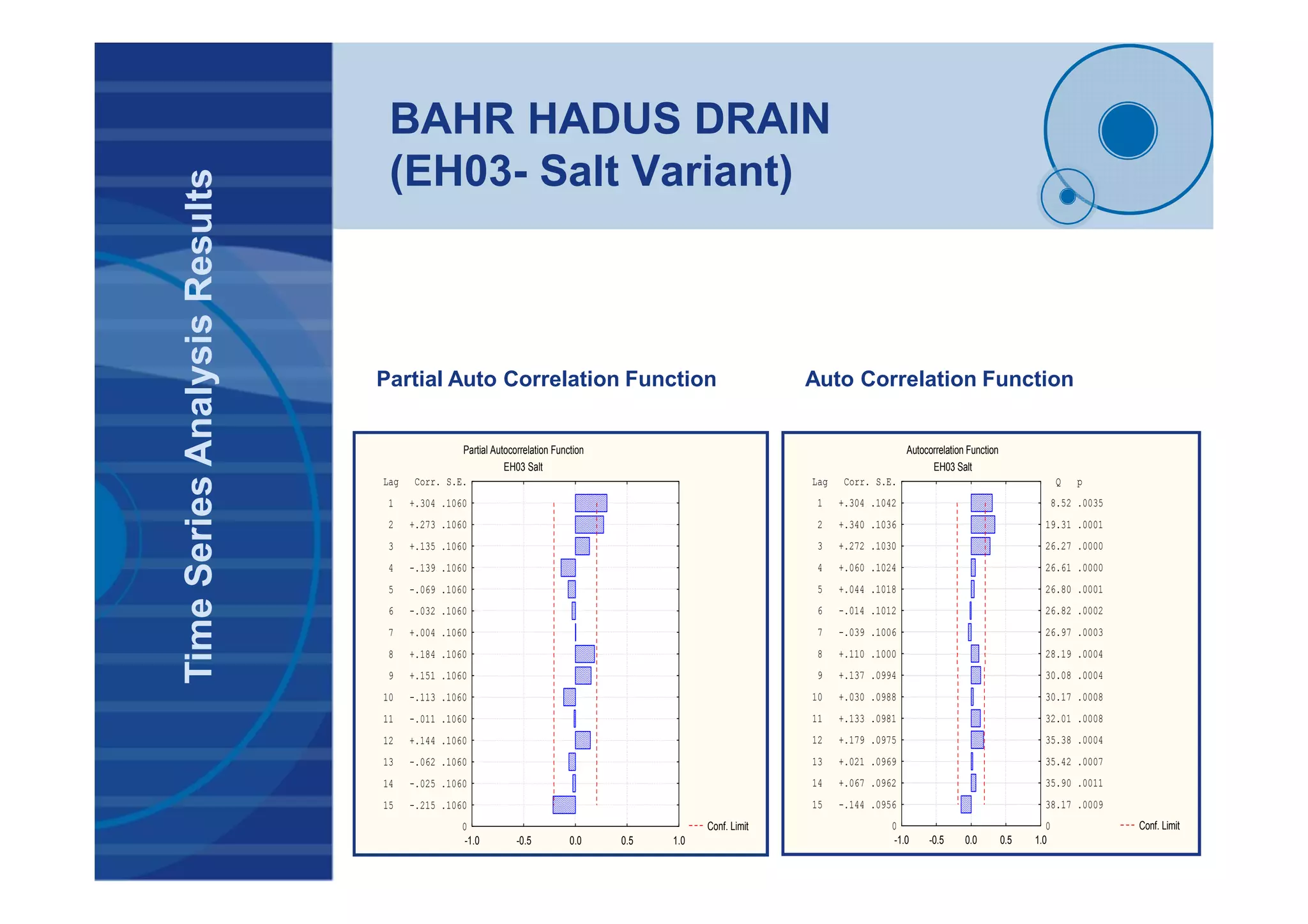
    BAHR HADUS DRAIN (EH03-Salt Variant) TimeSeriesAnalysisResults Autocorrelation Function EH03 Salt Conf. Limit -1.0 -0.5 0.0 0.5 1.0 0 15 -.144 .0956 14 +.067 .0962 13 +.021 .0969 12 +.179 .0975 11 +.133 .0981 10 +.030 .0988 9 +.137 .0994 8 +.110 .1000 7 -.039 .1006 6 -.014 .1012 5 +.044 .1018 4 +.060 .1024 3 +.272 .1030 2 +.340 .1036 1 +.304 .1042 Lag Corr. S.E. 0 38.17 .0009 35.90 .0011 35.42 .0007 35.38 .0004 32.01 .0008 30.17 .0008 30.08 .0004 28.19 .0004 26.97 .0003 26.82 .0002 26.80 .0001 26.61 .0000 26.27 .0000 19.31 .0001 8.52 .0035 Q p Partial Autocorrelation Function EH03 Salt Conf. Limit -1.0 -0.5 0.0 0.5 1.0 0 15 -.215 .1060 14 -.025 .1060 13 -.062 .1060 12 +.144 .1060 11 -.011 .1060 10 -.113 .1060 9 +.151 .1060 8 +.184 .1060 7 +.004 .1060 6 -.032 .1060 5 -.069 .1060 4 -.139 .1060 3 +.135 .1060 2 +.273 .1060 1 +.304 .1060 Lag Corr. S.E. Partial Auto Correlation Function Auto Correlation Function
  • 44.
    BAHR HADUS DRAIN (EH03-Salt Variant) TimeSeriesAnalysisResults Original Series of the Salt Variant with The Standards 0 2 4 6 8 10 12 14 16 18 20 5-Aug-97 12-Apr-98 18-Dec-98 25-Aug-99 1-May-00 6-Jan-01 13-Sep-01 21-May-02 26-Jan-03 3-Oct-03 9-Jun-04 Time SaltGroup Variant Standards at 203ppm
  • 45.
    BAHR HADUS DRAIN (EH03-Salt Variant) Location Variant Non Seasonal Model Seasonal Model θ d Φ θ d Φ EH03 Salt 0.765 1 -0.988 1 TimeSeriesAnalysisResults Values of the ARIMA Model Parameters 0 1 2 3 4 5 6 7 8 9 10 1-Sep-97 9-May-98 14-Jan-99 21-Sep-99 28-May-00 2-Feb-01 10-Oct-01 17-Jun-02 22-Feb-03 30-Oct-03 6-Jul-04 Time SaltGroup Original Series Generated Model Series
  • 46.
    BAHR HADUS DRAIN (EH03-Salt Variant) TimeSeriesAnalysisResults 0 0.5 1 1.5 2 2.5 3 3.5 4 5-Jan-05 15-Apr-05 24-Jul-05 1-Nov-05 9-Feb-06 20-May-06 Time SaltVariant Forecasted Values Actual values Validation process of ARIMA Model
  • 47.
    BAHR HADUS DRAIN (EH03-Salt Variant) TimeSeriesAnalysisResults INFORMATION ON DIAGNOSTICS SELECTIVE ARIMA MODEL SA quality index (stand to 10) 2.239 [0, 10] ad-hoc STATISTICS ON RESIDUALS Ljung-Box on residuals 15.87 [0, 33.90] 5% Box-Pierce on residuals 00.44 [0, 5.990] 5% Ljung-Box on squared residuals 24.89 [0, 33.90] 5% Box-Pierce on squared residuals 00.09 [0, 5.990] 5% Durbin-Watson statistic on residuals 2.16 [min:0, max:4] DESCRIPTION OF RESIDUALS Normality 1.30 [0, 5.99] 5% Skewness 0.00 [-0.57, 0.57] 5% Kurtosis 2.34 [1.87, 4.13] 5% OUTLIERS Percentage of outliers 2.33 % [0%, 5.0 %] ad-hoc Results of the Statistical Tests Applied on the Residuals of the Selected Model
  • 48.
    BAHR HADUS DRAIN (EH03-Salt Variant) -0.5 -0.4 -0.3 -0.2 -0.1 0 0.1 0.2 0.3 0.4 0.5 1 6 11 16 21 26 31 36 Lag Time Correlation TimeSeriesAnalysisResults -0.5 -0.4 -0.3 -0.2 -0.1 0 0.1 0.2 0.3 0.4 0.5 1 6 11 16 21 26 31 36 Lag Time Correlation The Auto Correlation Function for the Model Residuals The Partial Auto Correlation Function for the Model Residuals
  • 49.
    BAHR HADUS DRAIN (EH03-Salt Variant) TimeSeriesAnalysisResults The Forecasted values of the salt factor with the Equivalent Standards 0 1 2 3 4 5 6 7 8 9 10 3-Dec-02 21-Jun-03 7-Jan-04 25-Jul-04 10-Feb-05 29-Aug-05 17-Mar-06 3-Oct-06 Time SaltGroup L.C.L Value U.C.L Calculated Standards are at 203
  • 50.
    BAHR HADUS DRAIN TimeSeriesAnalysisResults LocationVariant Non Seasonal Model Seasonal Model θ d Φ θ d Φ EH05 Microbiological -0.661 1 -0.100 -0.200 -0.100 Salt -0.706 1 -0.999 1 Biological 0.552 1 -0.551 EH07 Salt -0.762 1 -0.100 -0.945 1 -0.087 Biological 1 -0.100 -0.636 -0.200 -0.076 Biological 2 -0.624 1 -0.095 Microbiological -0.938 1 -0.905 1 EH08 Microbiological -0.351 -0.789 -0.200 -0.069 Salt 1 -0.581 1 -0.100 -0.534 1 -0.100 Salt 2 -0.283 -0.772 1 Biological -0.936 1 -0.088 EH17 Biological -0.272 1 -0.944 1 -0.096 Salt -0.627 1 -0.919 1 Microbiological -0.464 1 Coefficients of the Selected ARIMA Models to the Other Locations
  • 51.
    COMPARISON BETWEEN THE THREEDRAINS FactorAnalysisResults
  • 52.
    COMPARISON BETWEEN THE THREEDRAINS TimeSeriesAnalysisResults EH03 MG02 WU01 Salt Variant [0,1,1][0,1,1] [1,1,1][1,1,1] [0,1,1][0,1,1] Nutrients Variant [0,1,1][0,1,1] [0,1,2][1,0,1] Biological Variant [1,1,1][1,0,1] [0,1,3][0,1,2] [0,1,1],[0,1,1] Microbiological Variant [1,0,0][0,1,1] [0,0,0][1,0,0]
  • 53.
    UNCERTAINTY STEMMED FROM MONITORINGLOCATIONS 0.0 1.0 2.0 3.0 4.0 5.0 6.0 7.0 8.0 9.0 5-Jan-05 15-Apr-05 24-Jul-05 1-Nov-05 9-Feb-06 20-May-06 28-Aug-06 6-Dec-06 Time SaltVariant L.C.L Average Value U.C.L Average L.C.L Average U.C.L BahrHadusDrain
  • 54.
    UNCERTAINTY STEMMED FROM MONITORINGLOCATIONS 0.00 2.00 4.00 6.00 8.00 10.00 12.00 14.00 16.00 18.00 6-Dec-04 5-May-05 2-Oct-05 1-Mar-06 29-Jul-06 Time MicrobiologicalVariant Average L.C.L Average U.C.L Min L.C.L Average Value Max U.C.L
  • 55.
    UNCERTAINTY STEMMED FROM MONITORINGLOCATIONS 0.00 0.50 1.00 1.50 2.00 2.50 3.00 3.50 4.00 6-Dec-04 5-May-05 2-Oct-05 1-Mar-06 29-Jul-06 Time NutrientsVariant Average L.C.L Average Value Average U.C.L Min L.C.L Max U.C.L
  • 56.
    CONCLUSIONS • The K-Meansalgorithm is a suitable technique to apply in the analysis of water quality data. • The drainage system at the three drains could be classified into two main clusters. The first cluster represents the upstream part of the drain while the second cluster represents the downstream part of the drain • Due to the high number of sites in each cluster, another step is applied to reduce the number of sites along the drain. This achieved by applying the multi correlation matrix between the members of each cluster; this step is an arbitrary step as this situation may not occur in other drainage catchments. • The factor analysis technique (Principle component) is also a powerful tool in reducing the number of water quality variables to meaningful variants from the decision maker point of view.
  • 57.
    CONCLUSIONS (Cont.) • Theprinciple component method succeeded in combining the most relevant variables with each other in separate variants. • Most of the variants formed in the selected locations at the three drains have the same combination from basic water quality variables. This could lead to using these factors as permanent variants or water quality indices to determine the status of water quality. • Most of the deduced variants in the five selected monitoring sites exceed the standards set by the Egyptian government except the salt variants in all location, which are below the Egyptian standards. • The seasonal pattern is found in all the water quality factors as the seasonal ARIMA models are always conjugate to the non seasonal ARIMA models. • Most of the ARIMA models used in this study have the same order except one factor that has a high ARIMA model order.
  • 58.
    RECOMMENDATIONS • The proposedframework should be applied to other several drainage catchments to check if the deduced variants will repeat again with the same basic water quality variables or will change from drain to drain. • A software interface for the proposed framework is needed to be easy to use in the future. • The economic dimension should be taken into consideration in the uncertainty analysis as the spatial distribution of the monitoring sites changes and the water quality variables decrease through the analysis. • Finally, the uncertainty should be taken into consideration in any future water quality studies rather than assuming that all the conditions involving the process of modeling are deterministic.