1
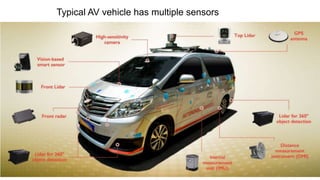
Typical AV vehicle has multiple sensors
2
Use of the Lidar for Autonomous Vehicle
Using 6 Ibeo Lidar
Sensor for 360 Detection
Need to working with
sensor OEM on
Automotive grade Lidar
System,
to replace Expensive Ibeo
Sensor
3
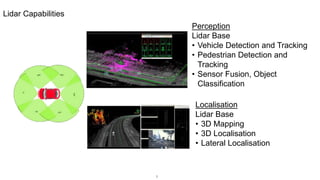
Lidar Capabilities
Localisation
Lidar Base
• 3D Mapping
• 3D Localisation
• Lateral Localisation
Perception
Lidar Base
• Vehicle Detection and Tracking
• Pedestrian Detection and
Tracking
• Sensor Fusion, Object
Classification
4
Standalone sensor
performances
AV sensor system
performances in
Collision Avoidance
Sensor
Manufacturer’s
specifications
Latency Measurements are only a starting point for Engineers to be aware about the need for testing at
different levels from Sensor Functions as standalone and Sensors when in Actual Road Conditions
Latency Results are different
sensor modules help to
identify critical latency
delays for improvements.
These improvements to
reduce AV latency can help
lower braking reaction time
and higher travelling speed
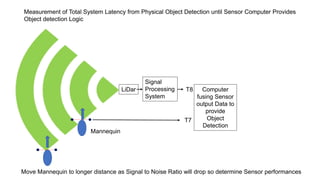
LiDar
Signal
Processing
System
Mannequin
T7
T8 Computer
fusing Sensor
output Data to
provide
Object
Detection
Move Mannequin to longer distance as Signal to Noise Ratio will drop so determine Sensor performances
Measurement of Total System Latency from Physical Object Detection until Sensor Computer Provides
Object detection Logic
Further Test cases
• Test Sensors in stationary AV for Distance and View of View in controlled workshop conditions (Done)
Next
• Test Sensors in stationary AV for Distance and View of View in simulated environmental conditions such as
rain, changing lighting conditions evenings (need to use Lux meter to measure light intensity on object
under test)
• Examples of such tests. Use Large LCD display to playback recorded travelling bus videos in front of AV
cameras to test the Computer Vision Modules. Then project augment objects onto the video screens such
that the AV camera views sudden object in front to determine the latencies.
• To understand how the various sensor works, design test scenarios to evaluate the AV sub-system
performances for stationary AV and then moving AV. This method helps us to determine critical improvement
parameters to focus on the R&D effort to improve performance for safety and speed in a controlled process
with priority.

AV Latency Measurement

  • 1.
    1 Typical AV vehiclehas multiple sensors
  • 2.
    2 Use of theLidar for Autonomous Vehicle Using 6 Ibeo Lidar Sensor for 360 Detection Need to working with sensor OEM on Automotive grade Lidar System, to replace Expensive Ibeo Sensor
  • 3.
    3 Lidar Capabilities Localisation Lidar Base •3D Mapping • 3D Localisation • Lateral Localisation Perception Lidar Base • Vehicle Detection and Tracking • Pedestrian Detection and Tracking • Sensor Fusion, Object Classification
  • 4.
    4 Standalone sensor performances AV sensorsystem performances in Collision Avoidance Sensor Manufacturer’s specifications
  • 5.
    Latency Measurements areonly a starting point for Engineers to be aware about the need for testing at different levels from Sensor Functions as standalone and Sensors when in Actual Road Conditions Latency Results are different sensor modules help to identify critical latency delays for improvements. These improvements to reduce AV latency can help lower braking reaction time and higher travelling speed
  • 6.
    LiDar Signal Processing System Mannequin T7 T8 Computer fusing Sensor outputData to provide Object Detection Move Mannequin to longer distance as Signal to Noise Ratio will drop so determine Sensor performances Measurement of Total System Latency from Physical Object Detection until Sensor Computer Provides Object detection Logic
  • 7.
    Further Test cases •Test Sensors in stationary AV for Distance and View of View in controlled workshop conditions (Done) Next • Test Sensors in stationary AV for Distance and View of View in simulated environmental conditions such as rain, changing lighting conditions evenings (need to use Lux meter to measure light intensity on object under test) • Examples of such tests. Use Large LCD display to playback recorded travelling bus videos in front of AV cameras to test the Computer Vision Modules. Then project augment objects onto the video screens such that the AV camera views sudden object in front to determine the latencies. • To understand how the various sensor works, design test scenarios to evaluate the AV sub-system performances for stationary AV and then moving AV. This method helps us to determine critical improvement parameters to focus on the R&D effort to improve performance for safety and speed in a controlled process with priority.