Ch. 5. Developing Workable
Management Options
Professor Eun-Sung Chung
Seoul National University of Science and Technology
Contents
5.1 Identifying the Sources.
1.1 Pollutant Loadings versus Concentration.
1.2 Total Maximum Daily Loads(TMSLs).
5.2 Creating a Long List of Management Options.
5.3 Types of Options.
3.1 The Option of Doing Nothing.
3.2 Structural Measures.
3.3 Vegetative Practices.
3.4 Nonstructural Options (Best Management Practices).
3.5 Naturalization Measures.
5.4 Developing Mutually Exclusive Management Alternatives.
5.5 Evaluation Constraints and Criteria.
5.1 Development and Application of Planning Constraints.
5.2 Choosing Appropriate Evaluation Criteria.
5.3 Weighting the Evaluation Criteria.
5.4 Multi-attribute Decision Making.
2Prof. Chung, Eun-Sung
5.1 Identifying the sources (Flow & Pollutants)
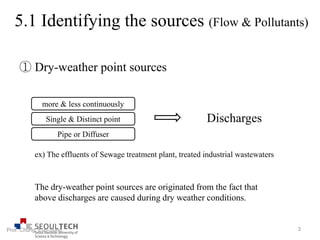
① Dry-weather point sources
Single & Distinct point
Pipe or Diffuser
Discharges
more & less continuously
ex) The effluents of Sewage treatment plant, treated industrial wastewaters
The dry-weather point sources are originated from the fact that
above discharges are caused during dry weather conditions.
3Prof. Chung, Eun-Sung
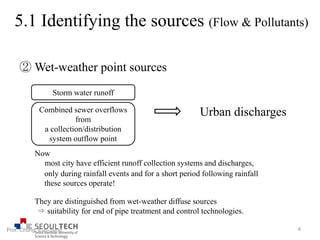
② Wet-weather point sources
Combined sewer overflows
from
a collection/distribution
system outflow point
Urban discharges
Storm water runoff
Now
most city have efficient runoff collection systems and discharges,
only during rainfall events and for a short period following rainfall
these sources operate!
They are distinguished from wet-weather diffuse sources
⇒ suitability for end of pipe treatment and control technologies.
4Prof. Chung, Eun-Sung
5.1 Identifying the sources (Flow & Pollutants)
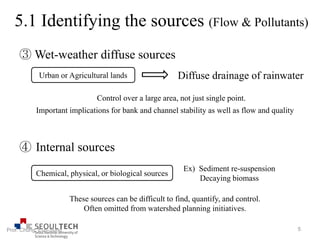
③ Wet-weather diffuse sources
④ Internal sources
Diffuse drainage of rainwaterUrban or Agricultural lands
Control over a large area, not just single point.
Important implications for bank and channel stability as well as flow and quality
Chemical, physical, or biological sources
Ex) Sediment re-suspension
Decaying biomass
These sources can be difficult to find, quantify, and control.
Often omitted from watershed planning initiatives.
5Prof. Chung, Eun-Sung
5.1 Identifying the sources (Flow & Pollutants)
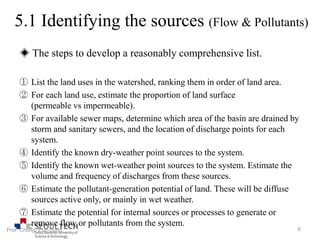
◈ The steps to develop a reasonably comprehensive list.
① List the land uses in the watershed, ranking them in order of land area.
② For each land use, estimate the proportion of land surface
(permeable vs impermeable).
③ For available sewer maps, determine which area of the basin are drained by
storm and sanitary sewers, and the location of discharge points for each
system.
④ Identify the known dry-weather point sources to the system.
⑤ Identify the known wet-weather point sources to the system. Estimate the
volume and frequency of discharges from these sources.
⑥ Estimate the pollutant-generation potential of land. These will be diffuse
sources active only, or mainly in wet weather.
⑦ Estimate the potential for internal sources or processes to generate or
remove flow or pollutants from the system.
6Prof. Chung, Eun-Sung
5.1 Identifying the sources (Flow & Pollutants)
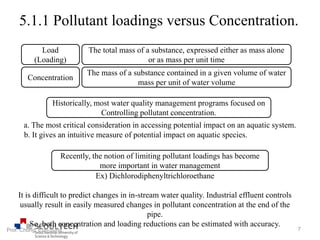
5.1.1 Pollutant loadings versus Concentration.
Load
(Loading)
Concentration
The total mass of a substance, expressed either as mass alone
or as mass per unit time
The mass of a substance contained in a given volume of water
mass per unit of water volume
Recently, the notion of limiting pollutant loadings has become
more important in water management
Historically, most water quality management programs focused on
Controlling pollutant concentration.
a. The most critical consideration in accessing potential impact on an aquatic system.
b. It gives an intuitive measure of potential impact on aquatic species.
Ex) Dichlorodiphenyltrichloroethane
It is difficult to predict changes in in-stream water quality. Industrial effluent controls
usually result in easily measured changes in pollutant concentration at the end of the
pipe.
So, both concentration and loading reductions can be estimated with accuracy.
7Prof. Chung, Eun-Sung
5.1.2 Total Maximum Daily Loads (TMDLs).
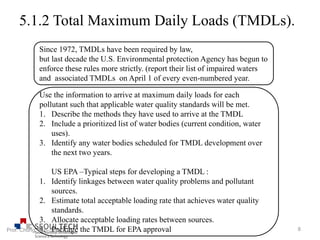
Since 1972, TMDLs have been required by law,
but last decade the U.S. Environmental protection Agency has begun to
enforce these rules more strictly. (report their list of impaired waters
and associated TMDLs on April 1 of every even-numbered year.
Use the information to arrive at maximum daily loads for each
pollutant such that applicable water quality standards will be met.
1. Describe the methods they have used to arrive at the TMDL
2. Include a prioritized list of water bodies (current condition, water
uses).
3. Identify any water bodies scheduled for TMDL development over
the next two years.
US EPA –Typical steps for developing a TMDL :
1. Identify linkages between water quality problems and pollutant
sources.
2. Estimate total acceptable loading rate that achieves water quality
standards.
3. Allocate acceptable loading rates between sources.
4. Package the TMDL for EPA approval 8Prof. Chung, Eun-Sung
5.1.2 Total Maximum Daily Loads (TMDLs).
While,
-TMDL system has been criticized for its long delays.
-There is also considerable variation in the way that state, territories
and tribes have developed TMDL.
Thus, EPA is currently investigating mechanisms for achieving a
more nationally consistent approach to developing and implementing
TMDLs.
Finally, the TMDL system is of little use in accomplishing water quality
improvement if load reductions are not achieved.
Yet, many substances arise from a bewildering array of sources.
Controlling those loads may require consultation with and agreement
from others.
9Prof. Chung, Eun-Sung
5.2 Creating a long list of management options
Brainstorming
Lumsdaine and Lumsdaine (1995)
Used to generate a list of possible solutions
Creative thinking is often limited by habits, emotions and false assumptions.
(artist’s mind-set, detective’s mind-set, explorer’s mind-set.)
This is also an important time to clarify the values and priorities of the
decision-making group and to ensure that all values are encompassed by the
evolving list of options.
They emphasis on creativity is important at this idea-generation stage of
problem solving.
The challenge for the decision-making team is to overcome preconceptions
about workable options and create, in the literal sense, a broad and
imaginative range of solutions for further investigation.
10Prof. Chung, Eun-Sung
5.3 Types of options (1)
1. Do nothing, or status quo option.
2. Structural measures. – structure and other built technology
3. Vegetative approaches.
4. Nonstructural measures. – best management practices
5. Naturalization measures.
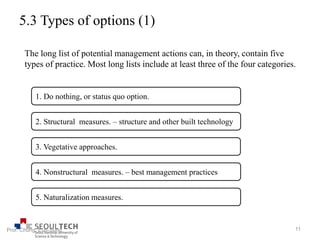
The long list of potential management actions can, in theory, contain five
types of practice. Most long lists include at least three of the four categories.
11Prof. Chung, Eun-Sung
5.3 Types of options (2)
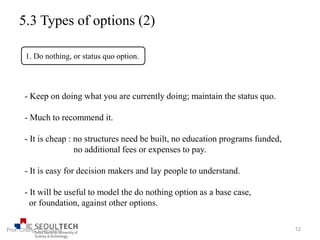
1. Do nothing, or status quo option.
- Keep on doing what you are currently doing; maintain the status quo.
- Much to recommend it.
- It is cheap : no structures need be built, no education programs funded,
no additional fees or expenses to pay.
- It is easy for decision makers and lay people to understand.
- It will be useful to model the do nothing option as a base case,
or foundation, against other options.
12Prof. Chung, Eun-Sung
5.3 Types of options (3)
- It is possible to build something, such as a treatment plant, stormwater
detention pond, or a grassed waterway.
(water quality and flow improvement)
- Structure solution are well described in the literature and in civil Eng. Text.
- Both end of pipe solution and preventive options.
2. Structural measures. – structure and other built technology
13Prof. Chung, Eun-Sung
5.3 Types of options (4)
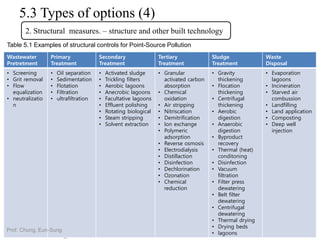
2. Structural measures. – structure and other built technology
14
Wastewater
Pretretment
Primary
Treatment
Secondary
Treatment
Tertiary
Treatment
Sludge
Treatment
Waste
Disposal
• Screening
• Grit removal
• Flow
equalization
• neutralizatio
n
• Oil separation
• Sedimentation
• Flotation
• Filtration
• ultrafiltration
• Activated sludge
• Trickling filters
• Aerobic lagoons
• Anecrobic lagoons
• Facultative lagoons
• Effluent polishing
• Rotating biological
• Steam stripping
• Solvent extraction
• Granular
activated carbon
absorption
• Chemical
oxidation
• Air stripping
• Nitriscation
• Demitrification
• Ion exchange
• Polymeric
adsorption
• Reverse osmosis
• Electrodialysis
• Distillaction
• Disinfection
• Dechlorination
• Ozonation
• Chemical
reduction
• Gravity
thickening
• Flocation
thickening
• Centrifugal
thickening
• Aerobic
digestion
• Anaerobic
digestion
• Byproduct
recovery
• Thermal (heat)
conditoning
• Disinfection
• Vacuum
filtration
• Filter press
dewatering
• Belt filter
dewatering
• Centrifugal
dewatering
• Thermal drying
• Drying beds
• lagoons
• Evaporation
lagoons
• Incineration
• Starved air
combussion
• Landfilling
• Land application
• Composting
• Deep well
injection
Table 5.1 Examples of structural controls for Point-Source Pollution
Prof. Chung, Eun-Sung
5.3 Types of options (5)
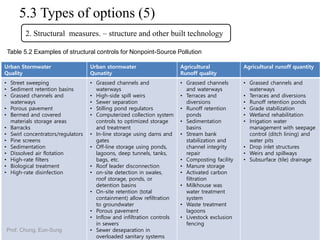
2. Structural measures. – structure and other built technology
15
Urban Stormwater
Quality
Urban stormwater
Qunatity
Agricultural
Runoff quality
Agricultural runoff quantity
• Street sweeping
• Sediment retention basins
• Grassed channels and
waterways
• Porous pavement
• Bermed and covered
materials storage areas
• Barracks
• Swirl concentrators/regulators
• Pine screens
• Sedimentation
• Dissolved air flotation
• High-rate filters
• Biological treatment
• High-rate disinfection
• Grassed channels and
waterways
• High-side spill weirs
• Sewer separation
• Stilling pond regulators
• Computerized collection system
controls to optimized storage
and treatment
• In-line storage using dams and
gates
• Off-line storage using ponds,
lagoons, deep tunnels, tanks,
bags, etc.
• Roof leader disconnection
• on-site detection in swales,
roof storage, ponds, or
detention basins
• On-site retention (total
containment) allow refiltration
to groundwater
• Porous pavement
• Inflow and infiltration controls
in sewers
• Sewer deseparation in
overloaded sanitary systems
• Grassed channels
and waterways
• Terraces and
diversions
• Runoff retention
ponds
• Sedimentation
basins
• Stream bank
stabilization and
channel integrity
repair
• Composting facility
• Manure storage
• Activated carbon
filtration
• Milkhouse was
water treatment
system
• Waste treatment
lagoons
• Livestock exclusion
fencing
• Grassed channels and
waterways
• Terraces and diversions
• Runoff retention ponds
• Grade stabilization
• Wetland rehabilitation
• Irrigation water
management with seepage
control (ditch lining) and
water pits
• Drop inlet structures
• Weirs and spillways
• Subsurface (tile) drainage
Table 5.2 Examples of structural controls for Nonpoint-Source Pollution
Prof. Chung, Eun-Sung
5.3 Types of options (6)
- Sometimes included among nonstructural management options.
- Change the extent, nature, and/or timing of vegetative cover and
change the rate and quality of water flowing over the land surface.
(vegetative cover)
- They are almost exclusively used in the control of nonpoint sources of
pollution.
- Particularly important in agricultural applications
because
they are readily controlled by the farm operator,
they are often low in cost,
they can provide secondary benefits in terms of crop production.
3. Vegetative approaches.
16Prof. Chung, Eun-Sung
5.3 Types of options (7)
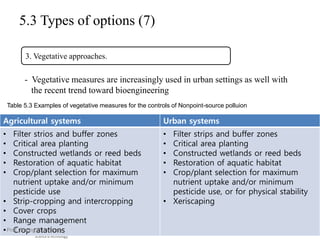
- Vegetative measures are increasingly used in urban settings as well with
the recent trend toward bioengineering
3. Vegetative approaches.
17
Agricultural systems Urban systems
• Filter strios and buffer zones
• Critical area planting
• Constructed wetlands or reed beds
• Restoration of aquatic habitat
• Crop/plant selection for maximum
nutrient uptake and/or minimum
pesticide use
• Strip-cropping and intercropping
• Cover crops
• Range management
• Crop ratations
• Filter strips and buffer zones
• Critical area planting
• Constructed wetlands or reed beds
• Restoration of aquatic habitat
• Crop/plant selection for maximum
nutrient uptake and/or minimum
pesticide use, or for physical stability
• Xeriscaping
Table 5.3 Examples of vegetative measures for the controls of Nonpoint-source polluion
Prof. Chung, Eun-Sung
5.3 Types of options (8)
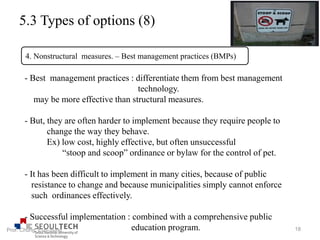
- Best management practices : differentiate them from best management
technology.
may be more effective than structural measures.
- But, they are often harder to implement because they require people to
change the way they behave.
Ex) low cost, highly effective, but often unsuccessful
“stoop and scoop” ordinance or bylaw for the control of pet.
- It has been difficult to implement in many cities, because of public
resistance to change and because municipalities simply cannot enforce
such ordinances effectively.
- Successful implementation : combined with a comprehensive public
education program.
4. Nonstructural measures. – Best management practices (BMPs)
18Prof. Chung, Eun-Sung
5.3 Types of options (9)
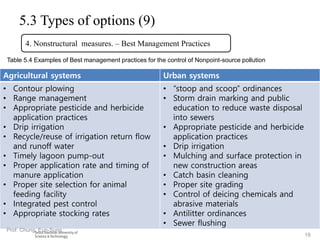
4. Nonstructural measures. – Best Management Practices
19
Agricultural systems Urban systems
• Contour plowing
• Range management
• Appropriate pesticide and herbicide
application practices
• Drip irrigation
• Recycle/reuse of irrigation return flow
and runoff water
• Timely lagoon pump-out
• Proper application rate and timing of
manure application
• Proper site selection for animal
feeding facility
• Integrated pest control
• Appropriate stocking rates
• “stoop and scoop” ordinances
• Storm drain marking and public
education to reduce waste disposal
into sewers
• Appropriate pesticide and herbicide
application practices
• Drip irrigation
• Mulching and surface protection in
new construction areas
• Catch basin cleaning
• Proper site grading
• Control of deicing chemicals and
abrasive materials
• Antilitter ordinances
• Sewer flushing
Table 5.4 Examples of Best management practices for the control of Nonpoint-source pollution
Prof. Chung, Eun-Sung
5.3 Types of options (10)
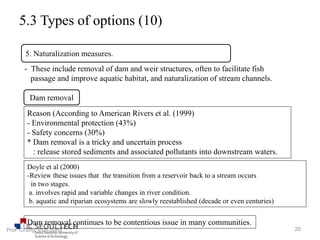
- These include removal of dam and weir structures, often to facilitate fish
passage and improve aquatic habitat, and naturalization of stream channels.
5. Naturalization measures.
Dam removal
Reason (According to American Rivers et al. (1999)
- Environmental protection (43%)
- Safety concerns (30%)
* Dam removal is a tricky and uncertain process
: release stored sediments and associated pollutants into downstream waters.
Doyle et al (2000)
-Review these issues that the transition from a reservoir back to a stream occurs
in two stages.
a. involves rapid and variable changes in river condition.
b. aquatic and riparian ecosystems are slowly reestablished (decade or even centuries)
Dam removal continues to be contentious issue in many communities.
20Prof. Chung, Eun-Sung
5.3 Types of options (11)
5. Naturalization measures.
Stream Naturalization
For the last several decade,
- Most watershed management activities have focused on control
: flooding, mitigation of water quality problems, and security of water supply.
- Protection of aquatic habitat and biota have also been important goal.
However, now
-Scientists have come to realize the importance of restoring natural channel.
(a basis for ecological restoration)
ex. Removal of concrete channel or bank liners, realignment of the stream,
altering and re-vegetating bank slopes.
21Prof. Chung, Eun-Sung
5.3 Types of options (12)
5. Naturalization measures.
Stream Naturalization
Wade et al. (2002) : naturalization practice must proceed by trial and error.
- Current knowledge of effects is so incomplete.
Clearly, stream naturalization must be approached with caution, and with carful
attention to social and economic implications in addition to physical, chemical,
and biological effects.
Frothingham et al. (2002) : Human alteration of most of our stream is so widespread
and catastrophic that most streams in developed areas now bear
virtually no resemblance to their pre-settlement condition.
Rodriguez et al. (2000) : Modeling and prediction of the environmental impacts of
naturalization projects requires a formidable computational
effort at multiple scale.
Shields et al. (2003) : Add that further complexities arise in that stream restoration
practice varies widely, field experiments are difficult to control.
22Prof. Chung, Eun-Sung
5.4 Developing mutually exclusive management alternatives (1)
The principles of developing alternatives are straightforward,
1. All possible management options must be listed separately
- unique budget, schedule, and associated considerations.
2. All possible combinations of options are listed.
- Fore the purpose, consider feasible combination of options.
3. All options are evaluated on the basis of a common planning period,
discount rate, and basis of comparison
All options are enumerated and that all management strategies, whether
comprising one or several individual actions, are mutually exclusive.
23Prof. Chung, Eun-Sung
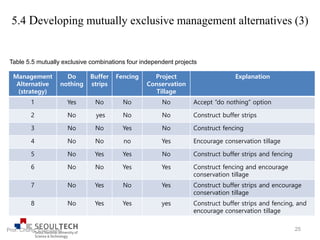
A hypothetical river basin currently experiences heavy loadings of sediment
and nutrients, primarily from agricultural activities. (example)
1. Do nothing
2. Construct riparian buffer strips to capture sediment and attached nutrients
before they enter the stream.
3. Construct livestock exclusion fencing to prevent cattle from entering the
stream and trampling stream banks.
4. Encourage conservation tillage in the basin.
5. Construct riparian buffer strips and livestock exclusion fencing.
6. Construct riparian buffer strips and encourage conservation tillage.
7. Construct livestock exclusion fencing and encourage conservation tillage.
8. Construct riparian buffer strips and livestock exclusion fencing and
encourage conservation tillage. 24Prof. Chung, Eun-Sung
5.4 Developing mutually exclusive management alternatives (2)
25
Management
Alternative
(strategy)
Do
nothing
Buffer
strips
Fencing Project
Conservation
Tillage
Explanation
1 Yes No No No Accept “do nothing” option
2 No yes No No Construct buffer strips
3 No No Yes No Construct fencing
4 No No no Yes Encourage conservation tillage
5 No Yes Yes No Construct buffer strips and fencing
6 No No Yes Yes Construct fencing and encourage
conservation tillage
7 No Yes No Yes Construct buffer strips and encourage
conservation tillage
8 No Yes Yes yes Construct buffer strips and fencing, and
encourage conservation tillage
Table 5.5 mutually exclusive combinations four independent projects
Prof. Chung, Eun-Sung
5.4 Developing mutually exclusive management alternatives (3)
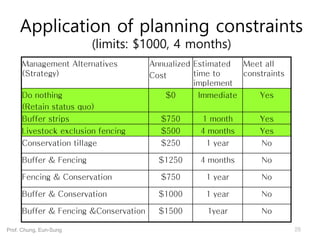
Application of planning constraints
(limits: $1000, 4 months)
Management Alternatives
(Strategy)
Annualized
Cost
Estimated
time to
implement
Meet all
constraints
Do nothing
(Retain status quo)
$0 Immediate Yes
Buffer strips $750 1 month Yes
Livestock exclusion fencing $500 4 months Yes
Conservation tillage $250 1 year No
Buffer & Fencing $1250 4 months No
Fencing & Conservation $750 1 year No
Buffer & Conservation $1000 1 year No
Buffer & Fencing &Conservation $1500 1year No
26Prof. Chung, Eun-Sung
5.5 Evaluation constraints and criteria (1)
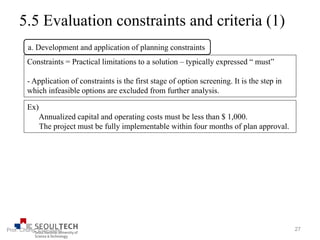
a. Development and application of planning constraints
Constraints = Practical limitations to a solution – typically expressed “ must”
- Application of constraints is the first stage of option screening. It is the step in
which infeasible options are excluded from further analysis.
Ex)
Annualized capital and operating costs must be less than $ 1,000.
The project must be fully implementable within four months of plan approval.
27Prof. Chung, Eun-Sung
5.5 Evaluation constraints and criteria (2)
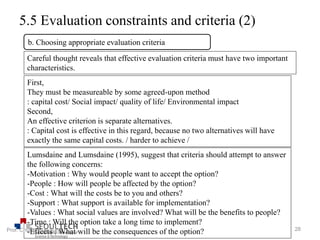
Careful thought reveals that effective evaluation criteria must have two important
characteristics.
First,
They must be measureable by some agreed-upon method
: capital cost/ Social impact/ quality of life/ Environmental impact
Second,
An effective criterion is separate alternatives.
: Capital cost is effective in this regard, because no two alternatives will have
exactly the same capital costs. / harder to achieve /
b. Choosing appropriate evaluation criteria
Lumsdaine and Lumsdaine (1995), suggest that criteria should attempt to answer
the following concerns:
-Motivation : Why would people want to accept the option?
-People : How will people be affected by the option?
-Cost : What will the costs be to you and others?
-Support : What support is available for implementation?
-Values : What social values are involved? What will be the benefits to people?
-Time : Will the option take a long time to implement?
-Effects : What will be the consequences of the option? 28Prof. Chung, Eun-Sung
5.5 Evaluation constraints and criteria (3)
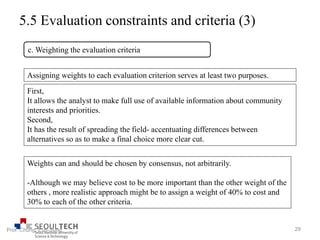
Assigning weights to each evaluation criterion serves at least two purposes.
First,
It allows the analyst to make full use of available information about community
interests and priorities.
Second,
It has the result of spreading the field- accentuating differences between
alternatives so as to make a final choice more clear cut.
Weights can and should be chosen by consensus, not arbitrarily.
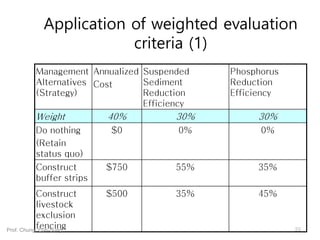
-Although we may believe cost to be more important than the other weight of the
others , more realistic approach might be to assign a weight of 40% to cost and
30% to each of the other criteria.
c. Weighting the evaluation criteria
29Prof. Chung, Eun-Sung
5.5 Evaluation constraints and criteria (4)
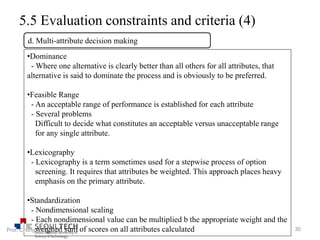
•Dominance
- Where one alternative is clearly better than all others for all attributes, that
alternative is said to dominate the process and is obviously to be preferred.
•Feasible Range
- An acceptable range of performance is established for each attribute
- Several problems
Difficult to decide what constitutes an acceptable versus unacceptable range
for any single attribute.
•Lexicography
- Lexicography is a term sometimes used for a stepwise process of option
screening. It requires that attributes be weighted. This approach places heavy
emphasis on the primary attribute.
•Standardization
- Nondimensional scaling
- Each nondimensional value can be multiplied b the appropriate weight and the
weighed sum of scores on all attributes calculated
d. Multi-attribute decision making
30Prof. Chung, Eun-Sung
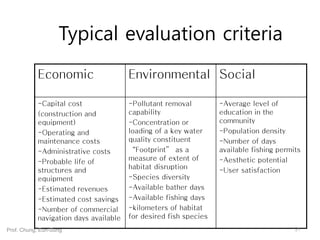
Typical evaluation criteria
Economic Environmental Social
-Capital cost
(construction and
equipment)
-Operating and
maintenance costs
-Administrative costs
-Probable life of
structures and
equipment
-Estimated revenues
-Estimated cost savings
-Number of commercial
navigation days available
-Pollutant removal
capability
-Concentration or
loading of a key water
quality constituent
“Footprint” as a
measure of extent of
habitat disruption
-Species diversity
-Available bather days
-Available fishing days
-kilometers of habitat
for desired fish species
-Average level of
education in the
community
-Population density
-Number of days
available fishing permits
-Aesthetic potential
-User satisfaction
31Prof. Chung, Eun-Sung
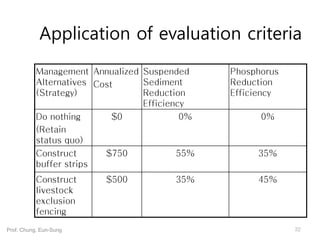
Application of evaluation criteria
Management
Alternatives
(Strategy)
Annualized
Cost
Suspended
Sediment
Reduction
Efficiency
Phosphorus
Reduction
Efficiency
Do nothing
(Retain
status quo)
$0 0% 0%
Construct
buffer strips
$750 55% 35%
Construct
livestock
exclusion
fencing
$500 35% 45%
32Prof. Chung, Eun-Sung
Application of weighted evaluation
criteria (1)
Management
Alternatives
(Strategy)
Annualized
Cost
Suspended
Sediment
Reduction
Efficiency
Phosphorus
Reduction
Efficiency
Weight 40% 30% 30%
Do nothing
(Retain
status quo)
$0 0% 0%
Construct
buffer strips
$750 55% 35%
Construct
livestock
exclusion
fencing
$500 35% 45%
33Prof. Chung, Eun-Sung
Application of weighted evaluation criteria
and data standardization (2)
Management
Alternatives
(Strategy)
Annualized
Cost
Suspended Sediment
Reduction Efficiency
Phosphorus
Reduction
Efficiency
Total
Score
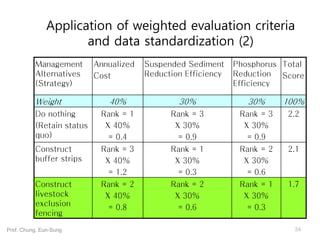
Weight 40% 30% 30% 100%
Do nothing
(Retain status
quo)
Rank = 1
X 40%
= 0.4
Rank = 3
X 30%
= 0.9
Rank = 3
X 30%
= 0.9
2.2
Construct
buffer strips
Rank = 3
X 40%
= 1.2
Rank = 1
X 30%
= 0.3
Rank = 2
X 30%
= 0.6
2.1
Construct
livestock
exclusion
fencing
Rank = 2
X 40%
= 0.8
Rank = 2
X 30%
= 0.6
Rank = 1
X 30%
= 0.3
1.7
34Prof. Chung, Eun-Sung
Application of weighted evaluation criteria
and data standardization (3)
Management
Alternatives
(Strategy)
Annualized
Cost
Suspended Sediment
Reduction Efficiency
Phosphorus
Reduction
Efficiency
Total
Score
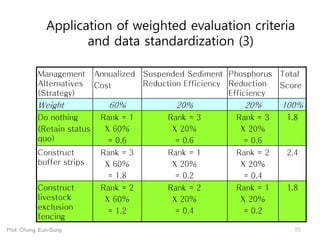
Weight 60% 20% 20% 100%
Do nothing
(Retain status
quo)
Rank = 1
X 60%
= 0.6
Rank = 3
X 20%
= 0.6
Rank = 3
X 20%
= 0.6
1.8
Construct
buffer strips
Rank = 3
X 60%
= 1.8
Rank = 1
X 20%
= 0.2
Rank = 2
X 20%
= 0.4
2.4
Construct
livestock
exclusion
fencing
Rank = 2
X 60%
= 1.2
Rank = 2
X 20%
= 0.4
Rank = 1
X 20%
= 0.2
1.8
35Prof. Chung, Eun-Sung
Summary (1)
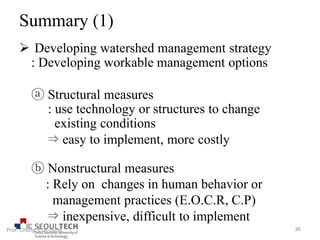
 Developing watershed management strategy
: Developing workable management options
ⓐ Structural measures
: use technology or structures to change
existing conditions
⇒ easy to implement, more costly
ⓑ Nonstructural measures
: Rely on changes in human behavior or
management practices (E.O.C.R, C.P)
⇒ inexpensive, difficult to implement
36Prof. Chung, Eun-Sung
Summary (2)
Thus,
most watershed management schemes include
mixture measures
Structural measures
+
Non-structural measures
In order to gear to the control of different
problems and sources.
37Prof. Chung, Eun-Sung

Integrated Watershed Management Ch. 5 Developing Workable Management Options

  • 1.
    Ch. 5. DevelopingWorkable Management Options Professor Eun-Sung Chung Seoul National University of Science and Technology
  • 2.
    Contents 5.1 Identifying theSources. 1.1 Pollutant Loadings versus Concentration. 1.2 Total Maximum Daily Loads(TMSLs). 5.2 Creating a Long List of Management Options. 5.3 Types of Options. 3.1 The Option of Doing Nothing. 3.2 Structural Measures. 3.3 Vegetative Practices. 3.4 Nonstructural Options (Best Management Practices). 3.5 Naturalization Measures. 5.4 Developing Mutually Exclusive Management Alternatives. 5.5 Evaluation Constraints and Criteria. 5.1 Development and Application of Planning Constraints. 5.2 Choosing Appropriate Evaluation Criteria. 5.3 Weighting the Evaluation Criteria. 5.4 Multi-attribute Decision Making. 2Prof. Chung, Eun-Sung
  • 3.
    5.1 Identifying thesources (Flow & Pollutants) ① Dry-weather point sources Single & Distinct point Pipe or Diffuser Discharges more & less continuously ex) The effluents of Sewage treatment plant, treated industrial wastewaters The dry-weather point sources are originated from the fact that above discharges are caused during dry weather conditions. 3Prof. Chung, Eun-Sung
  • 4.
    ② Wet-weather pointsources Combined sewer overflows from a collection/distribution system outflow point Urban discharges Storm water runoff Now most city have efficient runoff collection systems and discharges, only during rainfall events and for a short period following rainfall these sources operate! They are distinguished from wet-weather diffuse sources ⇒ suitability for end of pipe treatment and control technologies. 4Prof. Chung, Eun-Sung 5.1 Identifying the sources (Flow & Pollutants)
  • 5.
    ③ Wet-weather diffusesources ④ Internal sources Diffuse drainage of rainwaterUrban or Agricultural lands Control over a large area, not just single point. Important implications for bank and channel stability as well as flow and quality Chemical, physical, or biological sources Ex) Sediment re-suspension Decaying biomass These sources can be difficult to find, quantify, and control. Often omitted from watershed planning initiatives. 5Prof. Chung, Eun-Sung 5.1 Identifying the sources (Flow & Pollutants)
  • 6.
    ◈ The stepsto develop a reasonably comprehensive list. ① List the land uses in the watershed, ranking them in order of land area. ② For each land use, estimate the proportion of land surface (permeable vs impermeable). ③ For available sewer maps, determine which area of the basin are drained by storm and sanitary sewers, and the location of discharge points for each system. ④ Identify the known dry-weather point sources to the system. ⑤ Identify the known wet-weather point sources to the system. Estimate the volume and frequency of discharges from these sources. ⑥ Estimate the pollutant-generation potential of land. These will be diffuse sources active only, or mainly in wet weather. ⑦ Estimate the potential for internal sources or processes to generate or remove flow or pollutants from the system. 6Prof. Chung, Eun-Sung 5.1 Identifying the sources (Flow & Pollutants)
  • 7.
    5.1.1 Pollutant loadingsversus Concentration. Load (Loading) Concentration The total mass of a substance, expressed either as mass alone or as mass per unit time The mass of a substance contained in a given volume of water mass per unit of water volume Recently, the notion of limiting pollutant loadings has become more important in water management Historically, most water quality management programs focused on Controlling pollutant concentration. a. The most critical consideration in accessing potential impact on an aquatic system. b. It gives an intuitive measure of potential impact on aquatic species. Ex) Dichlorodiphenyltrichloroethane It is difficult to predict changes in in-stream water quality. Industrial effluent controls usually result in easily measured changes in pollutant concentration at the end of the pipe. So, both concentration and loading reductions can be estimated with accuracy. 7Prof. Chung, Eun-Sung
  • 8.
    5.1.2 Total MaximumDaily Loads (TMDLs). Since 1972, TMDLs have been required by law, but last decade the U.S. Environmental protection Agency has begun to enforce these rules more strictly. (report their list of impaired waters and associated TMDLs on April 1 of every even-numbered year. Use the information to arrive at maximum daily loads for each pollutant such that applicable water quality standards will be met. 1. Describe the methods they have used to arrive at the TMDL 2. Include a prioritized list of water bodies (current condition, water uses). 3. Identify any water bodies scheduled for TMDL development over the next two years. US EPA –Typical steps for developing a TMDL : 1. Identify linkages between water quality problems and pollutant sources. 2. Estimate total acceptable loading rate that achieves water quality standards. 3. Allocate acceptable loading rates between sources. 4. Package the TMDL for EPA approval 8Prof. Chung, Eun-Sung
  • 9.
    5.1.2 Total MaximumDaily Loads (TMDLs). While, -TMDL system has been criticized for its long delays. -There is also considerable variation in the way that state, territories and tribes have developed TMDL. Thus, EPA is currently investigating mechanisms for achieving a more nationally consistent approach to developing and implementing TMDLs. Finally, the TMDL system is of little use in accomplishing water quality improvement if load reductions are not achieved. Yet, many substances arise from a bewildering array of sources. Controlling those loads may require consultation with and agreement from others. 9Prof. Chung, Eun-Sung
  • 10.
    5.2 Creating along list of management options Brainstorming Lumsdaine and Lumsdaine (1995) Used to generate a list of possible solutions Creative thinking is often limited by habits, emotions and false assumptions. (artist’s mind-set, detective’s mind-set, explorer’s mind-set.) This is also an important time to clarify the values and priorities of the decision-making group and to ensure that all values are encompassed by the evolving list of options. They emphasis on creativity is important at this idea-generation stage of problem solving. The challenge for the decision-making team is to overcome preconceptions about workable options and create, in the literal sense, a broad and imaginative range of solutions for further investigation. 10Prof. Chung, Eun-Sung
  • 11.
    5.3 Types ofoptions (1) 1. Do nothing, or status quo option. 2. Structural measures. – structure and other built technology 3. Vegetative approaches. 4. Nonstructural measures. – best management practices 5. Naturalization measures. The long list of potential management actions can, in theory, contain five types of practice. Most long lists include at least three of the four categories. 11Prof. Chung, Eun-Sung
  • 12.
    5.3 Types ofoptions (2) 1. Do nothing, or status quo option. - Keep on doing what you are currently doing; maintain the status quo. - Much to recommend it. - It is cheap : no structures need be built, no education programs funded, no additional fees or expenses to pay. - It is easy for decision makers and lay people to understand. - It will be useful to model the do nothing option as a base case, or foundation, against other options. 12Prof. Chung, Eun-Sung
  • 13.
    5.3 Types ofoptions (3) - It is possible to build something, such as a treatment plant, stormwater detention pond, or a grassed waterway. (water quality and flow improvement) - Structure solution are well described in the literature and in civil Eng. Text. - Both end of pipe solution and preventive options. 2. Structural measures. – structure and other built technology 13Prof. Chung, Eun-Sung
  • 14.
    5.3 Types ofoptions (4) 2. Structural measures. – structure and other built technology 14 Wastewater Pretretment Primary Treatment Secondary Treatment Tertiary Treatment Sludge Treatment Waste Disposal • Screening • Grit removal • Flow equalization • neutralizatio n • Oil separation • Sedimentation • Flotation • Filtration • ultrafiltration • Activated sludge • Trickling filters • Aerobic lagoons • Anecrobic lagoons • Facultative lagoons • Effluent polishing • Rotating biological • Steam stripping • Solvent extraction • Granular activated carbon absorption • Chemical oxidation • Air stripping • Nitriscation • Demitrification • Ion exchange • Polymeric adsorption • Reverse osmosis • Electrodialysis • Distillaction • Disinfection • Dechlorination • Ozonation • Chemical reduction • Gravity thickening • Flocation thickening • Centrifugal thickening • Aerobic digestion • Anaerobic digestion • Byproduct recovery • Thermal (heat) conditoning • Disinfection • Vacuum filtration • Filter press dewatering • Belt filter dewatering • Centrifugal dewatering • Thermal drying • Drying beds • lagoons • Evaporation lagoons • Incineration • Starved air combussion • Landfilling • Land application • Composting • Deep well injection Table 5.1 Examples of structural controls for Point-Source Pollution Prof. Chung, Eun-Sung
  • 15.
    5.3 Types ofoptions (5) 2. Structural measures. – structure and other built technology 15 Urban Stormwater Quality Urban stormwater Qunatity Agricultural Runoff quality Agricultural runoff quantity • Street sweeping • Sediment retention basins • Grassed channels and waterways • Porous pavement • Bermed and covered materials storage areas • Barracks • Swirl concentrators/regulators • Pine screens • Sedimentation • Dissolved air flotation • High-rate filters • Biological treatment • High-rate disinfection • Grassed channels and waterways • High-side spill weirs • Sewer separation • Stilling pond regulators • Computerized collection system controls to optimized storage and treatment • In-line storage using dams and gates • Off-line storage using ponds, lagoons, deep tunnels, tanks, bags, etc. • Roof leader disconnection • on-site detection in swales, roof storage, ponds, or detention basins • On-site retention (total containment) allow refiltration to groundwater • Porous pavement • Inflow and infiltration controls in sewers • Sewer deseparation in overloaded sanitary systems • Grassed channels and waterways • Terraces and diversions • Runoff retention ponds • Sedimentation basins • Stream bank stabilization and channel integrity repair • Composting facility • Manure storage • Activated carbon filtration • Milkhouse was water treatment system • Waste treatment lagoons • Livestock exclusion fencing • Grassed channels and waterways • Terraces and diversions • Runoff retention ponds • Grade stabilization • Wetland rehabilitation • Irrigation water management with seepage control (ditch lining) and water pits • Drop inlet structures • Weirs and spillways • Subsurface (tile) drainage Table 5.2 Examples of structural controls for Nonpoint-Source Pollution Prof. Chung, Eun-Sung
  • 16.
    5.3 Types ofoptions (6) - Sometimes included among nonstructural management options. - Change the extent, nature, and/or timing of vegetative cover and change the rate and quality of water flowing over the land surface. (vegetative cover) - They are almost exclusively used in the control of nonpoint sources of pollution. - Particularly important in agricultural applications because they are readily controlled by the farm operator, they are often low in cost, they can provide secondary benefits in terms of crop production. 3. Vegetative approaches. 16Prof. Chung, Eun-Sung
  • 17.
    5.3 Types ofoptions (7) - Vegetative measures are increasingly used in urban settings as well with the recent trend toward bioengineering 3. Vegetative approaches. 17 Agricultural systems Urban systems • Filter strios and buffer zones • Critical area planting • Constructed wetlands or reed beds • Restoration of aquatic habitat • Crop/plant selection for maximum nutrient uptake and/or minimum pesticide use • Strip-cropping and intercropping • Cover crops • Range management • Crop ratations • Filter strips and buffer zones • Critical area planting • Constructed wetlands or reed beds • Restoration of aquatic habitat • Crop/plant selection for maximum nutrient uptake and/or minimum pesticide use, or for physical stability • Xeriscaping Table 5.3 Examples of vegetative measures for the controls of Nonpoint-source polluion Prof. Chung, Eun-Sung
  • 18.
    5.3 Types ofoptions (8) - Best management practices : differentiate them from best management technology. may be more effective than structural measures. - But, they are often harder to implement because they require people to change the way they behave. Ex) low cost, highly effective, but often unsuccessful “stoop and scoop” ordinance or bylaw for the control of pet. - It has been difficult to implement in many cities, because of public resistance to change and because municipalities simply cannot enforce such ordinances effectively. - Successful implementation : combined with a comprehensive public education program. 4. Nonstructural measures. – Best management practices (BMPs) 18Prof. Chung, Eun-Sung
  • 19.
    5.3 Types ofoptions (9) 4. Nonstructural measures. – Best Management Practices 19 Agricultural systems Urban systems • Contour plowing • Range management • Appropriate pesticide and herbicide application practices • Drip irrigation • Recycle/reuse of irrigation return flow and runoff water • Timely lagoon pump-out • Proper application rate and timing of manure application • Proper site selection for animal feeding facility • Integrated pest control • Appropriate stocking rates • “stoop and scoop” ordinances • Storm drain marking and public education to reduce waste disposal into sewers • Appropriate pesticide and herbicide application practices • Drip irrigation • Mulching and surface protection in new construction areas • Catch basin cleaning • Proper site grading • Control of deicing chemicals and abrasive materials • Antilitter ordinances • Sewer flushing Table 5.4 Examples of Best management practices for the control of Nonpoint-source pollution Prof. Chung, Eun-Sung
  • 20.
    5.3 Types ofoptions (10) - These include removal of dam and weir structures, often to facilitate fish passage and improve aquatic habitat, and naturalization of stream channels. 5. Naturalization measures. Dam removal Reason (According to American Rivers et al. (1999) - Environmental protection (43%) - Safety concerns (30%) * Dam removal is a tricky and uncertain process : release stored sediments and associated pollutants into downstream waters. Doyle et al (2000) -Review these issues that the transition from a reservoir back to a stream occurs in two stages. a. involves rapid and variable changes in river condition. b. aquatic and riparian ecosystems are slowly reestablished (decade or even centuries) Dam removal continues to be contentious issue in many communities. 20Prof. Chung, Eun-Sung
  • 21.
    5.3 Types ofoptions (11) 5. Naturalization measures. Stream Naturalization For the last several decade, - Most watershed management activities have focused on control : flooding, mitigation of water quality problems, and security of water supply. - Protection of aquatic habitat and biota have also been important goal. However, now -Scientists have come to realize the importance of restoring natural channel. (a basis for ecological restoration) ex. Removal of concrete channel or bank liners, realignment of the stream, altering and re-vegetating bank slopes. 21Prof. Chung, Eun-Sung
  • 22.
    5.3 Types ofoptions (12) 5. Naturalization measures. Stream Naturalization Wade et al. (2002) : naturalization practice must proceed by trial and error. - Current knowledge of effects is so incomplete. Clearly, stream naturalization must be approached with caution, and with carful attention to social and economic implications in addition to physical, chemical, and biological effects. Frothingham et al. (2002) : Human alteration of most of our stream is so widespread and catastrophic that most streams in developed areas now bear virtually no resemblance to their pre-settlement condition. Rodriguez et al. (2000) : Modeling and prediction of the environmental impacts of naturalization projects requires a formidable computational effort at multiple scale. Shields et al. (2003) : Add that further complexities arise in that stream restoration practice varies widely, field experiments are difficult to control. 22Prof. Chung, Eun-Sung
  • 23.
    5.4 Developing mutuallyexclusive management alternatives (1) The principles of developing alternatives are straightforward, 1. All possible management options must be listed separately - unique budget, schedule, and associated considerations. 2. All possible combinations of options are listed. - Fore the purpose, consider feasible combination of options. 3. All options are evaluated on the basis of a common planning period, discount rate, and basis of comparison All options are enumerated and that all management strategies, whether comprising one or several individual actions, are mutually exclusive. 23Prof. Chung, Eun-Sung
  • 24.
    A hypothetical riverbasin currently experiences heavy loadings of sediment and nutrients, primarily from agricultural activities. (example) 1. Do nothing 2. Construct riparian buffer strips to capture sediment and attached nutrients before they enter the stream. 3. Construct livestock exclusion fencing to prevent cattle from entering the stream and trampling stream banks. 4. Encourage conservation tillage in the basin. 5. Construct riparian buffer strips and livestock exclusion fencing. 6. Construct riparian buffer strips and encourage conservation tillage. 7. Construct livestock exclusion fencing and encourage conservation tillage. 8. Construct riparian buffer strips and livestock exclusion fencing and encourage conservation tillage. 24Prof. Chung, Eun-Sung 5.4 Developing mutually exclusive management alternatives (2)
  • 25.
    25 Management Alternative (strategy) Do nothing Buffer strips Fencing Project Conservation Tillage Explanation 1 YesNo No No Accept “do nothing” option 2 No yes No No Construct buffer strips 3 No No Yes No Construct fencing 4 No No no Yes Encourage conservation tillage 5 No Yes Yes No Construct buffer strips and fencing 6 No No Yes Yes Construct fencing and encourage conservation tillage 7 No Yes No Yes Construct buffer strips and encourage conservation tillage 8 No Yes Yes yes Construct buffer strips and fencing, and encourage conservation tillage Table 5.5 mutually exclusive combinations four independent projects Prof. Chung, Eun-Sung 5.4 Developing mutually exclusive management alternatives (3)
  • 26.
    Application of planningconstraints (limits: $1000, 4 months) Management Alternatives (Strategy) Annualized Cost Estimated time to implement Meet all constraints Do nothing (Retain status quo) $0 Immediate Yes Buffer strips $750 1 month Yes Livestock exclusion fencing $500 4 months Yes Conservation tillage $250 1 year No Buffer & Fencing $1250 4 months No Fencing & Conservation $750 1 year No Buffer & Conservation $1000 1 year No Buffer & Fencing &Conservation $1500 1year No 26Prof. Chung, Eun-Sung
  • 27.
    5.5 Evaluation constraintsand criteria (1) a. Development and application of planning constraints Constraints = Practical limitations to a solution – typically expressed “ must” - Application of constraints is the first stage of option screening. It is the step in which infeasible options are excluded from further analysis. Ex) Annualized capital and operating costs must be less than $ 1,000. The project must be fully implementable within four months of plan approval. 27Prof. Chung, Eun-Sung
  • 28.
    5.5 Evaluation constraintsand criteria (2) Careful thought reveals that effective evaluation criteria must have two important characteristics. First, They must be measureable by some agreed-upon method : capital cost/ Social impact/ quality of life/ Environmental impact Second, An effective criterion is separate alternatives. : Capital cost is effective in this regard, because no two alternatives will have exactly the same capital costs. / harder to achieve / b. Choosing appropriate evaluation criteria Lumsdaine and Lumsdaine (1995), suggest that criteria should attempt to answer the following concerns: -Motivation : Why would people want to accept the option? -People : How will people be affected by the option? -Cost : What will the costs be to you and others? -Support : What support is available for implementation? -Values : What social values are involved? What will be the benefits to people? -Time : Will the option take a long time to implement? -Effects : What will be the consequences of the option? 28Prof. Chung, Eun-Sung
  • 29.
    5.5 Evaluation constraintsand criteria (3) Assigning weights to each evaluation criterion serves at least two purposes. First, It allows the analyst to make full use of available information about community interests and priorities. Second, It has the result of spreading the field- accentuating differences between alternatives so as to make a final choice more clear cut. Weights can and should be chosen by consensus, not arbitrarily. -Although we may believe cost to be more important than the other weight of the others , more realistic approach might be to assign a weight of 40% to cost and 30% to each of the other criteria. c. Weighting the evaluation criteria 29Prof. Chung, Eun-Sung
  • 30.
    5.5 Evaluation constraintsand criteria (4) •Dominance - Where one alternative is clearly better than all others for all attributes, that alternative is said to dominate the process and is obviously to be preferred. •Feasible Range - An acceptable range of performance is established for each attribute - Several problems Difficult to decide what constitutes an acceptable versus unacceptable range for any single attribute. •Lexicography - Lexicography is a term sometimes used for a stepwise process of option screening. It requires that attributes be weighted. This approach places heavy emphasis on the primary attribute. •Standardization - Nondimensional scaling - Each nondimensional value can be multiplied b the appropriate weight and the weighed sum of scores on all attributes calculated d. Multi-attribute decision making 30Prof. Chung, Eun-Sung
  • 31.
    Typical evaluation criteria EconomicEnvironmental Social -Capital cost (construction and equipment) -Operating and maintenance costs -Administrative costs -Probable life of structures and equipment -Estimated revenues -Estimated cost savings -Number of commercial navigation days available -Pollutant removal capability -Concentration or loading of a key water quality constituent “Footprint” as a measure of extent of habitat disruption -Species diversity -Available bather days -Available fishing days -kilometers of habitat for desired fish species -Average level of education in the community -Population density -Number of days available fishing permits -Aesthetic potential -User satisfaction 31Prof. Chung, Eun-Sung
  • 32.
    Application of evaluationcriteria Management Alternatives (Strategy) Annualized Cost Suspended Sediment Reduction Efficiency Phosphorus Reduction Efficiency Do nothing (Retain status quo) $0 0% 0% Construct buffer strips $750 55% 35% Construct livestock exclusion fencing $500 35% 45% 32Prof. Chung, Eun-Sung
  • 33.
    Application of weightedevaluation criteria (1) Management Alternatives (Strategy) Annualized Cost Suspended Sediment Reduction Efficiency Phosphorus Reduction Efficiency Weight 40% 30% 30% Do nothing (Retain status quo) $0 0% 0% Construct buffer strips $750 55% 35% Construct livestock exclusion fencing $500 35% 45% 33Prof. Chung, Eun-Sung
  • 34.
    Application of weightedevaluation criteria and data standardization (2) Management Alternatives (Strategy) Annualized Cost Suspended Sediment Reduction Efficiency Phosphorus Reduction Efficiency Total Score Weight 40% 30% 30% 100% Do nothing (Retain status quo) Rank = 1 X 40% = 0.4 Rank = 3 X 30% = 0.9 Rank = 3 X 30% = 0.9 2.2 Construct buffer strips Rank = 3 X 40% = 1.2 Rank = 1 X 30% = 0.3 Rank = 2 X 30% = 0.6 2.1 Construct livestock exclusion fencing Rank = 2 X 40% = 0.8 Rank = 2 X 30% = 0.6 Rank = 1 X 30% = 0.3 1.7 34Prof. Chung, Eun-Sung
  • 35.
    Application of weightedevaluation criteria and data standardization (3) Management Alternatives (Strategy) Annualized Cost Suspended Sediment Reduction Efficiency Phosphorus Reduction Efficiency Total Score Weight 60% 20% 20% 100% Do nothing (Retain status quo) Rank = 1 X 60% = 0.6 Rank = 3 X 20% = 0.6 Rank = 3 X 20% = 0.6 1.8 Construct buffer strips Rank = 3 X 60% = 1.8 Rank = 1 X 20% = 0.2 Rank = 2 X 20% = 0.4 2.4 Construct livestock exclusion fencing Rank = 2 X 60% = 1.2 Rank = 2 X 20% = 0.4 Rank = 1 X 20% = 0.2 1.8 35Prof. Chung, Eun-Sung
  • 36.
    Summary (1)  Developingwatershed management strategy : Developing workable management options ⓐ Structural measures : use technology or structures to change existing conditions ⇒ easy to implement, more costly ⓑ Nonstructural measures : Rely on changes in human behavior or management practices (E.O.C.R, C.P) ⇒ inexpensive, difficult to implement 36Prof. Chung, Eun-Sung
  • 37.
    Summary (2) Thus, most watershedmanagement schemes include mixture measures Structural measures + Non-structural measures In order to gear to the control of different problems and sources. 37Prof. Chung, Eun-Sung