Restructuring Campus CI --
UCSD-A LambdaCampus Research CI
 and the Quest for Zero Carbon ICT
            Invited Presentation to the
 Net@EDU Campus Cyberinfrastructure Working Group
                    Tempe, AZ
                  February 3, 2009


                         Dr. Larry Smarr
  Director, California Institute for Telecommunications and
                    Information Technology
                  Harry E. Gruber Professor,
        Dept. of Computer Science and Engineering
            Jacobs School of Engineering, UCSD
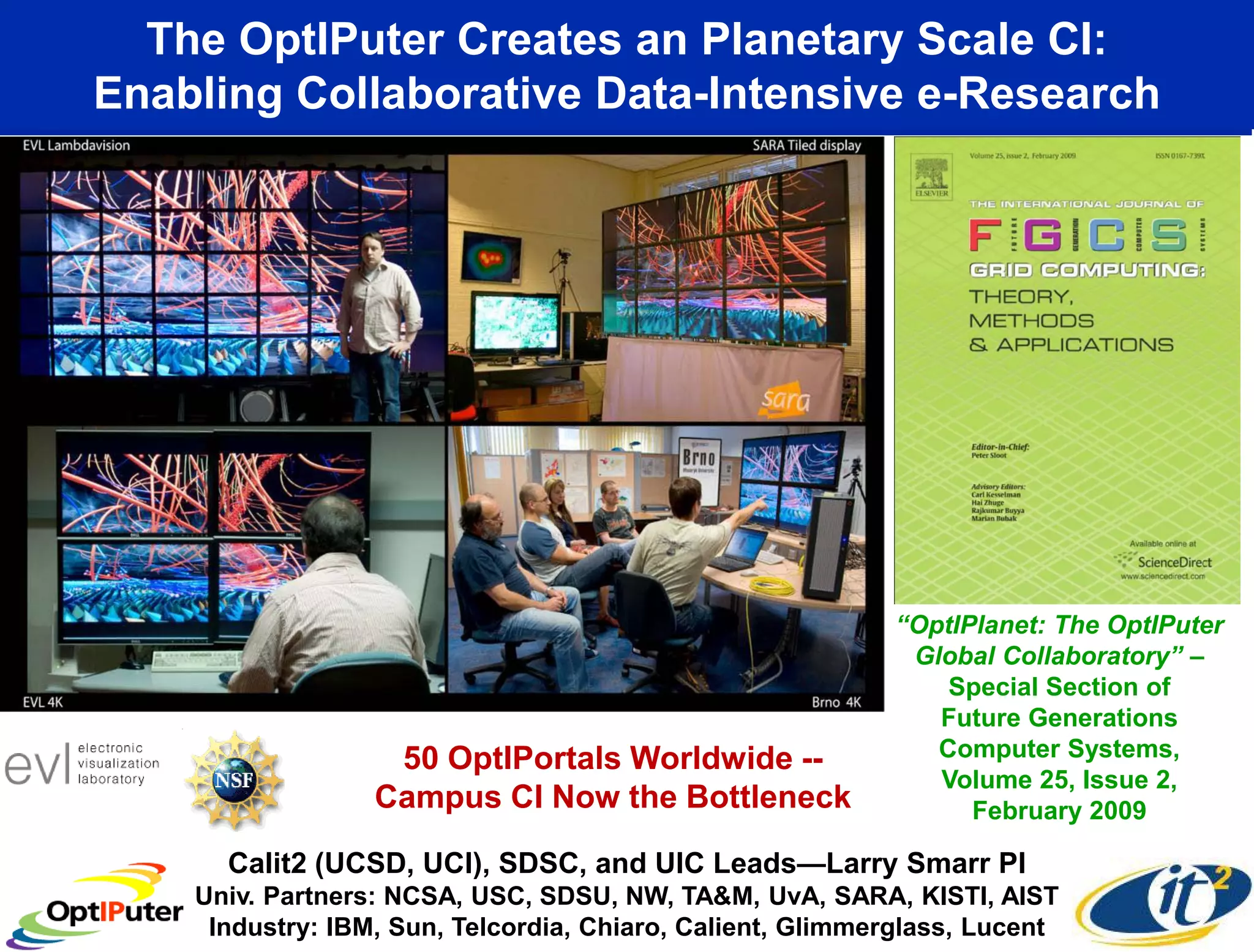
The OptIPuter Creates an Planetary Scale CI:
Enabling Collaborative Data-Intensive e-Research
      www.evl.uic.edu/cavern/sage


                                                           “OptIPlanet: The OptIPuter
                                                            Global Collaboratory” –
                                                               Special Section of
                                                              Future Generations
                   50 OptIPortals Worldwide --                Computer Systems,
                                                              Volume 25, Issue 2,
                  Campus CI Now the Bottleneck                   February 2009

      Calit2 (UCSD, UCI), SDSC, and UIC Leads—Larry Smarr PI
    Univ. Partners: NCSA, USC, SDSU, NW, TA&M, UvA, SARA, KISTI, AIST
     Industry: IBM, Sun, Telcordia, Chiaro, Calient, Glimmerglass, Lucent
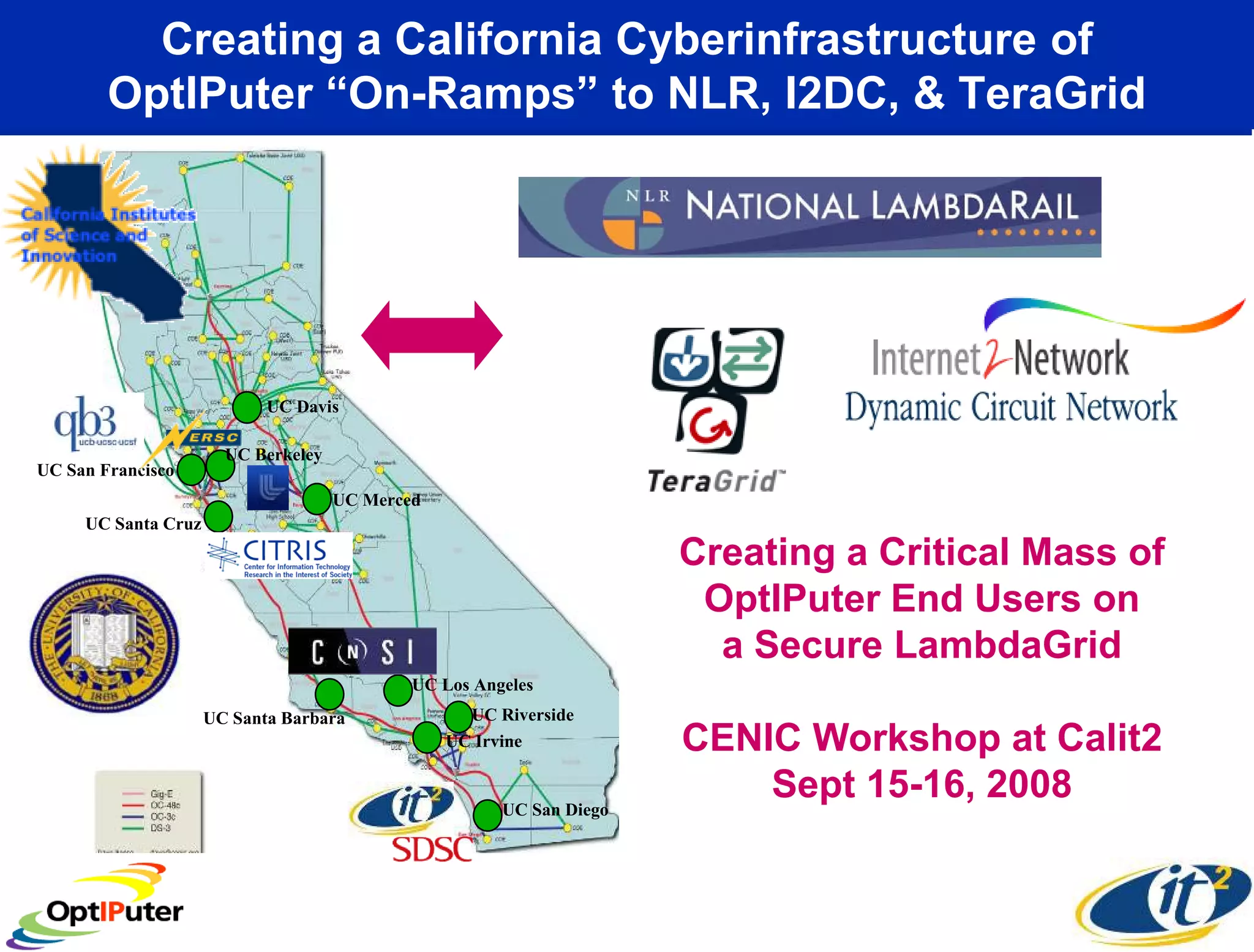
Creating a California Cyberinfrastructure of
        OptIPuter “On-Ramps” to NLR, I2DC, & TeraGrid


                            UC Davis

                       UC Berkeley
UC San Francisco
                                     UC Merced
     UC Santa Cruz
                                                                      Creating a Critical Mass of
                                                                       OptIPuter End Users on
                                                                        a Secure LambdaGrid
                                             UC Los Angeles
                     UC Santa Barbara              UC Riverside
                                                 UC Irvine            CENIC Workshop at Calit2
                                                       UC San Diego
                                                                          Sept 15-16, 2008
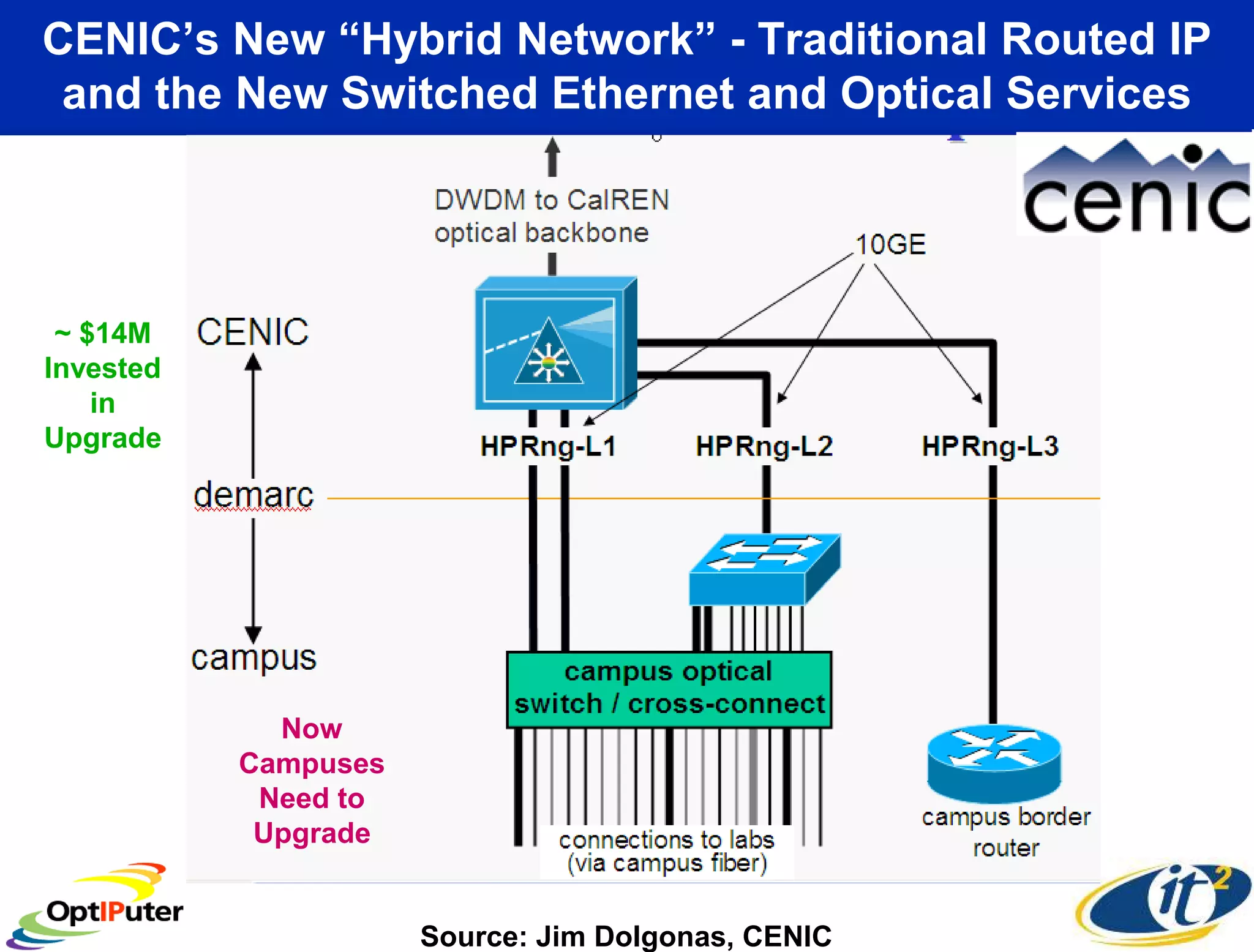
CENIC’s New “Hybrid Network” - Traditional Routed IP
 and the New Switched Ethernet and Optical Services


 ~ $14M
Invested
    in
Upgrade


             Now
           Campuses
            Need to
            Upgrade


                      Source: Jim Dolgonas, CENIC
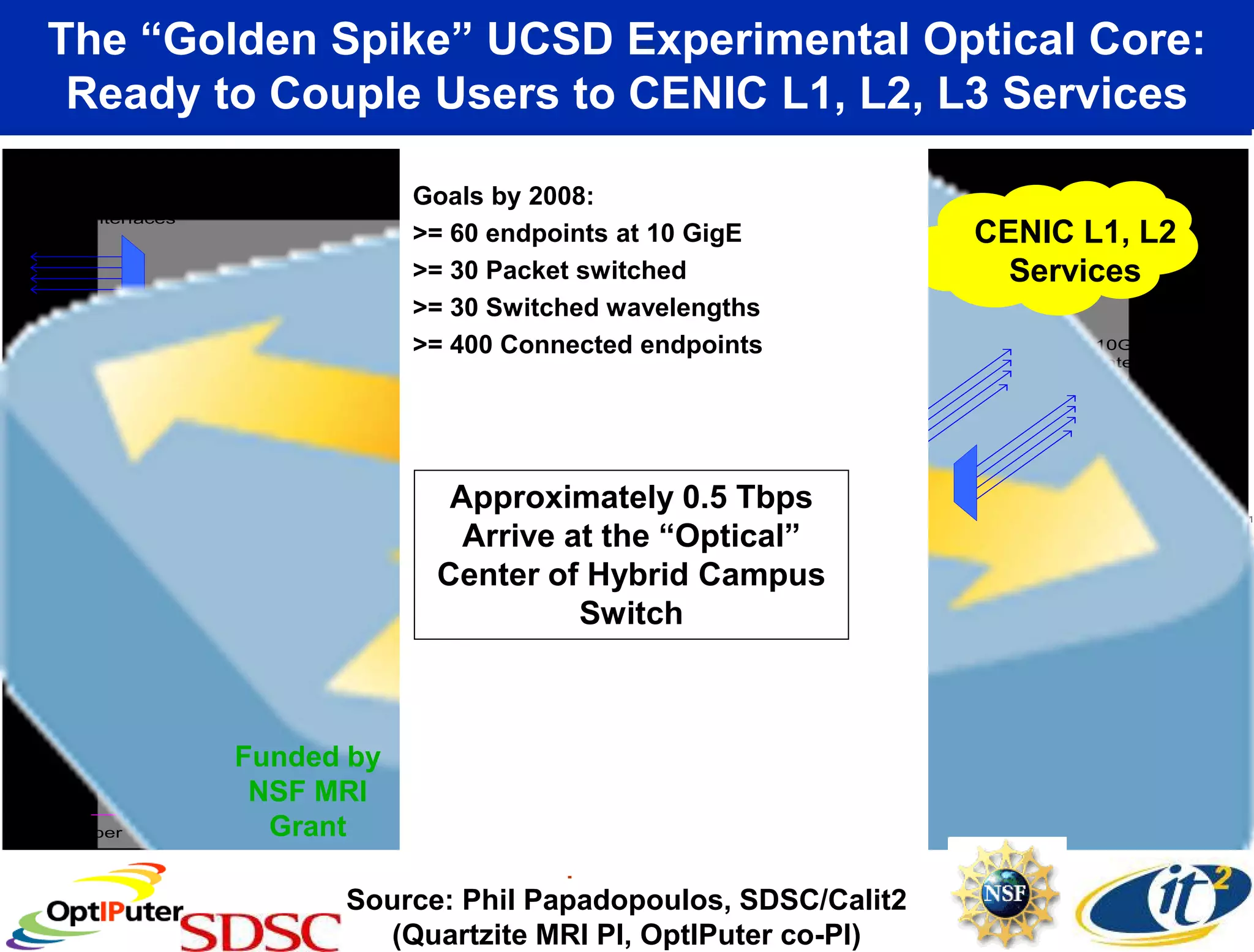
The “Golden Spike” UCSD Experimental Optical Core:
     Ready to Couple Users to CENIC L1, L2, L3 Services
                                       Quartzite Communications
  To 10GigE cluster                    Goals by 2008:
                                                  Core Year 3
   node interfaces
                                       >= 60 endpoints at 10 GigE                CENIC L1, L2
                                       >= 30 Packet switched Wavelength
                                               Quartzite         Selective
                                                                                   Services
                                                 Corewavelengths
       .....


                                                                  Switch
                                       >= 30 Switched
                                       >= 400 Connected endpoints
                                                                Lucent                   To 10GigE cluster
                                                                                        node interfaces and
                                                                                             other switches


To cluster nodes
                   .....
                                                                  Glimmerglass
                                          Approximately 0.5 Tbps                           .....
                                                                                                   To cluster nodes


            GigE Switch with
           Dual 10GigE Upliks
                                           Arrive at the “Optical”
                                                             Production
                                                               OOO
                                                               Switch
To cluster nodes
                                         Center of Hybrid Campus
                                               32 10GigE

                   .....
                                                    Switch                          GigE Switch with
                                                                                   Dual 10GigE Upliks
                                                                       Force10
                                                 ...


                                        To             Packet Switch             CalREN-HPR
            GigE Switch with
           Dual 10GigE Upliks           other                                     Research
                                        nodes
                                                                                    Cloud
    GigE
                           Funded by
 10GigE
                            NSF MRI                                              Campus Research
  4 GigE
  4 pair fiber               Grant                                                   Cloud
                                                       Cisco 6509
                                                       Juniper T320

                                                  OptIPuter Border Router
                                 Source: Phil Papadopoulos, SDSC/Calit2
                                   (Quartzite MRI PI, OptIPuter co-PI)
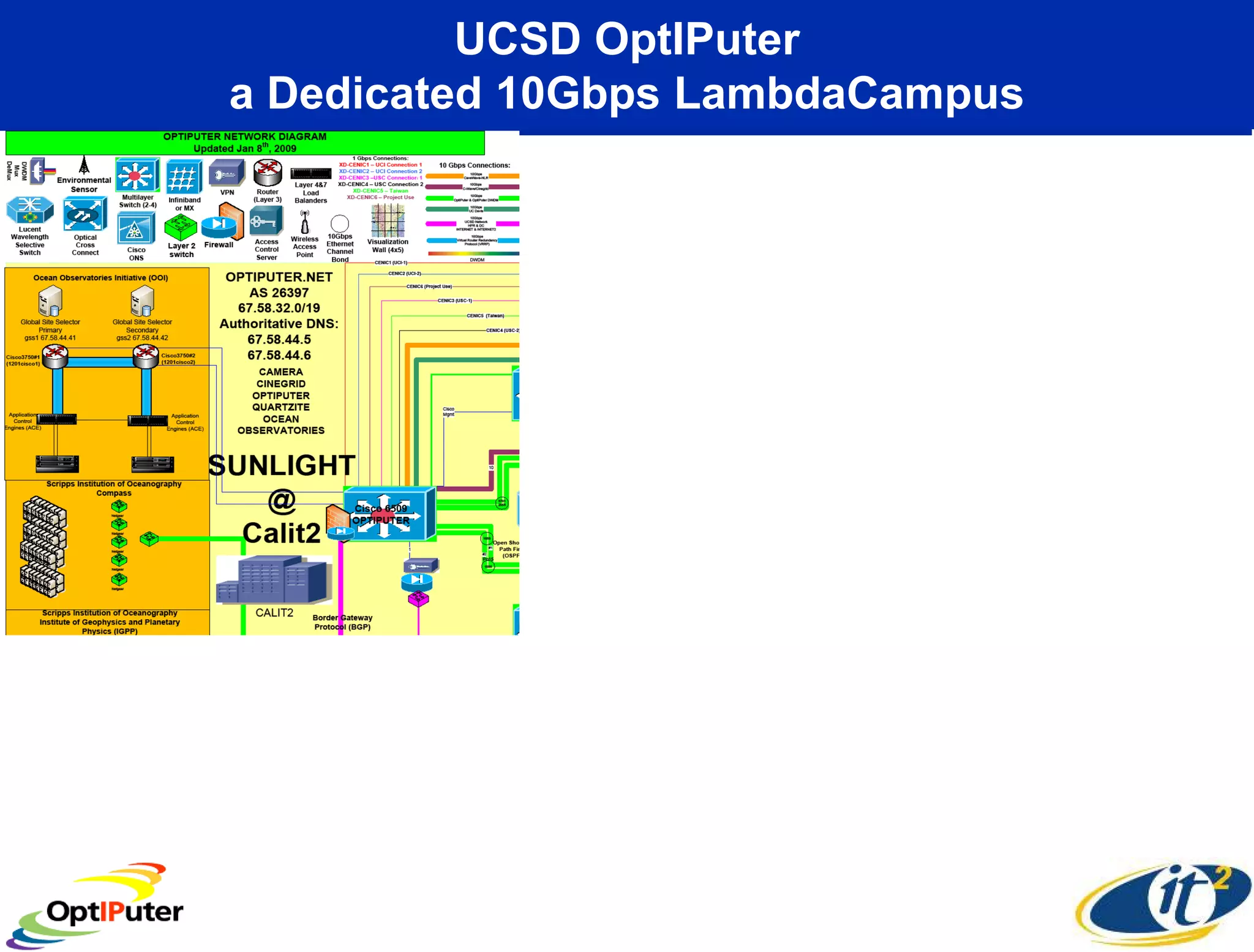
UCSD OptIPuter
a Dedicated 10Gbps LambdaCampus
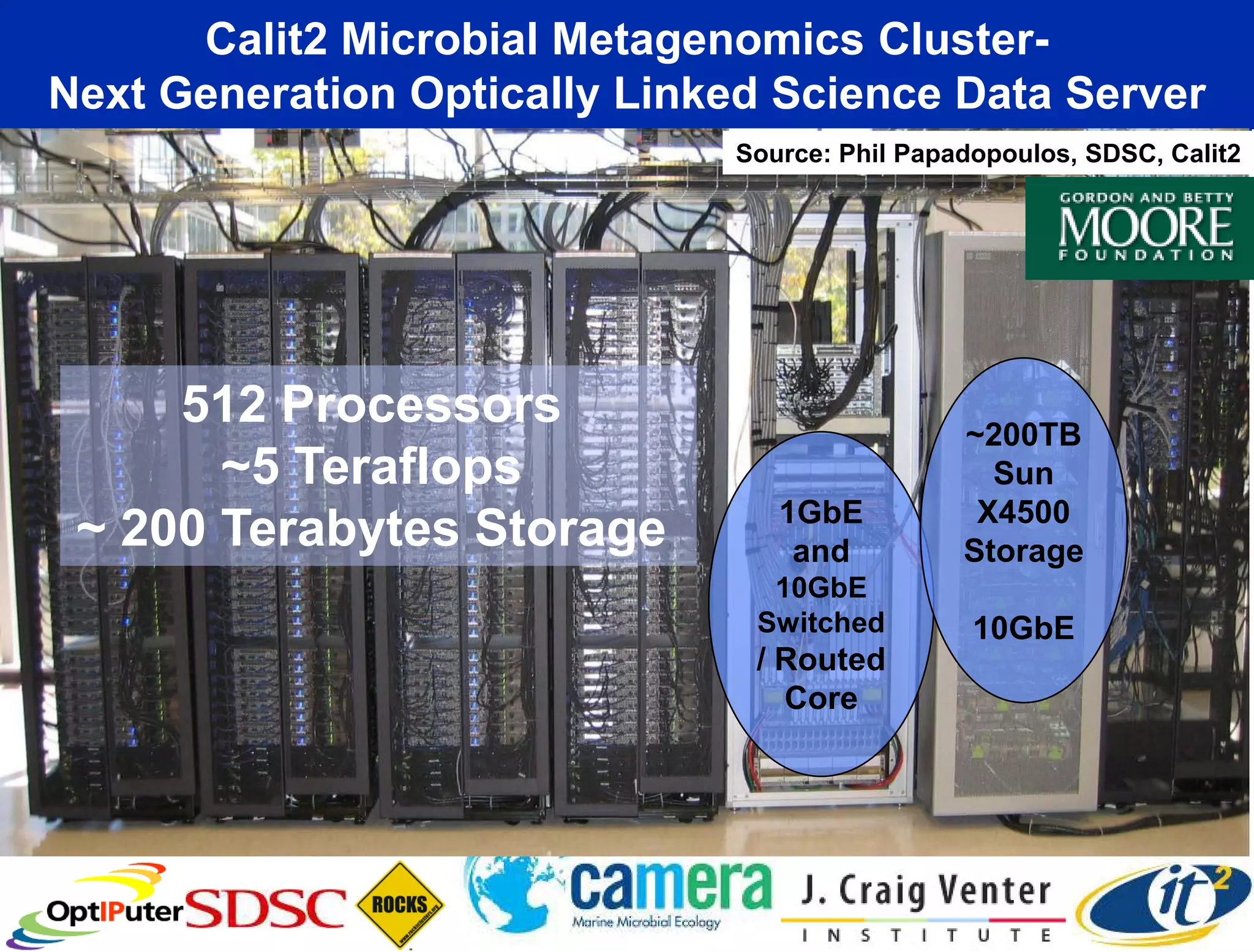
Calit2 Microbial Metagenomics Cluster-
Next Generation Optically Linked Science Data Server
                              Source: Phil Papadopoulos, SDSC, Calit2


     512 Processors                            ~200TB
       ~5 Teraflops                              Sun
                                 1GbE           X4500
 ~ 200 Terabytes Storage          and          Storage
                                10GbE
                               Switched         10GbE
                               / Routed
                                 Core
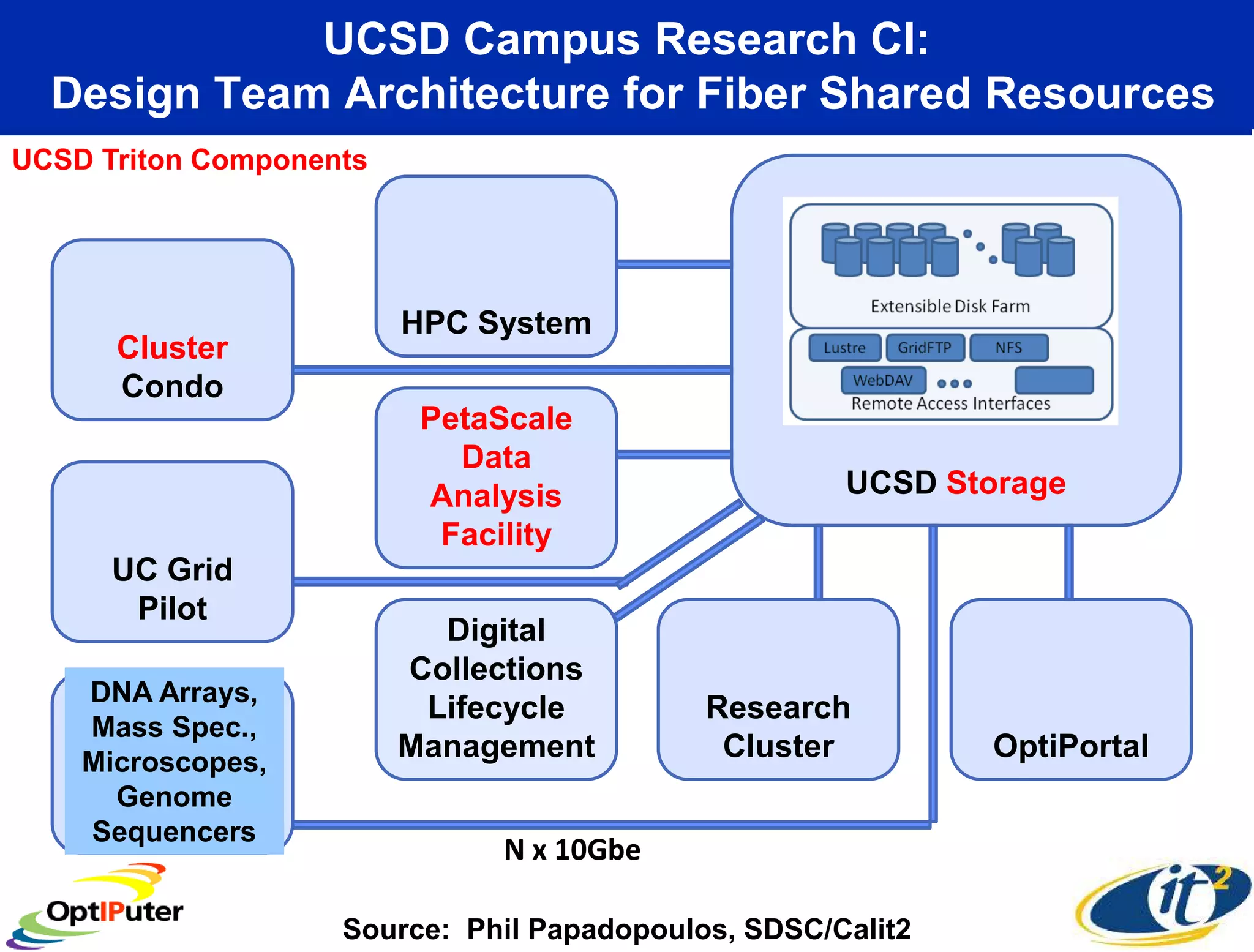
UCSD Campus Research CI:
  Design Team Architecture for Fiber Shared Resources
UCSD Triton Components


                         HPC System
      Cluster
      Condo
                          PetaScale
                            Data
                          Analysis                   UCSD Storage
                           Facility
      UC Grid
       Pilot
                           Digital
                         Collections
    DNA Arrays,
                          Lifecycle         Research
    Mass Spec.,
    Microscopes,
                         Management          Cluster         OptiPortal
     Research
      Genome
    Instrument
    Sequencers
                              N x 10Gbe

                    Source: Phil Papadopoulos, SDSC/Calit2
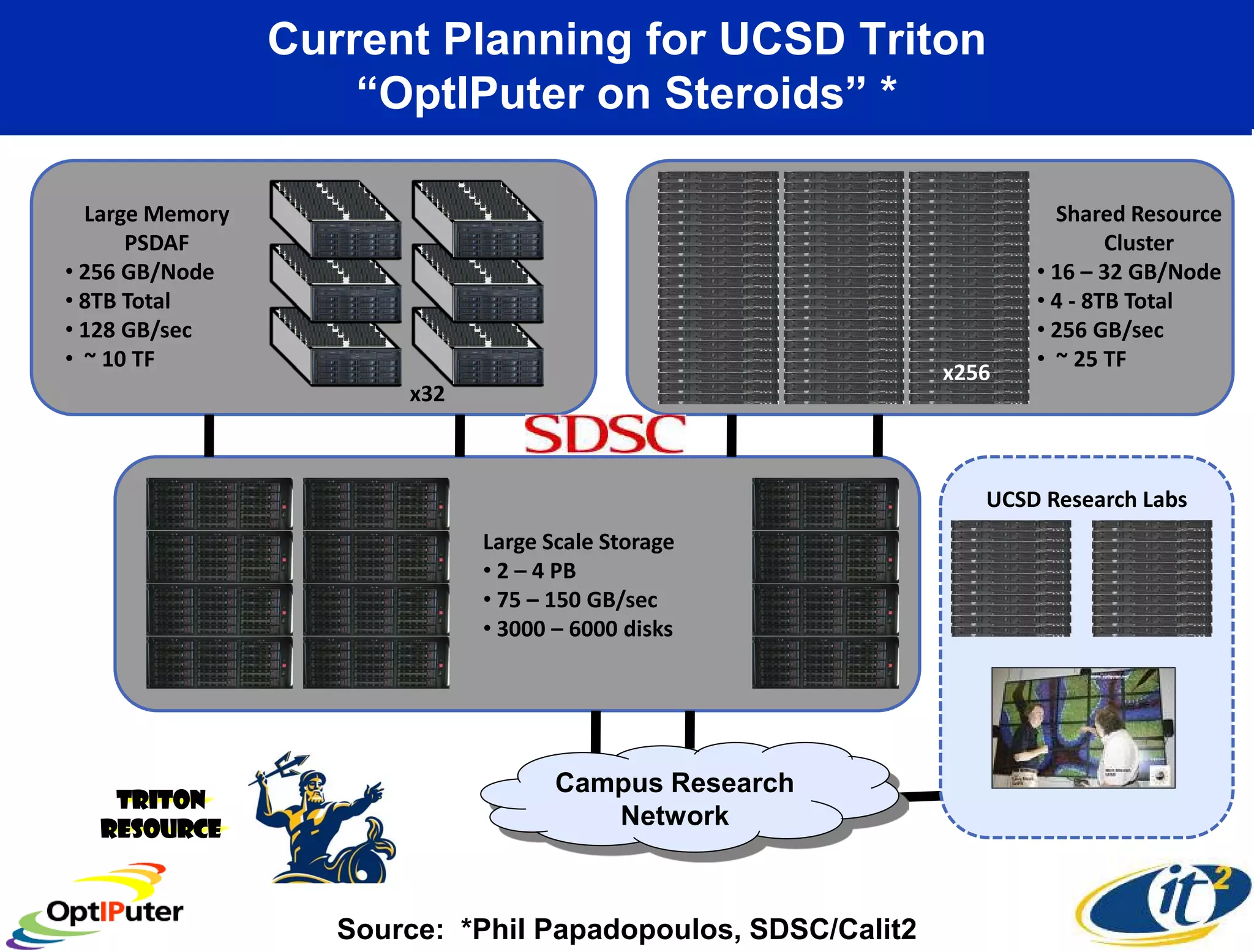
Current Planning for UCSD Triton
                     “OptIPuter on Steroids” *

  Large Memory                                                         Shared Resource
      PSDAF                                                                  Cluster
• 256 GB/Node                                                        • 16 – 32 GB/Node
• 8TB Total                                                          • 4 - 8TB Total
• 128 GB/sec                                                         • 256 GB/sec
• ~ 10 TF                                                            • ~ 25 TF
                                                              x256
                        x32


                                                                 UCSD Research Labs
                              Large Scale Storage
                              • 2 – 4 PB
                              • 75 – 150 GB/sec
                              • 3000 – 6000 disks


                                     Campus Research
    Triton
   Resource
                                        Network


                    Source: *Phil Papadopoulos, SDSC/Calit2
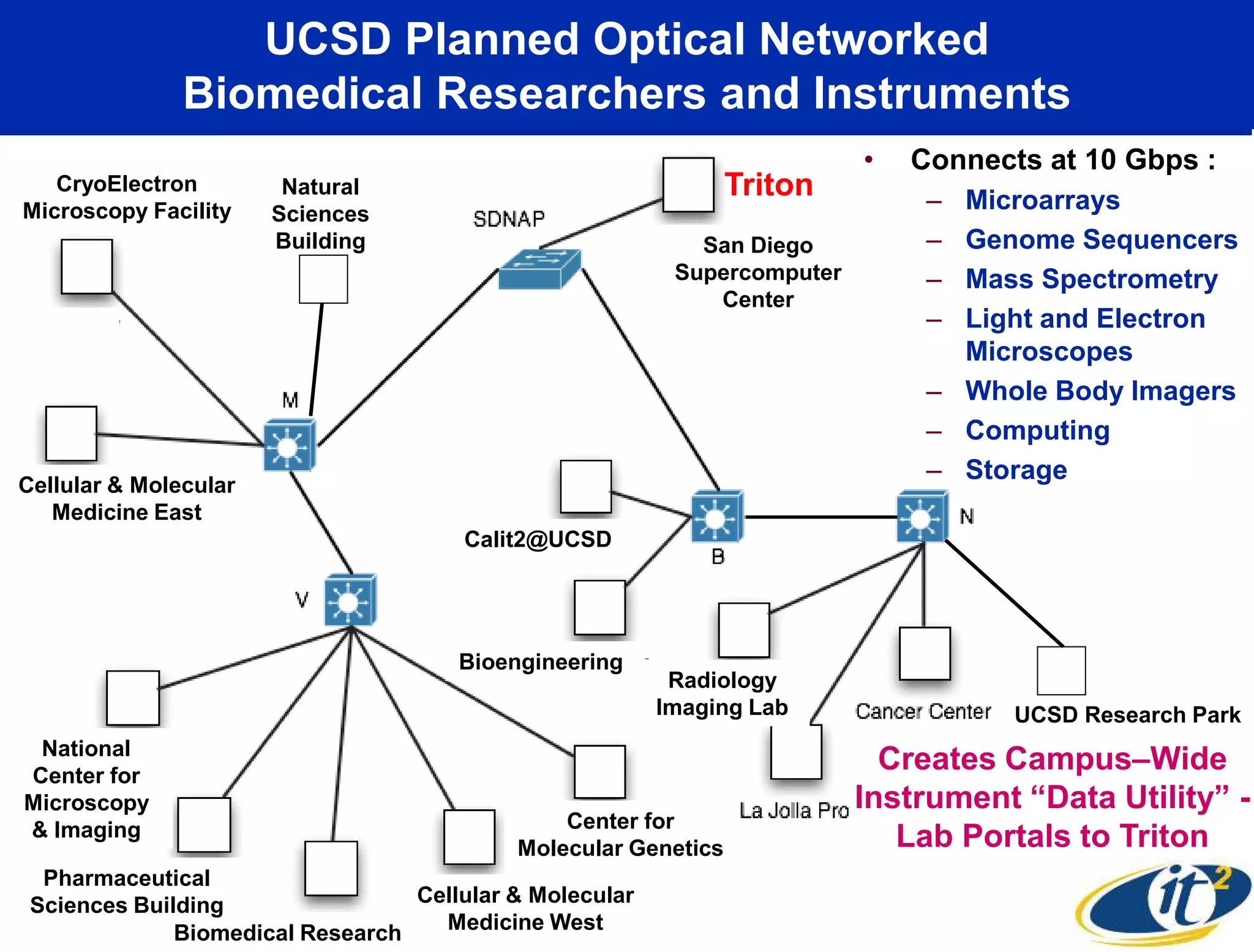
UCSD Planned Optical Networked
               Biomedical Researchers and Instruments
                                                                          •   Connects at 10 Gbps :
   CryoElectron         Natural                                 Triton         – Microarrays
Microscopy Facility    Sciences
                       Building                             San Diego          – Genome Sequencers
                                                          Supercomputer        – Mass Spectrometry
                                                             Center
                                                                               – Light and Electron
                                                                                 Microscopes
                                                                               – Whole Body Imagers
                                                                               – Computing
Cellular & Molecular
                                                                               – Storage
   Medicine East
                                       Calit2@UCSD


                                      Bioengineering
                                                          Radiology
                                                         Imaging Lab                 UCSD Research Park
 National
Center for
                                                                            Creates Campus–Wide
Microscopy                                                                Instrument “Data Utility” -
& Imaging                                      Center for
                                           Molecular Genetics                Lab Portals to Triton
  Pharmaceutical
 Sciences Building                Cellular & Molecular
              Biomedical Research   Medicine West
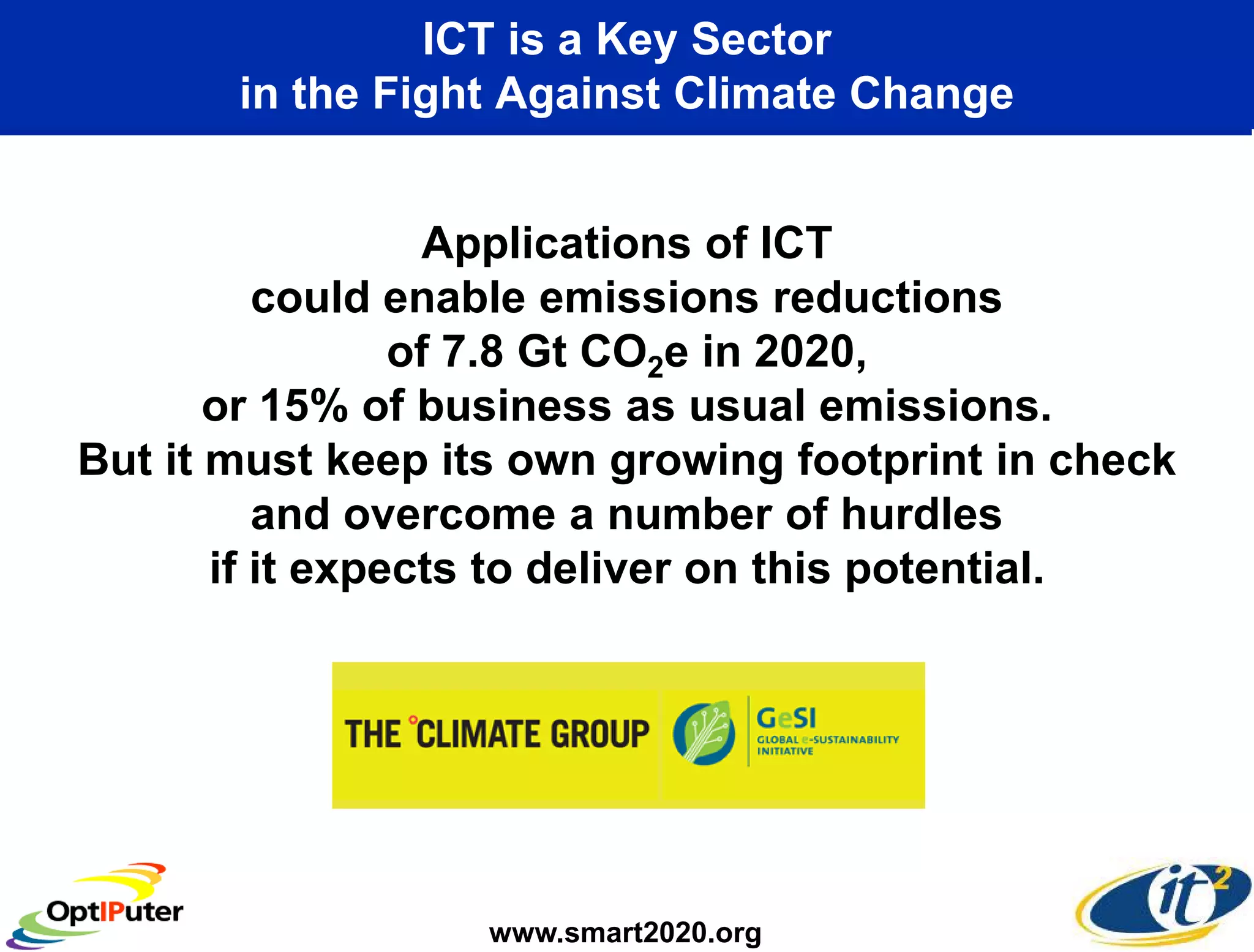
ICT is a Key Sector
       in the Fight Against Climate Change


                  Applications of ICT
          could enable emissions reductions
                 of 7.8 Gt CO2e in 2020,
       or 15% of business as usual emissions.
But it must keep its own growing footprint in check
          and overcome a number of hurdles
       if it expects to deliver on this potential.


                   www.smart2020.org
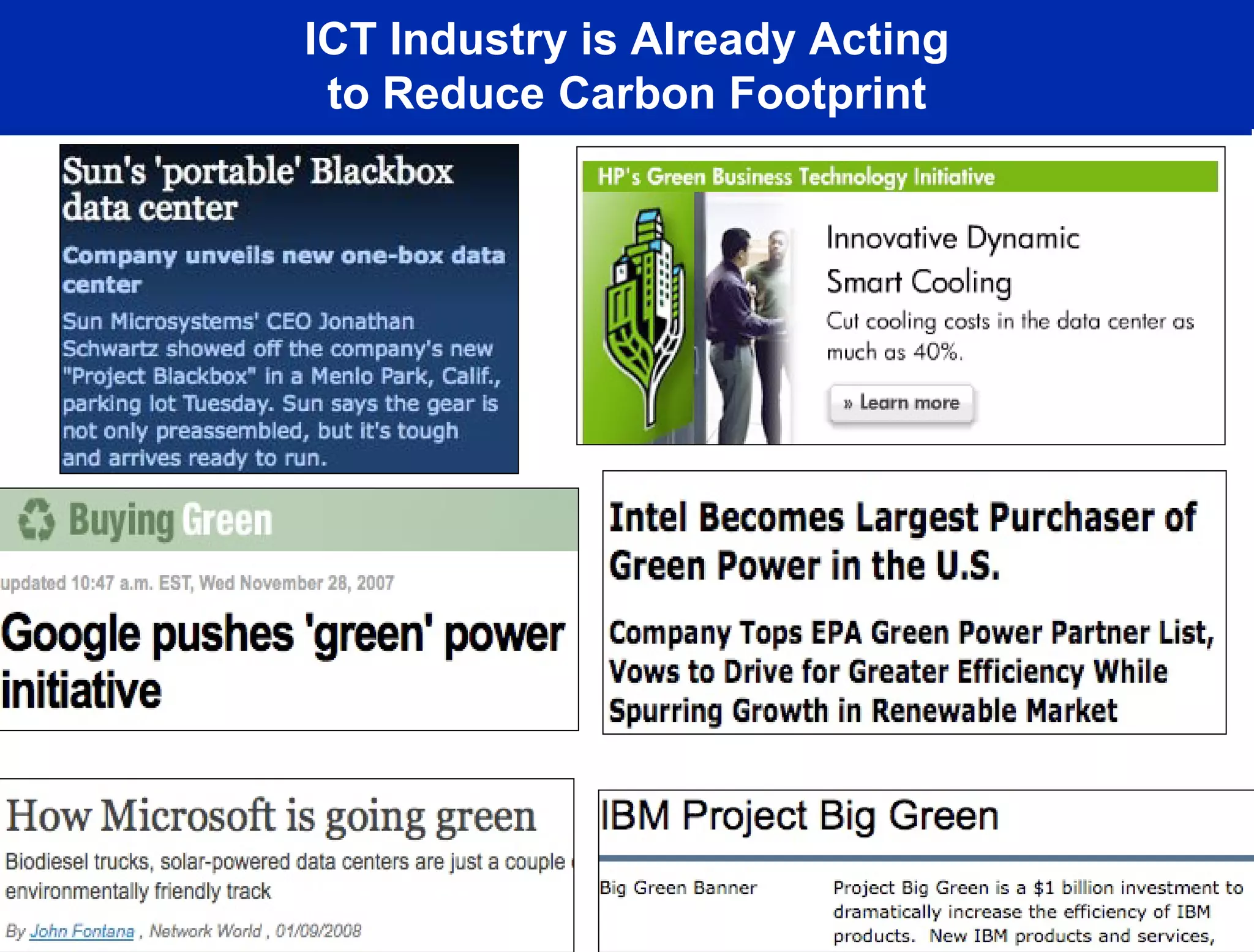
ICT Industry is Already Acting
 to Reduce Carbon Footprint
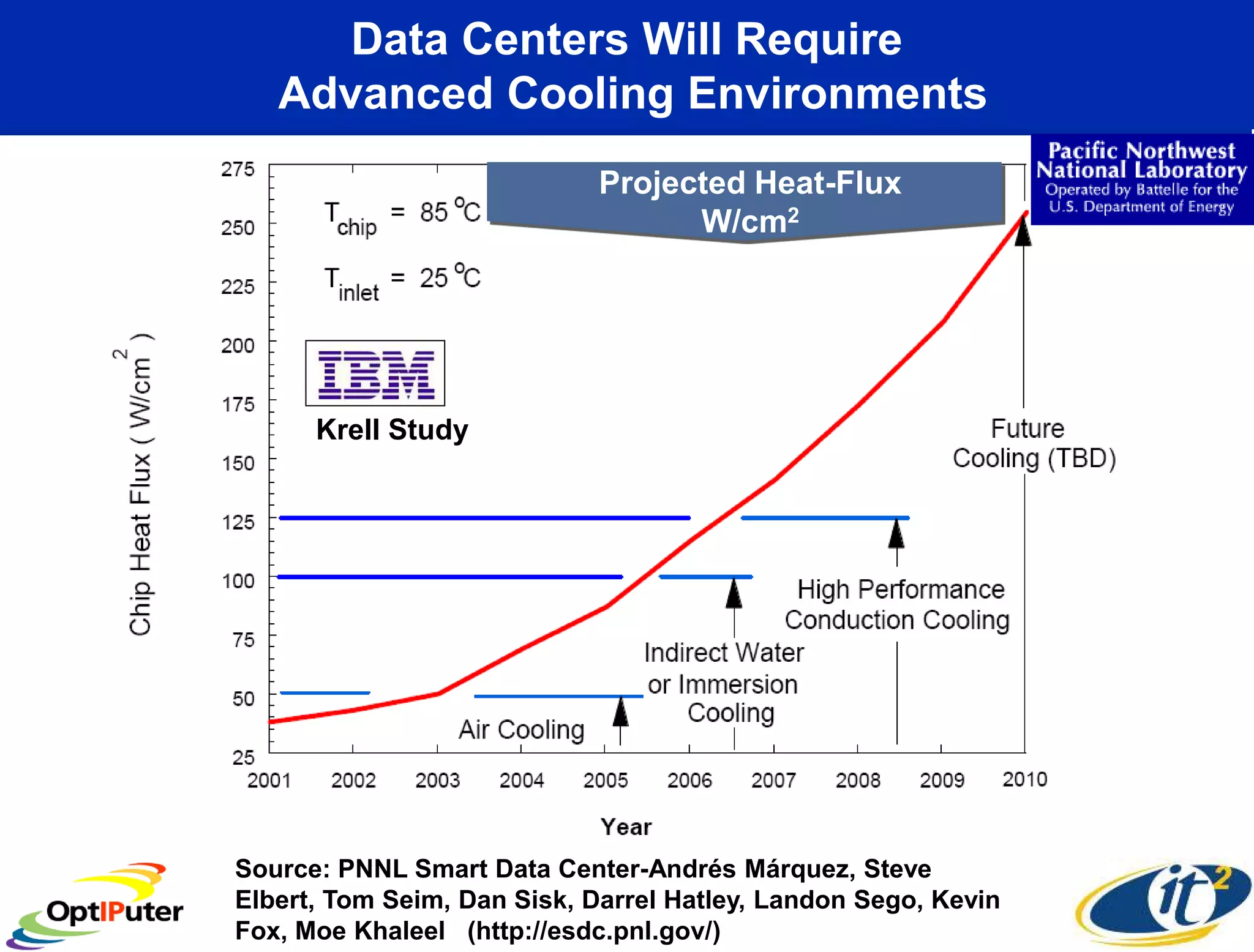
Data Centers Will Require
   Advanced Cooling Environments
                            Projected Heat-Flux
                                  W/cm2


      Krell Study


Source: PNNL Smart Data Center-Andrés Márquez, Steve
Elbert, Tom Seim, Dan Sisk, Darrel Hatley, Landon Sego, Kevin
Fox, Moe Khaleel (http://esdc.pnl.gov/)
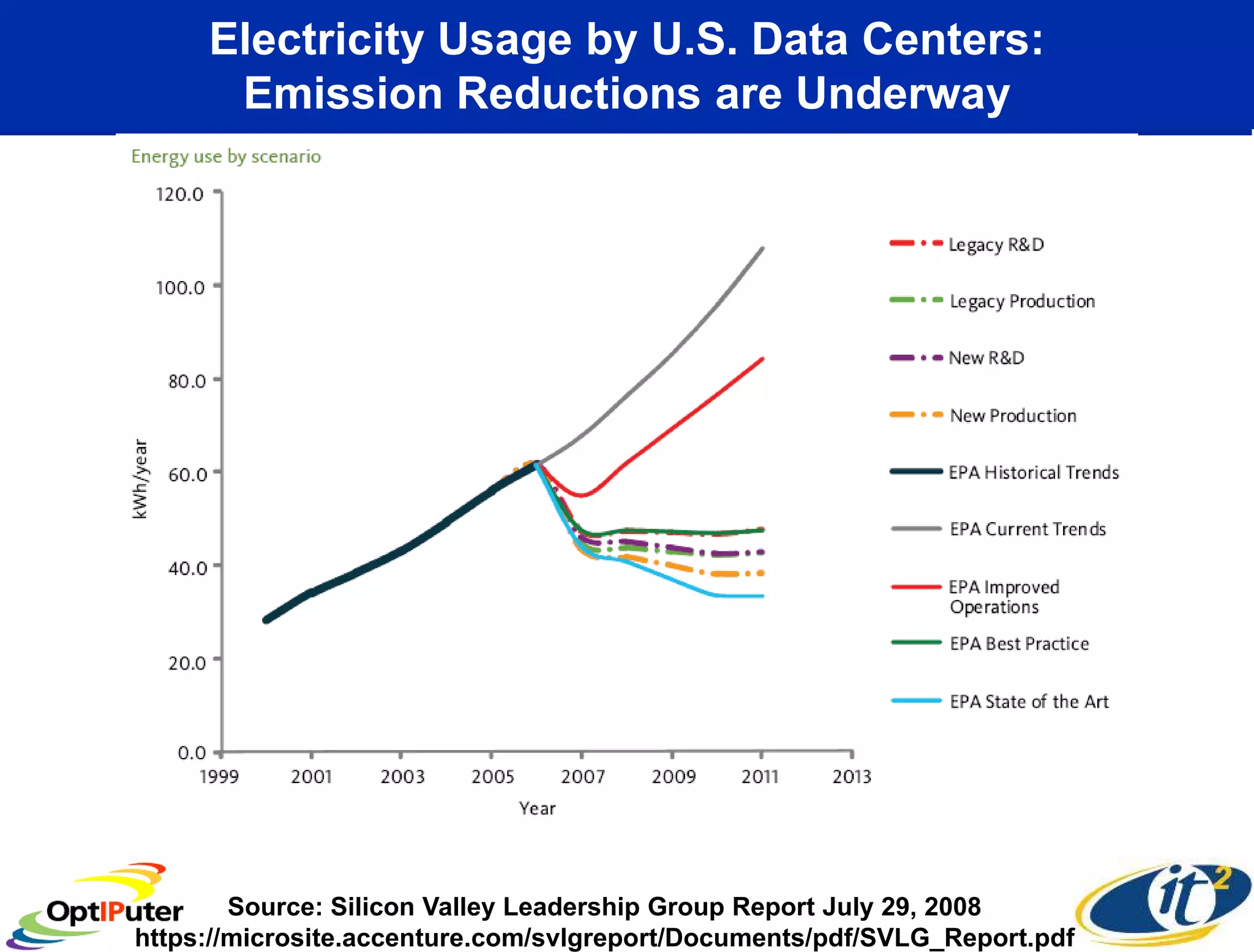
Electricity Usage by U.S. Data Centers:
      Emission Reductions are Underway


        Source: Silicon Valley Leadership Group Report July 29, 2008
https://microsite.accenture.com/svlgreport/Documents/pdf/SVLG_Report.pdf
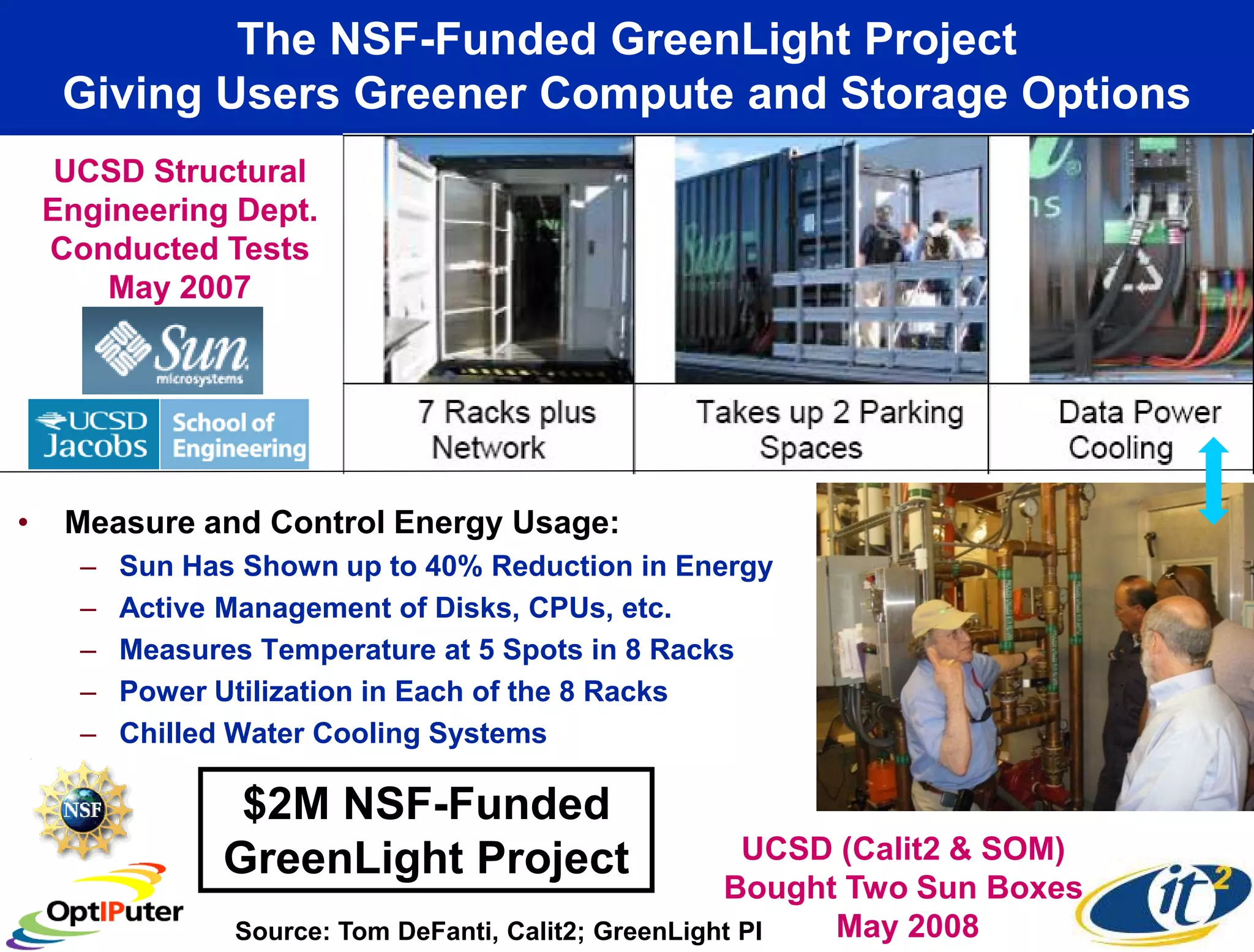
The NSF-Funded GreenLight Project
     Giving Users Greener Compute and Storage Options
     UCSD Structural
    Engineering Dept.
    Conducted Tests
        May 2007


•    Measure and Control Energy Usage:
      –   Sun Has Shown up to 40% Reduction in Energy
      –   Active Management of Disks, CPUs, etc.
      –   Measures Temperature at 5 Spots in 8 Racks
      –   Power Utilization in Each of the 8 Racks
      –   Chilled Water Cooling Systems

                 $2M NSF-Funded
                GreenLight Project                       UCSD (Calit2 & SOM)
                                                       Bought Two Sun Boxes
                 Source: Tom DeFanti, Calit2; GreenLight PI  May 2008
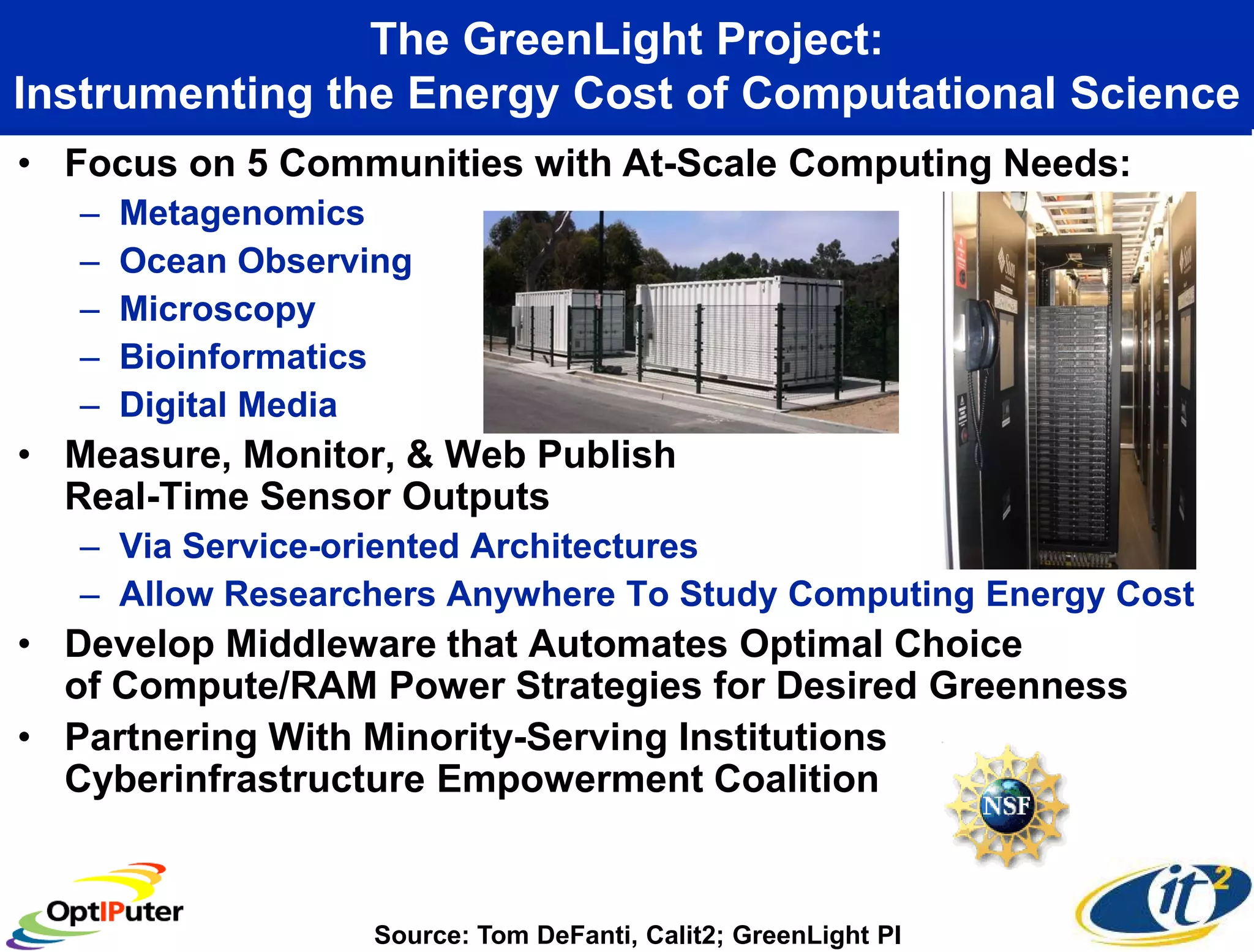
The GreenLight Project:
Instrumenting the Energy Cost of Computational Science
• Focus on 5 Communities with At-Scale Computing Needs:
   –   Metagenomics
   –   Ocean Observing
   –   Microscopy
   –   Bioinformatics
   –   Digital Media
• Measure, Monitor, & Web Publish
  Real-Time Sensor Outputs
   – Via Service-oriented Architectures
   – Allow Researchers Anywhere To Study Computing Energy Cost
• Develop Middleware that Automates Optimal Choice
  of Compute/RAM Power Strategies for Desired Greenness
• Partnering With Minority-Serving Institutions
  Cyberinfrastructure Empowerment Coalition


                    Source: Tom DeFanti, Calit2; GreenLight PI
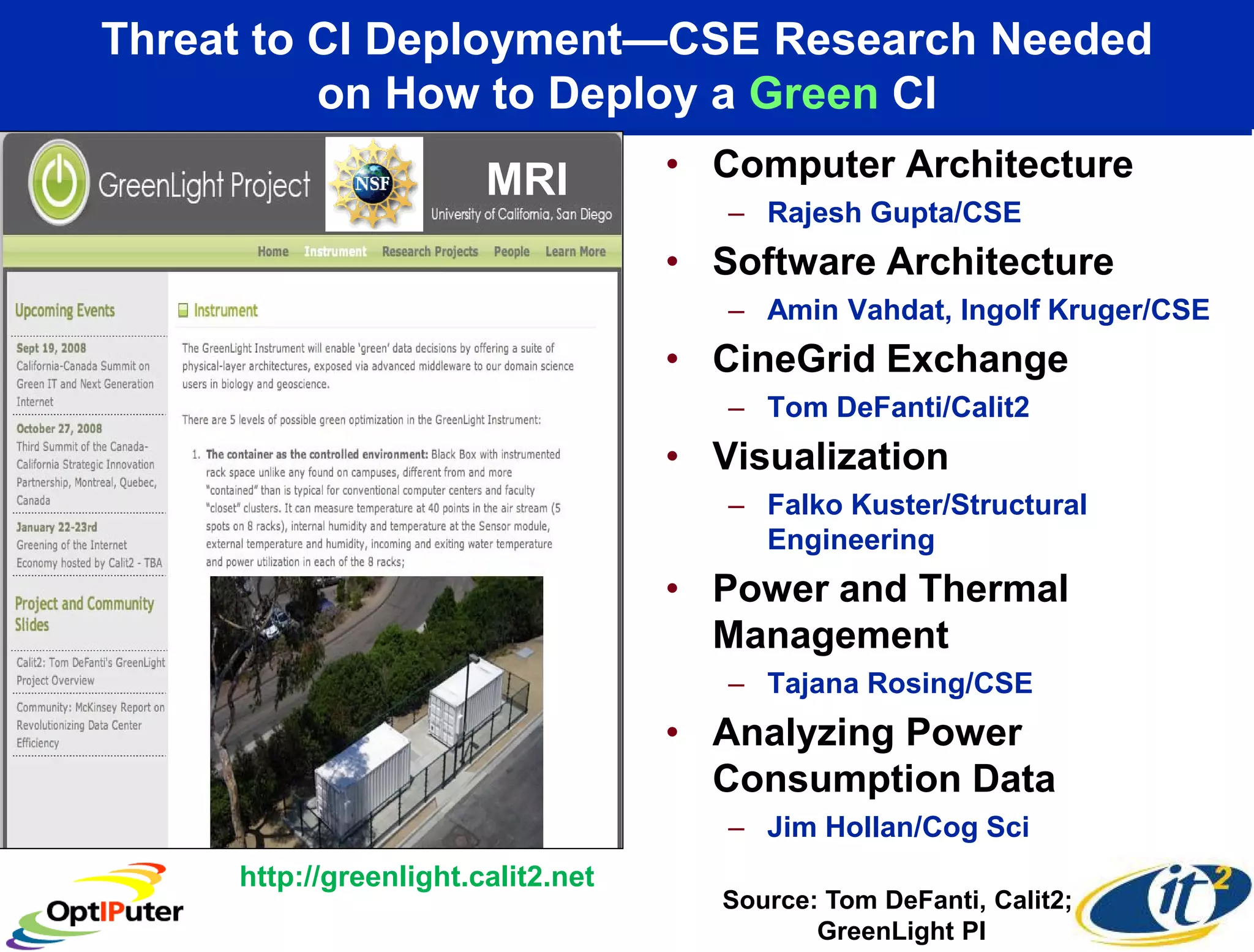
Threat to CI Deployment—CSE Research Needed
          on How to Deploy a Green CI
                        MRI         • Computer Architecture
                                       – Rajesh Gupta/CSE
                                    • Software Architecture
                                       – Amin Vahdat, Ingolf Kruger/CSE
                                    • CineGrid Exchange
                                       – Tom DeFanti/Calit2
                                    • Visualization
                                       – Falko Kuster/Structural
                                         Engineering
                                    • Power and Thermal
                                      Management
                                       – Tajana Rosing/CSE
                                    • Analyzing Power
                                      Consumption Data
                                       – Jim Hollan/Cog Sci
     http://greenlight.calit2.net
                                       Source: Tom DeFanti, Calit2;
                                              GreenLight PI
Improve Mass Spectrometry’s Green Efficiency
  By Matching Algorithms to Specialized Processors
• Inspect Implements the Very Computationally Intense
  MS-Alignment Algorithm for Discovery of
  Unanticipated Rare or Uncharacterized Post-
  Translational Modifications
• Solution: Hardware Acceleration with a FPGA-Based
  Co-Processor
  – Identification and Characterization of Key Kernel for
    MS-Alignment Algorithm
  – Hardware Implementation of Kernel on Novel FPGA-based
    Co-Processor (Convey Architecture)
• Results:
  – 300x Speedup & Increased Computational Efficiency
                  Large Savings in
             Energy Per Application Task
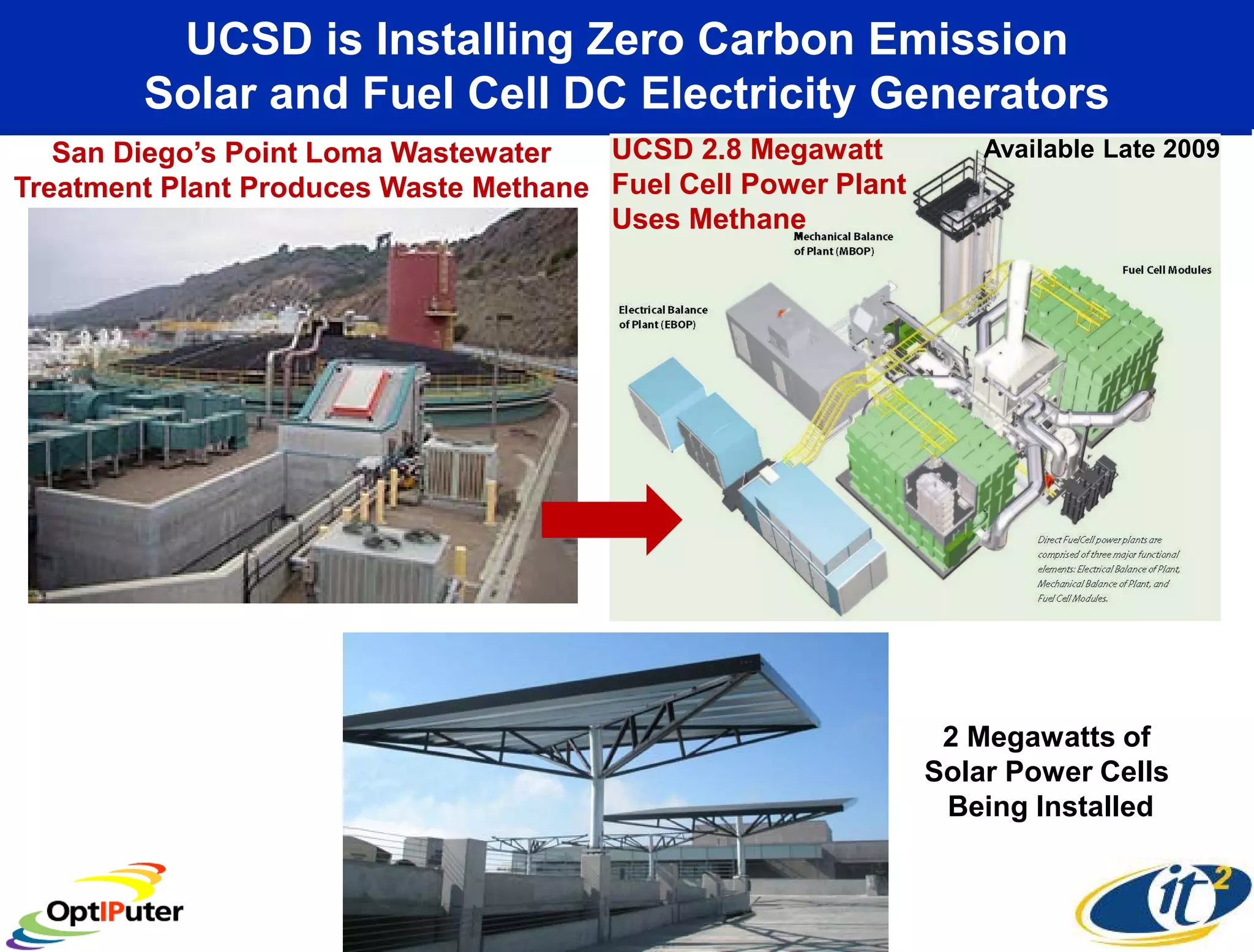
UCSD is Installing Zero Carbon Emission
        Solar and Fuel Cell DC Electricity Generators
   San Diego’s Point Loma Wastewater   UCSD 2.8 Megawatt           Available Late 2009
Treatment Plant Produces Waste Methane Fuel Cell Power Plant
                                       Uses Methane


                                                                2 Megawatts of
                                                               Solar Power Cells
                                                                Being Installed
Zero Carbon GreenLight Experiment:
            DC-Powered Modular Data Center
• Concept—Avoid DC to AC to DC Conversion Losses
  –   Computers Use DC Power Internally
  –   Solar and Fuel Cells Produce DC      Sun Box <200kWatt
  –   Both Plug into the AC Power Grid
  –   Can We Use DC Directly (With or Without the AC Grid)?
• DC Generation Can Be Intermittent
  – Depends on Source
     – Solar, Wind, Fuel Cell, Hydro
  – Can Use Sensors to Shut Down or Sleep Computers
  – Can Use Virtualization to Halt/Shift Jobs
• Experiment Planning Just Starting
  – Collaboration with Sun and LBNL
  – NSF GreenLight Year 2 and Year 3 Funds

                  Source: Tom DeFanti, Calit2; GreenLight PI
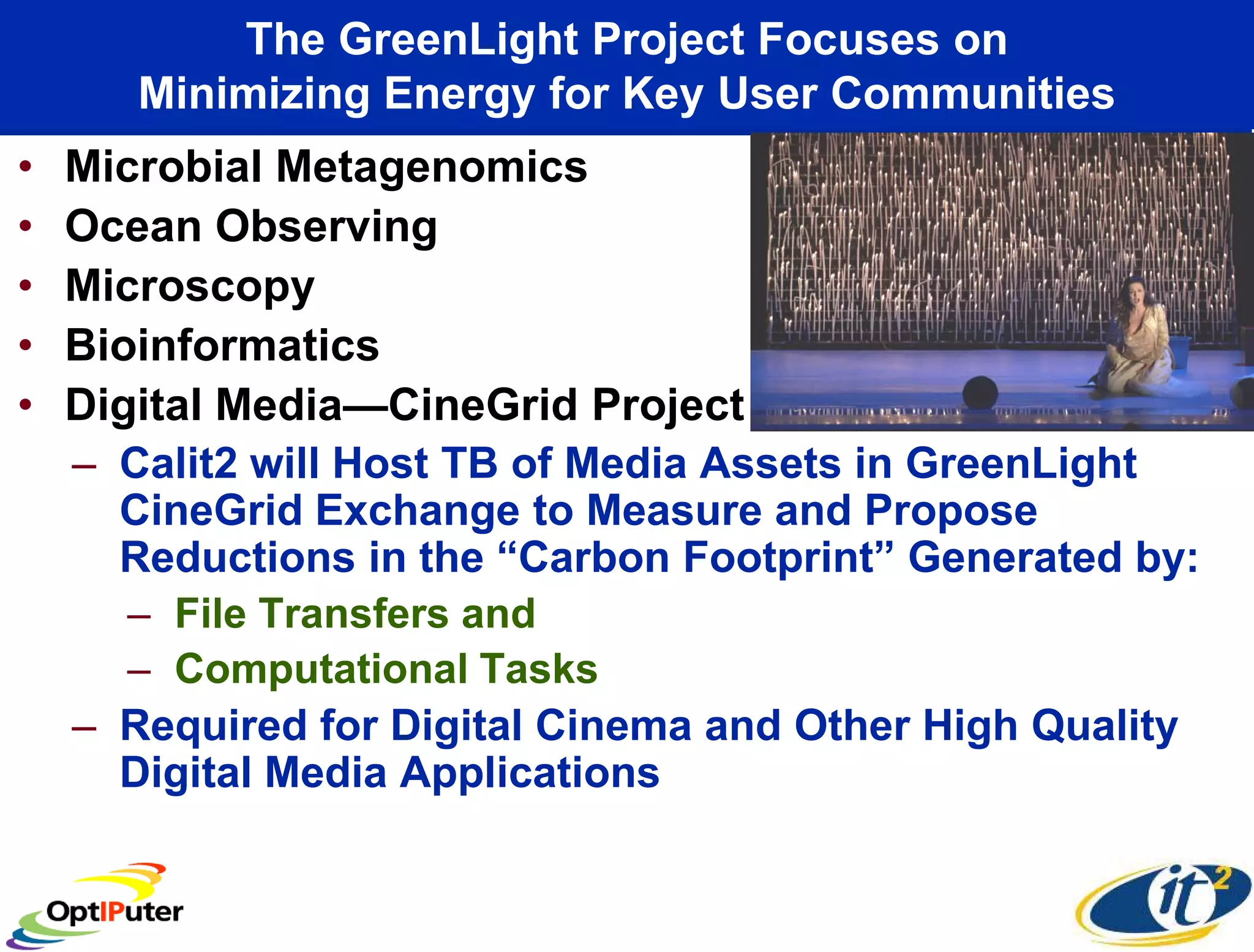
The GreenLight Project Focuses on
       Minimizing Energy for Key User Communities
•   Microbial Metagenomics
•   Ocean Observing
•   Microscopy
•   Bioinformatics
•   Digital Media—CineGrid Project
    – Calit2 will Host TB of Media Assets in GreenLight
      CineGrid Exchange to Measure and Propose
      Reductions in the “Carbon Footprint” Generated by:
      – File Transfers and
      – Computational Tasks
    – Required for Digital Cinema and Other High Quality
      Digital Media Applications
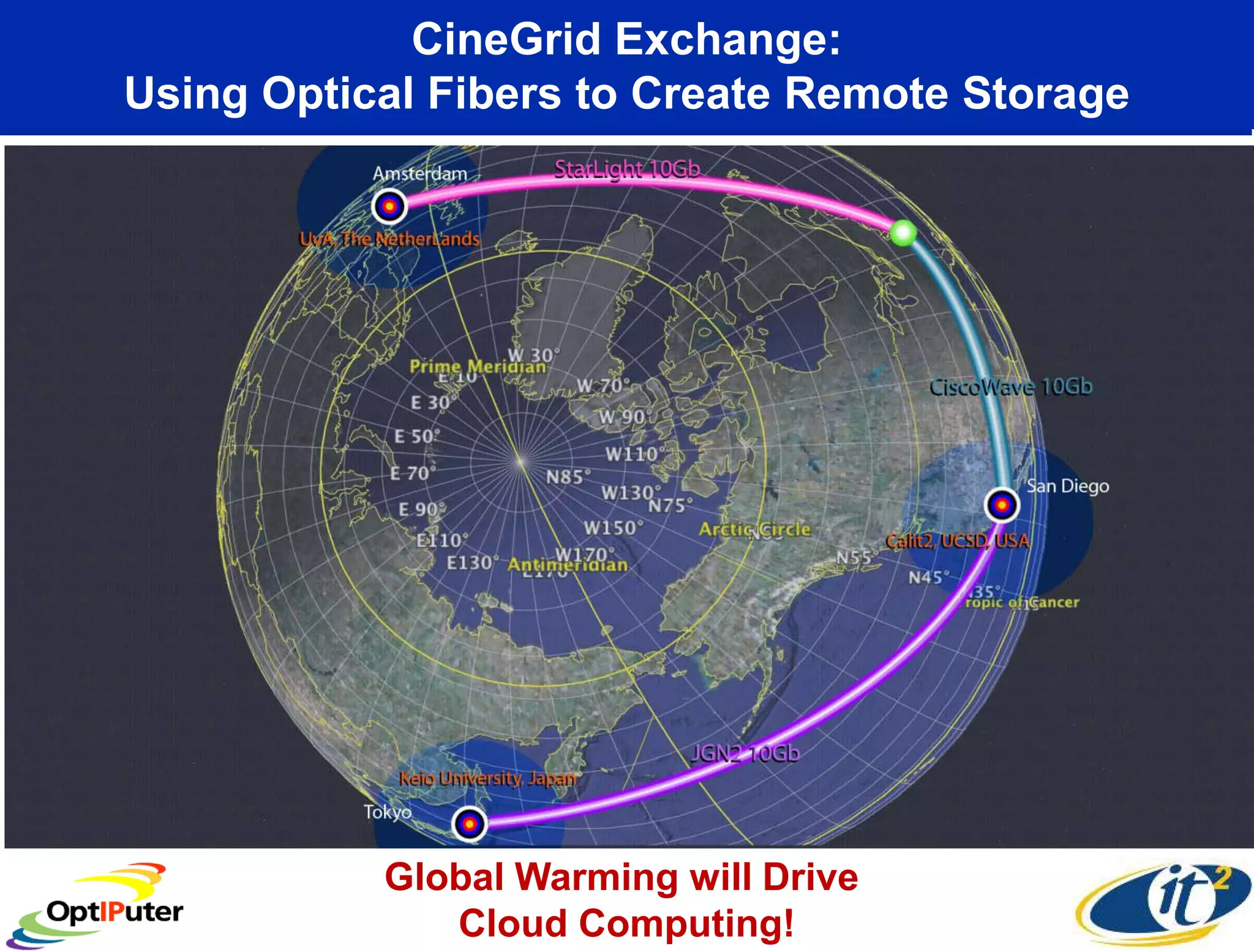
CineGrid Exchange:
Using Optical Fibers to Create Remote Storage


           Global Warming will Drive
              Cloud Computing!
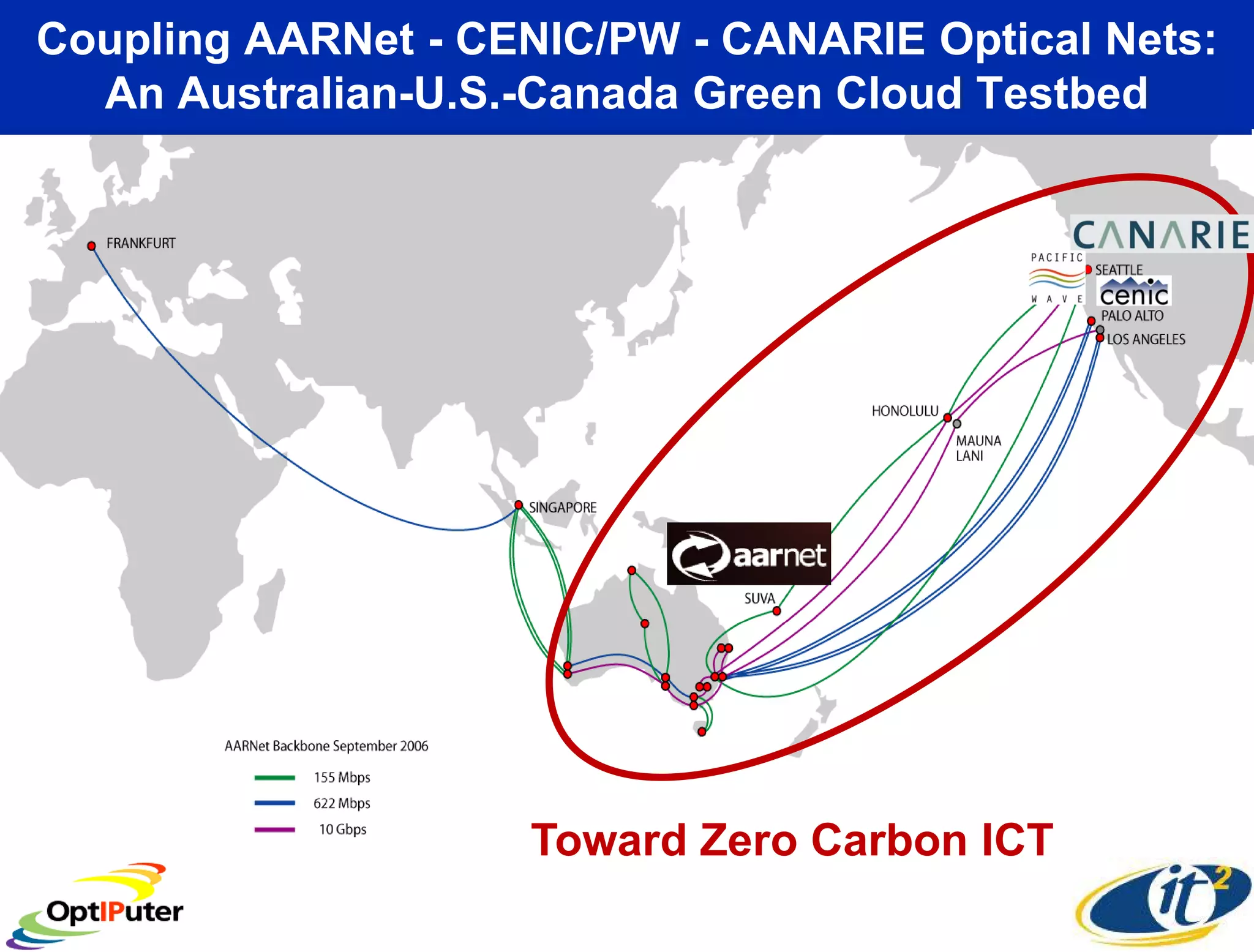
Coupling AARNet - CENIC/PW - CANARIE Optical Nets:
  An Australian-U.S.-Canada Green Cloud Testbed


                    Toward Zero Carbon ICT
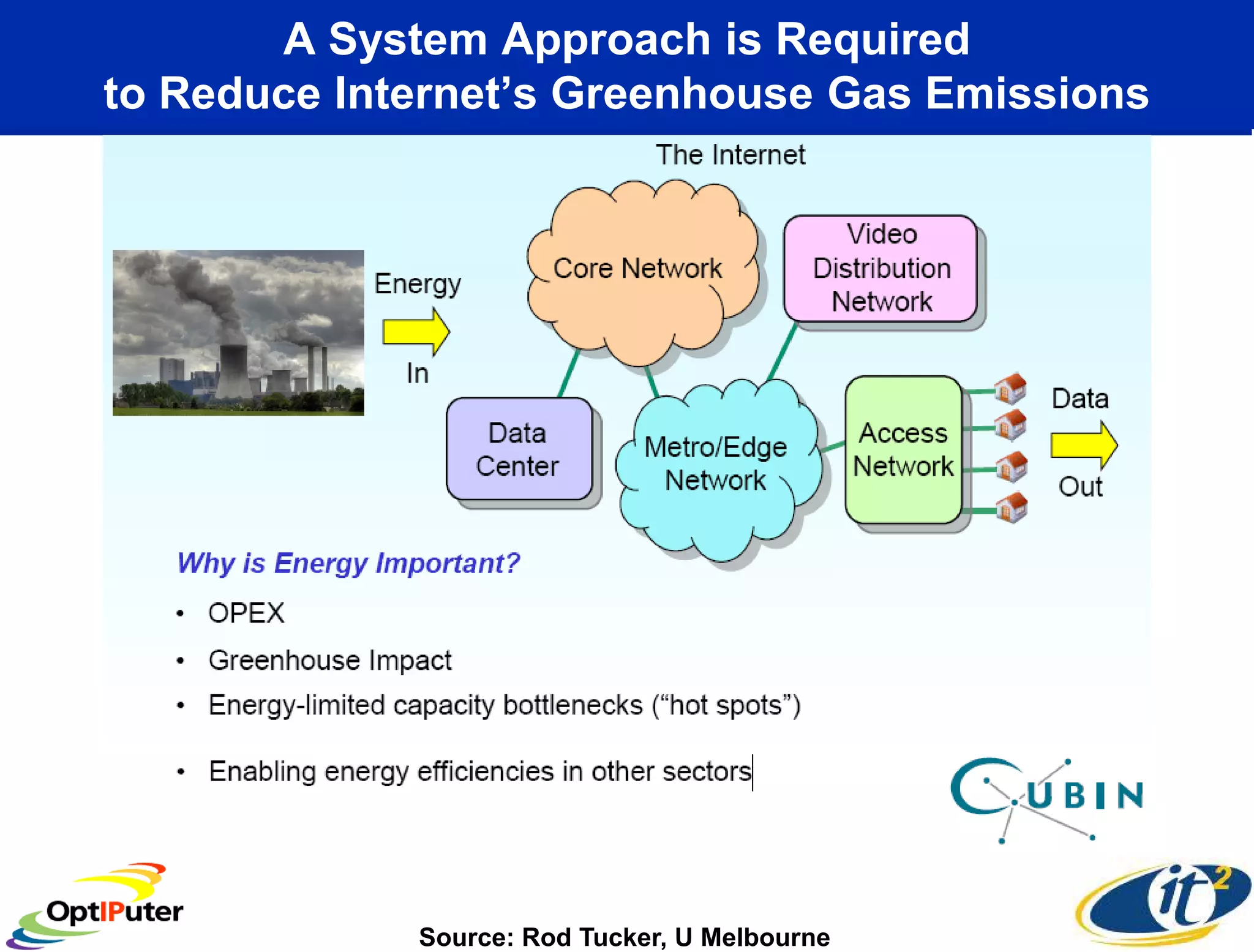
A System Approach is Required
to Reduce Internet’s Greenhouse Gas Emissions


             Source: Rod Tucker, U Melbourne
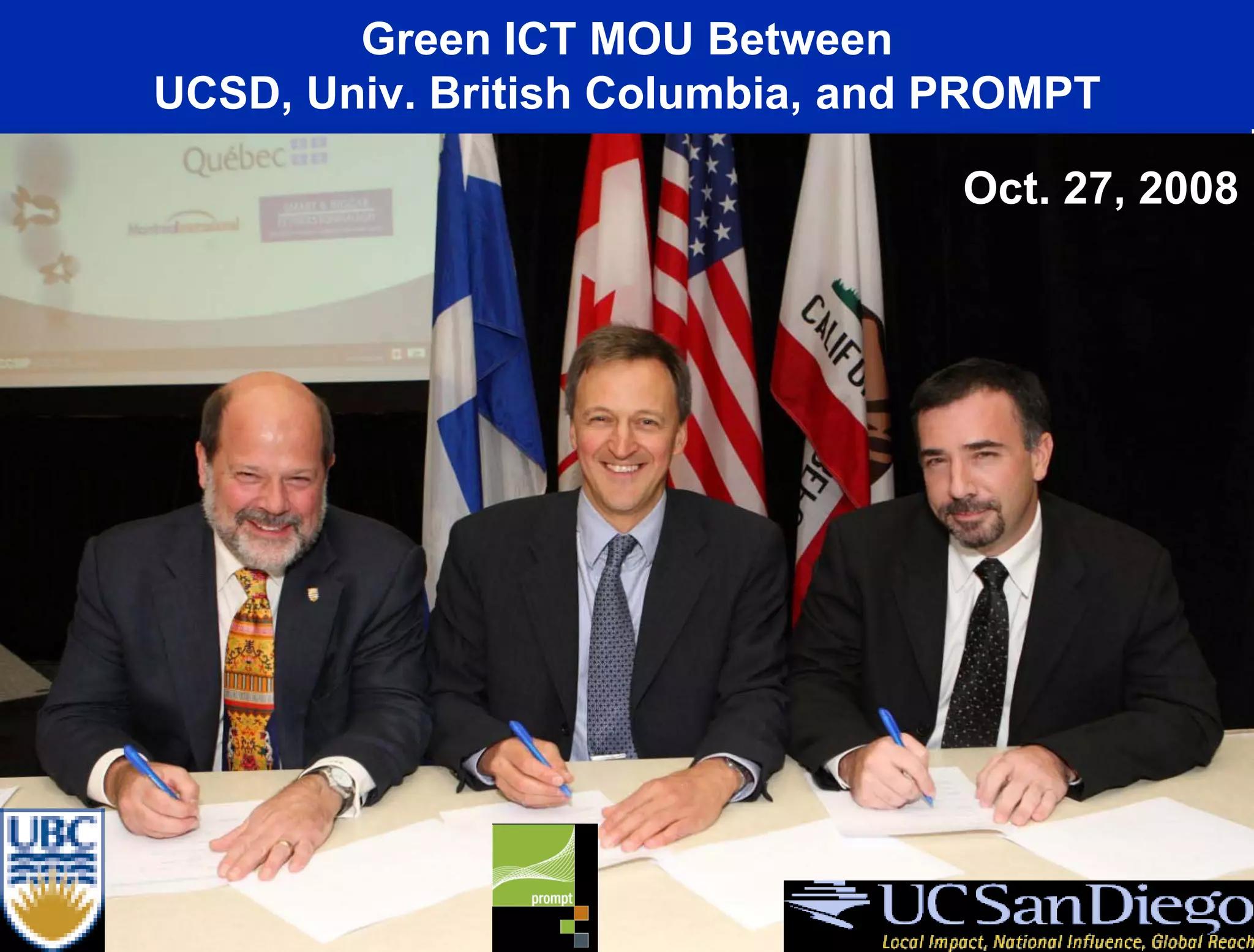
Green ICT MOU Between
      UCSD, Univ. British Columbia, and PROMPT
• Agree to Develop Methods to Share Greenhouse Gas (GHG)
                                                Oct. 27, 2008
  Emission Data in Connection with ISO Standards For ICT
  Equipment (ISO 14062) and Baseline Emission Data for
  Cyberinfrastructure and Networks (ISO 14064)
• Work With R&E Networks to Explore Methodologies and
  Architectures to Decrease GHG Emissions Including Options
  such as Relocation of Resources to Renewable Energy Sites,
  Virtualization, Etc.
• MOU Open for Additional Partners

       Canada-California Strategic Innovation Partnership (CCSIP)
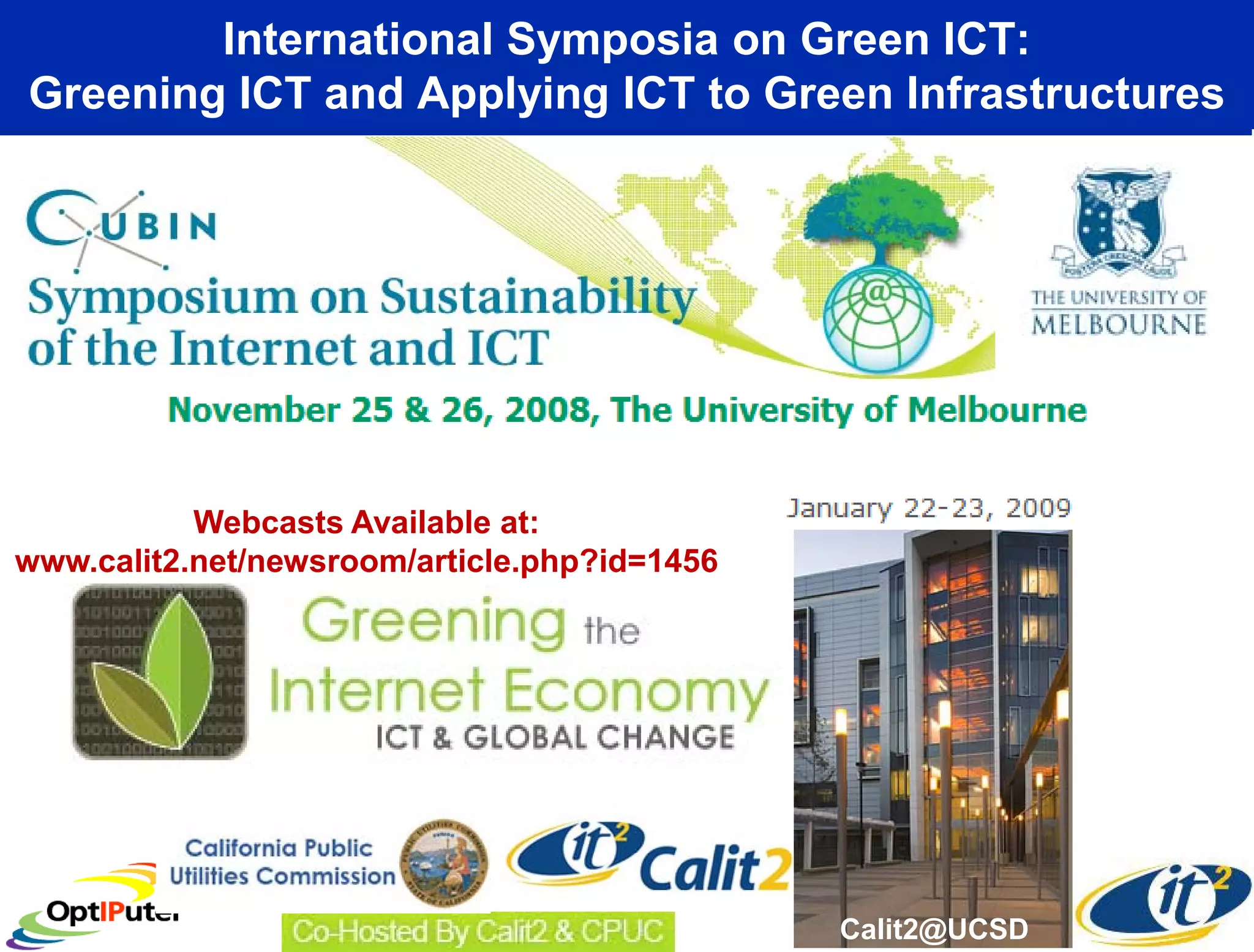
International Symposia on Green ICT:
Greening ICT and Applying ICT to Green Infrastructures


           Webcasts Available at:
www.calit2.net/newsroom/article.php?id=1456


                                              Calit2@UCSD
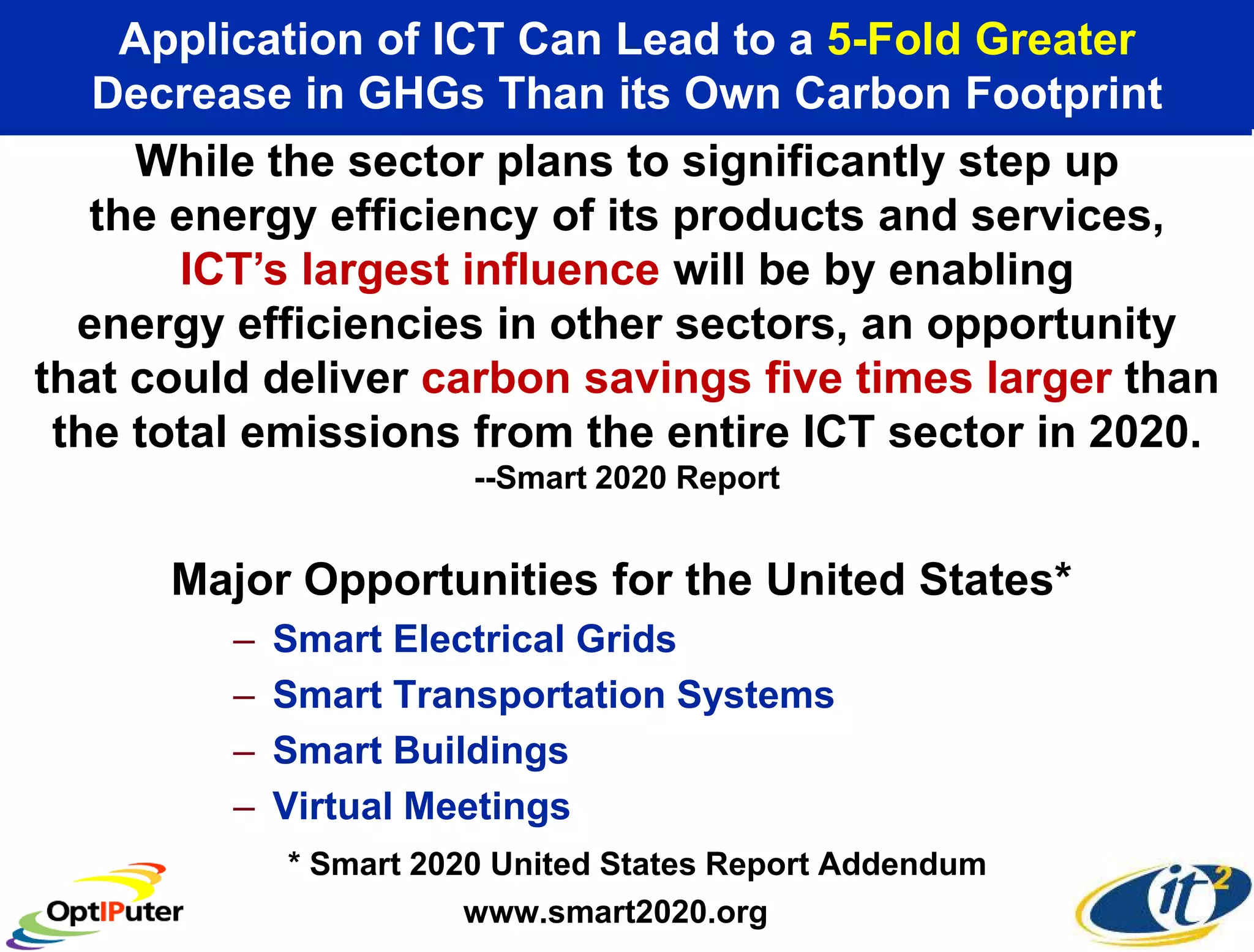
Application of ICT Can Lead to a 5-Fold Greater
   Decrease in GHGs Than its Own Carbon Footprint
      While the sector plans to significantly step up
   the energy efficiency of its products and services,
       ICT’s largest influence will be by enabling
  energy efficiencies in other sectors, an opportunity
that could deliver carbon savings five times larger than
 the total emissions from the entire ICT sector in 2020.
                        --Smart 2020 Report


      Major Opportunities for the United States*
         –   Smart Electrical Grids
         –   Smart Transportation Systems
         –   Smart Buildings
         –   Virtual Meetings
             * Smart 2020 United States Report Addendum
                        www.smart2020.org
Next Stage: Developing Greener Smart Campuses
            Calit2 (UCSD & UCI) Prototypes
• Coupling the Internet and the Electrical Grid
   – Multiple Time Varying Sources--GHG Emitting + Renewable
   – Measuring Demand at Sub-Building Levels
   – Make Local Energy Usage Explicit Over Web
• Transportation System
   – Campus Wireless GPS Fleet with Renewable Fuels
   – Freeway-Scale Measurements
   – Driver Level Cell Phone Traffic Awareness
• Travel Substitution
   – Commercial Teleconferencing
   – Next Generation Global Telepresence
       Student Video -- UCSD Living Laboratory for Real-World Solutions
          www.gogreentube.com/watch.php?v=NDc4OTQ1 on UCSD

            UCI Named ‘Best Overall' in Flex Your Power Awards
            www.today.uci.edu/news/release detail.asp?key=1859

Restructuring Campus CI -- UCSD-A LambdaCampus Research CI and the Quest for Zero Carbon ICT

  • 1.
    Restructuring Campus CI-- UCSD-A LambdaCampus Research CI and the Quest for Zero Carbon ICT Invited Presentation to the Net@EDU Campus Cyberinfrastructure Working Group Tempe, AZ February 3, 2009 Dr. Larry Smarr Director, California Institute for Telecommunications and Information Technology Harry E. Gruber Professor, Dept. of Computer Science and Engineering Jacobs School of Engineering, UCSD
  • 2.
    The OptIPuter Createsan Planetary Scale CI: Enabling Collaborative Data-Intensive e-Research www.evl.uic.edu/cavern/sage “OptIPlanet: The OptIPuter Global Collaboratory” – Special Section of Future Generations 50 OptIPortals Worldwide -- Computer Systems, Volume 25, Issue 2, Campus CI Now the Bottleneck February 2009 Calit2 (UCSD, UCI), SDSC, and UIC Leads—Larry Smarr PI Univ. Partners: NCSA, USC, SDSU, NW, TA&M, UvA, SARA, KISTI, AIST Industry: IBM, Sun, Telcordia, Chiaro, Calient, Glimmerglass, Lucent
  • 3.
    Creating a CaliforniaCyberinfrastructure of OptIPuter “On-Ramps” to NLR, I2DC, & TeraGrid UC Davis UC Berkeley UC San Francisco UC Merced UC Santa Cruz Creating a Critical Mass of OptIPuter End Users on a Secure LambdaGrid UC Los Angeles UC Santa Barbara UC Riverside UC Irvine CENIC Workshop at Calit2 UC San Diego Sept 15-16, 2008
  • 4.
    CENIC’s New “HybridNetwork” - Traditional Routed IP and the New Switched Ethernet and Optical Services ~ $14M Invested in Upgrade Now Campuses Need to Upgrade Source: Jim Dolgonas, CENIC
  • 5.
    The “Golden Spike”UCSD Experimental Optical Core: Ready to Couple Users to CENIC L1, L2, L3 Services Quartzite Communications To 10GigE cluster Goals by 2008: Core Year 3 node interfaces >= 60 endpoints at 10 GigE CENIC L1, L2 >= 30 Packet switched Wavelength Quartzite Selective Services Corewavelengths ..... Switch >= 30 Switched >= 400 Connected endpoints Lucent To 10GigE cluster node interfaces and other switches To cluster nodes ..... Glimmerglass Approximately 0.5 Tbps ..... To cluster nodes GigE Switch with Dual 10GigE Upliks Arrive at the “Optical” Production OOO Switch To cluster nodes Center of Hybrid Campus 32 10GigE ..... Switch GigE Switch with Dual 10GigE Upliks Force10 ... To Packet Switch CalREN-HPR GigE Switch with Dual 10GigE Upliks other Research nodes Cloud GigE Funded by 10GigE NSF MRI Campus Research 4 GigE 4 pair fiber Grant Cloud Cisco 6509 Juniper T320 OptIPuter Border Router Source: Phil Papadopoulos, SDSC/Calit2 (Quartzite MRI PI, OptIPuter co-PI)
  • 6.
    UCSD OptIPuter a Dedicated10Gbps LambdaCampus
  • 7.
    Calit2 Microbial MetagenomicsCluster- Next Generation Optically Linked Science Data Server Source: Phil Papadopoulos, SDSC, Calit2 512 Processors ~200TB ~5 Teraflops Sun 1GbE X4500 ~ 200 Terabytes Storage and Storage 10GbE Switched 10GbE / Routed Core
  • 8.
    UCSD Campus ResearchCI: Design Team Architecture for Fiber Shared Resources UCSD Triton Components HPC System Cluster Condo PetaScale Data Analysis UCSD Storage Facility UC Grid Pilot Digital Collections DNA Arrays, Lifecycle Research Mass Spec., Microscopes, Management Cluster OptiPortal Research Genome Instrument Sequencers N x 10Gbe Source: Phil Papadopoulos, SDSC/Calit2
  • 9.
    Current Planning forUCSD Triton “OptIPuter on Steroids” * Large Memory Shared Resource PSDAF Cluster • 256 GB/Node • 16 – 32 GB/Node • 8TB Total • 4 - 8TB Total • 128 GB/sec • 256 GB/sec • ~ 10 TF • ~ 25 TF x256 x32 UCSD Research Labs Large Scale Storage • 2 – 4 PB • 75 – 150 GB/sec • 3000 – 6000 disks Campus Research Triton Resource Network Source: *Phil Papadopoulos, SDSC/Calit2
  • 10.
    UCSD Planned OpticalNetworked Biomedical Researchers and Instruments • Connects at 10 Gbps : CryoElectron Natural Triton – Microarrays Microscopy Facility Sciences Building San Diego – Genome Sequencers Supercomputer – Mass Spectrometry Center – Light and Electron Microscopes – Whole Body Imagers – Computing Cellular & Molecular – Storage Medicine East Calit2@UCSD Bioengineering Radiology Imaging Lab UCSD Research Park National Center for Creates Campus–Wide Microscopy Instrument “Data Utility” - & Imaging Center for Molecular Genetics Lab Portals to Triton Pharmaceutical Sciences Building Cellular & Molecular Biomedical Research Medicine West
  • 11.
    ICT is aKey Sector in the Fight Against Climate Change Applications of ICT could enable emissions reductions of 7.8 Gt CO2e in 2020, or 15% of business as usual emissions. But it must keep its own growing footprint in check and overcome a number of hurdles if it expects to deliver on this potential. www.smart2020.org
  • 12.
    ICT Industry isAlready Acting to Reduce Carbon Footprint
  • 13.
    Data Centers WillRequire Advanced Cooling Environments Projected Heat-Flux W/cm2 Krell Study Source: PNNL Smart Data Center-Andrés Márquez, Steve Elbert, Tom Seim, Dan Sisk, Darrel Hatley, Landon Sego, Kevin Fox, Moe Khaleel (http://esdc.pnl.gov/)
  • 14.
    Electricity Usage byU.S. Data Centers: Emission Reductions are Underway Source: Silicon Valley Leadership Group Report July 29, 2008 https://microsite.accenture.com/svlgreport/Documents/pdf/SVLG_Report.pdf
  • 15.
    The NSF-Funded GreenLightProject Giving Users Greener Compute and Storage Options UCSD Structural Engineering Dept. Conducted Tests May 2007 • Measure and Control Energy Usage: – Sun Has Shown up to 40% Reduction in Energy – Active Management of Disks, CPUs, etc. – Measures Temperature at 5 Spots in 8 Racks – Power Utilization in Each of the 8 Racks – Chilled Water Cooling Systems $2M NSF-Funded GreenLight Project UCSD (Calit2 & SOM) Bought Two Sun Boxes Source: Tom DeFanti, Calit2; GreenLight PI May 2008
  • 16.
    The GreenLight Project: Instrumentingthe Energy Cost of Computational Science • Focus on 5 Communities with At-Scale Computing Needs: – Metagenomics – Ocean Observing – Microscopy – Bioinformatics – Digital Media • Measure, Monitor, & Web Publish Real-Time Sensor Outputs – Via Service-oriented Architectures – Allow Researchers Anywhere To Study Computing Energy Cost • Develop Middleware that Automates Optimal Choice of Compute/RAM Power Strategies for Desired Greenness • Partnering With Minority-Serving Institutions Cyberinfrastructure Empowerment Coalition Source: Tom DeFanti, Calit2; GreenLight PI
  • 17.
    Threat to CIDeployment—CSE Research Needed on How to Deploy a Green CI MRI • Computer Architecture – Rajesh Gupta/CSE • Software Architecture – Amin Vahdat, Ingolf Kruger/CSE • CineGrid Exchange – Tom DeFanti/Calit2 • Visualization – Falko Kuster/Structural Engineering • Power and Thermal Management – Tajana Rosing/CSE • Analyzing Power Consumption Data – Jim Hollan/Cog Sci http://greenlight.calit2.net Source: Tom DeFanti, Calit2; GreenLight PI
  • 18.
    Improve Mass Spectrometry’sGreen Efficiency By Matching Algorithms to Specialized Processors • Inspect Implements the Very Computationally Intense MS-Alignment Algorithm for Discovery of Unanticipated Rare or Uncharacterized Post- Translational Modifications • Solution: Hardware Acceleration with a FPGA-Based Co-Processor – Identification and Characterization of Key Kernel for MS-Alignment Algorithm – Hardware Implementation of Kernel on Novel FPGA-based Co-Processor (Convey Architecture) • Results: – 300x Speedup & Increased Computational Efficiency Large Savings in Energy Per Application Task
  • 19.
    UCSD is InstallingZero Carbon Emission Solar and Fuel Cell DC Electricity Generators San Diego’s Point Loma Wastewater UCSD 2.8 Megawatt Available Late 2009 Treatment Plant Produces Waste Methane Fuel Cell Power Plant Uses Methane 2 Megawatts of Solar Power Cells Being Installed
  • 20.
    Zero Carbon GreenLightExperiment: DC-Powered Modular Data Center • Concept—Avoid DC to AC to DC Conversion Losses – Computers Use DC Power Internally – Solar and Fuel Cells Produce DC Sun Box <200kWatt – Both Plug into the AC Power Grid – Can We Use DC Directly (With or Without the AC Grid)? • DC Generation Can Be Intermittent – Depends on Source – Solar, Wind, Fuel Cell, Hydro – Can Use Sensors to Shut Down or Sleep Computers – Can Use Virtualization to Halt/Shift Jobs • Experiment Planning Just Starting – Collaboration with Sun and LBNL – NSF GreenLight Year 2 and Year 3 Funds Source: Tom DeFanti, Calit2; GreenLight PI
  • 21.
    The GreenLight ProjectFocuses on Minimizing Energy for Key User Communities • Microbial Metagenomics • Ocean Observing • Microscopy • Bioinformatics • Digital Media—CineGrid Project – Calit2 will Host TB of Media Assets in GreenLight CineGrid Exchange to Measure and Propose Reductions in the “Carbon Footprint” Generated by: – File Transfers and – Computational Tasks – Required for Digital Cinema and Other High Quality Digital Media Applications
  • 22.
    CineGrid Exchange: Using OpticalFibers to Create Remote Storage Global Warming will Drive Cloud Computing!
  • 23.
    Coupling AARNet -CENIC/PW - CANARIE Optical Nets: An Australian-U.S.-Canada Green Cloud Testbed Toward Zero Carbon ICT
  • 24.
    A System Approachis Required to Reduce Internet’s Greenhouse Gas Emissions Source: Rod Tucker, U Melbourne
  • 25.
    Green ICT MOUBetween UCSD, Univ. British Columbia, and PROMPT • Agree to Develop Methods to Share Greenhouse Gas (GHG) Oct. 27, 2008 Emission Data in Connection with ISO Standards For ICT Equipment (ISO 14062) and Baseline Emission Data for Cyberinfrastructure and Networks (ISO 14064) • Work With R&E Networks to Explore Methodologies and Architectures to Decrease GHG Emissions Including Options such as Relocation of Resources to Renewable Energy Sites, Virtualization, Etc. • MOU Open for Additional Partners Canada-California Strategic Innovation Partnership (CCSIP)
  • 26.
    International Symposia onGreen ICT: Greening ICT and Applying ICT to Green Infrastructures Webcasts Available at: www.calit2.net/newsroom/article.php?id=1456 Calit2@UCSD
  • 27.
    Application of ICTCan Lead to a 5-Fold Greater Decrease in GHGs Than its Own Carbon Footprint While the sector plans to significantly step up the energy efficiency of its products and services, ICT’s largest influence will be by enabling energy efficiencies in other sectors, an opportunity that could deliver carbon savings five times larger than the total emissions from the entire ICT sector in 2020. --Smart 2020 Report Major Opportunities for the United States* – Smart Electrical Grids – Smart Transportation Systems – Smart Buildings – Virtual Meetings * Smart 2020 United States Report Addendum www.smart2020.org
  • 28.
    Next Stage: DevelopingGreener Smart Campuses Calit2 (UCSD & UCI) Prototypes • Coupling the Internet and the Electrical Grid – Multiple Time Varying Sources--GHG Emitting + Renewable – Measuring Demand at Sub-Building Levels – Make Local Energy Usage Explicit Over Web • Transportation System – Campus Wireless GPS Fleet with Renewable Fuels – Freeway-Scale Measurements – Driver Level Cell Phone Traffic Awareness • Travel Substitution – Commercial Teleconferencing – Next Generation Global Telepresence Student Video -- UCSD Living Laboratory for Real-World Solutions www.gogreentube.com/watch.php?v=NDc4OTQ1 on UCSD UCI Named ‘Best Overall' in Flex Your Power Awards www.today.uci.edu/news/release detail.asp?key=1859